Browse by city
Date range
Search help

Search titles, summaries, topics and stored transcripts together. Keywords may match separately; put the whole query in double quotes for a phrase. Matching follows word analysis, so punctuation is not exact. Both dates are included. Documents are not searched.

SHOWING 31–40 ENTRIES
31
AUG 19, 2026 · BOZEMAN, MONTANA · CITY COMMISSION
Bozeman Historic Preservation Advisory Board Meeting - August 19, 2026

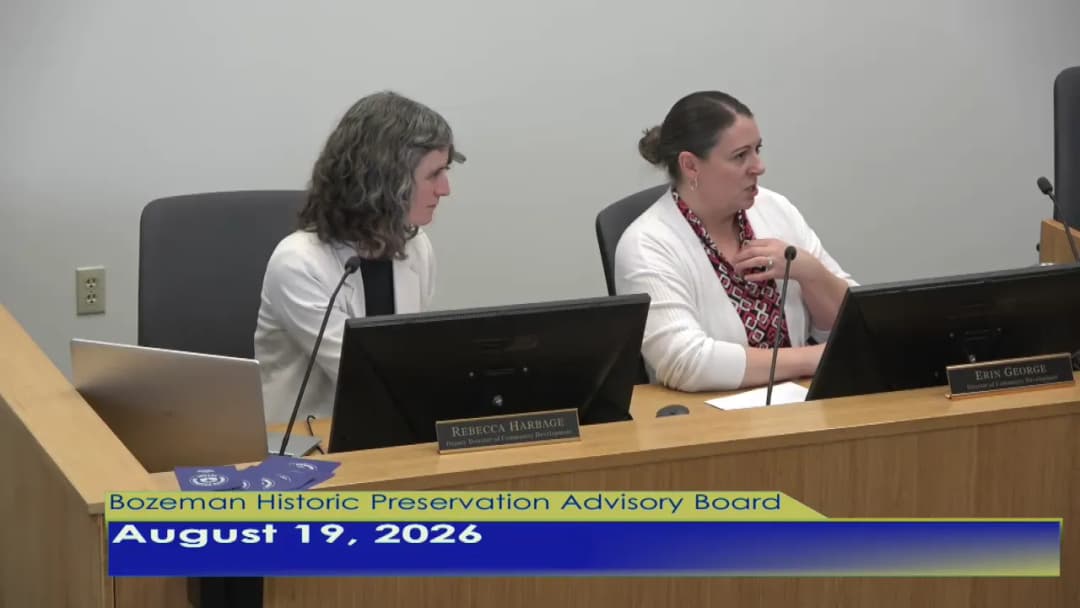
The Bozeman Historic Preservation Advisory Board (HPAB) met on Wednesday, August 19, 2026, from 6:00 PM to approximately 10:00 PM. The board discussed recommendations on B-3 zone edge transitions and maximum building height, received an update on the July 28 City Commission discussion on historic preservation projects, and held a work session on proposed demolition regulation changes. Three formal motions were passed unanimously. Consent Calendar - Approval of Minutes (July 15, 2026): The minutes were approved as amended by staff (motion by Webster, second by Wilson, carried 5-0). The amendment corrected a vote listing error where Member Weilbacker had abstained but was shown as approving. Public Comments & Testimony - Daniel Carty (resident, 213 North Third): Urged the board to recommend reducing the maximum building height in B-3 to 60 feet, arguing that 90 feet contradicts the city's strategic plan and growth policy. He also called for closing a loophole that allows developers to avoid zone edge transition requirements by ceding a small strip of land. - Natsuki Nakamura (resident): Opposed the 90-foot height limit, noting that the first draft of the UDC in 2023 used stories (B3 at 7 stories) and that the switch to 90 feet came late in the process. She highlighted that the 90-foot limit can be exceeded through affordable housing incentives, and that demolitions of older homes are incentivized by high development potential. - Emma Moralesitu (resident): Expressed general support for the board's work and shared personal experience with the zone text amendment process, stating it is expensive and cumbersome for residents compared to developers. She cautioned against assuming residents can easily pursue rezoning. - Additional public comment: A resident of the NCOD (near MSU) spoke about the difficulty of the zone text amendment process and praised the efforts of the Bonton and Centennial neighborhoods. Discussion Items - Special Presentation: Update on July 28 City Commission Discussion: Director of Community Development Erin George and Deputy Director Rebecca Harbage reported on three key questions posed to the City Commission: 1. Project sequencing: Commission agreed with HPAB's earlier recommendation to prioritize code revisions (especially demolition regulations), then NCOD design guidelines, then the local landmark program. However, Commission suggested completing the local landmark program before finalizing design guidelines to allow tiered application. 2. Scope of design guidelines: Commission directed that the NCOD design guidelines should not modify dimensional standards (height, setbacks) from base zoning; instead, any concerns about base zoning should be addressed through zoning map amendments. 3. Demolition regulations: Commission did not direct elimination of the two-year demolition stay; they asked for a thorough review of its effectiveness. The board's earlier suggestions were largely echoed by Commission. - Action Item G.1: Recommendations on B-3 Zone Edge Transitions and Maximum Building Height: - Extensive board discussion on height impacts on historic character, visual landmarks, and neighborhood context. Members expressed concerns that 90 feet dwarfs historic districts and incentivizes redevelopment of older structures. Comments on zone edge transitions focused on stepback requirements, landscaping, and the need to mitigate adverse effects on adjacent lower-density zones. - Public comments (noted above) influenced the debate. - Three motions were passed (all 5-0): 1. Recommend deleting transition type 1A and requiring a building stepback of 12 feet from the face of the building (not the lot line). 2. Recommend requiring landscaping at zone edge transitions in alleyways between RA and RB zoning districts. 3. Recommend setting the maximum building height in the B-3 district at 70 feet. - Action Item G.2: Work Session on Demolition Regulations: - Staff presented responses to HPAB's earlier written suggestions, incorporating feedback from legal and the consultant (CPC). Key points included: - Inventory/survey: Staff agreed to require updated inventory prior to demolition, but legal advised against mandating a specific pre-approved consultant list; instead, qualifications will be clarified in code. - Economic viability analysis: Staff will add clarity to the code regarding the director's interpretation on
HISTORIC PRESERVATION 42% · ZONING CODE 29% · LAND USE PLANNING 11% · PROCEDURAL 6%
32
AUG 19, 2026 · BOZEMAN, MONTANA · CITY COMMISSION
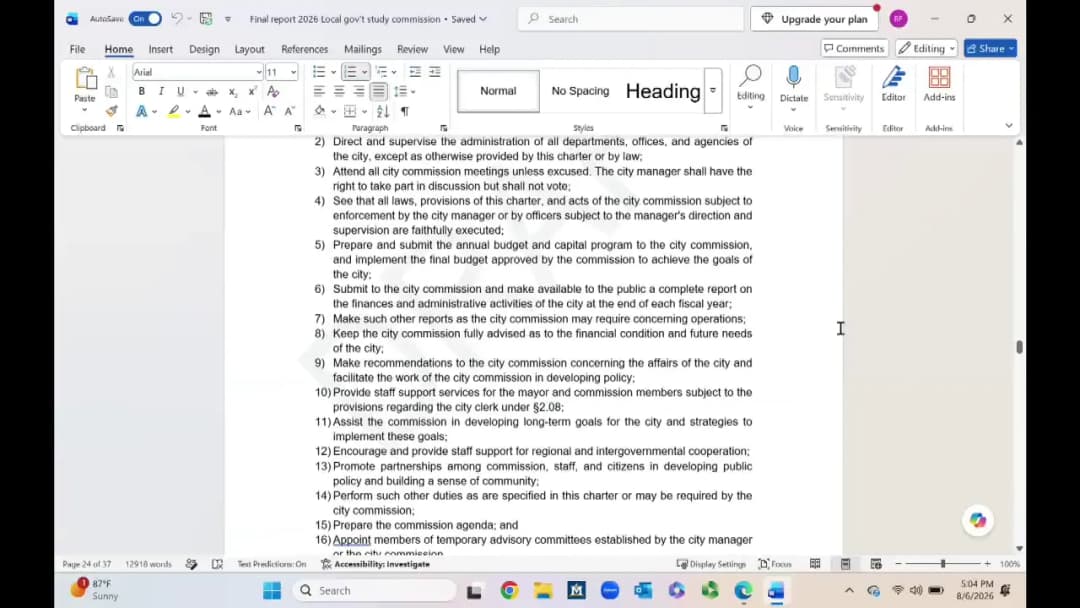
Bozeman Study Commission Meeting – August 19, 2026

The Bozeman Study Commission met on Wednesday, August 19, 2026, at 4:01 PM in the Commission Room at City Hall. The meeting focused on approving final report language, finalizing educational materials for the upcoming ballot, and planning outreach efforts. The commission approved key items and set future meeting dates. Consent Calendar - Approval of Minutes: The Study Commission unanimously approved the minutes from the August 6, 2026 meeting (4-0 vote). Public Comments & Testimony - No public comments were made during the meeting. Discussion Items - Correspondence and Study Commission Update: Commissioners reported on outreach at events (e.g., “Story Under the Stars,” Celebration of Life in Police Park, Business and Professional Women’s meeting). Concerns were raised about the website not yet displaying the final report and amended charter, which had been promised via QR codes on palm cards. The web team (Cole) aimed to have the landing page updated by the end of the week with direct links to documents. - F2: Ongoing Education Plan: Presenters Aaron Coursey and Nevin Graves (Dangeld) walked through proposed educational materials: a PowerPoint presentation, a quarter-page flyer, a trifold brochure, digital ads, a tent/tablecloth for events, and an updated website wireframe. Commissioners requested revisions: - Add a fourth bullet to the PowerPoint highlighting city commission vacancy changes (previously only three: four-year mayor term, expanded public engagement, compensation board). - Emphasize Article 8 (new article on public engagement) as a key change. - Clarify that ballot sub-options take effect only if the amended charter is adopted; add a slide or note about this. - Include campaign attribution (paid for by Study Commission, treasurer) on all materials. - On the flyer, reverse sub-option two to match ballot order and add city commission vacancy language. - Consolidate QR codes to a single link to the website homepage (which will contain both the report and amended charter). - Use state law language to indicate that sub-options are contingent on charter adoption. - F1: Approval of Final Report: The final report had been previously signed but contained a “DRAFT” watermark and lacked ADA compliance. The commission discussed reformatted version with table of contents and hyperlinks. Commissioner Deanna noted that Barb Sisteros, absent, supports the report. The commission praised the work of Barb and Becky. - Future Meeting Schedule: The commission debated need for future meetings given busy outreach schedule. It was decided to schedule two meetings (September 24 and October 14) with the possibility of cancellation if no agenda items arise. Key Outcomes - Approval of Education Materials: Motion to approve the graphics and central copy for ongoing ballot education materials (as presented) carried 4-0. Materials include PowerPoint, flyers, brochures, digital ads, and additional resources. - Approval of Final Report: Motion to approve the Bozeman Study Commission Final Report as written (with formatting and ADA changes) carried 4-0. Commissioners will sign the revised version for submission to the county. - Future Meetings: Motion to meet on September 24, 2026 and October 14, 2026 (both Wednesdays) carried 4-0. Other previously scheduled meetings (September 3, 16, and October 1) were cancelled. - Outreach Logistics: Commissioners will coordinate with Mike to manage engagement calendar. Tent and tablecloth will arrive for Catapalooza. Printing of brochures is scheduled for pickup by Friday; commissioners will arrange distribution for weekend events.

PUBLIC ENGAGEMENT 60% · CHARTER REVISION 27% · PROCEDURAL 12% · TECHNOLOGY AND INNOVATION 1%
33
AUG 18, 2026 · BOZEMAN, MONTANA · CITY COMMISSION
Downtown Urban Renewal Board Meeting - August 18, 2026: Building Height and Transition Recommendations

Date: Tuesday, August 18, 2026, 12:00 p.m. – 1:30 p.m. The Downtown Area Urban Renewal District (DURD) Board met to discuss a work session on possible recommendations regarding maximum building height in the B-3 zoning district and zone edge transitions. The board heard a presentation from City Planning Director Chris Saunders, received public comment, and voted to retain the current 90-foot maximum height while asking staff to consider additional transition zone amendments. The board also approved May meeting minutes and received the Executive Director’s August report and monthly finance report. Consent Calendar - Approval of Minutes (May 2026 DURD Meeting): The board unanimously approved the May meeting minutes. (Motion by Nicholas Wicks, seconded by John Howe; all members present voted aye: Nicholas Wicks, John Howe, Amy Horton, Jake Van Diesen, Tony Renslow, Ryan Finn, and Marley (remote).) Public Comments & Testimony - Daniel Cardi (Bozeman resident, Northside/Midtown): Commented on the maximum building height and zone edge transitions. He cited the Bozeman Community Plan’s principle of balancing new and existing development. He argued that shadows from tall buildings (especially south/west of lower-intensity residential zones) are unfair to existing property owners, particularly those with solar panels. He recommended that buildings taller than 60 feet require a 100-foot right-of-way for adequate transitions, and that the city not allow developers to cede small strips of land to avoid Community Development Transition (CDT) requirements. He also called for additional UDC changes to improve human scale and mitigate noise, light pollution, and construction impacts on adjacent neighborhoods. Discussion Items - Work Session on Building Height in B-3 and Zone Edge Transitions (Action Item F.1): - Chris Saunders, City Planning Director, presented a detailed overview of the history of height regulations in the B-3 district, the current 90-foot maximum (adopted in late 2025 after public hearings), and the tools used to manage transitions (setbacks, step-backs, landscaping, etc.). He showed shadow analyses comparing 70-foot and 90-foot buildings at different times of year, indicating minimal additional shadow impact. He noted that no formal applications for 90-foot buildings have been received since the code adoption. - Board members discussed the importance of density for increasing the tax base and reinvesting in downtown, the need to trust the thorough UDC process, and the desire to see how the code performs before making changes. Several members expressed that the core issue is not the exact height number but the relationship of scale and mass, and that transitions are the key area to monitor. - Marley (remote) stated that 90 feet feels moderate compared to other cities and that the shadow maps show low impact. She suggested creating a transition zone around B3C/B3. - Jake Van Diesen emphasized that the board should focus on the bigger picture of density and trust staff to handle transitions. He noted that the back-of-Collins example (blank wall) vs. Black Street (windows, activity) shows that design standards matter more than pure height. - John Howe supported giving the current code time to work, noting zero applications so far, and recommended asking staff to evaluate transition amendments. - Amy Horton and Ryan Finn concurred, highlighting the need to see how the code plays out and to rely on professional staff. Key Outcomes - Motion and Vote: A motion was made by John Howe, seconded by Amy Horton, to retain the 90-foot maximum height in the B-3 zoning district and to request city staff consider any additional amendments to transition zones. The motion passed unanimously (7-0) with all members voting aye. The board will submit this recommendation as public comment to the City Commission for its August 25, 2026 meeting. - Additional Direction: The board’s discussion emphasized that the recommendation is not just about the number but about honoring the multi-year UDC process, allowing the code to operate, and focusing on transitions as a potential area for improvement. Staff will provide a written summary of the board’s nuanced comments. - Executive Director’s Report (August 2026): Ellie Staley reported on: - Job openings (Operations Manager, BID weekend maintenance). - Construction updates, including Babcock Street pedestrian safety improvements (funded by URD). - The federal building being placed on the federal disposal list; the city is exploring acquisition for future projects, with URD potential expansion to include the site. - URD expansion study area (including federal building and Bozeman Creek) – resolution to accept study area expected by end of August, followed by public process to amend the urban renewal plan. - ADA-compliant park at Wilson School – RFP responses received, including one from Cushine Terrell. - Downtown parking vision plan – ongoing work with McLaren, final review expected soon. - Finance Report: The board received the monthly finance report for fiscal year 2027 (only 1.5 months in). Notable: half of the management fee paid biannually; few small improvements; no significant impact.

ZONING CODE 48% · URBAN REDEVELOPMENT 23% · PROCEDURAL 11% · LAND USE PLANNING 10%
34
AUG 18, 2026 · BOZEMAN, MONTANA · CITY COMMISSION
Bozeman City Commission Regular Meeting Summary – August 18, 2026

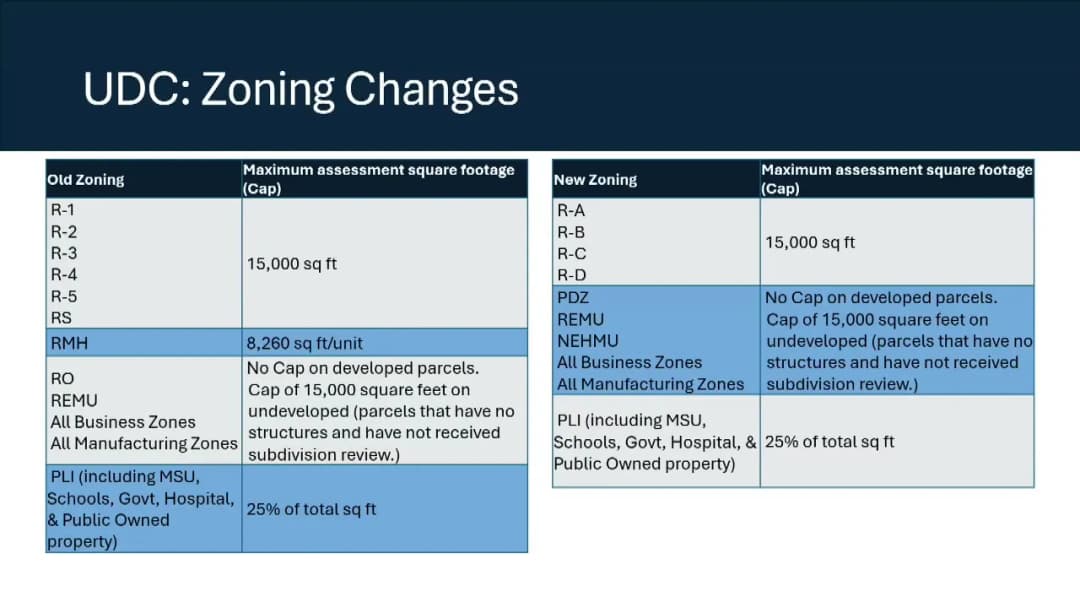
The Bozeman City Commission held a regular meeting on August 18, 2026, beginning at 6:00 PM and adjourning at approximately 10:20 PM. The agenda included a large consent calendar, action items on property tax mill levies, utility rates, special district assessments, and a resolution to add transportation safety to the city's strategic plan. The commission heard extensive public comment, including concerns about tax burdens and the equity of special district assessments. Consent Calendar - The commission unanimously approved all 18 consent items (H1–H18), including: - Accounts payable claims - Grant agreement with Greater Gallatin United Way for the Kinside Child Care Platform (43 licensed providers and 185 parents already using the platform) - Subrecipient agreement with Montana League of Cities and Towns for HUD Pro Housing 2 funds to comply with MLUPA ($313,000 reimbursement) - Final plat for Jarrett Phase 1 Major Subdivision - Professional services agreements for the Water Reclamation Facility solar project, City Hall parking lot replacement, library children’s room renovation, historic preservation services, Streamline bus service, and others - Creation of Special Improvement Lighting District 799 and police officer appointments Public Comments & Testimony - Kimberly Hall (Greater Gallatin United Way) expressed gratitude for the child care platform investment. - Mark Campanelli (Bogert Park neighbor) urged the city to report solar production data and maintain solar assets; later commented on traffic safety and tax assessment equity. - Gary Gillacson (404 South Church) encouraged the city to pursue the federal building for office space, citing recent renovations. - Judge Karolina Tierney thanked the commission for funding a citation import system for the municipal court. - Vicky Danhoff (resident since 1972) strongly opposed the 20% tree assessment increase, stating that fixed-income residents cannot absorb such hikes. - Paul Johnson (Westridge resident) criticized the tree assessment because his property has no trees and questioned city responsiveness to maintenance issues. - Jeff Paul (323 South Wallace) challenged the square-footage-based assessment methodology, arguing it unfairly burdens multi-unit properties. - Danielle Smith (property owner) urged the commission to slow tax and fee increases, noting the cumulative effect on household budgets. - Emily Tolego (resident) provided technical suggestions on correcting assessment schedules and recommended authorizing staff to adjust the Schedule A after adoption. - Ben Bisher (Gallatin Watershed Council) announced an upcoming riparian walk on August 27. - Daniel Cardi (resident) supported transportation safety priorities and suggested clarifying micromobility language. Discussion Items - J2 – MSU Water/Wastewater Impact Fee Agreement (unanimous): Staff presented an update to the declining balance program, which allows MSU to offset impact fees through water conservation. Since 2018, MSU has built 10 buildings under the program, reducing net water demand. One amendment clarified reconciliation provisions. Commission praised MSU's conservation efforts. - J3 – Property Tax Mill Levies FY27 (unanimous): Finance Director Melissa Hodnett presented the budget outlook. The city saw a 6.9% increase in taxable value but lower-than-expected newly taxable value ($3.3 million vs. projected $6.4 million). The recommended maximum levy (4.5 mills) would result in a $126 annual decrease for a typical primary residence, with an overall monthly increase of $14.89 (5.5%) when combined with fee increases. The levy supports $1 million/year for community housing, $400,000 for Streamline, and $350,000 for HRDC/Family Promise/Haven. Commissioners debated the use of general fund for community partners, but the motion passed unanimously. - J4 – Planning Fee Schedule FY27 (unanimous): A 15% increase on planning fees, the third consecutive annual 15% increase. The fee study is underway; staff noted that current fees cover only a portion of costs, with a $2 million annual general fund subsidy. Some commissioners expressed concern about impacts on small projects but supported the increase. - J5 – Transportation and Engineering Fee Schedule FY27 (unanimous): A 15% increase on permits, with floodplain permit fees rising significantly to reflect actual review costs. Street closure fees vary by event size; block parties usually exempt. Commissioners highlighted the need to balance cost recovery with community events. - J6 – Water, Wastewater, Stormwater, Solid Waste Rates FY27–28 (unanimous): Rates increased due to the SHOPs complex ($84 million project) and catching up from years of flat rates. The overall homeowner impact was reduced from earlier projections: $14.89/month in FY27 and $19.89/month in FY28. Tiered billing for water conserves use. Commissioners acknowledged the burden but noted long-term necessity. - J7–J10 – Special District Assessments (arterial/collector +3%, tree maintenance +20%, street maintenance +15%, parks and trails +23%): Each passed 3–1 (Commissioner Sweeney dissenting). The dissenting vote cited inequitable square-footage caps (15,000 sq ft residential cap) that disproportionately benefit large apartment complexes, arguing that the methodology must be updated. The majority voted to maintain service levels, with staff committing to a methodology review work session in January 2027. Key amounts: tree increase is $6.48/year for average homeowner; parks increase is $50.92/year. - J11 – Transportation Safety Strategic Plan Amendment (unanimous): Commissioner Magic proposed adding “safe” to the plan’s language and separating transportation from housing. The new section 4.6 includes enhanced non-motorized transportation, safe streets for everyone (physical, policy, policing, promotion), and updating the transportation master plan with four human-life-first priorities. An amendment to add support for an “efficient and effective public bus system” failed 2–2 (needed 3 votes) and was withdrawn. Key Outcomes - Consent Agenda (H1–H18): Approved unanimously. - J2 (MSU Agreement): Approved unanimously. - J3 (Property Tax Mill Levies): Approved unanimously; levies set at maximum authorized (4.5 mills). - J4 (Planning Fees): Approved unanimously; 15% increase. - J5 (Transportation/Engineering Fees): Approved unanimously; 15% increase. - J6 (Utility Rates): Approved unanimously; water/wastewater/stormwater/solid waste rates set for FY27–28. - J7 (Arterial & Collector Assessments): Approved 3–1 (Sweeney no). - J8 (Tree Maintenance Assessments): Approved 3–1 (Sweeney no). - J9 (Street Maintenance Assessments): Approved 3–1 (Sweeney no). - J10 (Parks & Trails Assessments): Approved 3–1 (Sweeney no). - J11 (Transportation Safety Resolution): Approved unanimously; authorizes staff to update the strategic plan. - The commission authorized the city manager to adjust Schedule A for special district assessments as needed before final submission to the county.

FISCAL SUSTAINABILITY 13% · BUDGET EQUITY ANALYSIS 12% · PUBLIC ENGAGEMENT 11% · PROCEDURAL 10%
35
AUG 17, 2026 · BOZEMAN, MONTANA · CITY COMMISSION
Bozeman Community Development Board Wetland Code Text Amendment, August 17, 2026

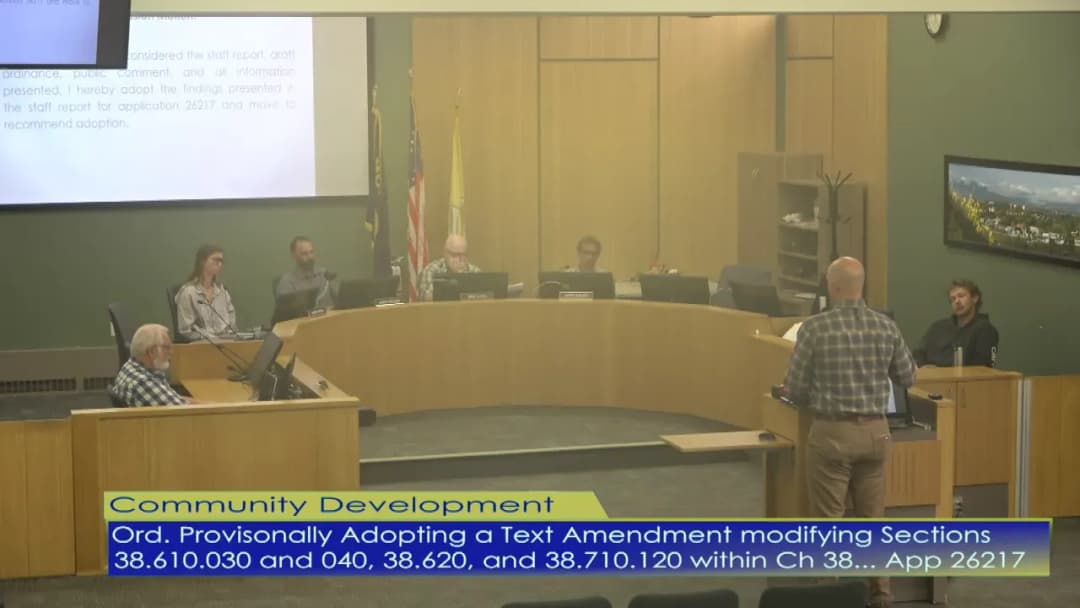
The Bozeman Community Development Board met on Monday, August 17, 2026, at 6:00 PM, with four members present (Chris Egnatz, Jason Delmue, Ben Lloyd, Lauren Mitro) and three excused (Joey Morrison, Erik Bonnett, Mark Egge). The primary action was a unanimous vote to recommend adoption of a text amendment to the city's wetland and watercourse regulations, aimed at streamlining the development review process by removing two submittal requirements. The meeting lasted approximately 34 minutes. Consent Calendar - Approval of August 3, 2026 Meeting Minutes: Moved by Jason Delmue, seconded by Lauren Mitro. Approved 4-0. Public Comments & Testimony - Kathryn Bear, Gallatin Watershed Council: Spoke on agenda item E.1, expressing support for the text amendment's removal of jurisdictional determinations from the Army Corps of Engineers and the Gallatin Conservation District. She also suggested that the wetland and watercourse delineation report be required earlier in the development review process (e.g., at pre-application or preliminary plat stage) to better inform site planning. Later, during non-agenda public comment, she promoted a riparian walk hosted by the Gallatin Watershed Council on August 27th from 7:30-9:00 AM along the Cattail Creek Corridor. Discussion Items - Ordinance 26217 – Text Amendment to Wetland & Watercourse Regulations: Staff presented a narrowly focused amendment to modify BMC Sections 38.610.030 and 040 (Application of wetland regulations), 38.620 (Watercourse setbacks), and 38.710.120 (Submittal Materials for Review). Community Development Manager Chris Saunders introduced the item, noting the amendment responds to coordination issues with review partners. Director of Transportation and Engineering Nick Ross explained the substantive changes: removing the requirement for an Approved Jurisdictional Determination (AJD) from the Army Corps of Engineers and a Watercourse Status Determination from the Gallatin Conservation District. He stated that AJDs typically take 12-18 months, adding unnecessary delay since all wetlands in city limits are now protected by either federal or local jurisdiction. The Conservation District no longer provides initial determinations as a matter of policy, making the requirement impossible to fulfill. Stakeholder engagement with the Gallatin Water Collaborative and Watershed Council reached consensus on these changes. Board members discussed implications, including whether the removal would leave wetlands unprotected. Staff clarified that applicants may assume federal jurisdiction and enter the 404 permit process without an AJD, and that the city's mitigation priority (avoid, minimize, mitigate) remains fully enforceable. The Sustainability Board had recommended support in July. The ordinance is scheduled for first reading before the City Commission on September 1, 2026. Key Outcomes - Motion to Recommend Adoption: Moved by Chris Egnatz, seconded by Jason Delmue. Approved 4-0 (Egnatz aye, Delmue aye, Lloyd aye, Mitro aye). The board adopted the findings in the staff report and recommended adoption of Ordinance 26217 to the City Commission. - Future Meeting Schedule: The board decided to cancel the September 7, 2026 meeting (Labor Day) and not reschedule, resulting in only one meeting in September (likely September 14 or 21, but no items currently pending).

ENVIRONMENTAL PROTECTION 46% · PROCEDURAL 22% · ENGINEERING AND INFRASTRUCTURE 21% · ZONING CODE 6%
36
AUG 13, 2026 · BOZEMAN, MONTANA · CITY COMMISSION
Gallatin Valley MPO TTAC Meeting - August 13, 2026: Initial Review of Long Range Transportation Plan Fiscally Constrained Project List

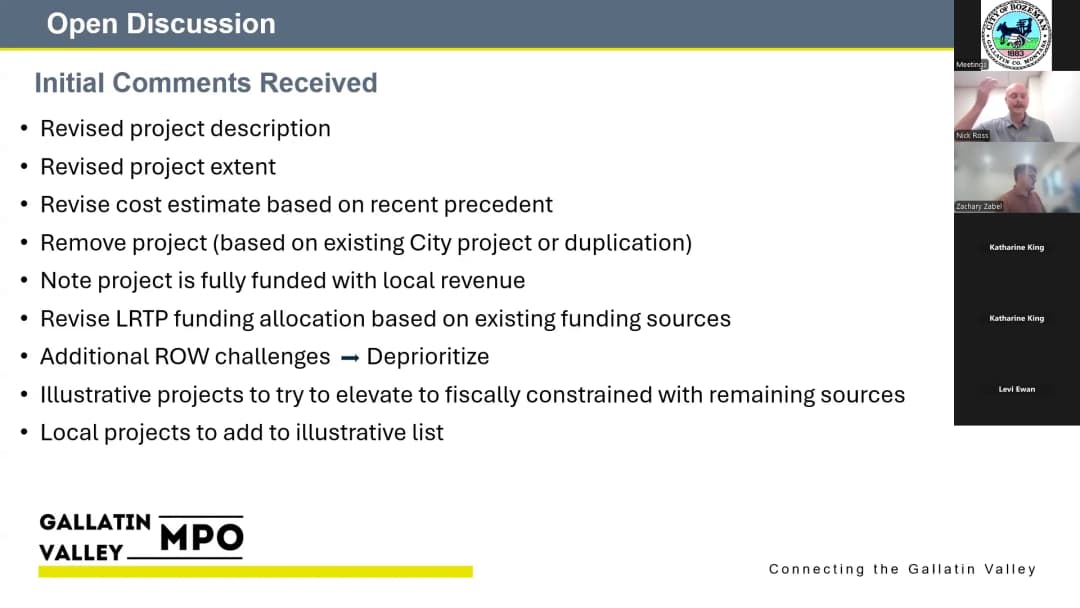
Note: The agenda and transcript indicate the meeting occurred on August 12, 2026, but the provided date for this summary is August 13, 2026. The summary uses the specified date. The Gallatin Valley Metropolitan Planning Organization's Transportation Technical Advisory Committee (TTAC) met to conduct an initial review of the draft fiscally constrained project list for the Long Range Transportation Plan (LRTP). The consultant team from Nelson\Nygaard presented revenue projections, funding source eligibility, and a draft list of projects. Committee members discussed project prioritization, costs, and the status of local projects. No formal votes were taken on the new business item; the meeting concluded with a request for written feedback by August 21, 2026. Consent Calendar - Approval of July 8, 2026 Meeting Minutes: The committee approved the minutes from the July 8, 2026 TTAC meeting. Motion by Sunshine Ross, seconded by Levi Ewan. Carried 8-0. Public Comments & Testimony - No public comments were offered during the meeting. Discussion Items - Initial Review of the Fiscally Constrained Project List: - Nelson\Nygaard consultant presented the financial outlook, noting total projected revenues of $486.83 million from federal, state, and local sources over the plan horizon. Approximately $128 million in discretionary funds are available for LRTP-eligible projects, though $112 million of that is tied to FTA funds or fuel tax revenues reserved for operations and maintenance by local jurisdictions. - The draft fiscally constrained list includes projects totaling about $330 million (adjusted for inflation). Projects were allocated based on committed funding, readiness, scoring, public workshop votes, and regional connectivity. High-cost or feasibility-challenged projects were placed on an illustrative list. - Committee Feedback: - Levi Ewan (Gallatin County) asked whether a recently awarded SS4A grant (approximately $14 million for a roundabout, shared-use path, and intersection improvements) was reflected. Staff confirmed partial inclusion and committed to adjusting the list. - Belgrade representative (Jason) noted that Belgrade's near-term projects are largely committed and requested further review of funding allocations. - Beth Clarkson (City of Bozeman) asked about including MACI (Macy) funding for street sweeper purchases; staff agreed to investigate. - Sunshine Ross inquired about the $6.5 million in 5307 FTA funds listed for downtown transfer station improvements, noting that such funds currently are not available. The consultant stated it was a potential source, not a guarantee. - Discussion on fuel tax revenue usage: Gallatin County confirmed all fuel tax funds are reserved for operations and maintenance, potentially requiring removal of capital projects from the recommended list. - Travel Demand Model Update: - Chris (Nelson\Nygaard) presented volume-to-capacity maps for 2022 base year and 2050 future (without project interventions), showing significant congestion increases without additional capacity. A map with 45 capacity-expansion projects (the full universe) indicated that the collection of projects reduces but does not eliminate future congestion. - Committee members asked about model assumptions and capacity limits. The model diverts trips to alternative routes but does not impose hard capacity ceilings; operational modeling is expected in future corridor studies. Staff noted that some committed projects under construction were not depicted on the map and will be corrected. - Next Steps: - Nelson\Nygaard will incorporate feedback received by August 21, 2026. A final model run will be completed for the fiscally constrained list. The draft LRTP document is expected in fall 2026. The September TTAC meeting may be cancelled to allow staff to focus on the plan. Key Outcomes - No votes on the fiscally constrained project list – discussion only. - Directive: Committee members and partners (MDT, local agencies) must submit consolidated feedback on the draft project list, cost estimates, and revenue assumptions by the end of next week (August 21, 2026) to Nelson\Nygaard and MPO staff. - Next Meeting: Tentatively cancelled for September; the next formal review of the revised list and draft LRTP is anticipated in October 2026.

TRANSPORTATION SAFETY 58% · PROCEDURAL 13% · PUBLIC ENGAGEMENT 10% · FISCAL SUSTAINABILITY 8%
37
AUG 13, 2026 · BOZEMAN, MONTANA · CITY COMMISSION
Bozeman INC Meeting on August 13, 2026 – Zone Edge Transitions & Updates

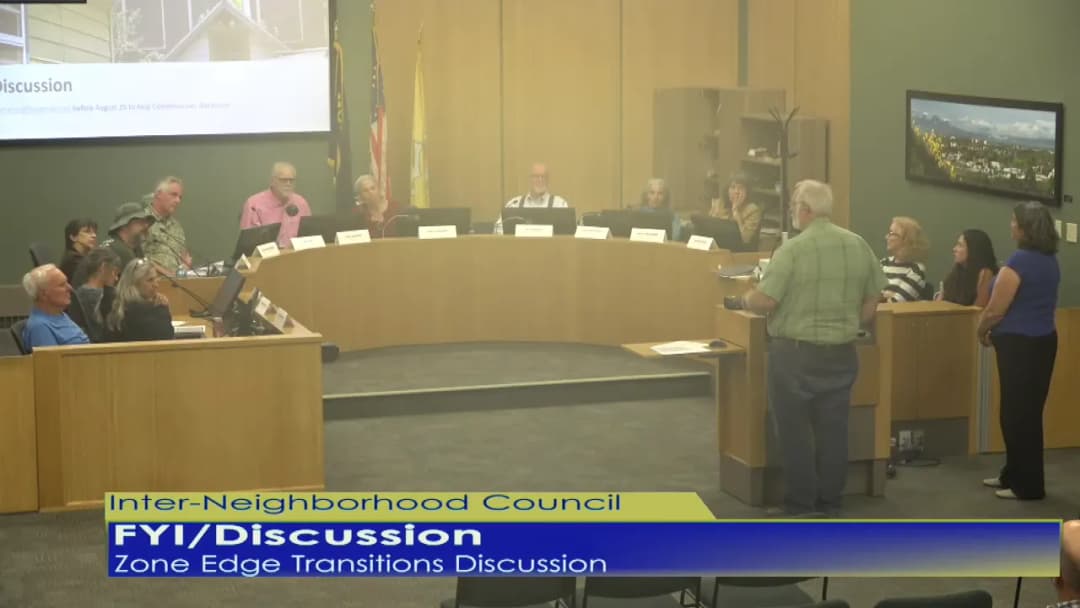
The Inter-Neighborhood Council (INC) of Bozeman met on Thursday, August 13, 2026, at 4:30 p.m. The meeting featured a detailed presentation on zone edge transitions, an update on the Integrated Water Resource Plan, and liaison reports from the City Commission and City staff. Public comments focused on concerns about building heights and inadequate transitions, while council members discussed potential improvements and next steps. Consent Calendar - Minutes from the July 7, 2026, meeting were approved unanimously without discussion. Public Comments & Testimony - Daniel Cardi (Bozeman resident, Midtown) urged reducing the B3 height limit from 90 feet to 60 feet and strengthening zone edge transitions to protect neighborhood character. He described the North Central area as a "cancer" spreading to other parts of town. - Noah Tenbrook (Midtown) noted that transitions often do not apply across rights-of-way wider than 60 feet, and many large buildings stand next to smaller ones without transition requirements because they share similar zones. He advocated for transitions based on actual built conditions rather than zoning maxima. - Multiple council members shared observations from walking tours, citing issues with noise, privacy, and design in buildings like the Ives. Discussion Items Zone Edge Transitions (F.1) - Kieran Filipovich gave a neighbor-to-neighbor presentation explaining the purpose and types of zone edge transitions (1A, 1B, 2A, 2B), which are intended to mitigate impacts of taller buildings on lower-intensity zones. She noted that transitions are required across Bozeman, but challenges arise from historic districts, HOAs, and existing built environments. - Chris Saunders, City Planner, clarified that the Ives building was constructed under the old 2018 code with a 45-degree angle transition, while the new 2026 UDC uses a stepped-back approach, considered an improvement. He added that all current construction still uses old code, and projects under the new code will take years to appear. - Council members debated the "underbuilt vs. overzoned" issue and suggested a neighborhood survey to gather feedback on height and transitions. Integrated Water Resource Plan Update (F.2) - Beth Boyson reported that the IWRP committee has developed tiered alternatives for water management. Tier 1 actions (including beaver dam analogs for aquifer recharge) are expected within 10 years; Tier 2 includes cloud seeding. A report will be prepared for City Commission adoption in November. Commission Liaison Update (F.3) - Deputy Mayor Douglas Fischer outlined upcoming City Commission items: August 18 (tax rates), August 25 (work session on height and zone edge transitions), September 15 (cash-in-lieu of water rights fee), October 6 (community ballot issues), and October 27 (UDC housekeeping). He invited the INC to forward guiding questions or policy recommendations for the August 25 work session. City Liaison Update (F.4) - Tommy Clark announced a block party on August 27 at Story Mansion (3–6 p.m.) and the final Urban Forest Management Plan engagement meeting on August 31 (4–6 p.m. at Bozeman Public Safety Center). He also noted that a draft engagement framework for INC is nearly complete. Neighborhood Written Updates & Follow-Up Questions (F.5) - The steering committee requested feedback on voting procedures (one vote per household vs. per adult) for neighborhood associations. Members shared diverse practices; no consensus was reached. - Kath Crumrod advocated for dedicating more meeting time to neighborhood updates, emphasizing the value of connection among representatives. Key Outcomes - No formal decisions were made except approval of minutes. - The INC discussed conducting a survey on zone edge transitions, with Filipovich offering assistance. - The steering committee will use member feedback to refine voting procedures. - The meeting was adjourned around 6:00 p.m.

ZONING CODE 30% · URBAN REDEVELOPMENT 22% · COMMUNITY ENGAGEMENT 10% · PUBLIC ENGAGEMENT 8%
38
AUG 6, 2026 · BOZEMAN, MONTANA · CITY COMMISSION
Bozeman City Study Commission Meeting – August 6, 2026: Final Report Approval & Education Plan

On Thursday, August 6, 2026, at 4:00 PM, the Bozeman City Study Commission convened at City Hall to finalize its work, approve the final report and amended charter for submission to the County Election Office, receive legal guidance on ballot education, and develop a public education plan. The meeting adjourned at 7:27 PM. Consent Calendar - The Commission unanimously approved the minutes from the July 30, 2026 meeting. Public Comments & Testimony - No in-person or online public comments were offered during the general public comment periods. - During the approval of the final report, no public comments were received. - When the Commission considered establishing an incidental political committee, Nevin Graves of Dangeld (the Commission's ballot education consultant) recommended removing the definite article “the” from the committee name to match existing materials. The Commission accepted this suggestion. Discussion Items Legal Guidance on Education and Advocacy - City Attorney Greg Sullivan presented on Montana law prohibitions on using public resources to support or oppose ballot measures (Title II and Title 13), explaining that the Commission's education campaign must be “properly incidental” to discussing the impacts of passage or failure on local government operations. He warned against “magic words” and language susceptible of no reasonable interpretation other than a call for passage or defeat. - Sullivan outlined disclosure requirements under the Montana Disclose Act, including the need to form an incidental political committee (IPC), appoint a treasurer, track all time and expenditures, and include attribution on all materials. He advised the Commission to avoid any coordination with separate political committees to protect election integrity. - Commissioners asked detailed questions about personal speech rights, quoting past meetings, handling minority reports, use of city email, and tracking time. Sullivan advised that individual commissioners may express personal views on their own time using personal resources, but should not do so at structured study commission events or using city resources. Approval of Final Report and Amended Charter - Becky Franks and Barbara Taylor presented the final report, highlighting remaining edits in red. Key edits included: - Clarifying language for sub-option two on commissioner residency and election method in Section 7.03. - Adding a blue explanatory box to indicate charter language that would apply if voters choose not to have wards. - Adjusting language on the Inner Neighborhood Council's ethics obligations: “are not bound by, but should consider the city and state code of ethics” was revised to “are expected to observe” the code after discussion. - Adding a new sentence to Section 8.03 (principles of public engagement) requiring all city meetings and hearings to be “conducted in a transparent manner, publicly announced in advance and open to the public.” The motion passed 4-1 (one abstention). - Commissioner Deanna raised the possibility of filing a minority report. After debate, the Commission agreed to include a placeholder “Minority Report – None filed as of August 6, 2026” and noted that a minority report could be submitted within 30 days if permitted by law. - Each commissioner delivered closing remarks, emphasizing the collaborative effort and the importance of the proposed changes. The final motion to authorize submission of the report and amended charter to the County Election Office passed 5-0. Education Plan and Materials - Consultants from Dangeld (Nevin Graves, Aaron Corsey, Tor Goodmanson) presented a draft engagement timeline with two lists: contact groups (civic organizations) and public events for tabling or presentations. - Commissioners volunteered for upcoming events: - Sweet Pea Festival: Friday, August 7 (3–5 PM, in front of library) and Saturday, August 8 (3–5 PM, at the back of the library). - SLAM (Saturday and Sunday): Jan will distribute materials, possibly from the City of Bozeman booth. - Bozeman Farmers Market (walking around with flyers) to begin in September. - Story Mansion “Under the Stars” film (August 16, approximately 8,000–10,000 attendees): Carson and Becky will staff a table if available. - Catapalooza (August 28, 10 AM–3 PM): Deanna volunteered for part of the event. - Bozeman Sunrise Rotary (September 25, 7 AM): Carson and Jan will present. - An Art Walk (August 14) was suggested; Jan and possibly others will attend. - The Commission approved (by consensus) a quarter-page “palm card” flyer with minor typographical edits. Nevin Graves confirmed the attribution line “Paid for by Bozeman Study Commission, Mike Moss, Treasurer” was included. - The Commission established a process for material approval: the two liaisons (Carson and Jan) will coordinate with Dangeld; all five commissioners will review major materials by August 19 meeting; minor tweaks can be handled via email. A trifold brochure will be developed for events with captive audiences. Key Outcomes - Unanimous approval (5‑0) of the Final Report and amended charter, including all edits discussed, and authorization to submit to the County Election Office. - Creation of an Incidental Political Committee (IPC) named “Bozeman Study Commission” with Mike Moss as treasurer, passed unanimously (5‑0). - Approval of consent agenda (minutes from July 30, 2026) unanimously. - Approval of a quarter-page palm card by consensus, with corrections to text. - Scheduling of next regular meeting: August 19, 2026, to finalize remaining education materials (PowerPoint, trifold brochure, talking points). - Direction to begin tracking time for education campaign activities in 15‑minute increments, as advised by the City Attorney. - August 10, 2026 deadline for filing the C2 form to formally create the IPC (to be completed by the next business day).

PUBLIC ENGAGEMENT 27% · PROCEDURAL 20% · GOVERNMENT ETHICS 15% · CHARTER REVISION 14%
39
AUG 5, 2026 · BOZEMAN, MONTANA · CITY COMMISSION
Economic Vitality Board Meeting of Bozeman, Montana - August 5, 2026

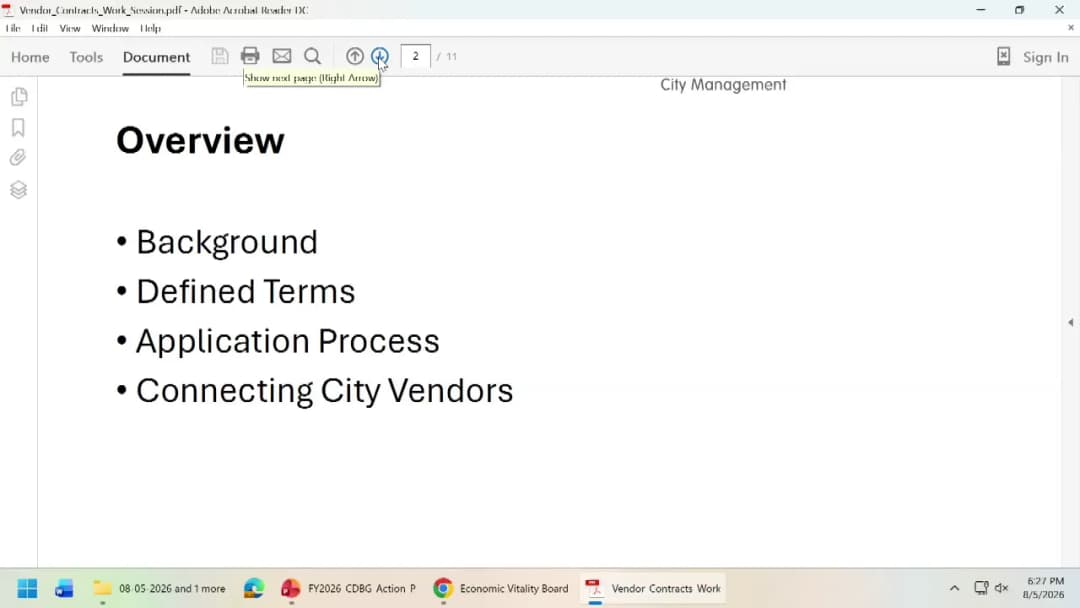
The Economic Vitality Board (EVB) of Bozeman, Montana, met on Wednesday, August 5, 2026, from 6:00 PM to approximately 7:21 PM. The meeting was held in person and via video conference. Key actions included approval of the May 6 and June 3, 2026 meeting minutes, approval of the CDBG Program Year 3 Annual Action Plan, and work sessions on vendor contracts and the Green Power Program. The board discussed economic development, housing, and energy sustainability. Consent Calendar - No consent items were presented. Public Comments & Testimony - No public comments were made during the meeting, either on non-agenda items or for specific agenda items. Discussion Items Approval of Minutes (E.1) - The board unanimously approved the minutes from the May 6 and June 3, 2026 meetings. Motion by Kelsey Larson, second by Natsuki Nakamura. Vote carried 4-0 (Andrew J Hill, Natsuki Nakamura, Albert Jones, Kelsey Larson). CDBG Program Year 3 Annual Action Plan (I.1) - Community Housing Program Manager Brian Guyer presented the plan, noting the city’s status as a new entitlement community. He explained that the plan follows the Consolidated Plan priorities: increasing/preserving housing options, supporting vulnerable populations, providing critical community services, and responsible planning/administration. - Key investments include funding for Family Promise water infrastructure (to expand transitional housing by four units, potentially serving up to 40 families annually), an eviction prevention program, and continued affordable housing activities. - Projected outcomes include increasing transitional housing capacity and assisting approximately 200 low- and moderate-income households through community services. - Guyer noted the city received approval from the Commission the previous night and emphasized the need for a timely recommendation to HUD. He also mentioned plans to explore child care and eviction prevention as future uses of CDBG funds. - Board members discussed the absence of public housing investment, the flexibility of the fourth bucket (housing options), and the upcoming changes to CDBG under the federal housing bill passed in July. Staff noted they are meeting with HUD the next day to clarify implementation. - Motion to recommend approval by Andrew J Hill, second by Nathan Stein. Vote carried 5-0. Work Session: Belonging in Bozeman Vendor Contracts (J.1) - Belonging and Engagement Coordinator Courtney Smith presented a recommendation from the Belonging in Bozeman plan (adopted December 19, 2023) to provide training on how to apply for city contracts and connect experienced vendors with small businesses. - Smith shared statistics: Roughly 40% of city contracts are with out-of-state firms, 60% with in-state; about 30% are Bozeman-based, and another 30% are Montana-based outside Bozeman/Belgrade. - She described the RFP (request for proposals) and RFQ (request for qualifications) processes, including posting on the city clerk's office, newspaper, and email notifications. She noted that RFPs are required for contracts valued at $80,000 or more by state statute. - The proposed training would be developed in partnership with Prospera and include a panel from the city clerk's office and legal department, with a QA session. - Board members suggested measuring success by tracking attendees and whether they later submitted RFPs/RFQs, using follow-up surveys, and addressing common errors. They also suggested considering outreach to specific sectors (e.g., construction) and leveraging lists, though staff noted limitations on using business licenses for solicitation. Work Session: Green Power Program Lead Community Agreement with NorthWestern Energy (J.2) - Sustainability Program Manager Natalie Meyer presented a program to allow NorthWestern Energy customers to purchase voluntary utility-scale renewable energy. Partners include the City of Missoula, Missoula County, and NorthWestern Energy. - The program aims to develop new renewable energy (up to 50 MW initial cap) in Montana, with no cost impacts on non-participants. Participants receive a floating credit based on market rates, plus a capacity credit. The program is designed to be accessible to commercial, industrial, and residential customers (if authorized). - The city has committed to filing with the Montana Public Service Commission by September 15, 2026, unless extended. Bozeman's potential subscription target is about 8.2 MW (based on community electricity use of 326,777 MWh annually). - Board questions touched on risk and price volatility, potential benefits for agricultural land leases, recruiting universities (e.g., MSU) and hospitals, and how other states have structured similar programs. Meyer acknowledged the complexity of the floating credit but noted it helps prevent cost shifting. - No formal action was taken; the work session provided input for future outreach and messaging. Key Outcomes - Approved Minutes for May 6 and June 3, 2026 (4-0). - Approved the CDBG Program Year 3 Annual Action Plan recommendation (5-0). - No formal decisions on vendor contract training or Green Power Program; discussions provided feedback for staff to incorporate. - The meeting adjourned at approximately 7:21 PM.

RENEWABLE ENERGY 27% · PURCHASING POLICY 18% · HOUSING DEVELOPMENT 13% · PROCEDURAL 11%
40
AUG 4, 2026 · BOZEMAN, MONTANA · CITY COMMISSION
Bozeman City Commission Regular Meeting - August 4, 2026

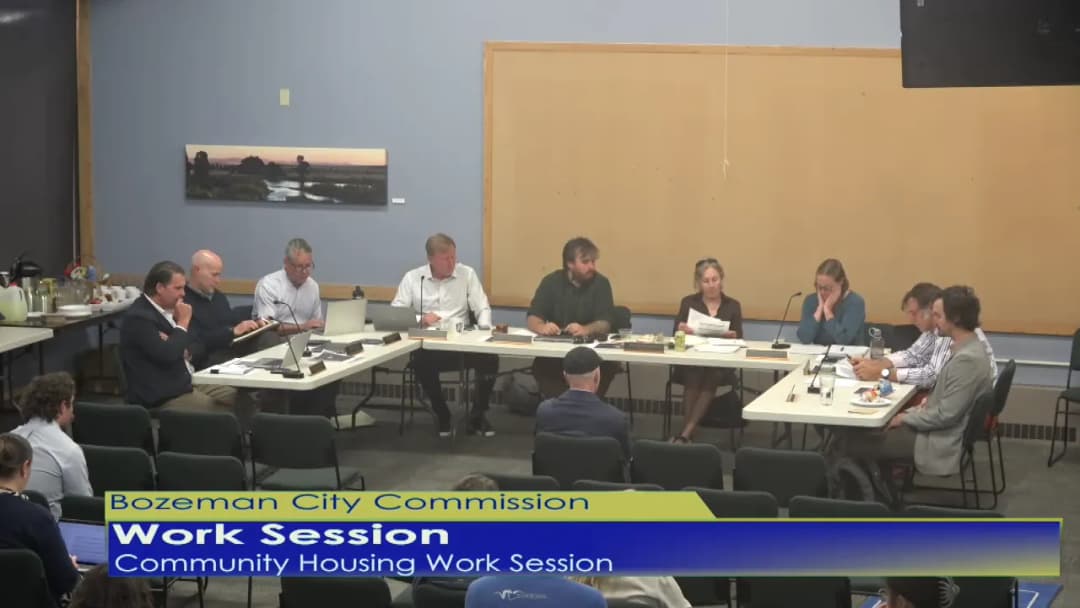
The Bozeman City Commission held a regular meeting on August 4, 2026, starting at 2:00 PM with an early start time. The meeting included consent agenda approvals, a special presentation on the National Community Survey, a lengthy work session on community housing, an appointment to the Board of Ethics, and approval of the CDBG Program Year 3 Annual Action Plan. Public comments addressed opportunity zones, meeting start times, and housing policies. Consent Calendar - G.3: Authorized the City Manager to sign a notice of award and final contract to Elevation Excavation for construction of the Bozeman Bicycle and Pedestrian Paths Transportation Alternatives Project, connecting paths along North 19th Avenue, Valley Center Road, and Flanders Mill Road. The path along Valley Center was modified to stop short of Catron Street due to tree conflicts. - G.4: Authorized a maintenance agreement with Montana Department of Transportation for the Bridger Point Master Site Plan Project. - G.5: Authorized a professional services agreement with Montana Legal Services Association for the Bozeman Tenant Right to Counsel Program. - G.6: Authorized a term contract with Cascadia Partners, LLC for economic development services. - G.8: Authorized Amendment 1 with AE2S for the Integrated Water Resource Plan Update. - G.9: Authorized Task Order 5 with Cushing Terrell for analysis of a housing site on five acres from the Turnrow subdivision, intended for affordable housing. - G.10: Resolution authorizing Change Order No. 5 with CK May Excavating for the 2024 Street and Utility Improvements Project. - G.11-G.14: Annexations and zoning for 133 Maus Lane (5.13 acres, M-1) and 1071 Story Mill Road (1.173 acres, R-1). - G.15: Ordinance finally adopting the dissolution of the Department of Strategic Services and creation of the Department of Communications & Engagement. - H.1-H.2: Resolution and ordinance for annexation of 163.9 acres at 5211 Baxter Lane (northwest corner of Baxter Lane and Harper Pucket Road) with zoning R-5 (RD) and R-3 (RB). Approved 3-2 (Commissioners Magic and Sweeney dissenting). Public Comments & Testimony - Non-Agenda Public Comment: Jerry Pape (15 N 25th) spoke about the need for connected pedestrian/bike paths, citing his grandchild Oliver's difficulty navigating sidewalks at county boundaries. He also urged that any affordable housing plan involve builders with experience in cost-effective design to ensure long-term affordability and upward mobility for residents. - Non-Agenda Public Comment: Jerry Pape spoke again on the Opportunity Zone program, warning that recommending Tract 6 (industrial redevelopment) over Tract 1102 could jeopardize hundreds of millions in housing projects. He argued that investors have avoided industrial redevelopment for a decade and that Tract 1102 already has significant investment. - Non-Agenda Public Comment: Anthony Smith criticized inconsistent meeting start times (2 PM, 4 PM, 6 PM) as a barrier to public participation and urged the commission to adopt a consistent schedule. He also referenced past incidents regarding police body camera footage and alleged retaliation. - Work Session Public Comment: Jerry Pape returned to discuss housing issues, emphasizing the need for accurate median home price data (including condos and townhomes), the importance of preventing real page price-fixing, the role of light-tech (LITEC) projects, and the need to vet developers. He argued that the city should reconsider Opportunity Zone Tract 1102 to avoid losing major housing projects. - Work Session Public Comment: Nathan Stein (Headwaters Community Housing Trust) thanked staff and reiterated the two biggest gaps: very low-income housing and middle-income homeownership. He stressed that local option sales tax or housing bonds may be necessary to generate permanent subsidy. - Work Session Public Comment: Heather Grenier (HRDC) noted that COVID-era housing resources are exhausted and supported focusing on very low-income and entry-level homeownership. She urged a unified community strategy. - CDBG Public Comment: No public comments were made on the CDBG item. Discussion Items - National Community Survey Special Presentation: Sonia Whittink (Polco) presented results from the third National Community Survey (NCS) for Bozeman. Key findings: 8 in 10 residents rated Bozeman positively as a place to live; 53 out of 129 rating items improved significantly since 2024. Highest-rated facets: parks/recreation, safety, natural environment. Lowest: economy, community design, mobility. Housing and cost of living remain top concerns. Only 33% rated employment opportunities positively. A hypothetical fire station bond received about 40% support, 30% opposed, 30% unsure. Residents' top priority areas for the next two years: natural environment, economy, community design. The survey had a margin of error of ±5% (382 responses out of 3,000 mailed). - Community Housing Work Session: - Brian Geyer (Community Housing Manager) reviewed the city's housing history: over 370 affordable units already built, 700+ under construction, 557 in development. Highlighted Hidden Creek collaboration and the community housing fund which helped 42 previously unhoused families since February 2026. - Mark Bond (One Valley Community Foundation) provided a regional perspective, citing a capital gap of $350,000 per unit and the work of the Gallatin Regional Housing Coalition. He presented a policy analysis titled "Bridging the Gap" exploring tools: local option sales tax, bed tax reallocation, housing levy, voluntary fee programs (e.g., Whitefish 1% sustainability fund). The RHC does not take advocacy positions. - Commission discussion covered: support for continuing LITEC and affordable housing ordinance (AHO), need to explore homeownership tools, streamlining development review (Aaron George presented on a process evaluation underway), and potential for pre-approved plans. Commissioner Sweeney advocated for a separate housing department and adaptive reuse overlays. Commissioner Bodie supported exploring revenue bonds and a modest housing levy alongside a voluntary fee program. Commissioner Magic emphasized state-level advocacy for local option sales tax and rental car tax. Deputy Mayor Fisher stressed making every public dollar a permanent community asset (revolving funds). Mayor Morrison called for a robust push for local option sales tax through the League of Cities and Towns. - Aaron George (Community Development Director) presented research on pre-approved plans, citing examples from South Bend, IN (91 units built since 2022) and Seattle, WA. Estimated costs around $200,000+ in Bozeman and noted concerns about fee waivers (impact fees cannot be waived in Montana). The commission generally supported exploring this tool further. - CDBG Program Year 3 Annual Action Plan: Brian Geyer presented the plan for $355,712 in federal CDBG funds. Key investments: water infrastructure for Family Promise's Journey Home facility (adding four transitional housing units that turn over 10 times/year), eviction prevention via Tenant Right to Counsel, and continued administration. The plan will assist approximately 200 low-income households. Key Outcomes - Consent I (Items G.1-G.15): Approved 5-0. - Consent II (Items H.1-H.2): Approved 3-2 (Commissioners Magic and Sweeney dissenting). - Appointment to Board of Ethics: Reappointed Jim Drummond for a term ending July 31, 2028, approved 5-0. - CDBG Annual Action Plan: Authorized the Mayor to approve and sign the Program Year 3 allocation, approved 5-0. - No formal votes on housing work session items: Staff will take direction from the commission's comments to: continue supporting affordable rental (LITEC, AHO), explore new tools for homeownership (pre-approved plans, adaptive reuse), work with partners on a voluntary fee program, and advocate for state-level revenue tools (local option sales tax, bed tax reallocation). The city manager will schedule a future work session to discuss the Baker Tilly revenue bond memo.

AFFORDABLE HOUSING 50% · PUBLIC ENGAGEMENT 15% · PROCEDURAL 13% · ECONOMIC DEVELOPMENT 6%
OPENPUBLICA · PUBLIC MEETING INDEXUPDATED DAILY · openpublica.com