Browse by city
Date range
Search help

Search titles, summaries, topics and stored transcripts together. Keywords may match separately; put the whole query in double quotes for a phrase. Matching follows word analysis, so punctuation is not exact. Both dates are included. Documents are not searched.

SHOWING 61–70 ENTRIES
61
JUN 24, 2026 · BOZEMAN, MONTANA · CITY COMMISSION
Bozeman Transportation Advisory Board Meeting – June 24, 2026

The Transportation Advisory Board (TAB) met on June 24, 2026, to discuss and take action on the Bozeman High School residential parking permit district, hear presentations on the Metropolitan Planning Organization’s (MPO) Long-Range Transportation Plan and the city’s Transportation Master Plan (TMP) update, and receive staff updates. The meeting included public testimony, board deliberation, and a formal motion. Consent Calendar - April 22, 2026 Minutes: Approved unanimously. Public Comments & Testimony - Public Comments on Non-Agenda Items: None. - Public Comments on Bozeman High School Parking District: Multiple residents and property owners spoke. - Kelly Wiseman, former parking commission member, urged eliminating the district south of Main Street, stating it solved the original problem and now only provides private parking for a low fee, pushing cars onto other streets. She recommended data-driven decisions. - Conlin Ritter, property owner on 10th & Villard, supported downsizing to streets closest to the high school, noting enforcement drove recent permit increases. - Chris Wasio, resident and business owner, strongly opposed dissolving the district, presenting data showing 350 on-street parking spaces within 800 feet of the high school entrance versus zero in school lots. He argued the district is essential for safety and congestion. - Abigail Brewer, resident on North 11th, opposed removal citing persistent safety issues, including hit-and-runs and dangerous student/vehicle interactions near the school portal. She called for infrastructure improvements rather than district removal. - Angie Wasio, resident, described historical problems since the school renovation removed a drop-off area, and urged retaining the district to manage traffic. - Emily Talago, online commenter, recommended first improving the Parking Benefit Zone tool before dissolving the district, noting upcoming development in Midtown may increase parking demand. Discussion Items - Bozeman High School Residential Parking Permit District: Parking Manager Nick Foken presented options: pause, reduce (to 11th & 15th only), or no change. He noted the district is not self-funding, with permit costs ($35/yr) covering only a fraction of enforcement and maintenance. Permit sales rose from 90 in 2022-23 to over 200 in 2024-25 due to increased enforcement. A 2021 consultant recommended dissolution. Board members discussed data gaps, citation hotspots, safety concerns, and the need to balance neighborhood tranquility with worker/student parking. Director Ross noted the board acts as the Parking Commission and can make recommendations to City Commission. - MPO Long-Range Transportation Plan: Jeff Butts, MPO Manager, presented the planning process, including alternative analysis, project scoring, and community input (several hundred comments). Key themes: safety, walking/biking connectivity, transit (including bus to airport), and regional coordination. The plan will be fiscally constrained and must align with federal requirements. Board asked about coordination with city TMP, road ecology integration, and public outreach methods. - City Transportation Master Plan (TMP) Update: Director Ross announced selection of Sandbell, Kittleson Associates, and Logan Simpson as preferred consultant. The TMP will be the city's MLUPA-compliant facility plan, guiding future street development and land-use coordination. Proposed community engagement strategy: combine safety action plan and TMP engagement, use online tools (Engage BZN), public meetings (citywide and regional), and a technical working group (no stakeholder groups to avoid exclusion). Board supported the approach, suggesting early notification and creative outreach to capture broader public input. Key Outcomes - Motion on Bozeman High School Parking District: Board member Rio moved to consolidate the district to North 10th, North 11th, Lammy, Mendenhall, Villard, and Beale (excluding 15th and areas south of Main Street) and to continue community engagement with additional data collection on citations and permits. The motion passed unanimously (5-0). Staff will refine the proposal and bring to City Commission. - TMP Community Engagement Plan: TAB provided feedback supporting the combined engagement strategy. Staff will finalize the plan for City Commission approval on July 21, 2026, and seek contract approval with Sandbell by end of July.
TRANSPORTATION SAFETY 33% · COMMUNITY ENGAGEMENT 14% · ENGINEERING AND INFRASTRUCTURE 13% · PROCEDURAL 11%
62
JUN 23, 2026 · BOZEMAN, MONTANA · CITY COMMISSION
Bozeman City Commission Meeting, June 23, 2026: Budget Adoption, Opportunity Zone, and Consent Agenda

The Bozeman City Commission met on June 23, 2026, to adopt the FY 2027 annual operating budget and the 2027-2028 biennium budget, discuss an opportunity zone application, and handle consent agenda items and public comments. Key decisions included approval of the budget with amendments adding the city shops complex and C. Bozeman Creek funding, removing a fire station line item, and authorizing an opportunity zone proposal for only one census tract. Consent Calendar - The commission voted 5-0 to approve consent items 1–2, 4–8, and 10–18, after removing item F3 and moving item F9 to an action item. City Manager noted that item F18 (sports park) came in significantly under budget, allowing restoration of value-engineered features. Public Comments & Testimony - Bob Muldowney argued that an interlocal agreement improperly overrode Ordinance 1409, which requires TIF overages to return to the general fund, and urged the commission to examine dissolution or compliance. - Mark Campanelli raised concerns about conflict-of-interest disclosures at the TIF board, the Idaho Pole property, and wetland relocation, calling for better oversight. - Emily Kelly questioned the TIF eligibility of several line items in the FY 2027 downtown URD budget, asking for a legal determination. - Ross Keo (from Missoula) supported the opportunity zone, stating it catalyzed affordable housing and investment in Missoula. - Suki Nakamura opposed the opportunity zone, citing lack of guarantees and oversight. - Dan Cardi also opposed, arguing beneficiaries are investors, not the community. - Jason Delmu (speaking on his own behalf) supported the opportunity zone as a marginal benefit. - Steve Noble (C. Bozeman Creek) thanked the commission for proposed funding. - Katie Madison (Haven) thanked the commission for maintaining shelter funding. - Emily Tlaido urged performance metrics and criticized using vacancy savings. - Chris Brown (resident) opposed the fire station bond, citing tax fatigue. - Ricky Burns (ADA coordinator) urged funding for the disability liaison position. - Kristen Newman supported the liaison role for community engagement. Discussion Items - Opportunity Zone (Action Item F9): Economic Development Director Britt Fontnum presented two eligible census tracts (Gallatin County Tract 6 and Tract 11.02) for a 10-year federal designation. Tight timeline (deadline July 7) limited community engagement. Commissioners questioned control over outcomes, community support, and potential displacement. After public comment, an amendment to remove Tract 11.02 passed 4-1. The main motion authorizing the city manager to submit the proposal for Tract 6 only passed 4-1. - Budget Adoption: Finance Director Melissa reviewed the FY 27-28 biennium budget ($689M resources, $609M requirements). Key discussions included: - City Shops Complex: Staff proposed adding $84.147M total (with $8M already budgeted) to fund a consolidated facility. An amendment to add $76.147M and update rate impact charts passed 4-1. - C. Bozeman Creek: The commission added $150,000 to the general fund, sourced from vacancy savings, for continued planning (passed 5-0). - Fire Station No. 4: An amendment to remove the $19M fire station bond and convert the $70,000 ballot education line to general ballot outreach passed 4-1. - Pre-Approved Building Plans: A proposal to allocate $125,000 from the planning subsidy failed 1-4. - Midtown Neighborhood Plan: A $50,000 proposal was withdrawn after staff noted it would be insufficient. Key Outcomes - Consent Agenda approved 5-0. - Opportunity Zone proposal authorized for Tract 6 only (vote 4-1). - Budget adopted with amendments: - Added $76.147 million for the city shops complex. - Added $150,000 for C. Bozeman Creek planning. - Removed $19 million for Fire Station No. 4; redirected ballot education funds to general outreach. - Final budget vote: 5-0. - The commission also approved two mayoral proclamations (Parks and Recreation Month and the 250th anniversary of the Declaration of Independence). - City Manager announced a new social media series, "Bozeman at Work," and reminded the public that city fireworks are only allowed at the fairgrounds on July 4th.

ECONOMIC DEVELOPMENT 30% · FISCAL SUSTAINABILITY 19% · PROCEDURAL 18% · COMMUNITY ENGAGEMENT 8%
63
JUN 18, 2026 · BOZEMAN, MONTANA · CITY COMMISSION
Bozeman Tax Increment Finance Advisory Board Meeting – June 18, 2026

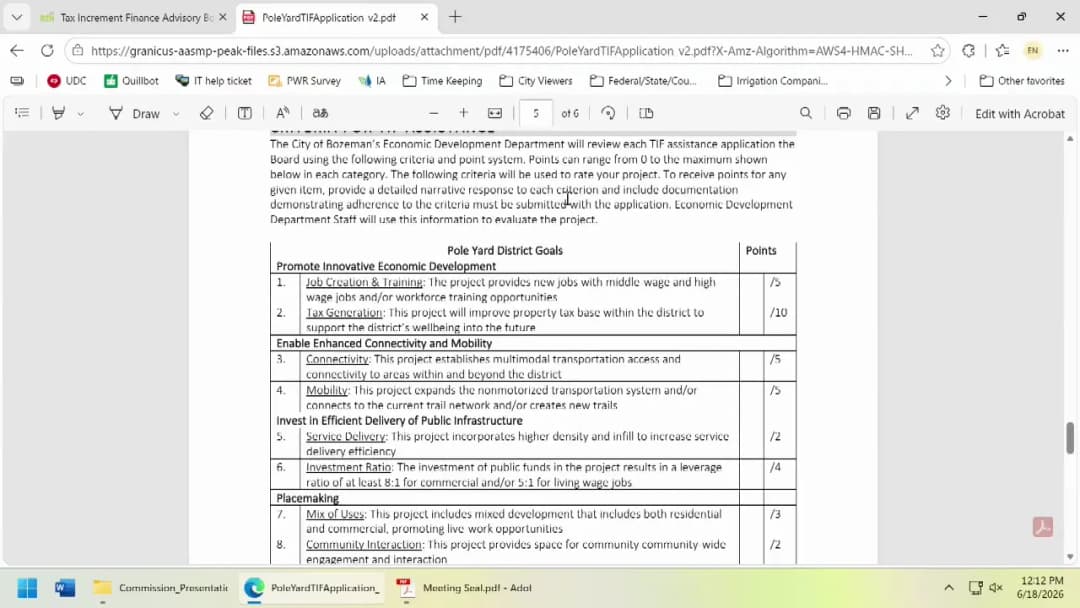
The Tax Increment Finance Advisory Board met in a work session on June 18, 2026, at 12:00 p.m. to discuss two major items: the Pole Yard Urban Renewal District Tax Increment Financing Assistance Program application and the Midtown Urban Renewal District Strategic Land Acquisition Loan Pilot Program. Board members present: Marty Matsen, Susan Fraser, Nolan Campbell, Julien Morice. Absent: Natalie Van Dusen, Mike Waterman, Zach Brown. Consent Calendar - The board unanimously (4-0) approved the minutes from the April 16, 2026 and May 21, 2026 meetings. Public Comments & Testimony - Amy Hoitsma (President, Northeast Neighborhood Association) commented on the Pole Yard TIF application, expressing concern that the program description gave the Director of Economic Development "sole discretion" with minimal board involvement, and questioned why impact fees are eligible for TIF funding. She urged more points for placemaking and inclusion of affordable housing in the criteria. She noted that treated soils from the Idaho Pole Superfund site are being moved closer to the neighborhood and advocated for an "avoid" rather than "mitigate" standard on environmental factors. - Nathan Stein (Executive Director, Headwaters Community Housing Trust) expressed strong support for the Midtown land acquisition pilot program, stating it could be a "hugely powerful" tool to help community land trust projects. He offered a friendly amendment to clarify that community land trust (CLT) projects create taxable value through homeowner improvements even though the nonprofit retains land tax-exempt. - Emily Talago (Bozeman resident) commented on the Midtown pilot, asking about the number of potential applicants, whether the program should be broadened to other shared-equity models, borrower equity requirements, return on investment, and the need for metrics to evaluate success. She also questioned the dedication of $2.5 million to acquisition lending versus other urban renewal investments. Discussion Items - F.1 Pole Yard TIF Assistance Program Application: Urban Renewal Manager David Fine presented the first draft of the application and scoring criteria, noting the district's focus on infrastructure deficiencies, an EPA Superfund site, and critical wetlands. Board members discussed the scoring process, emphasizing that a perfect score does not obligate approval because TIF awards are not entitlements. They debated the language on environmental protection, with a suggestion to separate "mitigate harmful environmental factors" (e.g., contamination) from "avoid impacts on streams, wetlands, wildlife habitat." The board also sought clarity on the role of the advisory board versus the Director of Economic Development in program administration. Fine agreed to revise the language and bring the item back as an action item. - F.2 Midtown Urban Renewal District Strategic Land Acquisition Loan Pilot Program: Fine presented a draft pilot program that would use $2.5 million in TIF funds to provide short-term (24–36 month), low-interest loans to nonprofit developers for acquiring land to build for-sale affordable housing using a community land trust model. Board members discussed the narrow eligibility criteria, noting that they might exclude many potential applicants. Marty Matsen suggested scoring criteria could be broadened, and Nolan Campbell recommended seeking input from experienced affordable housing developers. Staff indicated they would integrate feedback and return with an action item. An FYI was also provided regarding the upcoming Opportunity Zone 2.0 application process, which could benefit urban renewal districts. Key Outcomes - The board directed staff to revise the Pole Yard TIF criteria, particularly to strengthen the language on avoiding environmental impacts (criteria 11) and to clarify the board's role in the application process. The revised document will be brought back as an action item at a future meeting. - The board directed staff to incorporate comments on the Midtown pilot program—including broadening eligibility, clarifying tax treatment for CLT projects, and developing success metrics—and to return with a revised proposal for a future vote. - No formal votes were taken on either work session item; consensus was to refine and bring both back as actionable proposals.

ECONOMIC DEVELOPMENT 39% · AFFORDABLE HOUSING 30% · ENVIRONMENTAL PROTECTION 17% · PROCEDURAL 8%
64
JUN 18, 2026 · BOZEMAN, MONTANA · CITY COMMISSION
Bozeman City Study Commission Public Hearing on Charter Amendments – June 18, 2026

The Bozeman City Study Commission held a public hearing on June 18, 2026, beginning at 5:30 PM, to receive input on the tentative report and proposed amendments to the city charter. The meeting included a consent calendar, updates from commissioners, extensive public testimony from approximately 20 speakers, and discussion of a voter engagement plan. The commission approved a $60,000 personnel contract and $65,000 for voter engagement, set a public comment deadline of June 26, and scheduled future meetings for July 15, 23 (tentative), 30, and August 6 for final adoption. Consent Calendar - The consent agenda was approved unanimously by voice vote. Public Comments & Testimony - City Manager Chuck Wynn urged clarity on what belongs in a charter vs. policy. He expressed concerns that Section 2.04 (compensation) could subject elected officials to wage/hour laws, Section 3.03 (acting city manager) is overly prescriptive, and Section 8.04 (INCO) gives INCO more status than other advisory boards with "shall" language and requires a full-time staff member, which may conflict with NLUPA. He requested specific written recommendations. - Noah Tembruck criticized the appointment process (citing the Emma Bodie appointment), argued for stronger public input during crises, and supported keeping INCO in the charter. He noted that 73% of Bozeman is protected by CCRs, suggesting that only 28% neighborhood representation is not a coincidence. - Susan Hinkins supported the neighborhood association provisions but found the compensation algorithm too prescriptive and ill-defined. She preferred the old charter language letting a board decide salaries. - Emily Mason (INCO Chair) thanked the commission for strengthening Article 8 and asked for a moment of silence for a tragic accident involving first responders. - Mark Campanelli (Bogert Park Neighborhood Association president, speaking for himself) noted contradictions in Article 8 language between Section 8.02 ("may include but are not limited to neighborhood associations") and later sections requiring inclusion, and advocated for limited government and retention of rights to the people. - Daniel Cardi supported Article 8 and INCO, but opposed the current compensation board composition (including two commissioners and the city CFO). He proposed a board of disinterested parties selected by lottery. - Mary Bateson suggested that if the amended charter fails, its recommendations (Exhibit F) should be forwarded to the city commission for consideration. - Esther Fishbaugh (property owner outside city limits) argued compensation board should exclude anyone with city contracts or financial interest. She preferred ward-based elections where only ward residents vote for their representative. - Richard Bacher (INCO Secretary/Treasurer) supported keeping Article 8 and making INCO a budget line item. - Lynn Paul praised the study group's public engagement but called for more specificity in Article 8 on two-way communication, transparency, and accountability. - Andrew Thomas (Gallatin Valley Sentinel) presented survey results: 611 respondents; low confidence in city government; strong support for ward-based elections with residency voting requirements; majority favor mayor as presiding officer (not executive), a four-year mayor term, term limits, and increased commission size conditional on wards; majority believe commissioners should be salaried but not employees; many oppose increasing pay further. He noted that the study commission's survey data request remains unfulfilled. - Emily Talego expressed gratitude for the commission's work and encouraged balancing responsiveness with long-term charter vision. - Laithie Poole questioned ward boundary drawing by the commission (fear of gerrymandering) and opposed the compensation formula slaved to median income without entrepreneurial risk. - Trish Freheim asked why sub-options fail if the charter fails (per MCA) and suggested putting ballot language first in materials. She recommended using "current" instead of "existing" and praised the ballot clarity. - Natsuki Nakamura (Economic Vitality Board member, speaking personally) asked for clarity on ward definitions, highlighted that ward boundary changes cannot disqualify a sitting commissioner, and raised transition issues with staggered terms and potential disincentive for renters to run due to residency requirements. - Katie Adams (Gallatin Valley Sentinel) recommended changing ward boundary drawing to an independent advisory board (citing Montana Constitution Article 5, Section 14), adding "compact, contiguous" requirements preserving neighborhood boundaries, and fixing a conflict in Section 2.06 on mayor vacancy succession. Discussion Items - Voter Engagement Plan: Tor Goodmanson and Aaron Coursey (Dan Geld) presented three tiers of engagement: Active Electorate ($64,000 at $1.50 per voter from last municipal election), Active Voter ($110,000 at $1.50 per registered voter), and Transformative ($220,000 at $3 per voter). The remaining budget after the $60,000 personnel contract (approved on consent) was approximately $100,000. After discussion, a motion was made to approve $65,000 for active electorate engagement, requiring Dan Geld to present a detailed schedule and sample materials at the July 15 meeting. The motion passed 4–1 (with one abstention). - Future Meeting Schedule: The commission discussed adding meetings to address public comments. They confirmed meetings on July 15, July 23 (reserved if needed), July 30, and August 6 (final adoption). Public comment deadline for written submissions is June 26. Key Outcomes - Consent Agenda approved unanimously. - $60,000 Personnel Contract approved (previously on consent). - $65,000 Voter Engagement approved for Dan Geld, with a detailed plan and materials due by July 15. - Public Comment Deadline: June 26, 2026. - Commission Homework: Members to send "what I heard" summaries to Mike Moss for consolidation. - Charter Finalization: Final adoption of the report and ballot language scheduled for August 6, 2026. Ballot due to county by August 10. - Additional Meetings: July 15 (next), July 23 (reserved if needed), July 30, August 6.

COMMUNITY ENGAGEMENT 42% · PROCEDURAL 36% · PUBLIC ENGAGEMENT 10% · PERSONNEL MATTERS 8%
65
JUN 17, 2026 · BOZEMAN, MONTANA · CITY COMMISSION
Historic Preservation Advisory Board Work Session on Landmark Criteria and Demolition - June 17, 2026

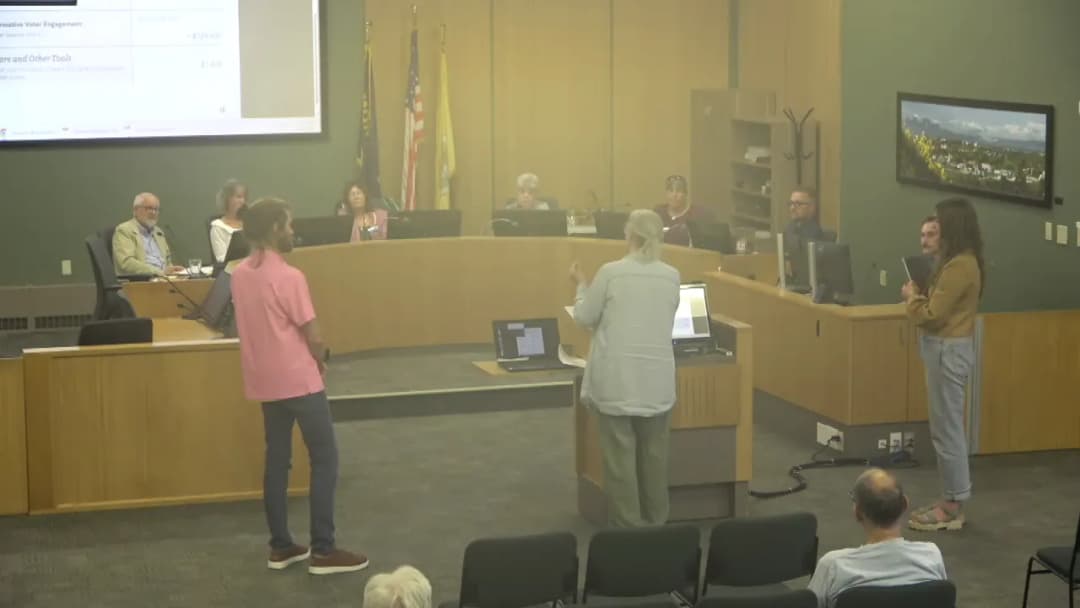
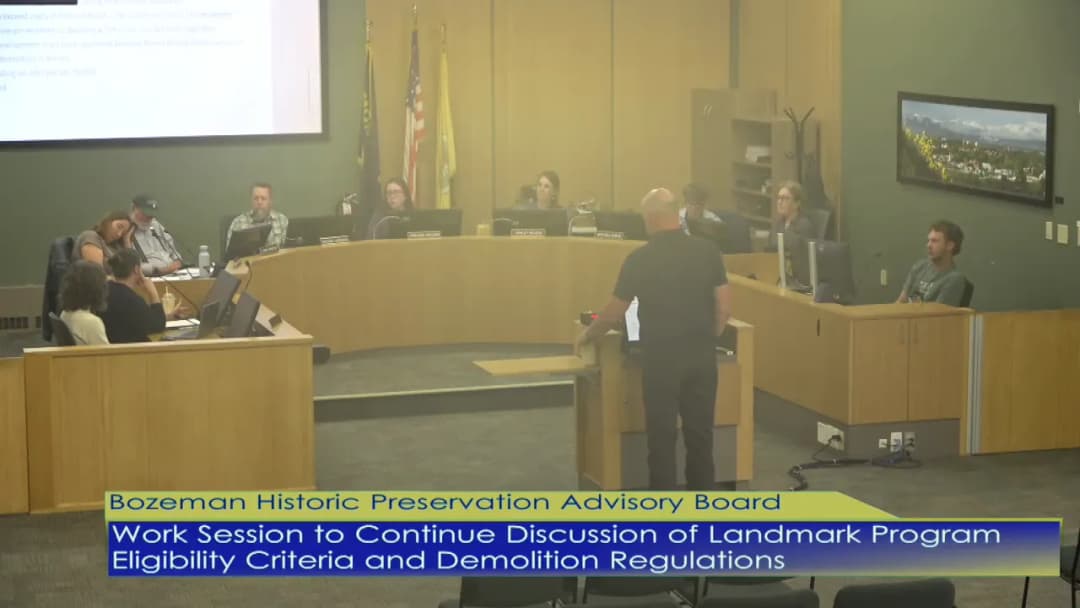
The Bozeman Historic Preservation Advisory Board (HPAB) met on June 17, 2026, from 6:00 p.m. to approximately 8:30 p.m. to continue discussion on the landmark program eligibility criteria and demolition regulations. The board reviewed draft purpose and criteria language, received an overview of current demolition procedures and data, heard public comment, and provided direction for next steps. Consent Calendar - Approval of Minutes (May 20, 2026): The board unanimously approved the minutes (7-0) without discussion. FYI/Discussions (Before Action Items) - Chair Chelsea Holling Recognition: Community Development Director Erin George recognized Chair Holling’s last meeting after approximately ten years of service. - HPAB Planner Position: The historic preservation planner position vacated by Sarah Rosenberg is being posted with an updated job description emphasizing preservation experience. - NCOD Design Guidelines Project: A public survey is open through the end of June. The next neighborhood focus group meeting is scheduled for July 9, 2026, from 12:00 p.m. to 1:30 p.m. Public Comments & Testimony - Daniel Carty (Bozeman resident): Urged the board to consider a deconstruction ordinance as part of demolition regulations. - Rick Carren (609 South Sixth, Cooper Park resident): Stated that demolition of historic homes is an “existential threat” to core neighborhood integrity. Emphasized that while some homes are not salvageable, replacement structures must fit the neighborhood fabric. Called for more public review of replacement proposals. - Natsuki Nakamura (Bozeman resident, renter): Supported updated inventory surveys for potential historic districts and a deconstruction ordinance to shift the economics of demolition. Noted a lack of penalty for demolition by neglect. Discussion Items - Landmark Program Purpose and Criteria: Consultant Adrienne Burk (Community Planning Collaborative) presented draft purpose language and a three-part designation test: (A) age requirement (50 years typical), (B) retention of integrity to convey significance, and (C) meeting one or more of eight significance criteria. Board feedback included: - Combine criteria C1 (“associated with an aspect of heritage or culture”) and C8 (“associated with a theme”) into a single criterion. - Retain the 50-year age threshold as a national standard, with no change. - Require only “one or more” from list C (keep broad to capture cultural significance). - Clarify the phrase “significant documented historic and cultural value” in the purpose statement (e.g., add a comma after “significant” to avoid ambiguity; consider a definition). - Found that the seven integrity factors in B provide sufficient guidance. - Demolition Regulations Overview: Staff (Rebecca Harbage, Erin George) and Planning Manager Brian Krueger presented current NCOD demolition rules for historic, non-historic, and unsafe structures. Highlights: - Demolition data table shows 14 approvals in 2025 (seven commercial, seven single-family; only one contributing/eligible). - Many non-contributory determinations rely on 1984 surveys; only 2,412 of 2,797 NCOD parcels have been inventoried. - The economic viability analysis for historic structures is complex; staff issued a director’s interpretation to clarify “habitable condition.” - Board expressed concerns about demolition by neglect, outdated surveys, and lack of public notice for non-historic demolitions. - Phase One Recommendations: Consultant Burk reviewed recommendations including updating the economic viability standards, requiring updated inventory forms (e.g., if older than 10 years), and clarifying the two-year stay process and early termination criteria. - Deconstruction Ordinance: At a board member’s request, Burk provided examples (San Antonio, Portland) and noted a city climate action plan item on a deconstruction handbook. Staff suggested sustainability should lead that effort. Key Outcomes - Landmark Criteria Direction: The board agreed on the three-part test, the combined criterion (C1/C8), the 50-year age threshold, and the “one or more” standard. Staff will refine the draft language accordingly. - Subcommittee on Demolition: A three-person subcommittee (Michael Wiseman, Allyson Brekke, Ashley Wilson) was formed to give focused attention to demolition regulations, including deconstruction, two-year stay language, and other issues. The subcommittee will report findings at future HPAB meetings. - Next Meeting: The July 2026 meeting will focus on the NCOD design guidelines update and neighborhood focus group input.

HISTORIC PRESERVATION 77% · PROCEDURAL 13% · ENGINEERING AND INFRASTRUCTURE 9% · COMMUNITY ENGAGEMENT 1%
66
JUN 16, 2026 · BOZEMAN, MONTANA · CITY COMMISSION
Bozeman City Commission Meeting – June 16, 2026

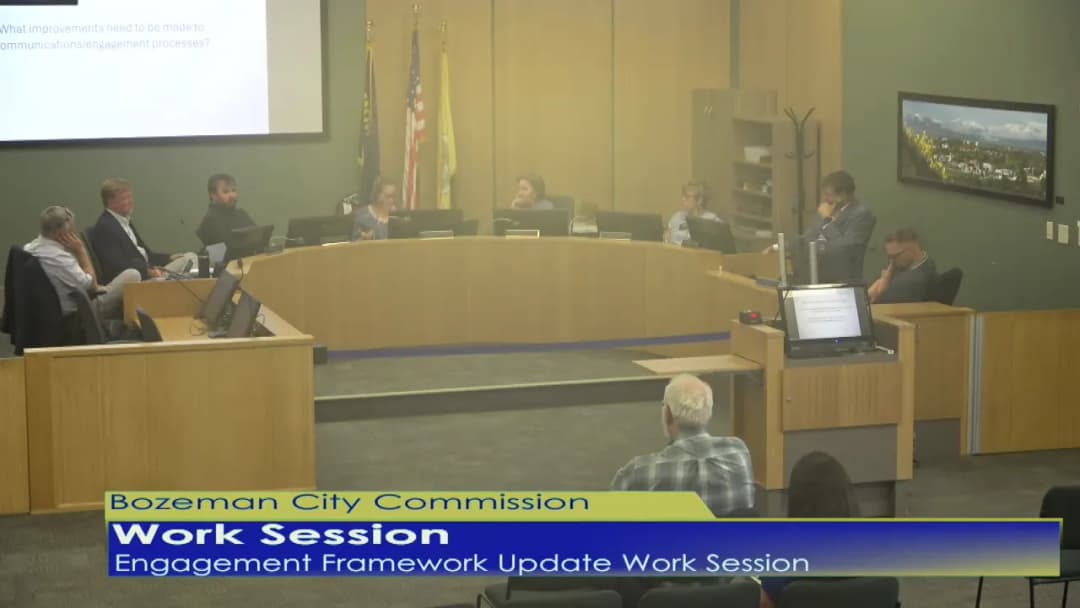
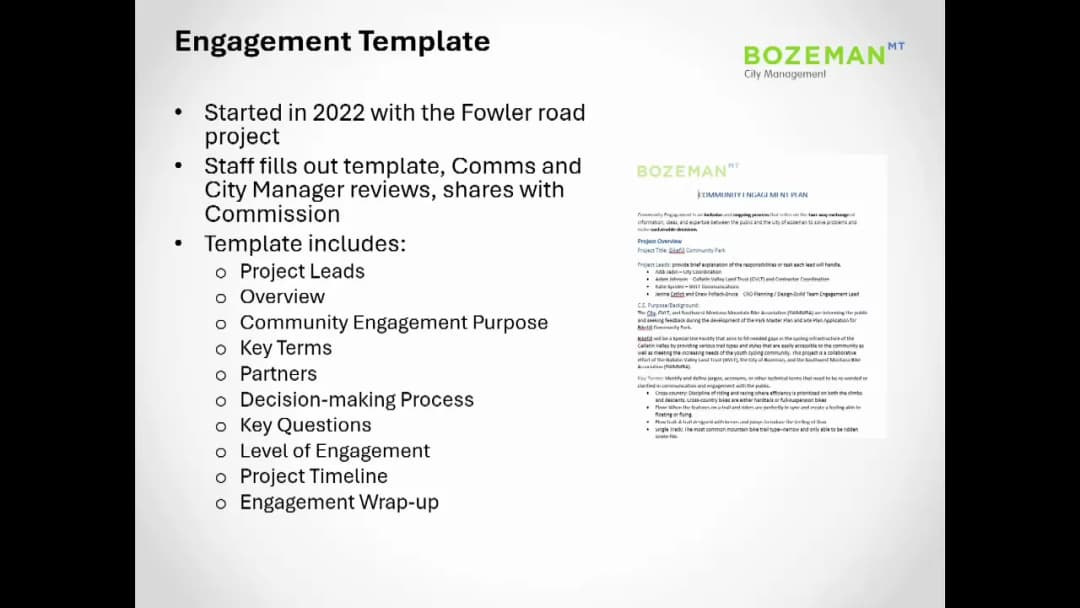
The Bozeman City Commission met on Tuesday, June 16, 2026, at 12:30 PM (UTC) for a regular meeting that included approval of minutes, consent agenda items, a public hearing on a wireless facilities ordinance, and a work session on the community engagement framework update. The meeting featured significant public comment and commissioner discussion on accountability, engagement tools, and regulatory updates. Consent Calendar - Minutes Approval: The commission approved the January 13, 2026, meeting minutes by a vote of 4–1 (Commissioner Sweeney opposed). - Consent Agenda Part 1 (Items G1–G7): Approved unanimously (5–0). Staff highlighted Item G3 (award of RFP for the Safety Action Plan for streets and roads) and Item G4 (contract to design infrastructure for Family Promise of Gallatin Valley using Community Development Block Grant funds). - Consent Agenda Part 2 (Item H1): Approved 4–1, with Commissioner Sweeney voting no. Public Comments & Testimony - Daniel Cardi (Bozeman resident): Expressed support for including statistically valid surveys in the engagement framework, referencing the IAP2 spectrum, and asked the commission to consider when such surveys are appropriate. - Callie Kazakoff (Big Sky Tutoring owner): Voiced opposition to a proposed cannabis dispensary sharing a common entrance with her tutoring business. She noted her business, along with Manmade Mentors (teen therapy) and Roots Family Collaborative (support for parents), would be negatively affected. She urged the commission to amend City Ordinance 2084 to include tutoring centers and daycare centers as prohibited neighbors of cannabis dispensaries, citing current law only protecting K‑12 and post-secondary schools. - Kristen Newman (former disability community liaison for the Blonde/Bozeman plan): Criticized the removal of an ADA coordinator and disability liaison from the city budget, arguing that a full-time coordinator is needed to support growing ADA compliance. She warned that lack of staff infrastructure undermines past commitments and could lead to liability. She emphasized that the city cannot rely on nonprofit partnerships to meet its ADA obligations. - Cindy Smith (Bozeman resident): Raised recurring concerns about transparency and accountability of city funds provided to HRDC. She stated she has filed a formal ethics complaint and requested an independent review. She asked for a written public accounting of all city funds to HRDC, including safeguards against misuse for employment disputes or public relations. She alleged selective accountability by the commission. Discussion Items - Ordinance – Wireless Facilities Text Amendment (Application 26074): Assistant City Attorney Jennifer Gutierro presented the first comprehensive update in nearly 30 years to Chapter 38 of the Bozeman Municipal Code (wireless facilities). The update aligns local regulations with evolving federal telecommunications law. Key changes include a new application review process with federally mandated “shot clocks,” exemptions for certain facility types (e.g., eligible facilities requests), and updated submittal materials. The Planning Commission (Community Development Board) recommended approval with one additional change (adding language to require concealed facilities in historic districts and under other circumstances). Staff had no concerns with the added language. The commission discussed aesthetics, micro facilities, and co-location requirements. The motion to provisionally adopt the ordinance passed 5–0. - Work Session – Engagement Framework Update: Communications and Engagement Manager Takami Clark led a work session on updating the city’s community engagement framework (Engage Bozeman). Drivers include the Montana Land Use Planning Act (MLUPA) and five years of implementation experience. The presentation reviewed the IAP2 spectrum (inform, consult, involve, collaborate, empower), existing tools, and planned improvements. Commissioner discussion focused on the need to move beyond “consult” toward “collaborate” and “empower,” using statistically valid surveys, deliberative polling, working groups, and better integration with neighborhood associations and advisory boards. Commissioners suggested adding deliverables to engagement plan timelines, identifying demographic groups for targeted outreach, improving real-time responses to public comment (especially technical issues), and ensuring that advisory board recommendations receive written responses when not acted upon. The update is expected to return in August 2026 for adoption. Key Outcomes - Wireless Facilities Ordinance: Passed 5–0, adopting the text amendment with the Planning Commission’s recommended change. - Engagement Framework: No formal action taken; the work session collected commissioner direction for the draft update (to be presented in August). - Public Comment Follow-up: The city manager agreed to provide commissioners with information regarding city funds sent to HRDC and explore possibilities for responding to public comments. The mayor and several commissioners committed to improving how they synthesize and acknowledge public input in real-time and in written form. - Future Items: Commissioner Sweeney expressed interest in regulating cannabis dispensaries further; the city manager will work with the city attorney to explore options.

COMMUNITY ENGAGEMENT 49% · PUBLIC ENGAGEMENT 19% · TECHNOLOGY AND INNOVATION 15% · PROCEDURAL 8%
67
JUN 15, 2026 · BOZEMAN, MONTANA · CITY COMMISSION
Bozeman Community Development Board Meeting - June 15, 2026

The Bozeman Community Development Board (CDB) met on Monday, June 15, 2026, at 6:00 PM. The meeting was held in-person and via video conference. The board considered two unified development code (UDC) housekeeping amendments regarding short-term rentals (STRs) in the RA district and parking standards in the B-3 district, heard an update on the city's engagement framework, and decided to cancel the July 6, 2026 meeting. Consent Calendar - Approval of Minutes: The board approved minutes from May 4, 2026, and June 1, 2026. A correction was made to the June 1 minutes: the word "compounds" was changed to "shelters" in the motion language. Motion carried 4-0. Public Comments & Testimony - No public comments were offered on non-agenda items or on the action item. Discussion Items - 2026 Unified Development Code Housekeeping Amendments (Application 26307): Staff presented two amendments. - B-3 Parking: The amendment carries forward existing parking standards in the B-3 (downtown) district after October 1, 2026, to align with state law changes. This ordinance will be codified. - Legacy Short-Term Rentals in the RA District: The amendment addresses an unintended consequence of the new UDC. Previously, type 2 STRs (where the host lives in the unit at least 70% of the year) were allowed in R2 but not in R1/RS. When those zones were merged into RA, type 2 STRs were not allowed. The initial staff draft proposed grandfathered status for existing type 2 STRs. However, after discussion, the board voted 4-0 to amend the main motion to instead allow type 2 STRs outright in the RA district (rather than grandfather them in). A subsequent motion to also allow type 2B STRs (renting the main house while the owner lives in an ADU) was introduced but later withdrawn after staff cautioned it could convert long-term rentals. The amended motion to recommend approval of both housekeeping amendments (including allowing type 2 STRs outright) carried 4-0. The recommendation will go to the City Commission for a public hearing on July 14, 2026. - Key statistics mentioned during discussion: Of 189 type 2 STRs citywide (53% of all STRs), 62 are located in the RA district (17% of total STRs). The RA district covers 1,033 acres of existing residential use. The citywide rental vacancy rate has risen to approximately 18% from low single digits in 2023, according to board member comments. - Engagement Framework Update: Takami Clark, the city's Communications and Engagement Manager, presented an update on the Engage Bozeman Framework, which is being revised to align with Montana Land Use Planning Act (MLUPA) requirements and to improve public participation processes. The board offered suggestions: summarize and respond to public comments, use cross-tabulations to contextualize input (e.g., by age or tenure), leverage new technology to objectively summarize comment themes, and consider different engagement levels based on project phase. The updated draft will be posted online in July for public review, with adoption anticipated in August. - Upcoming Items and July 6 Meeting Cancellation: The board voted to cancel the July 6, 2026 meeting due to lack of agenda items and proximity to the July 4th holiday. Staff noted that the UDC will be published in searchable format in August, and that the Gucci Plan (renamed to avoid confusion) has begun public outreach. Key Outcomes - Approved minutes from May 4 and June 1, 2026, with a correction (4-0). - Recommended approval of the 2026 UDC Housekeeping Amendments to the City Commission, with a modification to allow type 2 short-term rentals outright in the RA district (4-0). - Voted to cancel the July 6, 2026 CDB meeting (4-0). - Provided feedback on the Engage Bozeman Framework update for staff to incorporate.

COMMUNITY ENGAGEMENT 33% · CANNABIS REGULATION 23% · AFFORDABLE HOUSING 19% · MISCELLANEOUS 14%
68
JUN 11, 2026 · BOZEMAN, MONTANA · CITY COMMISSION
Inter-Neighborhood Council Meeting – June 11, 2026: Charter Support, Engagement Framework, Officer Elections

The Inter-Neighborhood Council (INC) held its regular meeting on June 11, 2026, from approximately 4:30 PM to 6:25 PM. Key topics included a motion to support the study commission's draft Article 8 (public engagement), a presentation on the city's engagement framework update, officer elections for the upcoming year, and a commission liaison update covering budget, public safety, and housing priorities. Public comments addressed INC representation, charter language, and neighborhood engagement. Public Comments & Testimony - Daniel Cardi (Bozeman resident, Midtown) thanked the INC for its willingness to write a letter supporting Article 8 (Role of Public Engagement and Local Governance). He urged INC officers to attend the study commission's June 18 meeting, noting that some written comments have called for deleting Article 8 or diminishing INC's role. He cited the Montana Constitution Article II, Section 8 on citizen participation. - Mayor Joey Morrison (speaking in his own capacity) corrected what he called misinformation about his earlier testimony to the study commission. He stated he never advocated for removing or diminishing the INC's authority, but rather for making neighborhood associations more representative (e.g., polling, door-knocking, engaging renters and younger residents). He expressed concern that the INC's current structure does not adequately represent all residents and that the charter review process has missed a robust conversation on improving neighborhood associations. - Richard Bacher (1470 Boylan Road) expressed upset over a letter from the vice mayor (Commissioner Fisher) to the study commission, which he interpreted as dismissing citizen involvement through structured systems like the INC. He asked how citizens can be involved without such a clearinghouse. - Angie Koch (Northeast Neighborhood Association) shared examples of neighborhood outreach (newsletters, door-to-door, email lists, new meeting formats) and noted challenges engaging transient populations like college students. She asked the city for help in reaching those groups. - Noah Tenbrook (INC member) commented on engagement fatigue, emphasizing that reciprocity (seeing input acted upon) is key to sustaining participation. He suggested the city focus on making engaged residents feel heard rather than constantly seeking new participants. Discussion Items Motion to Support Study Commission's Draft Article 8 - A member (unidentified) asked whether the subcommittee that worked on charter language had circled back to the study commission. After learning no formal response had been sent, a motion was made for the INC to circle back in support of the study commission's draft Article 8 (as currently proposed). The motion was seconded and passed unanimously. - Mark Campanelli (Bogart Park) volunteered to draft a simple letter stating INC support for the draft language as is. The letter will be reviewed by officers and submitted before the study commission's June 18 meeting. Emily Mason volunteered to attend that meeting to deliver oral comment. - Discussion clarified that the draft Article 8 includes language on community engagement beyond just neighborhood councils, which members viewed positively. Engagement Framework Update (Presentation by Takami Clark, Communications & Engagement Manager) - Takami Clark presented the city's update to the Engaged Bozeman framework, driven by the Montana Land Use Planning Act (MLUPA) requirements for public participation. The timeline includes drafting in July, posting for review, and returning to boards/commissions in August for adoption. - Key questions posed to the INC: what they want to see in the updated draft, how to help residents feel more heard, and improvements to communications/engagement processes. - INC members provided feedback: - Angie Koch suggested a prominent "Engagement" page on the city website with clear, bulleted links to Engaged Bozeman, public meeting info, and how to participate. - Noah Tenbrook emphasized the need for reciprocity—residents want to see how their input is used. He also noted that the city's website and Engaged Bozeman platform can be confusing (separate URLs). - Emily Mason asked about demographic data of Engaged Bozeman users to help INC broaden its own outreach. Takami confirmed they collect demographics and can share. - Douglas Fisher (commission liaison) noted that the city is investing in elevating the communications department to a director level and that the budget includes funding for a new fire station on the west end, which will require voter approval. - Several members raised concerns about engagement fatigue and the challenge of keeping up with multiple city projects. Suggestions included a monthly city newsletter and better use of social media/water bill inserts. Officer Elections - The INC elected officers for the upcoming year: - Chair: Emily Mason (nominated by Dick Bacher, seconded, approved) - Vice Chair: Jim Webster (nominated, seconded, approved) - Secretary/Treasurer: Dick Bacher (nominated, seconded, approved) - The vote was unanimous. Outgoing Chair Dick Bacher was thanked for his service. Commission Liaison Update (Commissioner Douglas Fisher) - Commissioner Fisher clarified his role as liaison: to present the commission's official actions and bring INC feedback back to the commission. He acknowledged that INC members feel unheard and offered to meet with the new chair to improve communication. - He provided updates on upcoming commission items: - June 23: Vote on a $610 million biannual budget. - July (21st or 28th): Discussion on restructuring advisory boards (super boards). - August 4: In-depth housing discussion (affordability, potential bonds). - August 25: Work session on B3 height transitions. - Ongoing questions about public safety (mental health response vs. police) and prioritizing capital projects (fire station, library, pool). - Fisher emphasized that the commission values INC input and that decisions are made by elected officials accountable to voters. Other Updates - Takami Clark (CD liaison) noted that New Highlight View was the first to submit its annual report (due June 30). Upcoming events: MSU strategic plan listening session (July), MSU block party (August 27), and Jant's neighborhood block party (July 25). The INC's bylaw ratification is on the June 16 commission consent calendar. - Angie Koch proposed a "flood watch symposium" to discuss flood resilience, insurance, and infrastructure, in conjunction with the Bozeman Creek Vision Plan. - A member requested Robert's Rules of Order training for the INC, which was supported and will be followed up. Key Outcomes - Motion passed unanimously: INC will send a letter to the study commission supporting the draft Article 8 language as is, to be submitted before the June 18 meeting. Emily Mason will attend to provide oral comment. - Officers elected: Emily Mason (Chair), Jim Webster (Vice Chair), Dick Bacher (Secretary/Treasurer). - Engagement framework feedback: INC members provided input on improving transparency, reciprocity, and outreach; Takami Clark will incorporate into the draft. - Next steps: The INC will receive Robert's Rules training; the bylaw ratification will be considered by the commission on June 16; the engagement framework draft will be posted for review in July.

COMMUNITY ENGAGEMENT 84% · PROCEDURAL 11% · AFFORDABLE HOUSING 3% · PUBLIC SAFETY 2%
69
JUN 10, 2026 · BOZEMAN, MONTANA · CITY COMMISSION
Gallatin Valley MPO Transportation Advisory Committee Meeting - June 10, 2026

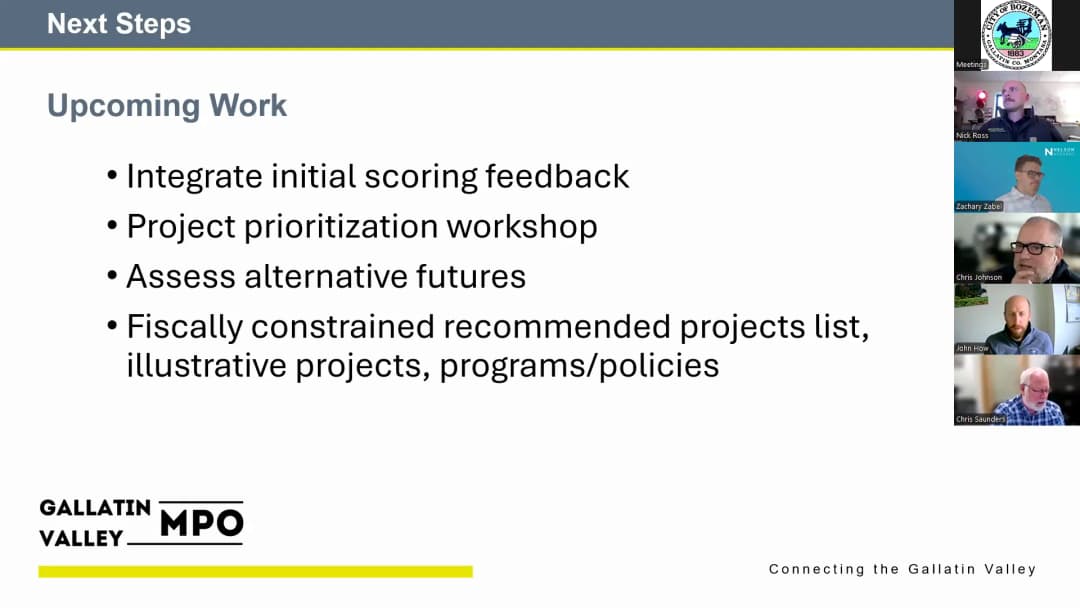
At its June 10, 2026 meeting, the Gallatin Valley Metropolitan Planning Organization (MPO) Transportation Advisory Committee (TTAC) reviewed a Unified Planning Work Program (UPWP) amendment, the draft FY27 UPWP, the Long-Range Transportation Plan (LRTP) project list, and a background report on the Valley Center Spur connection. All votes were unanimous. Consent Calendar - Approval of Minutes (March 2026): Motion to approve moved by John, seconded by Beth. All 8 voting members present voted yes. Public Comments & Testimony - General Public Comment: No requests. - On Valley Center Spur Report: Marilyn Brown praised the report as "amazing" and thanked staff for the work. Discussion Items - Amendment to FY26 UPWP (Item E3): Jeff (MPO Manager) requested an additional $53,159 for the LRTP to cover GIS work, modeling, and enhanced spring community engagement. Funding would come from reserve savings ($20,800), staff savings due to departure, reduced conference attendance, and minor program reductions. The amendment recommends TPCC approval. TTAC voted unanimously to recommend. - Draft FY27 UPWP (Item E4): Jeff presented the draft work plan for FFY27 (Oct 2026 – Sep 2027). Budget includes $601,835 after federal and state allocations. Notable changes: reducing out-of-state conferences to one per year, dropping two proposed continuous count stations (returning for refund with 10% restocking fee) due to cost/feasibility, and emphasizing partnership-building and e-notification. No action required; first look for feedback. - LRTP Project List Presentation: Consultants from Nelson Nygaard (Zach and Chris) presented the evaluation framework for scoring projects. 21 metrics across 6 goals yielded 29 possible points. 116 projects were scored and placed into four tiers. Members requested seeing full scores, adding metrics for number of users impacted and cost per user, and geographic labeling. Chair noted that scoring is not the final prioritization; cost, timing, and other factors will be considered later. No vote taken. - Valley Center Spur Background Report: Jeff summarized the report on this critical connection between Valley Center and Frontage Road. Historic safety issues (fatal/severe crashes) led to signal installation in 2019, but multimodal gaps remain. Near-term concept: pedestrian signal across Frontage Road. Longer-term: feasibility study for underpass and trail connections. Chris (City of Bozeman) noted upcoming lighting standard changes. City of Bozeman also closed an RFQ for pre-design of the Frontage Road shared-use path from this intersection to Cherry River fishing access. Key Outcomes - FY26 UPWP Amendment: Unanimously recommended to TPCC for approval (8 yes, 0 no). - Draft FY27 UPWP: No action; committee to provide feedback via email before next meeting. - LRTP Project List: No vote; staff to provide full scoring data and consider additional metrics raised. - Valley Center Spur: Background report accepted; no formal action but future discussion possible. - Vice Chair: Jason Murphy (acting Belgrade Public Works Director) introduced; consideration of formal vice chair appointment deferred to next month. Next Steps - LRTP prioritization workshops and modeling alternatives to be presented in July/August. - FY27 UPWP to return for formal recommendation at next TTAC meeting. - Valley Center Spur feasibility study and pedestrian signal concept to be advanced collaboratively.

ENGINEERING AND INFRASTRUCTURE 30% · TRANSPORTATION SAFETY 24% · PROCEDURAL 13% · FISCAL SUSTAINABILITY 11%
70
JUN 10, 2026 · BOZEMAN, MONTANA · CITY COMMISSION
Bozeman Sustainability Advisory Board Work Session on Green Power Program: June 10, 2026

The Bozeman Sustainability Advisory Board convened on June 10, 2026, at 12:15 PM for a work session focused on the Green Power Program Lead Community Agreement with Northwestern Energy. The meeting included a presentation, discussion, and public comment. Public Comments & Testimony - Mark Campanelli, a Bogert Park neighbor and resident, expressed skepticism about the program. He raised concerns about Northwestern Energy's reliability, the impact of its pending merger with Black Hills Corporation, and the need for improved battery options. He cautioned against bad incentives and urged support for local renewable energy and battery storage. Discussion Items - The main agenda item was a work session on the Green Power Program Lead Community Agreement, presented by Natalie Meyer. She outlined the program's history, guiding principles (additionality, no cost shifting), and the 50 MW cap. The agreement defines roles for lead communities (Bozeman, Missoula, Missoula County) and Northwestern in filing a tariff with the Public Service Commission. The program aims to develop a new utility-scale renewable energy project (likely wind or solar) in Montana. - Board members discussed the timeline, subscription details (including residential options), and market-based credits. Questions addressed the RFP process, energy storage, and the impact of Northwestern's evolving portfolio. Key Outcomes - The board approved the minutes from the May 13, 2026 meeting (motion passed). - The board anticipates reviewing the actual Lead Community Agreement at its next meeting for a recommendation to the city commission. - An FYI item: a Gooch Hill sub-area plan open house on July 8, 2026, was noted, with board members expressing interest in holistic planning for the area.

ENVIRONMENTAL PROTECTION 34% · ENGINEERING AND INFRASTRUCTURE 29% · TECHNOLOGY AND INNOVATION 23% · COMMUNITY ENGAGEMENT 8%
OPENPUBLICA · PUBLIC MEETING INDEXUPDATED DAILY · openpublica.com