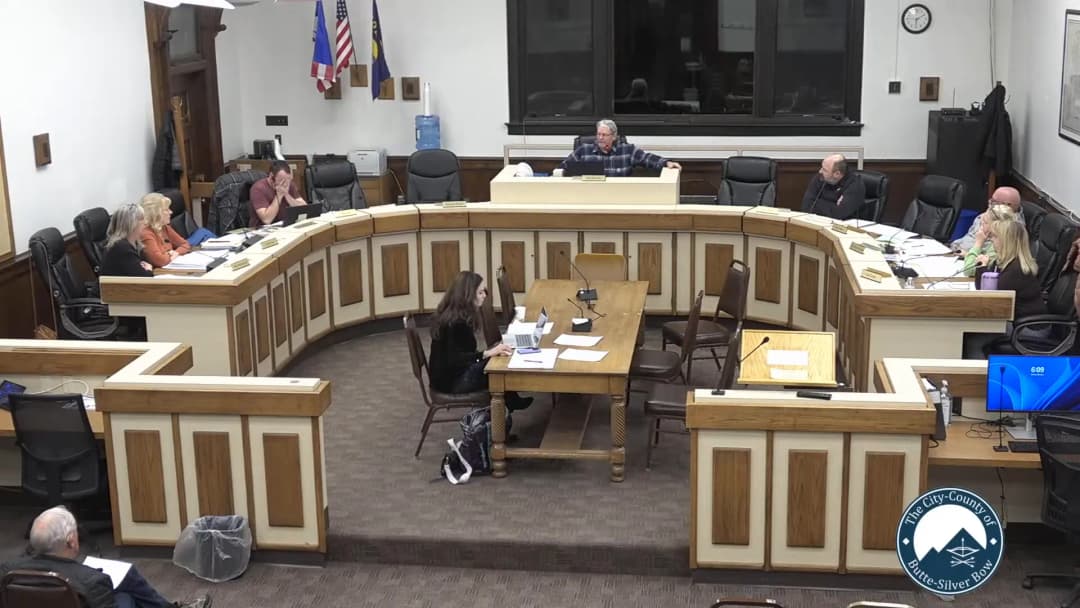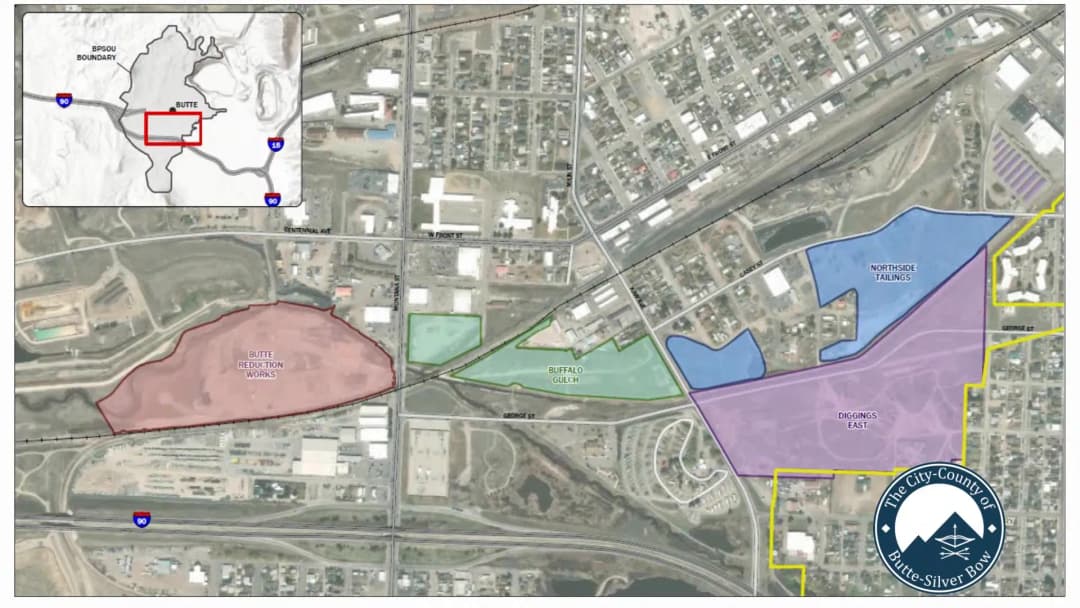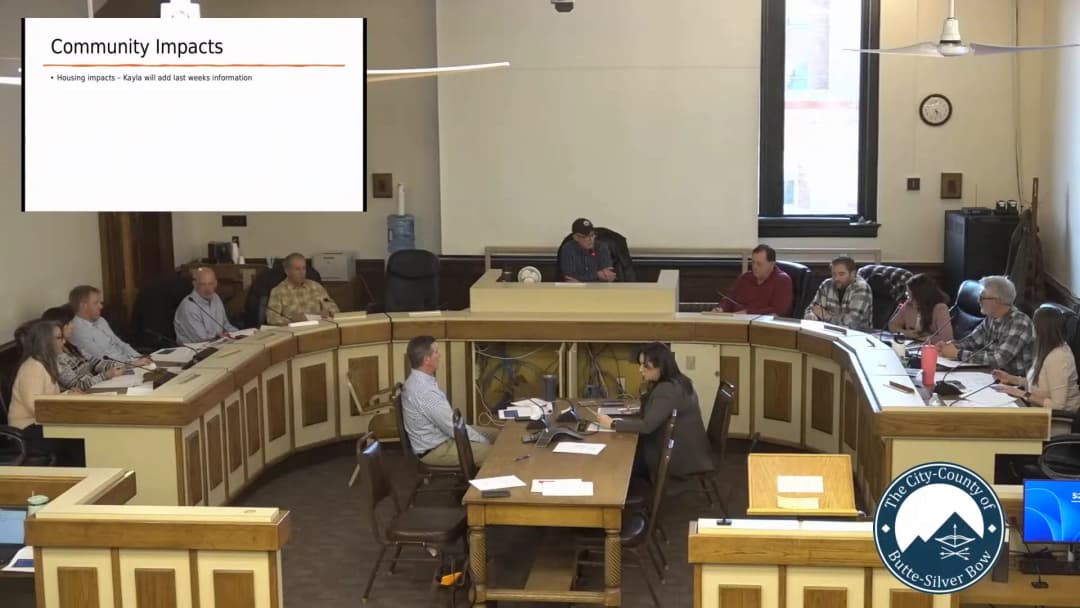
The Butte Silver Bow Ad Hoc Data Center Impact Committee met on February 10, 2026, to finalize a slide deck for a presentation to the Council scheduled for February 18, 2026, regarding the proposed SABI data center. The committee reviewed draft slides, discussed key topics, and set a timeline for completion. Consent Calendar - Minutes Approved: The committee unanimously approved the minutes from the previous meeting after the chair clarified a description of construction traffic and road conditions in the area. Discussion Items - Slide Deck Structure: The committee decided to create two versions: a condensed presentation for the Council covering power, water, taxes, jobs, environmental and community impacts, and a separate addendum with background information, definitions, and supporting data. The presentation will open with the committee's mission, a map, and then proceed through the core topics. - Definitions: The committee refined the definition of "data" to include all electronic devices, not just computers. Sarah Border volunteered to research inclusive terminology such as "Internet of Things." It was clarified that the proposed data center is a co-location type; Bob Morris will verify with SABI. - Jobs and Phasing: Sarah suggested breaking down jobs by phase (e.g., for the initial 50 MW). John McLean argued for consistency: if jobs are presented in phases, water and power estimates should also be phased. Karen Burns recommended presenting full build-out numbers across all topics for simplicity, with footnotes on phasing. The committee agreed to present full build-out data for water and power, with job numbers also at full build-out while noting the phased timeline. John McLean also stressed including a 10-year timeline reference to temper expectations. - Tax Revenue: John McLean requested specific tax revenue estimates for the full build-out, comparable to the detailed numbers given for other topics. Kayla Lappin confirmed that Andy Durkin's detailed tax calculations would be added to the slides. - Water Usage: Bob Morris and Jim Keenan merged water slides to show the independent industrial water system and projected usage. Key points: full build-out annual water consumption of 16 million gallons (peak summer usage 300,000-400,000 gallons/day for 30-60 days); the Silver Lake system has capacity well above this, as demonstrated by past usage and the upcoming Metro effluent reuse project which will offset the data center's usage. - Environmental Impacts: The committee planned slides on noise (including generator testing), lighting (downlighting requirements), and discharge (cooling water blowdown; SABI to clarify). They will request decibel readings from SABI and note that noise is comparable to existing industrial park activities. - Community Impacts: Slides on housing and traffic were retained and will be part of the presentation. - Public Questions: Kayla Lappin reported approximately 65 questions received. About one quarter have been answered, with responses directed to the website FAQ. Inappropriate questions will be omitted. A compiled Q&A addendum will be provided to the Council and posted on the website. Key Outcomes - Minutes Approved: Motion carried. - Next Meeting Canceled: The committee voted to cancel the meeting scheduled for February 17, 2026 (the following Tuesday) to allow time for printing and finalization. - Assignments: - Bob Morris: Confirm data center type with SABI; add slide on PSC docket and large load tariff; simplify water slides with Jim Keenan; provide estimated tax revenue slide (with Andy Durkin). - Kayla Lappin and McKenzie: Receive slide inputs from members by Thursday, February 12; compile final slide deck by Tuesday morning, February 17; coordinate printing of 100+ copies. - Jim Keenan: Assist with water slides. - Sarah Border: Research data terminology. - Presentation to Council: Set for Wednesday, February 18, 2026. The chair will lead, supported by Bob Morris (power, water), Andy Durkin (taxes), Kayla Lappin (jobs, Q&A), Karen Burns, and Jim Keenan. Public Comments - Jay Cornish: Asked about hazardous and solid waste disposal plans for the facility. - Cindy Purdue Nolan: Requested inclusion of information on closed-loop water systems and technological advancements. - Evan Bear: Thanked the committee but expressed difficulty viewing slides from the audience; urged earlier public access to slide drafts. He disagreed with using full build-out job numbers instead of a phased, sequential plan and left written comments for the committee. - Jamie Payne: Recommended adding a technical writer for consistency and questioned why the land agreement extension was presented to the Council before the committee completed its work. - Tom Malloy: Raised concerns about the "no discharge" claim, on-site water storage requirements, and hazardous waste storage and disposal. - Robin Jordan: Encouraged the committee to ensure slides are readable with clear, large text and fewer slides per sheet.
Public Meetings - Butte Silver Bow, Montana
Public Meetings - Butte Silver Bow, MontanaThe Butte-Silver Bow Study Commission met on February 9, 2026, to discuss and vote on options for the future of volunteer fire departments in the charter. The main agenda item was the fire department working group update, with extensive debate on three proposed options. The commission voted to advance options 1 and 3 to the working group for further development and to eliminate option 2. Consent Calendar - Approved the minutes from the February 2 meeting (motion by Ms. Shaw, second by Mr. Dennehy; unanimous voice vote). Public Comments & Testimony - No members of the audience were present; public comment was skipped. Discussion Items - Correspondence: An email from John Sorich was mentioned but not yet received by the chair; follow-up with Ms. Adams was directed. - Fire Department Working Group Update: The commission reviewed a document from the volunteer fire departments outlining their proposed transition plan under Option 1 (removal from charter). Key discussion points included: - The distinction between "rural fire districts" and "volunteer fire departments" in the charter and state law. County Attorney Matthew Enruth agreed to provide a memorandum clarifying the legal definitions. - Option 1: Remove all volunteer fire department language from the charter, leaving them subject to state law as rural fire districts. Supporters argued it gives volunteers independence and control over their future; opponents (including Commissioner Silk, a paid firefighter) raised concerns about operational cohesion, public safety, and potential for multiple tax levies without guaranteed service. - Option 2: A hybrid approach with detailed charter language specifying structure and authority. Many commissioners viewed this as overly complex and unlikely to succeed due to the need for extensive prescriptive details. - Option 3: Revise charter language to clarify the authority of the paid fire director over volunteers, include a volunteer fire coordinator, and allow future adjustments via ordinance. County Attorney Enruth opined this option is least likely to be litigated, as it corrects existing ambiguity. - Legal opinions: County Attorney Enruth stated that Option 1 could lead to litigation over ownership and taxing authority, while Option 3 clarifies the county's authority as intended by state law. He noted that the legal issue is simple but the public and interpersonal dynamics have prevented resolution for 40 years. - Commissioner Dolan emphasized the need for the volunteers to present their case directly to the commission, while Commissioner Steppen and others stressed evaluating financial sustainability and transition plans before placing options on the ballot. Key Outcomes - Vote on options to advance: Commissioner McCormick moved to advance Option 1 (remove volunteers from charter) and Option 3 (revised charter language with authority to paid fire director) to the working group, and to eliminate Option 2. The motion was seconded by Ms. Shaw. - After discussion, the motion carried unanimously. The working group is tasked with returning draft charter language for both options by the next meeting on February 23, 2026. - The commission also agreed to request additional information from both supporters of Option 1 (volunteers) and Option 3 (career department) to provide the public with a balanced view of pros and cons. - Next meeting scheduled: February 23, 2026, in council chambers. A special appearance on Party Line (February 25) is to be arranged via email.
The Council of Commissioners of Butte Silver Bow met on February 4, 2026, to address a contentious request from SABE Data Centers (via Horizons Montana LLC) for a one-year extension of the purchase and sale agreement for 600 acres in the Montana Connections Business Park. After extensive public comment and commissioner deliberation, the Council voted 9-3 to amend the extension to six months. The meeting also included routine approvals of consent agenda items, budget amendments, and resolutions. Consent Calendar - Approved the minutes from the January 21, 2026 regular meeting (12-0). - Approved consent agenda items with exclusions: finance grant (2026-20), Skyhawk Sports Academy agreement (2026-52), and the data center extension (2026-74) were segregated for separate votes. Public Comments & Testimony - Anthony Laslovich (BLDC Board President) spoke in support, urging approval to foster economic development. - Elton Ringshock opposed the extension, citing environmental harm, noise pollution, tax concerns with the TED district, and lack of public process. He called for renegotiation with protections. - Don Patriots questioned the promised 200 jobs, job types, and whether contractors would be local. He opposed the extension, asking for a new buy-sell agreement. - Eric Nylon opposed, noting a citizen-driven PSC case accepted that day. He criticized lack of transparency from Northwestern Energy and SABE, and urged the Council to let the extension lapse. - Scott Gray recommended letting the extension die to renegotiate with guardrails. - Holly Hansen asked to reject the extension or exclude the 373-acre parcel bordering Buxton, citing overreach on land use. - Sister Mary Joe (Leavenworth, Kansas) urged postponement, raising ethical concerns about community impact, cheap land price ($2,000/acre), and water/electricity burdens. She asked the Council to read their oath of office. - Brian Sullivan (Ad Hoc Committee Chair) asked for the extension to allow the committee to complete its fact-finding, noting they would present on February 18. - Kathy Fry opposed, citing unclear job numbers (25–30 typical), e-waste, noise, water concerns, and distrust of Northwestern Energy. - Denise Kelly opposed, calling the buy-sell one-sided and questioning a right-of-first-refusal cloud on the title. She urged a no vote. - Evan Barrett (former economic development professional) opposed the extension, calling the buy-sell a bad deal. He suggested renegotiation with sideboards on power, water, job quality, and land usage (600 acres excessive). - Ready Frost (Carpenter’s Union) supported, emphasizing construction jobs and standard of living improvements. - Brandon Calwell supported, arguing the project would keep union workers local and that concerns about transparency are overblown. - Todd Johnston (TED Board member) supported extension, saying the opportunity is unique and extensions are common. - Joel Wirth supported, recommending approval to create apprenticeship opportunities. - Andy Durkin (CPA) supported, citing enormous tax revenue potential: $1.5–2 billion in building investment alone, generating $13 million annually in property taxes (at 0.9% rate), most returning to the TED district. - Josh Cox (Sheet Metal Workers) supported, noting potential for 10–15 new apprentices and 20–40 workers. - Sean Roberts supported, citing experience at Intel and the potential for high-tech growth. Discussion Items - Chief Executive Gallagher gave a history lesson, noting that other projects (e.g., REC, Sonata) received less scrutiny. He argued the ad hoc committee was unprecedented, that water and power concerns are manageable, and that SABE has a strong track record. He urged approval of the extension. - Commissioner O'Leary delivered a lengthy critique, listing specific asks for written commitments from SABE on construction timeline, tax revenue breakdown, job guarantees, housing impact, noise mitigation, water usage, and splitting the purchase into three parcels with staggered clawback provisions. He stated he wants to vote for the project but needs these assurances. - Commissioner Thatcher supported the extension, arguing it buys time to get answers and noting that trades jobs matter. She cautioned against denying the extension and risking losing the project. - Commissioner Fisher opposed, citing calls from constituents against the project, a right-of-first-refusal cloud with REC, and concerns about legal disputes. - Commissioner Healy opposed, stating a one-year extension ties up public land without clear benefit and reduces leverage. - Commissioner Shea sought a middle ground, wanting SABE to engage directly with the community and clean up title issues before locking in a long extension. - Commissioner Morgan noted that SABE had already agreed to add a two-thirds council vote requirement, demonstrating good faith. He moved to amend the extension to six months. - Commissioner O'Neill objected to a one-year extension but supported six months to allow resolution of title and energy issues. - Commissioner Boyle favored a six-month extension to let the ad hoc committee finish. - Commissioner Callahan raised concerns about community wells and contamination risks that should be addressed. - County Attorney Ann Ruth explained that the right-of-first-refusal with REC could lead to litigation regardless of the Council’s action, and that amending the contract (to six months) requires SABE’s acceptance. Director Burns confirmed that SABE had verbally agreed to six months. Key Outcomes - Vote on extension (2026-74): Motion to concur and place on file with amendment to six months (from one year) passed 9-3 (Commissioners Fisher, Healy, and O'Leary dissenting). The amended extension now goes to SABE for acceptance. - Consent and other items: All remaining agenda items were approved unanimously (12-0), including: - Communication 2026-20 (NEHA FDA grant) - Communication 2026-52 (Skyhawk Sports Academy agreement) - Budget amendments for health department programs (communications 2026-46 through 2026-51) - Resolution 2026-02 (sole source purchase for sewer division) - Resolution 2026-05 (calling Melrose Water District mail ballot election) - Addition of emergency items (communications 2026-77 and 2026-78).
This meeting of the Finance and Budget Committee was called to order with all commissioners present: Walker, O'Neill, Thatcher, Shea, O'Leary, and Boyle. The sole agenda item was the expenditure list. Discussion Items - The committee reviewed the expenditure list. Commissioner Shay was asked if there were any questions. - A motion was made and passed concerning seasonal temp help, referenced on page 90 of the expenditure list. Key Outcomes - The motion regarding the expenditure list (specifically for seasonal temp help) passed. No vote tally was provided in the transcript.
Commissioners Josh O'Neal, Trudy Healy, Tommy Walker, Bert, and Bush Grubrant were present; Eric Mankins and Russell Larry were absent. Guest Kelly Sullivan, director of the Butte Local Development Corporation (BLDC), provided a quarterly update on the Anaconda ARCO Loan Fund, grants, business recruitment, and other BLDC activities. The meeting included discussion on loan fund details, the Praxis Center loan extension, and a data center ad hoc committee. No votes were taken. Discussion Items - Anaconda ARCO Loan Fund Update: Kelly Sullivan reported that the fund has $474,900.97 available for lending. It is a revolving loan fund specific to Butte Silverbow County, managed by BLDC. The only current loan is to the Praxis Center for approximately $200,000, which is on an interest-only payment plan. The Praxis Center has requested an extension, and the loan committee will review it on February 18, 2026. Commissioner Healy questioned the timeline of previous extensions and whether the construction loan was secured; Sullivan agreed to provide a full update at the March 4 meeting. - Grant Awards: Sullivan announced that six grants were awarded in the previous week: three Opportunities in Rural Economies (ORE) planning grants totaling $100,000 for feasibility studies and a geotechnical study for a multifamily housing development. Additionally, BLDC submitted an ORE capacity grant application for staff computers, education, and business recruitment events. - Business Recruitment: Sullivan attended the Photonics West Conference in San Francisco to recruit photonics companies. A red carpet tour was held on January 14, 2026, for Project Janicky, an aerospace components manufacturer considering Butte, Helena, Great Falls, and Idaho locations. Two sites are under consideration in Butte: Connections Park and land south of town. - Data Center Ad Hoc Committee: Sullivan stated that BLDC’s board supports the ad hoc committee and encourages the council to extend the purchase and sale agreement. She will read a letter during the public comment period for the record. - Workforce Development: Sullivan met with the Butte School District and County Superintendent Jim O’Neill to discuss the Pathways Program, which is used to attract businesses by showcasing workforce preparation. - Postponed Presentations: Sullivan postponed the BLDC strategic plan presentation and the Brownfields program update (with Melissa Wanamaker) to the March 4, 2026, council meeting due to the agenda’s focus on the data center. Key Outcomes - No motions or votes were taken during the meeting. - Kelly Sullivan will return on March 4, 2026, to present the BLDC strategic plan and a Brownfields update, and to provide additional information on the Praxis Center loan status. - The meeting adjourned by unanimous consent after a motion by Commissioner O'Neal and a second. Public Comments - No formal public comments were made during the meeting. Kelly Sullivan indicated she would read a letter from the BLDC board regarding the data center ad hoc committee during the public comment period, but this was not reflected in the transcript.
The Ad Hoc Committee convened on February 3, 2026, to review the proposed SABI Data Center project in the Montana Connections park. The meeting focused on four primary topics: economic impact (taxes and jobs), infrastructure requirements (water, wastewater, and power), permitting processes, and community comparisons. Representatives from the Butte Local Development Corporation, Butte-Silver Bow, and local educational institutions provided updates on the potential benefits and operational models of the facility, drawing parallels to a similar project in Quincy, Washington. Consent Calendar - Approval of the minutes from the previous meeting was unanimously accepted with no comments, questions, or clarifications. Public Comments & Testimony - Lori John Sandrish (former Microsoft safety manager) expressed strong support, citing excellent safety records in Quincy data centers and highlighting the positive economic shift in a former agricultural community to a tech-centric hub capable of retaining young families. - Don Patrice expressed reservations regarding the lack of clarity on job numbers, questioning if the 200-300 jobs cited are total for the area or per facility, and raised concerns about future fire department needs, their funding sources (TED increment vs. taxpayers), and the potential scale of tax benefits for a single facility versus the six cited in Washington. - Pam Dietrich expressed confusion regarding the timing of design release (before or after sale) and raised concerns about future power supply requirements, specifically the potential use of small modular nuclear reactors, urging the committee to investigate this possibility. - Lila Klovacar, a well resident, expressed apprehension about e-waste and water contamination risks, noting that Butte residents rely on aquifers and are not on the public water system; she also suggested sizing the project down to preserve land for future economic opportunities. - Linda Trevanna expressed concern that tax increments from a Tax Increment Financing (TED) district might not flow to general city services but remain trapped for the 15-year TED period, potentially misrepresenting the direct financial benefit to the community compared to the Quincy model where tax revenues directly funded expansions. - Michael Barrett argued the extension timeframe (32 months) is excessive, comparing it to the rapid closure of the Alcoa plant deal, and warned that the current extension removes community leverage while tying up resources for non-contiguous parcels without guaranteed outcomes. - Cindy Sanderson urged the committee to conduct an "impact statement" on current citizens, emphasizing opportunity costs of tying up resources and the social adjustment period required for the community. - Mike Houston (identifying himself as "hyperbolic" regarding power concerns) questioned if the data center would be prioritized over human life during grid blackouts or geomagnetic events, asked if the project requires a reclamation bond similar to hard rock mining, and inquired about safeguards for Butte's water rights against potential legal manipulation. Discussion Items - Economic Impact & Taxes (Kelly Sullivan & Director Burns): Kelly Sullivan presented data from Quincy, WA, where six data centers added approximately $7.5 billion to the taxable value (from $937M to $8.47B since 2006), funding infrastructure and schools even if rates dropped. She clarified that while TED increments are collected for 15 years, a remittance agreement could be enacted to return funds to taxing jurisdictions if district goals are met. Director Burns confirmed that all new taxpayers contribute to the base regardless of the TED, and the 15-year increment allows for infrastructure investment. JP Gallagher clarified that the base of the new TED now includes the old TIFF base, meaning current collections go to the city, with new increments going to the district. - Infrastructure & Water Systems (Director Burns & Bob Morris): The committee discussed the closed-loop cooling system for the servers, which would collect and ship treated coolant off-site rather than discharging it. A spray system on condensers using Silver Lake water is intended to evaporate rather than pool, but Director Burns noted the need to clarify if catch basins will be installed. Bob Morris, though absent, provided context on his independent review of the water system. The group clarified that the facility would connect only to sanitary/sewer systems for restrooms/kitchens, with industrial discharge being a distinct issue to be permited during the design phase. - Workforce & Education (Tammy McLean & Highlands College): Montana Tech remains neutral but committed to supporting workforce training in STEM fields (engineering, computer science, welding) regardless of site location. Highlands College expressed readiness to expand programs in heavy equipment operations, HVAC, and cybersecurity. They noted that SABI in Quincy partnered with local community colleges to create specific technician career launch programs with paid internships. The committee discussed the possibility of short-term certificates for these roles to avoid long board of regents approval processes. - Permitting & Zoning (Julie Crane): Julie Crane outlined the pre-application process for heavy industrial (RM2) zones, involving multiple departments: Planning, Public Works, Fire, Building Code, Health, and environmental partners. She confirmed that air quality, vibration, and lighting standards would be reviewed, often requiring state and federal permitting alongside local approvals. - Traffic & Construction (Director Burns): Discussions addressed traffic impacts primarily during the construction phase (peaking at 500-600 workers) and future commute patterns. Director Burns noted that road design in the park accommodates truck traffic (FedEx, REC) and that the TED increment can fund infrastructure improvements like bridge or road expansions if needed. The potential for using a loop road for construction access was suggested to minimize disruption. - E-Waste & Disposal (Ms. Bordoon): The committee identified e-waste management as a key area to be addressed. Ms. Bordoon proposed adding an action item for SABI to detail their e-waste collection and recycling procedures, including whether they will use third-party firms or internal logistics, noting that local landfill regulations could dictate disposal methods. - Process & Extension: The Montana Connections Board voted 5-1 to recommend a one-year extension of the purchase and sale agreement, with additional language addressing Butte-Silver Bow's review process. The committee agreed to continue operations post-presentation to the Council on Feb 18 to address ongoing questions, rather than disband. Key Outcomes - Extension Recommendation: The committee received confirmation that the Montana Connections Board voted 5-1 to extend the SABI purchase and sale agreement for one year, including language to ensure compliance with the city's review process. This recommendation is set to be presented to the City Council for a final vote. The Council must approve a two-thirds vote for the extension to be effective. - Information Gathering Directive: The committee agreed to compile all slide decks and gathered data (covering power, taxes, jobs, water, e-waste, and permitting) into a unified slide deck and accompanying technical papers to be distributed to the Council before the February 18 meeting. - Action Items: - McKenzie: To centralize all submitted slides and background information into a single, clear presentation format. - SABI: To provide detailed responses on e-waste disposal protocols, specific job breakdowns (direct vs. indirect), and wastewater discharge permit requirements. - High School Engagement: To reach out to Ramsey School (via Chris Kellogg) to gather input on the potential impact on high school students and local workforce pipelines. - Website Update: To publish answers to public questions regarding water, traffic, and jobs as they are finalized. - Continuity: The committee agreed to remain active beyond the Council vote to continue addressing community questions, ensuring transparency and a model for future large-scale economic development projects.
The Study Commission convened to review updates on the three proposed options for restructuring the fire service, discuss the lack of clarity from the Volunteer Fire Departments regarding Option One (removal from charter), debate the potential for a fourth option based on new information, and finalize a timeline for public input and the preliminary report. Key discussions centered on the ambiguity of authority under Option Two, the necessity of a unified command structure for public safety, and the logistical challenges of the working groups' deliverables. The commission agreed to extend the timeline for the tentative report to April to allow for public education and survey distribution, with a target date of February 23rd to finalize the options presented to the public. Consent Calendar - Correction of Minutes (Jan 26): Ms. Purdue Dolan requested a clarification to the minutes regarding her comments on Option Two. The commission agreed to amend page six to state that Ms. Purdue Dolan shared the concept of Option Two with volunteers, who indicated they would weigh in after receiving more details and specifics, rather than stating they rejected the idea. Mr. Stefan moved to approve the minutes from January 26th as amended. Public Comments & Testimony - Fire Advisory Board Discrepancy: Ms. Purdue Dolan reported confusion regarding a motion by the Fire Advisory Board to draft a letter of support for Chief Osborne. She noted that a volunteer attendee (Jonathan Rice) stated he did not vote on the motion to draft the letter, raising questions about the validity of the "all in favor" minute. Ms. Purdue Dolan expressed frustration that the board had not clarified the scope of the vote (drafting vs. sending) and stated the board plans to meet and resend a revised, formal statement. - Commissioner O'Neill's Role: Commissioner Josh O'Neill was contacted regarding the Advisory Board's confusion. He agreed to have the board finalize their statement and resend it to the commission, ensuring proper protocol and buy-in from all members. Discussion Items Option One: Removal of Volunteers from Charter - Information Gap: Ms. Purdue Dolan reported that Jason Willoughby (representing volunteers) has agreed to provide a specific list of actions, maps, boundaries, and consolidation plans required if Option One is chosen. He acknowledged the commission needs "meat on the bone" regarding what moving forward looks like under this option before the next meeting (deadline: Monday). - Clarification on Charter Language: Ms. Casey and Mr. Steppen discussed whether the volunteers' recent submission of charter edits constitutes Option One or a separate proposal. Mr. Steppen clarified that the draft presented Monday was created before receiving the volunteers' new data. There is a consensus that volunteers want clarification on whether they are seeking complete removal (Option One) or a different structure. - Option Four Proposal: Ms. Purdue Dolan suggested the new information from volunteers—which includes retaining charter presence but rejecting unified command—might constitute a separate "Option Four," distinct from the original three options. Option Two: Consolidated Volunteer Department / One Chief - Feasibility and Authority: Mr. Thielen confirmed that having two chiefs (one paid, one volunteer) is legally permissible under his interpretation, though Ms. Steppen and Ms. Silk urged the commission to seek clarity from County Attorney Enruth regarding the chain of command and liability under a unified charter structure. - Consolidation and Training: Mr. Thielen and Ms. Shaw discussed the potential for consolidating smaller volunteer districts into larger entities to create a "proving ground" for paid positions. They highlighted the need for a dedicated F2 Training Officer position (currently unfunded due to a legal cap on budget, though the Director has creatively utilized retirements for a six-month trial) to ensure standardized training across all ranks. - Union and Paid Department Perspective: Mr. Steppen and Mr. Thielen relayed that paid firefighters prioritize safety, standardized training, and clear authority over the director to ensure they can rely on each other during emergencies. They emphasized that the lack of administrative/operational control makes standardization impossible. Option Three: Unified Director of Fire Services - Unified Authority: Mr. Steppen presented Option Three as the method to solidify authority under the Director of Fire Services, addressing the 50-year ambiguity. He noted that paid staff view this as the best path to ensure uniform training and operational safety. - Volunteer Input Mechanism: Ms. Shaw and Ms. McCormick emphasized the necessity of a formally mandated "Volunteer Coordinator" or liaison position in the charter to ensure volunteers have a voice and representation, rather than being entirely subsumed by the director. - Binary Approach Debate: Several commissioners (Ms. Steppen, Ms. McCormick, Mr. Silk) argued for a "binary approach" (two distinct options) to avoid public confusion, suggesting the commission narrow the choices before the public hearing. Mr. Thielen echoed the need for the community to "grow up" and prioritize public safety over internal disputes. Timeline and Process - Schedule Adjustment: Ms. Casey and Ms. McCormick argued that a tentative report in February was unrealistic given the heavy lifting required to incorporate new volunteer data. They advocated pushing the tentative report and public hearing to April. - Deliverable Deadline: The commission agreed to a strict timeline: The working group will review new volunteer information on February 9th, discuss and finalize the options in the working group meeting of the week of February 16th, and make a final decision on the options to include in the preliminary report on February 23rd. - Survey and Public Input: The commission discussed launching a broader survey (addressing both fire options and the number of commissioners) in conjunction with the release of the tentative report. Ms. Casey suggested the report be published on the website only after full commission agreement to avoid confusion between draft and finalized timelines. Other Business - Number of Commissioners: Mr. Thielen reiterated his support for reducing the number of commissioners to three to save costs, noting public concern about the feasibility of five or six full-time commissioners. - Meeting Attendance: Ms. McCormick informed the commission of her unavailability from February 11th–18th. The commission confirmed that while proxy voting is not permitted, she may participate and vote via Zoom using the county's established technology. Key Outcomes - Timeline Agreed: - Feb 9: Commission meets to review new information from Volunteer Fire Departments. - Feb 16–Feb 20: Working group meets to analyze information and formulate final options. - Feb 23: Commission meeting to make the final decision on the options (likely a binary choice) for the preliminary report. - Late March/April: Release of tentative report, launch of public survey, and public listening sessions. - April: Potential public hearing on the tentative report. - Directives to Volunteer Fire Departments: - Volunteers (led by Jason Willoughby) are required to provide a detailed action plan outlining exactly what implementation of Option One (and potentially Option Two/Four) would look like, including maps, boundaries, equipment assessment, and consolidation steps, no later than the next meeting. - Action on Advisory Board: - The Fire Advisory Board is tasked with clarifying their stance on the letter of support for Chief Osborne and re-submitting a formally drafted and voted statement to the commission. - County Attorney Clarification: - The commission requests clarification from County Attorney Enruth regarding the legal authority structure required for Option Two (specifically the relationship between a volunteer chief and a paid chief within the charter). - Survey Development: - Working groups are instructed to begin drafting survey questions regarding the fire options, the number of commissioners, and district configurations to be released with the tentative report.
The Council of Commissioners convened for a Committee of the Whole meeting on Wednesday, January 28, 2026, following the passing of long-time community member Mr. Fritz Daly. The agenda featured presentations on the Butte Priority Soils repository siting, emergency operations center activations regarding recent water and wind events, and a public education session on AI-powered surveillance systems. Commissioner Gerbrandt was welcomed to the body. Key decisions included the approval of land sales communications, the placement of public health budget amendments in abeyance pending February hearings, and the vote to place the Flock surveillance presentation on file rather than formally referring questions to staff. Consent Calendar - Communication 2025-01 (Sarah Bordoon): Moved to place on file regarding impacts of a data center (11-0 vote). - Communication 2026-05 (John Morgan): Moved to place on file regarding the appointment of Commissioner Gerbrandt as interim replacement (11-0 vote). - Communication 2026-10 (Mark Neary): Moved to place on file regarding the bid opening for main water materials replacement (11-0 vote). - Communication 2026-34 (Kayla Lappin): Moved to place on file regarding the purchase and sale agreement for Montana Connections Park (11-0 vote). Public Comments & Testimony - John Search (1820 Wilson, Butte): Expressed support for the sediment cleanup, noting that technical teams have identified a suitable location for repository soil. Stated clearly that "without a place to put that soil, there is no cleanup" and urged the council to move the process forward. - Evan Barrett (807 West Silver Street): Expressed concern regarding the flawed process of the repository siting committee, specifically citing seven public meetings held without notice, agenda, or minutes, which he argued violated the Montana Constitution's right to participation. Expressed skepticism regarding the elimination of "Opportunity Ponds" as a site, stating it was "not duly considered" due to this flawed process, though he stated he remained "willing to be persuaded" the current preferred site was good. Highlighted cybersecurity risks associated with Flock cameras, specifically mentioning unsecured cameras leaking 913 vulnerabilities and credential leaks on Russian hacking forums. - Jason Rackham (2234 Grand Avenue, Butte): Expressed strong opposition to AI-powered surveillance cameras (Flock Safety), arguing they violate Montana's constitutional privacy standard by collecting broadly before searching, creating a generalized tracking capability. Stated that such systems invert the constitutional baseline and cause First Amendment chilling effects on lawful associations. - Finn Guerin (642 West Granite Street, Butte): Exposed opposition to Flock Safety, echoing Mr. Rackham's concerns and adding that the company has terrible cybersecurity practices. Cited reports that Flock contractors in the Philippines process data without clear legal protections and noted the cameras run an unpatched Android version with over 913 vulnerabilities. Mentioned that several cities (Austin, Flagstaff, Santa Cruz, etc.) have cancelled contracts due to these risks. - Nathan Bowman (18 North Clark Street, View Montana): Clarified that the City and County are not currently pursuing Flock cameras, citing Montana state law (HB 178) prohibiting AI surveillance of public places. Stated the presentation was an "eye-opening" preventative measure. Expressed concern that state laws are being overrun by the federal government and urged the public to research connections between Flock and Ring. - Evan Barrett (Repeated): Provided a historical tribute to Don Peoples, Chief Executive from 1979-1989, describing him as a "mentor" who mobilized the community during the Anaconda plant closure. Expressed that Peoples' leadership transformed Butte into a "can-do city" and led to its recognition as an All-American City in 1988. Discussion Items - Repository Siting (Communication 2026-21): Director Josh Bryson (Atlantic Richfield) presented the final recommendation to use the Butte Mine Waste Repository for 1.1 million cubic yards of mine waste tailings over 5-7 years. Stated that the site is already approved under the 2020 consent decree and avoids the regulatory conflicts of circular law associated with other sites. Explained that the Opportunity Ponds were eliminated because they were the furthest distance from the source (EPA criteria) and would require using BNSF/UP railroads, which are settling defendants unwilling to host ARCO waste or lack the necessary capacity. Addressed Commissioner Callahan's concern about capacity, stating the repository is now estimated to hold 1.4 million cubic yards vertically, accommodating the waste from corridor projects while leaving room for local operations. Discussed traffic mitigation plans, including AI driver monitoring and limiting haul times during peak hours. - Emergency Operations Center (Communication 2026-26): Director Lisa Carey presented on two activations: a 10-day "Do Not Consume" water order (August) and a historic wind event (December 17). Reported that 4,000 cases of water were distributed during the water incident, and the EOC managed over 2,300 hotline calls. Highlighted lessons learned, including the need for additional radios, limited chainsaw availability, and gaps in generator coverage for facilities like the Health Department and City Shops. Noted that the Everbridge notification system reached a large population but encouraged residents to register personally to ensure accurate contact information. - Flock Safety Cameras (Communication 2026-24): Commissioners and the County Attorney discussed the legality and feasibility of Flock cameras. County Attorney Enrith confirmed that Montana law (HB 178 and MCA 44-15-104) explicitly prohibits government implementation of AI surveillance and facial recognition in public places. Chairman Morgan clarified the administration has no intent to pursue this technology. Commissioner Shea suggested an ordinance to prohibit the technology on private property to prevent data harvesting, though noted the Council cannot regulate private property rights directly. Key Outcomes - Motions Passed: - Communication 2025-01 (Bordoon) placed on file (11-0). - Communication 2026-05 (Morgan) placed on file (11-0). - Communication 2026-10 (Neary) placed on file (11-0). - Communication 2026-34 (Lappin) placed on file (11-0). - Motions Failed: - Motion to refer Communication 2026-24 (Bowman) questions to the County Attorney and IT Department failed (2-9). - Action Items: - Communication 2026-24 (Bowman) placed on file (10-1 vote). - Communications regarding land sales (2025-581, 2025-249, 2025-587) held in abeyance pending reports from the Land Sales Committee. - Communications regarding budget amendments (2026-46 through 2026-51) held in abeyance pending February 4th public hearings. - Bid opening Communication 2026-25 postponed to next week due to publication issues. - Commissioner Gerbrandt welcomed as the new Commissioner for District 1.
The Judiciary Committee convened on January 28, 2026, to address routine and legislative matters. Commissioner Shea presided over the meeting. Commissioners Thatcher, Callahan, Mankins, and Gerbrand (substituting for Commissioner Anderson) were present. Commissioner Truly Healy was absent. Consent Calendar - Resolution 2026-02: Authorized the sole source purchase of Huber parts for the City County Utilities Liverpool Metro sewer division, establishing an effective date within the resolution. Public Comments & Testimony - No public comments or testimony were recorded in the provided transcript. Discussion Items - The committee reviewed the necessity of the sole source authorization for Huber parts to serve the municipal sewer division. Key Outcomes - Action Taken: Resolution 2026-02 was authorized to proceed as a sole source purchase.
The Finance and Budget Committee convened on Wednesday, January 28, 2026, with Commissioners Shay, Thatcher, Boyle, Walker, Shea present, and Commissioners O'Neill and O'Leary absent. The meeting focused on approving emergency expenditures, reviewing a standard expenditure list of approximately $983,000, and processing a series of budget transfers primarily intended to address mid-year fiscal adjustments and overexpended line items for the new fiscal year. A final discussion took place regarding a grant application for environmental health regulatory improvements, resulting in a decision to forward the request to the full council. Consent Calendar - Emergency Expenditure Approval: The committee unanimously approved an emergency expenditure of $3,000.00 for filing fees related to the Montana Department of Administration regarding the Fiscal Year 2025 financial report. Commissioner Shay noted this is required to prevent fines or report rejection. - Expenditure List Approval: The committee unanimously approved the general expenditure list for Wednesday, January 28, 2026, totaling $983,306.98. Public Comments & Testimony - No public comments or testimony were recorded during this meeting transcript. Discussion Items - Budget Transfers: A comprehensive review of budget transfers totaling various amounts for the following purposes was conducted: - $5,000.00 to Readers with Installation for security (cottage). - $16,569.00 from Public Works for bank charges (Square), Starlink internet systems, and a snowplow. - Machinery and equipment transfer for a replacement pressure washer. - $4,300.00 to the Council of Commissioners for Civic Rec subscriptions and Municode codification support. - $2,000.00 from Public Works for Hawser (Haswoper) training for the water maintenance division. - $1,194.00 from Public Works to the Water Utility for hazard pay and supplies for a water emergency. - $10,000.00 from Public Works for overtime to operate the industrial water system. - $10,000.00 from Metro Sewer and Public Works for increased cleaning, pest control, and excavation notices at the roundhouse. - $5,000.00 from the Road Fund for tools (Ferris Metal Locators and Asphalt Lutes) for year-round paving projects. - $10,600.00 as a grant allocation for the Veterans Treatment Court. - $4,868.00 from the Department of Justice as a grant for the DUI and Vets Treatment Court. - $1,926.00 transfer within the County Attorney's office to fund a copier (item adjusted from $7,315.80). - $3,797.00 to the Clerk of the Court for desks, returns, and filing cabinets. - $102.00 to the District Court for translator charges. - $25,000.00 transfer within the Sheriff's Office for deductible insurance expenses. - $25.00 for the detention summer. - Context: Chairperson Morgan explained these transfers increased in frequency nearing the fiscal year-end as departments address overspent line items during the mid-year review process. Key Outcomes - Motion Passed: Approved emergency expenditure of $3,000.00. - Motion Passed: Approved expenditure list of $983,306.98. - Motion Passed: Approved multiple budget transfers to reallocate funds for supplies, equipment, grants, and operational costs. - Referenced Item: Communication 2026-20 was reviewed. The committee made a motion to refer the request for a $5,000 NEHA FDA retail flexible funding model grant (with potential $7,500 training add-on) back to the full council for approval, citing potential urgency regarding application deadlines. - Adjournment: The meeting was adjourned with a unanimous "Aye" vote. Note: The transcript date is listed as January 28, 2026, while the header timestamp of the request specified January 29, 2026; the meeting content clearly reflects the January 28 proceeding.