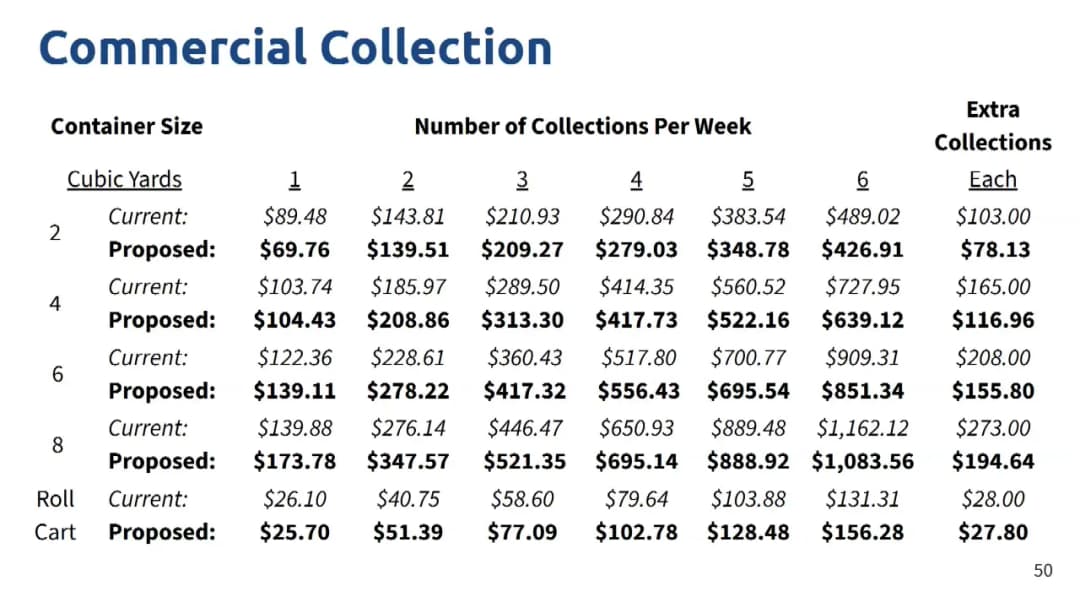
The City of Columbia held its second FY2027 budget work session on July 15, 2026, focusing on enterprise funds (transportation and utilities). Staff presented operating forecasts, cash positions, and proposed rate changes for each fund. Council members discussed parking enforcement, solid waste downtown rates, sewer realignment, water and electric rate increases, and other fiscal matters. No formal votes were taken; proposals will be introduced as ordinances in upcoming council meetings. Discussion Items Enterprise Fund Overview - Matthew Liu explained that enterprise funds must be self-sustaining, generating revenue through user fees; they cannot subsidize general government functions. The two groups are transportation (airport, parking, transit, railroad, transload) and utilities (sewer, solid waste, stormwater, water, electric). Airport - Projected $4.5 million cash above required reserve at end of FY27. Internal budget review cut marketing by $15,000 (shifted to city communications) to offset FAA-required air rescue firefighter training. Councilmember asked if this affects airline agreements; staff confirmed it does not. Parking - Projected $500,000 revenue over expenditures. A $1 million cash release from the Residential Parking Permit Only (RPPO) program is expected to be approved by council. Proposed changes: enforce hourly parking in garages on Saturdays (currently free), reduce free grace period from 60 to 30 minutes to improve turnover. Staff estimated $350,000 additional revenue from adjusting rates and Saturday enforcement. Councilmembers expressed concerns about impacts on downtown businesses and game-day parking. Discussion of future license plate reader (ALPR) technology to improve data and enforcement, but no immediate plan. Transit - Projected $1.2 million deficit, largely due to declining pandemic-era grant revenues. Railroad - Projected $14,000 surplus, supported by $500,000 in subsidies from utilities. Transload - Projected $70,000 deficit, but subsidies from utilities have decreased as revenue improves. Sewer - FY27 budget shows $3.6 million revenue over expenditures. No overall rate increase proposed. Staff recommended realigning residential base and volume charges based on cost-of-service: base rate drops from $12.37 to $11.10; volume charge increases. For users up to 5 CCF, bills decrease by $0.61/month; heavier users pay more. Non-residential base charges also decrease. Hauled waste fees shift to per-gallon charges. Extra strength charges adjusted. Sewer connection fees increase from $2,400 to $2,800. Council discussed impact on affordable housing and utility assistance; staff noted that assistance comes from general fund, not utilities. Councilmember Valerie questioned whether fee waivers exist for CHDOs; staff will clarify. Solid Waste - FY27 budget shows $1.9 million revenue under expenditures, driven by capital outlay (vehicles, automated recycling carts). Cash above target drops from $4 million to $680,000. Staff proposed a 5% revenue increase (about $1.5 million) for FY27, with higher increases in later years. Residential cart fees: 35-gallon and 65-gallon increase in FY27; 95-gallon stays flat. Commercial rates unified into a simpler structure; downtown CID currently under-recovering by about $200,000 (cost $700k, revenue $500k). Staff announced an audit of downtown billing (expected completion by end of calendar year). Council discussed whether to delay rate changes until audit is complete. Councilmember Valerie supported freezing rates temporarily; staff will provide cost impact information. Councilmember Christina asked about crediting overpayments; staff noted complexity of charging back underpayers. Staff will explore better notification of business changes (e.g., via licensing). Stormwater - Projected $1.9 million revenue over expenditures; cash stable around $4 million above target. Water - FY27 budget shows $4 million revenue over expenditures, but cash declines to below target due to capital projects (water main replacements, I-70 relocations, well rehabilitation). Staff proposed a 10% rate increase (base and volume charges) for FY27, generating $3.4 million. Water and Light Advisory Board recommended the increase. For a typical user (5 CCF, winter quarter average), bill would be $32.78 (still lower than FY25’s $34.72). Tiered rates encourage conservation; peak users pay more. Electric - FY27 budget shows $1 million revenue over expenditures, but cash declines sharply due to power purchase costs and $10 million restricted for future CIP. Staff proposed a 6% rate increase (all tiers) to generate $8.6 million; customer charge unchanged. Staff also proposed increasing the Power Cost Adjustment (PCA) cap from 15% to 20% to recover uncovered costs (currently $10 million under-recovered). Discussion of delayed projects (landfill gas generator, Bull SAD feeder, roof replacement) to show fiscal responsibility. Key Outcomes - Parking: Staff will bring forward a resolution to release $1M from RPPO. Council will consider Saturday garage enforcement and 30-minute free period; no decision made. Staff will study ALPR technology for future. - Sewer: Proposed fee changes to be introduced as ordinance; no overall rate increase. Council to consider impact on affordable housing and utility assistance. - Solid Waste: Staff will provide cost impact of delaying downtown rate changes until audit is complete. Ordinance with proposed rates will be on Monday’s agenda; council may amend. - Water: 10% rate increase to be introduced as ordinance; Water and Light Advisory Board supports. - Electric: 6% rate increase and PCA cap increase to 20% to be formally proposed; council feedback sought first. - General: All ordinances will be introduced at first read on July 20, 2026, with second read and possible vote at the next council meeting.
Public Meetings - Columbia, Missouri
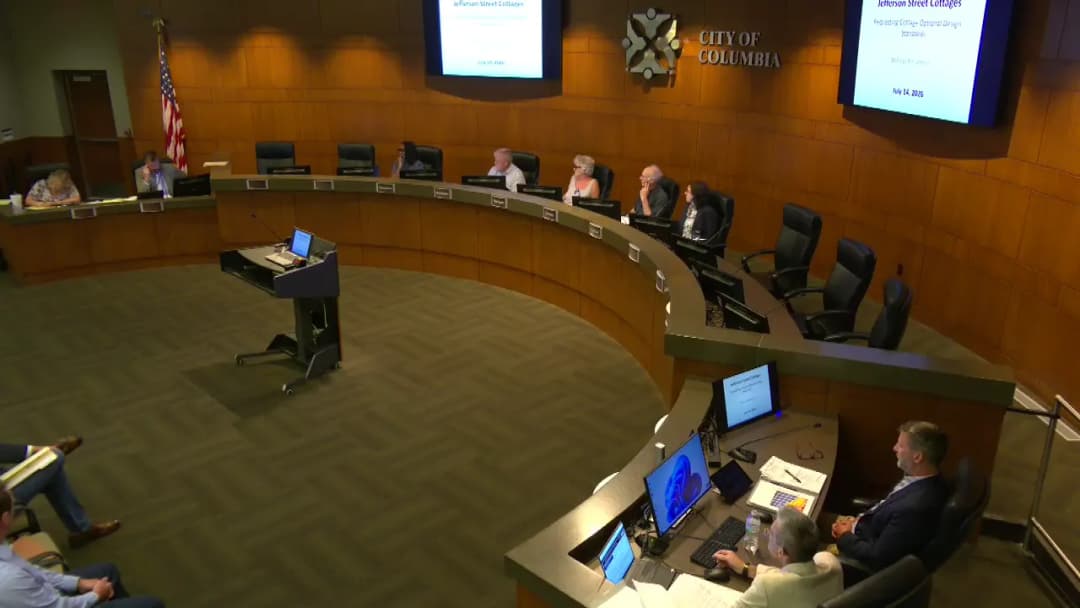
Public Meetings - Columbia, MissouriThe Board of Adjustment met on July 14, 2026, at 1:00 PM to consider a single agenda item: a request to use cottage optional development standards for a property at 307 West Sexton Road, proposing a three-lot cottage subdivision. The board voted unanimously to approve the application. Consent Calendar - Approval of the agenda and the June 9, 2026 meeting minutes were approved by voice vote, with one abstention noted on each. Public Comments & Testimony - Victor Miranda, resident of 809 Jefferson Street, expressed support for the single-family homes but asked about the driveway placement (all three on Jefferson) and setback requirements. He noted recent changes to setback rules for accessory dwelling units. Staff clarified that the reduced side-yard setbacks apply only to accessory dwelling units, not to the cottage development. Discussion Items - Applicant Presentation (Caleb Colbert, attorney): Presented the request for approval of cottage design standards to develop a vacant R2-zoned lot with three single-family detached homes. The proposal meets the three criteria: consistency with Columbia Imagined (compact development, diverse housing), adequate off-street parking (each home will have at least two spaces, tandem parking allowed), and no traffic congestion (lower traffic than a duplex). The development would add sidewalks along Jefferson Street. Staff report was supportive. - Staff Report (presented by planning staff): Noted the lot has been vacant since 2002-2007, requires right-of-way dedication for Jefferson Street, and the cottage orientation is practical. The rear yard setback is effectively a side yard, larger than R2 requirements. Parking is sufficient, and the project supports comprehensive plan goals. Staff recommended approval. - Legal Comments: The board was reminded that this is not a variance but an optional development standards request under Section 29-6.4J. The criteria are: consistency with comprehensive plan, adequate off-street parking not causing significant spillover, and no additional traffic congestion or safety risks. - Board Discussion: Board members expressed support, noting infill development, potential for affordable housing, and alignment with city plans. A motion to approve was made by Mr. Minshew and seconded by Mr. Sharp. Key Outcomes - Vote: The board voted unanimously (5-0) to approve Case Number 181-2026, allowing the use of cottage optional development standards for 307 West Sexton Road to create a three-lot cottage subdivision (Jefferson Street Cottages). - Next Meeting: The next meeting is tentatively scheduled for September 15, 2026, as no applications were received for the August meeting.
This work session was the first of three budget meetings for the City of Columbia’s Fiscal Year 2027 budget. City staff presented a detailed overview of the general fund, including revenue projections, expenditure plans, fee studies, and the internal process used to achieve a balanced budget. The proposed budget totals $133 million in both revenue and operating expenditures, with no new revenue sources assumed. Staff outlined $7.3 million in internal cuts, including personnel reductions, new decision item denials, and operating decreases, to address a structural gap between revenue growth and rising costs. Council members discussed impacts on services, the utility assistance fund, social services, and public safety equipment, and set dates for future meetings. Discussion Items - Budget Process Overview: City Manager DeCarlin described the collaborative budget process, beginning with goal-setting in January, followed by reviews of new positions and decision items with department directors. The original expenditure request was approximately $141 million, requiring cuts to match projected revenue of $133 million—a gap of about $7 million. Staff moved from blanket percentage cuts to a priority-based conversation, though a half-percent cut across all service lines was eventually applied. - Revenue Projections: Sales and use tax (29% of general fund revenue) is projected to grow at 1% annually. Property tax is stable with slow growth. Marijuana tax revenue has increased significantly but remains a small portion (about $1 million). Staff noted that several other local taxes (cigarette, telecommunications, cable TV) are declining. The budget does not anticipate revenue from the public safety sales tax. - Fee Studies: Two studies were completed: an internal cost-of-service study (to be presented in August) and a consultant-led business license fee study. The business license study uses police demand, street/traffic usage, and fire demand to set fees. A freeze on business license fees is currently in place. - Expenditures and Cuts: Personnel costs account for 70% of the general fund. The largest functional group is public safety. To balance the budget, $7.3 million in cuts were made internally: - Personnel reductions ($3.6M): $1.9 million through holding positions vacant or eliminating positions (e.g., police froze open positions, health eliminated an LPN, HIV case manager, and held planning supervisor and health program coordinator vacant). Police also included a $750,000 planned lapse to account for hiring timelines. - New Decision Item (NDI) reductions ($1.6M): Denied items include police overtime and standby pay, fire personal protective equipment ($271,000), fire station building improvements ($236,000), streets salt and pavement marking increases ($542,000). - Operating reductions: A half-percent cut across all service lines, plus department-level reductions to offset new items. - Impacts of Cuts: Staff highlighted delays in critical replacements, reduction of utility assistance fund from $600,000 to $400,000 (pending audit results), a 10% reduction in social services funding, discontinuation of family planning services, deferral of the drone fleet replacement program, and delay of the real-time information center specialist hiring. - Council Priorities: The budget includes a 3% wage increase for city employees, minimized insurance premium increases, public safety investments (10 sets of protective gear, Knox Box replacements, confined space safety equipment), and affordable housing funding ($610,000 HOME funds, $500,000 CDBG, $1 million housing trust fund). No new mechanism to fund the housing trust fund is included in this budget. - Council Budget Discussion: Council members reviewed their own budget for the first time, noting that boards and commissions historically spend only about half of their allocated budget. Councilmember Peters suggested using unused board funds to create a stipend for councilmember home security. Staff noted that boards were asked to propose cuts but most did not. The increase in the council budget was attributed to laptops moving from the public communications fund back to the council division. Key Outcomes - No formal votes were taken; the session was informational. - Council agreed to start the August 3rd and August 17th regular council meetings at 6:00 p.m. (pre-council at 5:00 p.m.) to accommodate the anticipated length of the budget public hearings. - Campaign finance reform discussion was deferred from August 17th to the September 21st work session. - Staff will provide a risk register (or equivalent) to help council assess the implications of budget cuts, and will include more detail on NDI denials in future quarterly budget adjustment memos. - Future meetings: A second budget work session (enterprise funds) on July 16, 2026; a third session (all funds) on July 18, 2026; the first public hearing on the budget on August 3, 2026; a budget town hall on July 30, 2026; and a bond debt work session on August 3, 2026 (pre-council).
Note: The raw transcript indicates the meeting was called to order on June 15, 2026, at 4:30 PM, but the official meeting date provided is June 16, 2026, at 10:30 UTC. This summary uses the official date as instructed, but acknowledges the discrepancy. This pre-council meeting focused on two agenda items: an overview of the Fiscal Year 2027 Capital Improvement Plan (CIP) and interviews for board and commission vacancies. The CIP overview was presented by staff (Matthew and Mackie) and included a presentation on the CIP process, project examples, and a question-and-answer session with council members. The interviews were not covered in the provided transcript. Discussion Items - FY27 Capital Improvement Plan Overview – Staff presented a comprehensive overview of the CIP, including its purpose, how projects are defined, funding sources, and the budget process. Key points included: - Capital improvement projects are defined as having a budget of $10,000 or more and taking longer than one year to complete, using a life-to-date budgeting method. Capital expenses are shorter-term and use year-to-date budgeting. - The CIP connects the city's comprehensive plans and financial plans, reflecting community values and goals. It is a blueprint for the city's physical evolution, helping stabilize tax rates and plan for infrastructure needs. - Examples of FY27 projects highlighted: - Fire engine replacement (funding in FY27, delivery expected in 2030, three-year build time). - Snow removal equipment for the airport ($1.4 million, 90/10 FAA match, delivery in 2027 or 2028). - MKT trail bridge replacement (bridges 9 and 10, construction end of 2026 to end of 2027, funded by park sales tax and a donation). - 10th and Cherry parking garage maintenance (built 1995, pre-design in FY26, construction in FY27, $750,000 from enterprise revenue). - Replacement of an alluvial water well ($2 million enterprise revenue, completion within FY27). - Braymore drainage project (stormwater easements in FY27, completion in FY28, enterprise revenue). - 5th and Wilkes relief sewer (design in FY27, construction through 2030, enterprise revenue). - Landfill cell seven ($11 million total, $2 million in FY27, permitting by 2028, construction 2028-2029, online 2031-2033). - Funding sources include taxes (capital improvement sales tax, county road tax, park sales tax, transportation sales tax, use taxes, stormwater rates) and bonds (general obligation, revenue, special obligation). Other sources include a designated loan fund, developer contributions, grants, and utility fees. - Upcoming council dates for the budget process: July 13-15, 17 (general fund, enterprise funds, complete proposed budget), July 20 (CIP public hearing), August 3 (public presentation), August 17 (first budget public hearing), September 8 (second public hearing), September 21 (budget adoption). - Council Questions and Discussion – Council members Valerie, Vera, Chris Taylor, Christina, Betsy, and Jackie raised questions about project identification and prioritization. - Valerie asked how projects end up on the CIP, specifically stormwater projects. Staff explained the ranking system based on consequence of failure and likelihood of failure, with arterial/collector street flooding ranking higher than residential, and house flooding impacting only one property owner. The ranking system has been used in the last 10 years, but projects can be moved up due to failing infrastructure. - Valerie also asked if similar ranking systems exist for other utilities. Staff noted that sewer has an integrated management plan, water and electric are moving toward prioritization, and solid waste has few capital projects. - Chris Taylor expressed a desire for more transparency in how projects move on and off the CIP list, and suggested attaching relevant master plans to future CIP work sessions. Staff acknowledged the need for more comprehensive planning, especially for water. - Christina asked about funding the AMI (Advanced Metering Infrastructure) project, questioning why it could not be funded through accumulation over time instead of bonds. Staff explained that the capital improvement sales tax cannot be used for utility projects, and while saving over time is possible, it would delay the project and costs increase with inflation. Bonding at current rates (3.1%) is advantageous given the city's return on investments (4-4.1%). - Jackie noted that council can add projects to master plans (e.g., sidewalk master plan) as a way to influence the CIP. - Betsy asked about process: the CIP will be attached to the next council meeting agenda (July meeting) and formally adopted with the budget. The proposed CIP will be part of the budget document. - Valerie indicated she would meet with department directors to prepare more questions for the next CIP meeting. Key Outcomes - No formal votes were taken at this pre-council meeting. The CIP presentation was informational, and council members were directed to the July 20 CIP public hearing for deeper discussion on specific projects. - The budget adoption timeline was reaffirmed, with public hearings and final adoption scheduled through September 21, 2026. - Council members expressed interest in receiving more detailed information on project prioritization and master plans ahead of the July meeting.
The City Council of Columbia, Missouri met on Monday, June 15, 2026 at 7:00 p.m. in the Council Chamber. The meeting included appointments, scheduled public comments, old business, a consent agenda, new business, reports, and general comments. Key outcomes included the defeat of a short‑term rental conditional use permit, passage of amendments to accessory dwelling unit regulations, and direction for future work sessions on vehicle stops data and the Water and Light Integrated Resource Plan. Consent Calendar - Appointment of Mayor Pro Tem: Council Member Jackie Sample was appointed Mayor Pro Tem without objection. - First Last Mile ARPA Update: Dr. Lester Woods reported that the program has provided over 7,000 rides since 2024, with 2,317 rides provided through mid‑May 2026. The program operates with 9–11 staff and eight partner organizations. Total public investment was $430,354.65 from Boone County, the City of Columbia, REDI, Veterans United, and an anonymous donor. Transportation remains a barrier due to high costs, limited public transit, and long travel times. - Board and Commission Appointments: Multiple appointments were made by majority vote or voice vote. Notable: Zachary Cartwright (Citizens Police Review Board, term to Nov. 1, 2028); Shane Lowe (Planning & Zoning, term May 31, 2027); Kate Stockton (Planning & Zoning, term May 31, 2029); Philip Fracica and Emily Piontek (Water & Light Advisory Board). The council also re‑advertised vacancies on the Citizens Police Review Board and the Climate and Environment Commission. - Consent Agenda Bills and Resolutions: Bills B144‑26 through B152‑26 and Resolutions R114‑26 through R116‑26, R118‑26 through R120‑26 were approved unanimously. These authorized construction of Fire Station 10, budget appropriations for the Municipal Service Center South, CDBG grants, agreements for the Senior Games and Show‑Me Games, an Axon technology contract, 800 MHz radio system agreements for Police, Fire, and Airport, public hearings for Bridge 9 replacement, the Water and Light Renewable Energy Plan, the FY 2027 Capital Improvement Plan, artist commissions for North Village Park benches, the Boone County Fair agreement, and a CDBG grant for Love Columbia. Public Comments & Testimony - Water and Light Advisory Board (David Switzer): Representing the board, Switzer noted that in FY 2025 the City’s total revenue was $484 million, with over 40% ($200 million) from water and electric utilities, and over $18 million transferred to the general fund. He urged the Council to allocate more time to utility issues, particularly the Integrated Resource Plan (IRP), and proposed two 2.5‑hour work sessions with the Council, the Board, and staff. - Matt Schacht (Vidwest representative): Schacht presented a map of Vidwest members and a petition of over 630 signatures requesting continued City funding for community media. He described community media as a school, gear library, business incubator, and third space. He noted that about one in five members identify as non‑white and that low‑income residents use the services to gain skills and start businesses. He asked the Council not to defund the organization. - Jeff Stack and Margaret McConnell: Both strongly opposed the median ban ordinance (No. 026217) set to take effect July 1, which would ban panhandling and constitutional protected protests on medians. McConnell argued the City’s $100,000 study did not show a causal link between panhandling and traffic fatalities, and that the ordinance would harm unhoused residents by removing their main income source (approximately $60 on a good day). She and others stated they were willing to risk arrest and provide resources for a legal challenge. Discussion Items - B101‑26 – Short‑Term Rental Conditional Use Permit (2002 Valley View Road): The applicant sought a conditional use permit for a short‑term rental on a cul‑de‑sac. Staff reported that all neighboring households (16) opposed the application. The Planning and Zoning Commission had recommended approval 6‑2. Public testimony was heavily opposed, citing safety concerns for children playing in the street, lack of sidewalks, and poor communication from the owner and agent. The owner (Laurie Gehrke) and agent (Russell Boyt) said they would manage the property closely and planned to retire in Columbia. The council discussed criteria for short‑term rentals, noting that neighborhood opposition is one factor. Council Member Valerie Carroll expressed concern about the designated agent system and the influence of well‑resourced neighborhoods. The bill was defeated 4‑2 (Carroll and Elwood voted yes). - B142‑26 – Accessory Dwelling Unit (ADU) Ordinance Amendments: Staff presented amendments to Chapter 29 to allow ADUs by right in R‑1 zoning (eliminating the conditional use permit requirement), increase maximum height to 24 feet (if over a garage), standardize the minimum lot size to 5,000 square feet across all zones, increase rear yard setback from 6 feet to 15 feet, reduce corner side yard setback from 25 feet to 12.5 feet, and codify that only one of the two dwellings on the lot may have a short‑term rental license. The amendments were recommended 8‑0 by the Planning and Zoning Commission. Public comment included advocacy for keeping the 3,000 sq. ft. minimum (Adrienne Stolwyk, Scott Claybrook), concerns about equity and infill housing, and requests for a nuanced approach to setbacks. Council discussion focused on the lot size change. Council Member Hartman suggested a conditional use path for lots between 3,000 and 5,000 sq. ft., but no motion was made. The council voted unanimously (6‑0) to approve the ordinance as recommended. - R121‑26 – North Village Park Sidewalk Closure: The resolution authorized temporary closure of sidewalks and parking lanes around North Village Park from June 26 through November 2026 for construction of new sidewalks and parking improvements. The project will expand sidewalks to 20 feet and increase parking spaces from 25 to 45. The resolution passed unanimously. - R117‑26 – Parks and Recreation Software Amendment: Moved from the consent agenda for a correction. The title and section one were amended to replace “add” with “remove” for the WebTrac App Workgroup Plus software. The resolution, as amended, passed unanimously. Key Outcomes - B101‑26 Defeated (4‑2): The conditional use permit for a short‑term rental at 2002 Valley View Road was denied. - B142‑26 Enacted Unanimously: Amendments to ADU regulations were approved, including by‑right ADUs in R‑1, increased height, minimum lot size of 5,000 sq. ft., 15‑foot rear setback, 12.5‑foot corner side yard setback, and a limit of one short‑term rental per lot. - Consent Agenda and New Business Resolutions Passed Unanimously: All consent items and resolutions R121‑26 and R117‑26 (as amended) were approved. - Work Session on Vehicle Stops Data: Council Member Hartman’s motion for a work session (preferably in November, coordinated with other scheduling) to discuss the Missouri Attorney General’s Vehicle Stops Report and disparities was approved unanimously. - Work Sessions on Integrated Resource Plan: Council Member Peters’ motion to schedule two 2.5‑hour work sessions with the Water and Light Advisory Board, beginning in early fall, was approved unanimously. - Report on First Read Presentations and Public Comment: Mayor Buffaloe’s motion requesting staff to prepare a report on the logistics of allowing presentations and public comments on first‑read items (to be discussed at a future work session) was approved unanimously. - Release of RPPO Funds: A motion for staff to bring forward legislation releasing funds from the Residential Parking by Permit Only program was approved by voice vote. - Liaison for Homeless Outreach: Council Member Peters was appointed as the council liaison for homeless outreach, including the Homeless Strategic Plan Steering Committee and the Affordable Housing Coalition. - Adjournment: The meeting adjourned at 11:45 p.m.
The Columbia Planning and Zoning Commission met on June 11, 2026, at 1:00 PM (Central) with a quorum of six commissioners. The meeting addressed four cases: two rezoning requests for student housing developments, and two short-term rental conditional use permits. Votes resulted in a tie on one rezoning, unanimous approval on another, approval of one STR, and a tie on the second STR. Consent Calendar - The May 7, 2026 meeting minutes were approved as amended. - The June 11 agenda was approved. Case 124-2026: The Retreat at Columbia (Rezoning from A to PD and PD Plan) - Staff presented a proposal for a 194-dwelling-unit (max 204) student housing development on 15% of the site, with 50% open space, and a traffic impact study showing minimal increases. Public comments raised concerns about Rock Quarry Road safety, crash data (41 crashes in 5 years, 2 fatal), and the adequacy of the traffic study. The applicant argued for compliance with the comprehensive plan and the need for student housing. Commissioners discussed the road's capacity and precedent. The motion to approve failed on a tie vote (3-3), resulting in no recommendation to City Council. Case 162-2026: Theory Sterling Mizzou (Rezoning from RMF to PD and PD Plan) - Staff presented a 305-unit, 970-bed student housing project with 570 parking spaces (0.6 per bed), four design exceptions for setbacks, height (85 ft), parking, and landscaping. Public comments focused on parking overflow into East Campus, pedestrian safety at the College and University intersection (most dangerous in city), and the need for a dedicated left-turn lane. The applicant provided parking comps and argued that parking is adequate. Commissioners agreed on the location's appropriateness but noted infrastructure concerns. The motion to approve passed 6-0. Case 166-2026: Short-Term Rental at 1309 W Worley Street (CUP) - Staff recommended approval for a maximum of 4 transient guests and 210 nights/year. The owner stated she was unaware of the ordinance and has since complied. A previous variance for a side parking lot was confirmed. Commissioners discussed parking and compliance. The motion to approve passed 6-0. Case 169-2026: Short-Term Rental at 1505 Richardson Street (CUP) - Staff recommended approval subject to adding a fourth parking space. The owner had been cited for illegal operation and pled guilty. Public comments raised parking and neighborhood concerns. Commissioners debated the owner's past non-compliance. A motion to approve with 4 guests (instead of 8) failed on a tie vote (3-3), sending no recommendation to City Council. Key Outcomes - Case 124-2026: No recommendation (tie vote). - Case 162-2026: Approved 6-0. - Case 166-2026: Approved 6-0. - Case 169-2026: No recommendation (tie vote). - Next meeting scheduled for July 23, 2026.
The Citizens Police Review Board (CPRB) met on June 10, 2026, in open session before moving to closed session. The meeting covered routine approvals, updates on an outstanding report request, board vacancies, and an informational update from the Columbia Police Department on training programs and the co-responder initiative. Consent Calendar - Agenda Approval: The board unanimously approved the meeting agenda (motion by member, seconded by Coleman). - Minutes Approval: The board approved the minutes from the April 8, 2026 meeting (motion by member, seconded by Coleman; one member abstained due to absence). Discussion Items - Old Business – Aggregated CPD Complaints Report: The board had previously requested an aggregated report on complaints against the Columbia Police Department. The police department is still working on the report; no due date was set. The board agreed to continue allowing the department to work at its current pace without imposing a deadline. Lieutenant Sinclair stated he had no timeline for completion. - New Business – Board Vacancies and Chair Election: The board currently has three vacancies. Two applicants are pending interview by the City Council at the June 15, 2026 pre-council meeting (or possibly delayed to July 20, 2026). The board decided to postpone the election of a new chair until August 2026, after new members are seated. No formal vote was taken; the decision was noted in the minutes. - Human Rights Commission Update: Representative Penny Coon Snarr reported that the Human Rights Commission is actively promoting its Human Rights Enhancement Program (HRAP) funding and has received many applications. They continue to inform the public about complaint resolution options. - Police Department Program Updates: Vice Chair Steve Jeffrey requested an update on the co-responder (dual responder) mental health program. Lieutenant Sinclair reported that the city has not filled any of the budgeted co-responder positions (5-6 responders plus a supervisor) and the program is on hold. He also detailed a new crisis response training model implemented department-wide called ICAT (Integrating Communications, Assessment, and Tactics), developed by the Police Executive Research Forum (PERF). The department’s new academy has a 92% graduation rate across its first three classes, and 94% of graduates complete field training. The board expressed interest in receiving further information on the co-responder program at the next meeting. - Staff Transition: Staff Liaison Stephanie Brown noted that this was City Manager Fellow Payne Oliver’s last day; a replacement will be assigned. Key Outcomes - Decisions: Agenda and minutes approved unanimously. - Directives: The board will wait to elect a chair until August 2026, pending new board members. Staff will inquire about the status of the co-responder program for the next meeting. - Next Steps: The board is not scheduled to meet in July 2026; the next regular meeting is in August 2026. The board may hold a special meeting if an appeal arises. - Closed Session: The board voted unanimously (by roll call) to enter closed session to discuss records protected from disclosure under Missouri law (sections 610.021(1)(4) and 590.502 RSMo).
The Columbia Board of Adjustment met on June 9, 2026, at 1:00 PM to hear two agenda items: a variance request for an accessory structure placement and a request for approval of optional cottage development standards. The board approved both items, with one member dissenting on the second. Consent Calendar - The agenda was approved by unanimous vote. - The minutes from April 14, 2026, were approved with one abstention. Public Comments & Testimony - Dave Forward (310 East Old Plank Road) expressed concerns about the proposed Old Plank Cottages development, citing traffic safety, inadequate road width (28 feet) for fire truck access, and high speeds on Old Plank Road. He noted previous promises of off-street parking that were not kept in a nearby duplex development. - Pat Forward (310 East Old Plank Road) echoed her husband's concerns, highlighting the danger of children boarding school buses without sidewalks, the frequency of accidents, and the poor sight lines at the proposed entrance. She urged the board to consider the cumulative impact of adding more traffic. Discussion Items - Case 154-2026: Variance Request for 2710 Bluff Creek Boulevard – Applicant Caleb Colbert (attorney) and Tim Crockett (engineer) sought a variance to allow a pool, pool house, and detached garage forward of the principal dwelling on a 2.62-acre MN-zoned lot. The property, built in 2015 before the Unified Development Code (UDC) steep slope regulations, has limited buildable area due to grades exceeding 25%. The proposed structures would be placed on flatter terrain forward of the house, screened by heavy vegetation. Staff noted the parcel is unique—isolated, with no residential neighbors within 750 feet—and that the variance would not harm public health, safety, or welfare. The board deliberated on the terrain hardship and the lack of alternative locations. - Case 155-2026: Optional Cottage Development Standards for 301 East Old Plank Road – Applicant Caleb Colbert and Tim Crockett requested approval to use cottage development standards on a 3.68-acre R2-zoned property to build 17 single-family homes (the “Old Plank Cottages”). The project would reduce lot sizes from standard R2 dimensions (60-foot width) to 38-foot width, with a minimum lot area of 4,000 square feet. Staff confirmed the development meets all applicable city standards, parking requirements (two spaces per unit), and that a traffic study was not warranted. The Planning and Zoning Commission had unanimously approved the preliminary plat. The board discussed traffic impacts, fire access, and parking, with staff noting that the 28-foot street width is standard and that the city can restrict on-street parking if needed. The applicant argued that the cottage option produces less density than duplexes (which are allowed by right) and is consistent with the comprehensive plan’s goal of diverse housing. Key Outcomes - Case 154-2026: Motion to approve the variance for 2710 Bluff Creek Boulevard, allowing accessory structures forward of the principal dwelling, passed unanimously (5-0). - Case 155-2026: Motion to approve the optional cottage development standards for 301 East Old Plank Road, subject to dimensional standards (minimum lot size 4,000 sq ft, lot width 38 ft, front yard 20 ft, side yard 6 ft, rear yard 20 ft, max building height 35 ft), passed 4-1 (Ms. Gaines opposed). - The board noted that the July 14, 2026, meeting is tentative due to renovations, with a possible reschedule to August 8, 2026.
Date: June 9, 2026 Time: 6:00 PM – 7:30 PM (approx.) Location: Columbia City Council Work Session This work session was convened to discuss the proposed Advanced Metering Infrastructure (AMI) project for both water and electric utilities. City staff and consultants from Amoresco presented the project scope, costs, benefits, and implementation timeline. Council members asked questions on financing, customer impact, data privacy, and public outreach. The council expressed general support and requested a financing report before a contract vote in September 2026. Discussion Items - Project Overview (Aaron Keys, Utilities Director): - AMI will enable automatic outage detection, flexible billing dates, remote turn-on/off, and real-time leak alerts. - Currently, the city relies on manual meter reads and customer calls for outages. - Staff has been working on the project for two years; the request is for council confirmation to proceed. - Technical Presentation (Eric Wurtz, Engineering Supervisor; Chad Nobles, Amoresco): - A field survey was conducted: 70 residential meters tested, hundreds surveyed. - Current meters are past useful life; many are failing or have inaccurate reads (average residential water meter accuracy 96%; low-flow accuracy 87%). - Scope: - Electric: replace all 53,900 electric meters. - Water: replace 33,000 meters, retrofit 20,000 newer meters with radio modules. - New meters have 20-year warranties (water) and solid-state technology with no moving parts. - AMI network uses a mesh system with 50 data collectors on light poles and existing cellular towers. - Data is transmitted 4 times per day; packet size is smaller than a text message. - A meter data management (MDM) system from Harris (current billing software vendor) will be implemented to handle the increased data volume. - Customer and Operational Benefits: - Citizens will have a customer portal to view usage, set leak alerts, and receive notifications. - Estimated 30-40% reduction in customer service calls. - Operational savings: reduced truck rolls for meter reading, turn-ons/offs, and re-reads. - Accurate billing (no estimated reads) and potential for future time-of-use or real-time rates. - Project Costs and Financing: - Total implementation cost: $42.1 million (Amoresco contract + Harris integration fees). - Ongoing annual costs: $560,000 (AMI network: $170,000; MDM: $330,000; portal integration: $62,000). - Construction timeline: 3 years, with construction starting March 2027. - Financing options: bonds (10-year, 3.5% interest) or bank loan (3.75%). - Staff presented a pro forma showing positive cash flow from year 1 assuming 4% interest over 15 years, due to revenue gains from meter accuracy and operational savings. - Revenue gains: $597,000/year from water/sewer accuracy improvement; $1.2 million from electric accuracy (1% gain). - Operational savings: $1.15 million/year (estimated from reduced truck rolls, re-reads, etc.). - Data Privacy and Cybersecurity: - Consumption data is encrypted and transmitted in small packets; no personal identification is stored in the meter or MDM – only account numbers and usage data. - City IT director confirmed encryption methods are robust and no known breaches of similar systems. - Historical data will be retained for a limited period (e.g., 5 years, similar to current billing data). - Opt-out policy: current ordinance allows opt-out with a one-time charge and monthly fee ($35.72/month). Staff prefers to remove the opt-out option and raise fees to cover costs, but this is a policy decision for council. - Public Outreach and Installation Process: - Amoresco will provide a dedicated on-site construction manager, data team, and community engagement plan. - Installations will be scheduled in geographic routes; indoor/commercial meters will be individually scheduled. - Critical care patients (e.g., dialysis, oxygen) will be identified and prioritized. - No water shutoffs before 8 AM; typical working hours 8 AM–5 PM. - A public portal will show real-time progress; pre-notices will be used, but not specific dates due to weather delays. - Council Questions and Concerns: - Council members asked about the impact on employees (meter readers will be retrained as meter technicians). - Concern over potential rate increases: accuracy gains are not rate increases; some customers with old, inaccurate meters may see slightly higher bills. - Councillor expressed excitement about real-time use rates for conservation incentives. - Councillor requested a comprehensive report on existing bond authority and water/electric capital projects to contextualize this large investment. - Council agreed to a financing report before the contract vote in September. Key Outcomes - Council consensus to proceed with the AMI project, pending a formal contract and financing report. - Next step: Staff will bring a financing options report to council in advance of the September contract vote. - Contract vote expected: Late August/early September 2026, with notice to proceed in mid-September 2026. - Construction start: March 2027, with 3-year rollout. - Pre-council scheduling: The June 15, 2026 pre-council meeting will start at 4:30 PM to accommodate interviews for Planning & Zoning, Water & Light Advisory Board, and Citizens Police Review Board, followed by a capital improvement plan discussion (estimated 90 minutes).
The Planning and Zoning Commission met on Thursday, June 4, 2026, with six commissioners present (Commissioners Brodsky, Darr, Goway Jones, Grabo [Graybaugh], Gray, Walters; Commissioner Staten absent). The commission addressed a tabling request, a preliminary plat approval, and a short-term rental conditional use permit. All items were approved unanimously. Staff introduced a new senior planner and provided updates on future meeting schedules and ongoing projects. Consent Calendar - Approval of Agenda: Motion by Commissioner Gray, seconded by Commissioner Darr. Unanimous approval. - Approval of Minutes (May 21, 2026): Motion by Commissioner Gray, seconded by Commissioner Darr. Approved unanimously with Commissioner Graybaugh abstaining. Public Comments & Testimony - No members of the public spoke on any agenda items or during the general public comment period. Discussion Items Case 124-2026: Tabling Request – Grindstone Acres LLC / The Retreat at Columbia - Request: Rezone from A (agricultural) to PD (plan development) with an associated statement of intent and plan development plan for a 194-unit multifamily development. No public testimony was offered. A motion to table the item was made by Commissioner Darr, seconded by Commissioner Gray. The motion carried unanimously (6-0), tabling the item to June 11, 2026. Case 149-2026: Preliminary Plat – Old Plank Cottages Plat No. 1 - Request: Crockett Engineering, agent for Lake Bradley LLC, sought approval of an 18-lot preliminary plat (17 single-family detached cottage lots and one common stormwater detention lot) on 3.68 acres at 301 Old Plank Road, zoned R2 (two-family dwelling). The applicant concurrently seeks Board of Adjustment (BOA) approval for optional cottage development standards (reduced lot width to 40 feet instead of the standard 60 feet). Staff recommended approval subject to technical corrections (street name approval and BOA approval) and noted that a condition could be added to restrict on-street parking to one side due to the 28-foot pavement width. Commissioner Darr expressed no need for additional parking restrictions or wider pavement. The applicant, Tim Crockett, supported the project as compatible with existing housing types. Motion by Commissioner Walters, seconded by Commissioner Gray, to approve the preliminary plat pursuant to technical corrections, including street name approval by Boone County Joint Communications and BOA approval of cottage standards. The motion carried unanimously (6-0). Case 157-2026: Short-Term Rental Conditional Use Permit – 1804 Juniper Drive - Request: Owners Tyler and Crystal Lorrigan sought a conditional use permit to operate a 210-night maximum, six-guest short-term rental (STR) in the eastern half of a duplex at 1804 Juniper Drive (0.24-acre site). Staff reported no public opposition, sufficient parking (two tandem spaces in driveway, one in garage), and a closed code violation from a previous owner (illegal STR operation closed December 23, 2025). The property manager, Ryan Kruger (RTK Rentals), stated he would manage both the STR and the long-term rental on the other side. Applicant noted recent improvements and personal use intentions. Motion by Commissioner Gray, seconded by Commissioner Darr, to approve with conditions: maximum occupancy of six transient guests, maximum 210 nights of annual rental usage, and keeping one spot in the garage available for transient guests. The motion carried unanimously (6-0). Staff Comments - Meeting Schedule: Next meeting on June 11, 2026 (not June 18) due to facility shutdown from June 16 through July 10. The following meeting will be July 23. Cases for June 11 include: the tabled Rock Quarry Road PD rezoning (124-2026), a plan development at 1205 University Avenue (162-2026), and two short-term rental requests (166-2026 on Whorley Street and one on Richardson Street). - New Staff: Senior Planner Steve Roth was introduced. He brings over 20 years of city management experience and will lead the comprehensive plan RFP, expected to launch in late July/early August with consultant selection by October. Comprehensive plan meetings will begin after the calendar year. - Definition of Family: Staff is meeting with boards and commissions as directed by city council. Human Rights Commission met on June 2; Disabilities Commission meeting next week; Collegiate Advisory Council deferred to fall. Boards are to provide written comments on current proposal or full IPMC model. - Data Center Discussion: Will continue at the June 11 work session. Commissioner Comments - New Commissioner: Andrew Graybaugh was welcomed. He noted he will be absent on June 11 due to a prior commitment. - Quorum Concern: Commissioner Darr raised the possibility of not having a quorum for the June 11 meeting given Commissioner Staten’s absence and Commissioner Graybaugh’s unavailability. The chair agreed to check with Commissioner Staten. - Motion to adjourn by Commissioner Gray, seconded by Commissioner Darr. Meeting adjourned. Key Outcomes - Case 124-2026: Tabled to June 11, 2026 (unanimous). - Case 149-2026: Approved with conditions (unanimous); recommendation forwarded to City Council. - Case 157-2026: Approved with conditions (unanimous); recommendation forwarded to City Council.