Browse by city
Date range
Search help

Search titles, summaries, topics and stored transcripts together. Keywords may match separately; put the whole query in double quotes for a phrase. Matching follows word analysis, so punctuation is not exact. Both dates are included. Documents are not searched.

SHOWING 71–80 ENTRIES
71
FEB 16, 2026 · COLUMBIA, MISSOURI · VIDEO ARCHIVE
Columbia City Council Regular Meeting - February 16, 2026

The Columbia City Council met on Monday, February 16, 2026, at 7:00 PM in the Council Chamber to conduct a regular meeting. The meeting included special recognition of police officers, appointments to boards and commissions, scheduled public comments, three public hearings, approval of a consent agenda, introduction of new legislation, and reports on community violence, communication strategies, and annual reports. The meeting adjourned at 9:16 PM. Consent Calendar - Approved minutes of January 20, 2026. - Approved a corrected agenda (changed R39-26 to B39-26). - Approved the consent agenda unanimously, including 13 bills (B24-26 through B36-26) and 8 resolutions (R28-26 through R35-26) covering a range of administrative, financial, and operational items. Key items include: amendments to pedestrian definitions, annexation agreements, final plats, MOUs for wastewater surveillance, criminal justice data sharing, counterdrug program, budget amendments for facility modifications, parking garage repairs, airport parking lot improvements, Providence Walkway development, housing revenue bonds, HIV testing, CDBG grant for Access Arts, CHDO agreement, True/False Film Festival sponsorship, HVAC maintenance contract, and animal control contract. Public Comments & Testimony - Randa Rawlins (Airport Advisory Board Chair): Reported on 2025 Airport Advisory Board activities, noting the airport's growth, the need for increased staffing, the challenges of working with airlines, and praised Airport Manager Mike Parks for his effectiveness. She emphasized the airport's role as an economic driver and requested continued council flexibility. - Jordan Lundy (Vidwest Studios): Described the history and importance of Vidwest Studios, providing training, professional help, and support for small businesses and nonprofits. He highlighted their work during the pandemic, including live streaming events and helping organizations tell their stories. He urged the council not to overlook Vidwest's commitment to the community. - Public Hearing on Old Plank Road Culvert: Paul Wagner (Creek Ridge resident) asked about parking, collateral damage, and project duration. Staff responded that a temporary road closure with detour would be implemented, no collateral damage anticipated, and construction would take 4-5 months starting in October 2026. - Public Hearing on Douglass Park Basketball Courts: Multiple speakers expressed support for the revised plan. Traci Wilson-Kleekamp thanked staff for listening and using the community engagement process. Kimberly Jordan thanked staff and emphasized the need for security at the park. Anthony Johnson thanked Council Member Carroll and staff for making changes, stating it showed citizens they would be heard. Alphia Hightower thanked Council Member Carroll for prioritizing public interest and highlighted the collaborative process. Debra Wilkerson expressed gratitude for giving the park back to the community and hoped to bring back programs. - General Comments: - Traci Wilson-Kleekamp (Race Matters, Friends) discussed past notification issues, recommended recognizing all associations, and suggested a neighborhood resource center. - Nickie Davis (Downtown CID) praised the SeeClickFix system for faster issue resolution. - Eugene Elkin (Second Ward) asked about the electric power line meeting, noted about 5,000 utility customers behind on bills, suggested $1/day parking at the airport, and called for a 5% cap on rent increases for mobile homes. - Renee Carter (Second Ward) asked if geofencing technology could be used to regulate speeds for safety. - Demetria Stephens (Third Ward) expressed urgency regarding crime, especially car break-ins in the east side, and requested council invest similar time as they did on the median ordinance. Discussion Items - Special Items (SI2-26): Police Chief Jill Schlude recognized officers for the December 4, 2025 search for a missing 4-year-old boy in Sturgeon, Missouri. Officer Tristan Alvarado received the Life Saving Award for finding the boy in a stroller. Other officers received Commendable Performance Ribbons. - Appointments to Boards and Commissions: Appointments made to Building Construction Codes Commission, Commission on Cultural Affairs, Human Rights Commission, Food Council, Parking Advisory Commission, and Public Transit Advisory Commission. - Public Hearing PH2-26 – Old Plank Road Culvert: Staff presented the project to replace three 66-inch corrugated metal culverts (90% rusted) with a 24-foot by 6-foot arch structure. Total cost $620,000, with $280,000 from MODOT grant and $337,000 from capital improvement sales tax. Council approved the project unanimously. - Public Hearing PH3-26 and B35-26 – Douglass Park Basketball Courts: Parks and Recreation Director Gabe Huffington presented a revised plan after community input. The plan features blue courts, one representing Douglas Bulldogs and the other Moonlight Hoops, plus a water fountain. Future engagement planned for public art, recreational programming, and park infrastructure. Council voted 7-0 to approve the ordinance. - Public Hearing PH4-26 – Annexation of 1020 S. El Chaparral Avenue: The city-owned property (4.5 acres) is proposed for a fire station administrative offices and future fire station. Staff recommended R-1 zoning. Council Member Carroll questioned the "lowest common denominator" zoning approach, but staff noted the use would not change. The public hearing was held; vote on the annexation ordinance will occur on March 2, 2026. - Reports: - REP5-26 – Mayor's Task Force on Community Violence (2014): Council Member Sample noted the recommendations led to the strategic plan and Office of Violence Prevention. She emphasized the need for measurable deliverables and evidence-based approaches. - REP6-26 – Communication Strategies: Extensive discussion on notification procedures for public works, community development, and utilities. Staff reported on plans for a geofencing text alert system (vendor identified, implementation within two months). Public Works Director Creech explained challenges with mill and overlay scheduling. Community Development Director Smith detailed notification processes (postcards, early notification, concept meetings). Comments from public on neighborhood association recognition. - REP13-26 – Disabilities Commission Annual Report: Received for information. - REP14-26 – Airport Advisory Board Annual Report: Already covered during scheduled public comment; a correction to a board member name was noted. - Introduction and First Reading: Several bills introduced, including B37-26 (electronic gaming machines), B38-26 (animals and fowl), B39-26 (FIFA World Cup liquor hours), B40-26 (annexation of El Chaparral property), B41-26 (short-term rental conditional use permit), B42-26 (Boone Industrial Park final plat), B43-26 (stormwater covenants), B44-26 (MULES/NCIC agreement), B45-26 (Rothwell Park improvements), B46-26 (airport passenger boarding bridge), B47-26 (HIV case management), B48-26 (teen connection project), B49-26 (public health services), B50-26 (animal control services), B51-26 (Love Your Block program), and B52-26 (creating Communications Department). City Manager Seewood explained the hybrid approach for the new Communications Department, comprising 25 FTEs and 4 part-time connectors, with a goal to enhance internal and external communications, crisis management, and branding. Key Outcomes - Approved: Old Plank Road culvert construction (unanimous). - Approved: Revised plan for Douglass Park basketball courts (B35-26, vote 7-0). - Consent Agenda: All 13 bills and 8 resolutions approved unanimously. - Directed Staff: To proceed with the public improvement process for the Vawter School Road transmission line route, including multiple public meetings and a public hearing. - Upcoming: The annexation and zoning for 1020 S. El Chaparral Avenue will be voted on at the March 2, 2026 council meeting. The Community Summit is scheduled for March 14, 2026, where input for the strategic plan will be gathered. - Next Steps: The geofencing text alert system is expected to be implemented within two months. The communication plan for the transmission line will be developed with citywide notice.
COMMUNITY ENGAGEMENT 42% · PROCEDURAL 11% · PUBLIC SAFETY 10% · ENGINEERING AND INFRASTRUCTURE 10%
72
FEB 12, 2026 · COLUMBIA, MISSOURI · VIDEO ARCHIVE
Columbia City Council Work Session on Transmission Line Needs - February 9, 2026

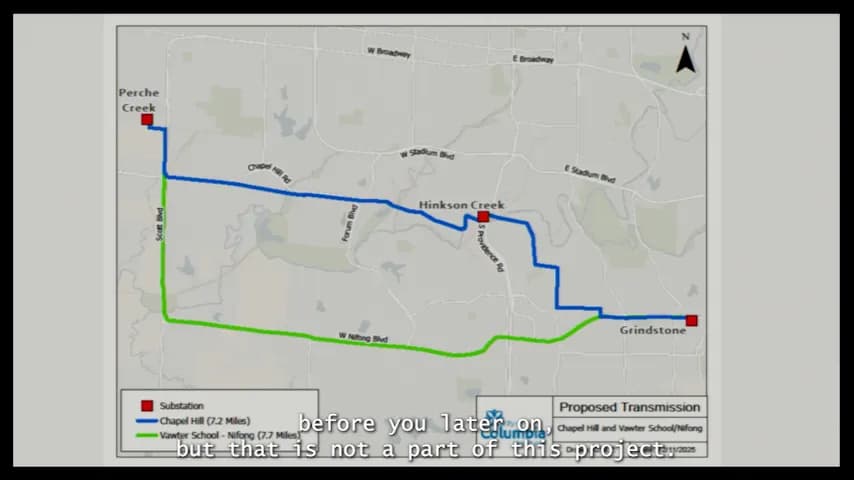
The City Council held a work session on February 9, 2026, to discuss the need for a new 161 kilovolt transmission line connecting the Perche Creek substation to the Grindstone substation. The session focused on two proposed routes, their cost estimates, historical context, and the risks of inaction. Council did not vote but agreed to seek feedback from the Water and Light Advisory Board before providing direction. Discussion Items - Utilities Director Aaron Keyes presented the necessity of the transmission line to ensure safe, reliable, and cost-effective power for Columbia, supporting residential, commercial, and industrial customers, as well as importing renewable energy. He stated the need will only grow with city growth and electrical load increase. - Two routes were detailed by Electric Engineering Supervisor Eric Wirtz: - Voder School Nifong Grindstone route (green, former Option A): estimated cost of $34.9 million, co-located along existing roadways, 0.5 mile longer than the alternative. - Chapel Hill route (blue): estimated cost of $56 million, co-located with an existing 69 kV line requiring pole replacement and significant undergrounding of distribution lines; the route cuts through parking lots, front yards, and backyards. - Updated cost estimates were provided by Black & Veatch at a 90% confidence level for transmission work; distribution costs are less certain. Undergrounding the entire line would cost 5–8 times more. - Remaining bond authority totals $29.8 million, with an additional $3.5 million available from other bond funds, leaving a $1.6 million gap for the Voder School route or a $22.7 million gap for the Chapel Hill route. Issuing bonds would require rate increases beyond planned annual increments. - The project's history was reviewed: proposed in 2013, a 2016 public hearing led to a pause, and the Integrated Electric Resource and Master Plan task force (2019-2022) recommended the Chapel Hill route. Staff recommended the Voder School route as the most cost-effective and reliable option. - Council members discussed aesthetic concerns, property value impacts, health worries, and the need for redundancy. The Chapel Hill route was noted to be less redundant since it follows the same corridor as an existing line. Staff clarified that load shedding remains a small but growing risk, and delays increase future costs and project duration (8–10 years). - A closed session was held to discuss specific risks and load shedding contingencies. Upon return, staff answered questions about relationships with neighboring utilities (MISO, SERC) and the remaining bond funding. - Council discussed next steps: choosing a route and initiating the public improvement process (multiple public meetings, a public hearing, then design). Some members suggested waiting for the Water and Light Advisory Board's feedback, which will be presented at the February 16 regular council meeting. Key Outcomes - No formal vote was taken; council reached consensus to wait for the Water and Light Advisory Board's recommendation on February 16 before giving staff direction on which route to pursue. - Staff will present a communications plan and a history roadmap for the project at the next council meeting. - City Manager noted that feedback from the Advisory Board will be heard during staff comments on February 16, after which council will provide direction on proceeding with a public improvement process for the transmission line.

ENGINEERING AND INFRASTRUCTURE 70% · PUBLIC ENGAGEMENT 14% · PROCEDURAL 7% · ENERGY MANAGEMENT 5%
73
FEB 11, 2026 · COLUMBIA, MISSOURI · VIDEO ARCHIVE
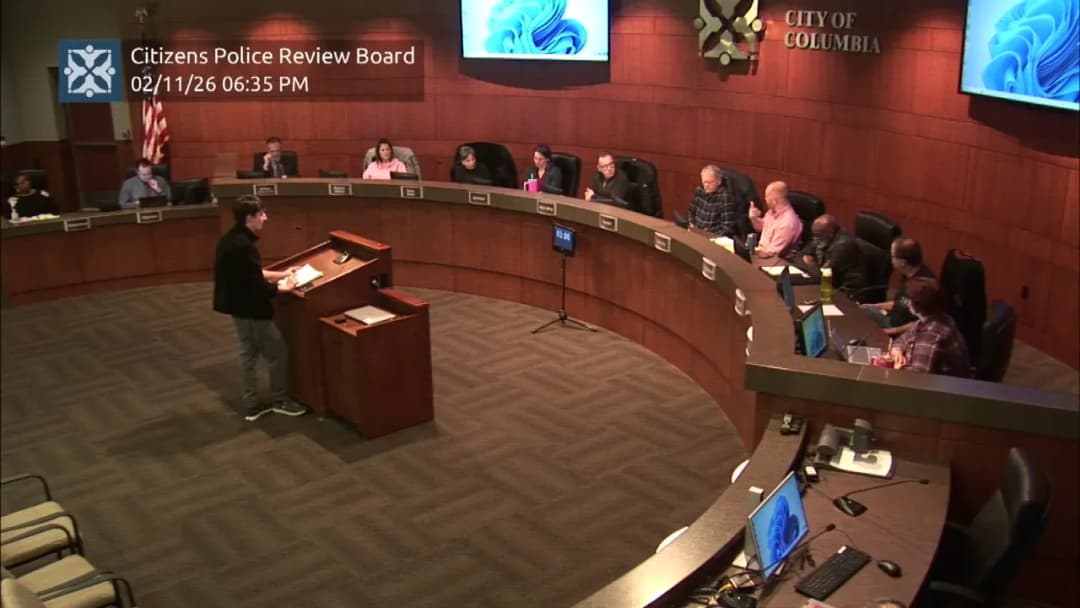
Citizens Police Review Board Meeting – February 11, 2026: Discussion on Limitations and Sunshine Law Constraints

The Citizens Police Review Board (CPRB) met on February 11, 2026, to discuss the board’s current limitations under city ordinance and state law, the implications of the Sunshine Law, and potential ways to foster public dialogue about the board’s role. The board also received an update from the Human Rights Commission liaison. No appeals were heard, and no formal votes were taken. Public Comments & Testimony - Micah Shulman, a reporter with the Columbia Missourian, asked the board to describe its duties before and after the restrictions imposed on September 3, 2024, and what activities it can no longer undertake. Discussion Items - Board Powers and Sunshine Law Constraints: - Chair Doug Hunt noted that the board’s annual report was presented to City Council on February 2, 2026. During that meeting, several council members, including the mayor, expressed willingness to revisit and possibly revise the ordinances that limit the board’s powers. Hunt expressed concern that the board cannot officially take up the matter because its duties are restricted by city ordinance (Section 21-49) and that any substantive discussion by a quorum would violate the Sunshine Law. - Earl (staff legal advisor) explained that the board’s duties are limited to reviewing appeals, jurisdictional reviews, complaints of alleged misconduct, and submitting an annual report. Unless City Council formally asks the board to provide advice on potential changes, the board cannot initiate discussion on modifying its own ordinance. - Board members explored ways to encourage public discussion without violating the Sunshine Law. Earl clarified that if four or fewer board members meet informally (less than a quorum), it is permissible. However, any coordinated effort to circumvent the Sunshine Law would be noncompliant. Board members also noted that individuals can speak to their City Council representatives as private citizens. - Multiple board members expressed frustration with the current limitations. They described the September 3, 2024 ordinance (02575) that narrowed the types of complaints the board can review to four categories, removed the board’s ability to host public informational meetings, and prohibited it from commenting on police policies, procedures, and training. Some board members argued that the city’s implementation was more restrictive than necessary, noting that other municipalities (e.g., Kansas City, Ferguson) determined the state law did not apply to their review boards. - State Legislation: - The board discussed two pending state bills: HB 2569 (sponsored by Rep. David Tyson Smith) which would exempt Columbia from the restrictive state law for cities with a population between 125,000 and 160,000, and HB 2237 (sponsored by Marty Murray) which is more comprehensive. Neither bill has advanced far in the legislative session. Board members agreed to monitor these bills but noted that legislative action is uncertain. - Human Rights Commission Report: - Steph Yochum, the Human Rights Commission liaison, announced that the commission will host a presentation by the Missouri Commission on Human Rights on public accommodations at its March 3 meeting. She also announced her departure from the commission after three years of service, citing health reasons, and expressed hope to return in the future. Key Outcomes - No formal decisions or votes were taken. The board acknowledged that it cannot officially pursue changes to its ordinance unless directed by City Council. - Board members agreed to engage with City Council members as private citizens and to watch for a potential request from the council to provide input on ordinance revisions. - The board will await the police department’s complaint report before deciding on case audits; only five complaints (including one compliment) are currently logged. - The meeting adjourned after general comments.

PUBLIC SAFETY 54% · PENDING LITIGATION 17% · PROCEDURAL 16% · HUMAN RIGHTS 7%
74
FEB 11, 2026 · COLUMBIA, MISSOURI · VIDEO ARCHIVE
City of Columbia Cost of Service Study Overview for Sewer and Solid Waste Utilities - February 11, 2026

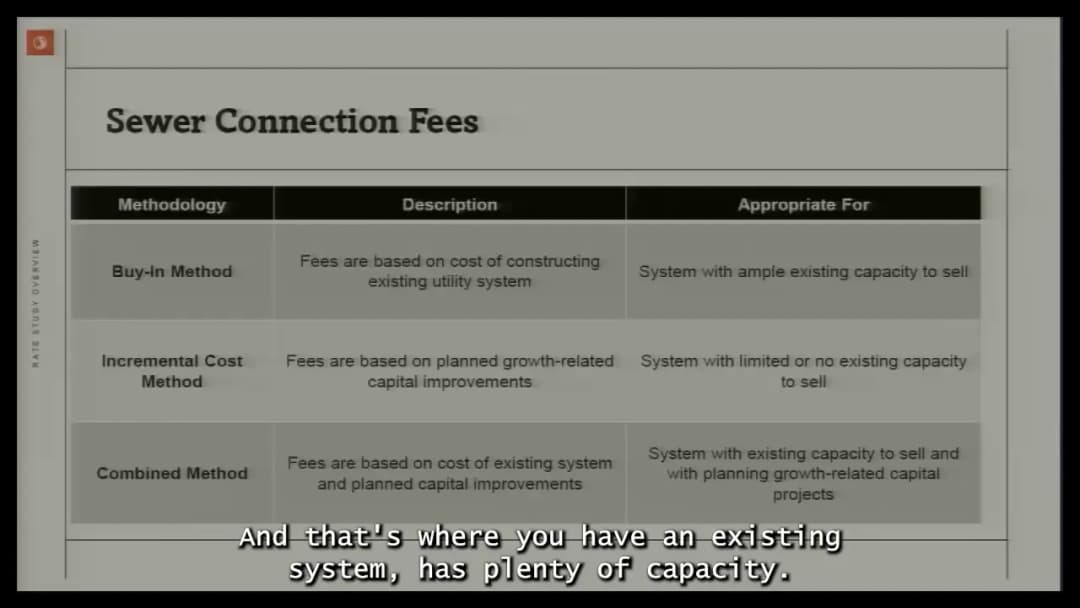
On February 11, 2026, the City of Columbia hosted a presentation by Kyle Stevens of Stantec Consulting to provide an overview of the upcoming cost of service study for the sewer and solid waste utilities. The study aims to evaluate revenue sufficiency, cost of service, rate design, and connection fees. Stevens noted that sewer rates were last adjusted in 2019 and that inflation for utility services has outpaced general consumer price inflation, with water and sewer costs rising 219% since 2000. Discussion Items - Revenue Sufficiency: The study will forecast utility costs over 5–10 years, considering capital investment needs, operating cost pressures (including recent inflation), regulatory compliance, and the time since last rate adjustments (sewer: 2019). A model will compare projected revenues to costs to determine sustainability. - Cost of Service Analysis: For sewer, costs will be allocated by function (collection, treatment, disposal) and then by cost components (flow, BOD, TSS, customer). For solid waste, costs will be broken down by service lines (residential refuse/recycling, commercial front/rear load, roll off). The goal is to ensure rates reflect the cost of serving each customer class. - Current Rates: Sewer rates consist of a fixed monthly base charge of $12.37 for single-family homes (scaling for meter size) and a volumetric charge of $2.55 per CCF. Solid waste rates feature a pay-as-you-throw program with cart sizes (35, 65, 95 gallons) and commercial rates based on dumpster size and pickup frequency. - Rate Design Objectives: The study will balance revenue requirements, affordability, simplicity, and proportionality. Bill impacts will be analyzed for average and high-use households, as well as for non-residential customers. - Connection Fees: A one-time fee for new sewer connections will be evaluated using the buy-in methodology, which calculates the current value of existing system assets adjusted for grants and debt. The example from a prior water study saw a fee increase from $578 to $1,069. Under-recovery of connection costs shifts the burden to existing ratepayers. - Project Timeline: Data collection began in February 2026; revenue sufficiency analysis will be conducted in mid-February, followed by cost of service in March, rate design in April, connection fee analysis in March, and preliminary results in April–May. Recommendations are expected for implementation in the next fiscal year. Key Outcomes - No votes or decisions were taken. The presentation served to inform the City of the study's scope, methodology, and timeline. The study is expected to produce rate recommendations for the fiscal year starting after completion.

WATER AND WASTEWATER MANAGEMENT 83% · PUBLIC UTILITIES 17%
75
FEB 10, 2026 · COLUMBIA, MISSOURI · VIDEO ARCHIVE
Columbia Board of Adjustment Meeting – February 10, 2026

The Board of Adjustment met to consider three variance requests related to property improvements in older neighborhoods. The board unanimously approved variances for shared driveway extensions at 210 and 300 Edgewood Avenue, and approved (4-1) a corner side yard variance to allow an accessory dwelling unit at 24th Avenue. No public comments were received. Consent Calendar - The agenda for the meeting was approved unanimously. - The minutes from the December 9, 2025 meeting were approved without correction. Public Comments & Testimony - No members of the public spoke for or against any of the applications during the public comment periods. Discussion Items - Case 339-2025 – 210 Edgewood Avenue (David Borgelt, owner): David Borgelt requested two variances to permit the extension of a shared driveway along the property line and to allow parking within six feet of the property line, enabling construction of a code-compliant detached garage. The property has a 50-foot-wide lot, a shared driveway that has existed for over a century, and topographical constraints. Staff noted that the 2017 Unified Development Code (UDC) created the need for these variances and that the lot’s narrow width and terrain create a practical hardship not of the owner’s making. Staff supported both variances, noting the improvements would not harm the neighborhood and would facilitate housing activation. - Case 62-2026 – 300 Edgewood Avenue (Tate Cooper, owner, represented by Mick Wilson): This concurrent request sought the same two variances for the adjacent property to the south, to allow the shared driveway to remain compliant and to permit future parking. Attorney Mick Wilson stated the owner supports Mr. Borgelt’s project and has no immediate plans to build but wants the ability to do so later without returning to the board. Staff’s comments mirrored those in Case 339-2025, emphasizing that the lot is a legal substandard lot and that the variance is preemptive. The board considered testimony from the prior case as linked. - Case 63-2026 – 24th Avenue (Central Missouri Community Action, owner, represented by Caleb Colbert and Jay Gebhardt): The applicant sought a 16-foot variance from the required 25-foot corner side yard setback to build a 510-square-foot accessory dwelling unit (ADU) on a 36.5-foot-wide corner lot. The lot was created from a 73-foot-wide lot and is zoned R2, where ADUs are a permitted use. Staff explained that the 2017 UDC’s 25-foot corner side yard makes the lot effectively unbuildable for an ADU; pre-2017 the setback was 12.5 feet. Staff recommended approval but noted that a narrower building could achieve a 12.5-foot setback as an alternative. The board debated whether the hardship was self-created, but staff argued the lot’s unique size and shape, combined with the code change, constitute a practical difficulty. The driveway access onto Garth Avenue had already been approved by the city traffic engineer and community development director. Key Outcomes - Case 339-2025 (210 Edgewood): Both variances were approved unanimously (5-0). The first variance allows the existing shared driveway to be considered regulatorily compliant and permits future extension within five feet of the property line. The second variance permits parking within six feet of the southern property line. - Case 62-2026 (300 Edgewood): Both variances were approved unanimously (5-0) with identical language to Case 339-2025 but specific to 300 Edgewood. - Case 63-2026 (24th Avenue): The variance was approved 4-1 (Ms. Hammond voted no). The motion included three conditions: (1) a minimum nine-foot corner side yard setback shall apply to new construction from the Garth Avenue frontage; (2) any voluntary demolition of the existing principal dwelling must adhere to the same nine-foot setback; and (3) the proposed ADU shall be built in substantial compliance with the submitted exhibit. - The next regular meeting in March is cancelled; the board will be notified of any applications for the April meeting. - Board member terms were reviewed: Ms. Hammond’s term expires in May 2026; Ms. Gaines and Ms. Bryant were welcomed as new members.

ZONING VARIANCE 63% · PROCEDURAL 15% · AFFORDABLE HOUSING 11% · LAND USE 5%
76
FEB 5, 2026 · COLUMBIA, MISSOURI · VIDEO ARCHIVE
Planning and Zoning Commission Meeting – February 5, 2026: The Vantage PD Rezone and Campus Spa CUP Approved

Date: February 5, 2026 Time: 7:00 PM – 9:19 PM Location: Columbia City Hall, Council Chambers, 701 E Broadway Attendance: All nine commissioners present (Brodsky, Darr, Geuea Jones, Gray, Ortiz, Stanton, Stockton, Walters, Wilson) The commission held two public hearings and approved both agenda items unanimously. The meeting also included a public comment on accessory dwelling units (ADUs) and a staff preview of upcoming agenda items. Public Hearings & Testimony Case 49-2026 – The Vantage (Rezone 50.8 acres from PD to PD, PD Plan & SOI) - Applicant: Kyle Miller, Crockett Engineering, on behalf of Tori-Bens, LLC - Proposal: Rezone 50.8 acres (Tracts 2, 4, and part of Tract 5 of the 2010 Richland Road Annexation) to allow 240 multi-family units (The Vantage) on both sides of Rolling Hills Road, south of Richland Road. - Staff Recommendation: Approval (Ross Halligan, Planning & Development) - Public Testimony: - Dee Dokken (804 Again St): Supported density and location but opposed building in the 100-year floodplain; noted Buildings 3 and 4 partially in floodplain. - Jon Duke (5317 Harbor Town Drive, The Brooks): Opposed four-story height and increased traffic; warned Hoy Lake Drive would become a dangerous cut-through. - Gail Hauswirth (5338 Harbor Town Drive): Opposed due to lack of infrastructure; argued Hoy Lake Drive already functions as a cut-through in violation of UDC standards, and the 2025 traffic study excluded it. - Troy Cox (5771 E Richland Road): Supported minimization of environmental impact but raised concerns about flooding and requested FEMA floodplain administrator involvement. - Barbara Sampsell (2 Bogie Hills, Bay Hill Subdivision): Concerned about safety on narrow Richland Road (Level of Service F for 5–10 years until roundabout built). - Dejuan Wright (5471 E Richland Road): Opposed high-density apartments; advocated for lower-density housing (duplexes) and preservation of green space. - Commissioner Discussion: - Chair Geuea Jones questioned the use of PD zoning (originally for commercial) but accepted staff explanation that PD secured new concessions (trailhead, roundabout contribution) not in the 2010 agreement. She initially objected to buildings in the floodplain but later voted yes after clarification. - Commissioners acknowledged traffic concerns on Hoy Lake Drive but deemed it an enforcement/prioritization issue separate from the zoning decision. - Several commissioners cited the need for housing (3,000-unit deficit per 2024 study) and the project's compliance with UDC density standards (gross 5.36 du/ac, net 9.13 du/ac, below 17 du/ac max). - Key Statistics: 50.8 acres, 240 units (4 buildings, 45 ft height), 448 parking spaces, 16% impervious surface, 1.5-acre trailhead park dedication, proportional contribution to future roundabout, Level of Service F currently, projected B after roundabout. Case 64-2026 – Campus Spa CUP (Conditional Use Permit) - Applicant: Cari Nichols, Campus Spa LLC, on behalf of BVSHSSF COLUMBIA, LLC - Proposal: Allow a 640-sq-ft spa in Suite 400 of University Place Apartments (1205 University Avenue), zoned R-MF. - Staff Recommendation: Approval (Ross Halligan) - Public Testimony: None other than applicant. - Commissioner Discussion: Unanimous support; praised local business, low-impact use, and alignment with comprehensive plan. Public Comment (Non-Agenda) - Adrienne Stolwyk (212 Hirth): Spoke in favor of relaxing ADU regulations (height, setbacks, CUP process) to encourage accessory dwelling units in R-1 zones. Key Outcomes - Case 49-2026 (The Vantage): Motion to approve the rezone, PD Plan, and Statement of Intent carried 9-0. Recommendation forwarded to City Council. - Case 64-2026 (Campus Spa): Motion to approve the CUP carried 9-0. Recommendation forwarded to City Council. - Next Meeting: February 19, 2026, at 7:00 PM (tentative), with agenda including a work session on ADU standards, a PD rezone for Broadway Office Park, a short-term rental application, and a text amendment defining data centers. - Staff noted: The public input period on the definition of “family” closes February 14/15; a vendor for short-term rental compliance is ready; the data center text change is the first of a two-step process.

ZONING 31% · TRANSPORTATION SAFETY 21% · PUBLIC ENGAGEMENT 18% · PROCEDURAL 6%
77
FEB 4, 2026 · COLUMBIA, MISSOURI · VIDEO ARCHIVE
City Council Meeting Summary - February 4, 2026

The City Council of Columbia met on February 4, 2026, to discuss, amend, and vote on pedestrian safety legislation and receive reports on homelessness, police reviews, and historic preservation. The meeting featured extensive amendments to Bill 26525, aimed at restricting standing on medians, following a contentious public comment period where positions ranged from strong support for safety to concerns over impacts on homelessness, disability rights, and free speech. The council also voted to authorize a new strategic planning process for homelessness services. Consent Calendar - Routine approvals and unanimous actions, with minor exceptions: Council approved a bundle of bills (17, 18, 19, 20, 21, 22, 23, 24, 25, 26, 27 of 2026) and resolutions (16-26 of 2026), with Council Members Carroll and Elwood voting 'no' on Bill 26-26 (Resolution 26-26) and Bill 26-26 (Resolution 26-27) respectively. Public Comments & Testimony - Position: Full Support for Ordinance - Timmy (Chamber of Commerce Rep): Expressed full support for the ordinance and amendments, arguing it protects public safety without restricting legitimate activity and is vital for the local economy. - Bruce Summers: Shared personal anecdotes of near-tragedies involving people in medians, expressing support for the ordinance as a necessary safety measure. - Tom Traby (Realtors Board): Supported the ordinance as a balanced, evidence-based tool for Vision Zero, though criticized Amendment 4 for watering down the original draft. - Jim Meyer: Supported the ordinance, citing the safety risks of unconscious individuals in medians and the viability of alternative protest locations. - Ken Rice (Disability Commission): Expressed support, viewing the ordinance as an interim safety measure that protects disabled residents from being blocked by panhandlers, while acknowledging infrastructure needs. - Tanya Heath: Supported the ordinance while suggesting an accompanying advertising campaign to help the unhoused population. - Ted Farnon: Expressed full support, dismissing opposition as political noise and arguing that the ordinance is constitutionally sound and necessary for common sense safety. - Carrie Gartner (Business Loop CID): Supported the ordinance, citing near-misses and student safety, noting that medians are currently unsafe due to panhandlers. - John Shin: Supported the ordinance, stating medians are designed for temporary refuge, not long-term residence or panhandling. - Position: Opposition to Ordinance - Doug Hunt (Citizens Police Review Board): Expressed opposition to the restrictions placed on the CPRB (a separate item), urging the council to reverse September 2024 limitations to restore robust civilian oversight of police. - Sarah Reid: Expressed strong opposition to the 2016 pause on the transmission line, urging the council to approve the line immediately to restore grid reliability and save millions in sunk costs. - Alphonso (Citizens Police Review Board Rep): Urged the council to reverse restrictions on the CPRB to restore its ability to comment on police policies and training. - Alison Calkins & Ashton Buckridge (VidWest/Film Club): Expressed gratitude for VidWest support for students; no direct policy position, but highlighted the need for community resources. - Alejandro Gallardo: Expressed strong opposition to the pedestrian ordinance, arguing it shifts blame to disabled and vulnerable pedestrians rather than fixing infrastructure. - Julie Shoop: Expressed opposition to the pedestrian ordinance, stating that allowing panhandling in medians is a short-term fix that endangers the homeless, but the ordinance still fails to address root causes. - Catherine Armbrist (Coma Mobile Aid): Expressed opposition, stating the ordinance is "ugly," targets the homeless, and fails to address infrastructure; urged the council to value people over property. - Derek Fogel: Expressed opposition, concerned the ordinance would force protesters and homeless individuals to cross intersections more frequently, increasing danger. - Kristen (Ward 5): Expressed opposition to the pedestrian ordinance, arguing it fails to commit to infrastructure improvements and still punishes users for inadequate infrastructure. - Ida Fogle: Expressed opposition, citing driver inattention as the primary danger and noting conflicts with the ordinance regarding litter cleanup. - Bill: Expressed opposition, arguing the ordinance criminalizes the act of survival for the homeless and fails to address root accident factors. - Anthony Wellroth: Expressed opposition, arguing the bill takes a "directionally backwards" approach by focusing on enforcement rather than infrastructure or driver liability. - Shane Lowe: Expressed opposition, suggesting exceptions for snow/debris clearing to avoid criminalizing community members helping neighbors. - Elizabeth Bridges: Expressed opposition, describing the ordinance as "bullying disguised as public safety." - Simon Macman: Expressed opposition, arguing the ordinance targets the homeless and will prolong homelessness by criminalizing survival. - Drew Amaday (Missouri Jobs with Justice): Expressed opposition, stating the ordinance targets marginalized communities and contradicts the city's diversity values. - Ada Growhering: Expressed opposition, characterizing the ordinance as culturally genocidal against the homeless community. - Matthew Schacht: Expressed opposition (initially), urging the council to communicate better with the community to bridge the divide. - Mike Burden (Local Motion): Expressed opposition, arguing the ordinance punishes vulnerable road users rather than fixing the car-centric infrastructure design. - Pat Fowler: Expressed opposition, arguing the ordinance denies the human right to self-preservation while long-term housing solutions are unavailable. - Matthew Struck: Expressed opposition, stating the data does not support the ordinance and it places an unfair enforcement burden on police. - Catherine Armbrist: Expressed opposition, warning of liability and stating the ordinance is about power and control. - Alex Bohan: Expressed opposition, citing lack of support from key commissions and the failure of the data to support enforcement of motorists. - Keith Clayton: Expressed opposition and disgust, stating the ordinance finds people who are "undesirable" and does not address heat stroke or medical issues. - Justin Sills: Expressed opposition, stating the bill fails on both facts and compassion. - Position: Mixed/Contextual - Renee Carter (Race Matters): Expressed opposition to the bill but support for the ordinance's amendments; corrected data regarding median accidents, clarifying they occurred near medians during crossing, not on them. - Rebecca Rosslet (Health Dept): Supported the strategic planning process but did not explicitly endorse the ordinance itself in her testimony. Discussion Items - Bill 26525 (Pedestrian Safety Ordinance): - Staff Presentation: Director Shane Creech and Chief Jill Saluti presented the ordinance, citing study data (29.2% of crashes involved pedestrians at medians) and the need to address unsafe behaviors like remaining in medians. - Amendments Passed: - Amendment 1: Added a requirement for the Director of Public Works to post a schedule of enforced medians on the city website. - Amendment 2: Modified the definition of inaccessible crosswalks to include conditions rendering them unsafe, removing the specific phrase "with a disability" to broaden applicability to any impassable condition. - Amendment 3: Clarified enforcement standards, defining "legal crossing" to include two consecutive opportunities to cross and adding specific exceptions for disabilities, mobility limitations, and safety considerations. The conjunction "and" was replaced with "or" to broaden the scope of prohibited locations (major corridor OR median < 6ft). - Amendment 4: Modified the prohibition of pedestrians on roadways to explicitly allow crossing when sidewalks are inaccessible or unsafe due to obstruction or disrepair. - Amendment 5: Removed the "distribution conduct" definition to separate pedestrian safety from motorist distribution issues, renumbering sections A and B to 6 and 7. - Amendment 6 (Added): Added an exception for cyclists lawfully operating under Article 7. - Amendment 7 (Added): Delayed the effective date of the ordinance from passage to July 1, 2026. - Public Debate: Council members and staff debated the enforceability of "immediate traffic hazards," the impact on First Amendment protests, the rights of cyclists, and the relationship between the ordinance and infrastructure improvements (specifically regarding MODOT roads). - Homelessness Strategic Plan: - Report: Public Health Director Rebecca Rosslet presented a report on the 10-year outlook for homelessness and the city's investment in services. - Discussion: Council debated the need for a new strategic plan to identify gaps in the continuum of care, with Council Member Betsy Elwood expressing frustration that the city is constantly reacting rather than planning proactively. - Citizens Police Review Board (CPRB) Annual Report: - Report: Presented by Stephanie Brown. The board reviewed 6 appeals in 2025, a decrease from 15 in 2024. - Discussion: Council Members Vera Sample and Don Foster expressed interest in revisiting the CPRB powers in light of Doug Hunt's testimony, noting that other Missouri cities (Ferguson, Kansas City) have broader powers. - Risk Management Move: - Discussion: Council Member Valerie requested a report on why risk management moved from Finance to the Law Department. City Manager DeKarlin explained the shift was to align legal liability and worker's comp oversight with legal expertise, noting Columbia's unique self-insured status. - Transmission Line: - Mention: Council noted that the next work session (Feb 9, 2026) will cover the transmission line issue raised by Sarah Reid. Key Outcomes - Bill 26525 Passed: The pedestrian safety ordinance, as amended, passed with the following vote tally: 4 Yes (Carroll, Elwood, Foster, Peters, Waterman, Buffalo), 2 No (Carroll, Elwood). Correction: Based on roll call, Carroll and Elwood voted No on specific bills but the final vote on 26525 saw 6 Yes and 1 No (Foster). Clarification from transcript: The roll call for Bill 26525 showed: Carroll (No), Elwood (No), Sample (Yes), Foster (Yes), Waterman (Yes), Peters (Yes), Buffalo (Yes). Result: 6 Yes, 2 No. The ordinance passed and is effective July 1, 2026. - Homelessness Strategy Authorized: Council voted unanimously (6 Yes, 0 No) to authorize staff to proceed with a five-year homelessness strategic planning process, potentially including an RFP for a third-party facilitator. - CPRB Review Flagged: Council agreed to revisit the CPRB powers, potentially requesting a report or waiting for state legislative changes to inform future actions. - Risk Management Report Denied: Council voted 4 No to 3 Yes to decline a formal report comparing Columbia's risk management structure to peer cities, accepting the City Manager's explanation. - Consent Items: Approved with noted exceptions (No votes from Carroll and Elwood on two specific items in the consent bundle).

PUBLIC SAFETY 32% · TRANSPORTATION SAFETY 15% · HOMELESSNESS 15% · PUBLIC ENGAGEMENT 10%
78
FEB 4, 2026 · COLUMBIA, MISSOURI · VIDEO ARCHIVE
City Council Meeting Summary: Municipal Court Update - February 4, 2026

The City Council met on February 4, 2026, to receive an update from the Municipal Court regarding operational capacity, docket performance, caseload trends, and recent community engagement initiatives. The presiding judge highlighted significant increases in volumes for the Community Support and Property Services dockets, attributed largely to increased enforcement resources and public engagement. The court is currently operating near its envisioned capacity, with plans to hire additional temporary staff to manage surging caseloads while maintaining a four-day work week to support staff retention and public access. Consent Calendar - No specific consent calendar items were explicitly raised for a vote during the transcript segment; the meeting moved directly to public comment/Q&A and then to a motion for closed session. Public Comments & Testimony - Council Member Inquiry on Docket Volume: A council member inquired about the reasons for the increase in Community Support docket attendance, specifically asking if the court's reputation for fairness in the unsheltered community was a factor. - Response Position: The Judge stated that building trust with the homeless community is a significant driver; anecdotal evidence suggests individuals are now bringing friends and family to the docket due to faith in the justice system's new approach. However, the Judge also noted that the volume surge is primarily driven by CPD enforcing specific ordinances (e.g., parking, homelessness in parks) which generates warrants and cases requiring court processing. - Council Member Inquiry on Enforcement Necessity: A council member questioned whether increased caseloads indicated that violations were previously unaddressed or if the increase was merely due to increased officer presence. - Response Position: The Judge clarified that violations (speeding, DWI, stop sign violations) were occurring but not being processed due to a lack of enforcement resources; the increase in tickets represents a realignment of resources to address existing compliance issues rather than a rise in actual criminal behavior alone. - Council Member Inquiry on Capacity Management: A council member asked for strategies to handle the docket if it continues to grow beyond current capacity. - Response Position: The Judge expressed that re-envisioning the docket would require either significantly expanding Divert services to act as a clearinghouse or dedicating more time per individual, neither of which is currently feasible without absorbing significantly more resources. The Judge noted that the current docket processes only about one-third of the identified homeless population. Discussion Items - Community Support Docket Dynamics: The judge noted a dramatic shift over eight years, with the docket handling up to 100+ individuals (compared to 5-6 previously). The docket serves veterans and individuals experiencing homelessness (including car-dwellers, couch surfing, and sheltered individuals). The judge highlighted the necessity of a "cleanup" session the following day for large dockets to avoid exceeding lunch hour capacity, noting the strain on time management. - Position: The judge expressed concern that expanding the docket further is difficult without absorbing significant time, emphasizing the need to maintain quality interaction rather than processing individuals too quickly. - Outcome: The judge shared a positive anecdote of an individual achieving housing and sobriety after three docket appearances, and criticized the lack of consequence when one individual failed to meet a promise after having a warrant recalled. - Property Services Docket: The judge described this docket as prosecutor-driven and problem-solving, focusing on maintenance code violations (junk in yards, weeds, unlicensed vehicles) rather than court-driven proceedings. The docket time was extended by 30 minutes to allow the prosecutor more time for resolution. - Position: The judge stated that early resolution at this docket reduces recurrence and helps corporations avoid expensive litigation. - Limitation: The judge noted they do not track how often specific issues (like rental complaints) stay in the court or repeat, as they rarely hear facts in cases that result in deferral or dismissal. - Court Operations and Staffing: The court operates a four-day work week (35 hours) with extended hours (7:30 AM to 5:30 PM) plus night courts. Three new employees were recently hired, though the court is operating with 7.0 FTE against an authorized 8.75 FTE. The judge plans to fill remaining positions and use temp staff for surges. - Position: The judge emphasized that the four-day work week is critical for recruiting staff who would otherwise be unable to work there (e.g., parents, students) and that they are not planning cuts to municipal court. - System Updates: The court will discontinue the legacy "Jessper" system in February, replacing it with the new "Show Me Courts" report after cleaning up one lingering bond. - Budget and Caseload Trends: Caseloads have seen a significant surge, with a doubling last year post-pandemic and an additional 700 cases recently. The judge noted that caseload volume is directly tied to resource allocation by management (e.g., CPD hiring, traffic units, fire department overtime). - Citizen Survey Interpretation: The judge disputed the summary statistics on page 16 of the citizen survey regarding court satisfaction. - Position: The judge argued that excluding "Don't Know" responses creates a warped perception. The detailed breakdown (Page 84) shows 46% of respondents were "Don't Know," with only 7% "Very Satisfied," 15% "Satisfied," and 28% "Dissatisfied/Very Dissatisfied" (combined) among those with an opinion, contrasting with the summary slide's implied 13% dissatisfaction. Key Outcomes - Caseload Management Strategy: The judge plans to fill open FTE positions and utilize temporary staff to manage current surges, with a commitment to not cutting municipal court resources. - System Transition: The "Jessper" legacy system is scheduled for discontinuation in February 2026, with a transition to the "Show Me Courts" reporting system. - Judicial Reappointment: Judge Briscoe is scheduled for reappointment in May 2026. - Motion to Close Session: The council moved to close the meeting to discuss legal actions, litigation, and personnel matters (hiring/firing/disciplining employees) under relevant Missouri statutes. - Warrant Policy Note: The judge reaffirmed that while positive engagement (like recalling warrants) is encouraged, failure to meet court-ordered promises results in new warrants with stricter terms (cash bond), emphasizing the need for consequences alongside support.

PUBLIC SAFETY 43% · HOMELESSNESS 37% · PERSONNEL MATTERS 13% · PUBLIC WORKS 4%
79
JAN 22, 2026 · COLUMBIA, MISSOURI · VIDEO ARCHIVE
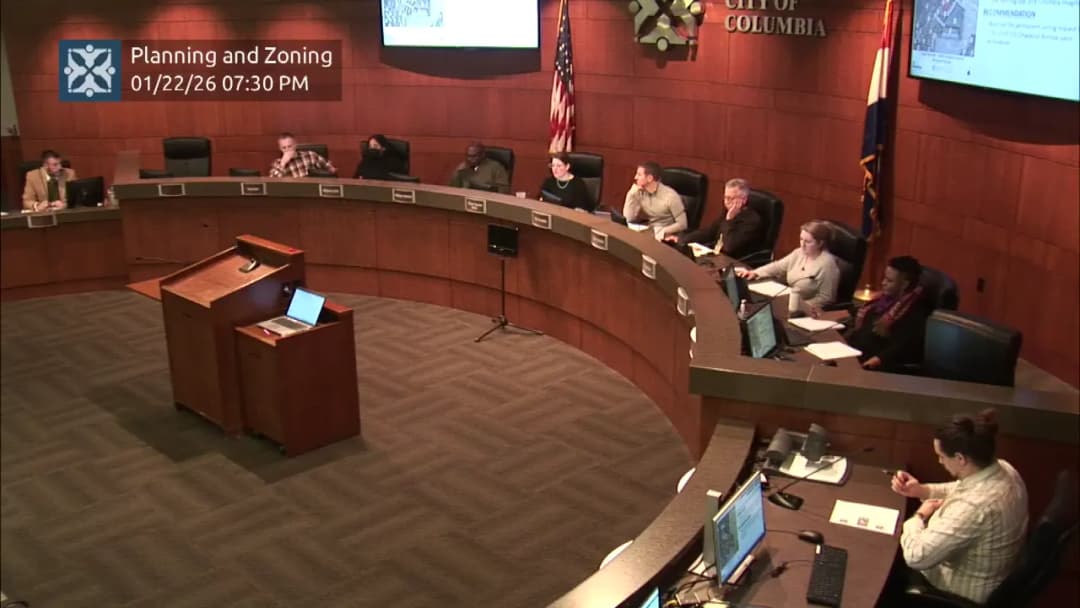
Planning and Zoning Commission Meeting - January 22, 2026

The Planning and Zoning Commission convened for its regular meeting on January 22, 2026, at 1:15 PM to address three specific land use cases involving rezoning, short-term rentals, and annexation preparation, alongside routine procedural items. The commission unanimously approved the agenda and the previous minutes, with Commissioner Brodsky abstaining on the minutes review. The proceedings focused on tabling a complex multifamily development, approving a conditional use permit for a short-term rental, and recommending permanent zoning for a new fire station site. Consent Calendar - Agenda for the January 22, 2026 meeting was approved unanimously by motion of Commissioner Stanton and secondment of Commissioner Ortiz. - Minutes from the January 8, 2026 regular meeting were approved unanimously, with Commissioner Brodsky abstaining. Public Comments & Testimony - Matthew Hawley (Owner/Agent for 903 West Worley Street): Expressed full support for the short-term rental (STR) operation at their property. They argued that as long-term residents and not outside investors, they are committed to the community. They noted that early concerns regarding noise were resolved through vetting guests via Airbnb. They emphasized that the income is essential for their family's housing upgrade and benefits the community by providing affordable lodging. Additionally, they expressed concern that the exterior "Short-Term Rental" signage may have coincidentally contributed to a recent burglary. - Hared Robertson (Resident at 1132 South Pecos Court): Expressed concern regarding increased traffic congestion at the intersection of L Chaparral Avenue and Highway WW due to the proposed fire station, supporting a letter requesting a traffic signal which the commission staff noted is out of their control. They raised an additional concern regarding the lack of a physical address on the public notice postcard, making it difficult for residents to locate the site. - Hared Robertson (Follow-up): Inquired about the specific access plans for the fire station relative to Broadway, noting that current access seems limited. They also questioned if infrastructure development was occurring prematurely before annexation approval. Staff clarified that access will likely be via a loop on El Chaparral and that current work is permissible because the lots are legal and the property is within the county but intended for city use. Discussion Items - Case 49-2026 (Crockett Engineering Consultants for Vantage Multifamily Development): Staff and the applicant discussed a request to table the vote from the current meeting to February 5, 2026. The delay is necessitated by unresolved discussions with the Parks and Recreation Department regarding land dedication for the 240-unit development. Staff noted that if the Parks Department response is delayed, further tabling to February 19th or March may be required. Commissioner Stanton moved to table the case specifically to the February 5th deadline. - Case 32-2026 (Matthew Hawley for 903 West Worley Street): Staff reported on a previously tabled request for a Conditional Use Permit (CUP) for a 210-night short-term rental with a six-guest maximum. Staff detailed that the property has code violations (solid waste, health nuisance, illegal STR) but is not currently being prosecuted. Three public letters were received (two in support, one in opposition), addressing concerns about neighborly relations, parking, and noise. The applicant confirmed ownership history and remediation efforts regarding past party disruptions. - Case 56-2026 (City of Columbia for 1020 South El Chaparral Avenue): Staff presented a request for permanent R1 zoning for a 4.64-acre parcel to facilitate the construction of a fire station and administrative offices. Staff clarified that the commission is only deciding on zoning, not the annexation itself. Public comments and staff discussion addressed traffic concerns at the nearby state highway intersection, with staff reiterating that traffic signalization is controlled by the Missouri Department of Transportation (MODOT) and is not currently planned for this specific location. Commissioner Brodsky commented on the potential need for sidewalks along El Chaparral for City Council's consideration. Key Outcomes - Case 49-2026 (Vantage Development): Motion to table the case to February 5, 2026, carried by a roll call vote of 6-0 (Commissioner Brodsky and Wilson were absent/ineligible for this vote). The next step is to await feedback from the Parks Department before the February 5th meeting. - Case 32-2026 (903 West Worley Street STR): Motion to approve the Conditional Use Permit subject to a maximum occupancy of six transient guests and a maximum operation of 210 nights per year carried by a roll call vote of 8-0. The recommendation will be forwarded to City Council. - Case 56-2026 (1020 South El Chaparral): Motion to approve the permanent zoning request to R1 for the specified parcel upon annexation carried by a roll call vote of 8-0 (Commissioner Wilson noted his vote as "yes" while absent). The recommendation will be forwarded to City Council. - Next Meeting: Scheduled for February 5, 2026. Agenda items include a CUP for a spa expansion in a residential zone and further discussion on accessory dwelling unit changes. Public comments are still being accepted regarding revised definitions of "family" via the "Be Heard" app and a pedestrian safety ordinance.

SHORT TERM RENTAL REGULATION 31% · ZONING 30% · PROCEDURAL 15% · PUBLIC ENGAGEMENT 8%
80
JAN 21, 2026 · COLUMBIA, MISSOURI · VIDEO ARCHIVE
Columbia City Council Pre-Council Meeting Summary - Jan 20, 2026

The Columbia City Council convened a pre-council meeting to receive presentations from four of the city's five labor negotiators regarding their bargaining priorities for the upcoming contract year, followed by a detailed review of the 2025 Community Survey results and staff responses. While the majority of meetings proceed to closed session for labor negotiations, the Mayor indicated that a closed session will likely be scheduled for the February 2nd pre-council to avoid personnel rule violations during the open presentations. The meeting concluded with discussions on tabling specific reports for the February 16th meeting and inquiries regarding transportation data in the survey. Consent Calendar - No specific consent calendar items were debated or voted upon during this pre-council session; the agenda focused on presentations and discussion. Public Comments & Testimony - No public comments were solicited or recorded during this specific pre-council segment; the session was dedicated to labor group presentations and staff analysis. Discussion Items - Labor Group Presentations: - Local 955 (Scotty Johnson): Expressed a clear desire for pay grade adjustments for union-eligible positions (including transit and water distribution workers), a $19/hour minimum wage for representatives, uniform attendance policies across departments, cost-of-living adjustments to step scales and holiday pay, and revised arbitration/discipline procedures. The speaker noted that specific details are reserved for formal negotiations. - Local 1055 (Zach Clivet): Stated full satisfaction with recent pay plan adjustments but argued that current compensation has fallen behind inflation, with members earning less in real terms than six years ago. Expressed strong support for step adjustments tied to economic conditions, increased ad-hoc pay for specialized teams (Hazmat, water rescue), and an automatic inflation-tied adjustment for meal allowances. Speaker proposed a post-employment health insurance HSA-style savings program funded by sick leave buybacks and advocated for a net-zero approach to be surpassed by actual growth. - CPLA (Derek Morris): Highlighted three primary goals: addressing recruitment and retention by aligning compensation (noting sergeants often earn more than lieutenants due to overtime), removing vacation accrual limits for better leave flexibility, and securing retirement benefits including service credit purchase options and post-employment health care. Expressed support for standardized leadership training and clarified that current job descriptions are often outdated or undermined by higher command staff taking over responsibilities. - Columbia Police Officers Association (Don Neavers): Emphasized the critical need for retention, noting the loss of 14 officers (nearly 10% of the sworn workforce) in the last 90 days. Proposed a pay step plan rewarding tenure and CPI-based adjustments, restoration of the 20-year retirement option, and bargaining for binding arbitration of discipline decisions to ensure neutral reviews. Speaker argued that the current Citizen Police Review Board lacks sufficient rules to prevent bias and requested collaborative brainstorming to improve the investigation and appeal process. - Water and Waste Association: The only labor group not requesting to present; the group is not listed on the agenda for this session. - 2025 Community Survey Results (Robert Heacot, ETC Institute): - Presented data showing that 80 of 89 measured metrics remained the same or improved, with only 9 decreasing slightly. Expressed strong support among the data for the city's direction, noting a 14.3% improvement in police department quality satisfaction in just one year. - Clarified methodology: The survey utilized a random, address-based sample (804 responses, 95% confidence, ±3.4% margin of error). Approximately 20 responses from social media ads and 20 from outside city limits were excluded. Respondents indicating "do not know" were filtered out of satisfaction benchmarks but included in the raw data report. - Key findings: Residents ranked "quality of police and fire services" and "increased number of police" as top priorities. Dissatisfaction remains high regarding crime prevention efforts (51% dissatisfied), though this metric improved 12% from the previous year. Public works satisfaction is mixed, with low scores for street maintenance and sidewalk conditions. Residents identified "transparency and accountability" as the top factor for trusting local government. - Noted that 69% of respondents believe the city does not have enough police officers and firefighters. - Staff Presentation (Carol Rhodes and Department Heads): - Outlined ongoing efforts to address survey concerns, including expanded homeless warming/cooling sites, a new "Right Home" program, and increased homelessness outreach officers. - Reported recruitment of 39 police and 33 fire officers in 2025, with a 67% increase in traffic stops (from 3,000 to 18,000) and the implementation of license plate readers and Axon cameras. Stated plans to reinstate the downtown unit and enhance park safety. - Addressed street maintenance costs, noting MODOT's reduced maintenance role due to resource constraints, and clarified that sidewalk maintenance is primarily the responsibility of property owners, though a 50-50 cost-share program exists. - Confirmed that recommendations will directly influence the Fiscal Year 27 budget formulation, particularly regarding staffing for litter control and park maintenance. Key Outcomes - Agenda Adjustment: Council agreed to table the "Communications for Capital Improvement Projects" and "Mayor's Task Force Feedback (2014)" reports to the February 16th meeting to ensure time availability. - Closed Session Planning: Council directed staff to add a closed session item regarding labor negotiations to the February 2nd agenda, with a request to potentially meet 30 minutes early (4:30 PM) to accommodate the discussion. - Data Follow-Up: Council requested a review of the raw survey data to confirm whether the excluded 40 respondents (social media/outside city) contributed to the open text comments section. - Transportation Inquiry: A council member requested ETC Institute be contacted to see if transportation comparisons to the Plains region (currently missing from the summary slides) can be included in future reports or the contract. - Methodology Verification: Council requested that the final report be corrected to fix a formatting error on page 11 where "tire" was printed instead of "fire." The surveyors confirmed this was an error in the draft and will issue a revised report.

PERSONNEL MATTERS 29% · COMMUNITY ENGAGEMENT 21% · PUBLIC ENGAGEMENT 19% · PUBLIC SAFETY 11%
OPENPUBLICA · PUBLIC MEETING INDEXUPDATED DAILY · openpublica.com