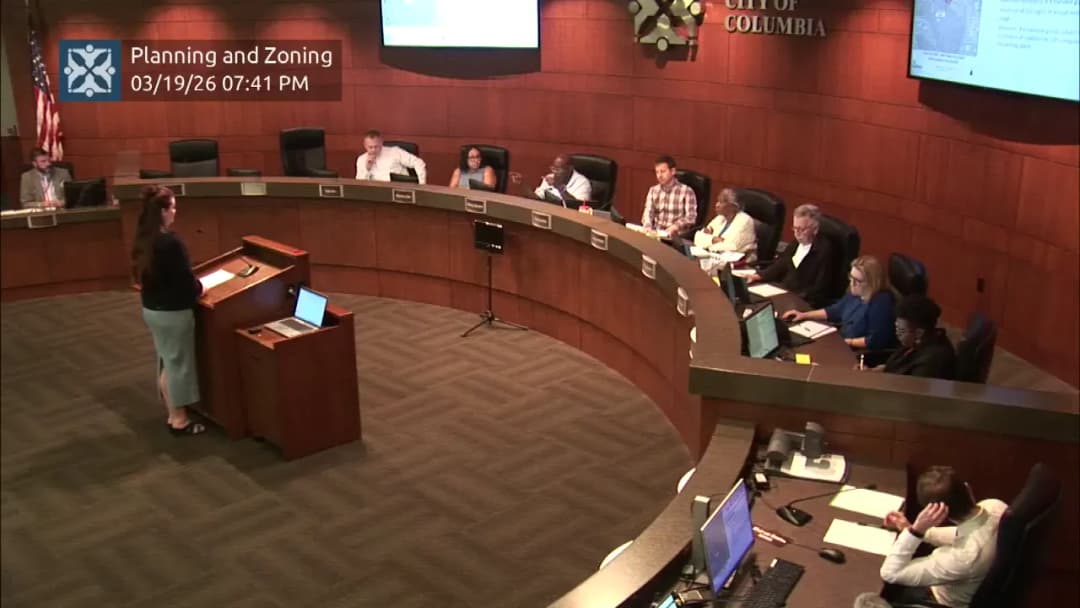
The Planning and Zoning Commission met on Thursday, March 19, 2026 at 7:00 PM at Columbia City Hall (Council Chambers) to consider an agenda including a tabling request, a conditional use permit for a short-term rental, and a text amendment to redefine “family.” All eight commissioners (Stanton, Wilson, Walters, Ortiz, Brodsky, Gray, Stockton, Darr) were present; Commissioner Geuea Jones was excused. The meeting adjourned at 9:12 PM. Consent Calendar - Approval of Agenda: Approved unanimously by thumbs-up vote. - Approval of Minutes: Minutes from the March 5, 2026 regular meeting were approved unanimously by thumbs-up vote. Public Comments & Testimony - Case 93-2026 – Valley View Short-Term Rental: Three neighborhood residents spoke in opposition during the public hearing, citing safety concerns, traffic, lack of sidewalks, and the potential for transient guests to disrupt the quiet, family-oriented character of the two cul-de-sacs. A petition signed by 16 out of 18 households (excluding the applicant and the agent) was submitted. The applicant and owners spoke in support, detailing their plans for high-end rentals (projected $400-$500/night) with strict management. Commissioner Wilson and others noted that the agent, Russell Boyt, lives next door, but residents expressed frustration over a lack of prior outreach. Discussion Items - Case 91-2026 – Bay Hills PD (Tabling): Staff requested a tabling to April 23, 2026 to allow the applicant to address technical revisions and prepare a development agreement. The project involves a major amendment to the existing Planned Development to allow 34 multi-family units on 3.5 acres at 3 and 21 Grace Lane. Staff clarified that this is a major PD amendment, not a rezoning. The public hearing was limited to the tabling request; no public speakers came forward. The commission voted 8-0 to table to the April 23, 2026 meeting. - Case 93-2026 – Valley View Short-Term Rental (STR): Public hearing on a request for a conditional use permit to allow 2002 Valley View Road (R-1 zoned, 1.2 acres) to operate as a 210-night STR with a maximum of six transient guests. Staff recommended approval subject to three conditions: maximum four transient guests unless an additional off-street parking space is installed, 210-night annual limit, and a maximum of six guests only with that extra parking. Discussion centered on neighborhood opposition, the lack of communication between the agent/owners and neighbors, and the fact that the registered agent lives next door. Some commissioners expressed concern over the applicant’s failure to preemptively engage neighbors. The motion to approve with the recommended conditions passed 6-2 (Yes: Gray, Stanton, Walters, Wilson, Brodsky, Darr; No: Ortiz, Stockton). Commissioner Walters noted that the ordinance is not a loophole. Commissioner Brodsky drew parallels to a prior STR case but found the on-site agent a key difference. Dr. Gray supported approval based on the criteria and a belief that regulation is preferable to denial. Commissioner Ortiz was torn but cited infrastructure (no sidewalks) as a concern. - Case 102-2026 – Family Definition Revisions (Text Amendment): Public hearing on a proposal to amend Chapter 29 (Unified Development Code) to revise the definition of “family.” Changes include: eliminating the difference in unrelated adult limits across R-1 (formerly 3), R-2, and R-MF (formerly 4) in favor of a single maximum of four unrelated adults; removing numerical limits on related persons; clarifying that children are not counted in the family definition; and incorporating International Property Maintenance Code (IPMC) standards for occupant load. The amendment stems from the 2024 Boone County/City of Columbia Housing Study. No public speakers offered comment. Commissioners briefly discussed whether to use “persons” or “adults” in the text; staff and legal counsel indicated the practical meaning is the same. The motion to recommend approval of the text change to Section 29-1.11(A) passed unanimously 8-0. Key Outcomes - Bay Hills PD (91-2026): Tabled to the April 23, 2026 Planning and Zoning Commission meeting. - Valley View STR (93-2026): Approved 6-2 to recommend approval of a conditional use permit with conditions: max 4 transient guests (or 6 with an additional UDC-compliant parking space), max 210 nights/year. The recommendation will be forwarded to City Council. - Family Definition Revision (102-2026): Approved 8-0 to recommend adoption of the text amendment to Chapter 29 as presented. The recommendation will be forwarded to City Council. - Next Meeting: April 9, 2026 at 7:00 PM (work session on text changes), followed by a regular meeting on April 23 at 7:00 PM (including a Complete Streets presentation and two additional STR cases). Meeting schedule changes for June and July were announced due to room renovations.
Public Meetings - Columbia, Missouri
Public Meetings - Columbia, MissouriThis work session was held to discuss proposed amendments to the City of Columbia's short-term rental (STR) ordinance. The amendments, previously reviewed by the Planning and Zoning Commission in mid-2025, aim to simplify the regulatory framework, increase licensure compliance, and streamline the path to obtaining a license. Staff presented a detailed comparison of current and proposed tiers, statistics on applications, and criteria for conditional use permits (CUPs). Council members raised questions about parking requirements, density, code violations, notification, and the impact on housing availability. No votes were taken; the council agreed to schedule a follow-up work session after additional data collection. Discussion Items - History and Background: Clint Smith (Community Development) reviewed the adoption of the original STR ordinance in February 2024, effective June 2024, and the staff's year-in-review report in March 2025 that led to proposed amendments. The amendments were drafted and reviewed by Planning and Zoning in April–May 2025 but delayed due to department leadership changes. - Goals of Amendments: Reduce complexity, create a more direct path to licensure, and retain core factors like density limits and per-individual caps. - Proposed Tier Changes: - Current Structure: Tier 1 (30 nights, principal residence, no additional parking); Tier 2 (120/210/210-CUP nights, principal residence or investor); Tier 3 (365 nights, commercial zones). - Proposed Structure: Tier 1 (120 nights, administrative approval, no additional parking for up to 4 guests); Tier 1 CUP (210 nights, administrative unless within 300 feet of another licensed STR or has open code violations, in which case requires CUP); Tier 2 (365 nights, commercial zones). - Statistics: As of the meeting, 134 total STR applications received. Of those, 59 were approved as CUPs (8 denied, 1 pending), 37 of 46 Tier 2 (120-night) applications were licensed, and only 2 Tier 1 (30-night) applications were submitted. Of the 59 approved CUPs, 53 stayed on consent, 6 were pulled for discussion, and 8 were denied after council debate. - Parking and Occupancy: The proposed Tier 1 (120 nights) waives additional parking for up to 4 guests. For more than 4 guests, standard parking requirements apply. This is intended to avoid forcing parking additions in older neighborhoods while recognizing that most newer homes already have two off-street spaces. - Conditional Use Triggers: Under the proposal, a 210-night license would be administrative unless the property is within 300 feet of another licensed STR or has open code violations. These triggers would send the application to a CUP process. The 300-foot spacing was previously not applied to administrative approvals; the amendment would apply it equally. - Principal Residence vs. Investor: Council members debated whether the impact of STRs differs between owner-occupied and investor-owned properties. Some argued that investor-owned properties have a greater impact on housing availability and neighborhood disruption, while staff noted that the proposed changes remove the distinction between principal residence and investor for the 120-night tier, treating all operators equally. Planning and Zoning Chair Gaway Jones expressed that owner-occupied STRs are less likely to cause issues and are self-selected for lower nights. - Code Violations: The proposed CUP trigger includes any code violations under the applicant's ownership. Council members questioned whether closed or old violations should count, and staff indicated that open violations are the primary concern but that the amendment language may need refinement. - Notification: Council asked about notification for neighbors of administratively approved STRs. Staff discussed a post-approval notification procedure (similar to CUP notifications) that would inform neighbors of the license and provide contact information for complaints. Some council members advocated for pre-approval notification to allow neighbors to report violations that could trigger a CUP. - Enforcement: Staff noted that enforcement has increased, with more than two prosecutions, and that the new vendor (to be onboarded soon) will help identify unlicensed STRs. A licensed STR can have its license revoked after two verified violations in 12 months. - Data Requests: Council requested additional data for the next work session, including: revenue from STR licensing and lodging taxes vs. administrative costs; percentage of housing stock used as STRs; concentration maps by ward; and breakdown of owner-occupied vs. investor-operated licenses. Key Outcomes - No decisions or votes were taken; the council directed staff to schedule a second work session in approximately two months, after the vendor onboarding is further along and additional data can be gathered. - Council members will submit specific data requests through the council inquiry process. - Staff will provide slides from the presentation to the council. - The proposed amendments remain under consideration; no timeline for formal introduction was set.
The Columbia City Council met on Monday, March 16, 2026, at 7:00 PM in the Council Chamber of City Hall. The meeting covered board appointments, public comments, a public hearing on the 2025 Consolidated Annual Performance Evaluation Report (CAPER), updates to purchasing ordinances, approval of an air service revenue guarantee with American Airlines for daily Charlotte flights, adjustment of council stipends, and multiple consent agenda items. All votes were unanimous (7-0) on items that were decided. Consent Calendar The consent agenda was approved unanimously, including: - B54-26: Amending the FY 2026 Annual Budget by appropriating $9,485,007.67 for second quarter funds. - B55-26: Conditional use permit for a spa facility at 1205 University Avenue. - B56-26: Vacating a drainage easement at 6409 Crooked Switch Court. - B57-26: Supplemental agreement for Broadway sidewalk project (Maplewood Drive to West Boulevard). - B59-26: Amendment to contract with Missouri DHSS for disease intervention specialist workforce program. - B60-26: Third amendment to affordable housing funding agreement with Housing Authority for Providence Walkway project. - B61-26: Second addendum to wind energy purchase agreement with University of Missouri for Crystal Lake III. - R39-26 through R42-26, R44-26: Setting public hearings for various Columbia Regional Airport projects (north parking lot, passenger boarding bridge, deicing pad, loop road, Airport Drive reconstruction). - R45-26: Fourth amendment with First Last Mile Valet Service for transportation. - R46-26: MOU with Creative Communities Alliance for "Sculpture on the Move" rotating public art project. - R47-26: First amendment to funding agreement with Burrell, Inc. for a crisis center. - R48-26: First amendment with Independent Living Center for home modifications. - R49-26: Participation agreement with KC CARE Health Center for HIV prevention (SPEED project). - R50-26: Tourism development sponsorship agreement with Columbia Art League for 2026 Art in the Park. - R51-26: Authorizing cost share grant application with MoDOT for signalized interchange at Paris Road/Starke Avenue. - R52-26: Special event operations agreement with FPC Live, LLC for two outdoor concerts. - R54-26: Temporary alley closure and waivers for "Mom’s Weekend" celebrations. - R55-26: Cultural Affairs programming grant with Audra Sergel for artist laureate program. Public Comments & Testimony - Devin Kareem Goins (Ward 4 resident): Spoke in support of Vidwest Studios, sharing how access to equipment and space enabled him to organize community creative events like "Cozy Sessions." He encouraged continued support for community media centers as infrastructure for creativity. - Jim Windsor (200 Manor Drive): Detailed his analysis of intergovernmental fees, claiming over $13.9 million in general administration fees were charged, with utilities paying $9.9 million (71%). He argued that solid waste customers paid $3.5 million, electric $2.5 million, sewer $2.4 million, water $1.3 million, and stormwater $93,000. He called for fee restructuring based on FTEs to reduce utility burdens and stated he would not support a ballot proposal for a dedicated public safety sales tax increase without transparency changes. - Elizabeth Miller (Columbia resident): Recounted frightening personal experiences (a man chasing with a crowbar at Stephens Lake Park, witnessing an execution-style shooting on Geyser Road, a car crash threat). She acknowledged the complexity of homelessness and crime but urged the city to ensure public spaces remain safe for families. - Matt (resident, general comment): Expressed concern about Missouri’s lack of protection under House Bills 2656 and 2388 (The Clear Skies Act), alleging neurotoxic heavy metals in the atmosphere. He requested the council formally endorse the bills and initiate independent air quality testing in Columbia. Discussion Items - Public Hearing – 2025 CAPER (PH7-26 / R57-26): Housing Director Bill Rataj presented the Consolidated Annual Performance Evaluation Report for HUD funds. Key accomplishments included assisting 8 first-time homebuyers, 5 households with rental assistance, completion of Kinney Point (34 affordable units), and meeting HUD timeliness goals (only one-third of grantees achieve this). Expenditures: $1.8M CDBG, $1.1M HOME, $2M HOME-ARP. No public comment; the resolution was adopted unanimously. - B53-26 – Purchasing Code Updates: Purchasing Agent Cale Turner presented changes to Article X, including raising formal bidding thresholds from $15,000 to $25,000, updating utility infrastructure thresholds ($750,000 for electric, $150,000 for water), formalizing electronic bidding and RFP/RFQ processes, capping change orders at 15% of original contract (exceeding requires city manager approval), and creating a surplus technology sales program with a 24-month resale restriction. Council discussion focused on enforcement and donation opportunities. The ordinance passed unanimously. - B58-26 – American Airlines Revenue Guarantee (moved from consent): Airport Manager Mike Parks reported a 1-year, up to $1.5 million revenue guarantee for daily roundtrip service between Columbia Regional Airport and Charlotte Douglas International Airport. The city’s share is $750,000, matched by private partners (Central Missouri Air Service Group). Parks highlighted that Columbia Regional Airport is the fastest-growing U.S. airport (101% increase in seats). Six public speakers expressed support, including Airport Advisory Board Chair Randa Rawlins, resident Les Gray, Susan Hart, restaurateur Matt Jenne, and REDI Board Chair Mike Grellner. They emphasized economic development benefits and high community demand. The bill passed unanimously. - R56-26 – Council Stipend Adjustment: Finance Director Matthew Lue presented a charter-mandated adjustment based on 2% (2024), 3.5% (2025), and 3.5% (2026) increases, to take effect May 1, 2029 (after the next election). No public comment. The resolution passed unanimously. - R43-26 – Airport Production Kitchen Cost Update (moved from consent): Resolution to set a public hearing for the terminal building production kitchen was amended to correct the estimated cost from $413,100 to $828,176 (including design). The amendment passed, then the resolution as amended was adopted unanimously. - Housing and Development Feedback: Council discussed gathering input from the development community on barriers and solutions for affordable housing. City Manager De’Carlon Seewood and Planning Director Clint Smith suggested staff could bring back a prioritized list of housing initiatives for council direction. Council members supported a joint work session or interested parties meeting rather than a new permanent commission. - Demolition Permit Oversight: Council Member Valerie Elwood requested a report on tools to preserve housing, such as additional oversight on demolition permits and rehabilitation programs, especially after multiple demolitions on North 8th Street. Staff will confirm the request and bring back options. Key Outcomes - All voting items (R57-26, B53-26, B58-26, R56-26, R43-26, and the entire consent agenda) passed unanimously (7-0). - Board appointments: Reese Holcomb to Commission on Human Rights; Gabi Jacobs and Connor Pinkley to Public Transit Advisory Commission. - Board of Equalization representatives: Finance Director (or designee Jim McDonald) and Council Member Betsy Peters were reappointed. - Staff was directed to: (1) Develop a prioritized list of housing initiatives from the housing study for council consideration; (2) Bring back a report on tools to preserve housing, including demolition permit oversight and rehabilitation program options. - The council will continue discussions on allowing public comment during first-read items at the upcoming council retreat.
The Citizens Please for You Board met on March 11, 2026, to discuss the annual report demographic supplement, complaint review procedures, and future meeting logistics. The board approved the agenda and minutes, reviewed complaint data, and deliberated on how to efficiently review complaints while complying with sunshine law. Consent Calendar - The board approved the agenda and the minutes of the February 11, 2026 meeting by unanimous voice vote. Discussion Items - Annual Report Update: Stephanie Brown presented demographic data on complainants for inclusion in the annual report. A board member noted that the data showed a higher number of complaints from female and Black complainants compared to male and white complainants, and suggested looking at five-year trends to better interpret the data. Another member noted that the chart showed 56 complainants, not 56 complaints, and that 20 complainants withdrew their complaints after speaking with investigators. The board voted unanimously to include the demographic supplement in the annual report. - Complaint Review Process: Board Chair Doug proposed a method for reviewing complaints from the first quarter of the year (2026), assigning primary and secondary reviewers to each of eight cases. Discussion ensued about whether subgroups meeting outside board meetings would violate sunshine law. Stephanie Brown clarified that any designated subgroup meeting to discuss board business would require public notice, agenda, and staff support, and that the board's previous practice of having groups of three meet might have been non-compliant. The board agreed that reviewers would work independently and bring their findings to closed session discussions. The board also directed staff to upload the eight cases to the evidence system for review prior to the next meeting. - Human Rights Commission Report: No report was given as the Human Rights Commission had not met; new members had been appointed by the City Council. The board noted that the next Human Rights Commission meeting is April 7, 2026. - Staff Comments: Staff announced that council chambers and conference rooms 1A1B will receive AV upgrades beginning in June, and suggested the board consider canceling the July meeting or relocating if an appeal is pending. Key Outcomes - The board unanimously approved the annual report demographic supplement (motion and second, voice vote with all ayes). - The board agreed to a complaint review process where each of the eight first-quarter 2026 cases will be assigned a primary and secondary reviewer, working independently, with discussion in closed session. - Staff were directed to post the eight cases on the evidence system for board access. - The board will consider canceling or relocating the July meeting due to AV upgrades, with a decision closer to the date. - The board voted unanimously to enter closed session for discussion of records protected from disclosure (roll call vote: all members present voted yes).
The Columbia City Council held a work session on March 10, 2026, to discuss the formation of a new city communications department and then moved into a closed session. Sydney Olson, Engagement and Public Communications Manager, presented a detailed overview of the department's vision, goals, and operational model. Discussion Items - Communications Department Model: Sydney Olson described a hybrid communications model that will serve as a strategic hub for citywide messaging, incorporating creative services, marketing engagement, public communications staff, and contact center staff. It is not fully centralized; departments will keep their own public information specialists who report within their departments, while the new department provides support, coordination, and ensures brand/messaging consistency. - Vision and Goals: Key goals include enhancing external communications (especially proactive storytelling about successes and citywide issues like pedestrian safety), improving media and public relations (responsiveness and proactive pitching), and strengthening crisis communications readiness (citing the recent tornado as an example). Internal communications will focus on leadership-to-staff updates, employee recognition, and two-way feedback such as "coffee with the city manager." - Content Strategy and Tools: The department plans to use a "city newsroom model" where public information specialists act as beat writers, feeding content into a single shared system for tracking and prioritization. A Google form now allows staff to request content. The city is also updating its brand and style guide, purchasing software for texting residents, and consolidating social media accounts. - Strategic Communications Plan: A plan has been developed with goals for consistent messaging tied to the city's strategic plan and community survey data, crisis communications readiness, and internal communications. Staff will create a citywide communications plan and an editorial calendar for major initiatives. - Council and Mayor Role in Communications: Council members discussed the need for clear standard operating procedures for their role in communications, especially during crises. They requested regular updates and a clear understanding of expectations for information sharing and public spokesperson duties. The idea of assigning a public information specialist to work with the council was raised and supported. - Contact Center and Customer Service: Stephanie from the contact center addressed questions about call routing, recording limitations, and tracking transferred calls. A new call tree for 874-CITY is being tested to direct callers to utility customer service without breaking call recording. Council members raised concerns about outdated voicemail greetings and calls that are transferred but not returned. The contact center does track transfers and can follow up on unresolved issues. - Engagement: The council noted that engagement was not listed among the department's goals. Olson explained that a separate work session on engagement will be scheduled, and the engagement guide will be reviewed. Council members emphasized the need to share community feedback received by staff with all departments. - Timeline and Evaluation: City Manager DeCarlin stated that the communications director position will be advertised shortly, with interviews in May and a hoped-for start in July. The department's effectiveness will be evaluated through ongoing communication with council and department directors, with a willingness to pivot if needed. Council members stressed the need for realistic expectations and suggested a retreat in May to discuss communications roles and timelines. Key Outcomes - The council discussed and provided feedback on the proposed communications department structure, goals, and timeline. - The council moved to go into a closed session immediately following the public discussion. - No formal votes were taken during the work session. - A future work session on engagement is planned, and the council retreat in May will include further conversation on communications expectations and roles.
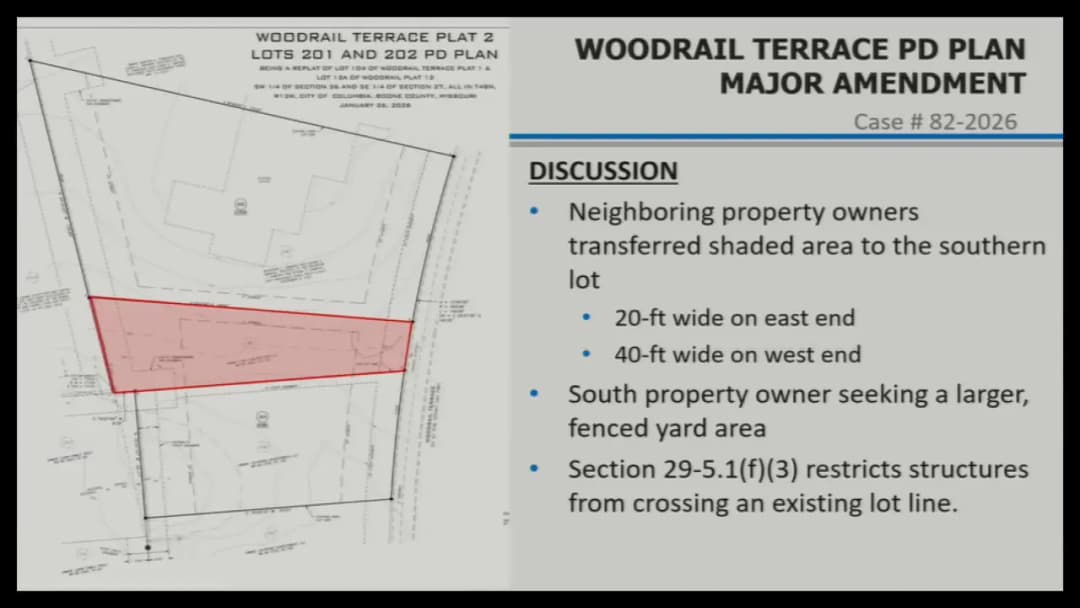
The Planning and Zoning Commission of Columbia, Missouri, held a regular meeting on Thursday, March 5, 2026, at 7:00 PM in the Council Chambers of City Hall. All eight commissioners were present (Commissioner Brodsky excused). The meeting covered four public hearings, including three rezoning requests and one conditional use permit for a short-term rental. All items were approved unanimously, with recommendations forwarded to the City Council. Approval of Agenda and Minutes - The agenda was approved unanimously. - Minutes from the February 19, 2026 Work Session and Regular Meeting were each approved 7-0 (Commissioner Walters abstained for both, having not attended the work session). Public Hearings & Testimony - Case 76-2026 (Rezoning 5 acres from PD to M-C): Staff recommended approval. Applicant Wes Bolton (Allstate Consultants) spoke briefly, answering no questions. No other public testimony was offered. - Case 78-2026 (Rezoning 1.81 acres from R-1 to R-2): Staff recommended approval. Applicant Jay Gebhardt (A Civil Group) spoke, answering no questions. Commissioner Darr inquired about a potential sidewalk gap on Olympic Boulevard; staff noted it would be addressed when the adjacent parcel develops. No public testimony. - Case 82-2026 (PD Plan Amendment for Woodrail Terrace): Staff recommended approval subject to technical corrections. Public speaker Clark Swisher, a resident at 3403 Woodrail Terrace, raised concerns about: (1) whether private covenants preventing sale of green space were being violated; (2) damage to Woodrail Terrace Road from construction trucks; and (3) the accuracy of the map showing property lines. Staff clarified that covenant enforcement is a private matter, and road damage inquiries should be directed to Public Works engineer Jake Ray. The applicant's agent, Jay Gebhardt, stated the transferred land (30 feet) will remain green space for a garden and dog run, and no expansion of the existing home is planned. Commissioner Walters advised the homeowner to be proactive with the HOA regarding any future fence. - Case 84-2026 (Short-Term Rental Conditional Use Permit): Staff recommended approval with conditions (max 8 guests, 365 nights/year). Applicant Dominick Lee, owner of 202 Old Highway 63 North, stated he plans to live in Columbia and his father will serve as agent, with immediate response to any issues. He indicated he does not expect to rent 365 nights but wants availability above 210. Commissioner Stanton asked about emergency response; Mr. Lee committed to handling issues personally or through his agent. No public opposition. Discussion Items - Case 76-2026: Commissioner Darr expressed support, noting the city's goal of moving away from planned districts. Motion to approve passed 8-0. - Case 78-2026: Commissioner Darr made a motion to approve; passed 8-0 after brief discussion on sidewalk connectivity. - Case 82-2026: Motion by Commissioner Walters to approve the PD plan and Statement of Intent subject to technical corrections (requirements/restrictions in the SOI reflective only of the subject lots). Passed 8-0. - Case 84-2026: Commissioner Darr noted it was the first time he had seen a request for 365 nights, but considered the location appropriate. Commissioner Stanton clarified that the M-OF zoning allows year-round operation. Motion by Commissioner Gray to approve with conditions (max 8 guests, 365 nights) passed 8-0. Staff Comments and Future Meetings - Staff announced the next meeting on March 19, 2026, will be a work session with three cases, including a PD rezoning, a short-term rental, and proposed revisions to the definition of family. - Staff noted that the July 9, 2026 meeting will be cancelled due to renovations, and the June 18, 2026 meeting may also be cancelled. The Commission tentatively agreed to consider a June 11, 2026 meeting if needed, subject to confirmation. - Regarding the Accessory Dwelling Unit (ADU) ordinance amendments, staff will proceed with public notice for a public hearing at the second meeting in April 2026, unless further work session is desired; no commissioner requested additional work session. Key Outcomes - Case 76-2026: Approved 8-0, recommending rezoning of 5 acres from PD to M-C. - Case 78-2026: Approved 8-0, recommending rezoning of 1.81 acres from R-1 to R-2. - Case 82-2026: Approved 8-0, recommending approval of the Woodrail Terrace Plat 2, Lots 201 and 202 PD Plan and Statement of Intent with technical corrections. - Case 84-2026: Approved 8-0, recommending approval of a conditional use permit for a short-term rental at 202 Old Highway 63 North, subject to maximum occupancy of 8 guests and 365 nights per year. - All recommendations will be forwarded to the City Council. - Meeting adjourned at 8:04 PM.
The City of Columbia Pre-Council met on March 3, 2026, to discuss affordable housing initiatives and a risk management report. The meeting included a detailed presentation on housing statistics, a review of zoning changes, and an actuarial analysis of the city’s self-insurance fund. No public comments or testimony were heard, and no formal votes were taken. Discussion Items - Affordable Housing Overview: Staff presented $14.3 million in city support for affordable housing since the 2024 housing study, including 440 total units (194 new construction, 264 preserved). New construction units included 19 for-sale units (for households at ≤80% area median income) and 165 rental units (mostly affordable). Funding sources include ARPA (federal), CDBG, and HOME program funds. - Small Lot Project: Planning staff updated that minimum lot size is proposed to decrease from 7,000 sq ft to 3,000 sq ft, with a minimum lot width of 30 ft. The goal is to reduce costs by eliminating a Board of Adjustment step. A draft is expected to go to Planning and Zoning Commission in June 2026. - Definition of Family: A proposal to expand the definition from “parent(s) and their children” to include relatives by blood, marriage, adoption, or custodial relationship, and to increase the unrelated occupant limit from three to four in R1 districts. Council member Valerie raised concerns about the definition relying on biology and marriage, potentially excluding unmarried partners and foster families. Staff noted the definition also includes “custodial relationship,” but whether it covers unmarried romantic partners was not definitively answered. - Accessory Dwelling Units (ADUs): Planning staff reported that a draft would remove the requirement for a conditional use permit in R1 zoning and reduce corner-lot setbacks from 25 ft to 12.5 ft. A public hearing is scheduled in March 2026. - Housing Trust Fund: A community summit on March 14, 2026 will seek public input on funding and sustainability. Council member Nick asked that feedback also include how the fund might be used. - Pro-Housing Grant: The city plans to apply for a HUD Pro-Housing Grant (reduced by 50% from last year). The grant can fund zoning studies and even new housing construction. - Housing Preservation Inventory: A survey of nearly 1,800 properties (mostly central city) in 2024 found 90% in good to excellent condition. Staff will expand the survey to other parts of the city, with an update expected at the September 2026 joint meeting with the county. - Home Rehab and Energy Efficiency Program: Currently funded by ARPA (must be spent by end of 2026), the city will apply for a Federal Home Loan Bank grant (due May 1, 2026) to continue the program. A decision on the grant is expected in December 2026. - Housing Production Targets: Staff showed that single-family permit data (260–270 units/year) lags behind the housing study’s target of 527 dwelling units/year. Multifamily permits spiked to 585 units in FY2025, but staff cautioned this is cyclical. - Risk Management Report: Chris Ubeck presented an overview of risk management responsibilities, including claims adjudication, insurance policy management, and safety training. Key points: the city is self-insured with high deductibles; self-insured retentions were recently increased to manage premium costs; workers’ compensation costs rose significantly in FY2025 due to a few severe claims, not an increase in claim count. - Actuarial Analysis: Huggins Actuarial Services (via Carolyn Dentino) presented estimated net liabilities for unpaid claims as of Sept. 30, 2025: $8,353,000 undiscounted. For FY2026, estimated retained losses at the expected (≈50% confidence) level are $3,974,000 undiscounted; at the 90% confidence level, $5,479,000. The FY2026 budget for the self-insurance reserve fund was $9 million, with a fund balance of $14.8 million. Key Outcomes - No votes were taken. The meeting was informational. - Next Steps: - Housing staff will present a similar update at the joint city-county meeting in mid-March 2026. - A community summit on the Housing Trust Fund will be held March 14, 2026. - The small lot ordinance draft is expected to go to Planning and Zoning Commission in June 2026. - Staff will follow up on the definition of family to clarify whether unmarried romantic partners are included. - The Federal Home Loan Bank grant application is due May 1, 2026. - An updated housing preservation inventory will be presented at the September 2026 joint meeting.
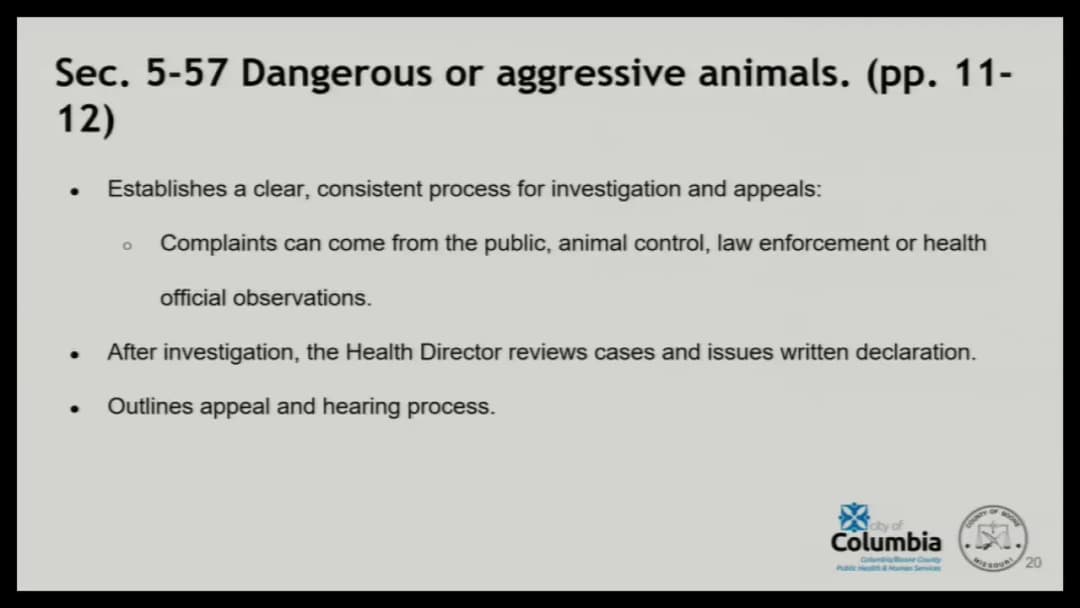
The Columbia City Council met on Monday, March 2, 2026, at 7:00 PM in the Council Chamber. Mayor Barbara Buffaloe presided with Council Members Jacque Sample, Nick Foster, Don Waterman, Valerie Carroll, and Vera Elwood present. Council Member Betsy Peters was absent. The meeting included a financial audit presentation, public hearings, discussion on animal ordinance amendments, and passage of a World Cup bar hours regulation. The meeting adjourned at 9:38 PM. Consent Calendar - Approved minutes of February 2 and February 16, 2026, unanimously by voice vote. - Approved the consent agenda (13 items) unanimously by roll call vote (6-0). Items included annexations, conditional use permits, stormwater covenants, airport funding, health services agreements, a new Communications Department, and resolutions setting a CAPER public hearing and an airport consultant agreement. - Council approved tabling Bill B37-26 (electronic gaming machines) to the May 18, 2026 meeting. Public Comments & Testimony - Matt Schacht (211 N. Ann Street) spoke about Vidwest community media, stating it aligns with city strategic goals of a resilient economy and an inclusive community. He argued that community media is in danger of disappearing and requested an RFP or RFQ process. He clarified that the city still collects hundreds of thousands in cable franchise fees and that grant funding cannot cover administrative or labor costs. He noted a communication loop between council and staff. - Kim (First Ward resident) supported a variance for pet limits but opposed a $50 per animal fee for exceeding four pets, stating it would financially burden responsible owners. She noted the fee would cost her nearly $1,000 annually. - Dan Viets (15 N. Tenth Street) supported most animal ordinance proposals but opposed the $50 fee, calling it impractical. He praised Kim’s care for cats and suggested narrowing complaint basis to local residents. - Eugene Elkin (Second Ward) asked where the $50 fee would go and noted it was expensive. - Christina (Columbia Second Chance) requested replacing the feral cat colony permit with a clear, enforceable TNR ordinance. She stated approximately 80% of caretakers are renters, and only one permit is in place. She provided a handout. - Janeene Johnston (1408 St. Andrew Street) thanked staff for removing annual rabies and testing requirements. She noted TNR caretakers fund their work and fear public records release could harm cats. - Pat Fowler (606 N. Sixth Street) supported fostering and suggested a community mediation program. - Renee Carter (Second Ward) questioned the impact of a $50 fee on fostering and asked about rabies vaccination frequency. - Tom Rose (Board of Health) noted the $50 fee was a legal recommendation, not board-initiated. He said the board could re-evaluate fees, foster situations, and TNR ordinances if directed by council. - Lily White Boyd (Columbia Chamber of Commerce) stated the Chamber had not taken a position on the World Cup bar hours bill, but noted businesses may lack staff. She suggested the ordinance could test different bar closing times for safety. Discussion Items FY2025 Financial Audit (SI3-26) Jonathan Nibarger (AGH) presented the audit. The city received an unmodified opinion (highest) on financial statements and single audit reports. One significant deficiency was noted: the city’s preparation of the Schedule of Expenditures of Federal Awards (SEFA) needs strengthening. Finance Director Matthew Lue responded that extensive training and mid-year reconciliations will be implemented. Council asked about an internal auditor position; Lue noted an external contract is more cost-effective. Quail Drive Stormwater Project (PH5-26) Utilities Director Erin Keys reported the Phase 2 project will replace failing stormwater infrastructure (collapsed pipe and undersized inlet) with 180 feet of new pipe and four structures. Estimated cost $130,000. One resident attended the November 2025 information meeting. No opposition. Council voted unanimously to proceed with final design. Rothwell Park Improvements (PH6-26 / B45-26) Parks Director Gabe Huffington described replacing a 26-year-old playground, adding a rubber safety surface, a single-table shelter, and trail improvements including invasive species removal. Park sales tax funding totals $200,000, with an additional $40,000 appropriation. Community input was gathered via an on-site event (Sept 9, 2025), online comments, and a Parks and Rec commission meeting. Council unanimously approved the ordinance (6-0). Animal Ordinance Amendments (B38-26) Staff presented changes to Chapter 5: new definitions, updated quarantine procedures, animal neglect charge, tethering rules in inclement weather, dangerous/aggressive animal hearing process, a permit for exceeding four pets with an annual $50 fee per additional animal, and streamlined feral cat colony permits. Public comment raised concerns about the $50 fee, fostering exceptions, and the permit system for TNR. Council discussed referring the fee and foster issues back to the Board of Health. After debate, Council voted unanimously to withdraw B38-26 with the understanding that two separate ordinances would be drafted: one with non-controversial changes (not requiring further Board review) and another covering fee and foster provisions after Board of Health re-evaluation. FIFA World Cup Bar Hours (B39-26) Convention and Visitors Director Amy Schneider proposed opting out of state law (HB 1041) that would allow 6 AM to 5 AM bar hours throughout the World Cup. Staff recommended a special event permit process. Police Chief Jill Schlude raised concerns about public safety and staffing, noting that late-night bar hours strain resources. Council amended the bill to: (1) permit one application per $100 fee listing all requested dates (limited to dates with late-start World Cup matches), (2) allow extended hours only on those dates, and (3) set the last call/take away time at 2:30 AM. The amended bill passed unanimously (6-0). Temporary Street Closure for UM Power Plant (R38-26) Public Works Director Shane Creech presented the resolution to close portions of Stewart Road sidewalk and parking lane, and a section of Fifth Street sidewalk, from March 9 to November 1, 2026, for roof replacement. University of Missouri owns adjacent property. Council member Sample asked about an exemption for governmental entities; City Counselor Nancy Thompson explained the ordinance exempts other governmental entities from paying. The resolution passed unanimously (6-0). Key Outcomes - Quail Drive Phase 2 Stormwater: Council directed staff to proceed with final design. - Rothwell Park Improvements: B45-26 approved (6-0), authorizing construction and $40,000 budget appropriation. - Animal Ordinance (B38-26): Withdrawn; Council directed staff to return with two separate ordinances—one for non-controversial changes and one, after Board of Health review, addressing the $50 fee, foster permits, and TNR ordinance considerations. - World Cup Bar Hours (B39-26): Amended and approved (6-0). Extended hours allowed on seven specific World Cup dates until 2:30 AM via special event permit. - Consent Agenda: All 13 items passed unanimously (6-0), including formation of a Communications Department and acceptance of $60,000 grant for Love Your Block program. - Street Closure (R38-26): Passed unanimously (6-0). - Cancel July 6, 2026 Meeting: Council voted unanimously to cancel the July 6 pre-council and regular council meetings to accommodate the Council Chambers AV remodeling project. - Reports: Council acknowledged the FY26 Uncollectible Receivables report (write-offs of $700,000 in utilities, 0.3% of revenue) and the Monthly Finance Report. Director Lue noted a forthcoming audit of the utility assistance program and a business license fee review.
The Planning and Zoning Commission of Columbia, Missouri, held a regular meeting on February 19, 2026, at 7:00 PM in City Hall Council Chambers. The meeting addressed three public hearings: a site-specific PD plan for Lake Broadway Townhomes, a short-term rental conditional use permit for 1707 Nelwood Drive, and a text amendment to define and regulate data centers in the Unified Development Code. All three items received commission approval and will be forwarded to City Council. Consent Calendar - Agenda Approval: Unanimously approved. - Minutes Approval: Minutes from the February 5, 2026 regular meeting were unanimously approved. Public Comments & Testimony - Case 68-2026 (Lake Broadway PD Plan): - Tim Crockett (Crockett Engineering, applicant) presented the proposal for 13 townhome units and a 2,000 sq ft office building on a 2.27-acre site, arguing the project returns to the original 1985/86 residential intent and addresses housing needs. He noted the site has been vacant since 2003 and that the adjacent office owner to the east supports the plan. - Brent Gibson (Broadway Office Complex Condominium Association) voiced concerns about stormwater detention pond capacity, increased traffic, and the proximity of townhomes to the office building. He stated the lot remained undeveloped due to ownership disputes within the condo association. - Pam Dodge (1205 West Broadway, medical office) opposed the plan, citing misleading statements about neighbor support, concerns about parking encroachment, lack of a full buffer (fencing), and potential disturbance to elderly patients. She noted her office lot line is only 5 feet from the property. - Emily Piontek (1305 Gary Street) requested traffic calming on Pershing Road due to speeding and lack of sidewalks, and asked for dark-sky-compliant lighting to maintain residential character. - Dee Dokken (804 Again Street) questioned whether the proposed impervious surface (1.29 acres) complies with current stormwater standards compared to the 2003 plan (1.4 acres). - Crystal Rein (104 Pershing Road) reported near-accidents on Pershing and recommended a stop sign at Gary and Pershing. - Emily Pherigo (103 Pinewood Drive) requested that no new exit be created near Pinewood; existing driveways should be used. - Case 70-2026 (Short-Term Rental): - Elena Sass (owner/applicant) explained her reasons for seeking a STR permit: difficulty finding good long-term renters, property damage, and her desire to feel safe while staying there intermittently. She emphasized that guests are screened and are usually parents visiting university students, not party-goers. She added she owns only one STR property. - Kerby Mitchell (Son of Mine, LLC, owner of adjacent four-plexes on Quail Drive) initially expressed concern about transient guests and safety, but after hearing the explanation, acknowledged the owner can regulate guests. He stressed the importance of communication and noted his long-term investment in the area. - Case 74-2026 (Data Center Definition): - Dan Murphy (Missouri Rural Crisis Center, 707 Mount Vernon) expressed concerns about data centers potentially using unregulated power generators, referencing issues in Memphis. He appreciated the commission's attention but encouraged thorough diligence. Later, he clarified that his primary worry is about full-time generator operation, not backup generators. - Paul Land (2501 Bernadette, representing business interests) supported the text amendment, saying conditional use gives absolute control site-by-site. He argued the definition is needed to avoid derailing future IG zoning requests and to attract industrial development. Discussion Items - Case 68-2026 – Lake Broadway PD Plan: - Staff report by David Kunz recommended approval with conditions: a 6-foot screening fence at the rear of patios facing the commercial parking lot (in lieu of Level 3 buffer). The plan serves as a preliminary plat for 13 multifamily dwelling units (townhouse style) and a 2,000 sq ft office addition. The site is in an infill development priority area, close to transit and commercial nodes. Impervious surface is reduced to 1.29 acres (from 1.4 in 2003). Staff noted the previous 2003 plan allowed 1.4 acres; the reduction does not exacerbate runoff. - Commissioner questions focused on whether the site had attracted office development in the past 20 years (no active pursuits), and the rationale for fencing only at patios vs. a full property-line fence. Staff explained that a full fence would be impractical due to topography and maintenance constraints; the patio fence provides screening while maintaining access. - Commissioner Geuea Jones expressed concern about lack of a physical barrier between residential and commercial uses, citing potential issues with foot traffic and parking misuse. A separate vote was taken on the fencing condition: the motion to adopt staff's recommendation (fence at rear of patios) passed 5-3 (Darr, Gray, Ortiz, Stanton, Wilson in favor; Geuea Jones, Stockton, Brodsky opposed). - The main motion to approve the PD plan, revised SOI, and preliminary plat with the fencing condition passed 8-0. - Case 70-2026 – Short-Term Rental CUP: - Staff report by Ross Halligan recommended approval subject to maximum 6 transient guests and 210 nights per year. The property is a half-duplex in an RMF zone, previously operated as an illegal STR since 2024. The owner had compliance issues (illegal STR and solid waste violations) but is now seeking proper permit. No other STR within 300 feet. One letter of support received. - Commissioner Stanton asked why the owner took so long to come into compliance; she explained the application complexity and divorce-related property transfer delays. - Commissioner Ortiz noted the owner operates no other Airbnb in Columbia. - The motion to approve with conditions passed 8-0. - Case 74-2026 – Data Center Text Amendment: - Staff report by David Kunz explained the need to define “data center” and add it as a conditional use only in the Industrial General (IG) district. The amendment is the first step; use-specific standards and CUP criteria will be developed later. The definition excludes facilities where data storage is incidental to the primary use (e.g., hospitals, universities). This action follows Council denial of a rezoning (Case 30125) due to data center concerns. - Commissioners discussed whether to add “backup” before “power generators” in the definition. Some feared leaving a loophole; others argued the definition should be broad to cover all facility components. Legal counsel advised that adding “backup” would exclude non-backup generators. Ultimately, no amendment was made, and the motion passed 8-0 to approve the text change as presented. - Staff clarified that without the definition, data centers could be allowed under general IG rules with less scrutiny. The definition subjects them to a conditional use permit, providing extreme oversight. Key Outcomes - Case 68-2026 (Lake Broadway PD Plan): Approved 8-0 to forward to City Council, subject to technical corrections and a note requiring a 6-foot screening fence at the rear of porches for dwelling units facing the east commercial parking lot (in lieu of Level 3 buffer). The preliminary plat is also approved. - Case 70-2026 (Short-Term Rental): Approved 8-0 to forward to City Council, with conditions: maximum 6 transient guests and maximum 210 nights per year. - Case 74-2026 (Data Center Definition): Approved 8-0 to forward to City Council, adopting the proposed text amendments to Sections 29-1.11 and 29-3.2 of the UDC. - Next Meeting: March 5, 2026 at 7:00 PM (work session at 5:30 PM). Items include continuing ADU amendments, CAP presentation on March 19, and Complete Streets presentation in April. The July 9 meeting is canceled due to AV renovations. - Adjournment: The meeting adjourned at 9:27 PM.
The meeting focused on the city's general fund financial outlook, a detailed breakdown of expenditures and revenues, and a proposed 1% city sales and use tax increase dedicated to public safety (police and fire). The presentation was led by Matthew Liu (Finance), with contributions from City Manager De'Carlon Seewood and Police Chief Jill Schloody and Fire Chief Brad Schafer. No formal votes were taken; the session was informational for the council to consider next steps toward a potential August 2026 ballot measure. Discussion Items General Fund Expenditures and FTE Breakdown - Public safety (police, fire, municipal court) constitutes 48.1% of general fund expenditures (FY26 budget), followed by health and environment (including the health department) and general administration. - Public works (streets, engineering, parking enforcement) is funded approximately 70% by the transportation sales tax. Parking enforcement moved from police back to public works, but its funding source (general revenue) did not change. - Health and environment departments grew from 128 FTEs in FY19 to 170 in FY26, with a budget increase from under $14 million to over $25 million. Approximately 33% of health expenses are offset by the county, and $4.4 million comes from state/federal grants. The Office of Sustainability receives $635,000 from utility transfers. - General administration (city clerk, manager's office, finance, HR, law, public works admin) increased from 93 to 109 FTEs (largely due to PMO moving from IT to CMO) and budget from under $10 million to $15 million. About $2.4 million of costs are offset by intergovernmental revenue from other city funds. - Supporting activities (facilities, creative services, contact center) budget grew from under $4 million in FY21 to over $5 million in FY26. - Public safety FTEs (police and fire) increased by 40.5 (fire) and 43 (police) from FY19 to FY26 (budgeted). The police increase was predominantly civilian staff; sworn officer count has not grown significantly since 2019. Police budget is $35.1 million, fire $30 million, municipal court $800,000 in FY26. - Council members questioned the source of budget increases, which staff attributed to the pay and classification study, higher health insurance costs, and inflation. The rise in personnel and salary costs was noted beginning in FY23–24. Revenue Outlook and Sales/Use Tax Trends - General fund revenue is composed of: sales and use tax (30%), PILOT payments, other taxes, intergovernmental transfers. - Sales and use tax projections: 1% city sales tax yields $32 million; total city sales and use tax estimated at $63 million and $10 million respectively in FY26. - Year-over-year sales tax growth turned negative in FY25 (-1%) after strong growth during pandemic years. The trend is flat, with recent Christmas season receipts flat. - City use tax (introduced in FY22) helped stabilize but did not boost overall revenue; from FY24 to FY25, total sales+use tax saw no growth. - Columbia’s current city sales tax rate is 2% (out of a permitted 3% under state law), with an overall combined rate of 7.9% (including state and county). This rate is compared to other Missouri cities; Kansas City, St. Louis, Springfield, and Independence have public safety taxes. - Projections for FY26–31 assume 1% growth per year, but staff cautioned that the low-growth scenario (0%) is current reality. The budget for FY26 assumes flat revenue from FY25. - About 68% of sales tax receipts come from local residents (within a 10-mile radius), 26% from in-state visitors, and 5% from out-of-state visitors. Proposed 1% Additional City Sales and Use Tax for Public Safety - The proposal is to ask voters for an additional 1% city sales and use tax (on top of the existing 2%) dedicated solely to police and fire services. This would increase the city portion to 3% and the overall combined rate to 8.9% (similar to or lower than Kansas City, St. Joseph, St. Louis, and Independence). - The tax would be placed in a new special revenue fund, separate from the general fund, to ensure funds are only used for police and fire. - Estimated revenue: $38.6 million per year (partial in FY27 if passed in August 2026, with collections starting January 2027). - Impact on residents: $0.04 on a $4 coffee, $0.12 on a $12 meal, $1.00 on a $100 non-grocery retail purchase (groceries taxed less, e.g., $0.75 on $100 of groceries). - Staff noted that this tax is within the city’s existing capacity (up to 2% general sales tax; only 1% is currently used), so no new state legislative approval is needed. The city simply needs voter approval. - Council members discussed alternatives: a property tax increase (currently 43 cents per $100 assessed valuation, generating $11 million) was considered but deemed insufficient and politically difficult because of competition with school funding. A combination of property and sales tax would require two ballot measures; staff warned that one might fail. Historical example: both a property tax increase and a development fee failed on the same ballot in November 2014. - Council member Valerie expressed a preference for property tax due to predictability and differing impact on residents, but acknowledged the challenges. Other members noted the volatility of sales tax and state-level threats to grocery taxation (potential loss of 17% of city sales tax from food items). Priorities for the Additional Revenue - Pension stabilization: Police and firefighter retirement funds have unfunded liabilities: police 51%, fire 57%; total unfunded liability of $156 million ($66 million police, $89 million fire). The tax would allow contributions to reduce this gap, though full stabilization depends on market returns and actuarial analysis. - Staffing: Add 50 police officers and 40 firefighters over four years (20 per year for first two years, then 10 per year). Attrition and retirements are factored in. Police hiring cost per officer (wages, benefits, equipment but not vehicle) is $135,000; police vehicle cost $80,000 per 25 cars for 50 officers. Firefighter costs and equipment are similarly detailed. - Facilities: Build a new police station (estimated $36 million for an existing south building project, with annual debt service $1 million), two new fire stations, renovate three current fire stations (House Five needs major work). Bond issuance of $50 million anticipated for these facilities. - Technology and equipment: Create a police and fire technology plan to budget for ongoing costs (e.g., Flock and Axon systems $1.2 million/year) and a building maintenance plan to avoid deferred maintenance. - Long-term projections: A 15-year projection shows that if all planned expenditures (personnel, debt service, maintenance) are implemented, the fund may approach balanced by FY33–35, indicating need for continued revenue growth or economic development. The fund would build a reserve in early years. - The city manager noted that this is an introduction; more detailed implementation pipeline will be developed for council and public review. Next Steps and Logistics - Council direction is required to proceed. A formal proposal, ballot language, and detailed spending plan will be brought back to council. - Deadline to place on August 2026 ballot: first reading at first meeting in May, vote at second meeting in May. - City staff can provide informational presentations to community groups but cannot advocate; a campaign committee would be needed for advocacy. Council members and unions may play roles. - Staff distributed a flyer explaining city cash fund balances to counter public misconceptions about available reserves. - Additional work: A cost-of-service study and a review of business license fees are underway to maximize current revenues. Key Outcomes - No formal votes or binding decisions were made. Council members expressed general support for exploring the 1% sales/use tax for public safety and requested a more detailed spending plan, timeline, and implementation pipeline before public presentation. - Staff will prepare detailed projections for pension, staffing, facilities, and technology spending, and bring back ballot language for council consideration by May 2026. - The discussion clarified that the tax is within existing city authority and does not require state legislative approval. - Note: The transcript references a meeting date of February 16, 2026, but the provided meeting date is February 17, 2026; the summary uses the latter per instruction.