Columbus City Council met on October 27, 2026. The meeting began with the national anthem, pledge, and prayer by Aaron Mackey of New Birth Ministries. Council handled routine journal and agenda approvals, recognized youth STEM and public-safety programs, approved financial guardrails for the income tax set-aside fund, adopted emergency retention-pond safety rules, revived the Transportation and Pedestrian Commission, and cleared zoning, technology, parks, and utility items. Announcements - Councilmember Barroso de Padilla recognized Epic Youth and the Girls World STEM Summit, a four-year partnership tied to the International Day of the Girl. Erin Hathaway, executive director of Epic Youth, said 250 girls were served this year; 168 reported discovering a new STEM career, and 80% of surveyed girls recognized they had creativity and problem-solving skills for real-world challenges. She cited the national statistic that women represent just 36% of the STEM workforce. Students from Columbus City Prep School for Girls and the Epic Youth Leadership Academy described gaining confidence, teamwork, leadership skills, and experience making an advertisement and meeting new people. - Councilmember Day-Achauer announced a Thursday Catalyst Summit bringing together 230 people from youth-programming organizations, and a planned honor for junior ROTC director Edward DeDuces. - Councilmember Barroso de Padilla announced the next Zone In phase-two public hearing for Thursday at 6 p.m. in Council Chambers, focused on public feedback from a six-day comment period; testimony requests go to Kevin McCain. - Councilmember Remy reported that South Side Public Safety Week connected residents with over $30,000 in safety supplies, including 250 fire extinguishers, 300 smoke detectors, 500 Birdie personal safety alarms, 500 locks, and 150 fire blankets. He also announced the 2026 Liquor Objections hearing on Thursday, November 5, at 3 p.m.; public-comment requests go to Pedro Mejia by noon that day. - Councilmember Ross announced the third annual C Brilliance STEAM Coalition brunch on Saturday, November 7, from 11:30 a.m. to 2:30 p.m. at Briggs Studio East, 1640 Oak Street in District 7. - Councilmember Wyche encouraged residents to vote, noting poll hours of 6:30 a.m. to 7:30 p.m. and directing residents to the Franklin County Board of Elections website for polling locations. Consent Calendar - Council approved the journal, received communications, approved the agenda, waived the reading of titles, and approved the consent agenda without public speakers. The consent agenda included routine ordinances and resolutions and appointment A0149-2026. - Ordinance 2839-2026 was removed from consent and later approved as amended. It authorizes an advanced-payment grant to Help and Hope Community Center for a six-month youth empowerment initiative serving marginalized youth and young adults ages 14 to 21 through mentorship, leadership training, conflict resolution, financial literacy, and career readiness; Councilmember Remy said the total was $30,000 with support from Councilmember Wyche. Public Comments & Testimony - Stevie Pasamonte, board chair of Transit Columbus, spoke in support of reinstating the Transportation and Pedestrian Commission with Council's code edits. Pasamonte cited safety concerns for pedestrians, bicyclists, bus riders, wheelchair users, and drivers, and said no one should have to work twice as hard to live just because they do not drive. - Sophia Fifner, president and CEO of the Columbus Metropolitan Club, supported the CMC Next grant. She said CMC has operated for 50 years, has over 1,700 members, holds nearly 50 forums each year, and connects with nearly 12,000 individuals online and in person. She described CMC as a trusted, nonpartisan space for civic dialogue and said the grant would expand digital platforms and access. - An unnamed organization submitted written testimony expecting that the income tax set-aside legislation could lead to funding cuts for its programs; administration officials said no specific cuts to organizations had been finalized. Discussion Items - Ordinance 2954-2026, income tax set-aside fund guardrails: Council President Harden explained that Columbus deposits 25 cents of every income-tax dollar into the income tax set-aside fund for debt service and capital needs, and that using the fund for operating expenses risks the city's AAA credit rating. The ordinance categorizes inappropriate expenses and requires the city to spend 10% less on them each year, with the goal of eliminating inappropriate uses by 2037. Director Erickson said ratings agencies have warned against the practice, that about $50 million in direct, non-capital-like expenses is expected from the fund in 2026, and that amendments add allowable categories such as light-duty vehicles, normal-course advances, and pay-as-you-go capital; shift expense categorization to finance with auditor oversight; clarify the cap; and create an auditor 'break glass' authority for financial necessity, still subject to Council appropriation. The cap was changed to reduce the all-other category by 10% per year over 10 years, rather than 90% of prior-year expenses. Officials estimated the change would remove about $5 million from programmatic operating expenses, equal to about four-tenths of one percent of the general-fund budget, or about half that for the all-funds budget. The city auditor supported the ordinance as responsible fiscal stewardship and warned that a downgrade would affect component units such as River South and the region; she said the city's outlook is stable but an upgrade back to AAA would be remote. Finance Director Long raised concerns that 'financial necessity' is undefined, that limiting flexibility could hamstring the city, and that $5 million matters to employees and community partners; he said no specific cuts had been finalized and that a roughly $21 million surplus includes $10 million of set-aside use and rolls into the 2027 budget. Councilmember Ross objected to framing human-services or vulnerable-neighbor programs as the place to absorb cuts, calling that unacceptable. Council President Harden said Council decides where cuts are made and called the question. The ordinance was amended and passed; no dissent was recorded in the roll calls. - Ordinance 3052-2026, retention-pond safety: The ordinance amends city code to require a buffer zone of at least 15 feet from the edge of retention ponds at multifamily residential properties, bars mowing or cutting vegetation in that buffer, and requires written standalone safety notices plus posting in common areas. If the city declares a nuisance, notices must state the reason. The measure followed an October 22 public hearing that reviewed 2024 pond regulations and child-drowning data. Councilmember Dorans said the rules are emergency measures and that he intends additional legislation by the end of the year requiring barriers around ponds. The ordinance passed. - Transportation and Pedestrian Commission: Councilmember Barroso de Padilla sponsored code changes to revive the commission, which has not been seated since 2015. The ordinance requires at least quarterly meetings, clarifies professional and advocacy perspectives on the commission, updates appointment terms, removes outdated language, requires staff support from the Department of Public Services mobility and parking services, and ensures commission review of the complete-streets policy. It passed. Key Outcomes - The income tax set-aside ordinance 2954-2026 was amended and passed, imposing a 10-year, 10%-per-year reduction on nonqualifying expenses with an auditor financial-necessity waiver. - Emergency retention-pond rules under ordinance 3052-2026 passed, with Council indicating further barrier requirements will be considered by the end of the year. - The Transportation and Pedestrian Commission was reinstated by ordinance and is to be reseated with quarterly meetings and staff support. - The consent agenda passed, and ordinance 2839-2026 passed as amended for a $30,000 Help and Hope youth empowerment grant. - Council approved technology and finance items including a three-year Dell Microsoft enterprise licensing agreement for $3,932,230.79, Dell Microsoft unified support services for $498,222.49, an IReport Source support and hosting contract, and the sale of a 2011 Vactor truck to SWACO for $20,000. - Council approved a CMC Next grant agreement for the Columbus Metropolitan Club to expand civic engagement and public dialogue. - Council approved public-service and transportation items including a $300,000 CHA Consulting contract for the Kimberley Parkway North at Kimberley Parkway East intersection project, which is planned to include a roundabout, shared-use paths, sidewalks, lighting, and street trees; the project was described as having a 58% injury rate and a $2.1 million ODOT grant, with design around 2027 and construction around 2029. Council also approved up to $180,000 for COSI transportation and mobility consulting and up to $150,000 for traffic management and control commodities. - In zoning, Council referred 1696 North Hague Avenue and a related variance back to committee at the applicant's request; approved a council variance for a Type A child care home at 100 Landers Avenue with reduced parking; and approved a temporary laydown yard at 4480 Groves Road. No public speakers signed up for zoning. - Council approved additional funding for the Marion Franklin Pool Replacement Project, with cited costs of $740,000 for redesign and construction of a self-drainage and filtration system, $224,000 for delay, and $40,000 for legal counsel; the new completion date is May 28, 2027, and the department aims to recoup the $224,000 from the contractor. - Council approved public-utilities items including $1,322,800 for Brown and Caldwell sludge-line improvements, $1,394,071 for Ascension Construction Solutions at the Jackson Pike Water Reclamation Plant, $4,650,000 for water-treatment chemicals, $4,595,036.43 for Black and Beach on the Lower Olentangy Tunnel Phase 2, $85,000.66 for a laboratory gas chromatography instrument, a hydrant and hydrant-parts contract, and supplemental appropriations and object-class transfers for storm sewer, electricity, water, and sanitary sewer operating funds. - The meeting adjourned after the final roll call.
Public Meetings - Columbus, Ohio
Public Meetings - Columbus, OhioThe Columbus City Council met on Thursday, October 22, 2026, for a regular session that included announcements, recognition resolutions, a consent agenda, second readings of ordinances, and a zoning committee hearing. The meeting lasted from approximately 4:00 PM to well into the evening, with significant discussion on affordable housing developments and infrastructure planning. Consent Calendar - Unanimously approved a consent agenda containing multiple routine ordinances and resolutions from various committees, including finance, economic development, public service, neighborhoods, workforce, health, public safety, housing, and public utilities. Specific items included approvals for contracts, grant acceptances, and budget adjustments. (Roll call vote: 9-0) Public Comments & Testimony - Zoning Committee – 2345 Demaris Road (Ordinance 1607-2026): Two residents spoke against the rezoning for a 216-unit affordable apartment complex. Gavin Price Fuller argued that the developer (Kittle Property Group) refused meaningful changes, that the Westland Area Commission twice recommended denial, and that the area lacks infrastructure (narrow roads, no sidewalks, no bus routes). Richard Prescott presented a map showing multiple nearby developments totaling over 1,200 new housing units, claiming Demerist Road is a two-lane rural road with a constrained 270 overpass, and that adding more traffic would overwhelm the area. Resolutions & Recognitions - Public Safety Week 2026 (Resolution 249X-2026): Councilmember Remy presented a resolution designating the week of October 18–24, 2026 as Public Safety Week. Chief Baugh (Fire) and Deputy Chief Smith Weir (Police) spoke about the divisions’ work and community events. Passed unanimously. - Urban Scrawl 20th Anniversary (Resolution 0240X-2026): Councilmember Ross honored the mural festival, noting it has paid nearly $65,000 directly to artists from 2022–2026. Travis Hay Wisher, board member, accepted. Passed unanimously. - Plant-Based Treaty Endorsement (Resolution 250X-2026): Councilmember White introduced the resolution making Columbus the first Midwestern city (8th in the U.S.) to endorse the Plant-Based Treaty. Three advocates spoke: Tyler Gardner (Columbus Animal Advocates), Anna Kolganova (OSU PhD candidate studying agricultural emissions), and Cruz Rodriguez (volunteer organizer). They emphasized animal agriculture’s contribution (20% of global emissions) and the need for food system change. Councilmember White noted the resolution encourages plant-based food consumption as a climate strategy. Passed unanimously. Discussion Items - Second Reading – Ordinance 2699-2026 (Easton Police Substation): Authorized $4 million for construction of a new substation at Easton. Emergency designation was requested to maintain schedule. Passed. - Second Reading – Ordinance 2705-2026 (NeoGov Contract): Waived competitive bidding and authorized $197,657 for continued use of NeoGov software by Civil Service Commission. Passed. - Second Reading – Ordinance 2762-2026 (Insurance Brokerage): Authorized $1,636,520 for insurance brokerage services from USI Insurance Services for policy year 2026–2027. Passed. - Second Reading – Ordinance 2892-2026 (Kingdom Image Arts Grant): Provided $20,000 for family programming, with an amendment to allow food/non-alcoholic beverage expenses. Passed as amended. - Second Reading – Ordinance 2533-2026 (Ryan White HIV Care Grant): Accepted $3,442,081 from U.S. DHHS for HIV care services for individuals earning less than 500% of federal poverty level. Passed. - Second Reading – Resolutions 247X-2026 and 248X-2026 (Liquor Objection Withdrawals): Withdrew objections for two liquor permits after settlement agreements with business owners. Passed. - Second Reading – Ordinance 2721-2026 (Neighborly Software): Authorized $66,333 for continued use of cloud-based application software for housing programs. Passed. - Second Reading – Public Utilities Ordinances: Several infrastructure projects approved: rain gardens in Livingston Ave area ($2.08M), Jackson Pike plant electrical upgrades ($20.59M), lead service line replacement project management ($10M), Yale Avenue water line improvements ($6.08M), parts for water reclamation ($1M), Mars meter test bench maintenance ($92,110), and emergency electrical repairs ($3M). All passed. - Postponement – Ordinance 2954-2026 (Income Tax Set-Aside): Postponed to November 11, 2026, for continued negotiations with the administration on guardrails for use of the set-aside fund. Zoning Committee (Affordable Housing Proposals) - Ordinance 2915-2026 (2125 Ackley Place): Rezoned 30.17 acres to AR-1 to allow 318 apartment units at 60% Area Median Income (AMI). Approved by staff and Northeast Area Commission. Passed unanimously. - Ordinance 1607-2026 (2345 Demaris Road): Rezoned 11.49 acres to LAR-1 for 216 units at 60% AMI. The Westland Area Commission recommended disapproval due to infrastructure concerns. Staff supported, noting consistency with housing strategy. After public testimony, Councilmember Green voted no, citing lack of a long-term infrastructure plan for Demerist Road. Passed 8-1 (Green opposed). - Ordinance 2890-2026 (6092 West Bourne Avenue): Granted variances to allow 104 multi-unit residential units in an LC-2 district (currently office-only). Approved by staff and Far East Area Commission. Passed unanimously. - Ordinance 2916-2026 (2125 Ackley Place – Concurrent Variance): Approved reduced perimeter yard standards for the same project. Passed unanimously. Key Outcomes - Votes & Decisions: All consent items, resolutions, and second-reading ordinances passed except for one zoning item (Demaris Road) which passed 8-1. - Directives: Councilmember Green urged the Department of Public Service to develop a comprehensive infrastructure plan for Demerist Road in coordination with Franklin County and Grove City. Council President Harden acknowledged the need for better planning. - Upcoming Hearings: Councilmember Ross announced a hearing on November 10, 2026 (5:30–7:30 PM) and a capital budget hearing on November 12, 2026 (4:30–6:30 PM). Public Safety Committee hearing on liquor objections set for November 5, 2026 at 3:00 PM. - Regulatory Changes: Pay transparency rules take effect in 2027; toolkit and events announced by Councilmember Bruce. - Grant Opportunities: 614 Beautiful grants (up to $10,000) available until late October 2026.
On October 14, 2026, the Columbus City Council, led by Council President Pro Tem Rob Dorans and joined by Councilmembers Green, Ross, and Day Achauer, held a public hearing to review enforcement of the 2024 retention pond safety ordinance, propose emergency amendments, and discuss future regulatory steps. The hearing was motivated by continued tragic drownings, including two-year-old Benny Mbo and Georgina Villar. City staff from the Department of Building and Zoning Services (BZS), Columbus Public Health (CPH), and the Legislative Research Office (LRO) presented data and recommendations. Public Comments & Testimony - Joe Motil (Retired Safety Manager): Public speaker Joe Motil strongly advocated for immediate, mandatory perimeter fencing around retention ponds as the most effective life-saving measure. He criticized cost-based opposition from apartment associations and developers, rejecting wildlife corridor arguments as pretextual. He argued against the \"perfect solution fallacy,\" promoted locked gates with Knox boxes for emergency access, and questioned the effectiveness and potential hazards (rat habitat, rescue obstruction) of a no-mow buffer. He explicitly asked why retention ponds lack the fencing required for swimming pools if both pose drowning risks. Discussion Items - Review of 2024 Ordinance (Kevin McCain, LRO): Mr. McCain reviewed the 2024 law (Section 452517), which was passed in response to 11 child drownings (2013–2022) and 21 adult drownings (2021–2024) in man-made ponds. The existing framework requires warning signs, U.S. Coast Guard-approved flotation devices, annual tenant notices, safety shelves for new ponds, and a public nuisance abatement process for high-risk sites. - BZS Enforcement Report (Director Scott Messer): Director Messer reported that BZS has proactively identified and inspected over 100 multi-unit residential ponds. Since the 2024 law took effect, 28 violation notices have been issued. Twenty-three properties achieved compliance; five are in active follow-up. Future compliance inspections will be integrated into the city’s new Rental Registry program. Messer noted that many violations involved technicalities (e.g., non-Coast Guard approved buoys) rather than outright refusal to comply. - Public Health Data (Dr. Mashika Roberts & Edward Johnson, CPH): Dr. Roberts presented Child Fatality Review data, showing drowning is now the fifth leading cause of death for children (down from fourth in the prior report). From 2019 to September 2026, 38 children drowned in Franklin County; 22 were under age four, and 10 died in retention ponds. CPH noted that three child drownings have occurred since the 2024 law passed (one in 2024, two in retention ponds in 2025/2026). Edward Johnson presented a comparison of interventions from four peer cities and Southgate, MI, finding that warning signs, flotation devices, and resident notification are universal best practices, while fencing, landscaping, and setback requirements vary widely and are often prescriptive for new development rather than retroactive. - Proposed Emergency Amendments (Kevin McCain / Council President Pro Tem Dorans): The LRO presented two emergency amendments to be voted on November 2, 2026. The first closes communication loopholes by requiring standalone physical safety notices and mandatory disclosure of public nuisance declarations. The second creates an immediate passive physical barrier by requiring a mandatory 15-foot no-mow buffer zone around the water's edge to deter toddlers and signal danger. - Councilmember Deliberation and Questions: Councilmembers engaged in detailed discussion with staff. Councilmember Morales clarified that the 2024 ordinance applies retroactively to existing ponds, not just new ones. Councilmember Green raised operational questions about the year-round effectiveness of tall grass barriers in winter and the need for specific vegetation types. Councilmember Ross asked about resources for inspection cycles and the possibility of new restrictions on pond location (setbacks, distance from playgrounds) for future developments. Councilmember Green also suggested developing a local standard or rubric for evaluating pond safety, noting that Columbus Recreation and Parks already has a process. Council President Pro Tem Dorans emphasized that the no-mow buffer is an interim measure and that comprehensive barrier/landscaping options would be developed via a variance process and formal rulemaking. Key Outcomes - Emergency Vote Scheduled: The proposed amendments (standalone notices, disclosure requirements, 15-foot no-mow buffer) will be presented to the full council for an emergency vote on November 2, 2026. If passed, they will take effect immediately. - Commitment to Comprehensive Action Framework: Council President Pro Tem Dorans committed to working with BZS, CPH, and LRO to bring comprehensive, long-term regulations before the council by the end of 2026. This includes evaluating full fencing, vegetative barriers, pond setbacks, and underground retention alternatives, using the public health comparison chart as a roadmap. - Continued Enforcement and Interdepartmental Coordination: BZS confirmed it has begun the formal public nuisance review for the two ponds where drownings occurred in summer 2026. The new Rental Registry will ensure annual inspection of all regulated ponds. CPH will continue providing fatality data and analysis to guide enforcement priorities.
On October 14, 2026, the sixth public utilities sustainability committee hearing of the year convened, chaired by Councilmember Weich. The committee heard a presentation from Deputy Director John Lee of Columbus Water & Power (CWP) on a proposed high demand surcharge for high volume peak water users. The chair also provided an update on the data center policy package, noting that feedback is still being accepted. Public Comments & Testimony - One individual (Darcy Odom) signed up to speak but was not present. Four pieces of written testimony were received and made available on the council web page. Discussion Items - Deputy Director John Lee presented the proposed high-peaking, high demand surcharge. The surcharge aims to recover additional system capacity costs from commercial customers whose water demand significantly exceeds their normal usage. The proposed structure: customers averaging at least 100 CCF per month and having a peak month at least twice their average monthly usage (peaking factor ≥2.0) would be subject to a surcharge of $1.62 per CCF. Approximately 426 customers would qualify, generating an estimated $6 million annually. The surcharge would be based on a 12-month evaluation period, with billing beginning in late 2027 or early 2028. Lee noted that the rate is based on cost of service and that the primary lever for adjusting revenue is the peaking factor and volume threshold, not the rate itself. He also outlined a notification plan to allow customers to adjust usage before the surcharge takes effect. - Councilmember Weich asked about applicability to schools and other institutions with seasonal peaks. Lee responded that it could apply but CWP would work with customers to understand individual cases. - Councilmember Ross expressed that $6 million seemed like a small amount and questioned whether it adequately reduces the burden on residential ratepayers. He suggested adjusting the peaking factor to a lower level (e.g., 1.5) to increase revenue. Lee noted that lowering the peaking factor to 1.5 could generate $10–15 million, but emphasized that the surcharge must be cost-justified. Ross also mentioned the significant infrastructure costs from data centers and the need for the surcharge to meaningfully offset those costs. - Vice Chair Reamy, in opening remarks, thanked Chair Weich for moving the conversation toward a rate proposal and expressed interest in understanding how the rates reflect actual infrastructure costs and ensure fairness for residential ratepayers. Key Outcomes - No formal vote or decision was taken. The committee will continue to accept feedback via email to the chair's aide. The CWP team will continue refining the proposal based on input. The proposed surcharge rate of $1.62 per CCF is expected to be codified, while parameters like peaking factor and volume threshold may be set administratively to allow flexibility. Council is expected to discuss further as rate decisions for 2027 approach.
Chair Banks convened the Finance Committee hearing on October 7, 2026, to discuss the city's 2026 operating budget status, the administration's mid-year financial and sustainability report, the 2026 Capital Budget overview, and related legislation. Council President Harden provided extensive opening remarks criticizing the administration's lack of transparency and recurring use of short-term fixes, while administration officials presented progress on expenditure reductions and projected a year-end surplus. The hearing also featured presentations from the city auditor on revenue trends and upcoming bond sale, and two pieces of legislation aimed at improving budgeting for police and fire overtime and restricting the use of the Income Tax Set-Aside (ITSA) fund. Public comments addressed neighborhood service concerns and staffing capacity. Public Comments & Testimony - Courtney Therane, Executive Director of the German Village Society, described three key issues: overwhelming sanitation-related 311 calls (over 2,500 in six months), persistent code enforcement failures on distressed properties (one property had 34 reports since 2002), and a zoning gallery tour where a city official acknowledged the need for more income tax revenue to fund services while staff reported being overwhelmed. She urged collaboration to improve sanitation oversight, code enforcement outcomes, and staffing capacity. - Will Harbin, President of AFSCME Local 1632, was recognized as present but left before speaking; his written testimony was to be submitted. Discussion Items - Opening Remarks & Context: Council President Harden detailed a timeline of concerns since the February 2026 budget hearing, criticizing the administration for backing out of a joint financial sustainability committee, failing to answer questions about $15.5 million in savings, and introducing a $2.8 billion capital budget without prior hearings. She highlighted that police and fire overtime had been under-budgeted by an average of 75% over the last few years and that the administration's reliance on ITSA harms credit ratings and capital capacity. - Administration's Financial Update (Chief of Staff Elon Sims & Director Chris Long): The administration reported a projected year-end general fund surplus of approximately $21 million, achieved through $21.1 million in expenditure reductions (including $14.3 million from vacancy management of over 200 non-uniformed positions, $5 million in discretionary contract cuts, and $1.76 million in operating reductions). They explained that the Income Tax Set-Aside (ITSA) fund is used according to code at 3.97% of the general fund (consistent with pre-pandemic levels). They projected removing over 400 general fund vacant positions over two budget cycles. They also discussed the Strategic Finance Committee, efforts to moderate wage growth (AFSCME 2191 agreed to 2% annual increases), and plans to reduce health insurance cost growth through a transition to Anthem. - Auditor Jacqueline Lewis's Report: The auditor presented the 2026 revenue estimate status: income tax up 3.88% year-to-date, property tax below by 6.1% (timing issues), investment earnings up 2.37%, and charges for services up nearly 20%. She noted macroeconomic trends showing a leveling-off of job growth and a tight labor market. She previewed the upcoming bond sale reduced to $515 million (from a potential $1.2 billion) to protect the city's AAA bond rating, highlighting that S&P had signaled that continued reliance on ITSA could lead to a downgrade. She clarified that drawing on ITSA during an operating deficit signals a deficit to rating agencies, even if the administration calls it a surplus. - Discussion on Police and Fire Overtime: Director Long stated overtime is tracking about $23 million over budget, remaining flat compared to Q2. He cited plans to deploy more officers/firefighters, adjust paid family leave policies (potentially saving $5 million), and negotiate union contracts to reduce overtime costs. Council members stressed that systemic under-budgeting (75% average shortfall over recent years) perpetuates structural imbalances. - Legislation 2758-2026 (Overtime Data): Director Matt Erickson presented this time-limited ordinance directing the auditor to supplement the 2027 budget revenue estimate with 10 years of historical police and fire overtime budget vs. actual data, including overtime as a percentage of personnel spending and per-officer/firefighter costs. The ordinance is on the agenda for passage at the evening council meeting. Chief Sims argued it was unnecessary and a "gotcha" since data is available in D365; Chair Banks and President Harden defended it as appropriate oversight. - Legislation 2954-2026 (ITSA Code Change): This ordinance would amend city code to categorize ITSA expenditures into six buckets, capping the "all other" category at 90% of the prior year's similar expenses, aiming to wean the operating budget off ITSA over time. Discussion focused on trade-offs: the administration and some council members expressed concerns about restricting flexibility during emergencies, while the auditor supported the move as favorable to rating agencies. President Harden noted the need for balance. The legislation is on first reading. - 2026 Capital Budget Overview: Director Long presented the mayor's $2.8 billion capital budget (largest in city history), including $1.8 billion in enterprise investments, $282 million in ITSA-supported investments, and $745 million in carryover. Key items: $21.5 million for fire apparatus (double 2024 level), $17.5 million for public safety facility renovations, $30 million for affordable housing, $56.7 million for recreation and parks, and $134.8 million for public service (roads, bridges, sidewalks). Council noted future hearings on utility and enterprise portions. Key Outcomes - Projected Surplus vs. Deficit Debate: The administration projects a $21 million year-end general fund surplus, achieved by $21.1 million in reductions, $8 million BWC rebate, $10 million ITSA use, and $14 million in anticipated additional revenue. The auditor and council members argued this relies on one-time funds and ITSA, which rating agencies view negatively; council president described the approach as not transparent. - Expenditure Reductions: The administration confirmed $21.1 million in reductions, including $14.3 million from 272 vacant positions already removed from the 2026 budget (not new actions) and approximately 180 additional vacancies to be removed from the 2027 budget. - Bond Sale Reduced: The administration, in partnership with the auditor, reduced the upcoming bond sale from a potential $1.2 billion to $515 million to preserve the AAA credit rating. The bond is slated for pricing in early December 2026. - Legislation 2758-2026: Up for a vote at the evening council meeting; it is time-limited and requires the auditor to provide historical police/fire overtime data for 2027 budget consideration. - Legislation 2954-2026: Placed on first reading; will be subject to amendment and further discussion before a future vote. Chair Banks and President Harden expressed willingness to work with administration to refine the cap while maintaining the goal of reducing ITSA reliance. - Future Hearings: Two additional capital budget hearings announced: November 12, 2026 (4:30 p.m.) on public utilities chaired by Councilmember Weich; and November 9, 2026 (1:00 p.m.) at Franklin County Municipal Court on courthouse conditions, chaired by President Harden. A second general capital budget hearing date to be announced.
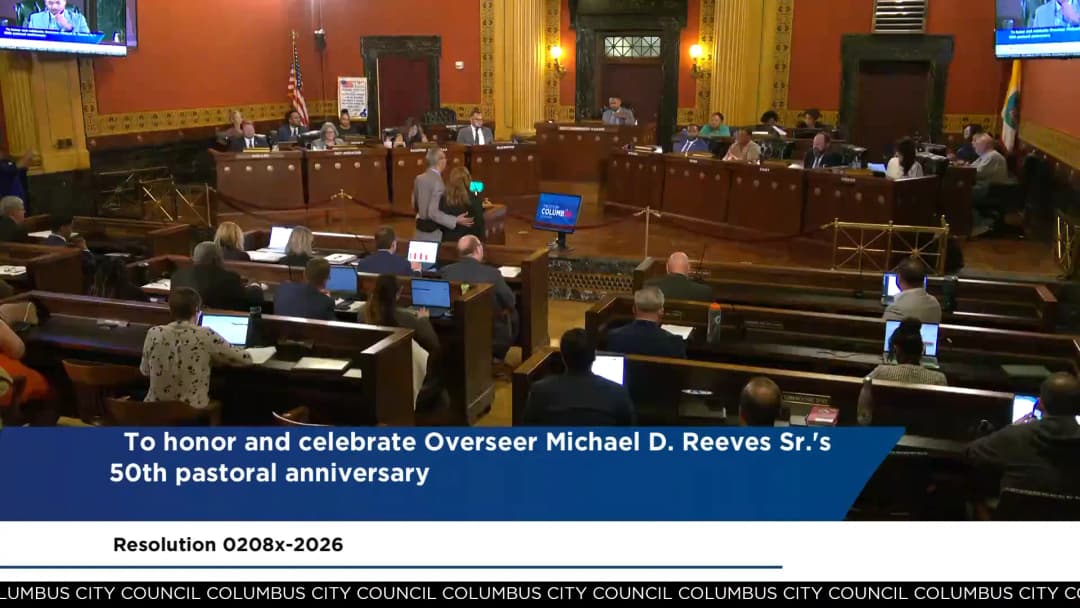
The Columbus City Council convened on September 30, 2026, for a regular meeting that included multiple resolutions, ordinances, and a subsequent zoning committee hearing to consider an administrative appeal of a downtown commission decision. Key topics included storm damage remediation, downtown safety and development, immigrant support, energy-efficient home repairs, and a detailed quasi-judicial appeal regarding a demolition permit for properties on South High Street. No public comments were made during the regular session. Consent Calendar - A series of routine approvals and unanimous actions were approved, including resolutions of expression, finance and governance ordinances, economic development ordinances, public service and transportation items, neighborhoods recreation and parks ordinances, health human services and equity items, public safety and criminal justice, housing homelessness and building, public utilities and sustainability, and appointments. Councilmember Green abstained from ordinance 2459-2026. Public Comments & Testimony - There were no speakers during the public comment period of the regular council meeting. Discussion Items - Storm Damage Remediation (Ordinance 2461-2026): Councilmember DeAkaur presented legislation authorizing $2.5 million for mitigation and remediation at Barrack Community Center, Bush Park, Berliner Park, and the Fran Ryan Center following an EF1 tornado on August 11. Councilmember Dorrens criticized the mayor for using the disaster as a political prop and delaying the capital budget process. The city's real estate office confirmed insurance claims filed for Berliner and Barrack (deductible $250,000), with FEMA reimbursement pending. Barrack is expected to reopen in spring 2027. Councilmember Rosa de Padilla noted that funds for Barrack were already being addressed and that the capital budget process is separate. - Economic Development Grant (Ordinance 2538-2026): A $2 million grant to Downtown Columbus Inc. (DCI) was authorized, with $500,000 from the housing business tax incentive fund for Safer Downtown's homeless outreach and $1.5 million for downtown strategic plan implementation. Robin Davis, Executive Director of Safer Downtown, reported 26 full-time ambassadors, 36,000 calls answered, and 126 people moved off the street via homeless outreach. DCI also raised $1.2 million in private funds. - Immigrant and Refugee Support (Ordinance 2237-2026): Councilmember Rosa de Padilla introduced a $213,000 grant split equally among CRIS, Jewish Family Services, and ETSS for case management, legal services, mental health, and resource coordination. She emphasized the importance of supporting families facing federal uncertainty. - Energy Efficient Home Repair Program (Ordinance 2757-2026): Councilmember Weish moved to amend the income cap from 200% of federal poverty level to 100% of area median income (approx. $110,000 for a family of four). The program, administered by MORPC, provides weatherization and home repairs to low-to-moderate income homeowners who often fall through gaps in existing programs. The amendment was approved unanimously. - Arttober Resolution (0225X2026): Councilmember Rosa de Padilla presented a resolution recognizing October 2026 as Arttober, celebrating Columbus's creative community. Mitch Maniaci of GCAC noted the arts generate $2.1 billion in annual economic activity and support 22,000 jobs. The resolution passed. - Nationwide Children's Hospital Marathon Resolution (0227X2026): Councilmember Dorrens presented a resolution honoring the marathon and half marathon. Race Director Darius Blackford reported that the event has raised over $15 million since 2012, with a record-setting pace to raise $1.5 million this year. The resolution passed. - Pastoral Anniversary Resolution: Council President Harden recognized Overseer Michael Reeves for his 50th pastoral anniversary at Corinthian Missionary Baptist Church. The resolution was adopted. - LGBTQ+ Commission Code Amendments (Ordinance 2622-2026): The council amended city code to clarify the commission's enabling provisions, allowing committees and chairs to be set by bylaws rather than code. Passed unanimously. Key Outcomes - Consent Agenda: Approved with Councilmember Green abstaining on ordinance 2459-2026. - Storm Damage Ordinance (2461-2026): Passed (all in favor). - Economic Development Grant (2538-2026): Passed (Councilmember Green abstained). - Immigrant Support Ordinance (2237-2026): Passed. - Energy Efficient Home Repair Ordinance (2757-2026): Amended and passed. - Arttober Resolution (0225X2026): Adopted. - Marathon Resolution (0227X2026): Adopted. - Pastoral Anniversary Resolution: Adopted. - LGBTQ+ Commission Ordinance (2622-2026): Passed. - Other ordinances (bond anticipation notes, WIC contract, film permits, public utilities items) all passed as noted. Zoning Committee: Administrative Appeal (Case COA 2600161) The zoning committee heard oral arguments on an appeal by Town High Plaza, LLC of a downtown commission's 3-3 tie vote denying a certificate of appropriateness for demolition of buildings at 171-191 South High Street and 200 Wall Street. The appellant proposes to demolish the unsafe, fire-damaged buildings and leave a grass-seeded, maintained lot while pursuing redevelopment. The downtown commission historically rejects such "vacant lot" plans, arguing the design guidelines require a productive replacement use. - Appellant's Position (Kevin Dunn): The city code (Section 3359.23) provides a second alternative for demolition when no replacement structure is proposed: a maintenance plan. The submitted plan includes capping utilities, grading, seeding, and ongoing maintenance. The commission's refusal to even review the plan on its merits violates the code. The buildings are unsafe (city unsafe building orders since 2019) and the owner cannot get environmental assessments without demolition. - City's Position (Josh Cartier): The downtown commission has discretion to interpret its guidelines, which disfavor vacant lots. The applicant declined an offer from Vice Chair Maniaci to consider a public art installation or walkway. A vacant lot has no design element, and the commission's decision should be affirmed. Other processes (court order or emergency order) can still lead to demolition if safety is formally determined. - Council Deliberation: Councilmembers asked about the definition of a maintenance plan, the commission's discretion, and whether intentional neglect played a role. No immediate vote was taken; the committee will issue a written decision later.
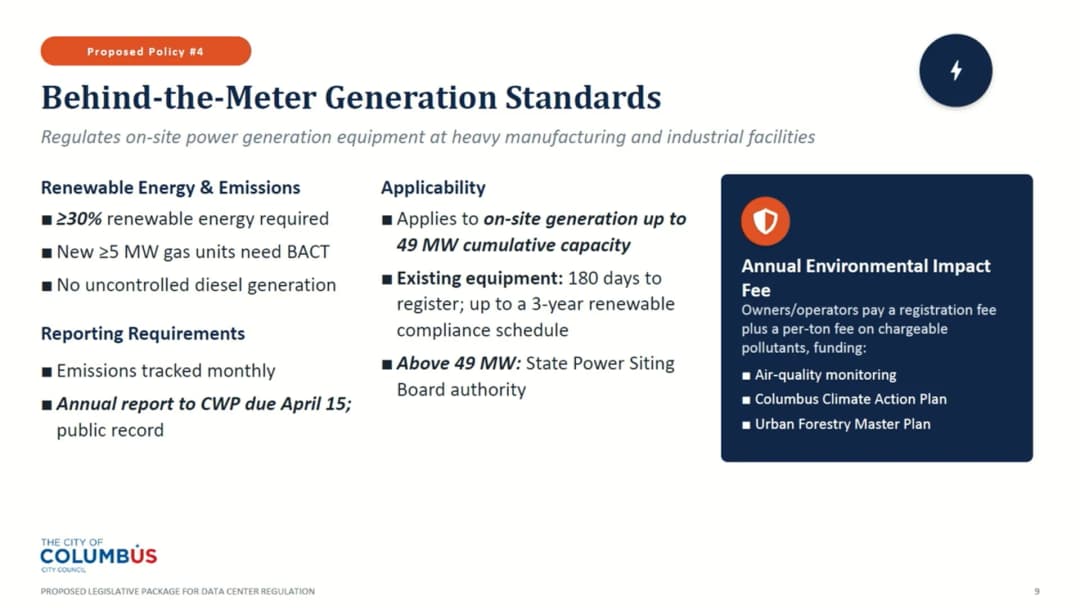
On September 11, 2026, Columbus City Council held its third hearing on high water usage data centers, focusing on financial impacts and rate fairness. Council President Harden and Councilmember Weish introduced Ordinance 2560-2026, directing Columbus Water and Power (CWP) to develop a rate structure ensuring large users (including data centers and heavy industrial facilities) pay their fair share of infrastructure costs, rather than shifting the burden to residents. The hearing also reviewed revisions to water conservation and decommissioning policies and introduced a behind-the-meter generation draft. Public Comments & Testimony - Annalisa Raka, Central Ohio Regional Director for the Ohio Environmental Council Action Fund, expressed strong support for the ordinance, stating that large users should pay for the infrastructure they require. She cited polling showing over two-thirds of Ohioans favor this approach, including over 90% of Democrats and over 80% of independents. - A resident voiced concern that data centers devastate communities, particularly affecting young people. Councilmember Weish responded that no new data centers are being built within Columbus proper, and the council's focus is on ensuring fair water rates for high-volume users. - Several journalists questioned council members: one asked why a moratorium on data centers was not pursued; another inquired about water rate increases and affordability; a third asked about enforcement penalties for non-compliance. Discussion Items - Ordinance 2560-2026: Council President Harden detailed the background: CWP's analysis found that some large users have peak water demand up to 12 times their average, requiring costly infrastructure. The ordinance directs CWP to create a rate structure that accounts for these costs, with the utility advisory board reviewing it and any rate changes requiring council approval. The ordinance had its first reading on September 8 and is scheduled for a vote on September 28, 2026. - Water Conservation & Decommissioning Policy Changes: Councilmember Weish outlined updates introduced in July, designed to strengthen requirements for high-volume users. - Behind-the-Meter Generation Draft: A new draft policy was introduced to address potential pollution from on-site power generation by industrial users. - Jurisdiction Limits: Councilmember Weish acknowledged that Columbus cannot impose a moratorium because data centers are not being built within the city, but the city can create regulatory frameworks for other municipalities to adopt. He also noted that the city lacks authority over clean energy requirements, AI regulation, or a statewide ban. - Capital Budget Dispute: Council President Harden expressed frustration that the mayor announced a capital budget with $21 million for fire apparatus and $3 million for facility upgrades without prior council consultation. She stated council would conduct due diligence with hearings before approving the budget, denying any intention to divert capital funds to the operating budget. Key Outcomes - Council will vote on Ordinance 2560-2026 on September 28, 2026, directing CWP to propose a new rate structure by year-end to ensure large users pay infrastructure costs. - Enforcement penalties for water conservation non-compliance are expected to increase substantially, likely starting at $10,000 per day, compared to current hundreds-of-dollars fines. - Council rejected a moratorium on data centers as counterproductive, emphasizing that regulatory solutions are more effective and Columbus does not host data centers within city limits. - Council committed to reviewing the mayor's capital budget through public hearings, maintaining that they will not rush approval without adequate briefings.
The Columbus City Council's Public Utilities and Sustainability Committee held its third hearing on the data center policy package on September 10, 2026, chaired by Chair Weich. The hearing covered Ordinance 2560-2026, which had a first reading on the previous Monday's council agenda and is scheduled for a vote on September 28, 2026; updated water conservation and decommissioning policies from the July hearing; and a newly introduced behind-the-meter generation draft. Chair Weich noted that about 25 people testified at the previous hearing and that changes had been made to reflect that feedback. Public Comments & Testimony - Multiple residents and advocates testified; a large majority opposed data centers and urged the city to pause action. - Samantha Baker described receiving the updated draft proposals by email only shortly before the hearing (the first at approximately 10:48 a.m. and the second about an hour later) and asked council not to make decisions until the public had reasonable time to review them. She said the overwhelming majority of people testifying at previous hearings oppose data centers and do not want them in their neighborhoods or in the city at all. - A speaker cited academic research describing data centers as 'investment without labor' that 'strains public infrastructure without generating widespread agglomeration gains.' The speaker also cited statistics: the average data center creates 25 to 150 long-term jobs, uses 10 to 40 acres of land, with hyperscale campuses reaching 400 acres or more, and a large AI data center can use up to five million gallons of water per day, 70% of which evaporates into the air. - A speaker noted that more than 50 municipalities, including Cleveland, Dayton, and Grove City in Ohio, have passed moratoriums on data centers, and questioned why Columbus was advancing policies quickly rather than slowing down to do it right. The same speaker noted that updated drafts were only made available the day before the hearing and that a zone-in hearing had been scheduled at the same time. - Another speaker supported a moratorium and argued the city should not connect data centers to water until larger societal questions are answered. - A utility or industrial wastewater professional who works in Asheville, Ohio, raised concerns about treatment chemicals entering the wastewater system and proposed a controlled study of data center heat exchangers, including measurement, identification, testing, and a controlled mechanical cleaning to evaluate results. - A speaker expressed a more moderate view, saying data centers are already in Columbus, regulations are needed to know their water use, and the industry has an economic impact on the city. Discussion Items - Ordinance 2560-2026 directs Columbus Water and Power to submit a rate design document to council by October 26, 2026, implementing cost causation for high-volume water users. The ordinance requires a separate rate class for those users, system development charges payable upon initial connection, and time-of-use and seasonal pricing to reflect system peaking costs. Any rate change must be reviewed by the utility advisory board and returned to council for a vote. - Staff presented updates to the water conservation and decommissioning policies introduced at the July hearing and introduced a behind-the-meter generation draft for the first time. - A council member expressed concern about the behind-the-meter generation proposal based on written testimony received before the meeting. - Chair Weich acknowledged that updated drafts had been distributed late, stated that feedback will be accepted at any time, and said the city would correct the process going forward. The chair also indicated some requirements would go back to the drawing board with the aim of reintroducing them at the next hearing. Key Outcomes - No votes were taken at this hearing. - Ordinance 2560-2026 is scheduled for a council vote on September 28, 2026. - Council will continue accepting written testimony and feedback on the updated drafts, including water conservation, decommissioning, and behind-the-meter generation proposals. - The next hearing was targeted for around October 21, 2026.
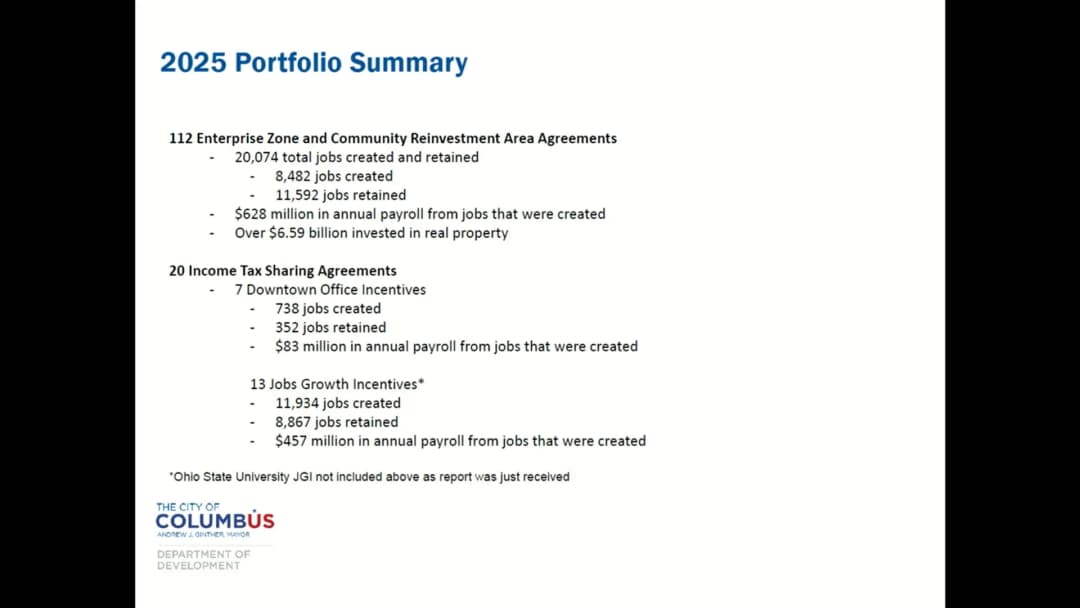
The Economic Development and Small Minority Business Committee of the Columbus City Council held a hearing on September 10, 2026, to consider potential changes to the city's minimum qualifying incentive wage threshold policy. The hearing featured two presentations: first from the United Way of Central Ohio on the ALICE (Asset Limited, Income Constrained, Employed) population, and second from the Department of Development on the current incentive portfolio, peer city comparisons, and a formal recommendation. No public comments were submitted. Councilmember Bankston chaired the meeting and emphasized the need to balance worker wages with the city's competitiveness in attracting jobs. Discussion Items - United Way of Central Ohio Presentation (Melanie Hill, Director of Data Analytics): - ALICE households are those with income above the federal poverty level but below the cost of basics in their county. In Ohio, 37% of households (1.7 million) are below the ALICE threshold (13% in poverty, 23% ALICE). In Franklin County, 37% of households (over 200,000) are similarly struggling, with high concentrations in Linden (67% living paycheck to paycheck) and zip codes 43223 (58%), 43227 (57%), and 43203 (57%). - Disparities exist by race (Black and American Indian/Alaska Native households at 51-52% hardship), age (households headed by someone under 25 at 63%), and family structure (single female-headed households at 71%). - The ALICE household survival budget for a family of four in Ohio was $81,852 in 2024, while combined wages from two common jobs (cook at $13.18/hr and bank teller at $18.74/hr) totaled under $64,000—a gap of nearly $18,000. For single-headed households with children, wages need to be around $24/hr to meet the survival budget. - The ALICE Essentials Index shows the cost of basics rising faster than the Consumer Price Index, and pandemic-era tax credits have expired, widening the gap. - Hill concluded that raising wages is a key tool to impact ALICE households, and she expressed support for informed wage policy changes. - Department of Development Presentation (Mark Lundine, Division Administrator; Bill Webster, Deputy Director): - History of Columbus wage thresholds: $12/hr in 2017, $15/hr in 2018, $20/hr in 2023 (current). - Current incentive portfolio: 112 enterprise zone and CRA agreements covering 20,000 jobs (8,400 created), $620 million annual payroll, $6.5 billion investment. The wage threshold applies to all incentives; jobs below the threshold receive no benefit. - Comparison with peer cities: Indianapolis ($18/hr), Cleveland ($15.85/hr with inflationary adjuster), Charlotte (no threshold due to state law). JobsOhio informally uses $20/hr. - Recommendation: Raise the wage threshold to $21.37 per hour, tied to the city's responsible wage determination (the lowest wage the City pays a full-time worker, indexed annually). This would align city contractor wages with incentive wages. - The Department also proposed applying the wage threshold at the time of building occupancy (rather than legislative approval) to account for construction timelines. - In response to Councilmember Bankston's questions, Lundine noted that the average wage across the portfolio is higher than the threshold, and that indexing to the city's own wage would not harm competitiveness based on current data. He also stated that the Department is not aware of any city using a dual rate by industry but would research it. Deputy Director Webster expressed openness to codifying requirements for health care and retirement benefits as part of incentive agreements. - Councilmember Bankston's Remarks and Questions: - Highlighted the difference between "survival" and "thriving" budgets, noting that the goal should be for workers to thrive, not just survive. - Asked about competitiveness, especially in logistics and warehousing, and whether a dual wage threshold for different sectors should be considered. - Noted that about 60% of Columbus workers are single, so a universal wage threshold may not address all family situations. - Stressed the importance of balancing worker wages with the city's need to compete for projects regionally and nationally, because losing projects to neighboring jurisdictions reduces city income tax revenue needed for services. - Announced that the committee will engage stakeholders over the coming weeks and may hold another hearing before bringing a proposal to council. Key Outcomes - No formal decisions or votes were taken at this hearing; it was informational. - The Department of Development recommended increasing the wage threshold to $21.37/hr, indexed to the city's responsible wage, and applying the threshold at occupancy rather than approval. - Councilmember Bankston directed staff to engage key stakeholders (including the business community and advocacy groups) to further assess competitiveness impacts. - A follow-up hearing may be scheduled to consider a legislative proposal. - The committee will explore codifying health care and retirement requirements for incentivized jobs and the possibility of a dual wage threshold for different industries.
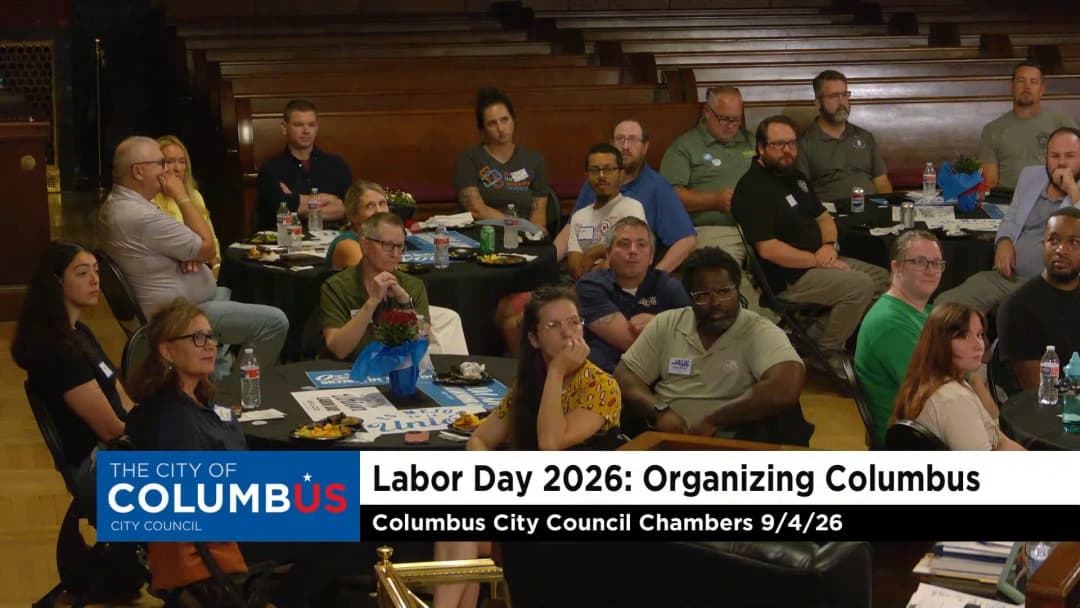
On August 31, 2026, Columbus City Council held a Labor Day celebration in City Council Chambers featuring remarks by Council President Rob Dorrans (also an IBEW member) and Central Labor Council Executive Director Jamie Shoemaker, followed by a panel discussion with four workers who recently organized their workplaces. The event highlighted the importance of unions and the ongoing efforts to organize workers across various industries. Opening Remarks - Council President Rob Dorrans, a second-generation IBEW member, shared his personal story of how the labor movement transformed his family's economic stability. He emphasized that union members are building and running the city, and urged continued organizing to counter attacks on workers at the state and federal levels. - Jamie Shoemaker, Executive Director of the Central Labor Council, acknowledged labor leaders in the room and noted that unions face coordinated attacks. She stressed that the fight is not over and encouraged attendees to connect with the panelists. Panel Discussion: Worker Organizing Experiences - Abby Gross Close (Nurse at Nationwide Children's Hospital) described their unionization effort over nearly two years, prioritizing patient care over profits. She learned that management does not always have workers' best interests in mind, and that many young workers lack basic knowledge about unions. - Violet Musser (Worker at Jenny's Ice Cream) emphasized that every worker deserves dignity, fair pay, and the ability to afford their city. She learned that workers are more alike than different, and that organizing breaks down barriers. - Jude Verosco (Adult Services Librarian, Columbus Metropolitan Library) recounted the library's organizing drive, noting that library leadership hired expensive lawyers and engaged in union busting, but they still won. The key lesson is that organizing is about listening more than talking. - Ashby Doherty (Gateway Film Center worker) described how workplace conditions deteriorated, leading to their successful unionization and contract. They were surprised by the strong community support from patrons. Key Advice for Workers Considering Organizing - Stick with it; it will be a grind but worth it (Abby, Ashby). - Make friends and build buy-in across the bargaining unit (Abby). - Recognize that you have power; your work matters (Violet, Jude). - Don't psych yourself out; management will try to scare you (Jude). How Community Members Can Support Organizing Efforts - Communicate directly with companies as consumers; they care about customer sentiment (Ashby, Violet). - Listen to the union's specific requests rather than going rogue (Jude, Ashby). - Use yard signs, social media, and petitions to apply pressure (Ashby, Violet). - Engage with workers and educate them about unions (Abby). Closing Remarks - Council President Rob Dorrans thanked the panelists and reiterated the importance of listening to workers. He noted that his council has partnered with workers during organizing drives and that unionization strengthens workplaces. He wished attendees a safe and happy Labor Day. Key Outcomes - No formal votes or decisions were made. The event served as a celebration and educational forum. The panelists' stories and advice were shared to inspire further organizing. The city council affirmed its support for worker organizing.