Browse by city
Date range
Search help

Search titles, summaries, topics and stored transcripts together. Keywords may match separately; put the whole query in double quotes for a phrase. Matching follows word analysis, so punctuation is not exact. Both dates are included. Documents are not searched.

SHOWING 11–20 ENTRIES
11
JUL 28, 2026 · COLUMBUS, OHIO · COUNCIL COMMITTEES
Columbus City Council Public Hearing on Council Structure Reform - July 28, 2026

This public hearing, convened by Columbus City Council on July 28, 2026, focused on a citizen-led charter amendment (the "simple fix") by the R City RSA coalition to replace the current at-large council election system with nine true district seats, and on potential complementary amendments that council might place on the November 2026 ballot. Council members, the coalition, staff, and over 30 public speakers debated the merits of district-only, at-large, and hybrid models, as well as related issues of redistricting, campaign finance, and racial representation. No formal votes were taken; council indicated it will vote on August 24, 2026 to advance the coalition's amendment and potentially its own concurrent amendment. Public Comments & Testimony - Maitland Neff (volunteer with Our City Our Say): Expressed full support for the district-only charter amendment, arguing it lowers barriers to entry and makes council members more accountable to neighborhoods. - Eric Cunningham (Vice President, CWA Local 4502): Opposed eliminating at-large seats, stating that at-large representation ensures citywide vision and collaboration; warned against losing sight of the big picture. - Jamie Shoemaker (Executive Director, Central Ohio Labor Council, AFL-CIO): Stated that preserving at-large representation is "not negotiable" for labor; argued that district-only seats risk divisiveness and that current maps were not designed for voting districts. - Will Harmon (via proxy) (President, AFSCME Local 1632): Expressed support for some reform but insisted on retaining at-large seats to maintain citywide perspective; urged getting the maps right and not moving too fast. - Sharon Kim (Lead Organizer, Asian American Midwest Progressives Ohio, petition committee member): Shared personal experience with district representation in New York City, arguing that district council members can collaborate for the greater good; urged council to support the R City RSA proposal and not send a conflicting plan. - Sarah Cherry (Democratic attorney, voting rights expert): Opposed the district-only measure and any hybrid; expressed concern about low recall thresholds; argued that the current at-large system has produced a diverse council and that voters can unite across the city; criticized R City RSA for lack of transparency. - Jennifer Creighton (resident): Supported district voting, asserting that the current system has failed to address neighborhood needs, such as ADA compliance in Hilltop; rejected the narrative that district voting would harm minority representation. - Danielle Dillard (Vice President, Livingston Avenue Area Commission): Argued that at-large representation is insufficient for neighborhood accountability; recounted personal experiences of unreturned calls and ignored community concerns; called for district-only representation. - Kaz Kamara (petition collector): Emphasized that 23,000 signers demand the exact proposal they signed, not a compromise with at-large seats; urged council to respect the citizen initiative process. - Sean Walton (President, NAACP Columbus): Stated reform is needed but raised concerns about the impact on Black political power; urged careful consideration of district maps and campaign finance; did not present an official NAACP position but spoke to broad community sentiment; also read a statement from Stephanie Hightower of the Columbus Urban League supporting a hybrid system with both district and at-large seats. - Nathaniel Wilkins (resident, 19-year resident of Linden): Expressed support for district representation, noting that at-large system neglects neighborhoods and fails to serve the visually impaired and elderly populations. - Dr. Nathaniel Harris (community servant): Supported reform but cautioned against creating nine insular territories; argued that a hybrid model preserving citywide responsibility is needed; called for increased trust and access to data. - David Gray (resident): Quoted Victor Hugo, asserting that the idea of district voting has come; argued that the system is broken when seven council members have more power than 23,000 signers; urged support for the petition as is. - Kara Dillon (Board of Trustees, League of Women Voters of Metro Columbus): Announced the League's endorsement of the R City RSA initiative with reservations; stated the League believes council should immediately convene a study group to address unintended consequences. - Pastor Cameron Harris (resident, pastor): Supported a hybrid system based on his experience representing a congregation that spans multiple districts; argued that at-large seats provide an additional avenue for representation. - Stacey Green (resident, Driving Park): Criticized the council for ignoring community concerns, including a homeless camp at Driving Park Recreation Center; argued that at-large representation has failed her neighborhood. - Liz Reed (resident, District 7): Urged council to support the district-only measure and to pursue real campaign finance reform; argued that district voting would reduce the influence of big money. - Samira Chicas (Livingston Avenue Area Commission, District 7 resident): Volunteered as a signature collector; reported widespread support for the simple fix; urged council not to block the initiative. - Chris Orban (candidate for State Board of Education): Called for ending citywide voting, noting the high cost of at-large races; argued that district elections could bring more diverse occupational representation (e.g., teachers, technical experts). - Heather Lauderbach (Indivisible Central Ohio leader, social worker): Supported the simple fix, recounting conversations with residents who felt unheard; highlighted the McCoy Park controversy as an example of donor-driven decisions. - Charles Coleman (resident): Expressed ambivalence; suggested a compromise where voters could vote in their district and also have one citywide vote; encouraged mutual trust between public and council. - Caleb Duarte (student, Ohio State, area commissioner): Supported district voting; argued that developers already pit neighborhoods against each other under the at-large system; claimed districts would reduce NIMBYism by fostering local accountability. - Katie Shanahan (voting rights attorney): Criticized council for announcing a potential competing amendment at the start of the hearing; argued that at-large systems historically dilute minority voting power; cited Voting Rights Act jurisprudence; rejected the notion that district systems harm minority representation; urged council not to duplicate Republican-style mid-decade redistricting. - Daniel Pintello (treasurer, R City RSA): Supported the simple fix based on conversations with hundreds of signers who expressed frustration with the current system. - Alexandra Nagy (resident, District 3, environmental justice organizer): Shared experience from Whittier, California, where at-large voting allowed oil interests to override community opposition; urged council not to undermine the grassroots process. - Zachary Besselman (volunteer): Provided historical context, noting that Columbus had a ward system until 1916 and that the at-large system was supported by the GOP and led to a 50-year gap without Black council representation; urged support for the initiative and additional reforms. - Minister O'Shea (UN peace ambassador, elder): Advocated for a hybrid system with one at-large seat dedicated to underrepresented groups (people with disabilities, veterans, seniors, LGBTQ+, etc.); stressed the need for a Voting Rights Act-compliant map before implementing district voting. - Kyle Miller (Chair, Columbus DSA): Supported the simple fix, arguing that at-large races are expensive and uncompetitive; stated that the current system incentivizes council members to be unaccountable to their own districts. Discussion Items - Council Opening Remarks: Council President Pro Tem Dorrans opened the hearing, acknowledging the R City RSA coalition and stating his personal support for a hybrid model (nine district seats plus up to four at-large seats). He announced his intent to ask the legislative research office to draft a concurrent charter amendment for the August 24 council vote, and emphasized that it should complement, not contradict, the coalition's proposal. - Council President Harden: Thanked the coalition, traced the history of council reform debates, and expressed support for a hybrid system to balance neighborhood and citywide representation. He also raised the need for campaign finance reform and ballot access. - Councilmember Bankston: Emphasized that the current system has flaws and that reform is needed; thanked the coalition for good-faith discussions; highlighted the need for maps that accurately reflect demographics and campaign finance reform. - Councilmember Barroso de Padilla: Expressed excitement about civic engagement; noted that the hybrid proposal with added at-large seats could increase diversity on council; shared personal commitment to representing Hispanic and Latino communities. - Councilmember DeAchauer: Described his long advocacy for district representation since 2014; supported districts for geographical and racial representation but stressed the need for at-large seats to consider the greater good. - Staff Presentation (John Tenuse, Council Chief of Staff): Recapped the months-long discussions between council and the R City RSA coalition. He outlined pros and cons of district vs. at-large systems, presented data on current district demographics (zero majority-black districts, six plurality-white districts), and discussed potential hybrid models (9 district + up to 4 at-large). He noted that the coalition's petition has been certified and a council vote to advance it is scheduled for August 24. He also mentioned unresolved topics: recall thresholds, council vacancies, and employment status of council members. - Coalition Presentation (Chris Tavener): Presented the R City RSA campaign, which collected over 23,000 signatures with 250 volunteers. Described the "simple fix" as changing only the voting method to true district elections. Explained that the coalition decided not to rescind their amendment despite council's compromise offer, but committed to not actively oppose a complementary amendment if it does not contradict theirs. Expressed willingness to consider endorsing a second amendment after community input. - Further coalition testimony (Stevie Pasimonte): Emphasized that district representation is needed for neighborhood-level issues, especially in low-income Black and Brown neighborhoods; asked council to support the measure on the ballot and to make any additional amendment truly complementary. Key Outcomes - Council will vote on Monday, August 24, 2026 (the next council meeting) to advance the R City RSA charter amendment to the November 2026 ballot, as it has been certified. - Council President Pro Tem Dorrans stated his intention to request a draft concurrent charter amendment from legislative research that would add up to four at-large seats (creating a hybrid 13-member council) and revise redistricting, and to seek a vote on that measure at the same August 24 meeting. - The R City RSA coalition pledged not to actively oppose a complementary second amendment, and may formally endorse it after conducting public input hearings. - No binding decisions were made at the hearing; the council's August 24 meeting will be the decisive action point.
PUBLIC ENGAGEMENT 23% · COMMUNITY ENGAGEMENT 23% · GOVERNANCE STRUCTURE 15% · RACIAL EQUITY 15%
12
JUN 18, 2026 · COLUMBUS, OHIO · CITY COUNCIL
Finance Committee Hearing on First Quarter 2026 Financial Review and Deficit - June 18, 2026

The Columbus City Council Finance Committee convened on June 18, 2026, to review the city's first quarter financial report and address a projected $15 million general fund deficit for the 2026 fiscal year. The hearing included presentations from the Legislative Research Office, the Auditor's Office, and the administration, followed by extensive discussion about the structural imbalance, public safety overtime, and long-term fiscal sustainability. City council members expressed urgency for a concrete plan, while the administration outlined initial cost-saving measures and committed to delivering a full plan by the end of July 2026. Public Comments & Testimony - Will Harmon, President of AFSCME Local 1632, urged council to prioritize funding for city workers over external contracts and third parties. He emphasized that workers—such as trash collectors, 911 dispatchers, and utility crews—are the backbone of the city and should not bear the burden of budget cuts. Discussion Items - Opening Remarks: Council President Harden outlined the severity of the deficit, noting that $15 million is projected early in the fiscal year and that usual belt-tightening tools have been exhausted. He criticized the administration for past budget errors (a $30 million misstep in 2025) and called for transparent, hard choices. He warned the deficit could grow due to public safety overtime (police and fire have already spent nearly all of their annual overtime budgets), collective bargaining cost risks, and potential legal settlements. - Director Matt Erickson (Legislative Research Office) presented historical context, showing that since 2022, the city has consistently projected deficits in Q1 but often ended with surpluses—though the structural issues have worsened. He highlighted that public safety overtime has been underbudgeted for years, with 2026 appropriations at $27 million but a full-year projection of $48 million. He noted that the Q1 review includes 207 full-time positions projected to be filled (165 of which are uniform police/fire), but historically only about one in five projected hires actually occurs. He also flagged the opening of Fire Station 36 without dedicated new personnel, likely increasing overtime. - Auditor Jackie Lewis reported that general fund core revenues are growing at 2.82% year-to-date, slightly ahead of the 2.37% estimate. Income tax collections are up 3.76% overall, but employer withholdings rose 8% while net profit tax collections fell 22%, reflecting economic normalization and uncertainty. Property tax collections were down 11.88% due to a timing issue (a $4 million payment received after May 31), but would have been down only 3.63% otherwise. She noted no new revenue sources are expected. - Chief of Staff Elon Sims described a two-year effort to build a strategic roadmap and a Strategic Finance Committee that meets weekly. He argued the Q1 report proves the system is working by identifying problems early. He listed actions already taken: a 0% COLA for non-union management (saving $1.3M), a fleet fund transfer ($2.4M), shifting towing costs to the mobility fund ($1M), uniform savings ($0.5M), and unfunding 20 vacant positions ($0.9M)—totaling $6.1M in reductions. He stated that layoffs are not currently under consideration. - Director Chris Long (Finance) detailed the expenditure growth: wages and benefits increased from $667M in 2021 to $886M in 2026 (33% rise), insurance from $103M to $156M (51% rise). The public safety budget grew 34% to $850M. He reiterated the need for a second quarter review to get a clearer picture before presenting a full closure plan by end of July. - Council Questions and Discussion: Councilmembers pressed on specific issues: - Councilmember Green questioned the lack of layoff plans and the need to evaluate every department's spending, including outside consulting contracts. She raised concerns about hiring new six-figure positions during a freeze. - Councilmember Dorans asked how the strategic framework handled the foreseeable opening of Fire Station 36 without new hires. Fire department representatives clarified that the station is not exclusively staffed by overtime, but transfers create gaps at other stations. - Councilmember Harden pressed for specific tools to close the gap, warning that delays lead to more painful cuts. The administration declined to specify options before the Q2 review. - Auditor Lewis cautioned that overreliance on the income tax set-aside fund for operating expenses reduces capital capacity and pressures the AAA bond rating. Key Outcomes - The administration committed to deliver a formal plan to close the budget gap by the end of July 2026, informed by the second quarter financial review. - Initial cost-saving measures totaling $6.1 million were announced, but these are largely one-time or fund shifts. - No votes were taken; the hearing was informational and part of ongoing oversight. - Council stressed that urgent action is needed to avoid more drastic measures, and indicated that all options remain on the table, including across-the-board cuts and restricting capital spending. - The administration's strategic finance committee will continue meeting weekly to evaluate options and improve long-term financial planning.

FISCAL SUSTAINABILITY 88% · PERSONNEL MATTERS 6% · PUBLIC SAFETY 3% · BUDGET EQUITY ANALYSIS 1%
13
JUN 5, 2026 · COLUMBUS, OHIO · CITY COUNCIL
Joint Columbus City Schools & Council Hearing on Funding & Partnerships – June 5, 2026

Council President Harden and Board President Dr. Antoinette Miranda co-chaired the inaugural joint hearing of Columbus City Schools and Columbus City Council. The session was held to align priorities, share financial and partnership data, and explore collaborative solutions to pressing challenges facing the district. Presentations covered existing city–school partnerships, the district’s severe financial outlook, and a community schools model piloted in Cincinnati. Eight community members provided public testimony, and leaders committed to continued joint meetings. Public Comments & Testimony - Stephanie Hightower (Columbus Urban League) – Reported that the Urban League has lost over $600,000 in funding for credible messenger programs, while serving nearly 800 youth in 2025 (154 paid interns, 22,000 hours, $330,000 in wages), and diffusing over 1,000 potentially violent incidents. She urged the committee to protect safety nets. - Munir Lynch – A CCS alumnus, Lynch stressed that abatements cost schools $80 million/year and called for every council decision to be evaluated by how it strengthens neighborhood schools. He asked the committee to keep the community informed. - Adaro Robinson (Communities & Schools of Ohio) – Reported that CIS partnered with nine CCS schools, impacting over 3,500 students and providing 14,000+ tiered supports (tiers 1–3) for nearly 500 case-managed students. He urged focus on chronic absenteeism, family supports, and neighborhood partnerships. - Ruth Lomax (City Year Columbus) – City Year supported five CCS schools with 28 AmeriCorps members, delivering 5,312 ELA sessions, 5,880 math sessions, and 14,271 coaching sessions. 100% of surveyed administrators agreed members positively impacted student growth. - Lisa Cortis (United Way) – Expressed support for the “Success by Third Grade” collaborative, which aligns schools, families, nonprofits, and funders to improve reading proficiency. She noted it currently serves six Franklin County districts with 66 nonprofits and 317 corporate partners. - Chris Monteiro (Northland High School teacher and first community schools coordinator for CCS) – Reported that the Northland pilot reduced chronic absenteeism, improved test scores, and cut behavior referrals by 56%. He expressed fear that the initiative could be co-opted by private interests and urged the committee to platform students, educators, and parents, not just leaders. - Lakretia Darling – A CCS alumna, parent, and former attendance program specialist, she argued that out‑of‑school suspensions are a pipeline to prison and a major driver of chronic absenteeism. She called for restorative practices to be implemented as transformational, not transitional. - Brie Losi (Student Success Stores) – In the last school year, the organization served 1,700 students across 15 schools, distributing more than 82,000 items (a 44% increase from the prior year) through 3,299 shopping visits valued at $78,000. She noted 13 schools are on a waitlist and called for basic needs access to be a permanent priority. - Jonathan Bashir – A CCS graduate, he advocated for merit‑based pay for top teachers and for removing severely underperforming teachers. He cited his own AP chemistry teacher, Mr. Fawcett, as an example of an educator who should be rewarded. Discussion Items - City–School Partnership Overview (Kirsten Sessa, Council Legislative Assistant) – Reviewed existing collaborations: Early Start Columbus (CCS provides a third to half of pre‑K slots), Columbus Promise (college access), revenue sharing from economic development incentives (income tax revenue shared per ORC 5709), and COVID‑19 partnerships (over $7M in city funding for Chromebooks, learning extension centers, credit recovery, Digital Equity Coalition). Other examples included a $4M+ ODOT safe‑routes project near Independence High School and Liberty Elementary, and the Northeast Indoor Aquatic Center (built on a CCS parcel, intended for student use during the day). - CCS Financial Overview (Ryan Cook, Chief Financial Officer) – Cook detailed a $50M budget reduction already executed for FY2026. He presented charts showing the state share of K‑12 revenue dropping from 47% in 1999 to a projected 32% in 2027, and the residential property tax burden rising from 46.1% in 1975 to 67.5% in 2023, while business tax abatements in Ohio grew from $5.7B to $26.6B. He warned that a ballot initiative to abolish property taxes would leave CCS with only about six months of operating funds. Cook noted that 80%+ of the budget is personnel, and that the $50M reduction already eliminates staff positions. - Community Learning Centers Model (Annie Bogenschutz, Executive Director, Community Learning Center Institute, Cincinnati) – Presentation via video. The Cincinnati model began in 1999–2000 amid a facilities crisis and enrollment decline. After a failed levy, the district engaged communities in deep engagement and passed a new levy to rebuild schools as community learning centers (CLCs). Today, all 65 CPS schools operate as CLCs, with resource coordinators employed by lead agencies. Bogenschutz highlighted five best practices: schools serving as community centers; ongoing community engagement (not just surveys); site‑based choice and governance; shared goals and accountability; and financial sustainability of partners independent of the school budget. She reported that since adopting the CLC model, all district levies have passed, and that the graduation rate at one high school (Euler) reached 92%. - Expanding Partnerships and Sustainability – Superintendent Dr. Angela Chapman emphasized that wraparound supports (early childhood, after‑school, mental health) are non‑negotiable but strain CCS’s limited state funding. Council pro tem Rob Dorans and Vice President Sarah Ingalls noted that many nonprofit partners are themselves squeezed by budget cuts, and that coordinated, sustainable funding models are needed. Key Outcomes - The committee will continue to meet; the next joint hearing is scheduled for September 2026 and will be held in a school or community location, not downtown. - Council President Harden and Council Pro Tem Dorans reiterated that “nothing is off the table,” including re‑evaluation of tax abatements, TIFFs, and other economic development tools that affect school funding. - Vice President Ingalls identified several priority areas for future work: chronic absenteeism, funding solutions (abatements, TIFFs, property taxes, building repairs), sustainable energy partnerships, and maximizing shared city‑school properties. - No votes were taken; the hearing was informational and intended to launch a permanent joint committee structure.

YOUTH PROGRAMS 33% · COMMUNITY ENGAGEMENT 32% · FISCAL SUSTAINABILITY 21% · ECONOMIC DEVELOPMENT 6%
14
JUN 5, 2026 · COLUMBUS, OHIO · CITY COUNCIL
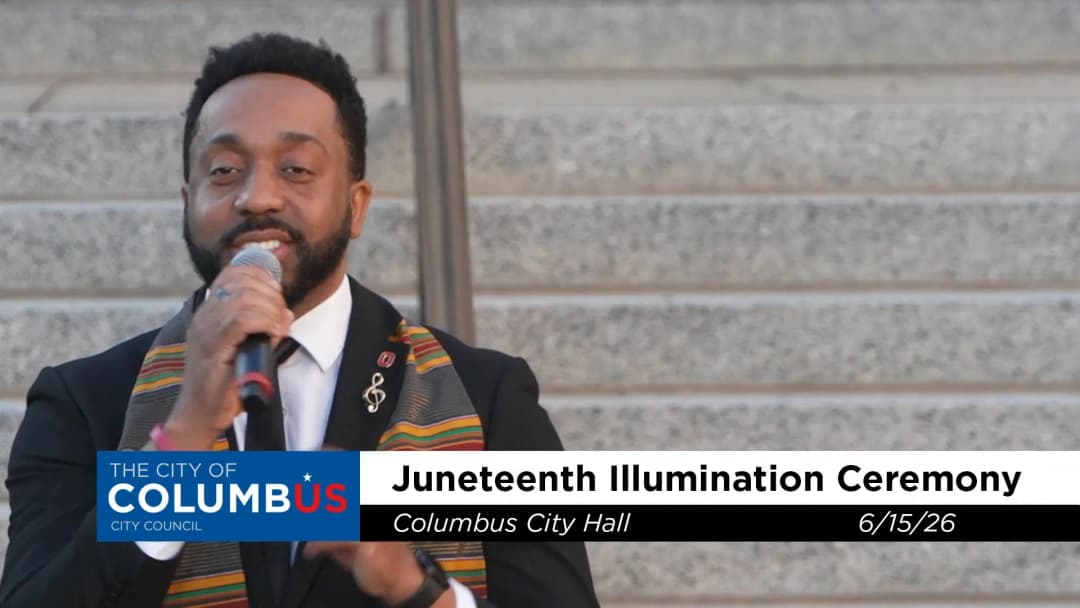
Juneteenth Illumination Ceremony at Columbus City Hall - June 5, 2026

On June 5, 2026, Columbus City Council hosted its inaugural Juneteenth illumination ceremony at City Hall, celebrating the resilience and contributions of Black Americans. The evening event featured prayers, gospel music, speeches by elected officials, and a resolution honoring the Juneteenth on the Av committee. Invocation and Opening - Baba Harris led an invocation invoking ancestors and Dr. Martin Luther King Jr., calling for peace, love, and unity. Attendees repeated phrases such as "unity in our community" and "peace love sisterhood." - Council President Hardin welcomed attendees and recognized council members, Mayor Andrew Ginther, Congresswoman Joyce Beatty, and other elected officials. Musical Performances - The Ohio State University African American Voices Gospel Choir performed "Lift Every Voice and Sing" and the spiritual "Jesus Promised." - Kwan Howe, a national recording artist, performed "Change is Coming" and led audience participation. - Swan Blakely, community activist and founder of Shades of Red, sang "I Am Free" and spoke about Juneteenth as reclaiming identity. Remarks from Officials - Mayor Andrew Ginther emphasized that Juneteenth is a reminder that "justice delayed is justice denied" and called for expanding opportunity and removing barriers so every family can build a stable future. - Stephanie Hightower, President/CEO of the Columbus Urban League, highlighted Juneteenth as a history lesson and urged voting to maintain freedoms, saying, "If we want to maintain our freedom… it's important that we get out to vote." - Corey Favor, CEO of the King Arts Complex, spoke of freedom as culture and community, and the responsibility to preserve sacred spaces. Recognition of Juneteenth on the Av Committee - Councilmember Tierra Ross and Nick Bankston presented a city council resolution to the Juneteenth on the Av committee, recognizing the Maroon Arts Group, Poindexter Village Museum, King Arts Complex, and Columbus Urban League for transforming Juneteenth into a platform of remembrance, education, and cultural expression. - State Representative Dontavia Juros presented a state resolution, declaring that "black history is American history" and commending the committee for preserving the spirit of Juneteenth. - Marshall Schwartz of the Poindexter Village Museum thanked officials for supporting the future African American museum (shovels in the ground in May 2026, opening early 2028) and highlighted collaboration among cultural institutions. Community Testimony - Swan Blakely spoke as a Black gay man and HIV advocate, urging attendees to be "free to be me" and honoring LGBTQ+ leaders like James Baldwin, Marsha P. Johnson, and Bayard Rustin. - Marshall Schwartz concluded with a call to action, noting that "freedom is not free" and that current struggles include voting rights, housing costs, and defunding of arts and education. Key Outcomes - City Hall was illuminated in recognition of Juneteenth after a countdown from ten. - The event served as the inaugural Juneteenth illumination at City Hall, with plans for future celebrations. - The Juneteenth on the Av committee received official recognition from Columbus City Council and the Ohio legislature.

ARTS AND CULTURE 78% · COMMUNITY ENGAGEMENT 14% · MISCELLANEOUS 6% · RACIAL EQUITY 2%
15
JUN 2, 2026 · COLUMBUS, OHIO · CITY COUNCIL
Columbus City Council Regular Meeting – June 2, 2026

Columbus City Council met on June 2, 2026, beginning at approximately 4:00 PM. The meeting opened with a color guard presentation, the national anthem, the Pledge of Allegiance led by Councilmember Ross, and an invocation by intern Joshua Gaucher. The council then proceeded through roll call, approval of the journal, and adoption of a resolution honoring the life and service of Caitlin Sparr, a prosecutor in the City Attorney's Office who passed away. Following a brief recess, the council took up regular legislative business, including consent agenda passage, multiple ordinance readings and votes, and a lengthy zoning committee session featuring public testimony on a controversial rezoning on Hard Road. Consent Calendar - The clerk read into the record several resolutions of expression and ordinances from multiple committees (Economic Development, Public Service, Neighborhoods, Workforce, Health, Public Safety, Housing, Public Utilities, Rules and Policy). No speakers came forward. The consent agenda was approved unanimously by roll call vote. Public Comments & Testimony - 2100 Hard Road Rezoning (0290-2026): Eight speakers signed up; after two withdrew, six spoke (three opposed, three in favor). Opponents included residents Scott Frederickson, Deborah Link (via video), Lisa Castler, and later on the variance, Jennifer De Blaze and Kevin Craig. They argued the proposed three‑story, 112‑unit apartment complex is too dense and tall for the surrounding single‑family neighborhood, raised traffic safety concerns (including a child fatality and a daughter’s accident on Hard Road), and criticized the developer’s process and lack of compromise. Proponents Jonathan Beshears and his daughter Julia Beshears (a rising ninth‑grader) argued that the city faces a severe housing shortage, that 30% of units would be affordable at 80% AMI, and that the development would provide homes for teachers, nurses, and other working families. Julia Beshears urged the council to “do what’s right” to prevent homelessness among young people. - 2100 Hard Road Variance (0291-2026): Two speakers originally signed up; Jennifer De Blaze and Kevin Craig testified against the variance, reiterating concerns about density and insufficient setbacks. - No other public speakers appeared on other agenda items. Discussion Items - Honoring Caitlin Sparr (Resolution 0137X-2026): Councilmember Ross introduced the resolution. Remarks were given by Judge Zach Gwynn, Deputy Chief Convice of Columbus Police, and Assistant City Attorney Melanie Tobias. Speakers highlighted Ms. Sparr’s competence, compassion, dedication to justice, and her role in building office culture (e.g., organizing Chipotle lunches, mentoring junior prosecutors). The resolution was adopted unanimously by voice vote followed by a roll call. - Councilmember Announcements: - Councilmember Bangston acknowledged intern Joshua Gaucher who gave the invocation. - Councilmember Rosa DePadilla proclaimed June as Immigrant Heritage Month and Caribbean Heritage Month, encouraging residents to visit immigrant‑owned businesses. - Councilmember Dey Akaur announced the next “Rise Up Cbus” event on June 4 at Galloway Ridge Intermediate School. - Councilmember Prezbót announced a joint Columbus City Schools Committee hearing on June 15 at 5:30 PM in City Hall. - Councilmember Remy announced a hearing on the Division of Fire’s apparatus and capital budget on June 25 at 2:30 PM. - Councilmember Ross announced the Columbus Fashion Alliance 614 Day celebration on June 14 and a Juneteenth illumination ceremony on June 15. - Councilmember Weiss thanked participants in the Public Utilities Committee hearing on water discount programs and wished Councilmember Remy a happy birthday. - Ordinance Readings (First Reading, Consent, Second Reading): - First reading ordinances were read by the clerk; no speakers. - Consent agenda passed unanimously. - Second reading items were taken up by committee chairs. - Finance Committee: Ordinance 1468-2026 (UNA Solutions procurement software) passed. Ordinance 1572-2026 (Habitat for Humanity) postponed to June 22. Ordinance 1715-2026 (roof replacements at fire stations and Reeb Center) passed. - Economic Development Committee: Ordinance 1361-2026 (Priscilla Tyson Consulting for Poindexter Village Museum) passed. Ordinances 1508-2026 and 1511-2026 postponed to June 22. Ordinance 1530-2026 (Paul Worth Associates communications contract) passed. - Public Service Committee: Ordinance 1418-2026 (ADA curb ramp project) passed. - Neighborhoods Committee: Ordinance 1436-2026 (Exercise is Medicine partnership with OSU) and Ordinance 1744-2026 ($25,000 grant to Step in the Right Direction hygiene program) passed. - Workforce Education Committee: Ordinance 1301-2026 (Hilltop Early Learning Center pre‑K program) passed as amended (voice vote, with President Harden abstaining). - Health & Human Services Committee: Ordinance 1692-2026 (Celebrate One supplies) passed. - Public Safety Committee: Ordinance 1391-2026 (police uniforms) passed. - Public Utilities Committee: Ordinances 1386-2026 (Wahala Ravine stream restoration), 1393-2026 (Big Walnut trunk sewer), 1470-2026 (Fourth Water Plant land acquisition), 1471-2026 (legal services for PFAS plan), and 1589-2026 (Impact Community Action solar training) passed. Ordinances 1387-2026 (janitorial services – recycling concerns), 1546-2026 (Keep Columbus Beautiful fund), and 1570-2026 (Sustainable Columbus operations) were referred back to committee. - Zoning Committee (chaired by Councilmember Dorans): - 2100 Hard Road Rezoning (Ordinance 0290-2026): Staff from Building & Zoning, Planning, Traffic Management, and Housing Strategy presented. The proposal rezones 5 acres from LRR to AR1 to allow a 112‑unit apartment complex with 30% affordable at 80% AMI. Staff recommended approval, noting consistency with the Northwest Plan’s medium‑density recommendation, the Columbus Growth Strategy, and the severe housing shortage (vacancy effectively zero, rents up 45% since 2020). The Far Northwest Civic Association and Development Commission had disapproved. After extensive public testimony and council discussion, Councilmember White stated he would vote no based on constituent opposition; other councilmembers voiced support, citing the need for housing and the developer’s commitments. Motion to amend (site plan) passed 7‑1 (White no). Motion to pass as amended passed 7‑1 (White no). - 2100 Hard Road Variance (0291-2026): Concurrent variance to reduce perimeter yards and building setbacks. Staff recommended approval, noting the requested reductions allow more buffer for western single‑family homes and better site design. Public speakers opposed. Council passed the variance (7‑1, White no). - Other Zoning Items: - 1612-2026 (East Fifth Avenue – LM2 limited manufacturing) passed unanimously. - 1582-2026 (988 Dublin Road – automatic car wash) passed unanimously. - 1599-2026 (3110 Jet Stream Drive – Type A child care home) passed unanimously after applicant Anelise Santiago Day Carter addressed Northland Community Council concerns. - 1610-2026 (190 King Avenue – apartment building) passed unanimously. - 1613-2026 (2006 East Fifth Avenue – mixed‑use building) passed unanimously. - 1614-2026 (3920 Hampton Square Boulevard – drive‑through coffee shop) passed unanimously. Key Outcomes - Resolution 0137X-2026 adopted unanimously to honor Caitlin Sparr. - Consent Agenda approved. - Hard Road Rezoning (0290-2026) and Variance (0291-2026): Approved by a 7‑1 vote (Councilmember White dissenting). The rezoning allows a 112‑unit apartment complex with 30% of units affordable at 80% area median income. - Postponements: Three ordinances (1572-2026, 1508-2026, 1511-2026) postponed to the June 22 council meeting. - Referrals to Committee: Three ordinances (1387-2026, 1546-2026, 1570-2026) referred back to the Public Utilities Committee for further discussion. - All other second‑reading ordinances and zoning items passed as detailed above. - Council recessed briefly after the Caitlin Sparr resolution for bagpipe remembrance, then resumed regular business.

AFFORDABLE HOUSING 27% · PROCEDURAL 18% · COMMUNITY ENGAGEMENT 12% · MISCELLANEOUS 11%
16
MAY 20, 2026 · COLUMBUS, OHIO · CITY COUNCIL
Columbus City Council Meeting - May 20, 2026: Budget, Public Safety Technology, and Community Recognitions

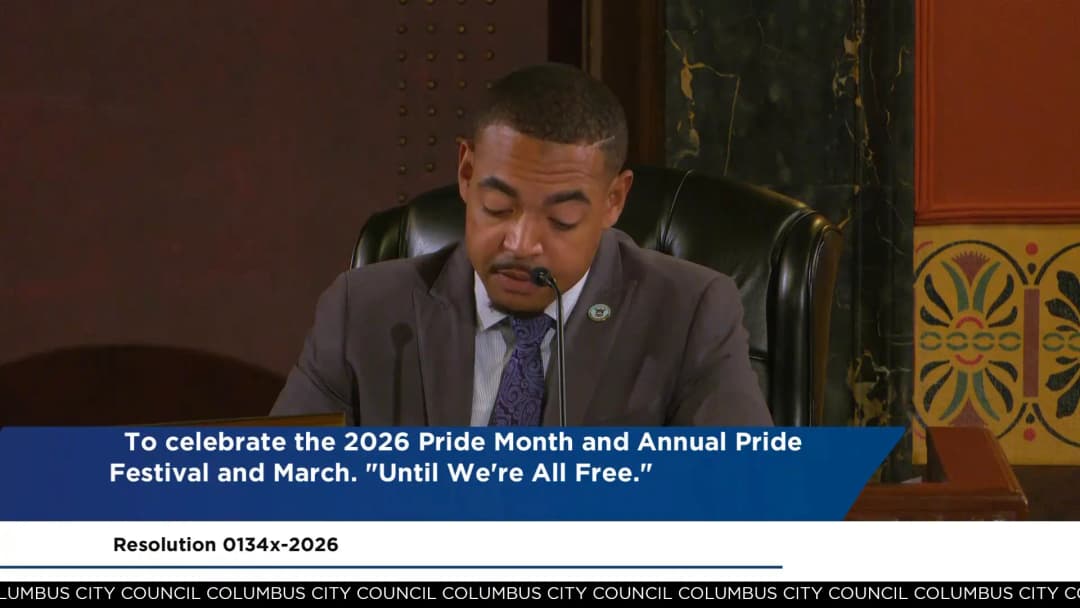
The Columbus City Council met on May 20, 2026, to consider a wide range of legislation including capital improvement projects, public safety technology contracts, affordable housing funding, and community recognitions. The meeting featured a lengthy discussion on the use of Flock automated license plate readers and ShotSpotter gunfire detection, with the council chair announcing a future public hearing on surveillance technology policies. Several resolutions celebrated local businesses and organizations, and the council passed an emergency measure opposing a statewide property tax repeal effort. Consent Calendar - Consent Agenda Items: The council approved a slate of routine ordinances and resolutions by consent, covering finance, economic development, public service, recreation, workforce, health, public safety, and zoning matters. One item, Ordinance 1229-2026, was passed with a note of abstention by Council President Harden. Public Comments & Testimony - Kaden Asifa (speaking against Pride Month resolution): Expressed strong opposition to the city’s recognition of Pride Month, stating that the American flag should be the only flag honored in June and July, and that the celebration dishonors military veterans and the nation. His comments were rebutted by Council President Harden, who emphasized that the freedom to celebrate Pride is protected by the very flag Mr. Asifa championed. - Iseta Thomas (Columbus Education Justice Coalition): Spoke in support of the Northland Community School Pilot Program (Ordinance 1600-2026), highlighting the success of the community schools model in increasing attendance, lowering suspension rates, and fostering student leadership. She urged the council to invest in the coordinator position funded by the ordinance. Discussion Items - Property Tax Repeal Opposition (Resolution 0133 X-2026): Council President Harden presented a resolution opposing a ballot initiative to completely eliminate property taxes in Ohio. Kent Scarrett (Executive Director, Ohio Municipal League) detailed the potential impacts, including the loss of $24 billion in local revenue, 32,000 first responder positions, 50,000 teachers, and severe cuts to senior services. He noted that while the initiative had until July 1, 2026, to submit signatures, polling showed 67% support without a public education campaign. Councilmembers expressed concerns, with Councilmember Barroso de Padilla citing California’s Proposition 13 as a cautionary example. The resolution passed unanimously. - Pride Month Resolution (0134 X-2026): Council President Harden presented a resolution celebrating June as Pride Month and the upcoming Pride Festival. Leo Rodriguez (Stonewall Columbus) thanked the council and noted that Columbus Pride draws 750,000 attendees and generates $7.5 million in economic impact. Public commenter Kaden Asifa spoke against the resolution. Councilmembers reaffirmed their support, and the resolution passed. - Public Safety Technology Oversight: A significant portion of the meeting was devoted to discussing the renewal of the ShotSpotter contract (Ordinance 1225-2026) and broader concerns about police surveillance technologies, particularly Flock automated license plate readers. Deputy Chief Tim Myers answered questions on data retention, geographic deployment, and steps taken to limit access by federal agencies. He reported that the division is developing a formal surveillance technology policy, expected by September 30, 2026, and has implemented filters to prevent immigration enforcement-related searches. Councilmembers voiced concerns about potential misuse by third parties, with several calling for a dedicated public hearing. Councilmember Remy announced her intent to hold such a hearing and to codify the policy into law. The ShotSpotter contract was ultimately passed. - Community Recognitions and Announcements: The council adopted resolutions honoring Soul Classics (20th anniversary), the Junior League of Columbus (50th anniversary of stewardship of Kelton House), and acknowledged the retirement of city employee Sheree Ilhami (Department of Technology). Several councilmembers made announcements about upcoming community events, including a joint city-school board hearing on June 15, 2026, a public utilities committee hearing on June 3, 2026, and summer reading programs at the Columbus Metropolitan Library. Key Outcomes - Adopted Resolutions: - Resolution 0135 X-2026 (Soul Classics 20th anniversary) – Unanimous. - Resolution 013x-2026 (Junior League 50th anniversary) – Unanimous. - Resolution 0133 X-2026 (Opposing property tax repeal) – Unanimous. - Resolution 0134 X-2026 (Pride Month) – Unanimous. - Passed Ordinances (selected): - Ordinance 1430-2026: Easton Police Substation – Construction manager at risk contract for $10 million. Unanimous. - Ordinance 1464-2026: Mount Vernon Avenue Phase 1 multimodal improvements – $7.1 million. Unanimous. - Ordinance 1230-2026: After-school programming for 1,300 middle school students – $2 million. Unanimous. - Ordinance 1600-2026: Northland Community School Pilot Program – Funding for a full-time coordinator. Unanimous. - Ordinance 1041-2026: Contracts with six FQHCs for primary care services – $3.8 million. Unanimous. - Ordinance 1225-2026: Renewal of ShotSpotter gunfire detection contract – $661,500 (one year). Unanimous. - Ordinance 1356-2026: Affordable housing grant for Barthman Family Homes (150 units) – $5 million. Unanimous. - Ordinance 1328-2026: Wilson Bridge Booster Station improvements – $1.285 million. Unanimous. - Future Actions: Councilmember Remy announced a forthcoming public hearing on police surveillance technology policies and an audit of Flock camera use. The joint city-school board committee will hold its first hearing on June 15, 2026.

PUBLIC SAFETY 28% · PROCEDURAL 10% · TECHNOLOGY AND INNOVATION 10% · COMMUNITY ENGAGEMENT 8%
17
MAY 1, 2026 · COLUMBUS, OHIO · CITY COUNCIL
Columbus City Council Regular Meeting – May 1, 2026

The Columbus City Council convened on May 1, 2026, at 5:00 PM (estimated) to consider a wide-ranging agenda including resolutions, ordinances on first and second reading, consent agenda items, and zoning matters. Key topics included the first reading of a resolution to expand the Confluence Community Authority for a National Women's Soccer League (NWSL) training facility, a deer feeding prohibition, recognition of Peace Officers Memorial Day, funding for affordable housing and arts facilities, and the purchase of a fire apparatus with enhanced contract protections. Public testimony was heard on the NWSL expansion and on affordable housing. Consent Calendar - Finance and Governance Committee: Ordinances 458, 995, 1062, 1129, 1144, 1150, 1181, 1192, 1217, 1219, 1263, 1290, and 1340-2026 (various financial authorizations). - Economic Development and Small Minority Business Committee: Ordinances 985, 1249, 1259, 1317, 1347-2026. - Public Service and Transportation Committee: Ordinances 965, 1110, 1148, 1165, 1183, 1203, 1237, 1238, 1242, 1246, 1252, 1287-2026. - Neighborhoods Recreation and Parks Committee: Ordinances 932, 1071, 1072, 1073, 1078, 1079, 1080, 1081, 1084, 1085-2026. - Workforce Education and Labor Committee: Ordinances 988, 1167-2026. - Health Human Services and Equity Committee: Ordinances 1050, 1155, 1196, 1214, 1232, 1243-2026. - Public Safety and Criminal Justice Committee: Ordinances 255, 1004, 1152, 1153, 1190-2026. - Housing Homeless and Building Committee: Ordinances 1250, 1293-2026. - Public Utilities and Sustainability Committee: Ordinances 872, 989, 1023, 1039, 1093, 1151, 1156, 1264, 1267, 1282, 1313-2026. - Rules and Policy Appointments: Appointments 84, 85, 86, 87-2026. All consent items were approved unanimously by voice vote. Public Comments & Testimony - Jennifer Creighton urged council not to allow Resolution 0121X-2026 (Confluence Community Authority expansion) to advance to second reading, stating it would give away the only major green space in the area (555 Green Lawn Avenue) and put the Castle Court manufactured housing community at risk. She described the process as lacking transparency and breaking promises made after the McCoy Park deal. - Nathaniel Wilkins spoke in support of affordable housing ordinances for Opportunity Point 1 and 2, but called for more funding (suggesting $1.5 million instead of $1.2 million) and for set-asides for people with disabilities, including the blind and visually impaired, who he said are often left out. Discussion Items - Resolution 0121X-2026 (First Reading) – To expand the Confluence Community Authority (NCA) by adding parcels for the NWSL training facility. Director Stevens explained the resolution sets a public hearing date and is a procedural step; it does not transfer ownership. Councilmember Reed (Chair of the working group formed per Ordinance 1112-2026) objected, stating the administration had not acted in good faith during working group meetings and that the legislation was introduced without community discussion. She presented maps showing the proposed overlay and argued the land north of McCoy Park and south of Greenlawn Avenue should remain public park space. Councilmembers Bankston, Dorns, and others sought clarifications on parcel boundaries (mobile home areas are not included) and on timing. No vote was taken; the item will return for second reading. - Resolution 0123X-2026 (Adopted) – Recognizing May 15, 2026 as Peace Officers Memorial Day and the week as National Police Week. Deputy Chief Mark Denner accepted the resolution on behalf of the division, noting a ceremony on May 22nd. - Resolution 0125X-2026 (Adopted) – Honoring Bishop Dr. Charles Berger Sr. upon his transition to Bishop Emeritus. His daughter Latoya Berger delivered remarks thanking the council. - Ordinance 0944-2026 (Passed) – Prohibiting intentional feeding of white-tailed deer within city limits (minor misdemeanor). Councilmember Dayakauer summarized the process: a survey of nearly 4,000 responses (two-thirds from Clintonville and the Olentangy River corridor) found broad support for deer management. The ordinance does not affect bird/squirrel feeders or composting. It is a first step; conversations with the mayor's office on a more comprehensive culling program have begun. - Ordinance 0999-2026 – Annexation request (15.4 acres in Jefferson Township) postponed to May 18, 2026 at the applicant's request. - Ordinances 1311, 1312, 1315, 1316-2026 (Passed) – Establishing two new downtown Special Improvement Districts (SIDs): Downtown Central and Downtown East. Executive Director Robin Davis of Safer Downtown testified that property owners representing more than 60% of frontage signed on. Services include ambassador patrols (26 full-time, 2 hiring), cleanliness, homeless outreach (69 people permanently housed since January), and special duty police. Councilmember Green abstained on all four. - Ordinance 0966-2026 (Passed) – Contract for engineering services for Nelson Road improvements (Livingston Avenue to Main Street), including lane narrowing, sidewalks, and resurfacing. - Ordinance 1205-2026 (Passed) – Livingston Avenue corridor project (18th Street to Nelson Road), including right-of-way acquisition and agreements with Norfolk Southern for roadway reconstruction, bike lanes, and signal upgrades. - Ordinance 0941-2026 (Passed) – Grant agreements totaling funding for four “aging in place” village programs (Village in the Ville, Village Connections, Village Central, At Home by High). Stephanie Baker of Clintonville-Beechwold Community Resource Center described prevention services that help older adults remain safely in their homes. - Ordinance 1070-2026 (Passed) – Contract with Theatrical Payroll Service for stagehand services (IATSE union) for the 2026 Jazz & Ribfest and Cbus Sol Fest, $78,000. - Ordinance 1075-2026 (Passed) – Temporary extension of Amara Restaurant's liquor permit to Bicentennial Park for 19 community events in 2026. - Ordinance 1082-2026 (Passed) – Grant agreement with COTA for design of the Big Walnut Trail (Hillsell Park to Refugee Road), a 1.25-mile segment with underpasses and a pedestrian bridge, funded by a $4,082,250 grant. - Ordinance 1120-2026 (Passed) – Technical support for the Seahive data platform (pre-K education), $226,375. - Ordinance 1266-2026 (Passed) – Contract with OhioHealth for pre-employment physical/cardiovascular screening of police and fire candidates, $207,200. - Ordinance 1040-2026 (Passed) – Appropriation of $1,172,278.92 for PrimaryOne Health to provide primary care services to vulnerable residents, especially given federal/state policy changes. - Ordinance 496-2026 (Passed as Amended) – Purchase of a Sutfin Monarch Custom Pumper fire apparatus for $1,263,945. Councilmember President Pro Tem Dorns introduced an amendment adding a stipulated damages clause and cancellation opt-out if delivery is late (including strikes). The amendment passed; the ordinance was then adopted. Discussion noted that the current engine fleet averages 11.5 years old vs. industry best practice of 8.5 years. Councilmember Dorns expressed concerns about the vendor's labor issues and a 0.002% price difference from the other bid. - Ordinances 1189 and 1191-2026 (Passed) – $2.4 million in HOME funds (combined) for Opportunity Point 1 (82 units) and Opportunity Point 2 (84 units) – affordable housing downtown in partnership with Woda Cooper and Columbus State Community Partners. Units are rent-restricted for households earning 30–80% AMI. - Ordinance 1042-2026 (Passed) – Contract with Mission Critical Partners for a justice ecosystem study to support the new municipal court building, $234,169. - Ordinance 1245-2026 (Passed) – Third year of a five-year contract with OARnet for VMware software licenses, $15,182.40. - Other public utility ordinances (Passed) – Contracts for storm pump station repairs ($1,040,794), lead service line outreach ($2,527,488), Alum Creek Reservoir water withdrawal annual payment ($1,383,585.54), and waste disposal tipping fees ($14.5 million for 305,000 tons estimated). Key Outcomes - Resolution 0121X-2026 – First reading only; no vote. The item will return for second reading and public hearing. Councilmembers indicated they could vote to table if concerns are not resolved. - Deer feeding ban (0944-2026) – Passed unanimously. - Downtown SIDs (1311, 1312, 1315, 1316) – Passed (Councilmember Green abstained on all). - Fire apparatus purchase (496-2026) – Passed as amended with late-delivery penalties. - Affordable housing (1189, 1191) – Passed. - All other ordinances on second reading – Passed unanimously except where noted. - Consent agenda – Approved unanimously.

PROCEDURAL 26% · ECONOMIC DEVELOPMENT 15% · PARKS AND RECREATION 12% · PUBLIC SAFETY 11%
18
APR 28, 2026 · COLUMBUS, OHIO · CITY COUNCIL
Columbus City Council Meeting - April 28, 2026: Auditor Appointment, Resolutions, and Legislation

The Columbus City Council met on April 28, 2026, at 6:30 PM for Meeting No. 21. The meeting included the appointment of a new city auditor, adoption of several resolutions, public comments, and votes on multiple legislative items. Key outcomes included the appointment of Jacqueline Lewis as City Auditor effective May 4, 2026, and passage of the jail contract after debate. Consent Calendar - Approved the journal and communications. - Passed the consent portion of the agenda, which included multiple ordinances and resolutions, with one speaker (Sherry Smith) testifying on senior housing concerns. The consent agenda was approved unanimously. Public Comments & Testimony - Sherry Smith (Columbus resident, speaking on behalf of senior citizens): Expressed concern that the city’s rental assistance programs leave out senior homeowners facing high property taxes. Noted that previous assistance through Catholic Social Services and the Auditor’s Office is no longer available. Highlighted barriers for seniors with life estates, where siblings may not sign required documentation. She urged the council to consider seniors facing property tax burdens and to revise rules that require all co-owners to sign for home repair assistance. - Isaiah St. John (organizer of COMO ICE Watch and 614 ICE Watch Network): Opposed the jail contract (Ordinance 0860-2026) citing cooperation between the Franklin County Sheriff’s Office and ICE. Argued that the council's symbolic actions have not stopped the transfer of prisoners to ICE custody. Criticized council members for waiting months to act, stating that about 160 people could be transferred to ICE in eight months. Urged a no vote on the contract. - Ricky Asher (Columbus resident): Also opposed the jail contract, stating that the Franklin County Sheriff directly hands off undocumented detainees to DHS. Criticized the council for voting in favor while claiming skepticism, and called for divestment from Israel as well. Discussion Items - Appointment of City Auditor: Council President Hardin announced that Auditor Megan Kilgore will resign effective May 4, 2026. The council had conducted a truncated but transparent process with five applicants, three of whom met requirements. Council members praised all candidates. Councilmember Barrosa DePadilla nominated Jacqueline Lewis; Councilmember Bankston nominated Garrett Patterson. After a roll call vote, Jacqueline Lewis was appointed 9-0. Lewis thanked the council and pledged to continue serving the city. - Fair Housing Month Resolution (0095X-2026): Recognized April as Fair Housing Month. Representatives from Columbus Realtors spoke about their commitment to fair housing. The resolution was adopted unanimously. - Reentry Week Resolution (0118X-2026): Commemorated Central Ohio Restored Citizens Collaborative Reentry Week (April 20–24, 2026). Speakers from the collaborative noted that over 20,000 individuals return to Columbus annually from incarceration, and that federal funding for reentry programs is declining. The resolution was adopted unanimously. - Arbor Day Resolution (0110X-2026): Recognized Arbor Day. Members of the Clintonville Green Team spoke about the importance of trees, noting that Columbus has only 22% tree canopy coverage (goal 40%) and that 70% of trees are on private land. The resolution was adopted unanimously. - Deer Feeding Ordinance (0944-2026): First reading of a code change to prohibit feeding deer in the city. Councilmember DeAkaur announced a second community meeting on May 5, 2026, at Whetstone Library. - Zoning Committee: Several items were postponed to the May 18, 2026 meeting (210 Hard Road, Olen Tangy River Road) due to family medical issue of Chair Dorans. Items that passed: ordinance 1136-2026 (rezoning 6955-6999 Harlem Road for an 84-unit apartment complex) and related variances; ordinance 1116-2026 (variance for two-unit dwelling at 1289-1291 East 17th Avenue); ordinance 1137-2026 (variance for apartment complex at Harlem Road); ordinance 1139-2026 (variance for seven-unit apartment at 427 Hanford Street); ordinance 1143-2026 (variance for two-unit dwelling at 2930-2932 Medina Avenue). All votes were unanimous. - Public Service and Transportation: Ordinance 0924-2026 (design of intersection improvements at Hilliard Rome Road and Rainier Road, $1M) passed. Ordinance 1048-2026 (purchase of rock salt for winter 2026-2027, $2.798M total across funds) passed. - Neighborhoods, Recreation and Parks: Ordinance 1066-2026 (third intergovernmental agreement with COG for senior services, $3.776M) passed. Ordinance 1128-2026 (contract extension for forestry consulting) was removed from the calendar and referred to committee. - Public Safety and Criminal Justice: Ordinance 0860-2026 (jail contract with Franklin County for housing city prisoners, $2M) was debated at length. Councilmember Remy (chair) explained that the ordinance had been referred back to committee due to concerns about the sheriff's policy on notifying ICE. After dialogue with the sheriff, who stated the policy is under legal review, the chair recommended passage. Councilmembers expressed frustration that the policy review has taken months. Multiple speakers opposed the contract. The vote was 8-1 (Councilmember Barrosa DePadilla voted no). - Housing, Homelessness and Building: Ordinance 1051-2026 (grant to Legal Aid of Southeast and Central Ohio for free legal representation to tenants facing eviction, $1.5M) passed. Eviction filings reached a record 25,000 in Franklin County last year. - Public Utilities and Sustainability: Ordinance (number not specified) authorizing $3.2M for biosolids disposal via beneficial reuse (hybrid poplar tree farm) passed. Key Outcomes - Appointed Jacqueline Lewis as City Auditor effective May 4, 2026, by a unanimous vote. - Adopted resolutions recognizing Fair Housing Month, Reentry Week, and Arbor Day. - Passed the jail contract (Ordinance 0860-2026) by an 8-1 vote, with $2M for housing city prisoners at Franklin County Correction Centers. The policy on ICE notification remains under review. - Approved $1.5M for legal aid for tenants facing eviction. - Approved $2.798M for rock salt purchases for the upcoming winter. - Approved $1M for design of intersection improvements on the high injury network. - Postponed two zoning cases and related variances to May 18, 2026. - Announced public hearing on council district structure rescheduled to May 4, 2026 at 5:30 PM. - Announced participatory budgeting hearing on April 30 (Wednesday) at 5:30 PM. - Announced community meeting on deer population management on May 5, 2026 at Whetstone Library.

PUBLIC SAFETY 20% · PROCEDURAL 13% · ENGINEERING AND INFRASTRUCTURE 13% · AFFORDABLE HOUSING 12%
19
APR 27, 2026 · COLUMBUS, OHIO · COUNCIL COMMITTEES
Columbus Participatory Budgeting Pilot Public Hearing - April 27, 2026

Councilmember Bangston convened a public hearing on April 27, 2026, to unveil the framework for Columbus's first participatory budgeting (PB) pilot, titled "Our Voice, Our Choice." The hearing featured presentations from the Participatory Budgeting Project (PBP), the city's Legislative Research Office, a steering committee representative, and the nonprofit One Project, which is building the online platform "Common." A single public commenter, Luca Weinberger, expressed concerns about a separate city decision regarding McCoy Park, questioning whether the council would honor community input. Councilmember Bangston closed by announcing the selection of community partner organizations for each district and a timeline for the process. Public Comments & Testimony - Luca Weinberger, a Hilltop resident and artist whose mural appears in the PB guidebook, testified in support of the PB process but criticized the city council for what he described as a broken promise regarding McCoy Park. He referenced a recent vote to lease park acreage for a National Women’s Soccer League training facility, arguing that the city had spent nearly $900,000 in tax funds on research for park upgrades, then changed course without community input. He stated that the council's actions undermine trust in the PB process and urged the council to return to the table with the NWSL to fulfill the original park commitment. Councilmember Bangston responded by defending the PB pilot and the work of the steering committee, and stated that a process is underway to deliver the promised park amenities on the Southwest side. Discussion Items - Opening Remarks: Councilmember Bangston introduced the hearing, noting that $9 million was secured in the capital budget for the PB pilot, split equally among the nine council districts ($1 million per district). Councilmembers Remy and Day-Achauer expressed support, with Remy emphasizing the importance of resident input and trust-building, and Day-Achauer praising the structure created by the steering committee. - Presentation by Participatory Budgeting Project (PBP): Kayla Knight (Director of Technical Assistance) explained PB as a process where community members directly decide how to spend public money. She contrasted PB with traditional engagement (surveys, hearings) and described the typical phases: planning, design (steering committee creates guidebook), idea collection, proposal development (by budget delegates), voting, and evaluation. She highlighted equity considerations: meaningful funding, community leadership, inclusive design, and intentional outreach. She noted that PB has been implemented in over 7,000 places worldwide, including Boston, New York, and Seattle. She answered questions about process evolution from year to year and best practices for pilot phases, emphasizing patience, moving at the speed of trust, and embracing conflict as a path to transparency. - Presentation by Legislative Research Office: Matt Erickson (Director) and Melissa Biela (former PB coordinator) provided background on the city's capital budget and prior resident-engagement programs (e.g., Urban Infrastructure Recovery Fund - UIRF). Erickson explained that capital projects are multi-year, debt-financed, and often slow by design (e.g., right-of-way acquisition). He noted that UIRF focused on underinvested neighborhoods but had limited broader community engagement. The PB pilot aims to give residents more direct influence. Biela described the steering committee selection process: 18 members (two per district) were nominated by community organizations, attended 11 workshops from November to February, and created a guidebook. She also explained the recruitment of community organizations to lead outreach and engagement during idea collection and voting. - Steering Committee Representative: Lawrence Jackson (District 6, Hilltop) shared his personal background and motivation for serving. He described the committee’s work as collaborative, with members from diverse backgrounds who prioritized values and principles. He emphasized that the process was resident-led, with city officials intentionally stepping back. He responded to council questions about capturing larger community needs beyond the $1 million projects, noting that steering committee members are engaging with local leaders and area commissions. He stressed the importance of transparency and maintaining the committee's values. - Presentation by One Project (Common Platform): Ilana Jacobs (Head of Platform) and Zaana Hall demonstrated the online platform "Common," designed to support the PB process from idea submission through implementation tracking. Features include: multilingual submission, budget delegate review tools, ranked-choice voting (as recommended by the steering committee), SMS/WhatsApp voting options, and a public record of funded projects. Jacobs confirmed the platform can provide aggregated analytics on keywords and themes. Councilmember Bangston asked about in-person voting options; Jackson confirmed that both digital and paper ballots will be available. - Closing Remarks: Councilmember Bangston announced the selected community partner organizations for each district (e.g., Ohio Hispanic Coalition for District 1, Transit Columbus for District 6). The guidebook is available on the city council website and will be distributed in print. The Common platform will go live the week of July 6, 2026. A resolution to support the guidebook will be introduced on May 18, 2026. Bangston thanked the steering committee, city staff, and partners, and expressed excitement for the pilot. Key Outcomes - Guidebook Released: The steering committee’s guidebook, "Our Voice, Our Choice Budget," is now public and outlines the PB process, eligibility, outreach, and project criteria. - Community Partners Selected: Nine organizations were named to lead outreach and engagement in each council district, effective immediately. - Platform Launch Date: The Common online platform will go live the week of July 6, 2026. - Upcoming Resolution: Councilmember Bangston will introduce a resolution on May 18, 2026, to formally acknowledge and support the guidebook. - Voting Methods: Both in-person (paper ballot) and digital (online, SMS/WhatsApp) voting options will be available, as recommended by the steering committee. - Public Trust Concerns: The public commenter raised concerns about the McCoy Park decision, which Councilmember Bangston addressed by stating that a process is underway to deliver the promised park amenities.

COMMUNITY ENGAGEMENT 79% · TECHNOLOGY AND INNOVATION 11% · FISCAL SUSTAINABILITY 7% · PARKS AND RECREATION 2%
20
APR 24, 2026 · COLUMBUS, OHIO · COUNCIL COMMITTEES
Columbus City Council Public Hearing on Council Structure - April 24, 2026

This public hearing, called by President Pro Tem Rob Dorans, was held to discuss the structure of Columbus City Council, with a focus on the current at-large system with district residency requirements and potential reforms. The hearing featured a presentation from the Legislative Research Office and testimony from 36 registered speakers, plus written submissions. No formal council proposal was introduced; the stated purpose was to begin a community dialogue. The hearing lasted over three hours. Public Comments & Testimony - Chris Tabner (personal capacity, petition committee member for "Our City, Our Say"): Expressed full support for switching to a true district-based system where each district elects its own representative. Argued the current at-large system is confusing and less democratic than the Ohio General Assembly. Asked council to support the citizen-led initiative, not introduce conflicting reforms, and not oppose the proposal. - Negan Harris (Near East Side Area Commission chair): Advocated for a balanced approach, acknowledging strengths of at-large (citywide perspective) and districts (neighborhood accountability). Warned of risks like political silos and NIMBYism in ward systems. Urged council to reimagine the system rather than simply patch it. - Will Petrick (resident): Supported the "Our City, Our Say" proposal. Argued the current system allows billionaires to control outcomes (citing Columbus Partnership). Responded to Council President Harden's concerns about housing, citing Minneapolis 2040 plan as an example where district system succeeded in housing affordability. Asked council to trust residents and share power. - Tom Albanese (Element Consulting Group, on homelessness): Did not take a position on structure but urged council not to forget marginalized voices, including renters and those experiencing homelessness. Noted that over half of Columbus residents are renters and many are cost-burdened. Shared experience from Chicago's ward system, which can work but requires strong citywide intent. - Zachary Sparks (Driving Park resident, Columbus DSA steward): Supported true districts. Accused council of co-opting a citizen-led initiative for their benefit. Said the current hearing was an attempt to control the narrative. Urged council to let citizens' initiative proceed without interference and to hold more hearings in different parts of the city at different times. - Vladimir Kogan (OSU political science professor, personal capacity): Argued against shifting to district elections, stating it would reduce African American voters' ability to elect preferred candidates (citing councilwoman Ross's election as example). Cited research showing district elections reduce housing supply and concentrate affordable housing in disadvantaged areas, referencing Chicago's report "A City Fragmented." Cautioned against well-meaning reforms that could worsen housing challenges. - Will Clatt (Clintonville Area Commissioner, union member): Strongly criticized the current system as rigged by the Columbus Partnership and billionaires. Said campaigns are too expensive, leading to predetermined outcomes. Called council members "made men" by the political system. Accused council of being afraid of competition and protecting a rigged system. Urged support for true district elections. - Jennifer Creighton (resident): Supported true district elections ("Our City, Our Say"). Argued that current district seats are in name only since elected citywide. Cited McCoy Park as example where district voices were overridden by at-large votes. Opposed any hybrid model with at-large seats. - Morgan Harper (co-founder of Columbus Stand Up): Supported the "Our City, Our Say" proposal. Stated that people feel their votes don't matter, and district representation would restore trust. Warned that alternative proposals with at-large seats would be seen as power preservation. Urged council to support the simple fix. - Mindy Justice (District 7 resident, housing advocate): Supported change but advocated for a hybrid model (e.g., 6 district and 3 at-large, or 7 and 4). Expressed concern that fully district system could hinder housing production. Said strong hybrid model would balance neighborhood voice and citywide needs. - Daniel Catello (volunteer with Our City, Our Say): Supported true districts. Recounted that only one council member responded to his outreach. Said the current system forces candidates to reach nearly a million voters, favoring wealthy interests. Urged council not to confuse voters with competing measures. - Jordan McLaughlin (founder of Evicks Private Equity Columbus): Supported Our City, Our Say. Criticized council for fast-tracking a deal for billionaire Jimmy Haslam (McCoy Park) while ignoring resident proposals like limits on private equity home buying. Said actions show housing is not a priority. - Jonathan Beard (resident, housing development professional): Opposed the "Our City, Our Say" proposal, saying it uses a gerrymandered map with no majority-black districts, which would disenfranchise Black voters. Argued council should put forward a better proposal with fair districts and a reasonable number of at-large seats (e.g., 9 districts and 3-4 at-large). Stated the current at-large system is rooted in anti-immigrant progressive reform. - Haley Mahern (District 7 resident, MPA graduate): Presented research showing Columbus experiences racial clustering and that at-large voting dilutes minority voting power. Cited statistical significance of racial differences across districts. Said Columbus fulfills two of three Gingles test requirements. Concluded that true district representation is essential for equity. - Joe Decker (social studies teacher, CEA Board of Governors): Spoke on behalf of CEA's 4,000 members supporting Our City, Our Say. Said the at-large system allows wealthy and powerful to choose politicians. Cited McCoy Park as example of district will being overturned. Said teachers support the proposal to fulfill democracy. - William Easton (Clintonville resident): Called for honesty. Said the April 20 council vote on McCoy Park was predetermined, the hearing was called only after petition signatures were gathered, and council is already planning competing measure. Argued that the system is a "managed democracy" controlled by wealthy donors. - Joe Motill (resident): Supported Our City, Our Say. Criticized council for not including campaign finance reform in the hearing. Cited historical corruption at the founding of the at-large system. Said Columbus is the last major city with this archaic system. - Willis Brown (Bronzeville resident, Our City, Our Say supporter): Supported true districts. Gave example of a contentious development where council voted 9-0 despite community opposition, and the district representative did not give them a single vote. Argued district representation would allow communities to vote out unresponsive representatives. - Elizabeth Reed (District 7 resident): Supported district-only system (no at-large). Said McCoy Park vote would have been different under district system. Also called for campaign finance reform. Addressed concern about committee chairs: argued that all council votes on budget, so no single district controls funding. - Minister Ashe (Columbus Fair Districts): Supported district representation but opposed the "Our City, Our Say" map as gerrymandered. Presented an alternative map with two or three majority-black districts. Called for fair map and district representation. - Jim Villers (Downtown Alliance for Voter Engagement): Supported Our City, Our Say. Said the council gave momentum to petition by the McCoy Park deal. Argued district elections reduce need for large donations. Asked council not to interfere with the citizen initiative. - Adrian Hood (retired AF MSgt, former candidate): Supported true districts. Said in 2023 election, voters were infuriated to learn they could vote for her even from other districts. Said the 2016-2017 reform effort failed because Columbus Partnership spent over $1 million opposing it. Criticized council for talk without action. - Colleen O’Connell (union officer, petition committee): Supported Our City, Our Say with no at-large seats. Said at-large seats require massive spending and make officials beholden to billionaires. Said infighting is a choice; council can choose to not let it happen. - Abe Van Helmand (Strong Towns Columbus): Supported district-based reform. Said the at-large system at Columbus's scale creates distance between residents and city hall. Housing concerns should not be the only lens; the city can do multiple hard things at once. - Stevie Pasmante (Transit Columbus board): Supported Our City, Our Say. Rebutted housing argument: said trust residents to make good decisions; current system hasn't met housing goals anyway. Said organizers work hard to bring NIMBYs along; council should trust that work. - Rachel Wenning (Hilltop resident): Criticized council for using flawed research (Evan Mast study) to oppose districts. Said the study looked at small cities decades ago and found a reduction of only 5 housing units. Argued that housing is not the only issue; democracy matters. - Katie Shanahan (election law attorney): Strongly contested Professor Kogan's testimony on minority representation. Said at-large systems have a documented racist history designed to dilute Black political power. Noted that districts 4,5,8,9 are majority-minority currently. Argued district representation would empower communities. Criticized council's actions on McCoy Park, ICE cooperation, and lack of meaningful public engagement. Urged council to stay out of the way of the citizen initiative. - DJ Burns (activist): Criticized the current system as corrupt and dominated by Columbus Partnership. Said campaign finance is obscene. Urged council not to dilute reform with hybrid measures. Supported Our City, Our Say but noted the map needs to be fair. - Dana Masoner (Bronzeville, former area commissioner): Supported district representation. Noted Columbus is the only city in the top 50 without district representation. Said housing development happens under all systems; the city should not use housing as an excuse. - Sandy Bolsinias (resident): Supported Our City, Our Say. Said most voters have no idea who represents them. Ward system would allow residents to personally meet candidates and make educated choices. - Stuart Wyland (Strong Towns Columbus): Supported Our City, Our Say as a start. Emphasized the need for functional feedback loops. Said housing is not the only issue. Called for incremental change and continuous improvement. - Gerson Leal (DSA member): Supported Our City, Our Say. Said cost of living has skyrocketed while corporations profit. Believed district representation would reduce corporate influence. - Samaria Chicas (Driving Park resident, area commissioner): Supported true district elections. Said her neighborhood has seen little meaningful change for decades. Believed district council members would be more responsive and accountable. Discussion Items - President Pro Tem Dorans opened the hearing by explaining its purpose: to discuss council structure after years of debate, and to hear from residents. He noted his personal opposition to the 2018 charter change, calling it confusing. He clarified this is not about any specific proposal. - Councilmember DePadia thanked the community and shared her perspective as a lifelong Columbus resident, emphasizing the importance of neighborhood representation. - Director Matt Erickson presented an overview of Columbus City Council structure history, including: - From 1834 to 1914, Columbus had ward-based representation. - The 1914 charter created an all-at-large system, seen as anti-corruption at the time. - Attempts to reform in 1968, 1975, and 2016 were rejected by voters. - In 2018, voters approved a nine-member at-large system with district residency requirements, first implemented in 2024. - Columbus is the largest U.S. city with an all-at-large council. - Comparison with other Ohio cities (mostly hybrid systems) and peer cities (mostly district-only systems). - Council asked questions about the variance provision (1% population difference) and the requirement for charter review every 10 years. - Councilmembers Dorans, DePadia, Ross, and others engaged with public speakers, asking questions and clarifying positions. Key Outcomes - No votes were taken; this was a public hearing only. - President Pro Tem Dorans stated that council may hold additional hearings and plans to continue community engagement. - He clarified that no official council proposal currently exists; the hearing was to gather input and begin dialogue. - Several speakers urged council not to introduce competing ballot measures that could confuse voters. - The "Our City, Our Say" coalition is actively gathering signatures for a November 2026 ballot initiative to establish true district elections (nine districts, no at-large seats).

COMMUNITY ENGAGEMENT 69% · PROCEDURAL 13% · RACIAL EQUITY 7% · AFFORDABLE HOUSING 6%
OPENPUBLICA · PUBLIC MEETING INDEXUPDATED DAILY · openpublica.com