Browse by city
Date range
Search help

Search titles, summaries, topics and stored transcripts together. Keywords may match separately; put the whole query in double quotes for a phrase. Matching follows word analysis, so punctuation is not exact. Both dates are included. Documents are not searched.

SHOWING 21–30 ENTRIES
21
APR 20, 2026 · COLUMBUS, OHIO · COUNCIL COMMITTEES
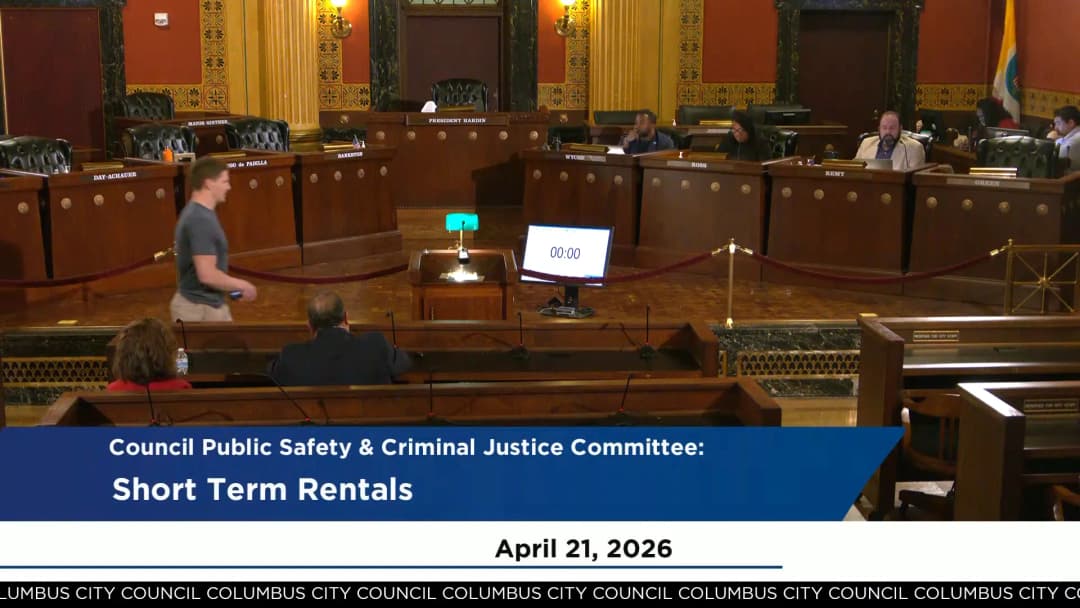
Columbus Public Safety Committee Follow-Up Hearing on Short-Term Rentals – April 20, 2026

This exploratory hearing, the second in a series, revisited the city's short-term rental (STR) framework as of April 20, 2026. Chair Remy opened by emphasizing that no legislation was before the committee; the purpose was to gather updated staff recommendations and public feedback to modernize the code adopted in 2018 and updated in 2021. The goal is to balance responsible operator needs with stronger tools against problematic properties. Discussion Items - Recap and Updated Recommendations – Dr. Tanisha Pruitt (Legislative Analyst) summarized the first hearing: - The need for a trespass authorization to allow police to enter and remove violators without contacting the owner. - Current permit counts: 1,535 permits issued, majority for non-primary residences. - Neighbor notification requirements used in peer cities (Toledo, Grandview Heights, North Canton; Santa Fe, Nashville, Georgetown, Texas). - Tax collection: 5.1% excise lodging tax, 1,600 STR accounts, about 1,200 active; interest in platform remittance but auditor system challenges. - Community concerns: unauthorized parties, noise, trash, violence, parking, housing supply, neighborhood character. STR owner concerns: administrative burdens, frivolous neighbor complaints. - Next steps: continue public input, introduce legislation before July recess. - Proposed Policy and Code Changes – Tony Celebrizi (Deputy Director, Department of Building and Zoning Services) presented: - Create a new city code chapter in Title V for easier access. - Implement fully online registration and renewal system with simplified affidavit for renewals; reduced renewal fee. - Neighbor notification at registration/renewal (proposed 125-foot radius from property line). - Graduated fines for noncompliant listings (starting at $50, rising to $250+ before court), with appeal rights. - Automatic tax remittance via platforms (under discussion, technology challenges with auditor). - Overnight occupancy limit: 2 per bedroom plus 2 additional guests; basements require safety inspection (egress, utility separation). - Non-overnight occupancy maximum to discourage parties; encourage trespass authorization letters for police to remove excess guests. - For buildings with 4+ units, require hotel/motel license if 25% or more units are used as STRs, to ensure safety features (exits, push bars, inspections). - Annual report to council on licences, violations, and problem properties. - Councilmember Questions and Discussion – Topics included: - Fines based on severity (e.g., violent felonies vs. registration lapses). - Proactive compliance checks (staff monitor platforms; partners with Airbnb to takedown noncompliant listings). - Data integration between police and licensing systems. - Trash and exterior maintenance – Chair encouraged residents to use 311 for code violations. - Occupancy metrics tied to beds vs. bedrooms; use of county auditor data. Public Comments & Testimony - Nat Shepherd (STR Operator) – Supported online renewals, platform tax remittance, and neighbor notification through the rental registry (approved yesterday) instead of paper notices. Advised higher fines for non-compliant operators ($250 is too low). Urged capturing more detailed license types (owner-occupied vs. non-owner, on-site vs. not). - Jeff Smith (Airbnb Community Manager, Columbus Host Alliance) – Stated existing legislation has reduced problems; Airbnb’s party crackdown helps. Supported streamlined permits and tax remittance. Called neighbor notification “worthless” in areas with apartments; preferred use of rental registry, 311, and licensing contacts. - Willie Jones (Host) – Described a January 2026 incident where police could not remove non-overnight guests from his STR, leading to a shootout with 47 bullet holes and a wounded guest. He has since filed a trespass authorization form and urged stronger police ability to remove violators. - Susan Sommerfeld (Resident, Short North) – Raised parking issues (lack of signage) and occupancy concerns for large houses (sleeping many guests despite bedroom limits). Asked about enforcement of exterior maintenance – Chair reminded her to use 311 and escalate to council/city attorney if needed; noted that area commissions cannot override code. - Michael Shibko (Host) – Asked to allow duplex owners to combine listings into one (currently limited to 5 bedrooms per STR). Deputy Director Celebrizi cited concerns about “party houses” but acknowledged good operators exist. No immediate commitment. - Ryan McFadden (Host/Realtor, Italian Village) – Echoed support for most proposals. Cautioned against reducing occupancy limits, requested grandfathering for existing investments. Favored electronic notification via registry over paper. Questioned enforcement of non-overnight guest limits for events like OSU games. Supported clear trespass procedures. - Christoph Schiller (Resident, Harrison West) – Described four townhouse units operating as a de facto 50-person hotel with parties, noise, and shootings every weekend. The owner was banned from Airbnb/VRBO but continues via own website (ads on Google Maps and YouTube). Called for immediate enforcement, not just long-term code changes. Deputy Director Wendy Boots confirmed awareness and planned meeting with owner. Chair Remy requested including the city attorney’s office in that meeting. - Jeremiah Logier (Host) – Owns a 9-bedroom Victorian mansion near Neil Avenue; limited to 5 bedrooms by current code. Argued the restriction forces him to split the house, while 80% of his guests are multi-generational families for weddings and tourism. Asked for flexibility based on operator track record. Key Outcomes - No votes were taken; this was an informational hearing. - The Department of Building and Zoning Services will meet with the owner of the Harrison West property, with the city attorney’s office included, to address immediate nuisance issues. - Staff will continue to refine proposed code changes based on testimony, aiming to introduce legislation before the July council recess. - Council will explore technical solutions for platform tax remittance and data sharing with the auditor’s office. - A future annual report on STR licenses, renewals, and violations is planned.
PUBLIC SAFETY 28% · CANNABIS REGULATION 27% · ECONOMIC DEVELOPMENT 25% · COMMUNITY ENGAGEMENT 11%
22
APR 14, 2026 · COLUMBUS, OHIO · CITY COUNCIL
Columbus City Council Meeting – April 14, 2026: Rental Registry Passes, NWSL Deal Approved with Controversy

The Columbus City Council met on April 14, 2026, to consider a range of legislation. The most notable items were the passage of a rental property registry (Ordinance 0923-2026) and approval of a development agreement to support a National Women's Soccer League (NWSL) franchise (Ordinance 1112-2026) after significant public debate and an amendment addressing community park commitments. The meeting also included routine consent items, several committee reports, and the announcement of Auditor Megan Kilgore’s resignation. Consent Calendar - Resolutions of Expression (Items 102X-2026, 92X-2026, 97X-2026, 98X-2026, 106X-2026, 107X-2026, 94X-2026, 101X-2026) and numerous ordinances from Finance & Governance, Health & Human Services, Public Safety, Housing, Public Utilities, and Appointments (A32-2026, A80-2026) were approved unanimously by voice vote. Public Comments & Testimony - Rental Registry (Ordinance 0923-2026): Jeff Covell, a landlord, expressed full support, calling the $15/unit fee “laughable” and stating any resisting owner “is not responsible.” Julianne Johnson, representing a Haitian immigrant family and member of BREAD, spoke in favor, describing unsafe conditions and exploitation of vulnerable tenants. Michael Edwards from Legal Aid of South Central Ohio offered detailed support, noting the registry will shift enforcement from reactive to proactive and provide leverage for tenants, while also highlighting remaining concerns (retaliation fears, small-owner loophole, enforcement pressure). - NWSL Deal (Ordinance 1112-2026): Liz Reed (Southwest Area Commission to Save McCoy Park) spoke against, arguing the amendment does not fix the broken promise and that building a replacement park on new land will take years, disadvantaging children with disabilities. DJ Burns (Brewster) opposed, criticizing the deal as rewarding billionaires and comparing the process to actions of the Republican statehouse. Kelsey Gray, a teacher, read letters from nine students who opposed giving away public park land. In favor: Gaia Kisatley (attorney) supported the amendment, citing representation for young girls; Mark Wise (Columbus Eagles FC) supported, emphasizing 23 years of effort to bring professional women’s soccer; Doug Wolf (Adaptive Sports Connection) supported, stating the NWSL investment can expand adaptive sports access if done right. Discussion Items - Rental Registry (Ordinance 0923-2026): Councilmember Bankston presented the ordinance, noting a nine-month community engagement process. The registry requires annual registration ($15/unit, capped at $1,500), free triennial preventive education inspections of exteriors/common areas, and conditional registration for repeat violators triggering mandatory inspections and daily fines. Director Messer (Building & Zoning) clarified the registry is not duplicative of the county registry and data will be shared. Director Stevens (Development) said the data will help identify exploitative landlords. Legal Aid’s Edwards highlighted strengths and weaknesses. Councilmember Remy opposed due to administrative burden on responsible owners. The fee is currently set but future adjustments for fee schedule will require council action. Passed 8-1 (Remy no). - NWSL Deal (Ordinance 1112-2026): The original deal involved a $25 million city front for a training facility at McCoy Park, repaid via a 2% surcharge on stadium tickets. Council President Harden introduced an amendment after learning the administration had promised an adaptive recreation park at McCoy Park to the Southwest community, with designs completed in November 2025, but offered the site to the ownership group without notifying council or the community. The amendment: (1) within 15 days of securing a franchise, the city must form a working group including the Southwest Area Commission to identify an alternative park site; (2) within 60 days, submit a plan to council; (3) the ownership group will donate $3 million to the Recreation & Parks Foundation for the new park; (4) ensure public access to training facility fields; (5) no funds released until park plan is approved. Director Stevens stated urgency because the NWSL is considering only one more expansion team for the 2028 season, and the bid deadline is imminent. Director Reese confirmed park design was stopped in late 2025 but said work on specifications can be reused and land acquisition is underway. Councilmembers Green, Dorans, and DeYaucor voted no, citing broken trust and the unfair burden on the underserved Southwest community. Councilmember Weiss, Bankston, Remy, Ross, and Harden voted yes, emphasizing the park will be built with new resources and accountability. Passed 6-3-1 (Bankston yes, Rosa DePadia abstain, DeYaucor no, Dorans no, Green no, Remy yes, Ross yes, Weiss yes, Harden yes). - Public Safety Settlements: Two settlements were debated. Brooke Wilson case ($750,000) – a former police sergeant used a racial slur toward a cadet; the city disciplined him based on a polygraph, but a federal judge indicated the polygraph would be inadmissible, increasing risk of a $3 million verdict. Councilmember Rosa DePadia voted no, arguing the settlement rewards bad behavior and the judge’s stance was an abuse of power. The rest voted yes, citing risk management. Hana Hassan case ($36,000) – pre-suit settlement involving a retaliation claim from a polygraph applicant; no probable cause found by OCRC but litigation risk loomed. Passed unanimously. Key Outcomes - Ordinance 0923-2026 (Rental Registry): Passed 8-1. Creates a city rental registry with annual registration, preventive inspections, and conditional registration for problem properties. First reading of fee schedule deferred. - Ordinance 1112-2026 (NWSL Development Agreement): Passed 6-3-1. Authorizes city participation in securing an NWSL franchise, including contributions for training facility and stadium upgrades, with a 2% user fee on tickets to repay city. Amendment adds $3 million private donation for a new adaptive park in Southwest Columbus, community working group, and progress milestones. - Settlements: Brooke Wilson case approved 8-1; Hana Hassan case approved unanimously. - Other Legislation: All consent items, Finance & Governance (waste disposal contract, Oracle software), Zoning variances (three items), Economic Development (Gravity Project Phase 3), Public Service (Avery Road improvements), and Public Utilities (multiple water/sewer infrastructure contracts) passed unanimously. - Auditor Vacancy: Council announced acceptance of applications to fill Auditor Megan Kilgore’s upcoming vacancy, due May 4, 2026, deadline April 23 at 12 p.m.

PARKS AND RECREATION 25% · PENDING LITIGATION 15% · COMMUNITY ENGAGEMENT 12% · PROCEDURAL 11%
23
APR 8, 2026 · COLUMBUS, OHIO · CITY COUNCIL
Columbus City Council Meeting: April 8, 2026 – NWSL Stadium Debate, Health Recognitions, and Zoning Actions

The Columbus City Council convened on April 8, 2026, at 5:00 pm in Council Chambers. The meeting opened with a prayer led by Monsignor Cody, followed by roll call and announcements. The council considered a range of resolutions, ordinances, and public testimony, with the most contentious item being Ordinance 1112-2026, which would authorize a lease of McCoy Park for a National Women’s Soccer League (NWSL) training facility. The council also approved numerous consent agenda items, zoning variances, and committee reports. Consent Calendar - Resolutions of expression: 75, 86, 87, 89, 74, and 78X-2026 (adopted unanimously). - Finance and governance ordinances: 375, 823, 848, 914, 938, 939-2026 (adopted). - Economic development ordinances: 753, 756, 845, 894, 912, 913, 915, 960, 974, 984-2026 (adopted). - Public service and transportation ordinances: 686, 715, 762, 814, 830, 876-2026 (adopted). - Neighborhoods, recreation, and parks ordinances: 672, 675, 685, 917, 955, 973-2026 (adopted). - Health, human services, and equity ordinance: 928-2026 (adopted). - Public safety and criminal justice ordinance: 254-2026 (adopted). - Public utilities and sustainability ordinances: 592, 648, 703, 840, 844, 866, 889, 896, 902-2026 (adopted). Public Comments & Testimony - Ordinance 1112-2026 (NWSL training facility at McCoy Park): Eight speakers were scheduled (three against, four for; one against speaker was not called due to time). - Derek Bergman (Franklin Tenary Commission, personal capacity) opposed the ordinance, arguing that the city had promised an adaptive/therapeutic recreation park for children with disabilities at McCoy Park, which was funded and planned. He stated that the administration’s lack of due diligence and failure to consult the community before offering the park violated public trust. He asked: “How will the neighborhood be made whole? What happened to the plans for the park? Where will the hundreds of kids using the park go?” - Rachel Wenning (former Hilltop Area Commissioner) spoke against the ordinance, criticizing the campaign contributions from the Haslam family (owners of the proposed NWSL franchise) to city officials, totaling at least $295,000 in the last five years. She argued that the deal prioritized wealthy donors over the poorest census tract in Columbus, which had been promised accessible park improvements. - Liz Reed (Area Commission chair) opposed the ordinance, emphasizing that the city had approved funding for McCoy Park improvements to begin in 2026 and be completed by 2027, but the administration hid this fact. She stated that the administration’s haste to secure the team put a community in one of the most resource-deprived neighborhoods at risk. She called on the council to vote no and save the park. - Alaria Rollins (CEO of Fortuna Bank) spoke in support, stating that a women’s soccer team would inspire young girls and women, provide economic benefits, and align with Columbus’s values of inclusion and opportunity. - Don Stewart (Director of Strategic Partnerships, Greater Columbus Sports Commission) spoke in support, sharing her personal story as a female athlete and administrator, and argued that the NWSL team would provide role models and strengthen Columbus’s sports landscape. - Eric Rkowski (Program Director, Leveling the Playing Field) spoke in support, highlighting the Columbus Crew’s community investments (e.g., $60,000 to four local nonprofits) and the positive impact of sports on youth. - Public comment on Ordinance 860-2026 (Franklin County jail contract): Isaiah St. John (personal capacity) urged the council to reject the contract due to the Franklin County Sheriff’s policy of notifying ICE about inmates who speak little English. He stated that in February 2026, 20 individuals were taken into ICE custody from the county jail, 12 of whom had no criminal convictions. He argued that taxpayer dollars should not support a system that collaborates with federal immigration enforcement. Discussion Items - Parkinson’s Awareness Month Resolution (0090X-2026): Councilmember Day-Agnew introduced a resolution recognizing April as Parkinson’s Awareness Month. She noted that approximately 1 million people in the U.S. have Parkinson’s, with 90,000 new diagnoses each year. The Parkinson’s Foundation’s annual “Moving Day” walk is scheduled for April 26, 2026, at 10:00 am at Wolf Park. Michael Rawl from the foundation thanked the council. - National Youth HIV and AIDS Awareness Day Resolution (0088X-2026): Councilmember Green introduced a resolution recognizing April 10, 2026, as National Youth HIV and AIDS Awareness Day. He noted that 1.2 million people in the U.S. live with HIV, and young people (13–24) account for 20% of new diagnoses. Ava Greer, an ambassador for Advocates for Youth, spoke about the importance of education and testing. - Local Food Action Plan 10-Year Anniversary Resolution (85X-2026): Councilmember Weich introduced a resolution celebrating the 10th anniversary of the Columbus and Franklin County Local Food Action Plan. Jill Clark (OSU professor and board member) and Yolanda Owens (executive director of Local Matters) thanked the council for investments in the local food system. - Delta Sigma Theta Senior Health Fair Resolution (0079X-2026): Council President Harden introduced a resolution honoring the Delta Sigma Theta Columbus Alumni Chapter for hosting a senior wellness health fair on April 22, 2026, at Broad Street Presbyterian Church. The fair is open to the public and targets the fastest-growing population in Columbus—seniors. - AIDS Walk of Central Ohio Resolution (0088X-2026): Council President Harden introduced a resolution commemorating the 2026 Dr. Robert J. Fast Memorial AIDS Walk on April 18, 2026, at 9:00 am at Genoa Park. Swan Blakely (Equitas Health Forward) and CEO David noted that more than 24,000 people in Ohio live with HIV, and about one in five do not know their status. They highlighted threats to federal funding for HIV prevention. - Participatory Budgeting Announcement: Councilmember Bankston announced that the city is launching the next phase of participatory budgeting with $9 million ($1 million per district). The process will allow residents to collect ideas and vote on capital projects. A steering committee has developed a guidebook. The kickoff event is April 29, 2026. - Street Sweeping Reminder: Councilmember Day-Agnew reminded residents that street sweeping runs April through October. Signs should be heeded to avoid towing. - Public Hearing on Council Structure: Councilmember Prespotan announced a public hearing on April 28, 2026, at 5:30 pm in Council Chambers as part of the Rules and Reference Committee to discuss the structure of Columbus City Council, including district representation. Residents can submit testimony by 3:00 pm on April 28 to AEB McDonald at Columbus.gov. - Short-Term Rental Regulations Hearing: Councilmember Remy announced a second hearing on short-term rental regulations on April 21, 2026, at 3:30 pm in Council Chambers. Written or public testimony must be submitted by 12:00 pm on April 21 to Pedro Mejia. - Cleaner Columbus Citywide Cleanup: Councilmember Remy announced the fifth annual Cleaner Columbus Citywide Cleanup on May 9, 2026. Sign up at CleanerColumbus.org. - Community Working Hours: Councilmember Ross announced community working hours at Parsons Library on April 14, 2026, from 1:00 pm to 3:00 pm. - Public Utilities and Sustainability Committee Hearing: Councilmember Weich announced a committee hearing on April 15, 2026, at 3:30 pm in Council Chambers, discussing the Columbus Green Fund, Environmental Science Advisory Committee, and surveillance pricing. Testimony due by noon on April 14. Key Outcomes - Ordinance 1112-2026 (NWSL training facility): The council took no vote on the ordinance at this first reading. Council President Harden and Chair Bankston expressed frustration that the administration had not disclosed the existing plans for McCoy Park (a therapeutic recreation park for children with disabilities) and that the area commission chair had not been contacted. Councilmember Day-Agnew stated that the Haslam Sports Group refused to include a playground or splash pad in the training facility, only soccer fields. Council President Harden called for an amendment to require the city to move at “warp speed” to find an alternative park location and to require the ownership group to fund community amenities. The ordinance will be brought back for a second reading, and the council will hold further discussions with the administration, the area commission, and the public. - Ordinance 860-2026 (Franklin County jail contract): Councilmember Remy moved to refer the ordinance back to committee for further study of the sheriff’s ICE notification policies. The motion passed unanimously. Public speaker Isaiah St. John’s testimony was noted. - All other ordinances and resolutions on the second reading agenda were passed unanimously, including the consent agenda items, zoning variances, and committee reports. - Zoning Committee: All three council variances (967-2026, 971-2026, 979-2026) were approved unanimously. - Adjournment: The meeting adjourned at approximately 8:15 pm.

PARKS AND RECREATION 19% · PROCEDURAL 17% · PUBLIC HEALTH 13% · ECONOMIC DEVELOPMENT 13%
24
APR 8, 2026 · COLUMBUS, OHIO · COUNCIL COMMITTEES
Public Utilities and Sustainability Committee Hearing on Environmental Advisory Body, Surveillance Pricing, Green Fund, and Recycling RFP - April 8, 2026

This hearing covered four main topics: the need to reactivate and update the Environmental Science Advisory Committee, surveillance pricing in housing and groceries, an update from the Columbus Region Green Fund, and the upcoming RFP for the city's residential recycling contract. The meeting took place on April 8, 2026, during Earth Month and tax day, as noted by Chair Weiss. Public Comments & Testimony - Tia Johnson, CEO of Fresh Environmental Services, advocated for changes to Title 13 and RFP language to allow local and minority-owned businesses to participate in waste and recycling collection. She emphasized that current rules limit innovation and called for procurement to include collaboration and local hauler access. Discussion Items Environmental Science Advisory Committee - Annalisa Rocca, Central Ohio Regional Director for the Ohio Environmental Council Action Fund, expressed support for reactivating and updating the Environmental Science Advisory Committee (Chapter 143). She recommended aligning it with the Climate Action Plan, integrating with the health department and Sustainable Columbus, ensuring regular reporting and community engagement, and diverse membership reflecting Columbus's demographics. She cited Cincinnati's Environmental Advisory Board as a model. - Craig Toothman, Executive Director of Franklin County Pollinator Pathways, supported the committee, emphasizing the need for independent science-based advice. He discussed the urban heat island effect, climate migration, hydrogen fuel cells, and birding as examples of issues requiring expert input. - Joe Flarida, Executive Director of Power Clean Future Ohio, recommended updating the committee's focus, people, capacity, authority, and transparency. He suggested the current code's charge (regulatory review) is too narrow and proposed aligning with the Climate Action Plan. He noted the importance of providing staff capacity and possibly giving the committee tangible responsibilities like grant review. - Chair Weiss noted that the committee was established in 1993 but has no records of ever meeting. The goal is to have draft language for the next committee hearing. Surveillance Pricing - Dr. Katie Fallon, Senior Policy Advisor in the Legislative Research Office, presented on surveillance pricing in rental housing. She explained that platforms like RealPage and Yardi collect massive data and use algorithms to suggest rents, with 90% of landlords adhering to recommendations. This costs renters an average of $70/month nationally, totaling $3.8 billion, and increases eviction filings. She noted additional fees (e.g., trash valet) can inflate costs by 10–30% and vary month-to-month. She suggested transparency measures, such as disclosing rent-setting software use, as potential local actions. - Mike Nichols, President of UFCW Local 1059, testified on surveillance pricing in grocery stores. He highlighted that electronic shelf labels (ESLs) combined with AI enable dynamic pricing based on customer data, leading to higher prices. He argued that banning ESLs alone is insufficient; action must address both surveillance pricing and ESLs. He noted that Kroger has used ESLs since 2018 and Walmart is adding them to all stores. He expressed skepticism that the technology would lower prices. Columbus Region Green Fund Update - Jackie Kimball, Interim Executive Director, provided an update. The Green Fund, capitalized with $7 million from the city and $2 million from the county, has provided $9.2 million in loans and grants, resulting in $24 million in projected savings over 25 years and avoiding 100,000 metric tons of CO2 (equivalent to 21,000 cars). Key projects include $4.3 million in solar loans for nonprofits and affordable housing, $1.9 million for energy-efficient housing (including a project for women in behavioral health treatment), and $1.8 million in grants for energy audits and weatherization. She also announced a new bridge loan product for pre-development energy-efficient housing and a free energy audit program for 30–35 buildings (50,000 sq ft). The Grid Innovation Fund, in partnership with Google, granted $300,000 to Columbus organizations for workforce development and home weatherization. Kimball noted that federal funding (IRA) has been frozen and investment tax credits are sunsetting in July, but the fund continues to innovate. Recycling Contract RFP - DSU Oshodi, Operations Coordinator for the Division of Refuse Collection, presented the RFP for residential recycling and yard waste collection starting April 2027. The contract covers approximately 221,520 households, divided into three zones (65,000–85,000 households each). The base term is five years with five one-year extensions. Bids are due May 8, 2026, with a pre-bid meeting on April 27, 2026. Key features include mandatory bidding on all zones, a subcontractor limit to encourage participation by small/minority businesses, and a requirement that 75% of materials be processed within Ohio. The current contract expires March 31, 2027. Oshodi noted that the department has learned from the current contract, including holiday scheduling and the need for flexibility in tonnage. The RFP also allows for future addition of collection programs (e.g., food waste composting) by mutual agreement. Key Outcomes - No votes were taken; the hearing was informational. - Chair Weiss stated that the committee will continue working on draft language for the Environmental Science Advisory Committee, aiming to present it at the next committee hearing. - The recycling RFP is now open (advertised April 15, 2026), with a decision expected by May 13, 2026. - The Green Fund will continue to report on its impact, including the Grid Innovation Fund report due in June 2026. - Council members expressed interest in further exploring transparency measures for rental housing and grocery pricing, as well as potential code changes to support local waste haulers.

ENVIRONMENTAL PROTECTION 50% · WATER AND WASTEWATER MANAGEMENT 20% · ECONOMIC DEVELOPMENT 10% · TECHNOLOGY AND INNOVATION 8%
25
APR 6, 2026 · COLUMBUS, OHIO · CITY COUNCIL
Columbus City Council Hearing on NWSL Expansion Proposal - April 6, 2026

This hearing, called by Council Chair Bankston, focused on a revised public-private partnership to secure an NWSL expansion franchise in Columbus. The revised deal includes a $25 million city investment (part of a $50 million total with Franklin County) for a new training facility at McCoy Park and improvements to Scotts Miracle-Gro Field, leveraging a $310 million private investment. Financing would be supported by increasing the admissions fee at the stadium from 5% to 7%, with the additional revenue dedicated to debt service. Over 30 years, the project is projected to generate $52 million in net fiscal impact to the city and create over 200 jobs. Council heard public testimony from 24 speakers, with 18 in support and 6 expressing concerns or opposition. Public Comments & Testimony - Stephanie Hightower (Columbus Urban League) expressed strong support, urging a mindset of abundance and highlighting the deal's responsible structure. - Morgan Hughes (resident, former Save the Crew activist) supported the investment, noting his daughter plays at McCoy Park and he is willing to pay the increased admissions fee. - DJ Burns (community activist) strongly opposed, criticizing the deal as a gift to billionaire Jimmy Haslam, citing his political donations, and arguing the loss of McCoy Park as public green space harms an underserved neighborhood. - Rachel Winning (Hilltop resident) opposed, questioning how bonds can be issued without voter approval and funded by speculative ticket revenue, and arguing the $25 million could better serve human services and summer programs. - Paul Edgar (club soccer coach) supported, urging council to "just do it" for the girls and women of Columbus. - Jason Hall (CEO, Columbus Partnership) supported, emphasizing the economic development and brand value for attracting talent and investment. - Tanny Crane (Crane Group executive) supported, speaking as a mother of four daughters and urging investment in women's athletics. - Pastor Michael Young (City of Grace Church) supported but challenged council to ensure equity and follow-through on community benefits for black and brown communities. - Christine Troyer (Watch Women Win) supported, citing personal experiences attending NWSL events and the growing demand. - Liz Reed (Southwest Area Commission) opposed, advocating for the original McCoy Park plans for a therapeutic recreation park and lake, which she said are now jeopardized. - Maggie Oliphant (Whetstone High School student) supported, sharing her soccer experience and the lack of parity in Columbus City Schools' girls soccer teams. - Emily Kegg and Ashley Hegarty Smith (Nordic supporters group) supported but urged the ownership group to align with NWSL's LGBTQ+ advocacy values. - Glenn Tumala (resident) opposed, criticizing the process (meeting time, accessibility) and the choice of McCoy Park over alternatives like Cooper Stadium. - Whitney Harding (former sports reporter) supported, highlighting the impact of women's sports on girls' confidence. - Kelsey Gray (CCS educator) opposed, citing tax abatements reducing school funding and arguing the $25 million should be used for schools and community needs. - Corey O’Neill (small business owner) supported, sharing grassroots support from families and youth. - Roy Winslow (community activist) opposed the site selection, advocating for Cooper Stadium and asking for an alternate plan for the neighborhood. - Megan Lush (Columbus Fury captain) supported, speaking as an athlete and mother about the importance of women's sports. - Paula Corti (Department of Neighborhoods) supported, emphasizing the importance for immigrant and refugee families. - Bri Losei (Student Success Stores) supported, citing the Columbus Crew's community partnership and the need for similar role models for girls. - Lisa and Lindsay Rush (restaurant owners) supported, noting the economic benefits for small businesses and the inspiration for young athletes. - Derek Bergman (Franklin resident) had concerns about the process and site, asking for a transparent evaluation of alternatives. Discussion Items - Opening Remarks: Council President Harden and Councilmember Marie expressed support for the revised deal, emphasizing the importance of public-private partnership and the need to address taxpayer concerns. - Presentation by Director Mike Stevens: Outlined the $310 million private investment, $25 million city investment (plus $25 million from Franklin County), and the admissions fee increase from 5% to 7%. Projected $52 million net fiscal return over 30 years, $2 million annual ongoing revenue, and over 200 jobs. - Auditor Megan Kilgore: Explained the bond issuance, noting the city's AAA rating allows low-cost borrowing, and the emissions fee creates a self-supporting revenue stream similar to parking garages. - Councilmember Questions: - Councilmember Weish asked about economic impact methodology. - Councilmember Remy asked about protections if the team is not awarded or if operations change; Director Stevens confirmed the site reverts to city control. - Councilmember Green questioned the ticket tax underperformance risk, repayment terms, and whether the $12 million community investment is firm; Mary Shepro stated it is being finalized. - Councilmember Dorans clarified the financing structure, noting the development agreement will include safeguards and multiple revenue sources (e.g., NCA charges) to ensure the public is not on the hook. - Invited Guest Speakers: - Mary Shepro (Haslam Sports Group) highlighted the competitiveness of the NWSL bid, the need for a public-private partnership, and community benefits (youth access, prevailing wages, local hiring). - Linda Logan (Greater Columbus Sports Commission) emphasized Columbus's track record in hosting women's sports events and the brand value. - Cassie Sistrunk (U.S. Soccer Federation, speaking personally) urged support, calling it a "last big shot" for an expansion team and noting the global growth of women's soccer. Key Outcomes - No vote was taken; council is continuing deliberations. - The proposal is expected to be considered for first and second readings by the April 20, 2026 council agenda. - Council Chair Bankston committed to working with councilmembers on concerns, including exploring alternate sites for McCoy Park programming and ensuring community benefits reach underserved areas. - The public was encouraged to submit written testimony and contact council offices.

ECONOMIC DEVELOPMENT 52% · YOUTH PROGRAMS 11% · FISCAL SUSTAINABILITY 9% · PARKS AND RECREATION 9%
26
MAR 25, 2026 · COLUMBUS, OHIO · COUNCIL COMMITTEES
Public Hearing on Big Darby Accord Amendment – March 25, 2026

The Columbus City Council held a public hearing to discuss the proposed update to the Big Darby Accord, a 20-year-old interjurisdictional agreement protecting the Big Darby Creek watershed in Franklin County. The hearing featured presentations from planning consultants, city development staff, invited speakers from Metro Parks and the Streams and Wetlands Foundation, and public testimony from 13 speakers. The update aims to strengthen water quality monitoring, expand protected conservation areas, increase stream buffers, and improve the revenue model for land acquisition, while maintaining the existing cap of 20,000 residential units. A major point of contention was whether to delay the amendment until the completion of the Ohio Department of Natural Resources (ODNR) Integrated Prioritization System (IPS) Phase 2 study, expected later in 2026. Public Comments & Testimony - Ashley Hoy (Chair, Big Darby Accord Advisory Panel) – Expressed support for the amendment, noting the panel’s labor of love and the need for updated tools. - Sharon Rastetter (Chair, Far West Side Area Commission) – Requested a pause until IPS Phase 2 is completed and integrated; also asked for formal stakeholder inclusion for the Area Commission. - Steve Campbell (North Star Policy and Project Development) – Supported the amendment, highlighting stronger standards, stream restoration, buffers, monitoring, and revenue dedication. - James Jewell (Prairie Township Administrator) – Supported moving forward, noting the amendment is not perfect but better than the current plan, with quarterly BDART reviews. - Kristen Terry (Columbus resident, OSU graduate student) – Urged council to wait for IPS Phase 2, citing the Derby’s ecological importance and the need for science-based decisions. - David Icke (Franklin County resident) – Requested a pause until IPS Phase 2 is completed and reviewed. - Melissa Brinkerhoff (Watershed resident) – Asked for a pause, emphasizing the 14,000-year history of the creek and the need for more science. - Mike Reeves (City-appointed Big Darby Accord Advisory Panel member) – Supported keeping the process moving, noting development applications continue under the outdated 2006 plan. - Anthony Sasson (Darby Creek Association) – Asked for a pause, citing the Hellbranch Run mussel survey finding no living mussels and the need to incorporate IPS Phase 2. - Annalisa Rocca (Ohio Environmental Council Action Fund) – Urged a pause for IPS Phase 2, but praised positive elements like increased buffers and monitoring. - Cynthia Vermillion (resident) – Urged waiting for IPS Phase 2, noting the correlation between impervious surfaces and stream degradation. - Adam Lehman (resident) – Asked for a pause, stating the IPS Phase 2 will answer how much development the watershed can absorb. - Debbie Hampton (Columbus resident) – Asked council to wait for IPS Phase 2, expressing concern about lack of compliance with existing plan and citing the Anderson Farm development. Discussion Items - Presentation by Chris Herman (MKSK) and Brian Clark (Department of Development) – Reviewed the 18-month amendment process, key changes including: expansion of protected conservation areas from 25,000 to 30,000 acres; increased stream buffers (150 feet on both sides of Big/Little Darby, 1,000 feet and 400 feet on tributaries); 50% open space requirement on new developments; new water quality monitoring program (rotating annually among main stems, tributaries, and aquatic biology); dedicated 25% of revenue for conservation land acquisition; and a commitment to quarterly BDART meetings for adaptive management. - Councilmember Nancy Day Achauer’s questions – Inquired about potential data center development in the watershed (confirmed land purchase in 2024 but no rezoning applications yet); definition of “commercially feasible” for secondary conservation areas; interplay with other jurisdictions’ open space requirements; absence of a permanent watershed coordinator (consensus not reached among BDART members); impact fee adequacy ($2,500 per unit in 2006, now worth $4,000); open space credit framework (placeholder for future consideration); and the “may” vs “shall” language regarding IPS Phase 2 incorporation (staff agreed to consider stronger language). - Councilmember Christopher Weish’s questions – Followed up on the data center issue; asked about Sustainable Columbus’s role (will provide staff support for implementation); discussed the need for a watershed coordinator and the balance between environmental protection and housing affordability; requested a cost analysis for housing affordability (not yet done, but revenue can support affordability programs). - Councilmember Ross’s questions – Focused on the “may” vs “shall” issue regarding IPS Phase 2, suggesting intermediate language; asked about triggers for adaptive management (quarterly reviews, water quality data, public reporting). - Invited Speakers: - Tim Maloney (Metro Parks) – Strongly supported the update, noting Metro Parks has invested $11 million in land acquisition since 2006 but received zero funding from the Accord’s revenue mechanism. Praised the increased buffers and called for all jurisdictions to prohibit variances that increase impervious surface. - Chelsea Kiefer (Streams and Wetlands Foundation) – Supported the amendment, offered expertise on open space aggregation and restoration, and noted the collaborative process. Key Outcomes - No vote was taken; the hearing was for public input and council discussion. - Council indicated that changes to wording (e.g., “may” to “shall” regarding IPS Phase 2 incorporation; restriction on advisory panel members’ public comment) would be considered. - Staff committed to working with ODNR and stakeholders on IPS Phase 2 and to reconvening BDART quarterly. - Next steps: Council will review public comments (13 oral, 25 written) and consider revisions before a future vote. The administration intends to seek adoption by Columbus first, with other jurisdictions to follow. A $2 million capital budget request for Derby open space acquisition was announced.

ENVIRONMENTAL PROTECTION 80% · COMMUNITY ENGAGEMENT 6% · ECONOMIC DEVELOPMENT 4% · WATER AND WASTEWATER MANAGEMENT 3%
27
MAR 19, 2026 · COLUMBUS, OHIO · CITY COUNCIL
Columbus City Council Meeting: March 19, 2026

This meeting of the Columbus City Council featured the adoption of a historic participatory budgeting process, recognition of retiring and departing public servants, approval of multiple infrastructure and safety projects, and funding for youth and social services. Key votes included the launch of Phase 1 of participatory budgeting with $9 million in capital funds, adoption of Vision Zero roadway safety projects along the High Injury Network, and approval of $10 million in Elevate grants for local social service agencies. Consent Calendar - Routine approvals and unanimous actions were passed on the consent agenda. Public Comments & Testimony - Mr. Wilkins (public commenter) questioned the affordability and accessibility of the Clover Glen 2 senior housing project for people with disabilities, and asked about the project's timeline, bus line proximity, and wheelchair accessibility. Director Stevens offered to follow up with details. Discussion Items - Participatory Budgeting Launch: Councilmember Bangston introduced the participatory budgeting (PB) process, a resident-driven initiative allocating $1 million per council district ($9 million total) from the 2025 capital budget. The PB Steering Committee, supported by AmeriCorps member Melissa Bila, produced recommendations and a guidebook. Council members praised the process as historic and a model for democratic engagement. - Infrastructure and Vision Zero Projects: Councilmember Barrosa de Padilla presented three transportation ordinances: Livingston Avenue safety improvements (shared use path, signals, lighting), a multimodal planning contract with Burgess & Niple ($300,000), and McNaughton Road bikeway design ($900,000). Director of Public Service noted the McNaughton project honors 11-year-old Elizabeth "Lizzie" Robertson Rutland, who was killed on that road. Construction is expected through 2031. - Elevate Program Grants: Councilmember Green presented $10 million in Elevate grants for nonprofits serving households below the ALICE threshold. Director Stevens explained a new peer-review process for equitable funding. Sharome Hathaway (COO, Epic Youth) and Kendall Bell (student) testified in support, emphasizing the program’s role in youth development and workforce readiness. - Retirement and Departure Recognitions: Council honored Paul Sauer (25 years, Department of Building and Zoning) for environmental blight abatement (3,212 properties cleaned, 4,000 tires removed) and Director Jason Jenkins (Office of Diversity and Inclusion) for increasing minority spending fourfold and fostering trust. Council also recognized Sandy Stevenson for decades of behavioral health advocacy, including founding CHOICES and leading the Ohio Department of Mental Health. - Equity and Women’s History Month: Councilmember Barrosa de Padilla noted that Equal Pay Day (March 26) fell further into the year for the second consecutive year, indicating a widening pay gap. She encouraged support for women-owned businesses. Key Outcomes - Participatory Budgeting: Unanimously adopted (Resolution 0072X-2026). First public hearing set for April 29, 2026. - Infrastructure: All three Public Service and Transportation ordinances passed unanimously (ordinances 0448, 0628, 0712). - Elevate Grants: Three ordinances authorizing $10 million in grants passed (0896, 0898, 0899). Councilmember Hardin abstained on 0899. - Summer Youth Programs: Nearly $7.5 million in grants awarded to 105 nonprofits (ordinances 0748, 0947). Passed unanimously. - Recreation and Parks: Beattie Community Center renovation ($3.9 million, completion by Oct 31, 2026) and Summer Food Service Program ($2.5 million, expecting 80,000+ breakfasts, 100,000 lunches, 15,000 snacks) both passed unanimously. - Public Safety: Eight ordinances passed, including maintenance contracts for communication towers, EMS equipment, and EMS billing transition (through May 31, 2026). - Zoning and Variances: Five zoning and variance items passed unanimously, including rezoning for a natural gas station, a daycare center at 1107 E. Mound Street, and accessory storage at 2515 Lockbourne Road. - Housing: Clover Glen 2 senior housing (95 units, 55+, affordable at or below 60% AMI) received $2.3 million in city funds ($4.3 million total commitment). Passed unanimously. - Recognition Resolutions: Paul Sauer and Sandy Stevenson honored; Jason Jenkins recognized for his service. - Upcoming Hearings: Public hearing on Big Darby Accord amendment (April 7, 5:30 PM); juvenile safety hearing (April 2, 2 PM); senior listening session (April 7, 12-2 PM).

PROCEDURAL 18% · COMMUNITY ENGAGEMENT 17% · PERSONNEL MATTERS 14% · TRANSPORTATION SAFETY 12%
28
MAR 11, 2026 · COLUMBUS, OHIO · CITY COUNCIL
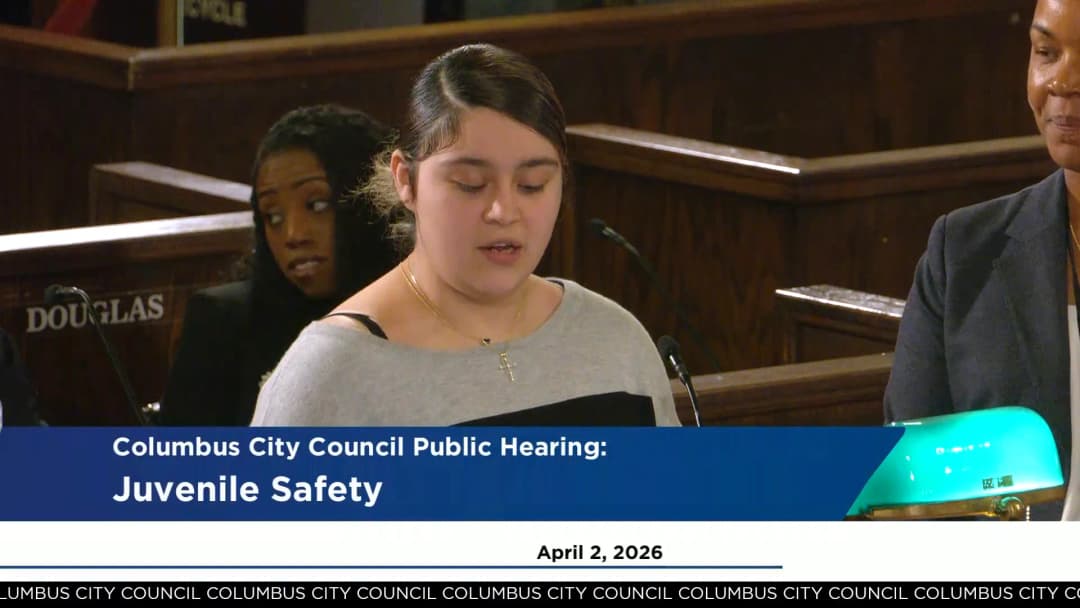
Juvenile Safety Hearing: Columbus City Council Discusses Curfew, Truancy, and Youth Violence Prevention - March 11, 2026

The Columbus City Council held a comprehensive hearing on juvenile safety on March 11, 2026, bringing together law enforcement, educators, data analysts, community organizations, and youth to address rising youth violence, truancy, and the need for coordinated prevention and intervention strategies. The hearing focused on the interplay of enforcement, youth programming, and systemic support, with an emphasis on data-driven solutions and community collaboration. Public Comments & Testimony - Melissa St. Clair (Mothers of Murder Columbus Children, MO MCC): Stressed the urgency of addressing teen takeovers and called for strict curfew enforcement. Noted that their organization has conducted safety walks and youth engagement. Highlighted a July 4, 2025 mass shooting at an unauthorized Airbnb party where a 17-year-old was killed and five injured, urging prevention before tragedies occur. - Willa Jackson (No Pandemic Child Left Behind): Emphasized that literacy is foundational to future success and safer neighborhoods. Requested funding for an eight-week summer academic enrichment program for grades 3-5 to improve reading, writing, and math skills. - Rhea Cunningham and Emily (Boys & Girls Club of Central Ohio): Emily, a Youth of the Year award winner, advocated for making schools welcoming, offering engaging programs, listening to students, and providing mental health support. Suggested using social media polls for youth input. Rhea Cunningham highlighted their programs' effectiveness in improving attendance and GPA. - Diego Hansard (BROS Mentor & Leadership): Urged reaching youth where they are – in the streets – and leveraging influential community members. Called for listening to youth and providing help to families before they must break the law to access services. - Ralph Carter (We Are Linden), Alea (student), and Jasmine Parker (mother): Alea, a 4.1 GPA sophomore, noted that youth crime stems from lack of safe spaces and opportunities. Jasmine Parker stressed adult accountability, bringing back the village, and the need for genuine care from leaders, not just popularity contests. - Aaron Hathaway (Epic Youth): Highlighted fragmented messaging among organizations and called for a unified, consistent standard and expectation for youth. Emphasized the need to retrain parents and align all community voices. Discussion Items - Columbus Division of Police Presentation (First Assistant Chief Potts, Officer Lutz, Sergeant Johnson): Reported that while overall homicides hit a low in 2025 (81 homicides), 28% of homicide suspects were 21 or under, and nearly half of felonious assault suspects were under 21. Gun violence is a major driver, with juveniles obtaining guns largely from stolen cars. Approximately 200 chronic offenders are responsible for a disproportionate share of serious incidents. Identified truancy as a key early indicator, with seventh grade as a critical marker. Called for better data sharing across systems and clearer roles for law enforcement. - Dr. Chanel Jones (Franklin University): Presented data showing a 33% increase in felonious assault suspects 21 and under. Proposed strengthening the curfew ordinance to align with most major cities (current end at 4:30 a.m., proposed 6:00 a.m.) as a protective measure. Advocated for parental responsibility laws paired with support services, not just punishment. Recommended using third-party metrics to evaluate funded programs. - Columbus City Schools (Monique Jacquette and Lauren Lopez): Shared progress: chronic absenteeism dropped from 74.6% (post-pandemic) to 49.6% as of March 2026. Truancy filings decreased 15.7% year-over-year. Described tiered attendance interventions, expanded mental health supports (from 54 to 103 school-based sites for clinical care), and noted increased student sense of belonging. Highlighted barriers: transportation, parent portal awareness, and the need for consistent notifications across all schools. - Council and Stakeholder Dialogue: Council members debated the need to strengthen curfew laws, improve school notifications (including via WhatsApp for immigrant families), and ensure youth have safe alternatives when a curfew is enforced. The importance of listening to youth and involving them in policy design was repeatedly emphasized. Key Outcomes - Commitment to Legislative Action: Council agreed to work with the Division of Police and community partners to strengthen the city's curfew ordinance, extending the current end time from 4:30 a.m. to 6:00 a.m. for minors 13-17, and sunset plus one hour to 6:00 a.m. for those under 13. - Parental Responsibility Framework: Council will explore a city-level parental responsibility law that couples accountability with supportive services (e.g., case management, resource referrals) to avoid punitive-only measures. - Truancy and Data Sharing: Council will pursue enhanced coordination between Columbus City Schools, law enforcement, and community organizations to improve early identification and intervention, including better real-time data sharing while respecting legal privacy protections. - Youth Programming and Funding: Council will host a youth programming summit to map gaps and align funding with measurable outcomes. Future grant contracts will include specific metrics tied to the priorities identified by data (e.g., attendance improvement, violence reduction). - Future Hearings: Councilmember Remy announced plans for additional hearings to include more community partners and youth voices, ensuring sustained attention and policy development.

YOUTH PROGRAMS 46% · PUBLIC SAFETY 39% · COMMUNITY ENGAGEMENT 10% · TECHNOLOGY AND INNOVATION 2%
29
MAR 4, 2026 · COLUMBUS, OHIO · CITY COUNCIL
Columbus City Council Meeting – March 4, 2026

The Columbus City Council met on March 4, 2026, to conduct its regular business, including recognitions, public hearings, and votes on a variety of legislative items. The meeting featured multiple resolutions honoring community members and organizations, as well as significant debate over a rezoning request in the Northland area. Several ordinances were passed to fund city services, housing initiatives, and public safety equipment. Consent Calendar - Resolutions of Expression: Adopted en bloc: 0058X-2026 through 0065X-2026, 0068X-2026, and 0060X-2026, recognizing individuals and events. - Ordinances (Finance, Economic Development, Public Service, etc.): Approved without discussion, including contracts for facility management, lockbox banking services, plumbing maintenance, and multiple capital improvement fund transfers. - Appointments: A39-2026 through A66-2026 were approved. Public Comments & Testimony - Zoning Case (4691 Central College Road): Three residents spoke against the rezoning, citing concerns about density, compatibility with the surrounding single-family neighborhood, and inconsistency with the Northland II plan. Matthew Ward (Asherton Grove Condo Association) stated that the 152-unit apartment proposal is too dense and called for development consistent with the 2002 Northland plan. David Slobe (Asherton Grove representative to NCC) argued that the project changes the character of the neighborhood and that the city should prioritize homeownership opportunities. Suzanne Harnisher (Northland Community Council) emphasized that the community had not been consulted on the final revision and that the density remains too high. - Habitat for Humanity Grant (Ordinance 0552-2026): Nathaniel Wilkins spoke against the grant, criticizing Habitat for Humanity for demolishing historic homes in the Linden neighborhood rather than rehabilitating them. Brandi Alisa (President/CEO, Habitat for Humanity Mid-Ohio) responded, noting that the 14-unit townhome project is in the Devon Triangle neighborhood (not Linden) and that building affordable homes requires cost-effective construction. She also provided statistics showing that 65% of Habitat homeowners report improved financial stability. Discussion Items - Recognitions: - Resolution 0069X-2026 honored the Centennial High School girls’ basketball team for winning back-to-back City League championships. Coach Ernest Bell and players were present. - Resolution 0067X-2026 recognized Local Matters during National Nutrition Month. Yolanda Owens (Executive Director) highlighted the organization’s 18 years of work, reaching over 200,000 lives in Central Ohio. - Resolution 0066X-2026 (introduced by Councilmember Weish) urged the Ohio legislature to pass House Bill 303, a community energy pilot program. Mariah Williams (Solar United Neighbors) noted that Columbus is the fourth city to pass such a resolution. - Resolution 0059X-2026 designated April as Jazz Appreciation Month and April 30 as International Jazz Day. Stephanie Matthews (A Tribe for Jazz) outlined a series of events and introduced students from Fort Hayes and Ohio State University. - Resolution 0070X-2026 honored Charles Coleman, a city water and power employee, for rescuing a young girl from a bridge. Coleman and his director spoke about the incident. - Zoning – 4691 Central College Road (Ordinance 3223-2025): The applicant (Preferred Living) proposed rezoning 10.1 acres from Rural to LARLD (Limited Apartment Residential District) to build 152 apartment units in two-story buildings. The project had been reduced from an initial 216 units after three appearances before the Development Commission, which ultimately recommended approval. Staff from the Department of Building and Zoning Services, Planning, Traffic Management, and Housing Strategy all supported the rezoning, citing the need for housing diversity and the adequacy of existing infrastructure. The Northland Community Council opposed the project, submitting a petition with 2,500 signatures. Councilmembers debated the issues of density, affordability, and community character. Council President Harden and several members expressed support, noting the need for rental housing and the project’s design improvements. Councilmember Remy opposed. The final vote was 6-1 in favor. - Habitat for Humanity Grant (Ordinance 0552-2026): Authorized $1 million (with a total commitment of $2 million) for a 14-unit affordable townhome development in the Devon Triangle neighborhood. Units will be sold to families earning 30-60% of area median income. - Recycling Contract (Ordinance 822-2026): Renewed the contract with Rumpke of Ohio for yard waste and recycling collection services for the 10th year at a total of $19.6 million, funded partly from the income tax set‑aside fund. The Department of Public Service noted that a new RFP will split the city into three zones to allow multiple vendors. - Other Ordinances: - Public safety: Approved funding for Verizon wireless services ($1.25M), firefighter uniforms and equipment ($1.53M), EMS pharmaceuticals ($1.2M), and crime lab equipment ($24,929). - Housing: Approved $1 million for the Tony R. Wells Foundation to manage the American Dream Down Payment Initiative, and $2.5 million (total $5 million) for 24 single-family zero‑energy ready homes in the American Edition neighborhood. - Public Utilities: Approved $3.2M for water distribution maintenance, $55,000 for methane detection systems on refuse trucks, and $3.2M for light‑duty vehicles for the Department of Public Utilities. - Code change: Reestablished the Information Service Division within the Department of Technology (Ordinance 0583-2026). Key Outcomes - Zoning 4691 Central College Road: Passed 6-1 (Councilmember Remy dissenting). The rezoning and development plan were approved with a commitment to the site plan and two-story height limit. - Habitat for Humanity Grant (Ordinance 0552-2026): Passed unanimously. - Other ordinances: All consent and second‑reading items were passed, including the recycling contract, public safety equipment, and housing grants. - Next Steps: The recycling contract renewal is effective until March 31, 2026, with a new RFP to be issued. The community energy resolution will be sent to the Ohio Senate. The housing projects will proceed with design and construction.

AFFORDABLE HOUSING 27% · COMMUNITY ENGAGEMENT 14% · PROCEDURAL 11% · PUBLIC SAFETY 7%
30
MAR 3, 2026 · COLUMBUS, OHIO · CITY COUNCIL
Columbus City Council Meeting - March 3, 2026

The Columbus City Council held its regular meeting on March 3, 2026, beginning with the national anthem, pledge, and a prayer by Bishop Hezekiah Martin of Southfield Missionary Baptist Church. The council approved the journal, received communications, and proceeded with announcements, recognitions, and legislative items. The meeting included a consent agenda, public testimony, and second readings of ordinances from multiple committees. All votes were unanimous unless noted otherwise. Consent Calendar - The council approved the consent agenda, which included resolutions of expression and numerous ordinances from various committees. Councilmember Green abstained from ordinance 0588-2026. - A speaker, Jordan, CFO of The Refuge, testified in support of funding for a clinical services building. Jordan shared his personal recovery story and noted that the Refuge helped save the community over $2.5 million from 2018-2020. The council acknowledged the impact of the program. Public Comments & Testimony - Sunny Fan (Ohio State student) spoke on the need for improved crosswalk safety on North High Street near campus. She cited 14 pedestrians struck by vehicles in 2025 within one mile of OSU and requested illuminated warning lights, noting a cost of $50,000. Councilmember Ross and Deputy Director Bourn Treger responded that improvements are underway, including resurfacing, repainting, and collaboration with the university on a long-term plan. - Nate Wilkins spoke during the Finance and Governance committee discussion on ordinance 0731-2026, advocating for summer jobs and workforce development programs rather than just youth programming. Councilmember De Acker clarified that the ordinance includes $850,000 for recreation and parks to fund summer pool, camps, and 350 youth job positions with workforce development wraparound services. Recognition & Resolutions - Resolution 0052X-2026 recognized Emily Ramirez as the 2026 Youth of the Year from the Boys & Girls Club of Central Ohio. Emily, a 17-year-old senior at Columbus Epicentric, received a $10,000 scholarship and shared her journey from depression to becoming Keystone president, aspiring to be an immigration lawyer. Councilmembers praised her leadership and offered mentorship opportunities. - Coach Mike Bale of East High School was recognized for saving a student's life during a shooting. Bale applied pressure to the victim's wound and performed the school chant to keep him awake. Councilmembers commended his bravery and highlighted the need for mental health support and resilience among youth. Bale emphasized changing perceptions and investing in neighborhoods. - Dress to Dream program was presented by founder Marlene Drayton and Bishop Hezekiah Martin. The program provides free prom dresses, shoes, and accessories to high school students. This year they have over 700 dresses. The council encouraged public outreach. Discussion Items - Finance and Governance Committee (Chair Bangston): - Ordinance 0086-2026: Established authorized strength levels for city departments in alignment with the 2026 operating budget. Passed. - Ordinance 0318-2026: Authorized purchase orders for vehicle fuel and fueling services with Wex Bank, up to $2 million. Passed. - Ordinance 0587-2026: Authorized $11,050,000 from admission tax proceeds for the Greater Columbus Arts Council. New CEO Mitch Minchaka highlighted a $13 return for every dollar invested and support for 1.2 million Franklin County kids and families. Passed. - Ordinance 0591-2026: Authorized $3,475,000 from arena admission tax proceeds for Nationwide Arena infrastructure. Passed. - Ordinance 0731-2026: Amended the budget to transfer $850,000 within recreation and parks for summer youth programming, and established $3.6 million in appropriations from the cannabis excise tax fund for Elevate Grants. Also corrected revenue estimates. Passed. - Public Service and Transportation Committee (Chair Ross): - Ordinance 0431-2026: Authorized $8,074,002.35 for resurfacing 36 streets and ADA curb ramps. Deputy Director Bourn Treger expressed condolences for a worker killed in a hit-skip on I-70. Passed. - Ordinance 0487-2026: Authorized $1.9 million for traffic management commodities (signs, signals, markings). Passed. - Ordinance 0572-2026: Authorized property acquisition for the Fourth Street Signals Phase 1 project (replacement of traffic signals at five intersections). Passed. - Zoning Committee (Chair Dorans): - Ordinance 0537-2026: Rezoned 18.6 acres at 1854 Selta Road to allow up to 384 dwelling units (expanding previously approved 264 units). Passed. - Ordinance 0538-2026: Granted variances for development standards on the same property. Passed. - Ordinance 0562-2026: Granted a variance to allow a manufactured home at 2734 Fairwood Avenue in an R2 district. Passed. - Public Safety and Criminal Justice Committee (Chair Remy): - Ordinance 0446-2026: Transferred $1,421,087.55 from a CDC overdose grant fund to the general fund for grant closeout. Passed. - Ordinance 0447-2026: Authorized $1,518,445 for a new explosive ordnance disposal vehicle for the fire bomb squad, replacing a 20-year-old vehicle that serves 33 Ohio counties. Passed with a bid waiver. - Housing, Homelessness, and Building Committee (Chair Ross): - Ordinance 0534-2026: Authorized $1,054,650 in HOPWA funds for Equitas Health to provide rental assistance and supportive services for low-income individuals with HIV/AIDS. Passed. - Public Utilities and Sustainability Committee (Chair Weiss): - Ordinance 0172-2026: Authorized $3,205,500 for parts and services for the Southerly Water Reclamation Plant. Passed. - Ordinance 0391-2026: Authorized $2,905,749 for residuals removal at Hap Cremean Water Plant Lagoon 2. Passed. - Ordinance 0422-2026: Authorized $11,111,848.45 for annual lining of sanitary sewers to reduce leaks and overflows. Passed. - Ordinance 0429-2026: Authorized $57,500,000 for professional engineering services for the Home Road Water Plant (1.6 billion project). Construction to begin in Q4 2026, lasting 60-72 months. Passed. - Ordinance 0441-2026: Authorized $1,483,646.40 for construction administration services for the annual lining contract. Passed. - Ordinance 0471-2026: Authorized $5,945,675.50 for a customer information system upgrade for Columbus Water. Passed. Key Outcomes - All ordinances presented were passed unanimously, with the exception of Councilmember Green's abstention on ordinance 0588-2026 on the consent agenda. - The council approved the consent agenda, including the resolution recognizing Emily Ramirez and other routine items. - The council recognized Coach Mike Bale and the Dress to Dream program, with commitments to continued partnership and investment. - The council recessed for zoning and returned to complete the agenda, adjourning after the final committee reports.

YOUTH PROGRAMS 27% · PROCEDURAL 12% · PUBLIC ENGAGEMENT 11% · PUBLIC SAFETY 9%
OPENPUBLICA · PUBLIC MEETING INDEXUPDATED DAILY · openpublica.com