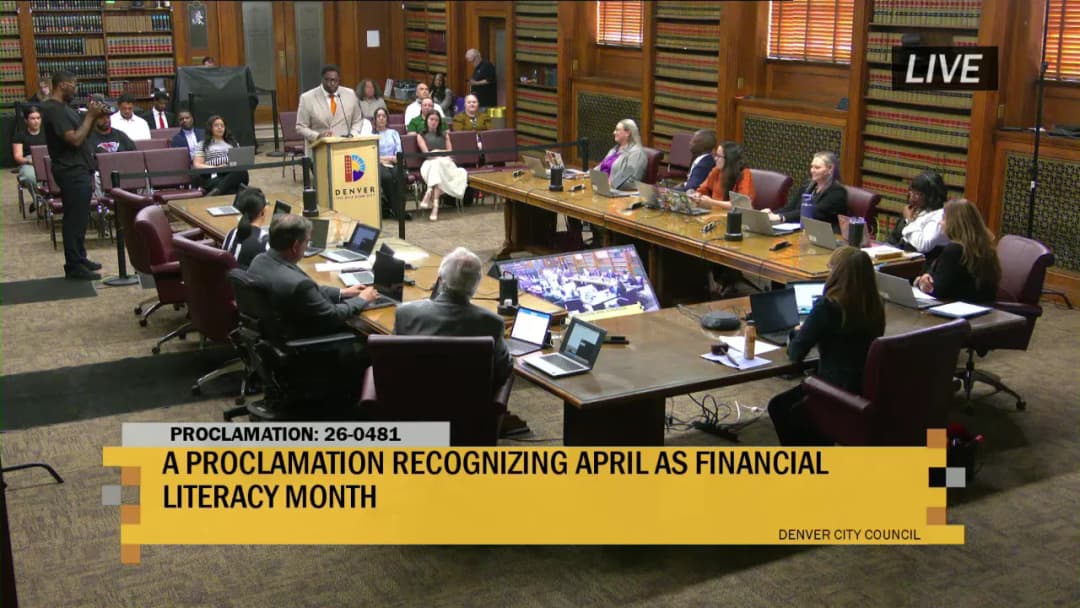
The Denver City Council held its regular session on Monday, April 6, 2026, at 3:30 PM (local time). The meeting included pledges, land acknowledgement, roll call (11 members present, 2 absent), adoption of minutes, council announcements, proclamations, a block vote on multiple resolutions and bills, and a required public hearing that was postponed. Key actions included adoption of three proclamations, approval of numerous contracts and agreements, and postponement of a major rezoning proposal for further community input. Consent Calendar All items below were approved en bloc by an 11–0 vote: - Resolutions: 26-0338 (asphalt paver purchase, $730,205), 26-0339 (AWS software, $1,821,500), 26-0369 (firefighters’ museum lease), 26-0329 (amending Council Rules of Procedure), 26-0362 (records storage contract amendment, +$800,000), 26-0363 (CatDV software contract amendment, +$299,490), 26-0370 (reappointment of Keith Hayes to Caring for Denver Board), 26-0371 (reappointment of Jesse Ogas to Caring for Denver Board), 26-0340 (forensic pathology services contract amendment, +$1,000,000), 26-0341 (WeeCycle infant formula grant reallocation, $30,500), 26-0365 (Fraternal Order of Police collective bargaining agreement for 2026), 26-0355 (Xcel Energy sponsorship agreement amendment, +$386,363), 26-0235 (Merrick & Company design contract extension), 26-0337 (revocable permit for pedestrian bridges at 3988 N Galapago St), 26-0368 (Medical Examiner’s Office lease amendment, +$6,087,673.51), 26-0358 (revocable permit for garage encroachment at 2535 W 35th Ave), 26-0364 (East Colfax BRT owner’s representative contract amendment, +$6,900,000). - Bills for Final Consideration: 26-0327 (amending DRMC on contract filing), 26-0300 (utility easement relinquishment at 805 W 38th Ave), 26-0316 (South Platte River flood control contract amendment, +$200,000). Public Comments & Testimony - General Public Comment Session (pre-recess): The council held a half-hour open comment session; no specific comments were recorded in the minutes or transcript. - Required Public Hearing on Bill 26-0176 (Zone Change, Gateway–Green Valley Ranch): Three speakers addressed the council: - Jesse Parris spoke in favor of the rezoning. - Scott Gilmore spoke neither for nor against, but raised concerns about parkland maintenance and funding. - Peter Wall (applicant) was available for questions. Discussion Items - Proclamations: - 26-0481: Recognized April as Financial Literacy Month. Councilmember Watson and others highlighted the work of the Global Children Financial Literacy Foundation. Adopted 11–0. - 26-0482: Celebrated the 100th anniversary of Wellshire Golf Course. Former Councilwoman Kendra Black and golf pro Susie Helmrick spoke. Adopted 11–0. - 26-0483: Honored the George Washington High School Speech and Debate Team for winning the 2026 5A state title. Coach Mary Rose Cohen and students accepted. Adopted 11–0. - Committee Reports and Resolutions: - 26-0340 (Forensic Pathology Contract): Councilmember Lewis called this item out, expressing disappointment about the contract going to a non-Denver provider and stressing the need to fill city staffing gaps. - 26-0339 (AWS Software): Councilmember Parady called it out, raising ethical concerns regarding large tech contractors with ties to immigration enforcement and the military, and suggested Denver needs an ethical contracting policy. - 26-0329 (Rules of Procedure Amendment): Councilmember Flynn explained the amendment requires draft contracts to be provided to council at the time of committee filing, restoring review time. Councilmember Parady and Council President Sandoval supported the change. - Bills for Introduction: Several zoning changes and expenditure authorizations were ordered published, including ordinances for rezoning at 992 N Knox Ct, 1453 N Wabash St, vacating South Delaware St, and relinquishing easements. - Required Public Hearing – Bill 26-0176 (Gateway–Green Valley Ranch Rezoning): This item would rezone 74 acres from former Chapter 59 zoning to S-MX-5 and S-MX-8 to allow a mixed-use development with a school, park, and affordable housing. Staff from Community Planning and Development presented. Councilmember Gilmore raised detailed questions about parkland dedication, fee-in-lieu spending in District 11, drive-through uses, and infrastructure commitments. She moved to postpone to allow further meetings with Parks and Recreation. The motion to postpone to June 8, 2026, was seconded and passed unanimously (11–0). Key Outcomes - All consent agenda items (16 resolutions and 3 bills) were adopted/passed unanimously (11–0). - Three proclamations were adopted unanimously. - Six bills for introduction were ordered published, with required public hearings set for future dates. - The required public hearing for Council Bill 26-0176 (Gateway–Green Valley Ranch rezoning) was postponed to Monday, June 8, 2026, by a unanimous vote. - Council announcements included recognition of recent shootings and upcoming community events (Front Range Passenger Rail, Unlocking Housing Choices community meeting).
Public Meetings - Denver, Colorado
Public Meetings - Denver, ColoradoOn Wednesday, April 1, 2026, at 1:00 PM (early start), the Transportation and Infrastructure Committee of the Denver City Council met in Room 391 of the City & County Building. Vice Chair Chris Hinds chaired the meeting in the absence of Chair Shontel Lewis. Members present: Flor Alvidrez, Kevin Flynn, Chris Hinds, Paul Kashmann, Amanda Sandoval, Shontel Lewis (remote), Sarah Parady (remote), and Darrell Watson (remote). Stacie Gilmore was absent. The agenda included one action item (a license agreement with Veo for the shared bike and scooter program), two briefings (Denver International Airport use and lease agreements and Xcel Energy’s wildfire mitigation program), and six consent items. The action item was postponed after extensive debate; the consent items were approved; the DEN briefing was heard; and the Xcel briefing was postponed to a future date. Consent Calendar - 26-0379 – Approved a contract with Inliner Solutions, LLC for $4,866,681.50 (NTP + 365 days) for 2025 WMD Pipe and Manhole Rehabilitation Phase 3, citywide. - 26-0381 – Approved a contract with GOODLAND CONSTRUCTION, INC. for $3,096,936.62 (NTP + 246 days) for Project CCD FY18 HSIP PKG 2 Traffic Signal Replacement at two intersections, citywide. - 26-0394 – Approved a contract with Gilmore Construction for $10,000,000 (5 years) for on‑call airside facilities maintenance at Denver International Airport (District 11). - 26-0395 – Approved a contract with Hensel Phelps Construction Company for $10,000,000 (5 years) for on‑call airside facilities maintenance at Denver International Airport (District 11). - 26-0400 – Dedicated a city‑owned parcel as public right‑of‑way (Public Alley) bounded by North Clayton Street, East 2nd Avenue, North Detroit Street, and East 3rd Avenue (District 5). - 26-0401 – Dedicated a city‑owned parcel as public right‑of‑way (North Xanthia Street) near the intersection of North Xanthia Street and East 37th Avenue (District 8). Discussion Items 1. Shared Bike and Scooter Program – License Agreement with Veo (26-0326) The committee considered a three‑year license agreement with VEORIDE INC. (dba Veo) to operate Denver’s shared bike and scooter program citywide, with a planned effective date of May 1, 2026. DOTI staff (Alaina McWhorter, Justin Begley, Nick Williams) presented the recommendation, highlighting: - A competitive procurement process that began in September 2025, with Veo selected as the single operator under a single‑operator model. - Pricing 10–35% cheaper than current rates, with locked‑in rates. - An access program offering 60 minutes of free ride time daily for eligible users, plus a discounted rate of 15¢/minute beyond 60 minutes. - A per‑device fee of $245/year (fleet cap 9,000) expected to generate $2.2 million annually. - An equity access program rebate: if access trips exceed 25% of total rides, the city receives a $2.50/trip rebate from the per‑device fee, up to $1 million/year. At the current 28% access ridership, the rebate would be $475,000, leaving the city with $1.7 million. Contract change and controversy: The original contract included a provision allowing the city and Veo to discuss an administrative monthly fee for access users if the $1 million rebate cap was exceeded. After public criticism (including a 9News article and an email from Denver Streets Partnership), that provision was removed and a revised contract was sent to council members on March 31 at 5:54 PM. Several council members (President Sandoval, Flynn, Kashmann, Watson, Parady) expressed frustration that the change came too late to review properly and that a red‑line version was not provided until after the meeting began. DOTI staff explained the clause was intended only as an emergency backstop for catastrophic economic events and was removed to avoid confusion. Key discussion points: - Council President Sandoval emphasized the need for adequate time to review contracts and questioned the definition of “catastrophic.” - Councilmember Kashmann expressed concerns about geofencing limitations and requested written guarantees on Veo’s parking management in District 6. - Councilmember Alvidrez asked about the W‑2 workforce requirement; DOTI confirmed Veo is contractually committed to a W‑2 workforce throughout the contract term. - Councilmember Parady raised concerns about the transition of access program users from current operators (Lime and Bird), noting that the two‑week overlap may not be sufficient. DOTI stated that a clean break is preferable based on experiences in other cities and that a longer overlap could hinder the new operator’s success. - Councilmember Watson noted that the removed clause was a response to a real problem (Lime’s previous financial difficulty with the access program) but agreed the timing of the change was problematic. - Councilmember Lewis (remote) sought clarification on the rebate structure and confirmed that the rebate comes from revenue that would otherwise go to the city, not from new budget sources. Outcome: A motion by Councilmember Flynn to refer the resolution to the full council failed for lack of a second. A subsequent motion by Council President Sandoval to postpone the item to the next available committee date (April 15, 2026) was seconded and passed 6‑0 (with Gilmore absent). 2. Denver International Airport – Use and Lease Agreements (26-0427) – Briefing Phillip Washington (CEO) and Chris Herndon (Chief Commercial Officer) presented an informational briefing on the upcoming batch of use and lease agreements (ULAs) for 18 signatory carriers whose current agreements expire December 31, 2026. Key points: - The four largest carriers (United, Southwest, Frontier, Delta) have long‑term leases extending to 2034‑2035. - The remaining 18 signatory carriers will receive three‑year ULAs (Jan 1, 2027 – Dec 31, 2029) with two one‑year city‑option extensions. - The first batch of seven airlines (Key Lime Air, Iceland Air, Turkish Air, Lutanza, Air France, Edelweiss, WestJet) will be brought to council on April 15, 2026. - In 2024, airline revenues were $362 million in facility rentals and $210 million in landing fees. - All signatory carriers participate in a revenue‑share program (up to $40 million annually, currently $50 million but decreasing). - Councilmember Alvidrez asked about vacancy rates; staff provided that of 1.4 million sq ft of rentable space, about 1 million is leased exclusively/preferentially to airlines, leaving 400,000 sq ft (28%) for common use. - Director Washington also provided spring break travel updates (1.3 million passengers, average TSA wait time 12 minutes), gift card donations for TSA agents ($55,000‑$65,000), and a planned update on alternative energy solutions after reviewing responses to a Request for Information. 3. Xcel Energy – Public Safety Power Shutoff Program (26-0428) – Briefing Postponed Grace Ramirez and Lyle Moore were present to present on Xcel’s wildfire mitigation program (including public safety power shutoffs). Due to time constraints and a desire to allow full discussion, the committee agreed to reschedule the briefing. The presenter clarified that the full program (not just shutoffs) would be covered at a future meeting to be coordinated with committee staff. Key Outcomes - Action Item 26-0326 (Veo license agreement) was postponed to the April 15, 2026 committee meeting by a vote of 6‑0. The postponement gives council members time to review the revised contract and obtain a red‑line version. - All six consent items (26-0379 through 26-0401) were approved by consent and will move to the full City Council. - The DEN briefing (26-0427) was received as information; staff will return with the first batch of ULAs on April 15. - The Xcel briefing (26-0428) was postponed to a date to be determined, with staff to coordinate scheduling.
On Wednesday, April 1, 2026, at 10:30 AM, the Denver City Council's Health and Safety Committee (chaired by Kevin Flynn, vice chair, presiding for Darrell Watson) received a briefing from Denver Health CEO Donna Lynne and staff on the 2025 spending of the 2Q (0.34% sales tax) revenue and the proposed 2026 spending plan. The meeting also approved two consent items. The committee discussed the financial sustainability of Denver Health, the impact of federal Medicaid cuts, and transparency metrics. Consent Calendar - 26-0387: Approved a grant amendment with Vivent Health Inc. adding $125,915 and extending the term to December 31, 2026, for behavioral health and syringe access services citywide. Approved by consent. - 26-0399: Approved a contract amendment with Diversified Body Acquisition LLC adding two years (to May 31, 2028) for on-call firetruck repairs with no change to contract capacity. Approved by consent. Briefing & Discussion Denver Health Sales Tax Spending Update (26-0432) Donna Lynne presented the 2025 spending and 2026 plan. Key statistics and positions: - The 2Q tax (3.4 cents per $10 purchase) generated approximately $65 million in 2025, with actual revenue slightly higher ($65.8 million) due to higher sales tax collections and lower administrative costs. An additional $1.8 million from the reconciliation will be applied to 2025 uncompensated care. - Uncompensated care exceeded $100 million for Denver residents in 2024, stabilizing in 2025. Denver Health receives $30.7 million annually from the city (MI payment), which has been flat since 1996, now only about 2% of the budget. 2Q provides about 4% of the budget. - 47% of Denver Health patients are on Medicaid, 20% on Medicare, and the rest on commercial or self-pay. Federal HR1 Medicaid cuts (work requirements, recertification twice a year, 30-day enrollment window) are expected to significantly reduce revenue starting in 2027, potentially causing 20,000 Denver residents to lose coverage. - 2025 2Q allocation by category: Emergency medicine and trauma ($34M, 51%), primary care ($14M, 20%), mental health ($13M, 20%), pediatrics ($2M, 3%), alcohol/substance use ($2M, 3%). The remaining gap in each category is covered by other revenues or operating losses. For example, emergency/trauma still has a $91 million funding gap after 2Q. - Accomplishments funded by 2Q include a hybrid OR, expanded dental/Lowry Saturday clinic, school-based clinics, IMAP behavioral health unit (12 beds, 70 patients served), two surgical robots, and paramedic workforce retention. - 2026 proposed 2Q spending plan: $67.7 million (up slightly), with similar percentages. The city plans to spend up to 1% on administrative costs ($670,000) but expects to not use the full amount. - Councilmembers expressed strong support for the transparency and use of funds. Councilmember Torres asked about recurring vs. one-time costs (overwhelmingly ongoing salary/wages). Councilmember Gonzales-Gutierrez sought clarity on revenue sources – the 2Q and MI payments are not shown in the payer mix pie chart. Councilmember Parady asked for future reporting on quality metrics (wait times, access, clinical outcomes). Councilmember Cashman criticized the flat MI payment as "embarrassing" given inflation. Councilmember Watson asked what would have happened without 2Q – Lynne said it would lead to service cuts and eventual business failure. Councilmember Torres and others noted the disparity with for-profit hospitals (e.g., UC Health with $6.7B revenue). Key Outcomes - The briefing was received and filed; no formal vote on the update. - Denver Health will work with city staff to include quality metrics in the end-of-year report and future quarterly updates. - The $1.8 million reconciliation from 2025 will be applied to 2025 uncompensated care, pending finalization. - Consent items 26-0387 and 26-0399 were approved unanimously by the eight members present (Flynn, Gonzales-Gutierrez, Parady, Sandoval, Sawyer, Torres, Watson, Kashmann). - The next spending plan review will be in August 2026.
The Community Planning and Housing Committee of the Denver City Council met on Tuesday, March 31, 2026, at 1:30 PM in Room 391 of the City & County Building. Chair Sarah Parady presided, with Vice Chair Diana Romero Campbell and members Flor Alvidrez, Shontel Lewis, Amanda Sandoval, Amanda Sawyer, and Jamie Torres present. Staff from Community Planning and Development (CPD) and other city departments also participated. The committee considered three action items: two rezonings and a proposed one-year moratorium on data center development. Public Comments & Testimony - For the rezoning at 1057 South Gaylord Street (Bill 26-0389), CPD staff reported receiving two letters of support: one from the Washington Park East Neighborhood Association and one from the South Gaylord Street Business Improvement District. Both favored the waiver to allow lodging accommodations (all other uses) and preserving the two-story height. - For the rezoning at 5101-5115 N Milwaukee Street (Bill 26-0392), the applicant received a letter of support from the Union United Community Action Network. No other public comments were received. - For the data center moratorium (Bill 26-0431), no public testimony was taken at the committee meeting; the public hearing is scheduled for May 18, 2026, at full council. Discussion Items Rezoning at 1057 South Gaylord Street (Bill 26-0389) Abner Ramos Salcedo of CPD presented a request to rezone the 5,555-square-foot property from U-MS-2 to U-MS-2 with Waivers to permit lodging accommodations (all other uses) in addition to the currently permitted bed-and-breakfast. The property is a two-story mixed-use building in the Washington Park neighborhood, Council District 6. The waiver would allow non-manager-occupied lodging. The Planning Board voted 8-0 to recommend approval. Councilmember Kashmann (district sponsor) noted that the Washington Park East Neighborhood Association's zoning committee had reviewed the application and reached comfort with the developer, particularly regarding the preservation of the two-story height. Councilmember Torres confirmed that the upper story is currently residential. The committee voted to approve the bill for filing. Rezoning at 5101-5115 N Milwaukee Street (Bill 26-0392) Joe Green of CPD presented a request to rezone two parcels (total 12,000 square feet) from E-SU-D to U-TU-C to allow a duplex or tandem house. The property is in the Elyria-Swansea neighborhood, Council District 9. The existing zoning pattern is single-unit (ESUD), but the Elyria-Swansea Neighborhood Plan designates the area as "single family duplex" and explicitly mentions duplexes, providing a basis for the rezoning. Planning Board voted unanimously to recommend approval. Applicant representative Shaquille Carter described outreach including bilingual letters and emails to 25 properties, plus social media, resulting in minimal feedback. Councilmember Torres clarified that the parcels are not being split; the applicant intends to purchase the vacant lot. Councilmember Watson asked about community engagement and affordability; Carter stated no final building plans or affordability commitments have been made yet. The committee voted to approve the bill for filing. Data Center Moratorium (Bill 26-0431) Councilmembers Kashmann and Watson introduced a one-year moratorium on the acceptance or processing of certain permits and site development plans where a data center is the proposed primary use. The purpose is to allow a working group to study the impacts of data centers—especially newer, large-scale facilities—on energy, water, noise, and zoning, and to recommend regulations. Key points raised in discussion: - The CoreSite facility under construction at 4900 Race Street (Council District 9) is a co-location data center; its first building (180,000 sq ft) uses 18 megawatts of power; three buildings could total 54 megawatts, equivalent to powering 30,000–40,000 homes. - There are currently zero pending zoning applications for data centers. Permits for the CoreSite building were issued on March 12, 2026; the moratorium would not affect that project but would apply to future proposals. - The working group will include community members, subject matter experts (Denver Water, Xcel Energy, state representatives), union representatives, IT industry representatives (trade organizations, not direct developers), advocacy groups, and city staff. Councilmembers expressed concerns about the balance of voices and the need for transparency. Councilmember Parady requested that the final composition of the working group be detailed before the full council vote. - The timeline: committee vote on March 31, first reading at full council on April 20, public hearing and second reading on May 18, effective date upon signing (estimated May 21). - Councilmembers discussed the need for clear definitions of data centers in zoning, potential setbacks, and the interplay with state regulations (e.g., Public Utilities Commission). Councilmember Sawyer noted that data centers are essential for modern infrastructure but emphasized the need for thoughtful integration. - The committee voted to approve the bill for filing. Key Outcomes - Bill 26-0389 (1057 S Gaylord Street rezoning): Approved by committee vote of 5-0 (Alvidrez, Romero Campbell, Sawyer, Torres, Parady aye; Lewis and Sandoval absent). Recommended for full council approval. - Bill 26-0392 (5101-5115 N Milwaukee Street rezoning): Approved by committee vote of 7-0 (Alvidrez, Lewis, Romero Campbell, Sandoval, Sawyer, Torres, Parady aye). Recommended for full council approval. - Bill 26-0431 (Data center moratorium): Approved by committee vote of 7-0 (same members). The bill will proceed to full council for first reading on April 20, 2026, with a public hearing on May 18, 2026. Councilmember Parady expressed intent to seek a more detailed working group composition before the final vote.
The Parks, Art and Culture Committee of the Denver City Council met on March 31, 2026, at 10:30 AM (late start at 11:00 AM) in the City and County Building, room 391. Chair Flor Alvidrez presided. The committee considered two action items: a bison donation ordinance (26-0422) and a concession license at Pahaska (26-0398), along with two consent items. One consent item (26-0396) was removed for further briefing. All action items were approved, and the bison donation program’s sunset was rescinded. Consent Calendar - Council Resolution 26-0423: Approved a Park Use Agreement with Denver Civic Ventures, Inc. for year-round markets, sports/entertainment watch parties, and free public events at Skyline Park Block 1, Council District 10. Approved by consent. - Council Resolution 26-0430: Approved a revenue agreement with Denver Mountain Parks Foundation, Inc. for seasonal operation of Mount Blue Sky Recreation Area under USFS permit through 12-31-2029. Approved by consent. Public Comments & Testimony - Lewis Talbull (Denver Mountain Parks staff, member of the native community) spoke emotionally about the spiritual and cultural significance of returning bison to tribal lands, describing bison as relatives and calling the transfer healing for indigenous people. He expressed full support for the bison donation program. - Rick Williams (community member) shared personal stories of visiting tribal nations that received bison, describing the joy of the animals' return. He also noted that the name "Pahaska" (Lakota for "White Butte") was a nickname for Buffalo Bill, and expressed support for the Pahaska concession’s indigenous focus. - Rick Waters (community member) spoke of the honor in giving back the buffalo and providing authentic storytelling at the Pahaska site. He emphasized the connection between the land and indigenous people, supporting both agenda items. Discussion Items - Bison Donation Ordinance (26-0422): Shannon Dennison, Director of Denver Mountain Parks, presented the history of the Denver bison herd (established 1898, one of the oldest conservation herds). She explained that the program, originally passed in 2021 with a 2030 sunset, has transferred 174 bison to tribes and nonprofits. The proposed ordinance removes the sunset, making the program permanent. Council members expressed strong support, with many sharing personal experiences at transfer ceremonies. Council President Sandoval noted Councilwoman Torres’ role in the original land acknowledgement and ordinance. Councilwoman Gilmore and Councilwoman Parady highlighted the program’s impact on healing generational trauma. Vice Chair Hinds framed the vote as both commemoration and celebration. The ordinance was approved. - Concession License at Pahaska (26-0398): Shannon Dennison presented the 10-year contract with Explore Pahaska LLC, which will provide indigenous-focused food, beverage, retail, and cultural programming at Lookout Mountain Park. The building, dating to 1921, needs substantial investment. Explore Pahaska will invest $400,000 upfront and pay 9.5% of gross receipts (2% for capital improvements). The vendor is in active discussions with Takabe, a local Native American eatery. Council members asked about the process for content and naming of the Buffalo Bill Museum; Dennison stated broader site questions will require future community outreach. Councilwoman Gilmore noted the 15-month notice given to the prior concessionaire. The resolution was approved. - Item 26-0396 Removed from Consent: Chair Alvidrez removed the Chick-fil-A sponsorship agreement (26-0396) from the consent calendar for a briefing, stating the committee will work with the mayor’s office on the best path forward. Key Outcomes - Council Bill 26-0422 (Bison donation) and Council Resolution 26-0398 (Pahaska concession) were approved in a block vote: 6 ayes (Hinds, Parady, Romero Campbell, Sandoval, Watson, Alvidrez), 0 nays, 1 absent (Lewis). The bison donation program’s sunset is rescinded, making it permanent. - Consent items 26-0423 and 26-0430 were approved by consent. - Item 26-0396 (Chick-fil-A sponsorship) was removed from the consent calendar for further review; no vote was taken.
The Denver City Council met on Tuesday, March 31, 2026, at 3:30 PM for its regular session. The meeting included the pledge of allegiance, land acknowledgment, roll call (13 members present), approval of prior minutes, council announcements, two proclamations, and a lengthy debate and vote on a proposed contract for an Automatic License Plate Recognition (ALPR) system. A block vote approved most other resolutions and bills on the agenda. Consent Calendar - Minutes of March 23, 2026 were approved without correction. - Proclamation 26-0433 (Honoring Denver Arts and Venues during Colorado Arts Education Month) was adopted by a vote of 12-0-1 (Councilmember Lewis absent). - Proclamation 26-0421 (Recognizing Public Health Week, April 6-12, 2026) was adopted by a vote of 13-0. - A block vote approved 19 resolutions and 2 bills for final consideration (items 26-0320, 26-0321, 26-0304, 26-0305, 26-0306, 26-0307, 26-0310, 26-0311, 26-0317, 26-0322, 26-0324, 26-0308, 26-0318, 26-0323, 26-0186, 26-0319, 26-0293, 26-0294, 26-0295, 26-0296, 26-0298, 26-0299, 26-0309, 25-0934, 26-0292) with all 13 members voting aye. These items included funding agreements for affordable housing, equipment purchases, software renewals, contract amendments, alley dedications, and the Five Points Business Improvement District renewal. Public Comments & Testimony - Prior to the recess, the chair noted one minute for public comment, but no detailed testimony was transcribed. Several councilmembers referenced hearing from constituents and public commenters during the debate on the ALPR resolution. Discussion Items - Resolution 26-0246 – Axon ALPR System Contract: The major discussion item was a $150,000 one-year contract with Axon Enterprise, Inc. for an Automatic License Plate Recognition (ALPR) system comprising 50 cameras and necessary hardware. Councilmember Flynn had previously called out the item for postponement, and it was debated at length. - Contract terms: The system provides encrypted data stored in Axon's evidence.com platform, with a 21-day retention policy, explicit bans on sharing data with federal immigration enforcement, and provisions that Denver owns its data. The administration committed not to expand the number of cameras during the contract year. - Councilmember positions: - Support (7): Councilmembers Alvidrez, Flynn, Hinds, Romero Campbell, Sawyer, Watson, and Council President Sandoval argued that the contract includes strong privacy protections, is time-limited, and provides a necessary tool for public safety while an ordinance is developed. They cited the need to solve serious crimes, the ability to prove innocence, and the reduced scale (50 cameras vs. previous 111). - Oppose (6): Councilmembers Gilmore, Gonzales-Gutierrez, Kashmann, Lewis, Parady, and Torres expressed concerns about insufficient guardrails, the lack of a citywide surveillance ordinance, the track record of the previous Flock system, potential misuse by federal authorities, and the fact that a $150,000 contract unusually required council approval. They argued that council should first pass an ordinance before authorizing more surveillance technology, especially given the current political climate and Axon's ties to immigration enforcement. - The vote was 7-6 in favor of adoption. Key Outcomes - ALPR Contract Approved: Resolution 26-0246 was adopted by a vote of 7-6. The contract runs through March 31, 2027, and authorizes 50 cameras at approximately 17 locations citywide. - Proclamations Adopted: Both proclamations were approved unanimously (with one absence). - Block Vote Passed: All remaining resolutions and bills on the consent agenda and final consideration were approved 13-0. - Bills for Introduction: Three bills were ordered published: 26-0230 (rezoning at 4211 N. Hooker St.), 26-0327 (contract filing requirements), and 26-0300/26-0316 (utility easement and flood control amendments). - Public Hearing Scheduled: A public hearing on Council Bill 26-0230 (zoning change) was set for April 27, 2026, with protests due by noon on April 20, 2026. - Next Steps: Councilmembers committed to continuing work on a comprehensive surveillance technology ordinance, with the surveillance task force remaining active.
The South Platte River Committee of Denver City Council met on March 25, 2026, at 1:30 PM MT to receive a briefing on the South Platte River Urban Waters Partnership's 2026 Work Plan and to approve four consent items. The briefing was presented by Samuel Wallace, Ambassador of the partnership, and covered the partnership's history, accomplishments, current challenges, and future plans. No votes were taken on the briefing; all consent items were approved unanimously. Consent Calendar - 26-0235: Amended a contract with Merrick & Company to extend the end date to 4-14-2027 for design efforts at the National Western Center Campus, with no change to contract capacity. Approved by consent. - 26-0336: Relinquished a Permanent Non-Exclusive Easement (PNEE) located at 3875 Walnut Street. Approved by consent. - 26-0337: Granted a revocable permit to AMFP V Fox Station LLC for two three-story pedestrian bridges connecting buildings at 3988 North Galapago Street, 3989 North Galapago Street, and 699 West 40th Avenue. Approved by consent. - 26-0368: Amended a lease agreement with Denver Health and Hospital Authority, adding $6,087,673.51 (new total $20,542,385.14) and extending the term by 120 months to 12-31-2035 for autopsy, forensic science, evidence storage, and office space at 500 Quivas Street, Baker Neighborhood. Approved by consent. Discussion Items - South Platte River Urban Waters Partnership 2026 Work Plan (26-0372): Samuel Wallace presented an overview of the partnership, which is part of the federal Urban Waters Federal Partnership established in 2011. The South Platte River location is one of 21 nationwide and has been operating for 15 years, with over 100 partner groups including federal and state agencies, municipalities, water providers, nonprofits, and academic institutions. The mission is to collaborate across jurisdictions to engage communities, protect and restore the watershed, and connect people with water. - Key accomplishments highlighted: - Development of a dynamic water quality assessment tool that integrates data from the Colorado Data Sharing Network and EPA National Water Quality Portal, updated nightly, and provides visualizations and sub-watershed views. The tool is not regulatory but helps identify pollution hotspots and trends. - US Geological Survey (USGS) studies: A 2020 study on nutrients (phosphorus and nitrogen) under low-flow conditions, followed by a 2025–2026 expanded study that includes high-flow, storm, and low-flow events, and additional parameters such as heavy metals and salinity. The 2020 study was motivated by Denver Water's consideration of orthophosphate treatment. The 2025–2026 study involves multiple stakeholders and will produce an interactive web map. - Workshops and field tours on topics such as federal funding applications, green infrastructure, collaborative projects, and tours of Lower Bear Creek, water treatment plants, and the CSU Spur campus. - Grant funding: Urban Waters small grants (now expired) funded youth leadership, open space planning, and a phosphorus-free fertilizer campaign. The National Fish and Wildlife Foundation Five-Star and Urban Waters grant program remains active; a 2026 RFP was recently released. - Funding challenges: In 2025, federal funds were significantly reduced. Aurora Water and Denver Water provided funding for 2026 to sustain the ambassador position and operations. The 2026 work plan is scaled back but includes a collaborative projects workshop (held February 23, 2026, with 30–35 partners), a partnership directory and database of projects, two field tours (planned for June/July and mid-fall), and a monthly newsletter. - Future plans (2027 and beyond, funding dependent): Host regular committee meetings on grant opportunities, community volunteer events, and continued partner gatherings. Council Member Questions and Discussion: - Councilwoman Alvidrez asked about the ambassador's role and staffing. Wallace explained he works for Peak Facilitation Group and is the only staff member for the partnership. - Councilman Flynn raised concerns about low snowpack and low flows in the river, noting dry ponds and irrigation ditches flowing early. He asked about impacts on water quality. Wallace explained that pollution concentration increases with low flows, and the upcoming USGS low-flow sampling in September 2026 (a very low water year) will provide valuable data. He also noted that the Denver Department of Public Health and Environment (DDPHE) will present on June 10, 2026, and could address the question more fully. - Councilwoman Parady appreciated the partnership's listserv and grant announcements. She asked about the types of organizations among the 100 partners. Wallace listed federal agencies (EPA, USGS, US Forest Service), state entities (CDPHE), water providers (Aurora Water, Denver Water), wastewater treatment plants, Mile High Flood District, municipalities (Adams County, Commerce City, Denver), nonprofits (The Nature Conservancy, Trust for Public Land), community-based organizations, and academic institutions (CU Denver, CU Boulder, CSU Water Center). She also asked whether the partnership makes policy recommendations. Wallace clarified that the partnership does not comment on behalf of all members, but the listserv is used to share information about public comment periods and planning efforts, such as the Burnham Yard small area plan. - Councilwoman Parady also asked about contamination challenges. Wallace highlighted E. coli in Lower Bear Creek, and phosphorus-related algal blooms affecting downstream reservoirs like Barr Lake and Milton Reservoir, which led to the phosphorus-free fertilizer campaign. Key Outcomes - No votes were taken on the briefing. The committee received the information and will follow up with DDPHE on June 10, 2026, for further details on low-flow impacts. - All four consent items were approved by consent without discussion, indicating unanimous support. - The committee expressed interest in continued updates from the partnership, particularly after the USGS low-flow study is completed in 2027.
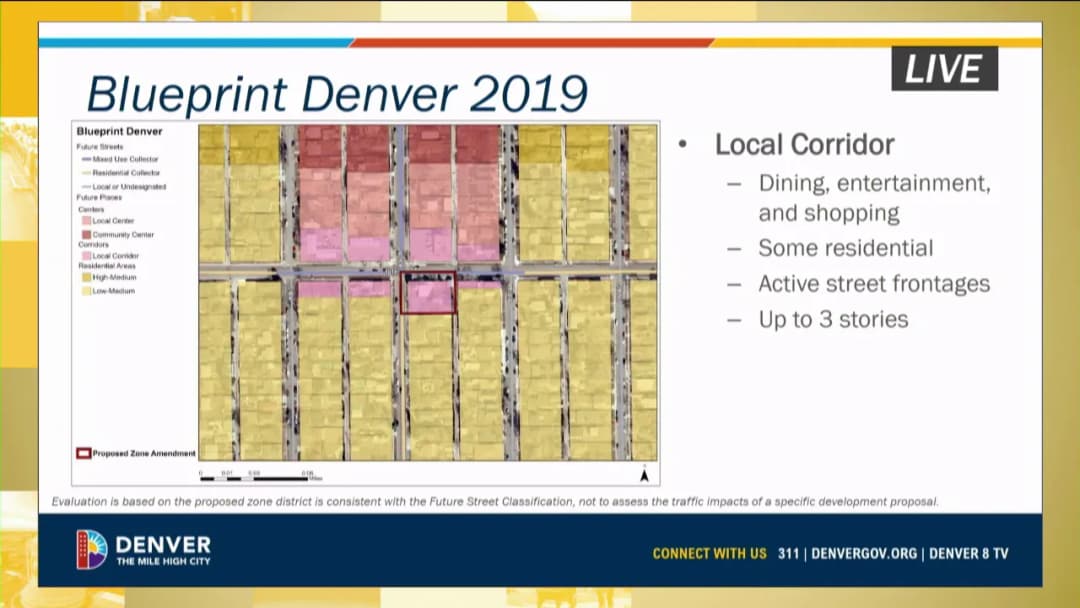
The Community Planning and Housing Committee of Denver City Council met on Tuesday, March 24, 2026, at 1:00 PM (early start) to consider three action items: two map amendment rezonings and a text amendment to extend the validity period of Site Development Plans. All three items were approved unanimously (5-0) with Councilmembers Lewis and Sawyer absent. The meeting was chaired by Sarah Parady. Public Comments & Testimony - 992 North Knox Court rezoning: One letter of support from a neighbor was received; no comments from registered neighborhood organizations (RNOs). - 1453 North Wabash Street rezoning: One letter of support from the FACS partnership and one letter of opposition from a neighbor concerned about paint odor; no comments from RNOs. - Site Development Plan extension: Three written comments were received, all inquiries about the amendment’s scope and interaction with other codes. - No oral public testimony was given during the meeting. Discussion Items 1. Rezoning at 992 North Knox Court (Bill 26‑0345) Staff planner Tony Lutuva (note: meeting minutes list staff as Luke Palmisano, creating a discrepancy) presented the applicant-driven request to rezone the property at 992 North Knox Court (Council District 3) from E-SU-D (Urban Edge Single Unit) to E-MS-3 (Urban Edge Main Street, up to 3 stories). The site, currently occupied by an 1899 single-family home, is located at a small commercial node in the Villa Park neighborhood near light rail and bus transit. The proposed district allows townhouse and shopfront building forms; protected district standards require 10-foot rear and side setbacks and upper-story stepbacks to protect adjacent single-unit districts. The applicant entered into a voluntary affordable housing agreement requiring 12% of units to be income-restricted (70% AMI for rental or 90% AMI for for‑sale units) with a 99-year covenant. The applicant (Niles Emmerich and Stephen McCullough) plans 12–15 units plus 1,000 sq ft of commercial space. No comments from RNOs; one letter of support; Planning Board voted unanimously to recommend approval on March 4. Committee members asked about the affordable housing terms and community engagement. 2. Rezoning at 1453 North Wabash Street (Bill 26‑0346) Staff planner Tony Lutuva presented a rezoning from E-TU-B (Urban Edge Two Unit) to E-MS-3 for a 6,000 sq ft parcel in Council District 8 (East Colfax neighborhood). The property shares a single parcel with an auto‑body shop to the north that already has EMS-3 zoning; the owner discovered a zoning violation due to the split zoning and seeks consistency. The existing business will continue; no immediate expansion is planned. Drive‑through building forms are allowed because the site is not within 1/4 mile of a transit station (though Colfax BRT stops are nearby – some committee members expressed concern about drive‑through proximity). Protected district standards apply to the south. Two public letters were received: one in support from FACS partnership, one in opposition about paint odor. Planning Board voted unanimously to recommend approval on March 4, noting that the East Area Plan might have been a candidate for legislative rezoning. The applicant (Jeremy Robideau) stated he wants to organize the lot with fencing and a storage building. Committee members questioned the suitability of EMS-3 deep into a residential block and the drive‑through allowance. 3. Site Development Plan Validity Extension (Bill 26‑0344) Staff (Sarah Schwalter, Brad Buchanan, Chris Gleisner) presented a text amendment to extend the validity of Site Development Plans (SDPs) from 30 months to an additional 3 years for any SDP approved on or before December 31, 2025. This responds to current market conditions – high interest rates, construction costs, and oversupply have stalled projects. Approximately 22,633 residential units across 156 projects would benefit. Without the extension, many shovel‑ready projects could expire, losing years of investment. Planning Board recommended approval unanimously on March 18. Committee members discussed distribution across council districts (highest in Districts 9, 11, 10), interplay with building/energy code changes, and the need for metrics to track success. The amendment is designed to be temporary and removable. Key Outcomes - Bill 26‑0345 (992 N. Knox Court rezoning): Approved for filing on a motion by Councilmember Torres, seconded by Vice Chair Romero Campbell. Vote: 5‑0 (Alvidrez, Romero Campbell, Sandoval, Torres, Parady yes; Lewis and Sawyer absent). - Bill 26‑0346 (1453 N. Wabash Street rezoning): Approved for filing on a motion by Councilmember Torres, seconded by Vice Chair Romero Campbell. Vote: 5‑0 (same). - Bill 26‑0344 (Site Development Plan extension): Approved for filing on a motion by Councilmember Alvidrez, seconded by Vice Chair Romero Campbell. Vote: 5‑0 (same). - All three bills will proceed to full City Council for a public hearing, anticipated in early May 2026. - No items were placed on the consent calendar.
The Denver City Council's Finance and Business Committee met on Tuesday, March 24, 2026 at 10:30 AM in Room 391 of the City & County Building. Chaired by Councilwoman Serena Gonzales-Gutierrez, the committee considered one action item (the first contracting action under the Vibrant Denver bond program) and four consent items. The meeting featured a presentation by the Vibrant Denver bond team and Denver Health leadership on a $20 million funding agreement to construct a new Westside Family Health Center. All items were approved and will move forward to the full City Council. Consent Calendar - Purchase Order with Wagner Equipment CO: Approved $730,205.00 for a one-time purchase of replacement asphalt paver, citywide (Item 26-0338). - Purchase Order with Insight Public Sector, Inc.: Approved $1,821,500.00 for annual usage of Amazon Web Services (AWS) software, citywide (Item 26-0339). - Denver Great Kids Head Start Grant: Established a budget based on a letter of intent to fund the grant for the program period July 1, 2026 to June 30, 2027 (Item 26-0366). - Lease Agreement with Denver Firefighters Museum, Inc.: Approved a lease for $10.00 through December 31, 2030 for a museum at 1326 Tremont, Denver, in Council District 10 (Item 26-0369). Discussion Items - Vibrant Denver Bond Funding Agreement for Denver Health Westside Clinic (Item 26-0367): The committee heard a presentation from Molly Scarbrough (Vibrant Denver Bond Program), Patrick Riley (Denver Bond Program), and Chris Gott (Chief Operating Officer, Denver Health). The action item approves a Funding and Assignment Agreement between the City, Denver Health and Hospital Authority (DHHA), and DHHA Westside Clinic QALICB to provide $20 million in Vibrant Bond proceeds (approved by voters in November 2025 at over 70%) for constructing a new Denver Health Sam Sandos Westside Family Health Center in Council District 3. The project has a total cost of approximately $100 million, with the city's $20 million contribution serving as a grant to complete the capital stack. The new three-story, 82,500 sq. ft. clinic will nearly double the existing square footage, include enhanced services (physical therapy, CT scanner, light-filled spaces), and be built on the same site. The existing clinic will remain open during construction, with a shuttle service provided. A parking deck will replace the old clinic after completion. The project adheres to 10% W/MBE goals and 1% public art requirement ($580,000). First patient visits are expected by Q3 2027. Key Outcomes - Motion and Vote: Councilman Darrell Watson moved to approve the action item (26-0367), seconded by Councilman Paul Kashmann. The committee voted unanimously (thumbs up) to advance it to the full City Council for first reading on March 31, 2026. - Consent Items: All four consent items were approved without objection and will also move to the full Council. - Next Steps: The funding must be provided to Denver Health by May 1, 2026 to facilitate their new market tax credit process. - Future Briefing Requested: Councilman Watson requested a future deeper dive into the overall Vibrant Denver bond investment portfolio, including the strength of bond investments. Chair Gonzales-Gutierrez confirmed this will be arranged.
This weekly joint meeting of Mayor Mike Johnston and the Denver City Council focused primarily on an update on the Place Network Investigations (PNI) strategy, a collaborative public safety approach that addresses violent crime through community partnerships and whole-of-government interventions. The presentation, led by Chief of Police Ron Thomas and Commander Jake Herrera, highlighted significant crime reductions at PNI sites, lessons learned, and plans for expansion. The meeting also included several community announcements. Announcements - Councilmember (District 7) announced the home opener of Denver Summer FC on Saturday, March 28, 2026, at Empower Field at Mile High Stadium, with nearly 55,000 tickets sold—expected to be the largest women's soccer sporting event in American history. - Councilmember Cashman promoted the University of Denver Pioneers hockey team playing Cornell in the NCAA regionals and reminded residents of the "Meet the City Academy" on April 1, 2026, from 6–8 p.m. at Cook Park Recreation Center. - A representative announced the 100th anniversary celebration of Wellshire Golf Course on June 5, 2026, including a community celebration and golf tournament; registration opens April 1. Discussion Items - Place Network Investigations (PNI) Overview: Mayor Johnston introduced the strategy, emphasizing it as an evidence-based, problem-oriented policing approach focused on addressing violent crime by partnering with residents, community organizations, and multiple city agencies. PNI sites are selected based on persistently high levels of violent gun crime. - Data and Outcomes: Commander Herrera presented slides showing crime statistics across six PNI sites. Key numbers: - From 2024 to 2025, non-fatal shootings across all sites dropped from 22 to 2, a decline of approximately 90%. - Aggravated assaults decreased by 30–40%, and overall violent crime fell by about 40% year-over-year. - Specific site highlights: Paco Sanchez Park had 763 days without a shooting; East Colfax and Verbena: 650 days; Leedsdale and Oneida: 480 days; North Peoria: 440 days. The original site at Alameda Federal reached 958 days without a shooting as of the meeting. - Five of six sites experienced a 100% reduction in shootings year-over-year; the only shootings occurred at one site. - Implementation and Lessons Learned: Chief Thomas described the phased rollout starting in 2021. PNI sites now include Lincoln La Alma Park, Paco Sanchez, Colfax and Verbena, Leedsdale and Oneida, Morrison and Perry, and North Peoria. A new site at Colfax and Pearl will launch in late April 2026. The Lodo site was transitioned to a problem-oriented policing (POP) strategy due to different crime dynamics. A key lesson: sustaining long-term investment requires non-police agency collaboration. Challenges include rebuilding trust after ICE raids, addressing vacant properties after shutting down corrupt businesses, and funding for ongoing activation. - Funding and Legislative Support: Councilmembers Watson and Alvidrez raised questions about ARPA funding ending and the need for budget support. Councilmember Sawyer highlighted legislative efforts such as the vacant and derelict properties ordinance and a forthcoming meet-and-confer bill to address persistent quality-of-life issues at rental properties. Chief Thomas responded that PNI helps prioritize existing resources rather than requiring new funding. - ALPR Cameras and Other Strategies: In response to a question from Councilmember Alvidrez about cameras, Commander Herrera explained that ALPR (automated license plate reader) cameras are deployed at PNI sites still experiencing gun violence (e.g., East Colfax, Colfax and Pearl) and also serve to solve serious traffic incidents and auto theft. The camera locations are not limited to PNI sites. - Downtown Development Authority (DDA): Council President (District 1) shared that the DDA provided $4 million for extra patrols downtown, with positive results reported. She noted that Crime Prevention Through Environmental Design (CPTED) assessments, such as those at Union Station and the skate park, have been effective and encouraged councilmembers to connect constituents with community resource officers for similar evaluations. Key Outcomes - No formal votes were taken, but key next steps were identified: - A new PNI site at Colfax and Pearl will begin in late April 2026. - The Lodo area will continue under a problem-oriented policing (POP) strategy. - Continued collaboration across 11 city agencies (Parks and Rec, DOTI, DDPHE, Excise and Licenses, etc.) and community boards. - Councilmembers committed to pursuing legislative solutions to address vacant properties and landlord accountability, supporting PNI goals. - The Mayor and Chief Thomas expressed gratitude for council leadership and noted that budget decisions will help sustain and expand these efforts.