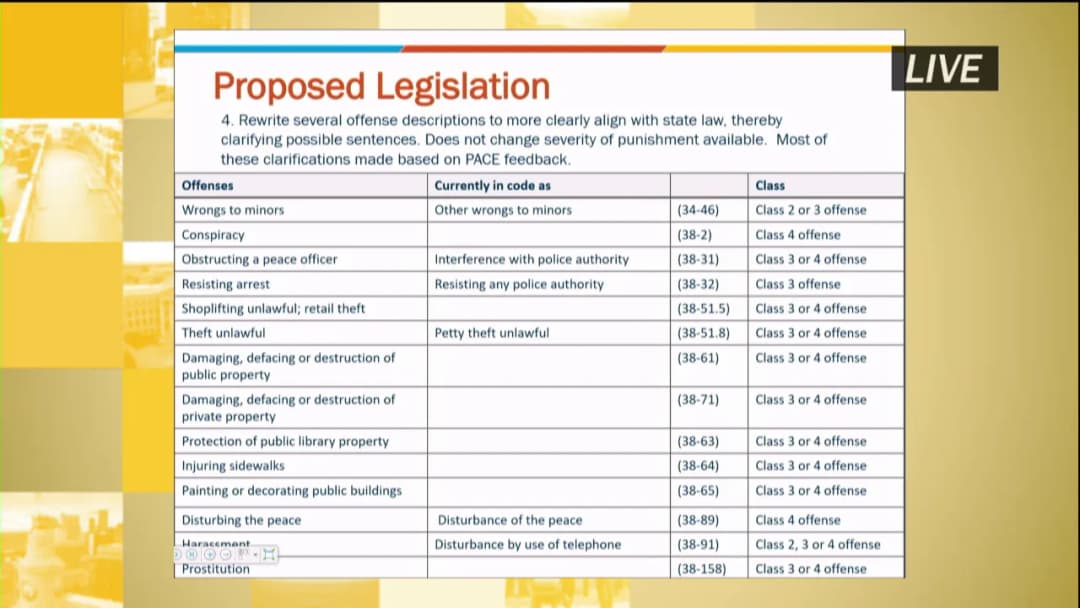
The Health and Safety Committee of the Denver City Council met on April 15, 2026, at 10:00 AM to consider Council Bill 26-0328, which would revise the criminal penalties for municipal crimes to align with state law and the Colorado Supreme Court's decision in People v. Camp. The meeting featured extensive public testimony, deliberation, and a motion to postpone the bill to May 13, 2026, which passed 7-0. Consent Calendar - Council Resolution 26-0488 – Amends a grant agreement with Harm Reduction Action Center, adding $239,375 for a new total of $968,127, extending the end date to December 31, 2026, to continue behavioral health and syringe access services. Approved by consent. - Council Resolution 26-0489 – Approves a contract with La Clinica Tepeyac for $918,771 (through February 28, 2031) to provide HIV/AIDS care and supportive services. Approved by consent. - Council Resolution 26-0490 – Amends a grant agreement with Hunger Free Colorado to amend Exhibit B for federal nutrition assistance enrollment under the Healthy Food for Denver’s Kids Initiative. Approved by consent. - Council Resolution 26-0491 – Approves a contract with La Raza Services, Inc. dba Servicios de La Raza for $1,083,647 (through February 28, 2031) to provide HIV/AIDS care and supportive services. Approved by consent. - Council Bill 26-0492 – Approves an intergovernmental agreement with University of Colorado Hospital Authority for $4,619,050 (through February 28, 2031) to provide HIV/AIDS care and supportive services. Approved by consent. Public Comments & Testimony - State Representative Javier Maybry (support) – Expressed full support for the bill, noting his role as prime sponsor of the Municipal Court Fairness Act. He argued that lengthy jail sentences for offenses of poverty (e.g., camping, loitering, trespassing) do not improve safety, cost money, and destabilize families. - David Howard (oppose) – Argued the bill weakens accountability and enforcement. He cited the city attorney's concerns and urged a narrower bill that complies with the Camp decision without reducing penalties for low-level crimes that create disorder. - Jen Garner (oppose) – Rejected the “crimes of poverty” framing, calling it insulting. She argued that reduced penalties would undermine leverage for treatment diversion and accountability, and would increase disorder. - Leanne Fix (support) – A social worker with the Denver Office of the Municipal Public Defender, she noted that over 80% of clients have mental health conditions, substance use disorders, or traumatic brain injuries, and more than half are unhoused. She stated that longer jail sentences are not effective deterrents and often worsen conditions, and that the cost of jail ($240/night) could be better spent on supportive services. - Brittany Chote (oppose, survivor) – A survivor of intimate partner abuse, she opposed the bill despite acknowledging improvements for domestic violence cases. She specifically criticized the “painless assault” provision, stating that coercive control and physical contact without visible injury are serious and often escalate. She urged the council to ensure survivor voices are heard. - Courtney Garrett (oppose, requesting more time) – President and CEO of Downtown Denver Partnership, she emphasized downtown’s fragility and the need for a safe visitor experience. She asked for more time to engage with business and community groups, noting that only city agencies and PACE had been involved in depth. - Kim Ray (support) – Denver campaign coordinator for the Colorado Criminal Justice Reform Coalition, she argued that the current system is unconstitutional, disproportionate, and relies on jail for low-level poverty-based offenses. She urged a yes vote to align with constitutional standards. - Cecily Riney (oppose) – Testifying on behalf of the Rose Andom Center, she stated the bill functionally eliminates meaningful accountability for municipal-only offenses, particularly in domestic violence and child endangerment cases. She expressed concern that violations of protection orders would lose enhanced consequences for repeat violations, weakening protections for victims. - Bayer Campbell (oppose, process) – Senior director of public affairs for Colorado Concern, he criticized the process, stating that version nine of the bill was received only a week prior and that the city attorney's office and community should have more voice. He urged letting experts implement the technical decision. - Anaya Robinson (support) – Public policy director at ACLU Colorado, she argued that Denver's sentencing structure is outdated, unpredictable, and unlawful under Camp. She said the threat of lengthy sentences coerces guilty pleas and disproportionately harms low-income residents and communities of color by criminalizing survival. - Letters read into the record: - District Attorney John Walsh (April 14, 2026) – Opposed the bill in its current form, arguing it goes beyond the Camp decision by reducing penalties for most ordinances not covered, without proper stakeholder discussion. He warned of increased caseload for his office and negative impacts on domestic violence and stalking victims. - Presiding Judge Lombardi (January 29, 2026) – Reassured the council that the Denver County Court is fully compliant with the Camp decision and that abrupt legislative changes are unnecessary. The court is already advising defendants of state maximum penalties and updating advisement forms. Discussion Items - Presentation by Bill Sponsors (Councilmembers Lewis, Gonzalez-Gutierrez, Parady) – The sponsors outlined the need to align Denver’s municipal code with state law following the Colorado Supreme Court’s 2025 Camp decision. Key data presented: - 12,000 municipal criminal case filings per year; 70,000 sentences over five years. - 75% of those charged are at or below the federal poverty line. - 24% decrease in reported crime (2021–2025) but 52% increase in municipal case filings. - 40% of charges in Denver jails are for municipal ordinance violations (mostly pre-trial). - Jail costs $240 per person per day. - Over the last two years, only about 100 people were sentenced to more than 10 days for municipal-only petty offenses; most received 15 days. - The proposed bill creates new offense classes (1–5) that align with state sentencing categories, preserving the highest possible sentences for crimes with state analogs. For municipal-only offenses, the bill sets a 10-day jail maximum (with $999 fine for some regulatory offenses) to avoid collateral consequences such as loss of benefits. - The sponsors emphasized that changes to the elements of crimes (e.g., assault, threats, trespass) were made only at the request of the City Attorney’s Office (PACE) to maintain the ability to prosecute at higher levels post-Camp. - They noted 10 meetings with PACE since August 2024 and extensive stakeholder outreach, including recent meetings with downtown business groups and upcoming community engagement sessions scheduled for April 21, 22, and 25, 2026. - Painless assault provision: The sponsors acknowledged concerns raised by Violence Free Colorado and stated they are open to further discussion but have not removed it to stay within the bill’s scope (sentencing only). - Councilmember Kevin Flynn – Asked about a drafting error on page three (class two/class three) and questioned the 10-day catch-all for municipal-only offenses. He expressed opposition to that provision and suggested the bill is not ready for floor action, noting version 11 was received late the previous evening. He proposed holding the bill until engagement is complete. - Councilmember Amanda Sawyer – Thanked sponsors for work but expressed concerns about enforcement impacts, particularly for DDPHE, Denver Fire, and DLCP (licensing). She heard from agency representatives: - Alex Fidol (DDPHE) – Stated the department is still learning about impacts, concerned about breadth of code provisions affected. - Molly Duplechan (DLCP) – Explained that for unlicensed operator violations, the fine remains $999 but jail drops from 300 to 10 days; for licensed business violations, the fine drops from $999 to $300. She expressed concern about decreased compliance, especially for problem residential rental operators. - Chief Desmond Fulton (Denver Fire) – Warned that removing the threat of jail time could reduce compliance with fire codes, potentially endangering public safety and firefighters. He urged slowing down. Councilmember Sawyer requested a middle ground to preserve enforcement leverage while achieving sentencing reforms and indicated she would hold her vote. - Councilmember Jamie Torres – Asked for assurance that the bill does not weaken protections for repeat offenders or domestic violence cases, noting confusion from the DA’s letter and victim advocates. Sponsors explained that without the bill, all domestic violence-related offenses would revert to the lowest penalty, so the bill actually preserves higher sentencing for those crimes. They attributed some confusion to an email from the city attorney's office that went out between drafts. - Council President Amanda Sandoval – Expressed support but raised concerns about the fire code and residential licensing, citing specific bad actors in her district. She urged including victim advocates (e.g., Rose Andom Center) in further discussions and supported holding the bill for more committee work. - Councilmember Paul Kashmann – Supported the bill in principle but asked PACE for specifics on remaining concerns. Marley Bordovsky (PACE) stated the biggest sticking point is the 10-day catch-all, which swallows the rule and is lower than any other metro city's general penalty. She acknowledged some remaining issues with threats to property (including threats to pets) and flourishing weapons in domestic violence contexts. - Councilmember Stacey Gilmore – Thanked sponsors for their work on criminalizing poverty, but raised concerns about domestic violence case increases and the difficulty for victims to come forward. - Council Chair Darrell Watson – Stated that the steps beyond the Camp decision are a step too far for his support. He noted he had submitted 25 written questions to sponsors and would not have time to address them, but appreciated the conversation. Key Outcomes - Motion to postpone Council Bill 26-0328 to a date certain (May 13, 2026) was made by Councilmember Parady, seconded by Councilmember Sawyer, and carried on a vote of 7-0 (Flynn, Gonzales-Gutierrez, Parady, Sandoval, Sawyer, Torres, Watson). - All consent items (26-0488 through 26-0492) were approved by consent without objection. - The meeting adjourned at approximately 12:00 PM.
Public Meetings - Denver, Colorado
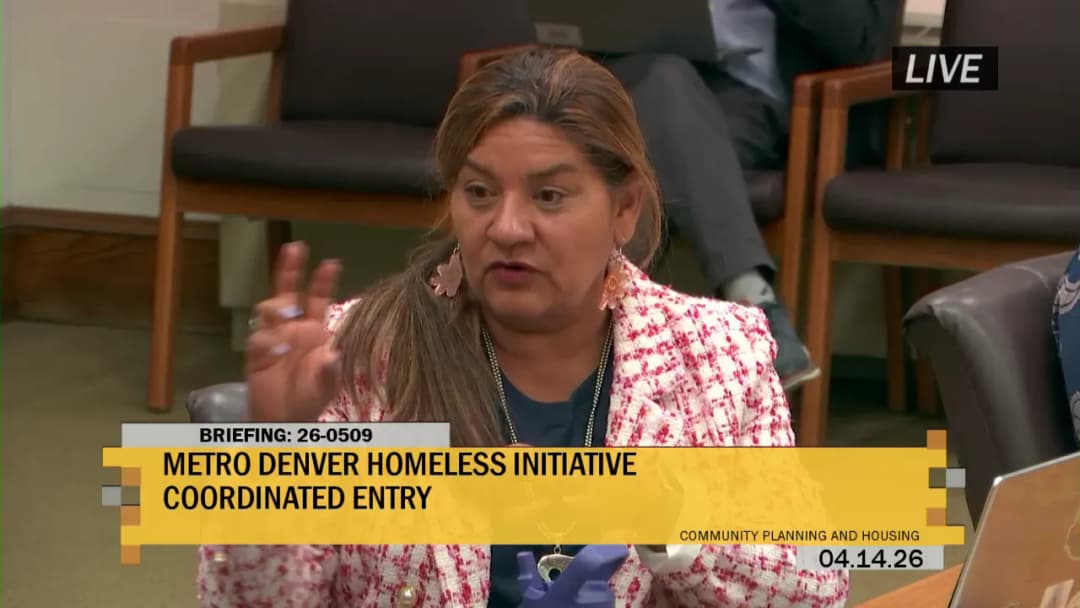
Public Meetings - Denver, ColoradoThe Community Planning and Housing Committee of the Denver City Council met on April 14, 2026, from 1:30 PM to approximately 3:00 PM. The committee considered one action item—a contract amendment for the Denver Day Works Program—and received a briefing from the Metro Denver Homeless Initiative (MDHI) on the Coordinated Entry system and data systems. All seven members were present. Action Item - Contract Amendment for Denver Day Works (Resolution 26-0503): The committee approved amending a contract with ServiceSource to add $413,000 (bringing the total to $550,000) and extend the term through December 31, 2026. The program serves 90 households annually, providing day labor, case management, and employment services to people experiencing homelessness. In 2024, the program placed 49 individuals in permanent jobs (average 35 hours/week at $19.51/hour); 2025 saw lower performance due to staff turnover, but 2026 has already seen 9 placements (all full-time) at an average wage of $23.50/hour. The program will focus on referrals from HOST's rapid rehousing programs and newly unhoused individuals entering shelter. The motion was offered by Councilmember Torres, seconded by Alvidrez, and passed 7-0. Briefings - MDHI Coordinated Entry System (26-0509): Jason Johnson (Executive Director), Sofia Vigil (Director of Strategy), and Kyla Mo (Deputy Director) from MDHI, along with Midori Higa from HOST, presented the region's Coordinated Entry system (One Home) and the Homeless Management Information System (HMIS). Key statistics: In 2024, over 34,000 unduplicated individuals received services across the seven-county metro region; the 2025 Point-in-Time count recorded over 10,000 people experiencing homelessness, with Denver accounting for 68%. Approximately 4,500 individuals are in the Coordinated Entry system, but only about 1,200 housing vacancies were filled in 2025 (20–25% of need). About 85% of eligible providers use HMIS. The system prioritizes based on vulnerability due to limited resources. Councilmembers discussed family homelessness, data integration with schools and healthcare, and the connection between HOST's Housing Central Command and MDHI's systems. Councilmember Sawyer raised concerns about the Denver Day Works program not aligning with HOST's mission and suggested it should be transitioned to the Department of Human Services and DITO (workforce development). Key Outcomes - Resolution 26-0503 approved (7-0) to amend the Denver Day Works contract. - Briefing received on MDHI's Coordinated Entry and HMIS; no formal action taken. - Committee discussion emphasized need for improved data on family homelessness and possible transfer of the Day Works program to a workforce agency. Next steps include following up on data reports and potential future agenda items on Medicaid work requirements and prevention programs.
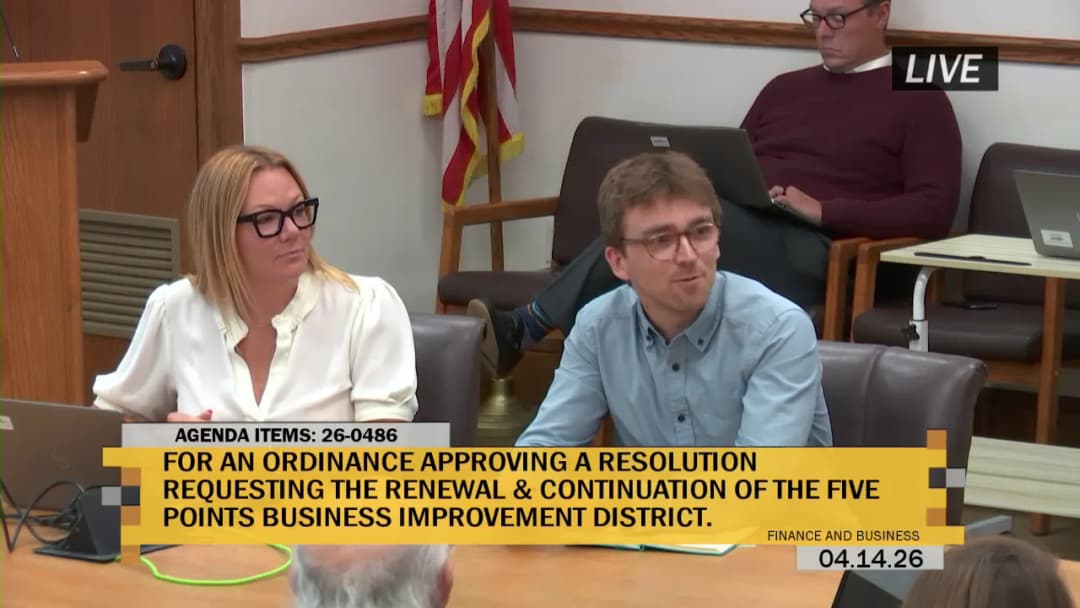
The Denver City Council's Finance and Business Committee met on April 14, 2026, at 10:30 AM (recorded as 17:45 UTC) in Room 391 of the City & County Building. The committee considered three action items and one consent item, resulting in postponements of a real estate acquisition and janitorial contracts, while advancing a Business Improvement District renewal. Action Items - 26-0120 – Purchase of 251 East 12th Avenue: A proposed contract to buy a 91,470-square-foot building on a 0.99-acre parcel from the State of Colorado for $4,525,000, intended for affordable housing development using Vibrant Denver bond funds. Councilmember Gilmore moved to postpone the item to May 12, 2026, citing concerns about the lack of City Council representation on the oversight committee for the $45 million housing allocation and a desire for greater transparency. The motion passed 7-0. During discussion, Councilmember Hinds expressed support for the site and advocated for a ground lease. Council President Sandoval questioned why city-owned land was not prioritized. The committee chair noted that prior feedback had been given but not fully addressed. - 26-0486 – Five Points Business Improvement District Renewal: An ordinance to approve a 10-year renewal of the Five Points BID, which serves the Welton Corridor (20th to 30th streets). The BID Executive Director Norman Harris highlighted accomplishments: no business closures in the last three years, support for over 60 commercial businesses (16 African American-owned), and advancing a study on the future of the light rail with $750,000 to $1 million committed. Councilmember Watson, the district council member, strongly supported the renewal, noting strategic coordination on stormwater, lighting, and historic preservation. The committee voted unanimously to approve the item for filing, setting a public hearing for May 11, 2026. - 26-0504 through 26-0506 – Janitorial Services Contracts: Three contracts totaling $26,000,000 for citywide janitorial services (excluding Denver International Airport) were postponed to a date certain due to time constraints. The motion, made by Vice Chair Kashmann and seconded by Council Pro-Tem Romero Campbell, passed 7-0. Consent Items - 26-0487 – Set Public Hearing for Welton Corridor Urban Redevelopment Plan Amendment: Approved by consent, directing the Denver Urban Renewal Authority to take actions related to the hearing. Key Outcomes - Real estate acquisition (26-0120) postponed to May 12, 2026, after concerns about council involvement in the selection process. - Five Points BID renewal (26-0486) approved for filing and will proceed to first reading and a public hearing on May 11, 2026. - Janitorial contracts (26-0504 through 26-0506) postponed; new date to be set by committee staff. - Consent item (26-0487) approved without objection.
This was a joint meeting of the Mayor of Denver and the Denver City Council, held on Tuesday, April 14, 2026. The meeting included brief announcements from council members, updates on city initiatives, a motion to move into executive session, and no public testimony or discussion of substantive agenda items. The session was short, as a longer executive session was planned for after the public portion. Announcements & Updates - Councilman Cashman (District 6) announced that the University of Denver Pioneers hockey team won the NCAA national championship (11th title), that his senior aide welcomed her first child, and that a new staff member, Alexa Trigo, is joining his office. He also promoted an Earth Day event in Washington Park on Saturday. - Councilwoman Almidrez (District 7) noted a public celebration at DU's Ritchie Center at 6:30 p.m. for the national champions. - Councilman Torres highlighted a recent Give Five event and the transformation of a former gas station site in the Barnum neighborhood into Crumley Park and Community Garden, a project involving Denver Urban Gardens and the School of Mines. - Councilman Sawyer (District 5) announced a Colfax Cleanup event in support of the Colfax BRT project and a district-wide community cleanup on Sunday at Claire Rec Center. - Councilwoman Gonzalez Gutiérrez provided an update on Registered Neighborhood Organization (RNO) feedback sessions, noting upcoming sessions in Southeast Denver (April 15, Wednesday, 6–8 p.m. at Eisenhower Rec Center), Southwest Denver (April 16, Thursday, 6–8 p.m. at College View Rec Center), and virtually on April 21 (6–8 p.m.). An online form is also available. - Councilman Hines (District 10) announced that his office is finalizing a community benefits fund (up to $2,000 per organization) and that Denver is bidding to host the Democratic National Convention in 2028. He thanked the Mayor, Council President, and others for traveling to New Orleans to promote Denver's bid. He emphasized that no city resources were used for the trip or host events. - Councilman Watson (District 9) echoed praise for the DNC bid effort and announced a public safety dialogue on April 16 at 6 p.m. at St. Charles Recreation Center, following multiple shootings in the city and three fatalities in District 9, including a young man killed at a park during an Easter celebration. - Council President (unspecified name) announced that La Raza Park will open May 1st in time for Cinco de Mayo, with a ground opening and the Chicano Pride Ride on May 2nd. - Mayor closed with a thank-you to council members for their support on the DNC bid, reiterating that no city resources were used, and announced a Give Five cleanup effort on Colfax meeting at Pablo's Coffee at 10 a.m. Saturday. Key Outcomes - The council unanimously approved a motion to move into executive session pursuant to DRMC 234A36 and 7 for consideration of pending and potential litigation, changes in state law, and related legal advice. - No substantive agenda items were discussed or voted on in the open session.
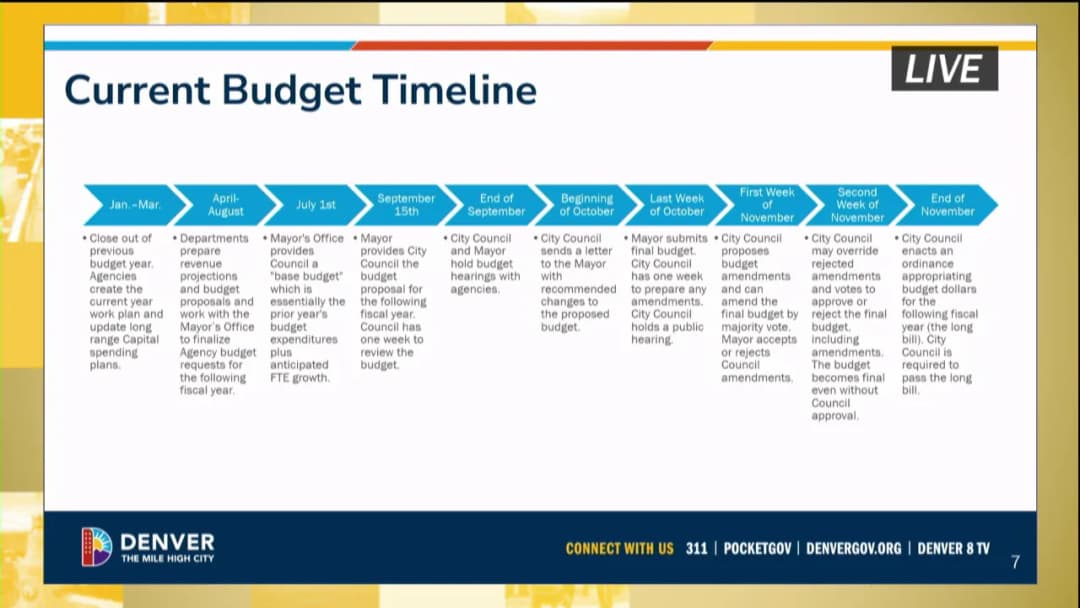
This meeting of the Budget and Policy Committee focused on a presentation by Councilmembers Stacey Gilmore, Amanda Sawyer, and Chantel Lewis proposing a series of charter changes to the city's budget process. The city's general fund, approximately $1.5 billion in 2024, funds salaries, programs, and operations. Current charter requires a balanced calendar-year budget with short and long-term planning, a 2% contingency, a 15% unassigned fund balance goal, and a 3% state-mandated emergency reserve. The sponsors argued that the current process limits community engagement, compresses council review, and provides no definition of a balanced budget, leading to mid-year shortfalls like the layoffs in 2025 when the fund balance fell below 10%. Presentation of Proposed Charter Changes - Optional Biannual Budget Cycle: The proposal would allow the city to adopt a two-year budget cycle, with a "main year" for full budget adoption and an "off year" for evaluation and adjustments. In times of economic uncertainty, the city could revert to a one-year budget. This aims to provide longer-term planning for capital projects and non-profit partners. The sponsors noted that cities like Fort Collins and Seattle use similar optional two-year cycles. - Require Public Engagement for Budget Priorities: The charter would mandate a process for community input during budget development, including surveys and town halls, led by the Mayor's Office. The sponsors emphasized that this would ground budget priorities in community needs, as current public hearings occur only one week before budget adoption. - Simplify Budget Timeline: The proposal seeks to remove the July 1st preliminary budget estimate requirement and move the September 15th budget delivery date earlier to give council more time for review. The goal is to separate the timeline to allow for reflection and analysis. The sponsors noted that subsequent discussions suggested a September 8th date may be possible, but more than one week is needed for both review and amendments. - Define Balanced Budget: The sponsors propose adding language stating that if expected revenues are less than total appropriations from the prior year's long bill, the Mayor shall propose and City Council shall reduce appropriations by ordinance to balance the budget. It also requires council approval for expenditures from the unassigned fund balance below a certain threshold. The sponsors initially suggested 10%, but the Department of Finance provided feedback that this threshold may not be practical. Discussion and Feedback from Council Members and City Officials - Councilmember Alviderez asked about the shift from mandatory to optional two-year budget and how capital project funds would be reflected. The Department of Finance clarified that capital funds are non-lapsing and would still roll over. - Councilmember Flynn expressed support for the public process and timeline simplification but strongly opposed the biannual budget, arguing it would reduce council's ability to respond annually and increase chaos. He noted that more cities have moved from two-year to one-year cycles and questioned the effective date, suggesting 2029 would be the earliest realistic implementation. He also asked about collective bargaining: the sponsors responded that union agreements would continue to be funded through contingency, unchanged from the current process. - Councilmember Romero Campbell inquired about when the decision between one-year and two-year would be made, and suggested the community engagement component should be robust but questioned if such prescriptive language belongs in the charter. Mayor's office representative Dominic Moreno agreed on the need for robust engagement but expressed concern about charter prescriptiveness. - Councilmember Hines highlighted a "knowledge disparity" where council receives budget information late and in overwhelming volume. He questioned how a two-year cycle would alleviate this, noting that economic volatility makes a standard year elusive. He also raised concerns about the six-year capital improvement plan not being transparently linked to the budget, and asked for better accounting of capital projects and agency budget expansion requests. - Councilmember Torres asked about the charter language and the possibility of testing changes via ordinance before amending the charter. She also clarified the relationship between the state-required 3% emergency reserve and the 15% unassigned fund balance, with the Deputy CFO explaining that the 3% reserve is separate and largely met by property value. - Deputy CFO Stephanie Kiralis Adams provided technical feedback, cautioning that a 10% threshold trigger for council approval of reductions might lead to unstrategic across-the-board cuts and that the Department of Finance prefers more flexibility. She suggested testing changes through ordinances and explained that mid-year reductions are currently handled through sequestered accounts (98s) without an ordinance. She also noted that the Department of Finance only calculates the fund balance point-in-time annually, making a mid-year threshold trigger difficult. - Councilmembers Gilmore and Sawyer responded, acknowledging that the 10% threshold is not final and that they are waiting for the Department of Finance's recommendation. They emphasized that policy decisions must be made before drafting final language. Gilmore argued that the two-year cycle would make community engagement more feasible, as conducting it annually would be too staff-intensive. They also noted that some changes, like community engagement and a two-year strategic plan, do not currently exist in the charter and cannot be tested without amendment. Key Outcomes - No formal votes were taken. The committee will continue discussions with the Department of Finance to refine the proposals. - The sponsors plan to bring refined language back to committee, with a goal to meet charter amendment deadlines for the November 2026 ballot. - Councilmembers expressed a range of opinions, particularly on the biannual budget cycle, with several members skeptical and others seeing value in the timeline changes and public engagement. The committee acknowledged the need for compromise between council's desire for oversight and the Department of Finance's need for flexibility. - The meeting concluded with adjournment, noting that the next committee meeting scheduled for June 15 may need to be moved due to other agenda items.
The Denver City Council convened on April 13, 2026 at 3:30 PM, with Council President Sandoval presiding, for its weekly general session. Twelve members were present, with Councilmember Kashmann absent. The meeting included proclamations, approval of consent agenda items, introductions of new bills, and three required public hearings on zoning changes. The session adjourned at 7:56 PM. Consent Calendar - Minutes of April 6, 2026 (26-0507): Approved unanimously. - Resolutions adopted en bloc (12-0): Included over 20 resolutions covering contracts, grants, appointments, permits, and a legal settlement. Notable items: $10 million contract with Gilmore Construction for Denver International Airport maintenance (26-0394, adopted 10-0, with Councilmember Gilmore abstaining due to a conflict of interest); $5.28 million for Denver Fire Department turnout gear (26-0382); $4 million for aftermarket auto parts (26-0383); $300,000 amendment for WorkReady Denver program (26-0393); appointments to the Denver Community Corrections Board (26-0385, 26-0386); $125,915 for behavioral health and syringe access services (26-0387); multiple on-call landscape architecture contracts totaling over $30 million (26-0402 through 26-0420); a $32,000 legal settlement (26-0508, commented on by Councilmember Lewis who stated 2026 settlements total $479,500); and others. - Bills for final consideration adopted en bloc (12-0): Included funding for the Denver Great Kids Head Start program (26-0366), a street vacation (25-1861), and two easement relinquishments (25-2086, 26-0336). Public Comments & Testimony During the required public hearings: - Council Bill 26-0206 (3601 N Monaco St Pkwy rezoning): Two speakers supported the rezoning. Jesse Parris (representing multiple organizations) expressed full support, citing the need for more housing. Elizabeth Hennessey, the property owner and an architect, spoke in favor, stating her plans to build a net-zero duplex and noting the existing pattern of duplexes in the area. - Council Bill 26-0207 (2625 E 3rd Ave rezoning): Six speakers commented. Trent Ambler, Melinda Humphrey, Lou Raders (chair of Cherry Creek North Neighborhood Association zoning committee), and Caitlin Quander (applicant's land use counsel) spoke in favor. Rick Merpi (representing Clayton Court Townhome HOA) and Scott Robinson (adjacent townhome owner) spoke in opposition, requesting a 29-foot setback condition be maintained from a 2007 ordinance. Jesse Parris spoke neutrally, asking about affordability, traffic, and community benefits. - Council Bill 26-0208 (Far Southwest legislative rezoning): One speaker, Jesse Parris, spoke neutrally, noting the proposal met criteria but questioning the lack of housing focus. Discussion Items - Proclamations: - 26-0511 (National Donate Life Month): Adopted 11-0 (Councilmember Sawyer abstained due to a financial interest in a transplant company). Council President Sandoval and Councilmember Alvidrez shared personal stories about organ donation. Laura Jeffries (Donor Alliance) and Phil Workman accepted. - 26-0514 (Honoring Mary Savina Mendoza, founder of La Loma restaurant): Adopted 12-0. Councilmember Alvidrez read the proclamation. Several councilmembers shared memories of the restaurant. Mary Savina Mendoza and family accepted. - 26-0512 (Honoring Crayton "CB" Jones Jr.): Adopted 12-0. Councilmember Watson read the proclamation. Multiple family members spoke about his legacy in Five Points. - 26-0513 (10th Anniversary of Prodigy Ventures): Adopted 12-0. Councilmembers Parady and Watson co-sponsored. Jesselyn Shaharazai and others accepted. - Council Bill 26-0206 (3601 N Monaco St Pkwy rezoning from E-SU-Dx to E-TU-C): Staff recommended denial, citing inconsistency with Blueprint Denver because there is no existing pattern of two-unit zoning and the 2000 Park Hill Neighborhood Plan does not explicitly set a new pattern for two units. Planning Board had unanimously recommended approval. After debate, Council voted 10-2 to pass (Nay: Flynn, Sawyer). - Council Bill 26-0207 (2625 E 3rd Ave rezoning from CCN with conditions to C-CCN-4): Staff recommended approval, finding consistency with adopted plans. The 2007 ordinance’s 29-foot setback condition was debated; the City Attorney clarified the condition runs with the zoning, not the land, and the new zoning would supersede it. A community benefits agreement was noted. Council voted 11-0 to pass (Lewis absent). - Council Bill 26-0208 (Far Southwest legislative rezoning): Staff recommended approval. The rezoning implements the Far Southwest Area Plan (adopted December 2025), rezoning over 100 properties in centers/corridors to suburban mixed-use (A-series to limit drive-throughs), industrial areas to light industrial (no new residential), and one park to open space. Council voted 11-0 to pass (Lewis absent). Key Outcomes - Votes on Proclamations: 26-0511 (11-0), 26-0514 (12-0), 26-0512 (12-0), 26-0513 (12-0). - Resolution 26-0394 (Gilmore Construction contract): Adopted 10-0 (Gilmore abstained). - Consent Agenda (resolutions and final consideration bills): Approved 12-0. - Council Bill 26-0206 (Monaco St rezoning): Passed 10-2. - Council Bill 26-0207 (3rd Ave rezoning): Passed 11-0. - Council Bill 26-0208 (Far Southwest rezoning): Passed 11-0. - Upcoming Public Hearings Scheduled: May 11, 2026 for 26-0389 (1057 S Gaylord St) and 26-0392 (5101-5115 N Milwaukee St); May 18, 2026 for 26-0431 (data center moratorium). Protests deadlines: May 4 and May 11, 2026, respectively.
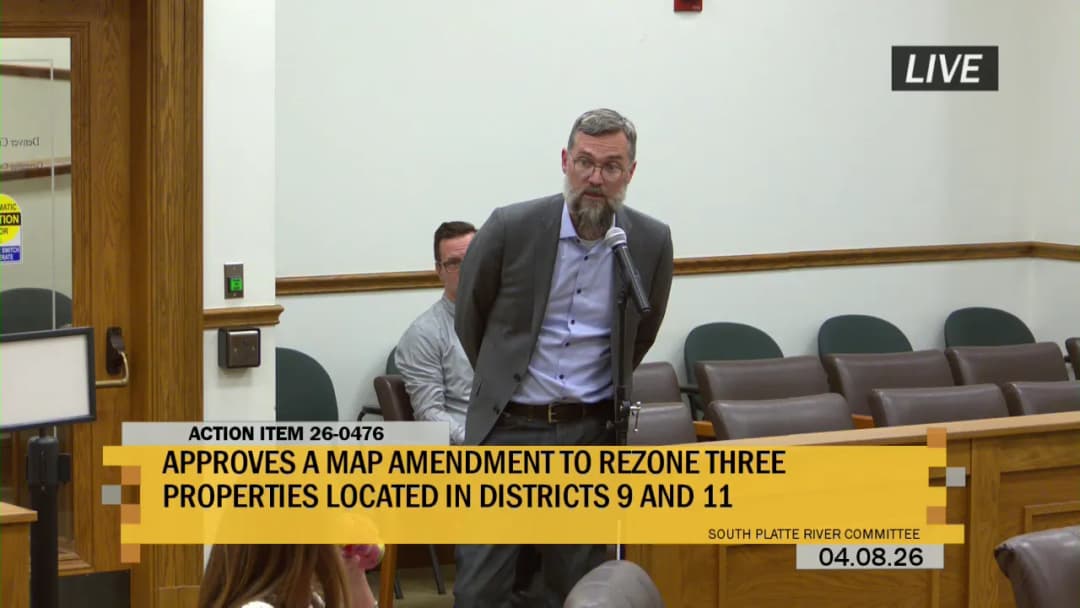
The South Platte River Committee met on April 8, 2026, at 1:30 PM in the Council Committee Room. The committee approved two rezoning actions and one consent item. Chair Jamie Torres presided. Consent Calendar - 26-0467: Approved a grant agreement with the Colorado Department of Transportation for $9,750,000 (Federal $7,800,000, CCD $1,950,000) for the Alameda Ave Underpass Improvements project (Kalamath St to Cherokee St) focusing on design and environmental work, with an end date of January 11, 2036. (Council District 7) Discussion Items 26-0391 – Rezoning at 3232 Larimer Street - Proposed rezoning from R-MU-30 with Waivers to I-MX-3, DO-7. The property is vacant and adjacent to a parcel owned by the same family. Applicant Will Legg expressed plans for a green space and outdoor area to address the lack of parks in the River North (RiNo) area. Council President Sandoval asked about the Design Overlay 7 (DO-7), which was adopted in 2018 and includes minimum street-level height and mass reduction requirements. The Planning Board unanimously recommended approval. The committee voted 4-0-3 (Alvidrez, Flynn, Sandoval, Torres in favor; Hinds, Parady, Watson absent) to approve the bill for filing. 26-0476 – Rezoning Three Properties to Open Space (OS-A) - Three properties: 4458 Pearl St, 5275 N Franklin St, and 4621 N Telluride St, rezoned from U-MX-3, I-B, and PUD 319 to OS-A. All are owned by Denver Parks and Recreation (DPR). Sites include the Heron Pond regional park (under construction, 80 acres, $40 million investment), 44th & Pearl (vacant lot, pre-development), and Far Northeast Maintenance Facility (vacant land). The rezoning is part of a map cleanup effort to align zoning with park use. Planning Board unanimously recommended approval. No public comments received. The committee voted 5-0-2 (Alvidrez, Flynn, Sandoval, Watson, Torres in favor; Hinds and Parady absent) to approve. Key Outcomes - 26-0391: Approved for filing (4-0-3). Will proceed to full Council. - 26-0476: Approved for filing (5-0-2). Will proceed to full Council. - 26-0467: Consent item approved unanimously. Note: Councilmember Darrell Watson arrived after the first vote and was present for the second vote. No public testimony was provided during the meeting.
The Denver City Council Community Planning and Housing Committee convened on April 7, 2026, chaired by Councilwoman Diana Romero Campbell. The committee reviewed and voted on two contracts supporting residents with intellectual and developmental disabilities (I/DD), received a detailed briefing on the citywide Housing Needs Assessment and Anti-Displacement Strategy, and heard the final report and implementation update for the Quebec Corridor Task Force. Discussion Items Housing Support Contracts for I/DD Populations (Resolutions 26-0463 and 26-0464) - Project Description: Jordan Mulholland (DHS IDEAS Program) and Midori Higoshi (HOST) presented two three-year contracts funded through DHS’s IDEAS mill levy. Resolution 26-0463 ($3.42 million with Jewish Family Service) provides rapid rehousing for at least 55 I/DD households. Resolution 26-0464 ($2.58 million with Rocky Mountain Human Services) provides stability navigation for at least 300 I/DD individuals and families. Both contracts run through April 30, 2029. - Council Positions and Questions: Councilmembers broadly supported the targeted partnership. Councilwoman Alvidrez asked about long-term sustainability beyond the 24-month rapid rehousing program, noting that half of participants earn under $10,000 annually. Councilwoman Torres inquired about the IDEAS fund balance ($17.7 million at the start of 2026) and whether a dedicated housing development is planned for this population (staff reported that concept is paused). Councilwoman Sawyer clarified the benefit of the outreach metric requiring monthly shelter screenings, calling it a unique and valuable contract requirement. Housing Needs Assessment & Anti-Displacement Strategy (Briefing 26-0477) - Project Description: Laya Mitchell (HOST) and Heidi Aggeler (Root Policy Research) presented the methodology for a state-mandated, city-specific Housing Needs Assessment. The assessment will analyze demographic projections, housing market gaps, an anti-displacement strategy addressing residential/commercial/cultural displacement, and eviction/foreclosure patterns. Preliminary projections are due in late July 2026. - Council Positions and Feedback: - Councilwoman Alvidrez questioned the disconnect between rising vacancy rates and increasing family homelessness, emphasizing a mismatch between unit sizes and family needs. She requested analysis of declining Black homeownership rates. - Councilwoman Sawyer expressed strong concern over the validity of the 2025 DRCOG regional study as a metric. Staff confirmed the city is using a tailored local model and is required only to acknowledge the DRCOG study, not rely on it. Sawyer asked how data will translate into actionable policies, such as prioritizing funding for larger family units. - Councilwoman Torres requested vacancy rate calculations that account for units in initial lease-up periods. - Councilwoman Lewis requested specific analysis of senior housing needs (65+) and foreclosures. - Chair Romero Campbell requested data on residents already displaced from Denver, analysis of climate change and insurance costs on housing affordability, and emphasized the gap where newly built affordable units often exceed 30% of the target occupant's income. She recommended targeted focus groups for displaced individuals. Quebec Corridor Task Force (Briefing 26-0478) - Project Description: Councilwoman Shontel Lewis (District 8) and task force member David Kugler presented the task force’s recommendations and implementation status. The group was convened to address quality-of-life complaints related to the concentration of shelters along Quebec Street. - Task Force Positions and Implementation: - Positions: The task force explicitly stated it does not support camping bans, over-reliance on policing to address homelessness, or isolation of unsheltered residents from services. - Short-Term Outcomes (End of 2025): Urban Alchemy’s shelter operation has dramatically reduced police and fire calls. Three overdoses were reported and reversed. Common gathering space is being developed. - Medium-Term Outcomes (2026–2027): The city committed to not using the Aspen shelter (4040 Quebec) as a cold weather shelter for the next winter. DPD and Walmart are partnering to provide hygiene products and pet food to the shelter to address shoplifting concerns. - Long-Term Outcomes (2027+): The corridor has been included in the Near Northeast Planning Initiative (NNENPI). The task force recommends housing development for 30–110% AMI households and improved pedestrian infrastructure. HOST is developing a navigation center concept. - Councilwoman Sawyer commended Urban Alchemy’s approach, noting a significant improvement in shelter atmosphere. Chair Romero Campbell requested clear timelines for converting shelter sites to permanent affordable housing and stressed the need for a comprehensive citywide shelter siting policy. Key Outcomes - Votes: Resolutions 26-0463 and 26-0464 were approved in a block vote of 6–0–1 (Aye: Alvidrez, Lewis, Romero Campbell, Sandoval, Sawyer, Torres; Absent: Parady). - Directives & Next Steps: - HOST and Root Policy Research will incorporate council feedback on family unit sizes, displacement, climate/insurance costs, and senior populations into the Housing Needs Assessment. - The committee recommended exploring focus groups with residents who have already left Denver due to housing costs. - HOST is expected to continue planning for the Quebec Corridor navigation center and the long-term conversion of shelter sites into permanent housing.
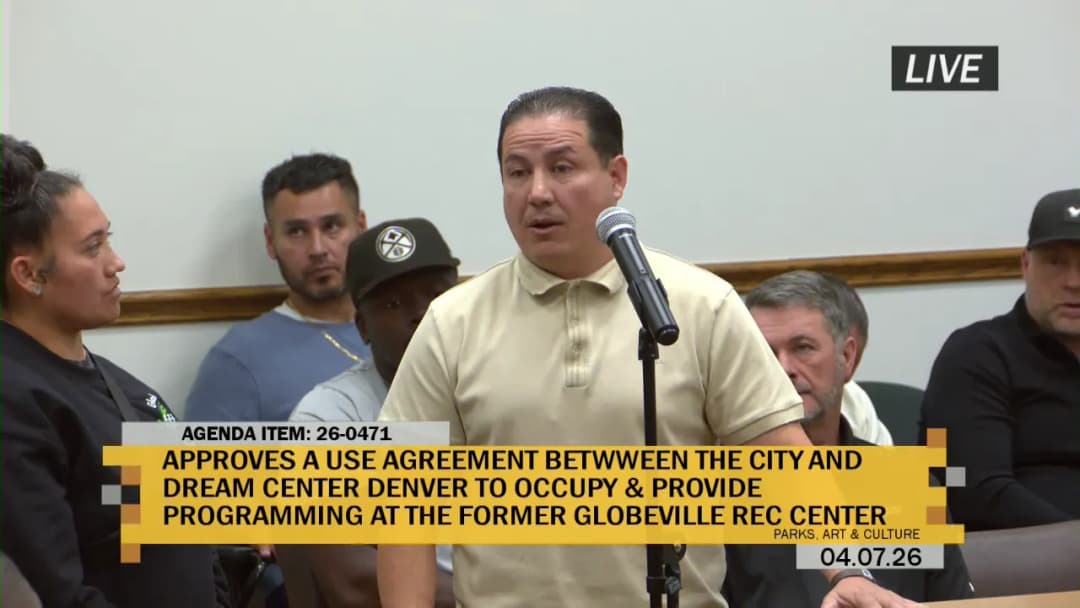
The Parks, Art and Culture Committee of the Denver City Council met on April 7, 2026 (agenda listed 10:30 AM start; the instruction provided 5:30 PM UTC – discrepancy noted). Chair Flor Alvidrez presided with six members present (Hinds, Lewis, Romero Campbell, Sandoval, Watson, Alvidrez) and one absent (Parady). The committee approved a block of 19 landscape architecture on-call contracts, a use agreement with Denver Dream Center for the former Globeville Recreation Center, and a consent item for My Outdoor Colorado programming. Consent Calendar - 26-0472: Approved a contract with the State Board of Great Outdoors Colorado Trust Fund for $2,000,000 (through 12-31-2030) to continue My Outdoor Colorado coalition initiatives and programming in Council Districts 3 and 9. Approved by consent. Discussion Items - Parks and Recreation Landscaping On-Call Contracts (26-0402 through 26-0420): Kristen Beard (Design Construction Supervisor) and Jesús Orrantia (Community Engagement Specialist) presented 19 on-call contracts for landscape architecture, planning, and design services citywide. The contracts cover four years with a one-year extension option. Fourteen contracts for MWBE firms are at $2.5 million each; five for SBE firms are at $1.5 million each. The MWBE pool has a 20% MWBE participation goal; the SBE pool has a 30% self-performance requirement. Councilmembers raised questions about capacity, project timelines, drought considerations, and use of on-call contracts for strategic vision planning. The committee also heard about upcoming ecological restoration contracts (not yet for action). Councilmember Watson secured verbal commitments from DPR regarding the Curtis Park implementation schedule (target 2028) and a budget breakdown for the project within 30 days. - Dream Center Denver Use Agreement (26-0471): Jesús Orrantia presented a three-year use agreement for $90,000 to allow Dream Center Denver to occupy and program the former Globeville Recreation Center (Council District 9). The previous vendor’s contract ended in fall 2025, creating a gap in services. Councilmember Lewis expressed concern that DPR did not conduct a new community engagement process for the RFP, relying instead on a 2017 RFP. Deputy Executive Director John Martinez acknowledged the misstep and committed to robust community engagement within the first year and a half of the contract. Representatives from Dream Center and Globeville First (Milo Valdez, Rebecca Treehouse) spoke about their partnership and commitment to community-driven programming. Councilmember Watson vowed to ensure Birdseed Collective also remains integrated. - Consent Item (26-0472): No discussion; approved by consent. Key Outcomes - Approved 19 on-call landscape architecture contracts (Resolutions 26-0402 through 26-0420) in a block vote of 6-0 (motion by Lewis, second by Hinds). - Approved Dream Center use agreement (Resolution 26-0471) by a vote of 5-1 (Lewis opposed). - Approved consent item 26-0472 by consent. - DPR committed to providing a list of upcoming projects to the committee. - DPR committed to a community engagement process within 18 months for the next Globeville Recreation Center RFP. - Councilmember Lewis emphasized the need for equitable community input processes, particularly for Black and brown communities. - Councilmember Watson received commitments on Curtis Park timeline and budget communication. - The ecological restoration on-call contracts (10 firms) will be presented for action in a future meeting.
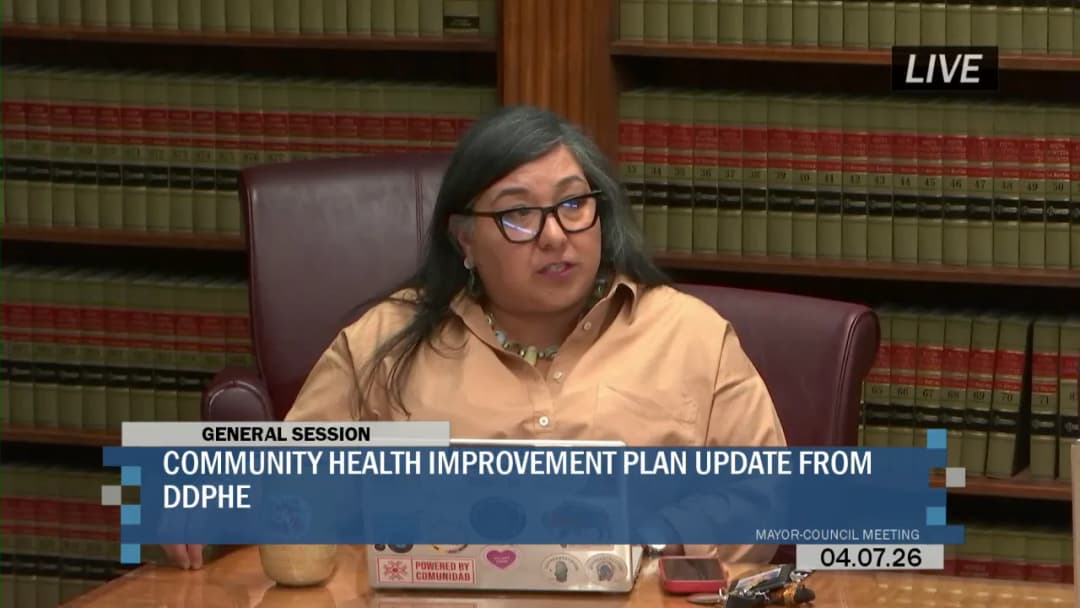
The weekly joint meeting of Mayor Mike Johnston and Denver City Council convened on April 7, 2026. The meeting opened with council members sharing community announcements and concluded with a unanimous vote to enter executive session. The main agenda item was a briefing from the Denver Department of Public Health and Environment (DDPHE) on the Community Health Assessment (CHA) and Community Health Improvement Plan (CHIP), in celebration of National Public Health Week. Announcements - Councilmember Ligas thanked attendees of the Constitution book club and announced the next session on April 29. He also promoted a community meeting on unlocking housing choices at 6 p.m. at Athmar Park Rec Center and upcoming town halls on the Front Range Passenger Rail (Colorado Connector) on April 11 from 10 to 11:30 a.m. at the Center for African American Health. - Councilmember Watson announced the Colorado Spartans arena football team home opener at 7 p.m. on April 11 at the Denver Coliseum and the Blair Caldwell Library Community Advisory Committee hybrid meeting from 4:30 to 6:30 p.m. on April 7. He also noted Denver's finalist status for the 2028 Democratic National Convention and imminent travel to New Orleans for selection meetings. - Councilmember (name unclear) announced community feedback sessions on the recently released racial equity (RO) report: April 9 from 6 to 8 p.m. at Montbello Rec Center and April 11 from 10 a.m. to 12 p.m. at Johnson Rec Center. - Councilmember Knights expressed personal support for the 2028 DNC bid, recounting his transformative experience at the 2008 DNC in Denver. Discussion Items: Community Health Improvement Plan Briefing - Nathan Keffer, Senior Analyst at DDPHE, presented the five-year CHA/CHIP cycle. The CHA, completed in spring 2025, gathered over 2,000 survey responses, held 12 focus groups, two town halls, and analyzed over 100 health metrics. The process was co-created with community members, who took leadership roles alongside practitioners and academics. - Three priority areas were identified: access to healthcare, safe and affordable housing, and systemic racism as a driver of health disparities. - Broad goals under each priority: - Access to healthcare: increase accessibility and availability of care, strengthen Medicaid affordability and sustainability, and increase equitable services for communities of color. - Safe and affordable housing: reduce evictions, displacement, and financial hardship for renters; and increase housing diversity and expand land use options. - Systemic racism: improve access to affordable childcare, nutritious food, basic needs to reduce criminalization, and improve financial stability. - These goals were narrowed from an initial list of approximately 190 potential goals identified through community engagement. - The CHIP action plan will be published in May 2026, followed by a 180-day operationalization period. The plan is designed as a shared cross-sector agenda with over 60 partner agencies, including Denver Health and community organizations. - Councilmember Alvidrez questioned whether homeowners were addressed in the housing goals and raised concerns about unhealthy living conditions for homeowners. Keffer acknowledged that homeowner support might be considered under the financial stability goal. - Councilmember Hines asked about the city's ability to influence Medicaid funding amid federal cuts and suggested including Rocky Mountain Human Services as a partner. Keffer noted that the CHIP could work with Colorado Access to expand Medicaid enrollment and provider acceptance. - Councilmember Torres strongly supported the community-driven approach and urged embedding CHIP goals into citywide policy, especially regarding historically redlined neighborhoods and specific populations such as LGBTQ, Black, Latino, and American Indian communities. She expressed concern about the scaling back of the city's discrimination office. - A council member (name not clearly transcribed) emphasized the need to disaggregate childcare by age groups (infant/toddler vs. school-age and out-of-school care) and to address isolation among seniors and Southeast Denver residents. Keffer responded that the city survey oversampled high-social-vulnerability areas to capture those voices. - Councilmember Watson praised the presentation's thoroughness and community engagement. He highlighted recently approved funding for a food summit that aligns with CHIP goals. Key Outcomes - The council unanimously approved a motion to enter executive session pursuant to DRMC 23-4A sections 3, 6, and 7 to discuss settlement of pending litigation and legal advice.