Browse by city
Date range
Search help

Search titles, summaries, topics and stored transcripts together. Keywords may match separately; put the whole query in double quotes for a phrase. Matching follows word analysis, so punctuation is not exact. Both dates are included. Documents are not searched.

SHOWING 171–180 ENTRIES
171
MAR 23, 2026 · DENVER, COLORADO · COUNCIL COMMITTEES
Denver City Council Budget & Policy Committee on RNO Ordinance & Single-Unit Development — March 23, 2026

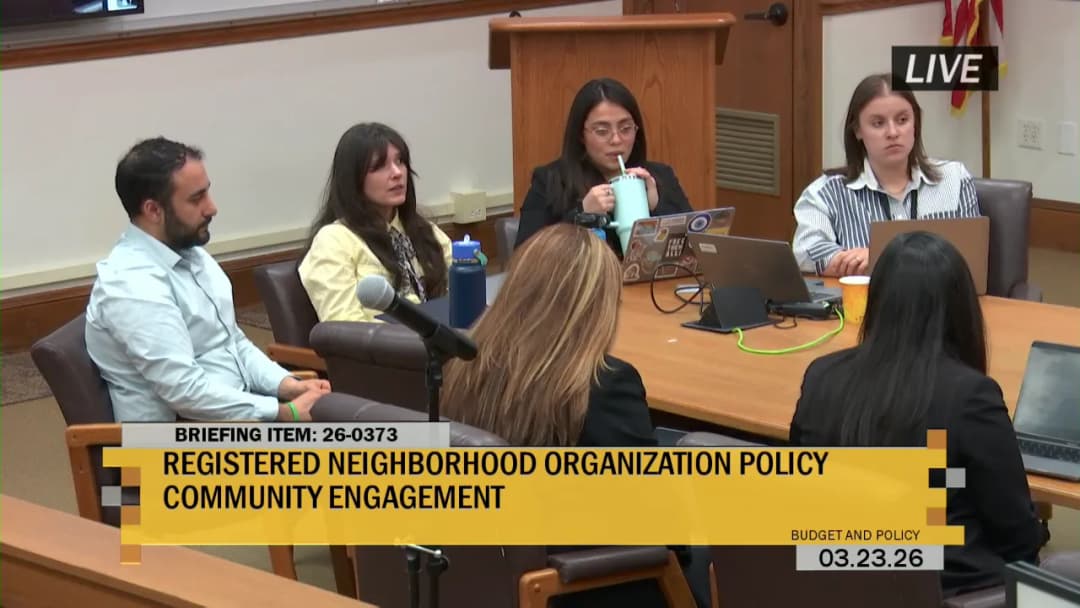
The Budget and Policy Committee of the Denver City Council met on Monday, March 23, 2026, for two briefings: (1) an update on the Registered Neighborhood Organization (RNO) Ordinance community engagement process, and (2) a concept introduction regarding single-unit development in higher-density zone districts. Councilmembers present included Kevin Flynn (District 2), Jamie Torres (District 3), Amanda Sawyer (District 5), Oscar (At-Large), Paul Cashman (District 6), Sarah Purdy (At-Large), Darren Watson (District 9), and Laura Alvidrez (District ?). No votes were taken; both items were presented for discussion. RNO Ordinance Community Engagement Update - Presentation: Council aides Masha Leor, Elise Bob, Sino Jorge, and Claire Kelly presented findings from the "Your City Your Voice" project, a year-long community engagement effort to inform potential changes to the RNO ordinance. The project included over 40 in-person events, approximately 1,100 survey responses, four neighborhood engagement workshops, RNO focus groups, and interviews with city departments and external partners. A report was published on March 19, 2026, identifying five community-informed considerations: (1) identity and framework (renaming RNOs, clarifying purpose, reducing overlapping boundaries), (2) membership, governance, and recognition standards, (3) outreach and communication infrastructure, (4) training, funding, equity supports, and neighborhood liaisons, and (5) accountability and collaborative conflict resolution. The next steps include four more in-person feedback sessions and an online form through April 2026, with policy drafting in April/May and a proposed ordinance in late spring/early summer. - Councilmember Flynn expressed support for the process but raised concerns about overlapping RNO boundaries and the need to preserve neighborhood identity. He noted that statistical neighborhood boundaries are arbitrary and can cause confusion. - Councilmember Sawyer (Amanda) highlighted that RNOs struggle with volunteer recruitment, standard operating frameworks, and city permitting for small neighborhood events (e.g., movies in the park). She stated that overly burdensome regulations have caused neighborhood events to cease and urged that these issues be prioritized as short-term fixes. - Councilmember Alvidrez expressed disappointment that engagement was lower in some neighborhoods (e.g., Ruby Hill, Overland) and emphasized the need for equitable funding to support lower-income neighborhoods. She also noted that RNO leaders sometimes face threats and safety concerns. - Councilmember Torres questioned whether there was an asset-based assessment of RNOs (what they do well) and asked about the implication that the city should fund RNOs. She raised concerns about non-residents creating RNOs in other districts and emphasized the need for funding to be clearly defined. - Councilmember Watson asked about engagement with the Inter-Neighborhood Cooperation (INC). Presenters noted that staff attended INC meetings and met with INC leadership, but that INC does not equally represent all RNOs because membership fees can be a barrier (though fees can be waived). He also asked about grant-writing support for RNOs; presenters confirmed that templates and training are part of the considerations. - Councilmember Purdy (Sarah) supported moving RNO oversight from Community Planning and Development (CPD) to the Division of Community Empowerment within Human Rights and Community Partnerships (HRCP), but expressed concern that HRCP currently has limited staff. She noted the original intent of the RNO ordinance was to empower communities in redlined areas and praised the project for returning power to the people. Single-Unit Development in Certain Zone Districts (Concept) - Presentation: Councilmember Flynn and Councilmember Parody introduced a concept to limit or prohibit new single-unit dwellings in zones where higher density is planned (TU, RH, MU — two-unit, rowhouse, and multi-unit zones). They presented data: since 2019, 28,000 dwelling units were built citywide; 12% (3,374) were single-family homes, and of those, 15% (247) were built in zone districts that allow higher density. Two approaches were outlined: (1) remove single-unit as a permitted use (making existing single-family homes non-conforming, which could create financing and renovation hurdles), or (2) only prohibit new single-unit dwellings after a scrape or demolition (a forward-looking approach). The presenters favored approach 2 to avoid non-conformity issues. Next steps include presenting to the Unlocking Housing Choices advisory committee and continuing to refine the concept. - Councilmember Sawyer stated that the 15% figure shows this concept could have a greater impact than unlocking housing choices. She asked whether CPD could study the capacity to build to existing zoning. A CPD staff member (Kyle Dalton) confirmed it is possible but complex, noting constraints like historic districts and lot sizes. - Councilmember Campbell (Pro Tem) asked about grandfathering projects already in the pipeline; presenters noted no grandfathering date has been set and the concept is still early. - Councilmember Parody expressed concern about creating non-conforming structures and preferred approach 2. She also noted that single-family homes represent only 12% of new units, arguing that the focus on single-family zoning may be disproportionate. - Councilmember Torres noted that along corridors like Morrison Road, large lots without alleys could lead to scraping of existing affordable homes for duplexes or rowhouses. She cautioned that the concept should not incentivize loss of affordable housing. Key Outcomes - No formal votes or decisions were taken on either item. - For the RNO ordinance update: The committee will continue gathering community feedback on the five considerations through April 2026. Council aides will draft policy changes for April/May and bring a proposed ordinance to committee in late spring/early summer. - For the single-unit development concept: Councilmembers Flynn and Parody will refine the proposal, present it to the Unlocking Housing Choices advisory committee, and return to the budget and policy committee with a draft for further discussion.
COMMUNITY ENGAGEMENT 70% · LAND USE ZONING 22% · HOUSING DEVELOPMENT 3% · PROCEDURAL 1%
172
MAR 23, 2026 · DENVER, COLORADO · CITY COUNCIL
Denver City Council General Session - March 23, 2026

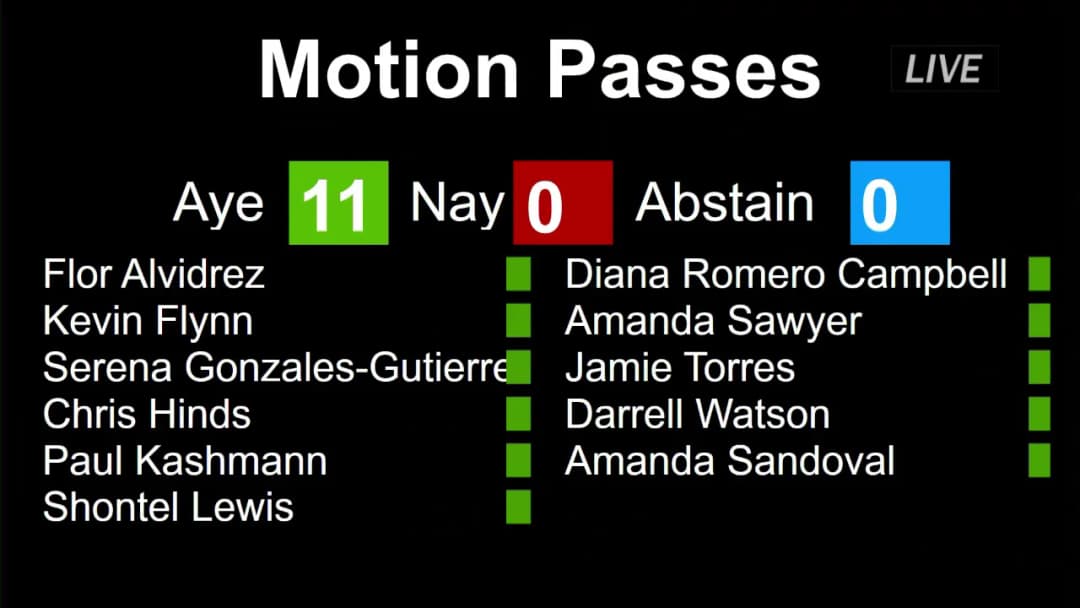
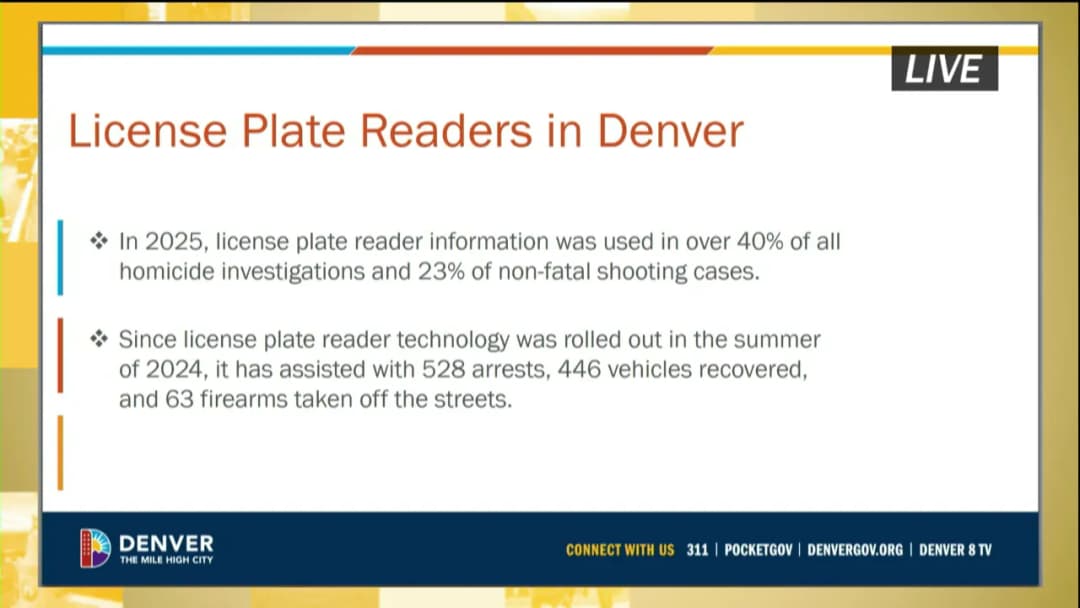
The Denver City Council held its regular general session on Monday, March 23, 2026, at 3:30 PM, with 13 members present. The meeting included approval of minutes, council announcements, two proclamations, adoption of a block of resolutions and bills, introduction of two bills, and a courtesy public hearing on a proposed contract for an Automatic License Plate Recognition (ALPR) system. The public hearing attracted significant testimony, and final action on the ALPR contract was postponed to March 31, 2026. Consent Calendar - A block vote approved 15 resolutions (26-0239 through 26-0250, 26-0231–26-0238, 26-0144, 26-0225, 26-0234) and 2 bills on final consideration (26-0205, 26-0204) without individual debate. These items covered various city contracts, including street sweeper brooms, fire trucks, server purchases, a leased office space, a child nutrition program, park maintenance, a fitness passport program, a shooting range cleaning contract, and electrical work at Boettcher Concert Hall. - Resolution 26-0241 (amendatory agreement with Point b (e) Strategies, LLC for grant-writing services) was called out for a separate vote and adopted 13-0. Councilmember Alvidrez questioned the reduction in contract capacity; the Finance Department explained it eliminated a retainer. Public Comments & Testimony - During the courtesy public hearing on Resolution 26-0246 (Axon ALPR contract), 55 speakers signed up; 12 spoke in favor, 42 opposed, and 1 was neutral. Key points from supporters (including Don Ku, David Howard, Tony Frey, Sally Jones, Craig Arfsten, Seamus Johnston, Rob Collins, Derek Friedman, Dr. Robin Engel, Maria Alicia Ashar) included: the technology helps recover stolen vehicles (over 400 recovered), remove firearms (over 60), solve homicides (40% of 2025 homicides involved ALPR evidence), and is used in major cities; the contract has strong privacy safeguards (data owned by Denver, no AI training, 21-day retention, FedRAMP security). Opponents (including Katie Leonard, Dr. Lisa Calderon, Marilynn Ackermann, Dana Miller, Nate Kassa, Kristen Seidel, Lillian House, Miriam Osman, Alfonso Espino, Jesus Loayza, Elisha Roberts, Darlene Rivera, Isabella Nevin) argued: the technology constitutes mass surveillance, violates Fourth Amendment rights, risks data sharing with federal agencies under the Trump administration, Axon has a history of promoting “excited delirium” pseudoscience, the contract lacks adequate community input and a comprehensive surveillance ordinance, and ALPRs have documented inaccuracies. Discussion Items - Council Announcements: Members made personal and community announcements, including congratulations to the University of Denver hockey team, Denver Summit FC’s first home game, and a historic designation for Wellshire Golf Course. Councilmember Romero Campbell expressed devastation over sexual abuse allegations against Cesar Chavez, calling for broader community conversation. - Proclamations: Two proclamations were adopted 13-0: 26-0378 recognizing “Sí Se Puede Day” (March 31) in honor of Dolores Huerta and farmworkers, and 26-0377 commemorating Nowruz (Persian New Year). Speakers shared personal connections to the farmworker movement and the Persian community. - Resolution 26-0241 (Grant-writing contract): Called out for a separate vote. Councilmember Alvidrez asked why the contract was reduced; staff explained it eliminated a retainer. Adopted 13-0. - Axon ALPR Contract (Resolution 26-0246): Extensive discussion after the public hearing. Councilmembers raised concerns about: data security and breach liability, lack of a comprehensive surveillance ordinance, the 21-day retention policy being in police policy rather than the contract, opt-out language that could allow future expansions, the integration of Axon’s FUSUS dashboard with other cameras (e.g., Halo, traffic cameras), and the reduction from 112 Flock cameras to 50 Axon cameras. Staff (Tim Hoffman, Chief Ron Thomas, Commander Cliff Barnes, Terra Sagura) presented the contract’s safeguards, including Denver data ownership, no AI training, limited retention, and auditing. Councilmember Parady questioned the accuracy of ALPRs (96-98% read accuracy). Councilmember Gilmore highlighted that 42 of 55 speakers opposed the contract. Councilmember Flynn invoked Rule 3.6 to postpone final action to March 31, 2026, citing the need for more time. - Bills for Introduction: Two bills were ordered published: 25-0934 (financing for Colorado Convention Center fire alarm project via certificates of participation up to $108 million) and 26-0292 (relinquishing an easement at 2777 North Zuni Street). - Bills for Final Consideration: Two bills were placed on final passage and passed en bloc: 26-0205 (relinquishing an easement at 2622 West 11th Avenue) and 26-0204 (relinquishing an easement at 5000 East Alameda Avenue). Key Outcomes - Proclamations 26-0377 and 26-0378 adopted 13-0. - Resolution 26-0241 (Point b (e) Strategies contract) adopted 13-0. - Consent agenda block: 15 resolutions and 2 bills adopted/placed on final passage by a 13-0 vote. - Bills introduced: 25-0934 and 26-0292 ordered published. - Resolution 26-0246 (Axon ALPR contract): Postponed by Rule 3.6 to the next regular council meeting on Tuesday, March 31, 2026, at 5:30 PM. The public hearing was closed, but council may continue questioning. - Adjournment: The meeting adjourned at 8:21 PM.

PUBLIC SAFETY 47% · PROCEDURAL 12% · DATA MANAGEMENT 7% · TECHNOLOGY AND INNOVATION 6%
173
MAR 18, 2026 · DENVER, COLORADO · COUNCIL COMMITTEES
Denver Transportation and Infrastructure Committee Meeting March 18, 2026: Veo Contract Postponed and On-Call Contracts Delayed

The Denver City Council Transportation and Infrastructure Committee met on Wednesday, March 18, 2026, at 1:30 PM in Room 391 of the City & County Building. The committee considered two major action items: a proposed three-year license agreement with VeoRide Inc. (dba Veo) to operate Denver’s Shared Bike and Scooter Program (26-0326), and a block of 38 contract amendments for on-call vertical professional and technical services (26-0254 through 26-0291). After extensive public testimony and council discussion, both action items were postponed to future dates. Eight consent items were approved unanimously. Consent Calendar - 26-0293 through 26-0295: Three resolutions dedicating City-owned parcels as public alley right-of-way bounded by East 1st Avenue, North Lincoln Street, East Ellsworth Avenue, and North Broadway, in Council District 7. Approved by consent. - 26-0296: Dedicating two parcels as right-of-way at South Clermont Street and East Evans Avenue, Council District 4. Approved by consent. - 26-0297 and 26-0298: Dedicating parcels as right-of-way at North Broadway and West 8th/9th Avenues, Council District 10. Approved by consent. - 26-0299: Dedicating two parcels as right-of-way at Green Valley Ranch Boulevard and North Jebel Street, Council District 11. Approved by consent. - 26-0309: Amending contract with Wilson & Company, Inc. to add $17,060 for a new total of $1,087,113.23 and extend one year to 12-31-2026 for design services on the Connecting Auraria project (Larimer Street Bridge over Cherry Creek), Council District 10. Approved by consent. Public Comments & Testimony - Lime Access Users (Colby Campbell, Dustin Wilburn, Rin Lian, Whitney Smith, Brayden Davis): Several speakers opposed the transition to a single operator (Veo), urging the committee to extend Lime’s contract for 12-18 months to allow a smoother transition. They described how Lime’s access program (providing free or discounted rides) has been essential for medical appointments, employment, and family emergencies. One speaker noted over 300,000 riders rely on the program, and a rushed transition could disrupt vulnerable residents. - Downtown Neighborhood Representatives (David Kurth, Mike Miller, Ellen Baker): Representing the Upper Downtown and Lower Downtown neighborhood associations, these speakers strongly supported moving to a single vendor model. They argued that the current two-vendor system creates fragmentation, makes enforcement difficult, and leads to unsafe riding and parking. They stated their position is on structure—not the specific vendor—and that a single operator provides clear accountability, unified data, and better safety outcomes. - Current Operator Representative (Arnaldo Colon, regional manager for Bird): Opposed the selection of Veo, citing Bird’s seven years of experience in Denver, existing W-2 workforce, and concerns that Veo’s total ridership across all markets is only slightly larger than Denver’s program. He warned that Veo’s planned hiring of 15+ drivers could lead to layoffs in winter, and noted Bird already employs a W-2 team. - Veo Employee (Devin Morrison, hired as maintenance operations manager): Supported the transition, stating that Veo is investing in a large in-house workforce of over 100 W-2 technicians and 25 mechanics, assembling vehicles in a local warehouse. He claimed that Veo’s fleet is more environmentally sustainable (electric vehicles, no gas vans) compared to Lime’s current use of gas-powered subcontractors. Discussion Items - 26-0326 – Veo License Agreement: DOTI staff presented the rationale for selecting Veo as the single operator for a three-year term (with an optional two-year renewal). Key benefits included a 10% price reduction for all riders, a new Denver resident pass offering 35% savings, a more diverse fleet (seated scooters, cargo trike, adaptive devices), real-time sidewalk riding detection, and a W-2 workforce. The contract also includes a revenue share of $250 per device per year (over $2 million annually) and incentives to grow the income-qualified access program. Staff emphasized that a single operator allows better distribution of devices and stronger accountability. - Council Questions and Concerns: - Councilmember Hinds asked about safety, noting eight scooter-related deaths in 2025. Veo’s larger-wheeled seated scooters (70% of fleet) are linked to fewer crashes. - Councilmember Flynn questioned Denver residency verification for the discount pass and requested maps comparing current and proposed equity deployment areas. He also asked for the full contract documents to be provided before the final vote. - Councilmember Alvidrez expressed concern about Veo’s ability to manage an equity program of this size, noting it took current operators years to build. She also cited risks seen in Columbus, Ohio, with single-operator models leading to service interruptions. - Council President Sandoval pressed for the scoring rubric and full contract, stating that NACTO reports (which DOTI referenced) recommend transparent scoring. She argued that without seeing the contract or scoring, council cannot properly vote. - Councilmember Romero Campbell asked about device numbers (7,000 currently, 6,000-7,000 at Veo launch) and cross-border riding issues in unincorporated areas. She requested measurable timelines for access program transition and inter-jurisdictional agreements. - Councilmember Kashmann noted weak enforcement of prior contracts and asked about data ownership. Staff confirmed the new contract includes clearer service-level agreements and data handoff provisions. - Councilmember Watson asked about adaptive devices (Veo’s trike and two-seater e-bike) and Veo’s warehouse location (14,000 sq ft near Regis University). He expressed confidence in the procurement process given that current operators only improved after legislation pushed them. - On-Call Contract Amendments (26-0254 through 26-0291): These 38 items were presented as a block. They amend contracts with various architecture, engineering, and construction firms to add funds and extend end dates to 7-13-2028 for vertical professional and technical services citywide. No public comment was taken on these items. Council agreed to postpone them to April 15, 2026, to allow further review. Key Outcomes - Item 26-0326 (Veo License Agreement): Motion by Council President Sandoval, seconded by Chair Lewis, to postpone to a date certain (April 1, 2026) was approved by a vote of 6-0 (Alvidrez, Flynn, Hinds, Kashmann, Sandoval, Lewis all aye; Gilmore absent). The postponement allows councilmembers to review the full contract and scoring documents before the final vote. - Items 26-0254 through 26-0291 (On-Call Contract Amendments): Motion by Vice Chair Hinds, seconded by Council President Sandoval, to postpone to a date certain (April 15, 2026) was approved by a vote of 6-0 (same breakdown). These items will be considered at a future committee meeting. - Consent Items: All eight consent resolutions (26-0293 through 26-0299 and 26-0309) were approved by consent without objection. These dedicate small parcels as public right-of-way and amend a contract for bridge design services. - Next Steps: The Veo contract will return to the committee on April 1, 2026, for discussion and action. The on-call contracts will be re-scheduled for April 15, 2026. Both require full city council approval (first reading March 31 for Veo, now delayed).

TRANSPORTATION 53% · CONTRACTS AND PROCUREMENT 15% · TRANSPORTATION SAFETY 15% · COMMUNITY ENGAGEMENT 5%
174
MAR 18, 2026 · DENVER, COLORADO · COUNCIL COMMITTEES
Health and Safety Committee Meeting - March 18, 2026

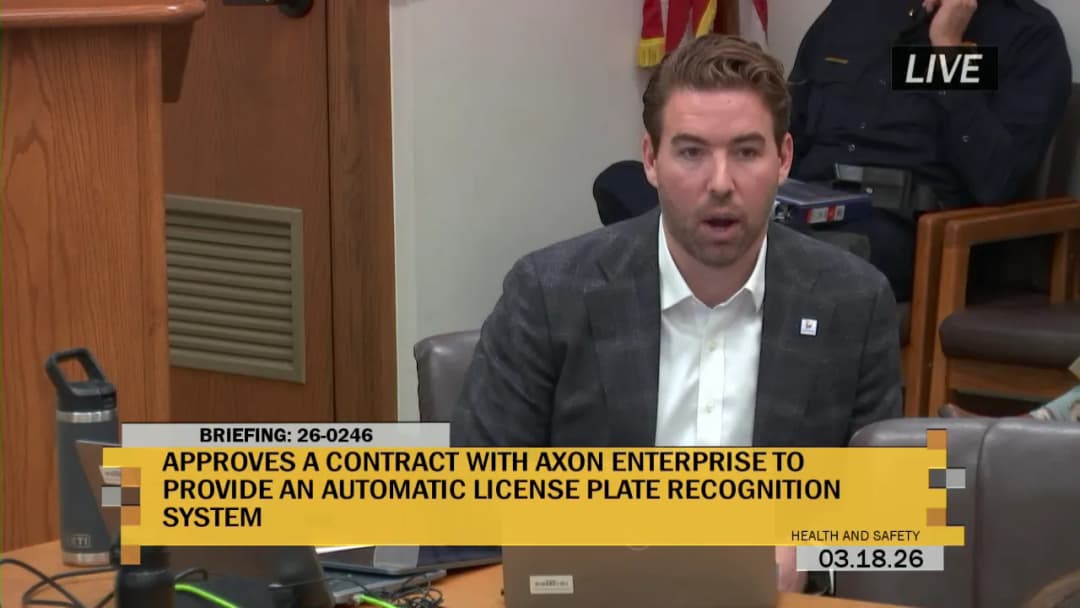
This is a summary of the Denver City Council Health and Safety Committee meeting held on March 18, 2026, at 10:30 AM. The meeting was chaired by Councilmember Darrell Watson. The main action item was a resolution to approve a contract with Axon Enterprise, Inc. for an Automatic License Plate Recognition (ALPR) system, which was debated extensively and ultimately passed on a 5-2 vote. Three consent items were also approved. Consent Calendar - 26-0308: Amends a contract with 5280 Forensic Pathology, PLLC d/b/a Dr. Kelly Lear to add $250,000 for a new total of $633,000 for emergent forensic pathology services (citywide). Approved by consent. - 26-0318: Amends a contract with Goodwill of Colorado to modify language in the Scope of Work to allow for reimbursement of PTO payouts and retention bonuses for case management and supplemental services to Colorado Works/TANF participants (citywide). Approved by consent. - 26-0323: Amends a contract with Dr. Meredith Frank, PLLC to add $1,000,000 for a new total of $1,383,000 for emergent forensic pathology services (citywide). Approved by consent. Discussion Items - Action Item 26-0246: Resolution to approve a $150,000, one-year contract with Axon Enterprise, Inc. for an ALPR system including 50 cameras, hardware, software, and equipment. The contract had been discussed in prior briefings. The administration provided a draft contract to council members on the previous Friday. Key points of discussion included: - Data security and privacy: Councilmembers expressed concerns about the 48-hour breach notification requirement (Section 12.3.1) and the potential for data sharing under “otherwise required by applicable law” provisions. The city’s data protection officer noted 48 hours aligns with industry standards, but some councilmembers found it too long. - Opt-out vs. opt-in for new features: The contract includes an opt-out provision for new features, but councilmembers argued that without an updated DPD policy or ordinance, the decision-making authority rests solely with the administration, not the council or public. - Retention period: The contract states the city sets the retention policy, which will be 21 days per DPD operations manual (not in the contract itself). - Live streaming capability: Commander Barnes clarified that the cameras can live stream temporarily during critical incidents but do not record continuously. Existing Halo camera policies will apply. - Comparison with body-worn cameras: Councilmember Gonzales-Gutierrez noted that ALPRs capture all passersby, unlike body cameras activated during interactions. - Federal immigration enforcement: Councilmembers asked about the vendor’s philosophy on using technology for deportations; Axon’s representative promised a written statement. - SB 2670: The pending state bill would require a warrant for ALPR use. The administration said they would update policies if it passes. - Councilmember Positions: - Councilmembers Parady, Gonzales-Gutierrez, and others opposed moving the contract forward due to concerns about privacy, lack of updated DPD policies, and potential misuse under the current federal administration. - Councilmembers Sawyer, Flynn, Watson, and others supported moving forward, citing improved contract language and community safety needs. Key Outcomes - Vote on Action Item 26-0246: A motion to approve the resolution for filing was made by Councilmember Sawyer and seconded by Vice Chair Flynn. The vote was 5-2 in favor, with Councilmembers Flynn, Sandoval, Sawyer, Torres, and Watson voting aye, and Councilmembers Gonzales-Gutierrez and Parady voting nay. The resolution will proceed to full city council for a vote on Monday, March 23, 2026. - Commitments from Administration: - Commander Barnes committed to updating DPD’s ALPR policy to match vendor contract terms (e.g., opt-out, live streaming) before the full council vote. - Tim Hoffman agreed to provide a map of current and proposed camera locations, criteria for placement, and clarification on contract sections (e.g., missing Section 12.4). - Axon will provide a written statement on its philosophy regarding use of technology for deportations. - Public Hearing: Council President Sandoval noted that a courtesy public hearing has been scheduled for Monday, extended from 30 minutes to one hour to accommodate public comment.

PUBLIC SAFETY 34% · TECHNOLOGY AND INNOVATION 30% · DATA MANAGEMENT 17% · PROCEDURAL 10%
175
MAR 17, 2026 · DENVER, COLORADO · COUNCIL COMMITTEES
Denver City Council Planning Board Working Group Special Session on Unlocking Housing Choices – March 17, 2026

This special session, convened on March 17, 2026, centered on the preliminary economic feasibility findings of the "Unlocking Housing Choices" project, presented by Community Planning and Development (CPD) staff and consultant team. The presentation detailed three Phase 1 strategies to encourage missing‑middle housing in low‑scale residential neighborhoods: form changes (limiting mass and scale), an infill bonus (preserving an existing front house to allow additional units on the same lot), and an affordability bonus (requiring a permanently affordable unit). Councilmembers and planning board members discussed the results, potential unintended consequences, and necessary complementary policies. Discussion Items - CPD staff Rob Haig and Andrew Webb, along with economist Arlene Taniwaki, presented the feasibility analysis for the urban context. They showed that limiting gross floor area reduces profitability for large single‑family homes (which remain feasible but less lucrative) while making missing‑middle options more attractive. The infill bonus can produce for‑sale rear units at a modeled sale price of $361,000 — less than half the cost of a typical new single‑family home under current rules. The affordability bonus is most feasible for double‑duplex and cottage court configurations; a four‑plex is not feasible for market‑rate developers due to building code costs. - Councilmember Cashman expressed concern that reducing allowable floor area could lower property values and property taxes. Consultants noted the relationship is complex, dependent on improvements and market conditions, and that tax assessment lags. - Councilmember Sawyer asked about the number of properties that could be affected citywide. Staff responded that even a small percentage uptake across a large area could yield significant new housing without overwhelming individual neighborhoods, particularly where alley access exists. - Councilmember Flynn argued that a citywide blanket application would conflict with adopted plans and urged a more targeted approach near transit and centers. He also announced a concept, developed with Councilwoman Torres, to remove single‑unit development as a use by right in zone districts already allowing two or more units, to be discussed at an upcoming Budget and Policy meeting. - Planning Board Vice Chair Fred Click raised concerns about limiting scale potentially reinforcing economic segregation, noting Denver’s existing economic and racial divides. He asked whether the affordability strategy relies primarily on affordable housing developers (confirmed). He also urged examining building code changes (e.g., transitioning from IBC to IRC) to improve feasibility for multiplexes. - Councilmember Heidi asked about the ability to sell rear units via lot splits and raised infrastructure challenges such as water tap fees. Staff confirmed lot splits are permitted under current rules and noted Denver Water now offers discounts for additional taps on the same parcel. However, Metro Wastewater’s separate tap fee remains a barrier, as experienced with ADUs. - Councilmember Caitlin queried whether maximum square footage ranges are still flexible and whether historic districts might see increased value. Staff said the numbers are still being refined and are based on peer city analysis. - Councilwoman Campbell highlighted differences in the suburban and urban edge contexts, where few lots have alley access, and asked how the strategies would adapt. Staff acknowledged ongoing conversations and planned feasibility analysis for those contexts. - Councilmember Rachel asked whether existing structures (e.g., basement conversions) had been evaluated rather than only new builds. Staff confirmed building code changes are needed to make such conversions viable, and that this work is continuing. She also asked about the criteria for a text amendment; staff cited consistency with adopted plans, public health/safety, general welfare, and uniformity. - Councilwoman Torres (who had previously implemented overlays in Sunnyside and Potter Highlands) shared experience: limiting bulk planes and requiring pitched roofs successfully decreased large‑scale development in Sunnyside but pushed development to neighboring Sloan’s Lake, illustrating unintended consequences. She stressed that zoning is a blunt instrument and called for parallel policies on anti‑displacement, aging in place, and housing affordability — work being advanced by Councilwoman Torres and Councilmember Flynn. Key Outcomes - Preliminary economic feasibility findings presented; a full report including urban edge and suburban contexts is expected by summer 2026. - No final decisions were made. The project remains in Phase 1, and any future proposals would require preservation of an existing front house to qualify for the infill or affordability bonuses. - Upcoming community meetings were announced: first at Highland Recreation Center (District 1) and Cook Park Recreation Center (District 4), followed by meetings in Montbello and Athmar Park after spring break. Staff have posted flyers citywide and are engaging neighborhood organizations. - Councilmembers emphasized the need for public participation and asked all attendees to help spread word about the meetings. - Continued work on building code reforms, Denver Water fee policies, and other non‑zoning tools was identified as critical to the project’s success.

COMMUNITY PLANNING 30% · HOUSING DEVELOPMENT 21% · AFFORDABLE HOUSING 12% · LAND USE ZONING 11%
176
MAR 17, 2026 · DENVER, COLORADO · COUNCIL COMMITTEES
Denver Governance Committee Meeting: Contract Filing Rules & RTD Accountability Report - March 17, 2026

The Governance and Intergovernmental Relations Committee of the Denver City Council met on Tuesday, March 17, 2026, at 10:30 AM. The meeting focused on two action items to improve contract review transparency and a state legislative briefing, which included a special presentation from the RTD Accountability Committee on proposed governance reforms. Eight council members were present. Consent Calendar - No consent items were considered. Public Comments & Testimony - No members of the public signed up or provided comments. Discussion Items - Action Items: 26-0327 & 26-0329 (Contract Filing Requirements) – Councilmembers Kashmann and Flynn presented a package of two measures: 26-0327 amends the Denver Revised Municipal Code to clarify that the 30-day review period for contracts, grants, and intergovernmental agreements begins at the Thursday noon filing deadline; 26-0329 amends Council's Rules of Procedure to require that draft agreements be provided to council members at the time of the committee meeting where they will be considered for approval. The mayor’s office agreed to a 10-week implementation delay and discretionary waivers for committee chairs. A SharePoint folder for committee-organized access was discussed. Council President Sandoval noted committee chairs will need to work with agencies on compliance after the 10-week period. The measures were approved for filing in a block. - State Legislative Update – Adam Paul (Mayor’s Office) and Policy Matters lobbyists presented a bill status review. Of over 500 bills introduced, 143 were tracked. Key topics included: HB 1054 (worker safety) – moved to support; transit housing investment zones – support; data center bills (HB 1122 incentives and large-load bill) – the city opposes the incentive bill and is monitoring the omnibus bill amid negotiations; lot-splitting bills (HB 1308 and related HB 26114) – city opposes as one-size-fits-all; and the formerly known Yigby bill – city took an amend position and secured some amendments. City council also took solo positions on four bills (worker protections, eviction protections, law enforcement identification, immigration training, TABOR). Concerns were raised about state preemption and the need to preserve Denver’s home rule. A data center moratorium (action item scheduled for March 31 committee meeting, vote in May) was also discussed. - Special Presentation: RTD Accountability Committee – Maria Garcia Berry and Jamie Lewis, members of the state-established RTD Accountability Committee, presented a 100-page report on recommended governance, workforce, and paratransit reforms. Key findings: RTD lacks urgency, vision, and trust; the board is too large (15 members) and lacks diversity and expertise; parochialism hinders regional collaboration. Recommendations include reducing the board to 9 members (5 elected, 4 appointed by governor with Senate confirmation), requiring expertise in land use/finance/community representation, increasing board pay and staff, and improving labor and paratransit services (e.g., on-demand Access-a-Ride). Two minority reports advocated for a fully elected or larger board. Discussion centered on the balance between elected and appointed members, district size, and the need to avoid governor overreach. Councilmember Watson raised the importance of city‑RTD collaboration (e.g., DOTI partnerships). Key Outcomes - Vote on Action Items 26-0327 and 26-0329: Approved in block by a vote of 5-0-2 (Flynn, Gonzales-Gutierrez, Kashmann, Sandoval, Sawyer voting aye; Gilmore and Torres absent). The resolution (26-0329) will be delayed one week to align with final reading of the bill. - Next Steps: The RTD reform bill is expected to be introduced soon; council will continue to monitor and may take positions. The data center moratorium will be presented as an action item on March 31. Council will receive further updates on state budget negotiations and the JBC’s revenue forecast (announcement expected March 19). - No further action was taken on other items.

PUBLIC TRANSPORTATION 37% · PROCEDURAL 11% · LEGISLATIVE AFFAIRS 9% · COMMUNITY ENGAGEMENT 8%
177
MAR 17, 2026 · DENVER, COLORADO · MAYOR-COUNCIL MEETING
Mayor and Denver City Council Joint Meeting - March 17, 2026

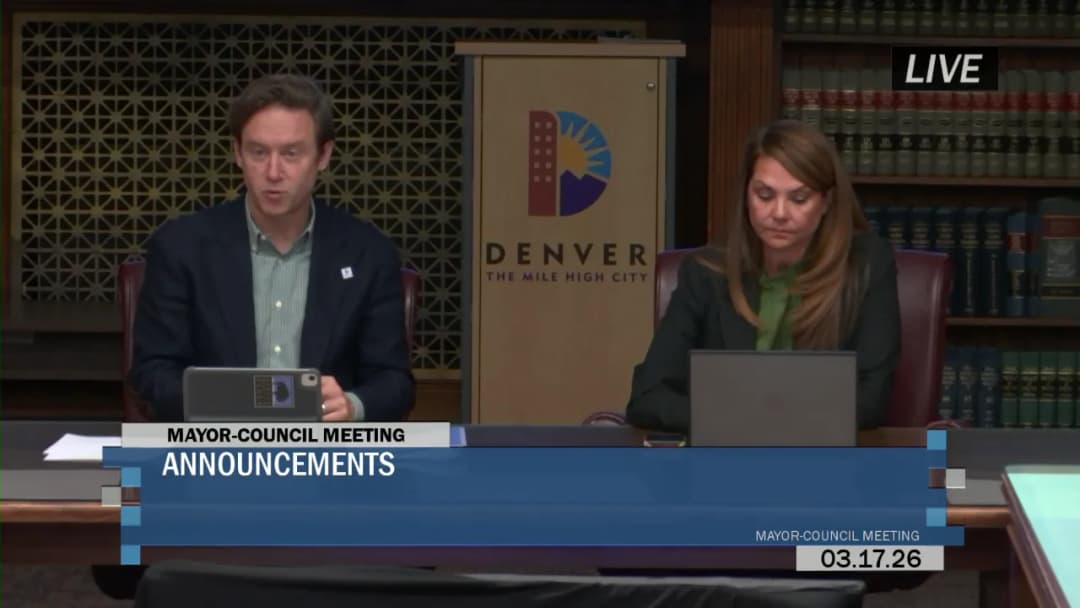
On Tuesday, March 17, 2026, at 4:30 PM UTC, the Mayor and Denver City Council held a joint meeting to receive updates on city operations and discuss federal obligations affecting Denver International Airport. The meeting included announcements from council members, a presentation on airport law and grant assurances, and concluded with a motion to enter executive session for contract negotiations. Public Comments & Testimony - No public comments were heard during this meeting. Discussion Items - Council Member Announcements: Several council members shared updates on community events and recognitions: - Council Member Diana Romero Campbell (District 4) announced a community open house on Wednesday at Thomas Jefferson High School from 5:00 PM to 7:00 PM, with city agencies including Dotti, Parks and Rec, Economic Development, and Denver Water. She also noted the Welshire 100 celebration, marking the centennial of the Welshire Golf Course, with a tournament on June 5th and registration opening April 1st. - Council Member Darrell Watson (District 9) reported that Community Solutions, a national program focused on reducing homelessness, is meeting with the All-In Mile High team today at the Sydney County building to identify additional solutions for ending homelessness, including for veterans and all residents. - Council Member Kevin Flynn (District 2) congratulated the University of Denver men's hockey team for defeating Western Michigan 2-1 in overtime in the NCHC semifinals, noting they will play Minnesota Duluth on Saturday and anticipate NCAA tournament selection. - Council Member Amanda Sawyer (District 5) recognized George Washington High School for winning the state speech and debate tournament, with over 200 students in the program and a national ranking of 4th. - Council Member Paul Kashmann thanked TSA workers at Denver International Airport for working without pay, acknowledging the sacrifices of those still reporting during the government shutdown. The Mayor thanked airport staff for supporting TSA workers through food, gift cards, and other resources. - Airport Operations Presentation: David from Denver International Airport delivered a presentation on federal obligations impacting the airport, covering four key legal concepts: federal preemption, proprietary rights, grant assurances, and revenue diversion. He emphasized that grant assurances are contractual obligations attached to all FAA grants, valid for 20 years per grant, with the clock restarting each time a new grant is accepted. He outlined 10 critical grant assurances, including: - Grant Assurance 1 (compliance with federal statutes like ADA and environmental laws) - Grant Assurance 5 (preserving airport sponsor rights) - Grant Assurance 19 (operational maintenance of the airport) - Grant Assurance 22 (economic non-discrimination, including comparable rules and fees for carriers) - Grant Assurance 21 (FAA involvement in sponsor actions) - Grant Assurance 23 (prohibition on exclusive rights for aeronautical users) - Grant Assurance 24 (reasonable fee and rental structure for self-sustainability) - Grant Assurance 29 (airport layout plan maintenance) - Grant Assurance 27 (use of government aircraft, with a recent FAA interpretation change in February 2026) - Grant Assurance 39 (competitive access requirements for medium and large hubs) He noted that enforcement occurs through informal (14 CFR Part 13) or formal (Part 16) FAA processes, not direct court action. - Airline Use and Lease Agreements: David discussed the distinction between signatory carriers (with commitments like minimum flights and leased space) and non-signatory carriers. There are four carriers with long-term leases (all expiring in 2035) and 18 carriers with leases expiring at the end of 2026. Key elements include exclusive use clauses for non-aeronautical purposes (e.g., airline clubs), preferential use gates with utilization requirements, common use facilities, baggage system access, and city rights to relocate carriers for operational efficiency. Rate-setting for fees and charges occurs through Exhibit F, which can be amended via a majority interest vote by airlines. Key Outcomes - The council voted unanimously to move into executive session (pursuant to DRMC 2-4A, sections 3, 6, and 7) for legal advice on contract negotiations. No other formal votes or decisions were made during the public portion of the meeting. - Council members expressed support for community events, athletic and academic achievements, and airport staff during the government shutdown.

TRANSPORTATION 52% · PROCEDURAL 27% · ANNOUNCEMENTS 11% · CONTRACTS AND PROCUREMENT 10%
178
MAR 16, 2026 · DENVER, COLORADO · CITY COUNCIL
Denver City Council Regular Session – March 16, 2026

The Denver City Council convened on Monday, March 16, 2026, at 3:30 PM (note: user-provided timestamp indicates 10:30 AM UTC; minutes state 3:30 PM local time) with all 13 members present except for Councilmember Torres during the consent vote. The meeting included the Pledge of Allegiance, Land Acknowledgement, approval of prior minutes, council announcements, two proclamations, a consent agenda of 11 resolutions, introduction of several zoning bills, and a required public hearing on a rezoning application. The meeting adjourned at 5:59 PM. Consent Calendar - Approval of minutes from March 9, 2026 (Minutes 26-0325). - Adoption of Proclamation 26-0331 honoring Dr. Greggory LaBerge, Director of the Denver Crime Lab, for his 30-year career and leadership (vote: 13-0). - Adoption of Proclamation 26-0332 recognizing Soka Gakkai International-USA (SGI-USA) Youth and Community Dialogue for Peace, Culture, and Education, and declaring March 16, 2026 as SGI-USA Youth Day of Peace, Culture and Education (vote: 11-0; Councilmembers Gilmore and Parady absent). - Approval of 11 resolutions en bloc (Consent Agenda) with a vote of 12-0 (Councilmember Torres absent): - 26-0221: Appointment of Melissa Schenter to the Denver County Cultural Council. - 25-1985: Amendatory agreement with The Salvation Army adding $274,683.77 for nutritious food access (total $825,357.77) through 2027. - 26-0333: Settlement of $67,500 to Matlin Injury Law for a claim against the Department of Public Health & Environment (incident April 10, 2025). - 26-0217: Amendatory agreement with JV LoDo Denargo LLC adding $22,419.99 for community garden overages in Denargo Market redevelopment (total $3,022,419.99). - 26-0209: Dedicating a parcel as Leetsdale Drive at South Oneida Street. - 26-0210: Dedicating a public alley bounded by North Perry Street, West 14th Avenue, North Osceola Street, and West 13th Avenue. - 26-0211: Dedicating a public alley bounded by North Pearl Street, East 16th Avenue, North Washington Street, and East 17th Avenue. - 26-0213: Dedicating West 38th Avenue at North Zenobia Street and a public alley bounded by West 38th, North Zenobia, West 39th, and North Yates. - 26-0214: Dedicating West 38th Avenue at North Zenobia Street and a public alley bounded by West 38th, North Zenobia, West 39th, and North Sheridan Boulevard. - 26-0215: Lease agreement with USO for 3,831.4 sq ft club space at Denver International Airport Concourse A for $10/year for 10 years. - 26-0216: Purchase order with Front Range Fire Apparatus for $12,229,826 for one 2028 F550 Patrol Unit, one 2030 Pierce Velocity 100' Ladder Truck, and three 2027 Oshkosh Striker Vehicles for Denver Fire Department operations at DEN. Public Comments & Testimony - During the required public hearing on Council Bill 26-0081, one speaker, Jesse Parris (representing Black Star Action Movement, Unity Party of Colorado, and others), spoke in favor of the rezoning. He initially opposed the project but changed his position after learning it would facilitate a much-needed medical clinic in the area. No one spoke in opposition. Discussion Items - Council Announcements: Several councilmembers made announcements about upcoming community events, including a district open house (March 18), a budget town hall (March 17), a meet-the-city academy (April 1), Nouruz celebration (March 18), and recognition of World Down Syndrome Day (March 21) and the DU Pioneers hockey team. - Proclamation 26-0331 (Dr. LaBerge): Councilmember Flynn read the proclamation. Councilmembers Alvidrez and others praised Dr. LaBerge's leadership, noting the crime lab's role in solving gun crimes and cold cases, and its national model for ballistic intelligence. Former District Attorney Mitch Morrissey also spoke. Dr. LaBerge accepted, dedicating his career to victims and highlighting his immigrant journey. - Proclamation 26-0332 (SGI-USA): Councilmember Hinds read the proclamation. Councilmembers commented on the organization's new building on Speer Boulevard and its cherry tree planting partnership (over 2,000 trees). SGI-USA representatives accepted and noted that five Denver youth will attend a peace training in Hiroshima. - Recap of Bills Called Out: Councilmember Lewis called out Resolution 26-0333 (settlement) and provided a running tally of 2026 city settlements totaling $447,500, emphasizing the need for fiscal transparency. - Required Public Hearing – Council Bill 26-0081: Staff report by Joe Green (CPD) explained the rezoning from B-1 with waivers to E-MX-3 at 385 S Zuni Street in Athmar Park. The property currently has a single-unit house but is zoned for commercial uses with many waivers (e.g., no medical clinic). The applicant seeks to open a medical office. The rezoning is consistent with Comprehensive Plan 2040, Blueprint Denver, and the Southwest Area Plan. Planning Board recommended approval unanimously. Councilmember Alvidrez expressed support, noting the community's need for a local clinic. Councilmember Flynn humorously listed the waived uses (apothecary, bank, dental clinic, etc.). The bill passed unanimously (11-0). Key Outcomes - Proclamations Adopted: 26-0331 (Dr. LaBerge) and 26-0332 (SGI-USA) were adopted. - Consent Agenda Approved: All 11 resolutions were approved en bloc, 12-0. - Council Bill 26-0081 Passed: Rezoning 385 S Zuni Street from B-1 with waivers to E-MX-3 was approved (11-0) to allow a medical clinic. - Bills Introduced: Five bills were ordered published for future public hearings: - 26-0206: Rezoning 3601 N Monaco Street Parkway in Northeast Park Hill. - 26-0207: Rezoning 2625 E 3rd Avenue in Cherry Creek. - 26-0208: Rezoning multiple properties in Bear Valley, College View - South Platte, Harvey Park, Harvey Park South, and Marston. - 26-0205: Relinquishing a wastewater easement at 2622 W 11th Avenue. - 26-0204: Relinquishing an easement at 5000 E Alameda Avenue. - Future Hearings Announced: Required public hearings on CB 26-0206, 26-0207, and 26-0208 will be held on April 13, 2026. Protests must be filed by noon on April 6, 2026. - Councilmember Lewis tracked settlement total: $447,500 in city settlements approved in 2026 as of this meeting.

COMMUNITY ENGAGEMENT 27% · LAND USE ZONING 21% · PUBLIC SAFETY 16% · PROCEDURAL 12%
179
MAR 13, 2026 · DENVER, COLORADO · CITY COUNCIL
Denver City Council Transportation Committee Meeting on Vision Zero and Safe Routes to School - March 13, 2026

The Transportation Committee of the Denver City Council met on March 13, 2026, at 7:45 PM to discuss the city's Vision Zero program, Safe Routes to School initiatives, and traffic safety concerns. DOTI staff presented data on fatal and serious injury crashes, speed management, and infrastructure projects. Council members raised questions about specific corridors, crosswalks, speed cameras, and the need for improved communication between departments. Discussion Items - Vision Zero Data and Trends: Staff presented slides showing crash statistics by mode, roadway type, and location. Councilmember Hines noted that the Vision Zero slide text should emphasize that system design can prevent mistakes from causing injuries, not just that crashes are predictable. He also suggested using "pedestrians" instead of "people walking" to include wheelchair users. - Speed Management and Automated Speed Cameras: Staff explained that speed cameras target excessive speeders (11+ mph over limit) and have proven crash reduction factors of 45-50%, with some cities seeing 70% speed reductions. Councilmember Flynn argued that lowering speed limits does not always reduce speeds, citing examples where raising limits on highways actually lowered average speeds. Staff noted they are lowering speed limits on Alameda in the favorite area. - Safe Routes to School Program: Staff reported the 2026 budget is $3.67 million ($2 million from city sources, $1.1 million from state grants, plus $1.6 million added by council). Councilmember Cashman called this woefully inadequate compared to the need, which is in the hundreds of millions. Councilmember Cashman also questioned the prioritization of a $70 million soccer stadium over safety funding. - Specific Corridor and Intersection Concerns: Councilmember Flynn requested a crosswalk beacon at Sabin Elementary on Dartmouth and a crossing at Yates and Jewell near Dennison Montessori. Councilmember Sandoval noted that a protected bikeway on 41st Avenue has pushed traffic onto 32nd and 26th Avenues, which have schools and Sloan's Lake, and asked for analysis of such impacts. She also requested that the fire department be included in crash investigations, as their perspective differs from police. - Funding and Project Delays: Councilmember Sandoval highlighted that beacons funded in the 2021 bond have not been installed after five years, and staff cited resource constraints and re-analysis. Councilmember Romero Campbell noted that a beacon on the Highline Canal at Yale has gone out to bid multiple times without a vendor, while Arapahoe County installed a similar beacon on the same trail much faster. - Scooters and e-Motos: Councilmember Romero Campbell raised concerns about high-speed scooters and e-bikes on sidewalks, trails, and parks, and asked for a policy or study. Staff noted a new class of vehicles called eMotos are becoming popular. - Fatal Crash Reports: Councilmember (likely from district 10) asked about rapid response reports for fatal crashes. Staff said they can provide summary reports, but noted delays due to hit-and-run investigations and DPD evidence timelines. The councilmember had been waiting for a 2023 report on Santa Fe and Mississippi. Key Outcomes - Staff committed to providing a list of crosswalk beacons in design, including the 15 locations, and to follow up on specific requests from councilmembers (e.g., Sabin Elementary, Yates and Jewell, Lowell Avenue). - Staff agreed to include Denver Fire in future rapid response investigations, as requested by Councilmember Sandoval. - Staff will provide a breakdown of fatal crashes by mode, including the "other" category for 2025 (two incidents: one at DIA involving load vehicles, one involving an ATV with a snowplow). - Staff will supply a per-capita fatality rate chart, as requested by Councilmember Cashman. - Councilmember Hines offered to help DOTI achieve a 50% reduction in Vision Zero fatalities by end of 2026, noting that current trends are moving in the wrong direction. - The committee agreed to schedule a follow-up meeting with more time to discuss safety issues in depth.

TRANSPORTATION SAFETY 70% · PUBLIC ENGAGEMENT 17% · PUBLIC SAFETY 8% · BUDGET EQUITY ANALYSIS 5%
180
MAR 11, 2026 · DENVER, COLORADO · COUNCIL COMMITTEES
Health and Safety Committee Meeting - March 11, 2026: Axon ALPR Contract Postponed

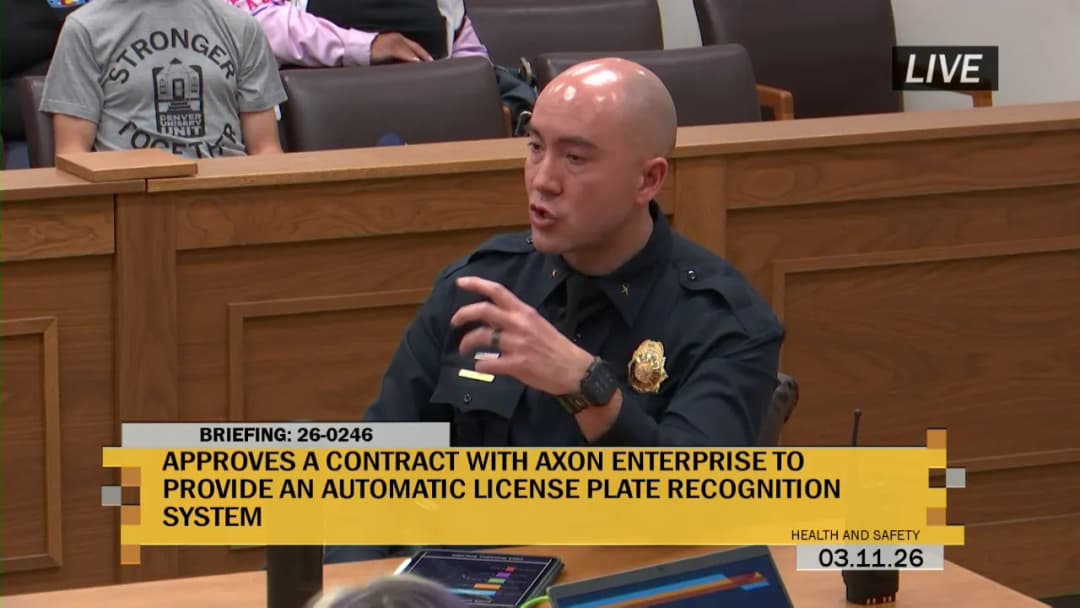
Note: The transcript incorrectly identifies the meeting as March 18, 2026; the agenda and minutes show March 11, 2026. The Health and Safety Committee of the Denver City Council met on March 11, 2026, to consider a contract with Axon Enterprise, Inc. for an Automatic License Plate Recognition (ALPR) system. The committee received a presentation from city officials, heard extensive discussion, and voted to postpone the action item to March 18, 2026, to allow time for review of the final contract. Consent Calendar - Approved Council Resolution 26-0231: a contract with Michael’s of Denver Catering, Inc. for $3,500,000 to prepare and deliver nutritious meals to children at Tasty Food Program sites, citywide, with an end date of 12-31-2031. Discussion Items - Presentation on Axon ALPR Contract (26-0246): Tim Hoffman (Mayor's Office), Commander Cliff Barnes (Denver Police Department), and Tara Segura (Technology Services) presented the proposed contract. The $150,000 one-year contract would provide 50 Axon Outpost cameras, hardware, software, and a 21-day data retention policy (reduced from 30 days). Key safeguards included: FedRAMP High security authorization, data encryption at rest and in transit, no AI training using city data, no data sharing with third parties without explicit opt-in, access limited to Denver safety personnel, and an immutable audit log. The administration requested a postponement to allow council members to review the final contract. - Council Q&A: Councilmembers raised numerous concerns and questions, including: - Councilmember Parady: questioned the timeline for decommissioning Flock cameras, the need for a contract clause preventing unauthorized feature additions, the accuracy of audit logs, the live streaming capability of the cameras, and the potential for data sharing with other jurisdictions. She expressed concern about entering the contract without a completed surveillance ordinance or updated DPD policies. - Councilmember Cashman: requested data on the number of crimes solved by Flock cameras, emphasized the need for guardrails on data sharing, and expressed skepticism about Flock's 'decommission mode'. - Councilmember Gonzales-Gutierrez: asked about the rationale for the 21-day retention period, the status of Flock drones, and the potential for public access to audit results. - Councilmember Flynn: sought clarification on the interactivity between Axon cameras and other devices, the accuracy of ALPR alerts, and whether monthly audit logs could be shared with council. - Councilmember Torres: asked about the process for updating the operations manual, the real-time crime center's staffing, and the impact of adding technology on the DPD budget. - Councilmember Sawyer: highlighted the need to see the final contract before voting, noting that guardrails must be in the contract. She viewed the reduced number of cameras (50 vs. 11 Flock) as a pilot. - Councilmember Parady (second round): raised concerns about Axon's history with an ethics board resignation, potential immigration enforcement ties, and the need to protect First Amendment activities. - Councilmember Cashman (second round): asked about the trigger mechanism for cameras (heat signature vs. motion) and how data sharing with other jurisdictions would work. - Axon Representative (Joey Domino): answered questions about camera capabilities (dual sensors for ALPR and live streaming, 98% accuracy, ability to search vehicle characteristics), data sharing features (case-based or reason-based sharing under development), and the transparency portal. Key Outcomes - Vote to Postpone: A motion by Chair Watson, seconded by Vice Chair Flynn, to postpone Resolution 26-0246 to a date certain of March 18, 2026, carried by a vote of 6-0 (Flynn, Gonzales-Gutierrez, Parady, Sawyer, Torres, Watson in favor; Sandoval absent). - Expectation: The administration agreed to provide the final contract to council members by Friday, March 13, 2026, for review before the postponed meeting.

TECHNOLOGY AND INNOVATION 45% · PUBLIC SAFETY 35% · CONTRACTS AND PROCUREMENT 12% · PROCEDURAL 4%
OPENPUBLICA · PUBLIC MEETING INDEXUPDATED DAILY · openpublica.com