Browse by city
Date range
Search help

Search titles, summaries, topics and stored transcripts together. Keywords may match separately; put the whole query in double quotes for a phrase. Matching follows word analysis, so punctuation is not exact. Both dates are included. Documents are not searched.

SHOWING 481–490 ENTRIES
481
MAR 5, 2024 · DENVER, COLORADO · MAYOR-COUNCIL MEETING
Denver Mayor and City Council Meeting - March 5, 2024: Roads to Recovery Update and Executive Session

[Introductory paragraph] The weekly session of the mayor and Denver City Council convened on March 5, 2024, with introductions from council members and district announcements. The main agenda item was a briefing on the "Roads to Recovery" initiative aimed at improving the continuum of care for individuals struggling with addiction and mental health issues. The meeting concluded with a motion to enter executive session to discuss ongoing litigation. Announcements - Councilmembers shared district events, including District 6 Academy on March 27, a Good Neighbor Agreement meeting in Globeville/Elyria/Swansea, coffee conversations in District 10, open office hours in District 4, and a business roundtable. - Council President reminded attendees to vote in the presidential primary election. - Personal milestones were noted, including Councilwoman Parody's daughter's birthday and Councilman Watson's anniversary. Discussion Items - Roads to Recovery Update: The mayor and policy director Matt presented a strategy to break the cycle of incarceration and recidivism for individuals with addiction or mental health needs. The initiative focuses on a coordinated entry system (e.g., Aid Center, Denver CARES, Solution Center) leading to treatment, specialty courts, and long-term stability through housing and workforce connections. Initial focus is on 37 individuals with 24+ arrests and an 800-person high-risk list. First-year goal: move 200 people through the system. The initiative is funded by reallocating existing resources and grant dollars, with no new general fund allocation in year one. - Councilmember Feedback: - Councilman Cashman expressed full support but emphasized making treatment access as easy as purchasing alcohol or cannabis, suggesting storefront locations. He called for historic investment in future budgets. - Council President Pro Tem Sandoval raised concerns about gaps for youth aging out of systems, family reintegration, and the need for quality providers. She referenced past efforts like the social impact bond and urged research on high-frequency users similar to "Reggie's list." - Councilwoman Parody requested broader council involvement and offered to support grant applications. She asked for more details on working groups, changes to entry points, and the scope of "first contact." - Councilman Watson highlighted technical assistance needs at entry points (e.g., spreadsheet-based tracking) and questioned funding sustainability, noting that some investment may be essential. - Councilman Heinz shared a personal story about addiction's impact on his family and noted the disparity between private industry's easy access to substances and the public/nonprofit burden of dealing with consequences. - Councilwoman Gonzalez-Gutierrez stressed the need for youth-specific services, noting few providers, and pointed out demographic disparities: the Solution Center serves a whiter population than the incarcerated population, partly because only first responders can bring people in, creating a decision point that may lead to racial disparities. - Councilwoman Alvidres thanked the team for addressing issues in her district (e.g., deaths on Broadway) and urged support for community-based organizations like Four Winds Council's indigenous healing program. - Councilwoman Lewis asked about success metrics (measured as stability in the community), cultural competency of providers, evaluation tools to assess provider performance, and adequate funding for providers to handle increased volume. - Council President requested a financial briefing on current costs for Aid Center, Denver CARES, and Solution Center, noting that the Solution Center may need additional funding due to reduced federal Medicaid reimbursements. Key Outcomes - No formal vote on the Roads to Recovery initiative; it remains a policy brief with further briefings promised to council committees. - A motion was made and approved unanimously to enter executive session pursuant to DRMC 20-2348, three and six, to discuss settlement of ongoing litigation against the city. - The mayor's team committed to providing additional briefings, including a finance briefing and a more detailed presentation to council committees on working groups and provider partnerships.
MENTAL HEALTH AWARENESS 54% · PUBLIC SAFETY 15% · COMMUNITY PLANNING 15% · PROCEDURAL 10%
482
FEB 27, 2024 · DENVER, COLORADO · MAYOR-COUNCIL MEETING
Denver Mayor and City Council Briefing on 2024 Citywide Goals - February 27, 2024

At the weekly Mayor-Council session on Tuesday, February 27, 2024 (16:30 UTC), city leaders shared announcements, heard the Mayor's proposed 2024 citywide goals, and voted to move into executive session. Council members offered feedback on measurement, community engagement, climate and equity, and public safety. No agenda or minutes were available; this summary relies solely on the transcript. Announcements - Councilwoman Sawyer reminded residents of an online Exposition Street traffic study meeting at 6:00 p.m. that evening, covering Quebec to Leetsdale, including the George Washington High School triangle. - Councilwoman Alvidrez announced a 5:30 p.m. roundtable at Table Public House with a micro-community operator and Denver Police Department, and a March 6 business roundtable in District 3 with the Council President and Mayor at Mi Casa Resource Center. - Councilmember Gonzales-Gutierrez highlighted a youth gun violence prevention town hall at West High School the previous Saturday, where young people raised concerns about rec center hours and programs, funding for community-based organizations, culturally responsive mental health support, and root causes of gun violence. - Councilman Cashman praised community support for newcomers, citing the Love Project at Ellis Elementary and McMean, and noted Little India owner Cimeron Bidwan provided 600 meals to overnight shelter users during a recent cold spell. - Councilman Watson announced a February 28 Black History Month event at the Posner Center, 5:00-7:00 p.m., co-hosted with Councilwoman Lewis and Mayor Johnston. Discussion Items - The Mayor presented proposed 2024 citywide goals built on a vision of a Denver that is 'vibrant, affordable, and safe for all' and values of listening, daring, and delivering. Specific targets include: improving employee engagement by 5%; engaging the public across all 11 council districts to envision vibrant neighborhoods and downtown and identify funding by year-end; moving 2,000 people indoors from unsheltered homelessness; permitting, financing, or supporting 3,000 long-term affordable housing units; moving 200 individuals struggling with addiction or mental health out of the criminal justice system into an intervention, treatment, and rehabilitation pipeline by December 31; reducing violent gun crime by 20%; improving customer satisfaction with emergency services by 15%; reenvisioning the development permitting process to reduce city review time by 30%; and cutting response time to the top three 311 constituent concerns by 20%. - Councilwoman Alvidrez expressed concern about middle-class housing affordability, foreclosure prevention, and mortgage assistance. She called for more accessible CASER energy-efficiency programs, including vendor list and school-based e-bike distribution, and for better coordination among youth violence prevention efforts. The Mayor said the affordability pipeline will include households up to 120% of median income, pledged to take CASER feedback directly to the office, and noted an ongoing landscape analysis of youth violence programs. - Councilwoman Parady asked about the mechanics of 'tiger teams,' who owns each goal, how council members can plug in, and how city revenues fit. The Mayor said he would provide a list of point people, explained that each goal has two leads (Mayor's office and relevant agency), and offered quarterly town halls in council districts plus an offline budget/revenue conversation. - Councilwoman Romero Campbell praised the SMART goals and asked about coordination with council committees, requesting a District 4 town hall within the next quarter. The Mayor described team structure with permanent members, content experts, and on-call advisors from finance, the city attorney, equity, and climate, and said teams would be available to committees. - Councilman Cashman supported the public engagement goal and urged improvements to the Registered Neighborhood Organization (RNO) structure. He also asked why climate/environment were not explicit goals. The Mayor said climate and equity are cross-cutting priorities integrated across departments, citing work on electric fleet infrastructure, charging stations, solar gardens, and renewable energy. - Councilman Hines agreed on RNO reform and asked how the 311 response-time goal would be measured, noting that 311 currently closes tickets within 48 hours without taking action. The Mayor responded that 'response time' means actual action or service delivered, not acknowledgement, and that sub-goals will be specific. Hines also raised constituent concerns about trash collection changes in Congress Park. - Councilmember Gonzales-Gutierrez asked about rollout timelines, community feedback across all goals, and flexibility to add agencies. The Mayor said all goals are starting concurrently with different first steps, metrics will be tracked quarterly, community feedback will be gathered through town halls, and teams can be adjusted. - The Council President raised equity questions about how neighborhoods experience issues differently and asked how the 20% violent gun crime reduction would be assessed geographically, noting District 3's heavy ShotSpotter use and a 'donut' pattern of violence around the city. The Mayor said the work begins in the most affected neighborhoods, uses place network investigations and crime prevention through environmental design, and includes comprehensive support, community input, and multi-agency coordination. Key Outcomes - No vote was taken on the citywide goals; council feedback was received for further refinement. - The Mayor committed to provide a document listing point people for each goal and to schedule quarterly town halls in council districts. - Council members' requests regarding CASER accessibility, RNO reform, committee engagement, and district-specific town halls were acknowledged as follow-ups. - The council voted unanimously to enter executive session under Denver Revised Municipal Code Section 23-4(a)(4) and (6) to discuss ongoing negotiations of contracts to potentially acquire or use real property for shelter or housing. The motion required and received two-thirds approval, and the meeting adjourned to executive session.

COMMUNITY ENGAGEMENT 32% · PROCEDURAL 17% · PUBLIC ENGAGEMENT 13% · COMMUNITY PLANNING 11%
483
FEB 13, 2024 · DENVER, COLORADO · MAYOR-COUNCIL MEETING
Denver Mayor and City Council Weekly Session – February 13, 2024

This weekly session of the Denver Mayor and City Council on February 13, 2024, included council member announcements, a lengthy discussion about disruptions and safety concerns from the previous night's council meeting, and an update from the mayor on the first round of budget cuts totaling approximately $5 million. Council members expressed support for public participation while condemning threats and bullying. The meeting concluded with a motion to enter executive session to discuss ongoing litigation. Discussion Items - Council Member Statements on Previous Night's Meeting: Councilman Darrell Watson (District 9) described the previous night's council meeting as a "takeover" where council members were berated, yelled at, and threatened. He stated that someone yelled "you should die" and that a council member was followed to their car. Council President Jamie Torres acknowledged the national climate of division, noting that all 13 council members have received threats regardless of their votes. Council President Pro Tem Amanda Sandoval shared personal experiences of being targeted and stressed the need for mental health support. Councilwoman Diana Romero Campbell distinguished between hard feedback (which elected officials should absorb) and threats (which are unacceptable). Councilwoman Flor Alvidrez emphasized the importance of maintaining a space for civil disagreement and warned that good people will not run for office if such behavior continues. Councilwoman Stacey Gilmore noted that bullying silences not just council members but also constituents who might feel unsafe attending meetings. - Mayor's Budget Update: Mayor Michael Johnston announced the first round of budget adjustments (approximately $5 million in savings) from the Department of Parks and Recreation and the Department of Motor Vehicles (DMV). He noted that this is only a fraction of the $180 million shortfall, with 30 to 40 times that amount still to be cut from other city agencies. Parks and Recreation Director Jolon Clark explained that the early action was taken to minimize the impact on critical services, but there will be reduced hours at recreation centers and potential loss of seasonal jobs. DMV adjustments involve pausing new hires and shifting existing staff between centers. Councilwoman Amanda Sawyer expressed concern about disproportionate impacts on youth and requested coordination with Denver Public Schools to open school pools. Councilwoman Amanda Sandoval thanked Parks and Rec for its leadership in making the difficult first cuts. Key Outcomes - The mayor announced the first round of budget cuts totaling approximately $5 million, with further cuts expected from all 24 city agencies. - Council members committed to improving safety and decorum at future meetings, including continuing to allow public comment while addressing threats and disruptions. - A motion to enter executive session pursuant to DRMC 234A3 and 6 for the purpose of discussing settlement of ongoing litigation against the city was approved. - No formal votes were taken on budget items during this session.

PUBLIC SAFETY 33% · COMMUNITY ENGAGEMENT 20% · PROCEDURAL 17% · BUDGET EQUITY ANALYSIS 12%
484
FEB 8, 2024 · DENVER, COLORADO · MAYOR-COUNCIL MEETING
Denver Mayor Council Meeting - February 8, 2024

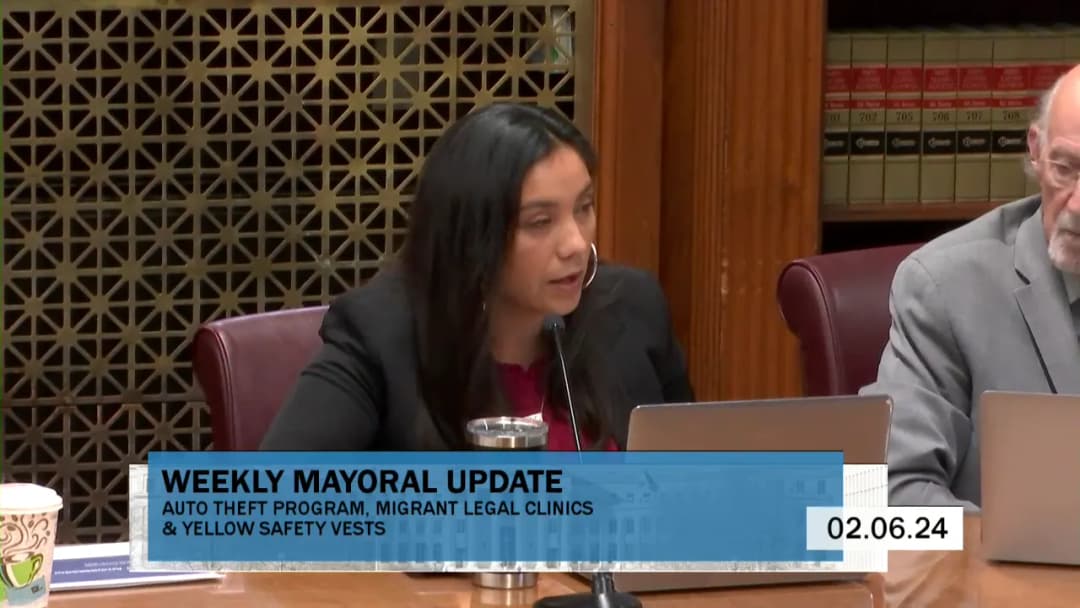
The Mayor and Denver City Council convened on February 8, 2024, for updates on the city's auto theft program, the ongoing migrant shelter and legal clinic operations, and the newly launched Denver Ambassadors program for downtown coordination. Discussions largely centered on resource allocation, program oversight, and the balance between public safety and community-based response. Auto Theft Program Update - Mayor provided updates on the comprehensive auto theft reduction strategy, which includes a permanent DPD auto theft team, expansion of automated license plate readers (ALPRs), software upgrades for Hyundai and Kia vehicles, and distribution of steering wheel locks at police districts. - Statistics: The Mayor cited a 90% reduction in auto thefts at Denver International Airport over the previous three to six months. The program was noted as building on ideas pioneered by Councilmembers Cashman and Sawyer. - Councilwoman Torres (District 3) questioned the placement of 15 cameras in her district, the highest in the city. The Mayor explained placements were driven by auto theft 'hot spots' data, aiming for an average of roughly 10 cameras per district citywide. - Councilwoman Sawyer testified to her personal experience registering for the Denver Track program, confirming it was easy to use and that no registered cars have been stolen to date. She specifically countered concerns about police overreach. - Councilwoman Gonzalez Gutierrez inquired about protocols to deter individuals from tracking and retrieving their own cars following a prior tragedy. The Mayor stated the program aims to replace this practice, but there is no specific ordinance prohibiting it; the city is actively discouraging it by providing a city-led tracking alternative. Migrant/Newcomer Response Update - Shelter Exits: The Mayor announced the first group of families exited shelter on February 7. He stated 100% had transition plans, connecting to housing, family/friends, or other cities. - Councilwoman Parady challenged this assessment, reporting 'chaos' from the prior day. She cited a family with a hotel being taken by a volunteer and questioned the coordination of the five housing navigation nonprofits. She stressed that saying 100% were resolved was 'not a realistic portrayal of what is happening'. - Legal Clinics: The city is standing up clinics to process CBP One work authorizations for eligible newcomers (approx. 800 identified). Two clinics are scheduled for February 15 and 16 with USCIS present. The Mayor noted 80% of arrivals lack CBP One eligibility and must navigate a longer asylum process. - Population & Costs: Of the roughly 5,000 people in shelter, 80% are families. About 45% of shelter guests are children. The city has received roughly $20 million from the state, but the Mayor warned that failure of the federal border bill could require the city to absorb up to $180 million in budget cuts. - Councilwoman Lewis requested a comprehensive document on the crisis. Councilwoman Parady listed extensive outstanding questions regarding shelter discharge schedules, vendor accountability (AC Disaster Services for McNichols), DPD issuing fines to migrants washing windows ($60 tickets), and the need for better council notification. - Mayor acknowledged the dilemma, framing it as a 'dilemma' (competing values) rather than a 'problem' that can be fixed. He noted the overwhelming volume: 'three and a half weeks to prep for one day of exits, and then that number is undone by a day of arrivals'. - Coordination: Discussion of a city coordinating council with Denver Public Schools, which must meet before March 31, 2024. Denver Ambassadors Program - Description: A 'yellow vest' program unifying existing private security (Downtown Denver Partnership, private buildings) and nonprofit outreach (Denver Dream Center) under a single communication system and uniform for downtown. - Mayor's Position: The program is a communication alignment, not a scope of work change. The city is not funding or supervising the private security. The goal is visibility and coordinated response without escalation, with serious issues still routed through 311/911. - Councilwoman Gonzalez Gutierrez noted discrepancies from the Safety Committee presentation and requested details on the triage process and training of responders. - Councilwoman Parady strongly opposed the program, arguing it outsources public safety oversight to private security without POST certification, and specifically cited Allied Security's contract termination by RTD after the Rivero Stanet assault. She argued the yellow vest implies city imprimatur and liability. - Councilman Lewis echoed concerns, recounting his experience on the RTD board with Allied Security. He raised concerns about vigilante authority, stressing the need for strict performance metrics for any city dollars involved. - Councilman Watson noted the lack of coordinated communication between DDP and council prior to the program's rollout, which caused confusion. - Councilman Nines pointed out the funding disparity between the Downtown BID ($12.5M for 120 blocks) vs. Cherry Creek ($8.5M for 16 blocks) and suggested augmenting the city's STAR program citywide with downtown funding. - Councilwoman Sawyer framed the debate as a 'yes and' conversation, acknowledging the program's good intentions but validating the council's concerns about needing more time to ask questions and address gaps. Key Outcomes & Next Steps - Data and Transparency: The administration committed to providing council with comprehensive documents on migrant operations, legal pathways, and shelter exit data. A notification process for sweeps on DPR land will be established. - Oversight: Council will continue to seek detailed answers on the training, triage, and accountability structures of the Ambassadors program. - Executive Session: Council moved into Executive Session (DRMC 233 C1 and 234 A6) for a collective bargaining negotiations update. - FinGov Session: Cancelled because General Services was not ready to present.

PUBLIC SAFETY 44% · IMMIGRATION LAW 13% · COMMUNITY ENGAGEMENT 13% · HOMELESSNESS 9%
485
JAN 23, 2024 · DENVER, COLORADO · MAYOR-COUNCIL MEETING
Mayor-Council Meeting Update on Migrant Supports and Federal Advocacy - January 23, 2024

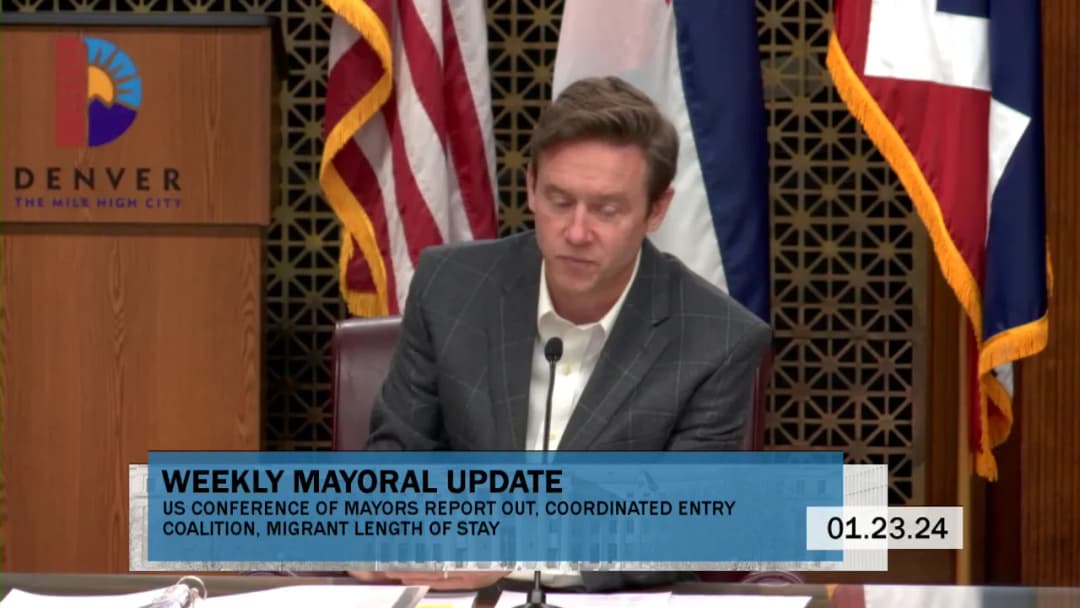
This meeting of the Mayor and Denver City Council on January 23, 2024, focused primarily on an update from Mayor regarding migrant support services, federal advocacy efforts, and legislative prospects. The meeting concluded with a motion to enter executive session to discuss collective bargaining negotiations. Discussion Items - Migrant Support and Federal Advocacy Update: Mayor reported on his recent trip to Washington D.C. for the U.S. Conference of Mayors, where he engaged with mayors, White House officials, and Senators on three key needs: increased federal funding, expanded and expedited work authorization, and a coordinated entry system for migrants. He noted that conversations with Senate sponsors suggest a bipartisan bill including federal dollars and accelerated work authorization may be introduced in the coming week. However, he expressed concern about passage in the House of Representatives, recalling the 2013 Gang of Eight proposal that stalled. He outlined three near-term options: passage of federal legislation, executive actions (e.g., extending TPS for Venezuelans), and reallocation of city resources or service adjustments. He emphasized that Denver is at carrying capacity with about 5,000 newcomers and that any surge (e.g., 250 arrivals per day) would overwhelm capacity. - Council Questions and Responses: - Councilman Gonzalez-Cutieris asked whether the proposed bill and potential executive orders would apply to all immigrants or only Venezuelans. Mayor responded that the bill likely focuses on future arrivals and may not apply to current residents, and executive orders are not yet concrete. He noted that other cities have different immigrant populations (e.g., New York and Chicago see more African and Caribbean asylum seekers). - Councilman Sawyer asked how the Council could support the Mayor's advocacy. Mayor suggested a joint letter, mobilization of councils from other cities, and leveraging council members' personal networks to persuade federal lawmakers. He acknowledged the bill may contain provisions some may not like, but expressed his bias toward securing city relief given the severe consequences of inaction. Key Outcomes - The Council received the update and discussed potential support actions. - The Council voted unanimously to move into executive session pursuant to DRMC 233 C1 and 234A6 for collective bargaining negotiations. The motion passed with two-thirds vote of members present. The meeting then adjourned into executive session. Note: No agenda or minutes were available; summary based solely on transcript.

IMMIGRATION LAW 40% · MIGRANT SERVICES 31% · PROCEDURAL 20% · COLLECTIVE BARGAINING 9%
486
JAN 9, 2024 · DENVER, COLORADO · MAYOR-COUNCIL MEETING
Mayor and Denver City Council Meeting - January 9, 2024: Public Safety Initiative and Migrant Crisis Update

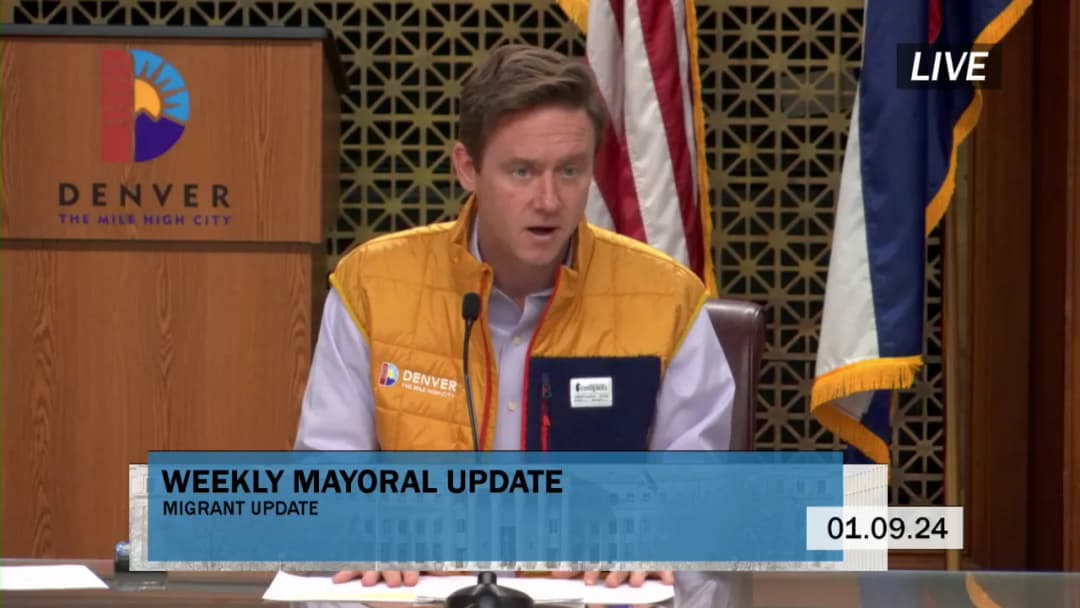
This weekly session of the mayor and Denver City Council began with introductions and featured two major briefings: a coordinated public safety effort launched on January 8, 2024, and an update on the migrant crisis. The meeting concluded with a motion to move into an executive session to discuss ongoing litigation. Discussion Items Coordinated Public Safety Effort (Downtown Clean & Safe) - Mayor announced a multi-partner initiative launched on January 8, 2024, focusing on downtown Denver. Key components include: - Clear Streets & Safe Sidewalks: 1,135 people moved into housing; all major downtown encampments closed. The city aims to prevent re-encampment by connecting individuals to housing. - Safe & Clean Denver App: A partnership with the Downtown Denver Partnership allowing residents to report issues (trash, safety concerns) directly to a central dispatch, which routes to the appropriate responder (e.g., STAR van, co-responder, DPD, public works). - Denver Ambassadors Program: A unified yellow vest system for all outreach partners (nonprofits, private security, city staff) to provide a recognizable point of contact for help. The Dream Center (a nonprofit serving formerly unsheltered and justice-impacted individuals) is a key partner. - Activation Grants: Dynamic downtown Denver Grants for events like mariachi bands, Shakespeare in the parking lot, and badminton to bring joy and activity downtown. - Councilmember Watson (District 9) expressed strong support for the Dream Center's role, highlighting their trust and relationship-building with unsheltered individuals. - Councilmember Hines (District 10) endorsed the yellow vest identification, noting it helps residents and taxpayers see their funding in action. - Councilmember Cash (District 6) asked about volunteer opportunities; Mayor responded that currently all ambassadors are trained contracted staff, but the city will explore adding a volunteer framework. - Mayor emphasized that the approach shifts the first point of contact from police to community ambassadors, preserving police resources for actual safety risks. Migrant Status Update & Budget Crisis - Mayor reported that the number of migrants in shelter has risen from 400 in July 2023 to 4,800 as of January 9, 2024 — a 12-fold increase. The city has filled all shelter space (hotels and two congregate sites) and lacks capacity to add more. - Budget Impact: The 2024 projection for migrant support is $180 million, representing 10–15% of the city's total budget. Department heads have been asked to prepare for 10–15% cuts across departments to absorb this cost. - Housing Strategy: The city has accelerated housing clinics, with over 400 housing applications submitted between Christmas and New Year’s. However, many migrants lack work authorization (due to asylum processing delays of 6–8 months), making it difficult to secure income verification for housing. The city is using $345,000 in council discretionary funds for deposits and first month's rent. - Process Improvement: Councilmember Gonzalez-Gutierrez (at-large) requested a detailed process plan for intake and integration. Chief of Staff John Redder noted that a new position (Newcomers Coordinator) has been posted within Denver Human Services to coordinate the response. - Councilmember Alvidres (District 7) stressed the need to support all undocumented workers, not just recent migrants, and noted that many have been without work authorization for years. - Councilmember Sawyer (District 5) highlighted Denver's wage theft ordinance, which allows third-party complaints for undocumented workers through the Auditor’s Office (via 311). - Councilmember Parity (at-large) asked about the RFP process for restructuring migrant services and about inter-city coordination. Mayor stated he is working with other mayors on a coordinated entry system and will discuss at the National Conference of Mayors. He also welcomed council-to-council outreach to push mayors in other cities. - Council President Pro Tem Sandoval (District 1) emphasized the need for clear language (e.g., “onward travel” confusing) and noted that Denver is expensive, so migrants should be informed of other affordable destinations. Key Outcomes - No formal votes were taken on the public safety or migrant topics. - The council unanimously approved a motion to enter executive session pursuant to DRMC 234A3N6 to discuss settlement of ongoing litigation against the city. The motion was moved, seconded, and passed by voice vote with all in favor. - Next steps: Department heads will return with budget cut proposals; the mayor will continue inter-city coordination; council members will have one-on-one meetings with the mayor's office to discuss budget implications and migrant strategy.

MIGRANT SERVICES 43% · PUBLIC SAFETY 30% · PROCEDURAL 13% · COMMUNITY ENGAGEMENT 6%
487
JAN 2, 2024 · DENVER, COLORADO · MAYOR-COUNCIL MEETING
Denver Mayor and City Council Briefing on Homelessness and Migrant Response - January 2, 2024

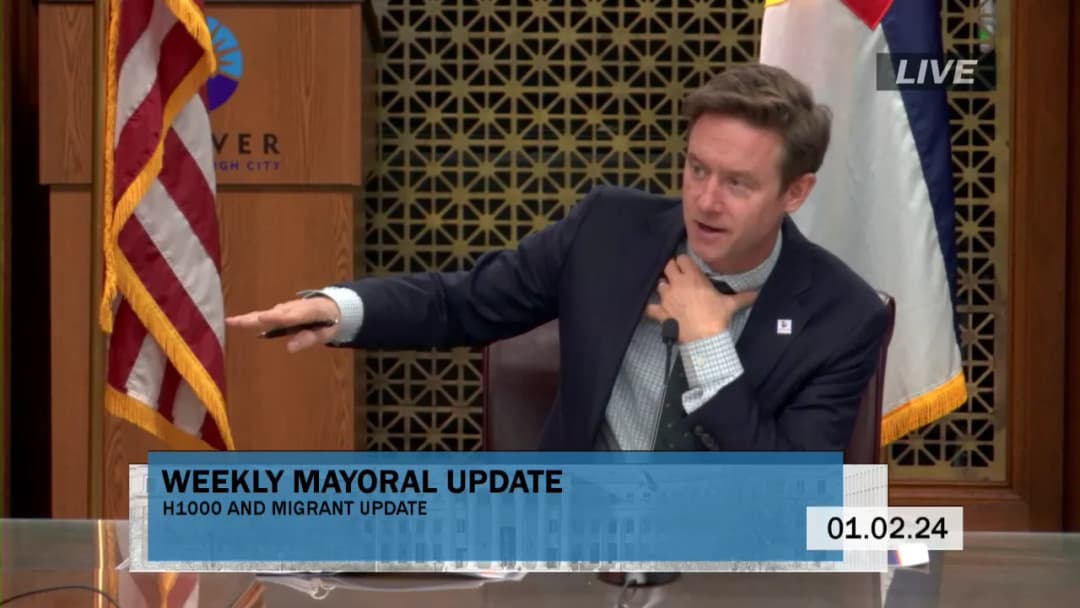
The Mayor and Denver City Council met on January 2, 2024, for a weekly briefing. The session covered two main agenda items: an end-of-year update on the city's homelessness efforts and an update on the migrant situation, including the closure of the encampment at 26th and Zuni. Council members asked questions, made requests for future information, and expressed support for the administration's work. Homelessness Response Update - The Mayor reported that no new emergency declaration is needed, and the previous emergency has subsided. The total number of people moved from streets into housing is expected to exceed 1,100, with a final count around 1,130 by the end of the day. - Two new sites, the LODI and Overland sites, are scheduled to open within the next four to six weeks, delayed by shipping of community buildings. - The city has resolved 10 large encampments, moving residents directly into housing, and has conducted individual outreach citywide through leased units and vouchers. - Seven new sites will be operational in January. The family sheltering system has been expanded by more than 35 percent through the Embassy Suites site, cutting the family waitlist in half. More than 60 community meetings were held. - A publicly available dashboard tracks moves indoors, exit destinations, and later average length of stay. The Mayor said a more detailed safety briefing will cover workforce training, mental health, addiction services, and job placements at each site. Migrant Encampment and Shelter Update - The encampment at 26th and Zuni has grown to more than 300 people. The city is closing the encampment, moving individuals to two congregate sites on January 3 (tomorrow from the meeting date). The target length of stay at those sites is 30 days while housing applications are processed. - In the two weeks preceding the meeting, 95 individuals had been moved directly from the encampment into housing. Of the encampment's residents, 295 have submitted housing applications, and roughly two-thirds of those relocating already have applications pending. - Council allocated $345,000 from its budget to cover application fees, deposits, and first month's rent. The Mayor credited this allocation for enabling the rapid housing program. - The Mayor reported 4,500 newcomer migrants in shelter that night, about 10 times the number when the council took office about 100 days earlier (then 400). More than 150 buses arrived in December, bringing roughly 200-250 new arrivals per day. - The projected 2024 budget for migrant services at current capacity is approximately $180 million, equal to 10-15 percent of the city's general fund budget. Council Discussion and Requests - Councilman Hines thanked the Mayor for setting an aggressive goal and said it appeared "the impossible is possible." - Councilwoman Parady requested a list of employees who contributed to the success and asked who was responsible for the dashboard. The Mayor said the host team and technology services collaborated, with regional partner MDHI. - Councilwoman Sawyer asked for a future conversation about next steps, noting unresolved smaller encampments, and requested a wrap-up of financials, particularly hotel investments. The Mayor agreed to provide both a budget wrap-up and a look ahead. - Councilwoman Romero Campbell asked that the dashboard track children in families, noting the Embassy Suites move of 138 families (approximately 400 people) included many children, newborns, and pregnant women. The Mayor noted an additional 300 migrants who were rehoused are tracked separately. - Councilman Alvidas expressed concern that Denver is bearing a disproportionate share and urged partnership with other cities and states. The Mayor said he had called 12 mayors and planned to contact 20 more, and that Denver is the largest per-capita recipient of migrants in the nation—2.5 times the second-place city. He discussed a coordinated entry plan that could reduce arrivals to about 50 per week from the current 2,000, and said he would attend the U.S. Conference of Mayors in 10 days. - Councilwoman Sandoval spoke emotionally about the impact on Northwest Denver, described daily involvement and personal attacks, and stated she "a hundred percent" supports moving people indoors. She invited colleagues to join her at the site closure the next morning and noted that 180 million in budget will require hard decisions. Key Outcomes - No formal votes were taken; the session was informational. - The Mayor committed to provide: a list of employees for recognition, an overview of the next phase of homelessness strategy, a financial wrap-up and look ahead at the budget, and more detailed site-by-site service data at a future safety briefing. - The city will proceed with closing the 26th and Zuni encampment on January 3, moving residents to two congregate sites.

HOMELESSNESS 44% · MIGRANT SERVICES 32% · PROCEDURAL 9% · PERSONNEL MATTERS 6%
488
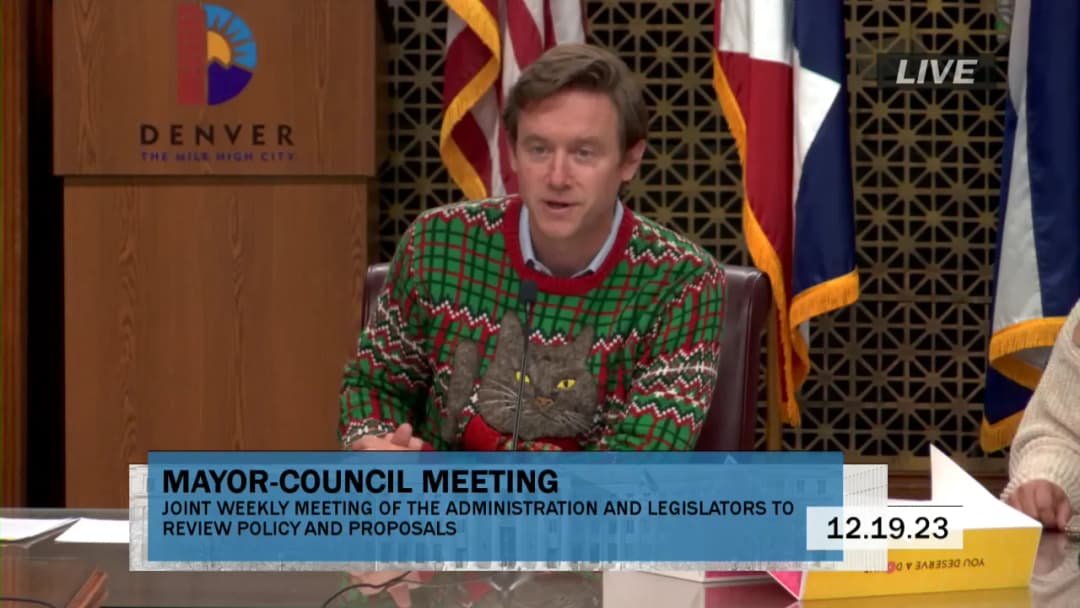
DEC 19, 2023 · DENVER, COLORADO · MAYOR-COUNCIL MEETING
Mayor and Denver City Council Weekly Session – December 19, 2023

This meeting of the Denver Mayor and City Council convened on December 19, 2023 at 8:30 AM. The council heard holiday announcements, updates on housing and community events, a review of board and commission diversity efforts, and voted unanimously to enter an executive session. No agenda or minutes were available; this summary is based solely on the meeting transcript. Announcements & Reports - Council President Pro Tem Sandoval called for grace and compassion toward city staff, shelter workers, and everyone working with migrant communities during the holiday season, acknowledging that her own patience had been tested by emails. - Councilman Daryl Watson of District 9 announced a community information meeting on Thursday, December 21, 2023 from 6:00–7:30 p.m. at the Johnson Rex Center regarding the Radison conversion to house unsheltered residents through the 'housing 1000 process.' Food and childcare will be provided. - Council President Jamie Torres announced the groundbreaking of 'The Three at Theodora' family hotel on West Colfax, a five-story, 60-family suite project with a $27 million budget. It converts an old motel into family homes, with Volunteers of America as a partner. - Mayor and Council President initiated the holiday 'ugly sweater competition.' Discussion Items - Mayor highlighted upcoming appointments to boards and commissions, emphasizing a goal of increasing diversity across all city boards. Esther is leading the review. Council President Torres suggested consulting Human Rights and Community Partnerships about their diversity matrices. Key Outcomes - The Council voted unanimously to enter executive session under state statute 24-34-C(a)(3) and (4) for settlement negotiations and legal advice related to municipal bus regulations. The meeting then recessed for that session.

PROCEDURAL 88% · MIGRANT SERVICES 10% · HUMAN RIGHTS 2%
489
DEC 12, 2023 · DENVER, COLORADO · MAYOR-COUNCIL MEETING
Denver Mayor and City Council Meeting - December 12, 2023

The Denver Mayor and City Council convened for a weekly session on December 12, 2023, with introductions from council members and the mayor. The meeting featured community announcements from councilmembers and concluded with a unanimous vote to enter executive session to discuss ongoing negotiations for property acquisition for shelter or housing and related legal advice. Announcements & Community Updates - Councilmember Flora Alvidres announced a virtual town hall with the Overland microcommunity on Thursday, December 14 at 5 PM, hosted by the mayor. - Councilmember Diana Romero Campbell invited residents to a community information meeting about the Embassy Suites on Saturday at 10 AM at Hamilton. - Councilmember Darrell Watson announced a District Nine \"Council in the Community\" event at Prodigy on 40th in Cole on Friday, December 15 from 11:30 AM to 1:00 PM. - Councilmember Serena Gonzalez Gutierrez noted that December 12 is a free admission day at the Denver Art Museum and other SCFD facilities. - Councilmember Jamie Torres announced a community engagement listening session on Thursday, December 14 regarding proposed healthy drink options (water or unflavored milk) for kids\' meals at Denver restaurants to limit sugar intake. - Councilmember Sarah Parody announced the Golden Triangle Creative District holiday party on Friday, December 15 from 5:30 to 7:30 PM. - Councilmember Gonzalez Gutierrez wished Emily Ochoa, an at-large council aide, a happy birthday. Key Outcomes - The council unanimously voted to enter executive session pursuant to DRMC 2-34 A34 and six to discuss ongoing negotiations for contracts to acquire or use real property for shelter or housing, and to receive legal advice related to such acquisitions. The motion was made, seconded, and passed with no opposition.

PROCEDURAL 78% · COMMUNITY ENGAGEMENT 13% · AFFORDABLE HOUSING 9%
490
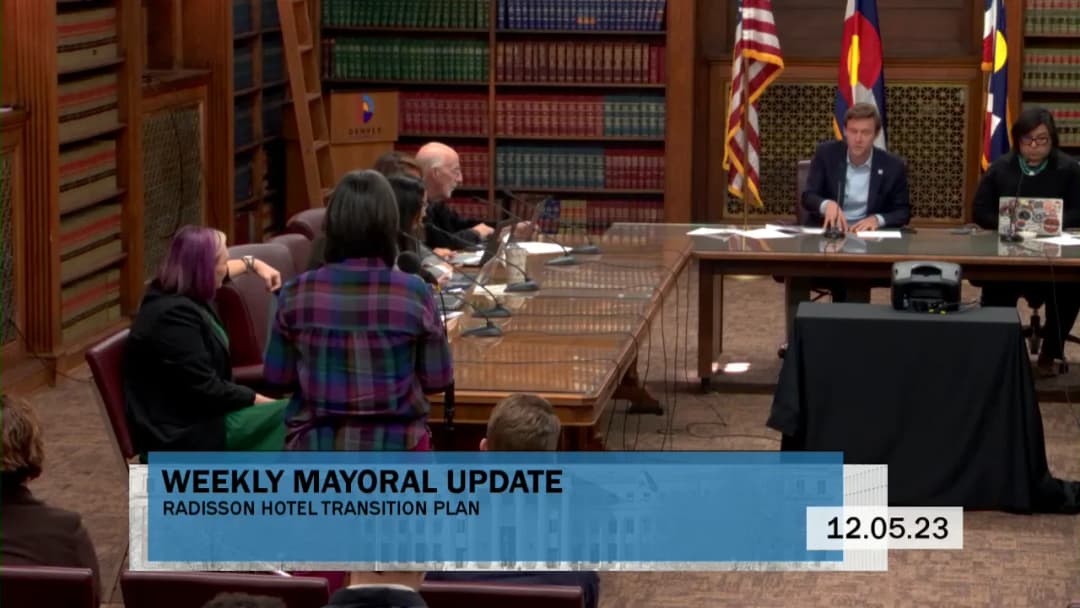
DEC 5, 2023 · DENVER, COLORADO · MAYOR-COUNCIL MEETING
Mayor and Denver City Council Meeting: Radisson Hotel Update & Announcements (2023-12-05)

This weekly meeting of Mayor Mike Johnston and the Denver City Council included introductory remarks, member announcements, a detailed presentation on the transition of the Radisson Hotel from a migrant shelter to a non-congregate shelter for individuals experiencing homelessness, and a motion to enter executive session for litigation discussion. The meeting opened with introductions and announcements covering community events, health initiatives, and a significant update on the migrant response and shelter system. Announcements - Councilwoman Amanda González-Cuchillas announced the passing of community pillar Lucille Ribal Rivetta and provided details on her services and celebration of life. - Council President Jamie Torres acknowledged the consent agenda’s continued funding for the Immigrant Legal Services Fund, noting its creation in 2017. - Councilwoman Laura Alvidrez highlighted Colorado Gives Day and reported that food insecurity in Denver has risen from 1 in 10 families last year to 1 in 3 families this year, urging donations to Community Ministries Denver. - Councilwoman Shontel Lewis invited colleagues to the 40th annual Hiawatha Davis Senior Luncheon on December 8 at the DoubleTree Hotel, free for seniors 65+ (or 55+ with exceptions). - Councilwoman Diana Sandoval announced that council members and central staff donated a total of $390,000 from their budgets to support migrant families, funds now moving through city council process. - Councilwoman Diana Romero Campbell promoted a community information meeting on the family shelter on December 16 at 10 a.m. at Hamilton Middle School, as well as a ‘Donuts with the Grinch’ event on December 16 at Eisenhower Rec Center. - Councilman Paul Cashman reminded colleagues of the 34th annual ‘We Will Remember’ Homeless Persons Memorial Vigil on December 21 on the steps of the City and County Building, honoring those who died while experiencing homelessness in 2023. - Councilman Chris Heinz encouraged support for the Clifford Still Museum (a city asset) and the Dumb Friends League on Colorado Gives Day. Discussion Items - Radisson Hotel Transition and Contracts: Senior Advisor for Homelessness Resolution Cole Chandler presented the plan to convert the Radisson Hotel (4849 Bannock Street, Council District 9) from a migrant shelter to a non-congregate shelter for individuals experiencing homelessness. Key points: - The site offers 220 total units; 51 migrant families remain as of the meeting date. - Final transition date for migrant families is December 16, with children enrolled in Denver Public Schools allowed to stay through the semester end (December 15). No displacement of families; children will not be moved before the academic term ends. - Migrant families will be prioritized for relocation to other shelter sites on the west side to maintain geographic proximity. - A community information meeting was noticed on November 30 (21-day notice); the contracts will go to Safety Committee on December 13, with final council consideration on December 18 (target). Move-in for homeless individuals is scheduled for December 20-21 (110 rooms each day). - Two contracts were detailed: a master lease with the hotel owner (Quebec Hospitality, local ownership) for 12 months at just over $10.3 million, covering all rooms, ballrooms, and parking; and a 6-month service agreement with Bayod Enterprises for wraparound services, including 24/7 staffing, case management, and health services. Bayod is tasked with serving 250 individuals, with a target of 40% exiting to permanent or stable housing (an annual benchmark). - Discussion on Metrics and Accountability: Midori Higa (Homelessness Resolution Programs Director) clarified that the 40% exit rate is an annual benchmark; for the six-month contract, expectations may be adjusted. Councilman Hines questioned the math of 40% of 220 rooms exceeding 250 served, but was informed that rooms turn over (roughly 2.5 uses per room per year) and the 40% is annual. Councilman Watson requested monthly performance reviews; Lisa Lumley (Director of Real Estate) confirmed that quarterly site visits and data reviews are standard, with bi-weekly meetings for new micro-communities. - Concerns on Purchase Orders and Displacement: Councilwoman Sawyer raised concerns about a recent incident at an Aurora hotel where residents were displaced when the city used a purchase order to rent rooms for migrants. Mayor Johnston explained that during emergencies, purchase orders allow rapid room acquisition (e.g., 400 arrivals on Thanksgiving night). He acknowledged the Aurora issue and committed to ensuring all hotel operators include clear displacement mitigation strategies in future agreements, with documentation for council verification. - Census Data and Parks Amenities: Councilman Lewis inquired about the demographic data for sites; Chandler explained the red dotted lines represent census tracts, showing that five of seven sites are in tracts with higher average income ($94,700 vs. city median $78,000) and less Hispanic population. She also requested attention to parks and amenities for new shelter residents. Key Outcomes - The motion to enter executive session (pursuant to DRMC 2-34(a)(3) and (6) for litigation settlement discussion) was moved, seconded, and approved unanimously by voice vote. - No final votes were taken on the Radisson contracts; they are scheduled for Safety Committee on December 13 and full council on December 18. - The administration committed to incorporating displacement prevention clauses in future emergency purchase orders and to providing documentation of compliance. - The migrant fund donation of $390,000 from council and central staff budgets will proceed through the council process. - Councilmembers will receive updated waitlist numbers for homeless families (approximately 120 families) from the administration later that day.

MIGRANT SERVICES 35% · HOMELESSNESS 33% · COMMUNITY ENGAGEMENT 13% · PROCEDURAL 11%
OPENPUBLICA · PUBLIC MEETING INDEXUPDATED DAILY · openpublica.com