Browse by city
Date range
Search help

Search titles, summaries, topics and stored transcripts together. Keywords may match separately; put the whole query in double quotes for a phrase. Matching follows word analysis, so punctuation is not exact. Both dates are included. Documents are not searched.

SHOWING 201–210 ENTRIES
201
MAR 18, 2026 · DETROIT, MICHIGAN · CITY COUNCIL
Detroit Internal Operations Standing Committee Meeting - March 18, 2026

The Detroit City Council's Internal Operations Standing Committee met on March 18, 2026, to consider a range of items including public comments, an interview for the Detroit Land Bank Authority, several contract amendments, lawsuit settlements, and representation/indemnification requests. The meeting began without a quorum but later achieved quorum after Councilmember Miller joined. Public Comments & Testimony - Mr. Cunningham (in-person): Advocated for improved D-Dot bus services, particularly after 6 p.m. and on weekends. Described a community initiative he organized (pizza and raffles for bus tickets) that D-Dot is now continuing. Also raised an issue with the United Way 211 service, noting that individuals using the Text Now app cannot call 211 from their cell phones, and suggested a workaround. - Benny A. Varner (President of the Soda Ellsworth Black Association, virtual): Provided alternative ways to contact 211 (toll-free number 1-844-875-9211 or texting zip code to 898211). Announced a free health fair on April 18, 2026, at Mount Zion Missionary Baptist Church, offering eye screenings, health services, and more for adults and children in the Metro Detroit area. - Caller ending in 039 (Ruben Crowley Jr., virtual): Accused District 3 Representative Scott Benson of cheating in elections and called for federal investigation. Made allegations against Daniel Baxter and others. - William M. Davis (virtual): Expressed support for Mr. Cunningham and Ms. Varner, calling for more proactive community engagement. Criticized the city's payment of indemnifications and lawsuits, and urged increased voter turnout in Detroit. - Final caller ending in 169 (virtual): Agreed with previous speakers, praised Mr. Cunningham's gumption, and thanked the committee. Discussion Items - Line Item 7.5 – 1300 Lafayette Litigation: Melvin Butch Hollowell (Managing Partner, Miller Law Firm) appeared to discuss the litigation involving the Historic District Commission. The committee voted to send the formal objection to the full council with a recommendation to approve. - Housekeeping (Bringbacks): Line item 7.1 (fire prevention ordinance) was brought back to April 8, 2026. Line item 8.7 (request for information on tenants' rights commission appointments) was brought back to April 1, 2026. Two receiving files (7.3 and 8.6) were received and filed. - Interview for Detroit Land Bank Authority Appointment: Raymond Lozano (Executive Director, Mexican Town Community Development Corporation) was interviewed. He emphasized his long Detroit residency, experience in community development, and commitment to fair representation. Councilmember Miller asked about his priorities for residents; Mr. Lozano stressed ensuring that properties are sold to Detroiters and continuing blight removal. Councilmember Benson asked about communication with the council; Mr. Lozano pledged to be transparent and proactive. The committee voted to recommend approval and send to formal session. - Line Item 7.2 – Board of Ethics Request: The committee discussed a request to lift privilege on a legislative policy division memo and to allow separate legal counsel for the Board of Ethics. After discussion, a motion to deny the request passed, sending it to the full council with a recommendation to deny. - Line Item 7.4 – LAZ Parking Contract Amendment: An amendment to increase funds and extend time for city employee parking spaces (contract runs through January 30, 2029, increase of $791,000 for a total of $1.127 million). Approved without objection. - Line Item 7.6 – Proofpoint Subscription Renewal: Cybersecurity contract with Security Solutions Services, LLC for $481,000. Initially described as a three-month contract, but a correction letter extended it to 2027. Approved without objection. - Line Items 7.7, 7.8, 7.9 – Lawsuit Settlements: Settlements of $50,000 (Kimberly Roblouski v. City) and $10,000 (Manuel Gibson v. DDOT) were approved. Also 7.8 and 7.9 were bundled. - Line Items 7.10–7.15 – Representation and Indemnification: Bundled motion initially approved, but after objections from Councilmember Benson (7.14) and clarification from the Law Department (7.13 was inapplicable), the committee reconsidered. Final action: items 7.10, 7.11, 7.12, and 7.15 were approved and sent to formal; 7.13 was brought back in one week; 7.14 was brought back for a date to be determined after a closed session. - Line Item 8.1 – Appointment Resolution: The resolution related to the Land Bank interview was moved to formal with a recommendation to approve. - Line Item 8.2 – Contract with Cummings for Conviction Cases: Amendment 9 to add $500,000 for legal services related to reverse conviction cases. Graham Anderson (Law Department) explained the high stakes and need for outside counsel. Approved without objection. - Line Item 8.3 – Settlement in Clark v. City: Approved $95,000 settlement for claims against the Department of Transportation. - Line Item 8.4 – Rescission of Settlement: Removed due to a typo in the resolution; to be resubmitted. - Line Item 8.5 – Election Security Grant: Accepted a $257,000 federal grant from the Michigan Bureau of Elections for the Department of Elections. No match required. Approved. Key Outcomes - Appointments: Raymond Lozano recommended for appointment to the Detroit Land Bank Authority (sent to formal session). - Denials: Board of Ethics request to lift privilege and obtain separate counsel was denied (recommendation to full council). - Contracts Approved: LAZ parking amendment ($1.127M), Proofpoint subscription ($481,000), Cummings legal services ($500,000 amendment). - Settlements Approved: $50,000, $10,000, $95,000 (three separate lawsuits). - Representation/Indemnification: Five items approved (7.10, 7.11, 7.12, 7.15); two items held for further review (7.13 and 7.14). - Grant Acceptance: $257,000 election security grant accepted. - Bringbacks: Items 7.1 (April 8) and 8.7 (April 1) scheduled for future meetings. - Item Removed: 8.4 removed due to clerical error. - Public Comment: Three virtual speakers and one in-person speaker were heard; comments included concerns about transit, 211 access, election integrity, and city indemnification practices.
PENDING LITIGATION 27% · PUBLIC COMMENT 20% · PROCEDURAL 18% · LAND BANK 16%
202
MAR 17, 2026 · DETROIT, MICHIGAN · CITY COUNCIL
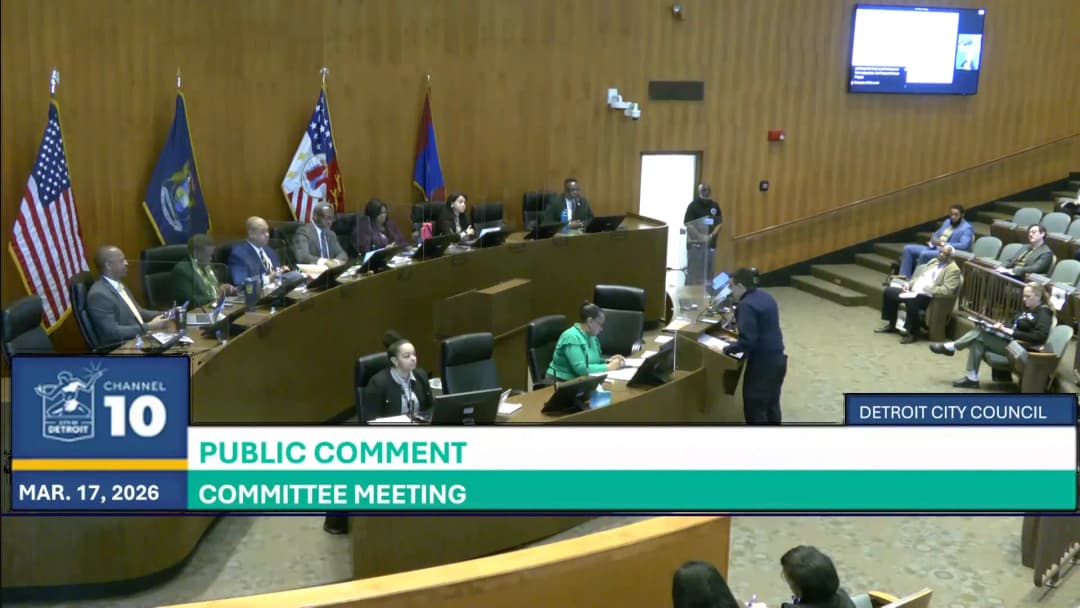
Detroit City Council Formal Session - March 17, 2026

On Tuesday, March 17, 2026, the Detroit City Council held a formal session beginning with an invocation for Ramadan, followed by presentations recognizing deed fraud education partners and a young Mensa scholar. The council then heard public comments, debated items including appointments to the Detroit Land Bank Authority, a two-year moratorium on data centers, and tree trimming contracts, and approved numerous resolutions. Consent Calendar - The journal of the March 3, 2026 session was approved. - Multiple reports from city departments were referred to standing committees without objection. Public Comments & Testimony - Ruben James Crowley Jr. criticized council members, alleging election fraud and calling Councilmember Gabriela Santiago Romero a liar. - Kenneth Isaacson, a paramedic with the Detroit Fire Department, shared his story of overcoming foster care and becoming a first responder, advocating for foster youth programs. - Char Williams alleged misconduct by Detroit police officers, including identity theft and illegal weapons possession at a shelter. - Lemisha M. Lee called for better accessibility for disabled citizens, robot legs, and prison reform. - Ronald Foster urged accountability for vendors like United Housing Coalition, stating they must acknowledge past wrongs. - Brother Cunningham promoted a hybrid community input meeting and emphasized listening to constituents. - Stephen Rimmer and Darryl Stewart (Leland residents) raised concerns about security, generator costs, and the lack of transparency in the Leland building redevelopment, urging expedited access to their properties. - Josh Mann criticized the city's response to Leland break-ins and called for removal of Flock camera systems, labeling them a military weapon. - Terry Jones reported his house on Rosemary Street was sold without his knowledge and alleged fraud at the Wayne County Deeds Department. - Anthony Eden (CDAD) presented a transition playbook for the new administration, supporting increased housing trust fund funding and D-Dot investment. - Online commenters: Betty A. Varner promoted caregiver support services; Shamika alleged sexual assault by DPD and criticized female council members for silence; William Davis praised awardees but noted District 7 lacks libraries and recreation centers; a caller urged recognition for Professor Bernadette Atuahene; Renard Bashewski affirmed transit budget proposals; Chris Gilmer-Hill supported the data center moratorium citing electricity price impacts; Shadante Smith called for downzoning near industrial areas; C. Gina Brown questioned conflict of interest in council votes and neglected District 3; Darren McCoy supported the moratorium and criticized the solar neighborhoods initiative. Discussion Items - Deed Fraud Education Series Presentation: Councilmember Mary Waters honored volunteers including Emma Elder Hall, Ted Phillips, Lakeshore Legal Aid, and Suzanne Fanning for their work educating residents. Speakers thanked the council and noted the need for continued efforts—5,500 homes still have untransferred deeds. - Miles Danzler Recognition: Councilmember Waters presented a Spirit of Detroit award to 8-year-old Miles Danzler, a Mensa achievement honoree (top 2% globally). His parents expressed gratitude and announced plans to visit schools with books and toys. - Land Bank Authority Appointments (18.1, 18.2): Councilmember Waters objected to approving mayoral appointments without first acting on her resolution to renegotiate the intergovernmental agreement (IGA) with the state land bank. Council President Tate and others noted ongoing discussions to codify a council appointment. The Law Department clarified the mayor holds appointing authority under state law. Motion to approve 18.1 and 18.2 passed; 18.2 (Donna Givens) received one no vote from Waters. - Data Center Moratorium (18.8): Councilmember Benson proposed a two-year moratorium on new data centers to allow zoning and environmental study. Several members supported the duration, citing national concerns about energy use and utility costs. Councilmember Young proposed a one-year amendment, which failed. The two-year moratorium passed with opposition from Young (who favored one year) and Miller (who wanted to await constituent input). Member Callaway joined remotely as a co-sponsor. - Tree Trimming Contracts (21.11–21.17): Councilmember Johnson and Miller objected to contracts awarded to non-Detroit vendors, arguing the city should prioritize local businesses. Member McCampbell stressed the need for Detroiters on these contracts. The contracts were approved despite objections from Johnson, Miller, and Tate on specific items. - Right to Counsel & Hotline (19.1): Removed from the agenda at the administration's request for further logistics. - SIMCOG Board Appointments: A resolution to amend appointments was postponed after debate over whether the council president and pro tem are required to serve as delegates. The council decided to hold further discussion. Key Outcomes - Approved: Journal, committee reports, and most consent items. - Approved with objections: Land Bank appointment (18.2) – one no; tree trimming contracts (21.12, 21.13, 21.15, 21.16, 21.17) – objections from Johnson, Miller, Tate; data center moratorium (18.8) – objection from Young. - Removed: Line item 19.1 (Right to Council Hotline) to be resubmitted. - Postponed: Line item 18.9 (by Young) for one week; SIMCOG resolution for further discussion. - Waivers denied: Request for waiver on 18.2 was objected; waiver on 21.11–21.17 also objected. - Walk-on resolutions approved: Three resolutions from Member Waters honoring Miles Danzler, Von Z. Whitlow, and John Richard Seabitt III were placed on new business and approved without objection. - Member reports: Upcoming events including Women's History Month celebration (March 20), Skill Trade Task Force meeting (March 18), and free Serve Safe manager certification training.

PUBLIC COMMENT 16% · PROCEDURAL 14% · INTERGOVERNMENTAL AGREEMENT 9% · PUBLIC ENGAGEMENT 7%
203
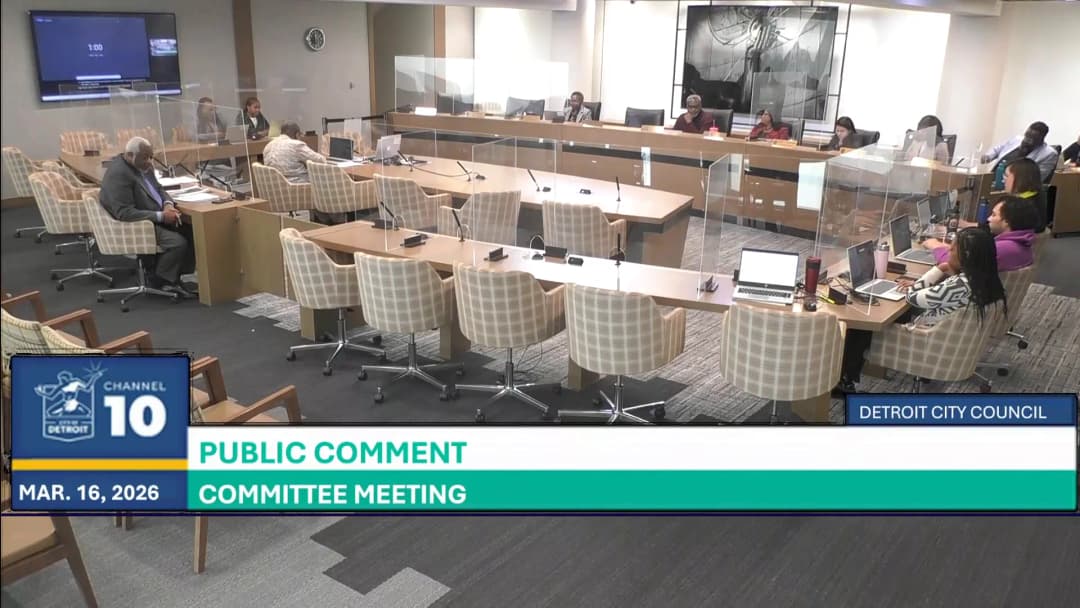
MAR 16, 2026 · DETROIT, MICHIGAN · CITY COUNCIL
Detroit Fire Department FY2027 Budget Hearing - March 16, 2026

On March 16, 2026, the Detroit City Council held a budget hearing for the Detroit Fire Department (DFD). Commissioner Chuck Sims and his team presented their FY2027 budget, highlighting achievements, response metrics, community programs, and future initiatives. Council members raised questions on demographics, recruitment, retention, capital improvements, firefighter health, and technology. Public Comments & Testimony - No public comments were made. Discussion Items - Budget Presentation: Commissioner Sims introduced his leadership team and outlined DFD's alignment with Mayor Sheffield's "Rise Higher" platform. Key metrics included: 1,311 budgeted members, 40-42 daily ambulances, 450 medical calls/day, over 300 patient transports/day, CO1 response time of 7 minutes 30 seconds (consistent for two years), over 73,000 total incidents responded to, structure fire response time of 5 minutes 20 seconds (beating NFPA standard of 6-7 minutes), lowest structure fires in 40 years (1,471), and over 45,000 medical runs. - Fire Communications: Dispatched over 180,000 emergencies; consistently met NFPA 30-second standard at 20 seconds for two years. - Community Relations: Installed/distributed over 4,000 smoke and CO detectors; attended over 80 community events reaching over 30,000 citizens; provided fire safety presentations reaching over 33,000 citizens; hands-only CPR sessions for over 3,200 citizens; distributed DFD safety guides in English, Spanish, Arabic, and Bengali; received FEMA grant for a smoke training trailer; trained over 1,000 eighth graders in hands-only CPR; hired an ADA coordinator. - Fire Marshal: Implementing a community risk reduction initiative targeting district-specific risks; inspecting 100% of critical structures (high-rises, senior multifamily, gas stations, rec centers, hazardous material sites, schools); launched a business self-reinspection program. - Fire Investigations: Joint task force with police (16 fire investigators, 8 police officers); investigate 100% of structure fires; created a state-recognized fire investigation course. - Training: First internal paramedic training class of 28 resulted in 25 licensed, 3 testing (90-95% pass rate vs. 70% national average); nine EMT classes increased departmental EMT or higher licensure to over 80%; cross-training of all EMS personnel; two fire academy classes for new recruits; five disciplines for rescue courses. - Next Generation of Life Savers: Investing in youth with CPR/AED awareness, apprenticeship program, and Heart Safe Community designation (largest city in the U.S. with this designation). Key Outcomes - Demographics & Residency: Commissioner Sims reported DFD is 51% white, 34% African American, 10% no answer/prefer not to say, remaining Hispanic and Asian; approximately 25% of the department are Detroit residents. (Councilmember Benson noted the department lacks a formal retention period, and Deputy Commissioner Hillman stated a prior legislative effort dropped the fire aspect). - Recruitment: Commissioner Sims confirmed ongoing talks with HR to establish specialized recruiters for DFD, similar to DPD. - Community Outreach: Reported plans to increase community relations staffing; current smoke/CO detector inventory is being replenished after the DSAP program ended. - Capital Investment: Councilmember Benson moved to request the administration provide a capital plan for upgrading/replacing fire stations (motion approved with no objections). He also moved to add $500,000 for a capital fund study for the fire department (approved without objection). - Revenue: Commissioner Sims noted EMS billing (Bravo 24, $22.7 million) could potentially increase by $1-2.5 million per year once the paramedic program is fully implemented (5-10% increase). - Firefighter Cancer & Health: Councilmember Waters moved to "do an analysis of fire firefighters, health and wellness" (approved without objection). Council President Tate pressed for more details on cancer presumption challenges; Commissioner Sims stated that an oncologist reviews files and disqualifiers include 10-year smoking-free status and documented non-work-related causes. DFD now offers cancer screenings twice a year (aiming for quarterly) and has proactive gear cleaning with two sets of gear to reduce carcinogen exposure. - Mental Health Response: Councilmember Santiago-Romero moved that the administration, fire, and police work to move the COIL response (mental health response unit) under the fire department first (approved without objection). She also expressed full support for the upcoming nurse navigation program. - Technology: Council President Pro Tem Young discussed extended reality, augmented reality, drones, and AI. Commissioner Sims confirmed DFD is researching augmented reality face pieces, smart clothing, and autonomous drones dispatched simultaneously with fire companies. AI is also being considered for EMS billing and report writing. - Advisory Commission: Councilmember Miller moved to hold a discussion on reinstating the advisory commission for the fire department (approved without objection). She also moved to develop mandatory safeguards to ensure Detroit is not used as a training ground, suggesting a minimum three-year employment commitment (approved without objection).

PUBLIC SAFETY 54% · PUBLIC HEALTH 9% · PROCEDURAL 8% · TECHNOLOGY AND INNOVATION 7%
204
MAR 16, 2026 · DETROIT, MICHIGAN · CITY COUNCIL
Detroit Public Health & Safety Committee Meeting - March 16, 2026

The Detroit Public Health and Safety Standing Committee met on Monday, March 16, 2026, from approximately 9:00 AM to 10:00 AM. The meeting was chaired by Councilmember Gabriela Santiago Romero and included Vice Chair Denzel McCampbell and Councilmember Mary Waters. Due to budget hearings later in the day, the meeting was constrained to one hour. The committee approved several contracts, discussed flood prevention, rental fee reforms, and referred multiple items for further review. Consent Calendar - Minutes from the previous session were approved without objection. Public Comments & Testimony - William M. Davis (former 34-year water department employee) urged the city to improve emergency preparedness planning, citing increased flooding since the bankruptcy and past FEMA Incident Command training. He called for more preventive maintenance of infrastructure. - Mr. Foster (in-person) raised concerns about the police union's history of defending officers without acknowledging wrongdoing, referencing a 1997 case. He requested the union acknowledge past wrongs. - Caller ending in 169 expressed gratitude to council members, using the word "gumption," and urged fixing DDOT (Detroit Department of Transportation). - Betty A. Varner (President, Soda Else for Black Association) promoted caregiver support resources through Community Solutions (Executive Director Deborah A. Roy), including in-home assistance and free activities, regardless of Medicaid status (phone: 313-438-0808). - Mr. Cunningham (Transit Riders United) reported that flowers were sent for Stephen Halloween (a transit advocate who died in a Florida car accident) and advocated for rehiring Corey Holmes at DDOT and making DDOT fare-free. - Caller ending in 482 (District 6 resident, self-identified as "young blood from the Brewster Project of 1980") accused Chair Santiago Romero of lying and alleged election fraud since 2020. - Carolyn Hughes was unable to speak due to technical difficulties. Discussion Items - Water Department Flood Prevention (5.1): Chair Santiago Romero discussed a memo on water department planning for citywide flooding. She emphasized the need to replace old infrastructure and highlighted preventive maintenance of catch basins. She noted that street flooding often involves debris and leaves, and encouraged residents to clean up leaves. Vice Chair McCampbell echoed the need for preventive vacuum trucks and mentioned constituent flooding reports. The item was received and filed. - Commercial Buildings with Liens (5.2): Requested to be brought back in one week; motion passed. - RX Kids Program Contract (6.1): Contract 6007651 with Michigan State University for $1.5 million, funded 100% by opioid settlement funds, to administer the RX Kids program providing cash transfers to pregnant Detroiters and families with infants ($1,500 mid-pregnancy, $500/month for 6 months after birth). Luke Schaefer presented: independent research showed improved prenatal care, reduced preterm birth, fewer NICU admissions, reduced evictions, and decreased postpartum depression. He noted state funding covers three years, with broad bipartisan support. The contract was approved for new business. - HIV/AIDS Contracts (6.2, 6.3, 6.4, 6.5): Multiple health department contracts totaling over $10.7 million for HIV services and WIC programs were approved. - Vehicle Repair Contract (6.6): Contract 600726 with Curry Bros. Truck Repair for $60,000 (city-funded) for light duty vehicle/truck repair; approved for new business. - Dangerous Buildings Orders (6.7, 6.8): Findings and orders for February 20 and February 27, 2026, were received and filed. - Rental Fee Ordinance (6.9): Councilmember Waters sponsored an ordinance to amend Chapter 22 of the 2019 Detroit City Code to limit pre-tenancy fees and application fees for renters. Referred to the Law Department for approval as to form. - Ordinance Enforcement Report (6.10): Chair Santiago Romero noted a disconnect between resident complaints about enforcement of the healthcare facilities ordinance and DPD's report stating no issues. She committed to following up. Received and filed. - Street Vacation Petition (6.11): Detroit International Bridge Company petition to vacate streets/alleys in the Ford Street, Savoy, and West Lafayette area (within the plaza footprint). Mr. Doherty confirmed the vacation is within the existing footprint. Approved for formal session. - Memo on Data Center Regulation (6.12): Resolution in support of House Bills 5594 and 5596; response received, filed. - Severe Weather Awareness Week (6.13): Memo from Member Johnson's office; brought back in two weeks. - Rental Certificate of Compliance (6.14): Memo requesting draft review; brought back in two weeks. - Developmental Disabilities Awareness Month (6.15) and National Social Work Month (6.16): Proclamations approved for new business. - Securing City Property Against Federal Overreach (6.17): Memo to codify barring certain ICE activities on city property; brought back in one month. - Women's History Month (6.18) and Don Ison's Day (6.19): Proclamations received and filed. - Safe Storage of Cannabis Ordinance (6.20): Request for report and draft ordinance; brought back in one month. Key Outcomes - Approved contracts (6.1–6.6) sent to new business with recommendation to approve. - Referred ordinance (6.9) to Law Department for review. - Set return dates for various memos: 5.2 (one week), 6.13 (two weeks), 6.14 (two weeks), 6.17 (one month), 6.20 (one month). - Chair announced next budget hearing at approximately 10:15 AM (Fire Department), followed by DDOT Transportation in the afternoon. - Member Waters reminded about the Skill Trade Task Force meeting on Wednesday, March 18, 2026, from 4-6 PM at IBEW Local 58.

PUBLIC COMMENT 18% · PUBLIC HEALTH 15% · WATER AND WASTEWATER MANAGEMENT 11% · PROCEDURAL 9%
205
MAR 16, 2026 · DETROIT, MICHIGAN · CITY COUNCIL
Detroit City Council D-DOT Budget Hearing: March 16, 2026

On March 16, 2026, the Detroit City Council held a budget hearing for the Detroit Department of Transportation (D-DOT). Director Robert Kramer presented the FY 2027 budget and provided updates on service improvements, fleet modernization, safety initiatives, and youth programs, including a new year-round fare-free bus program for K-12 students. Council members discussed bus reliability, shelter placement, fare-free pilot proposals, safety for drivers, and the need for long-term transit transformation. Public comment was taken and will continue at a public hearing on March 30, 2026. Public Comments & Testimony - Megan Owens (Transportation advocate): Thanked the council for attention to D-DOT, noting progress is slow, and urged doubling the D-DOT budget to achieve adequate service and fully implement D-DOT Reimagined. - Donald Stuckey: Stated that any state dollars received for D-DOT should be in addition to, not a replacement of, city dollars, expressing concern that state funds were being used to replace some city funding. - Joel Batterman: Emphasized the importance of D-DOT investments for Detroiters' opportunities and quality of life, specifically asking for increased frequency on routes like the hourly Linwood bus, as proposed in D-DOT Reimagined. - Caller ending in 169: Praised council for helping people and said "fix D-Dot." - Betty Varner (President, Soda Elsewhere Black Association): Asked the council to allocate funds to cover the $1,500 application fee required for a land use hearing when Black clubs want to install playground equipment on vacant lots, and for investment in neglected neighborhood corridors. - Caller (IPhone): Suggested using smaller, cheaper vans or short school buses for low-ridership night routes instead of million-dollar full-size buses. - Cassie Pettler (Resident, District 4, Detroit Disability Power): Called for fully funding D-DOT Reimagined by 2030, including borderless paratransit and 15% coverage of bus stops with shelters and benches. Recommended the website isthemetroaccessible.com for tracking stop amenities. - Renard Monchinski: Praised the proposed budget and the conversation about fares and driver security, saying the budget reflects the mayor's goals for reliability and frequency and is the result of years of advocacy. - Samson S M: Described lack of shelters on the Six Mile, Conant, and Van Dyke bus routes, urged council to provide shelters, and complained about slow weekend service. - William M. Davis: Called for expanding the People Mover with low-cost parking, moving D-DOT toward green energy, and providing free bus rides for all city of Detroit retirees. - Rochella Stewart: Supported funding D-DOT Reimagined by 2030 and urged council to pass at least a $30 million budget for DDOT to create an efficient, replicable transit system. - Caller (Cunningham): Called for doubling D-DOT, borderless paratransit, and free bus fares, arguing sponsors can be found just as for the People Mover and QLine. Also referenced a whistleblower article on Facebook. Discussion Items - Consent Calendar: Routine approvals and unanimous actions were taken without recorded opposition. - FY 2027 Budget Presentation: Director Kramer presented D-DOT's FY 2027 budget aligned with Mayor Sheffield's "Rise Higher" vision, with a focus on youth and seniors. The budget includes a year-round fare-free bus program for K-12 students, Accessibility 2.0 for seniors and individuals with disabilities, and increased funding for paratransit. The general fund subsidy for D-DOT is $84.2 million (down from $97 million in FY 2026 due to increased state Act 51 funding). Total subsidy including DTC (People Mover) is $118 million. The budget also adds five new FTEs, including a Public Health Liaison, while reducing some driver positions due to lower turnover in training classes. - Fleet & Service Updates: Director Kramer reported that D-DOT provides 50,000 rides daily. A 10% service increase last year failed because of vehicle availability. The new union contract (ratified November 2025) has increased active drivers by about 50 (to a net positive after decades of decline). Bus availability fluctuated—dipped to 80% of 45 New Flyers back up, now projected to increase. Summer 2025 saw July/August dips; recovery to near 100% in Nov/Dec 2025 followed by a Jan/Feb 2026 drop, now recovering again. By April 2026, the Coolidge Terminal (165M project) will reopen. 60 shelters and 25 benches installed; 100 more shelters and 175 more benches are funded and in process. Cloth seats are being replaced with vinyl on all new and recent buses; remaining 80 older buses (model years 2014-2015) still need replacement. Two federal grants for low-emission buses cover all 80 eligible replacements for FY 2027-2028. - Youth Programs & Free Fares: The FY 2027 budget includes funding for a year-round free bus program for K-12 students. D-DOT launched "Ride Free for Three" (providing three monthly passes to new employees of enrolled Detroit businesses; over 100 passes provided so far). Councilmember Johnson noted that the response to Cody High School students' requests was positive. Councilmember Mitchell (apparently through a question) moved to include a pilot for free fares for D-DOT in the closing resolution—passed without objection on the floor. Director Kramer said D-DOT will study the costs and implications of a fare-free pilot or fuller implementation (noting that in Houston the cost of induced ridership made free fares very expensive—$300M in capital alone). - Safety & Security: A new onboard camera system (with higher resolution, more cameras, and real-time remote access for DPD) will be fully deployed by first quarter FY 2027. A safe driver incentive program ($500/quarter for no preventable crashes) started with a 18% reduction in preventable accidents so far (preliminary data, two months). D-DOT works with DPD transit unit on security. For paratransit, an AI voice assistant ("Alex") now handles over 50% of calls (booking, cancelling, confirming trips) to reduce wait times. On questions about driver protection, Director Kramer reported that vapor barriers were added during COVID, but they are not full cabs; policy prohibits operators from carrying weapons. He committed to circle back on whether mace or similar could ever be allowed. - Shelters & Benches: Councilmember McCampbell noted only four shelters in District 7; three on Grand River, one west of Southfield Freeway. Director Kramer explained the prescribed selection process (based on boarding data, title VI equity, state historic review, and federal environmental approvals—taking 18 months). Cost is $50,000+ per site. There is no budget currently to expand beyond the 100 funded shelters; benches are more flexible. Councilmember McCampbell made a motion to add a conversation about additional shelters and benches in a future session—passed without objection. - Accessibility 2.0: The FY 2027 budget includes $1 million for launching Accessibility 2.0, a grant-funded successor to the first autonomous shuttle pilot. It expands coverage, includes veterans and survivors of gun violence, and aims to become a permanent DDOT service. Phase 2 will add autonomous vehicles, contingent on an MDOT grant. - Real-Time Information & Customer Service: D-DOT is upgrading its real-time data feed (working with a partner also used by PeopleMover and SMART) to improve accuracy, enable detour alerts, and enhance customer service. This is prioritized based on feedback from students and seniors. QR codes and informational posters will be placed at key stops linking to the improved Detroit app. - Connections & Regional Transit: Councilmember Waters asked about connections between D-DOT and SMART for commuting to jobs in the suburbs. Director Kramer noted that about half of Detroit residents work outside the city and half of city jobs are held by non-residents, making regional connections critical. The upcoming regional transit millage (if approved) would generate about $7-8 million for Detroit—significant but modest relative to D-DOT's budget. Discussions on its use are ongoing. - OMI & EV Charging: Ryan Michael (acting chief, Office of Mobility Innovation) reported that the city has three new DC fast chargers (one often broken) and 11 level-two chargers, with 21 more sites planned citywide covering all seven council districts. OMI plans a 30% increase in scooter availability in 2026, aiming for 100-200 scooters per district. Councilmember Benson noted all four DC fast charger ports were recently down; he requested a plan to ensure reliability through revenue from the mandated 39-cent/kWh charge and proactive maintenance. - Future Vision & "System of Choice": Council President Tate asked Director Kramer what it would take to make D-DOT a system people choose to use, not just a necessity. Director Kramer discussed layering services (microtransit, express buses, improved frequency), aligning land use and transit, and stressed the need for reliability and real-time information. Councilmember Young proposed a set of reforms using AI, autonomous vehicles, and trackless trams, citing projected cost savings (operating cost per bus hour from $170 to $140, fleet downtime from 18-22% to 8-10%, on-time performance from 72% to 90%) and major ridership growth (40-120%) and economic benefits. He committed to sharing the proposal with Director Kramer. Key Outcomes - Motion Passed (Unanimous): To include a pilot for free fares for D-DOT as part of the closing resolution. Councilmember Mitchell's motion was adopted without objection. - Motion Passed (Unanimous): To add a conversation about additional bus shelters and benches in a future session. Councilmember McCampbell's motion was adopted without objection. - Directives to D-DOT: Council member Mitchell requested but did not receive immediate cost estimate for a free fare pilot; D-DOT will study and report back. Councilmember Benson asked for a plan to ensure reliability of EV charging infrastructure; OMI will respond. Councilmember Young submitted a written reform proposal for AI and automation; it will be reviewed. - Next Steps: The public hearing on all budget items (including D-DOT) will occur on March 30, 2026. Budget hearings reconvene March 18 at 10:00 AM with the Detroit Institute of Arts, Department of Appeals and Hearings, BSEED, and CREO. Council will issue a status update on Council-sponsored changes to the current FY 2026 budget (asked by Councilmember Corley).

PUBLIC TRANSIT 56% · PUBLIC ENGAGEMENT 10% · PUBLIC SAFETY 7% · PUBLIC COMMENT 7%
206
MAR 16, 2026 · DETROIT, MICHIGAN · CITY COUNCIL
Detroit City Council Hearing on Construction and Demolition Department FY2027 Budget - March 16, 2026

The Detroit City Council held a budget hearing on March 16, 2026, for the Construction and Demolition Department (CDD) for Fiscal Year 2027. Director Tim Palozolo presented the department's priorities, including a rapid response team for youth facilities, a shift from demolition to preservation, and a proposed budget of $7.3 million for facilities maintenance and $10 million for capital improvements. Council members raised questions on workforce development, autonomous technology, contaminated soil, EV charging infrastructure, demolition reductions, and property preservation. Public comment focused on contaminated soil testing, mental health investments, and confusion over the health department's schedule. Several motions were passed to include items in the executive session and closing resolutions. Public Comments & Testimony - Kamal Clark asked when the health department hearing would be held, noting a schedule change. - Ronald Foster advocated for fire department improvements, including cancer benefits for firefighters' children and consideration of fire helicopters/airplanes. - Tahira Amen (online) questioned who would pay for contaminated soil cleanup on private lots and expressed health concerns. - Betty A. Verner (Soda L for a Black Association) urged the city to waive land use hearing fees for community groups and allocate funds for corridor improvements. - Justin Dale, Matthew Murray, Tyler Caton, and others (Ginger Root) expressed disappointment that the health department was not present and advocated for increased investment in mental health services, restorative care, and workforce programs for Black men, boys, and families. - Jabari Cook (District 5 resident) argued that beautification efforts should not take precedence over mental health and restorative care. - Samsung S M asked how residents will be notified about contaminated soil testing results on lots they purchased. - William M. Davis urged diversification of the fire department workforce and questioned whether bond money could cover the cost of contaminated soil. - Mia (District 3 resident) called for demolition of abandoned schools, specifically Courville School at 18030 St. Aubin. - Owner Papa criticized the lack of a rec center in District 7 and called for more accountability. Discussion Items - Director Palozolo presented the CDD's FY2027 budget, highlighting a new rapid response team for youth after-school facilities, a shift from demolition to stabilization, and the end of large-scale demolitions. The department has demolished over 10,000 residential and 380 commercial structures since July 2020. - Councilmember Young asked about 3D printing, autonomous demolition, and environmental abatement technologies. Director Palozolo stated that 3D printing is being explored for hard-to-find replacement parts, but autonomous demolition is not yet suitable for dense urban environments. He noted that remote-operated equipment is more realistic for hazardous material abatement. - Councilmember Benson raised concerns about electric vehicle charging infrastructure reliability, noting that 3 out of 4 DC fast chargers are down. He emphasized the need to implement the mandated 39 cents per kWh fee to fund repairs. He also asked about contaminated soil testing in the 3rd district, where approximately 400 publicly owned lots have been tested, with removal and replacement occurring when cleanup criteria are exceeded. A presentation on the issue was scheduled for that evening. - Councilmember Benson noted a 90% reduction in planned demolitions, 75% in stabilization, and 91% in trash outs from FY25 to FY27. He expressed concern about the impact on neighborhoods and moved to include continued support for demolition as a public health and safety issue in the closing resolution. - Councilmember McCampbell asked about bringing contractor services in-house and establishing apprenticeship programs. Director Palozolo said he would need to study the trade-specific feasibility. McCampbell also asked about cost recovery for contaminated soil remediation; Palozolo confirmed the law department is investigating. - Councilmember Santiago Romero questioned the decision-making process for demolishing properties that could be saved with minor repairs. Director Palozolo stated that demolition is a last resort, and the department works with BCED, DON, and the Land Bank to preserve structures. Romero moved to add a preservation plan to the closing resolution. - Councilmember Johnson raised issues with the Chandler Park Dome, which has been closed during cold weather due to insufficient heating. Palozolo explained that running the mechanical units at higher capacity would damage them, and similar domes regionally face the same issue. Johnson also asked about marketing of stabilized properties and trash-out services for boarded homes; she moved to include trash-out services for boarded properties in the executive session. - Councilmember Miller asked about constructing new recreation centers, noting that some districts lack them. Palozolo confirmed the proposed budget does not include new construction. Miller also requested a meeting with the Brush Park residents regarding contaminated soil at a planned dog park and children's park. - Councilmember Waters noted that a $1 million apprenticeship program she started last budget cycle had not been communicated to the department. She also asked about the percentage of contracted-out services. Palozolo stated that 100% of demolition is contracted out, while 100% of stabilization is done in-house. Facilities maintenance varies by trade. Key Outcomes - Motion to place the entire CDD budget question into executive session – passed without objection. - Motion to include in the closing resolution advocacy for continued demolition as a public health and safety issue – passed without objection. - Motion to include in the executive session a discussion on in-house services and apprenticeship programs – passed without objection. - Motion to add a preservation plan for properties to the closing resolution – passed without objection. - Motion to include trash-out services for boarded properties in the executive session – passed without objection. - The meeting was recessed until 2:00 PM for the Detroit Transportation Corporation and DDOT budget hearings.

BLIGHT 20% · PUBLIC COMMENT 14% · CONSTRUCTION AND DEMOLITION 12% · PROCEDURAL 10%
207
MAR 16, 2026 · DETROIT, MICHIGAN · CITY COUNCIL
Detroit City Council Budget Hearing for Detroit Transportation Corporation (People Mover) - March 16, 2026

The Detroit City Council held a budget hearing for the Detroit Transportation Corporation (DTC), which operates the Detroit People Mover. General Manager Malia Howard presented the FY27 budget, highlighting increased ridership, system improvements, and expansion plans. Council members questioned the DTC team on free fare, future expansion, maintenance, and community partnerships. No formal votes were taken; the hearing was informational with follow-up questions to be submitted. Discussion Items - Ridership and Free Fare: Ridership increased 64% from 2023 to 2024 (including NFL draft) and 23% from 2024 to 2025, despite a two-month closure for rail replacement. The free fare policy is intended to remain permanent, supported by increased sponsorship and advertising revenue (goal of $2 million). - Fleet and Infrastructure: DTC purchased 16 used train cars from the Toronto Transit Commission to replace aging rolling stock, providing 7–10 years to plan for new vehicles. A $1 million community benefits agreement will upgrade the Water Square station exterior. The Michigan Central Multimodal Facility project ($40 million investment) will connect Amtrak, Greyhound, and other transit, with the goal of restoring passenger rail from Canada. - System Study and Expansion: DTC is conducting a system study to improve first/last-mile connections and pedestrian access. Five potential expansion modes were identified: Michigan Central, Grand River (U-M/ casino), Woodward, Eastern Market, and Jefferson East (to the Uniroyal site). Final community meetings are upcoming, with the study concluding in summer 2026. - Artwork and Station Naming: The Financial District station will be renamed the Coleman A. Young station, with a bronze artwork commissioned. Artwork maintenance occurs every 5–7 years; the next cycle is due soon. - Public Restrooms and Third Space: No public restrooms exist within People Mover platforms; General Manager Howard committed to investigating options with nearby businesses. The People Mover is being used as a community space, with future events planned for the 40th anniversary (July 2027). - Maintenance and Technology: Track maintenance includes laser geometry cars and grinding for noise reduction. DTC is updating procurement and financial policies to align with city, state, and federal guidelines. Key Outcomes - Council members expressed support for the People Mover’s free fare and expansion vision, particularly along Jefferson Avenue to serve seniors and reduce congestion. - Council will send additional written questions to DTC; the team will provide follow-up information on parking lot partnerships, restroom options, and expansion coordination with the Regional Transit Authority (RTA). - No budget adjustments or votes were made; the hearing was part of the FY27 budget review process.

TRANSPORTATION 42% · PUBLIC TRANSIT 30% · PUBLIC ENGAGEMENT 17% · BUDGET 4%
208
MAR 13, 2026 · DETROIT, MICHIGAN · CITY COUNCIL
DWSD FY2027 Budget Hearing - March 13, 2026

The Detroit City Council held a budget hearing for the Detroit Water and Sewerage Department (DWSD) on March 13, 2026, at approximately 6:00 PM. Director Gary Brown presented the proposed FY2027 operating budget, which includes a 3.5% system-wide rate increase, new infrastructure programs, and staffing additions. The hearing covered affordability, capital projects, and customer service improvements. Public comment was limited to one minute per speaker. Public Comments & Testimony - Wanda Lowe Anderson, a community advocate from 48217, requested attention to a designated library site on Fort Street that has remained vacant since 1974, stating residents must leave the neighborhood for library services. She asked council to support the development of a library in the underserved area. - Brother Cunningham (caller) reported on a productive trip to Lansing regarding increased local bus operating funding and encouraged passion in advocacy. He provided his contact information and noted he works without payment. - Betty A. Byrne, president of DeSoda Else for Black Association, praised Brother Cunningham and urged council to provide him with financial support for his advocacy work. She also requested funding for a land use hearing fee for black clubs ($1,500) and allocation for quarters. - An iPhone caller (anonymous) asked council to post Zoom transcripts on the website for easier public access and noted communication issues with the water department, describing a failed appointment attempt. - A caller (owner Papa) from District 7 called for a new library and criticized the use of the Legal News for public notices, stating 80-90% of its funding goes to staffing. She also opposed tree cutting for reservoir installations on Outman Boulevard, asking who authorized it. - Norrell Hemphill, legal and public policy manager at We the People of Detroit, encouraged viewing the water system as one contiguous system, challenged the GLWA lease agreement (arguing Detroit should receive $218 million instead of $50 million), and supported water affordability using ratepayer funds. He asked council to support House Bills 455 and 5170. Discussion Items - Budget Overview: Director Brown presented the FY2027 operating budget, developed to keep rate increases below 4% (proposed 3.5% system-wide). Key factors: affordability, compassionate customer service, public health, employee safety, water/sewer upgrades (lead service line replacement, flood mitigation), and employee focus. Total system-wide revenue requirement is $543.8 million, with a rate revenue requirement of $520 million after non-rate revenues. The increase of $22.5 million is driven by GLWA wholesale charges ($13 million, +57.8%) and personnel expenses ($4.8 million, +21.3%) due to 15 new positions (primarily operations). Non-departmental expenses (77% of costs) include wholesale charges (62%), debt service (18%), and bad debt (16%). Collection rate is in the mid-80s, down from 93% pre-pandemic and 77% immediately post-pandemic; national average is 95%. Director Brown noted bad debt is passed to paying customers in rates. - Infrastructure Investments: DWSD plans to clean 600 miles of sewers annually, clean 8,000 catch basins, replace at least 3,500 lead service lines (8,000 if federal/state funding received), paint 5,000 fire hydrants, and continue the Lifeline Plan and EasyPay program. A $184 million CDBGR grant will fund the Alley Sewer Repair Program over three years, reconnecting 10,000 private sewer laterals. The program will be evenly divided among seven council districts, prioritizing homes with known separated laterals (letters already sent). Director Brown stated one-third of Detroit homes have lateral problems. The first contracts are expected within 30 days. - AWR Contract: Asked about the American Water Resources Service Line Protection Program (expiring September 2026, not May as initially thought), Director Brown said DWSD is evaluating performance data (including participation rates and claim utilization) and considering renewal, rebid, or discontinuation. An update will be provided within seven days after receiving latest data from AWR. - Preventative Maintenance and Leaf Education: Councilmember Santiago Romero raised the issue of leaves clogging catch basins and suggested public education, composting, and vacuuming leaves. Director Brown agreed to produce informational packets and work with DPW. He noted leaves are the biggest contributor to basin blockages. - Commercial vs. Residential Shutoffs: Councilmember Callaway asked about claims that commercial customers avoid shutoffs longer. Director Brown and General Counsel Scott McGriff stated that DWSD does not differentiate; they sue commercial customers (25 pending lawsuits) and shut off as needed. Commercial collection rates exceed 90%, so fewer shutoffs occur. - Flooded Basements: Director Brown explained that 90% of basement flooding complaints are due to private sewer lateral disconnections, not main breaks. The $184 million grant program aims to address these. He noted 200 complaints from recent rainstorms; crews are working 12-hour days. - Infrastructure Technology and AI: Councilmember Young inquired about 4D printing, smart materials, and AI for predictive maintenance. Director Brown said AI projects are underway internally and with the city’s IT team (Redwood AI for Oracle). He noted water pipes are pressurized and harder to inspect than sewers; a 42-inch main on Jefferson (installed 1875) will be decommissioned and replaced with two 12-inch pipes. The 54-inch GLWA pipe in Southwest Detroit (installed 1970) failed prematurely, requiring full replacement. Councilmember Young provided a cost-benefit analysis showing $861 million savings over 10 years with $200 million investment. Director Brown agreed to review. - GLWA Lease Agreement: Councilmember Johnson asked about the $50 million annual payment from GLWA and the possibility of renegotiation. General Counsel McGriff explained the lease is part of a complex 40-year agreement (until 2055, automatically extended if bonds outstanding). Renegotiation would be difficult and could open other terms unfavorable to Detroit. Director Brown noted additional benefits: $22 million owner’s premium, $13 million shared services, and $1 billion in debt refinancing savings due to GLWA’s AAA bond rating. The $50 million is not cost-of-living adjusted. Pension payments for 10 years were front-loaded. - Water Affordability and Lifeline Program: Director Brown stated 1.8% of household income is the target for affordable water. Lifeline currently serves 4,500 households (funded at $4.5 million), down from 30,000 when $50 million was available. EasyPay has 42,000 customers. Combined, 50,000 households receive assistance (out of 150,000 households in Detroit). He called for state/federal funding for a permanent Lifeline source, noting that customers pay when bills are affordable. Councilmember McCampbell expressed concern that 3.5% annual increases could worsen affordability and increase bad debt. - Contractor Performance: Councilmember McCampbell asked about contractor oversight. Director Brown acknowledged training deficiencies for inspectors and hired an internal auditor to audit contractor accounts. General Counsel McGriff stated that contractors must fix shoddy work, and DWSD is revamping procurement to include past performance history. Lashonda Davis added that DWSD is withholding or delaying payment until work is completed satisfactorily. - Urban Farmers and Wabash System: Councilmember Johnson raised issues with urban farmers accessing water connections. Director Brown said they should get permits and install new lines, noting that 15 new staff will help service levels, but priority remains on emergency complaints. Deputy Director Sam Smalley is working with urban farmers. - Alley Collapses: Councilmember Miller reported collapsed alleys in District 5. Director Brown confirmed these are often caused by separated sewer laterals and will be prioritized under the $184 million program. He offered to do a tour with her. - Brown Water on Jefferson: Councilmember Miller reported brown water calls after a water main repair. Director Brown said crews will flush fire hydrants the next morning; no boil water advisory is needed (turbidity, not bacteria). Bottled water will be delivered to affected homes. He acknowledged the issue is common and easily fixed. - Grants: Councilmember Waters asked about recent grants. Lashonda Davis stated DWSD is applying for multiple grants, including an EPA WIN grant ($5 million for lead service lines at schools), BRIC federal grants, and others. She noted a decrease in ARPA funds. - Closing Statements: Director Brown praised the administration’s neighborhood focus and thanked staff for working through extreme weather (cold, water main breaks, flooding). Councilmember Young reiterated his recommendation for AI investment. Key Outcomes - No formal vote was taken on the budget; the hearing was part of the budget review process. Councilmembers will submit written questions and continue evaluation. - DWSD will provide an alley repair list to each council district and coordinate tour for District 5. - AWR contract evaluation data will be shared within seven days. - Public education materials on leaf prevention will be developed with Councilmember Romero. - Director Brown committed to flushing fire hydrants on Jefferson the next morning and delivering bottled water. - The administration will work with council on prioritizing sewer lateral repairs using the $184 million grant, with council input on lists. - Council President Corley noted budget review continues, with attention to subsidy reductions (e.g., solid waste fund from $17M to $9M) and the shifting of the Black grant from HRD to OCFO. - Next budget hearing: Monday, March 16, 2026, at 10 AM.

WATER AND WASTEWATER MANAGEMENT 55% · PUBLIC ENGAGEMENT 12% · PUBLIC COMMENT 11% · TECHNOLOGY AND INNOVATION 8%
209
MAR 13, 2026 · DETROIT, MICHIGAN · CITY COUNCIL
City Council Budget Hearing: BZA Presentation - March 13, 2026

The Detroit City Council heard a budget presentation from the Board of Zoning Appeals (BZA) for fiscal year 2026-2027. Director Ray Brown highlighted a leaner staffing model, a significant decline in projected revenues, and ongoing challenges with community appeals, transcript costs, and circuit court cases. Council members discussed the budget, operational issues, and community outreach, and made several motions. Budget Presentation & Discussion - Director Brown presented the BZA's budget snapshot: total expenditures of $57,100 (though breakdown items suggest a total around $570,000), total revenues of $53,040, and net tax costs of $5,000 (with an additional $118,768 referenced unclearly). The budget includes three full-time positions, with personnel and benefits accounting for 71% of total expenditures. Salaries and wages are approximately $308,000; employee benefits about $98,000; professional and contractual services $141,000; operating supplies $4,500; and operating services $18,250. - Revenue from sales and charges for services dropped from $112,000 in FY 2026 to $53,040 proposed for FY 2027, attributed to a decline in BZA cases (from 93 cases in 2024 to an estimated 30-35 in the current fiscal year). The drop is partly due to fewer marijuana and auto-related cases and improved compliance through the Excel system. - Director Brown noted that the BZA is a quasi-judicial body that hears appeals, variances, and exceptions. He explained that community appeals require the appellant to meet a strict “aggrieved person” standard set by state law. Transcript costs are $6.25 per page (average 300 pages), and the contract was bid through procurement. The BZA is exploring a consolidated court reporter contract across departments. - The BZA has three current cases in circuit court, all community appeals. Director Brown expressed concern that the BZA is often the last step in the process, and that better community outreach and pre-hearing reviews could reduce conflicts. - Council members discussed the need for improved training for BZA members (two members attended training in 2025), the impact of losing one FTE (a frozen appeals specialist position), and the importance of community notifications. Member Miller noted that 300-foot notification can miss neighbors in historic districts. Member Johnson encouraged a survey of board members' comfort levels. - Director Brown reported that the BZA has a public-access computer (with USB and email options) and that the office is staffed from 9 a.m. to 4 p.m. He also noted that four members' terms expire in December 2026, and that tardiness is a problem with one or two members. Key Outcomes - Councilmember McCampbell's motion to place the BZA budget into executive session was approved without objection. - Councilmember McCampbell's motion to put the conversation around court reporting across all departments into executive session was approved. - Councilmember Benson's motion to place the entire BZA budget into executive session was approved. - Councilmember Johnson's motion to add community outreach review for various departments (including BZA) to executive session was approved, with Member Miller joining the motion. - Councilmember Callaway raised a concern about a citizen who mistakenly paid $600 to the BZA for a DAH ticket. Agency CFO Andre Blair offered to assist in crediting the payment to the correct account, and the council agreed to handle the matter offline. - No final votes on the budget were taken; the budget was placed into executive session for further discussion.

ZONING AND LAND USE 47% · COMMUNITY ENGAGEMENT 18% · PROCEDURAL 11% · PUBLIC COMMENT 8%
210
MAR 13, 2026 · DETROIT, MICHIGAN · CITY COUNCIL
Detroit Public Library Budget Hearing – March 13, 2026

On Friday, March 13, 2026, the Detroit City Council held a public budget hearing for the Detroit Public Library (DPL). Executive Director Joanne Mundowney and CFO Antonio Brown presented a $45.4 million proposed operating budget for fiscal year 2027, funded predominantly by property tax millage (86%). The hearing covered branch renovations, capital needs, staffing vacancies, literacy initiatives, and long-term planning. Council members expressed strong support for the library’s direction, raised concerns about millage reductions and ADA compliance, and approved motions related to capital bonding and a literacy impact study. Library Budget Presentation - DPL’s proposed 2027 budget totals $45.4 million, balanced without using fund balance, with a $2 million revenue increase from 2026 due to the end of Downtown Development Authority (DDA) millage capture (approved in Proposal L by 85.8% of Detroit voters in August 2025). - The library serves Detroit through Main Library and 21 branches, with 325 FTEs budgeted (240 filled, 85 vacancies, many part-time customer service positions). - Branch updates: - Skillman Branch: Reopening projected in 2027, funded by a $3 million DDA grant for window replacement, roof repair, entrance work, and landscaping. - Monteith Branch: Boiler replaced; ongoing work includes parapet wall repair, asbestos floor abatement, and new flooring. Reopening estimated late 2026 to early 2027. - Knapp Branch: Boiler replaced; HVAC system installation underway, expected before spring 2026. - On February 17, 2026, the Library Commission approved a contract with Quinn Evans to conduct a comprehensive structural assessment of all DPL locations. The assessment (expected August/September 2026) will inform a long-term capital plan; preliminary estimates for needed repairs across the system range from $200–300 million. Council Questions and Discussion - Councilmember Callaway asked whether DPL could reduce its millage by 10% as the city has done. CFO Brown replied that without a dedicated capital millage, such a cut would force difficult trade-offs, potentially reducing branch operations. Callaway also suggested approaching wealthy Detroit alumni (e.g., Stephen Ross) for naming rights to fund new libraries. - Councilmember Benson praised DPL’s management, noting its $72 million fund balance (growing by $10 million from FY2024 to FY2025) and investment income. He urged leveraging that fund balance for capital improvements and encouraged bond financing. Benson made a motion (approved) for the administration, library commission, and city council to work on issuing bonds for DPL capital improvements. - Councilmember Waters expressed concern about the 85 vacancies; staff explained many are entry-level positions for high school students. She also highlighted the need for family literacy programs and offered to help recruit young people. - Council President Pro Tempore Young noted the last citywide literacy study was conducted in 1993 (published 1998). He presented data that raising literacy from an assumed 47% to 75% could yield $4.8 billion in new personal income, $200 million in city tax revenue, and reduce poverty. He made a motion (approved) for a five-year impact study on raising literacy to 75%, with $75,000 allocated to the Office of Early Learning, not DPL. - Councilmember Santiago Romero asked about 14 contiguous parcels DPL owns in the 48217 zip code (the most polluted in the U.S.) and plans for a library there. DPL noted the land was acquired years ago for a potential branch, but the plan stalled; the current capital planning process may restart that conversation. She also raised ADA compliance at the Bowen (Duffield) branch, which is grandfathered due to its 1912 Carnegie design; DPL confirmed they have a list of accessible branches and will share a map. She corrected that Skillman Branch is in District 6, not District 5. - Councilmember Miller asked about capital needs for the Duffield Branch (also a Carnegie building) and staffing for the Burton Historical Collection. She suggested placing mini-libraries in adaptive reuse sites (e.g., vacant churches) to serve underserved areas like along Joy Road. - Councilmember Johnson celebrated progress on the Monteith Branch and thanked Commissioner Milton and the community advocate Mrs. Gwendolyn Peoples. She confirmed DPL will seek community input and will explore acquiring adjacent land for a parking lot. Johnson also noted that the budget includes positions for Monteith when reopened. - Councilmember McCampbell (District 7) emphasized the need for libraries in underserved areas, noting only one branch (Edison) in his large district. He advocated for libraries as resource hubs for technology, media production, and workforce training, and offered partnership with community organizations. - Councilmember Benson closed the hearing by again thanking DPL and noting the importance of showing residents that millage dollars are well spent. Key Outcomes - Motion on Bond Issuance for Capital Improvements (Benson): Approved without objection, directing the library, library commission, and city council to explore issuing bonds for DPL capital improvements. - Motion on Literacy Impact Study (Young): Approved without objection, placing into executive session a five-year study on raising Detroit’s literacy rate to 75%, with $75,000 allocated to the Office of Early Learning (not DPL). - Motions for Executive Session Items (Santiago Romero): Approved without objection, moving to executive session discussions on media services for non-English channels and on preventative maintenance measures for flooding (to be discussed with the water department). - The library’s proposed 2027 budget of $45.4 million was presented for council consideration; no final vote was taken during this hearing.

PUBLIC ENGAGEMENT 20% · BUDGET 15% · LIBRARY SERVICES 14% · PUBLIC COMMENT 11%
OPENPUBLICA · PUBLIC MEETING INDEXUPDATED DAILY · openpublica.com