Browse by city
Date range
Search help

Search titles, summaries, topics and stored transcripts together. Keywords may match separately; put the whole query in double quotes for a phrase. Matching follows word analysis, so punctuation is not exact. Both dates are included. Documents are not searched.

SHOWING 101–110 ENTRIES
101
FEB 10, 2026 · EDMONDS, WASHINGTON · CITY COUNCIL & BOARDS
Edmonds City Council Meeting - February 10, 2026

The Edmonds City Council met on February 10, 2026 at 6:00 PM. The meeting included public comments, consent agenda approval, discussion and votes on a $500,000 on-call engineering contract with Jacobs, and a six-month moratorium on permit applications in the Deer Creek Critical Aquifer Recharge Area (CARA) related to stormwater management. All votes were unanimous. Consent Calendar - Approved the meeting agenda. - Approved the consent agenda en bloc, which included: Council meeting minutes from February 3, 2026; approval of claim checks; approval of payroll and benefit checks; Amendment No. 6 to the Wastewater Treatment, Disposal and Transport Professional Services Agreement; a revision to Commute Trip Reduction code (ECC 17.95.090); an interlocal agreement with Snohomish County; and a resolution adopting the Business Improvement District (BID) recommendations. - Received for filing: Written public comments and appointment of councilmembers to 2026 committees. Public Comments & Testimony - Christine (city resident): Expressed frustration with lack of vegetation maintenance on sidewalks, stating that as a wheelchair user she cannot travel safely and that Edmonds lacks an ADA coordinator. Urged council to enforce existing codes. - Stephanie (city resident): On behalf of a group of residents, requested that the lead agency issue a Determination of Significance and require a full Environmental Impact Statement (EIS) for the proposed expansion of the Linwood wastewater treatment plant. Cited concerns about adverse public health impacts, financial risks (citing cost overruns on similar megaprojects), geology similar to Oso landslide, and that the project may become obsolete within 20–30 years. - Lizzie (child resident): Expressed general appreciation for Edmonds and the salmon run. - Bob Brunette (Edmonds resident for 22 years): Asked the City of Edmonds to serve as the SEPA lead agency for the Linwood plant expansion, arguing the plant is in the middle of Edmonds residential area. Criticized the proposed incinerator technology as a failed technology (similar to Edmonds gasification plant) and noted a growing opposition group of about 150 voters. - Bruce Buchanan (resident above treatment plant): Described ongoing noise pollution (low-frequency hum), light trespass, and odor issues from the Linwood plant. Demanded a halt to further development until an EIS is produced, and warned of a potential class-action lawsuit. - Steve Fisher (resident above plant): Reported that core drilling had already begun on site, and encouraged council members to visit the area to understand the impact. - John (remote participant): Thanked council for listening to the community, noted concern about state legislation (Shelters Not Penalties Act) that could limit camping bans, and urged council to go big on funding for unhoused support to maintain public spaces and pass a levy. Thanked Councilmember Barnett for data-driven governance. Discussion Items - Jacobs On-Call Services Contract (Public Works) - Public Works Director Andy Ream presented a $500,000 not-to-exceed on-call contract with Jacobs Engineering Group for work on the wastewater treatment plant's liquid side, including updating engineering record drawings and creating standard operating procedures (SOPs) required by the NPDES permit. The contract was sole-sourced due to Jacobs' historical familiarity with the plant; switching firms would be expensive and time-consuming. - Councilmembers discussed the necessity of the contract for safety and redundancy, the $500,000 figure (larger than typical on-call), and the importance of transparency in reporting total spending. Councilmember Nand noted the contract brings oversight that would aggregate expenses. Councilmember Chen questioned the sole-source justification; Director Ream explained the city's purchasing policy and legal verification. - Motion: Authorize the mayor to execute the contract with Jacobs Engineering Group in the amount of $500,000. Passed unanimously. - Six-Month Moratorium on Permit Applications in Deer Creek CARA - Planning Director Mike Cludson and City Engineer Mike Daley presented updated information: a draft scope for a PFAS-stormwater study, and a memo from Herrera Consultants showing that existing stormwater infrastructure in the CARA is almost nonexistent. Because all water infiltrates in the area, a new code prohibiting infiltration means virtually any project triggers stormwater requirements with no feasible pathway. A basin study would cost approximately $1.4 million and take years, followed by design and construction. Ecology has not processed a basin study in 10–15 years. - Council debate weighed the need to protect groundwater from PFAS versus the burden on property owners and staff. Councilmember Payne noted that without a moratorium, staff would have to process futile permit applications. Councilmember Olson expressed low confidence but supported the moratorium as a short-term fix. Council President Dash supported only a six-month term, insisting on no extension. Councilmember Barnett questioned if a pre-screening modification could replace a moratorium; staff replied the code change is the root problem. - Motion: Adopt an ordinance establishing a six-month moratorium on permit applications within the Deer Creek CARA that require stormwater management, and set a required public hearing for March 3, 2026. Passed unanimously. Key Outcomes - Unanimous approval of the Jacobs on-call engineering services contract ($500,000). - Unanimous adoption of a six-month moratorium on certain permit applications in the Deer Creek CARA, with a public hearing scheduled for March 3, 2026. - Consent agenda approved unanimously. - Council remarks encouraged voting on the Edmonds School District levy (due by 8 PM that evening), supporting the Edmonds Food Bank, donating blood, and maintaining sidewalks free of vegetation encroachment. - Scheduled Mayor's Finance Update (agenda item 5.1) was not presented during the meeting.
WATER AND WASTEWATER MANAGEMENT 49% · PROCEDURAL 17% · ENVIRONMENTAL PROTECTION 14% · PUBLIC WORKS 7%
102
FEB 9, 2026 · EDMONDS, WASHINGTON · CITY COUNCIL & BOARDS
Edmonds City Council Retreat: GFOA Priorities, Tyler Software, and 2026 Planning – February 9, 2026

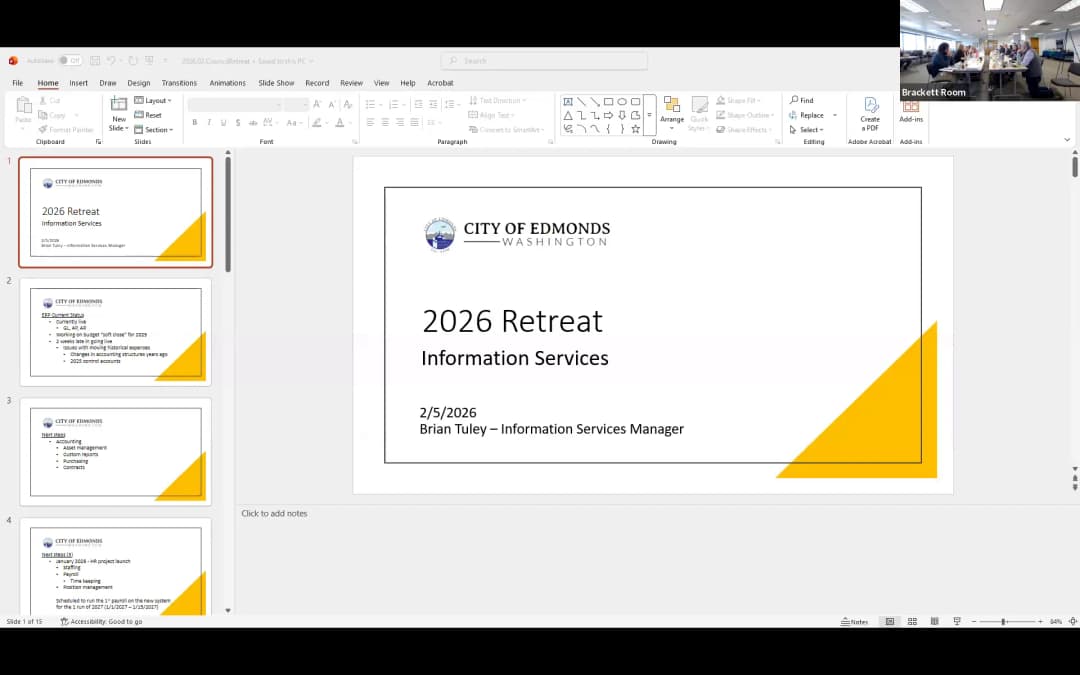
The Edmonds City Council held a special meeting and retreat in the Brackett Room at City Hall, beginning at 8:30 a.m. and adjourning at 2:24 p.m. The agenda and transcript header are dated February 6, 2026, but this summary uses the supplied meeting date of February 9, 2026. The retreat was a working session, not a voting meeting, focused on establishing council priorities through the Government Finance Officers Association (GFOA) performance management framework, reviewing the city’s community survey and vision, testing Tyler software reporting tools, and aligning council and staff work for the year ahead. GFOA / Performance Management Framework - City Administrator Todd Tatum presented the GFOA planning framework, noting the city’s strategic plan was developed in 2013 and last updated in 2015, and that the Puget Sound region has grown by roughly 30% over the last decade. - Tatum distinguished metrics (any quantifiable data point tracked) from KPIs (a small set of critical measures tied directly to outcomes, priorities, or strategy), and said the city has strong department-level KPIs but needs work on city-level KPIs residents understand. - He described GFOA, an organization with more than 30,000 members, and its “Financial Foundations for Thriving Communities” pillars: long-term vision, trust and open communication, collective decision making, clear rules, and fair treatment. - Councilmember Folsom asked how to bridge community priorities with residents’ willingness to pay for them; Tatum responded that staff is exploring engagement tools and has created a public/customer engagement working group. - Councilmember Chen supported the framework and asked whether the city already has a KPI base; Tatum said there are parallel tracks: continuous improvement now while building a more rigorous structure. - Councilmember Barnett disagreed with the characterization that the city lacks transparency or accountability, and said the framework should address a perception issue and make work more visible. - Councilmember Payne said the previous strategic planning process had gaps, including assignments to community groups that were never followed up on, and urged using social science expertise for nuanced metrics in human services and law enforcement. - Councilmember Nand described the council’s oversight role versus the administration’s service-delivery role, and said the city must continue educating residents about how government works. Community Priorities & City Vision Review - Staff reviewed the 2024 Edmonds Community Survey conducted by EMC Research, described as a statistically valid survey of roughly 350 randomly selected residents. - The top six resident priorities from the survey were public safety; infrastructure and core services; fiscal responsibility; housing and growth management; parks, recreation, and public spaces; and economic vitality and local business. - The city’s vision statement from the comprehensive plan was read: “Edmonds is a charming and welcoming city offering outstanding quality of life for all with vibrant and diverse neighborhoods, safe streets, beautiful parks, and a thriving art scene that promotes healthy lifestyles, climate resiliency, and access to the natural beauty of our community.” - Councilmembers noted the importance of remembering residents who do not participate in surveys, especially the most vulnerable community members. Priority Setting Workshop - The workshop used a “1-2-4-all” facilitation method, followed by a “five whys” root-cause analysis, and a PESTLE (political, economic, social, technological, legal, environmental) framework. - In the values exercise, groups said public safety should reach beyond residents to visitors and business owners, communications is a core service, low-income families need more housing support, environmental stewardship was missing, and Highway 99 and annexed neighborhoods should receive comparable attention and investment. - Desired outcomes included a clear strategic plan, financial sustainability, safe and welcoming neighborhoods, maintained roads, reliable and efficient permitting, support for local businesses, balanced budgets, modern technology, and inclusive decision-making with clear trade-offs. - Opportunities and gaps identified included strong council-administration alignment, economic development beyond downtown, real-time public data, updated strategic planning, neighborhood-based council engagement, volunteer leverage, improved internal processes, and better communication. - Barriers discussed included limited financial resources, low diversity of revenue sources, siloed information, capacity and bandwidth, outdated systems and training, resistance to change, community engagement challenges, fear, geographic diversity, and unclear priorities. - The five-whys exercise traced resource challenges to siloed information and lack of a shared framework; motivation problems to firefighting and lack of strategic planning; and low engagement to lack of accessibility, education, and trust. - Staff synthesized the workshop into draft priority themes: economic development; engagement, communication, and transparency; prioritization, trade-offs, and capacity; strategic clarity and direction; and financial stability. Tyler Software Update - During the working lunch, staff shared the status of the Tyler Technologies ERP implementation. - General ledger, accounts payable, and accounts receivable modules are live but roughly two weeks behind the goal of a January 1 start. - The HR project launched in January; the first payroll run in the new system is scheduled for the first pay period of 2027. - Utility billing is tentatively scheduled to go live in Q3 of 2026, dependent on internal bandwidth. - Public-facing financial dashboards are being developed; staff showed examples of budget, revenue, and vendor payment dashboards used by other cities. - Councilmembers requested dashboards that show budget-to-actual at project and fund levels, revenue sources with expiration dates, historical data on major expenditures, staffing levels and vacancies, cost-center visibility for facilities like the Francis Anderson Center, and portfolio tracking for major efforts such as Highway 99 redevelopment. - Councilmembers also discussed using the existing maps.edmonds.gov GIS tool to connect residents to current city projects. Communication Practices Update - Public Information Officer Natasha Ryan, in the role for four months, presented the city’s 2026 communication strategy. - She emphasized conversational, non-government-speak messaging, proactive transparency, sharing what is known when it is known, honest uncertainty, and closing the loop after public input. - Ryan outlined the public participation spectrum: inform, consult, involve, collaborate, and empower, noting each level carries a different promise to the public. - Examples included the mayor’s weekly Wednesday video summaries, a snow-plow naming contest, a street-sweeping video that received about 15,000 views, memorial tree planting storytelling, and employee recognition. - Councilmembers praised the communication work, linked it to rebuilding trust and staff morale, and cautioned councilmembers to remain mindful of the Open Public Meetings Act when responding to comments online. - Councilmember Nand framed the communication effort as the first step of a social contract with the community: showing residents what the city offers before asking them to trust it with their money. Administrative Legislative Calendar Review - City Clerk Luke Lawney presented a new annual “living” administrative and legislative calendar to replace the quarterly version. - The calendar maps anticipated council, committee, and study-session items across the year and will be updated regularly on the public website. - The new committee structure includes finance; parks and public works; and public safety, planning, human services, and personnel. - Lawney introduced an “items for future consent” category for noncontroversial items that can move directly to a consent agenda if no councilmember objects during a study session. - Councilmembers noted public works items are filling study sessions, and suggested cross-assigning some public works topics to other committees or considering whether public works needs its own committee. Next Steps and Implementation - Staff will refine the draft priority themes using input from the day’s sessions. - Council President Dodge said a study session the following Wednesday would be used to further distill council priorities, with staff then aligning programs, services, activities, and KPIs to those priorities. - Dot-voting results showed the highest concentration of “urgent/foundational” red dots on financial stability (especially sustainable revenue and aligning the budget with priorities), strategic clarity and direction, breaking down silos, and economic development aligned with growth. - “Important” yellow dots concentrated on economic development and engagement, communication, and transparency; “dependent” green dots marked items that rely on other foundational work first. - No formal motions or votes were taken during the retreat. The meeting adjourned at 2:24 p.m.

COMMUNITY ENGAGEMENT 24% · PUBLIC ENGAGEMENT 20% · PROCEDURAL 17% · FISCAL SUSTAINABILITY 12%
103
FEB 4, 2026 · EDMONDS, WASHINGTON · CITY COUNCIL & BOARDS
Edmonds City Council Regular Meeting - February 4, 2026: Immigration Resolution, Deer Creek Moratorium, and More

The Edmonds City Council met on February 4, 2026 (the meeting was called to order on February 3 at 6:00 PM PST but is recorded as February 4 UTC). The council addressed a wide range of issues, including a resolution affirming immigrant rights, a potential moratorium on permits in the Deer Creek Critical Aquifer Recharge Area (CARA), and public comments on immigration enforcement and the Lynnwood wastewater treatment plant expansion. Key decisions included adoption of Resolution 1584 (6-1), referral of the Deer Creek moratorium to the next meeting for further discussion, and placement of several items on future consent agendas. Consent Calendar - Approval of council meeting minutes (January 27, 2026). - Approval of claim checks and wire payments (check run 01-28-26). Both items were approved unanimously. Public Comments & Testimony - Immigration and ICE Activity: Multiple residents spoke in strong support of the city taking a firm stand against ICE enforcement. Diane Paul (Edmonds resident, 30 years human rights experience) described witnessing an illegal search by ICE agents in Bothell, including agents without badges. Sarah (Edmonds resident) called ICE "bad for business" and urged city to demand accountability. Diana Nielsen (United and Faith Coalition leader) reported 600 people attended a recent ICE training, thanked Mayor Rosen and Chief Dawkins for their statement, and urged stronger action. Chelsea Rudd (Edmonds resident) shared that ICE visited bilingual daycares in Edmonds, terrifying children and staff; she asked the council to bar ICE from city property and issue a stronger statement. Several other speakers (Simone Bauer, Kelly Haller, Lila Noreco) pressed for concrete policies and legal boundaries, including prohibiting ICE use of city property. One speaker (Vince Tupper, 46-year resident) argued the council should focus on city finances instead of this resolution, which he called mild and unnecessary. - Lynnwood Wastewater Treatment Plant Expansion: Residents from the Meadowdale neighborhood (Edmonds) expressed strong opposition to Lynnwood's planned expansion of a wastewater treatment plant located in a critical area ravine. Bob Brunette (22-year resident) stated the plant had exceeded Clean Air Act emissions by $550,000 in 2024, accused Lynnwood of using eminent domain threats, and said Lynnwood had not adequately consulted Edmonds residents. Others (John Quast, Lori, Steve Fisher, Stephanie McLaughlin) recounted planning that had been hidden for five years, requested a full environmental impact statement, and urged council to void interlocal agreements with Lynnwood. Stephanie McLaughlin (CAPE representative) provided detailed suggestions on permitting leadership, cost escalation (from $250M in October 2025 to $330M in December 2025), and asked the council to protect residents' interests. Discussion Items - Revision to Commute Trip Reduction (CTR) Section 17.95.090: Transportation Engineer Bertrand House presented the update, which includes strategies such as alternative work schedules, educational campaigns, and potential ORCA pass programs. The council moved to forward the item to a future consent agenda, with an amendment to place it on consent. The motion passed unanimously. - Potential Moratorium on Permits in Deer Creek CARA: Planning Director Mike Cluxton and City Engineer Mike Delilah explained that a recent code update prohibits stormwater infiltration in the Deer Creek CARA, effectively blocking most development (new homes, ADUs, patios, etc.) without alternative stormwater management. Staff recommended a six-month moratorium to allow a PFAS study and evaluation of alternatives. Council debated the moratorium's necessity and timing; an amendment to bring the item back on February 10 for further discussion passed 6-1, deferring a final decision. - Snohomish County Technical Services Interlocal Agreement: Director Tully presented the ILA for server rack space and aerial imagery services, with a planned cost of $4,500. The council moved to place it on the next meeting's consent agenda (unanimous). A proposed amendment to add language about cost-sharing was withdrawn after procedural discussion. - Resolution 1584: Affirming Support for Immigrants and Rights of All Residents: Councilmember Eck moved to adopt the resolution, which affirms support for immigrants, endorses the Keep Washington Working Act and Courts Open to All Act, and encourages local education on rights. Councilmembers expressed mixed views: many supported it as a values statement, while Council President Dutch abstained, arguing the resolution might be misunderstood and that the mayor's statement was a better vehicle. Chief Dawkins clarified that EPD does not conduct civil immigration enforcement. The resolution passed 6-1 (Dutch abstaining). Key Outcomes - Resolution 1584 adopted (6-1), affirming immigrant rights and state laws. - Deer Creek CARA moratorium deferred to February 10, 2026, for further discussion and public input. - CTR code revision placed on future consent agenda for approval. - Snohomish County ILA placed on next meeting's consent agenda. - The council extended the meeting by 15 minutes to allow full discussion. - Council comments included thank-yous to the public, announcements of community events (chess club, Lunar New Year, Chinese Exclusion Act remembrance march), and a promise to address the Lynnwood wastewater plant issue.

PROCEDURAL 13% · WATER AND WASTEWATER MANAGEMENT 13% · IMMIGRATION RIGHTS 10% · PUBLIC SAFETY 10%
104
FEB 2, 2026 · EDMONDS, WASHINGTON · CITY COUNCIL & BOARDS
Edmonds Planning Board Special Meeting – February 2, 2026: OPMA and Appearance of Fairness Training, Subcommittee Discussion

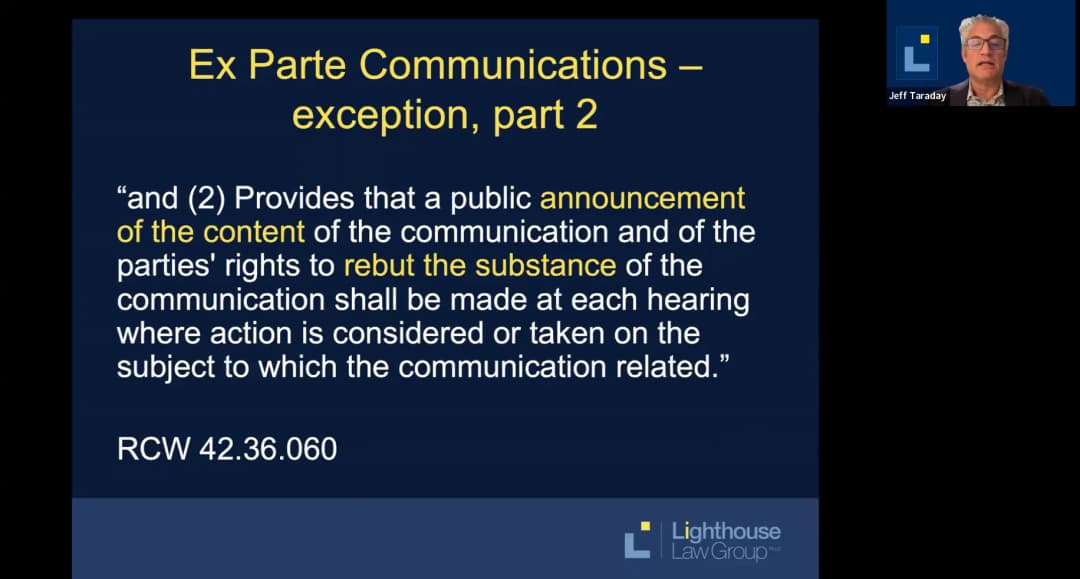
The Edmonds Planning Board held a special meeting on February 2, 2026, primarily for training on the Open Public Meetings Act (OPMA) and the Appearance of Fairness Doctrine, presented by City Attorney Jeff Teraday. The board also discussed the use of subcommittees for future work. Discussion Items - OPMA Training: City Attorney Jeff Teraday provided training on the Open Public Meetings Act, covering the definition of meetings, serial meetings, email communication, and the importance of avoiding collective intent to meet via electronic means. He emphasized that passive receipt of information does not constitute participation, but BCCing the entire board in responses to staff could create the appearance of a meeting. He answered questions about serial meetings involving staff and recommended responding only to staff, not BCCing other board members. - Appearance of Fairness Doctrine: Teraday explained that this doctrine applies to quasi-judicial hearings (e.g., site-specific rezones) and prohibits ex parte communications. Board members must disclose any external communications and allow rebuttal. He provided guidance on recusal, making a proper record, and the necessity of clear findings of fact. He noted that legislative actions are not subject to this doctrine. - Subcommittee Discussion: The board discussed the potential use of subcommittees for complex topics, such as the tree code or comprehensive plan. Members expressed support for subcommittees to manage time and depth, but cautioned that subcommittees must have clear goals and not create disparate recommendations. Chair and others noted that subcommittees should be used for organizing large amounts of information and drafting recommendations, while the full board retains decision-making authority. Key Outcomes - No formal votes were taken. The board agreed in principle to consider using subcommittees for future complex topics, with a focus on clear objectives and integration into full board discussions. The training reinforced proper procedures for OPMA compliance and quasi-judicial hearings.

GOVERNMENT STRUCTURE 71% · PUBLIC RECORDS MANAGEMENT 21% · PROCEDURAL 6% · PUBLIC ENGAGEMENT 2%
105
FEB 2, 2026 · EDMONDS, WASHINGTON · CITY COUNCIL & BOARDS
Edmonds Planning Board Meeting - February 2, 2026: Tree Code Update Discussion

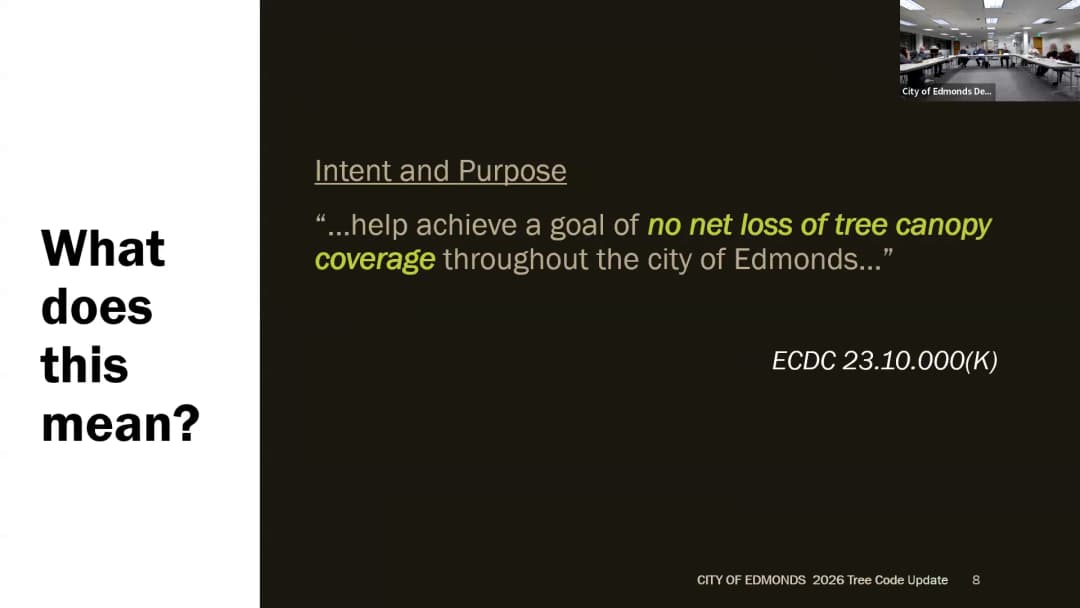
Note: The agenda listed the meeting as January 28, 2026, however the instruction specifies the date as February 2, 2026; this summary uses the provided date. The Edmonds Planning Board met on February 2, 2026, at 7:00 PM in a hybrid format. The meeting focused on the ongoing 2026 Tree Code Update, including establishing a citywide tree canopy cover goal. The board also approved previous meeting minutes, received an administrative report from Parks, Recreation & Human Services, and heard public comments. Consent Calendar - Unanimous approval of the December 10, 2025 meeting minutes. - Unanimous approval of the January 14, 2026 meeting minutes. Public Comments & Testimony - Regina Armstrong (Edmonds Climate Advisory Board) expressed support for incorporating climate change considerations into the tree code, emphasized the importance of implementation over goal-setting, and urged the board to start with restrictive rules to avoid weakening during negotiations. She also questioned the use of 2021 data in the consultant's report and pointed to the Climate Action Plan as an example of lacking implementation progress. - A second speaker (unidentified resident) described a recent permit case where hazard tree provisions in the Critical Areas Ordinance (CAO) were allegedly abused, allowing removal of six trees without a maintenance bond. The speaker argued that starting with the least restrictive code can lead to unintended tree loss and urged the board to begin with the most restrictive levels. Discussion Items - Parks, Recreation & Human Services Department 2026 and Q4 Reports: The board reviewed the administrative report; no presentation was made. - 2026 Tree Code Update, Project AMD2025-0006 – Deb Powers, staff planner, presented the project scope, timeline, and public engagement strategy. Key points included: - The project aims to establish a citywide tree canopy cover goal, define landmark trees, slow tree loss on private property, and improve code clarity. - The current code's purpose and intent language ("no net loss of tree canopy coverage") is not a measurable metric and is difficult to enforce. The board discussed replacing it with a specific canopy cover percentage. - Existing canopy cover data: 32.4% based on 2021 imagery (PlanIT Geo assessment). Historical data showed a slight gain from 2005 (32.3%) to 2020 (34.6%), but a recent loss of 106 acres between 2020 and 2024. - The board debated whether to set a conservative, moderate, or aspirational goal. Several members expressed support for a moderate increase (2-5% above current) and emphasized achievability and public perception. Others preferred a more aspirational target (5% or more). No final number was adopted; the board agreed to continue the discussion at the next meeting. - A planning board liaison (John) was appointed to the stakeholder focus group. - Extended Agenda: Brad provided an updated schedule for upcoming meetings, including topics on landmark trees, middle housing, and a potential public hearing on the draft tree code in June 2026. The board discussed the need for a public hearing and agreed to hold one closer to the recommendation date. Key Outcomes - Minutes approved unanimously. - No decision on canopy cover goal; board directed staff to proceed with a moderate/achievable approach (2-5% increase) as a working target, but final number to be determined at a future meeting. - John appointed as planning board liaison to the tree code stakeholder focus group. - Meeting extended by 15 minutes to cover the extended agenda. - Next meeting scheduled for February 25, 2026, focusing on landmark trees and middle housing.

TREE MANAGEMENT 50% · TREE REGULATIONS 33% · ENVIRONMENTAL PROTECTION 7% · PROCEDURAL 6%
106
JAN 27, 2026 · EDMONDS, WASHINGTON · CITY COUNCIL & BOARDS
Edmonds City Council Regular Meeting Summary — January 27, 2026

The Edmonds City Council met at 6:00 p.m. on January 27, 2026, in Council Chambers and via Zoom. The council approved the consent calendar, continued the 84th Avenue Street Vacation public hearing to March 10, adopted Ordinance 4429 restructuring council meetings/committees/study sessions, and approved sunsetting Resolution 1543. A motion to remove the ECC 1.04 item from the agenda failed 3–4, after which the agenda was approved. The meeting was adjourned at 8:34 p.m. Consent Calendar - No members of the public spoke during the initial audience-comment period. - Received for filing: written public comments for the January 27 meeting and signed affirmations of the Council Code of Conduct and Code of Ethics. - Consent agenda approved unanimously, including: minutes from Jan. 13, Jan. 15, and Jan. 20 meetings; claim checks; payroll and benefit checks/direct deposits; Amendment 1 to the WSDOT ILA for the Highway 99 Stage 3 project; the Caspers Street speed-limit reduction ordinance revision; the Executive Assistant to City Council employment agreement; the Lynnwood Jail contract; the 2026 First Responder Flex Fund agreement; and authorization to call bids for the Wastewater Treatment Plant truck enclosure and air scrubber. - Mayor’s Finance Update was acknowledged; council was referred to the prior week’s budget briefing. Public Hearing — 84th Avenue Street Vacation - City engineer Mike Dalila and acting engineering program manager Jennifer Lambert presented the staff recommendation. A portion of 84th Ave W near SR 104/Highway 99 was proposed for vacation; staff recommended continuing the hearing because deed/title sequencing, reversionary-clause research, appraisals, and noticing were still being completed. - Applicant Sean Leiser spoke in support, presenting parcel history and arguing the vacation is in the public interest. He cited about 225 police responses in the last five years, over $150,000 in property stolen, and ongoing dumping/camping/traffic issues; he said the appraisal would be updated and redevelopment would add tax revenue. - Public testimony: Several nearby residents supported the vacation, citing long-standing dumping and illegal activity. A representative of Campbell Volkswagen/Nissan said he did not want to lose the existing curb-cut access. A resident of the adjacent Edmonds Greenery condos supported cleaning up the area but was concerned about the possible commercial rezoning and property-tax effects. One speaker attempted to raise a separate Lynnwood wastewater-treatment cost-sharing issue; the mayor noted the hearing was limited to the street vacation. - Council voted unanimously to continue the public hearing to March 10, 2026, when additional information and testimony will be taken. Council then asked staff for future schematic images showing access/turnaround impacts and raised questions about utility easements, long-term maintenance costs, emergency access, and precedent for future Highway 99 right-of-way vacations. Council Business — Jacobs On-Call Services Contract - Public Works presented a proposed $500,000 sole-source on-call engineering services contract with Jacobs for the wastewater treatment plant’s liquid side. The director said the plant lacks accurate as-builts and an updated operations/maintenance manual, and deferred maintenance needs to be addressed. No action was requested; a better council memo and future decision will follow. - Council discussed funds from the wastewater utility/CIP, likely ongoing on-call engineering costs of roughly $250,000–$300,000 per year, and the need to clearly define the scope of work. Council Business — Satisfied and Sunset Resolution 1543 - Sheila Cloney, president of the Edmonds Business Improvement District, presented the BID’s recommendation that the expectations in Resolution 1543 have been satisfied. - Council unanimously approved the BID recommendation and directed staff to formally sunset Resolution 1543. Council noted this sunset does not dissolve the BID itself. Council Business — Ordinance 4429 (Council Meetings, Committees, Study Sessions) - A motion to remove the ordinance from the agenda failed 3–4. - Council adopted an amendment changing the scheduled monthly study session from Thursday to Wednesday by a 5–2 vote. - A motion to strike the study-session section (Section C) failed 3–4. - Ordinance 4429 was adopted 5–2. It amends ECC 1.04 to revise council meeting, committee, and study-session provisions, including a standing second-Wednesday, 3:00–4:30 p.m. study session. Council President said she will seek council members’ committee preferences before making assignments. Council Comments - Councilmembers commented on Holocaust Remembrance Day, immigration/ICE enforcement and due-process concerns, the Seahawks’ Super Bowl berth, an Edmonds Arts Commission Wintergrass preview event, and an Association of Washington Cities visit. The student representative reminded the public of rights when encountering immigration enforcement. Key Outcomes - Agenda vote to remove Item 10.3 failed: 3–4; agenda approved unanimously. - Consent agenda approved unanimously. - 84th Ave Street Vacation hearing continued unanimously to March 10, 2026. - Resolution 1543 sunset motion approved unanimously. - Ordinance 4429 study-session day amendment approved 5–2. - Motion to remove Section C failed 3–4. - Ordinance 4429 adopted 5–2. - Meeting adjourned at 8:34 p.m.

LAND USE REGULATIONS 23% · PROCEDURAL 21% · GOVERNMENT STRUCTURE 17% · WATER AND WASTEWATER MANAGEMENT 8%
107
JAN 21, 2026 · EDMONDS, WASHINGTON · CITY COUNCIL & BOARDS
Edmonds City Council Committee B Meeting Summary – January 21, 2026

The Edmonds City Council Committee B met to review six staff-presented items. All were advanced by committee consensus to a future consent agenda. The agenda and transcript date the meeting as January 20, 2026, 3:00–3:55 p.m., while the provided meeting metadata date is 2026-01-21 17:30:00+00:00. Agenda Item 2.1: WSDOT Highway 99 Stage 3 Interlocal Agreement Amendment - Staff described Amendment 1 to the WSDOT/City of Edmonds ILA for the Highway 99 Stage 3 project, adding complete-streets elements required by state law, including bike lanes on both sides and separate bike/pedestrian crossings at the 238/240 intersections. - To fit the bike lanes, seven travel/turn lanes would be narrowed from 11 feet to 10.5 feet, a 7-foot planter strip may be trimmed, regrading is needed, and new bike signal heads will be installed. Staff stated 10.5 feet is the arterial minimum and will require WSDOT justification. - The amendment increases WSDOT funding by approximately $136,000, bringing the project phase total from roughly $1.3 million to $1.45 million. Councilmember Vivian requested the agenda memo be updated to show the full $242,157 amendment amount with both WSDOT and Connect Washington/Move Ahead funding sources; staff agreed. - The project remains 100% funded by grants and appropriations, with no local fund changes. - Asked about future obligations, staff said bike lanes will be added wherever feasible on the corridor, with costs covered by developers or WSDOT; the future Stage 4 ILA would follow a similar funding formula. - Committee consensus: forward to consent. Agenda Item 2.2: Caspers Street Speed Limit Reduction (ECC 8.16.040) - Staff proposed reducing the speed limit on a 600-foot stretch of Caspers Street between Sunset and Third Avenue North from 25 mph to 20 mph, matching Sunset Avenue’s existing 20 mph limit. - A speed study showed an 85th percentile speed of 21 mph, and staff cited the recommendation based on the speed study plus high pedestrian and bicycle activity. - Councilmembers supported the change. One member asked about further traffic calming on nearby Sunset; staff said recent Sunset speed studies did not meet the threshold for the city’s traffic calming program, and resident requests could be considered in the 2026 traffic calming review. - Another councilmember asked staff to rename the attachment so it clearly refers to Caspers Street rather than Highway 99; staff agreed. - Committee consensus: forward to consent. Agenda Item 2.3: Employment Agreement – Executive Assistant to City Council - HR Manager Rand Duarte presented a one-year employment agreement for Teresa Simanton, Executive Assistant to the City Council, covering February 1, 2026 through January 31, 2027. The contract increases the position from 30 to 40 hours per week at 1.0 FTE. - Council President Dosh confirmed the mayor delegated day-to-day supervision to the Council President and that Simanton was asked to continue. - Councilmembers supported the hours increase, noting the workload regularly exceeded 30 hours. One member asked about placement at step two rather than step three; HR explained non-represented pay policy advances one step per contract year and does not include a six-month probationary increase. - Councilmember Vivian asked for confirmation that no budget amendment is needed; Council President Dosh stated the budget has sufficient allocation for 40 hours. - Committee consensus: forward to consent. Agenda Item 2.4: Lynnwood Jail Contract - Assistant Chief Josh McClure presented an interlocal agreement for booking misdemeanor and gross misdemeanor offenders at the Lynnwood Jail. There is no upfront cost; daily booking and housing fees are lower than Snohomish County Jail, and the shorter drive saves officer time. - Through November 2025, Edmonds had 574 bookings into Snohomish County Jail. At 2026 fee rates, those bookings would cost about $87,000 at Snohomish County versus about $59,000 at Lynnwood. The average Edmonds booking length of stay is about four days. - Video court costs differ: Snohomish County charges $251 per hour, while Lynnwood charges $100 per inmate per appearance. - Councilmember Susan noted earlier concerns about women inmates and warrant-tracking appear resolved. McClure said Lynnwood offered iPad-in-cell appearances so judges can still see inmates who refuse to come out. - Councilmember Payne requested a cost-by-cost comparison after 12 months of use; McClure agreed to provide it. - Committee consensus: forward to consent. Agenda Item 2.5: 2026 First Responder Flex Fund Agreement - McClure presented the recurring 2026 First Responder Flex Fund agreement. He reported that the Police Department already used some funds to help a family at risk of homelessness, identified by the department’s problem-solving emphasis team. - Councilmembers expressed strong support for the grant-funded program. - Committee consensus: forward to consent. Agenda Item 2.6: Washington State Patrol Interagency MOU - McClure presented the annual renewal of an ALPR (automated license plate reader) MOU with the Washington State Patrol, in place since 2009. It lets Edmonds police run license plates through WASIC/NCIC databases to detect stolen vehicles and warrants. - McClure stressed the agreement is separate from the city’s paused Flock ALPR program and is specifically not for immigration enforcement or reproductive health investigations. - Councilmember Vivian asked about data-sharing concerns with federal agencies. McClure said Edmonds Police/IT stewards the data, WSP rules govern use, and officers must complete annual four-hour recertification. - Staff was still verifying whether the MOU remains needed; Commander Hawley was checking. Committee members indicated no objection to filling in contact details if returned. - Committee consensus: forward to consent. Key Outcomes - All six items received committee consensus to be placed on a future consent agenda; no formal roll-call votes were taken and final Council action was not taken at this committee meeting. - Staff agreed to update the Highway 99 ILA memo with the full amendment funding breakdown from WSDOT and Connect Washington/Move Ahead. - Staff agreed to prepare a 12-month comparison of Lynnwood Jail versus Snohomish County Jail costs. - Staff agreed to fix the Caspers Street ordinance attachment name. - The meeting adjourned at 3:55 p.m. per the transcript.

PUBLIC SAFETY 29% · ENGINEERING AND INFRASTRUCTURE 27% · TRANSPORTATION SAFETY 18% · PERSONNEL MATTERS 6%
108
JAN 21, 2026 · EDMONDS, WASHINGTON · CITY COUNCIL & BOARDS
Edmonds City Council Committee of the Whole Meeting - January 21, 2026

The Edmonds City Council Committee of the Whole met to review the 2026 Development Code Update work plan, the November 2025 financial report, a requested authorization to bid on a wastewater treatment plant truck enclosure and air scrubber, 2026 committee appointments, and a proposed ordinance amending ECC 1.04 on council meetings. No public comments were heard during the meeting. Two future action items were referred to forthcoming consent agendas. Note: The agenda and transcript identify the meeting as January 20, 2026, at 6:00 PM, while the supplied meeting timestamp is January 21, 2026, at 17:30 UTC. 2026 Development Code Update - Preliminary Work Plan - Planning Director presented the department's 2026 work plan as a recovery year after an unusually busy 18 months. - Planned work includes non-substantive cleanups to middle housing and design review codes, creation of a unified development code, and a broad tree code update covering the landmark tree interim ordinance, development tree code, private property tree code, and consistency with landscaping code chapter 20.13. - The landmark tree interim ordinance expires at the end of April. Staff do not expect to finish the tree code work by then and plan to request an extension through the end of the year, with a public hearing and council touch point expected later in February. - New staff include urban forest planner Deb Powers, who started January 6, and planning manager Brad Shipley, who started January 2. The unified development code timeline depends on filling two funded senior planner vacancies; if filled, the 2027 target is achievable. - Other future work includes comp plan refinements for Westgate parcels and potential annexation work. - A state-required code update adding residential uses to existing commercial buildings is expected in the second quarter of 2026. - Council members expressed support for the plan, especially the tree code focus and unified code effort. Requests included early engagement with tree advocates, view advocates, the tree board, and other stakeholders; quarterly deliverable timelines; project team and FTE visibility; daycare code improvements to remove conditional use permit barriers; permit process streamlining; and evaluating AI-assisted code review tools. Director stated no AI tool or policy is currently built into the timeline. - Councilmember Olson said the tree board should be unpaused to support the tree code work, and that lessons from a resident community engagement study should be used to avoid past failures. November 2025 Monthly Financial Report - Finance Director Richard Gould presented the November 30, 2025 financial report. - Fund balances were up almost $14 million compared with the amended budget, primarily because capital projects were delayed, staffing was reduced, and some other expenditures did not occur. - The amended budget had assumed a $17.2 million fund balance spend-down, mainly for capital projects. - Notable variances included the general fund at $4.8 million above expectations, real estate excise tax fund up $2.9 million, gifts/catalog fund up $1.7 million due to a large donation, and the wastewater treatment fund up $4.4 million due to delayed capital projects. - Sales tax for 2025 was essentially flat: November sales tax was up about 3% from November 2024, while December receipts were down 2.6% or $26,000, bringing the full year down 0.05% or $5,500. - Labor costs were under budget by about 9%, or $3.2 million, mostly due to unfilled budgeted positions. Four general fund departments were trending over budget on salaries and benefits, largely because of retirement payouts; total payouts exceeded $500,000 against a $300,000 budgeted amount. - General fund revenues were on budget, and expenditures were 7% under budget. - Real estate excise tax received in November was $219,000, up 11.5% from the prior year, or about $374,000. - The city's migration from Eden to Tyler Munis was delayed. The planned January 5 go-live did not occur, and the project is about 50% complete because 2025 numbers have not tied out. This affects accounts payable and financial reporting; December reporting may be delayed until mid-February, and no timeframe for January reporting is set yet. - Council discussed the risk that roughly $10 million in delayed capital projects would roll into 2026, the need to analyze development services revenue overperformance and staffing capacity, red-light camera net revenue analysis, and long-term financial planning. - Director Gould reminded council that the city borrowed $6 million and that the general fund would be near zero without it; he expected year-end spending to reduce the currently positive fund balance and projected the general fund balance would be in the $2 million to $3 million range through much of 2026. Wastewater Treatment Plant Truck Enclosure and Air Scrubber - Public Works Director Andy Room requested council authorization to call for bids, using the small works procurement process, for a truck enclosure and air scrubber at the wastewater treatment plant. - The project was not listed in the capital improvement plan, although council had funded $1 million for wastewater treatment plant improvements. - The plant has been trucking solids for about three years since its gasifier came online. The current setup has caused ongoing odor complaints. Director Room described the enclosure and air scrubber as a proven backup approach and an important redundancy measure. - Capital and maintenance costs would be shared proportionally by plant partners: Mountlake Terrace, Shoreline, and Olympic View Water and Sewer District. The current estimated expense is about $280,000. - Council asked about cost recovery; Director Room said the expense would be borne by Edmonds utility ratepayers and partner agencies for now, while other recovery options were discussed for executive session. - Councilmember Payne asked about delivery timelines; Director Room said the bid process would establish delivery timing, but scrubbers of this type are often quickly available. - Council raised no objection to placing the authorization on the next possible consent agenda. Committee, Board, and Commission Appointments for 2026 - This item was informational only. It noted the newly elected council president's responsibility for councilmember appointments to boards and commissions, and Mayor Rosen's appointments to the disability board. Ordinance Amending ECC 1.04 - Council Meetings - Council President Dutch proposed changing the council meeting structure from Committee A/Committee B/Committee of the Whole to subject-matter committees plus monthly full-council study sessions, each held on a separate day to allow more focused discussion. - The proposal was intended to create more touch points before action items, reduce last-minute questions at regular meetings, and improve communication between staff and council. - Councilmembers expressed mixed views. Supporters valued subject-matter expertise, continuity, deeper policy dives, and the ability to hold joint study sessions with other jurisdictions, such as Snohomish County on annexation or Lynnwood on the wastewater treatment plant. - Opponents of dropping the A/B structure noted that two committee meetings per month helped move routine contracts and police-related items quickly, that public works and parks contracts often need more than one hour, and that the city is not yet out of financial danger, making full-council financial discussion important. - Several councilmembers objected to holding the proposed study session on Thursdays due to personal or professional conflicts. Council President Dutch said she was open to revisiting timing and suggested reviewing the structure after roughly four months. - Councilmember Chan suggested considering one-year budgets for 2027 and 2028 rather than a biennial budget to avoid repeating the extensive 2025-26 budget revision process. - An informal show of hands placed the proposed ECC 1.04 amendments on the next consent agenda; four hands were seen. Councilmember Payne cautioned that the public works/parks committee would need more than one hour for spring contracting. Key Outcomes - The committee directed that the wastewater treatment plant truck enclosure and air scrubber authorization be placed on the next possible city council consent agenda with no objections. - The committee directed that the proposed ECC 1.04 council meeting ordinance amendments be placed on the next consent agenda by an informal show of hands, with four hands seen. - Planning staff will return in February with more detail on the tree code update and a public hearing to extend the landmark tree interim ordinance. - The November 2025 financial report was received; no formal action was taken. - The 2026 committee, board, and commission appointments were acknowledged as informational.

GOVERNMENT STRUCTURE 23% · LAND USE REGULATIONS 18% · BUDGET EQUITY ANALYSIS 13% · PUBLIC WORKS 8%
109
JAN 15, 2026 · EDMONDS, WASHINGTON · CITY COUNCIL & BOARDS
Edmonds Planning Board Regular Meeting - January 15, 2026

This hybrid meeting of the Edmonds Planning Board took place at 7:00 PM in the Brackett Room, City Hall. All members were present. The meeting covered introductions to three upcoming code amendment packages, a discussion of the tree code update process, and a decision to send prior meeting minutes back for revision. No public comments were received. Note: The agenda and transcript list the meeting date as January 14, 2026, but the provided timestamp states the meeting occurred on January 15, 2026 at 17:15 UTC. This summary uses the specified date. Approval of Minutes - The board discussed the quality of the meeting minutes from the previous meeting (December 10, 2025). Board member Judy Gladstone noted that recent minutes had reverted to a verbatim format, contrary to the board’s previous direction to use condensed summaries. After discussion, the board voted unanimously to send the minutes back for revision based on the feedback provided. Public Comments & Testimony - No audience members or online participants offered comments. Discussion Items - Existing Buildings and Housing Conversion Code Amendments (HB 1757): Building Official Ted Corey (online) and Planning Director Brad introduced the state-mandated changes required by House Bill 1757. The bill allows commercial buildings with a certificate of occupancy for at least three years to be converted to residential use. Key provisions include: up to 50% of underlying zone density allowed, no additional parking required, limited design standards for enclosed conversions, and energy code carve-outs for existing systems. The board noted the state requirements leave little discretion; staff will draft code amendments for review by March 2026, with adoption required by June 30, 2026. - Landmark Tree Code Permanent Ordinance Introduction: Urban Forester Deb Powers presented a comprehensive overview of the upcoming tree code update. She reviewed her extensive background and the previous work done in 2022–2023, including public engagement and draft code language. The current interim ordinance (defining landmark trees as 30 inches or greater in diameter) expires April 29, 2026; a public hearing with the city council is required to extend it through the end of the year. The broader update will address property owner tree removals (currently unlimited), establish a citywide canopy cover goal, simplify code language, and align with industry standards. Board members stressed the need for clear meeting agendas with specific decision points, input from stakeholders (e.g., developers, environmental groups), and staff recommendations to avoid unfocused discussions. - Introduction to Minor Development Code Amendments Related to Middle Housing: Planning staff outlined the phased approach to refining middle housing regulations enacted in 2025. Phase one (first half of 2026) will address minor clarifications, particularly engineering standards for driveways and access. Phase two will revisit design standards, frontage types, and other topics not fully explored during the compressed 2025 timeline. A longer-term unified development code project (2+ years) will eventually consolidate all zoning regulations. Key Outcomes - The December 2025 meeting minutes were not approved; the board voted unanimously (9-0) to return them for revision. - No votes were taken on the three new business items; all were presented as introductions for future action. - The next regular meeting will be a joint retreat and OPMA training on January 28, 2026, starting at 6:00 PM. - Staff will bring back a refined work plan and timeline for the tree code update at the next meeting. - Preliminary discussions regarding a potential annexation of the Esperance neighborhood were noted; no formal action required from the board. - The Parks, Recreation and Human Services report (deferred from this meeting) will be rescheduled.

TREE MANAGEMENT 40% · PROCEDURAL 17% · LAND USE REGULATIONS 12% · PUBLIC ENGAGEMENT 9%
110
JAN 15, 2026 · EDMONDS, WASHINGTON · CITY COUNCIL & BOARDS
Edmonds City Council Special Meeting - January 15, 2026: Tree Code Recodification and CAO Updates

The Edmonds City Council held a special meeting on January 15, 2026, starting at 11:00 AM and adjourning at 11:12 AM. The council considered two ordinances related to the recodification of the tree code and minor updates to implement the Critical Areas Ordinance (CAO). Both ordinances were adopted unanimously. Council member Nand was excused from the meeting. Discussion Items - Ordinance 4426: Recodification of Tree Code – Planning and Development Services presented an ordinance to repeal and recodify the tree code (Chapter 23.10) into Chapter 17.130, consolidating all critical area provisions in one title. A key clarification was the definition of a hazard tree, which now requires an ISA-certified arborist to determine if a tree poses high or extreme risk using a Level 2 ISA tree risk assessment. Council members discussed the legal liability implications and confirmed that the applicant (tree owner) is responsible for hiring the qualified professional. The motion was amended to include the ordinance number 4426, and the amendment passed unanimously. - Ordinance 4427: Minor Code Updates to Implement CAO – This ordinance made minor, non-substantive amendments to references throughout the Edmonds City Code and Community Development Code to align with the reorganized CAO. No further discussion was held. Key Outcomes - Unanimous adoption of Ordinance 4426 (tree code recodification) – All council members present voted aye; none opposed. - Unanimous adoption of Ordinance 4427 (minor CAO-related code updates) – All council members present voted aye; none opposed. - The council clarified that the applicant bears the cost and responsibility for hiring an ISA-certified arborist to assess hazard trees.

TREE REGULATIONS 72% · PROCEDURAL 28%
OPENPUBLICA · PUBLIC MEETING INDEXUPDATED DAILY · openpublica.com