Browse by city
Date range
Search help

Search titles, summaries, topics and stored transcripts together. Keywords may match separately; put the whole query in double quotes for a phrase. Matching follows word analysis, so punctuation is not exact. Both dates are included. Documents are not searched.

SHOWING 91–100 ENTRIES
91
FEB 27, 2026 · EDMONDS, WASHINGTON · CITY COUNCIL & BOARDS
Edmonds City Council Special Meeting – February 27, 2026

This summary is based solely on the posted agenda; no minutes or transcript were provided. The agenda indicates the special meeting was scheduled for 4:00 PM in the Brackett Room, 121 5th Avenue N, Edmonds, WA, with remote participation via Zoom and phone. The posted agenda is dated February 24, 2026, while the supplied meeting timestamp is February 27, 2026. Executive Session - The council was scheduled to enter executive session after the call to order, pursuant to RCW 42.30.110(1)(i). - No public discussion, testimony, or action is documented in the available materials. Key Outcomes - No votes, motions, or decisions can be confirmed because no minutes or transcript were provided. - According to the agenda, the council was expected to reconvene in open session and then adjourn.

92
FEB 26, 2026 · EDMONDS, WASHINGTON · CITY COUNCIL & BOARDS
Edmonds Planning Board Meeting: Tree Code Update and Canopy Goal - February 26, 2026

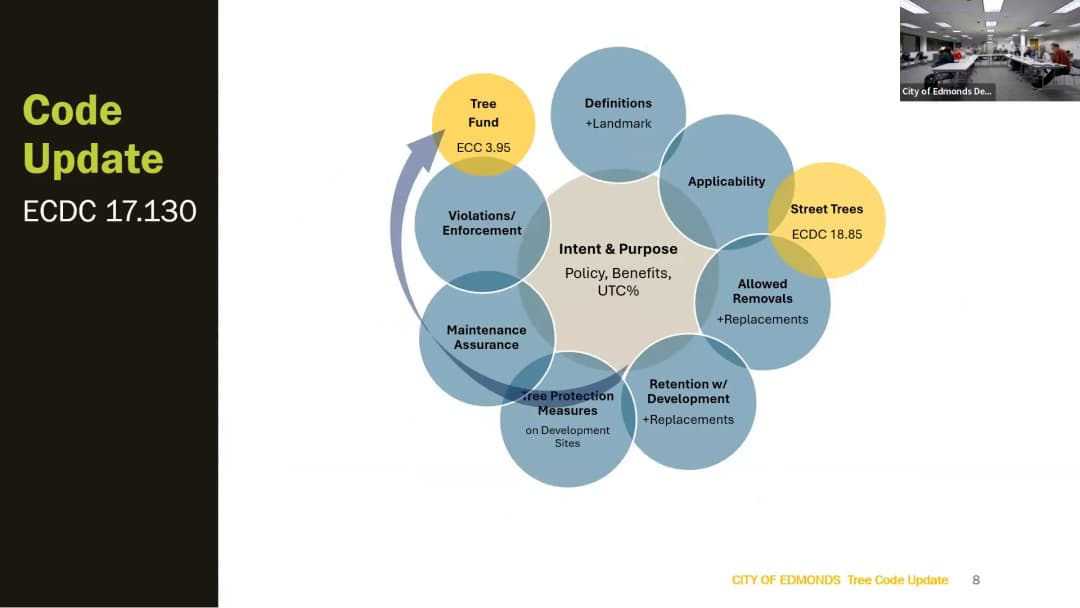
The Edmonds Planning Board met on February 26, 2026, to continue discussions on the 2026 Tree Code Update. The board heard public comments, debated citywide canopy cover goals, and provided direction on landmark tree definitions and code consolidation. Key decisions included setting a 35% canopy cover goal within 10 years while maintaining no net loss, and adopting species-specific landmark tree sizes. Public Comments & Testimony - Kathleen Sears thanked the board for their work and recommended a citywide canopy coverage goal of 35% within 10 years, and a non-one-size-fits-all definition for landmark trees based on species. - Pam Piar urged the board to incorporate climate co-benefits into the tree code definitions to align with the Climate Action Plan and Comprehensive Plan. - Barbara Stiller expressed support for increasing the tree canopy and commended the board. - Mia Rue, a student, supported tree protection and noted the importance of shade and wildlife habitat. - A speaker (name not given) asked for stronger definitions for hazard tree and nuisance tree to prevent misuse, citing the “Big Red” redwood removal as an example. - A speaker (likely from the focus group) recommended a base size of 26 inches DBH for landmark trees, with a species-specific table for native trees, to protect older trees that provide the most benefits. - Kyle McIntyre supported the definition recommendations in the packet and noted that 8–10 noble firs had been cut down on their street, emphasizing the need for preservation of landmark trees. - A certified arborist and urban forester supported landmark tree designations based on age class, noting that older trees provide irreplaceable ecological and cultural benefits. - Roger Pitts, a former board member, suggested using incentives rather than penalties to encourage tree preservation, and warned that landmark tree thresholds could incentivize premature cutting. Discussion Items - Staff presented an updated timeline and proposed a more efficient agenda format, including upfront action items, summaries of public feedback, focus group comments, and staff recommendations. The board generally supported this approach but requested sample code language (redlined) rather than a table format, and wanted to see full sections of code to understand context. - The board discussed the citywide canopy cover goal. Staff presented a table showing current canopy cover at 32.4% and the number of trees needed to achieve various targets. A motion was made to set a goal of 35% canopy cover within 10 years. After debate about including “no net loss” language, the board passed a motion to adopt a 35% canopy cover goal over 10 years, with the additional direction that the city shall aim to maintain at least the current 32.4% canopy cover in each year (no net loss). The motion passed with a majority vote. - The board discussed consolidation of tree-related code sections into one chapter. Staff noted pros and cons, including legal limitations and the upcoming Unified Development Code project. The board expressed strong support for consolidation as much as feasible now, to improve user clarity and avoid future rework. - The board discussed landmark tree definitions. After hearing public comments and staff input, a motion was made to define landmark trees using species-specific size thresholds (as shown in the table in the packet) rather than a single size. The motion was seconded and passed. The board also agreed to revisit definitions for hazard tree, nuisance tree, specimen tree, and multi-trunk measurement standards at the next meeting. Key Outcomes - Motion passed (majority): Set a citywide tree canopy cover goal of 35% within 10 years, with the direction that the city shall aim to maintain at least the current 32.4% canopy cover in each year (no net loss). Staff will bring back sample code language reflecting this goal. - Motion passed (majority): Landmark tree definitions shall be based on species-specific size thresholds, as outlined in the table provided in the packet. Staff will bring back draft code language for landmark trees and other related definitions (hazard tree, nuisance tree, specimen tree, multi-trunk measurement). - Direction given: Consolidate tree-related code sections into one chapter as much as feasible, with the understanding that legal and practical limitations may apply. - Meeting extended: The board voted to extend the meeting until 9:10 PM to complete the agenda. - Next steps: The board will continue discussion on definitions at the March 11, 2026 meeting, and staff will provide sample code language and summaries for each key code decision going forward.

TREE REGULATIONS 41% · TREE MANAGEMENT 39% · PUBLIC ENGAGEMENT 11% · PROCEDURAL 5%
93
FEB 25, 2026 · EDMONDS, WASHINGTON · CITY COUNCIL & BOARDS
Edmonds City Council Regular Meeting - February 25, 2026

Note: The agenda lists the meeting date as February 24, 2026, but the user-provided date is February 25, 2026. This summary uses the latter per instruction. The Edmonds City Council held a regular meeting on February 25, 2026, at 6:00 PM in the Council Chambers. The meeting included a proclamation, the mayor's finance update, public comments, a consent agenda, and three council business items: updates to the tree code, adoption of a resolution on council priorities, and a proposal to remove the mayor's standing finance update. The meeting adjourned at 7:51 PM. Consent Calendar - Approved unanimously: minutes from prior meetings, PSA for Water Comprehensive Plan Update, claim checks and wire payments, payroll and benefit checks, and a parks maintenance worker position conversion. Public Comments & Testimony - Jess Grant (homeowner, Perrinville) expressed concern about the cancellation of her group's event at the Edmonds Waterfront Center. She stated that the event, titled "Should Boys Be Allowed to Compete in Girls Sports," was scheduled for March 14, 2026, but was canceled by CEO Daniel Johnson on February 16, 2026, citing potential disruption. Grant argued that the cancellation was discriminatory based on politics and violated the city's equitable engagement framework. She noted the event has been moved to the Linwood Event Center, removing event dollars from Edmonds. - An unnamed speaker (Edmonds resident) addressed item 9.2, urging the council not to adopt a resolution that he felt was too restrictive and a political reaction. He suggested amending the motion to clarify that the intent is to prepare for the next biennium budget rather than to micromanage city employees. Discussion Items - 2026 Tree Code Updates (First Reading): Mike Cludson (Planning and Development) and Deb Powers (Urban Forest Planner) presented the project scope, timeline, and public engagement strategy. The update aims to address landmark tree code, private property tree removals, and development tree code. A focus group of eight members includes developers, arborists, environmentalists, and city board representatives. The timeline is aggressive (8 months) with a possible extension of the interim ordinance. Councilmembers discussed the need for broader input from the Tree Board and view advocates, as well as alignment with the Climate Action Plan and Urban Forest Management Plan. No vote was taken; this was a first reading. - City Council Resolution Establishing Priorities (Second Reading): Council President Dutch presented the resolution, which outlines four priorities: financial stability, strategic clarity, prioritization/trade-offs, and economic development. Several amendments were debated: - Amendment 1 (passed unanimously): Added "enhance livability in commercial and urban areas" to the economic development priority. - Amendment 2 (failed 4-3): To add "with an intent to pursue our city's diversity, equity, and inclusion goals" to the prioritization priority. - Amendment 3 (failed 5-2): To add a reference to Resolution 1556 (long-range financial strategy and revenue policy). - Amendment 4 (failed 6-1): To strike "out of crisis mode" and replace with "to long-term financial stability." - Amendment 5 (passed 6-1): To add "and into long-term financial stability" after "out of crisis mode." The amended resolution was adopted unanimously. - Removal of Mayor's Finance Update (First Reading): Council President Dutch moved to remove the standing mayor's finance update from the presentation section of each regular meeting, arguing it was redundant with the finance committee and other reports. Councilmembers debated transparency and efficiency. The motion failed 5-2, meaning the update remains on the agenda. Key Outcomes - Approved unanimously: Consent agenda and the resolution on council priorities (as amended). - Failed motions: Amendments to add DEI language (4-3), to reference Resolution 1556 (5-2), to strike "crisis mode" (6-1), and the motion to remove the mayor's finance update (5-2). - Tree code update: First reading held; staff will continue work with a focus group and planning board, with a target completion by October 2026. Council Comments - Councilmembers expressed support for the Lunar New Year celebration on February 28, 2026, and noted community events. Councilmember Nand reaffirmed commitment to diversity, equity, and inclusion, and to anti-displacement in Highway 99. Councilmember Payne mentioned a meeting on the Meadowdale wastewater treatment plant. Councilmember Olson congratulated a new Washington Supreme Court Commissioner. The student representative highlighted the Edmonds Food Bank resources.

TREE REGULATIONS 20% · FISCAL SUSTAINABILITY 19% · GOVERNMENT STRUCTURE 16% · PROCEDURAL 13%
94
FEB 23, 2026 · EDMONDS, WASHINGTON · CITY COUNCIL & BOARDS
Edmonds City Council Special Meeting Executive Session – February 23, 2026

The Edmonds City Council held a special meeting on February 23, 2026, at 12:00 PM in the Police Training Room. The sole purpose of the meeting was to conduct an executive session. Mayor Rosen did not attend; the meeting was chaired by another council member. The council convened at 12:00 PM, immediately entered executive session, and reconvened in open session at 2:31 PM to adjourn. Executive Session - The council entered executive session pursuant to RCW 42.30.110(1)(g), which allows closed sessions for certain legal or personnel matters. No public discussion or action occurred during the session. The council reconvened at 2:31 PM and voted to adjourn the meeting without any other business.

PROCEDURAL 100%
95
FEB 18, 2026 · EDMONDS, WASHINGTON · CITY COUNCIL & BOARDS
Edmonds City Council PSPHSP Committee Meeting - February 18, 2026

Note: The agenda and transcript indicate the meeting occurred on February 17, 2026, at 4:30 PM, but the user-provided date is February 18, 2026. This summary uses the given date while noting the discrepancy. The Public Safety, Planning, Human Services, and Personnel (PSPHSP) Committee met to discuss two agenda items: a parks maintenance worker position conversion and an ordinance amending authorized employee positions. Both items were forwarded to future consent agendas with sequencing adjustments to ensure consistency. Discussion Items - 2.1 Parks Maintenance Worker Position Conversion (First Reading): Director Angie Fesser presented a proposal to increase operational efficiency by converting an existing senior parks maintenance worker position into a second parks lead position. Fesser explained that the current structure had 12–15 workers reporting to one lead, creating a bottleneck. The change would split workers into two groups of about six per lead, with a minimal budget impact of approximately $5,500 annually (absorbed within existing budget). The affected employee is strong in aquatics and would retain related duties. The proposal does not increase FTEs and has union approval. Councilmembers expressed support, with Susan noting it addresses a span-of-control issue. The committee reached consensus to forward this item to the consent agenda for the next full council meeting. - 2.2 Ordinance Amending Authorized Employee Positions (First Reading): HR representative Emily Wagner presented an ordinance reflecting position changes adopted in the 2026 budget. Wagner highlighted for the public several consequences of the failed lobby lid lift: elimination of two police officer positions, elimination of the arts and culture program for 2026, unfunding of two parks maintenance workers, and loss of one FTE from the wastewater treatment plant. Wagner requested that the ordinance be amended to include the parks lead conversion from item 2.1 (since that item had not yet been heard when the ordinance was drafted). Councilmember Susan proposed delaying item 2.2 so that item 2.1 is approved first (via consent the following week), then item 2.2 (amended) would go to consent the week after (March 3). This sequencing avoids inconsistencies if either item is pulled from consent. Council agreed. Wagner also noted a formatting issue: the font in Attachment A (pages 12–14) is very small; she will try to improve legibility (e.g., landscape layout or removing redundant columns) before final submission. Key Outcomes - Item 2.1 (Parks Lead Conversion): Committee reached consensus to forward to the full council consent agenda for the next meeting (likely February 24, 2026). - Item 2.2 (Ordinance Amending Positions): Committee agreed to a sequencing plan: item 2.1 goes to consent first; once approved, item 2.2 will be amended to include the parks lead change and then go to consent on March 3, 2026. - No formal votes taken (committee actions were consensus-based). - No public testimony was heard.

PERSONNEL MATTERS 55% · PROCEDURAL 28% · PARKS AND RECREATION 9% · BUDGET EQUITY ANALYSIS 8%
96
FEB 18, 2026 · EDMONDS, WASHINGTON · CITY COUNCIL & BOARDS
Edmonds City Council Finance Committee Meeting - February 18, 2026

The Edmonds City Council Finance Committee met on February 18, 2026, to review the Preliminary December 2025 Monthly Financial Report. The discussion covered fund balances, labor costs, interest income, sales tax trends, new revenue sources (public safety sales tax, transportation benefit district, red light cameras), capital project delays, and planned improvements to financial reporting and fiscal sustainability. No formal votes were taken; the meeting focused on staff updates and council questions. Discussion Items - Preliminary December 2025 Financial Report – Finance Director Rachel Gould presented the report, noting it is preliminary with year-end adjustments expected by April. Fund balances across all funds increased by $7.7 million, compared to a budgeted decrease of $17.2 million, primarily due to delayed capital projects (e.g., Yost Park, Highway 99 stages 3 and 4). Capital project carryovers into 2026 will increase activity this year. Director Gould emphasized the need for a more streamlined monthly financial reporting process to reduce staff burden and focus on key metrics, with policy changes proposed for the March committee meeting. Councilmembers expressed mixed views: Council President Michelle Dutch supported maintaining thorough monthly reports to track revenues closely, while others were open to quarterly detail if monthly summaries remained informative. - Interest Income and Investment Strategy – Director Gould reported that declining interest rates have reduced earnings by 163 basis points over two years (67 bps from 2024 to 2025, 96 bps from 2023 to 2024). To mitigate further losses, she plans to purchase $2–4 million in bonds to fill gaps in the five-year ladder (2028 and 2029 maturities) at around 3.6% yield, close to current state pool returns. She also will evaluate Snohomish County pool options. Councilmember Erica Banet questioned the internal interest rate (4.4%) on the $6 million interfund loan from 2025, noting it exceeds LGIP rates; Gould explained the rate was set at the time of borrowing. - Labor Costs – Director Gould reported labor costs were 9% under budget overall ($3.7 million) and 7% under budget in the general fund ($2.1 million), partly due to vacancies (227 filled out of 255 budgeted positions as of December 8, 2025). Payouts for retirements and layoffs exceeded budgeted amounts (budgeted $250,000, actual $500,000). Council President Dutch asked about tracking budgeted positions and vacancy duration; Gould agreed to improve reporting and reevaluate whether positions should be reabsorbed if unfilled for long periods. Councilmember Banet noted that one interim director was paid as a consultant, not salary/benefits, slightly skewing comparisons. - Sales Tax Trends – Gould reported that 2025 sales tax revenue was essentially flat (down $10,000 year-over-year). January 2026 showed a 3.2% increase ($31,000) over January 2025, but overall trend remains flat. The 2025–2026 budget assumed zero growth, so no shortfall is expected. Councilmembers discussed the impact of new revenues: the utility tax increase (10% to 20%) will add about $3.3 million to the general fund, the 0.1% public safety sales tax is budgeted at $1 million (conservatively, based on uncertain implementation timelines and lower sales), and the transportation benefit district is similar. Councilmember Banet noted that collection rates for red light camera tickets are around 70%, requiring conservative revenue projections. - Capital Projects and Budget Amendments – Councilmembers requested a “burn rate” report to track capital project spending against plan, particularly for delayed projects. Director Gould agreed to work with public works to improve reporting. A budget amendment may be considered in March to account for updated revenue projections and capital project needs. - Future Agenda – The committee plans to discuss financial recovery and long-term fiscal sustainability as a special topic at the next meeting. Director Gould will bring an example of a fiscal sustainability plan. Key Outcomes - Financial Reporting Changes – Director Gould will propose policy changes to streamline monthly reports (e.g., moving some detail to quarterly) at the March finance committee meeting, after gathering input from all councilmembers on what information is most valuable. - Bond Purchase – Director Gould will proceed with purchasing $2–4 million in bonds to fill the 2028 and 2029 ladder positions in the investment portfolio within the next few days. - Labor and Vacancy Analysis – Staff will improve reporting on budgeted positions, including dollar amounts and duration of vacancies, and evaluate a policy for automatically reabsorbing funds for positions vacant beyond a set period. - Revenue Projections – Director Gould will provide updated revenue projections for the public safety sales tax, transportation benefit district, red light cameras, and utility tax, accounting for collection rates and behavioral changes. - Capital Project Tracking – A capital project burn rate report will be developed to help council track spending and cash flows. - Next Meeting – The next finance committee meeting will include a special topic on fiscal sustainability and recovery planning, with a goal of long-term structural balance.

FISCAL SUSTAINABILITY 41% · BUDGET EQUITY ANALYSIS 22% · REVENUE GENERATION 8% · CAPITAL PROJECTS 7%
97
FEB 18, 2026 · EDMONDS, WASHINGTON · CITY COUNCIL & BOARDS
Edmonds Parks and Public Works Committee Meeting – February 18, 2026

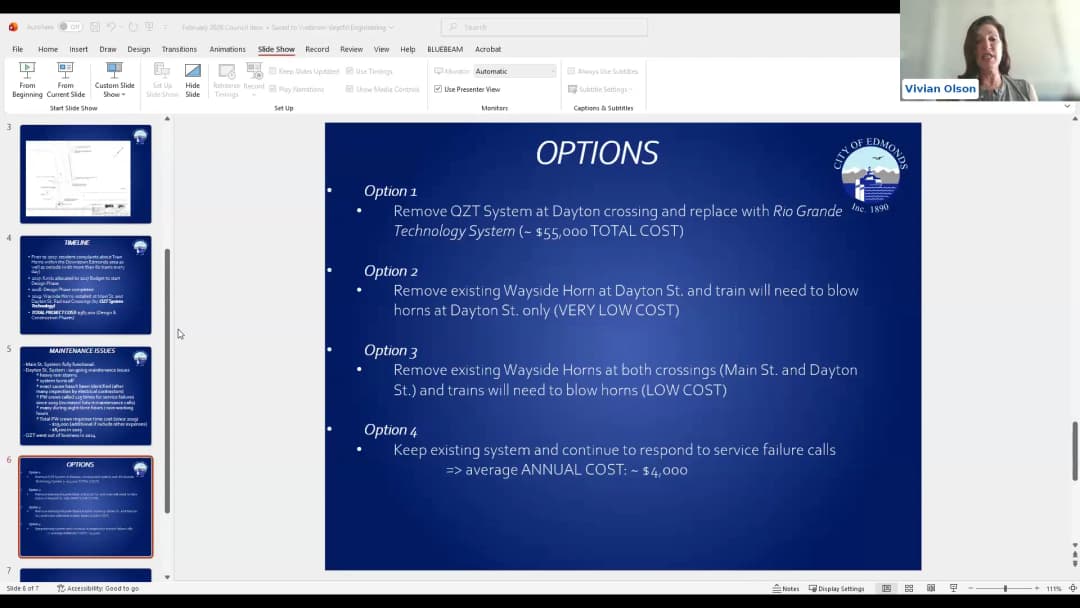
The Parks and Public Works (PPW) Committee of the Edmonds City Council met on February 18, 2026, at 3:00 PM (agenda date February 17, 2026; per meeting instruction, the official date is February 18, 2026). Chair Vivian Olson presided, joined by Councilmember Chris Eck and city staff. The committee heard first‑reading presentations on three items: a Community Transit contract for the Highway 99 Revitalization Project, a professional services agreement for the Water Comprehensive Plan update, and options for the wayside horn at the Dayton Street railroad crossing. Public Comments & Testimony - No members of the public provided testimony during this meeting. Discussion Items - Community Transit Contract (Hwy 99 Revitalization Stage 3) – City Engineer Bertrand presented the first reading. The project includes a five‑foot planner strip, bike lane, sidewalk, and reduced SWIFT platform widths (from 16‑ft to 12‑ft‑8‑in) at the 238th Street stations. Existing QCT‑installed platforms will be modified; a new contract with OTAC (architectural sub‑consultant) is being negotiated with Community Transit. Total cost is still under negotiation. Staff confirmed grant funding will cover all costs. Councilmember Eck raised minor scheduling concerns (final design start in March 2026) and noted a discrepancy in the agenda memo regarding platform width. Staff agreed to revise the memo before it goes to full council. The committee supports sending this item to the full council consent agenda. - Professional Services Agreement – Water Comprehensive Plan Update – City Engineer Mike Dalila presented the first reading. The plan is required every ten years by the Growth Management Act and Washington Department of Health. After a request for qualifications, only one qualified firm (UMSour, formerly Murray Smith & Associates) submitted a complete proposal; they have prepared the city’s last two water plans. The contract uses a blended rate for multi‑year work to minimize future supplements. Staff will include the schedule of hourly rates in the next submittal. The committee unanimously supports forwarding this item to the full council consent agenda. - Options for Wayside Horn at Dayton Street Railroad Crossing – Transportation Engineer Bertrand presented four options: (1) replace the failing QCT system with a Rio Grande system ($55,000); (2) remove the Dayton Street wayside horn only; (3) remove both the Dayton Street and Main Street wayside horns; or (4) continue responding to service failures (average $4,000/year in staff time, with 125 after‑hours calls since installation). The existing Main Street system is fully functional, but the Dayton Street system fails frequently (20‑25 times per year), mostly during heavy rain. The original manufacturer is out of business. Councilmember Eck and Councilmember Payne discussed funding options, including a Local Improvement District (LID). Staff indicated no safety preference; any funding would likely come from the general fund. The committee agreed to remove option 3 (remove both horns) from consideration, as it would eliminate a fully operating system. The remaining options will be presented to the full council with the recommendation that the LID discussion be included but without a specific staff preference. Key Outcomes - Community Transit Contract and Water Comprehensive Plan PSA – Both items will be placed on the full council consent agenda after agenda memoranda are revised (platform width for Hwy 99; hourly rates for the water plan). - Wayside Horn Options – The committee voted to remove option 3 (remove both wayside horns) from the list of alternatives. The remaining three options will be forwarded to the full council for a decision within the next month. Staff will provide additional details on annual maintenance costs and the feasibility of a Local Improvement District. - Staffing Update – At Councilmember Eck’s request, the committee agreed to receive a staffing update at each future PPW meeting, including the status of open positions and any risk of losing grant funding due to understaffing.

PUBLIC WORKS 24% · TRANSPORTATION SAFETY 22% · ENGINEERING AND INFRASTRUCTURE 15% · COMMUNITY ENGAGEMENT 12%
98
FEB 17, 2026 · EDMONDS, WASHINGTON · CITY COUNCIL & BOARDS
Edmonds Historic Preservation Commission Meeting – Sherwood Village Survey – February 17, 2026

On February 17, 2026, at 5:30 PM (originally scheduled for February 12, 2026, per agenda), the Edmonds Historic Preservation Commission met in the Brackett Room at City Hall and via Zoom. Chair Larry Vogel called the meeting to order, acknowledged the Tulalip Tribes, and led the Pledge of Allegiance. The commission was reconvened after a budget-related pause of approximately one year. The primary agenda item was an introduction to a reconnaissance-level survey of the Sherwood Village neighborhood, funded by a federal grant through the Certified Local Government program. Consent Calendar - None. Public Comments & Testimony - No public comments were made. Discussion Items - Sherwood Village Reconnaissance Survey Presentation: Spencer Howard of Northwest Vernacular (consultant) presented the scope of the survey. The survey area includes about 101 properties, mostly built between 1921 and 1968, with some earlier homes. The survey will document architectural character, assess National Register and Edmonds Register eligibility, and produce a report and GIS maps. Fieldwork is planned for March 2026, with a draft report due April 30, 2026, and a second public meeting on June 11, 2026. Commissioner Chris Diner Carr shared extensive research she had compiled on the area, including historic maps, assessor data, and deed histories. She offered to share her data with the consultant. Chair Vogel noted that the survey is funded entirely by a grant, not city funds. Commissioner David Cleston (via Zoom) asked for clarification that the survey would not restrict property owners’ ability to make alterations; Spencer confirmed that the National Register is primarily honorary and requires owner consent for any restrictions. Commissioner Chris Diner Carr raised concerns that past surveys led to nominations that stalled at the planning department, and she advocated for streamlining the process. She also proposed recruiting a grant-writing volunteer to the commission to reduce staff workload. Other commissioners discussed the need to revitalize the commission’s role and improve communication with staff. Key Outcomes - The commission heard the presentation and expressed support for continuing the survey as planned. - Commissioner Chris Diner Carr will share her research data with Spencer Howard via a shared online folder arranged by staff liaison Rose. - The next milestones: fieldwork in March 2026, draft report by April 30, second public meeting on June 11, 2026, final report by August 31, 2026. - Commissioners agreed to further discuss operational improvements (e.g., grant writing, nomination processing) at future meetings, but no formal action was taken at this session. - The meeting adjourned at approximately 6:35 PM.

HISTORIC PRESERVATION 68% · PROCEDURAL 10% · PUBLIC ENGAGEMENT 9% · GOVERNMENT STRUCTURE 5%
99
FEB 12, 2026 · EDMONDS, WASHINGTON · CITY COUNCIL & BOARDS
Edmonds City Council Study Session: Email Response & Priorities - Feb 12, 2026

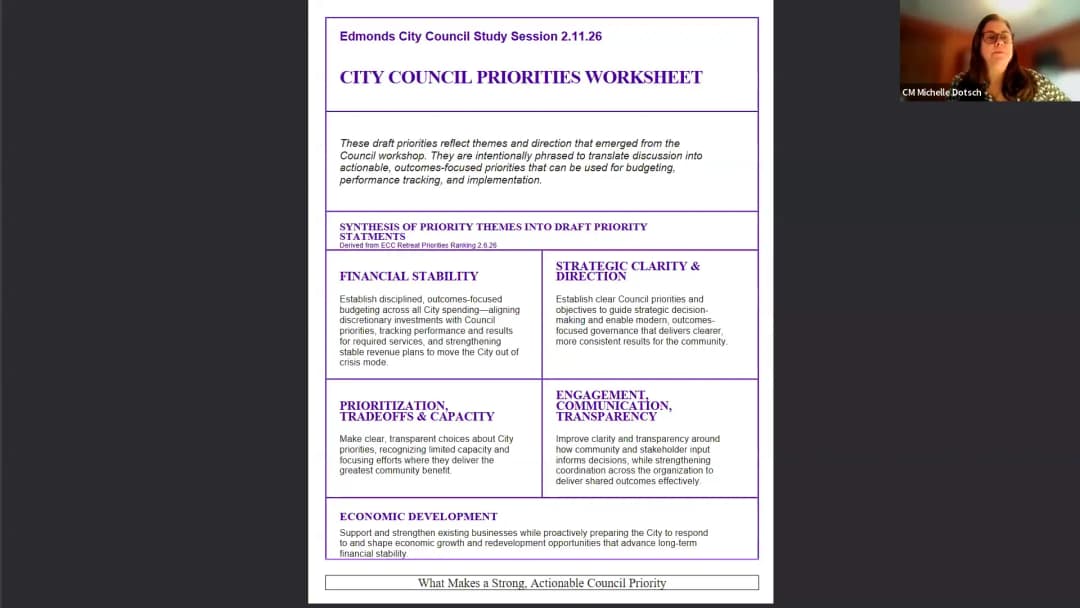
This study session covered two main items: implementing an automatic email reply to acknowledge public correspondence and finalizing the council's priority topics for 2026. Councilmembers discussed the wording of the auto-reply and debated which priorities to emphasize, including financial stability, economic development, and equity, with a plan to refine language through written feedback. Discussion Items - Email Auto-Reply Adoption: Council President Dutch introduced a proposal to set up an auto-reply for emails sent to the council office, acknowledging receipt without implying content has been read. Councilmember Payne suggested changing the closing from "warmest regards" to "sincerely," which was supported. Councilmember Burnett shared an example from former councilmember Neil Tibbet's auto-reply that included links to public comment, committee assignments, and the Fix It app. The group agreed to adopt the basic auto-reply now and consider adding links later. - Council Priority Topics: Council reviewed a worksheet from the February retreat, which ranked priorities by urgency (red, yellow, green dots) and weighted scores. Five themes emerged: financial stability, strategic clarity and direction, prioritization/trade-offs/capacity, engagement/communication/transparency, and economic development. Discussion focused on narrowing to three core priorities. Councilmember Olson proposed changing language in financial stability from "move the city out of crisis" to "long-term financial stability," but others (Councilmembers Barnett, Chen) argued the fiscal crisis is ongoing due to structural deficits and borrowed funds. Councilmember Burnett suggested adding equity and inclusion language to the prioritization/trade-offs/capacity statement, which received broad support. Councilmember Jenna advocated for framing economic development around community-driven development and anti-displacement, especially on Highway 99. Councilmember Vivian proposed making engagement/communication/transparency a "lens" applied across all priorities rather than a standalone item. City Administrator Todd Tatum noted that once priorities are set, staff will map programs to them and develop measurable KPIs. Council President Dutch proposed sending a draft to members for track-change edits by mid-next week, with finalization at a future meeting. Key Outcomes - Email Auto-Reply: Consensus to implement automatic reply with the closing changed to "sincerely"; future amendment to add resource links. - Priority Language Refinement: Council agreed to include equitable access and inclusion in the prioritization/trade-offs/capacity statement. Economic development remained a separate priority candidate, but many saw it as contributing to financial stability. No formal vote; the council president will circulate a draft for written feedback by February 19, with the goal of finalizing at an upcoming regular meeting or study session.

ECONOMIC DEVELOPMENT 26% · GOVERNMENT STRUCTURE 17% · PUBLIC ENGAGEMENT 15% · FISCAL SUSTAINABILITY 12%
100
FEB 12, 2026 · EDMONDS, WASHINGTON · CITY COUNCIL & BOARDS
Edmonds Planning Board Regular Meeting – February 12, 2026

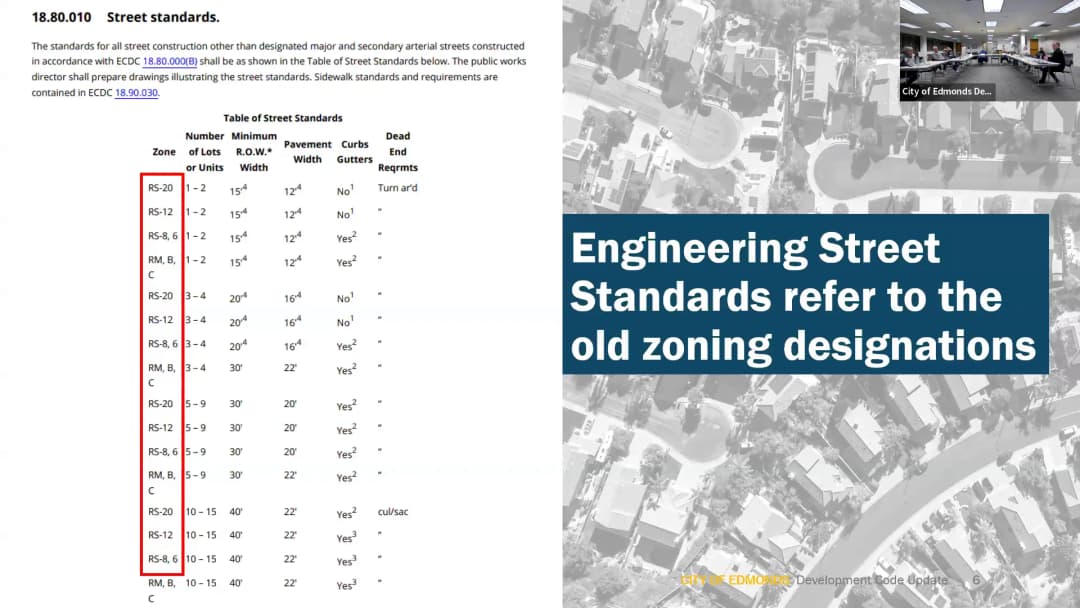
The Edmonds Planning Board convened on February 12, 2026, at 7:00 PM in the Brackett Room of City Hall. The meeting focused on proposed minor and major development code amendments related to middle housing, including discussions on frontage types, flag lots, building orientation, and setbacks. Board members also revisited tree canopy goals and reviewed the extended work program. No public testimony was given, and no binding votes were taken on substantive items. Consent Calendar - Approval of Minutes – The board approved the special meeting minutes from January 28, 2026, with a vote of 5–0–2 (five in favor, two abstentions). Several members noted the minutes were poorly drafted, lacking detail and missing key points from the previous meeting. Public Comments & Testimony - No members of the public provided comments, either in person or via Zoom. Discussion Items - Minor Development Code Amendments (Middle Housing) – Planning Manager Brad Shipley presented a package of minor amendments aimed at correcting inconsistencies, removing redundancies, and clarifying language. Topics included: - Removing frontage type lists from overlay zones to rely solely on building type regulations. - Correcting outdated zone references (e.g., RS zones to LDR) in engineering street standards. - Clarifying the application of green building incentives for duplexes within multi-family zones. - Refining language for ADU orientation and frontage type applicability. - Adding a definition for "side court" to align with existing design standards. - Changing the definition of "building" to "dwelling unit" for frontage type requirements. The board debated whether these items were truly minor or should be elevated to major amendments. Consensus was to advance most as minor, but to treat ADU orientation and frontage type definitions as major due to policy implications. - Major Development Code Amendments (Middle Housing) – Brad Shipley introduced a broader set of amendments to be considered later in 2026. Key points: - Overlay Zone and Lot Size Standards – Discussion centered on the potential Esperance annexation, which requires allowing six units per acre (approximately 7,260 sq ft per lot). The current minimum lot size is 8,000 sq ft (LDRL). Board members suggested creating a new overlay or adjusting the LDRL zone to 7,200 sq ft to align with state law, while noting community opposition to increased height. - Building Types and Lot Width/Depth – The board declined to add new minimum lot width/depth requirements for specific building types, favoring flexibility and creativity over prescriptive rules. - Building Placement and Frontage Zones – The board agreed that frontage zones and orientation criteria need revisiting, especially for corner lots and ADUs on street‑facing lots. This will be a significant topic in future sessions. - Affordability Program – Staff noted that the existing affordability incentive program is unfunded and lacks enforcement capacity. The board discussed whether to retain the requirement or allow a blanket three‑unit‑per‑lot option. No decision was reached, but members suggested revisiting if applications increase. - Flag Lots – A lengthy debate occurred on flag lot subdivisions. Board member Lauren noted that flag lots (where all four sides become side setbacks) allow reduced setbacks (5–10 ft) compared to standard front/rear setbacks (25 ft). This enables greater density but impacts neighbors. The board agreed to include flag lot regulations in the major amendments and requested hypothetical examples for future discussion. - Tree Code Update – Board members who missed the previous meeting (Judy, Nick, Isabel) were given a summary of the discussion on tree canopy goals. The working group aims for a modest increase of 2–5% above the current 32.4% canopy coverage. Focus areas include regulating tree removal on private residential property and linking policies to measurable outcomes. Key Outcomes - No formal votes or decisions were taken on the substantive code amendments. The meeting was informational and directional. - The board endorsed forwarding the minor amendment package to City Council for consent, with the understanding that staff will present the complete list at the March 11, 2026 meeting for final review. - The following items were designated for major code amendment discussions (to be scheduled later in 2026): ADU orientation and frontage type applicability, flag lot regulations, frontage zone definitions, and affordability program enforcement. - The public hearing for tree code updates was tentatively moved to July 8, 2026, with a recommendation to Council in early August. - The board agreed to hold extended discussions on the major amendments in mid‑May, incorporating illustrative examples of flag lots and frontage types.

LAND USE REGULATIONS 54% · ZONING 15% · AFFORDABLE HOUSING 11% · TREE MANAGEMENT 9%
OPENPUBLICA · PUBLIC MEETING INDEXUPDATED DAILY · openpublica.com