Browse by city
Date range
Search help

Search titles, summaries, topics and stored transcripts together. Keywords may match separately; put the whole query in double quotes for a phrase. Matching follows word analysis, so punctuation is not exact. Both dates are included. Documents are not searched.

SHOWING 51–60 ENTRIES
51
JUN 16, 2026 · EDMONDS, WASHINGTON · CITY COUNCIL & BOARDS
Edmonds PSPHSP Committee Meeting on June 16, 2026

The Edmonds City Council Public Safety, Planning, Human Services, and Personnel (PSPHSP) Committee met on June 16, 2026, at 4:30 PM to discuss four items: minor code amendments for middle housing, a pre-approved DADU plan program, cigarette sales to minors, and parking impound fines. The committee reviewed each item and made recommendations for full council action. Discussion Items - Minor Code Amendments Related to Middle Housing (2.1): Brad Shipley from Planning presented minor, non-substantive code amendments to align references with the newly adopted Low Density Residential (LDR) zone, replacing RS references. The committee discussed whether to forward the amendments to full council as consent or regular business. Councilmember Susan Payne supported option one (proceed with minor amendments) and suggested consent, but after discussion with ex officio members about public visibility and staff preparation, the committee reached consensus to forward the item to full council as regular business for the next meeting. - Resolution on Contract Authority for Pre-Approved DADU Plan Program (2.2): Ted Corey, Building Official, presented a program to allow design professionals to submit pre-approved structural plans for detached accessory dwelling units (DADUs). The resolution would move authority to enter into agreements with design professionals from the city council to the mayor to expedite the process. Committee members expressed support and discussed oversight, including regular updates to council, design quality, and potential for a design review committee. The committee reached consensus to recommend the resolution for consideration and approval at the July 14, 2026 city council meeting as regular business. - Cigarette Sales to Minors (2.3): Shane Holly from Police Services presented an ordinance amending ECC 5.15 and 5.46 to align city code with RCW 70.155 regarding cigarette sales to minors. The update primarily affects retailers. Committee members had no questions and agreed to forward the item to a future consent agenda. - Parking Code Update (Impound Fines) (2.4): Shane Holly presented an amendment to reduce the fine for 72-hour overtime parking from $250 to $40, consistent with other parking fines, noting that vehicles are already subject to towing fees. Councilmember Susan Payne requested regular business for visibility, and the committee agreed. The committee recommended forwarding the ordinance to full council as regular business. Key Outcomes - The committee forwarded the minor middle housing code amendments to full council as regular business. - The committee recommended approval of the DADU program resolution at the July 14, 2026 council meeting as regular business. - The committee approved forwarding the cigarette sales to minors ordinance to a future consent agenda. - The committee recommended the parking code update (impound fine reduction) to full council as regular business. The meeting adjourned at 5:22 PM.

LAND USE REGULATIONS 39% · AFFORDABLE HOUSING 22% · TRANSPORTATION SAFETY 9% · ENGINEERING AND INFRASTRUCTURE 8%
52
JUN 16, 2026 · EDMONDS, WASHINGTON · CITY COUNCIL & BOARDS
Edmonds Finance Committee Meeting: June 16, 2026 Financial Reports and Budget Amendments

The Edmonds City Council Finance Committee met on June 16, 2026, at 1:00 PM to review the April 2026 monthly financial report, discuss budget amendments, and follow up on questions from the recent budget retreat. Key topics included a Moody's rating review, cash flow management, interfund loan repayment, and revenue options. Consent Calendar - No consent calendar items were discussed; all agenda items were considered individually. Public Comments & Testimony - No public comments or testimony were recorded during this meeting. Discussion Items - Moody's Rating Update: Mayor Rosen reported that Moody's placed the city's rating under review pending completion of the audited financial statements. The 30-day review period began June 16, 2026; no immediate impact on ratings is expected as the city is not seeking new debt. - April 2026 Monthly Financial Report: Finance Director Kisha Pose presented highlights: sales tax revenue slightly up from last year and budget; property taxes ticking up; REAT revenues up; development services revenues up. General fund revenues are tracking behind last year due to removal of EMS levy and transport fees. Salaries and benefits remain under budget due to 25.99 vacant funded FTEs. Cash flow analysis showed negative cash balance at start of year, but positive as of April (2.6 million) after property tax receipts. Councilmember Chen questioned the use of contingency fund sub-funds to cover cash flow without council approval; Mayor Rosen clarified that the actions were within policy per legal counsel, but acknowledged a need for clearer policy language. Councilmember Vivian Owlison emphasized the need for council authorization if contingency funds are used. - Budget Amendment June 2026: Two amendments were presented: (1) repayment of $183,621.65 to the state for overpaid REAT funds, split evenly between funds 125 and 126; (2) additional $150,000 expenditure authority for the cemetery wall repair project (fund 137). Discussion ensued on the accounting treatment of the state overpayment—whether to treat as expense or revenue correction. The committee decided to bring both items to the full council as a business agenda item, not consent, due to the need for discussion. - Follow-up to Budget Retreat Questions: Discussion covered cash flow projections (general fund specific), methodology for interfund service charges (overhead allocation based on time, invoices, etc.), and council actions impacting revenues. Kisha provided a list of revenue measures enacted: public safety sales tax ($1 million budgeted), red-light cameras ($1.47 million increase 2024-2025, budgeted $2.2 million for 2026), utility tax increase ($3.25 million budgeted for 2026, dropping to $1.63 million in 2027), and transportation benefit district sales tax ($660,000 budgeted for 2026, $1 million for 2027). Councilmember Susan Payne requested a dashboard to track council-generated revenue performance. - Revenue Options: Councilmember Payne urged discussion of new revenue streams, noting the city cannot cut its way out of the deficit. Others agreed but noted ongoing work on revenue strategies. Key Outcomes - The committee directed staff to bring the two budget amendments (state overpayment and cemetery repair) to the full council as business agenda items, not consent, due to accounting questions. - Staff will provide a typed summary of council-generated revenue actions and explore creating a revenue tracker dashboard. - Staff will continue to refine financial report clarity, particularly regarding fund terminology and footnotes explaining year-over-year changes (e.g., EMS levy removal, utility tax). - No formal votes were taken; decisions were by consensus. - Meeting adjourned at approximately 2:35 PM.

FISCAL SUSTAINABILITY 47% · BUDGET EQUITY ANALYSIS 35% · REVENUE GENERATION 10% · PUBLIC ENGAGEMENT 5%
53
JUN 15, 2026 · EDMONDS, WASHINGTON · CITY COUNCIL & BOARDS
Edmonds Planning Board Regular Meeting – June 15, 2026

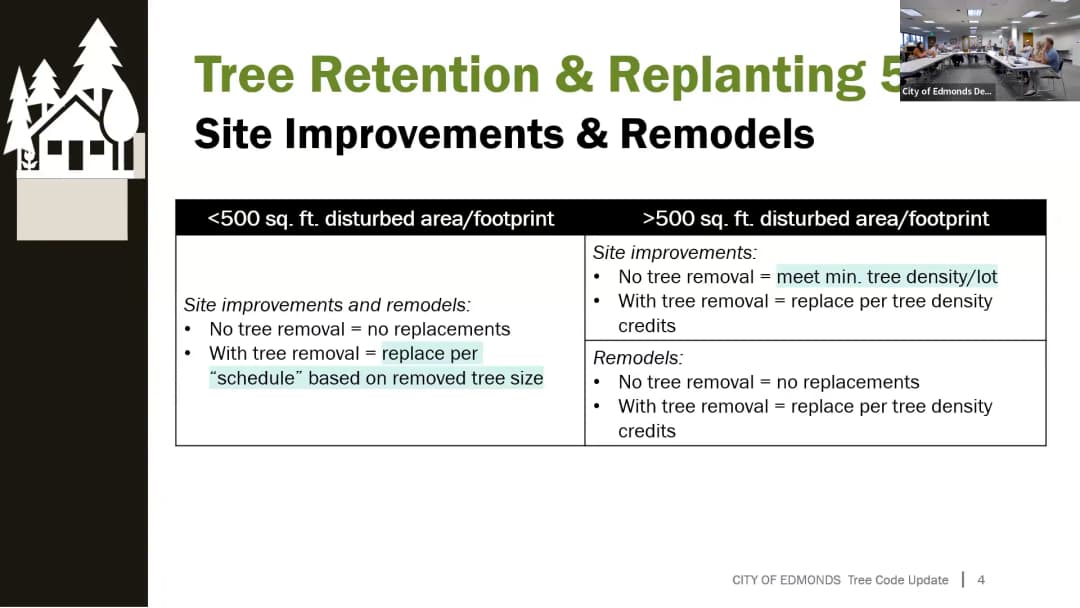
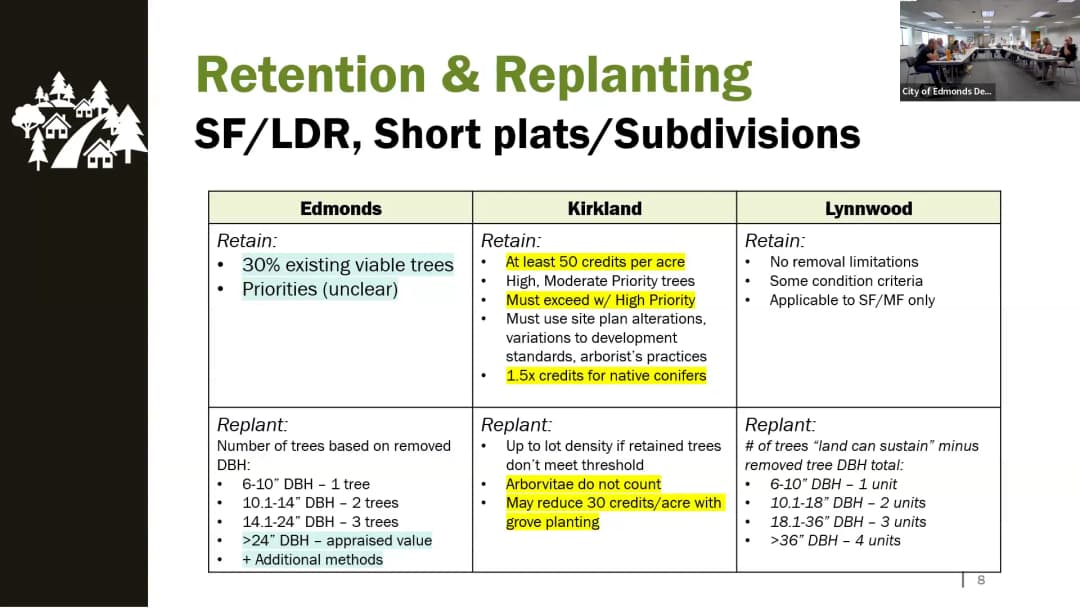
The Edmonds Planning Board met in hybrid format in the Brackett Room at Edmonds City Hall, 121 5th Ave N, Edmonds, WA. The meeting opened at 7:02 PM and adjourned at about 9:07 PM. The board approved prior minutes, heard public comment, considered House Bill 1757 commercial-to-residential conversions, and continued the 2026 tree code update. Note: the agenda and transcript date this meeting June 10, 2026, while the supplied meeting timestamp is June 15, 2026; this summary uses the supplied date. Opening, Roll Call, and Minutes - The meeting began with a land acknowledgment recognizing the Snohomish (Sdohobsh) people and the Tulalip Tribes. - Roll call was taken. Present: Steven Lee, Nick Maxwell, John Jesson, John Milkey, Bristol Ellington, Danielle Decoto, and Lee Hankins. Judy Gladstone was absent and excused. Chair Lauren Golemby presided. - There was no separate consent calendar. A motion to approve the May 27, 2026 Planning Board minutes passed unanimously. Public Comments & Testimony - Karen Barnes, an Edmonds resident, commented on the tree code’s fee-in-lieu/tree fund. She requested that the city remove the cap on fee-in-lieu payments, require those payments to be used for tree replacement rather than tree removal, and spend them promptly. She said the current cap can make payments smaller than the actual damage and remediation cost. - A commenter who said she was correcting a Friends of Edmonds Trees memo stated that the group supports using fee-in-lieu funds only for planting trees and believes the city needs a separate maintenance fund, including from fines. She pointed to Lynnwood’s tree voucher program as an example to consider. - One resident, referred to by a later speaker as Pam, said she had attended many tree code meetings and recommended the board take a final look at the complete package of decisions before moving forward. - Deborah Ashland, an Edmonds resident, said she did not support applying different tree code requirements based on whether a property has existing trees. She proposed a framework separating non-development requirements from development tree-density credits, reducing the residential addition threshold from 500 square feet to 200 square feet, subjecting all land uses to the tree code, and requiring a tree retention amount in addition to minimum credits. She noted Bellevue’s tree canopy increased 2.1% from 2011 to 2021. - Natalie Rever, representing the Master Builders Association and its more than 2,500 members working in both counties, urged the board to finish a permanent tree code, not continue under interim status. She said a successful code should prioritize preserving significant healthy trees and recognize housing, infrastructure, safety, and reasonable private-property use. She said Edmonds needs 9,000 new housing units in the next 20 years and is about 5,000 behind, and cited Snohomish County’s code as an example with a 30% canopy goal that is on target for 38% and 100% compliance from the development and builder community. - No online attendees raised their hands for public comment. New Business — House Bill 1757: Commercial-to-Residential Conversions - Senior planner Gwen Wokan and planning staff presented. House Bill 1757, effective July 27, 2025, requires cities to allow conversion of existing commercial buildings — generally buildings with a certificate of occupancy for at least three years — into residential uses. Staff said the city will not meet the June 30, 2026 compliance deadline. - The bill allows ground-floor residential units unless a property is on a designated “major pedestrian corridor.” Staff proposed the following definition: a planned or existing public street, walkway, or public right-of-way designated by the city as a major pedestrian corridor because of its identified role in providing safe, comfortable, accessible, and connected pedestrian access to transit, commercial areas, civic destinations, public spaces, or other pedestrian-oriented amenities while supporting active street-level opportunities. - Staff proposed an MPC map based on transportation mobility, connectivity, active frontage, transit, bicycle and sidewalk networks, and safe routes to school. The map is intended to preserve existing ground-floor commercial requirements in downtown, neighborhood centers/hubs, and the commercial waterfront. - Board discussion included questions about why MPCs extend beyond commercial districts. Staff explained that the MPC is a transportation definition, not a land-use tool, and could support future sidewalk and safe-routes planning. One board member expressed concern about vacant storefronts and said well-designed ground-floor residential can be better than a long-vacant commercial space. Another warned that without action, HB 1757 could supersede local zoning and undermine the commercial core. - The board passed a motion to adopt the proposed major pedestrian corridor definition and establish the MPC map, with refinements to specific street designations or the definition to be discussed at the next meeting. Unfinished Business — 2026 Tree Code Update - Staff said this was the last meeting where staff would seek direction; starting June 24, the board would review draft code top to bottom. Staff recapped prior direction: a 35% citywide canopy-cover goal, a landmark tree definition at 24-inch trunk diameter plus smaller diameters for some species, no-development removal allowances, and a tree-density-credit approach for development. - Staff’s recap listed no-development removal allowances of one, two, or three trees per 12 months depending on property size. Several board members said they had voted for one tree per lot per year. Staff said the table in attachment 2 came from prior minutes and could be revisited in draft code. - The board directed staff to explore a permit process to exceed the one-tree-per-year allowance for non-development removals. The motion passed, with Nick Maxwell voting no. - Tree-density-credit applicability was the main unresolved item. Staff used a 500-square-foot disturbed-area/footprint threshold consistent with other Edmonds codes. Above the threshold, remodels and site improvements would require a tree retention plan and tree-density credits; below it, removal would trigger a replacement schedule. Staff used Kirkland-style calculations as an example: 50 credits per acre on an 8,500-square-foot lot equals roughly 10 new trees; retaining an 18-inch native conifer could earn 1.5x credits, reducing the number of new trees needed. - The board adopted a motion that tree-density credits apply to all remodels and site improvements over 500 square feet, requiring planting up to the minimum TDC even on sites with no existing trees. It passed 5–2, with Nick Maxwell and Lee Hankins voting no. - The board then passed a motion that projects under 500 square feet would trigger a tree replacement schedule if a tree was removed, rather than a full TDC requirement. The vote was 6–0–1, with Steven Lee abstaining. Key Outcomes - Approved the May 27, 2026 meeting minutes. - Adopted the proposed “major pedestrian corridor” definition and directed staff to prepare the MPC map and code amendments; board refinements will be discussed on June 24. - Directed staff to explore a non-development permit process for exceeding the one-tree-per-year removal allowance. - Confirmed that remodels and site improvements over 500 square feet are subject to tree-density-credit requirements (5–2). - Confirmed that projects under 500 square feet require a tree replacement schedule only if a tree is removed (6–0–1). - Extended agenda items: staff will update the City Council on June 23, bring tree code draft code on June 24, and seek a recommendation on HB 1757 on July 8; the board’s recess begins August 26.

TREE REGULATIONS 54% · LAND USE REGULATIONS 20% · PROCEDURAL 14% · TRANSPORTATION SAFETY 6%
54
JUN 15, 2026 · EDMONDS, WASHINGTON · CITY COUNCIL & BOARDS
Edmonds Planning Board Special Meeting: Robert's Rules Training — June 15, 2026

The Edmonds Planning Board convened a special training meeting on parliamentary procedure led by City Clerk Luke Lani. The hybrid meeting was held in the Brackett Room at Edmonds City Hall; the land acknowledgement was deferred to the regular meeting. Per the meeting metadata, this session is dated June 15, 2026; however, the agenda and the raw transcript both date it as June 10, 2026, with a 6:30 PM scheduled start, the call to order at 6:34 PM, and adjournment at 7:01 PM. No votes or official actions were taken. Roll call: Stephen Lee, Nick Maxwell, John Jesson, John Melke, Bristol Ellington, Danielle Decoto, and Lee Hankins were present; Judy Gladstone was absent and excused; the alternate was seated as a voting member. Quorum and the Open Public Meetings Act (OPMA) - Lani explained that a quorum is required even for a training because the session was publicly noticed as a special meeting; for the seven-member board, a quorum is four members. - Without a quorum, no action can be taken, and Lani recommended canceling the meeting after a set amount of time. - Under OPMA, any gathering of four members where city business is discussed constitutes a meeting regardless of where, when, or how the conversation happens; violations can result in personal fines of $500 for the first offense and $1,000 for any future violation, and the city will not cover these fines. - The mere presence of a quorum outside regular meeting times does not by itself constitute a meeting, but Lani strongly discouraged such gatherings because board business is nearly impossible to avoid discussing and outside observers may perceive a 'serial meeting.' Members discussed practical precautions, including splitting up after adjournment and avoiding elevator rides with four or more board members. Duties of the Chair - Lani reviewed the chair's duties: opening the meeting; announcing the next item of business; recognizing members; stating questions and putting them to a vote when legitimately before the body; refusing dilatory or frivolous motions; enforcing order and decorum; expediting business politely; ruling on questions of order; responding to parliamentary and factual inquiries; authenticating actions by signature when necessary; and closing the meeting. Motions - Lani described main motions, subsidiary motions (amend, call the question, postpone, limit or extend debate), and 'bring-back' motions such as reconsideration and taking from the table. - A motion to reconsider a previous vote must be made during the same meeting as the original vote and only by a member who voted on the prevailing side; a motion to take from the table must be made during the same or next regular meeting or it dies. Lani noted the Edmonds City Council had used a bring-back motion the previous night. - For action items, a motion must be made before discussion begins; the motion should be clear and contain no commentary, and a second should be a simple 'I second.' Not all motions require a second; one example is a motion to nominate a member to a position such as board chair. - During debate, every member must have an opportunity to speak before any member speaks twice. The chair then restates the motion, calls for the vote, and announces the results. - Lani stressed clarity because minutes are a permanent record for a 130-year-old city; motions should avoid vague references such as 'approve the contract listed in item 10.1 of the agenda.' Amendments - An amendment must be relevant to the motion it modifies: amending '100 feet' to '90 feet' in an underground parking garage ordinance would be acceptable, while striking 'parking garage' and inserting 'power lines' would not. - An amendment that replaces the substance of the main motion — his example changed an allocation of $150,000 to a generic nonprofit into $10,000 for the council's training budget — is a replacement motion disguised as an amendment and is out of order. - Using a flavored ketchup example, Lani showed that amendments should strike and/or insert specific words, such as striking 'five' and inserting '10,' or striking '12' and inserting 'six.' - An amendment cannot be modified by another amendment before the first amendment is voted on; Lani illustrated this with an analogy of changing a six-cylinder engine to eight cylinders and then trying to amend the amendment to install an electric motor, producing an unworkable result. - The amendment is voted on first, and then the main motion as amended is voted on. Discussion, Voting, and Incidental Motions - Discussion is important for fairness to members in both the majority and minority; no member should speak twice until all members have had the opportunity to speak once. - The body acts as one unit: the result of a 7-0 vote is the same as a 4-3 vote. OPMA requires votes to be taken in public; executive session discussions cannot be voted on until the body returns to open session, and secret ballots are not permitted. - Incidental motions include points of order, appeal of the chair's decision (the resulting vote is final), points of information (factual questions only), suspension of specific rules (generally requiring a supermajority), and withdrawal of motions. - Once a motion has been seconded, it belongs to the body and cannot be unilaterally withdrawn by its maker. The Edmonds City Council allows the maker to request withdrawal by unanimous consent, an example of a rule of procedure overriding Robert's Rules. Q&A Highlights - Robert's Rules sets no debate time limit but encourages bodies to set one; two minutes per member is common. - A board member confirmed the planning board has a code and a handbook but has not formally adopted Robert's Rules; Lani recommended adopting a parliamentary authority, calling Robert's Rules the 'gold standard.' - Informational presentations can be discussed freely, but action items require a motion before discussion; if the board simply gives staff direction, that should be formalized with a motion such as 'I move to direct staff to such and such.' - An amendment is voted on separately from the main motion; after the amendment is resolved, the body votes again on the main motion as amended. - An amendment can be offered immediately after the second, before any debate, and the maker of the main motion has the first opportunity to speak. - On reconsideration, Lani explained that the council has a rule permitting reconsideration from the previous meeting, while Robert's Rules generally allows reconsideration only at the same meeting; for a subcommittee-type body such as this, the prevailing-side requirement may not apply, especially when new information emerges. - On staff interaction, Lani said casual bodies may invite their staff liaison to offer opinions, while in formal settings staff should run the meeting and answer questions directed to them. Key Outcomes - No motions were made, and no votes or decisions were taken; the session was informational training only. - The special meeting was adjourned at 7:01 PM. - Discussion points for possible future board action included adopting a parliamentary authority such as Robert's Rules in an update to the board's handbook or bylaws.

PROCEDURAL 92% · GOVERNMENT STRUCTURE 8%
55
JUN 15, 2026 · EDMONDS, WASHINGTON · CITY COUNCIL & BOARDS
Edmonds Historic Preservation Commission Regular Meeting - June 15, 2026

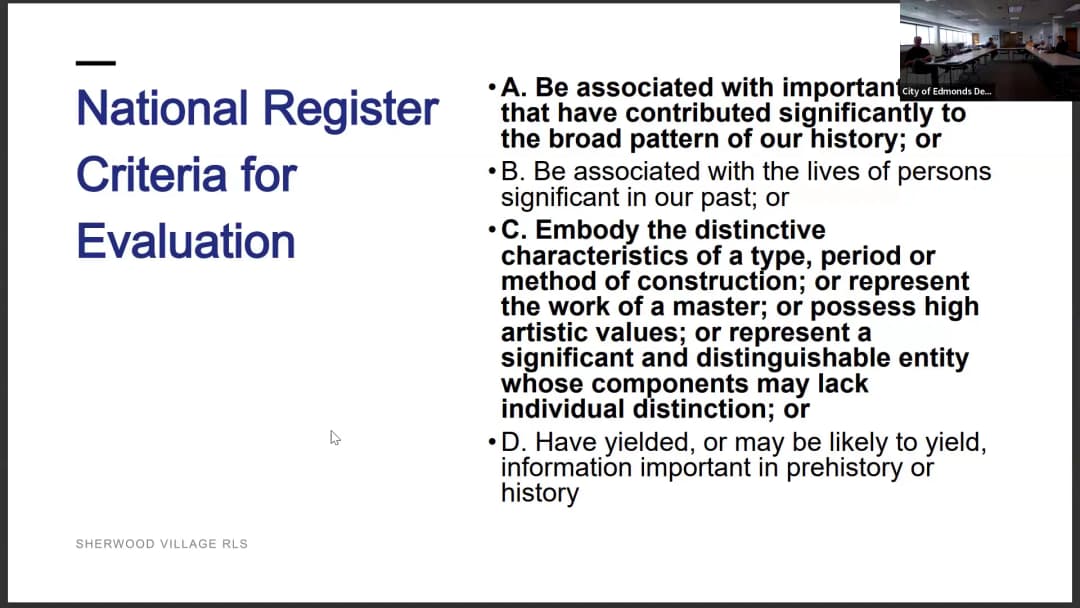
Discrepancy note: The agenda and transcript indicate the meeting occurred on June 11, 2026 at 5:30 PM, but the provided date is June 15, 2026. This summary adheres to the provided date. The Edmonds Historic Preservation Commission held a hybrid meeting in the Brackett Room at City Hall, chaired by Larry Bogle. The meeting included a land acknowledgment, roll call, approval of previous minutes, a detailed presentation on the Sherwood Village Reconnaissance Survey Report, and a lengthy discussion about the commission’s future in light of a recent city council study session where the mayor proposed transitioning the commission to an advisory board meeting quarterly. Consent Calendar - Approval of Minutes: The minutes from the February 12, 2026 meeting were approved unanimously after a motion and second. Discussion Items - Sherwood Village Reconnaissance Survey Report (Unfinished Business): Spencer Howard of Northwest Vernacular presented the findings of a reconnaissance-level survey financed in part with federal funds from the National Park Service and administered through the Washington Department of Archaeology and Historic Preservation. The survey covered the Sherwood Village plat, filed in 1954 by James R. and Jenny W. Fletcher. Fieldwork was conducted in March 2026. Key findings included: - Buildings surveyed: 89 buildings (11 built after 1989 were not surveyed). - Architectural styles: Primarily mid-20th century forms: ranch, raised ranch, split entry, split level, and contemporary styles (front gabled, contemporary gabled, side gable, contemporary slant roof). Other styles included early American, Northwest regional, pavilion, and storybook. - Alterations: 72% of buildings had intact or slightly altered plans; only 17% had intact or slightly altered windows (most windows replaced, often with vinyl); 91% had intact or slight cladding changes. - National Register Eligibility: Eight properties were recommended as individually eligible under Criteria A (association with events) and C (architectural character). - Edmonds Register Eligibility: Additional properties (shown in blue on a map) were recommended as eligible only for the local register due to slightly lower integrity thresholds. The presentation identified a total of approximately 10 homes that could potentially be listed on registers pending owner consent. - Recommendations: Prepare intensive-level inventory forms for eligible properties; conduct additional archival research on properties along 235th Place (Robin’s Roost) to investigate possible early log cabin use by University of Washington faculty; engage property owners for interest in further research or nominations. - Next steps: Second draft of report due July 15, 2026; final report and inventory forms due by August 31, 2026. Commissioners expressed high praise for the report and asked for deeper information on the top-tier properties. Spencer Howard confirmed that justification language is included in the report’s tables. - Future of the Commission (New Business): Chair Larry Bogle added an agenda item to discuss the commission’s future following a May 15 council study session where the mayor proposed retaining the commission’s codification but transitioning it to an advisory board meeting quarterly, with optional committees for special projects (e.g., designations, Native American historic walking tour). The commission’s pause (due to a council resolution expected to sunset in January 2027) currently halts regular meetings. Commissioner discussion highlighted three core functions from the enabling ordinance (2002): maintaining the Edmonds Register of Historic Places, raising community awareness, and serving as the city’s primary resource on historic preservation. Concerns were raised that an advisory board status would impede these functions, especially grant applications (e.g., the commission lost nearly $40,000 in grants during the pause, and window changes at the Francis Anderson Center removed it from the state register, jeopardizing future grants). Commissioners also noted that the listing process through the planning department has become cumbersome (8–9 months for one listing) and that the commission could take on more workload to simplify and expedite listings. Chair Bogle suggested the commission propose returning to its former status and meeting schedule, taking a more active role in preparing nomination packages, and simplifying the city code. Commissioner Sam Spencer added that engaging other commission members (e.g., Karen) and re-establishing liaison with the museum and parks department (for Francis Anderson Center and cemetery) would strengthen preservation efforts. Staff liaison Mike stated he would administer whatever program results but did not advocate a specific position. Key Outcomes - Direction: Chair Larry Bogle will meet with Michelle Dodge (who could not attend) to advocate for maintaining the commission’s status, taking on more of the listing workload from planning, and simplifying the nomination process. He will report back to the commission. - Sherwood Village Report: Commissioners requested that Spencer Howard provide more in-depth information on the top 10 eligible properties. No formal vote was taken; the report will proceed to a second draft by July 15. - Adjournment: The meeting was adjourned by motion and second, with general consensus to continue the commission as currently structured if possible.

HISTORIC PRESERVATION 68% · GOVERNMENT STRUCTURE 11% · PROCEDURAL 10% · LAND USE REGULATIONS 8%
56
JUN 15, 2026 · EDMONDS, WASHINGTON · CITY COUNCIL & BOARDS
Edmonds Planning Board Tree Code Update Discussion – June 15, 2026

Note: The agenda listed the meeting date as May 27, 2026, but the official record indicates the meeting occurred on June 15, 2026. This summary uses the latter date as instructed. The Planning Board continued its eighth meeting on the 2026 Tree Code Update (Project AMD2026-0001), focusing on tree retention and replacement requirements for development. Staff presented options for transitioning from a percentage-based retention system to a tree density credit system, and the board discussed which types of permits should trigger tree density credits versus simple replacement schedules. Key discussion included comparisons with Kirkland and Lynnwood codes, the importance of retention over replanting, and the need to balance tree canopy goals with development feasibility. The board reached consensus on several threshold questions but did not take formal votes. Discussion Items - Tree Density Credits Overview: Staff (Deb) reviewed the proposed tree density credit system, which assigns points per inch of trunk diameter and combines retention and replacement requirements into a single minimum threshold per lot. The board discussed the levers available to increase canopy cover, including retention rates, replacement ratios, fees in lieu, and incentives for native conifers and groves. - Applicability to Development Types: The board debated whether tree density credits should apply to all construction types (single-family, multifamily, commercial, mixed-use) and to site improvements such as decks, retaining walls, and parking lots. Staff noted that Kirkland’s code does not apply tree density credits to multifamily/commercial, but the board leaned toward a scalable approach with different minimums for different development types. - Thresholds for Site Improvements and Remodels: A key discussion centered on the trigger for tree density credits. The board considered a 500‑square‑foot disturbed area threshold, consistent with other parts of the code. Opinion was divided on whether credits should be required if no trees are removed. After extended debate, the board reached a consensus (see Key Outcomes). - Comparison with Other Codes: Staff highlighted differences between Edmonds’ current code, Kirkland’s comprehensive code, and Lynnwood’s simpler approach. The board acknowledged that copying Kirkland’s code verbatim would be inappropriate due to different zoning contexts, but agreed to “Edmondize” successful elements, such as the prioritization of retention and the use of credits for both retention and replanting. - Incentives and Non‑Regulatory Tools: The board discussed potential incentives like heritage tree programs, credits for planting native conifers, and fee‑in‑lieu programs to fund off‑site planting. Staff noted that retention of mature trees provides the greatest canopy benefit. Key Outcomes - Consensus on Trigger Thresholds: For site improvements and remodels under 500 square feet of disturbed area that involve tree removal, the board agreed to use a simple replacement schedule (based on size of removed trees) rather than the full tree density credit system. For remodels and site improvements over 500 square feet that involve tree removal, and for all ADUs, middle housing, multifamily, commercial, and mixed‑use developments, the board agreed to require meeting a tree density credit minimum (specific credit numbers to be determined later). If a project exceeds 500 square feet but does not remove any trees, tree density credits are not triggered. - Next Steps: Staff will incorporate this direction into draft code language and bring it back for further discussion at the next meeting (special meeting on June 10, 2026, at 6:30 PM). The board will also consider variable credit minimums for different development types and finalize the definition of landmark trees. - No Formal Votes: All decisions were made by consensus; no formal motions were passed.

TREE REGULATIONS 57% · TREE MANAGEMENT 24% · LAND USE REGULATIONS 15% · PROCEDURAL 3%
57
JUN 10, 2026 · EDMONDS, WASHINGTON · CITY COUNCIL & BOARDS
Edmonds City Council Study Session: Capital Facilities Plan and Tree Code Updates (June 10, 2026)

The Edmonds City Council held a study session on June 10, 2026, at 3:00 PM, to discuss the 2027-2028 Capital Facilities Plan (CFP) introduction and the 2026 Tree Code updates. The meeting focused on gathering council feedback on project priorities and process for the CFP, and on reviewing the progress of tree code amendments, including planning board direction on canopy cover goals, landmark tree definitions, and tree removal allowances. No formal votes were taken; the session served as a preparatory discussion for future decision-making. Capital Facilities Plan (CFP) Discussion - Introduction: Director Andy Reum presented the 2027-2028 CFP as a first touch, emphasizing that the full six-year plan will come to council in September. He sought feedback on process and project priorities. - Utilities: Reum highlighted the city's strong asset management in water and sewer systems, noting few main breaks or backups. Stormwater projects include marsh and Parentville Creek restoration. A water system plan update is due by 2028, requiring staff bandwidth, so some projects are pushed to 2028. - General Fund Systems (Transportation, Parks, Facilities): - Street preservation is underfunded by $2.3 million for the biennium (target $5.3 million, only $3 million secured). Reum warned that deferring maintenance leads to higher costs. Councilmember Chris inquired about the shortfall; Reum confirmed it’s $2.3 million. - Traffic calming budget is $22,000 annually, which council members noted is low and insufficient for visible improvements. Councilmember Will suggested prioritizing low-cost, high-impact projects like traffic calming near schools. - Councilmember Vivian expressed support for shifting REIT (Real Estate Excise Tax) from 50-50 parks/transportation to focus more on street preservation and pedestrian safety, citing community survey priorities. She also raised the issue of the Parentville Creek restoration project (PWD04) being delayed due to railroad culvert issues and grant challenges. Staff responded that they are partnering with the Tulalip Tribes and reapplying for a larger AOP grant. - Councilmember Erica asked about using Transportation Benefit District and impact fees for preservation, but staff clarified those funds are restricted to concurrency projects or maintenance, not preservation. - Council Feedback: Overall, council members emphasized street preservation, pedestrian safety, and traffic calming as high priorities. They requested a recap list of delayed projects and more information on funding alternatives. Tree Code Updates Discussion - Introduction: Project lead Deb Powers provided a progress report on the 2026 Tree Code amendments. Key elements include: - Code Reorganization: Consolidating tree-related sections from other codes, excluding conservation subdivisions and critical area trees. - Canopy Cover Goal: Planning board set a citywide target of 35% by 2045, based on current 34.6% and realistic growth. Councilmember Chris confirmed it means no net loss. - Landmark Trees: Defined as trees with DBH ≥24 inches (lower than the interim 30 inches), plus additional species-specific thresholds. Councilmember Vivian expressed concern about property owner rights and views. - Tree Removal Allowances: Proposed 1-3 trees per year without a permit, based on lot size, with replacement required. Vivian suggested a percentage-based allowance for properties with many trees. - Incentives: For retaining native conifers (1.5x density credits), planting future groves, and using a preferred species list. Jenna supported guidance on native and non-invasive species. - Monitoring: Canopy assessments via aerial imagery every 5-8 years, with a 2026 LIDAR flyover already budgeted. Erica asked about measuring heat islands and using tree fund dollars for replanting. - Nuisance Trees: Planning board considered striking the definition, but Vivian and Council President urged keeping it for safety (e.g., falling branches). - Process: Focus group lacked view advocates/realtors; Vivian expressed concern about bias. Councilmember Jenna suggested a special session on July 15 for community Q&A. - Council Feedback: Members supported the consolidation, canopy goal, and simplified removal process. Concerns included landmark protections, nuisance tree definitions, enforcement resources, and tree board participation. The next council touchpoint is scheduled for August 3 (or 4), 2026. Key Outcomes - CFP: Staff will compile council feedback, provide a recap with additional information (e.g., list of delayed projects, alternatives for street preservation funding), and schedule another touch point before the full CFP in September. - Tree Code: The planning board will finalize draft code by August 4 (or August 3 based on council calendar). Council will review and hold a public hearing in August/September. Staff will update materials with council’s concerns, including consideration of view impacts, nuisance tree clarity, and dedicated enforcement resources. - Future Consent: The Access Agreement for Marsh Estuary restoration was noted but not discussed. It will be considered at a future meeting. (Note: Dates and times are based on the meeting recording; the meeting adjourned at 4:35 PM.)

ENGINEERING AND INFRASTRUCTURE 26% · TREE REGULATIONS 24% · TRANSPORTATION SAFETY 12% · PUBLIC ENGAGEMENT 11%
58
JUN 10, 2026 · EDMONDS, WASHINGTON · CITY COUNCIL & BOARDS
Edmonds City Council Regular Meeting: Pride Flag Motions, Flock Termination, WWTP Emergency, and TIP Bike Lane Vote — June 10, 2026

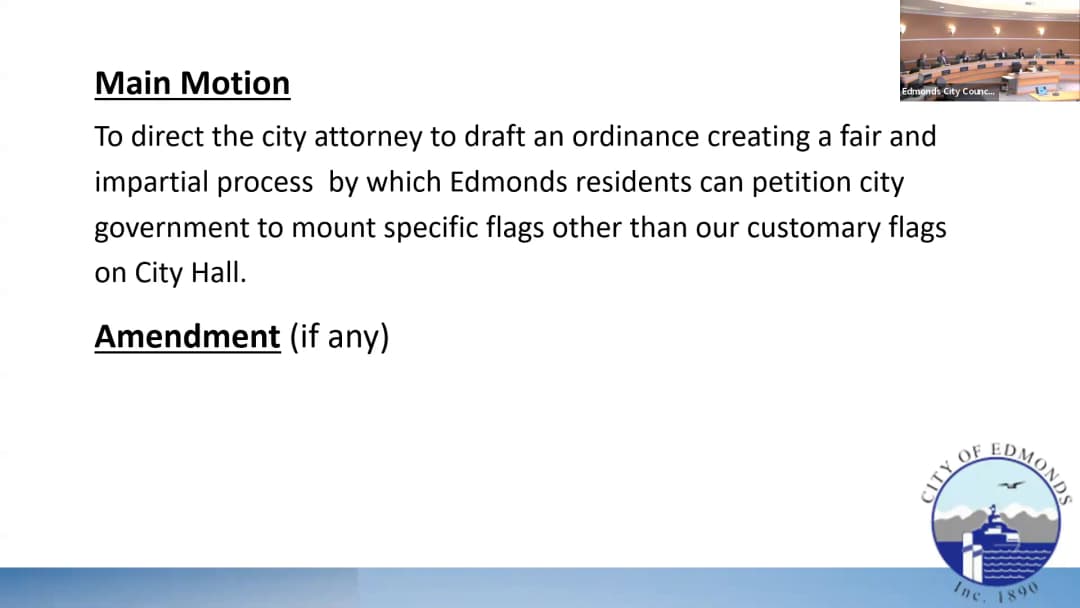
The Edmonds City Council met for a regular meeting that began at 6:00 p.m. (the agenda and transcript list June 9, 2026, while the supplied metadata says June 10, 2026, 13:45 UTC). The council adopted an amended agenda, heard presentations and public comments, approved routine consent items, unanimously terminated the Flock Safety agreement, approved an emergency resolution for wastewater sludge hauling, voted on pride-flag-related items, and reconsidered a Main Street bike lane priority in the Transportation Improvement Program (TIP). The meeting recessed for an executive session and adjourned at 11:25 p.m. Presentations - Juneteenth Proclamation: Mayor Mike Rosen proclaimed June 19, 2026 as Juneteenth Day of Observance. Donny Griffin (president, Lift Every Voice Legacy) said the local Juneteenth celebration grew from about 150 to almost 400 people; Dr. Stephen Woodard, board member and Mayor of Mountlake Terrace, thanked Edmonds for inspiring neighboring cities. - 2026 FIFA World Cup Proclamation: The mayor proclaimed the 2026 FIFA World Cup (June 11–July 19, 16 host cities; Seattle to host six matches, Vancouver seven) a time of celebration, unity, and global connection for Edmonds. - ERP Council Update: Information Services reported on the Tyler ERP implementation. Phase 1 accounting began January 2025; general ledger, accounts payable, and accounts receivable are live, with budgeting, inventory, and contracts still in progress. The HR component began January 2026; staff are preparing for a mini payroll test. The project has more than 1,340 tasks; roughly 80% of solution preparation and 45% of production readiness are complete. The 2025 budget was just over $481,000 and payments totaled $356,000; 2026 spending so far was $345,000. Implementation costs are expected to drop by about $240,000 after the project. The department also previewed a public-facing “Open Finance” dashboard showing budget, revenue, expenses, and city checkbook data. Annual Tyler maintenance was described as about $230,000, compared with roughly $109,000 for the legacy Eden system. - Highway 99 Stage 3 Urban Design Update: Engineers presented the Stage 3 project (244th to 238th) including roadway, bike lane, pedestrian, utility, and urban design improvements. Two public concepts were offered: “Pins” (90 painted metal poles in three groups) and “Panorama” (metal cut panels). Public open house and online survey results strongly favored Pins. Design completion is targeted for third quarter 2027, possibly early 2028 because of right-of-way issues involving about 20 property owners. Funding includes prior Connecting Washington and Move Ahead state allocations. - City Attorney’s Annual Report: Jeff Taraday of Lighthouse Law Group presented the 2024–2025 report. The firm has eight attorneys; Dan joined in September 2025. Total hours and spending declined after the flat-fee arrangement ended, with 2025 the lowest year. The effective hourly rate was $300 in 2024 and $319 in 2025. Taraday reminded the council that the city is the client and that councilmembers are authorized constituents, with confidentiality protections. - Mayor’s Finance Update: The mayor said the finance committee would receive April finances the next week; the 2024 audit is expected to be completed in July. April sales tax year-to-date was about $365,000 higher than budgeted, with total sales tax revenue over $4 million; property tax was $64,000 over forecast. A roughly $2 million year-over-year drop was attributed to the absence of the EMS levy. Development-related revenue was 49% of projections received at 33% of the year, about $307,000 ahead. Lodging tax was $12,800 above forecast, with total lodging tax revenue of $42,000. Consent Calendar - Approved city council meeting minutes of June 2, 2026. - Approved claim checks and wire payments (check run of June 3, 2026). - Approved payroll and benefit checks, direct deposits, and wire payments for May 16–31, 2026. Public Comments & Testimony - Several speakers opposed a proposed Main Street bike lane and asked council to consider alternatives such as Dayton Avenue, citing parking loss, pedestrian safety, business impacts, sidewalk narrowing, and inadequate infrastructure near Maplewood Elementary. Speakers included Ingrid Philippe, Michael McMurray, Sheila Cloney (owner of Anchor Chic, speaking remotely), and Kim Bear Augustavo. - Numerous speakers criticized Mayor Rosen’s decision not to fly the Pride flag at City Hall in June and the removal of the flag mounting bracket. Rowan Soy Set, director of Edmonds Pride, said the decision was hurtful, disputed the mayor’s statement, noted that neighboring jurisdictions were flying the flag, and said, “Do not come to Pride unless the flag is flying.” Other speakers included Alicia Soy Set, Holly Monikanderson, Lila Noreko, Laura Hein, Kurt Kataye, and Theresa Hollis, who referenced King 5 News coverage and urged the city to install the flag before the arts festival. - Dr. Jennifer Lush, a local primary care physician, said accepting communities reduce the odds of a past-year suicide attempt by at least 40%, asked council to prioritize the Pride flag, and offered free installation help. Nora Carlson supported terminating Flock cameras and praised Pride celebrations in neighboring cities. - Council also received a request from Sheila Cloney that her letter opposing the Main Street bike lane priority be entered into the public record. Council Business: Flock Safety Agreement Termination - Police Chief Dawkins recommended terminating the Flock Safety agreement. Council had approved the system in October 2024; the 24-month agreement began November 1, 2024. A Washington Auto Theft Prevention Authority grant covered about $131,881.75, so there is no refund or remaining financial obligation. The cameras have been deactivated since around April 2026, but the department wanted to end the contract to eliminate data-access risk, public disclosure and record retention burden, liability exposure, and public trust concerns. The motion to authorize the mayor to terminate the agreement passed unanimously. Council Business: Emergency Resolution for WWTP Sludge Transport - Public Works Director Andy Reym reported that a Schwing pump piston failed on May 7, 2026, creating a single point of failure at the wastewater treatment plant. Without emergency hauling, the plant risked discharging 4–5 million gallons per day of raw sewage into Puget Sound. Two trucks hauled sludge to Lake Stevens for about 14 hours per day from May 8–13, 2026, at a total cost of $212,000, within industry norms. The operating budget can absorb the cost without a budget amendment. The council unanimously approved the resolution finding an emergency existed and waiving competitive bidding requirements. Council Business: Pride Flag and Flag Policy Items - After adding the items to the agenda, the council considered a motion to direct the administration to mount the Pride flag on City Hall for June. City Attorney Jeff Taraday gave a quick take that the council cannot direct the mayor to take a specific administrative action absent a policy or ordinance. Councilmember Olson successfully amended “direct” to “recommend”; the amendment passed 4–3. The amended motion to recommend that the administration mount the Pride flag passed unanimously. - The council then took up a proposed ordinance for a resident petition process for flags. A council amendment to first send the matter to the DEIA commission failed 4–3. The original petition-process motion was withdrawn, and a substitute motion was offered to direct the city attorney to draft an ordinance to have the Pride flag flown at City Hall in June. That substitute passed 5–2. Council Business: Reconsideration of TIP Project 22 (Main Street Bike Lane) - The council voted unanimously to reconsider Resolution 1589, adopted June 2, 2026. It then considered an amendment to lower TIP Project 22 “bike lane along Main Street from the Ferry Terminal to 6th Avenue” from high to low priority. Supporters cited significant community and business opposition, parking and sidewalk concerns, and staff opportunity costs. Opponents noted the project was only a study, had no identified construction funding, and that lowering it would require comprehensive plan changes and could delay multimodal waterfront access. The amendment passed 5–2. The council then adopted Resolution 1589 as amended unanimously. Executive Session and Adjournment - The council entered executive session under RCW 42.30.110(1)(i) for litigation or potential litigation, extending the meeting to 11:30 p.m. After reconvening at 11:25 p.m., the council stated no action was taken in executive session, unanimously removed council comments from the agenda, and adjourned at 11:25 p.m. Key Outcomes - Agenda amended to add Pride flag items and reconsideration of Resolution 1589; amended agenda approved unanimously. - Consent calendar approved. - Flock Safety agreement termination authorized unanimously. - Emergency declaration for WWTP sludge hauling approved unanimously. - Council recommended (not directed) administration to mount the Pride flag; motion passed unanimously after the “recommend” amendment. - Council directed the city attorney to draft an ordinance to have the Pride flag flown in June; motion passed 5–2. - TIP Project 22 bike lane priority was lowered from high to low; Resolution 1589 adopted as amended unanimously. - No action was taken in executive session; meeting adjourned at 11:25 p.m.

PUBLIC ENGAGEMENT 13% · GOVERNMENT STRUCTURE 13% · RACIAL EQUITY 12% · TECHNOLOGY AND INNOVATION 9%
59
JUN 2, 2026 · EDMONDS, WASHINGTON · CITY COUNCIL & BOARDS
Edmonds City Council Regular Meeting - June 2, 2026

The Edmonds City Council convened on Tuesday, June 2, 2026, at 6:00 PM in Council Chambers. The meeting included a proclamation designating Edmonds as the first community of service in the nation, a finance update from the mayor, audience comments, and two major council business items: adoption of a temporary ordinance regulating family burial grounds and approval of the 2027-2032 Transportation Improvement Program (TIP). The meeting adjourned at 7:34 PM. Consent Calendar - Approved minutes of the May 26, 2026 council meeting. - Approved claim checks and wire payments from May 27, 2026. - Both items passed unanimously. Public Comments & Testimony - Elizabeth Seabacher (Edmonds resident) addressed noise pollution from vehicles, citing health studies and existing city laws that are not enforced. She requested the council prioritize enforcement. - Logan Chong (Edmonds resident) alleged discriminatory enforcement by a code enforcement officer against his family and claimed no response to his prior complaints. He asked for fair treatment. - Xiaomi (Edmonds resident, spoke through translation) stated her family immigrated to the U.S. for freedom and fairness, and requested equal treatment from the city. - Jim Loganowski (Edmonds resident) commented on the mayor's finance update, stating that the mayor cannot unilaterally move funds and that the council must act on a $2 million general fund deficit. He urged immediate discussion of fund transfers. - Kenny (Edmonds resident) discussed the TIP, noting that the Ebbtide missing link project was never in the city's transportation plan despite significant litigation costs ($4,000 legal hours). He requested additional oversight for future capital project litigation. Presentations - Proclamation for Edmonds Serves: Mayor Rosen proclaimed Edmonds the first "Community of Service" in the nation, recognizing volunteerism and civic engagement. Brian Baird (founder, National Museum and Center for Service) and Daniel Johnson (Edmonds Waterfront Center) accepted and highlighted a week of community posters. - Mayor's Finance Update: Mayor Rosen explained the difference between cash accounting and accrual accounting, noting that an internal loan between city funds causes a negative general fund balance on year-end statements but does not mean the city cannot pay bills. He acknowledged a long-term structural deficit where costs grow faster than revenues, and thanked council for the recent budget retreat. Discussion Items - Family Burial Grounds (HB 2239) – Third Reading: Mike Clugston (Planning and Development) presented a six-month interim ordinance to prohibit family burial grounds while the city develops permanent regulations. Councilmember Payne moved to set a public hearing for June 23, 2026, and adopt the interim ordinance. Councilmembers expressed support for a temporary pause to study land use impacts. Councilmember Nand requested a carve-out for alternative methods like cremation or hydrolysis, but no amendment was made. The motion passed unanimously. - Adoption of the 2027-2032 Transportation Improvement Program (TIP): After a public hearing the previous week, staff opened for questions. Councilmember Chan moved to adopt the resolution approving the TIP. Discussion included two amendments: 1. Councilmember Olson's amendment to add a pedestrian safety crossing improvement at 100th Avenue West at Firdale Village to the 2027 TIP. After debate, the amendment failed unanimously. Councilmembers cited a need for further study, prioritization through normal processes, and coordination with Shoreline. 2. Council President Dash's amendment to change project 22 (bike lanes on Main Street from Ferry Terminal to 6th Avenue) from high to low priority. Councilmembers debated impacts on parking, bistro dining, ADA compliance, safety, and fiscal constraints. The amendment failed 4-3. (Four members voted against lowering priority, three in favor.) The main motion to adopt the TIP as presented passed unanimously. Key Outcomes - Family Burial Grounds Interim Ordinance: Set public hearing for June 23, 2026; adopted a six-month temporary prohibition on family burial grounds. (Unanimous) - 2027-2032 TIP Adoption: Approved the six-year transportation improvement program and directed filing with WSDOT. (Unanimous after amendments failed) - Council Directives: The council will continue to address the general fund deficit, explore revenue options, and consider further study of the Firdale Village pedestrian crossing for future TIP cycles.

TRANSPORTATION SAFETY 41% · PUBLIC SAFETY 12% · PEDESTRIAN SAFETY 9% · COMMUNITY ENGAGEMENT 8%
60
JUN 1, 2026 · EDMONDS, WASHINGTON · CITY COUNCIL & BOARDS
Edmonds City Council Budget Retreat - June 1, 2026

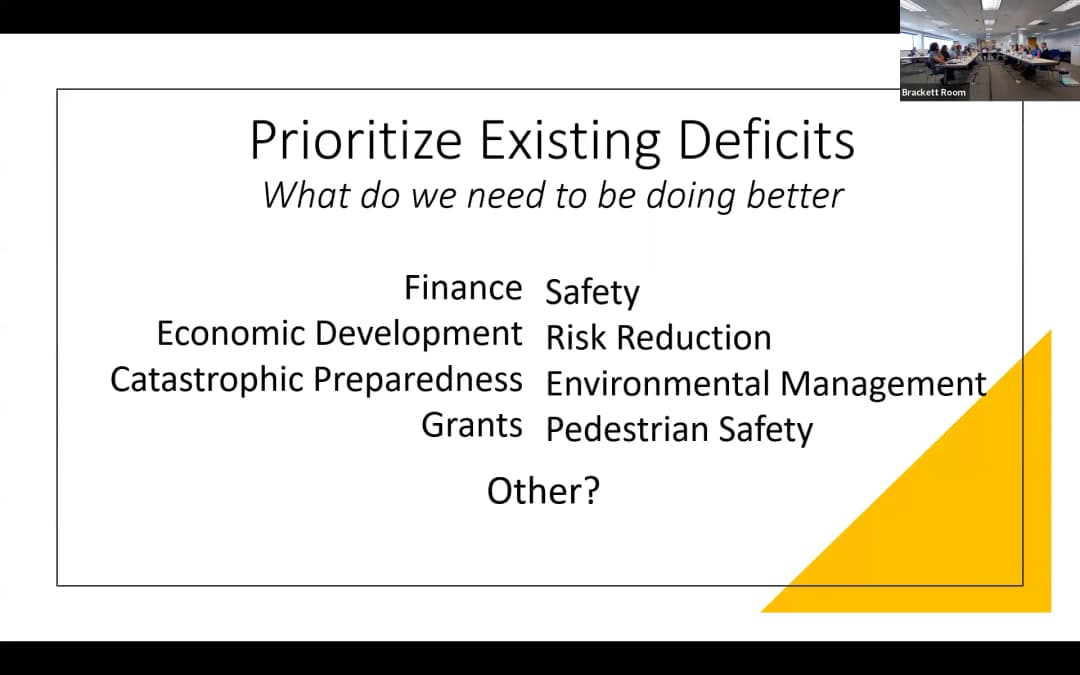
The Edmonds City Council held a special budget retreat on June 1, 2026, to begin planning for the 2027-2028 biennial budget. Council President emphasized the importance of aligning the budget with community and council priorities, and staff presented financial forecasts, budget assumptions, and a proposed new budget format. The council discussed revenue and expenditure assumptions, reviewed the city's financial condition, and outlined next steps for the budget process. Discussion Items - Budget Foundation and Guiding Principles: Staff presented guiding principles including alignment with priorities, long-term sustainability, data-driven decisions, transparency, equity, economic vitality, operational efficiency, and course correction as new information arises. Council members discussed the need for better tracking of interdepartmental projects and more frequent review of spending. - Revenue Assumptions: The council debated revenue projections for 2027-2028. Key decisions included: - Property tax: 1% annual increase (unchanged). - Sales tax: 1% annual increase (some members advocated for 0.5% or 0% due to economic uncertainty; consensus was to stick with 1% but remain conservative). - Utility tax: 20% tax rate for utilities, but only for six months in 2027 (sunset), after which it drops back to 10%. This assumption is pending a rate study. - Other taxes: 2% increase. - Construction permits: 5% increase (after a 20% increase in 2027 due to fee adjustments). - State revenues: flat. - Goods and services charges: 3% increase. - Interfund service charges: 3% increase. - Fines and forfeitures: 1% increase. - Expenditure Assumptions: Labor costs projected at 5% increase, benefits at 9% (after debate between 8% and 10%; settled at 9% pending further data). Supplies and services at 3% and 5% respectively. - Exceptional Expenditures: Known cost increases include prisoner care, parks fees, Baker Tilly financial sustainability planning ($100,000 in 2027), prosecuting attorney services ($154,000), defense attorney costs ($47,000), housing action plan ($50,000 in 2028), urban forest management plan update ($25,000), and unfunded mandates ($150,000 in 2027, $756,000 in 2028). - Financial Forecast: Staff presented a five-year outlook showing deficits in 2027 and 2028, with a negative fund balance due to accrual accounting treatment of an interfund loan. Council members discussed the need for better communication about cash vs. accrual accounting and the city's financial position. - Unmet Needs: The council identified several areas requiring investment: finance capacity, economic development, risk reduction (HR), public safety, environmental management, and catastrophic preparedness. No specific funding was allocated, but these will be explored further in upcoming workshops. - Budget Format: Staff proposed a new budget book format focused on strategic alignment, outcomes, and readability. Some council members requested more detailed line-item information (decision packets), while others supported the new approach as a step toward outcome-based budgeting. - Decision Process and Schedule: Staff explained the process for council amendments, emphasizing clarity and advance preparation. The proposed schedule includes study sessions, department presentations, public hearings, and adoption by November 24, 2026. A special workshop on July 8, 2026, will discuss potential cuts and revenue options. Key Outcomes - Consensus on Budget Assumptions: The council reached general agreement on the revenue and expenditure assumptions listed above, with the understanding that some numbers (e.g., benefits, utility tax) are subject to change as more information becomes available. - Direction to Staff: Staff will proceed with developing the proposed budget using these assumptions, and will incorporate the new budget format, including dashboards and outcome-based metrics, where possible. - Future Workshops: A workshop on July 8, 2026, will focus on identifying potential expenditure reductions and revenue enhancements. Additional workshops will be scheduled as needed. - Continued Exploration of Unmet Needs: The council will continue to evaluate priorities such as economic development, risk reduction, and public safety, but no new positions or programs were approved at this retreat. - Schedule Adoption: The proposed timeline for budget development and adoption was accepted, with the goal of final adoption by November 24, 2026.

BUDGET EQUITY ANALYSIS 33% · FISCAL SUSTAINABILITY 21% · ECONOMIC DEVELOPMENT 9% · PUBLIC ENGAGEMENT 7%
OPENPUBLICA · PUBLIC MEETING INDEXUPDATED DAILY · openpublica.com