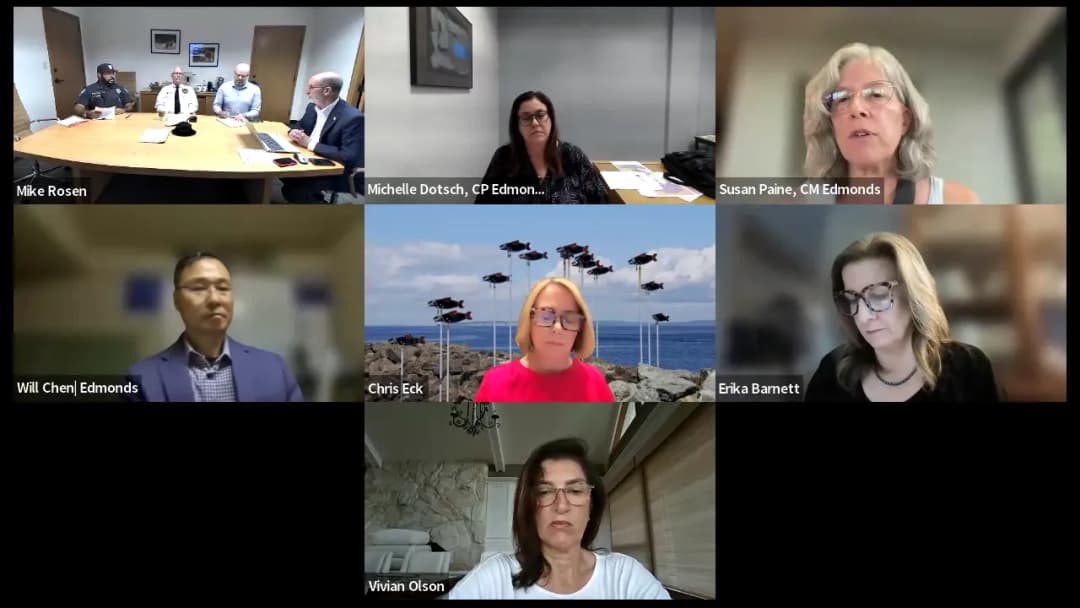
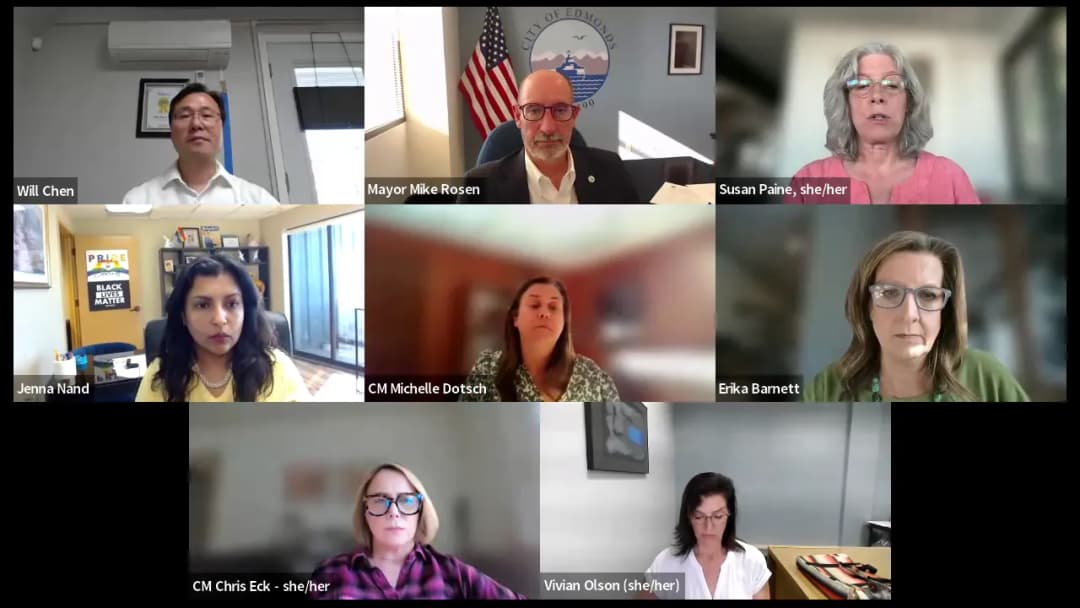
Note on meeting date: The agenda and transcript list this meeting as occurring on July 16, 2026. However, the instruction provided for this summary specifies the date July 17, 2026. This discrepancy is noted; the content below reflects the actual discussion from July 16. The Edmonds City Council held a special meeting to receive a presentation and discuss five redistricting options for the South County Fire (SCF) Regional Fire Authority (RFA). The meeting featured SCF Commissioners Joseph Walkelman (District 1), Michael Pernelhoff (District 2), and City Liaison Will Morris. Council President Dodge led the meeting. The council explored the implications of each map, heard that a previous urgent vote had been delayed to late August or early September, and ultimately decided not to take formal action, opting to allow more time for public input and further deliberation. Discussion Items - Overview of Five Redistricting Maps: Will Morris presented five options: - Map 1: Original map with 95–98% of Edmonds in District 2 and the area east of Highway 99 in District 1. - Map 2: All of Edmonds in District 2 (adjusted to include the block east of Highway 99). - Map 3: North-south split along roughly Pine Street; south and Five Corners area in District 1, north in District 2. - Map 4: Seven unique districts (replacing current five districts plus two at-large positions). - Map 5 (new): Keeps all of Edmonds in one district (like Map 2) but adjusts the northern boundary to keep incumbent commissioners in separate districts. This map was added in response to public comment. - Commissioner Feedback and Public Comment: Commissioner Walkelman noted that public comment on the maps had been limited: fewer than six initial positive comments on Map 2, but later a strong community advocate favored Map 5. He reported receiving 10–15 direct comments from Edmonds residents, with overwhelming support for keeping Edmonds in a single district. Commissioner Pernelhoff added that a commissioner vacancy will occur at the end of July, adding fluidity to the process. - Potential Annexation of Everett and Mukilteo: In response to Councilmember Payne, Commissioner Walkelman confirmed that exploratory talks with Mukilteo and Everett have occurred, but are not yet formal. Any future annexation would trigger another redistricting process, and Edmonds’ eventual voice would depend on the new map and continued advocacy through commissioners. - Voting Structure and Representation: Councilmember Chan clarified that under Map 2, Edmonds would have one commissioner from District 2 (but not guaranteed to be an Edmonds resident because the district includes Lynnwood and unincorporated areas) plus two at-large positions, potentially three seats. Councilmember Olson noted that no option guarantees an Edmonds commissioner because the city’s population (58,000 per district) is too small to command an entire district. - Council Positions on Maps: - Councilmember Payne favored Map 3 (north-south split) because it would give Edmonds two potential representatives. - Councilmember Heck advocated for taking more time rather than voting immediately. - Councilmember Dash emphasized the need for public participation and sought clarity on timeline. - Councilmember Barnett asked what action was expected from council; liaison Will Morris responded that council could send a joint letter or resolution reflecting a consensus. - Councilmember Olson pointed out that no map guarantees an Edmonds commissioner, reducing the urgency for a single-district map. - Future Engagement and Noticing: Councilmember Chen asked if SCF board meetings could be held on a night other than Tuesday to avoid conflict with council meetings. Commissioner Pernelhoff noted that the August meeting will move to Wednesday (due to National Night Out), providing an opportunity for the public to attend both. Key Outcomes - No Formal Action Taken: The council did not vote on a preferred map or resolution. The consensus was to delay any decision to allow public input and further discussion at a future regular meeting. - Second Meeting Adjourned: A second meeting scheduled for 12:30 PM was convened and immediately adjourned with no business, as council chose not to use it for action or extended discussion. - Timeline Extended: The SCF board’s vote on redistricting has been delayed from late July to late August or early September, giving Edmonds council more time to deliberate and gather community feedback. - Public Input Encouraged: Residents can provide comments at SCF board meetings (Tuesdays at 7 PM, with special Wednesday meeting in August) or via email to SCF’s PIO, Christy. The SCF board is considering another public outreach event.
Public Meetings - Edmonds, Washington
Public Meetings - Edmonds, WashingtonThe Edmonds City Council held a special meeting on July 17, 2026 (though the agenda and transcript indicate July 16, 2026 at 12:30 PM). The meeting was called to order and adjourned immediately with no discussion or action taken on any agenda item, including the sole scheduled item regarding the SCF RFA Potential Action. Agenda Items - The council had one scheduled item: "SCF RFA Potential Action - Recommendation to SCF RFA Commissioners Second Reading" (15 minutes allotted). However, when the Mayor called for discussion items, none were raised, and the meeting adjourned without addressing this item. Key Outcomes - The meeting was adjourned at 12:30 PM with no business conducted and no votes taken. - No decisions, directives, or referrals were made. Note: The transcript and agenda state the meeting date as July 16, 2026, but per instruction the summary uses July 17, 2026.
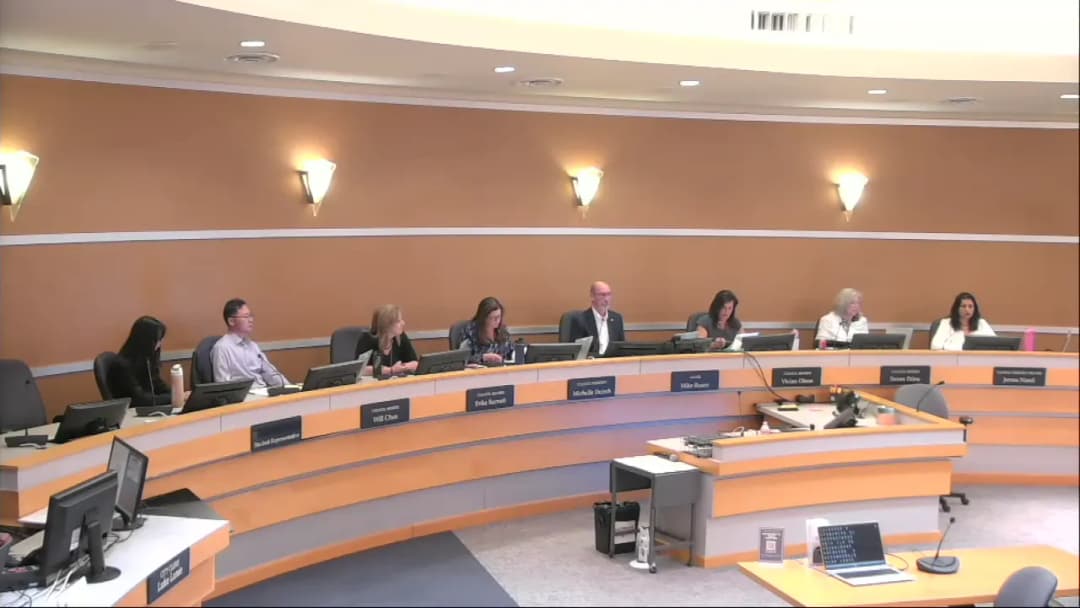
The Edmonds City Council held its regularly scheduled meeting on Tuesday, July 14, 2026, beginning at 6:00 p.m. in Council Chambers. All councilmembers were present except Councilmember Eck, who was excused unanimously. The agenda included a Parks and Recreation Month proclamation, the Mayor's finance update, public comment, a unanimous consent calendar, five council business items (Cascade Swim Club/Yost Pool update, the pre-approved DADU program resolution, unlicensed food vendor code amendments, the Esperance annexation financial analysis, and the Fiscal Sustainability Task Force charter), council comments, and an executive session on litigation. The meeting was extended to 10:00 p.m. and then to 10:20 p.m., reconvened from executive session at 10:17 p.m., and adjourned at 10:17 p.m. (Note: the transcript renders the Council President's surname inconsistently as "Dutch," "Dodge," and "Dash"; "Dash" is used here as the predominant form.) Presentations - Parks and Recreation Month proclamation — Mayor Mike Rosen proclaimed July 2026 as Parks and Recreation Month. Recreation Supervisor Todd Korr described managing more than 100 programs per season and 7,750 annual facility rentals; Parks Manager Jesse Curran accepted the proclamation on behalf of staff, emphasizing the role of parks in community connection. - Mayor's Finance Update — The Mayor said the July 24 exit meeting with the State Auditor's Office is expected to include a management finding on street depreciation: the city uses a 30-50 year useful life tied to resurfacing, while the state requires a 100-year useful life for the full street depth. The city disagrees but will comply; the change adds about $37 million to net assets. S&P affirmed the utility fund at AA with a positive outlook; the general fund, currently AAA, may be downgraded, per bond advisor Scott Bauer, because of the declared fiscal emergency, low reserves, and an internal loan. Moody's has placed the city "in review" pending receipt of the audit. Public Comments & Testimony - Rick Bowden (Edmonds) expressed concern about a proposed bike lane on Main Street from 9th to 6th, through the fountain oval, to the ferry, stating it would remove about 60 parking stalls on one side of the street, including drop-off lanes, and create a "catastrophe" at the turnabout. He said he is neither for nor against bike lanes but opposes this route and called spending $25,000-$100,000 on a survey a waste of money, suggesting alternative routes around downtown and engagement of Edmonds College urban planning students. - Joe Scordino (47-year Edmonds resident) strongly recommended at least one or two town hall meetings on the upcoming budget before work on a new levy, saying the city should avoid the divisiveness of the last levy cycle and build public understanding of spending priorities. Consent Calendar - Approved unanimously: council minutes from June 23, July 7, and July 8 (special meeting) 2026; acceptance of the Lynnwood Honda community engagement vehicle donation (including the 2026 lease and courtesy vehicle donation agreement); and claim checks and wire payments from the July 8, 2026 check run. Discussion Items Cascade Swim Club — Yost Pool Agreement Update Angie Fesser, Parks and Recreation Director, and Max Efkin, Cascade Swim Club President, gave an informational update. (The agenda spells the facility "Yost Pool"; the transcript uses "Yoast.") Fesser reported the pool costs about $267,000 per year: roughly $150,000 in labor, $16,000 in supplies/materials/services, and $100,000 in utilities. Cascade has operated the pool year-round since August 2021 under a five-year agreement (currently in year two) and pays about $102,000 per year toward utilities; the council's mid-biennium budget modification also required an additional $85,000 from Cascade. The city and Cascade are exploring transferring routine maintenance, utilities, supplies, and materials to Cascade by the end of the year, while the city would remain responsible for capital needs. Efkin said the Seattle area ranks lowest among major U.S. cities in public pool access, with 0.8 pools per 100,000 residents and 20 pools needed to reach the national average. He reported that more than 1,000 regional visitors from 38 zip codes outside Edmonds use Yost annually; swim lessons are up 214%, the Yoast Penguins recreational league is up 46%, lifeguard training is up 400%, and about 300 club swimmers from outside Edmonds visit weekly. Public access is 70% of open hours (10-13 hours daily in summer). Cascade's operational spending is $430,000, supporting 75 part-time jobs, with an estimated IMPLAN economic benefit of $645,000-$860,000 annually. The club plans to increase investment to about $650,000 per year and is considering about $75,000 in USA Swimming-approved starting blocks to enable sanctioned meets, which could generate $1.3-$1.5 million per year. Cascade's nonprofit net income was $73,999 last year. Councilmembers expressed strong support for the partnership; Councilmember Olson noted a $40,000 swim-a-thon result and suggested banners and donor fundraising, while Efkin noted the club prefers hosting meets and wants to clarify costs with the community before launching fundraising. Councilmember Barnett asked about routine vs. capital maintenance and liability; Fesser said Cascade has offered to take on all routine maintenance tasks listed, with non-routine and capital responsibilities still being negotiated, and that a grant-funded planning study of the 50-plus-year-old pool's mechanical systems and lifespan is planned (application due at the end of July; work could begin January 2027). Pre-Approved DADU Plan Program — Contract Authority Resolution Building Official Ted Corey presented the second reading of a resolution establishing the pre-approved detached accessory dwelling unit (DADU) plan catalog, approving a template participation and license agreement, and authorizing the mayor to execute those agreements. Plans are reviewed to existing standards — with no reductions in requirements — and designers agree to sell approved plans for no more than $1,000. Approximately 40 DADU permits were applied for in 2025, with many designs reused; pre-approval saves days of review time and roughly 20% of plan review fees for applicants. The catalog will launch on the planning department website next week or the week after and will be refreshed at least every three years in line with state building code cycles. Councilmember Chen noted the $1,000 cap matches Seattle's program. The motion passed unanimously. Unlicensed Food Vendors — Code Update Planning Manager Brad Shipley and Senior Planner Dwayne Wilkhan presented the second reading of draft amendments to Edmonds Code Chapter 4.12 addressing unlicensed food vendors, a growing issue along Highway 99 and in the Westgate area. The update responds to public health risks (lack of hand washing, temperature controls, contamination risk), enforcement gaps, and the need for impound/retrieval rules and regional coordination; it regulates public property only. Staff noted the draft sets a misdemeanor with a $1,000 maximum fine — less strict than Everett's approach (gross misdemeanor, up to $5,000) — and that police patrols would be able to identify permitted vs. unpermitted vendors. Councilmembers debated enforcement philosophy, low-barrier pathways to legal operation, and whether licensed vendors should be allowed in public parking spaces. Four motions were considered: 1. A motion by Councilmember Olson to add language allowing nearby parties input on the use of public right-of-way parking by vendors — failed on a 4-2 vote (2 in favor, 4 opposed). 2. A motion by Councilmember Nand to amend the definition of "non-motorized mobile food vending unit" so carts/wheel devices are not mandatory — passed unanimously; site, sanitation, operating, and 10-foot size limits still apply. 3. A motion by Councilmember Chen directing staff to return with additional research on regulatory and enforcement options, including a possible first-offense warning before fines — passed 4-2 (Chen, Barnett, Payne, and Nand in favor; the Council President and Councilmember Olson opposed). The transcript's initially reported 3-3 roll call was corrected to 4-2 by a second roll call. 4. A motion by the Council President to restore stricken language in section 4.12.100 D1 prohibiting street vendors from operating in portions of the right-of-way designed for vehicular travel or parking — passed 4-2. Preliminary Fiscal Analysis of Potential Esperance Annexation Planning Manager Brad Shipley and Josh Linden (BERC Consulting, remote) presented preliminary findings. Esperance includes 464 acres (about 8% of Edmonds' area), more than $1.3 billion in taxable value, roughly 4,500 residents (about 10% of the city), nearly 1,800 housing units, about 190 jobs, and 25 centerline miles of streets. Snohomish County's 2044 population target for the area is just under 800 net new residents and just under 500 housing units; the 2021 Buildable Lands study estimates capacity for about 76 jobs. The preliminary general fund analysis shows a net positive of $3.8 million in year one; $20 million cumulative in years 1-5 at a 20% utility tax (or $19 million if the rate reverts to 10%); and roughly $54 million in years 6-15 at 20% (just under $50 million at 10%). Results exclude any additional staffing. Department heads identified a potential need for up to 7.75 FTE (4 police officers, 1 police support staff, 1.75 parks and recreation FTE, 1 public works FTE). Revenue drivers include property tax (existing and new construction), utility tax and Olympic View franchise fees, sales tax (mostly online and construction-related), REET (about $3 million in the first six years), and transportation revenues of about $1.3 million (fuel tax, transportation benefit district, $40 license fees). Capital cost estimates use per-capita methods for transportation and stormwater with condition-based adjustments. Linden explained that state annexation sales tax credits (0.1%-0.2% for areas of 2,000-10,000 population) sunset on June 30, 2028, and the state distributes credit revenue only when annexation costs exceed revenues; because the analysis shows net-positive results, eligibility is uncertain. It is not yet assumed that Esperance Park or the 84th Avenue Bridge qualify as "municipal services." The county indicates the bridge does not currently need significant repair. A two-phase annexation split (roughly at 84th Avenue) could place each area above 2,000 residents and create two potential sales tax credit sources; the proposed path is an interlocal agreement process (no direct vote), which could be challenged at the boundary review board. Shipley said no decision is being sought tonight, but a resolution on whether to pursue annexation will be needed soon to meet the sales tax credit timeline, with preliminary engagement including a town hall. Councilmember Olson expressed support, calling the city and Esperance "better together" and noting the net-positive result is important given the city's fiscal situation. Councilmember Nand urged a collaborative, public-facing process with an actual vote by Esperance residents, arguing the administrative route would be a mistake; she also suggested analyzing whether residents' tax burdens would decrease and addressing concerns about semi-rural uses (e.g., roosters) that Edmonds code restricts. Councilmember Barnett said Esperance is "a hole in the heart of Edmonds" and asked what assumptions remain; staff cited cost attribution, staffing scenarios, stormwater facility conditions, and capital (transportation/bridge) analysis. Councilmember Chen said Highway 99-adjacent zoning in the area would need to conform to Edmonds' business zoning, in place since 2017. Staff and BERC will finalize the analysis over the coming weeks. Fiscal Sustainability Task Force Charter and Work Plan Council President Dash presented the first reading of the charter and work plan for a council-driven, advisory Fiscal Sustainability Task Force supported by Baker Tilly, modeled in part on Mountlake Terrace. All decisions remain with council; the task force would provide community input and has access to the city's finance team, with staff liaison Keisha. Councilmember Nand expressed concern that the city's finance professionals were not given a voice to shape policy in the current design; Councilmember Barnett clarified the task force is advisory and does not replace the finance department. Councilmember Olson suggested task force feedback be incorporated between work plan phases; Councilmember Payne stressed the need for geographic representation across the city. The motion to accept the charter and proposed work plan passed unanimously. Key Outcomes - Councilmember Eck excused unanimously; agenda approved unanimously. - July 2026 proclaimed Parks and Recreation Month; Mayor's finance update received. - Consent calendar approved unanimously (minutes; Lynnwood Honda community engagement vehicle donation; claim checks and wires from July 8, 2026). - Pre-approved DADU plan program resolution passed unanimously (mayor authorized to execute participation/license agreements). - Unlicensed food vendor code: commitment to further research (4-2), restoration of the public right-of-way parking prohibition (4-2), removal of the cart/wheel mandate (unanimous); a neighboring-input parking motion failed (2-4). Staff will bring back revised code with enforcement options, including a possible warning-first approach. - Esperance annexation: no vote taken; analysis continues with a decision on whether to pursue annexation expected soon due to the June 30, 2028 sales tax credit sunset. - Fiscal Sustainability Task Force charter and work plan accepted unanimously; council will next set selection criteria and an application process. - Executive session on litigation (RCW 42.30.110(1)(i)) held; reconvened at 10:17 p.m.; no action taken; meeting adjourned at 10:17 p.m.
This special meeting was a continuation of the budget workshop process, focusing on the city's structural deficit and the path to a balanced biennial budget (2026–2027). Council reviewed updated forecast assumptions, explored revenue opportunities, and discussed potential service reductions. The current projected shortfall is $5,291,974 for the biennium. Consent Calendar No consent calendar items were considered. Public Comments & Testimony No public comment period was held; the meeting was a council workshop. Discussion Items Budget Overview and Forecast – Keisha presented changes to the forecast assumptions since the May retreat. Only two changes occurred: the agreement to shift the cost function from 8% to 9% and an increase in water costs (25% increase from previous estimate plus an additional 12% tax from Adrick). These changes increased the biennial gap by approximately $600,000–$700,000. The total shortfall remained at $5,291,974, driven by $4.4 million in expenditure increases and the remainder from revenue reductions. Revenue Opportunities - Sales Tax Projection – Staff Mike Bailey suggested increasing the 2026 sales tax forecast by $500,000 and raising the 2027 growth assumption from 1% to 2% based on a current 6.4% year-over-year increase. Council members Susan and Jenna advocated for conservative estimates, preferring to keep the 1% assumption. Council members Jeff, Chris, and others supported the 2% update, arguing it was still prudent. No formal consensus was reached, but staff will proceed with the 2% assumption for planning purposes. - Inter-fund Service Charges – Discussion on whether to increase the current 3% annual growth rate for inter-fund service charges to 4%–5% to align with rising labor and benefit costs. The issue was tabled for further analysis; council directed staff to review billing accuracy and consider a standardized overhead charge model. - Automated Traffic Safety Cameras – Council debated extending school zone camera hours to 24/7 (estimated $247,000 annual revenue). A majority expressed support for public safety reasons, with Chief Hopkins noting high speeding violations (300+ per camera per week, including speeds up to 70 mph). Council member Jenna strongly opposed, calling it a regressive “money grab” and raising concerns about data sharing with federal authorities. Council also discussed adding park zones and increasing fines for repeat offenders. Possible expansion of red light cameras was mentioned but not decided. - Utility Tax Extension – Council discussed extending the temporary utility tax through 2028 to bridge the one-time $3 million loan repayment need. Some members advocated for a shorter-term levy as an alternative paired with repealing the utility tax. No final action. - Other Revenue Ideas – Short-term rental tax, paid parking, cannabis tax, alcohol tax, collecting cable streaming fees, concierge service for developers, and annexation of Esperance area were introduced as longer-term options. Service Reductions – Council members individually listed four service areas they would be comfortable reducing, then ranked the most and least comfortable options. Items frequently listed as most comfortable to cut: privatizing creative district, reducing city-sponsored recreation, outsourcing janitorial/logistics, pausing arts programs, and selling unused properties (e.g., Meadowdale Clubhouse, Yost Pool). Items listed as least comfortable to cut: human services, parks programs, graffiti/vandalism cleanup, police/emergency services, boards and committees, and employee relations. Staff noted that recreation programs essentially break even and eliminating them would not save significant net revenue. Long-term Strategies – Council emphasized the need for sustainable revenue growth through development along Highway 99, middle housing, streamlining permitting (unified development code), raising SEPA exemption thresholds, and re-engaging the planned action ordinance. The city is working with Baker Tilly and a community task force to identify further opportunities. Key Outcomes Direction to Staff: Prepare an ordinance to operate school zone cameras 24/7, bring options for increasing fines (speed-based escalation), and explore park zone cameras. Also, prepare analysis on extending the utility tax or a one-year levy option. Revenue Target: Approximately $1.7 million in new revenue was preliminarily identified (sales tax adjustment and 24/7 cameras), reducing the gap from $5.3 million to $3.6 million, with $3 million of that being a one-time loan repayment. The ongoing structural gap is approximately $600,000. No Formal Votes: All decisions were advisory for staff to refine proposals before the October budget submission. Further council discussion is scheduled. Next Steps: The Baker Tilly forecast analysis will be presented at the next council meeting. The council will also receive the community task force recommendations later in the year.
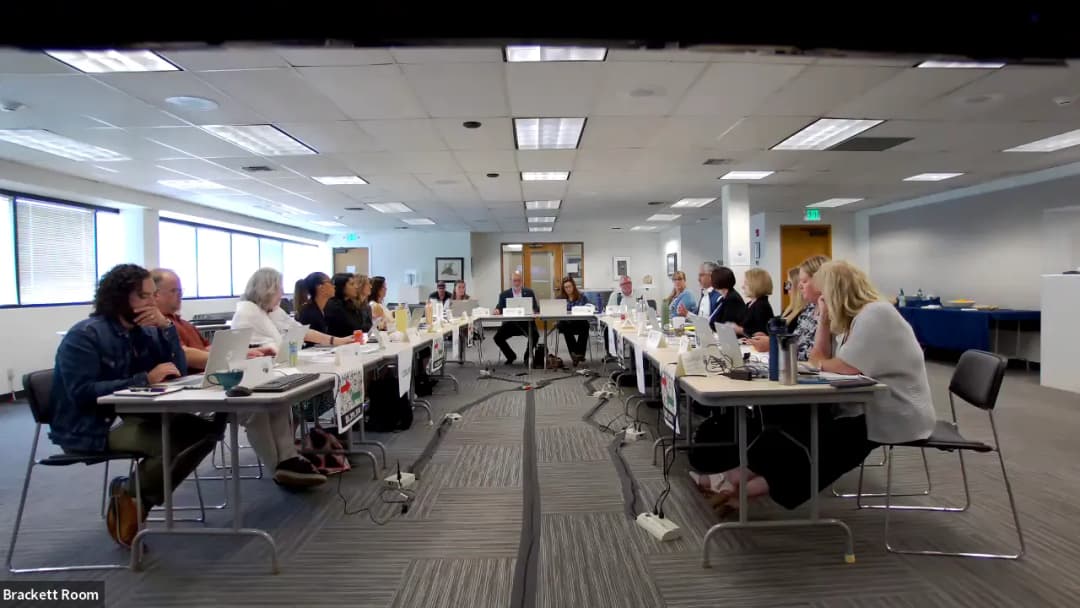
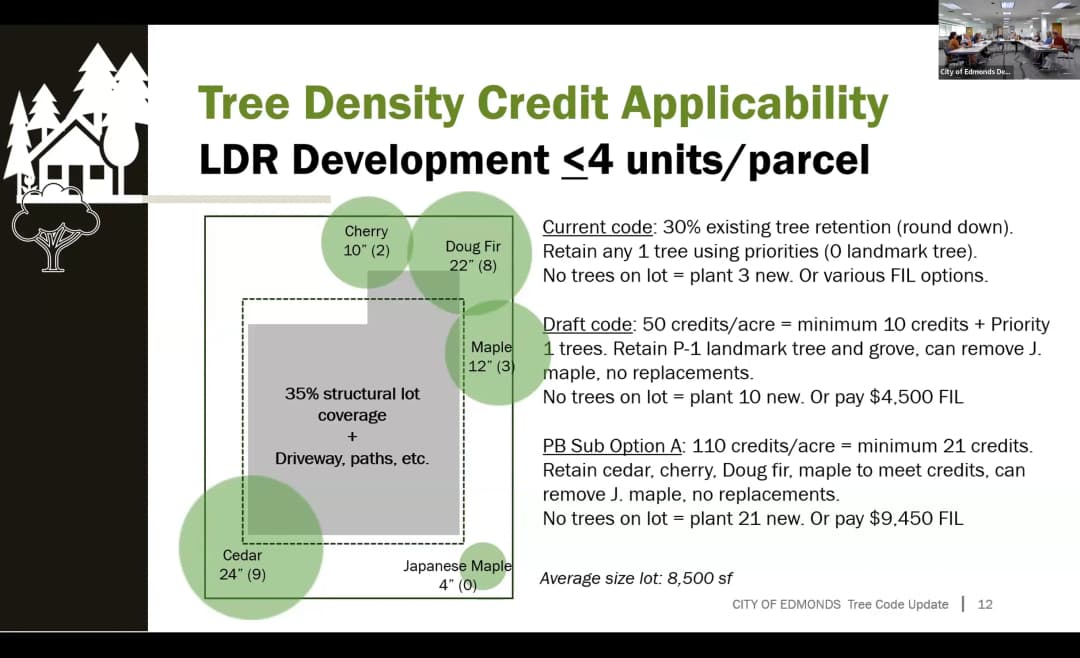
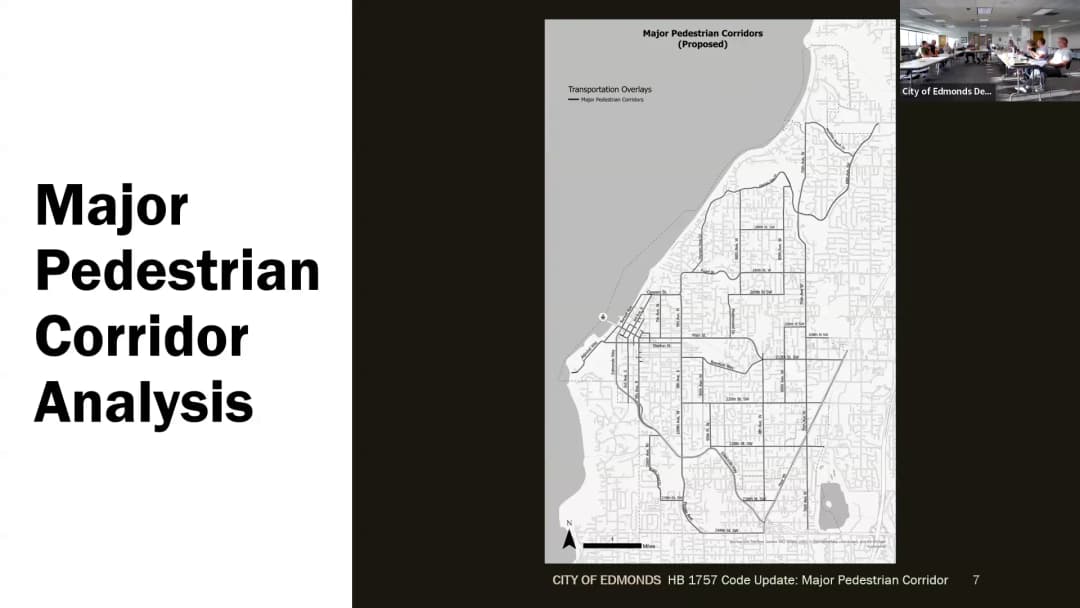
The Edmonds Planning Board met in hybrid format in the Brackett Room on the 3rd floor of City Hall (121 5th Ave N, Edmonds, WA 98020) on July 9, 2026 (2026-07-09), to approve minutes, take public comment, continue the third reading of the House Bill 1757 code amendments allowing conversion of existing commercial buildings to residential use, and continue the 2026 Tree Code Update (Project AMD2026-0001). The agenda lists the meeting date as July 8, 2026, at 7:00 PM, while the meeting record timestamp is 2026-07-09 17:45 UTC; this summary follows the timestamp date. The board completed its HB 1757 recommendation to council, adopted landmark tree definitions, and deferred final tree density credit decisions back to the subcommittee. Consent Calendar - Approved the June 24, 2026, Planning Board meeting minutes as revised by Judy Gladstone, including a correction that Lee Hankins read the land acknowledgement instead of Stephen Lee. The motion passed with 5 ayes, no nays, and no abstentions. Public Comments & Testimony - Deborah Aspland, who stated she is president of the Edmonds Trees advocacy group, expressed full support for a strong tree code with retention as the first requirement, replacement trees for any deficit, and fee-in-lieu only as a last resort. She recommended the planning board subcommittee's option of 110 tree density credits per acre with the 10-point scale, noted replacement trees are only needed to meet minimum credits, suggested tailoring replacement credits to incentivize native conifers and larger mature trees, and urged adoption of a 24-inch landmark tree threshold with a landmark species list. - John Mursky of 518 Bell Street, a former sustainability policy advisor for Ann Arbor, called the draft code excellent. He recommended a landmark DSH threshold no larger than 24 inches, lower DSH thresholds for native species that do not reach 24 inches, a tree density credit system that demonstrably achieves the citywide 35% canopy goal, extending the 1.5 credit multiplier now used for conifers to other native trees on the city's recommended tree list (noting oak supports over 400 species while ginkgo supports about five), and indexing fines and fees. He rejected takings objections, stating the city is preserving significant community assets rather than taking property. - Pam Tower, an Edmonds resident, supported the same 110 credits per acre with the 10-point scale recommended by Deborah Aspland. She recommended a fee-in-lieu of about $1,300 to $1,500 per tree credit, noted that under the initial draft code a 10-credit landmark tree could be removed for only about $4,500, and advocated minimum tree retention requirements plus double tree density credits for replacement native conifers and other high-value species. - Kathleen Sears, an Edmonds resident and Edmonds Trees member, said she seconded the previous comments. She supported the 24-inch landmark definition and species list, asked the board to reconsider last meeting's vote on tree species, and recommended that permit types and technical standards be written more clearly and specifically. Citing Forest Service i-Tree calculations, she said a 24-inch Douglas fir absorbs and mitigates 2,003 gallons of stormwater per year (a figure she later restated as 2,350 gallons) versus about 10 gallons for a sapling, so roughly 235 young saplings would be needed to match one mature tree's immediate infrastructure capacity; she also cited neighboring cities that use aggressive tree credit multipliers. Discussion Items House Bill 1757 - Commercial-to-Residential Conversions - Dwayne Wacon, senior planner, presented the third reading of the HB 1757 code amendments. The board had previously approved the major pedestrian corridor definition; staff presented three map options for areas that could be removed from the corridor. Option 1 removed segments along Olympic View Drive, Meadow Beach Drive, and Puget Drive where the comprehensive plan indicated future study needs. Option 2 removed school-connector routes not identified as primary pedestrian corridors in the comprehensive plan. Option 3 removed routes in the Esperance area; the transcript includes an exchange clarifying that Esperance is annexed rather than unincorporated. Staff recommended the full proposed overlay to protect ground-floor commercial in the commercial waterfront zone, downtown BD designated street fronts, and the NCH ground-floor commercial overlay. - Board discussion focused on breadth. Judy said the city was using a transportation construct to address commercial zoning and supported removing all three option areas; staff responded that the map aligns with the comprehensive plan's planned pedestrian and bicycle networks. Bristol clarified that the overlay is a preservation tool that identifies where ground-floor commercial cannot be converted and does not itself require commercial uses. Nick suggested adding the word existing to item F to clarify the prohibition applies only to existing ground-floor commercial; staff cautioned against the edit because the entire chapter applies to existing buildings. Staff also noted that a separate state bill expected next year would limit ground-floor commercial requirements to 40 percent of square footage in commercial or mixed-use zones. - The board passed a motion to recommend that the major pedestrian corridors be the primary pedestrian corridors from comprehensive plan Figure 2.2, with the addition of the downtown BD zones; the commercial waterfront was already included in the primary routes. The vote was 6 ayes, 0 nays, and 1 abstention. A second motion to recommend the draft code language in the packet, including the previously approved definition and the map just voted on, passed 6 ayes, 0 nays, and 1 abstention. 2026 Tree Code Update - Landmark Tree Species and Definition - The subcommittee recommended adopting the Bellevue landmark species list as a compromise. The board noted Bellevue's list protects species such as madrona and Pacific yew at 8 inches DSH rather than 12 inches, better reflecting the mature size of those species, while using less restrictive thresholds than Seattle's 6-inch values. - A friendly amendment to remove cascara from the Bellevue list passed. The board then unanimously adopted the Bellevue landmark species list minus cascara, and 24-inch DBH as the landmark definition for all other trees. 2026 Tree Code Update - Tree Density Credits - The subcommittee framed the central choice as Option A (110 credits per acre with a 1-to-10 existing tree value scale) versus Option B (65 credits per acre with a 1-to-5 scale adapted from Shoreline). Members noted Option A would require about 21 credits, and about 21 planted trees on a vacant 8,500-square-foot lot, while Option B would require about 13 credits and about 13 planted trees. They also discussed whether replanted trees should each count as one credit and whether credits should be tailored to reward native conifers and mature species. - An amendment passed 6 ayes, 0 nays, and 1 abstention to remove ADUs and DADUs from the proposed 110-credit-per-acre requirement, on the grounds that these housing types work around existing buildings and should not be as restrictive. - A subsequent motion to adopt 110 credits per acre for other low-density residential development was withdrawn after discussion raised concerns about middle housing feasibility, replanting counts, potential fee-in-lieu triggers, and the need to balance housing production with the 35% canopy goal. A motion to extend the meeting by 15 minutes failed; a 5-minute extension passed. - No final decision on tree density credits was made. The subcommittee was directed to refine Options A and B with tiered thresholds and replanting incentive options for the next meeting. Key Outcomes - Recommended the HB 1757 draft code to council with the major pedestrian corridor defined as the comprehensive plan's primary pedestrian corridors plus downtown BD zones; votes were 6-0-1 and 6-0-1. - Unanimously adopted the Bellevue landmark species list minus cascara, with 24-inch DBH as the landmark definition for all other trees. - Approved the June 24 minutes with revisions and the corrected land acknowledgement attribution. - Deferred a final tree density credit decision; ADUs and DADUs were exempted from the 110-credit-per-acre proposal, and the subcommittee will return with refined options. - The board discussed the extended agenda: the next regular meeting, referenced as July 22 after initially being stated as July 27, will include a tree code hearing and the Westgate zoning map discrepancy item. No special meeting was scheduled; the chair said subcommittee time would be better spent before the next meeting. Adjournment - The meeting adjourned at 9:01 PM.
The Edmonds City Council held a regular meeting on July 7, 2026, at 6:00 PM in the Council Chambers. The meeting included a presentation of the Mayor's Finance Update and a proclamation for Disability Pride Month, approval of the consent agenda, and a discussion and vote on a budget amendment. The council also entered an executive session to discuss potential litigation. No public comments were made. Presentations - Mayor's Finance Update: The mayor reported positive financial news. Year-to-date (through May) sales tax revenue was $391,000 over forecast; development-related revenue was $400,000 over forecast and 61% of anticipated revenue had been collected (42% into the year). Lodging tax was $16,000 ahead, while the Real Estate Excise Tax (REAT) was $22,000 below forecast. For June, planning fees totaled $74,487 (up from $63,000 the prior year), building and fire permits reached $1.5 million (up from $676,000), and engineering permits also reached $1.5 million (up from $600,000). Three major projects drove the permitting surge: the Boys and Girls Club, Edmonds Green Apartments, and the Port of Edmonds Seawall Phase 2. The mayor also noted that a city check was intercepted and sold on the dark web, but the bank stopped payment and the vendor was notified; the issue was resolved. - Proclamation: Disability Pride Month (July 2026): The mayor read a proclamation recognizing July as Disability Pride Month, marking the 36th anniversary of the Americans with Disabilities Act. Jody Callello, a board member of the Arc of Snohomish County, accepted the proclamation and spoke about her work as a disability rights advocate, including helping families with IEP meetings and supporting transition-age students with disabilities. Consent Calendar The following items were approved unanimously without discussion: - Approval of City Council meeting minutes from June 10, 2026 (study session). - Third reading of the Park Impact Fee (PIF) Interim Ordinance Extension. - Approval of payroll, benefit checks, direct deposit, and wire payments for June 16–30, 2026. - Approval of claim checks and wire payments for June 24 and July 1, 2026. Discussion Items - Budget Amendment (Ordinance Amending 4422): Finance staff presented five key adjustments to the 2026 operating budget: 1. REAT Funds (125 & 126): Return $183,621.65 to Washington state following a program audit of past payouts. The city received funds from the county and now owes the state. 2. Columbarium Project (Fund 009): $150,000 expenditure authority ($140,000 for professional services, $10,000 for parks project manager labor). 3. LEOF (Law Enforcement Officers’ and Firefighters’ Retirement System) Fund (001 to 009 transfer): $187,000 transfer from the General Fund to cover anticipated benefit expenses (long-term care) and professional services. 4. Lodging Tax Advisory Committee (LTAC) – Holiday Lights: $15,000 additional expenditure authority for holiday lights in downtown Edmonds, approved by LTAC. 5. LTGO Debt Service Fund (126 to 231 transfer): $700 transfer for previously unbudgeted administrative service fees. Council discussion: Councilmember Chen asked to delay approval on the REAT repayment, citing inability to verify that the city actually received the funds from the two companies (Healthcare Loyalty Trust Inc. and East of Marion Adams) in 2022 and 2023. He also noted the repayment should be a fund balance adjustment, not an expense. Finance staff responded that delaying could result in the state withholding future REAT distributions and that the county may not be able to provide more detailed information. The city is currently under audit. Councilmember Barnett asked about forecasting for LEOF expenses; staff acknowledged that new long-term care claims had not been fully anticipated. Councilmember Eck supported the finance department's approach. Councilmember Nan moved to adopt the ordinance, arguing cooperation with the state is prudent and the adjustments are well-documented. Key Outcomes - Budget Amendment Ordinance passed 6-1, with Councilmember Chen voting against. The ordinance amends Ordinance 4422 to account for unanticipated transfers and expenditures. - The council entered executive session for 60 minutes to discuss potential litigation (RCW 42.30.110(1)(i)). - The meeting was reconvened at 8:15 PM, after which council members gave brief comments about community events, including the Fourth of July parade (estimated 19,000 attendees), Pride Fest, and the upcoming Porch Fest. Councilmember Payne urged focus on revenue options at the next day's budget retreat, noting the utility tax expires in 12 months.
The Edmonds Planning Board held a hybrid regular meeting on June 26, 2026, at 7:01 PM. The meeting included approval of minutes, public comments, and discussions on two unfinished business items: code amendments for HB 1757 (conversion of commercial buildings to residential) and the 2026 Tree Code Update. The board also addressed its extended agenda and next steps. Public Comments & Testimony - Three representatives from Friends of Edmonds Trees (FOT) spoke. They expressed support for the tree density credit (TDC) approach but argued that the proposed 50 credits per acre is too low to meet the city's 35% canopy goal; they recommended 175 credits per acre. They also called for higher fee-in-lieu amounts, a minimum retention requirement for viable trees, and stronger incentives for retaining existing trees. They proposed a graded removal allowance for non-development properties based on lot size and emphasized that replacement requirements should align with the TDC system. - Arlene Williams (online) criticized the draft code's language as vague, particularly regarding permit denials and hazard tree documentation. She noted that a photo-only option for hazard trees is insufficient and recommended requiring an arborist report or staff verification. She also argued that the TDC numbers are too low, using the Hadley Acres project as an example, and urged the board to raise the numbers to at least match current code protections. Discussion Items - HB 1757 – Conversion of Commercial Buildings to Residential (Second Reading): Staff presented the definition of Major Pedestrian Corridor (MPC) and a map identifying corridors where ground-floor commercial use would be protected. The board discussed whether the map is overly expansive, covering many arterials and school routes. Some members feared the MPC designation could later be used to justify upzoning. Others saw value in a broader transportation definition for grant eligibility and sidewalk planning. No final decision was reached; staff will bring three alternative map scenarios to the next meeting. - 2026 Tree Code Update: The board reviewed the draft code section by section. Key discussion centered on the landmark tree definition. A motion to adopt a species-specific list with varying diameter thresholds (as proposed by FOT) failed with one aye, two nays, and two abstentions. The board will wait for a recommendation from the Tree Board (meeting July 2) before deciding. On other topics, the board confirmed its earlier decision to allow one tree removal per 12 months for non-development properties, regardless of lot size. The board also discussed permits, nuisance tree criteria, and the need for clearer language on when permits can be denied. To expedite remaining decisions, the board formed a three-member subcommittee (Judy, Lee, and the chair) to work with staff on priority issues. Key Outcomes - Minutes Approved: The minutes from the June 10 special meeting and regular meeting were approved, with Judy Godson abstaining on both. - HB 1757: Staff will present three revised MPC map options at the July 8 meeting for a final recommendation. - Tree Code Update: The board postponed the landmark tree definition pending the Tree Board's recommendation (July 2). The new subcommittee will meet to resolve remaining code issues, aiming for 95% completion before the public hearing on July 22. - Schedule: July 8: HB 1757 recommendation and continued tree code work. July 22: Public hearing and final recommendation on the tree code. The zoning map amendments for Westgate were moved to September 9.
The Edmonds City Council met on June 23, 2026, to discuss a proclamation for the 250th anniversary of the Declaration of Independence, presentations from the Edmonds Arts Commission and Sno-Isle Libraries, public hearings on park impact fees and family burial grounds, and several business items including a sewer comprehensive plan update, public defender contract renewal, and code amendments. Audience comments addressed the library levy and a transitional housing project. Presentations - Proclamation for 250th Anniversary of the Declaration of Independence: Mayor Mike Rosen and Councilmember Susan Payne (a direct descendant of signer Robert Treat Paine) presented a proclamation declaring July 4, 2026, the 250th anniversary. Councilmember Payne shared family history and called for upholding the ideals of liberty and equality. - Edmonds Arts Commission Update: Chair Richard Chung and other commissioners presented the history and current work of the commission, including its role in public art, community events, and economic development (noting 12% of Edmonds' GDP is tied to arts-related businesses). They highlighted challenges due to the unfilled Cultural Arts Manager position and reduced staff support, and requested council support to restore capacity. Councilmembers expressed strong support and discussed staffing needs. - Sno-Isle Libraries Update: Executive Director Eric Howard and South County Assistant Director Phil Spirido presented on library services, summer reading, and the upcoming August 4 levy (Proposition 1) to restore the levy rate. They reported that library card creation reached an all-time high in 2025, with 10.8 million items checked out. The Edmonds library has circulated 550,000 items since its January 2024 reopening. Councilmembers expressed support and discussed trends, partnerships, and facilities. - Mayor's Finance Update: Mayor Rosen referenced the April 2026 Financial Report and reminded council of the upcoming budget workshop. Audience Comments - Jeannie Thorson (Edmonds, volunteer chair of Yes for Libraries) spoke in favor of the library levy (Proposition 1), emphasizing free access to resources and community benefit. - Carol Simpson (Mukilteo) invited council to the June 29 opening of the New Start Center (48-unit transitional housing by YWCA), urging attendance to show support for addressing homelessness. - Nora Carlson (Edmonds) thanked council for reinstating the Pride flag at City Hall following a recent council motion, and quoted actor Wilson Cruz on the importance of the rainbow flag as a symbol of inclusion. Public Hearings - Park Impact Fee Interim Ordinance Extension: Parks Director Angie Fasser requested a six-month extension (to end of 2026) to complete a revised park impact fee study, as required by updated state law. No public testimony was offered. Council will consider approval on July 7. - Interim Regulations on Family Burial Grounds: Planning Director Michael Clugston presented the required public hearing for the interim ordinance adopted on June 2, 2026, which prohibits family burial grounds while permanent regulations are developed. No public testimony was offered. Council Business - Access Agreement for Edmonds Marsh Restoration (Item 10.1, postponed from consent): Council President Dodge moved to postpone approval of the access agreement for stream restoration work by Edmonds Marsh Estuary Advocates and Adopt a Stream Foundation until local permits (including a critical areas ordinance permit) are obtained. City staff noted a proposed dam feature requires further review. The motion passed unanimously. - Sewer Comprehensive Plan Update PSA (Item 10.2, moved from consent): City Engineer Mike Delilah and Public Works Director Rahim explained the need for a 30-month, $440,080 professional services agreement with BHC Consultants to update the 13-year-old wastewater comprehensive plan. The plan will guide capital investments and rate decisions. Councilmember Barnett requested discussion. A motion to approve the agreement passed 6-1. - Public Defender Contract Renewal (Item 10.3): HR Director Lisa Takich presented the renewal of the contract with Snohomish County Public Defender Association (SCPDA) from July 1, 2026, through December 31, 2028. The contract includes a $61,068 increase for the second half of 2026, with further escalations due to state-mandated caseload reductions. Executive Director Kathleen Kyle answered questions. The motion passed unanimously. - Code Amendments for HB 1757 (Energy Code) (Item 10.4): Building Official Ted Corey presented amendments exempting energy code requirements for converting existing buildings (with a certificate of occupancy for three or more years) to dwelling units, as mandated by the state. The motion passed unanimously. - Minor Code Updates for Middle Housing (Item 10.5): Planning Manager Brad Shipley presented minor code amendments to correct outdated references and terminology from the low-density residential (LDR) code adopted previously. Council adopted option 1 (approve amendments). The motion passed unanimously. - Resolution Adopting Budget Calendar (Item 10.6): Council approved the planning calendar for the 2027-2028 biennial budget. The motion passed unanimously. Key Outcomes - Unanimous approval of the consent agenda (items not pulled). - Unanimous postponement of the Edmonds Marsh restoration access agreement pending permit completion. - Approval of the sewer comprehensive plan PSA ($440,080) with a 6-1 vote. - Unanimous renewal of the public defender contract through December 2028. - Unanimous adoption of energy code amendments for HB 1757. - Unanimous adoption of minor middle housing code updates. - Unanimous adoption of the 2027-2028 budget calendar. - Public hearings held on park impact fees and family burial grounds with no public testimony. - Council comments included announcements about the upcoming Pride Festival (June 27), Fourth of July parade (July 4), Juneteenth celebration, and the Edmonds Arts Festival. Student Representative Leo highlighted the Lambert House LGBTQ+ youth programs.
Note: The agenda and transcript list the meeting date as June 16, 2026, but the provided metadata indicates June 17, 2026. This summary uses the latter date per instructions. The Edmonds City Council held a special meeting on June 17, 2026, to conduct interviews for two vacancies on the Salary Commission and to discuss a draft letter to the Everett City Council and Mayor regarding utility tax and water rate proposals. The meeting was called to order at 5:30 PM and extended to 6:30 PM via unanimous vote. Board/Commission Appointment Interviews – Salary Commission Human Resources Director Lisa Takich presented the background: Ordinance 4372 (December 2024) suspended the Salary Commission for two years; Ordinance 4435 (May 2026) resumed it. The five-member commission had two vacancies after one term expired and one member resigned. Mayor Rosen appointed two candidates: Alicia Koney and Jerry Masters. Council members interviewed each candidate. Interview with Alicia Koney - Alicia Koney, a 25-year Edmonds resident and owner of Kone Consulting, expressed gratitude for the council’s service. She highlighted her data-driven approach and experience with wage/salary analyses. - Councilmember Eck asked what unique skills she brings; she cited grounding in data and experience with comparable salary studies. - Councilmember Chen asked about balancing city finances with fair compensation. Koney emphasized considering the city budget, the need to avoid barriers for elected officials, and time commitments. - Councilmember Nand shared an example of incumbents running unopposed (72 positions in Snohomish County in 2023) and asked how she would incorporate diversity, equity, and inclusion (DEI). Koney responded that she would factor in cost of living in Edmonds and the risk of disincentivizing qualified candidates if compensation is too low. - Council President Bosh asked how she would weigh data versus public sentiment. Koney said she would stand behind data if sentiment conflicted, but would also value public input. - Councilmember Olson raised a potential conflict of interest if Koney consulted for the city while on the commission. Koney stated she would not pursue city work during her tenure, considering it a conflict. Interview with Jerry Masters - Jerry Masters, an eight-year Edmonds resident and retired business owner, noted his volunteer experience on the Northwest Straits Commission and Snohomish County Marine Resources Committee, including wage/salary survey work. - Councilmember Chen asked about the city’s financial situation. Masters replied that the city’s financial situation is secondary to determining fair pay; he would not advance a career by underpaying people. - Councilmember Nand repeated the DEI question. Masters acknowledged his privilege as a white male and said he would listen to others and follow guidance on DEI. - Council President Bosh asked about data vs. public sentiment. Masters said the commission’s job is to do its job even if sentiment differs; revenue issues should be separate from job value. - Councilmember Barnett asked about selecting comparable jurisdictions. Masters emphasized looking at neighboring cities with similar demographics and structures, and communicating findings to citizens. - Councilmember Payne asked about unique skills. Masters cited his experience negotiating funding for the Northwest Straits Commission in 2010, requiring him to speak truth to power and advocate for the value of the work. - Councilmember Olson noted that Masters’ initial reaction was “who would want to do that,” but he later applied. Masters agreed. No formal vote was taken; the interviews were conducted for council consideration. The council will presumably forward the appointments to the Salary Commission. Letter to Everett City Council and Mayor Council President Bosh introduced a draft letter regarding Everett’s proposed utility tax and regional water policy. The letter aimed to correct a misstatement that Edmonds imposes a utility tax on customers outside its limits, and to express concerns about representation and financial impacts. Councilmembers provided feedback: - Councilmember Barnett suggested using bullet points or bolding to highlight key points (e.g., Edmonds does not tax outside customers, the tax would apply to unrepresented customers, the proposal compounds existing water rate increases). She noted the letter should be easy to scan. - Councilmember Nand recommended softening “respectfully clarify that this characterization is incorrect” to “respectfully wish to clarify that this characterization is incorrect.” She also suggested removing references to Alderwood Water and Wastewater District to keep the focus on correcting the misstatement, but later agreed to keep it after discussion. - Councilmember Payne supported keeping the Alderwood references because Edmonds buys water through Alderwood and the connection is relevant. - Councilmember Olson proposed minor edits: adding “and been relied on in support of” after “discussion of the proposed ordinance,” and adding “who do not directly benefit from Edmonds’ general fund expenditures” after “neighboring jurisdictions.” She also preferred bolding over bullets and emphasized expediency. - Councilmember Chen suggested the city also communicate with its own residents via a PIO statement. - Councilmember Olson opposed bolding, preferring underlining or italics for emphasis. - Council President Bosh noted the mayor would sign the letter, so the opening should include the mayor. Consensus: The letter would be sent with the agreed edits (adding the mayor, softening the clarification language, incorporating Olson’s additions, and retaining Alderwood references). Council President Bosh and Councilmember Barnett volunteered to finalize the draft and send it promptly. Key Outcomes - Interviews conducted: No formal vote was taken on the Salary Commission appointments; the council will proceed with the mayor’s appointments. - Letter to Everett: The council agreed to finalize and send the letter with the discussed edits. Council President Bosh and Councilmember Barnett will complete the draft and transmit it. - Meeting extension: The council unanimously voted to extend the meeting from 5:30 PM to 6:30 PM to allow sufficient discussion. - Next steps: The letter will be sent to the Everett City Council and Mayor; the city may also issue a public information statement to Edmonds residents.
The Parks and Public Works Committee met on June 16, 2026, at 3:00 PM to discuss two items: an extension of the interim ordinance for Park Impact Fees and a Professional Services Agreement (PSA) for the Sewer Comprehensive Plan Update. Both items were advanced to the consent agenda for full City Council consideration. Discussion Items - Park Impact Fee (PIF) Interim Ordinance Extension: Director of Parks, Recreation and Human Services Angie Fesser presented a request for a six-month extension of the interim ordinance governing park impact fees. The city needs more time to update the fee calculation methodology following state RCW changes. A $60,000 budget amendment was approved on April 7, 2026, to fund the study; consultant Burke has been selected and will begin work June 30. The previous park impact fee study was last updated in 2015. A public hearing is scheduled for June 23, 2026, with approval consideration on July 7, 2026. Council members expressed support; the committee agreed to advance the item to the consent agenda after the public hearing. - Sewer Comprehensive Plan Update PSA: City Engineer Mike Delilla presented a PSA with BHC Consultants to update the Sewer Comprehensive Plan, last updated 13 years ago. The update addresses changes in federal/state regulations, population density, and zoning. BHC was selected from two qualifications. The plan will guide future projects, asset management, and financial planning, including a revenue analysis to support rate structures. Delilla noted the city is separately working on a utility rate study. Council members expressed support, citing the risk of inaction exemplified by a neighboring city’s 42.5% sewer rate increase. The committee forwarded the item to the consent agenda. Key Outcomes - Both items were recommended for approval on the consent agenda. The Park Impact Fee interim ordinance extension requires a public hearing (June 23, 2026) before final approval. The Sewer Comprehensive Plan Update PSA will proceed to the full council for approval on consent.