81
APR 1, 2026 · EDMONDS, WASHINGTON · CITY COUNCIL & BOARDS
Edmonds City Council Special Meeting for Executive Session on April 1, 2026
PROCEDURAL 100%
The Edmonds City Council held a special meeting on April 1, 2026, at 12:00 PM. The purpose of the meeting was to convene in executive session to evaluate the qualifications of an applicant for public employment or to review the performance of a public employee, pursuant to RCW 42.30.110(1)(G). The executive session was expected to last 120 minutes, with the council scheduled to reconvene in open session at 2:00 PM. The meeting was then adjourned. Consent Calendar - No consent calendar items were discussed. Public Comments & Testimony - No public comments or testimony were heard. Discussion Items - No discussion items were considered in open session. Key Outcomes - The council moved into executive session for 120 minutes to discuss personnel matters. The meeting reconvened briefly in open session and adjourned.
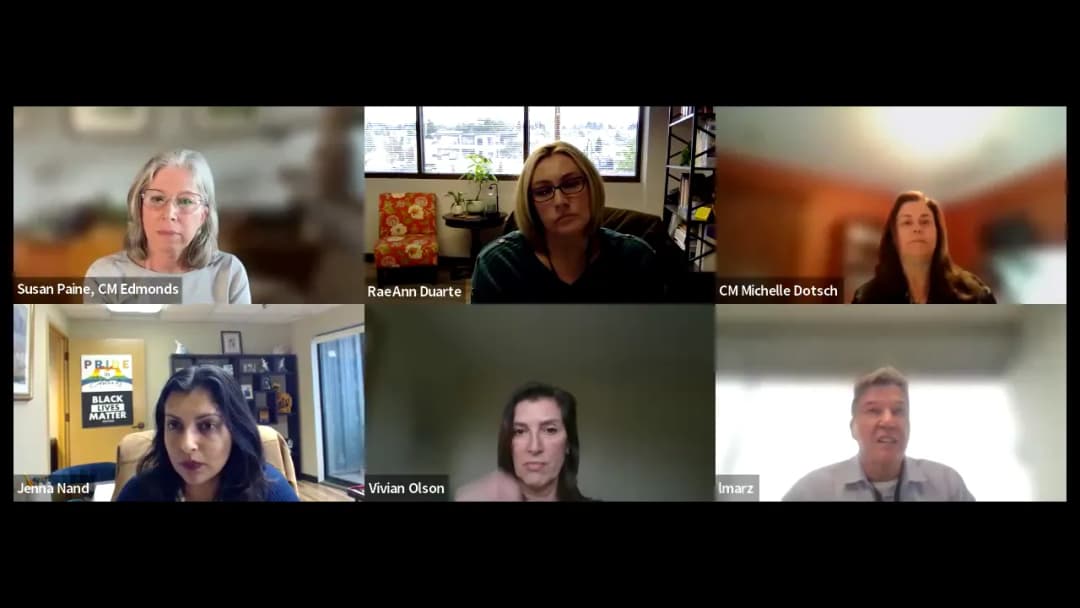
The Edmonds City Council Public Safety, Planning, Human Services, and Personnel (PSPHSP) Committee met to conduct a first reading of the Senior Office Specialist (City Clerk) job description and decide whether to forward it to the full City Council. Agenda materials list the meeting date as March 17, 2026, but the supplied meeting timestamp is March 26, 2026; this summary uses the supplied timestamp. No public testimony was offered. Discussion Items - Human Resources representative Rayanne Duarte presented the item. Duarte explained that HR, Finance, the Mayor, and the City Clerk analyzed the role and concluded that reclassifying the position from Administrative Assistant to Senior Office Specialist better matched current needs, and that the position would be better placed under the City Clerk. Finance supported the move. - Duarte said the job description was clarified to emphasize a customer-focused front-desk role, including greeting visitors, directing them to appropriate staff, managing the access-controlled elevator, and supporting City Clerk office functions. - The reclassification lowers the salary grade from N29 to N25 and is expected to result in salary savings. The union was notified and provided the proposed job description; no objections had been received, and HR remained open to bargaining concerns. - Councilmember Susan Paine questioned the driver's license requirement, asking whether driving is an essential function of the role and warning that the requirement could be exclusionary and screen out otherwise strong candidates. - Vivian Olson, a non-voting ex officio member, supported removing the requirement if it is not actually needed for the job, saying it would make it easier to attract good candidates. - Councilmember Jenna initially opposed changing the language, arguing the committee should not attempt to do HR's job and should trust administration and union agreement on the job requirements. - Councilmember Ludwig/Livwick, who joined the meeting late, favored removing the requirement or changing it to "preferred" or "desired," citing accessibility and DEI considerations and noting that staff without vehicles can still perform the job. - Council President Michelle Doshi noted that the committee has the authority to amend the language if members agree. Key Outcomes - The committee reached consensus to schedule the Senior Office Specialist job description on the consent agenda for the March 24, 2026 City Council meeting, with administration asked to prepare an amendment to the driver's license requirement—changing it from a required qualification to preferred/desired language. - Councilmember Paine reserved the right to pull the item from the consent agenda if the final amendment is not acceptable. - HR needs City Council approval to move forward with recruitment; a temporary employee is currently serving in the role without full benefits. - The meeting was adjourned at 4:54 PM.
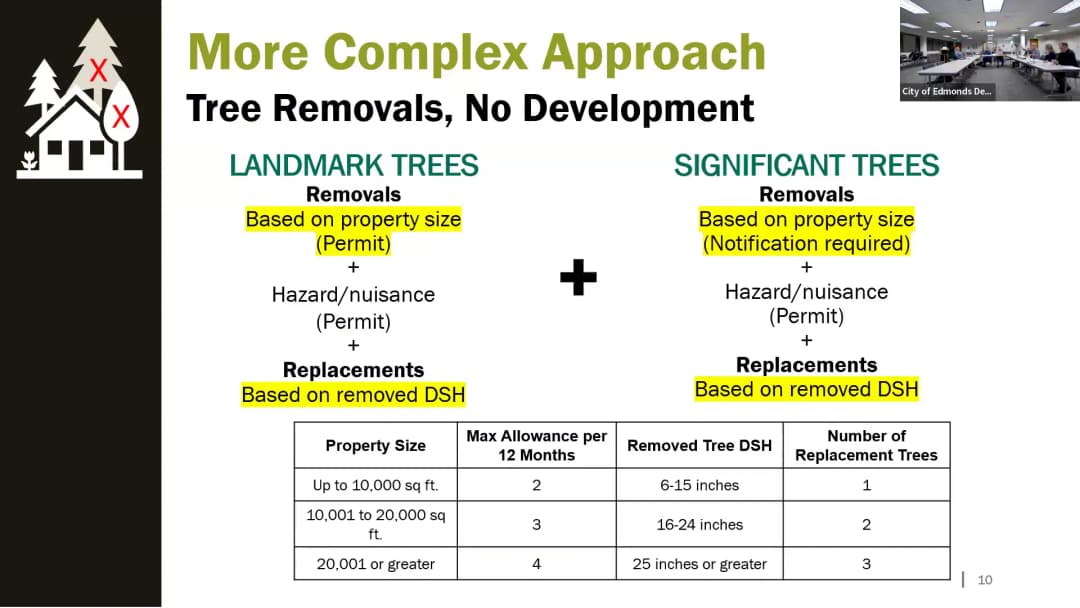
The Edmonds Planning Board met on March 26, 2026, starting at 7:00 PM, to discuss tree code amendments for private property tree removals not associated with development. The board considered public testimony, reviewed regulatory approaches, and provided direction to staff on a hybrid framework combining a removal allowance for significant trees with a permit-based system for larger removals and landmark tree removals. The meeting adjourned without completing the discussion, which will continue at the April 8, 2026 meeting. Consent Calendar - Approval of Minutes: The board approved the minutes from the March 11, 2026 meeting with corrections (adding Nick as the motion maker for January 28 minutes and correcting Isabel Jones' attendance status). Motion carried unanimously. Public Comments & Testimony - Ben Mark (consulting arborist, former tree board member) expressed support for a tree density credit system over a tree-for-tree count or canopy-based system, noting that density credits encourage retention of larger, higher-ecological-value trees. He cited Kirkland, Medina, and other communities as examples. - Deborah Ashland (Edmonds resident) supported defined quantity replacements and the tree density credit method as the best ways to achieve the city's 35% canopy goal. She opposed removal allowances, stating they degrade canopy, and urged not to protect landmark trees at the expense of significant trees (e.g., 20-inch trees). She also cautioned against equating hazard and nuisance trees, recommending nuisance removals be subject to replacement requirements. - Linda Firkingstead (Edmonds resident) expressed strong opposition to the tree ordinance, arguing it violates property rights under the Washington State and U.S. Constitutions. She recounted her family's experience with a seven-year permit process that was blocked by tree replacement requirements, devaluing their land. She urged the board to consider constitutional protections. Discussion Items - Tree Code Update (Project AMD2025-0006): Staff presented options for regulating tree removals on developed properties without development. The current code prohibits removal of landmark trees (≥30 inches) except for hazard or nuisance, but allows unlimited removal of significant trees (6–24 inches). The board discussed two main approaches: - Removal Allowance: A set number of trees (e.g., two per 12 months) that can be removed without a permit, with replacement encouraged but not required. This is used in Kirkland pre-2021. - Tree Density Credit: A point system based on tree trunk diameter, requiring a minimum number of credits per lot. Staff noted this is more complex and typically used for development, not individual property owner removals. - The board expressed support for a hybrid approach: a small allowance for significant trees (e.g., 1-2 per year, potentially varying by lot size) with a permit required for exceeding the allowance. Landmark trees would not be included in the allowance; removal of a healthy landmark tree would require a permit, possibly using a tree density credit to evaluate the impact. Hazard tree removals would not require replacement, but nuisance removals would. The board did not finalize specific numbers or criteria, requesting staff to provide detailed scenarios and examples at the next meeting. - The board agreed to align landmark tree regulation with the interim ordinance (prohibiting removal except for hazard/nuisance) but left open the possibility of allowing healthy landmark tree removal under a permit with tree density credits. Further discussion is needed. Key Outcomes - Direction to Staff: The board reached consensus on the following: 1. Landmark tree removals on developed properties should generally be prohibited except for hazard or nuisance (consistent with the interim ordinance), but staff should explore permitting healthy landmark tree removals under a tree density credit framework. 2. Significant tree removals should be regulated using a hybrid approach: a small allowance (e.g., 1-2 trees per year, possibly scaled by lot size) without a permit, with a permit required for exceeding the allowance. Replacement requirements for permitted removals will be discussed later. 3. Hazard tree removals (landmark or significant) should not require replacement; nuisance tree removals should require replacement. 4. Property size should be considered in setting allowance amounts (e.g., larger lots might have a higher allowance). - Next Steps: The tree code discussion will continue at the April 8, 2026 meeting, which will also address frontage types and building orientation for middle housing. Staff will prepare graphics and scenarios to illustrate the hybrid approach. The tree code update is on track for completion by June 2026. - Meeting Extension: A motion to extend the meeting beyond 9:00 PM failed (2 yes, 3 nays), so the board adjourned on time.
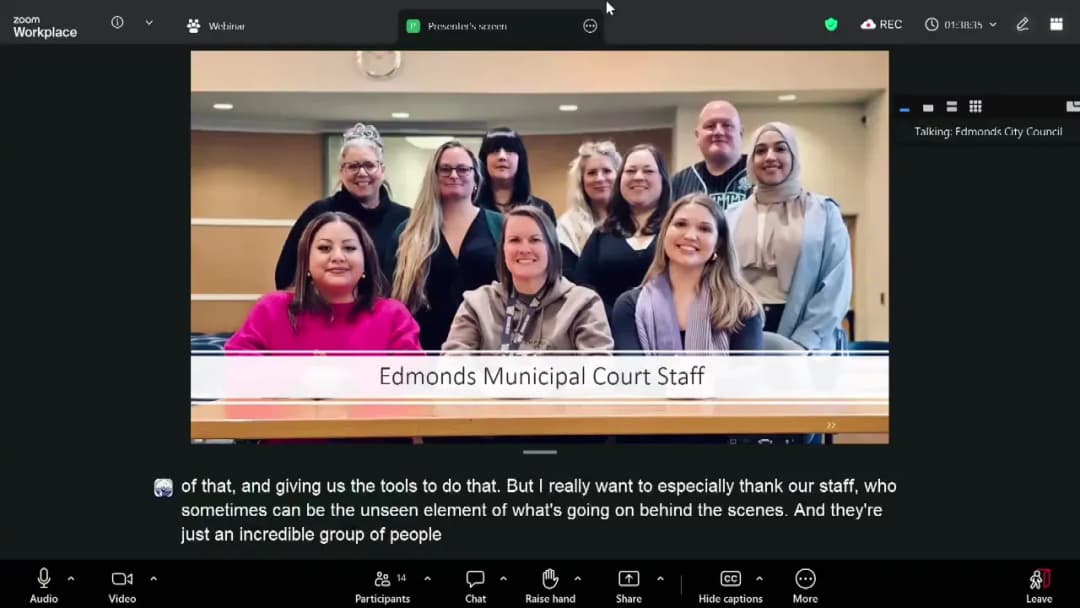
The Edmonds City Council met on March 24, 2026, from 6:00 PM to 9:05 PM. The meeting included presentations from the Port of Edmonds and the Municipal Court, a finance update from the Mayor, approval of the consent agenda, confirmation of a new HR Director, a resolution of intent to vacate a portion of 84th Avenue West, and a discussion on options for the wayside horn at Dayton Street railroad crossing. Public comments addressed youth activity account funding, the Lynnwood Wastewater Treatment Plant, street vacation support, and red light camera ordinance compliance. Consent Calendar - Approved unanimously: - City Council meeting minutes (2026-03-10, 2026-03-17 committees) - Summer Market Special Event Agreement - Approval of payroll, benefit checks, direct deposit, and wire payments (03/01/2026–03/15/2026) - Approval of claim checks and wire payments (03/11/26, 03/18/26) - Senior Office Specialist (City Clerk) job description - PSA Amendment 2 for the Phase 16 Waterline Replacement Project Public Comments & Testimony - John Martin (Mountlake Terrace): Urged council to adopt a resolution encouraging the Everett City Council to not use youth activity account funds for a professional baseball stadium, emphasizing that those funds support parks in Edmonds and neighboring communities. - Stephanie McLaughlin (Edmonds): Raised concerns about the Lynnwood Wastewater Treatment Plant expansion, noting it is expected to reach capacity by 2040 (only four years after completion) and that costs have already risen from $150M to $330M. She called for a regional solution. - Sean Leiser (applicant): Spoke in support of his 84th Avenue street vacation application, stating the state has approved it, it will clean up illegal dumping and encampments, place land in private ownership for tax base, relieve city maintenance liabilities, and enable redevelopment. - Ken Reedy (Edmonds, via Zoom): Argued that Ordinance 4361 (red light camera program) cites a repealed statute (RCW 46.63.170, repealed June 6, 2024) and urged the council to amend it to reference current law (RCW 46.63.210–.260), update the city code, align operations with new equity and signage requirements, and reduce litigation risk. Presentation: Port of Edmonds - Commissioner Ross Dimmick, Executive Director Brandon Baker, and Economic Development Director Brittany Williams presented an overview of the port’s role as a public economic development agency under RCW Title 53. - The Port of Edmonds owns 30 acres, operates a marina (900 storage spaces, 275-person waitlist, 5,000+ guest moorage nights in 2025), a boat valet, fuel dock, and 50-ton travel lift. - Harbor Square Business Complex: 100,000 sq ft leasable space, 93% occupied, 81 businesses, 600 employees. - Environmental programs include clean marina certification, underwater cleanups, hazardous waste disposal, oyster shell water purification, and treated pressure wash water. - North Port Walk and Seawall Reconstruction Project (3 phases, $38–40M total): Phase 1 (admin building) completed 2024 at $10M; Phase 2 (site prep/electrification) 100% funded, starting late 2026; Phase 3 (950-ft seawall and walkway) – funding mix being finalized, includes 6-inch elevation for sea-level rise. - 2026 priorities include starting Phase 2 construction, pursuing Phase 3 funding, and a master planning process (first full update in 20 years). - Councilmembers asked about coordination with city’s comprehensive plan, leasehold excise tax revenue, boutique hotel projections, World Cup opportunities, connecting downtown to waterfront, climate impacts, and active entertainment for youth. Presentation: Edmonds Municipal Court – State of the Court - Judge Neil Weiss and Assistant Court Administrator Omar Gomez presented. - Court handles misdemeanors, infractions, parking, photo enforcement, dangerous dog hearings, and vehicle impounds. - 2025 filings jumped dramatically due to red light camera enforcement (began May 2025). Parking/photo enforcement filings (labeled as parking) reached 25,000, an 8× increase from 2023 and 3× increase from 2024. - Red light filings: 21,000 in 2025 (partial year) vs. school speed zone: 2,003. Monthly peak: 4,000 in May/June, then 2,500 in December. - Criminal cases returned to pre-pandemic levels. - To manage volume, court added extra hearings (Mondays, Fridays, written, ex parte), created a financial hardship form, and implemented a text messaging program (15,000+ reminders sent) and an administrative warrant quash policy. - Blake case vacates: Completed 850 dismissals, first court to work with AOC’s Blake unit. - Community Court: Monthly resource fair (first Monday, 1 PM) with 10 vendors; Therapeutic Community Court (weekly Tuesdays) for high-risk/high-need individuals; participants reported program helped avoid future legal trouble. - Budget: Court came in under budget due to delayed hiring (savings $280K), offset by credit card fee increases. Grants (Blake, therapeutic, interpreter, pretrial) returned $175K to city. - Incarceration costs: Steadily increasing but per-case costs remain comparable to pre-COVID when adjusted for contractual 3% annual increases. - Upcoming: Lynnwood Jail interlocal agreement begins March 30, expanding from 3 to 8 in-custody calendars per week; new statewide case management system (replacing DOS-based legacy system) implemented September 2026 with no direct city cost; credit card fees will shift to state-run system, passed to payers. - Councilmembers asked about alternatives to incarceration, net financial impact of red light cameras, convenience fees, ICE protections for undocumented community members, and staffing adequacy. Presentation: Mayor’s Finance Update - Mayor Rosen reported good news: Grant for Olympic View Drive overlay increased from $700K to $1.4M, reducing city contribution from $1.1M to $457K, thanks to Transportation Engineer Bertrand House. - Bad news: Fuel costs have risen sharply—$37,000 for a purchase in late January vs. $51,000 for the same amount six weeks later—impacting city operations despite efforts to use alternative vehicles and reduce idling. Council Business 1. HR Director Confirmation of Appointment - Mayor Rosen appointed Lisa Takach as HR Director after a nationwide search (60+ applicants, interviews with leadership, community panel, mayor, and council). - Motion to confirm and approve employment agreement passed unanimously. - Ms. Takach addressed council, expressing excitement to join the city and lead the HR team. 2. 84th Avenue Street Vacation – Resolution of Intent to Vacate - Staff presented the resolution for a portion of 84th Avenue West. After extensive prior discussion, the council had no new questions. - Motion to approve the resolution, subject to conditions, passed unanimously. - Councilmembers noted that concerns (utility easements, access for neighbors/businesses) had been resolved and that state law requires half of any compensation to be dedicated to open space or transportation capital projects. The city attorney recommended that language be included in the subsequent ordinance, not the resolution. 3. Options for the Wayside Horn at Dayton St. Railroad Crossing - Transportation Engineer Bertrand House presented four options: 1. Replace existing QZT system (vendor out of business) with Rio Grande Technology system ($100K total cost). 2. Remove wayside horn at Dayton only; train horns resume at that crossing. 3. Remove wayside horns at both Dayton and Main Street; train horns resume at both. 4. Keep existing system but only respond to service failure calls during weekday working hours (2025 call-out cost $8K). - Staff recommended Option 1 as preferred, but noted no funding in 2026 budget; temporary fallback of Option 4 if funding unavailable. A local improvement district was not recommended. - Council discussion: Members expressed concern about safety (fatalities have occurred at crossing) vs. cost and staff frustration (125 call-outs since 2019, $19K total overtime costs). Option 4 was argued to maintain safety because train engineers will blow horns if wayside horn fails. - Motion (Councilmember Payne): Adopt Option 4. Seconded. - Amendment (Councilmember Dutch): Add “until funding becomes available to remove the QZT system at Dayton Crossing and replace with Rio Grande Technology system.” - Amendment debate: Supporters (Dutch, Nand, Payne, Eck) cited desire to pursue a permanent fix when possible; opponents (Chen, Barnett, Olson) cited current financial constraints, need for further due diligence on moisture issues, and decibel testing. - Amendment passed 4-3 (Eck, Dutch, Payne, Nand yes; Chen, Barnett, Olson no). - Main motion as amended: Unanimously approved (7-0). Key Outcomes - Unanimously approved consent agenda, HR director appointment, and 84th Avenue street vacation resolution. - Adopted Option 4 for the wayside horn at Dayton Street, with an amendment directing staff to pursue replacement with a Rio Grande (or equivalent) system when funding becomes available. Funding not currently allocated; implementation during weekday hours only. - The council extended the meeting to 9:10 PM to complete business. - Meeting adjourned at 9:05 PM.
Note: The agenda and transcript list the meeting date as March 17, 2026, at 1:00 PM, but the provided instruction specifies March 18, 2026, at 15:45 UTC. This summary uses the given date per instruction, while noting the discrepancy. The Finance Committee reviewed the January 2026 monthly financial report, discussed a proposed revision to the city's financial reporting policy, and considered a budget amendment for April 2026. Key topics included cash flow projections, new revenue tracking, and the need for forward-looking financial analysis. Discussion Items 1. January 2026 Monthly Financial Report Finance Director Go presented the report, noting that January typically shows a fund balance decline due to large annual payments such as the $2.7 million WCIA liability insurance premium. The general fund decreased by $2.4 million in January, which Director Go characterized as normal. He explained that the city is now in month 13 of the biennium, and staff are working to improve the biennial report to mirror simpler formats used by Lynnwood, with four columns showing beginning balance, revenues, expenditures, and ending balance. The improved report will be available starting with the February report. Councilmember Barnett asked about cash flow, and Director Go showed that property tax revenues arrive in large chunks in April and October, causing cash lows in early months. The city is also repaying an interfund loan, which affects cash flow. Councilmember Barnett also requested clarity on “carry forward” in the biennial budget; Director Go explained that in a biennium, funds remain available unless removed by amendment, and future amendments should be used proactively rather than carrying forward at year-end. Councilmember Payne asked about sales tax increases, including the new public safety sales tax (PSST). Director Go noted that PSST revenues have not yet been received (due to a two-month lag) and that the observed increase in January sales tax reflects November-December activity. He committed to breaking out PSST in future reports. Councilmember Payne also asked about real estate excise tax (REET) trends and contingency planning if revenues fall short; Director Go said the city would consider budget amendments or project delays. Councilmember Barnett asked about the investment portfolio; Director Go reported that the city recently purchased three investment items to fill a gap in 2029, keeping the portfolio within best-practice five-year maturity and under the 75% compliance threshold. Councilmember Peng asked about the status of the Tyler ERP implementation and its impact on the technology rental fund. IT Director Brian confirmed that higher January expenditures in the technology rental fund are due to concurrent work on the accounting and HR modules, with consultant costs higher than last year. Councilmember Chen asked about graphs in the water utility fund (421) showing a sharp jump from July to August, which did not match prior year trends. Director Go said it might be due to rate increases and seasonal patterns, and he will research further. Councilmember Chen also questioned a debt payment line showing interest on the interfund loan, though the ordinance states no payments until 2027. Director Go said he will follow up to clarify the numbers. Councilmember Barnett expressed concern about the need for forward-looking projections, not just historical reports. Director Go agreed to include cash flow projections in the next month's report, incorporating new revenue estimates. 2. Financial Policy – Financial Reporting Director Go presented a comparison of financial reporting policies from neighboring cities (Lynnwood, Mukilteo, Mountlake Terrace, Shoreline). He argued that the current policy (a page and a half) is overly prescriptive, leading to 40-page monthly reports that obscure the big picture. He proposed revising the policy to allow a shorter monthly report focusing on fund balance, high-level revenues/expenditures, and key metrics, with quarterly reports providing more detail. He also noted that the new ERP system will eventually enable dashboards and drill-down capabilities. Councilmembers generally supported the idea of a more concise monthly report, with the ability to dig deeper when needed. Councilmember Will suggested using the new ERP to allow self-service for council and the public. Councilmember Chen asked about the status of dashboard development; IT Director Brian said a dashboard project kickoff is planned for summer 2026, and he will provide a work session to define parameters. Councilmember Michelle requested visual aids (e.g., red flags for out-of-trend items) and a breakdown of revenue sources (e.g., sales tax by sector, port revenue). The committee directed Director Go to bring back a modified policy and an example of a streamlined monthly report at the next finance committee meeting in April. 3. Budget Amendment – April 2026 Director Go introduced the first budget amendment of 2026, primarily driven by three items: - Marsh Fund Project (Phase 2): A grant-funded design project to restore the marsh to its original saltwater condition. Total cost $1,066,140, with $677,400 from a grant (NFWF), $98,240 from the Marsh Fund, $50,000 citizen donation, and $240,000 in-kind volunteer labor. The city must amend the budget to have authority to spend the grant funds. Engineer Mike Delila explained that the 30% design will improve eligibility for future grants. The project also involves land ownership issues (Unocal owns part of the marsh, but the city has first right of refusal). The committee expressed support for the project. - Park Impact Fee Study: Parks Director Angie Feser requested $50,000 (up to $60,000) to update the city's park impact fee formula, which has not been revised since 2015. A state law change in 2024 requires recalculation by July 2026. The study cannot be paid from impact fees or REET, so general fund allocation is needed. Feser noted that if authorized now, she can expedite a consultant selection via informal bidding; otherwise, a formal process would take months. The committee supported moving forward. - IT Software and License Increases: IT Director Brian requested $21,025 for increased costs in fleet management software, text message capture for public records, and engineering software licenses. These are ongoing operational needs. Additionally, the committee discussed a carry-forward of $200,000 for the Ballinger Lake Park Phase 3 project (ILA with Mountlake Terrace). The money was already allocated but unspent due to contractor delays. No new funding is needed; only a budget amendment to reflect the extended timeline. Councilmember Barnett asked about the timing of the grant for the Marsh project; the grant award is pending further paperwork from NFWF, but the city wants to be ready to issue an RFQ. The committee agreed to advance the budget amendment to the full council, with a target first reading in April (likely April 7 or later) to allow for additional items. Director Go noted that the Marsh project is the most time-sensitive. Key Outcomes - The committee will advance the April 2026 budget amendment to the full council for first reading, with a tentative schedule of April 7, 2026, or later, depending on any additional items. - Director Go will bring a revised financial reporting policy and an example of a streamlined monthly report to the April finance committee meeting. - The committee will consider a separate presentation from the Marsh group on the scope and success of the partnership. - IT Director Brian will provide a work session on dashboard capabilities before the summer 2026 kickoff. - The committee noted the discrepancy between the agenda date (March 17) and the instruction date (March 18) and will rely on the official record for future references.
On March 17, 2026, at 3:00 PM, the Edmonds City Council Parks and Public Works Committee met to review two first-reading agenda items: the Summer Market Special Event Agreement and a professional services agreement amendment for the Phase 16 Waterline Replacement Project. Both items were discussed and subsequently advanced to the full council's consent agenda. Discussion Items - Summer Market Special Event Agreement – Councilmember Olson presented the annual agreement for the Edmonds Summer Market. Key changes include: no market on July 4 (Saturday) and an extension of the season into October. The market requested the option to expand onto Bell Street, subject to obtaining letters of support from affected businesses and apartment residents. Discussion highlighted concerns about parking impacts on Barclay Shelton (with 60 families attending Saturday classes) and access for apartment dwellers. Councilmember Eck noted that the church and ballet school are not directly impacted. The committee stipulated that written support from all impacted parties is required before the expansion can be authorized. - Presentation of PSA Amendment 2 for the Phase 16 Waterline Replacement Project – City Engineer Mike Delilla presented a $31,000 amendment to add a short segment of aging water main connection on Sunset Avenue near Main Street to the existing replacement project. This avoids future separate disruptions at the intersection. The amendment covers additional survey, locates, and potholing. The design is expected to be complete by September 2026, with construction starting in early 2027. Councilmember Eck requested that the exhibit scope be clarified for legal clarity. The committee agreed that combining the work is prudent and cost-effective. Key Outcomes - Both items were unanimously supported by the committee to be placed on the full council's consent agenda for final approval. The Summer Market agreement will be forwarded with the condition that letters of support from impacted businesses and residents along the proposed Bell Street extension are obtained. The Waterline amendment will proceed with a request for improved clarity in the exhibit attachment.
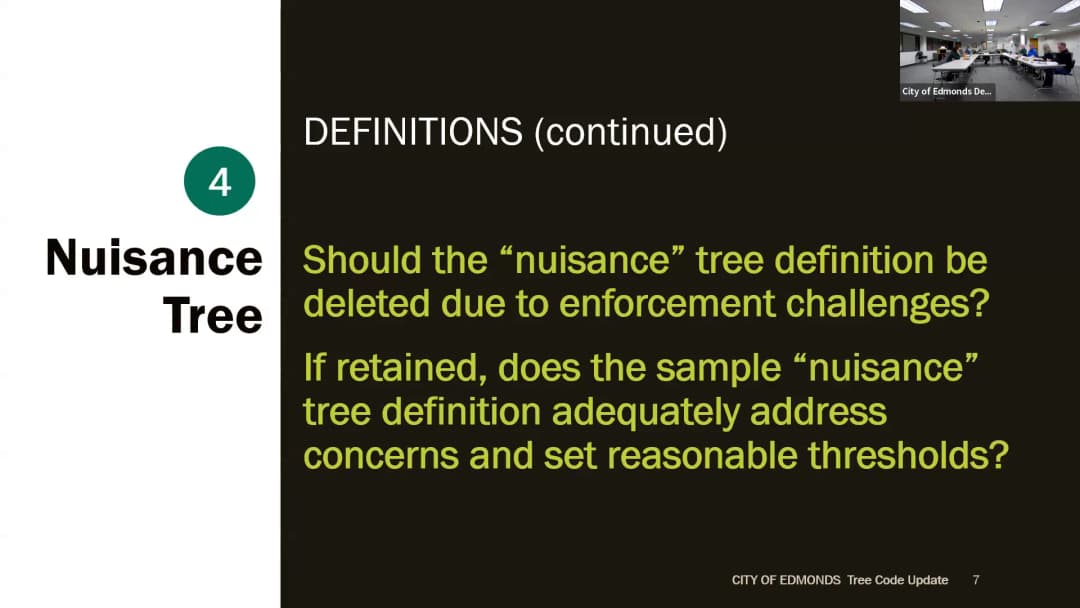
The Edmonds Planning Board convened on March 12, 2026, at 7:45 PM (originally scheduled for March 11) to discuss unfinished business on the 2026 Tree Code Update, including definitions for landmark, specimen, hazard, nuisance, qualified professional, and multi-trunk tree measurement. The board also received public comments and approved previous meeting minutes. The middle housing code amendment discussion was tabled due to time constraints. Consent Calendar - Minutes Approval: - January 28, 2026 Regular Meeting minutes: Approved with 5 ayes, 0 nays, and 2 abstentions. - February 25, 2026 Regular Meeting minutes: Approved with revisions (including recording public commenters’ names and cities of residence) as offered by board member Judy. The vote was 4 ayes, 0 nays, and 2 abstentions (tally was not fully clear, but the motion carried). Public Comments & Testimony - Deborah Ashland (Edmonds resident, 27 years): Presented a memo on landmark tree definitions, suggesting an expanded species list (citing Burien’s exceptional tree code) and emphasizing preservation over replanting due to established trees’ environmental benefits (carbon capture, stormwater, shade). Urged clear replacement requirements. - Bill Phipps (Edmonds resident, former tree board member): Offered assistance and encouraged the board to consider written comments submitted. Noted the complexity and nuance of tree code work. Discussion Items 1. 2026 Tree Code Update – Definitions (Unfinished Business) - Landmark Tree: The board discussed single‑diameter threshold vs. species‑varying diameters. A motion to adopt a flat 24‑inch DBH for all trees with Madrona at 18 inches was made and then withdrawn. General consensus emerged to use a species‑specific table with most trees at 24 inches and Madrona at 18 inches, but the motion was withdrawn to allow further refinement of the full list. The board will continue work on March 25. - Specimen Tree: The board leaned toward deleting the definition as redundant with landmark tree criteria and too subjective (rarity, form). Some members suggested a future heritage tree program instead. No formal vote taken. - Hazard Tree: The board agreed to adopt the industry standard (ISA Tree Risk Assessment) as reflected in the sample code rewrite. Staff described over‑the‑counter approval using photographs for obvious hazards to address equity concerns; the definition will be adjusted to include this option. - Nuisance Tree: Debate centered on whether to retain the definition. Concerns about abuse (e.g., intentional damage to justify removal) were raised. A key argument for retaining nuisance was to provide a path for removing landmark trees causing significant structural damage (e.g., foundation issues). The board instructed staff to tighten the language and return to it, potentially merging nuisance criteria with landmark tree removal rules. - Qualified Professional: The board reviewed expanding credentials to include Board Certified Master Arborist and other certifications. Issues of enforceability and cost equity were discussed. The topic was left for further input; staff will provide additional analysis by the next meeting. - Measuring Multi‑trunked Trees: The board supported moving the definition to the DBH/DSH section and using proper mathematical calculation (square root of sum of squares) with clear examples and diagrams to improve usability. Industry standard was endorsed. 2. Substantive Code Amendments – Middle Housing (LDR Zone) This item was not reached due to time constraints and will be carried over to the April 8, 2026 meeting (or later). Key Outcomes - Tree Code Definitions: No formal votes were taken, but staff received clear direction on seven definitions. The board will continue the Tree Code Update on March 25, 2026, focusing on remaining definitions and allowed tree removals. - Middle Housing: Tabled to a future agenda; no action taken. - Report to Council: Board member Lauren will prepare a draft report of the board’s progress for council; board members to review and respond by Monday, March 16. - Next Steps: The extended agenda included planning board member comments; no new business was added. The meeting adjourned without setting additional dates beyond the regular March 25 meeting.
The Edmonds City Council met at 6:00 PM on Tuesday, March 10, 2026, in Council Chambers at 250 5th Ave North, Edmonds, with all councilmembers and Mayor Mike Rosen present. The meeting included a land acknowledgment, approval of the agenda and consent calendar, a finance update, a proclamation, the continuation of a public hearing on the 84th Avenue street vacation, an executive session, and council and mayor comments. Consent Calendar - The agenda was approved unanimously. - The consent calendar was approved unanimously: approval of city council minutes from the March 3, 2026 regular meeting and March 5, 2026 special meeting; payroll and benefit checks, direct deposits, and wire payments for Feb 16–28, 2026; claim checks and wire payments from the March 4, 2026 check run; and the Resolution including findings of fact to support adoption of Ordinance 4430 imposing a six-month moratorium on acceptance of certain development permits in the Deer Creek Critical Aquifer Recharge Area (CARA), fourth reading. Presentations - Mayor's Finance Update: Mayor Rosen noted January is a difficult cash-flow month, including a $2,700,000 WCIA insurance bill due at the beginning of the year and a $210,000 Microsoft payment. He also described agenda memo improvements, including meeting type, touch points/readings, budget impacts, problem statement, alternatives, item history, staff recommendation, and downstream impacts. - Proclamation: Mayor Rosen proclaimed Saturday, March 14, 2026 as Frank DeMiero Day in Edmonds, honoring his more than six decades of music education, his founding of the music department at Edmonds Community College, the Frank DeMiero Jazz Festival, and his community legacy. His son Vince accepted the proclamation and noted the festival's 50th anniversary; Councilmember Olson later noted the public celebration of life is Sunday, March 15, 2–4 p.m. at Edmonds College. Public Comments & Testimony - Dr. Eileen Newton, a Bothell resident and chief medical officer of Evergreen Recovery Centers, described the organization's Medicaid-based substance use disorder services and its upcoming women's-only treatment center, which she said would be the only one in Washington taking only Medicaid, expected to open in May. She asked the council to become familiar with their work and to consider donations and support, citing funding constraints. - Sean Leiser, the applicant and an Edmonds resident and business owner, expressed support for the proposed 84th Avenue street vacation. He said WSDOT, Olympic View Water and Sewer, city planning and engineering staff, the Planning Commission, and many residents support it, and that it would make the area safer and more attractive for redevelopment. - Written public comments were received for filing under agenda item 7. Discussion Items - 84th Avenue Street Vacation public hearing continuation (fifth reading): Public Works staff presented an update on the proposal to vacate right-of-way on 84th Ave W near SR 104 and Highway 99. The application was received Oct 24, 2024. Staff proposed removing the two-phase approach, keeping the public vehicle turnaround within city right-of-way, and adding a fire-department turnaround served by a public easement and Knox box. All property accesses would be maintained. - Council discussion included questions about compensation, utility easements, and public benefit. Councilmember Nand asked whether compensation could be held in escrow or used as a credit for future development; staff responded that this would be complicated and not standard, and that an updated appraisal will be required before the ordinance is adopted. Councilmember Chen asked about utility easements; staff said utility negotiations would be left to the parties. Councilmember Barnett asked for a specific public benefit; staff cited the applicant's maintenance of the area, potential utility relocation and downsizing, no Highway 99 or SR 104 connection needs, and a potential gateway redevelopment parcel. Legal counsel advised that the conditions are lawful under RCW 35.79 and code-city authority because they are reasonably connected to replacing the cul-de-sac's function, and cautioned that unreasonable conditions would be inadvisable. Executive Session - The council held an executive session under RCW 42.30.110(1)(i) to discuss litigation or potential litigation with legal counsel. After reconvening, no motion or action was taken. Key Outcomes - The public hearing was closed with no council action on the street vacation; the item is expected to return with a revised resolution, updated appraisal, and recommended compensation before a resolution of intent to vacate is considered. - Council and mayor comments included Women's History Month remarks, mention of Edmonds' three women mayors, support for Evergreen Recovery Centers, and an announcement of the upcoming State of the City event at the Edmonds Waterfront Center (reception 5–6 p.m., program 6–7 p.m.). - The meeting adjourned at 8:15 PM.
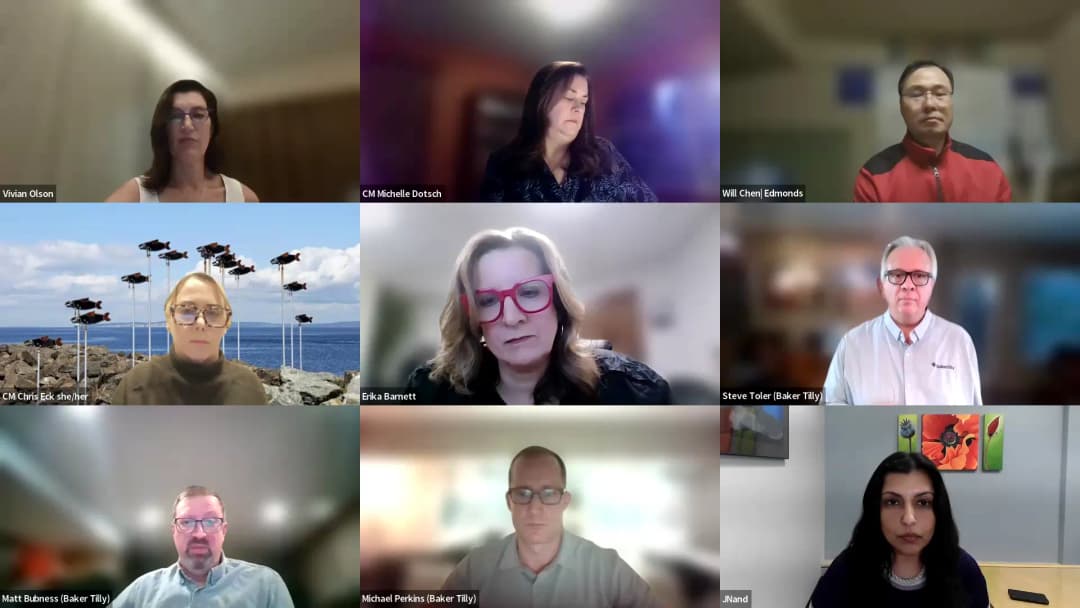
On March 6, 2026, the Edmonds City Council held a special meeting to hear Baker Tilly consultants present the Mountlake Terrace Fiscal Sustainability Taskforce results. The meeting, scheduled from 5:00 PM to 6:00 PM, was extended to 6:10 PM and adjourned without formal action. Note: Although the agenda and transcript reference March 5, 2026, this summary uses the specified meeting date of March 6, 2026. Presentation: Mountlake Terrace Fiscal Sustainability Taskforce Results - Baker Tilly directors Matt Bubnis, Steve Toller, and senior manager Michael Perkins presented; colleague Andy Bellnip was unable to attend. - They described fiscal sustainability planning as linking long-term financial forecasts to decision-making, setting financial goals and reserve levels, prioritizing spending, identifying revenue opportunities, engaging stakeholders, and ensuring the plan is not left on a shelf. - For Mountlake Terrace, Baker Tilly enhanced a long-range forecast, independently analyzed revenue trends and cost drivers, and reviewed financial policies. They called Mountlake Terrace's 5% minimum reserve policy "abysmally low," noting the Government Finance Officers Association generally recommends about two months' general fund reserves. - The forecast showed Mountlake Terrace reserves would be depleted within about three years without action, and the structural gap required roughly a 10–15% adjustment to the general fund. - Baker Tilly identified about 30–35 possible budget strategies—including transportation benefit district sales tax, use of bank capacity, operational efficiencies, and service delivery alternatives—but did not issue recommendations. Instead, they facilitated a citizen task force that deliberated trade-offs and produced the recommendations. - The task force was recruited through an open application process: approximately 30–40 applications led to 17–18 selected and about 15 active members, intentionally diverse in background rather than finance experts. The group met in six 2-to-2.5-hour sessions over about six months, with homework between meetings; Baker Tilly worked to ensure no voices dominated. - The task force narrowed the strategies to roughly 10–12 recommended options focused on near-term fiscal impact over one to three years, while longer-term community and economic development ideas were also discussed. The final report was presented to Mountlake Terrace City Council the prior Thursday, and Baker Tilly offered to share the report and slide deck. Council Discussion - Councilmembers asked how task force members were fairly selected and representative; consultants described the open application, staff/council selection, and deliberate inclusion of varied perspectives, including possible city critics. - Councilmember Chen asked whether the recommendations came from the task force rather than the consultant; Baker Tilly confirmed they acted as facilitators and the task force owned the recommendations. - Councilmember Nand asked about the contract value: just north of $100,000 (initially about $99,000 plus a small amendment), covering financial forecast model development, strategy identification, interviews with council and staff, and facilitation of up to six meetings. Nand noted Edmonds declared a fiscal emergency in 2023 and expressed interest in clearly articulated options, including maintaining city staffing and property portfolio versus outsourcing. - Councilmember Barnett asked about timeline and parallel work; consultants confirmed the analysis and task force processes ran in parallel, and the recommendations focused on near-term fixes because Mountlake Terrace was running out of reserves. - Councilmember Wilson said many options had already been identified in Edmonds and the main challenge was community education, outreach, and consensus. Steve Toller expressed optimism that a community can coalesce around a shared vision of its future and resources. - Council President Dash asked how non-financial volunteers were brought up to speed and how the facilitator managed differing voices; consultants described plain-language municipal finance training, reading the room, soliciting input from quieter members, and interest-based problem-solving. - Councilmember Nand asked about next steps; Mayor and Council President Dash clarified the presentation was informational, not a job interview, and any potential contract would need council discussion, likely with Finance Director Richard Gould. Key Outcomes - No formal action was taken on hiring Baker Tilly or adopting a process; the meeting was informational. - The council unanimously extended the meeting to 6:10 PM. - The next step is for the council to decide whether the Mountlake Terrace task-force approach is attractive for Edmonds and, if so, how to execute it; no contract decision was made.
The Edmonds City Council met on March 4, 2026, starting at 6:00 PM and concluding after an executive session at 10:25 PM. The meeting included presentations, a public hearing, extensive discussion on the Lynnwood Wastewater Treatment Plant upgrade, and action on an odor control contract. Consent Calendar - Approved minutes from previous meetings (February 23, 24, and 24 regular). - Approved claim checks and wire payments from February 25-26, 2026. - Approved second reading of ordinance amending authorized employee positions (FTE changes). Presentations - Mayor's Finance Update: January 2026 revenues exceeded projections: sales tax up $25,449, property tax up $2,672, and development-related revenues up $23,591 – a combined positive variance of $51,712. - Hearing Examiner Annual Report: Hearing Examiner Olbricks presented cases from 2025, including: - A landmark tree violation (Redelfs) where a $102,000 fine was reduced to $20,000 due to extraordinary circumstances – the owner relied on a contractor's inaccurate statement and had no economic benefit from removal. Councilmembers expressed concern about environmental value and contractor accountability. - A unit lot subdivision appeal where the state requirement for a public hearing was criticized as misleading because building permits were already issued. - A SEPA appeal concerning Bernhoff Creek bypass and railroad safety – appeal sustained on railroad risk grounds; fish habitat claim denied. - A conservation plan subdivision that achieved 71% tree retention via city incentives. - A notice of violation for stairs/boathouse built without permits – the owner agreed to remove them. - Councilmember Olson noted the unit lot subdivision case highlighted a need for process improvements to avoid futile public hearings. Public Comments & Testimony - Multiple residents (Tim Amon, Jeff Flowers, Mandana Baniani, John, Bob, Steve Fisher, Bruce, Lori Dressler, Stephanie McLaughlin, James Weiss, Ken Reedy) spoke against the Lynnwood Wastewater Treatment Plant expansion, citing concerns about odor, property value, health (clusters of illness near the plant), traffic, noise, lack of community notification, and the use of eminent domain. Many urged relocating the plant or conducting a full environmental impact statement. Bob stated that 50% of neighbors he canvassed had no knowledge of the project. - Rachel Potts accused an Edmonds City Council member of cyberbullying after she declined a campaign call; she reported the incident to police and requested council action. - Ken Reedy criticized the Hearing Examiner system, alleging lack of independence, record integrity, and accountability, and requested a new ordinance and comparative analysis. Public Hearing: Deer Creek CARA Moratorium - Director Cluxton confirmed the six-month moratorium (Ordinance 4430) on permit applications triggering stormwater management in the Deer Creek Critical Aquifer Recharge Area. No public testimony was offered, either in person or remotely. Council discussed: some residents have been impacted (expansion plans delayed), but staff noted the moratorium is required for PFAS/stormwater study. The city attorney indicated low litigation risk. Council directed staff to expedite the study and report back if earlier completion is possible. Discussion Items - Update on City of Lynnwood Wastewater Treatment Plant Upgrade (Item 10.1): - Lynnwood Public Works Director Jared Bond, plant manager Asan Shirkani, and supervisor Tanner Boyle presented the project history, need (aging infrastructure, incinerator failures, regulatory requirements), and alternatives. The current preferred alternative is upgrading the existing site (estimated $208 million in 2021 dollars) vs. new location ($250–400M) or connecting to King County Metro ($340M). - They acknowledged past EPA violations for air emissions (incinerator) but stated compliance was achieved by 2023. Community outreach included postcards to a half-mile radius, tours, and meetings, though many residents said they were not contacted. - Two properties were acquired voluntarily (not eminent domain) for $1.2M plus relocation costs, to mitigate space constraints. No further acquisitions are planned. - Edmonds Public Works Director Andy Reum emphasized that 7,000 Edmonds residents rely on this plant, and if Lynnwood relocated, Edmonds would have to build its own plant – possibly costlier. - Councilmembers raised questions about population projections (2040 vs. 2050), climate resilience (sea level rise), cost allocation for Edmonds, construction impacts on neighborhoods (truck routes, staging), and the upcoming SEPA review for the construction phase (expected in 2027). Lynnwood committed to re-evaluating alternatives and sharing results. - Award Construction Contract for Odor Control Enclosure and Air Scrubber (Item 10.2): - Two contracts totaling $287,353 (Engineering Services & Products Co. – $211,503.12; Netwerra Corp Inc. – $75,849.43) to control odors at the Edmonds Wastewater Treatment Plant. The motion was initially made with incorrect amounts from an older packet, then amended to the correct figures. Approved unanimously. - Council noted this is a necessary investment to address neighborhood odor complaints and will be used long-term. Key Outcomes - Consent agenda approved unanimously. - Deer Creek CARA moratorium retained for six months; staff to provide updates on study progress. - City Council will continue to monitor Lynnwood WTP upgrade, with Edmonds staff now actively involved in planning and BODR (Basis of Design Report) process. - Odor control contract awarded (amended vote: unanimous). - Council will consider a resolution supporting Edmonds residents near the Lynnwood WTP, as requested by a resident. - Executive session held (30 minutes) to discuss litigation with legal counsel under RCW 42.30.110(1)(i). - Council comments included updates from Councilmember Nand on new SNOCOM and emergency communications board appointments.