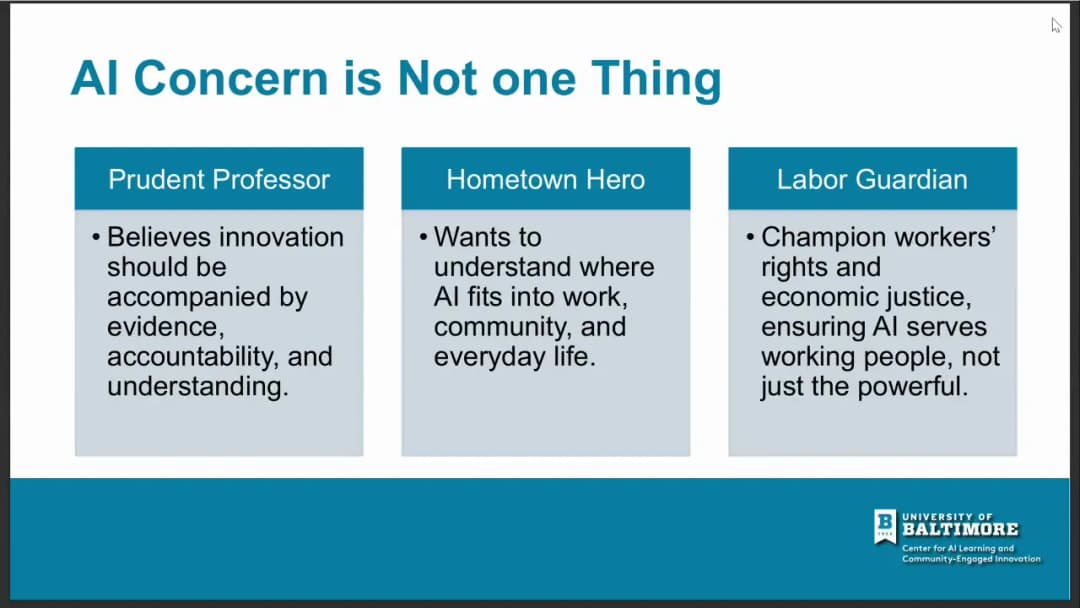
The Government Operations Committee met on August 3, 2026, at 4:00 PM. The agenda included approval of prior minutes, two workshop presentations (University of Baltimore Center for AI Learning and Community-Engaged Innovation; OpenGov and Priority-Based Budgeting), and discussion of proposed charter amendments. No public comment was offered. Consent Calendar - The committee approved minutes from nine prior meetings: January 12, February 9, February 23, March 2, March 9, March 23, April 6, June 22, and July 6, 2026. The motion carried with one abstention. Public Comments & Testimony - No public comments were made. Discussion Items - Presentation from University of Baltimore Center for AI Learning and Community-Engaged Innovation – Dr. Jessica Sansbury, founding director, presented on AI literacy and community engagement. She outlined six AI personas (civic champion, student superuser, adaptive achiever, prudent professor, hometown hero, labor guardian) and emphasized that AI adoption is a human challenge requiring trust, inclusion, and shared ownership. She noted that AI is already impacting sectors like education, workforce, and government, and recommended a human-centered approach: start with the problem, not the technology. She described the "AI Navigators" model and a living ecosystem hub for community input. Committee members asked about formal training programs and expressed interest in connecting AI readiness to the city’s strategic goals. - Presentation on OpenGov and Priority-Based Budgeting – Lacey Gordon (Budget Manager) and Erica Robrahl (Senior Advisor for Opportunity Innovation) presented a three-phase framework to evolve the city’s budget process: priority-based budgeting, program-based budgeting, and performance-based budgeting, all supported by OpenGov. They introduced the "Spark Tool," an interactive exercise where each council member assigns 100 points to strategic goals and objectives to create a weighted aggregate priority list. They highlighted examples: a street paving program (aggregating $12.9 million across departments) and a food and nutrition program (city contributed $295,000 of $1.9 million total, 75% grant-funded). The timeline calls for the council to receive the Spark survey in September 2026, with results presented in October 2026. Committee members discussed the need for clear KPIs, transparency, and the importance of analyzing data, not just publishing it. Lacey Gordon noted that she will continue to build the program inventory and that the performance-based module may require additional funding. - Old Business: Proposed Charter Amendments List – The committee reviewed a list of charter amendment topics compiled by staff, including vacancies and open primaries. They discussed a process for moving items forward: an initial conversation with research, followed by a follow-up discussion to determine consensus, then bullet-point recommendations to the full council. The schedule for these items will be presented at the next committee meeting. Key Outcomes - Consent calendar approved: Minutes from nine meetings were approved with one abstention. - OpenGov and Priority-Based Budgeting framework endorsed: The committee expressed support for the presented framework and timeline. The Spark tool survey will be distributed to council members in September 2026, with aggregated results to inform the mayor’s budget preparation. The budget process will adopt a phased approach: priority setting in fall 2026, program inventory development throughout the fiscal year, and performance KPI dashboards as the OpenGov module is fully implemented. - Charter amendment process agreed: The committee agreed to use a two-step process (initial information gathering, then consensus discussion) for each amendment topic, with bullet-point recommendations flowing to full council. The schedule will be finalized at the next meeting.
Public Meetings - Frederick, Maryland
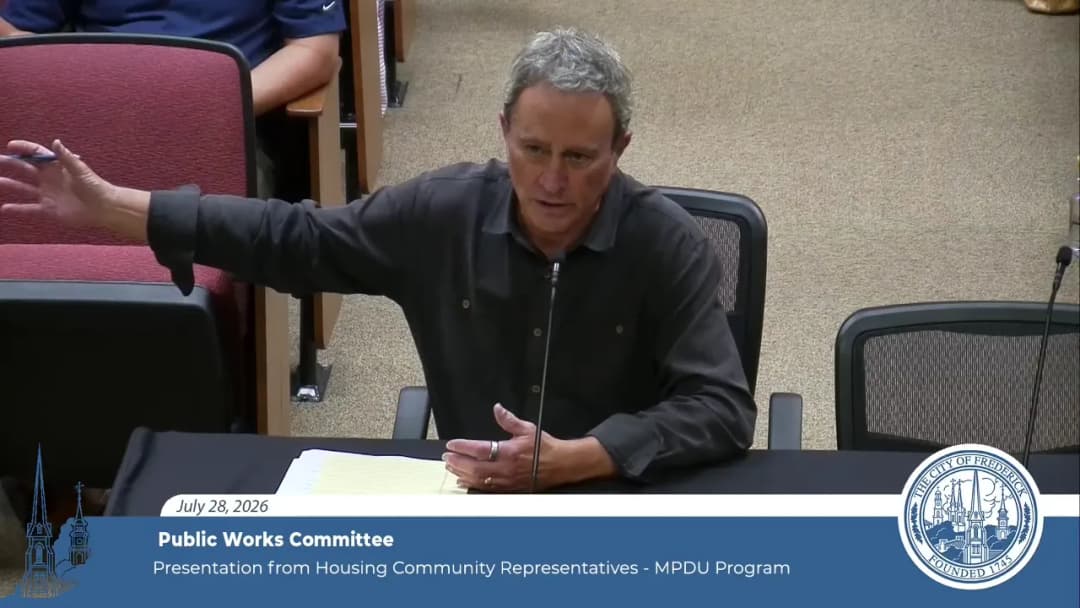
Public Meetings - Frederick, MarylandOn July 28, 2026, the City of Frederick Public Works Committee convened to discuss a proposed ordinance creating a Housing Solutions Fund and to hear presentations from housing community representatives on the Moderately Priced Dwelling Units (MPDU) program. The meeting was a workshop with no formal votes taken. Consent Calendar - Approval of Minutes: The minutes from the July 14, 2026 meeting were approved by unanimous consent. Public Comments & Testimony - Ryan Trout, city resident: Commented as a former municipal housing director and lead of Frederick County's MPDU rewrite. He urged the committee to understand the payment-in-lieu option's role in leveraging state and federal funds, noting that during the county's analysis, fee-in-lieu funds often produced five to eight times more affordable housing than if MPDUs had been built (mostly through LITEC rental developments at 60% AMI). He recommended pairing MPDU requirements with meaningful incentives, such as a property tax abatement model used in Chattanooga, and suggested evaluating the payment-in-lieu fee and incentive program together. He also advised that to build more starter homes, the city should address regulations, fees, pre-approved plans, and creative financing. Discussion Items - Housing Solutions Fund Ordinance Concept: Councilmember Charlie Jackson and Councilmember Shackleford discussed the draft ordinance. Shackleford requested percentage allocations for the six categories of allowable uses (e.g., administrative costs, LITEC projects, home repair assistance). Councilmembers debated whether to set percentages in the ordinance or have the director propose annual allocations for council approval. Councilmember Jackson expressed opposition to tying a fixed percentage of the city budget to the fund, preferring flexibility. The committee also discussed whether the fund could include a
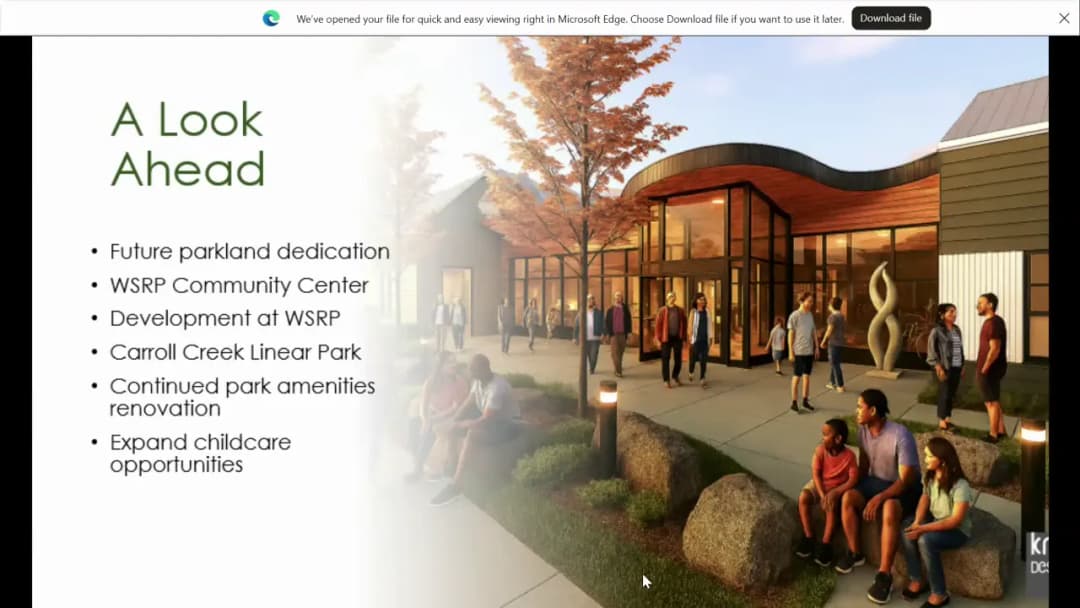
The Committee and Culture Committee held a hearing on Thursday, July 16, 2026, to review the city's parks and recreation amenities and programming. Presentations were given by Director of Recreation Bob Smith and Superintendent of Recreation Sean Poolin, covering current inventory, recent and future projects, program expansion, funding mechanisms, and planning processes. The discussion also addressed fee-in-lieu policies, park distribution, Wi-Fi, child care, and partnerships. Consent Calendar - (No consent calendar items were identified in the transcript.) Public Comments & Testimony - (No public comments or testimony were recorded in the transcript.) Discussion Items - Bob Smith presented an overview of current park infrastructure: 79 parks, over 1,000 acres, 42 athletic fields, 44 playgrounds, 55 sports courts (basketball, pickleball, tennis), 26 rental pavilions, 2 skate parks, 3 inline rinks, 3 dog parks, and extensive passive space and path networks. - Recent and ongoing park improvement projects were reviewed: Westside Regional Park (multi-purpose fields and baseball field completed, expected playable by spring 2027), Lucas Village Park (basketball court and skate park resurfacing), Lake Coventry and Clear Story Parks (basketball court renovations), Valley Street Park (playground renovation), Riverside Park (boat ramp renovation), and McCurdy Field (new LED lights, surface, irrigation, concrete, and bleacher work; lights installation is a two-week project). - Hill Street Skate Park is at concept design; a second community meeting was scheduled for July 21 at Butterfly Ridge Elementary School. Design completion is targeted for early 2027, construction summer 2027, opening fall 2027. - Hill Street Park Master Design is at 90%, delayed by stormwater management for the pump track (a separate project with private funding and a state grant). - Mullinix Park was submitted at 100% design and is in final review. - Westside Regional Community Center is at 90% design, submitted to the city on July 16; review and revision to 100% will follow. - Future planning relies on current inventory condition, the Parks and Rec Master Plan, the Grass Park Inventory Atlas, developer parkland dedication, park impact fees, fee-in-lieu money, collaboration with transportation planners, the CIP plan, and grant funding (Project Open Space, Community Park and Playground Grants, Outdoor Recreation Legacy Program). - A council member asked how residents can advocate for additional amenities like bathrooms; Smith responded that advocacy could come through council or direct contact, but funding is a key challenge. - Superintendent Sean Poolin discussed recreation programming initiatives: expanding early childhood programming (under age 6) at Tally Rec Center and Trinity Rec Center, with camps serving nearly 600 campers this summer; after-school programs expanded from 4 to 6 elementary schools, with 330 kids enrolled last year; a new Youth Recreation Coordinator position was budgeted to expand teen programming. - Other programs include adult swim lessons, aquafit classes, STEM and cooking classes, outdoor leadership, youth/adult/senior trips, and pop-up programming. - Poolin presented a cost recovery model that tiers fees based on community benefit, from minimal cost recovery for community events to higher fees for private rentals/lessons. Reduced registration offers 50% off youth programs for those eligible for free/reduced lunch, and pool entry for youth at $1. - A council member asked about park-poor areas; Smith stated that every city resident lives within one mile of parkland, but infill development downtown lacks acreage. Creative use of funds to renovate existing parks was emphasized. - Discussion on fee-in-lieu money: currently restricted to debt payment or new parkland purchase, but Smith noted sufficient parkland from development and the need to explore using it for renovation of existing parks. - A council member asked about county resident use of city programs; Smith and Poolin agreed to provide data from the registration system. - Smith expressed support for public Wi-Fi in parks, acknowledging logistical complexities. - Child care expansion plans for Westside Regional Community Center were discussed, including transit access and use of vans for transportation. - A brief update on the Hood College partnership was given: lease work is underway for the baseball field. - A council member gave kudos for the Mural 101 program at their park. Key Outcomes - No formal votes or decisions were recorded in the transcript; the hearing was informational and allowed for discussion and questions. - Smith and Poolin committed to providing data on county resident participation in city programs. - The committee heard proposals to explore expanded use of fee-in-lieu funds for existing park renovations, public Wi-Fi, and continued development of child care programming. - Future budgetary impacts were anticipated for Westside Regional Community Center operations (FY28), Westside Regional Park Phase II amenities, Carroll Creek Linear Park renovations, and ongoing amenity renovations.
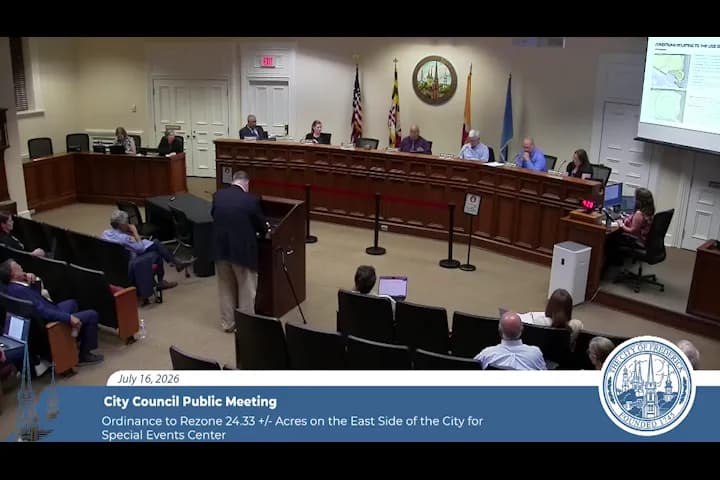
The Frederick City Council held a public meeting on July 16, 2026, at 6:00 PM at City Hall. The meeting included approval of minutes, a consent agenda, several public hearing items, and a lengthy quasi-judicial hearing on the proposed rezoning of 24.33 acres of the Gateway property from General Commercial to Institutional to establish a special events center for cricket. The council also introduced a rodent control ordinance. Public comments were heard on multiple topics, with significant testimony regarding the cricket facility. Consent Calendar - Approved release of a $119,311.55 letter of credit posted by Habitat for Humanity for improvements to the West All Saints Street project. Public Hearings & Approvals - Weatherization Contract: Approved a contract for services with DeVere Insulation Home Performance to provide weatherization services to eligible households. Funding comes from the Department of Energy and not city funds. (Motion passed 6-0) - School Resource Officer MOU: Approved a Memorandum of Understanding with the Maryland School for the Deaf to continue School Resource Officer services. The city has provided an SRO since 2019, reimbursed by MSD. (Motion passed 6-0) Quasi-Judicial Hearing: Gateway Property Rezoning (Ordinance G-26-7) and Conditions of Rezoning This was the first introduction of the ordinance to rezone 24.33 acres from General Commercial to Institutional for a cricket special events center. The council then held a hearing to consider conditions of rezoning proposed by the applicant (Washington Freedom). The hearing included sworn testimony, public comments, and council deliberation. Applicant Presentation: - Bruce Dean (attorney for applicant) presented 17 proposed conditions, including limits on events (max 20 professional cricket matches/year, max 10 non-cricket events 1,500 people), an event management plan, traffic management, noise and light compliance, environmental protections, and a stakeholder group/event management commission. - Rohit Anand (Washington Freedom) reported the team's playoff success and emphasized community engagement, partnerships with local organizations, and commitment to being a good neighbor. Public Comments & Testimony: - Supporters: Many spoke in favor, including: - A young resident who plays cricket and desires a proper field. - Tamika Thrasher (Boys & Girls Club of Frederick County) highlighted opportunities for youth. - Sunil Dasara (parent) noted lack of local facilities for his son's cricket dreams. - Mahesh Joshi (Dean, Hood College) discussed internship and academic program partnerships. - Venkata Dandu and Satvi Raval (parents) emphasized the need for safe, local cricket infrastructure. - Carol Sap (former planning commission member) argued the cricket park is less intensive than permitted commercial uses. - Jasmine Sneed and Vinay Gupta praised the applicant's long-term community investment. - Opponents/Concerns: Raised by nearby residents and advocates: - Laura Gibbs (neighbor) requested additional floodplain study and traffic analysis, citing flood risks and emergency access. - Darlene Balderson called it the wrong location for traffic. - Roberta Huber (via former traffic engineer) questioned coordination with the county and parking enforcement. - Sonia Lux Jolly (neighbor) worried about emergency response times. - Robert Wisner opposed, fearing taxpayer costs. - Mary Mannix (Frederick County Landmarks Foundation) argued the site is part of the Monocacy Battlefield National Historic Landmark and should be preserved. - Rebecca Chisholm and Vic Winkler (neighbors) asked for clear conditions and enforcement mechanisms. - Alex Botar (attorney for citizens) requested a full traffic impact study and flood study before rezoning, and more specific noise enforcement. - Steve Jakupsic and Alan Schaefer raised concerns about cumulative traffic and air quality. - Oscar Gregory suggested building grassroots support before a stadium. Rebuttal by Applicant: - Bruce Dean responded to concerns, stating the floodplain study was reviewed by city, FEMA, and MDE; traffic subjects to city APFO; and the site was selected after evaluating many others. He noted the conditions provide strong guardrails. Council Discussion & Amendments: The council reviewed the 17 conditions and made several changes: - Condition 1 (Event Management Plan): Added "at least" before components; added "on-site grass areas" to prohibited parking areas; added "or as mandated by the commission" for annual updates; added Frederick Police to the stakeholder group; clarified "chief operations officer or designee" to allow future event management commission to act as designee. - Condition 2: Amended to allow a future events management commission (by resolution, ordinance, or executive order) to perform stakeholder group functions. - Condition 4 (Professional cricket matches): Changed from 20 to 15 in the first calendar year; subsequent years may exceed 15 only with approval of COO in consultation with stakeholder group. - Condition 5 (Non-cricket events): Any increase beyond 10 per year subject to COO approval in consultation with stakeholder group. - Condition 9 (Music prohibition): Deleted entirely. Noise will be regulated by existing noise ordinance. - Condition 12 (Noise monitoring): Added requirement for applicant to provide on-site sound monitoring equipment to assist police enforcement of noise regulations. - New Condition 18: Events shall not be scheduled past 11:00 PM. - Attendance cap: Motion to cap first season at 5,000 failed (2-4). Condition 17 remains unchanged, allowing up to 10,000 individuals; events over 10,000 require a large event permit. Key Outcomes: - The council adopted the July 7, 2026, conditions as amended (motion passed 6-0). - Resolution 09-23 (annexation of the Gateway property) was continued to the August 6, 2026, meeting. - Ordinance G-26-7 (rezoning) was introduced; a second public hearing will be held on August 6, 2026, after conditions are finalized and accepted by the applicant. - Ordinance G-26-6 concerning rodent control was introduced for first reading; discussion and public comment will occur at a future meeting. - Public comments also included a plea from a resident of Carroll Park Manor for rodent control measures, including improved trash collection and abatement. Council Business/Comments - Councilmember O’Connor announced this would be her last in-person meeting due to impending childbirth; she will vote virtually if needed. - The meeting adjourned after the final votes.
The special meeting was called to order at approximately 10:00 AM. The council immediately voted to convene in closed session under Maryland law (General Provisions Article 3-305(b)(1)(i)) to discuss personnel matters including appointment, employment, assignment, promotion, discipline, compensation, removal, resignation, or performance evaluation of an appointee, employee, or official under its jurisdiction. No public discussion or action items were conducted during the open session.
The Frederick City Council held a work session on July 14, 2026, covering presentations on burying overhead power lines, enhancing wireless connectivity, updates to the moderately priced dwelling unit (MPDU) ordinance, and a proposed noise ordinance revision. Presentations were given by Potomac Edison, Milestone Towers, and the City Attorney's Office, with public comment heard on the noise ordinance and previous items. Potomac Edison Presentation on Burying Power Lines - Dave Klein, External Affairs Manager for Potomac Edison, presented on the feasibility, cost, and challenges of burying overhead power lines in the city. He estimated a cost of roughly $500,000 per block for Potomac Edison's work alone, with additional costs for trenching and conduit, potentially totaling $50 to $70 million citywide. - Klein described historical problems with underground vaults in downtown Frederick, including flooding, grease contamination from restaurant dumping, and a tragic 2012 accident where a lineman was electrocuted by an induced current. - He noted that underground lines are not a panacea: faults are harder to locate, repairs take longer, and customer service entrances must be changed at the owner's expense (approx. $15,000 per property). - Tracy Coleman, Director of Public Works, confirmed that new residential subdivisions are required to bury utilities, and that city utilities in those areas are typically buried. She noted that full-depth road reconstructions (which occur one to two every five years) do not easily lend themselves to burying lines, but conduit could be installed under sidewalks during such projects. - A councilmember asked about using a hypothetical $60 million grant for burying lines; Klein deferred the question to the city's priorities. - No decisions or votes were taken on this informational item. Enhancing Wireless and Digital Connectivity - Len Forkas, founder and president of Milestone Towers, presented on improving wireless infrastructure. His company has built 10 sites in Frederick, including a recent tower at Butterfly Lane generating $30,000 in net revenue annually (growing to $43,000), with over $100,000 generated since construction. - Forkas explained that densification—adding new facilities in coverage gaps—is the primary tool for keeping up with data demand, and that the city can encourage investment by being "open for business" with transparent processes and pre-vetted agreements. - A staff member noted the city already has a contracting vehicle from the 2021 Butterfly Lane site agreement; the council directed staff to explore expanding that agreement and identify potential sites for future towers, with public hearings to follow. Moderately Priced Dwelling Unit (MPDU) Ordinance Update - Jody Astoich, Housing Policy Advisor, presented preliminary recommendations to revise the MPDU ordinance. The city's Housing Fund currently has approximately $4.5 million, funded by developer fees in lieu of building MPDUs (currently 12.5% of units for projects of 25+ units, priced for 70–90% AMI). - Since 2017, Housing Fund awards have supported 628 affordable units, including projects like 528 North Market Apartments (59 units), South Street Center (96 units), The Junction (179 units), and others. - Recommendations included: streamline eligible uses into broader categories (e.g., health/safety, accessibility, energy); add flexible language for responsiveness; set AMI restrictions (e.g., 30–80% AMI); and create a separate ordinance for the Housing Fund to distinguish it from the MPDU requirement. - A councilmember requested data on how the Fund has been spent historically; staff agreed to provide that analysis. One project—the Himes Avenue project (about 125 units)—is currently in the pipeline for gap financing. Noise Ordinance Proposal - Mike Fry from the City Attorney's Office presented a draft revision to the noise ordinance, noting it was developed in consultation with law enforcement and aims to balance downtown nightlife with resident quality of life. - Key issues: the current ordinance does not cover outdoor special events (e.g., Carroll Creek Park, parades) with amplified sound, but state law sets maximum decibel limits (e.g., 62 dB daytime, 52 dB nighttime). The city cannot allow higher levels without state legislation (as Howard County did for Merriweather Post). - The draft includes a "plainly audible" standard (100 feet from source) for enforcement when officers lack sound meters. - Public comment included concerns from business owners: Greg Brown (Brewers Alley) argued the language is subjective, could target hospitality unfairly, and would force owners to bear costly sound studies ($12,000–$15,000) without clear decibel limits. Eric Schultz (Jojo's) said his professional system operates at 90–92 dB indoors, well below outdoor limits, and feared penalties (fines up to $5,000 and 30 days in jail) could put businesses out. - Kara Norman (Downtown Frederick Partnership) emphasized the importance of entertainment for downtown's health, urged balanced language, and questioned the impact on special events. - Councilmember Hempel noted the distinction between occasional joyful events and persistent noise; member Shacklford suggested convening all stakeholders for further discussion. - No votes or decisions were taken; the draft is expected to be revised after public input. Key Outcomes - Staff directed to explore expanding the existing 2021 Milestone Towers agreement and identify new potential tower sites, with public hearings to follow. - Staff agreed to provide a historical analysis of Housing Fund expenditures and return with more detailed MPDU ordinance revisions. - The noise ordinance draft will be revised following public comment; no formal action was taken.
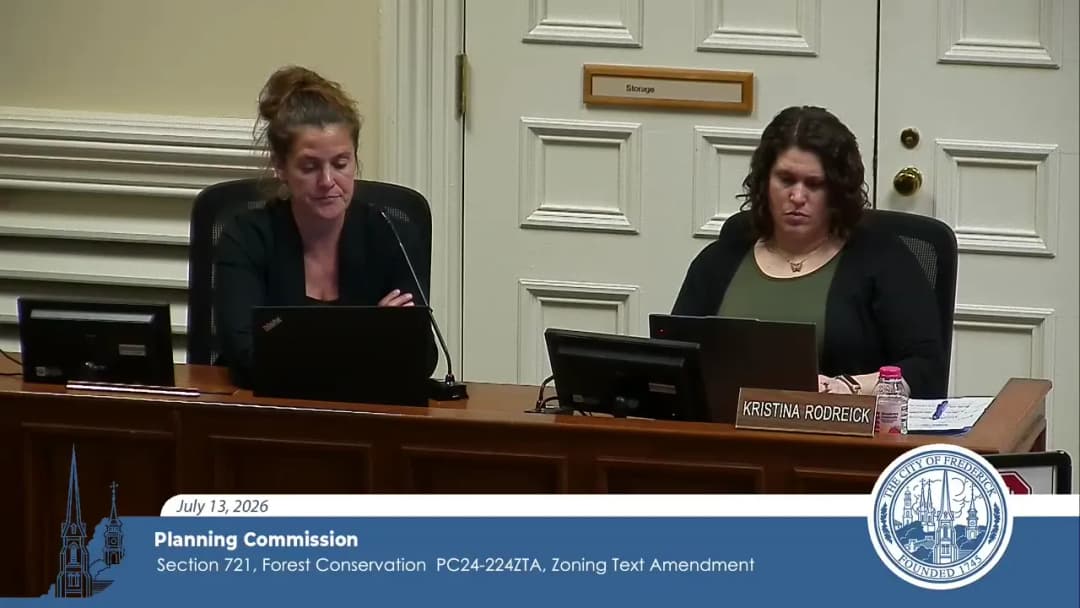
The Frederick Planning Commission met on July 13, 2026, to consider administrative items, continuances, and several development applications. The commission approved minutes from prior meetings, granted continuances for four projects, and voted on four major agenda items, including a site plan revision, a preliminary plat and final site plan, a zoning map amendment (first hearing), an annexation recommendation, and a zoning text amendment recommendation. All motions passed unanimously (4-0) unless noted. Consent Calendar - Approved the June 8, 2026 Planning Commission minutes (motion by Commissioner Montes, second by Commissioner Temple; 4-0). - Approved the June 15, 2026 Planning Commission workshop minutes (motion by Commissioner Temple, second by Commissioner Roby; 4-0). - Approved the July 10, 2026 pre-planning commission meeting minutes (motion by Commissioner Temple, second by Commissioner Roby; 4-0). Continuances - Industrial Center East Lot 337 (PC 26-68 FSI): Continued due to ongoing APFO testing; approved 4-0. - West Frederick Public Library (PC 26-64 FSI & PC 26-65 FSCB): Continued due to ongoing stormwater review; approved 4-0. - West Side Regional Park Community Center (PC 26-29 FSI): Continued to August meeting due to stormwater review; approved 4-0. - Carroll Fuels Gas Station (PC 25-628 FSI & PC 25-629 FSCB): Continued to August 10, 2026 meeting due to stormwater review; approved 4-0. Discussion Items - Kellerton Land Bays D and E (PC 26-67 PSU FSI & PC 26-66 PFCP): Staff recommended unconditional approval of a combined preliminary plat/final site plan revision and a preliminary forest conservation plan revision to adjust lot lines and accommodate stormwater areas. The applicant confirmed compensatory plantings. The commission approved both actions unanimously (4-0). - Canterbury Station (PC 25-247 PSU FSI): The applicant proposed 204 residential units, renovation of the Banner School buildings, and three modifications to landscaping standards. Staff supported all modifications, citing increased tree plantings (192 trees required vs. 168 minimum, 25 street trees vs. 16 required). The commission approved the three modifications and the combined preliminary plat/final site plan with conditions (4-0). One commissioner (Temple) expressed concern about sidewalk width along North Market Street, but no formal condition was added. - 600 South Market Street (PC 26-24 ZMA): First public hearing for a zoning map amendment to rezone 1.03 acres from Downtown Residential (with Institutional floating zone) to Light Industrial (M1) to correct a mapping error. No action taken; a second hearing will occur in August. The applicant argued the IST zone was mistakenly applied due to a 2005 lot line change. Commissioners noted the site is split-zoned and the proposed rezoning is the "best worst option." - Sunday Farm Annexation (PC 25-627): Request for recommendation to City Council to annex 51.98 acres zoned MU1 to expand the Bloomfields age-restricted community. The applicant stated the annexation would not increase total density beyond the previously approved 1,500 units, but would allow achieving the full unit count (previously only 1,300 could be built due to the unannexed parcel). A fiscal analysis showed net positive revenue to the city (annual revenue over $21.1 million, including $13.5 million in property taxes). The commission voted 4-0 to recommend approval with two conditions: development shall adhere to existing resolution 1725, and the master plan must be amended to incorporate the property. - Section 721 Forest Conservation Zoning Text Amendment (PC 24-224 ZTA): Staff presented updates to comply with state law (S.B. 224 and S.B. 526) and local improvements. Key changes include revised mitigation ratios, extended maintenance periods (short-term from 2 to 5 years), and new provisions for specimen tree removal (30-inch DBH trees replaced by twice the circumference in new plantings). Commissioners debated the effectiveness of using circumference vs. canopy/trunk area for specimen tree replacement. The commission voted 4-0 to recommend approval to City Council with two conditions: (1) staff review and clarify the definition of "12-inch topsoil" to prevent confusion; (2) staff review the relationship between canopy area, trunk area, and tree caliper size to better maintain canopy when specimen trees are removed. Key Outcomes - All four continuances approved unanimously (4-0). - Kellerton Land Bays D and E: Unconditional approval of preliminary plat/final site plan and forest conservation plan (both 4-0). - Canterbury Station: Three modifications and combined plan approved (all 4-0). - 600 South Market Street: No action; second hearing scheduled. - Sunday Farm Annexation: Positive recommendation to City Council (4-0). - Section 721 ZTA: Positive recommendation to City Council with two conditions (4-0).
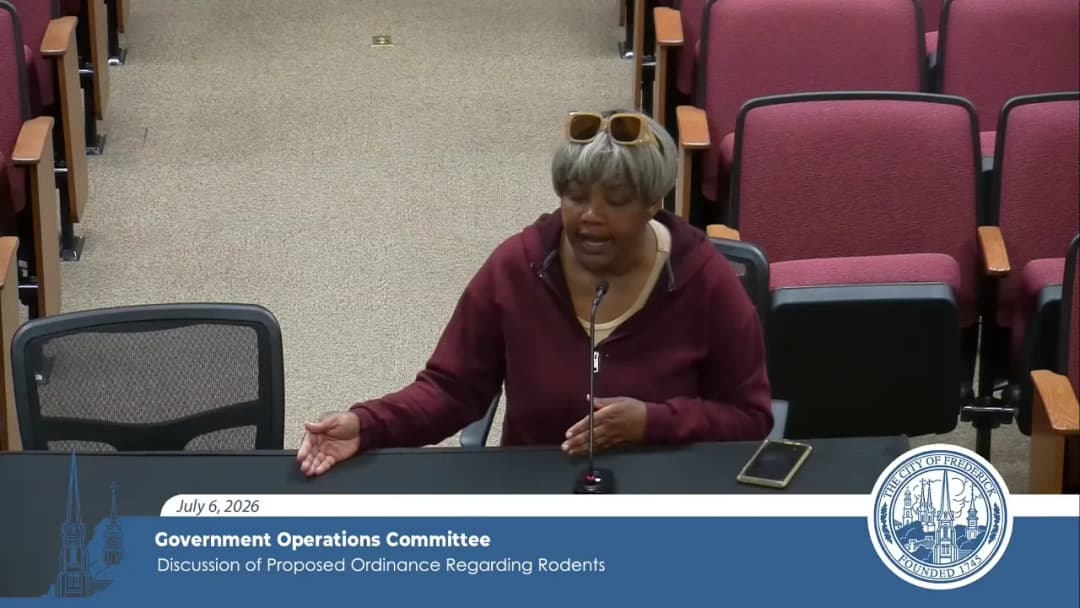
The committee met to discuss a draft ordinance designed to address rat infestations, which members described as a growing crisis in the city. Councilmember Nash led the discussion, presenting an initial draft and proposed revisions based on feedback from the Department of Public Works (DPW) and the city attorney. The conversation focused on enforcement timelines, allocation of responsibility among developers, homeowners, occupants, and HOAs, and the need for a formal city-led, neighborhood-wide response mechanism. A resident of Carroll Park Manor gave public testimony detailing the severity of the problem and calling for immediate action, particularly increased trash pickup. Public Comments & Testimony - Marion Brown, a resident of Carroll Park Manor, provided extensive testimony about a severe, worsening rat infestation in her neighborhood. She described rats appearing in broad daylight, breaking into homes, chewing through fences and trash cans, and resisting standard poisons. She identified the reduction of trash pickup from two days per week to one day per week as the primary catalyst for the crisis, noting that a week with two pickups (Juneteenth) immediately showed a reduction in rat activity. She stated that individual homeowner efforts are futile without a coordinated, citywide abatement strategy and increased trash collection frequency. She expressed frustration with the lack of responsiveness from the HOA. Discussion Items - Background and Scope: Councilmember Nash framed the issue as a public health crisis, citing prior infestations in District 3 (caused by construction displacement) and the ongoing emergency in Carroll Park Manor. The draft ordinance aims to create a rapid enforcement and mitigation framework. - DPW Recommendations (Zach Kirshner): Staff proposed removing specific timeframes from the ordinance to give code enforcement flexibility. Councilmember Nash resisted this, arguing that fixed timelines are needed to force prompt action, though she indicated openness to discussion. - Construction Activity: Councilmember Nash agreed that the ordinance should explicitly cover building construction (in addition to demolition), because ground disturbance from development was proven to displace rats into surrounding neighborhoods. The consensus was that the developer should be financially responsible for mitigation in these cases, with the city performing the work and billing the developer if necessary. - Responsibility of Property Owners and Occupants: The committee discussed holding owners responsible for rodent-proofing buildings and occupants responsible for rodent control in their immediate living areas. Councilmember Nash supported this division. - HOA Accountability: There was significant debate regarding the role of HOAs. Councilmember Nash noted that HOAs with common spaces must be held accountable, and that the city is exploring legal avenues for enforcement and cost recovery. Councilmember Peter suggested HOAs should pay for mitigation in common areas. - Neighborhood-Wide Response: Councilmember Nash strongly advocated for a city-coordinated, neighborhood-wide abatement program over solely relying on individual homeowner action. A formal declaration process was discussed to trigger a city-led treatment plan. - Reporting and Treatment Methods: The committee discussed a dedicated rodent reporting form on the city website. Preferences were voiced for least-harmful rodenticides to protect birds of prey. Councilmember Nash suggested contracting exterminators for large-scale treatments and adding language to the ordinance requiring departments to report budget barriers. - Trash Pickup Frequency: The committee acknowledged the direct link between trash accumulation and rat populations and discussed exploring the reinstatement of two-day-a-week pickup in affected neighborhoods. - Vacant Properties: Discussion included ensuring vacant residential buildings are covered, potentially integrating with the vacant property registry. Key Outcomes - Consensus on Developer Responsibility: Agreement that building construction projects causing rodent displacement should be included, with the developer bearing mitigation costs. - Commitment to a Neighborhood-Scale Approach: The committee reached a philosophical agreement that the city must establish a formal, city-led response system for neighborhood-wide infestations. - Revised Draft Ordered: Councilmember Nash committed to integrating the committee's discussion into a revised draft for the full city council meeting on July 9, 2026. A public hearing is tentatively planned for August 2026. - Deferred Decisions: Final decisions on specific enforcement timelines and the precise structure of the formal neighborhood infestation declaration process were deferred for future discussion. - Other Business: The committee work plan and attached goals were presented. Approval was deferred to the next meeting. The committee also briefly discussed a protocol for writing city support letters for grant applications, specifically regarding a potential grant for Community Mediation Maryland.
This meeting featured a presentation from Federated Charities, a nonprofit that houses and supports other nonprofits in Frederick, followed by a discussion among council members on the committee’s work plan priorities. The presentation covered Federated Charities’ role as a fiscal sponsor, its plans for a first-floor renovation, and the challenges facing the nonprofit sector. The council then reviewed a list of potential focus areas, including digital equity, AI usage, and an ombudsperson for the deaf community. Discussion Items - Federated Charities Presentation – Ellen Abbott (Executive Director) and John Bowman (Board Chair) presented Federated Charities’ impact. They highlighted that the organization houses 14 nonprofits, provides free meeting space to an additional 75–125 nonprofits, and offers fiscal sponsorship, professional development, and board governance training. They stated that tenants save approximately $250,000 per year in rent and IT costs combined. The organization has a $150,000 bond bill to renovate its first floor into a more accessible welcome space and meeting area, with a total project cost estimated at $275,000–$300,000. They also noted they have a remaining mortgage of $118,000 on the property, which they hope to pay off. The presentation emphasized the strain on the nonprofit sector due to shrinking small donors and federal funding challenges. Council members asked about affordability, ADA accessibility, and how Federated Charities fosters collaboration among nonprofits. The presenters expressed a desire for targeted city support, not annual grants. - Work Plan Discussion – Council members reviewed a compiled list of potential initiatives discussed over the past seven months. Topics included digital equity, AI as a communication tool, an ombudsperson for the deaf community, wayfinding signage, and underutilized properties. Council member Shackelford advocated for data collection on the nonprofit sector’s scope and impact. The committee agreed to prioritize items by gathering more data from partners like the United Way and the Osherman Foundation, and to follow up with staff on underutilized property maps and MOU-to-contract transitions. Key Outcomes - No formal votes were taken. The council directed staff to provide additional data on nonprofit services, underutilized properties, and existing research (e.g., from the nonprofit summit). Staff will also follow up with the United Way for specific policy ideas. - The committee will create a prioritized list of work plan items based on data and council input, with an emphasis on quick wins such as digital equity and the ombudsperson position. - The Federated Charities request for support (bond bill match and potential assistance with renovation) was discussed but no commitment was made; the council acknowledged the need for clearer funding criteria to avoid “picking winners and losers” among nonprofits.
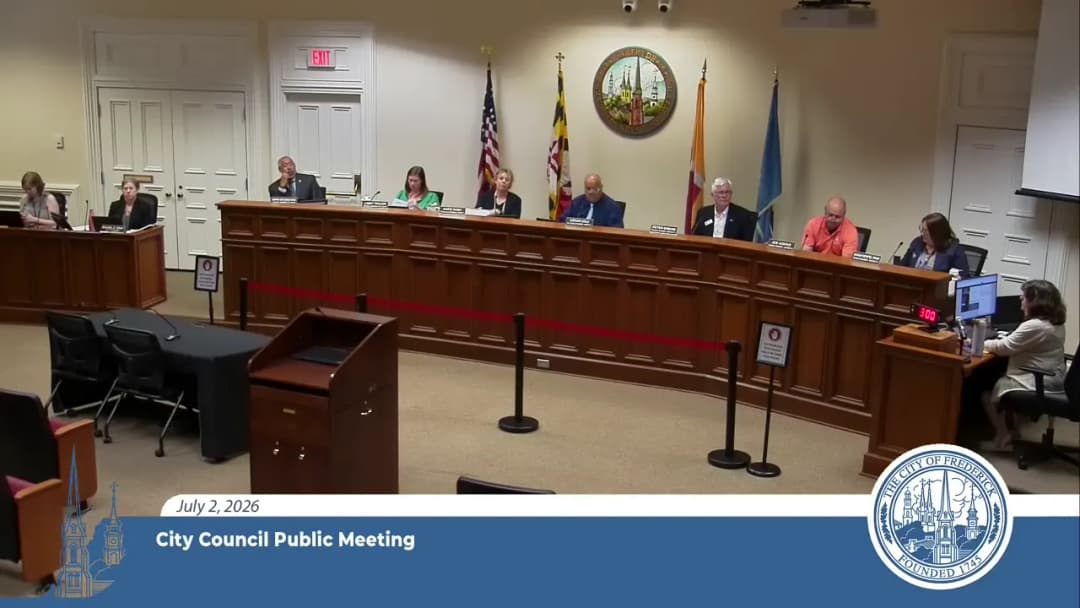
On July 2, 2026, at 11:00 AM, the Frederick City Council convened to consider routine approvals, a memorandum of understanding with the Downtown Frederick Partnership, an ordinance on vehicles for hire, and an update to school zone designations. The meeting included public comments on the ethics complaint process and neighborhood rat infestation. Votes were taken on all agenda items. Consent Calendar - Approval of Minutes: The council unanimously approved the minutes of the June 18, 2026 regular public meeting and closed session. - Appointment: Rupert Gardner was appointed to the Board of Supervisors of Elections for a term from July 6, 2026 to May 31, 2030, by a unanimous vote (7-0). - Consent Agenda: Routine items were approved by motion without discussion. Public Comments & Testimony - Kathy Anderson (Frederick resident, Fairview Avenue) presented a document titled "One Commission to Authorities" and urged the council to commission an independent review of the ethics complaint process. She stated that the current process, controlled by the legal department under the mayor's direction, produced no records of her complaint proceedings and argued that the council has the authority to reform it. - Marion Brown (Carroll Park Manor resident) described a rat infestation in her neighborhood, exacerbated by the city's reduction of trash collection from twice a week to once a week. She attributed the reduction to city expansion without corresponding infrastructure funding. She requested restoration of twice-weekly trash pickup and funding for commercial pest control, stating that the problem has persisted for nearly two years and that previous city efforts in other neighborhoods had not achieved lasting results. Discussion Items - Memorandum of Understanding with Downtown Frederick Partnership: City Attorney Rachel Gray presented the MOU, which provides $125,000 in annual city support and a 50-50 cost split for holiday lights. Kara Norman, Executive Director of the partnership, answered questions about the arrangement, noting it has been in place for about 25 years and implements the Main Street program. The MOU is non-binding, and a separate lease covers the partnership's building. Councilmember Taylor expressed opposition because the city's Economic Development office does not recognize the Route 40 corridor. The vote was 5-1-1, with Councilmember Taylor voting no and one abstention due to recusal. - Ordinance G-263 (Vehicles for Hire): Third reading. Councilmember Brem presented amendments reducing fees: the application fee dropped from $2,500 to $50, the biannual renewal from $50 to $25, and the permit transfer fee from $500 to $25. The ordinance also updated assault conviction disqualifications, splitting them into first-degree/felony assault (four-year lookback) and misdemeanor assault (24-month lookback). Fees will be set in a separate fee schedule ordinance. The vote was unanimous (7-0). - Ordinance G-265 (School Zones): Second reading. Councilmember Hempel Rani updated the list of designated school zones to include new schools (Monocacy Valley Montessori, Yellow Springs Elementary, Classical Charter School) and remove the closed Banner School. The ordinance allows speed camera enforcement within a half-mile radius of listed schools. An amendment to strike the Banner School was adopted. The vote was 5-0-1, with one abstention due to recusal. Key Outcomes - Approved minutes, appointments, and consent agenda. - Approved the Memorandum of Understanding with Downtown Frederick Partnership (5-1-1). - Approved Ordinance G-263 on vehicles for hire (7-0). - Approved Ordinance G-265 on school zones with amendment (5-0-1). - Public comments were received; no immediate action was taken on the issues raised.