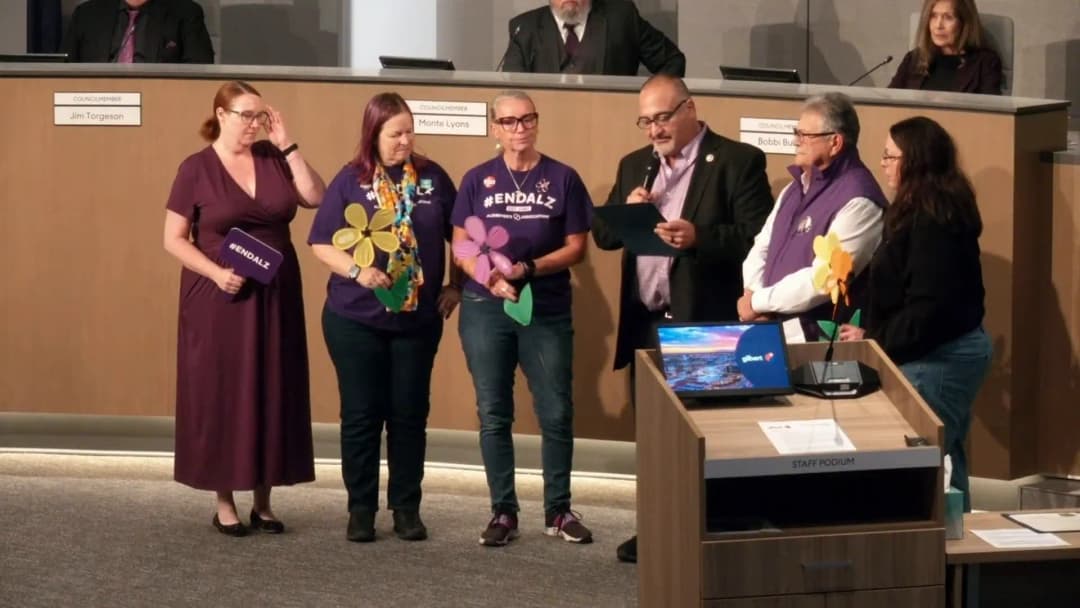
The Gilbert Town Council held a regular meeting on November 4, 2026, presided over by Mayor Scott Anderson. The agenda featured proclamations for Alzheimer's and Caregiver Month and Veterans Week, public comments, unanimous approval of the consent calendar, and a resolution to participate in PFOS litigation settlements. Consent Calendar - Town Manager Mario Paniagua announced future updates to council rules, including the addition of funding source details to agendas starting November 17, 2026. - The council voted unanimously (7-0) to approve the consent calendar, covering items 3 through 11. Public Comments & Testimony - Barbara Colbin (Gilbert Resident): Addressed the Town of Gilbert Code of Conduct. She criticized the Mayor for responding with "no action is merited" to her ethics complaints regarding council members' social media conduct, alleging that this demonstrated selective kindness and hypocrisy. - Shelby Baldwin (Gilbert Resident): A graduate student in arts leadership, she expressed gratitude for the town's governance and advocated for the future creation of a Local Art Agency (LAA) to improve arts representation in Gilbert. Proclamations - Alzheimer's and Caregiver Month: Vice Mayor Bon Giovanni presented the proclamation. Statistics included over 11% of Arizonans over 65 living with Alzheimer's, 224,000 Arizonans providing 379 million hours of unpaid care, and $617 million in Medicaid costs. Steve Adams (caregiver) and Kinsey McManus (Alzheimer's Association) thanked the council, highlighting awareness, caregiver burnout, and the symbolic Alzheimer's walk flowers. - Veterans Week: Councilmember Lyons presented a proclamation for November 9–13, 2026. Charles and Doug McClure from the Veterans Advisory Board accepted, noting the 36 veteran banners displayed in the Heritage District and a new veteran recognition t-shirt available at the town store. Discussion Items - Item 12: Resolution 4699 (PFOS Class Action Settlement): The council authorized the town to join proposed class action settlements against manufacturers of PFOS chemicals ("Forever Chemicals"). The town attorney recommended participation to avoid the high cost of separate litigation. The motion passed unanimously (7-0). Town Manager Report - Assured Water Supply Renewal: The town announced the successful renewal of its 100-year Assured Water Supply designation from the Arizona Department of Water Resources for a new 10-year term. This confirmed collaborative investments in water security, including the 2019 San Carlos Apache Tribe Lease and a 2023 intergovernmental agreement. Council Reports - Vice Mayor Bon Giovanni promoted upcoming "Crafts for Cops" (Nov 4, 4:00–5:30 PM) and the Veterans Breakfast (Nov 11, 8:30 AM–12 PM) at the Gilbert Community Center. - Councilmember Lyons reported on the Veterans Advisory Board's strategic planning session and the banner program. - Mayor Anderson noted the polls had closed for the election. Key Outcomes - Consent Calendar: Approved 7-0. - Resolution 4699 (PFOS Litigation): Approved 7-0. - Water Designation: 10-year renewal of the Assured Water Supply confirmed. - Next Steps: Council retreat scheduled for the following Thursday.
Public Meetings - Gilbert, Arizona
Public Meetings - Gilbert, ArizonaThe Gilbert Town Council held its regular meeting on October 20, 2026. The meeting included proclamations, public comments on several topics, approval of a consent calendar, and significant discussion and votes on data center regulations, council procedures, and a council code of conduct. Proclamations & Recognitions - Domestic Violence Awareness Month: Councilmember Torgeson stated that Gilbert Police responded to 2,096 domestic violence calls and made 1,250 arrests over a recent 12-month period. He noted Arizona ranks 5th in the nation for domestic violence and emphasized the opening of the Family Advocacy Center. - Breast Cancer Awareness Month: Councilmember Buckley presented the proclamation. A speaker from the Brightly Living Foundation shared her personal experience with breast cancer and advocated for mental and emotional support resources. - Recognition of Kathleen: The council honored a Dignity Health executive retiring after 33 years of service for her role in developing the Heritage Center, the Gilbert Advocacy Center, and the Community Engagement Task Force. Consent Calendar - Items 5 through 37 (excluding Item 7, which was continued) were approved in a single 7-0 vote. The items included intergovernmental agreements for school resource officers, contracts for water conservation, street maintenance, firefighter equipment, server infrastructure replacements, and various construction projects. Public Comments & Testimony - Barbara (Gilbert resident) criticized the council for prioritizing approximately $300 million in park investments over what she described as neglected water and infrastructure needs. She thanked Councilmembers Torgeson and Lyons for voting against the parks plan. - Boss Obayami (Councilmember-elect) called for civility, decorum, and mutual respect among council members and between the council and the public. - Nikki Weber opposed new data centers in Gilbert, citing noise and high electricity and water consumption, and urged the council to require data centers to provide their own utility infrastructure. - River Brown spoke against data centers, arguing they harm the environment and consume excessive water, drawing parallels to water access issues on the Navajo Nation. - Charles Montenegro thanked the council for their service and requested a new ordinance to address youth vandalism and aggressive door-knocking, similar to a recent e-bike ordinance. Discussion Items - Item 40: Hemmington Assisted Living Facility: The council approved a general plan amendment and rezoning for an 88-bed, 53,613 sq ft assisted living facility. The developer agreed to single-story buildings and enhanced landscaping buffers. The motion passed 6-1, with Councilmember Torgeson dissenting. - Item 41: Data Centers LDC Text Amendment: Staff presented regulations for data centers, including 400-foot setbacks (650 ft near residential), a 55-foot height limit, a prohibition on using potable water for cooling in primary data centers with reclaimed water required, and restrictions on open-loop evaporative cooling. Council debated the need for an ordinance given a lack of current applications, focusing on future micro data centers, water usage, and national security. Councilmember Torgeson successfully moved to continue the item to December 15, 2026 to study accessory and smaller data center regulations. The motion passed 6-1 (Councilmember Bucklin dissenting). - Item 43: Council Procedures: The council adopted amendments to streamline meetings, including a noon deadline for pulling consent items, moving study sessions to separate Mondays, and starting regular meetings at 5:30 PM. The motion passed 6-1 (Councilmember Buckley dissenting, citing concerns about excluding working residents). - Item 45: Council Code of Conduct: The council revised the code of conduct to prohibit council members from recording town staff without consent and to restrict direct staff contact, requiring all requests to go through the Town Manager. Supporters cited a toxic environment, staff departures, and public harassment. The motion passed 7-0. Key Outcomes - Approved: Consent Calendar Items 5-37 (7-0). - Approved: Hemmington Assisted Living Facility (6-1). - Continued to Dec 15, 2026: Data Center regulations for further study on smaller/accessory facilities (6-1). - Adopted: Code of Gilbert amendments for streamlined council meetings (6-1). - Adopted: Revised Council Code of Conduct (7-0). - Approved: Appointments to the Redevelopment Commission. - Removed: Item 46 (Public-Private Partnership) from the agenda, directed to a November 17 study session.
The Gilbert Town Council held its regular meeting (called to order on September 15, 2026; transcript timestamp 2026-09-16 01:29:17+00:00). The agenda covered the consent calendar, parks and recreation projects and funding (items 15–17), and a contested rezoning/general plan amendment known as GP25-04 / Z25-09 (Headwaters Gilbert). No agenda or minutes were available; the raw transcript appears to end before final roll-call votes were recorded. Opening, Invocation, and Recognition - The meeting opened with reflection on recent 9/11 remembrances and the prayer offered by George Washington after his April 30, 1789 inauguration in New York, noting that St. Paul's Chapel still stands today. - The mayor recognized Tracy Paul and Craig for their daily work, with support from Don, the manager's office, and the town council, to keep the community prepared. - Meeting rules were announced: three-minute speaker limit; 30-minute total for initial public comments, with remaining comments heard after public hearings; no recorded music or moments of silence for recorded material (decorum and copyright); and no advocacy for or against any candidate for public office. Consent Calendar - The consent calendar was presented with brief staff overviews. The mayor asked the council whether any consent items besides items 16 and 17 should be discussed individually; no vote tally is captured in the available transcript. Public Comments & Testimony - Multiple speakers expressed support for items 16 and 17, saying the parks and recreation projects would expand recreation opportunities in Gilbert and provide supervised, positive environments for youth and teens during after-school and evening hours. - One speaker said they were “for the parks” but urged the council to “push the brakes” and let the public vote on how the projects are funded rather than funding them “behind closed doors.” The same speaker referenced the town manager's statement that items 15–17 would be funded with capital one-half cent sales tax funds set aside for these and other projects, and asked whether the council should wait to calendar the items until full funding is available and stays available. - During the Headwaters Gilbert public comment period, neighbors voiced opposition. One said the traffic comparison used by the applicant “measures the proposal against the least favorable baseline available rather than the relevant one.” - An opponent said the developer “could rent his space now, but because he wants an even bigger profit, he's willing to betray this community before you, change the rules to benefit himself, and cram apartments into his lot.” - Another neighbor said residents “are not asking anyone to go without a place to live,” and described the proposal as seeking modifications to landscaping, open space, and setbacks that would reduce separation from existing neighborhoods. - A commenter noted that “nearly 80% are all just one bedroom units” in the proposed unit mix. - A commenter contrasted the current proposal with the Harvest Grove project in April 2026 (more than 1,000 new homes), where the developer removed all multifamily housing from the plan after stating that the “highest and best long-term use” of the land was economic development, and warned that approving the new proposal would allow “a complete lack of form to win the day.” - A speaker praised the applicant's group for civil engagement, saying that in nearly four years they had never seen a group come in with “no rage, no matching t-shirts, proper civil engagement.” Discussion Items - Parks and recreation items (15, 16, 17): - Staff described phased delivery using guaranteed maximum price (GMP) contracts and reported that the current phase of the park is 25% complete. - The project was paused from approximately April to June/July; staff highlighted outreach efforts and how public input changed the design. - Bonding discussion: bonds would be issued in smaller chunks to avoid paying interest on the full amount for the full term, and these are not general obligation bonds. Staff stated the actions that night would not by themselves necessitate future bonding, but if the council chose not to bond, projects would be spread over the full 20-year period, potentially delaying projects needed to provide services. - Gilbert Regional Park's layout allows concurrent large-scale events without closing the whole park. - It was noted that 25 acres previously planned for a surf park are now available for a request for proposals for public-private partnerships or other development. - Headwaters Gilbert (GP25-04 / Z25-09): - Staff reported receiving two letters from neighbors prior to the planning commission meeting, nine letters of opposition before the August town council meeting, and three letters from two neighbors after the September 1 town council meeting. The applicant requested a continuation to reduce the number of deviations to the two presented. - The developer's representative stated that a drone study was conducted before the original building was designed to assess impacts from a third story; argued that the proposal is compatible with adjacent uses and responds to the weak office market; and said existing office properties had aimed for 90% occupancy within 18 months but none reached that level, making a roughly $20 million speculative office building likely to sit vacant. The representative also cited an ASU innovation land ground-lease office building that sold “for pennies on the dollar” and remains vacant, said the site lacks arterial frontage, making uses like a restaurant unlikely to succeed, and argued that companies considering relocation look at the availability of diverse housing types nearby, including rentals at different price points. - The requested zoning amendments include adding drone docking stations and drone drop boxes to setback regulations and amending the use regulations table for these new items. - One council member said, “I am 100% opposed to apartments, especially the density like this,” but acknowledged that demographics are trending toward a need for more senior facilities. Another council member said there was “no way I can support this” and doubted the project was the highest and best use of the property, while also expressing care for residents both nearby and across Gilbert. - The chair said they were “absolutely not against the use” but expressed concern about the significant number of deviations. - A council member noted that infill parcels like this will require harder decisions as Gilbert approaches build-out, and appreciated the public's input and how it changed the design. Key Outcomes - No final vote tallies are captured in the available transcript; it appears to end mid-speech, and no agenda or minutes were provided. The council's decisions on the parks funding/bonding approach and the Headwaters Gilbert rezoning could not be confirmed from the source material.
The Gilbert City Council held a study session on September 15, 2026, at 5:00 PM (estimated start time based on adjournment around 6:30 PM) with all seven councilmembers present. The agenda included three discussion items: an update on utility billing credits, the adoption of the 2024 building code, and a review of the Gilbert Police Department's automated license plate reader (ALPR) technology, protocols, and governance. Consent Calendar - No consent calendar items were presented; the meeting was a study session. Public Comments & Testimony - No public comments were taken during the study session; the session was for council information and discussion only. Discussion Items - Utility Billing Credits and Resuming Normal Procedures: Staff member Hawken reported that 264 accounts are due refunds totaling approximately $18,000 from a six-year water meter audit. No back billing will occur for under-billing errors. A 45-day grace period begins September 16, 2026, with late fees and disconnections resuming November 1, 2026. Over 4,200 accounts (out of 93,000) are past due. Staff will provide multiple notices and work with customers on payment plans and assistance programs. Vice Mayor Bongiovanni asked about the range of past-due amounts; staff noted some accounts have significant balances. - Update on 2024 Building Code: Eric Zavala, Plan Review and Inspection Manager, presented a proposal to adopt the 2024 International Code Council building codes, replacing the current 2018 codes. Stakeholder engagement included the Home Builders Association (95% agreement after compromises), the multifamily housing association (no response), and the Chandler Chamber of Commerce (positive feedback). Key changes include expanded definitions for townhouses, updated regulations for energy storage batteries and solar roof tiles, and prescriptive methods for homeowners. No negative impacts on development are expected. The goal is final adoption in November 2026 with a January 1, 2027, implementation date. Councilmember Kaprowski thanked staff for the presentation; no other questions were raised. - Discussion of Gilbert Police Department ALPR Technology: Chief Jim Bisegley and Interim Assistant Town Manager Mike Solberg provided a detailed overview. Gilbert has used mobile ALPRs since 2010 and added 42 fixed ALPRs (25 in 2024, plus 14 stationary and 3 mobile in 2025) under a five-year Flock Safety contract ($13,268/year, expiring 2028). Axon Fleet 3 cameras on patrol vehicles also capture license plates at no additional cost. Privacy safeguards include: no facial recognition, no GPS tracking of individuals, no audio monitoring, 30-day rolling data deletion (unless evidence), mandatory case number for searches, monthly random audits (10 searches per month), and data sharing limited to state, county, and local law enforcement agencies (64 in-state, 799 out-of-state, no federal agencies). Data is not sold to third parties per state law (SB 1552, effective September 12, 2026). Recent statistics (August 13–September 11, 2026): 8.2 million total reads, 2.6 million unique reads, 1,305 alerts, and 1,822 searches (mostly for stolen vehicles, assaults, and wanted individuals). Since May 2023, 455 incidents had actionable LPR hits, leading to 269 arrests. Examples included a missing elderly person found alive, a murder suspect, and property crime arrests. Council asked about data sharing, contract termination for misuse, public records requests, and the difference between total and unique reads. Councilmember Kaprowski supported the program and suggested increasing the audit sample size. Councilmember Lyons questioned the lack of a misuse termination clause in the contract and why state standardization legislation failed. Councilmember Bongiovanni addressed common public myths (e.g., tracking individuals, bank account information). Councilmember Torgeson asked about Queen Creek's ordinance making misuse a misdemeanor; staff recommended waiting for state-level felony legislation. Chief Bisegley noted that some private companies and HOAs operate their own ALPRs, which are not town-owned. Councilmember Lyons advised using the term ALPR generically rather than referring to Flock by name. Key Outcomes - No formal votes were taken; the session was for information and discussion. - Staff will bring the building code adoption to council for a vote in November 2026. - The police department will continue exploring enhanced auditing features from Flock Safety, a transparency portal for the public, and monitoring state legislation on ALPR misuse penalties. Council expressed support for maintaining strong privacy safeguards and considering increased audit frequency.
The Gilbert Town Council held a regular meeting on September 2, 2026, with Mayor Scott Anderson, Vice Mayor Chuck Bon Giovanni, Councilmembers Bobby Buckley, Monty Lyons, and Jim Torgeson present. Councilmembers Kenny Buckland and Yan Kaprowski were absent. The meeting opened with an invocation by Pastor Brad Myers and the Pledge of Allegiance led by Vice Mayor Bon Giovanni. Key agenda items included presentations, proclamations, public comments, consent calendar approval, and a continuance of a public hearing item. Presentations - America 250 Commemorative Plaque: Rich Ganley and Dominic Longo presented a plaque to the town to commemorate the 250th anniversary of the United States. Councilmember Lyons accepted on behalf of the town. Ganley explained that he and Longo jointly purchased the plaque at a charity auction and donated it to express gratitude for the town's public servants. Proclamations - Suicide Prevention Awareness Month (September 2026): Councilmember Torgeson presented the proclamation to the Gilbert Police Department's Crisis Response Team (Sergeant Dias, Officers Richter, Galardo, Lopez, and Kelly). The team handles approximately 40% of mental health calls in Gilbert. Speakers emphasized destigmatizing mental health and using resources like the 988 Suicide & Crisis Lifeline. - Gilbert High School Tiger Pride Marching Band: Vice Mayor Bon Giovanni presented a proclamation honoring the band's selection to participate in the 2027 Rome New Year's Day Parade. Drum major Emily Graves thanked the council, noting the band's excitement to represent the community on the world stage. Consent Calendar - Items 4–21 were approved unanimously (5–0). These included intergovernmental agreements, contracts for infrastructure improvements, pavement maintenance, security systems, drone equipment for police/fire, and a law enforcement mental health grant. Councilmember Torgeson had requested additional information on several items, which was provided by the town manager. Public Comments & Testimony Three speakers addressed the council: 1. Barbara Colvin (Gilbert resident): Criticized the town's water and sewer rate increases, citing a presentation by Water Resources Manager Lauren Hickson. She argued that the town had failed to prepare for infrastructure needs over 40 years and accused staff and council of negligence and incompetence. She also questioned the salaries of seven senior staff members and asked when it became acceptable for a council member to tell a resident to “F off” on social media. 2. Carissa Arnold (Gilbert resident): Alleged that the town and councilmembers Torgeson and Bon Giovanni engaged in corruption, cover-up, and harassment related to a sexual assault case involving her daughter. She claimed that police records were mishandled, that the Attorney General's initial investigation relied only on statements from town officials, and that the councilmembers used her unredacted documents to intimidate witnesses and influence an election. She demanded the resignation of Chief Solbert. 3. Charles Montenegro (Gilbert resident): Suggested two water conservation ideas: (1) a town program to install recirculating pumps on water heaters to save water while waiting for hot water, and (2) a partnership to repurpose pool water (when drained) by giving homeowners a credit on future bills, since the water is already treated. Council Responses to Public Comments: - Councilmember Bon Giovanni stated he has never spoken to an investigator about the allegations and denied lying. - Councilmember Torgeson said he has never been interviewed about the assault, which occurred before he was on council, and that he has not seen the case details. He expressed frustration at being accused of corruption and urged Carissa Arnold to let her daughter heal. Both councilmembers denied any cover-up. Discussion Items - Item 25 – General Plan GP25-05 / Zoning Z25-14 (Residences at the Reserve): This public hearing item was pulled for separate consideration. Town Attorney explained that due to only five council members present, rezoning and general plan amendments require four affirmative votes (a supermajority). The applicant's representative, Taylor Earl of Earl & Curly, requested a continuance to the next available hearing to allow a full council to hear the case after three years of work. The council unanimously (5–0) granted a continuance to September 15, 2026. Key Outcomes - Consent Calendar: Approved 5–0 (items 4–21). - Public Hearing Items (22–24, 26–30): Approved 5–0 as a block. - Item 25 Continuance: Granted unanimously to September 15, 2026. - Administrative Items: Approved 5–0. - Future Meetings: Study session and regular meeting dates noted. - Recognition: Town Manager recognized Lieutenant Porti for his five-year leadership of the Gilbert Police SWAT team; he will return to patrol operations. - Council Reports: Upcoming events announced: Gilbert Family Triathlon (September 19), Viva Hispanic Heritage celebration (September 25), classic car show at Water Tower Plaza, and 9/11 ceremony at the municipal center (September 11). - Adjournment: Meeting adjourned by motion.
Note on date: The meeting was called to order on September 1, 2026, according to the transcript, but the provided timestamp indicates September 2, 2026, 00:56 UTC. This summary uses the date from the instruction. This study session focused on a proposed text amendment (Z2608) to the Land Development Code (LDC) regarding unmanned aircraft systems (UAS) and commercial drone delivery, in response to Arizona House Bill 2875. Senior Planner Kristen Devine presented the proposed changes to council members for feedback before formal adoption. Discussion Items - Presentation by Kristen Devine: She explained that HB 2875, effective September 2026, limits municipal regulation of UAS but allows towns to regulate public UAS and commercial drone delivery on town-owned property. Gilbert chose to be proactive by establishing guidelines for the structures associated with these systems, primarily to protect residential areas. Key definitions (e.g., unmanned aircraft, commercial drone, drone docking station, drone drop box) were proposed to be added to the LDC, consistent with the state law. - Proposed Use Regulations: - Drone docking stations (20–30 ft tall, used for charging) would be permitted in all non-residential zoning districts, with a 150-foot setback from residential zoning districts. - Drone drop boxes (for goods pickup) would be permitted in all non-residential zoning districts, with a 50-foot setback from residential zoning districts. The difference in setbacks was justified by the drop boxes being less impactful and typically located closer to neighborhoods (e.g., at drive-throughs). - Both structures would be required to meet applicable zoning setbacks as "structures." - Within 2.5 miles of an airport, applicants must provide proof of consultation with the airport. - New Section 5.11: This section would prohibit commercial drones from landing in residential zoning districts or within 150 feet of them, except in approved drop boxes or for deliveries. Docking stations and drop boxes are also prohibited in residential districts, with the same setbacks as above. - Council Questions and Comments: - Councilmember Lyons asked about benchmarking with other communities. Devine replied that only Mesa had recently adopted similar language, and Gilbert's approach focused on regulating structures rather than fleet operations. The proposal was informed by a pre-application from Zipline, a drone delivery company. - Councilmember Lyons expressed concern about noise from multiple drones and asked about sound studies. Devine explained that no additional sound studies were required because drones are regulated by the FAA and Gilbert's existing municipal code on decibel limits (approximately 60 dB, to be confirmed) would apply. - Councilmember Buckley asked about security of the structures. Devine noted that examples from Texas showed enclosed, gated areas, but security measures are determined by the operating company. - Vice Mayor Bon Giovanni mentioned his deposit on a manned drone and suggested the town prepare for future ordinances covering that technology. Devine acknowledged the comment. Key Outcomes - No formal vote was taken; this was a study session to gather council feedback. - The council expressed general support for the proactive approach, with suggestions to consider noise impacts and future technology (e.g., manned drones). - Staff will incorporate feedback and bring the ordinance forward for formal adoption at a future regular session.
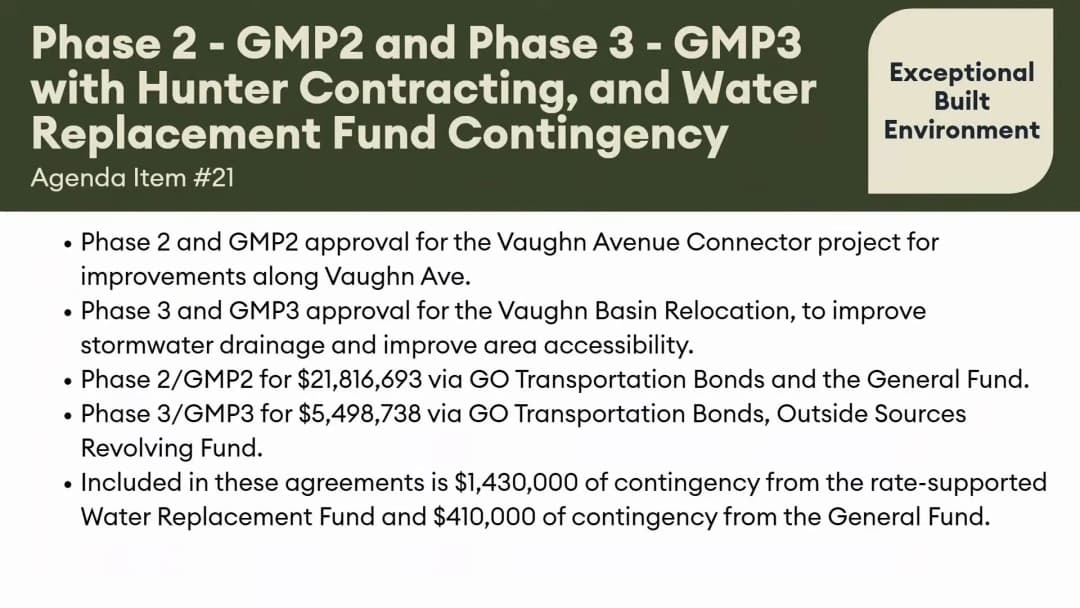
The Gilbert Town Council held its final regular meeting of fiscal year 2025-26 on June 23, 2026. The meeting included a proclamation for Parks and Recreation Month, public comments, approval of a large consent calendar, a public hearing on a zoning appeal, and a presentation on the water meter audit final report. Proclamation - The council proclaimed July as Parks and Recreation Month, recognizing the benefits of parks and recreation for health, wellness, and community engagement. Public Comments & Testimony - Barbara (Gilbert resident): Expressed concerns about utility rates, questioning whether sewer rates would return to $30 after project completion and whether water rates would decrease. She doubted the accuracy of town charts and raised questions about apartment rates, contractor fees, and accountability. She also noted a $3.5 million transfer from the wastewater fund to the Greenfield Service Area System Development Fee fund. - Charles Montenegro (Gilbert resident): Requested a left turn signal at the intersection of Power Road and Ridden House, citing traffic congestion and safety concerns for parents driving children to school. He emphasized benefits such as reduced stress and emissions. - Noah Markham (Tempe resident, former Gilbert resident): Spoke about traffic issues, happy Pride Month, the Preston Lord case and the "Gilbert Goons," criticized police officers and the police chief, mentioned a political sign incident, and advocated for light rail expansion, a New Year's Eve party, and the Cactus Surf Park. Consent Calendar - The consent calendar included items 2 through 27, covering routine approvals such as intergovernmental agreements for transit and library services, contracts for water treatment chemicals, police uniforms, park maintenance, software licenses, and capital improvement projects. - Items 13, 17, 20, 21, and 26 were pulled for discussion: - Item 13 (NUMO contract): Contract renewal for short-term rental licensing software, $421,903 over five years. Staff noted the program nets about $40,000 annually and a fee increase is proposed to cover costs. - Item 17 (Sprout Social contract): Social media management platform renewal, $116,141 over three years, allowing efficient management of 20+ accounts without additional staff. - Item 20/21 (Vaughn Connector Project): Phase 2 and 3 approvals for road improvements and drainage relocation, with contingencies. Discussion included coordination with the American Legion regarding parking. - Item 26 (Transfer of funds): Transfer of $3.5 million from the wastewater fund to the Greenfield Service Area System Development Fee fund, part of a previously planned $9 million transfer to address timing of expenditures. No impact on rates. - The consent calendar was approved unanimously (7-0). Public Hearing Items - Item 28 (Zoning Appeal 2601 – Harvest Grove Commercial): An appeal of the Planning Commission’s approval of a design review for a 27-acre commercial component. The council first addressed the threshold issue of standing. - Appellant’s argument (Doug Jordan): Represented four nearby residents (including Robert Monastero, who was out of town). He argued that proximity (within half a mile) establishes standing and requested a continuance to gather traffic studies and other evidence, claiming insufficient time to prepare. - Developer’s argument (Brennan Ray): Represented Barclays Group. He argued that the alleged harms (construction disruption, increased traffic, property value concerns) are generalized and shared by all 1,200 surrounding parcels, not unique enough to confer standing under state law. He noted the design review focuses on aesthetics, not land use, and that traffic was already studied during the zoning case. A delay would cause financial harm. - Town Attorney’s guidance: Explained that standing requires a particularized, direct, and real injury, not generalized concerns. Proximity alone is insufficient. - Council discussion: Councilmembers agreed that the appellant lacked standing, citing the generalized nature of the concerns and the need to avoid setting a precedent. The motion to deny the appeal for lack of standing passed 7-0. - Item 29 (A and B): Two administrative items approved without discussion. Motion passed 7-0. Discussion Items - Item 30 (Short-term rental fee increase): Notice of intent to increase licensing and renewal fees from $100 to $250 to cover program costs. Currently operating at a deficit, with the general fund subsidizing the difference. The fee would make the program revenue-neutral. Approved 7-0. - Item 31 (Policy 202602 – Responsible Financial Management): Updated the health trust fund minimum balance from 30% to 25% and updated references. Approved 7-0. - Item 32 (Council meeting efficiency measures): Postponed to the first meeting in August. Motion passed 7-0. - Item 33 (Water meter audit final report presentation): Presented by Hawken and Candace. Key findings: - No systemic or system-wide failures; the system is working as intended. - Over 50 million rows of data reviewed; fewer than 0.5% of transactions had potential issues. - 381 residential accounts potentially overbilled (total $44,000); zero commercial overbilling. - Credits to be issued by July-August 2026 after validation. - Underbilled accounts (residential and commercial) require further review and physical inspections. - Recommendations for improvements in asset management, billing processes, performance monitoring, and communication. - Communication plan outlined: phased approach to share findings, issue credits, and return to normal billing. - Councilmember appreciation: Acknowledged the audit team and staff for transparency and efforts. Key Outcomes - Consent calendar (items 2-27) approved 7-0. - Item 29 A and B approved 7-0. - Item 28 (zoning appeal) denied due to lack of standing, 7-0. - Item 30 (short-term rental fee increase notice of intent) approved 7-0. - Item 31 (financial policy update) approved 7-0. - Item 32 (meeting efficiency measures) postponed to August 2026, 7-0. - Water meter audit final report released; credits for overbilled customers to be processed by July-August 2026; further review of underbilled accounts ongoing. Reports - Town Manager: Recognized staff accomplishments for the fiscal year, highlighting work across departments. - Councilmember Lyons: Thanked outgoing members of the Veterans Advisory Board. - Vice Mayor Bongiovanni: Promoted upcoming Parks and Recreation Month events, including a dine-in movie night and Nerf Wars at the library. - Mayor: Presented a detailed summary of fiscal year achievements across all departments, including water well drilling, hazardous waste collection, traffic signal installations, park awards, and recruitment efforts.
The Gilbert Town Council met on June 10, 2026, to adopt the final budget for fiscal year 2027, pass an e-bike ordinance, approve the capital improvement plan, and address public comments on a wide range of issues including utility rates, spending transparency, police accountability, and park projects. The meeting included a recognition of interim town manager Don Prince and a transition to new town manager Mario Paniagua. Recognition - Interim Town Manager Don Prince was recognized for her six months of service. The mayor read a letter commending her leadership during a transition period, including producing a balanced budget, reprioritizing resources, and maintaining staff morale. Public Comments & Testimony - Barbara Colvin (Gilbert resident) criticized the council for not caring enough about residents, pointing to steep utility rate increases (doubling sewer rates, tripling flat fees, and future water rate hikes). She argued the council had predetermined votes on water and Harvest Grove issues and accused staff of poor resolution processes. - Tiffany Silva (Gilbert resident) expressed concern about the scale of spending: approximately $1.7 billion in planned projects over the next decade, a $100 million CIP contingency fund lacking clear oversight, and $400 million in parks and recreation spending (including pickleball courts and a pump track). She requested an independent audit of water treatment facilities and better transparency on existing revenues. - Lauren Reber (Gilbert homeowner) criticized the grass rebate program for encouraging heat islands, opposed a primary property tax, and complained about e-bikes and golf carts causing safety issues at night. She asked for stronger enforcement of rules on trails and bike usage. - May Dobbins (Gilbert resident and business owner) thanked the council for their work and urged proactive efforts to increase diversity in leadership to reflect the growing community. - Charles Montenegro (Gilbert resident, Power Ranch) supported the e-bike ordinance but recommended strengthening helmet requirements, adding strobe lights, and escalating fines for repeat offenders. He also raised concerns about e-bikes on HOA green belts and near businesses. - Noah James Markham (Tempe resident) spoke about Pride Month, the new city manager, flock cameras, Israel/Palestine, transgender restrooms, light rail, and the cactus surf park. He also criticized gender representation in leadership. - Daryl Grosen (Gilbert resident) accused council members of attacking residents, spreading misinformation, and using police to harass a resident over a Facebook post. He denied encouraging a utility bill boycott and stated he had 300 pages of screenshots to back his claims. - Carissa Arnold (Gilbert resident) commemorated the 10-year anniversary of Alyssa Romine's murder, alleging the Gilbert Police Department concealed evidence and failed to investigate. She demanded the resignation of Chief Solberg, citing the unsolved murders of Rachel Hanson, Nick Cordova, and Preston Lord. Discussion Items - E-Bike Ordinance (Item 32): Assistant Chief Mike Angstead presented the ordinance, which establishes age restrictions (no one under 12 for Class 1/2 e-bikes, under 16 for Class 3), a 15 mph speed limit on sidewalks and multi-use paths, helmet requirements for minors, parent liability for violations, and a safety program that waives fines upon completion. The ordinance also prohibits riding under the influence and fleeing from police. Councilmember Buckley requested a six-month update on enforcement. After public testimony, the council amended the safety program language to require completion (not just selection) for a fine waiver. The ordinance passed 7-0 and took effect immediately. - Streetlight Improvement Districts (Item 33): Kelly from the budget office explained that the district pays for electricity costs only, and the proposed budget reflects about a 5% increase due to SRP rate changes. Public speaker Barbara Colvin asked for clarification. The council approved the item 6-1 (Councilmember Lyons opposed). - Parkway Maintenance Improvement Districts (Item 34): Approved unanimously after brief explanation. - Capital Improvement Plan (Item 35): Councilmember Kaprowski recused herself due to a potential conflict of interest. The plan includes $1.7 billion in infrastructure projects, with $1.2 billion already in progress. The motion passed 5-1 (Councilmember Torgeson opposed). - Secondary Property Tax Levy (Item 36): The levy remains at $0.98 per $100 assessed value, providing $36.6 million to repay voter-approved debt. Councilmember Torgeson expressed ideological opposition to property taxes but supported the levy because the debt must be paid. The motion passed unanimously. - Final Budget Adoption (Item 37): The budget video highlighted a $20 million annual revenue loss due to state and federal changes, zero-based budgeting, and tough trade-offs (e.g., reduced park maintenance, canceled events). The council approved the final budget of $2,554,042,835 for FY 2027. Vice Mayor Bongiovanni clarified that the total budget includes multi-year CIP projects, and actual spending is $500–$800 million. The motion passed 6-1 (Councilmember Torgeson opposed). - Consent Calendar (Items 2–24, 38): Town Manager Mario Paniagua summarized 23 items, including intergovernmental agreements, contracts for water infrastructure, firefighting equipment, stormwater repairs, park development, and the appointment of four members to the Veterans Advisory Board. Councilmember Torgeson asked for a breakdown of water-related spending. The consent calendar passed 6-0. Key Outcomes - E-bike ordinance adopted (7-0) with immediate effect; includes age restrictions, helmet mandate, speed limits, and a safety program. - Capital Improvement Plan approved (5-1) for FY 2027–2036, totaling $1.7 billion. - Secondary property tax levy set at $0.98 per $100 (unchanged from previous year), generating $36.6 million. - Final budget adopted (6-1) for FY 2027 at $2.55 billion (total budget; actual spending estimated at $500–$800 million). - Streetlight improvement districts approved (6-1) with a 5% increase in electricity costs. - Parkway improvement districts approved unanimously. - Consent calendar approved (6-0), including contracts for water, sewer, and park projects. - Four new members appointed to Veterans Advisory Board: James Baplasic, Rose Lichtenfels, Douglas McClure, and Raymond Kimball (terms through June 2029). - New town manager Mario Paniagua thanked the council and staff; Don Prince returned to her role as assistant town manager. - Future meetings announced: Juneteenth celebration (June 19) and Fourth of July celebration.
This regular meeting of the Gilbert Town Council was called to order on May 19, 2026, and continued into May 20, 2026. The meeting included proclamations, a consent calendar with numerous routine approvals, a public hearing on a contentious rezoning case, and adoption of the preliminary FY2027 budget. Key actions included approval of a rezoning for a Target-anchored retail center on a 4-3 vote, adoption of the consent calendar with two items pulled for separate votes, and unanimous approval of the budget. Proclamations & Recognitions - National Public Works Week (May 17-23, 2026): Councilmember Kaprowski presented the proclamation, recognizing public works staff for their contributions to infrastructure and community wellbeing. - Mental Health Awareness Month (May 2026): Councilmember Buckland presented the proclamation with remarks from Miss Awatuki (Stephanie Delion) and community initiative coordinator Letitia Gilmore. Resources such as the 988 Suicide and Crisis Lifeline were highlighted. - Gilbert Visual Art League Recognition: Councilmember Buckley recognized artist Jane Bradley for her piece "The Hitchhiker," the first recipient of the Gilbert Town Art Award. Donna Fenter of the GVAL board described the league's activities. Consent Calendar - The interim town manager presented 19 consent items (items 4-22), covering contracts for hazardous waste disposal, bus shelter cleaning, custodial services (item 6 was pulled for further study), landscape monitoring, deferred compensation consulting, traffic signal projects, trail repairs, park renovations, fire equipment maintenance, and more. - Item 6 (Custodial Services): Pulled by Councilmember Torgeson for further review of potential in-house options. The existing contract expires June 30, 2026; staff will study cost-effectiveness. - Item 21 (SS4A Grant): Pulled by Councilmember Torgeson due to concerns about federal overreach and zero-fatality goals. After clarification that no penalties exist for not meeting goals, the item passed 4-3. - The remainder of the consent calendar (excluding items 6 and 21) passed 7-0. Public Comments & Testimony - Open Call to Public (Barbara Colby): Colby criticized the council for not responding to questions from previous meetings, alleged incompetence regarding water rate increases, and accused the council of failing to plan for infrastructure needs. She stated, "You have thrown the original good people of this town under the bus." - Item 24 (Higley and Aquillo Retail Center Rezoning): 75 speaker cards submitted; 43 in favor, 33 opposed. Key speakers: - In favor: Kim Drogas (resident, supported transparency), David Basha (property owner, stated family tried to find tenants for 23 years), Ryan Day (resident, supported facts over emotions), Christine Zimmerman (resident, wanted larger store in South Gilbert), Lori Ray (resident, cited convenience and economic benefits), Whitney Georgevich (resident, argued Target is the gold standard and brings revenue), Sean Miller (resident, emphasized jobs and tax revenue). - Opposed: Kegan Salah (cited 700+ petition signatures, argued project doesn't fit, raised concerns about traffic and safety), Kevin Sproul (called the project "inappropriate" for the neighborhood), Christine (healthcare provider, feared traffic and safety near the park), Chad Brossman (architect, presented data showing 48 similar Targets average 50.54 acres, this site only 16), Robert Gerlock (resident, opposed due to traffic and loss of quiet neighborhood), Tracy Pagano (resident, questioned traffic study and enforcement of truck routes), Andy (argued project only works with rule bending), Bill Brothers (urged study after bridge opens). Discussion Items - Item 24 – Z25-13 (Southeast corner of Higley and Aquillo, rezoning from Shopping Center to General Commercial for a Target store): - Staff presented the case: the site is 16.14 acres, currently zoned Shopping Center (SC) which caps single-user footprints at 75,000 sq ft. The applicant seeks General Commercial (GC) to allow a single user up to 128,000 sq ft (with other pads totaling 139,000 sq ft). Staff noted a legal protest was filed but did not meet the 20% area requirement. Planning Commission recommended approval. - Applicant (Reese Anderson) argued the change solely addresses the square-footage limit, and that the project meets or exceeds SC standards on setbacks (meet or exceed 75-ft residential setbacks, 280 ft south, 170-240 ft east), landscaping (29% open space vs. 15% required), and building height (single-story, actual height 22 ft measured to roof). He offered to add a condition limiting uses to those permitted under SC. Traffic study showed the proposed project generates fewer trips than potential SC development (16% fewer daily trips). A condition to restrict trucks from turning south on Wilson Way was proposed. - Council discussion: Councilmember Buckland supported, citing Target's crime lab partnership, revenue benefits, and data showing reduced parking needs due to online shopping. Councilmember Lyons noted the site could host two 75,000 sq ft buildings without council review and emphasized revenue. Councilmember Buckley opposed, citing quality of life, traffic, and fit. Vice Mayor Bongiovanni opposed, arguing the project doesn't complement the neighborhood and noting potential for less desirable uses under SC. Councilmember Torgeson expressed caution but noted the inevitability of traffic and the risk of unwanted uses (e.g., car wash, apartments) if the rezoning fails. Councilmember Kaprowski questioned land-use differences but supported after considering potential negotiations. The motion to approve with staff conditions passed 4-3. - Item 29 – CIP Program: Councilmember Kaprowski recused herself due to a potential conflict of interest. The motion passed 6-0. - Item 30 – FY2027 Property Tax Levy: The preliminary budget setting the secondary property tax levy at $36.635 million (rate of $0.98 per $100 assessed value) was presented. Councilmember Buckland requested future consideration of adding motorcycle officers. The motion passed 7-0. - Item 31 – Preliminary Budget Adoption: The budget for July 1, 2026 to June 30, 2027 was adopted 7-0. Key Outcomes - Consent Calendar (Items 4,5,7-20,22): Approved 7-0. - Item 6 (Custodial Services): Pulled for further study; staff to report back. - Item 21 (SS4A Grant): Approved 4-3. - Items 23,25,26,27,28 (Public Hearings): Approved unanimously. - Item 24 (Z25-13 Rezoning): Approved 4-3, with conditions including use limitations to SC uses and truck routing signage. - Item 29 (CIP Program): Approved 6-0 (one recusal). - Item 30 (Property Tax Levy): Approved 7-0. - Item 31 (Preliminary Budget): Approved 7-0. - Councilmember Buckland's request to explore adding motorcycle officers in FY2028 was noted. - The next regular council meeting is scheduled for June 8, 2026 at 7:00 PM.
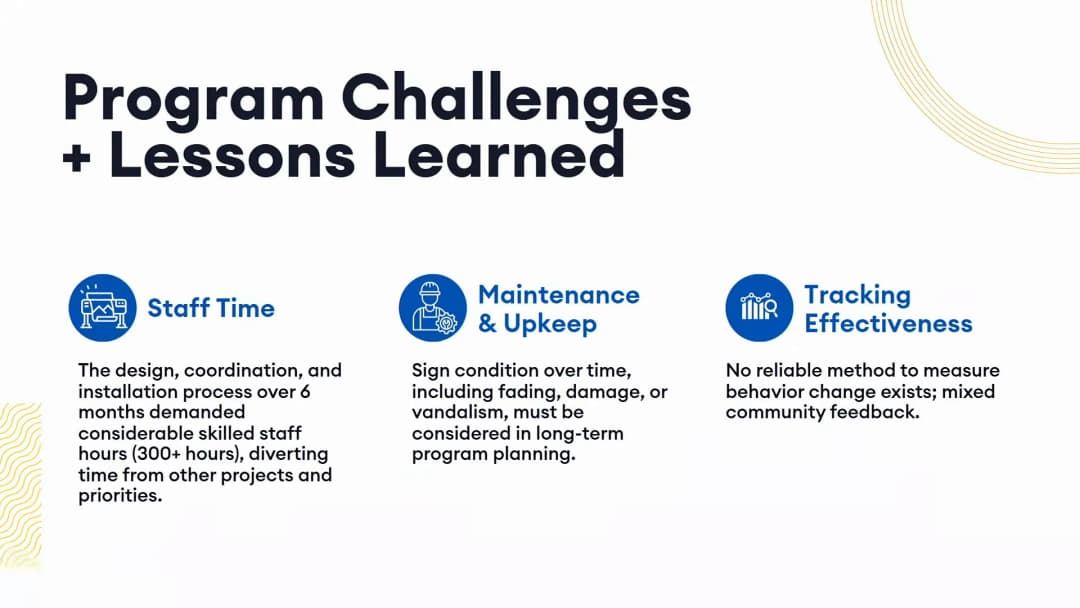
This study session focused on two major items: a proposed e-bike and helmet ordinance update, and results from a six-month traffic safety sign pilot program. The council heard presentations from the Gilbert Police Department, Office of Communication and Engagement, and Traffic Engineering, and provided feedback on proposed ordinance provisions and the future of the sign program. E-Bike and Helmet Ordinance Presentation Assistant Chief Mike Ankstead and Brenda Carrasco presented data on rising e-bike and e-motorcycle collisions, enforcement challenges, and community education efforts. The presentation included video footage of dangerous rideouts and reckless riding. Key proposed ordinance changes included: - Age restrictions: no person under 12 on class 1 or 2 e-bikes; no person under 16 on class 3 e-bikes. - Speed limit: 15 mph on sidewalks, parks, and multi-use paths. - Helmet requirements: council decision point: either require helmets for all riders under 18 (including bicycles) or only for e-bike riders under 18. - Parental liability for allowing children to violate the ordinance. - Reckless riding provisions (e.g., wheelies, carrying passengers, modifying devices). - DUI and failure-to-stop provisions for all devices, class 1 misdemeanors. - Business requirements to inform buyers of local rules. - A safety education program as an alternative to civil fines. Council feedback included: - Councilmember Kaprowski supported helmets for e-bikes and bicycles, and suggested a 30-day education-only period if an emergency clause is enacted. - Councilmember Bucklin supported the age restrictions and called for an adult to be present for any purchase of e-bikes. - Councilmember Lyons suggested a driver safety program administered by parks and recreation. - Councilmember Buckley voiced support for zero tolerance for repeat offenders and ringleaders. - Vice Mayor asked about enforcement of e-motorcycles (already illegal) and whether under-12 restrictions apply on private property (yes, within town boundaries). The next step is council approval of the ordinance on June 9, 2026, with a possible emergency clause for immediate effect. Traffic Safety Sign Pilot Program Results Deputy Director Jen Harrison, Chief Bisegli, and Town Engineer Susanna Strubble presented results of the six-month pilot (Oct 1, 2025 – Apr 1, 2026) at 10 intersections. Key findings: - Crash data at four monitored intersections showed no statistically significant change (crashes increased by 1 in the pilot period compared to previous year). - Speed data showed little to no change, with some intersections affected by construction. - Community feedback: 89% of 750 social media respondents had seen the signs; 57% said signs encouraged safer driving; overall sentiment was mixed (47% positive, 53% questioning). - Total cost: $20,000, including 213 staff hours from streets team. - Challenges: maintenance, vandalism, easement conflicts, and limited ability to measure behavior change. Staff recommended discontinuing the program and focusing on other safety initiatives: education, enforcement (red light cameras, e-bike ordinance), engineering projects (80 ongoing), and a comprehensive safety action plan via a grant application. Council discussion: - Councilmember Buckler favored discontinuing due to budget and insignificant results, calling for more police staffing. - Councilmember Kaprowski and Councilmember Torgison noted the low cost and potential benefit of even one prevented crash, with Torgison questioning whether the data anomalies (e.g., Williamsfield & Valvista decline) could be partly attributed to the signs. - Vice Mayor requested data on the other six intersections before making a final recommendation. Key Outcomes - No formal votes were taken (study session). - Council direction on the e-bike ordinance: staff will bring the ordinance for adoption on June 9, 2026, with an emergency clause. Council’s feedback will inform the final language, particularly on helmet requirement scope and education-first enforcement. - For the traffic sign pilot: staff will provide data on all 10 intersections to council. The program is not recommended for continuation, but council may revisit if new data supports it.