The Gilbert Town Council held a regular meeting on February 17, 2026, beginning at approximately 6:00 PM. The meeting focused on proposed utility rate increases for water, solid waste, and recycling services, as well as several consent agenda items including grants and contracts. Council heard public comments, debated rate options, and voted on three rate resolutions. Key decisions included adopting a 25% water rate increase, a 2% residential solid waste increase, and an approximately 20% commercial solid waste increase, all effective April 2026. Council also approved a controversial Build Grant application for the Hunt Highway corridor study. Consent Calendar - Items 1-6, 8-9, 10 approved unanimously (7-0): Included an intergovernmental agreement with Save the Family for affordable housing, an amendment to the HOME consortium adding Goodyear, a cooperative contract for aluminum sulfate (not to exceed $680,000/year for 4 years), a contract for water treatment equipment ($250,000/year for 5 years), a development reimbursement lien agreement with Simon CRE, a CIP contingency contract with Sunt Construction ($838,023), a change order with Endris Houser ($220,000 for FY27), claim settlements totaling $485,320, a Homeland Security Cybersecurity grant application ($92,045 with up to 25% match), and a 2027 Homeland Security grant application ($574,750 for armored vehicle, training, and drone equipment). - Item 7 (Build Grant) passed 6-1 after separate vote: Approved application for a $1,065,000 federal BUILD grant for a feasibility study and 15% design on Hunt Highway from Val Vista to Wrecker. The town's 20% match ($200,000) may be offset by in-kind staff time. Councilmember Bobby Buckley voted no, citing insufficient time to review and concern about long-term construction costs. Public Comments & Testimony - Barbara (Gilbert resident): Opposed the proposed water rate increases, calling them "extortion" and criticizing the planning of multiple major projects simultaneously. Cited a prior email to council that received no direct response. Expressed concern about traffic and new apartment developments. - Shane Melvin (Gilbert resident, Bridges neighborhood): Described a severe mid-fly infestation from the nearby recharge basin at Katio and Higley. Reported spending $900 on mitigation, with flies affecting indoor and outdoor living. Asked for a concrete plan to dry the basin and measurable improvements. Council directed staff from Public Works to follow up. - Eric Rumstead (Gilbert resident): Questioned the need for expanded police and emergency equipment grants (item 9), arguing for de-escalation over militarization. Shared an incident at Williams Field High School where he felt police lacked clear communication. Council noted a future presentation on item 9. - Elizabeth Lee: Did not appear. - Clay Richardson (Gilbert resident, Gilbert Leadership class participant): Praised town staff for proactive compliance notices, leak detection assistance, and quick streetlight repairs. Expressed gratitude for the community and staff dedication. Discussion Items - Water and Solid Waste Rate Increases (Items 16-18): Staff presented detailed rate pressures: water infrastructure inflation, Colorado River shortage risks (up to 77% cut to CAP water), rising vehicle and maintenance costs for solid waste, and increased landfill tipping fees. Two water rate options were debated: Option A (25% increase in April 2026, no planned increase in 2027) and Option E (14% increase in 2026 and another 14% in 2027). The Public Works Advisory Board recommended Option A. Council also discussed a potential agricultural water rate framework for small businesses, which will return on March 3, 2026. Councilmember Monty Lyons expressed concern about meter audits and Colorado River uncertainty, favoring Option E. The majority supported Option A as following the original 2023 plan and avoiding prolonged pain. - Utility Assistance Program: Council gave direction to staff to increase the $30/month utility assistance amount and to shift future rate adjustments to fall months to align with budget cycles. Staff may bring a future contingency request for additional funding. Key Outcomes - Water Rate Increase (Resolution 4637): Adopted Option A (25% increase effective April 2026) by a vote of 4-3 (C. Buckley, Bucklin, Kaprowski, Torgeson in favor; Lyons, Bongiovanni, and an unnamed member dissenting; transcript shows "4-3" for item 16). - Residential Solid Waste Increase (Resolution 4638): Approved 6-1 (Lyons dissenting). 2% increase ($0.55/month for standard 90-gallon service) effective April 2026. - Commercial Solid Waste Increase (Resolution 4639): Approved 6-1 (Lyons dissenting). Approximately 20% increase for most commercial services, effective April 2026. - Build Grant (Item 7): Approved 6-1. - Consent Calendar (Items 1-6, 8-10): Approved 7-0. - Public Hearing Items 11-15: Adopted as a block 7-0. - Administrative Item 19 (Budget & Contingency Report for Q2 FY26): Approved 7-0. - Future Meetings: Next regular meeting scheduled for March 3, 2026, including discussion of agricultural water rate framework.
Public Meetings - Gilbert, Arizona
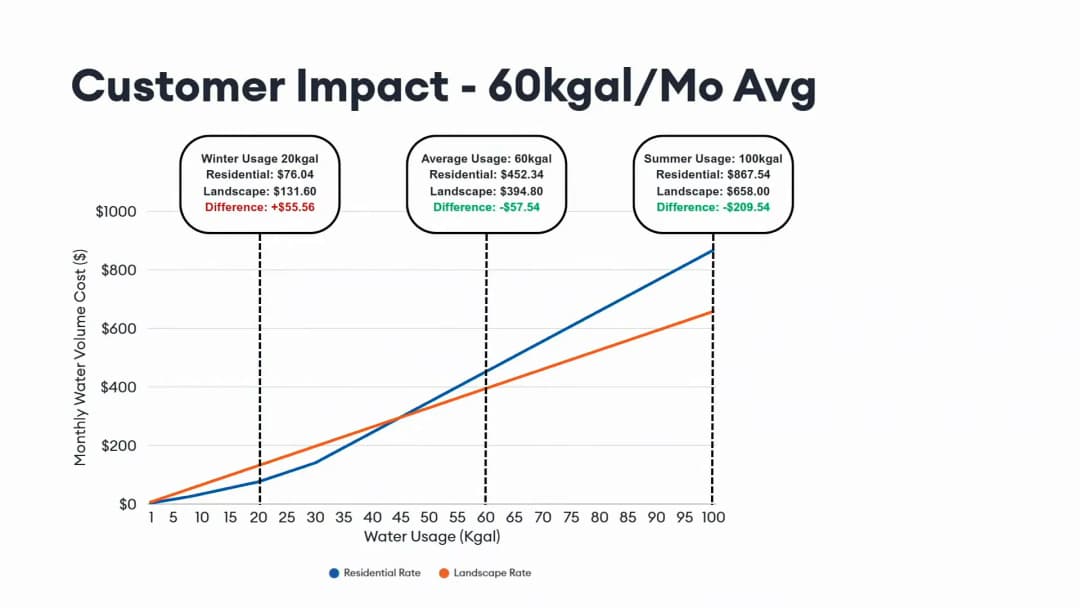
Public Meetings - Gilbert, ArizonaThe Gilbert City Council held a study session on February 17, 2026, focused on a presentation and discussion of a proposed agricultural water rate framework. The session included an update on Colorado River conditions, a detailed proposal for a pilot program to reduce water rates for qualifying residential properties with agricultural or livestock operations, and council questions regarding eligibility and implementation. Consent Calendar - [No consent calendar items were discussed.] Public Comments & Testimony - [No public comments or testimony were presented.] Discussion Items - Colorado River Update: A staff member reported that the Bureau of Reclamation released a draft plan in January 2026 detailing five alternatives for operating the river. The "no deal" alternative could result in Arizona taking up to 77% of water reductions under declining river conditions. Current record low runoff projections indicate a high likelihood that Lake Powell will decline below minimum power pool elevation by the end of 2026. The town continues to advocate that the no-deal alternative is incomplete and has legal concerns, emphasizing the need for water resiliency projects such as the Northwater Treatment Plant Reconstruction and well development program. - Proposed Agricultural Water Rate Framework: Staff presented a proposal to establish a pilot program allowing qualifying residential properties with livestock or local food production to switch from the tiered residential water rate to the non-residential landscape water rate. The rate change would apply to all water use on the property. The break-even point for savings is approximately 45,000 gallons per month. Example savings: a customer using 60,000 gallons per month average would save about $57 per month ($690/year); a customer using 125,000 gallons per month average would save about $305 per month ($3,600/year). - Eligibility Criteria: Four categories were proposed: (1) customer requirements (existing residential customer within town limits, with an active animal/agricultural business as of December 31, 2025); (2) property characteristics (lot size ≥35,000 sq ft, no exempt well, compliance with 1980 Groundwater Management Act); (3) water use and efficiency (max 10% ornamental grass, flood irrigation usage preference, water use limited to highest of prior three years' annual use); (4) compliance and audits (cross-connection audit, water efficiency checkup, review of livestock quantity per land development code). The program would not transfer upon sale of property, and participants cannot also participate in the utility discount program. - Council Questions: Councilmember Buckley asked about the number of eligible properties—staff estimated about 500 properties over 35,000 sq ft using at least 45,000 gallons/month, but the number of actual farms is likely significantly lower. Staff contacted two local farmers markets and found about five farms operating in Gilbert, and worked with a handful of residents. Councilmember Buckley clarified that the program applies only to occupied residential properties, not vacant land, and that agricultural businesses are exempt from Gilbert business license requirements but must prove business existence via tax records or vendor lists. Councilmember Lyons confirmed positive feedback from stakeholders. Vice Mayor Bongiovanni suggested reconsidering the December 31, 2025 deadline to potentially include businesses that may become more compliant. Key Outcomes - The council provided general direction for staff to bring the pilot program forward as a resolution at the next regular meeting on March 3, 2026. - If approved, the program would launch on April 1, 2026, with staff reaching out to eligible customers, adding information to the website, and tracking participation. Staff would return within at least one year with data on program performance. - The meeting adjourned, with the regular meeting scheduled for 6:30 p.m.
The Gilbert Town Council convened on February 3, 2026, at 6:00 PM for a regular meeting. The meeting opened with an invocation by Pastor Michael Haydn of Christ Greenfield Church, followed by a roll call confirming a quorum of all seven members. The agenda included a consent calendar, public hearings, and administrative items. The most significant action was the reconsideration and continuance of the Harvest Grove development proposal (Items 14A and 14B), which had been denied at the January 20, 2026 meeting. After extensive public comment and council debate, the council voted 5-2 to reconsider the item and then unanimously voted to continue the public hearing to the April 7, 2026 regular council meeting. Communications from Citizens (Public Comments) - Christine Brennan (Gilbert resident & business owner) – Expressed concern that immigration enforcement by ICE is creating fear and reducing community trust. She urged the council to keep Gilbert police focused on local public safety, not federal immigration enforcement. - Sharon N. (Gilbert resident) – Opposed the use of Flock automated license plate readers, calling them a "massive, intrusive, warrantless surveillance network." She cited recent AI-related false arrests, a data breach, and the $350,000 cost, urging cancellation of the contract. - Barbara Colvin (Gilbert resident) – Criticized the town for purportedly ignoring resident input, citing the Harvest Grove project as an example of do-over despite previous denial. She also opposed water rate increases and argued that new housing is being approved without adequate water supply. - David Ruby (Gilbert resident) – Asked the council to represent citizens rather than developer interests, underscoring that individual residents cannot compete with large developers. He urged representation over leadership. - Noah James Markham (Tempe resident, former Gilbert resident) – Supported more housing, including the Harvest Grove project, and opposed ICE presence in Gilbert. He advocated for speed cameras and high-density development in the Heritage District. - Carol Cherry (Gilbert resident, 18 years) – Thanked the council for the previous denial of Harvest Grove and opposed reconsideration, arguing that a third chance sets a dangerous precedent for developers. - Richard Young (Gilbert resident) – Opposed the Harvest Grove project, calling it "gas, garbage, crime, and traffic." He drew on negative experiences with overdevelopment in Scottsdale and Palm Springs and warned against ruining Gilbert's character. - Mara Frankel (Gilbert resident, Stratford community; 50-year construction industry veteran) – Opposed reconsideration, stating the developer's requests for zoning changes are "spot zoning." She said the Stratford community was not properly notified and that the plan disregards the general plan. She urged the council to uphold its earlier decision. - Mike Larson (Gilbert resident) – Thanked the council for the initial no vote, saying it renewed his faith in local government. He encouraged the council to hold the line and not reconsider. - David Regimbal (Gilbert resident) – Opposed reconsideration, quoting councilmembers' campaign statements about following the plan as an "instruction book." He argued the project doesn't fit the Santan character area and that a revised plan still includes high density on frontage roads. - Andrew Burgesson (Gilbert resident, father of five) – Opposed the project, noting that the city planner "paused and sighed" when asked about it, suggesting even staff doubts its fit. He cited traffic and safety concerns for his children. - Elliot Mason (Gilbert resident, 2 years, from Los Angeles) – Opposed Harvest Grove, questioning why the council would reconsider a vote. He stated the developer did not mention residents in his presentation and argued that big-lot homes are in demand, not apartments. - Barbara Siegel (Gilbert resident, 20+ years) – Opposed the project, citing concerns about water shortages and urging that the general plan be followed. - Tanner Pomeroy (Gilbert resident, young couple) – Spoke in support of Harvest Grove, saying young families who grew up in Gilbert cannot afford to stay. He noted that he and his wife live in his in-laws' basement to save for a home and that many friends have moved away. He argued the project offers for-sale options for young families. Consent Calendar - Councilmember Torgeson requested separate discussion on Item 1 (pavement condition ratings contract) and Item 8 (fall 2026 election designations). Staff explained that specialized equipment makes contracting out for pavement ratings more efficient, and that election dates are subject to pending state legislation. - The consent agenda (Items 1-9 plus Item 15) was approved 7-0. Public Hearings (Items 10-13) - Items 10, 11, 12, and 13 were approved as a block without discussion (motion carried 7-0). Harvest Grove Reconsideration (Public Hearing Item 14) Item 14A: Reconsideration of the Council's January 20, 2026 Denial - Applicant’s Statement (Brendan Ray, representing Lennar Homes) – Requested reconsideration, stating that Lennar has already made substantial changes: reducing overall density, removing all multifamily from the Santan character area, and reducing density in that area to 3.5 units per acre. He asked for the opportunity to continue working with staff and council on an appropriate plan. - Councilmember Torgeson – Moved reconsideration. He argued that denial is final, while reconsideration keeps the council in control. He warned that state legislation is eroding local zoning authority, and that a blanket refusal could lead to by-right development of up to 4 units per acre without public process. He stressed that reconsideration does not guarantee approval and that a better outcome could be negotiated. - Councilmember Buckley – Supported reconsideration, noting that the changes already made are substantial and that the project offers diverse price ranges. - Vice Mayor Bongiovanni – Opposed reconsideration, citing the appearance of rewarding a developer for "shooting for the moon" and the erosion of public trust. He defended the integrity of council members and rejected allegations of bribery. - Councilmember Koprowski – Asked staff questions about the Coronado Road CIP (not currently funded), system development fees (calculated per dwelling unit), and the well site (not needed for existing residents but reserved for future redrilling). The information did not change his position against reconsideration. - Councilmember Bucklin – Supported reconsideration, noting that 10 of 13 public emails received were in support. He cautioned that rejecting the project could worsen the town's fiscal shortfall (approximately $20 million) and argued that the council must find middle ground. - Councilmember Lyons – Supported reconsideration, stating that the plan has moved substantially toward the Santan character area and deserves further discussion. He noted he was still not fully satisfied. - Councilmember Torgeson – Clarified that his vote for reconsideration is not an endorsement; he remains a "hard sell" and wants to see a plan that addresses community concerns and contributes to infrastructure funding. - Motion to reconsider Item 14A passed 5-2 (Vice Mayor Bongiovanni and Councilmember Koprowski opposed). Item 14B: Motion on the Merits - The applicant requested a continuance to the April 7, 2026 regular council meeting. - Councilmember Bucklin moved to continue to April 7, 2026; Councilmember Buckley seconded. - Motion carried 5-2 (same two dissenting votes). Administrative Items - Item 15 (appointments to the Judicial Selection and Advisory Board) was approved as part of the consent calendar. Future Meetings & Reports - Councilmember Lyons – Announced a softball night for veterans, families, and friends on February 17 from 6-8 PM at Cactus Yards (RSVP by February 14). Promoted the Gilbert Banners program honoring veterans and active-duty service members, and a fundraiser for veteran support shirts. - Councilmember Buckley – Announced new guided tours at the Riparian Preserve at Water Ranch, launching in partnership with the Desert Rivers Audubon Society, to be promoted at the Gilbert Outdoor Expo on February 21. - Councilmember Koprowski – Invited the community to the free Gilbert Symphony Orchestra concert on February 12 at 7 PM at the Higley Center for the Performing Arts. - Vice Mayor Bongiovanni – Promoted several events: Galentine's Day Bingo (Feb 6, 6:30-8:30 PM, McQueen Park Activity Center), Father-Daughter Dance (Feb 6), volunteer award nominations, Student Government Day (March 31), and the Community Connect Expo (Feb 7, 9 AM-12 PM, HD South). Key Outcomes - Consent Calendar (Items 1-9 & 15): Approved 7-0. - Public Hearings (Items 10-13): Approved as a block 7-0. - Item 14A (Reconsideration of Harvest Grove denial): Motion carried 5-2. - Item 14B (Continuance of Harvest Grove public hearing): Continued to April 7, 2026 regular council meeting; motion carried 5-2. - No other votes or directives were taken.
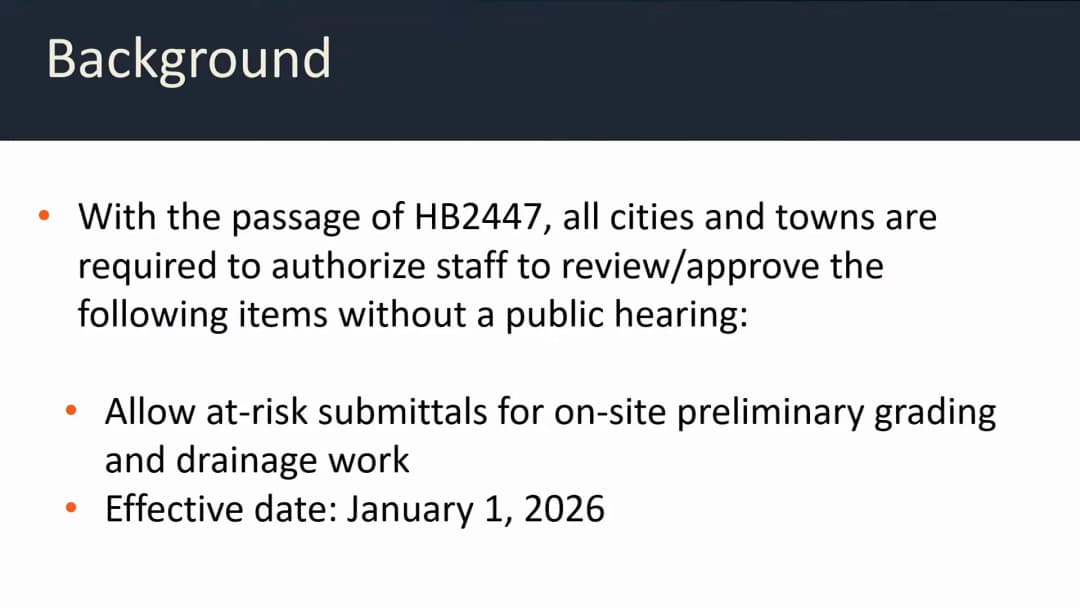
This study session, held on February 4, 2026, included two presentations for council discussion: an LDC text amendment allowing administrative review of at-risk grading permits, and a proposed ordinance to codify and introduce new court program and service fees, including a prosecutor diversion fee and detention recovery fee. No votes were taken; the council provided direction to bring the fee ordinance forward for a regular session vote on February 17, 2026. Discussion Items - At-Risk Grading Permits: Justin Eisenham from the Development Services Group presented a proposed LDC text amendment to authorize preliminary on-site grading work before final permit approval. The amendment would allow the town to establish fees, set criteria for permit applications and design plans, and permit revocation for noncompliance, failure to disclose facts, lack of progress, fraud, safety issues, or site conditions. The council had no questions. - Court Program and Service Fees Ordinance: Chris presented a proposed ordinance covering two areas: - Court Program and Service Fees: Codifying existing fees (Gilbert Youth and Adult Resources fee, forensic laboratory fee for DUIs) and creating a new prosecutor diversion fee of $200 per case for voluntary diversion programs, to offset the cost of a paralegal. The fee would be non-waivable by the court, while the other fees could be waived for financial hardship. - Detention and Jail Cost Recovery Fees: A new detention recovery fee (amount to be set, not to exceed actual detention costs) and codification of an existing jail cost recovery fee. Both fees could be waived or reduced by the court based on hardship or justice. The council gave direction to bring the ordinance to the regular session on February 17, 2026. Key Outcomes - The council provided direction to staff to bring the proposed court program and service fees ordinance to the February 17, 2026 regular council meeting for a vote. - No action was taken on the at-risk grading permit amendment; it was presented for discussion only.
This meeting covered a wide range of topics including a special recognition, public comments on development and policing, a major rezoning and general plan amendment for the Harvest Grove development, and a critical discussion on the town's fiscal future. The council approved consent items and a liquor license, but denied a motion to approve the Harvest Grove development and voted down a notice of intent to raise sales tax rates, instead calling for a comprehensive financial plan. Consent Calendar - Approved items two through five and seven through nine, and reappointment items 12 and 13 (7-0). - Item six (urban lakes renovation) was pulled for a separate vote and approved 6-1. - Item 10 (liquor license) was approved. Public Comments & Testimony - Barbara Colvin (Gilbert resident): Expressed frustration about unanswered emails, continued apartment construction despite prior assurances, rising costs, water issues, and a persistent phone system problem at town hall. - Richard Young (Gilbert resident): Spoke in opposition to the police department's "30 by 30" program, arguing it is illegal social engineering that prioritizes hiring women over competence. - David Rigby (Gilbert resident): Raised concerns about transparency in capital improvement projects, the rehiring of contractors with a history of shoddy work (e.g., North Treatment Plant), and questioned the town's budgeting practices. - Greg Bamford (community member): Opposed the sale of 18.9 acres at Ray and Santan Village Parkway to the highest bidder, arguing the town should prioritize quality of life and community needs (like a church site) over economic factors. - Randy Nelson (Gilbert resident, 15 years): Opposed the same land sale, arguing that a state statute requiring sale at the highest price disregards residents' quality of life, particularly regarding light pollution from a proposed entrance. - Cindy Barnes (former Gilbert resident, 12 years on Parks & Rec Board): Requested a stipulation that no two-story homes be built adjacent to the soccer complex in the Harvest Grove development, citing predictable issues with light, noise, and traffic from her experience. - Andrew Burgesson (Gilbert resident, father of five): Opposed high-density housing in Harvest Grove, arguing it will outpace infrastructure and change Gilbert's character, despite presented designs. - David Rigby (second appearance): Restated opposition to the Harvest Grove project on the basis of density, traffic, and inconsistency with the Santan Character Area, noting the development would increase traffic sevenfold and cause premature road deterioration. Discussion Items - Harvest Grove Development (Items 10A & 10B): A major 311-acre planned area development (PAD) rezoning and general plan amendment for 1,678 residential units (965 single-family, 713 multifamily) and 45 acres of commercial at Germann and Val Vista. Staff presented significant revisions since the November hearing, including reduced density, improved traffic circulation, and new amenities. The applicant (Lenar Homes) projected $1.4 million in annual sales tax from a Fry's grocery anchor, $340,000 in property tax, and $45 million in impact fees. Several council members expressed concerns about density exceeding the Santan Character Area plan, traffic impacts, and quality of life. The motion to approve failed. - Neighborhood Commercial Site (Item 10A): A 12.05-acre parcel at the southeast corner of Val Vista and Queen Creek Road zoned for neighborhood commercial. After discussion, the applicant withdrew the request following the denial of the larger development. - Fiscal Plan & Sales Tax Notice of Intent (Item 11): Town budget director Kelly Faust presented a $20 million structural deficit driven by state legislative changes, including the loss of rental tax ($9M), corporate tax changes, and population shifts. A proposed "notice of intention" to raise several sales taxes (coin-operated, communications, restaurant/bar, and a new tax license fee) was presented to begin a public hearing process. After extensive debate, council members expressed a desire for a comprehensive, holistic plan rather than piecemeal tax increases. The motion to deny the item passed 5-2. Key Outcomes - Harvest Grove Development (Item 10B): Motion to approve the rezoning and general plan amendment failed. The project is denied. - Neighborhood Commercial Site (Item 10A): Withdrawn by the applicant after the denial of the larger project. - Sales Tax Notice of Intent (Item 11): Motion to deny the notice of intention passed 5-2. The council directed staff to develop a comprehensive financial plan involving community stakeholders and to explore alternative revenue options and cost-cutting measures before any future tax proposals. - Future Directions: The council discussed exploring public-private partnerships, potential use of one-time funds for short-term needs, and reprioritizing capital projects. A report on CIP projects under $10 million was requested.
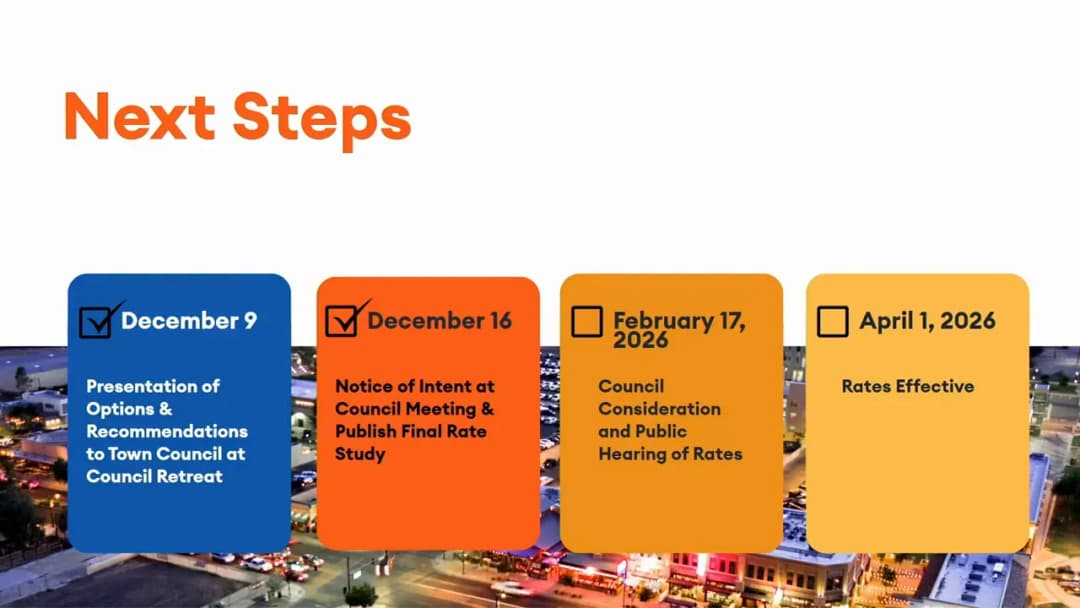
The Gilbert Town Council held a meeting on January 15, 2026, to discuss proposed rate increases for water and solid waste and recycling services. Town staff presented detailed analysis of the financial pressures driving the need for increases, including Colorado River shortages, infrastructure costs, and rising operational expenses. The Public Works Advisory Board recommended Option A (a 25% water rate increase in 2026) as the most balanced approach. The council also heard about a third-party water meter audit and a community engagement plan for the rate-setting process. No formal vote was taken during this meeting; the council is expected to approve the notice of intent to allow for a public hearing on February 17, 2026, and final adoption on February 27, 2026. Discussion Items - Opening Remarks on Enterprise Funds and Rate Drivers: Town staff (likely the Town Manager) introduced the enterprise funds (water, wastewater, solid waste, environmental compliance), emphasizing that they are self-supported through rates and fees. Key drivers include the ongoing Colorado River drought (40% of Gilbert's water supply), rising water costs, inflationary pressures, and critical infrastructure needs such as the North Water Treatment Plant reconstruction and a well-drilling program. The town's AAA credit rating was reaffirmed, but Fitch noted sensitivities regarding rate adjustments and capital spending. A third-party water meter audit by Kimley Horn and Associates was announced, with preliminary findings expected in March 2026, including a 95% statistical confidence sample test. - Solid Waste and Recycling Presentation (Isaiah Scarcero Mero): The solid waste and recycling manager outlined rate pressures: - Vehicle replacement costs have increased 87% since 2020 (now over $525,000 per vehicle), with a backlog of 13 vehicles past the 7-year replacement cycle. - Repair and maintenance costs rose 301% since 2020, reaching nearly $5.5 million in the last year. - Landfill disposal fees increased 78% since 2020, with annual post-collection costs rising from $3.8 million (2023) to $5.5 million (2024). - Recycling market volatility: The average cost per ton to recycle is $18.08, while landfill disposal averages $30.97 per ton. The town's diversion rate is below average, prompting programs like glass drop-off (earning $8,000 vs. $39,000 in avoided costs) and a Goodwill donation pilot. - Proposed residential rate increase: 2% revenue increase, resulting in a $0.55 monthly increase for standard 90-gallon service. Commercial rates would increase by 13% for front-load service, with discounts reduced to 17% for additional containers. - Water Presentation (Rebecca Hamill): The water manager detailed three main cost pressures: 1. Water resource costs: CAP water costs have risen 73% since 2020. Colorado River supplies are at risk, with a potential Stage 3 shortage in 2027. Gilbert relies on the Colorado River for 41% of its supply, supporting 120,000 people. 2. Critical infrastructure: The North Water Treatment Plant (70% of supply, 60 MGD capacity) is over 50% complete, with 200 days until online. Eight new wells are under construction, but some face water quality challenges. 3. Operational costs: Chemical and electrical costs added $600,000 to the budget. The town deferred or reduced $239 million in planned projects to mitigate rate increases. - Rate options: Option A (25% increase in 2026, as originally planned) and Option E (14% in 2026 and 14% in 2027). The Public Works Advisory Board recommended Option A, citing better long-term affordability and lower total cost. The board also used five criteria: short-term customer impact, operating fund capacity, repair and replacement fund capacity, total cost of ownership, and long-term customer impact. - Affordability: Gilbert's current rates are 1.01% of the 20th percentile income, below the 2% affordability threshold. A utility bill assistance program provides $30/month discounts to 591 enrolled clients, with over $76,000 issued. - Communications Plan (Candace Kwan): The Chief Communications Officer presented the outreach strategy, including three listening sessions with 93 attendees. Key themes from residents included questions about rate increases, billing accuracy, growth impacts, and customer service. The town will use a multi-channel approach (mailers, social media, in-person) to inform the 90,000 utility customers. The communication timeline runs from January 2026 through April 2026 and beyond. Key Outcomes - The council received presentations and discussed the proposed rate increases. No formal vote was recorded during this meeting. - The town will proceed with publishing the notice of intent, setting the maximum potential rate increase. A public hearing is scheduled for February 17, 2026, and formal adoption is planned for February 27, 2026. - A third-party water meter audit by Kimley Horn and Associates will commence, with preliminary findings due in March 2026, including a public presentation to the council. The audit includes data, operational, and infrastructure components, with a 24/7 project hotline and biweekly updates. - The council will continue to review the two rate options (A and E) before the public hearing, with the Public Works Advisory Board's recommendation to adopt Option A. - The utility bill assistance program will be monitored and adjusted to support residents making up to 120% of area median income.
The Gilbert Town Council held its regular meeting on January 7, 2026, beginning with an invocation by Darren Smith of the Baha'i faith. The council recognized outgoing Vice Mayor Bobby Buckley, elected a new vice mayor, issued proclamations for Human Trafficking Prevention Month, heard public comments on a range of topics, approved the consent calendar and several public hearing items, and conducted a public hearing on the sale of town-owned property. Recognitions and Proclamations - Councilmember Bobby Buckley was recognized for her service as Vice Mayor in 2025 and received a certificate of appreciation. - Councilmember Chuck Bongiovanni was elected Vice Mayor for 2026 by unanimous voice vote. - The council issued two proclamations: one in support of the Maricopa County Attorney's Office "Break the Chain" campaign and another for the "Not in Our City" movement, both declaring January as Human Trafficking Prevention Month. Representatives from the county attorney's office, local pastors, and community leaders spoke in support. Consent Calendar - Items 4 through 12 were approved as a block on a 7–0 vote. Key items included: - Item 4: Intergovernmental agreement with Queen Creek for reclaimed water delivery. - Item 5: $2.5 million contract with Lumen for internet and cloud services over five years. - Item 6: Job order contracts for traffic signal improvements and street infrastructure. - Item 8: Change order with SDG Group ($350,485) for data governance and email retention enhancements. Councilmember Buckland requested a presentation on this item, which was provided by IT Chief Information Officer Eugene Hia, who explained the funds would improve dashboard analytics without altering records. The item was then included in the consent block. - Items 9–11: Additional change orders for network cabling, records management, and construction management. Public Comments & Testimony - Jason McCray (Gilbert resident) described ongoing harassment by masked youths on speed bikes in his neighborhood, submitted a letter with signatures from concerned residents, and thanked Gilbert Police for their response. - Daniel Perkinson (5th-generation Arizonan, Gilbert) spoke about the need for connection and family unity, linking it to the issue of missing children. He introduced the work of Lisa Marie and America's Missing Children. - Lisa Marie (Idaho resident, does business in Gilbert) reported that over 1,000 children go missing daily in the U.S. (citing FBI/NCIC data), shared her personal experience with child molestation, and called for more funding for law enforcement. She distributed comic books and a list of questions for parents. - Andrew Bench (Highland High School sophomore) expressed concern about how the juvenile court system handled cases involving his friends, urging better approaches. - Noah James Markham (Tempe resident) advocated for speed cameras, the right to go shirtless in public, continued development of the Heritage District, recognition of Japanese American internment, and a Pride celebration in the Heritage District. - Gina (Gilbert property owner) stated that the town's requirement for $800,000 in infrastructure upgrades on her 1.6-acre property has prevented her from selling it (six buyers backed out). She called it an abuse of power and also noted ADA accessibility deficiencies in several town parks and downtown, offering to provide a compliance list. - Anna (Gilbert resident) criticized councilmember Bongiovanni's earlier comment about a third-grade-level presentation, noting that 48% of Gilbert adults have a bachelor's degree or higher. She condemned the council's unanimous vote to commend former Town Manager Patrick Banger, citing mismanagement of water infrastructure and rate increases, and demanded that further water rate increases be halted. - Barbara Colvin (Gilbert resident) said she would send each council member an email with questions about the necessity of simultaneous increases in water, sewer, trash, and recycling services. She argued that the council has unregulated power to raise rates, that the increases are not reasonable, and that the town should have planned for infrastructure maintenance rather than approving new apartment construction. She also noted that Gilbert's utility bill is now higher than typical electric bills from SRP/APS. - Darrell Grosson (Gilbert resident) called the town's $2.46 billion budget (about $25,532 per household) “out of control.” He questioned why water funding isn't prioritized, why rates aren't tiered more heavily for businesses and apartments, and why the town didn't bond more effectively for the North Water Treatment Plant. He urged the council to stop blaming previous councils, cut “pet projects” like the Ocotillo Bridge (which has doubled in cost), and prioritize Gilbert residents for park access before asking for more revenue. - Maureen Hoppe (Gilbert resident) alleged that she has been harassed and cyberbullied by council members for three years, specifically mentioning a fake social media account named “Pence Williams” that she implied may be operated by Councilmember Bongiovanni or Torgeson. She directly asked each of them to confirm or deny affiliation on the record. - Clarissa Arnold (former Gilbert resident, now Mesa) stated she filed a police complaint (report GI 25-223083) alleging criminal misconduct by town officials, including a records purge. She opposed items 8 and 10 on the consent calendar, claiming they are tools to delete records faster. She also mentioned a police report documenting threats by Councilmember Torgeson against a resident and alleged that a councilman may be named in an FBI report. - Mr. Spence (Gilbert resident, home farm operator) requested that the council create an ordinance allowing home farm businesses to pay the same business water rates as other commercial entities, rather than residential rates. He argued this would preserve Gilbert's farming heritage with negligible financial impact and offered to provide research. He asked the council to agendize the item for the January 20 meeting. Council Responses to Public Comments - Vice Mayor Bongiovanni and Councilmember Torgeson each stated on the record that they are not affiliated with the “Pence Williams” Facebook account. - Councilmember Buckley clarified that she did not vote for the council pay raise three years ago, noting the vote was 5–2. - Mayor Anderson noted that council members currently receive minimum wage, and that the raise amounted to three-tenths of one penny per resident per month. He also referenced that a proposal regarding agricultural water rates is already in motion. Discussion Items - Public Hearing on Sale of Town-Owned Property (Item 21): The council held a statutorily required public hearing on the proposed sale of an 18.9-acre parcel at the northeast corner of Ray Road and Santan Village Parkway, appraised at $6.39 million. Two speakers commented: - Tony Bergarello (Christ Church of the Valley) thanked the town for the process and expressed interest in bidding, noting that 1,000 Gilbert residents attend their campuses and that they offer youth sports programs. - Greg Bamford (developer, former Gilbert resident) urged the council to maintain the current General Plan designation (public facilities/institutional) and not allow a change to higher-density residential use, arguing that the “as is, where is” sale should honor that designation rather than seeking maximum value through a rezoning. Key Outcomes - Vice Mayor Election: Chuck Bongiovanni elected Vice Mayor for 2026 (unanimous voice vote). - Consent Calendar: Approved 7–0 (items 4–12). - Public Hearing Items 13–20: Approved as a block (7–0). - Item 21 (Land Sale): No action taken; public hearing only. Next steps: pre-bid conference January 8, bid opening February 2, council consideration of purchase agreement February 17. - Directives: None formal; council noted that a home farm water rate proposal is already in development.
The Gilbert Town Council held its regular meeting on December 16, 2025, at 5:30 PM (MST). The meeting began with an invocation, Pledge of Allegiance, and a special presentation honoring Town Manager Patrick Banger for 14 years of service. The major substantive item was the presentation and discussion of proposed utility rate increases for water and solid waste/recycling, leading to council approval to publish a Notice of Intent and schedule a public hearing for February 17, 2026. The meeting also included public comments on water rates, police data integrity, and record management, as well as approval of a lengthy consent calendar (with a 6–1 vote on three parks projects), and continuation of several public hearing items. Recognition of Town Manager Patrick Banger - Mayor Anderson read a resolution (Resolution 46-20) commending Patrick Banger for 14 years of dedicated service as town manager. The resolution highlighted his leadership in achieving Triple-A bond ratings, economic growth, park development, public safety improvements, and transparency initiatives. - Banger thanked the council, staff, and the community, stating that all accomplishments were due to the 1,850 town employees. The council adopted the resolution by a unanimous voice vote. Utility Rate Increase Presentation and Notice of Intent - Town Manager Patrick Banger introduced the topic, explaining that enterprise funds (water, wastewater, solid waste, environmental compliance) are self-supported through rates and fees. He outlined drivers: Colorado River drought, rising water costs, inflation, and critical infrastructure needs (e.g., North Water Treatment Plant, well drilling). - Banger also announced a third-party water meter audit by Kimley Horn & Associates, with findings expected in March 2026, to strengthen public confidence. - Isaiah Scarcia Romero (Solid Waste and Recycling Manager) presented on solid waste rate pressures: 87% increase in vehicle replacement costs since 2020, 301% increase in repair and maintenance, 78% increase in landfill tipping fees, and volatile recycling markets. He proposed a 2% revenue increase for residential services (e.g., $0.55/month for standard 90-gallon service) and a 13% increase for commercial front-load service. - Rebecca Hamill (Water Manager) presented on water rate pressures: 73% increase in CAP water costs since 2020, aging infrastructure (North Water Treatment Plant – 50% complete, 60 MGD capacity; eight new wells), and rising operational costs (chemicals, electricity). She summarized that the town deferred $239 million in costs to mitigate increases. Two options were presented: Option A (original 25% increase in April 2026) and Option E (14% in 2026, 14% in 2027, plus estimated 5% in 2028 and 2030, 0% in 2029). The Public Works Advisory Board recommended Option A for balancing short-term affordability with long-term needs. - Candace Kwan (Chief Communications Officer) outlined a community engagement plan including a dedicated website, hotline, and mailers. - The council discussed the options but refrained from debating, noting the vote was only to set the public hearing date. Councilmember Torgerson requested a projection of when rates might stabilize. Staff committed to providing more information. - Councilmember Bon Giovanni clarified that the proposed increase applies only to the water portion of the utility bill, not the entire bill. - The council voted 7–0 to approve the Notice of Intent and set a public hearing for February 17, 2026. Public Comments & Testimony - Darrell Gross (Gilbert resident): Using an allegory of "Ghosts of Utilities Past, Present, and Future," urged the council to slow down, find efficiencies, phase increases more gradually, and create a fair rate structure for larger properties. He asked for more compassion and transparency. - Tiffany Silva (Gilbert resident): Requested a fully independent, outside audit of the water system and North Water Treatment Plant costs, with detailed itemized expenses posted online. - Kim Britton (20-year Gilbert resident): Urged pausing non-essential projects until water issues are resolved, questioned moving funds from other projects, and suggested waiting for Colorado River negotiations before raising rates. - Dave Rosenfeld (Gilbert resident): Alleged a vendetta by Councilmember Torgeson against him, including a perceived threat in 2021 and a recent police report (No. 2025-1944). Claimed Councilmember Lyons supported Torgeson in removing him from the Veterans Advisory Board. He stated he filed multiple FOIA requests and that the council retaliated. - Rachel Jones (Gilbert resident, 30+ years): Expressed concern for single-family farm properties facing 400% water rate increases. She urged the council to recognize the value of agricultural heritage, equestrian activities, and to devise fair rate structures for large-lot properties. - Barbara Colvin (Gilbert resident): Criticized the council for waiting 8 years without rate increases, leading to large cumulative increases. She argued that sewer rates doubled and would increase another $30/month, and said the town provides breaks to apartments/commercial while burdening homeowners. She accused staff of lying at listening sessions about halting apartment approvals. - Bill Spence (Gilbert resident): Raised concerns about manipulated police staffing numbers from 2017–2023, suggesting understaffing may have affected investigations of murders (Nick Cordova, Rachel Hansen, Preston Lord). He asked how many more officers are needed and stated he and Darrell Gross filed a complaint with the Attorney General regarding unlawful utility rate noticing and billing. - Carissa Arnold (former Gilbert resident): Stated she notified the council on November 17 about deliberate deletion of public records, and that a police report was filed against the town clerk. She demanded an independent investigation into police data manipulation and alleged that the town manager directed deletion of records by year-end. She connected the data issues to unsolved murder cases and criticized council inaction. Consent Calendar - Town Manager Patrick Banger presented a summary of 23 consent items covering roadway improvements, employee engagement surveys, mechanical/plumbing contracts, public safety, parks, water infrastructure, fleet purchases, and a third-party water meter audit. - Councilmember Torgerson pulled items 9 (Freestone Park Pickleball Complex), 10 (Freestone Park Splash Pad), and 11 (Desert Sky Park Phase 2) for separate discussion, expressing disappointment that baseball and soccer fields were not prioritized over pickleball and splash pads. He made a motion to approve items 2–23 excluding 9, 10, 11, which passed 7–0. - Then Councilmember Koprowski moved to approve items 9, 10, and 11. Councilmember Bon Giovanni commented that the community survey of over 60,000 residents prioritized these projects, and that the town made a promise when asking voters for a dedicated sales tax. He argued that delaying these projects would not speed up ball fields. The motion passed 6–1, with Councilmember Torgerson voting no. Public Hearings - Items 24, 25, 25A, and 25B were on the agenda. The mayor noted that two speakers (Catherine Jones, Michael Lachlin) were not present. Councilmember Koprowski moved to approve item 24, and continue items 25, 25A, and 25B to January 20, 2026. The motion was seconded and passed 7–0. Administrative Items - Item 26: Motion to direct staff to publish Notice of Intent to increase water and solid waste rates, and set public hearing for February 17, 2026. Passed 7–0. - Item 27: Resolution 2026-01 regarding purchases from members of the governing body (annual policy). Passed 7–0. - Future Meetings: Study sessions were noted for future dates. Town Manager Communications & Recognitions - Patrick Banger highlighted the Intergovernmental Relations Department’s work on state/federal appropriations (including $8M for the Octillo Bridge). - He recognized Lauren Hickson for representing Arizona at the Colorado River Water Users Conference. - He recognized Kirsten McGay, Assistant to the Town Manager, who is leaving to pursue further education, for her contributions. - Banger gave final remarks thanking staff, council, and the community, noting his tenure ends soon. Key Outcomes - Recognition Resolution 46-20: Unanimously adopted to honor Patrick Banger. - Notice of Intent for Utility Rate Increases: Council voted 7–0 to publish the notice and set a public hearing for February 17, 2026, on rate increases for water (option A, 25% in 2026) and solid waste (2% residential, 13% commercial). - Consent Calendar: Items 2–23 passed 7–0, and items 9–11 (parks projects) passed 6–1 (Torgerson opposed). - Public Hearings: Item 24 approved; items 25, 25A, 25B continued to January 20, 2026, all unanimously. - Administrative Items: Both items 26 and 27 passed unanimously. - Third-Party Water Meter Audit: Contract with Kimley Horn (up to $476,000) was approved as part of the consent calendar to enhance billing transparency. - Community Engagement: The communications plan for rate changes began immediately; staff will provide detailed rate study and engagement through February 2026.
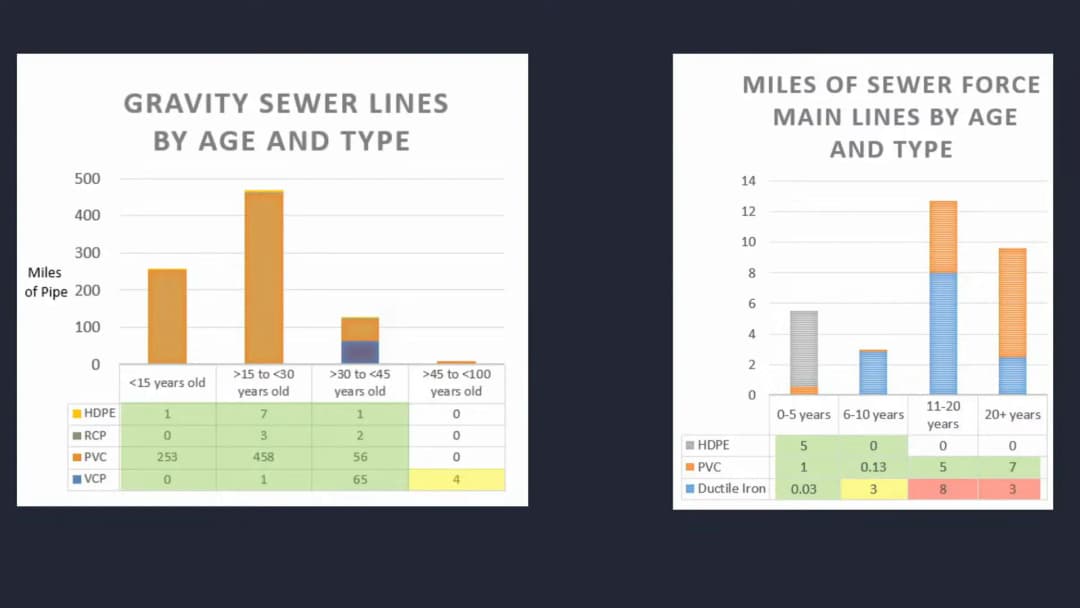
This study session of the Gilbert Town Council, held on December 16, 2025, at 23:28 UTC, covered two main agenda items: a presentation on pipe materials used in the sewer system and a presentation on water and solid waste recycling rate pressures. The council heard from staff and two public speakers, but deferred completion of the water rate discussion to the subsequent council meeting. Public Comments & Testimony - Jeremy (clay pipe industry representative): Presented arguments favoring vitrified clay pipe, citing its longevity (over 100 years), inert nature, and environmental concerns about PVC (including microplastics and toxic additives). He referenced cities like New York, Philadelphia, and Phoenix that use clay pipe exclusively, and claimed a 100-year warranty versus PVC’s typical 11-month warranty. - James Ashley (Home Builders Association of Central Arizona): Expressed support for staff’s assessment favoring PVC pipe. He noted PVC’s durability, cost-effectiveness, and ease of installation, and cited Maricopa Association of Governments (MAG) standards specifying PVC for gravity sewers. Discussion Items - Pipe Materials Presentation: Ken Snow (Public Works Assistant Director) reviewed three pipe materials: vitrified clay pipe (VCP), polyvinyl chloride (PVC), and ductile iron (DIP). Key points: - VCP is brittle, has shorter laying lengths, and more joints leading to root intrusion, but is corrosion resistant. It requires special inspections and more complex repairs. - PVC is lighter, easier to handle, has lower upfront installation costs, and smoother interior aiding flow. PVC has not yet completed a full life cycle but is projected to last 80–100 years. The town’s system is predominantly PVC. - Ductile iron is used in structural applications (e.g., under highways) but is prone to corrosion and most expensive. Staff prefers CIPP lining for new installations. - Staff noted that VCP would not have prevented recent ductile iron force main failures, as those were in pressure applications where clay cannot be used or under highways where DIP is required. - Council members asked about cost differentials, life cycle data, and the rationale for requiring engineering approval for VCP (town practice, under review). Councilmember Lyons questioned the contradiction between PVC’s “new material” disadvantage and claimed lower long-term maintenance. Councilmember Buckland expressed concern about continued use of ductile iron given past failures; staff clarified replacement will use HDPE or other materials. - Solid Waste Rate Pressures Presentation: Isaiah Scarcio Romero (Solid Waste and Recycling Manager) presented drivers for rate increases: - Vehicle replacement costs have risen 87% since 2020 (now $525,000 per truck). One-third of residential fleet (13 vehicles) is past its 7-year useful life, causing high repair/maintenance costs (up 301% since 2020). - Landfill tipping fees have increased 78% since 2020, from $3.8 million annual to $5.5 million. Average household generates 2,079 pounds of trash per year (13% more than regional average). - Recycling market volatility: average net cost per ton to recycle over five years is $18.08; landfill cost per ton is $30.97. Diversion rate is below average; glass recycling program (drop-off) saves money and earns rebates. - Proposed residential rate increase: 2% revenue increase (e.g., $0.55/month for standard 90-gallon service). Commercial: 20% revenue increase (e.g., $12.45/month for a standard container service). No further increases assumed through FY2030, contingent on stable conditions. - Councilmember Buckland questioned high trash generation; staff noted household size differences (Gilbert 3 vs. Mesa 2.5) partially explain the comparison. Councilmember Lyons asked about inflation and phasing; staff noted some inflation built in but landfill cost escalation may require future adjustment. Key Outcomes - No formal votes were taken; the study session was informational. - The council decided to postpone the water rate presentation to the council meeting scheduled to begin immediately after the study session. - Staff will provide cost differential data for pipe materials as requested by Mayor Anderson. - The town will proceed with a third-party water meter audit (Kimley Horn) with preliminary findings in March 2026, as part of transparency efforts. - A battery drop-off pilot program is anticipated by March 2026 to improve safe disposal of lithium-ion batteries.
The transcript for this meeting is garbled and does not contain coherent speech. No agenda or minutes were provided. As a result, no meaningful discussion, decisions, or public comments can be identified from the available recording. Consent Calendar - No items could be identified due to the unintelligible transcript. Public Comments & Testimony - No coherent public comments were discernible. Discussion Items - The transcript contains only fragmented, nonsensical phrases; no substantive discussion can be extracted. Key Outcomes - No votes or decisions can be confirmed from the provided material.