Browse by city
Date range
Search help

Search titles, summaries, topics and stored transcripts together. Keywords may match separately; put the whole query in double quotes for a phrase. Matching follows word analysis, so punctuation is not exact. Both dates are included. Documents are not searched.

SHOWING 1–10 ENTRIES
01
OCT 27, 2026 · HARRISONBURG, VIRGINIA · CITY COUNCIL & PLANNING COMMISSION
Harrisonburg City Council Meeting: October 27, 2026

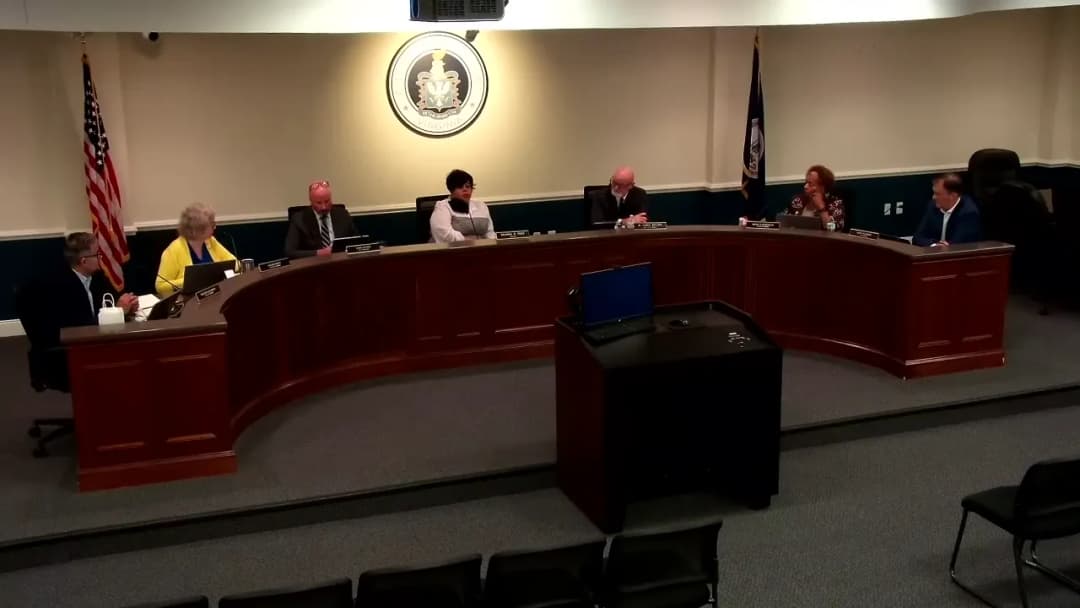
The Harrisonburg City Council met at 7:00 PM on Tuesday, October 27, 2026, in Council Chambers. No public hearings or special recognitions were held. Council approved the consent agenda, a letter opposing proposed decennial census changes, the 2027 Legislative Agenda, and an appointment to the Harrisonburg Electric Commission. Consent Calendar - Approved the minutes from the October 13, 2026 City Council meeting. - Approved special event applications for the Veterans Parade on Sunday, November 8, 2026; HDR's Winter Wonderfest and Harrisonburg's Holiday Parade on Saturday, December 5, 2026; and the Rocktown Turkey Trot on Thursday, November 26, 2026. - Approved a zoning text amendment to include qualifying manufactured homes in the definition of 'Dwelling, single-family'. - Approved Eastern Mennonite School's request to amend the master plan at 701 and 801 Parkwood Drive and 1251 Virginia Avenue. - Approved a Zoning Ordinance amendment to reduce the minimum lot width for single-family detached dwellings in the R-8 district. Public Comments & Testimony - A community member, speaking at the last council meeting before the election, warned about unplanned growth, comparing Iowa's rising cancer rates and Northern Virginia's data center buildout to challenges Harrisonburg could face; they urged residents to attend the candidate forum and vote. - Isaac Felix, 1115 Commercial Court, expressed support for a collective bargaining ordinance for school bus drivers. He cited low wages compared with other CDL jobs, driver retention challenges, the example of Charlottesville, and the importance of investing in bus drivers so they can safely transport students. - No callers phoned in during the public comment period. Discussion Items - Census comment letter (7A): City Manager Banks presented a letter opposing the U.S. Department of Commerce's proposal to alter demographic questions and residence criteria for the Decennial Census. Council members noted that the change could exclude foreign-born residents, who represent about 20% of Harrisonburg's population, and could jeopardize federal funding including approximately $5 million for school nutrition and $4-5 million for transportation. Council accepted the letter as written; it was authored by Amy Snyder. - 2027 Legislative Agenda (7B): Brian Vandenberg, Assistant to the City Manager, reviewed the final version, which retained the policy principles of protecting local authority and funding state mandates. Revisions included changing the public sector collective bargaining priority to add state funding for administration and arbitration costs and protect council approval over budget-impacting negotiations; adding state funding for local affordable housing and workforce housing initiatives; allowing urban redevelopment funds to support local small businesses; and adding new priorities for English learner education funding and data center accountability based on Governor Spanberger's Executive Order 22. Budget requests included child care facilities expansion grants, a water storage tank, the Virginia Homeless Solutions Program, and new stormwater funding for the Northeast neighborhood. Council and Staff Updates - Council members attended a Parks and Recreation event and the Zoning Ordinance Update Project (ZOOP) session at SIMS. - One council member reported plans to attend COP 31 in Turkey and to be absent from both November council meetings. - Council reported on the Healthy Community Collaborative's quarterly meeting and Deputy Chief Quisenberry's retirement event. - Council participated in a launching meeting for an AI workforce initiative with university presidents from JMU, EMU, Bridgewater, and Blue Ridge, along with workforce partners; Senator Warner may attend a follow-up session. - Council highlighted the Lights on After School event on October 22 and discussed the $17 billion Meta settlement, with Virginia receiving $353 million, advocating that some funds support after-school programs and youth services. Boards and Commissions - After reviewing applicants Craig Anders, Edward Yoder, and Aaron Ludwig, and noting the HEC board's need for accounting expertise, Council unanimously appointed Edward Yoder to the Harrisonburg Electric Commission. Key Outcomes - Consent agenda approved unanimously. - Census comment letter approved unanimously as written. - 2027 Legislative Agenda adopted unanimously. - Edward Yoder appointed to HEC unanimously. - The agenda included a closed session item for legal consultation, but the transcript reflects no closed session before adjournment; the meeting adjourned after the HEC appointment.
PUBLIC ENGAGEMENT 23% · LEGISLATIVE PROCESS 19% · PROCEDURAL 11% · PUBLIC TRANSPORTATION 11%
02
OCT 14, 2026 · HARRISONBURG, VIRGINIA · CITY COUNCIL & PLANNING COMMISSION
Harrisonburg Planning Commission Meeting - October 14, 2026

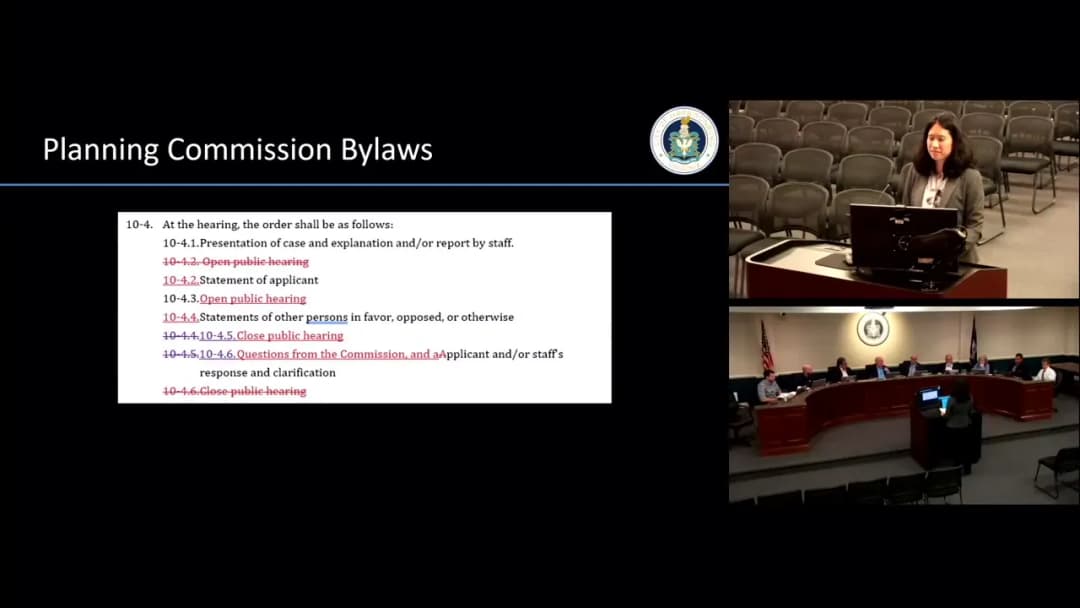
The Harrisonburg Planning Commission met on Wednesday, October 14, 2026, at 6:00 PM in City Hall Council Chambers. The commission unanimously approved two recommendations to City Council: a zoning ordinance amendment clarifying shopping center definitions and parking calculations, and a request for variations from street design standards for The Lindsey development. It also discussed amendments to its bylaws, heard public comments, and received reports from the county and city council. Consent Calendar - Minutes from the September 9 and September 15, 2026 meetings were approved unanimously. Public Comments & Testimony - Item 4.a (Shopping center amendment): Seth Roderick (Monte Verde Engineering) spoke in support of the change, describing it as a practical and timely improvement. - Item 5.a (The Lindsey variations): Laura Camarado, a Paul Street resident, opposed the request, citing existing traffic dangers and a history of personal property damage on Paul Street. - General public comment: No other members of the public provided comment. Discussion Items - Zoning Ordinance Amendment – Shopping Centers (4.a): Planner Nirmasafle presented the proposed change, which revises the definition of "shopping center" to specify permitted uses and adds a parking calculation: 1 space per 250 square feet for centers with 10,000 or more square feet of gross floor area. Commissioners discussed concurrent uses (e.g., houses of worship with different peak hours) and the origin of parking ratios; staff noted that the broader zoning rewrite would address deeper issues. The amendment codifies existing practice. Staff recommended approval. - Subdivision Variations – The Lindsey (5.a): Planner Meg Repkey detailed the requested modifications: a 24-foot-wide roadway (standard: 34 feet), 12.5-foot curb radii, and access management exceptions for parking garage entrances on South Main and South Liberty Streets, as well as reduced spacing from existing entrances. Tom Hartman (Public Works) explained that the narrower dimensions suit the downtown context and meet VDOT maintenance minimums. Seth Roderick (applicant) confirmed the design aligns with the proffered concept from the rezoning. Commissioners raised concerns about traffic on Paul Street, garage queuing, bike and pedestrian accommodation, and communication with the adjacent church. The request was recommended for approval as presented. - Bylaws Amendments (5.b): Staff outlined two proposed amendments: (1) allowing the director of community development to designate the commission secretary, and (2) granting the chair discretion over applicant rebuttal during public hearings. The commission discussed the language and practical implications but took no vote; formal consideration is planned for the November meeting. Reports - Rockingham County Planning Commission Liaison: A commissioner reported on the county's October 6 meeting, which featured a rezoning and two zoning ordinance amendments; all items passed 4-0. - City Council Update: A council member summarized recent council actions, including the approval of a battery energy storage system, a landfill solar feasibility study, a solid waste management ordinance, and a resolution on the 2030 census. Council also began discussions on the 2027 legislative agenda and requested planning commission input on cannabis facility zoning. Key Outcomes - Approved (unanimous): Minutes from September 9 and September 15, 2026. - Approved (unanimous, recommendation to City Council): Zoning ordinance amendment revising the definition of "shopping center" and setting a 1-space-per-250-sq.-ft. parking requirement for centers over 10,000 square feet. - Approved (unanimous, recommendation to City Council): Subdivision variations and exceptions for The Lindsey development, including a 24-foot pavement width, 12.5-foot curb radii, and reduced access management spacing. - Next steps: The two recommendations will be heard by City Council on November 10, 2026. The bylaws amendments are scheduled for a vote at the November 12, 2026 commission meeting. - Future meetings: The next regular commission meeting is Thursday, November 12, 2026 (adjusted from the usual second Wednesday due to Veterans Day). The November 17 work session is cancelled so commissioners can attend the Safe Streets Harrisonburg open house.

ENGINEERING AND INFRASTRUCTURE 15% · TRANSPORTATION SAFETY 15% · PUBLIC ENGAGEMENT 15% · ZONING 12%
03
OCT 13, 2026 · HARRISONBURG, VIRGINIA · CITY COUNCIL & PLANNING COMMISSION
Harrisonburg City Council Meeting - October 13, 2026

The Harrisonburg City Council met in regular session at 7:00 PM in the Council Chambers on October 13, 2026, with Mayor Reed presiding. The agenda included a proclamation, consent agenda, three public hearings, several regular items, public comments, and a closed session. The Council took unanimous votes on the consent agenda, zoning-related public hearings, the street renaming resolution, cannabis zoning referral, and NLC delegate appointments; presentations on Safe Streets and the legislative agenda were for discussion. Special Recognition - The Council recognized National Lights On Afterschool Day. The agenda states October 23, 2026, while the proclamation read aloud during the meeting said October 22, 2026. Students and representatives from the Boys and Girls Club, On the Row Collaborative, and Girl Scouts attended. The proclamation noted that over 28 million U.S. children have parents who work outside the home and 15.1 million children have no place to go after school. Consent Calendar - The Council approved the consent agenda by one roll-call motion, 5-0. It included the September 22 City Council meeting minutes (the agenda prints the year as '2206', an apparent typo), a supplemental appropriation for an Opioid Abatement Authority (OAA) grant, an ordinance granting a city real property lease, and an ordinance prohibiting city procurement or use of automatic license plate recognition systems. Public Comments & Testimony - A caller who identified only as a 'city resident' supported the manufactured-homes zoning amendment. He recalled local controversy around the 'Bluestone Town Center' development and said the General Assembly's state-level action helped resolve the issue, despite his broader concerns about local authority under Dillon's Rule. - A caller on the R-8 lot-width item supported the amendment, arguing that traditional setback requirements were tied to exclusionary zoning and redlining and that state action helped the city avoid getting 'stuck' in local deliberations. - A caller on the Eastern Mennonite School master plan asked Council to pause the request until the zoning rewrite and comprehensive plan update were complete, criticized current public engagement as 'checking the box', and argued for genuine public input and public-sector collective bargaining in planning decisions. - Michael Hullman, a Harrisonburg transit operator on Blue Ridge Drive, supported collective bargaining for city transit workers. He described low pay, coworkers working 50-60 hour weeks or second jobs, and turnover after drivers obtain their CDL. - Matthew Ray, lead steward for the Amalgamated Transit Union and a Charlottesville Area Transit operator, supported collective bargaining for Harrisonburg transit workers. He said collective bargaining in Charlottesville produced significant pay increases, improved retention, and was not adversarial. - Victor Suck, a paratransit driver, thanked Council for listening to city drivers, described the department's daily volume of roughly 200-250 calls and 250 rides with 10-12 drivers, and asked Council to retain experienced workers in the community. Public Hearings - 6.a Manufactured homes amendment: Staff explained that Code of Virginia changes effective July 1, 2026 require qualifying manufactured homes to be permitted wherever single-family detached dwellings are allowed. The proposed definitional amendment requires conversion of the manufactured home to real property under Va. Code §46.2-653.1, a certificate of occupancy within five years of manufacture, and placement on an individual lot. Planning Commission recommended approval unanimously (5-0, two commissioners absent). Council discussion noted the home must be on a permanent foundation with axles and wheels removed. Council approved the amendment unanimously. - 6.b R-8 lot width reduction: House Bill 1212 from the 2026 General Assembly requires localities with populations of 50,000 or more to maintain at least one zoning district allowing single-family dwellings on lots with minimum lot area no greater than 3,000 square feet and lot width no greater than 30 feet. Staff said R-8 already allowed 2,800-square-foot lots, and the amendment reduced the R-8 single-family detached lot width from 35 to 30 feet. Planning Commission recommended approval unanimously (5-0, two commissioners absent). Council approved the amendment unanimously. - 6.c Eastern Mennonite School master plan amendment: The school sought a master plan amendment for the roughly 26-acre campus at 701/801 Parkwood Drive and 1251 Virginia Avenue, zoned R3 and B2 with an I-1 institutional overlay. The plan maintains a 10-foot perimeter setback and requests deviations from parking-lot landscaping requirements, a five-foot separation between non-residential parking and residential properties, and the 50% front-yard parking limit. Planning Commission approved a 200-space parking minimum and a 435-space cap, and recommended approval. Council approved the master plan amendment unanimously. Regular Items - 7.a Street dedication and renaming: The Council adopted a resolution naming the new University Boulevard segment from Oak Hill to the former University Boulevard as University Boulevard, renaming Forest Hill Road (between Oak Hill and Port Road) to University Boulevard effective January 1, 2027, and renaming the old University Boulevard segment and Convocation Service Drive to Driver Drive. Staff said five residential properties will receive new addresses, and JMU and utility partners were already notified. Additional road-name cleanup, including Hickory Hill and the remaining old University Boulevard, is planned for early next year. - 7.b Safe Streets Harrisonburg planning efforts: Staff presented four grant-funded planning efforts under the federal Safe Streets and Roads for All grant: a roadway safety action plan, a complete streets design guide, an update to the bicycle and pedestrian plan, and a safe routes to school plan, with consultant support from Kimley-Horn. Staff cited an average of about 3 fatalities and 33 serious injuries per year on city streets over the last five to six years, and proposed goals of zero fatalities by 2040 and a 50% reduction in serious injuries by 2040; no vote was requested. Public engagement begins in November, with plan adoption targeted around September 2027. Council noted overlap with the neighborhood traffic calming program and uncertainty about future federal transportation funding. - 7.c Draft 2027 Legislative Agenda: Staff presented draft policy principles, legislative priorities, and budget requests. Proposed principles included protecting local authority and requiring state mandates to be funded. Priorities included keeping local authority over public-sector collective bargaining and housing location/density, full funding for redevelopment and children's services, road maintenance payment formula flexibility, fire services funding, and state funding for ASAP DUI programs. Budget requests included a childcare facility expansion grant program that added about 200 slots locally at about $3,000 per slot, a 5-million-gallon water storage tank linked to Harrisonburg's status as the second fastest-growing locality in Virginia, and Virginia Homeless Solutions program funding. Staff requested Council feedback by the October 27 meeting so the agenda could be finalized before state delegation visits. - 7.d Cannabis zoning resolution: The Council adopted a resolution referring to the Planning Commission draft zoning amendments for businesses licensed by the Virginia Cannabis Control Authority. City Attorney Brown stated the city cannot prohibit such businesses but can regulate location, uses, special-use permits, distances from schools and other institutions, and clustering. Key dates are February 1, 2027 (license applications), May 1, 2027 (license issuance), and July 1, 2027 (operations). Council discussed communicating the state rules publicly and following up on the state's education campaign. - 7.e 2030 Census proposal: Council discussed proposed federal changes to residence criteria and demographic questions for the 2030 Census, including adding a citizenship/legal-status question, narrowing 'usual residence' to a January 3-April 1 window, relying more on administrative records, and making most demographic questions optional. Councilmembers said these changes could undercount Harrisonburg's immigrant, student, renter, and young child populations and affect federal funding; members noted the 2020 Census already undercounted Harrisonburg, and one member described the plan as an effort to strip people from the count. Staff was directed to prepare a draft comment letter for the next Council meeting. The comment deadline was cited as November 2, with one later reference to November 3. - 7.f NLC delegate appointment: The Council appointed Councilmember Robinson as voting delegate and Councilmember Al Sadude as alternate for the NLC Annual Business Meeting at the NLC City Summit in Nashville, Tennessee, on Friday, November 20, 2026, from 2:30 to 4:30 p.m. The agenda lists Nashville as the site; one oral reference in the transcript used 'Ashville'. The appointment was approved by voice vote. Other Council & Staff Matters - Councilmembers reported on recent conferences and events, including New York Climate Week, ICLEI meetings, the Virginia Clean Energy Summit, the Virginia Municipal League conference, and Virginia First Cities legislative meetings. The City Manager noted upcoming travel to the ICMA conference and that EMU inaugurated its new president. Key Outcomes - Consent agenda approved unanimously, 5-0. - Manufactured-home zoning amendment approved unanimously. - R-8 lot width reduction approved unanimously. - Eastern Mennonite School master plan amendment approved unanimously. - University Boulevard/Forest Hill Road/Driver Drive resolution approved unanimously. - Cannabis zoning referral to Planning Commission approved unanimously. - Draft legislative agenda placed on an October 27 feedback/finalization track; no vote. - Safe Streets plans presented for information; no vote. - Council directed staff to prepare a 2030 Census comment letter. - NLC delegate and alternate appointed by voice vote. - Motion to enter closed session approved unanimously. Closed Session - The Council entered closed session under Virginia Code §2.2-3711(A)(3) for real estate acquisition discussion and §2.2-3711(A)(8) for consultation with legal counsel. The provided transcript ends as the closed session begins; no post-session report or adjournment is available in the source.

TRANSPORTATION SAFETY 15% · PUBLIC ENGAGEMENT 12% · ZONING 10% · PROCEDURAL 9%
04
SEP 22, 2026 · HARRISONBURG, VIRGINIA · CITY COUNCIL & PLANNING COMMISSION
Harrisonburg Planning Commission Zoning Ordinance Update Work Session - September 22, 2026

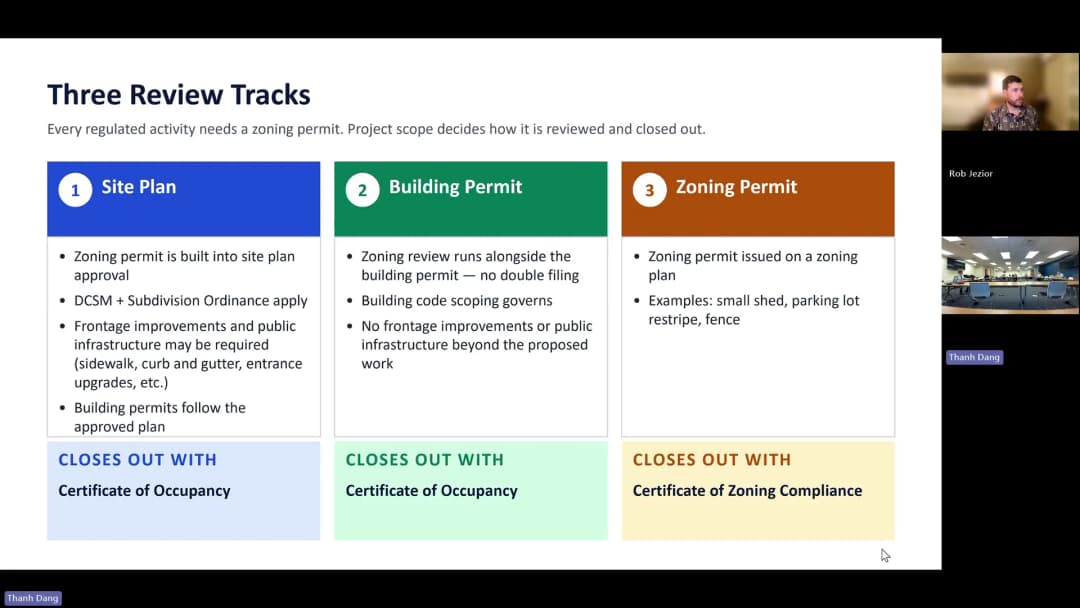
The Harrisonburg Planning Commission held a work session on the Zoning Ordinance Update Project at City Hall, Room 011, convened at 6:00 p.m. and adjourned at 8:12 p.m. Six commissioners were present (Richard Baugh, Shannon Porter, Laura Dent, KC Kettler, Randy Seitz, and Rob Jezior, who participated remotely from Scranton, Pennsylvania); Heja Alsindi was absent. No public comment was taken. The agenda and minutes contain conflicting dates (September 15 and September 25, 2026), but this summary uses the provided meeting date of September 22, 2026. Discussion focused on proposed zoning district names and draft Articles D and H of the revised zoning ordinance. Consent Calendar - The agenda did not include a consent calendar; the Commission's unanimous approval of Commissioner Jezior's remote participation was a routine procedural action taken at the start of the meeting, upon motion by Vice-Chair Porter and second by Councilmember Dent. Public Comments & Testimony - No oral public comment was received; the agenda stated that no public comment would be accepted at the work session. - Written feedback from the Harrisonburg-Rockingham Association of Realtors (HRAR), included in the agenda packet, emphasized that district names communicate the general character and development pattern of an area to residents, prospective buyers, and property owners. Discussion Items Zoning District Names - Staff said the recommended district names had not changed since the prior meeting. - HRAR feedback, obtained through outreach by Commissioner Seitz, emphasized the importance of names that clearly describe neighborhood fabric and development patterns. - Commissioners discussed the three residential districts: Suburban Neighborhood, Flexible Neighborhood, and Urban Neighborhood, and agreed to change Flexible Neighborhood to General Neighborhood. - Staff and commissioners agreed to change Garden Community to Apartment Community because apartment is more understandable than terms such as multifamily or garden-style. - The phrase higher density will be removed from the Attached Community district intent statement to avoid confusion when read outside the sequence of district descriptions; intent statements will be reviewed for clarity. - Single-family attached is effectively a duplex where the two units are separated by a lot line; a duplex without separate lots is a duplex, and a building with more than two attached units on individual lots is a townhouse. One commissioner expressed concern about introducing single-family attached as new terminology when duplex is widely understood. - Staff said the district originally contemplated for garden-style apartment complexes such as Sunchase and Arcadia is now proposed as Apartment Community. Staff are still considering where more traditional urban-form multifamily buildings, including larger buildings with internal corridors and elevators, should be accommodated, possibly in Mixed-Use Urban Village or Auto-Urban Commercial through a special exception. - One commissioner stated that garden-style apartments and attached residential forms should not automatically be characterized as high density because their form and intensity differ from larger urban apartment buildings. - Staff explained that Mixed-Use Urban Village is being considered for mixed-use areas outside downtown, as distinct from Mixed-Use Downtown. Draft Article H - Development Review Procedures - Staff described three proposed review tracks: site plan review for development requiring engineering review and addressing infrastructure, public improvements, and zoning; building permit review when a site plan is not required; and zoning permit review for standalone zoning compliance when neither a site plan nor building permit is required. - A commissioner raised concerns about added time, cost, and burden of a zoning permit for minor resident improvements such as a utility shed or low fence. Staff responded that existing surveys or plats could usually be used, and floodplain compliance is an important reason for review because FEMA requires permits for floodplain improvements. A building permit is not required for a shed under 256 square feet, but zoning compliance would still be checked under the proposed zoning permit. - Commissioners acknowledged that proactive review before construction may reduce neighbor disputes and costly post-construction corrections, even though it adds process. - Site plan review would be presumed unless an activity is exempt. Proposed exemptions include construction of a single-family detached dwelling or duplex on an existing lot, additions to a single-family dwelling or duplex, and interior renovations that do not increase floor area. Subdivision requirements, such as sidewalk connections, would still apply when an existing lot is subdivided. - Staff proposed changes to plats, surveys, foundation-location surveys, and certificates of occupancy. Harrisonburg currently requires certified location information less frequently than many jurisdictions; hand-drawn sketches would still be accepted for residential additions and accessory structures when sufficient certified survey or plat information exists, but a survey may become part of permitting when none exists. - Staff reviewed the proposed proffer-revision process. The Planning Commission would make its recommendation based on proffers submitted at its public hearing; an applicant could submit amended proffers until publication of the City Council public hearing notice; afterward, City Council could consider further amendments until the hearing closes and decide whether a material change warrants an additional public hearing. - Staff stated that the draft zoning map does not broadly upzone properties solely to increase development potential; retaining a rezoning process preserves the City's ability to seek mitigation through proffers. The Future Land Use Guide is long-range, and staff cautioned that immediately rezoning everything designated for higher density could outpace water, sewer, and transportation capacity. Commissioners discussed the need to balance housing development with infrastructure, community character, and a predictable review process. - On nonconforming properties, staff cited West Washington Street as an example where existing single-family and duplex residences sit in the M-1 General Industrial District; the draft map recommends a residential district to make those uses conforming. Staff said a comprehensive nonconformity overlay would require point-in-time determinations for every property, while a structure's nonconforming setback is generally stable and a nonconforming use may be lost after discontinuance. - Staff proposed allowing amendments to approved proffers without new public hearings in limited circumstances. The current amendment process can take 90 to 120 days and often leads applicants to submit less detailed proffers. Under state law, City Council could waive public hearings for proffer amendments that do not change approved use or density, with notice and advertisement still required and Council retaining discretion to deny waivers. Commissioners discussed public-perception concerns and examples from Rockingham County, such as Preston Lake. - Staff reviewed corner-lot provisions intended to preserve a usable building area on narrow corner lots by limiting how much a side-street setback consumes buildable width; a property owner may seek a variance from the Board of Zoning Appeals if a hardship remains. - Staff reviewed setback-reduction provisions allowing use of the average setback of the two nearest structures or the average along a block, helping additions and porches align with the streetscape. One commissioner suggested evaluating whether a median might be more appropriate than an average. - A commissioner raised Section 10-3-63.B, which limits architectural projections into a required setback to 2 feet, 8 inches, and suggested increasing it to 3 feet or 3 feet, 4 inches to give residents flexibility for roof or canopy covers over front stoops. Staff noted the draft districts reduce many front setbacks from 30 feet to 20 feet, which may help, and will evaluate the proposed increase and consult Building Inspections on fire-spread and building-code issues. - A commissioner asked whether more decisions could be handled administratively. Staff agreed some matters may be appropriate for administrative review, citing townhome development standards as an example, and noted that a parallel update to the Design and Construction Standards Manual (DCSM), including bicycle and pedestrian planning, Safe Routes to School, and Complete Streets work, will inform future standards. Key Outcomes - Unanimously approved remote participation for Commissioner Jezior. - Staff will implement district-name changes: Flexible Neighborhood to General Neighborhood, Garden Community to Apartment Community, removal of higher density from the Attached Community intent statement, and review of intent statements. - Staff will evaluate increasing the 2-foot, 8-inch architectural projection allowance to 3 feet or 3 feet, 4 inches and will consult Building Inspections staff. - Staff will evaluate the potential use of a median rather than an average for setback reductions. - No work session will be held in October; at least two public open houses are planned for late October, followed by a public comment period, after which the Commission will reconvene for another work session. - Staff will prepare presentations for the Planning Commission in 2027 using a list of city departments and related organizations submitted by a commissioner. - The meeting adjourned at 8:12 p.m.

ZONING AND LAND USE 60% · PLANNING AND ZONING 11% · BUILDING CODE 6% · COMMUNITY DEVELOPMENT 6%
05
SEP 22, 2026 · HARRISONBURG, VIRGINIA · CITY COUNCIL & PLANNING COMMISSION
Harrisonburg City Council Meeting Summary - September 22, 2026

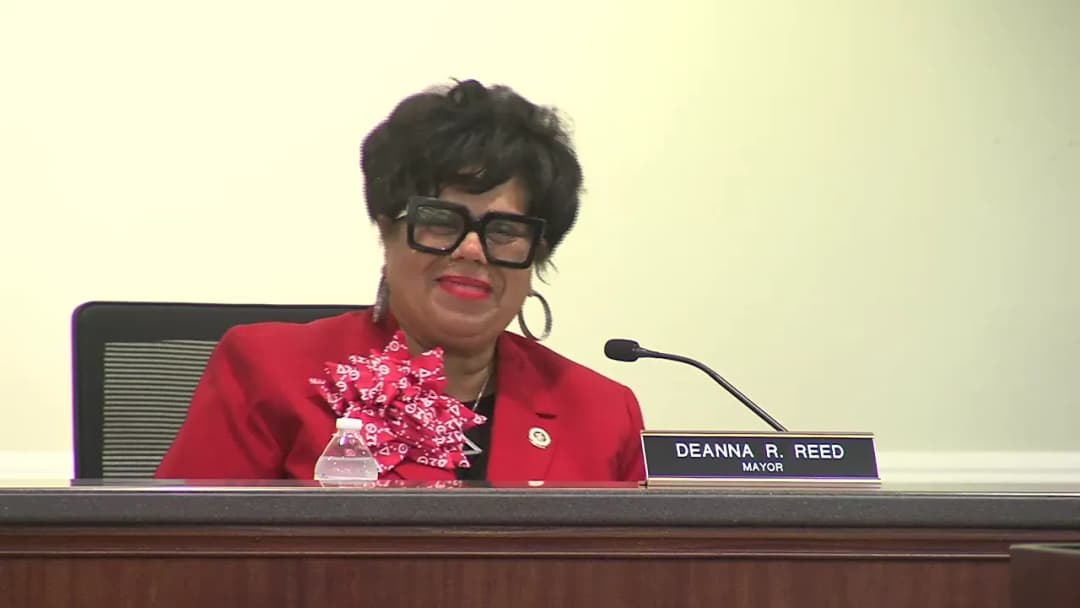
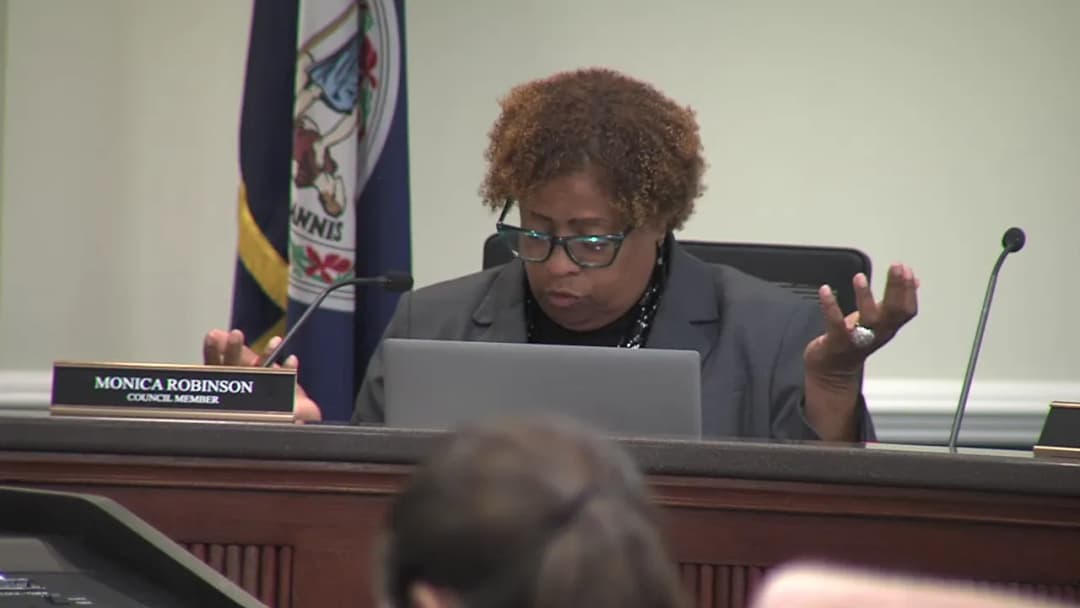
The Harrisonburg City Council met on Tuesday, September 22, 2026, at 7:00 PM in Council Chambers. Mayor Deanna R. Reed presided, with Vice Mayor Dany Fleming and Council Members Laura Dent, Nasser Alsaadun, and Monica Robinson present. Council Member Dent participated virtually from New York City after the Council approved her electronic attendance. City Manager Ande Banks, City Attorney Chris Brown, City Clerk Pam Ulmer, and police and fire chiefs were also present. The meeting adjourned at 8:38 PM. Special Recognition - Mayor Reed read a proclamation honoring the life of former Mayor and Council Member Rodney Eagle and presented it to his family. The proclamation highlighted his city council service, community involvement, support for public safety, and role in bringing Heritage Oaks golf course to Harrisonburg. Consent Calendar - Approved the minutes of the September 8, 2026 City Council meeting. - Approved on second reading the rezoning request by Trenton Inc. and Bernard LC for properties at 435-495 South Main Street and 282-298 South Liberty Street (The Lindsey Apartments). - Approved on second reading a Zoning Ordinance amendment creating a new term and definition for 'poultry hatchery.' - Approved on second reading a supplemental appropriation of $22.1 million for carryover of prior-year encumbrances, unexpended grants, and new grant awards. - All consent agenda items passed by a 5-0 roll call vote. Public Hearing: Lease of City Real Property - The Council held a public hearing on an ordinance granting a lease of City-owned property at 2230 Ramblewood Road to the Virginia Municipal Energy Association (VMEA) for construction of a battery energy storage system. City Attorney Chris Brown explained that HEC and VMEA negotiated with LightShift Energy for a 20-year lease, with cross-default provisions; the fire chief reviewed the design and had no issues. - Following public comment and discussion of cost savings, clean energy benefits, and peak-shaving, the Council adopted the ordinance by a 5-0 roll call vote. Public Comments & Testimony - During the Ramblewood Road lease hearing, Panayotis 'Poti' Giannakouros said he attended the HEC meeting about the storage facility and raised concerns about HEC destroying a friend's pollinator habitat. He asked the City to add positive ecosystem maintenance to the lease's environmental provisions, noting that 80% of qualitative responses in the Downtown landscape survey affirmed native plants. - During the regular public comment period, Giannakouros criticized enforcement of the tall grass and weeds ordinance and what he described as retaliation by City staff over a meadow. He proposed a 'no HON' pledge for Council candidates and elected officials to avoid over-regulating private property, arguing that most property actions should not require permitting unless there is a compelling health or safety purpose. Discussion Items - Battery Energy Storage System Agreements: The Council approved a resolution allowing HEC to enter into a BESS interconnection agreement with LightShift Energy and a member agreement with VMEA. HEC Manager Brian O'Dell said the project has no net costs to members and that energy cost savings will be allocated among the seven participating localities. - Utility Bill Write-Offs: The Council approved writing off 312 utility bills and 9 accounts receivable bills from July 1, 2023 through June 30, 2024, totaling $37,247.62, equal to 0.15% of total billings for that period. City staff will continue collection efforts. - Downtown Master Planting Plan: Sustainability and Environmental Manager Keith Thomas presented the plan, timeline, survey results, and revisions. The online survey received 134 responses; respondents rated investing in downtown landscaping 4.7 out of 5 in importance, and 4.07 out of 5 for improving appearance and welcoming feel. The most requested features were native plants and pollinators, street trees and shade, inviting parks, and parking-lot vegetation. 62% of respondents supported strong investment in installation and long-term maintenance, and 62% supported adding dedicated staff. Revisions removed invasive species and increased native pollinator plants. The Council approved the plan 5-0. - Roadless Area Conservation Rule: Council Member Dent introduced a discussion on the U.S. Forest Service's proposal to rescind the 2001 Roadless Area Conservation Rule, with a comment deadline of October 6, 2026. Lynn Cameron of Friends of Shenandoah Mountain and Pete Bsumek of the Virginia Sierra Club - Shenandoah Chapter requested that Harrisonburg submit a formal comment supporting the rule. The rule was reported as adopted in 2001; the approved minutes contain a typographical reference to 2021. They noted the rule protects 58.5 million acres nationally, about 394,000 acres in Virginia, and that seven roadless areas are within an hour of Harrisonburg. They highlighted drinking water protection, recreation, and a 2018 JMU study estimating $13.7 million per year in ecosystem services from the Dry River watershed. Council directed staff to draft a support letter to the Forest Service before the October 6 deadline. - Passenger Rail Expansion: The Council adopted a resolution endorsing passenger rail service expansion to the Shenandoah Valley and asking the Virginia Department of Rail and Public Transportation to include the City in future planning and evaluation. The vote was 5-0. - Prohibition on ALPR Systems: The Council adopted an ordinance prohibiting the City from procuring, installing, maintaining, or using stationary Automatic License Plate Recognition (ALPR) cameras. The ordinance includes exceptions for vehicle-mounted cameras, the emergency communications center, and information received from another entity's camera not under a prohibited arrangement. The vote was 5-0. - Tow Company Policies and Fees: The Council approved the amended Harrisonburg Police Department policies and equipment requirements for tow companies and the amended fee schedule, with staff-recommended changes. Attorney Brown advised removing the proposed cap of eight towing companies on the list because a cap would require an ordinance amendment, and removing a proposed $100 non-refundable deposit for retrieving personal property because state law requires access without such a fee. The approved motion passed 5-0. Supplementals and Reallocations - Opioid Abatement Authority Grant: The Council approved a supplemental appropriation of $200,000 from the Opioid Abatement Authority grant, with the City serving as fiscal agent in partnership with Rockingham County, to subgrant to Strength in Peers for peer recovery center operations. Vote was 5-0. - ARPA Fund Reallocation: The Council approved reallocating roughly $37,350 in remaining ARPA funds from the completed Northeast Neighborhood Sidewalk and Trails Project to the Northeast Neighborhood Paving Project, an open active project meeting federal deadlines. Vote was 5-0. Boards and Commissions - The Council appointed Brian Vandenberg as alternate City representative to the Community Policy and Management Team (CPMT), replacing City Manager Ande Banks as alternate; Amy Snider remains primary representative. The appointment was approved by unanimous voice vote. Key Outcomes - Adopted the Ramblewood Road lease ordinance, BESS agreements resolution, ALPR prohibition ordinance, passenger rail resolution, and Downtown Master Planting Plan. - Approved consent agenda items, utility write-offs, tow policy and fee amendments, OAA supplemental appropriation, and ARPA reallocation, all by 5-0 roll call votes. - Directed staff to draft a letter supporting the Roadless Area Conservation Rule to the U.S. Forest Service by October 6, 2026. - Appointed Brian Vandenberg as CPMT alternate City representative. - Public comments were received from one resident on the lease and one resident during the public comment period.

PROCEDURAL 17% · ENERGY POLICY 14% · ENVIRONMENTAL PROTECTION 11% · WATER AND WASTEWATER MANAGEMENT 10%
06
SEP 9, 2026 · HARRISONBURG, VIRGINIA · CITY COUNCIL & PLANNING COMMISSION
Harrisonburg Planning Commission Meeting Summary – September 9, 2026

The Harrisonburg Planning Commission met at 6:00 p.m. on Wednesday, September 9, 2026, in City Council Chambers, 409 South Main Street. Five members were present: Chair Richard Baugh, Vice Chair Shannon Porter, Commissioners KC Kettler and Rob Jezior, and City Council Representative Laura Dent. Heja Alsindi and Randy Seitz were absent. The commission approved minutes, held four public hearings, initiated a zoning amendment, appointed a deputy secretary, discussed bylaw changes, heard public comment, and received staff and committee reports. All four public hearing items were recommended to City Council on October 13, 2026, each by 5-0 votes. Consent Calendar - Approved the August 12, 2026 Planning Commission minutes by a 5-0 vote. - Approved the August 18, 2026 Planning Commission minutes as amended to correct two heading dates from July 21 to August 18, by a 5-0 vote. The final written minutes contain a typo in item 3.b referring to the August 12 minutes, but the transcript confirms the August 18 minutes were approved. Eastern Mennonite School – Off-Street Parking and Master Plan Amendment - Staff reviewed two requests for the approximately 26.3-acre Eastern Mennonite School (EMS) campus at 701 and 801 Parkwood Drive and 1251 Virginia Avenue, zoned R-3/I-1 and B-2/I-1. - EMS requested Planning Commission approval of 200 minimum off-street parking spaces for school use, calculated using the Virginia Department of Education's Guidelines for School Facilities in Virginia's Public Schools (2021), including staff, visitors at a 10% rate, and student parking equal to one-third of enrollment. - The 2026 master plan amendment would supersede the 2002 I-1 master plan and the 2016 amendment, maintain a 10-foot exterior campus setback, and allow up to 435 total campus parking spaces. The additional 235 spaces above the school requirement would serve church services, athletic events, and special events. - The applicant requested flexibility from parking lot landscaping and separation standards, including allowing landscaping within 15 feet of parking lots and reducing the five-foot separation between nonresidential parking and adjoining residential property. - Applicant representatives Gil Colman of Colman Engineering and Paul Leaman, EMS Head of School, said the requested flexibility is mainly needed for one area adjacent to Eastern Mennonite University, that no residential use currently surrounds EMS, and that parking is frequently shared with EMU and VMRC. - The master plan also identifies access easements affecting Virginia Mennonite Missions/Anabaptist Mission Partners and a potential future connection to Mount Clinton Pike whose final design remains subject to City approval. - No public comments were made during the public hearing. A motion by Vice Chair Porter, seconded by Commissioner Jezior, to approve both the parking requirement and the master plan amendment passed 5-0. Manufactured Homes in Single-Family Dwelling Definition - Planner Nyrma Soffel presented a Zoning Ordinance amendment to comply with Virginia SB346/HB655, effective July 1, 2026, which requires localities to allow qualifying manufactured homes in all zoning districts where site-built housing is permitted. - The amendment would add manufactured homes to the definition of Dwelling, single-family if the home is converted to real property under Va. Code §46.2-653.1, receives its certificate of occupancy within five years of the date of manufacture, and is placed on an individual lot. - Commissioners discussed the state mandate, improved manufactured housing quality, and the potential to lower housing costs. No public comments were made. A motion by Commissioner Kettler, seconded by Councilmember Dent, passed 5-0. R-8 Minimum Lot Width Reduction - Ms. Soffel presented an amendment to reduce the minimum lot width for single-family detached dwellings in the R-8 district from 35 feet to 30 feet, based on Virginia HB1212 and new Code of Virginia Section 15.2-2286.2. - The new state law requires localities with populations of 50,000 or more to maintain at least one zoning district permitting single-family dwellings on lots no larger than 3,000 square feet and no wider than 30 feet. R-8 already permits 2,800-square-foot lots but currently requires 35 feet of lot width. - Staff and Deputy City Attorney Wesley Russ noted that 50- to 60-foot lot widths are standard in most by-right urban districts, that few R-8 lots currently exist, and that properties become R-8 through spot rezoning rather than by city initiative. - Commissioners discussed driveway feasibility, infill potential, and the proposed Urban Neighborhood District in the upcoming zoning rewrite. No public comments were made. A motion by Commissioner Kettler, seconded by Vice Chair Porter, passed 5-0. Refuse Collection Facilities Zoning Amendment – Initiation - Deputy Director Thanh Dang requested initiation of amendments to Zoning Ordinance Section 10-3-110(h) to expand screening and location requirements for private refuse collection facilities to include public refuse collection facilities not associated with single-family detached and duplex dwellings. - The change complements a proposed Title 6 solid waste amendment that would allow City toter service for multifamily developments of 6 to 11 units. - Discussion clarified that residents would pull toters to the public street because City sanitation crews do not enter private property. Vice Chair Porter, who noted her day job is with Habitat for Humanity, expressed strong support for the added flexibility. - A motion by Commissioner Kettler, seconded by Commissioner Jezior, to initiate the zoning amendment passed 5-0. Deputy Secretary Appointment and Bylaws Discussion - The commission appointed Nyrma Soffel as Deputy Secretary by voice vote during the current secretary's absence, with no opposition. - Staff previewed a future bylaw amendment to Section 4.4-1 that would allow the Director of Community Development to designate a City employee as secretary. Draft amendments will be presented at the October 14, 2026 meeting, with possible adoption at the November 12, 2026 meeting under the 28-day notice requirement. Public Comments & Testimony - Ron March, owner of Sit Means Sit dog training franchise, requested that professional dog training without boarding be separated from kennel use in the Zoning Ordinance. He said he does not operate a kennel or daycare, does not house dogs overnight, has struggled since December to find a suitable M-1 space, and considers B-2 more appropriate for his low-impact business. - He asked to work with the zoning team to create a draft amendment. Staff said the Zoning Ordinance update team is already reviewing animal-related uses and would continue exploring the issue, with a goal of bringing a proposal forward in the shorter term rather than waiting for the full rewrite. - Commissioners expressed general support, noting that B-2 already permits veterinarians, groomers, retail pet training, and puppy sales, and that the current use list may be overly restrictive. Reports and Other Matters - Commissioner Kettler reported on the September 1, 2026 Rockingham County Planning Commission meeting, including a Cobblers Valley master plan amendment of approximately 11 acres, a 1.738-acre rezoning from R-2 to PSF, a 19.518-acre rezoning from R-3 to A-2C, and a biomass conversion facility ordinance amendment; all were recommended for approval. - Councilmember Dent reported on City Council actions, including approval of The Lindsey Apartments rezone, special use permits at 387 Monticello Avenue and 291 West Wolfe Street/336 West Market Street, the Northeast Neighborhood Small Area Plan, and a poultry hatchery definition. City Council denied a sidewalk-related variance at 704 North Liberty Street by 4-1 despite a 4-2 Planning Commission recommendation to approve it. - Vice Chair Porter asked staff to explore possible ordinance tiering for sidewalk infrastructure requirements on small subdivisions, citing the Liberty Street variance. Staff agreed to research the issue and return with a recommendation. - Councilmember Dent and Commissioner Kettler discussed passenger rail advocacy, noting 680 comments in favor had been submitted to DRPT by the September 30 deadline and that City Council directed the City Attorney to prepare a letter or resolution in support. - Commissioner Kettler requested a future update on the housing fund; staff agreed to coordinate with the Housing Coordinator. - Staff previewed the October 14, 2026 agenda: Subdivision Ordinance Variations and Exceptions – The Lindsey, and a Zoning Ordinance Amendment on Shopping Center Parking. Key Outcomes - Recommended approval to City Council for EMS approval of 200 minimum off-street parking spaces and the 2026 master plan amendment: 5-0. - Recommended approval to City Council for the manufactured homes definition amendment: 5-0. - Recommended approval to City Council for the R-8 lot width reduction to 30 feet: 5-0. - Initiated the Zoning Ordinance amendment on refuse collection facilities: 5-0. - Appointed Nyrma Soffel as Deputy Secretary by voice vote with no opposition. - Directed staff to continue exploring dog-training zoning and sidewalk-infrastructure ordinance issues; no formal motions were made on those topics. - The City Council-bound recommendations are due back on October 13, 2026. The meeting adjourned at 7:47 p.m.

PARKING POLICY 19% · ZONING 18% · PLANNING AND ZONING 11% · ZONING AND LAND USE 11%
07
SEP 8, 2026 · HARRISONBURG, VIRGINIA · CITY COUNCIL & PLANNING COMMISSION
Harrisonburg City Council Meeting – September 8, 2026: Special Use Permits, Rail, and ALPR Ordinance

The City Council met on Tuesday, September 8, 2026, at 7:00 PM in Council Chambers. The meeting included six public hearings, several regular agenda items, and discussions on passenger rail, utility merger participation, and an automatic license plate reader (ALPR) ordinance. All votes were unanimous unless noted. Consent Calendar - Minutes from the August 25, 2026 City Council meeting were approved by a 5–0 roll call vote. Public Hearings - 6a: PY2025 CDBG CAPER – Kristin McCombe, CDBG program manager, presented the Consolidated Annual Performance and Evaluation Report. No public comments were received. The public hearing was closed with no action required. - 6b: Special Use Permit for Short-Term Rental at 387 Monticello Avenue – Adam Fletcher, director of Community Development, presented the request for a short-term rental in an accessory building. Staff and Planning Commission (6–0) recommended approval. No public comments. Council approved the permit with conditions by a 5–0 vote. Discussion addressed future accessory dwelling unit (ADU) state code changes. - 6c: Special Use Permit for Recreational/Leisure Use at 291 W. Wolfe Street and 336 W. Market Street – The applicant, VG Harrisonburg Storage LLC, proposed indoor recreation (rock climbing, pickleball, and other activities) in a former industrial building. Staff and Planning Commission (6–0) recommended approval with amended conditions. Public speakers: - Mary Boitnott (55 N. Brook Ave.) expressed concerns about parking, traffic, and outdated street signage. - Benjamin Ho (applicant representative) stated they anticipate one tenant with one specific activity. - Amanda Presgraves (260 W. Wolfe St.) spoke in favor, noting excitement for neighborhood activation and requested traffic calming. - Neil Detwiler and Kristin Grimshaw (potential climbing gym operators) described plans for a climbing wall and futsal courts, emphasizing family-friendly recreation. Council approved the permit with staff’s recommended conditions (including a traffic impact analysis trigger for uses generating over 100 vehicle trips in peak hours) by a 5–0 vote. - 6d: Comprehensive Plan Amendment – Northeast Neighborhood Small Area Plan – Nirma Soffle, planner, presented the plan (the city’s first small area plan) developed through the Community Connectors Program grant to address harms from 1950s/60s urban renewal. Staff and Planning Commission (6–0) recommended approval. Public comment: - Panayotis “Poti” Giannakouros expressed caution about Strategy 8.5, arguing that code enforcement can be a technique for displacing residents. Council approved the amendment by a 5–0 vote. - 6e: Zoning Ordinance Amendment – “Poultry Hatchery” Definition – Adam Fletcher presented an amendment to add a definition for poultry hatcheries as a permitted-by-right use in M-1 zoning, clarifying long-standing interpretation. Three existing hatcheries (George’s and Cargill) are in M-1. No public comments. Council approved by a 5–0 vote. - 6f: Supplemental Appropriation – $22.1 Million – Larry Propst, finance director, presented the annual supplemental request: $12 million for encumbrances, $8.8 million for unexpended grants, and $1.2 million new grant from Virginia Housing Development Authority for a housing workforce investment program. No public comments. Council approved by a 5–0 vote. Regular Items - 7a: Variance from Subdivision Ordinance at 704 N. Liberty Street – Adam Fletcher presented a request to waive sidewalk construction along North Liberty Street. Staff recommended denial; Planning Commission voted 4–2 to recommend approval. Council discussed the ordinance’s requirements and the implications of granting variances for market-rate housing. A motion to deny the variance carried 4–1 (Council Member Dent dissenting). - 7b: Personal Property Tax Relief Resolution for Tax Year 2026 – City Attorney Chris Brown presented the resolution setting the tax relief percentage at 18.2%, based on $1,522,583 from the Commonwealth. Council adopted the resolution unanimously (5–0). - 7c: Mosaic Design for Sprayground Pumphouse at Ralph Sampson Park – Amy Snider, deputy city manager, and donor Steve Carpenter presented the proposed mosaic design by Scott Supraner, funded by $100,000 in private donations. The design depicts a historic diver from Harris Pool, reflecting community input after four iterations. Council approved the design unanimously (5–0). - 7d: Tow Company Policies and Fee Schedule – This item was tabled to the September 22, 2026 meeting by unanimous consent. - 7e: Discussion Concerning Passenger Rail – KC Kettler, representing Blue Ridge Rail, presented a proposal for passenger rail service to Harrisonburg. He noted 680 public comments already submitted (exceeding the 500 goal) and a September 30 deadline for inclusion in the state rail plan. Discussion emphasized benefits for college students, seniors, and tourism, and compatibility with the Shenandoah Rail Trail. Council directed staff to draft a formal letter or resolution of support requesting Harrisonburg be added as a future destination in the 2026 DRPT rail plan. Motion carried unanimously. - 7f: City Participation in SCC Proceedings – Dominion Energy/NextEra Energy Merger – Council Member Dent explained the merger would create the largest regulated public utility in the U.S. The State Corporation Commission hearings begin in November, with a September 11 deadline to file participation. Filing does not imply a pro/con position but allows the city to stay informed and express interests based on adopted climate goals. Council directed the city attorney to file a petition to participate. Motion carried unanimously. - 7g: Drafting an ALPR Ordinance – Council Member Alsaadun requested an ordinance prohibiting the city’s procurement, installation, maintenance, and operation of automatic license plate readers, following the termination of the Flock contract. City Attorney Brown noted an ordinance does not require a public hearing but must appear on an agenda for two readings. Council directed staff to draft an ordinance for consideration at the September 22, 2026 meeting. Motion carried unanimously. Other Matters – Public Comments - Panayotis “Poti” Giannakouros spoke about code enforcement, alleging that city code enforcement “terrorizes” residents and uses surveillance-like tactics to pressure property owners. Council and Staff Reports - Council Member Alsaadun noted Senator Warner’s Labor Day visit. - Council Member Dent urged public comment on the proposed federal rescission of the Roadless Rule (deadline September 21), announced the Sustainability Success Summit (September 18), and her attendance at NY Climate Week. - Council Member Robinson reported on Kids Castle ribbon cutting, the Community Criminal Justice Board conference, and an upcoming Shenandoah Black Heritage Project event (September 19). - Vice Mayor Fleming noted an upcoming Virginia Municipal League legislative committee meeting. - Mayor Reed reported on Kids Castle, JMU Block Party, and upcoming African American Festival (September 12) and Pride Festival (September 20). - City Manager Ande Banks noted September 11 is the 25th anniversary; a stair climb event will honor first responders. Key Outcomes - Approved (all 5–0): Consent agenda minutes; special use permits for 387 Monticello Ave and 291 W. Wolfe St/336 W. Market St; comprehensive plan amendment for Northeast Neighborhood Small Area Plan; zoning ordinance amendment for poultry hatchery; supplemental appropriation of $22.1 million; personal property tax relief resolution at 18.2%; mosaic design for sprayground pumphouse. - Denied (4–1): Subdivision variance at 704 N. Liberty Street. - Tabled: Tow company policies and fee schedule to September 22, 2026. - Directives issued: Draft letter/resolution supporting passenger rail; file petition to participate in SCC Dominion/NextEra merger proceedings; draft ALPR ordinance for September 22, 2026 meeting.

PLANNING AND ZONING 17% · PUBLIC ENGAGEMENT 12% · PUBLIC TRANSPORTATION 11% · ZONING AND LAND USE 9%
08
AUG 25, 2026 · HARRISONBURG, VIRGINIA · CITY COUNCIL & PLANNING COMMISSION
Harrisonburg City Council Meeting: August 25, 2026 – Lindsey Apartments Rezoning and Health District Presentation

The City Council met on Tuesday, August 25, 2026, at 7:00 PM in Council Chambers. The meeting included a presentation from the Virginia Department of Health Central Shenandoah Health District, approval of consent agenda items, a contested public hearing on the rezoning of 10 parcels for the Lindsey Apartments (formerly The Link), and a subdivision ordinance amendment. After a lengthy public comment period and council discussion, the council voted 3-2 to approve the rezoning on first reading. The meeting adjourned at 10:53 PM. Special Recognition / Presentation - Virginia Department of Health Central Shenandoah Health District: New District Director Xavier Crockett introduced himself and outlined services. He reported FY2026 usage in Harrisonburg: 5,659 immunization clinic visits, 789 long-term care screenings, 444 food safety inspections, and 22 community outreach events. Priorities for FY2027 include supporting the public health workforce, keeping core services reliable, strengthening access for families, and communicating clearly. The presentation was received and filed. Consent Calendar - Minutes from August 11, 2026 City Council meeting: Approved as part of consent agenda. - Rezoning request from Jose Antonio Lopez Montiel for 704 N Liberty Street: Approved on second reading. - Supplemental appropriation for Public Works Department: Approved on second reading. The consent agenda was approved unanimously by a roll call vote (5-0). Public Hearing: Rezoning Request for the Lindsey Apartments (435, 445, 457, 473, 483 & 495 S. Main Street and 282, 288, 294 & 298 S. Liberty Street) - Applicant Presentation: Thanh Dang, Deputy Director of Community Development, presented the request to rezone from R-3 to B-1C. The project is a four-story multifamily building with a maximum of 180 units, 2,500–5,000 sq ft of non-residential space, and a five-level parking garage with at least 320 spaces. Key proffer amendments from April 2026: reduced dwelling units from 250 to 180, bedrooms from 555 to 440, height from 75 ft to 52 ft, and removed occupancy restrictions and parking agreement with the city. Staff recommended approval, noting alignment with the Comprehensive Plan and Downtown 2040 Plan, but Planning Commission had a split vote (3-3) recommending denial. - Applicant’s Representative: Todd Rhea (Clark & Bradshaw) argued the project is a compromise after community feedback, brings economic benefits (approx. $500,000/year in taxes), and the alternative by-right use is 25–30 townhomes with no proffers or management. He stated the Lindsay family does not support a park on the property. - Public Comments – In Support (13 speakers): Isaac Witmer, Peter Demby, Leigh Evans, Ed Rodriguez, Sarah Baker-McEvilly, Manny Fisher, Sam Nickels, Jeremy Litwiller, Keith May, and others. Key positions: the project addresses housing shortage, provides walkable density near JMU, supports downtown businesses, and is better than townhomes. Some noted climate benefits of dense infill. - Public Comments – In Opposition (25 speakers): Steven Sites, Jennifer Cunningham, Sherri Good, Sara Lichty, Nicole, Sunny, Valerie Sulfaro, Elizabeth Swallow, Marsha McGrath, Candy Graham, Jack McCaslin, Cathy Schwartz, Joe Whitehill, Leanne McMurray, Carl Larsson, Aaron Garber, Frank Steller, Panayotis Giannakouros, Heriberto Cortes Mendez, Matt Winters, John Mansfield, Sierra Lambert, Jennifer, Bob Corso, Stephanie West, John McMurray, Bucky Berry (by phone). Key positions: project is too large, 80% four-bedroom units target students only, parking insufficient, proffers not legally binding, harms gateway character, contradicts downtown 2040 plan’s call for green building and transition zones, and will increase noise, trash, and traffic. Many urged creating a park instead and pointed to JMU’s plan to house 60% of students on campus by 2040. - Public Comments – Neither (1 speaker): Steve Horn expressed neutrality but noted the community trusts council’s judgment. Discussion on the Rezoning - Council Member Dent: Supported the project, citing need for inward growth, environmental benefits of walkability, and housing mismatch at both ends. Thanked developer for reducing height. Dismissed park alternative as unrealistic. - Mayor Reed: Consistent no; reiterated the project is not the right fit for the location due to size and four-bedroom units. - Council Member Robinson: Opposed, arguing downtown shouldn’t depend on student spending, student housing doesn’t solve community housing needs, and the density and proffers don’t justify the impacts. Called for easier development processes with public engagement requirements. - Vice Mayor Fleming: Supported the project, comparing it favorably to the by-right alternative of townhomes. Noted that student housing downtown reduces traffic from outlying areas and aligns with the Downtown 2040 Plan. - Council Member Alsaadun: Initially hesitant but ultimately voted yes after considering investor signals, tax revenue loss if denied, and the long process. He acknowledged community concerns but believed the project is better than the alternative. Key Outcomes - Rezoning for The Lindsey Apartments (6.a.): Approved on first reading by a 3-2 roll call vote (Vice Mayor Fleming, Council Members Dent and Alsaadun in favor; Mayor Reed and Council Member Robinson opposed). The vote sends the matter to a second reading at a future meeting. - Subdivision Ordinance Amendment (7.a.): Approved unanimously on second reading with a late addition clarifying that lot line adjustments and vacations are not considered subdivisions for the purposes of requiring improvements. Vote: 5-0. - Comments on Other Matters (8.a.): Panayotis Giannakouros spoke about recent primary election results, marginalization, and the need for inclusive community planning. - Council Member Reports: - Dent: Advocated for city participation in Dominion NextEra merger hearings (deadline Sept 11), contesting the roadless rule repeal (deadline Sept 21), and supporting passenger rail to Harrisonburg (deadline Sept 30). Noted a productive meeting with Rep. Ben Cline. - Alsaadun: Requested a council letter to the State Department supporting refugee resettlement. - Robinson: Promoted a SVBHP workshop on runaway ads (Sept 18) and a CCJB forum (Sept 2–4). - Fleming: Reported on the Southern Cities Economic Initiative’s first small business cohort. - Mayor Reed: Noted the Lucy Simms exhibit ribbon cutting, weekly prayer at Harrisonburg Baptist Church, welcome to Dukes Making a Difference students, attendance at area college presidents’ address, Rotary speech, and upcoming downtown Block Party (Aug 29). Adjournment At 10:53 PM, the meeting was adjourned.

AFFORDABLE HOUSING 34% · ECONOMIC DEVELOPMENT 16% · PROCEDURAL 10% · PUBLIC ENGAGEMENT 8%
09
AUG 24, 2026 · HARRISONBURG, VIRGINIA · CITY COUNCIL & PLANNING COMMISSION
Harrisonburg Planning Commission Work Session on Zoning Ordinance Update – August 24, 2026

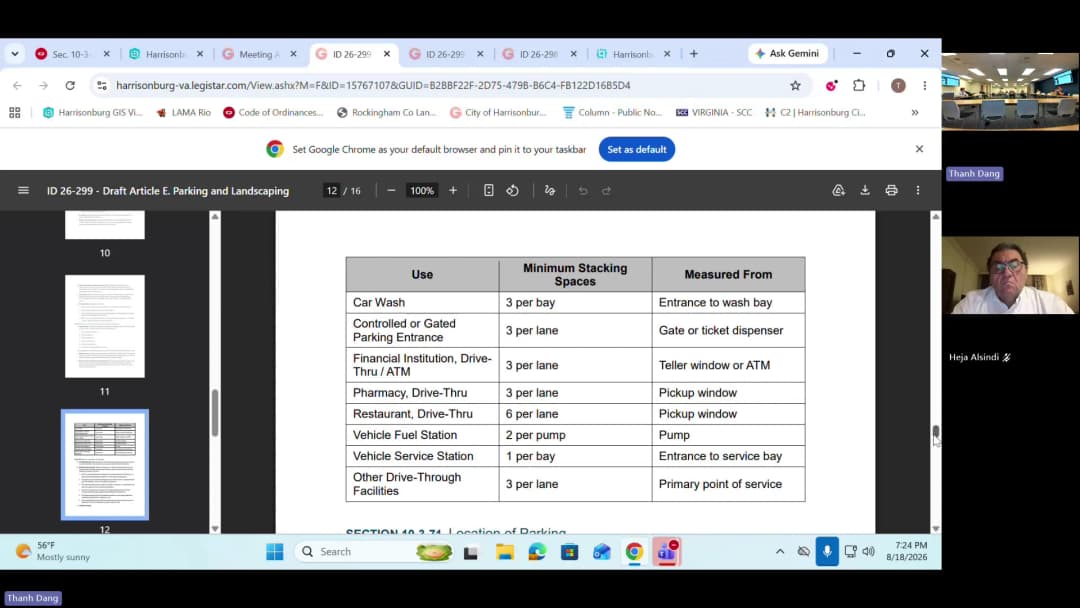
The Harrisonburg Planning Commission held a work session on Tuesday, August 24, 2026, at 6:00 PM in City Hall Room 011 to continue their Zoning Ordinance Update Project. The meeting focused on refining zoning district names and intent statements, and reviewing draft provisions for off-street parking, landscaping, and related standards. Commissioners participated remotely and in person; public comment was not accepted. The meeting adjourned at 7:48 PM. Discussion Items 3.a. Brief Reflections on Prior Work Session (10-15 minutes) Staff offered an opportunity for commissioners to raise questions about prior sessions, including the zoning map. No additional questions or comments were raised. 3.b. Review Zoning District Names and Intent Statements - Staff presented proposed names ("urban," "traditional," "suburban") to replace the current R-1, R-2, R-3 numeric system, aiming to better communicate neighborhood character along a continuum. - Commissioners expressed concern that "suburban" may evoke suburban sprawl, and that density labels (low, medium, high) could create perceptions about property values or desirability. - Alternatives discussed included "low medium high neighborhood," "core urban," "old town," "transitional," and density-based names. - Concerns were raised that "traditional" carries cultural, historic, and planning connotations that may not clearly communicate district characteristics. - Commissioners generally agreed that the proposed intent statements improve upon existing numeric labels, but further consideration of district names is warranted. - Staff requested that commissioners provide additional name suggestions and feedback by September 7, 2026, to allow compilation for a future work-session discussion. 3.c. Review portions of draft Zoning Ordinance text (Parking and Landscaping) - Staff reviewed draft provisions for off-street parking, shared parking, vehicle stacking, residential driveways, parking-lot landscaping, and parking location. The objective is to make modest updates while reserving larger policy changes for a later phase. - Parking requirements will align with proposed zoning ordinance use tables, using measurable features (e.g., floor area, beds, dwelling units) rather than operational factors (e.g., employee counts). - Restaurant parking: reduced from 1 space per 100 sq ft to 1 space per 250 sq ft, to improve flexibility for reuse of existing commercial buildings. - Residential parking: 1 space per dwelling unit, except in the R-A C and R-GC districts (covering most student housing), where 0.85 spaces per bedroom is proposed. Staff stated this would create a small reduction for four-bedroom units while eliminating the current differential that may discourage one- and two-bedroom units. - Institutional care: 1 space per 3 beds, consistent with current nursing-home standard. A commissioner questioned whether some facilities (e.g., medical offices) might have parking demand not primarily related to beds; staff said such uses may need evaluation under an office-related category. - Churches: commissioners noted declining attendance but increased community center use, and that growing churches typically seek more than minimum parking. Staff is comfortable with the simplified approach. - Shared parking: the current provision in Section 10-3-26(b) has been used only once. The draft proposes removing the 10-year expiration so recorded agreements remain until formally terminated. - Retail parking: currently decreases from 1 per 200 sq ft to 1 per 250 sq ft after 10,000 sq ft of gross floor area. Commissioners discussed incentives to repurpose excess parking from older shopping centers into development. - A commissioner asked about exemptions or flexibility from parking minimums for neighborhood commercial development near residential areas where customers may walk or bike. Staff will examine the concept. - Private K-12 schools: proposed as special exception; colleges/universities as permitted in mixed-use and commercial districts. Commissioners generally expressed comfort with addressing these through special exception or institutional overlay rather than a fixed parking metric. - Public schools: commissioners generally expressed comfort with no minimum parking requirement. - Vehicle stacking for drive-throughs: proposed to move from Design and Construction Standards Manual into zoning ordinance, with slight differences. Staff will evaluate other localities' enforceable approaches for managing excessive queueing. - Parking minimums purpose: commissioners discussed public concerns about spillover into residential areas, on-street parking conflicts, and downtown parking perceptions. Staff asked for direction on whether reductions go too far. - Compact parking: current allowance of 25% compact spaces retained; staff can examine adjustments if interested. - Residential driveway width: proposed maximum of 12 ft at the lot line for lots ≤40 ft wide, and 30% of lot width or 24 ft for wider lots. The limitation aims to reduce curb cuts and pedestrian conflict points. - Parking lot landscaping: proposed 15% landscaping, with interior islands required for larger lots. Staff will evaluate application to parking garages and integrated structures (e.g., "Texas donut"). - Parking location: in neighborhood commercial districts, the draft proposes limiting parking between a building and a public street. Commissioners discussed broader application outside downtown. Key Outcomes - Commissioner Alsindi’s remote participation from Erbil, Iraq was unanimously approved. - Commissioners will provide additional feedback and suggested names for proposed neighborhood zoning districts by September 7, 2026. - Staff will continue meeting with City departments to review draft content. - The next regular Planning Commission meeting is scheduled for September 9, 2026; the next work session is scheduled for September 15, 2026. - Staff is planning at least two public open houses in late September to mid-October 2026; dates not yet established.

ENGINEERING AND INFRASTRUCTURE 57% · ZONING 11% · PARKING POLICY 9% · ZONING AND LAND USE 7%
10
AUG 12, 2026 · HARRISONBURG, VIRGINIA · CITY COUNCIL & PLANNING COMMISSION
Harrisonburg Planning Commission Meeting: August 12, 2026

The Harrisonburg Planning Commission convened on Wednesday, August 12, 2026, at 6:00 PM in the City Council Chambers with six members present (Richard Baugh, Chair; Shannon Porter, Vice Chair; KC Kettler; Rob Jezior; Randy Seitz; and Laura Dent, Councilmember). Commissioner Heja Alsindi was absent. The Commission reviewed and acted on four public hearing items and one action item, forwarding all to City Council. Consent Calendar - The Commission unanimously approved the minutes from the July 8, 2026 meeting (motion by Porter, seconded by Kettler) and the July 21, 2026 meeting (motion by Seitz, seconded by Dent). Public Hearings 4.a. Short-Term Rental Special Use Permit (387 Monticello Avenue) - Project: Caitlin and Peter Denbigh requested a Special Use Permit (SUP) to operate a short-term rental (STR) in an accessory structure on their property, seeking to host up to four guests for more than 90 nights a year. - Applicant Position: The Denbighs stated they are respectful neighbors committed to enforcing strict rules, minimizing noise, and directing parking to a new alley-accessible lot. - Public Testimony: Neighbor Dave McCarty (366 Monticello Ave) opposed the permit, arguing the STR constitutes a business in an R-1 district, raising concerns about parking, transient guests, and lack of oversight. Heidi Klim (418 Monticello Ave) questioned the "tipping point" for neighborhood stability and who would manage problems when owners are away. - Commission Discussion: Commissioners characterized the request as a creative use of property to improve housing affordability without removing a dwelling unit from the long-term market. Parking concerns were noted, but the limited scale of the operation was seen as manageable. The trend toward liberalizing accessory structure rules was acknowledged. - Outcome: Recommended for approval to City Council (6-0). Motion by Kettler, seconded by Dent. 4.b. Indoor Recreational Facility Special Use Permit (291 West Wolfe Street / 336 West Market Street) - Project: VG Harrisonburg Storage LLC sought an SUP for indoor recreational and leisure-time activities (e.g., rock climbing, pickleball) in a former industrial building, while operating a by-right self storage facility on the same site. - Applicant Position: Benjamin Ho requested the Commission broaden the list of allowed uses in the permit conditions to attract tenants, suggesting specific exclusions (e.g., no shooting ranges, no go-karts, no paintball) rather than a narrow inclusion list. - Public Testimony: Neighbor Mary Boitnott (55 N Brook Ave) raised concerns about inadequate parking, a problem she recalled from the site's prior industrial use. Carina Young (29 Shenandoah Ave) expressed excitement about the potential for pickleball and rock climbing. - Commission Discussion: The key debate centered on whether Condition 2 should be defined by specific inclusions, specific exclusions, or a broader "substantially similar" standard. Staff was directed to craft broader language reflecting the discussion for City Council's consideration. - Outcome: Recommended for approval to City Council (6-0). Motion by Kettler, seconded by Jezior. 4.c. Comprehensive Plan Amendment (Northeast Neighborhood Small Area Plan) - Project: Staff requested the incorporation of the Northeast Neighborhood Small Area Plan (SAP) into the Comprehensive Plan as Appendix A, the city's first small area plan developed through the Smart Growth America Community Connectors grant. - Proponent Positions: Karen Thomas, Director of the Northeast Neighborhood Association, and Monica Robinson, representing the Shenandoah Valley Black Heritage Project, strongly endorsed the plan, stating it represents over three years of community engagement aimed at rebuilding trust and reversing the impacts of urban renewal. - Public Testimony: City Resident Panayotis Giannakouros warned against Goal 8.5 (proactive code enforcement), arguing it establishes legal pillars that could be used for future displacement, citing a lack of safeguards against a repeat of urban renewal. - Commission Discussion: Members inquired how the plan would influence CIP prioritization, zoning ordinance updates, and departmental awareness. Staff affirmed that Public Works already uses the plan for grant applications and committed to continued engagement with the neighborhood during the zoning rewrite. - Outcome: Recommended for approval to City Council (6-0). Motion by Seitz, seconded by Kettler. 4.d. Zoning Ordinance Amendment (Poultry Hatchery Definition) - Project: Staff proposed amending the Zoning Ordinance to define "poultry hatchery" and codify it as a by-right use in the M-1 General Industrial District, correcting an unintentional non-conformity created by a February 2026 amendment. - Discussion: Councilmember Dent clarified the distinction between hatcheries (live poultry) and table egg production. Staff confirmed coordination with the Virginia Poultry Federation, which raised no concerns. - Outcome: Recommended for approval to City Council (6-0). Motion by Kettler, seconded by Dent. Action Item 5.a. Subdivision Ordinance Variance (704 North Liberty Street) - Project: Jose Antonio Lopez Montiel requested a variance from the Subdivision Ordinance to waive the requirement to construct a public sidewalk along the North Liberty Street frontage of a proposed four-lot subdivision intended for workforce housing. - Applicant Position: Engineer Gil Colman argued the $5,000–$10,000 sidewalk cost represents a significant burden for a small-scale infill project, advocating for a city-funded approach through the Housing Fund to avoid encumbering affordable housing development. Mr. Lopez noted the city previously built sidewalk on adjacent West Washington Street without an easement on his property. - Public Testimony: Panayotis Giannakouros supported the variance, contrasting the cost burden with the city's recent multi-million dollar land donation for housing and arguing the public should bear the cost of infrastructure. - Staff Recommendation: Denial. Staff found the applicant had not demonstrated a topographical hardship and argued that requiring sidewalk construction incrementally advances the Comprehensive Plan and pedestrian network goals. - Commission Discussion: The vote split sharply. Vice Chair Porter, Commissioner Seitz, Commissioner Jezior, and Councilmember Dent supported the variance, viewing the requirement as an undue burden on small-scale workforce housing and preferring the city assume responsibility for such infrastructure. Chair Baugh and Commissioner Kettler opposed, arguing that waiving the requirement undermines a key tool for building the pedestrian network and sets a poor precedent. - Outcome: Recommended for approval to City Council (4-2). Motion by Seitz, seconded by Jezior. Voting in favor: Porter, Seitz, Jezior, Dent. Voting against: Baugh, Kettler. Key Outcomes - The Commission forwarded five items to the Harrisonburg City Council. Four items received a unanimous recommendation; the Subdivision Variance was recommended with a 4-2 split. - Next Steps: All items are scheduled for a City Council public hearing on September 8, 2026.

ZONING AND LAND USE 42% · ZONING 13% · AFFORDABLE HOUSING 10% · PUBLIC ENGAGEMENT 8%
0102
NEXT →
OPENPUBLICA · PUBLIC MEETING INDEXUPDATED DAILY · openpublica.com