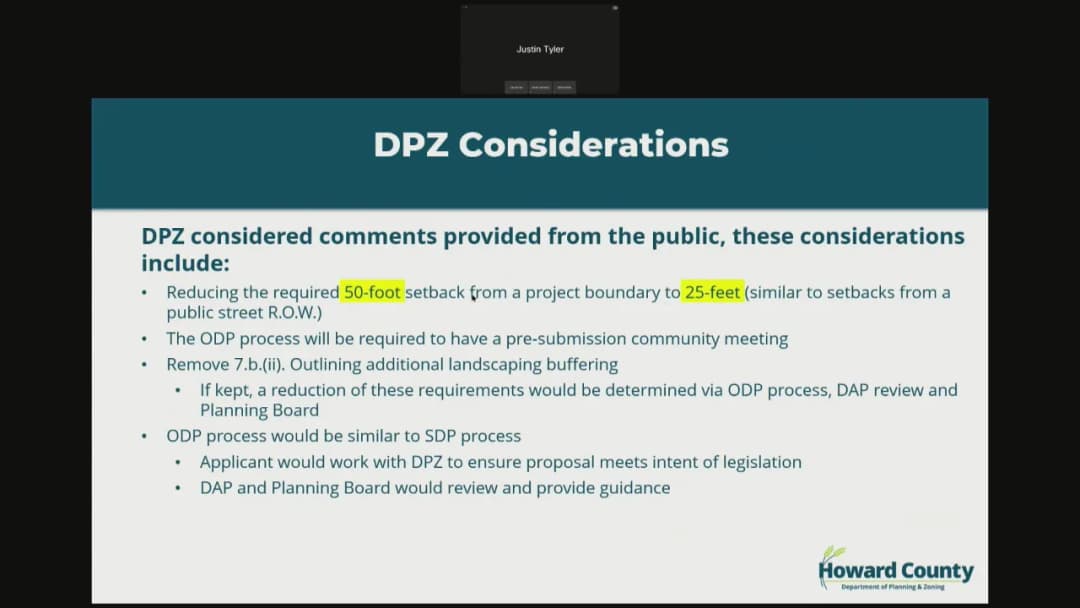
The Howard County Planning Board held a public meeting/hearing on April 9, 2026, to consider ZRA 224, a zoning regulation amendment to permit age-restricted adult housing cottage clusters. The board convened with a quorum of three members (Cecil, Gadzi, Tilburg); members Barbara and Lynn were absent. The main agenda item was the DPZ presentation on ZRA 224, followed by public comment and board deliberation. Consent Calendar - Approved the meeting agenda unanimously. - Approved the minutes of the March 26, 2026 Planning Board meeting as presented via WebEx recording. - No chair items or executive secretary updates were presented. Public Comments & Testimony - Sam Alomar, a civil engineer in Howard County, expressed strong support for ZRA 224 and offered suggestions: reduce the project boundary setback from 50 to 25 feet, increase the height limit from 20 to 26–28 feet to allow second-floor units (for dens/offices), permit stormwater management facilities (including underground) in common areas, waive buffering when adjacent to open space/parkland, and waive excise or permit fees to improve affordability. - Joel Horowitz, representing Living Columbia, raised concerns about the provision triggering the 20% MIHU requirement when constructed amenity areas (pools, gyms, etc.) are included, questioning why such amenities are allowed if they undermine affordability. He also questioned the 10-acre maximum, suggested capping courtyard clusters at around 12 units to preserve intimacy, and asked how the MIHU requirement would apply if cottage clusters were part of a larger HOA or had shared access to amenities in B1/B2 districts. Discussion Items - Justin Tyler of the Department of Planning and Zoning (DPZ) presented ZRA 224. Key elements: - Purpose: Permit age-restricted adult housing cottage clusters as "missing middle" housing to align with HoCo By Design and the Housing Opportunities Master Plan. - Definition: At least four detached dwelling units with a footprint of less than 900 square feet, arranged around a common courtyard. - Permitted districts: RED, PGCC, R20, R12, RSC, RSA 8, RHED, RA15, RAPT, B1, and B2, subject to optional design project (ODP) approval; maximum development area 10 gross acres, minimum 20,000 sq ft; must be within planned public water/sewer service area. - Density: 9 units/net acre (RED, RHED, PGCC, R20), 10 (R12), 11 (RSC), 12 (RSA 8), and 20 (RA15/RAPT). - Bulk requirements: max height 20 feet, min setback 50 feet from project boundary (proposed reduction to 25 feet), 25 feet from public street ROW, 8 feet between structures, 20 feet from interior road/driveway for units with garages. - A 20% MIHU requirement applies if the development includes constructed amenity areas (e.g., gyms, pools, sports courts, clubhouses) sized at least 500 sq ft; cumulative recreational amenity area capped at 3,500 sq ft. - No MIHU requirement otherwise, to keep units "naturally affordable." - Optional design project process: developer works with DPZ, then Design Advisory Panel (DAP), then Planning Board approval; no conditional use required for cottage clusters. - Webinar feedback: DPZ held a public webinar on April 7, 2026, with 200+ registered attendees; received positive feedback and over 20 live questions plus 30 pre-submitted questions. - DPZ analysis: 55,651 parcels (32,723 acres) could be impacted, with 921 feasible infill locations (under-improved or unimproved parcels). - Board members discussed: - Setback reduction: Board generally supported 25 feet to allow feasible development on small infill parcels and better blend with neighborhoods. - Height: Concerns that allowing higher structures or variances could lead to larger units, increased traffic/parking, and reduced affordability. Board decided to keep 20 feet, though staff noted administrative adjustments up to 20% or variances are possible. - MIHU/amenity language: Board debated whether the list of constructed amenities was clear enough; staff agreed to consider explicit language or rely on the ODP process and DAP review. - Courtyard clusters: Multiple courtyards are allowed; size of courtyard is indexed to 250 sq ft per dwelling unit; no unit cap was adopted, but ODP/DAP would review. - Community meeting: The ODP process will require a pre-submission community meeting as part of the site development plan (SDP) process. Key Outcomes - The Planning Board voted unanimously to favorably recommend ZRA 224 to the Howard County Council with suggestions based on the DPZ considerations slide, specifically bullet 1 (reduce the setback from 50 to 25 feet), bullet 3 (remove or reduce additional landscape buffering requirements, subject to DAP and Planning Board review), and bullet 4 (make the ODP process similar to the SDP process, which includes a required pre-submission community meeting). Bullet 2 (required community meeting) was considered incorporated into bullet 4. - The recommendation will be documented in the board's final decision order.
Public Meetings - Howard County, Maryland
Public Meetings - Howard County, MarylandThe Howard County Zoning Board held a hybrid presentation/work session on Wednesday, April 8, 2026, at 7:00 p.m. to review Hearing Examiner Kathryn Nichols' report on ZB 1131M (The Palmetto Group, Inc.), hear exceptions, and vote on the zoning map amendment petition for 6871 and 6875 Dorsey Road, Elkridge. Present were Chair David Yungmann, Vice Chair Liz Walsh, and members Deb Jung and Christiana Rigby; Opel Jones was absent. Consent Calendar - Minutes Approval: The board voted 3-0-1 to approve the March 25, 2026 Zoning Board Administrative Meeting minutes. Chair Yungmann, Ms. Rigby, and Ms. Young voted yes; Vice Chair Walsh abstained; Dr. Jones was absent. Procedural Discussion - Notice and Scheduling Concerns: Vice Chair Walsh raised concerns about whether scheduling evidentiary hearings as continuations of administrative meetings complied with notice requirements, suggesting the practice may not provide sufficient public notice. Member Jung noted that many Long Reach residents were unhappy about a daytime redevelopment hearing and urged that zoning board hearings be held in the evening. The board discussed the exception filing timeline (20 business days) and whether to revise it. Council attorney Mr. Moore explained that board rules require 30 days' notice for administrative meetings, but the practice of scheduling follow-up hearings may differ. The board agreed to revisit procedural rules in the fall after the current cases conclude. - Hearing Examiner Rules Accessibility: Mr. Hurowitz stated that the zoning board hearing examiner's rules of procedure were difficult to find online. Board members acknowledged the issue and noted that the rules are within the zoning board rules of procedure. Hearing Examiner's Report on ZB 1131M - Case Summary: Hearing Examiner Kathryn Nichols presented her report on the petition by The Palmetto Group, Inc. to rezone two parcels (approximately 0.4 acres combined) at 6871 and 6875 Dorsey Road, Elkridge, from TOD (Transit Oriented Development) to R-12 (Residential Single) District. She noted the properties were placed in TOD in the 2013 comprehensive rezoning, likely due to an error regarding their size (thought to be 1.1 acres) and lack of knowledge of environmental constraints (streams, wetlands, stormwater facilities) separating them from TOD development. She stated the applicant argued mistake in the last comprehensive rezoning and found the burden met. She noted the applicant suggested the RSC (Residential Single Cluster) zone, which would allow single-family homes on each lot, and that this would align with the residential character across the street. She reported that no members of the public testified at the hearing, but the planning board had received comments about commercial vehicle parking. Exceptions by Protestant Joel Hurowitz - Arguments: Mr. Hurowitz filed exceptions regarding the appointment of the zoning board hearing examiner and zoning counsel. He argued the hearing examiner's appointment violated Section 216 of the County Charter, which requires appointment by resolution in public, and that the hearing examiner's role constitutes providing legal advice. He also contended the de facto officer doctrine did not preclude his challenge. He acknowledged he did not expect the board to grant relief in this case. - Board Response: Members discussed the validity of the appointment process but did not take action on the exceptions. Ms. Young stated she agreed the process could be improved but would not vote for the exceptions. Chair Yungmann noted the board heard the exceptions for completeness. Board Deliberation and Vote - Record Sufficiency: The board unanimously agreed the record was sufficient to make a decision without remand. - Vote on Petition: A motion to approve the petition passed 4-0 (Jones absent). The written decision and order will be forthcoming. Note: The petition originally requested a change to R-12, while the hearing examiner discussed the alternative RSC zone; the board's motion did not specify the zone, and the practical outcome will be detailed in the written decision. Key Outcomes - Approved ZB 1131M rezoning petition (4-0). - Approved March 25, 2026 minutes (3-0-1). - No action taken on Joel Hurowitz's exceptions. - Board identified procedural issues to revisit in fall 2026.
This is a summary of the Howard County Hearing Examiner meeting held on April 7, 2026, at 5:30 PM, presided by Hearing Examiner Joyce Nichols. The single agenda item was Case BA 25-023C, a conditional use petition by Friendship Baptist Church to increase student occupancy at its existing child daycare center and nursery school from the currently approved 39 morning and 39 afternoon students to a total of 110 students, without altering existing structures. Petitioner's Testimony - Thomas B. McKee (representative of Friendship Baptist Church): Stated that installing acceleration/deceleration lanes on Maryland 32, as initially recommended by the State Highway Administration (SHA), is financially infeasible for the church or the leaseholder (Little Oak Nursery School). He noted the church has approximately 440 members (averaging 360–370 attendees on Sundays) and reported no history of ingress/egress incidents. - Joseph Caligaro (traffic engineer, The Traffic Group): Presented exhibits including trip generation estimates (83 trips during the AM peak hour, 82 during the PM peak hour, with 90% of traffic from the south) and crash data showing only 2 intersection-related crashes over 10 years (both on Fridays around 3:30 PM, potentially school-related). He explained that SHA had previously removed acceleration/deceleration lanes and replaced them with a center turn lane, which he considered a safer configuration. He concluded that the proposed use would provide safe ingress/egress without requiring additional lanes. - Dan Sweeney (civil engineer, GLW Engineering): Confirmed agreement with the technical staff report from the Department of Planning and Zoning, noted no external improvements are proposed, and stated the existing 170-space parking lot and playground meet requirements. Key Outcomes - All seven exhibits (traffic analysis, crash data, etc.) were admitted into evidence. - The evidentiary hearing was concluded; a decision and order will be rendered at a later date.
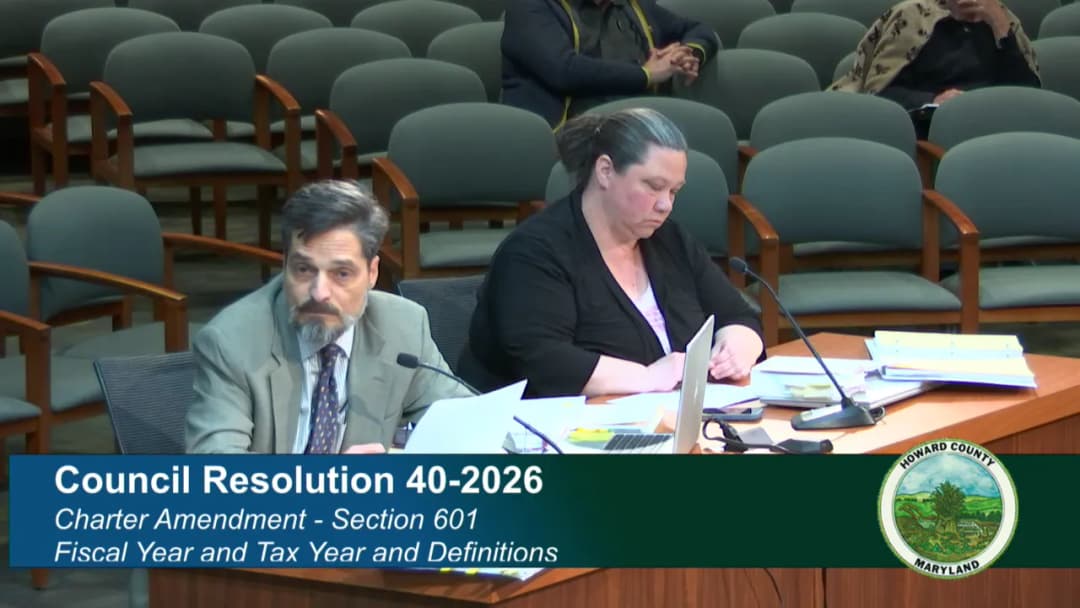
The Howard County Council held a hybrid legislative session on April 6, 2026, at 7:00 PM. The meeting included the introduction of 11 new legislative items (appointments, financial transfers, and zoning changes) and final consideration of 10 previously introduced items. Key debates centered on a charter amendment to allow general obligation bonds for affordable housing (CR40) and an accessory dwelling unit enforcement bill (CB21). All votes were unanimous except where noted. Approval of Journal and Minutes - The council unanimously approved the journal of the March 2, 2026 legislative session and the minutes of meetings on March 9, March 17, and March 23, 2026. Introduction of Legislation The council introduced the following items (all to be considered at a public hearing on April 20, 2026, and a work session on April 27 if needed): - Appointments: CR42-2026 (Property Tax Assessment Appeal Board list), CR43-2026 (Aileen Maren Jaentsch Marshall to Animal Matters Hearing Board), CR44-2026 (Kimberly Brokaw, DVM to Animal Matters), CR45-2026 (Maryam Fathirad to Public Works Board), CR46-2026 (Dinah R.K.K. Yukich to LGBTQIA+ Commission), CR47-2026 (Dr. Meghana S. Ray to Board of Health), CR48-2026 (Michael Cummins to Inspector General Advisory Board, introduced by Councilmember Yungmann). - Financial: TAO2-FY2026 (transfer $3,500,000 from school capital projects to Faulkner Ridge Center Early Learning Center), CB22-2026 (authorize $3,500,000 in bonds for Faulkner Ridge Center), CR49-2026 (endorse application to Maryland Transit Administration for grants), CR50-2026 (endorse State financing for Feast & Fettle economic development project), CR51-2026 (approve PILOT agreement with Midway 32 LLC for 623-unit housing at 10010 Junction Drive, Annapolis Junction). - General: CB23-2026 (ZRA 221 – adaptive reuse of motel/hotel sites along Route 1 corridor), CB24-2026 (ZRA 222 – optional design projects in Route 1 corridor). Discussion Items and Final Consideration CB19-2026 – Multiyear Renewable Energy Power Purchase Agreement - The council debated and adopted Amendment 1 to CB19, which made technical corrections, changed the power provider name to CI Renewables Osprey, added exhibits, and clarified roof warranty and interconnection costs. The amendment passed unanimously. The main motion to approve CB19 as amended passed 4-1, with Councilmember Yungmann voting no. CR39-2026 – Payment in Lieu of Taxes Agreement – Fall River Terrace Apartments - Councilmember Young expressed concern that the developer, Enterprise, had misled the community about opportunities for public input at the pre-submission meeting. She clarified that her criticism was directed at the developer, not the village board or staff. The council adopted Amendment 1 to CR39, correcting the unit counts: 56 units at 80% AMI (up from 50) and 20 market-rate units (down from 26). The amendment and the main motion as amended passed unanimously. CR40-2026 – Charter Amendment – Section 601 (Affordable Housing Bonds) - This was the most debated item. The amendment would define “affordable housing projects financed in whole or in part by the Housing Opportunities Trust Fund” to allow funding the trust fund through general obligation bonds, and would be submitted to voters in November 2026. Multiple amendments were proposed and voted on: - Amendment 1 (introduced by Councilmember Walsh): Restricted the use of bonds to “for sale” housing only. Passed 4-1, with Council Chair Jones voting no. - Amendment 2 (administration’s amendment): Added criteria that projects must be wholly owned by the Howard County Housing Commission or an entity controlled by it, or be exclusively for sale. Two sub-amendments were considered: - Amendment 1 to Amendment 2 (introduced by Councilmember Young): Further restricted projects to be exclusively for sale and wholly owned by the commission. Passed 3-2, with Chair Jones and Councilmember Rigby voting no. - Amendment 2 to Amendment 2: Added a reference to the Maryland Housing and Community Development Article to define “control.” Passed unanimously. - Amendment 2 as amended then passed unanimously. - The final vote on CR40 as amended passed unanimously (5-0). Councilmembers made statements: Young expressed concerns about the lack of details, borrowing limits, and potential pay-to-play; Rigby lamented the restrictions as diminishing the charter amendment’s impact; Yungmann supported the tool for for-sale housing; Walsh supported the amendment; Jones voted yes to move forward. CB21-2026 – Enforcement of Owner Occupancy – Accessory Dwelling Units - Councilmember Yungmann introduced Amendment 1, which aligned the ADU rental license process with the standard two-year term and addressed concerns raised by housing advocates. The amendment passed unanimously. The main motion as amended also passed unanimously. Councilmember Young commended Yungmann for listening to advocates. Other Final Consideration Items Approved Unanimously: - CR38-2026 (appointment of Melissa Terlaje to Economic Development Authority Board) - CB18-2026 (lease of historic county jail to Preservation Maryland, Inc.) - CR41-2026 (Howard County Board of Education FY2026 operating budget amendment, transferring $3,000,000 from Health Fund to General Fund) - CB20-2026 (establishment of Interfaith Advisory Commission) - Tabled appointments: CR211-2025 (Valoria Walker to Commission on Aging), CR5-2026 (John Mobley to Board of Electrical Examiners), CR8-2026 (Juan Valdez to Commission for Veterans and Military Families) – all removed from the table and approved unanimously. Key Outcomes - CR40 (Charter Amendment): Approved with amendments that restrict the use of GO bonds for affordable housing to (1) for-sale projects, and (2) projects wholly owned by the Howard County Housing Commission or an entity controlled by it. The charter amendment will be placed on the November 2026 ballot for voter approval. - CB19 (Renewable Energy PPA): Approved as amended, with a 25-year term for purchasing renewable energy for county, school system, and community college. - CR39 (PILOT – Fall River Terrace): Approved as amended, allowing a 76-unit development (56 affordable at 80% AMI, 20 market-rate) at 5551 Harpers Farm Road, Columbia. - CB21 (ADU Enforcement): Approved as amended, requiring owner-occupancy attestation, two-year rental licenses, and civil penalties. - Next Steps: Public hearing on introduced legislation on April 20, 2026; work session on April 27 if needed. The council adjourned.
Opening Remarks The hearing began at 10:00 AM on March 26, 2026, before Hearing Examiner Joyce Nichols. The case concerns ZB 1133M, a petition by Howard Research and Development Corporation (HRD) to rezone two undeveloped parcels (approximately 11.01 acres) at 9121 S. Commerce Center Drive, Columbia, MD, from B-2 (Business: General) to M-1 (Manufacturing: Light). Petitioner's Opening Statement Tom Cole, representing the petitioner, argued that the current B-2 zoning is a mistake originating from the 2003 comprehensive zoning. He stated that in 2003 the area was zoned for customer-facing retail (big box stores), but since then trends have changed due to the rise of e-commerce (Amazon) and the property has remained a vacant grass field. He asserted that retaining B-2 zoning in the 2013 comprehensive zoning was a clear mistake because the zoning authority failed to account for changed conditions. He cited case law (Beechwood Limited Partnership, Chapman v. Montgomery) to support that an error or mistake is established when the assumptions relied upon were invalid, and that a more liberal standard applies when reclassifying within commercial categories. He noted that the Planning Board had also recommended rezoning. Testimony of Dan Sweeney (Civil Engineer/Planner) Dan Sweeney, a civil engineer retained by the petitioner, testified that the property is an 11-acre vacant grass lot fronting Commerce Center Drive. He reviewed planning documents and the Technical Staff Report. He stated that the surrounding parcels are mostly zoned M-1 (light industrial), and that the B-2 zoning is inconsistent with the Gateway Master Plan, which for Sub-Area 6 recommends light industrial/employment uses. He testified that the assumption of retail viability was incorrect, as evidenced by the property's prolonged non-development (40+ years). He argued that the 2014 comprehensive zoning authority had constructive knowledge of the vacancy but retained B-2, constituting a mistake of fact (not judgment). Under cross-examination by Mr. Foreman (Zoning Council), Sweeney confirmed that access for industrial uses would require more heavy truck traffic and that the property is accessible via Commerce Center Drive. He noted that the adjacent former movie theater parcel is being demolished and replaced with a warehouse, consistent with M-1 zoning. Testimony of Gabe Chung (HRD Senior Vice President) Gabe Chung, Senior Vice President of HRD, testified via WebEx. He stated that the parcel has been undeveloped for decades and that HRD's internal marketing efforts for retail uses yielded only sporadic interest that never materialized. He attributed the lack of retail viability to poor access, visibility, and traffic counts, and the absence of nearby residential density or co-tenancy with other retail. He contrasted the 2003 retail environment (big box heyday) with 2026 (e-commerce dominance) and noted that these trends were already apparent by 2013. He stated that M-1 zoning (light industrial/warehouse) would be more suitable because industrial uses do not require the same visibility or co-tenancy. He confirmed that HRD has received inquiries for industrial use but has no current site plan. He argued that rezoning would create jobs, increase tax base, and put the property to productive use instead of remaining a grass field. Petitioner's Closing Argument Tom Cole reiterated that the property's prolonged vacancy is strong evidence of a mistake. He argued that the B-2 zoning was retained under a misapprehension in 2013, and that the evidence supports a recommendation to the Zoning Board that B-2 was a mistake and M-1 is appropriate, consistent with surrounding uses and county planning documents. Key Outcomes - The hearing was concluded and the record closed on the same day. - Hearing Examiner Joyce Nichols directed that memoranda of law be filed by March 31, 2026, at 4:00 PM. - A report will be prepared and presented to the Zoning Hearing Board, which will make the final decision on the rezoning petition. - No decision was made at this hearing; it is a recommendation process to the Zoning Board.
The Howard County Planning Board held a public meeting on March 26, 2026, in person and virtually. The meeting included an update from the Executive Secretary, a presentation on Ho Co By Design implementation progress, and a public hearing on Site Development Plan SDP-26-001 for the redevelopment of the former Columbia Flier Building into The Source community center. The board approved the agenda and previous minutes, and later voted unanimously to approve the site development plan contingent on parking easements and agreements. Consent Calendar - The board approved the meeting agenda by unanimous voice vote. - The board approved the recording of the March 5, 2026 WebEx meeting as the official minutes, by unanimous voice vote. Executive Secretary Update - The county office building will be closed the week of March 30 for energy saving days, and on Good Friday (April 3). - Zoning Regulation Amendment (ZRA) 2-4, addressing cottage courtyard development, will be presented to the Planning Board on April 9, 2026. - A public webinar on ZRA 2-4 was rescheduled from April 6 to April 7, 2026, from 4:00–5:00 PM. Ho Co By Design Implementation (2023–2025 Reporting) Randolph Mitchell and Kate Bollinger (Department of Planning and Zoning) presented the second annual implementation report for the county’s General Plan, Ho Co By Design, adopted in 2023. - Progress Dashboard: Of 359 tracked actions, 78% are now underway (up from 61% in 2024). 100% of “managing growth” actions are complete. 81% of equity‑focused actions are underway. - 2025 Accomplishments Included: Adoption of the Gateway Master Plan; completion of APFO review committee and housing affordability work group recommendations; adoption of AG ZRA 217 to expand agribusiness; state Housing Expansion and Affordability Act implementation; Landscape Manual update; draft EV charging permit checklist; 150 acres added to Agricultural Land Preservation Program; state Renewable Energy Certainty Act adoption. - Notable Actions per Chapter: Ecological health (tree canopy goals, climate action plan coordination, ag land preservation in east county); County in Motion (real‑time traffic monitoring, complete streets, design manual updates); Economic Prosperity (Gateway Master Plan, broadband expansion, agritourism ZRA); Dynamic Neighborhoods (ADU regulations ZRA 218/CB 3‑2026, affordable housing work group, down payment assistance, moderate‑income homeownership program, zero net loss of affordable housing); Quality by Design (open space goals, landscape manual update, cemetery inventory work group); Public Schools (school capacity evaluation for Gateway); Supporting Infrastructure (budget consistency with General Plan, septic system inspection program); Managing Growth (APFO evaluation and task force completed). - Board members thanked staff and noted their familiarity with many of the referenced initiatives. Public Comments & Testimony Joel Horwitz (speaking for himself, Harper’s Choice resident) urged denial of SDP‑26‑001, arguing that the parking plan does not meet zoning requirements (Section 131.0B4E). He claimed only 100 spaces are effectively guaranteed, with no room for snow removal or events; that the HCPSS lot is not fully on-site; and that easements for the Montessori parking are subject to numerous restrictions, including approval from Aya Montessori and potential suspension. He also questioned the community college’s bus ridership data and whether a parking agreement with a bond‑financed building is legally permissible. Erica Shavaria (speaking for herself, Columbia resident) strongly supported the project, describing The Source as a welcoming, resource‑rich space addressing community needs for wellness, daycare, food, recreation, and social services. She highlighted the developer’s (Columbia Concepts) deep roots in Howard County and commitment to inclusive development, urging approval. Joan Langos (Hickory Ridge resident, former Planning Board member 1992–2002) raised significant concerns about parking sufficiency. Noting that only 31 on‑site spaces and 39 immediately adjacent spaces (total 70 likely always available) are provided for a 60,180 SF building, she questioned the realism of the parking demand study’s assumption that most users will walk, bike, or take transit. She cited existing parking issues at nearby businesses and asked the board to delay a decision until detailed questions (safe pedestrian pathway, bike racks, EV charging, college bond implications) are answered. She submitted a written list of additional questions. Discussion Items SDP‑26‑001 – Columbia Concepts / The Source Community Center - Project Description: Redevelopment of the former Columbia Flier Building site (2.16 acres, zoned New Town) at 10750 Little Patuxent Parkway into a two‑story, 60,180 SF multi‑use youth community center. Uses include gymnasium, education center, medical/mental health services, bilingual daycare, food stalls, and nonprofit social service space. - Parking Plan: 31 on‑site spaces proposed, plus 8 additional spaces on adjacent school property (requiring a separate FDP amendment). Off‑site parking includes 69 spaces at the Wild Lake Middle School lot (adjacent) and 55 spaces at Howard Community College (secured via MOU). Total 124 off‑site spaces. A parking demand study (ITE/ULI) estimated average demand at 104 spaces and 85th percentile at 140 spaces, using 1.67 spaces per 1,000 SF. - Staff Presentation: Jill Maggi presented the technical staff report, noting the project meets allowable uses under FDP 48, landscape manual requirements (approved by HRD Architectural Review Committee on Feb. 19, 2026), and includes a fee‑in‑lieu for forest conservation ($5,445 for 0.1 acre obligation). Two specimen trees will be removed (one due to utility conflicts, one for fire access), mitigated with four additional native shade trees. - Applicant Presentation: Eric McWilliams (landscape architect, Bowler) and Patrick McGowan (architect, KGD) described the design as a contemporary interpretation of the original Flier building’s role in connecting neighborhoods. Katie Wagner (traffic consultant, Gorove Slade) detailed the parking demand study and shared parking arrangements. - Board Questions: Board member Barbara Mosier asked whether the 55 community college spaces were reflected in the SDP; staff confirmed they were secured after the technical staff report was posted and would be shown on the final plan. Another member asked about existing pedestrian connectivity; applicant confirmed a new sidewalk and multi‑use path will be constructed through the site to connect to Wild Lake Middle School. - Board Discussion: Members acknowledged the community need for the services, the flexibility of the user population, and the ability to adapt parking management over time. They expressed confidence that the parking agreements and easements in place would be sufficient, and that conditions could ensure their maintenance. Key Outcomes - Vote on SDP‑26‑001: The board voted unanimously (4‑0) to approve the site development plan, with the condition that approval is contingent on the existing easements, agreements, and MOUs for off‑site parking being maintained. - Next Meeting: The board adjourned to April 9, 2026.
The Howard County Zoning Board held an administrative meeting on March 25, 2026, at 7:00 PM in a hybrid format. The board approved minutes from the previous meeting and voted to refer a zoning map amendment case to the hearing examiner. Consent Calendar - Approval of Minutes from March 11, 2026: The board approved the minutes of the March 11, 2026 Zoning Board Administrative Meeting. Chair Youngman voted yes, Vice Chair Walsh was absent, Dr. Jones abstained (noted absence from that meeting), Ms. Rigby voted yes, and Ms. Jung voted yes. Discussion Items - Case ZB 1133M – The Howard Research Development Corporation: A zoning map amendment petition requesting to rezone two undeveloped parcels from B-2 (Business: General) to M-1 (Manufacturing: Light) located at 9121 S. Commerce Center Drive, Columbia, MD 21046. The board reviewed the petition and supporting documents. No discussion was held. A motion was made to refer the case to the hearing examiner. Key Outcomes - Referral to Hearing Examiner: The board voted unanimously (4 yes votes: Chair Youngman, Dr. Jones, Ms. Jung, and Ms. Rigby; Vice Chair Walsh absent) to refer ZB 1133M to the hearing examiner. The hearing is scheduled for March 26, 2026, at 10:00 AM.
A conditional use petition hearing was held on March 24, 2026, at 10:00 am before Hearing Examiner Joyce Nichols, regarding a proposed redesigned nature-based play space with an ADA-accessible pathway at the Howard County Conservancy property (10520 Old Frederick Road, Woodstock, MD). The applicant, Meg Boyd, Executive Director of the Howard County Conservancy, presented the project and called one expert witness to testify about its consistency with county plans and zoning requirements. Discussion Items - Project Overview: Meg Boyd described the 36-year-old nonprofit's mission to provide environmental education on an 84-acre site within a 232-acre conservation easement. The proposed improvements include a 790-foot pervious ADA-accessible pathway connecting existing nature play elements on approximately 5 acres (less than 2% of the easement). Boyd emphasized the importance of nature play for children's physical and mental health, aligning with Howard County's growth and conservation goals as outlined in HOCO by Design chapters 2, 6, and 7. - Witness Testimony: Mr. Groom Seav, a witness for the petitioner, testified that the proposed nature-based play features and path are appropriate for the site, given sufficient setbacks (over 300 feet to property lines, nearly 1,000 feet from dwellings), adequate ingress/egress via existing frontage improvements (acceleration/deceleration lane from 2004), and no anticipated adverse noise, lighting, or environmental impacts. He confirmed that parking from a 2016 study remains adequate and that the historic site (H0406) on the property would not be adversely affected, noting positive advisory comments from the Historic Preservation Commission. - Historic Preservation Commission Report: It was noted that the Historic Preservation Commission had provided advisory comments after the conditional use application was submitted, but the report was not yet in the hearing record. The Hearing Examiner requested that an electronic copy be provided to close the record. Key Outcomes - Record Conditionally Closed: The hearing record will be closed upon receipt of the Historic Preservation Commission's report (minutes or recommendation). Once received, a decision and order will be issued in a timely manner. - No Immediate Decision: The Hearing Examiner did not render a decision during the hearing; approval is pending submission of the outstanding document.
The Alcoholic Beverage Hearing Board met on March 24, 2026 at 6:30 PM in the Banneker Room (3430 Court House Drive, Ellicott City, MD) and via WebEx. The board considered three agenda items: a transfer with extension of premises for Compadres, a new license for Sushi Tendou (continued from January 13, 2026), and a new license with a wine corkage permit for Dwaraka's Bawarchi Indian Kitchen. All applicants were represented by liquor license consultant Martin Johnson. Consent Calendar - Unanimous approval of the minutes from February 24, 2026 (moved, seconded, all members voted yes). Discussion Items 1. Transfer + Extension of Premises: BinBiv Enterprises, LLC t/a Los Compadres to OSG Group, LLC t/a Compadres - Applicant: George Brack (20% owner, general manager) and Leo Giraldo (80% owner). - Location: 10805 Birmingham Way, Woodstock, MD (1,482 sq. ft. restaurant with proposed 60 sq. ft. exterior patio with three high-top tables seating up to 9). - Key testimony: - Mr. Brack has 7 years of experience in alcohol service, holds alcohol awareness certification, and works 50 hours/week. - The restaurant is food-focused (estimated 80% food sales), with alcohol primarily beer, wine, and margaritas. - Outdoor area would be marked with potted plants, light chains between columns, and table tents; no self-seating; servers would attend. - Alcohol to-go would be sold only with food and sealed, as per law. - Board concerns: Chair Chen expressed reservations about the outdoor area not being fully enclosed, citing past experiences where barriers were not maintained. Other members noted the small size (6–9 people) and minimal risk. - Deliberation: The board voted separately on the transfer and the extension. 2. New License (Continued): Tendou Kanbuku, LLC t/a Sushi Tendou - Applicants: Xiao Min Jiang (assistant GM, U.S. citizen) and Maria Eugina Hu (GM, permanent resident). New applicant since prior hearing; Maria Hu added as resident agent. - Location: 8194 Westside Boulevard, Suite G, Fulton, MD (2,049 sq. ft., 70 dining seats + 10 sushi bar seats). - Key testimony: - Maria Hu has 7 years at the restaurant, works 66 hours/week, previously handled alcohol under prior owner. - Xiao Min Jiang works 55 hours/week as assistant manager, alcohol certified. - The prior license was surrendered due to the previous owner's non-cooperation; alcohol was removed from premises. - Four employees currently alcohol certified; managers and servers oversee service. - Estimated alcohol sales <50%; no plans for to-go or delivery alcohol. - Management chart provided at board's request. - Board comments: Appreciation for the management chart and addition of Maria Hu. Recommendation that the 75% owners (not working) obtain alcohol certification. - Unanimous approval. 3. New License + Wine Corkage Permit: Dwaraka's Bawarchi Columbia, LLC t/a Dwaraka's Bawarchi Indian Kitchen - Applicant: Mary Cleona Maddala (owner, works 16 hrs/week, employed by IRS). Managing partners: husband Prasana Kakumani (34 hrs/week) and Suresh Paramala (32 hrs/week). - Location: 7185-A Columbia Gateway Drive, Columbia, MD (3,400 sq. ft., 81 seats + 7 bar seats, 427 sq. ft. patio). - Key testimony: - Restaurant opened Oct 2024; previous incarnation served alcohol under different owner; customers have been asking for alcohol, and 50% of groups inquire. - Three alcohol-certified individuals (Maddala, Kakumani, Paramala); plan to certify more. - Outdoor patio would have 4-ft privacy wall with artificial ivy; designated server; no self-seating. - No plans for alcohol to-go or delivery. - Wine corkage permit requested to allow customers to bring their own wine for special occasions (rarely used). - Board concerns: Lack of experience with alcohol service (Maddala no restaurant background, Kakumani had deli experience, Paramala 1 year). Corkage permit considered unnecessary for a new establishment. - Deliberation: Board members noted passion and preparation but had reservations about corkage. Motion made to grant the main license; no motion made for corkage, so it was denied. Key Outcomes 1. Transfer + Extension for Compadres: - Transfer of Class B Beer, Wine & Liquor license approved (4-0: Chair Chen, Hunt, Johnson, Kim all yes). - Extension of premises for 60 sq. ft. exterior patio approved (3-1: Hunt, Johnson, Kim yes; Chair Chen no). - Applicant waived right to appeal. 2. New License for Sushi Tendou: Granted (4-0). Applicants waived right to appeal. 3. New License for Dwaraka's Bawarchi Indian Kitchen: Granted (4-0). - Wine Corkage Permit: Not granted (no motion made; board advised applicant could reapply after gaining experience). - Applicant waived right to appeal.
The Howard County Council held a hybrid legislative work session on March 23, 2026, to discuss Council Resolution 40-2026, a proposed charter amendment that would allow the county to use general obligation bonds to fund affordable housing projects through the Housing Opportunities Trust Fund. The discussion involved detailed questioning from council members and responses from staff regarding the fund's current revenue sources, fiscal impacts, and comparisons to other jurisdictions. Discussion Items - CR40-2026 Overview: The charter amendment, introduced at the request of the County Executive, seeks to amend Section 601 of the County Charter to define “affordable housing projects, financed in whole or in part by the Housing Opportunities Trust Fund,” allowing bond financing for such projects. - Current Trust Fund Funding: The Housing Opportunities Trust Fund currently relies on transfer tax revenue and moderate income housing unit fees, which are volatile and decreasing. For example, transfer tax revenue dropped from $63 million in 2022 to $41 million in 2023. The fund has received only two appropriations totaling $15 million, used for gap financing on projects like Patuxent Commons, Waverly Winds, and Ranley Court, plus other housing programs. - Need for New Tool: Councilmember Rigby emphasized that bonding for affordable housing is common practice in Maryland (Montgomery County, Baltimore City) and nationwide (Milwaukee, Pittsburgh, Seattle, Denver). She argued that the amendment would provide a stable, long-term funding source to proactively address housing affordability and grow the county’s tax base. - Fiscal Concerns: Councilmember Youngman expressed concern that using general obligation bonds for housing would compete with other critical infrastructure needs (schools, roads, libraries) given limited bonding capacity. He noted that a $10 million bond could cost $15 million in debt service and questioned the lack of specific repayment plans or collateral requirements. - Montgomery County Model: Councilmembers Jung and Walsh asked about Montgomery County’s revolving loan fund, which uses short-term loans (up to 3 years) and requires developer equity. The administration responded that long-term bonds were chosen for Howard County to provide greater control and a better interest rate (triple-A rating) compared to housing authority bonds (double-A plus). - Use of Existing Funds: Councilmember Walsh pointed out that the Community Renewal Fund has a balance of approximately $43.6 million (including $15 million transferred to the Housing Opportunities Trust Fund) and questioned why those funds hadn't been used more aggressively to produce net new affordable units. Staff noted the funds have been used for preservation and gap financing, but many projects produced no net increase in affordable housing. - Developer Incentives: Councilmember Jung raised concerns about developer fees and the potential for private profit, suggesting that directing bonding authority to the Housing Commission would ensure proceeds returned to housing production. Ms. Simoneau noted that state rules cap developer fees and allow them only over time, and that the commission already reinvests fees into its mission. Key Outcomes - No Vote Taken: The work session concluded without a formal vote on CR40-2026. Councilmembers indicated the need for further deliberation and potential amendments before advancing it to the full council. - Proposed Amendments: Councilmember Walsh suggested limiting the amendment to for-sale affordable housing projects to encourage homeownership, which was supported by Councilmember Jung. Councilmember Youngman recommended restricting bonds to Housing Commission projects to avoid the county acting as a bank for private developers. - Next Steps: The council will continue discussing the charter amendment at a future session. If passed by the council, it would be placed on the ballot for voter approval in the next election.