Browse by city
Date range
Search help

Search titles, summaries, topics and stored transcripts together. Keywords may match separately; put the whole query in double quotes for a phrase. Matching follows word analysis, so punctuation is not exact. Both dates are included. Documents are not searched.

SHOWING 91–100 ENTRIES
91
APR 23, 2026 · HOWARD COUNTY, MARYLAND · COUNTY COUNCIL & BOARDS
Howard County Board of Appeals Meeting – April 23, 2026: Appeal BA 827D (Speedfloor Mid Atlantic) Deliberation and Decision

This meeting was a continuation of the hearing for case BA 827D, an administrative appeal filed by Speedfloor Mid-Atlantic LLC against the Department of Planning and Zoning (DPZ) regarding a denial of alternate compliance under Section 16.120B43 of the Subdivision and Land Development Regulations. The board deliberated after the petitioner had rested its case and presented closing arguments at the prior session. The meeting was held hybrid (in-person and via WebEx) and streamed online. Consent Calendar - The board unanimously approved the meeting minutes from April 16, 2026. Voting: Chair Ryan (approve), Ms. Fearcomp (approve), Ms. McCarty (approve), Ms. Phillips (approve), Ms. Harris (approve). Discussion Items - Framing of the Deliberation: Chair Ryan explained the two-step process for the appeal. Step 1: Determine whether DPZ’s decision was clearly erroneous, arbitrary, capricious, or contrary to law (burden on appellant by preponderance of the evidence). Step 2: If the board finds DPZ erred, it must evaluate whether a waiver under Section 16.104A1 is appropriate, applying four criteria. - Board Deliberation – Step 1: Members expressed differing views. Ms. McCarty argued DPZ’s rationale (consistent encroachment issues from forest conservation easements on residential lots) was rational and the appellant had not met its burden. Ms. Phillips and Ms. Harris initially leaned toward finding DPZ’s decision arbitrary, citing the appellant’s offer of a split‑rail fence, HOA management, and the existence of similar easements across the street. Chair Ryan and Ms. Fearcomp also voiced concerns that DPZ’s letter did not address the appellant’s mitigation proposals. After discussion, the board voted 4‑1 to find that the appellant had met its burden (Chair Ryan: grant, Ms. Fearcomp: grant, Ms. McCarty: deny, Ms. Phillips: grant, Ms. Harris: grant). - Board Deliberation – Step 2 (Waiver Criteria): The board then examined the four waiver criteria. - Criterion 1 (Deprivation of rights commonly enjoyed): Most members agreed that strict compliance would deprive the appellant of rights others in similar areas enjoy (e.g., the property across the street). Ms. McCarty abstained. Outcome: affirmative. - Criterion 2 (Uniqueness of property causing practical difficulty): Chair Ryan and Ms. Harris argued that the unique combination of stream buffers, floodplain, and wetland constraints prevented the appellant from using on‑site forest for conservation credit. Ms. McCarty abstained. Outcome: affirmative (4 yes, 0 no, 1 abstain). - Criterion 3 (No special privilege): Members agreed that granting the waiver would not confer a special privilege, as other properties have similar on‑site forest conservation. Outcome: affirmative (4 yes, 0 no, 1 abstain). - Criterion 4 (Not detrimental to public welfare): All members voting agreed the modification would not be detrimental; one noted that preserving trees near a highway (I‑95) provides environmental benefit. Outcome: affirmative (4 yes, 0 no, 1 abstain). - Conditions: The board specified that the waiver is granted with conditions: the forest conservation area must be managed by a homeowners association (HOA), a split‑rail fence must be installed as a physical barrier, and signage as shown in Exhibit 4 must be posted. These conditions were included in the final vote. Key Outcomes - Approval of Minutes: Unanimous approval of April 16, 2026 minutes. - Appeal Sustained: The board voted 4‑1 to find that DPZ’s denial was clearly erroneous, arbitrary, and capricious, thus the appellant met its burden (Step 1). - Waiver Granted: The board voted 4‑0‑1 (McCarty abstaining from all subsequent votes) to grant the requested alternate compliance under Section 16.104A1, subject to the conditions that the forest conservation area be HOA‑managed, a split‑rail fence be installed, and signage be posted as depicted in the record. - Direction on Fee Refund: Chair Ryan noted that under Board Rules 2.202F, the appellant is entitled to a refund of administrative hearing and filing fees. The appellant’s attorney raised a dispute regarding whether mandatory newspaper advertising costs are included. The county solicitor agreed to discuss the issue further with the board’s attorney, and the matter was left open for resolution without delaying the order. - Future Waiver Issue: The appellant’s attorney also raised a potential requirement for an additional waiver regarding HOA ownership of forest conservation on infill developments. The board did not rule on this, but the county solicitor noted it would be addressed if a separate application is filed.
ZONING AND LAND USE 41% · ENVIRONMENTAL PROTECTION 40% · PROCEDURAL 16% · PENDING LITIGATION 3%
92
APR 22, 2026 · HOWARD COUNTY, MARYLAND · COUNTY COUNCIL & BOARDS
Howard County Council Capital Budget Work Session #2 - April 22, 2026

This was the council's second FY2027 capital budget work session, held in hybrid format (in-person and via WebEx) starting at 10:00 a.m. and concluding at approximately 4:30 p.m. The session covered Recreation & Parks, Road Construction, Road Resurfacing, Sidewalk/Curb, Traffic/Intersection, and General County capital projects. No formal votes were taken; the meeting focused on discussion and feedback to inform the upcoming budget deliberation. Recreation & Parks - The Recreation & Parks FY27 budget request is $16.43 million, including $3.55 million in grants, $3.56 million in paygo, and $9.32 million in transfer tax funding. No new projects were proposed. - Blandair Regional Park ($150,000) – continuing design of mansion restoration; slave quarter restoration beginning. - Patapsco Female Institute ($175,000) – stucco and stone repair to be completed in May; funds for pavilion and drainage. - Pathway and Trail Rehab ($720,000) – ongoing trail and bridge improvements; Gray Rock Bridge design underway. - East Columbia Library Athletic Field (Cradle Rock Park) ($450,000) – groundbreaking held; funding for project management and contingency. - Parkland Acquisition ($650,000) – $100,000 for property expenses, $550,000 in program open space grants. - Ilchester Park and Recreation Center ($1 million) – phase two indoor improvements and exterior restroom/shower for overnight camps. - Park Systemic Improvements ($4.825 million in TTAX, $2.4 million in grants, $500,000 paygo) – includes garden plot project on Montgomery Road. - Park Resurfacing ($1.34 million for resurfacing, $500,000 in grants for Rockburn Branch Park improvements). - Historic Structures Rehab ($690,000 TTAX, $1.5 million reallocated for closeout support). - Public Gardens ($3.06 million paygo) – phase one of Longwood property activation; 12-acre meadow planting in May. - C0375 Elkridge Community Center ($25.71 million in bonds, $700,000 in grants, $8 million paygo) – 85% design complete; permitting this summer; construction begins FY27 with phased implementation; pool deferred to future phase. - C0376 Multi-Sport Indoor Track Facility ($12.5 million paygo) – 120,000 sq ft facility; land acquisition and schematic design in FY27; originally at Troy Park but now site in Elkridge; council members expressed strong preference for a banked and hydraulic track to attract regional tournaments. - C0377 Public Ice Rink Facility ($3.5 million design) – 98,000 sq ft, two sheets of ice; site at Meadowbrook Athletic Complex; market analysis projects 30,000+ hotel stays annually. Discussion: Council members raised concerns about costs: the ice rink's $71 million total cost (later $96 million with track) was questioned relative to private facilities like Ion International Training Center ($305/sq ft in 2019). The ice rink's operating margin only covers operations, not debt service. The multi-sport track was seen as more versatile (basketball, volleyball, indoor track, pickleball). Council Member Young asked if a private partner was considered; the response was that private investors require shorter payback periods. Council Member Jung pressed for a choice between the two projects; the director stated the ice rink is more shovel-ready but both are close. Council Member Walsh noted that youth sports participation is declining and that doubling field fees (as planned) contradicts affordability goals. Council Member Yungmann requested usage data to justify community benefit. Road Construction, Resurfacing, Sidewalk, and Traffic - Road Construction (J projects) – FY27 request $2.742 million, with over $10 million in unobligated funds reallocated from five J projects. Highlighted: J4173 Hanover Road at High Tech – three-way stop signs and realignment at 60% design. - Road Resurfacing (H projects) – $10.18 million request. Pavement Condition Index (PCI) goal is 80; a countywide assessment is ongoing. Cold in-place recycling highlighted for sustainability. Council Member Young expressed concern about reduced funding (from $12M last year) and urged maintaining road quality. Director Chagarapu noted asphalt prices rose 35% from March to April 2026. - Sidewalk (K projects) – $11.45 million, no new capital projects. Focus on complete streets. - Traffic/Intersection (T projects) – $4.9 million, including $1.4 million for residential traffic calming (T7089). 433 applications received; 13 projects implemented in FY26. Discussion: Council Member Rigby asked about asset management plans; DPW is focusing on water/sewer first, with a target of 2030 for a coordinated system. Council Member Young questioned the prioritization of traffic calming; the point system includes speed, volume, crashes, and community support. Council Member Walsh requested updates on Harper's Farm Road crosswalk and Beaver Kill Road signalization; both are under evaluation and expected to be addressed with grant funding. Council Member Jung discussed the need for improved cost-benefit analysis for projects like the non-congregate shelter. General County Projects - Community Solar (C0384) – FY27 request $5.4 million. Total project cost $20 million ($11 million county out-of-pocket after $4.27 million state grants and $5 million federal tax credit). Debt service $740,000/year for 20 years. Electricity generated (5.5 million kWh/year) will serve low-income households (25% discount). Half of the power from Cars Mill landfill goes for free to low-income households designated by the state. Council members expressed concern that benefits may not be limited to Howard County residents; the director stated they will prioritize local promotion but cannot legally exclude others. - Non-Congregate Shelter (C0381) – $10 million for 22 rooms (plus community spaces). Council Member Yungmann criticized the cost ($472,000 per room), arguing that rental subsidies could serve more families. DGS noted the project includes a commercial kitchen and is designed to meet code and sustainability standards; bidding for construction is upcoming. - Detention Center (C0365) – Master plan 95% complete; potential new facility cost estimated at $140–180 million, with 50% state grant possible (but requires a 5-year application process). Current facility is aging; council discussed phasing and site options. Council Member Walsh suggested exploring alternative sites, but state property swaps are complex. The director indicated that construction could begin as early as FY33. - Other General County Items: - Enterprise Resource Planning (ERP) System (C0312) – $4.6 million for SAP and tax system upgrades; bonding software was questioned by Council Member Young, but finance director argued useful life justifies bonding. - Bus Stop Improvements (C0332) – $300,000 for 50 bus stops; Flash BRT service start expected September 2026 with Montgomery County buses. - Transit Center (C0353) – $250,000 for short-term alternatives; tied to Howard Hughes development. - US 1 Safe Streets for All (C0370) – Phase one testing with quick-build improvements; phase two seeking USDOT funding. - Toby's Rebuild – No new county funding; project cost $68.7 million for 44,000 sq ft (plus parking garage). Council Member Young noted the cost per square foot ($1,400) and questioned the reduction from 166,000 sq ft at same price. Key Outcomes - The council expressed a need for more detailed cost-benefit analysis and usage data for the ice rink and multi-sport track before deciding whether to proceed with both or stagger construction. - Concerns about escalating construction costs, bonding capacity, and deferred maintenance were recurring themes. - The next capital budget work session will focus on the operating budget; a separate session on TIF and safe and sound projects is anticipated. - The council directed staff to provide additional information on grant status, traffic calming prioritization, and energy savings from the energy savings days program.

PARKS AND RECREATION 17% · ENGINEERING AND INFRASTRUCTURE 15% · ENERGY POLICY 11% · BUDGET EQUITY ANALYSIS 11%
93
APR 21, 2026 · HOWARD COUNTY, MARYLAND · COUNTY COUNCIL & BOARDS
BA 25-031V Variance Hearing – Shed Setback (April 21, 2026)

On April 21, 2026, at 10:00 AM, Howard County Hearing Examiner Joyce Nichols conducted a hybrid hearing (Banneker Room and WebEx) for variance case BA 25-031V. Applicant Sudarshan Chand sought a variance of the full 10-foot side yard setback for an existing shed at 4276 Columbia Road, Ellicott City. The shed, built in 2011 without a permit and later partially enclosed, measures 12 ft by 20 ft (approximately 368 sq ft total including open area) and sits on a concrete slab. It encroaches onto the property line abutting 4256 Columbia Road. The adjoining property owners (new owners as of August 2025) opposed the variance. Public Comments & Testimony - Telena Clark (attorney and mother of the new owners at 4256 Columbia Road) testified in opposition. She argued that: - The lot (14,636 sq ft, rectangular) is not unusually narrow or topographically exceptional compared to neighbors; the practical difficulties are self-created by the applicant. - The shed has been incrementally expanded over 18 years (exhibits A–F), including thinning of trees and addition of a climate control unit (exhibit H) as recently as three years ago. - The structure is now visible from the public roadway (exhibit F) and negatively alters the essential character of the neighborhood. - The structure impairs use of the adjacent property by obstructing mowing, causing trespass (e.g., basketballs), and reducing visual/acoustic privacy (exhibit I). - She asked for denial of the variance and opposed any minimum variance less than the full 10-foot setback. The new owners have landscaping plans (exhibit J) that include planting privacy trees along the shared lot line. - Applicant Sudarshan Chand testified that he purchased the property in 1997, built the shed around 2011 with no permit, and later enclosed half of it about 8–10 years ago. He noted that previous neighbors (Liz Hobby, who worked for Howard County, and later Ben) had no objections. He offered to remove a movable basketball hoop and to pay for landscaping on the neighbor’s side to mitigate visual impact. Discussion Items - Applicant’s Burden of Proof: The Hearing Examiner walked through the four required findings: 1. Unique physical conditions: Applicant cited narrow lot width and a slight slope (about six inches from front to rear). He could not provide exact lot dimensions or explain why the shed could not be relocated within the house’s footprint (house width 30.3 ft; shed width 15.5 ft). He stated the main hardship is that the shed is mounted on a concrete slab, making relocation very difficult. 2. No alteration of neighborhood character: Applicant argued the shed has existed for many years without complaint. 3. Hardship not self-created: Applicant acknowledged he built the shed and slab himself, but argued he was unaware of zoning requirements and acted with neighbors’ consent. 4. Minimum variance necessary: Applicant argued the full 10-foot variance is needed because the shed occupies the entire setback; relocation would be impractical and costly. - Key Exchange: The Hearing Examiner noted that, based on the site plan, the shed could fit within the same 30-foot width as the house without encroaching on the opposite setback. Applicant admitted he had not measured the area and had not prepared for that question. The Examiner suggested the practical difficulty is the slab, not the lot shape. Key Outcomes - The Hearing Examiner closed the evidentiary record with no decision made at the hearing. - A written decision and order will be issued by Hearing Examiner Joyce Nichols at a later date. - No vote was taken; the case was under advisement.

ZONING AND LAND USE 85% · PROCEDURAL 13% · ENGINEERING AND INFRASTRUCTURE 2%
94
APR 21, 2026 · HOWARD COUNTY, MARYLAND · COUNTY COUNCIL & BOARDS
Howard County Hearing Examiner Meeting – April 21, 2026: Howard EcoWorks Conditional Use Petitions

This hybrid hearing (4:00 PM, Banneker Room and WebEx) considered two conditional use petitions by Howard EcoWorks for property at 14270 Burntwoods Road, Glenwood, MD. The hearing examiner, Joyce Nichols, presided. The petitioner was represented by Sang O. The first case (BA 25‑024C) sought a landscape contractor conditional use on approximately 0.239 acres (barn A and gravel parking). The second case (BA 25‑025C) sought a charitable institution conditional use (office, educational programs) for the remainder of the 16.4‑acre parcel. The hearing examiner incorporated the record of the first case into the second. Public Comments & Testimony - Gary Mellick (opponent, adjacent property owner) testified that the existing fence is in disrepair and encroaches on his property (survey showed up to 2.5 ft encroachment). He expressed concerns about traffic (potential 74 trips/day from 37 parking spaces total) and noise from trucks. He stated he is not opposed to the use if proper screening is provided. - Christy Hill (neighbor) asked that decisions about fencing include all affected property owners (the brown fence also borders her property). She raised concerns about a new well and water usage, though the hearing examiner noted that is not part of this proceeding. - Marissa Vitamvas (property owner of the driveway easement) testified that she has a shared driveway agreement with Howard EcoWorks, has not experienced safety issues, and finds the current use acceptable. Discussion Items - Landscape Contractor Case (BA 25‑024C): - Petitioner’s Witnesses: - Lori Lilly (founder, former executive director) described Howard EcoWorks’ mission and operational need for space. - Alec Lind (executive director) detailed the three workforce programs (EcoAmbassadors, REDI, Uplift) and the types of services (grant‑based and fee‑for‑service). He confirmed that the landscape contractor use involves fee‑for‑service work, and participants would be on site for training or when working at the property. - Jamie Frazier (co‑chair of the board, civil engineer) testified that the conditional use plan limits the landscape contractor activities to barn A and a 10‑space gravel parking area (0.239 acres). He explained that the only access is via a 20‑foot easement (not a 24‑foot commercial standard), but a waiver is being sought. He provided sight‑distance analysis showing 500 ft available (required 260 ft for 35 mph). He agreed to a condition that a six‑foot opaque privacy fence be installed along the driveway adjacent to neighboring properties, either on the petitioner’s property or as agreed with neighbors. - Staff Report: The technical staff report was largely supportive, noted the need for a design manual waiver for the driveway width, and flagged the 100‑foot setback issue for existing barns. - Charitable Institution Case (BA 25‑025C): - The petitioner adopted all testimony from the first case. The charitable use will be located in the existing house (office, meetings, education). Outdoor areas will demonstrate environmental conservation, consistent with the nonprofit’s mission. The building envelope is compliant with the 50‑foot setback. Parking includes 13 spaces for the philanthropic use, 2 ADA stalls, and 10 for the landscape contractor (total 25; additional existing spaces on the plan bring the total to 37, but the petitioner clarified that the 10 landscape spaces are the only ones for that use). - The hearing examiner clarified that the philanthropic conditional use area is essentially the entire property minus the 0.239 acres for the landscape contractor (approximately 16.161 acres). Key Outcomes - Evidentiary Hearings Concluded: The hearing examiner closed the record for both cases. A decision and order will be issued later. - Conditions Proposed by Petitioner and Accepted by Hearing Examiner: 1. For both cases, the conditional use is personal to Howard EcoWorks and expires if the property is no longer operated by that organization. 2. For both cases, as a condition precedent, a six‑foot opaque privacy fence must be constructed along the driveway adjacent to neighboring properties. The fence shall be located entirely on the petitioner’s property (within the easement) unless the affected neighbors (Mellick, Hill, Vitamvas) agree otherwise in writing. The fence shall be installed before the use commences. 3. For the landscape contractor case, the petitioner must obtain a design manual waiver for the 20‑foot driveway width (to allow 24‑foot commercial standard) as a condition of approval. - Next Steps: The hearing examiner will issue a written decision. The petitioner will continue discussions with neighbors regarding fence placement and maintenance.

ZONING AND LAND USE 41% · PROCEDURAL 27% · ENVIRONMENTAL PROTECTION 7% · ENGINEERING AND INFRASTRUCTURE 6%
95
APR 20, 2026 · HOWARD COUNTY, MARYLAND · COUNTY COUNCIL & BOARDS
Howard County Council Meeting - April 20, 2026: Budget Presentation and Legislative Public Hearing

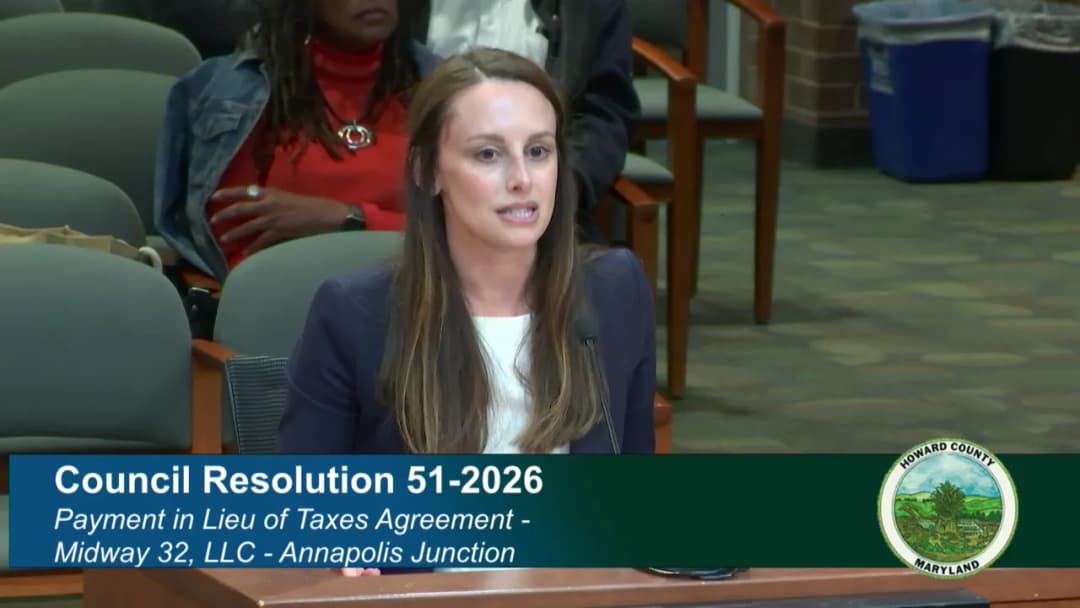
The Howard County Council held a hybrid meeting on April 20, 2026, beginning with the presentation of the County Executive's FY2027 Proposed Budget, followed by a Legislative Public Hearing to receive testimony on several resolutions and bills. The budget presentation by County Executive Dr. Calvin Ball detailed a $2.5 billion operating budget and a $120.7 million capital budget, with no property or income tax increases. The subsequent public hearing included testimony on appointments, financial transfers, economic development incentives, zoning changes, and a payment-in-lieu-of-taxes (PILOT) agreement. No final votes were taken; a work session is scheduled for April 27 and a legislative session for May 4, 2026. Consent Calendar - No consent calendar was used; all items were heard individually. Public Comments & Testimony - Appointments: Seven individuals testified in support of their appointments to various boards and commissions: Brian Auger (Property Tax Assessment Appeal Board), Eileen Marshall (Animal Matters Hearing Board), Kimberly Brokaw, DVM (Animal Matters Hearing Board), Maryam Fathirad, PMP (Public Works Board), Dinah Yukich (LGBTQIA+ Commission), Dr. Meghana S. Ray (Board of Health), and Michael Cummins (Inspector General Advisory Board). All expressed commitment to public service and relevant expertise. - Faulkner Ridge Center Funding (TAO2-FY2026 & CB22-2026): Dan Lubley, Executive Director of Capital Planning and Construction for HCPSS, testified in support of transferring $3.5 million from completed school projects to address a budget shortfall for the Faulkner Ridge Early Learning Center. He noted construction cost increases of 63% since FY2018 and that $2.4 million remains unfunded for FY2028. Rafi Healy, County Finance Director, also supported the legislation. - MTA Application (CR49-2026): Clarence Dickerson, Office of Transportation Administrator, testified in support, seeking endorsement for the FY27 annual transportation plan to access federal and state grants for RTA bus and paratransit services. - Feast & Fettle Financing (CR50-2026): Jennifer Jones, CEO of Howard County Economic Development Authority, testified in support, stating the company plans to create about 200 jobs and HCDA will provide a 10% match from existing funds. Stu Cohn (HCCA president) and Alan Schneider testified with questions, requesting more details on milestones, loan specifics, and job quality. They urged tabling for further review. - Annapolis Junction PILOT (CR51-2026): Kelly Simoneau, Director of Housing and Community Development, testified in support, noting the developer will deliver 623 rental units with 95 affordable units (32 at 20% AMI, 32 at 40% AMI, 31 at 60% AMI). Mandy Heinel, attorney for the developer, emphasized the $200 million private investment and net tax revenue increase of over $12 million over the PILOT term. Stu Cohn raised concerns about infrastructure capacity and the absence of the approved PILOT agreement in the exhibit. Brent Loveless (PTAC legislative chair, speaking independently) questioned the omission of additional expenses for schools and services. Alan Schneider argued the county should not subsidize developers in a premier location. Councilmembers discussed student yield projections; Chair Jones suggested an amendment requiring post‑occupancy data reporting. Councilmember Jung noted the high cost of building an elementary school in the area, estimated at over $63 million, and expressed concern about impacts on school capacity. - ZRA 221 – Adaptive Reuse of Motel/Hotel Sites (CB23-2026): Mandy Heinel testified in support, explaining the bill allows redevelopment of underutilized motel properties along Route 1 by applying CAC district standards and requiring affordable housing. She identified four parcels as immediate candidates. Brent Loveless testified against, arguing the corridor is being converted from commercial to residential without adequate resources for schools and infrastructure. - ZRA 222 – Optional Design Projects (CB24-2026): Mandy Heinel testified in support, stating the bill expands access to an existing design‑review process for commercial properties under 10 acres along Route 1. She confirmed the petitioner owns 10052 Washington Boulevard but has no specific site plan yet. Brent Loveless testified against, calling the ZRA a zoning change that could alter commercial/residential balance and criticizing past incentives granted to the petitioner. Councilmember Jung questioned why DPZ was not proposing such tools. Discussion Items - Faulkner Ridge Center Funding: Councilmember Yungmann questioned the efficiency of issuing a $3.5 million bond; Mr. Healy explained bonds are issued once a year and pooled with other projects. Councilmember Rigby expressed concern that construction cost increases could delay the project if the remaining $2.4 million is not secured. Dan Lubley confirmed the contractor’s bid is locked and the project can proceed with current funds. - Annapolis Junction PILOT: Vice Chair Rigby discussed student yield analysis and noted the low bedroom ratio at the project should produce few students. Councilmember Jung calculated the cost of a new elementary school at over $63 million, questioning whether the PILOT’s revenue would cover increased school costs. Chair Jones proposed an amendment to require the developer to report actual student yields after occupancy, to improve future decision‑making. Councilmember Jung cited past discrepancies in student projections at Robinson Overlook. - ZRA 221 and ZRA 222: Councilmembers asked about density limits and the number of parcels affected. Mandy Heinel confirmed most motel parcels are under 1 acre, so density would be capped at 15 units per acre. For ZRA 222, Councilmember Jung expressed concern that the proposal should come from the Department of Planning and Zoning rather than a petitioner, but acknowledged the tool’s potential. Key Outcomes - No votes were taken on any agenda items during this meeting. - The council will hold a work session on Monday, April 27, 2026 at 10:00 AM in the C. Vernon Gray Room to discuss the items heard. - A legislative session for final consideration of certain legislation will be held on Monday, May 4, 2026 at 7:00 PM in the Banneker Room. - Chair Jones indicated she plans to introduce an amendment to CR51-2026 requiring reporting on student yields from the Annapolis Junction development.

EDUCATION POLICY 13% · ECONOMIC DEVELOPMENT 13% · AFFORDABLE HOUSING 11% · BUDGET EQUITY ANALYSIS 10%
96
APR 16, 2026 · HOWARD COUNTY, MARYLAND · COUNTY COUNCIL & BOARDS
Howard County Board of Appeals – April 16, 2026: Speedfloor Mid Atlantic Appeal

The board convened a hybrid meeting on Thursday, April 16, 2026, at 9:00 am to hear case BA 827D – Speedfloor Mid Atlantic, LLC, an appeal of the Hearing Examiner’s December 23, 2025 decision affirming the Department of Planning and Zoning’s (DPZ) denial of an alternative compliance request for a 2.14-acre property (6474–6496 Lawyers Hill Road, Elkridge). The appellant sought to place a forest conservation easement on four residential lots smaller than 10 acres to preserve existing trees along an I-95 noise wall. Consent Calendar - Approval of March 19, 2026 Meeting Minutes: Motion by Ms. Ferrocop, seconded by Ms. Phillips. Unanimous vote (5-0) to approve. Public Comments & Testimony - No members of the public signed up to testify or become parties. Discussion Items - Preliminary Matter: Appellant’s counsel noted that the DPZ file had been posted on the Board site, which they considered procedurally improper for a de novo hearing. The chair acknowledged the concern and stated the board would investigate; hearing proceeded without objection. - Appellant’s Case: The appellant called Frank Manilanson, a professional land surveyor and principal at Fisher Collins & Carter, who described a six-year review process (2020–2026) complicated by two council bills, pandemic delays, complete streets implementation, and multiple plan revisions. Key points: - The property is zoned R20 with environmental features (streams, wetlands, floodplain) on the eastern and northeastern boundaries. - An earlier alternative compliance (Petition 2068) required specimen tree 4 to be protected within a forest easement; the tree later died from oak wilt. - After DPZ rejected on-lot forest easements due to concerns about encroachment and insufficient usable rear yard, the appellant redesigned to provide 25 feet of unencumbered backyard plus 35 feet of structure setback (60 feet total) before the proposed easement, with a split-rail fence and signage to mark boundaries. - The appellant’s obligation is 1.3 acres of forest conservation; only 0.3 acres of on-site easement would count, requiring off-site banking. No banks exist in the watershed, so the obligation triples to 3.9 acres, costing approximately $150,000. - Appellant’s counsel argued DPZ’s denial was arbitrary and capricious because: (a) DPZ incorrectly stated environmental features were off-site; (b) the property is unique due to the I-95 noise wall; (c) other properties in the area have forest easements on lots smaller than 10 acres; (d) the denial forces tree removal contrary to community desires expressed in 2019 meetings. - Appellant Timothy Harmon’s Testimony: He stated he lives in the community and wishes to preserve trees as neighbors requested, contrasting with a nearby development that cleared to the noise wall. He noted that regulations have added about $50,000 per lot in costs, plus $30,000 per house under an affordable housing fee, making the project unaffordable for his children. - Exhibits Introduced: Nine exhibits, including GIS screenshots, renderings of proposed (Exhibit 4) and denied (Exhibit 5) configurations, a split-rail fence detail (Exhibit 6), DPZ staff recommendation (Exhibit 7), DPZ director’s decision (Exhibit 8), and a prior Board of Appeals decision (Exhibit 9). - No DPZ representative was present at the hearing. Key Outcomes - The board closed the hearing and took the case under advisement. - Deliberation and decision are scheduled for Thursday, April 23, 2026, at 6:30 pm. - The appellant is requesting the board find DPZ’s decision clearly erroneous, arbitrary and capricious, and/or contrary to law, and to grant the alternative compliance to allow forest conservation on lots smaller than 10 acres, enforced by an HOA with a split-rail fence and signage.

ZONING AND LAND USE 37% · ENGINEERING AND INFRASTRUCTURE 27% · ENVIRONMENTAL PROTECTION 11% · TREE PLANTING 11%
97
APR 15, 2026 · HOWARD COUNTY, MARYLAND · COUNTY COUNCIL & BOARDS
Howard County Council FY 2027 Capital Budget Work Session #1 - April 15, 2026

On April 15, 2026, the Howard County Council held its first FY 2027 Capital Budget Work Session, a hybrid meeting to review capital project proposals for Police, Fire and Rescue, Agricultural Preservation, Water, Sewer, Storm Drainage, and Bridges. The session lasted from 10:00 a.m. to approximately 4:30 p.m. Councilmembers Opel Jones (Chair), Christiana Rigby (Vice Chair), Deb Jung, Liz Walsh, and David Yungmann participated. The council reviewed project highlights, asked questions, and discussed funding priorities. Discussion Items Police - Animal control design moving ahead with construction expected in FY28. Councilmember Young raised concerns about the Oracle building lease (ending in three years) and the need for a central police station, possibly in Columbia. Chief Ban stated there have been no recent discussions on a central station or lease renewal, but gateway master plan conversations have begun. Fire and Rescue - Chief Wallace presented five ongoing projects and one new (Fire Station 16). Highlights include: - Armory conversion to fire headquarters (Phase 1 $5.9M, late summer 2028) and logistics facility (Phase 2). - Fire Station 15: Land transfer from Board of Education approved, with MOU for EMT pathway program expanding to 60 students. - Fire Station 7 (Banneker): Feasibility study underway for potential rebuild on existing site due to insufficient land for relocation. Councilmember Young advocated for upgrades rather than full replacement, citing historic importance and community attachment. - Fire Station 16: New project for land acquisition in western Ellicott City/Turf Valley area to address response time challenges. Councilmember Yungmann noted a service gap ("donut hole") around Folly Quarter and suggested a medic-only facility; Chief Wallace preferred a full station but was open to discussion. He also mentioned that water tanks for rural fire protection (40 operational, 4 more planned for FY27) are sufficient, costing $330-340k each. - Councilmember Rigby inquired about the fire fund's long-term outlook; the fund is modeled through 2032. Agricultural Preservation - Joy Levy reported that the county has preserved 16,200 acres via 174 easements (including state and dedicated easements, 23,400 acres total). A 66-acre Harrison property adjacent to a previous acquisition was settled in January 2026, filling a "donut hole." Councilmember Young asked about expanding AgPres to eastern Howard County; a work group chaired by Kathy Hudson will begin meeting, aiming for recommendations by November 2026. Councilmember Yungmann noted the challenge of land value (cap at $40,000/acre vs. higher eastern prices). Water - Joseph Cabeda presented a $52.2M ask for sewer and $18M for water projects. Highlights: - Lead and copper program: 829 public-side lines of unknown material remain; county is reaching out to homeowners for private-side identification. - Clarksville water tower: Discussions with Howard County Public School System about siting on River Hill High School land are at the beginning stage. Councilmember Young emphasized early land acquisition. - Water and sewer master plan expected by end of 2026; capacity exists for 60,000 more people. - Longfellow water main replacement: Phase 1 to be completed by end of 2026; Phase 2 will be bid later this year. Elliott's Oak Road repaving will follow phase 1 completion. Sewer - Dryers (biosolids): Currently operational after engagement with manufacturer; safety interlocks and preventive maintenance being addressed. - Flow equalization project: Delayed one year due to procurement delays for engineering design; funds moved to FY28. Councilmember Yungmann expressed frustration with the procurement timeline. - Deep Run Shallow Run interceptor: Contract 1 going to bid spring 2026; contract 2 procurement planned for FY27. Storm Drainage - Total request $27.1M for FY27. Key topics: - Green streets program: Permeable pavement removal at Columbia Gateway Drive example. - Private stormwater ponds: Councilmember Rigby discussed HOA financial challenges and proposed a revolving loan program; county historically has not funded private pond repairs due to legal hurdles (liens, title complications). Councilmember Yungmann noted that asset management needs to incorporate long-term infrastructure costs. - Cedar Lane Park stream restoration: Public meetings held; design alternatives presented; underground stormwater management under one field likely; waiting on feedback from Recreation & Parks. Councilmember Young requested project details. - MS4 permit: County is in compliance; next permit cycle unknown but likely similar to large municipalities. Councilmember Young questioned the effectiveness of bay restoration efforts given the Susquehanna River dam sediment issue. Bridges - Inspection program includes 65 large, 60 small bridges and 50 retaining walls per year. Councilmember Yungmann questioned the need for $1M additional new money for project 3053 (bridge repairs) given low historical spend and high bond issuance. DPW explained that infrastructure aging and cost escalation necessitate higher funding, but Yungmann remained skeptical. Key Outcomes - No formal votes were taken; the session was informational for budget development. - The council will continue work sessions on other capital project categories in the future. - Staff committed to providing additional details on Cedar Lane Park stream restoration, private pond financing options, and further analysis on central police station feasibility.

WATER AND WASTEWATER MANAGEMENT 30% · ENGINEERING AND INFRASTRUCTURE 21% · PUBLIC SAFETY 18% · PUBLIC ENGAGEMENT 7%
98
APR 15, 2026 · HOWARD COUNTY, MARYLAND · COUNTY COUNCIL & BOARDS
Zoning Board Work Session – April 15, 2026: Approval of ZB 1133M Rezoning Petition

This meeting of the Howard County Zoning Board was held to review and decide on Zoning Map Amendment Petition ZB 1133M, filed by The Howard Research Development Corporation, to rezone two undeveloped parcels (totaling 11.01 acres) from B-2 (Business: General) to M-1 (Manufacturing: Light). The meeting also included approval of the prior meeting’s minutes and consideration of exceptions filed by Mr. Joel Horowitz. Consent Calendar - The Board voted unanimously (5-0) to approve the unapproved Zoning Board meeting minutes from April 8, 2026. Public Comments & Testimony - No members of the public spoke in opposition. The only public participant was Mr. Joel Horowitz, who filed written exceptions on April 15, 2026, and argued before the Board. He raised jurisdictional challenges, arguing that the hearing examiner’s appointment violated the county charter (Section 405B) because the examiner was not a county employee and that the rezoning should be denied or remanded. He also argued that the hearing examiner’s report improperly dismissed the doctrine of laches and that the Board should refer the employment issue to the ethics commission. The Board heard his remarks but did not adopt his objections. Discussion Items - Hearing Examiner’s Report: Ms. Nichols presented the case, stating that the rezoning is a “piecemeal rezoning” based on a mistake in the last comprehensive zoning (2013). The parcels have never been developed, lack visibility for retail, and are consistent with the Gateway Master Plan’s recommendation for light industrial/employment uses. No opposition was heard at the public hearing. The examiner recommended approval of the M-1 zone. - Board Deliberation: Board members (Chair Yungmann, Vice Chair Walsh, Ms. Rigby, Ms. Jung, and Dr. Jones) expressed support for the petition. They noted the land’s long-term vacancy, infeasibility for retail, and potential to generate commercial tax revenue. No questions or concerns were raised regarding the exceptions. Key Outcomes - Motion to Approve ZB 1133M: Moved and seconded, the Board voted unanimously (5-0) to approve the petition to rezone 9121 S. Commerce Center Drive, Columbia, MD from B-2 to M-1. A written decision and order will follow. - No Remand: The Board determined the record was sufficient to make a decision without remanding for additional hearings. - Exceptions Denied: The Board implicitly rejected Mr. Horowitz’s exceptions by approving the petition as recommended by the hearing examiner.

ZONING AND LAND USE 69% · PENDING LITIGATION 24% · PROCEDURAL 7%
99
APR 13, 2026 · HOWARD COUNTY, MARYLAND · COUNTY COUNCIL & BOARDS
Howard County Council Monthly Meeting - April 13, 2026

The Howard County Council convened its April monthly meeting on Monday, April 13, 2026, in a hybrid format. The agenda included the Spending Affordability Advisory Committee (SAAC) annual report, the Annual Comprehensive Financial Report (ACFR) for FY2025, and council reports. Councilmembers present were Vice Chair Christiana Rigby, Liz Walsh, Deb Jung, and David Yungmann; Council Chair Opel Jones was expected to join later. No formal votes were taken. Spending Affordability Advisory Committee Annual Report - SAAC Chair Holly Sun presented the committee's FY27 recommendations. Members Todd Arnerbrunn, Dr. Richard Clinch, and Alan Flynn Giles detailed the county's economic outlook and revenue projections, with additional members joining online. - Dr. Clinch reported that county fiscal health is driven by income and property taxes, which account for about 90% of revenues. He cited stress from Maryland's economic slowdown and federal cuts: Maryland has lost 15.3% of its federal employees, 11.3% of Howard County residents are federal employees, and federal procurement in the county fell 15% from $4.3 billion. Howard County ranks fifth in federal jobs, seventh in share of employment, fourth in procurement dollars, and second in procurement per capita among Maryland counties. - Mr. Arnerbrunn projected FY27 revenue growth of 6.3% over FY26, driven largely by property taxes, but cautioned that income tax revenues are volatile and the long-term growth rate is 3.6%. The committee recommended limiting expenditure growth to 4%, using any surplus to rebuild reserves, and limiting general obligation bond issuance to $75 million with a focus on deferred maintenance (countywide need exceeds $400 million, including about $200 million for schools). - Ms. Giles emphasized that Howard County is maturing: by 2030, 20% of residents will be over 65, school enrollment is declining (400 fewer students this year), and aging infrastructure demands investment. She called for responsible long-term planning. - Councilmembers questioned the committee. Deb Jung supported making SAAC full-time and asked about capital gains; David Yungmann questioned why Howard County lags the state in recovery and noted federal contractor exposure; Liz Walsh asked about contractor mix; Christiana Rigby asked about reserves and the gap between SAAC's $75 million bond recommendation and the county executive's $120 million proposal. Dr. Sun described the higher amount as a "calculated risk." Ms. Rigby stated she would struggle to approve $120 million in GO bonds and that the discussion did not change her perspective. She also presented a per-acre revenue comparison suggesting multifamily transit-oriented development can be revenue-positive. Annual Comprehensive Financial Report FY2025 - Director of Finance Rafiu H. and CLA manager Jonathan Griffin presented the audited FY2025 financial statements. The county received an unmodified (clean) opinion. - New GASB standards applied: GASB 101 (compensated absences) required a $33 million restatement of FY24 governmental activities and $1.2 million for business-type activities; GASB 102 requires tracking of concentrations and constraints, including reliance on property/income taxes, eight collective bargaining units, the charter debt limit, and mandated spending. - Key financial changes: property tax revenue rose $51 million from a rate increase (1.014 to 1.044 per $100 of assessable base); other taxes rose $71 million, driven primarily by income tax; general fund expenditures increased $47 million, including $10 million to the Housing Opportunity Fund and pay-go capital costs (North Laurel Pool, land for a high school); cash and pooled investments rose $51 million; pension and OPEB liabilities decreased. - Discussion of OPEB: the county funds retiree health care for all component units; the funded ratio is approximately 22–23%, with a net liability of about $226 million for the county portion and over $900 million including schools. The county pays about $13.5 million annually toward the liability. - Councilmember Jung asked about the water and sewer fund; Mr. Healy noted the fund has a total net position of $538 million but only about $200 million available beyond capital assets, and the county's water/sewer infrastructure is 40–50 years old. Ms. Jung expressed concern about aging pipes and rate increases. - Mr. Healy provided general fund reserve trends: 26.8% in FY25, down from 32.4% in FY24 and a peak of 36.9% in FY23. He said rating agencies have warned that falling below 25% would trigger a review, reinforcing the importance of maintaining the AAA rating. Reports - The council received reports from MACo/NACo, the Chair, the Council Administrator, and the County Auditor. No questions were raised, and the meeting was adjourned. Key Outcomes - Received the SAAC annual report and its recommendations (4% expenditure growth cap, $75 million GO bond limit, reserve replenishment, focus on deferred maintenance). - Received the FY2025 ACFR with an unmodified audit opinion. - Councilmembers voiced concerns about the county executive's proposed $120 million GO bond issuance versus SAAC's $75 million recommendation; no vote was taken. - No formal actions or resolutions were adopted during the meeting.

FISCAL SUSTAINABILITY 58% · ECONOMIC DEVELOPMENT 16% · WATER AND WASTEWATER MANAGEMENT 7% · AFFORDABLE HOUSING 6%
100
APR 13, 2026 · HOWARD COUNTY, MARYLAND · COUNTY COUNCIL & BOARDS
Howard County Council FY2027 Capital Budget Public Hearing - April 13, 2026

The Howard County Council held a hybrid public hearing on Monday, April 13, 2026, at 6:00 p.m. to receive testimony on the County Executive's proposed FY2027 Capital Budget. The budget covers capital projects for education (Howard County Public School System, Howard Community College, Howard County Library System) and general county functions (police, fire, recreation, roads, etc.). The council heard from 17 speakers, including students, nonprofit representatives, elected officials, and residents. No votes were taken; the hearing was solely for public input. Public Comments & Testimony Education – Howard County Public School System (HCPSS) - Maybelle Liu (junior, Marriotts Ridge High School, student leader of Branch Out) testified in support of expanding educational programs for students with disabilities and implementing an inclusive curriculum highlighting contributions of people with disabilities. - William Barnes (Superintendent, HCPSS) expressed appreciation for the council's partnership and strongly encouraged the council to fully fund the county executive's proposed $98.6 million capital budget allocation for the school system, calling it a move from a wish list to an action list. He noted the county executive's proposal fully funds the Board of Education's requests. - Dr. Lin Feng Chen (Board of Education member) expressed gratitude for the historic $98 million capital investment in school facilities, highlighting that most of the 80+ school buildings were built before 1980 and require significant renovations. He thanked the council and county executive for their collaborative approach. - Anthony De Bella (resident, Laura Holland) argued that Howard County Investment Income could generate an additional $10 million in FY27 to fund school budgets, recommending that the county executive allocate up to $34 million in investment income to fully fund both capital and operating budgets for HCPSS. Education – Howard Community College (HCC) - Maureen Evans (VP of Government and External Affairs, HCC) thanked the council for funding and urged continued support for the county executive's proposed FY27 capital budget, which fully funds HCC's capital requests at $3 million for deferred maintenance and systemic renovations. She highlighted progress on the Kathy and Danny Bell Workforce Development Skilled Trade Center, which will start its first cohort in fall 2026. - Vivian Moore Lawyer (Chair, HCC Board of Trustees) stressed the importance of the capital request for maintaining campus infrastructure and supporting the Bell Center. She noted that more than one in five households in Howard County are ALICE (Asset Limited, Income Constrained, Employed) and that HCC awards more degrees than the next two institutions combined. Education – Howard County Library System (HCLS) - Tonya Aikins (President and CEO, HCLS) provided data on the deteriorating condition of the current Central Library (45 years old): 72 facilities/maintenance requests since January 2024, 33 related to elevator issues; both elevators currently out of service; 143 HVAC work orders; five closures since 2024 due to unsafe conditions. She expressed gratitude for the council's December vote to acquire the lakefront site for a new Central Library and requested support for the county executive's capital budget, which includes no additional local funding for FY27. - Councilmember Deb Jung (District 4) expressed shock at the broken elevators, calling it an ADA issue, and asked whether a new elevator is in the capital request (it is not). She urged expedited action. - Rob Mints (Chair, HCLS Board of Trustees) emphasized that the current Central Library lacks adequate space for early literacy, teens (81% smaller teen space than smallest branch), and adult programming. He noted that a new library directly supports strategic goals and the county's priorities. - Ann Santos (Friends and Foundation of HCLS) thanked the council for approving land purchase negotiations and asked for approval of the capital budget with no new local funding needed for FY27. She described the current facility as an eyesore. - Angie Boiter (former president, Friends of HCLS) testified against the proposed lakefront library, arguing it would reduce access to open space at Lake Kittamaqundi and that funds should instead be invested in e-books. She called the e-book collection disgracefully small compared to Baltimore County. General County Government - Jessica Zuniga (CEO, Benton Communities; VP, Columbia Downtown Housing Corporation) expressed strong support for the new Central Library at the lakefront, arguing it will accelerate affordable housing development in downtown Columbia under the 2016 Development Rights and Responsibilities Agreement (DRRA). She noted that only 15% of required 900 affordable housing units have been delivered one-third of the way through the 30-year plan. - Zach Dickerson (Track and Field Coordinator, HCPSS) advocated for building an indoor banked track facility in Howard County, saying it would be the first in the state, keep spending local, attract regional meets, and serve as a year-round community resource for health and wellness. - Kevin Chin (District 1 resident) testified in support of the $34 million for the Elkridge Community Center, noting Elkridge's 150% population growth since 2000 and the need for equitable capital investment in the community. Discussion Items No formal discussion or deliberation occurred among council members during the public hearing. Councilmember Deb Jung briefly questioned Tonya Aikins about elevator repairs and indicated she would pursue funding for a new elevator. Key Outcomes - No votes or decisions were taken; the hearing was solely to receive public testimony. - The council will hold budget work sessions through April and May, including an April 27th session with HCC staff. - Written comments will be accepted and considered by the council prior to taking action on the FY2027 Capital Budget.

PARKS AND RECREATION 18% · EDUCATION POLICY 14% · BUDGET EQUITY ANALYSIS 13% · ARTS AND CULTURE 10%
OPENPUBLICA · PUBLIC MEETING INDEXUPDATED DAILY · openpublica.com