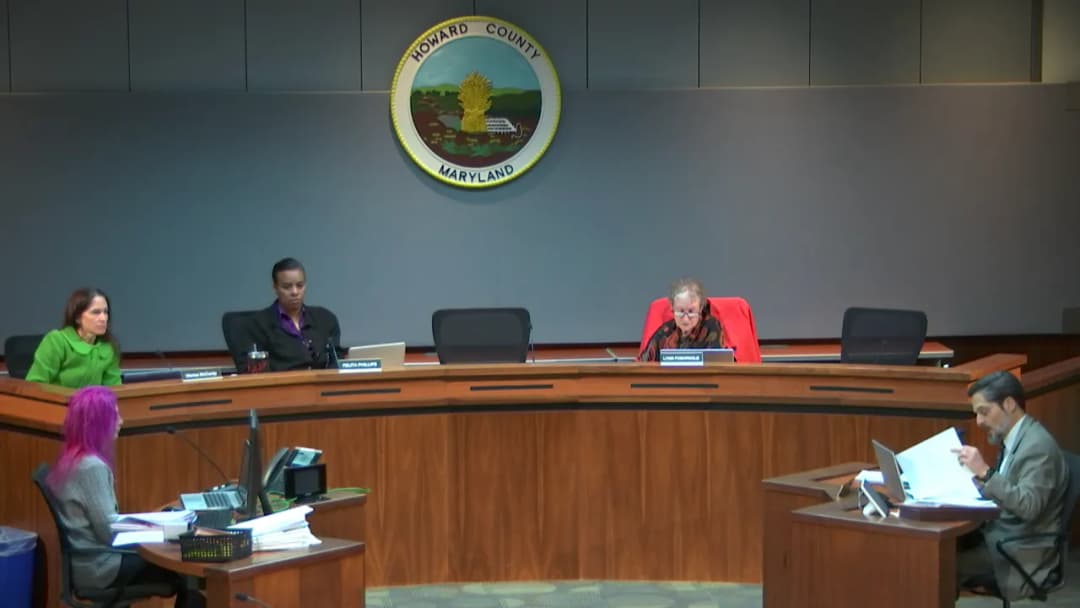
The Howard County Board of Appeals held a hybrid meeting on March 19, 2026, at 9:00 AM. The meeting addressed administrative matters, one case continuation, and planning for future board training. Consent Calendar - Meeting Minutes (March 5, 2026): Approved unanimously (5-0) with an amendment from Ms. Harris. Motion by Ms. Phillips, second by Ms. Fearcom. Discussion Items - Case BA 25-019C – Trotter 5857, LLC: An appeal of a Hearing Examiner’s decision regarding 3173 St. Charles Place, Ellicott City. The board opened the case as advertised and then continued it to May 21, 2026 (with a reserve date of May 28, 2026) due to the need for the full board to be present. No substantive hearing was conducted. - Board Training Topics: The board discussed prioritizing training topics for future sessions. Ms. Harris noted that her specific bullet points under each topic were not incorporated into the compiled document. After discussion, the majority of board members prioritized Topic 3: "Hearing Procedure and Rules of Evidence." Mr. Cook, from the Office of Law, indicated that the topic could be further divided into separate sessions on rules of evidence and procedural matters. The board agreed to coordinate with Mr. Cook to schedule a training session on Topic 3, and Ms. Harris’s additional bullet points will be added to the material. Key Outcomes - Meeting Minutes Approved: The minutes from March 5, 2026, were approved unanimously (5-0) with an amendment. - Case Continued: BA 25-019C was continued to May 21, 2026, at 9:00 AM, with a reserve date of May 28, 2026. - Training Priority Established: Topic 3 (Hearing Procedure and Rules of Evidence) was selected as the first training priority. Mr. Cook will coordinate scheduling and incorporate all board members' suggested bullets, including those from Ms. Harris.
Public Meetings - Howard County, Maryland
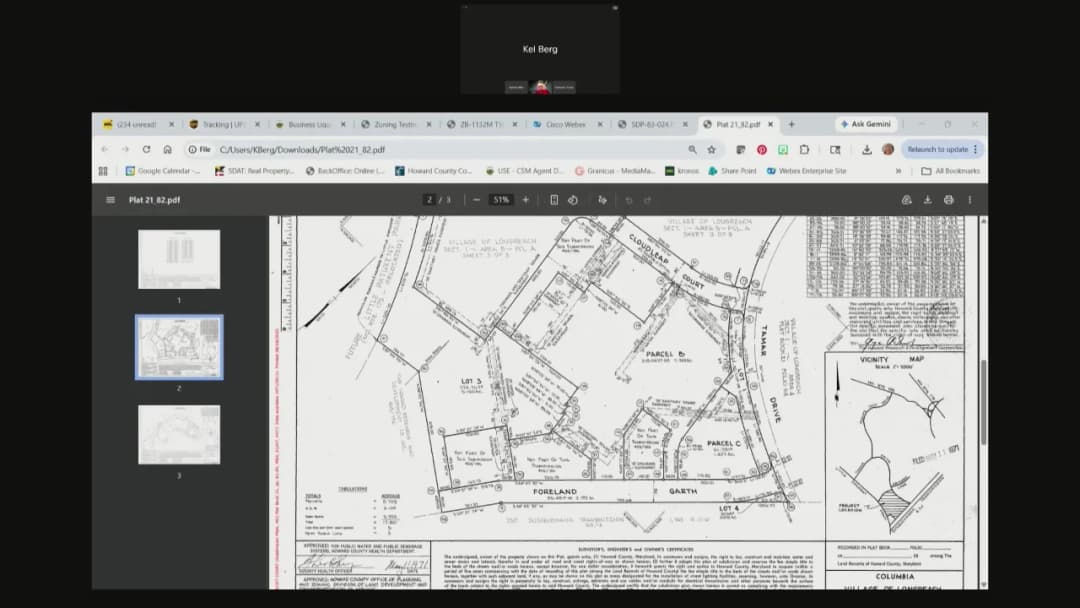
Public Meetings - Howard County, MarylandThe Howard County Hearing Examiner, Joyce Nichols, convened a continuation of the evidentiary hearing for ZB 1132M, a petition by Columbia Concepts, LLC to amend the Preliminary Development Plan for a major village center redevelopment of the Long Reach Village Center. The hearing began at approximately 10:00 a.m. on March 18, 2026, and concluded after testimony from the technical staff, undeclared witnesses, and opposition speakers. The record will remain open until April 1, 2026, for submission of legal memoranda. Public Comments & Testimony - Todd Zimmerman (undeclared resident): Expressed support for revitalization but raised concerns about the 60% increase in density (from 315 to 505 dwellings), insufficient homeownership opportunities (only 50 townhomes out of 505 units), scale of proposed seven-story buildings, and inadequate parking. He noted that the proposed timeline of nearly 10 years introduces risk, especially if the final townhouse phase is not completed. He suggested more ownership options such as condominiums. - Amy Bennett (opposition, Long Reach Village Board member speaking personally): Opposed the project at the proposed scale, noting that the density increased from 315 to 505 units in recent months. She requested a significant reduction in housing units and raised concerns about parking (a waiver likely needed for 950 spaces vs. 2,400 required) and phasing that prioritizes residential over community space. She urged the Hearing Examiner to consider the Village Board's community response statement. - Karen Emory (opposition, Columbia Association Board member speaking personally): Stressed parking overflow issues based on her experience in Long Reach and Blandair, warning that inadequate parking would impact existing apartment complexes and townhomes. She noted that Tamar Drive is being reduced from four to two lanes, worsening traffic congestion. - Richard Bannister (opposition): Opposed the sports complex, arguing it is not a community amenity (unlike a library or rec center). He stated that community engagement meetings felt dismissive and that residents were never asked what they wanted. He proposed a library and maker space instead, citing high population density and the need for educational resources. - Susan Bannister (opposition): Echoed concerns about density, traffic, parking, and the lack of benefit to current residents. She noted that the Stonehouse and art center are valuable assets that would be lost or disrupted. She questioned the need for a sports complex when other sports facilities already exist. - Debbie Boers (opposition): Stated she would prefer a cafe or restaurant and a library rather than the proposed redevelopment. She expressed concerns about traffic and high-rise buildings. - Dara Baker (opposition): Highlighted the 10-year construction timeline and the need to ensure business viability before moving to later phases. She warned of construction-related road damage and urged against granting waivers without evidence of sustainability. - Ryan Green (opposition): Opposed the parking waiver because the plan lacks a direct connection to the Ducketts Branch trail. He argued that without that connection, the parking reduction is unjustified. - Nina Bassou (undeclared, representing Long Reach Village Board): Spoke in support of the petition, noting it generally comports with the 2025 Village Center Master Plan. She recommended phasing that prioritizes non-residential and community amenities first, increased green spaces, sustainability features, improved connectivity, and minimizing disruption to the Stonehouse and Arts Center. She clarified that the Village Board voted 4-1 to support the CRS, with internal disagreement over the 505 units. - Joe Hurwitz (opposition, protestant): Argued the petition should be denied due to incomplete consideration of church parking easements, boundary ambiguities, and the lack of a clear map for the village center. He raised demographic concerns, stating that the sports complex may not serve the low-income and Hispanic community. He also questioned the project's compliance with county charter requirements. Discussion Items - Technical Staff Report (Julia Sauer, DPZ): Ms. Sauer explained the new town zoning district, the process for amending the preliminary development plan, and the role of the major village center redevelopment process. She confirmed that the 2018 boundary determination established the village center boundaries, and that the current petition covers only a portion of that area. Parking requirements will be further analyzed at the comprehensive sketch plan and site plan stages. The zoning board can set parking minimums or maximums as conditions of approval. She noted that the technical staff report identified concerns about the scale of the seven-story buildings and recommended future design review. - Closing Arguments: - Petitioner (Owen Jarvis): Arguing that the petition satisfies all 10 criteria for major village center redevelopment, emphasizing the mix of uses, open space, and community engagement. He noted that no parking waiver has been submitted yet and that the phasing is flexible. He stated the developer is willing to work with neighboring property owners on easements. - Protestant (Joe Hurwitz): Argued that the application is incomplete because easements with the church were not properly addressed and that the sports complex may not serve the local community. He urged the board to consider the operational viability of the athletic facility. Key Outcomes - The evidentiary hearing was concluded. The record will be held open until 4:00 p.m. on April 1, 2026, for the submission of memoranda of law from the parties. - After that date, the Hearing Examiner will issue a report with a recommendation to the Zoning Board. - No votes were taken during this hearing; the zoning board will make the final decision on the petition.
Administrative Appeal Hearing for BA 828D – Hillstreet Overlook LLC: Denial of Alternative Compliance for Steep Slopes (March 18, 2026)\n\nThe Howard County Hearing Examiner, Joyce Nichols, convened a hybrid meeting on March 18, 2026, at 5:30 PM to hear an administrative appeal by Hillstreet Overlook LLC (the appellant) of a November 21, 2025 decision by the Department of Planning and Zoning (DPZ) denying reconsideration of the denial of an alternative compliance application for steep slope disturbance at 8500 Hill Street, Ellicott City. The appellant sought to build a single-family home on a 6,200-square-foot legal lot of record, but DPZ determined that 78% of the site contained steep slopes (≥25%) and denied relief. The appellant argued the denial was arbitrary and capricious, particularly because DPZ repeatedly cited the property owner’s purchase date after steep slope regulations took effect as a self-created hardship. Multiple neighbors testified in opposition, raising concerns about slope instability, flooding, and ongoing road subsidence on Hill Street. The hearing concluded with closing arguments; no decision was announced, and the case was taken under advisement.\n\n Public Comments & Testimony\n- Diane Paulis (8392 Merriman Street): Testified that her property is directly below the subject lot and that the proposed house would be within 10 feet of her property line. She stated that her historic house (built 1860) was constructed on similar steep slopes, and she expressed concern that excavation could cause a landslide similar to one on an adjacent property during the 2018 flood. She noted that Hill Street is sinking, with multiple parking spaces recently removed due to road instability. She argued that any construction would pose a risk to her lot.\n- Gail Robinson (8388 Merriman Street): Testified that soil testing on the subject lot in fall 2025 caused a crack in her dining room ceiling due to constant pounding. She described the lot as having terraced slopes held up by old wooden structures and stated she does not believe a house of any size can fit on the available land without destabilizing the hill.\n- Josh Wiker (8407 Merriman Street): Lives at the bottom of the riprap wall and would be immediately affected by any landslide. He noted that county engineers recently surveyed Hill Street for movement and mentioned that long steel rods may be needed to stabilize the street. He advised the hearing examiner to consult with the county engineering department about how building on the lot might affect road stability.\n- Nicholas Slater (8505 Hill Street): Owns a historic house (built 1824) across from the subject property. He described ongoing erosion and the removal of three additional parking spots on Hill Street due to sinking. He argued that adding another house would exacerbate the parking crisis and create further instability.\n- Laura Janiszewski (8497 Hill Street): Lives directly across from the property. She corroborated the parking space removal and noted that the no-parking signs were initially wider than their current placement, indicating continued road movement. She stated that while she sympathizes with the appellant’s situation, she believes the neighbors should not bear the burden of the development.\n\n Discussion Items\n- Appellant’s Case: The appellant, represented by Christopher DeCarlo, called Frank Manilanson, a professional land surveyor and principal at Fisher Collins & Carter, as its sole witness. Manilanson testified that the slopes on the property are man-made (tiered with retaining walls) and that, in his experience, DPZ historically calculates steep slopes based on a continuous 10-foot vertical grade at ≥25%, which he argued does not exist within the proposed building footprint. He introduced exhibits including a June 2024 alternative compliance application showing a 22-foot by 35-foot house with less than 5,000 square feet of disturbance (later reduced by 29% to 22x35 ft). He stated that DPZ’s denial repeatedly cited the property owner’s purchase in December 2023 (after steep slope regulations in effect since 1993) as a self-created hardship, which he argued is contrary to Maryland case law. He also testified that a geotechnical report showed a factor of safety of 1.51 for slope stability, and that the appellant had agreed to provide stormwater management (a cistern) and erosion control measures (e.g., soil nails) even though the size of disturbance would ordinarily exempt the project from such requirements.\n- DPZ’s Position (presented through cross-examination): Barrett King, representing DPZ, highlighted multiple reasons for denial beyond the purchase date, including concerns about hydraulic loading from the cistern discharge, risk of slope failure similar to a 2018 landslide on an adjacent property, and the fact that the appellant’s exhibit still showed a carport that was no longer proposed. King argued that the appellant’s comparison to the Penkusky property (which received alternative compliance approval) was not analogous because that site was nearly an acre, had no stream buffer, no forest conservation easement, and no history of flood-related landslides.\n- Exhibits Admitted: The following appellant exhibits were entered into evidence: Exhibit 1 (GIS aerial), Exhibit 2 (buildable lot letter), Exhibit 3 (photographs A–D), Exhibit 4 (slope analysis plan), Exhibit 5 (Penkusky environmental concept plan), Exhibit 6 (alternative compliance application), Exhibit 7 (site plan with larger footprint), Exhibit 8 (soil stabilization analysis), Exhibit 9 (initial denial letter from September 2025), Exhibit 10 (Penkusky approval records), Exhibit 11 (reconsideration request), Exhibit 12 (reduced building footprint plan), Exhibit 13 (slope analysis overlay for reduced footprint), Exhibit 14 (reconsideration denial letter from November 2025).\n\n Key Outcomes\n- No decision was announced at the conclusion of the hearing. The hearing examiner took the case under advisement.\n- The appellant argued that DPZ’s decision was clearly erroneous, arbitrary, and capricious because it improperly used the property owner’s purchase date after the effective date of steep slope regulations as a basis for denying the alternative compliance request. The appellant provided citations from Maryland case law (Richards v. Anne Arundel County, 368 Md. 294; Chelsea v. City of Annapolis, 176 Md. App. 413) to support that mere purchase with knowledge of regulations does not constitute a self-created hardship.\n- DPZ countered that its denial was based on multiple technical and safety concerns, not solely the purchase date, and that the appellant had not adequately addressed those concerns in the reconsideration submission.\n- The appellant seeks an order remanding the case to DPZ with instructions to approve the alternative compliance application consistent with all other criteria, or to reconsider without considering the purchase date.
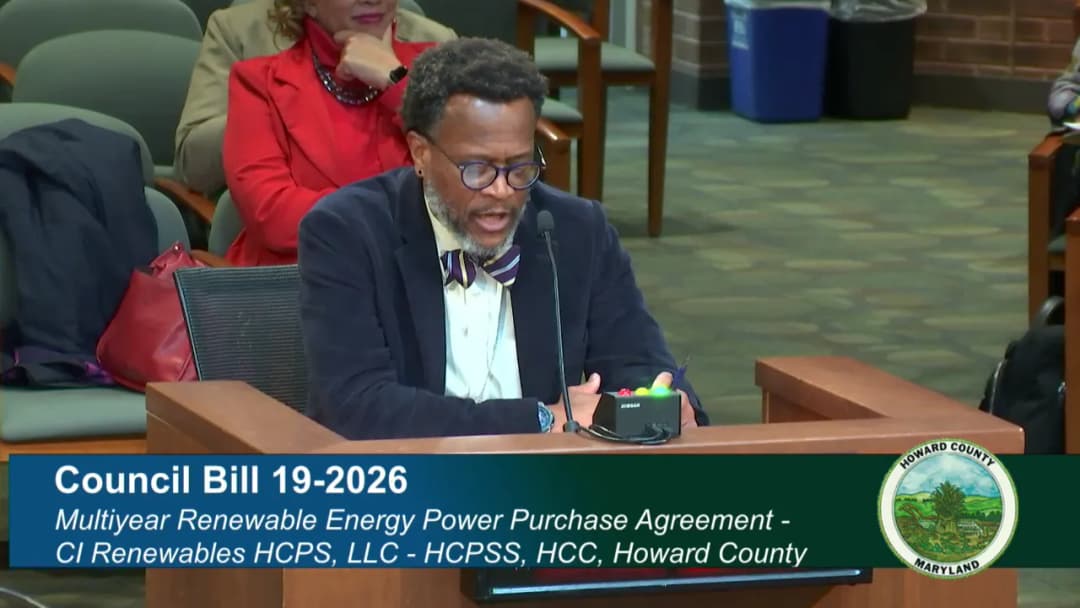
The Howard County Council held a legislative public hearing on Tuesday, March 17, 2026, at 7:00 p.m. (rescheduled from March 16 due to inclement weather). The hybrid meeting was conducted in person and via WebEx, with live streaming and broadcast on channels 44 (Verizon) and 1071 (Comcast). Councilmembers Opel Jones (Chair), David Yungmann, Liz Walsh (virtual), and Deb Jung were present; Christiana Rigby was absent. The hearing covered appointments, financial bills, and general legislation. The council will hold a work session on Monday, March 23, 2026, at 10 a.m., and a legislative session for final consideration on Monday, April 6, 2026, at 7 p.m. Public Comments & Testimony Appointments - CR211-2025 (Valoria Walker – Commission on Aging): Walker testified in support of her appointment, citing her healthcare background, master’s degree in management of aging services, and end-of-life doula work. - CR5-2026 (John Mobley – Board of Electrical Examiners): Mobley testified in support, noting his experience as a master electrician, small business owner, and Air Force veteran. - CR8-2026 (Juan Valdez – Commission for Veterans and Military Families): Valdez testified in support, describing his Purple Heart award, combat service, and work with the Wounded Warrior Project. - CR38-2026 (Melissa Terlaje – Economic Development Authority Board): Terlaje testified in support, highlighting her role as Chief Government Relations Officer at Johns Hopkins APL, engineering background, and desire to connect businesses. CB18-2026 – Lease with Preservation Maryland for Historic Jail - Emily Ayaki (Bureau of Real Estate Management) testified in support, stating the 40-year lease would allow Preservation Maryland to restore and occupy the historic jail, with the county maintaining exterior spaces. - Nicholas Redding (Preservation Maryland CEO) testified in support, noting the project has raised nearly $4 million, will create a preservation innovation center, provide University of Maryland studio space, and interpret the site’s history including two documented lynchings. CB19-2026 – Multiyear Renewable Energy Power Purchase Agreement - Tim Latimer (Office of Community Sustainability) testified in support, explaining that the joint PPA with CI Renewables would save the county $3–$3.5 million and partners $11.8–$13.9 million over 25 years. He emphasized that federal tax credit deadlines require council approval by early April. - Luke Smith (CI Renewables) testified in support, stating the company will finance, build, and operate the solar systems at no upfront cost, and that the county’s 2020 PPA has saved over $30 million. - Maureen Evans (Howard Community College) testified in support, noting HCC’s rooftop installation at Clark Library (257 kW) projected to save $475,000–$558,000 over 10 years, and the PPA will eliminate greenhouse gas emissions equivalent to taking nearly 36,000 gas-powered vehicles off the road over 25 years. - Dr. Cornell Brown (HCPSS COO) testified in support, listing eight HCPSS sites. He noted estimated savings of $8.2–$9.7 million over 25 years for the school system. Councilmember Yungmann asked about the use of the Marriott’s site, and Brown confirmed it would be used for solar panels. CR39-2026 – PILOT for Fall River Terrace Apartments - Kelly Simeno (Housing Director) testified in support, stating the redevelopment will replace 56 existing affordable units with 76 units (31 at 80% AMI, 25 at 50% AMI, 20 market rate). The PILOT is needed to close a $2.1 million gap. Chair Jones questioned community support, noting that a follow-up meeting was virtual and residents could not participate. Simeno acknowledged the concern. - Jessamine Duval (Columbia Housing Center) testified in support, stating the PILOT will generate $140,000 more in first-year taxes and that the project aligns with Columbia’s founding vision. - Jackie Ng (Housing Affordability Coalition) testified in support, emphasizing preservation of 56 affordable units, the addition of 20 market-rate units, and six for-sale townhomes. She also noted universal design features. - Jennifer Broderick (Bridges to Housing Stability) testified in support, citing the housing crisis and need for high-quality affordable housing. - Alexandra Hoffman (Enterprise Community Development) testified in support, detailing the project timeline (financial closing end of 2026, occupancy early 2028) and that the PILOT requires at least $300/unit/year plus surplus cash, expected to reach standard tax levels by year 10. - Dan Kelleher (Community Homes Housing Inc.) testified in support, thanking the council for prior approvals and noting the redevelopment improves the gateway to Columbia Town Center. CR40-2026 – Charter Amendment to Allow Bond Financing for Housing Trust Fund - Kelly Simeno (Housing Director) testified in support, stating the amendment would allow the Housing Opportunities Trust Fund to use bond financing, creating a predictable funding source. The county currently has a shortage of at least 6,100 affordable units for households earning under $60,000/year. - Kelly Rives (JCRC) testified in support, citing a survey of 169 Jewish participants where housing was a top concern, and noting that the trust fund has only received $15 million to date. - Fran Lepresti (Citizen) testified in support, stating that the county needs homes for people earning 60% or less of AMI and that the charter amendment is a needed tool. - Paul Casey (Housing Commissioner) testified in support, noting that 856 housing trust funds exist nationwide, about 20% use bonds, and Montgomery County uses bonds. He addressed Councilmember Yungmann’s question about bond ratings, stating that bond issuance would be part of the county’s overall debt plan. - Peter Engel (Howard County Housing Commission) testified in support, stating that 79% of renters nationwide have cut back on spending to cover rent, and that a bond-funded trust fund would create a revolving fund. - James Bell (Citizen) testified in support, noting that default rates on such bonds are well under 1%. - Erin Mansur (Clergy Alliance) testified in support, citing PATH listening sessions where housing was the top concern among 700 participants. - Jessamine Duval (Columbia Housing Center) testified in support, citing a statewide survey finding 92% of Maryland voters say housing costs are a problem and 73% say there are not enough affordable homes. - Dana Soar (Bridges to Housing Stability) testified in support, noting that the average two-bedroom apartment rents for $2,600/month, and that 1 in 4 county households have low incomes. She stated the county has a shortage of 9,000 affordable homes for those below 60% AMI. - Jackie Ng (Housing Affordability Coalition) testified in support, citing the Spending Affordability Advisory Committee’s warning that population growth is slowing and housing costs are eroding competitiveness. She noted that Montgomery County’s housing initiative fund has produced thousands of homes. - Nikki Highsmith Vernick (Horizon Foundation) testified in support, stating that the median home price in Howard County is about $630,000 and typical gross rent is $2,600/month. - Claire Mansor (Preschool Teacher) testified in support, sharing her personal struggle to afford housing on a $30,000/year salary and noting that rent would exceed 50% of her take-home pay. - Lisa Markovitz (People’s Voice Columbia) testified in support, stating that the bond term requirements will keep units affordable for a long time and that the amendment adds guardrails. - Melissa Rosenberg (Autism Society of Maryland) testified in support, noting that the Patuxent Commons project received 2,300 applications for 76 units, demonstrating urgent need. - Alex Hoffman (Enterprise Community Development) testified in support, stating that the trust fund has helped create over 200 units of mixed-income housing. - Jansen Evelyn (Citizen) testified in support, noting that Howard County produces hundreds of units per year but needs thousands. He compared bonding to a tool but stressed the need for a dedicated revenue stream. - Jim Sanders (Citizen) testified in support, focusing on seniors, stating that the perception of lack of affordable housing increases risk of depression and cognitive impairment. He noted that off-site construction can reduce costs by 30%. CR41-2026 – Board of Education Operating Budget Amendment - No one testified on this item. CB20-2026 – Establish Interfaith Advisory Commission - Lakeisha McClendon (Office of Human Rights and Equity) testified in support, stating that the commission formalizes partnership between county government and faith communities, which have been critical during COVID-19 and other crises. Councilmember Young asked about staffing impacts; McClendon acknowledged the workload but said they will manage and build a case for future resources if needed. - Naresh Das (Jagannath Organization) testified in support, stating that a permanent commission is necessary infrastructure for a diverse county. - Regina Clay (Life Change AME Church) testified in support, noting that faith communities have stood in the gap for housing, food insecurity, and emergencies. She noted the commission will meet quarterly. - Chapella Lewis Daima (Ahavat Yeshua) testified in support, emphasizing that the commission does not violate separation of church and state and is needed now. CB21-2026 – Enforcement of Owner Occupancy for ADUs - Jessamine Duval (Columbia Housing Center) testified in opposition, stating that the bill adds unnecessary regulatory burdens (annual attestation, higher penalties) that will disincentivize ADU construction. She argued that existing owner-occupancy requirements in ZRA 218 are sufficient. Councilmember Yungmann questioned enforcement; Duval said penalties should be increased across the board, not just for ADUs, and that annual renewal is inconsistent with the usual two-year cycle. - Jackie Ng (Housing Affordability Coalition) testified in support, but with amendments: she urged changing the rental license renewal to two years and clarifying that ADUs not rented (e.g., for family members) do not require a license. - Jennifer Broderick (Bridges to Housing Stability) testified in opposition, stating that the bill’s requirements and severe penalties will discourage homeowners from creating ADUs, which are an important tool for affordable housing. Discussion Items - CB19: Councilmember Young asked Luke Smith why CI Renewables took on the risk; Smith cited trust in the county’s energy manager Leah Miller. Young also asked about the timeline for federal tax credits; Smith explained that safe harbor must be achieved by July 2026. Young praised Miller’s work. - CR39: Chair Jones questioned Kelly Simeno about community engagement, noting that a follow-up meeting was virtual and some residents could not participate. Simeno acknowledged the concern. Later, during Alexandra Hoffman’s testimony, Jones reiterated that the meeting was not accessible, and Hoffman noted that the Harper’s Choice Architectural Committee meetings are normally virtual. Jones expressed concern that the community’s concerns were not fully addressed. - CR40: Councilmember Young asked Paul Casey about the impact on bond ratings and whether other counties use bonds. Casey noted that Montgomery County issues bonds for this purpose and that the county’s AAA rating would be considered in each bond issuance. Young also asked Peter Engel about the same; Engel confirmed Montgomery County uses tax-exempt bonds. - CB21: Councilmember Yungmann engaged in a back-and-forth with Jessamine Duval, arguing that the higher penalties are justified because ADU builders are aware of the rules, unlike accidental landlords. He indicated that the one-year renewal could be changed to two years. Yungmann also noted that a work session may not be held but that amendments are possible. Key Outcomes - No votes were taken at the public hearing. - The council will hold a work session on Monday, March 23, 2026, at 10 a.m. to discuss the legislation. - A legislative session for final consideration of the bills is scheduled for Monday, April 6, 2026, at 7 p.m. - Written testimony will continue to be accepted and considered. - For CB19, the county administration noted that council approval by early April is critical to secure federal investment tax credits for solar projects; HCPSS and HCC boards will vote on the PPA on March 25 and 26, respectively. - For CB21, Councilmember Yungmann indicated openness to amendments (e.g., two-year renewal) and suggested that the bill may be revised before final action.
The Howard County Hearing Examiner, Joyce Nichols, held a hybrid hearing on Friday, March 13, 2026, at 10:00 AM, to consider Petition ZB 1132M filed by Columbia Concepts, LLC for an Amended Preliminary Development Plan to permit Major Village Center Redevelopment at the Long Reach Village Center (8775 Cloudleap Court, Columbia, MD 21045). The hearing included preliminary motions, petitioner's witness testimony, public testimony in support, and was continued to March 18, 2026, at 10:00 AM. Preliminary Matters - Petitioner (Owen Jarvis) moved to schedule a second hearing date two weeks from March 13 to allow more time for public testimony, citing a letter from the Long Reach Community Association requesting the delay. Hearing Examiner Nichols declined to grant the request immediately, citing election-year time constraints but stated she would try to accommodate citizens. - Mr. Hurrowitz (representing the Long Reach Community Association) raised concerns that the petition was incomplete due to missing corporate disclosures and financial contributions (e.g., an affidavit lacking contributions from Victor Co./Cookjoy, and insufficient explanation of HRD Development Management's connection to other entities). He noted similar issues were pending in another case (Howard Research Development). Hearing Examiner Nichols directed Mr. Hurrowitz to articulate specific irregularities to Mr. Jarvis, and Mr. Jarvis to either correct or justify them by the next hearing. Zoning Council (Nate Foreman) interjected that failure to fully comply with disclosure provisions does not affect the evidentiary purpose or application completeness but is handled separately. Discussion Items – Petitioner's Case Petitioner's Opening Statement (Owen Jarvis) Mr. Jarvis outlined a timeline: County Council declared Long Reach Village Center blighted in 2014 and acquired 7.71 acres in 2014–2015. A prior redevelopment effort by Orchard Development was approved in 2018 (adding 315 dwelling units) but withdrawn in 2019. In 2023, the county issued a new RFP; Columbia Concepts was the sole respondent. County Council approved the urban renewal plan and sale of county property in February 2025. Community engagement sessions were held in April–June 2025. The Design Advisory Panel (DAP) recommended addressing James Rouse's vision and circulation plan. The Planning Board unanimously recommended approval in December 2025. The petition seeks to add 190 dwelling units (total 505) to the previously approved 315. Four exhibits were entered into evidence (timeline and three county resolutions). Witness 1 – Eric McWilliams (Bowler Engineering – Civil/Site Design) - Testified about existing site conditions: the village center is underutilized, lacks a sense of place, has no residential component, and the grocery store is undersized. The plan aims to create a mixed-use community hub with apartments, attached single-family, age-restricted housing, a multi-sports complex, parks, and a community arts center. - The plan preserves open space, improves stormwater management (quality-based vs. quantity-based), and adds streetscaping. The DAP requested a comprehensive circulation plan and understanding of Rouse's vision. - Cross-examination (Mr. Hurrowitz): Acknowledged the church is within the village center boundary but not included in the development plan; the plan provides parking for the church on CA property. Confirmed the 190-unit increase is in addition to the 315 previously approved. The PDP redline amendment shows a total of 505 dwelling units, which is below the maximum density of 2.5 FAR for New Town Zoning. Witness 2 – Patrick McGowan (KGD Architecture – Architect) - Designed the master plan: community engagement sessions (Q2–Q3 2025) informed the layout. The proposed use plan includes a community building (arts/community space) at the Tamar Drive frontage to draw visitors. The sports complex (volleyball, basketball, pickleball) would be phased later. Building heights are kept below maximums to fit with surrounding context. - Phasing: Phase 1 – new street network (existing community building may remain); Phase 2 – center commercial pad and community pad; Phase 3 – senior building; Phase 4 – sports complex; Phase 5 – townhomes. Phasing is flexible. - Open spaces include pocket plazas, a cross-functional park, and a ceremonial entry plaza for concerts/gatherings. The plan incorporates native plantings and sustainable design. - Cross-examination (Mr. Hurrowitz): The community building is a focal point, not full profit, and would host arts/studio spaces. The 505-unit number balances economic viability with scale. Retail is intended to be local/small-scale to distinguish from nearby big-box stores. The sports complex is for-profit and would be privately operated, not by CA or county. A berm and trees would mitigate noise/emissions from the adjacent gas station. The townhomes would be owner-occupied; the remaining 450 units are rental (including age-restricted). No demographic studies were conducted beyond community meeting feedback. The BGE towers to the east were considered as backdrop. Witness 3 – Katie Wagner (Grove Slade – Transportation/Traffic Engineer) - Prepared Traffic Impact Study (Exhibit 7), Circulation Study (Exhibit 8), and Parking Study (Exhibit 9). - Traffic: The study analyzed intersections within 1.5 miles; all intersections are projected to operate at Level of Service C or better (county standard D). The project will generate 364 net new AM peak trips, 475 PM peak, and 459 Saturday peak. A new traffic signal is warranted at Foreland Garth and Tamar Drive; a right-in/right-out access is proposed at the main entrance (no left turns). The Tamar Complete Streets project (road diet with bike lanes) is assumed. - Circulation: Pedestrian/bike connections include sidewalks, shared-use paths, and crosswalks. Direct connection to Elkhorn Branch Trail is proposed. Pickup/drop-off zones are located near building entrances. - Parking: The project provides 1,007 total spaces (833 garage, 102 surface, 72 on-street). Parking demand was calculated using ITE, ULI shared parking methodology, and Howard County ratios, with reductions for multimodal access (10% non-auto mode shift) and captive market (5% internal capture). The parking supply is deemed adequate. - Cross-examination (Zoning Council Foreman): The traffic study credits existing approved uses (315 units), not current underutilized uses. The parking study assumes shared parking; the church's parking needs were not analyzed as it is not part of the application. The bus stops on Tamar will remain. The parking reduction is justified by mixed-use and multimodal context. Witness 4 – Brian Kim (Columbia Concepts – Managing Director) - Testified as a Howard County resident and developer. The team was attracted by the opportunity to revitalize a key asset. Community engagement was central; changes were made based on feedback (e.g., non-slip walkways, lighting). The plan modernizes Rouse's vision with higher density and mixed-use to create a walkable, gathering place. - The current decline resulted from Safeway's departure and inability to attract a new anchor. The mixed-use approach (residential, retail, sports) diversifies foot traffic. The sports complex targets unmet demand for youth travel sports (basketball, volleyball, pickleball) with a for-profit model. - Cross-examination (Mr. Hurrowitz): No formal market study was done for the sports complex; the decision was based on personal experience and community feedback. No partnerships with county or CA were considered. The church's existing easements and parking agreements will be honored. The development's boundaries do not include the church or BGE right-of-way; no changes to village center boundaries are requested. Public Comments & Testimony Supporters 1. Erica Chavaria (Founder/Executive Director, Columbia Community Care) – Spoke in strong support, stating the redevelopment would provide a resource-rich community hub, benefiting families she serves (hunger relief, youth programs). She emphasized the importance of investment in neighborhoods and praised Columbia Concepts' inclusive approach. 2. Phil Sherer (Baltimoreans for People-Oriented Places) – Supported the project, highlighting the reduction of parking minimums and walkable design. He suggested additional bicycle connectivity between the Elkhorn Branch Trail and the site via a lower-grade path (per the Bikeable Baltimore Region Plan). 3. Brian Shepter (Administration of County Executive Ball) – Testified in support on behalf of the Ball administration. He summarized the decade-long effort to redevelop Long Reach, crediting Columbia Concepts' vision (townhomes, multifamily, senior housing, grocery, sports complex). He noted the urban renewal plan was approved by County Council in February 2025, and the plan delivers needed community amenities. Undeclared Person of Record - An individual (name not provided) requested not to testify on March 13, stating they were not prepared, and asked to speak at the continued hearing. Hearing Examiner Nichols continued the hearing to March 18, 2026, at 10:00 AM, and granted that request. Key Outcomes - Petitioner's exhibits 1–10 were accepted into evidence. - Corporate disclosure issues were deferred: Mr. Hurrowitz must specify perceived irregularities; Mr. Jarvis may correct or justify by the next hearing. - Hearing continued to Wednesday, March 18, 2026, at 10:00 AM to accommodate further public testimony and continuation of the case. Zoning Council's presentation and any opposition will be heard at that time. - All parties were reminded to register online for testimony; the next hearing will follow the same order of presentation.
On March 12, 2026, at approximately 10:00 a.m., Hearing Examiner Joyce Nichols conducted a hybrid hearing in the George Howard Building (Banneker Room and WebEx) for application BA 25-022V. The petitioner, Kurush Mechanic (co‑petitioner with Farehabi Habibi), owner of 3704 Red Oak Lane, Ellicott City, sought a variance to reduce the rear‑yard setback from 10 feet to 5 feet to construct an in‑ground swimming pool and two sheds/pool houses. The property is a 3.1‑acre lot, of which approximately 2.8 acres are dedicated to sewer/septic systems or reserved for forest retention, leaving limited buildable area. Public Comments & Testimony - Todd Sun and Later (3681 Blackberry Lane) spoke at length in opposition, presenting 18 exhibits. He argued that the petitioner failed to meet the statutory variance criteria, citing: (1) no unique physical conditions – all four lots in the Red Oak subdivision share identical constraints; (2) the variance would alter the neighborhood’s essential character, impair adjacent properties, and harm public welfare due to tree removal and potential destabilization of neighboring trees; (3) the hardship is self‑created because the petitioner refused alternative designs that would require zero variance; (4) the petitioner ignored a recorded forest‑buffer‑retention easement, removed dozens of trees without proper authorization, and disregarded county arborist guidance; and (5) the requested reduction is not the minimum necessary – a zero‑variance design is feasible. - Alex Chin (3707 Red Oak Lane) opposed, emphasizing that the submitted plans lack detail (e.g., no grading, fence, or retaining‑wall dimensions), and that the proposed construction encroaches on a legally recorded 20‑foot easement for forest buffer retention. He argued the variance criteria are not met: the lot is not unusual compared to others in the subdivision; alternative pool locations exist; and the hardship is self‑created (based on personal preference for symmetry and style). - Bill Hester (3701 Red Oak Lane) provided historical context, noting that developer Lois Peters subdivided the original 14‑acre parcel in 1997 with restrictive covenants to preserve wooded privacy. He argued that further tree clearing would fundamentally alter the neighborhood’s character and diminish property values. - John Roberts (3710 Red Oak Lane) supported the existing zoning regulations, stating that a variance would undermine fairness and predictability in the neighborhood. - Harry Walker (12323 Benson Branch Road) testified that the character of the neighborhood remained unchanged for 30 years until the petitioner cut down many trees. He described the area as a rare wooded community and opposed the variance. - Mike Ruane (Blackberry Lane) highlighted that his six‑acre property is entirely wooded and that the petitioner’s tree removal (approximately 30–46 trees, disputed) already altered the neighborhood. He argued the variance offloads sacrifices onto neighbors and conflicts with the community’s vision of living in the woods. - Malika Bus (3701 Blackberry Lane) stated that a pool is a luxury amenity that should not override the established zoning protections for the community’s forested character. - Charles Green (3731 Blackberry Lane, testifying by phone) noted that the property backs up to Benson Branch Park, and that tree removal diminishes the sound buffer from Route 32 and negatively affects the wider community and wildlife. Discussion Items - Petitioner’s Case: Kurush Mechanic testified that the variance is needed because 2.8 of the 3.1 acres are already encumbered; the 5‑foot reduction is the minimum to avoid relocating the septic system and drain field, which he claimed would be more environmentally destructive. He stated that the proposed pool and sheds would not alter the character of the neighborhood, impair adjacent property, or harm public welfare. He acknowledged that his personal preference for symmetry and design shapes the proposal, and that the hardship is self‑created. - Opposition’s Evidence and Cross‑Examination: The opposition, led by Todd Sun and Later, elicited admissions from the petitioner that: (a) he had not verified the recorded plat’s 30‑foot building restriction line (believing it to be 10 feet based on county zoning); (b) he had not sought to legally extinguish the easement; (c) approximately 80% of trees within 20 feet of the property line were removed; (d) no arborist assessment of critical root zones for neighboring trees was conducted; (e) alternative pool dimensions, shapes, or locations are feasible without a variance; and (f) the requested variance is not the minimum necessary. Opposition exhibits included satellite imagery, photographs, emails from county arborist Scott Mowen showing non‑compliance with tree‑removal instructions, and a recorded set of restrictive covenants (Opposition Exhibit 19) that govern the subdivision. - Rebuttal: The petitioner offered no rebuttal witnesses. Key Outcomes - The evidentiary hearing was concluded. Hearing Examiner Joyce Nichols will issue a written decision and order at a later date. - No vote was taken during the hearing; the outcome of the variance request is pending the examiner’s determination on whether the statutory criteria (Howard County Zoning Regulations §130.B.2.A) are satisfied.
This hybrid meeting (Banneker Room and Webex) was held to decide whether the Zoning Board or the Hearing Examiner would hear a pending zoning case. The board voted unanimously to approve the minutes from the February 25, 2026 administrative meeting and to refer ZB 1132M (Columbia Concepts, LLC) to the Hearing Examiner. Consent Calendar - Approval of February 25, 2026 meeting minutes: Motion by Chair Yungmann, seconded by Ms. Walsh. All voting members present (Yungmann, Rigby, Jung, Walsh) voted yes. Dr. Jones was absent. The motion passed. Discussion Items - Ethics disclosure compliance: Board members raised concerns about ensuring that the petitioner (Columbia Concepts, LLC) and its counsel (Owen Jarvis) had complied with Maryland State Ethics Law and local financial disclosure requirements. The board’s attorney, Mr. Moore, confirmed that the Ethics Commission has jurisdiction, but agreed to notify the Hearing Examiner of the board’s concern and to alert counsel to the disclosure requirements. The board emphasized that the Hearing Examiner should verify that disclosures are complete before the case returns to the Zoning Board, to avoid procedural delays. - Referral of case ZB 1132M: The board discussed whether to keep the case or refer it to the Hearing Examiner. After the ethics discussion, a motion was made by Ms. Walsh (seconded by Ms. Jung) to refer the case to the Hearing Examiner. The motion passed unanimously (4–0). Key Outcomes - Case ZB 1132M referred to Hearing Examiner: The board voted to send the Amended Preliminary Development Plan petition for Long Reach Village Center (8775 Cloudleap Court, Columbia) to the Hearing Examiner for initial hearing. The Hearing Examiner has scheduled the hearing for March 13, 2026 at 10:00 a.m. - Ethics oversight: The board’s attorney will contact the Hearing Examiner to ensure that required disclosures under Maryland State Ethics Law are checked before the record is closed.
The Howard County Council held its monthly hybrid meeting on March 9, 2026, at 10:00 a.m. The primary agenda item was a presentation and discussion on Maryland's Prescription Drug Affordability Board (PDAB). Councilmembers present included Vice Chair Christina Rigby (presiding), Liz Walsh (District 1), and Deb Jung (District 4); Councilmembers Opel Jones (Chair) and David Yungmann were absent. The meeting also included brief reports from the Council Administrator and County Auditor, with no questions or discussion. Presentation: Maryland's Prescription Drug Affordability Board Benny DeMarco, President of the Maryland Health Care for All Coalition, and Andrew York, Executive Director of the Maryland Prescription Drug Affordability Board, presented on the board's mission and upcoming actions. - Overview and History: DeMarco explained that the coalition's goal is to make healthcare more affordable, noting that 30 to 40 percent of Marylanders cannot afford necessary prescription drugs. He emphasized that high drug costs drive up insurance premiums—one-third of Blue Cross Blue Shield premium costs are for high-cost drugs—and strain state and local government budgets. He cited Anne Arundel County's spending on prescription drugs for employees exceeding library budgets. Maryland created the nation's first Prescription Drug Affordability Board in 2019, initially with authority limited to state and local government drug costs. A 2025 law (sponsored by Delegate Bonnie Cullison and Senator Don Gile) expands the board's authority to all Marylanders one year after it sets upper payment limits for state and local governments. - Progress and Plans: York described the board's cost review studies for six drugs: Farxiga, Jardiance (diabetes), Ozempic, Trulicity (diabetes), Skyrizi, and Pixim (autoimmune diseases). The board has determined that the first four drugs cause affordability challenges and is working to set upper payment limits (UPLs) for state and local governments, which would apply to county employees. The UPLs will be implemented through regulations. York noted the board also pursues non-UPL policies to help patients. The board aims to take initial UPL action on Farxiga and Jardiance early in 2026, with other drugs later in the year; savings are expected to begin when regulations take effect, possibly aligning with calendar year 2027 based on Colorado's timeline. - Discussion: Councilmembers asked about the impact of the new Maryland AHEAD model, pharmacy benefit managers (PBMs), and how local governments can support the board's work. York explained that the AHEAD model currently carves out drugs but a comment period (ending March 20, 2026) is considering including them, which could promote pharmacy transparency. Regarding PBMs, York described how rebates and confidential pricing obscure actual drug costs, though the Inflation Reduction Act's Medicare negotiation is improving transparency. Councilmember Walsh requested a deeper explanation of the insulin pricing example. - Call to Action on Legislation: DeMarco requested council support for House Bill 484 (Delegate Natalie Ziegler) and Senate Bill 587 (Senator Karen Lewis Young), which would prohibit drug corporations from taking Maryland tax deductions for advertising. An Attorney General opinion confirmed constitutionality. The bills would direct savings to Medicaid and health insurance premiums. The hearing for SB 587 was scheduled for Wednesday, March 11, 2026, before the Senate Budget and Taxation Committee. - Council Response: Vice Chair Rigby, Councilwoman Walsh, and Councilwoman Jung expressed support for writing a letter supporting SB 587 to Senate Chairman Guy Guzzone and President Bill Ferguson, as well as to Senator Young and the Speaker. The deadline for the letter to be included in the committee record was 6:00 p.m. that day. Council staff was directed to prepare the letter. Reports The Council Administrator and County Auditor provided brief reports. No questions or discussion followed. The meeting was then adjourned. Key Outcomes - The council expressed support for and directed staff to draft a letter endorsing Senate Bill 587 (disallowing tax deductions for prescription drug advertising) to key state legislators, with a deadline of 6:00 p.m. on March 9, 2026. - The PDAB presenters committed to continuing engagement with Howard County, including a future public forum when the board's authority expands to all Marylanders. - No other formal votes or decisions were taken during the meeting.
The Howard County Board of Appeals held an administrative meeting on March 5, 2026, from 9:00 AM to approximately 10:30 AM in a hybrid format. The primary purpose was to discuss and plan training objectives for the board's members. The meeting began with approval of the previous meeting's minutes and then focused on identifying training priorities and establishing a process to develop and implement the first training module. Consent Calendar - Minutes Approval: The board unanimously approved the meeting minutes from January 8, 2026. Motion by Ms. FearCog, seconded by Miss Phillips. Roll call vote: Chair Ryan, Ms. Fearclub, Ms. Harris, Miss Phillips, Ms. McCartney all approved. Discussion Items - Training Priorities Identification: Chair Gene Ryan emphasized focusing on training topics before discussing funding or resources to avoid past inefficiencies. Board members shared their perspectives on the need for structured training, especially for new members who often felt unprepared. Ms. Robin Harris presented six core training modules: 1. Maryland Land Use Law and Planning Framework 2. Administrative Law and Quasi-Judicial Decision Making 3. Hearing Procedure and Rules of Evidence 4. Ethics, Conflicts of Interest, and Ex Parte Communications 5. Writing Legally Defensible Decisions 6. Howard County Regulatory Framework - Discussion on Content and Delivery: Members agreed that the first three modules were most urgent. They discussed incorporating mock hearings, recorded training for future board members, and the importance of practical examples and demonstrations. The board also considered the need for both general and county-specific training, as well as the potential to use existing resources like Plan Howard County and videos from law schools. - Process for Finalizing Priorities: After extensive deliberation, the board decided to refine each module with specific bullet points from each member. Members will email their additions to Ms. Berg by March 12, 2026. Ms. Berg will compile the list and distribute it to the board by March 17. The board will then meet on March 19, 2026 (before the scheduled hearing at 9:00 AM) for a brief 10-minute session to agree on the first training priority. Key Outcomes - Next Steps Agreed: - Board members to submit bullet points for any of the six modules to Ms. Berg via individual email (not group reply) by March 12, 2026. - Ms. Berg will compile the submissions and circulate the full list to the board by March 17. - On March 19, 2026, at 9:00 AM (prior to the hearing), the board will convene briefly to select the first training priority. - Once a priority is identified, the board will approach the Office of Law (Mr. Cook) to solicit recommendations for resources and training providers. - Long-term Plan: The board intends to start with one training module before expanding, ensuring recorded sessions for future board members. The first topic is expected to be one of the top three modules (Administrative Law, Hearing Procedures, or Ethics).
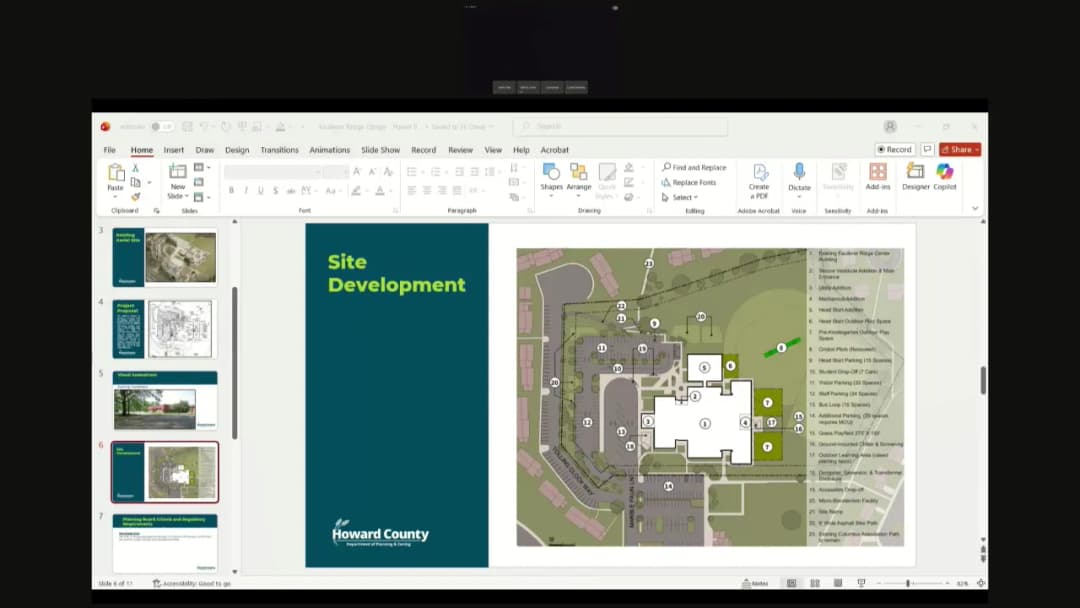
The Howard County Planning Board convened on March 5, 2026, at 12:15 PM in the Banneker Room of the George Howard Building, with both in-person and virtual participation. The board unanimously approved the agenda and the recording of the February 19, 2026 meeting as minutes, heard an executive secretary update on upcoming ZRA 224 (cottage clusters), and then considered three major agenda items: a site development plan for the Faulkner Ridge Early Learning Center, ZRA 221 (adaptive reuse of existing hotel/motel sites on Route 1), and ZRA 222 (optional design projects in the Route 1 corridor). Each item included staff and petitioner presentations, public testimony, board discussion, and a vote. Consent Calendar - Agenda Approval: Unanimously approved. - Minutes Approval: The recording of the February 19, 2026 WebEx meeting was adopted as the board’s approved minutes. - Executive Secretary Update: Noted that ZRA 224 (cottage clusters for age-restricted adult housing) will be heard on April 9, 2026, and that a deadline for zoning regulation amendments begins June 23, 2026. Public Comments & Testimony Faulkner Ridge Early Learning Center (SCP 26-003): - Danielle Peterson (Tolling Clock Way) expressed concerns about the bike path being rerouted onto Tolling Clock Way, which is already a narrow street with parking, and about loss of open space. - Paula Rivers (Tolling Clock Way) urged placement of a sign directing school traffic away from Tolling Clock Way and opposed the bike path extension onto her street. - Leila Kenny (Tolling Clock Way, Faulkner Ridge community board) supported the plan, noting the current blighted condition of the school and that the design addresses safety concerns; she appreciated that buses will not use Tolling Clock Way. - Zach Burnett (Faulkner Ridge Circle) supported the plan but requested trash cans along the walking path, native plants for landscaping and bioretention areas, and attention to stormwater runoff and drainage. - Debbie Capacity (Faulkner Station community board) supported the plan, noting community involvement in earlier design meetings (buses were rerouted away from Tolling Clock Way) and asking for trash cans and consideration of drainage impacts from the existing ditch. - Laura Wisley (Elkridge, nurse educator) praised the design but urged a dedicated loading/unloading zone that encourages proper car seat use, with driver-side curbside drop-off to reduce safety risks. ZRA 221 and ZRA 222: - Laura Wisley (Elk Ridge Community Alliance) expressed general support for both ZRAs but voiced trepidation, citing past experiences where redevelopment did not meet community needs. She urged that the planning board ensure meaningful community input and that redevelopment be comprehensive, not just piecemeal. Discussion Items 1. Faulkner Ridge Early Learning Center (SCP 26-003) - Proposal: The Board of Education seeks site plan approval for a one-story, 6,146 sq ft building addition, three soft-surface play areas (totaling 4,900 + 4,900 + 2,004 sq ft), a 1,063 sq ft mechanical addition, a 328 sq ft vestibule, a grass outdoor learning area, parking lot expansion, carpool and bus drive aisles, and an 8‑ft wide asphalt bike path on a 9‑acre parcel (Lot 92, Faulkner Ridge) at 10598 Marble Fawn Lane. The building will be re-clad with energy‑efficient materials and colorful wayfinding panels. The early learning center will house 13 classrooms (260 pre‑K students) plus a Head Start wing (3 classrooms, 60 students). Parking will provide 80 spaces. The site is exempt from forest conservation. Landscaping includes 16 shade trees, 20 evergreens, and 10 landscape trees, all native species. - Board Discussion: Questions focused on traffic circulation, wayfinding, trash cans, native plants, and stormwater management. The board proposed a motion to approve with a suggestion for additional wayfinding signage and street markings at the entrance to differentiate parent drop-off from Tolling Clock Way. - Motion: Unanimously approved with the suggestion for wayfinding improvements. 2. ZRA 221 – Adaptive Reuse and Redevelopment of Existing Hotel/Motel Sites in the Route 1 Corridor - Proposal: Adds a new subsection (128.0P) to allow eligible hotel/motel properties (lawfully established before Dec. 1, 2025, with frontage on Route 1) to redevelop by right with multifamily dwellings, multiplex housing, or mixed‑use buildings, plus all commercial/industrial/retail uses permitted in the CAC district. At least 15% of dwellings must be moderate‑income housing units. The site must be brought into conformance with the Route 1 Manual and current site development requirements. Approximately 16 parcels (30 acres) are potentially impacted. - Board Discussion: Members asked about compatibility with other corridor initiatives (e.g., development authority, parcel aggregation). Petitioner noted that the ZRA provides a streamlined tool for owners of obsolete motels to redevelop, consistent with adopted plans (HOCO by Design, Route 1 Corridor Plan). The board expressed no major concerns. - Motion: Favorably recommended to the County Council. 3. ZRA 222 – Optional Design Projects in the Route 1 Corridor - Proposal: Expands eligibility for the existing optional design project process (currently limited to the CR overlay) to all commercial properties with frontage on Route 1 that are less than 10 acres in size. The process allows flexible design and use standards, subject to planning board approval. Approximately 133 parcels (199 acres) could be affected. The 10‑acre cap protects larger employment hubs and industrial parcels. - Board Discussion: Members queried the purpose of the optional design process, its rarity (only one known previous use), and how criteria (e.g., “enhance not overwhelm the surrounding community”) would be applied. Staff and petitioner clarified that the board retains full approval authority over each optional design project and that criteria are subjective but grounded in the Route 1 Manual and HOCO by Design. Concerns about unintended consequences for large parcels were addressed by the acreage cap. The board confirmed that industrial/commercial definition is intentionally broad (“non‑residential”). - Motion: Favorably recommended to the County Council. Key Outcomes - Faulkner Ridge Early Learning Center: Approved (motion and second, unanimous) with a suggestion to add wayfinding signage and street markings at the entrance to differentiate parent drop-off from Tolling Clock Way. - ZRA 221: Favorably recommended to the County Council (motion and second, unanimous). - ZRA 222: Favorably recommended to the County Council (motion and second, unanimous). - Next Meeting: March 19, 2026, in the Severn and Gray Room (not Banneker).