The Janesville City Council met on Monday, February 23, 2026, at 6:00 PM in Council Chambers. The meeting included consent agenda approvals, public comments largely focused on the proposed Viridian data center and the Beloit Avenue housing development, discussion and action on street contracts, a supplemental budget appropriation, annexation and zoning items, a labor agreement, and a housing concept review. The council also voted to enter closed session regarding the GM/JATCO site sale. Consent Calendar - Approved minutes of the January 26, 2026 and February 9, 2026 regular council meetings. - Approved preliminary financial statements for December 2025. - Adopted resolutions commending Michael C. Rebman (32+ years of service) and Carri E. Salus (17+ years of service). - Adopted a resolution revising a Relocation Order for the East Memorial Drive STP-Urban Reconstruction Project. - Approved CSM 26001-C for Rock Energy Cooperative along Performance Place. Public Comments & Testimony - Tyballer (address given) spoke about railroad bridge footings and deed issues related to 840 South Washington Street, suggesting a partnership opportunity. He also mentioned concrete deterioration on a bridge. - Cassandra Pope questioned council members about the due diligence performed since the data center LOI approval, citing lack of public input sessions and transparency. She argued that data centers raise utility bills, using an NDA to withhold details, and that ratepayers will subsidize infrastructure. She requested the council stop misleading the public about rate increases. - Kathy Erdman (1516 South Ridge Drive) expressed concerns about the tax and revenue projections for the data center, questioning the sustainability of adding $1 billion to valuation, the risk of a single taxpayer industry, and the lack of downside modeling. She noted a recent open meetings lawsuit against Port Washington regarding a similar project. - Bill Mears supported the Bloyd Avenue residential development and urged inclusion of retail nodes for daily goods, drawing parallels to the success of the Highway 11 bypass area. He noted about 7–10 developable acres on frontage. - Austin Deal (lifelong resident) expressed pause on the Viridian data center proposal, stating it yields only about 2–3 long-term jobs per acre and a 91% loss of payroll potential compared to other uses. He advocated for production industries (solar assembly, grid storage) that could use skilled trades, and urged maximizing the GM site's long-term value. - A speaker (name not given) raised concerns about closed session timing, the NDA, the data center's size (5th largest in US), noise (60–90 decibels), diesel toxins from backup generators, and impact on Rotary Gardens. He urged the council to respect calls for a referendum and not rush decisions. - Deborah Rodell (southside resident) cited a Rolling Stone article about a data center in Oregon, linking it to well contamination, nitrate poisoning, noise, energy prices, and electrical fires. She warned that small towns are easy targets, that the local grid and water table are inadequate, and that data centers are capital-intensive, not labor-intensive. She noted Bill Gates has pulled out of centers in multiple states. - Oakley Ryan (1000 East Milwaukee Street) spoke about the Beloit Avenue project, applauding the city's community engagement process. He encouraged the council to think big, include commercial/retail, and use an open RFP process, drawing on the Woodman Center example. Discussion Items - City Manager Report: Kevin Lehner provided an update on the purchase and sale agreement (PSA) for the GM/JATCO site with Viridian. He clarified that the PSA is a legally binding contract detailing property transfer terms; a development agreement (covering noise, cooling systems, buffers, community investment, hiring, cleanup) would be negotiated later and would require council approval. He estimated the entitlement process could take up to two years. In response to Councilmember Nino's question about environmental cleanup, Lehner explained the site is currently closed with continuing obligations under DNR oversight; a materials management plan would be filed with the DNR when redevelopment occurs, and presentations on cleanup could happen during the development agreement phase. - Award of Contracts (Item 8a): City Engineer Brad Rentz presented three annual street rehabilitation contracts: curb/gutter ($2,195,239.30 to Yes Construction), water/sewer improvements ($2,675,121.50 to Madrell Excavating), and Mt. Zion Reconstruction ($4,488,293.38 to Rock Road, with a $2 million state grant). All bids were under estimate. Council approved unanimously. - Preliminary Resolution for Anthony Avenue (Item 8b): Rentz proposed a preliminary resolution to urbanize a gravel through-street (Anthony Avenue) with curb, gutter, storm sewer, and lighting, using special assessments on six adjacent parcels. The total cost was estimated at a couple hundred thousand dollars. Councilmember Miller questioned the burden on existing properties and suggested deferring assessments or having the city pay. He moved to refer the item back to staff for alternative options. The motion passed unanimously. - Supplemental Budget Appropriation (Item 8c): Finance Director Dave Godek presented a budget amendment for FY2025: reappropriating $575,000 underspent from DPW to general government and public safety, a supplemental $1.5 million for public safety overtime (primarily fire department), and using $870,024 in fund balance to bring reserves into policy compliance and fund capital items (fire equipment, security cameras, JATV media server, etc.). Council approved unanimously. - Annexation and Zoning (Items 8d and 8e): First reading of an ordinance to annex property at northerly extension of Hemmingway Drive, and a companion ordinance to zone the property to R1 (single/two-family) and B3 (general commercial). Both were referred to Plan Commission with a public hearing scheduled for April 13, 2026. - Labor Agreement with Teamsters Local 120 (Item 8f): Human Resources Director Tara Sevenchuck presented a three-year contract (2026-2028) with wage increases of 3% each year, health insurance contributions consistent with other groups, and adjustments for mechanics’ wages, vacation, holiday (MLK Day), and other benefits. Total cost estimated at $581,500 (9% increase). The union ratified on January 11, 2026. Council approved unanimously. - Mixed Residential Housing Development at 2400 Beloit Avenue (Item 8g): Senior Planner Carolyn Eswine presented the public engagement process and two concept plans (Option A: 283 units; Option B: 237 units) for a 55-acre city-owned site. After multiple public input sessions, the concepts include a mix of single-family, townhomes, cottages, and multi-family, with bioswales, trails, and connectivity. Councilmember Miller asked about including retail; City Manager Lehner said it could be considered in the RFQ. Council approved a motion to proceed and authorized staff to develop a Request for Qualifications (RFQ) for developers. Key Outcomes - Awarded three street improvement contracts to lowest bidders (all unanimously approved). - Referred the Anthony Avenue street improvement back to staff to explore alternative funding options (unanimous). - Adopted supplemental budget appropriation for FY2025 (unanimous). - Approved first readings and scheduled public hearings for annexation and zoning of Hemmingway Drive properties (April 13, 2026). - Approved labor agreement with Teamsters Local 120 (unanimous). - Approved moving forward with the Beloit Avenue housing development concept plans and authorized an RFQ process (unanimous). - Voted to convene into closed session to discuss the GM/JATCO site sale (no vote taken in open session).
Public Meetings - Janesville, Wisconsin
Public Meetings - Janesville, WisconsinOn Monday, February 23, 2026, at 5:15 PM, the Janesville City Council held a special workshop session in City Hall Council Chambers to receive a 30-minute presentation from Ehlers, Inc. (Todd Teaves) and City Finance Director Dave Godek on the economic and tax implications of a potential large-scale data center project. The presentation focused on levy limit mechanics, net new construction, TID closure adjustments, and the flexibility the city would have in managing additional revenue. A 15-minute Q&A period followed, with hard stops set at 5:30 PM for the presentation and 5:45 PM for questions. The session adjourned promptly thereafter. Presentation on Data Center Economic and Tax Impacts - Todd Teaves (Ehlers, Inc.) explained that under Wisconsin levy limit law, the city's general operating levy can increase annually only by the percentage of net new construction from the prior year. For the 2025 valuation cycle, Janesville added approximately $130 million in new construction, equal to 1.63% of total value. Net new construction occurs both inside and outside TIDs, and the city may carry forward unused levy capacity for up to five years before it is lost. - Teaves described two scenarios for a data center project located in TID 42: - If the TID remains open, the city could either claim the net new construction annually (raising the levy but increasing the tax rate because only non-TID properties pay the higher levy) or defer/not use it (neutral on tax rate, no additional revenue). At TID closure, the city would receive a one-time closure adjustment based on the final incremental value. - If the city closes the TID or removes the development site, the new tax base becomes available immediately. Claiming all net new construction would keep the tax rate stable while increasing revenue; claiming none would push the tax rate down, providing property tax relief. - Finance Director Dave Godek added concrete projections: a $1 billion assessed value data center would increase the city's total assessed value by about 13%. The share of residential property would drop from 70% to 61.7% of the tax base, and annual tax revenue would increase by approximately $4.8 million. The mill rate would decline as citywide assessments rise. Council Questions and Discussion - Councilmembers asked about flexibility in using additional revenue, including reducing debt (e.g., avoiding borrowing for short-lived assets like police vehicles), creating sinking funds, and funding community development. Teaves and Godek confirmed significant but not unlimited flexibility, noting that the project would build out over six years, not all at once. - Councilmember Nino requested the historical percentage of taxable value that General Motors represented (last fully valued around 2010). Godek stated he would need to research the figure. - Councilmembers inquired about valuation methodology: the assessor would likely use cost of construction due to lack of comparable sales or income data for data centers. Construction value would be added incrementally each year as buildings are completed. - A councilmember asked about the risk of the project failing (data center not built), leaving the city with debt for infrastructure. Godek estimated that $30 million in new debt would cost the median assessed homeowner about $845 per year. - Councilmember Miller noted that the net new construction percentage would decrease after the large project (because the denominator grows), but the total dollar amount of levy capacity would still be larger. Godek confirmed and said his office's normal budget recommendation would be to take the maximum allowable levy increase, though the council has discretion. - Multiple councilmembers emphasized that this project is not a single solution; continued growth and diversification of the tax base remain essential. The council thanked the presenters. Key Outcomes - No formal votes or decisions were made; the session was informational only. - Councilmembers gained a clearer understanding of levy limit mechanics, the trade-offs of keeping vs. closing TID 42, and the flexibility available in budgeting additional revenue. - The city will continue evaluating the proposed data center project, including its build-out timeline and long-term fiscal impacts.
Consent Calendar - Approved the minutes of the January 20, 2026 regular meeting as amended after a correction to the date (the original draft incorrectly referenced January 20, 2020). The motion carried unanimously. Public Comments & Testimony - No written or in-person public comments were received. Discussion Items - State Award Programs: The commission reviewed two Wisconsin Historical Society award opportunities. No eligible project exists for the Preservation and Rehabilitation Award, so no application will be submitted. Applications will be pursued for the Historic Preservation Excellence Awards in two categories: - Identification and Designation: For the three elementary schools listed on the National Register last April; one application covering all three schools. - Advocacy: For the roadway signage project being installed throughout historic districts. Commissioner Mitch stated that submission materials are nearly ready, pending a few clarifications, and applications should be submitted by the end of February, well before the deadline. - Local Historic Preservation Award: The commission discussed the local award program that had only two submissions last year. They agreed to release the application as soon as possible, with a closing date of March 27, 2026 (a Friday). If submissions are insufficient, the period may be extended to no later than April 15. Awardees will be announced at a May meeting during Historic Preservation Month. The commission decided not to require that completed work be within the last two years, to encourage participation. They also discussed advertising through the city manager's office, press releases, social media, and neighborhood groups, and posting past awardees on the city website. Announcements - Commission Member Klingaman resigned; Member Hansen is reaching term limits. Two vacancies will be filled, with applications accepted through March 8, 2026. Chairperson Griff is eligible for reappointment. - Michael Roach is no longer pursuing redevelopment of the engineering building. - The zoning code update will eventually include sections on the Historic Preservation Commission for commission review. - More street signs are being replaced in the Courthouse Hill area. Key Outcomes - Approved minutes as amended. - Decided not to apply for the Wisconsin Historical Society Preservation and Rehabilitation Award. - Directed staff to finalize and submit Historic Preservation Excellence Award applications for the school designations and signage advocacy. - Set the local award application deadline for March 27, 2026, with possible extension to April 15; announcement planned for May 2026. - Agreed to coordinate with the city manager's office on promotion and to post past awardees online.
The Board of Trustees of Hedberg Public Library met on February 17, 2026, beginning at 4:30 p.m. in the Woodruff Room, with a virtual option via TEAMS. The meeting included routine consent items, reports, old business on retiree insurance and board officer nominations, and new business involving the 2025 DPI annual statistical report and a SOAR strategic planning session. Note: The provided timestamp indicates 10:30 UTC, which conflicts with the agenda's 4:30 p.m. start time. Consent Calendar - Approval of the February 17, 2026 agenda - Approval of the minutes from the January 20, 2026 meeting - Financial reports: 2026 Operating Statements through January 31, 2026, and Expenditure Approval covering January 15 to February 11, 2026 - Activities Report - Library Trustee Essentials: TE11 Planning for the Library's Future Public Comments & Testimony - Public comments were invited per library policy, but no oral comments were recorded or presented during the meeting. Reports - Prairie Lakes Library System Report (Assistant Library Director) – included in packet; no oral presentation. - Friends of the Library Report (Library Board Representative) – included in packet; no oral presentation. - Activities Report – department heads reported in writing; no oral reports given. - Library Director Report – included in packet. Old Business - HPL 55-65 Retiree Insurance Gap: Board officers reported on the status of the retiree insurance gap for employees aged 55-65. - Board Officer Nomination Process: Board President provided an update on the officer nomination process. New Business - Presentation of 2025 DPI Annual Statistical Report: The Library Director presented the report and requested board approval to sign the 2025 DPI Annual Report. - Board SOAR Analysis for Strategic Plan: Consultant Cindy Fesemyer led a SOAR (Strengths, Weaknesses, Opportunities, Aspirations, Results) analysis to inform the library's strategic planning. Key Outcomes - The consent calendar items were approved by unanimous consent (no separate discussion or recorded votes). - The board took action to approve signing the 2025 DPI Annual Report. - The SOAR analysis was conducted; no formal decision was documented—likely a workshop session. - Next regular meeting scheduled for March 17, 2026, at 4:30 p.m. Adjournment - The meeting adjourned; no specific time recorded.
The Plan Commission met on Monday, February 16, 2026, at 6:00 PM in the Council Chambers at City Hall, Janesville, Wisconsin. The meeting covered consent agenda items, approval of a revised relocation order for the East Memorial Drive reconstruction project, and a director's report on an upcoming council workshop. Commissioner Bowerman was absent; all other commissioners were present. Consent Calendar - Approved the minutes of the previous meeting without discussion. - Approved three Certified Survey Maps (CSMs) under the consent agenda: - CSM 25031-T (Mary Ann Burkheimer): 1 lot and 1 outlot along N. County Road F, Town of Janesville. - CSM 25034-T (Mary A. Russell): 2 lots along US Highway 51 and Russell Road, Town of Janesville. - CSM 26001-C (Rock Energy Cooperative): 1 lot along Performance Place. All passed without objection. New Business - Revised Relocation Order for East Memorial Drive STP-Urban Reconstruction Project The commission considered a resolution to establish a revised relocation order for the project. The order authorizes acquisition of fee simple and temporary limited easements to facilitate the reconstruction. Staff provided a brief update, noting the project had been discussed previously. Commissioner Squire moved to adopt the order, recommending the City Council proceed with the transactions, with the stipulation that the Plan Commission had not reviewed the financial aspects. The motion was seconded by Commissioner Williams. After a question about railroad coordination (staff confirmed all necessary approvals were obtained), the commission voted unanimously via roll call: Commissioners Squire, Madare, Don Tara, Bosco, and Williams voted yes; Commissioner Bowerman was absent. The resolution will go to the City Council on February 23, 2026. Director's Report - The Director announced that the City of Janesville will host the second in a series of council workshops regarding data center development, scheduled for Monday, February 23, 2026, at 5:15 PM in the Council Chambers. The topic is the economic and tax impacts of data centers. The workshop will be televised. The Director noted that the City, including the Finance Director, is facilitating the session, potentially with an outside consultant. Key Outcomes - All three Certified Survey Maps (CSMs) approved under the consent agenda. - The revised relocation order for the East Memorial Drive reconstruction project was approved unanimously (6-0) and referred to the City Council for final action on February 23, 2026. - The commission acknowledged the upcoming council workshop on data center development, which will be open to the public.
The Janesville City Council met on Monday, February 9, 2026, at 6:00 PM in the Council Chambers. The primary agenda item was a second reading and public hearing on a proposed ordinance (File Ordinance 2026-926) that would require voter approval for any development project or development agreement exceeding $450 million in costs, or any transfer, conveyance, or encumbrance of the GM/JATCO site. The meeting also included a consent agenda, a city manager update, and extensive public testimony. Consent Calendar - Resolution 2026-2412 (Peace Park Playground Renovation) was pulled by Councilmember Williams for discussion. The council discussed that the project is a renovation, not a complete redo, preserving the iconic playground's original features. The resolution passed unanimously. - All other consent agenda items (Riverside Golf Course bunker renovation, solid waste collection vehicles, IT room HVAC study, commendations for Jane E. Burr and Michelle Wilson-Smith, and licenses) were approved unanimously without discussion. City Manager Update - City Manager Kevin Laner announced a $5 million federal grant earmark from Senator Tammy Baldwin's office for blight elimination, originally focused on the GM/JATCO site and expanded to 21 additional properties. The funds will be administered by the EPA or Economic Development Administration. Laner thanked Senator Baldwin and noted that Janesville was one of the largest recipients in Wisconsin. Public Comments & Testimony (General and Public Hearing) General public comments (before public hearing): - A resident (Ty) spoke about the history of the GM site, railroads, and water power, urging the council to consider an electric railroad on 10 acres of the site and criticizing the data center proposal. Public hearing on Ordinance 2026-926: - Eileen Newcomer (League of Women Voters of Wisconsin, Janesville resident) expressed concern about the process, stating that the petition with over 4,000 signatures shows the public wants a voice. She urged the council to respect the direct legislation process. - Kevin Algiers (Janesville south side resident) shared personal experience from Mount Pleasant with the Foxconn project, warning against repeating mistakes. He asked the council to think carefully and not be swayed solely by dollar signs. - Adam Schultz (Coldwell Banker Commercial) supported the data center proposal, citing the site's contamination and high remediation costs ($30-40 million). He argued that no other developer has been willing to invest, and the project represents a unique opportunity for Janesville. He noted that the site's economics do not work for other uses. - Katie Myers (Janesville small business owner and content creator) stated she is still undecided about the data center. She urged the council to allow more time for informed discussion, avoid extremes, and maintain respectful dialogue. She supported the city's recommendation to refer the ordinance to the November ballot. - Amber Manny (Janesville resident with chemistry background) requested the council adopt the ordinance outright, giving citizens a vote. She highlighted concerns about water use and trust in government. - Sean Kennedy (lifelong Janesville resident) argued the ordinance would complicate redevelopment and recommended sending it to referendum in November for more public education. - George Cullen (community member) requested the council not adopt the ordinance directly but refer it to the November ballot. He expressed concern that the $450 million threshold would hinder all large development, not just data centers, and could deter future investment. - Mick Gilbertson (IBEW Local 890, Southern Wisconsin Building and Construction Trades Council) strongly supported the data center, emphasizing that the developer is prepared to invest $30-40 million in remediation. He noted that the site has been vacant for over 10 years and that this project would create union construction jobs, drive infrastructure investment, and generate immediate property tax revenue (TIF district closing). He urged the council to move forward. - Garrett Harwick (union representative, IBEW Local 890) echoed support for the data center, highlighting the remediation commitment and the need for progress. - Brett Halsey (gubernatorial candidate) addressed the broader AI concerns and suggested the council work with petitioners to narrow the ordinance scope to avoid lawsuits, while allowing a referendum. - Casey Peterson (U.S. Navy veteran) supported the petition as a pro-voter measure, stating that projects over $450 million should have a public vote. He recommended adopting the ordinance. - Cassandra Pope (organizer of No Janesville Data Center, city council candidate) clarified that the petition is not anti-data center but pro-community involvement. She urged the council to adopt the ordinance, arguing that referring to November would delay and potentially bypass voter input. She criticized the city administration for one-sided information and urged the council to represent the community. - Kathy Erdman (Janesville resident) asked the council to adopt the ordinance, noting that over 4,670 citizens signed the petition. She criticized the delay and asked whether the council would delay the land sale until after the November vote. - Nick Reed (Janesville resident) urged adoption, citing NDAs and lack of transparency. He quoted principles of public service. - Brad Schmidt (Janesville resident) expressed skepticism about the data center's job numbers and asked for checks and balances to avoid a Foxconn-like situation. - Alyssa Capazello (Janesville resident) urged adoption, citing environmental concerns (air quality, water use, pollution). She challenged the council to think with compassion and empathy. - Lisa McAfee (lifelong Janesville resident) raised concerns about air pollution, water usage, and lack of AI regulation. She asked the council to adopt the ordinance to give citizens a voice. - Sam Nemitz (Party for Socialism and Liberation, petition organizer) stated the petition is about democracy, not stopping development. He urged adoption, warning that a November referendum could be a delay tactic. He called on the council to stand with constituents. - Andrea Breyer Moon (Fourth Ward resident) questioned the viability of data centers due to AI advancements and space-based alternatives. She criticized the city's handling of the site and urged the council to step back. - Noah Mills (Janesville resident) cited multiple studies on water consumption, climate change, and health impacts of AI data centers. He urged the council to send the ordinance to referendum or vote against the data center. - Charlene Negus (Janesville resident) noted that weather and holiday season limited signature collection. She asked for greater transparency and for the council to adopt the ordinance or put it on the November ballot. - Brendan Pokinghorn (Janesville resident) praised the petitioners' efforts but expressed concern that the $450 million threshold could deter redevelopment. He did not make a specific recommendation but urged caution. - Mark Fuller (Janesville resident) urged adoption, noting that the petition process brings community voices. He suggested that a full voter turnout would provide the truest picture. - Ty Bularud (Janesville resident) spoke about railroad history, mercury poisoning, and criticized the data center proposal. He suggested a percentage-based deal for the site. - Sean Nishaus (U.S. Army veteran, event organizer) promoted a military gala and motorcycle ride, not directly related to the agenda. - Yusuf Adamo (Beloit resident) spoke about data centers as sacrifice zones, citing air quality and energy justice. He urged the council to take a pause and consider the broader regional impacts. - Diane Dooley (Milton resident) raised concerns about CO2 emissions, the AI bubble, and property taxes. She favored a different development for the site. - Riley Pitkin (Janesville native, age 20) expressed feeling that opportunities are being taken from young people. He opposed the data center but wanted growth, asking the council to consider the future. - John Wangren (Janesville resident) thanked the council for due diligence. He supported referring the ordinance to the November ballot to allow all voters to decide, cautioning against misinformation. - Stephen Gainon (Janesville resident) supported referring to the ballot, noting that the $450 million threshold could limit development. He highlighted long-term infrastructure jobs. - Tony Capazello (former restaurateur and educator) cited a Harvard Law article on data center electricity costs and ratepayer impacts. He urged caution. - Angelina (petition organizer) stated the petition is valid under Wisconsin statute 9.20 and is not anti-development. She urged adoption or a guaranteed November vote. - Taylor Ransom (Janesville resident) criticized the council for patronizing tone and urged adoption of the ordinance. - Aaron Agater (Janesville resident) expressed concern about the purchase agreement deadline potentially bypassing the vote. He asked the council to adopt the ordinance. - Stephen Atkinson Jr. (Janesville resident) spoke in support of the petition, asking for a motion to withhold any final agreement with Viridian until after the petition process concludes. - Lynn Retzloff (Janesville resident) urged adoption, stating that health and environment outweigh dollar signs. - Brian Newmeyer (Sheet Metal Workers Local 18) argued that adopting the ordinance only hears 7% of the population; a referendum in November would give all voters a voice. He noted that construction jobs are permanent for workers. - Zaley Pope (17-year-old Janesville resident) suggested the city could clean the site itself for $30 million instead of relying on a data center. She preferred a park or grocery store. - Patrice Wilson (Janesville resident, AI company employee) urged balance between economic benefit and community/environmental impact, emphasizing transparency. Discussion Items - City Manager Kevin Laner gave a detailed presentation on the proposed data center project, including the letter of intent with Viridian Partners, site remediation costs ($30 million), projected economic impacts ($2 billion direct economic benefit, $3.7 billion total impact, 21,000 jobs supported, 600 permanent jobs, $12 million annual tax revenue at full buildout). He outlined the city's control over the development process and the legal constraints of the ordinance, noting that the council's options were limited to either passing the ordinance or referring it to the electorate. He stated that the city would likely face legal challenges regardless of the council's action and recommended referring the ordinance to the electorate. - Councilmembers discussed the two options: adopt the ordinance outright or refer it to the November ballot. Several councilmembers (Squire, Williams, Nino, Burdick) expressed support for the November referendum, citing the need for broader public input and more time for community education. Councilmember Miller noted a preference for the spring election but supported the November date. The council voted unanimously to refer the ordinance to the November 2026 general election. Key Outcomes - Consent Agenda (except 6B): Approved unanimously. - Resolution 2026-2412 (Peace Park Playground): Approved unanimously after discussion. - Ordinance 2026-926 (Referendum on large projects at GM/JATCO site): The council voted unanimously to submit the proposed direct legislation ordinance to the electorate at the fall general election (November 2026) pursuant to Wisconsin Statutes 9.20. The city attorney was authorized to draft ballot language for approval at a future council meeting. - The meeting was adjourned after council announcements.
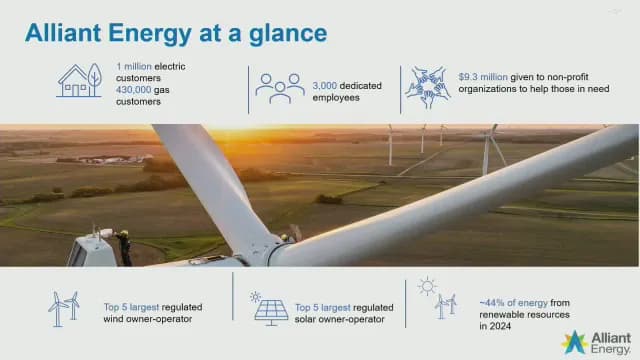
This special session workshop on February 9, 2026, was the first in a series of workshops addressing data center topics. The 30-minute presentation by Alliant Energy focused on how electricity is generated, transmitted, delivered, and how rates are set in Wisconsin, with specific emphasis on dispelling misconceptions about energy costs associated with large industrial customers such as data centers. The session included a 15-minute question-and-answer period for council members only. No votes or decisions were taken; the meeting adjourned at approximately 5:59 PM. Presentation & Discussion - Alliant Energy Representative: Becky Vaughn (identified as President of the Wisconsin Energy Group; note that the agenda listed "Becky Volk" but the transcript uses "Becky Vaughn"—a discrepancy). She emphasized that Alliant Energy is agnostic about customer type and legally obligated to serve any customer within its territory. She explained the role of MISO (Midcontinent Independent System Operator) as the regional transmission operator balancing supply and demand across 15 states and Manitoba. - Key points from the presentation: - In Wisconsin, utilities are regulated monopolies with rates set by the Public Service Commission (PSC) to ensure reliable service at reasonable cost and utility financial viability. - Fixed costs make up the majority of customer bills; attracting new customers helps spread these costs and can lower rates for all. - For large load customers (e.g., data centers), Alliant negotiates contracts that require the customer to pay for any dedicated infrastructure (e.g., substations) and provide financial security (letters of credit) to protect other ratepayers if the customer leaves early. - Two independent studies (Lawrence Berkeley National Lab and Charles Rivers Associates) found that states with strong electricity load growth often have lower or declining real prices, and recent rate changes are driven by localized factors, not data center growth. - Councilmember Questions: - Vice President Squire asked about rate impacts across the service area. Ms. Vaughn confirmed that a new large customer anywhere in Alliant's Wisconsin territory affects rates equally across all customers in the state. - A councilmember (unidentified) asked about the treatment of infrastructure costs and risks if a data center closes. Ms. Vaughn explained that Alliant requires contractual guarantees from large load customers to cover specific investments, unlike standard customers who can leave without penalty. - Another councilmember asked about potential bias given Ms. Vaughn's prior service on the PSC and the revolving door between regulators and utilities. Ms. Vaughn noted her 20+ year career in the industry, with less than a quarter spent at the commission, and stated she is proud of her record.
The Alcohol Licensing Advisory Committee (ALAC) met on Tuesday, February 3, 2026, at 8:00 AM in Council Chambers. The committee considered two license applications and received staff reports. Five members were present (Brunner, Miller, Squire, Knox, and Chair Miller) and two were absent (Henry and Sickich), constituting a quorum. The meeting was adjourned at approximately 8:45 AM. Consent Calendar - Approval of Minutes: The minutes from the January 6, 2026 meeting were approved unanimously on a motion by Brunner, seconded by Miller. Public Comments & Testimony - No members of the public came forward to speak on non-hearing agenda items. Discussion Items - Temporary Extension of Class B Premise – O’Riley & Conway’s Irish Pub, 214 W. Milwaukee St.: The committee reviewed an annual request to extend the licensed premise for St. Patrick’s Day celebrations on March 14 and 17, 2026. The extension is a recurring application (approximately 15–16 years). Staff noted no changes from prior years and no police objections. The committee approved the extension unanimously on a motion by Knox, seconded by Squire. - Original Application for Class B Intoxicating Liquor & Fermented Malt Beverage License – Rick's Jukin Barclub & Grill, LLC dba Rick's Jukin Barclub & Grill, 1901 Beloit Ave.: Applicants Ricky D. Smith Jr. (1901 Beloit Ave.) and Ricky Smith Sr. (one Walcott St., Janesville) presented their business plan for a sports bar, concert venue, and nightclub. They plan to operate the former “Back of the Yards” space, including the adjacent softball fields. Key details: - Food will be available via an operational kitchen; a health department license is expected by the end of the week. - Alcohol service will be limited to a designated area (marked by red lines), using only plastic containers. Patrons may take drinks to seating (picnic canopies) but alcohol cannot touch the playing fields. A separate outdoor bar is not planned. - Security: Six security guards will be on site; the police department is approximately 7 minutes away. - The applicants plan to run softball, kickball, and volleyball leagues through the GW Smith Foundation. - Ricky Jr. owns four restaurant franchises in California and has management experience; this is their first tavern operation. - The police department had no objection. - A motion to approve the license was made by Squire, seconded by Miller. An amendment was offered (and accepted) to include the outdoor patio/canopy area on the plans for clarity. The motion passed unanimously (5–0). Staff Reports - Janesville Police Department: No incidents to report on current establishments. - City Clerk's Alcohol License Quota Report: No issues reported. - Temporary Licenses Issued: Standard report; no licenses under conditions currently. - Follow-up on Licenses with Conditions: - Brazilian Steakhouse: The parking lot is not plowed and no activity has been observed. The establishment is two months into a six-month extension granted in December 2025. No further updates. - Indian Cuisine (Swad): A soft opening has occurred; they are working with Rock County on remaining requirements. A new city ordinance allowing Dane County agents will enable them to use a Madison agent to finalize their application. Key Outcomes - Approved: Temporary extension for O’Riley & Conway’s Irish Pub (March 14 & 17, 2026). - Approved (5–0): Original Class B license for Rick's Jukin Barclub & Grill, including the outdoor patio area. This license will be forwarded to the Janesville City Council for final approval on Monday, February 9, 2026, at 6:00 PM. The applicants were advised to attend that meeting (the item will appear on the consent agenda). - No action: The committee took no further action regarding the Brazilian Steakhouse or Indian cuisine follow-ups; these remain pending. - Adjourned: The meeting was adjourned on a motion by Knox, seconded by Brunner, with no opposition.
The meeting was held on 2026-02-03 at 11:00:00+00:00. However, no agenda, minutes, or transcript were provided, so no discussion items, public comments, or decisions can be summarized. Note - No substantive information is available for this meeting.
The Janesville Area Metropolitan Planning Organization (MPO) Technical Advisory Committee (TAC) convened on Monday, February 2, 2026 (2026-02-02), at 1:30 PM CT (19:30 UTC) in Training Room 416 at Janesville City Hall, with a virtual attendance option. The meeting was advertised as a public hearing. The agenda covered approval of the December 1, 2025 meeting minutes, a proposed amendment to the 2025–2030 Transportation Improvement Program (TIP), and an update on the Long Range Transportation Plan (LRTP). Consent Calendar - Approval of the December 1, 2025 Technical Advisory Committee meeting minutes was listed on the agenda. New Business - Amend 2025–2030 Transportation Improvement Program (TIP) – Incorporation of 2026 Performance Measures: The committee was scheduled to review the Q1 2026 memo and resolution packet amending the 2025 TIP to incorporate 2026 performance measures. - Long Range Transportation Plan (LRTP) Update: The committee was scheduled to review an LRTP update memorandum with supporting elements: Background and Purpose; Freight; Transit; Bicycle & Pedestrian; and Streets & Highway. Communications - The agenda included communications from staff and from members, followed by adjournment. Note on Source Materials - No meeting minutes or transcript were available for this meeting. As a result, specific discussion content, individual speaker positions, public testimony, and formal votes/outcomes cannot be summarized. The agenda's public hearing notice directed comments to staff at chapmank@janesvillewi.gov or 608-755-3163.