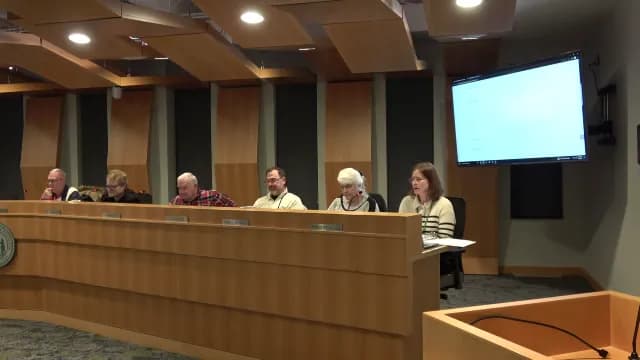
The Janesville Plan Commission met on February 2, 2026, at 6:00 PM. The meeting opened with a tribute to the late Commissioner Doug Markline, followed by roll call (all members present), consent agenda approval, and a detailed presentation on the proposed mixed residential development at 2400 Beloit Avenue. The Commission unanimously recommended forwarding the concept plans to the City Council and authorizing a Request for Proposals (RFP) process. Consent Calendar - Approved the minutes of the previous meeting (no details provided). - Approved Certified Survey Maps (CSM) under the consent agenda: CSM 25025-C (Cody Ellickson & Justin Erdman, three lots along South Marion Avenue), CSM 25029-T (Michael & Cynthia Cusick, two lots along East Bingham Road in Town of Harmony), and CSM 25032-T (William & Susan Krebs Revocable Living Trust, one lot along North Polzin Road in Town of Janesville).all items were approved without objection. Public Comments & Testimony No public comments were taken during the meeting. The Commission noted that a future public hearing will be heldt when a specific developer proposal is submitted. Discussion Items 1. Review of Mixed Residential Development at 2400 Beloit Avenue - City Manager Kevin Lanier and consultant Carolyn Eswine (C Planning Studio) presented the results of a multi-month community engagement process for the approximately 55-acire site (39 developable acres). oTwo concept plans were presented: o - Option A: 283 units (5.1 units per acre), including 54 single-family homes (1,200-1,400 sq ft), duplexes, townhomes, and apartment buildings (up to 3 stories) along Beloit Avenue. Includes bioswales, trail connectivity, and a direct path to the school. - Option B: 234 units (4.25 units per acre), with 40 single-family homes plus 12 cottage units, fewer duplexes, and a different street network (two access points). Both options responded to community feedback favoring small-scale, walkable neighborhoods and a buffer of larger structures along Beloit. - Commissioners discussed traffic impact on the school, stormwater management, use of TIF, and density on the 12-acre parcel. Commissioner Squire praised the process and alignment with the new zoning code. Commissioner Bowerman expressed preference for Option B due to unit mix and street grid. Commissioner Squire also noted support for Option B. - The presentation confirmed that developers expressed confidence in delivering units under $300,000 threshold due to reduced footprints. 2. Director's Report on Zoning and Subdivision Ordinance Update - Planning Director Duane reported that staff is finalizing revisions to the zoning and subdivision codes based on prior Commission feedback. The next review session is tentatively scheduled for March 16, 2026, followed by a public open house. All articles (1-3) have been finalized and shared. Remapping of the city's 26,000 parcels is underway and will be presented after the teext review. Key Outcomes - Unanimous Motion (6-0): The Commission recommended that the City Council adopt the concept plans for 2400 Beloit Avenue and authorized staff to prepare an RFP/RFQ to solicit developer interest. The motion was moved by Commissioner Squire and seconded by Commissioner Dongere. o- The item will be heard by the City Council on February 23,2026. o- The zoning code update process will continue with a public open house after the March 16 Plan Commission meeting.
Public Meetings - Janesville, Wisconsin
Public Meetings - Janesville, WisconsinNo agenda, minutes, or transcript were provided for this meeting. Therefore, no summary can be generated.
The Janesville City Council held a regular meeting on Monday, January 26, 2026, at 6:00 PM in the Council Chambers, 18 North Jackson Street. The meeting focused on the recognition of a former council member, public comments on the proposed data center and a referendum ordinance, and the first reading of an ordinance that would require voter approval for development projects exceeding $450 million at the GM/JATCO site. The council voted on motions to expedite the ordinance to the April ballot, but both motions failed. Recognitions - The council observed a moment of silence for former council member and council president Doug Markline, who passed away. Markline served from 2013, holding multiple leadership roles including council president, Plan Commission chair, and MPO Policy Board chair. Consent Calendar - Approved minutes of the January 9, 2026, Special City Council Meeting and the January 12, 2026, Regular City Council Meeting. - Approved licenses and recommendations. - Approved financial statements for November 2025. Public Comments & Testimony - Ty Bullrood (Milton, WI) raised concerns about a potential railroad derailment downtown, alleging the city is ignoring safety issues. He urged the council to invite engineer Mike Payne back to inspect the tracks. - Julie Backen-Keller (719 North Grant Avenue, Janesville) read from a blog by Rich Gruber, criticizing the city's lack of transparency, particularly regarding the data center proposal. She argued that the advisory committee on appointees has been bypassed by the city manager, and that public input has not translated into influence. - Aaron Aguilar (526 Laurel Avenue, Janesville) opposed the data center, stating it is not appropriate for the urban GM/JATCO site. He noted that previous plans had called for a centennial park honoring General Motors, and that the proposed 8–11 building hyperscale data center (165 million square feet) would negatively impact the neighborhood. He supported putting the ordinance to a referendum so citizens can vote. - Kathy Erdman (1516 South Ridge Drive, Janesville, Snow Janesville volunteer) thanked council members who placed the direct legislation petition on the agenda. She argued that the city staff's memo overstates the impacts of a $450 million threshold, noting that no such project has ever been proposed in Janesville until now. She stated that a referendum would force better due diligence and community engagement, and urged the council to adopt the ordinance or send it to the April ballot. - Sam Nemitz (resident near Center and Burbank, organizer with Party for Socialism and Liberation) emphasized that the petition gathered 4,600 signatures despite cold weather and holidays. He argued that the process has lacked transparency and that the people deserve a direct say in massive projects. - Samantha Doukas (statewide data center activist) testified that she has worked with multiple Wisconsin communities facing data center proposals, all of which have been opposed by residents. She stated that the 4,600 signatures represent the will of the people and that the council should adopt the ordinance immediately or send it to a referendum, as allowed by Wisconsin Statute 9.20. She noted that Port Washington sent a similar petition to the ballot without delay. - Alyssa Capozziello (Sumac Street, Janesville) spoke in favor of the ordinance, saying she collected signatures out of love for the city. She asked the council to pass the ordinance without alteration or submit it to the electorate. - Erica Lund (no address given) spoke briefly in support of the ordinance, echoing earlier speakers. - Mark Fuller (320 East Holmes Street, Janesville) thanked the council for including the petition on the agenda. He urged the council to apply curiosity and listen to the people, and to put the ordinance on the April referendum. - Kimberly Liebergen (Kennedy Road, Janesville) asked the council to adopt the ordinance without alteration. If not, she urged putting it on the spring election ballot. She stated that doing nothing would be a slap in the face to the 4,600 residents who signed the petition. City Manager Report - Assistant City Manager Ryan McHugh reported that emergency warming sites have been open due to cold weather and will continue through Saturday. Sites include Giftsman's Shelter, Mercy Health ER lobby, and First Congressional UCC Church. - Employee of the Year awards were announced: Sue Arnt (payroll clerk, administration), Sergeant Benji Thompson (JPD, public safety), and Beth Johnson (public service representative, public works). - Winter weather response: 4 weather events, 3 citywide plows, 48 hours of response with 40 staff members, operators averaging 12.25 hours of work. Total snow accumulation of 11.6 inches from January 16–22. JPD wrote 567 citations during the snow emergency on January 20. - Upcoming data center workshops: February 9 (energy), February 23 (economic/tax impacts), March 9 (Wisconsin Data Center Coalition), March 23 (water usage), April 13 (labor, education, jobs). All workshops at 5:15 PM in council chambers. Discussion Items - First Reading of Ordinance 2026-926 (Referendum for Projects $450M at GM/JATCO Site) - The ordinance proposes that any development project or development agreement exceeding $450 million in project costs, or any transfer, conveyance, or encumbrance of the GM/JATCO site, must be approved by the electorate. - Councilmember Miller moved to submit the ordinance without alteration to the April 7, 2026, spring election pursuant to Wisconsin Statute 9.20(4). However, the city attorney advised that the city's rules require a second reading and a public hearing before the ordinance can be adopted. Councilmember Miller then amended his motion to suspend the rules requiring multiple readings and a public hearing. - Vote on suspension of rules: Failed 5–2 (Councilmembers Burdick, Squire, Nino, Williams, Cass voted no; Miller and Erdman voted yes). - After the suspension failed, Councilmember Miller moved to move the ordinance to the April ballot without alteration. The city attorney stated that the motion is in order but its legal effect is likely moot without a second reading and public hearing. - Discussion ensued. Councilmember Williams and others argued that a public hearing should be held to allow all residents, not just those following social media, to participate. Councilmember Squire emphasized the need for more information through the upcoming workshops and stated that putting it on the November ballot would give more time for informed decision-making. Councilmember Erdman argued that the county clerk's timeline could still accommodate an April referendum if the language was provided by the statutory deadline. - Vote on motion to move ordinance to April ballot: Initially reported as 5–2, then corrected to 4–3 (Miller, Cass, Erdman voting yes; Burdick, Squire, Nino, Williams voting no). The motion failed. Key Outcomes - The first reading of Ordinance 2026-926 was held. The council scheduled a second reading and public hearing for the February 9, 2026, meeting. - A motion to suspend the rules to allow immediate adoption and referral to the April ballot failed 5–2. - A motion to directly move the ordinance to the April ballot without a public hearing failed 4–3. - The council will proceed with the public hearing and second reading on February 9, 2026. The ordinance could potentially be placed on a later ballot (likely November 2026) after full council consideration and public input.
This meeting of the GM/JATCO Redevelopment Advisory Board was convened to interview two finalist firms – Stantec and AECOM – for master planning and development strategy services for the former GM and JATCO site (approximately 250 acres in Janesville). After presentations and board discussion, a motion was made and carried to select Stantec as the recommended firm, with Sigma (not interviewed on this date) as an alternative if contract negotiations fail. Note: The agenda and transcript indicate the meeting took place on Tuesday, January 20, 2026, but the provided date for this summary is January 22, 2026. The exact date used here follows the instruction that the meeting occurred on 2026-01-22. Presentations & Interviews - Stantec Presentation (approx. 40 minutes + Q&A): The firm introduced its team of planning, brownfield, and community engagement specialists. Jim Hallman (planning lead) noted Stantec has 34,000+ employees, 450 locations, and 2,000 community development specialists in North America. Amy Worsham (project manager) emphasized an integrated approach: combining environmental due diligence (over 550 brownfield grants secured, totaling $140 million) with market analysis and public engagement. Harris (brownfield expert with a doctorate in contaminant hydrogeology) shared a personal connection as a UAW child and stressed that contamination data must be translated into planning-ready documents from day one. Jay Delma (urban planner) described a market study focusing on demand drivers, indicators, and site context. Renee Blaine (landscape architect) outlined an iterative design process with multiple public workshops. Key points: 18-month proposed schedule; strong emphasis on grant funding, including a North American funding practice and partnership with KSU TAB (free technical assistance); a community sentiment and risk assessment tool (optional, inexpensive); and branding/rebranding the site early. Stantec positioned itself as a neutral third party and said the site's environmental liabilities (PCBs, metals, TCE, lead, petroleum) require careful phasing. Bill (a former city consultant now with Stantec) provided three years of site-specific knowledge, noting the GM parcel (north) has concrete slabs capping contamination, while the JATCO parcel (south) is cleaner but has unknown risks. Board members asked about phasing, grant stacking (e.g., six grants over seven years on a 350-acre project), public engagement, and the challenge of $30 million cleanup costs. Stantec responded that funding doesn't scare them and that they have written 60% of EPA grants in Wisconsin. - AECOM Presentation (approx. 30 minutes + Q&A): Chris Brewer (vice president) led with 30 years of industrial redevelopment experience, including military base reuse. Alex Miller (project manager) proposed a 10-month schedule (vs. the RFP's 18 months) to maintain community momentum, and emphasized an intensive first three months: meeting with environmental consultants, stakeholder interviews, and a concentrated market analysis. Shannon Flanigan (brownfield specialist, environmental engineer) reviewed the site's contamination, noting that the JATCO site might be more suitable for housing but warned of vapor intrusion and remediation costs. AECOM highlighted its integrated team (SMEs in transportation, water, cost estimating, data centers) and optional financial analysis for the back-end transaction. Public engagement centered on three in-person open houses plus a digital survey, with a philosophy of co-design: stakeholders receive the same data as planners before giving input. Chris discussed challenges like rail lines and slab removal, and the importance of defining success (tactical vs. strategic goals). Example projects: West Dundee, Illinois (mall-to-mixed-use); Kenosha Innovation Neighborhood (brownfield remediation); and a passenger rail study for Rock/Dane County. AECOM stressed that public engagement must be high-touch to change narratives, especially given the data center proposal. Board members asked about the 10-month schedule and risk of rushing; AECOM said they can adapt and that the budget can be managed if adjustments are needed. Discussion & Selection After both interviews, the board discussed each firm's strengths and weaknesses. Board members provided impressions: Mick (chair) saw Stantec as strong in master planning, public engagement, and grants, but felt their design visuals were lacking; he noted AECOM's design approach was more illustrative but questioned their narrow focus. Jeff liked Stantec's energy (Harris) and mentioned the JATCO site's potential for housing. Lindsay appreciated Stantec's branding and grant expertise. Craig favored Stantec and Rinka (not interviewed that day). Kristen liked AECOM's environmental specialist and their honest discussion about stakeholder management and gentrification. Nate found Sigma (not interviewed) appealing for its collaborative approach but noted Stantec's in-house resources. Jim C. preferred Sigma for its priority on Janesville and more intimate feel. James emphasized the need for a firm that can deliver tough love and avoid analysis paralysis. Kevin (city manager, via video) noted that both finalists are strong, with Stantec having in-house expertise and Sigma bringing creative partners like Cardio. A straw poll of top-two firms among board members yielded: Rinka – 1, Sigma – 7, Stantec – 8, AECOM – 2. Rinka and AECOM were eliminated. Further discussion highlighted Stantec's grants, branding, and project management (Amy) versus Sigma's energy, gamification, and real estate connections (Josh). The city manager advised focusing on the project manager as the key relationship. Key Outcomes - Motion: Mick moved to direct the city to enter into a contract with Stantec for the GM/JATCO redevelopment master planning, with a friendly amendment (by James) that Sigma be second choice if contract negotiations fail. Seconded by Craig. Vote: 7 in favor (Burkhart, Devorek Stone, Winchell, DeGarmel, Bittendorf, Gilbertson, Otterstein, Kuborn), 1 opposed (Deninger). Motion carried. - Next Steps: City staff will negotiate a contract with Stantec based on the RFP and their response. If an agreement cannot be reached, staff will return to the board to recommend Sigma. The contract is expected to be brought to city council for approval. Professional courtesy requested: no social media posting until all consultants are notified. - Meeting adjourned.
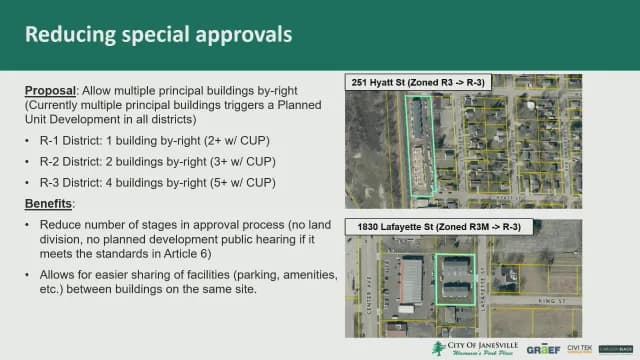
The Community Development Authority (CDA) met on Wednesday, January 21, 2026 at 5:30 PM in City Hall Council Chambers. The meeting included a presentation on the city's zoning and subdivision code rewrite, a public hearing and approval of updates to the Rent Assistance Administrative Plan, and a director's report. All votes were unanimous. Consent Calendar - Approved the minutes of the December 17, 2025 regular meeting and the Budget Performance Report under consent without separate discussion. Discussion Items City of Janesville Planning Presentation on Zoning and Subdivision Code Rewrite - Dwayne Sherry (Planning Director) and Brian Schweigel (Senior Planner) presented proposed changes to the zoning code, focusing on expanding housing opportunities. Key proposals include consolidating six residential districts into three, allowing residential uses in commercial districts, reducing minimum lot sizes and setbacks, increasing density, and streamlining approval processes. For example, on a five-acre site, the number of possible single-family lots would increase from 25 to 43 under the new R1 district; multifamily density could rise from 96 to 534 units on a five-acre R3 site. Accessory dwelling units (ADUs) and alternative housing types (e.g., cottage courts, tiny homes) are also included. - CDA member Michael Cass asked whether parking could be unbundled from lease requirements to reduce costs; staff noted the code allows parking reductions based on location and design but deferred to market decisions. Cass also inquired about incentivizing infill development alongside large-scale projects; staff responded that code changes apply uniformly and that ownership and neighbor preferences often constrain infill, but the code aims to lower costs and streamline review for infill sites. - No vote was taken; the presentation was informational. Public Hearing and Consideration of Updates to the Rent Assistance Administrative Plan (Homeownership Choice Voucher Program – A Place of My Own) - Staff presented revisions to Policy 33 of the Rental Assistance Administrative Plan, which enables housing choice voucher recipients to use rental assistance toward mortgage payments for homeownership. Since the program began in 2021, no participants have used it. Staff consulted with other housing authorities and local lenders to identify barriers and updated the plan to: clarify acceptable loan types (FHA loans allow the voucher as a payment offset; conventional loans count it as income), add requirement for cash reserves of $1,000 at closing for maintenance, include post-purchase homeowner education, and specify grounds for termination of assistance. Staff recommended approval. - CDA members asked questions about termination procedures and program outreach. Staff explained the due process for termination (including appeals to an independent hearing officer and circuit court) and noted plans to meet with lenders and real estate agents in March 2026 to promote the program. - A public hearing was opened; no members of the public spoke or submitted written comments. The hearing was closed. Key Outcomes - Unanimous approval (voice vote) of the revisions to the City of Janesville Rental Assistance Administrative Plan Policy 33, dated January 21, 2026. Motion by Lisa Hegins, seconded by Scott Greenland. - The director reported that a federal appropriations bill has been drafted, proposing an 8% increase in housing choice voucher assistance and a 2% increase in administrative fee funding, but a formula reduction may affect Janesville. Community Development Block Grant and HOME funds are expected to be level-funded. - The director also announced the resignation of CDA member Brian Bridges due to competing priorities, creating a vacancy to be filled through the city's normal board/commission appointment process.
Date: Tuesday, January 20, 2026 Time: 5:00 PM – 5:33 PM Location: City Hall, Council Chambers, 18 N. Jackson Street, Janesville, WI Meeting called to order at 5:00 PM by Chair. Roll call confirmed five members present (Griffith, Crummers, Conrad, Go, Terrell; Hansen abstained on roll call? One member abstained from approval of minutes). The meeting covered approval of prior minutes, a federally funded riverwalk lighting project, public outreach activities, and planning for historic preservation award programs. Consent Calendar - Approval of Minutes – December 16, 2025: Motion to approve carried with one abstention. (No other consent items.) Public Comments & Testimony - No members of the public provided comment, either in person or via written submission. Discussion Items - East Bank Riverwalk Lighting Project (Section 106 Review): Staff presented plans to replace existing concrete light poles and bollards with new painted aluminum LED light poles along the Rock River near several historic districts. The project is funded through the federal Carbon Reduction Program, administered by the Wisconsin Department of Transportation (WisDOT). City Assistant Engineer Anna B. Jack confirmed that funding for state fiscal year 2026 is secure, though later phases (2028) are less certain. The commission discussed: removal of electrical outlets from poles (stated reason: safety and to discourage congregation/charging); potential for increased light pollution from omnidirectional poles vs. directional bollards; and the new poles’ aesthetically more historic design. Multiple commissioners expressed support, noting the new fixtures match existing pedestrian-scale lighting on Main Street and will be more attractive. The chair directed staff to submit a positive comment to the reviewing agency. - Public Outreach and Calendar of Annual Activities: Staff reported sending a welcome packet to a new property owner at 315 E. Home Street (no response yet). A commission member volunteered to follow up. The group also discussed establishing contacts with local Realtor associations; another member offered to work with staff on messaging. The calendar of activities was reviewed; members agreed to rely on a digital PDF and update as needed, removing calendar review from future agendas. - Historic Preservation Award Programs: The commission reviewed three award opportunities: 1. Board of Curators Awards (under $2.5 million category) – The St. Patrick’s Church project was identified as a potential candidate. A commissioner requested the application form to start conversations, as the work must have been completed within the last two years. 2. Historic Preservation Excellence Awards – The commission showed interest in the Advocacy category. Staff will share links and application details. 3. Local Historic Preservation Award Program – Staff reviewed prior nomination forms (last awarded in 2024). Members suggested adding optional photo uploads and ensuring property owner awareness. The group agreed to continue the local program for 2026, with proclamations, press releases, and social media posts. Staff will investigate obtaining past video highlights from JATV. Key Outcomes - Lighting Project Comment: The commission voted (by consensus) to submit a positive formal comment on the East Bank Riverwalk Lighting Project, noting aesthetic improvements and support for the design. - Public Outreach: A commissioner will personally contact the new property owner at 315 E. Home Street. Staff will assist in developing a Realtor outreach message. - Award Applications: Staff will provide application links for the Board of Curators and Excellence Awards. A commissioner will begin exploring the St. Patrick’s nomination. Local award details (optional photos, timeline) will be finalized ahead of a typical March launch. - Next Meeting: Tuesday, February 3, 2026, at 5:00 PM.