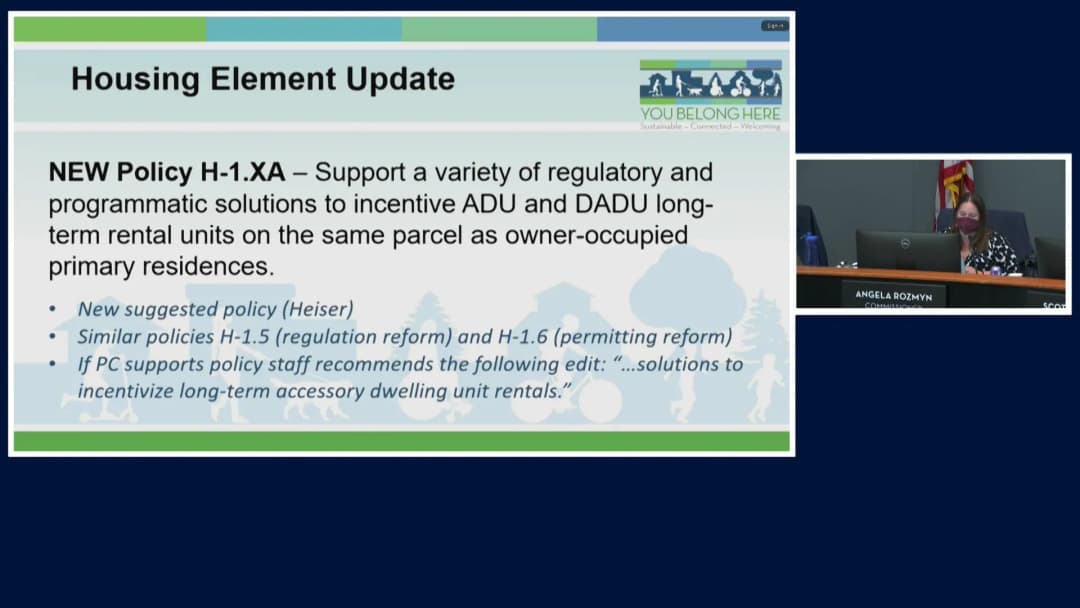
The Kirkland Planning Commission held a continued public hearing on the Housing Element of the 2044 Comprehensive Plan. After extensive deliberation and numerous amendments, the Commission voted 6-1 to approve the Housing Element as amended. The Commission also approved the minutes from June 27, 2024. Consent Calendar - Approval of Minutes (June 27, 2024): Motion carried 7-0. Public Comments & Testimony - Ken MacKenzie (Kirkland): Emphasized that neighborhoods are what make Kirkland special, noting that every homeowner, renter, and business belongs to one of 13 designated neighborhoods. - Margaret Bull (Kirkland): Expressed concern that the Cross Kirkland Corridor trail might eventually be replaced with transit, as was the original intent. - Landyn Knipp (Kirkland): Described her family's 10-year effort to afford a home in a single-family neighborhood and expressed fear that proposed policies would erode the character and safety of neighborhoods she worked hard to join. Discussion Items - No Confidence Motion: Vice Chair Heiser moved a vote of no confidence in the Comprehensive Plan process, requesting a middle-growth alternative. The motion failed 1-6 (Heiser in favor; Rutherford, Allen, Jacobson, Madeya, Reusser, Rozmyn opposed). - Main Motion: Commissioner Jacobson moved to approve the Housing Element as presented in the packet, with administrative edits. The motion was seconded and then amended through a series of policy-by-policy changes. - Key Amendments and Votes: - H-1.2 (Strike): Carried 7-0. - H-1.4 (Strike): Carried 4-3 (Rutherford, Allen, Jacobson, Rozmyn yes; Heiser, Madeya, Reusser no). - H-1.5 (Amend): Carried 7-0. - H-1.6 (Amend – replace “increasing” with “building”): Carried 7-0; further amend to strike “capacity”: Carried 7-0. - Deeply Affordable & Emergency Housing (H-1.8 & H-1.9): After withdrawn motions, adopted a combined policy using “explore removal of regulatory barriers” and siting language. Carried 6-1 (Heiser no). - H-1.10 (Amend – strike location language, add context-sensitive direction): Carried 6-1 (Heiser no). - H-1.XA (ADU/DADU – strike owner-occupancy requirement): Carried 6-1 (Heiser no). - H-1.XB (Middle housing – amended to include all forms and avoid adding costs): Carried 7-0. - H-1.XD (Short-term rentals – “help preserve housing stock by evaluating and managing the inventory”): Carried 7-0. - H-1.12 (Amend – replace “in areas that have potential to be” with “in 10-minute neighborhoods”): Carried 7-0. - H-1.14 (Amend – adopted alternate policy with location language from H-1.15): Carried 7-0. - H-1.15 (Amend – adopted alternate policy with location language): Carried 7-0. - H-1.20 (Amend – add “surplus property not designated for parks or open space”): Carried 7-0. - H-1.11 (Amend – adopt alternate policy on no net loss): Carried 7-0. - Goal H.2 & Alternate Goal H.3 (Amend – adopt as shown): Carried 6-1 (Heiser no). - H-2.2 (Strike – redundancy): Carried 7-0. - H-2.3 (Amend – focus on disproportionately impacted populations): Carried 7-0. - H-2.9 (Amend – community suggestion): Carried 7-0. - H-2.10 (Amend – add “context-sensitive”): Carried 7-0. - H-2.XB (Amend – replace “Washington State Building Code” with “building codes”): Carried 7-0. - H-2.19 (Amend – strike “all” and add “and future residents”): Carried 7-0. - H-2.22 (Reinsert – “ensure equitable distribution… by removing exclusionary regulations and review processes”): Carried 6-1 (Heiser no). - H-3.4 (Amend – “aim to make homelessness rare and brief when it occurs”): Carried 7-0. - H-3.XA (Amend – “explore a resident subsidy program… especially for residents who provide vital hands-on services”): Carried 6-1 (Rutherford no). - New Policy H-X.XB (Amend – adopt staff recommendation with substitutions: “nurture,” “in all neighborhoods,” “equitable”): Carried 4-3 (Rutherford, Allen, Jacobson, Rozmyn yes; Heiser, Madeya, Reusser no). - H-2.13 (Amend – replace “prohibit any unlawful activity that results in discrimination” with “support programs that deter discrimination”): Carried 6-1 (Heiser no). - Final Vote on Housing Element as Amended: Motion carried 6-1 (Heiser opposed; all others in favor). Key Outcomes - Housing Element Approved: The Planning Commission approved the Housing Element chapter of the 2044 Comprehensive Plan with numerous amendments, by a vote of 6-1. - No Confidence Motion Rejected: The motion for a vote of no confidence in the process and to request a middle-growth alternative failed 1-6. - Minutes Approved: The minutes from June 27, 2024, were approved 7-0. - Next Steps: The Commission will present its recommendations to the City Council at a joint meeting on October 15, 2024. Staff will prepare a memo and slides highlighting key themes and split votes.
Public Meetings - Kirkland, Washington
Public Meetings - Kirkland, WashingtonThe Kirkland City Council met on Tuesday, October 1, 2024, for a study session beginning at 5:30 PM and a regular meeting at 7:30 PM, adjourning at 10:16 PM. The study session included a joint meeting with the Senior Council and a preliminary review of fire and parks impact fees. The regular meeting featured a proclamation for Indigenous Peoples’ Day, a donation toward the Pride crosswalk repair, multiple public comments, and action on several business items including opposition to the Kroger-Albertsons merger, adoption of public records rule amendments, and discussion of business license code amendments, the Transportation Strategic Plan, and the 100th Ave NE roadway improvements. Consent Calendar - Approved unanimously (7-0): Minutes of September 17, 2024; Audit of Accounts (payroll $5,810,918.35, bills $9,469,327.08); Claims for Damages from Tan-Hai Nguyen, Zachary R. Shaw, and Darren Trautmann; Resolution R-5647 relinquishing city interest in unopened right-of-way to William and Peggy Jergesen; Proclamations for Walk and Roll to School Month, Disability Awareness Month, Domestic Violence Awareness Month, and National Code Compliance Month; August 2024 Sales Tax Report; and Procurement Report. Public Comments & Testimony - North Lake Academy Homeless Encampment (3 speakers): Jyothsna Ventrapati, Navreet Mathur, and Tejal Gupte expressed safety concerns for students and teachers due to a growing homeless encampment near the school. They requested prompt removal, citing lockdowns due to a man banging on windows with a knife, unsanitary conditions, and children unable to use the adjacent playground. The speakers felt prior city responses were dismissive. - Kroger-Albertsons Merger (1 speaker): Deirdre DeWan Johnson opposed the merger, noting Kirkland would lose four grocery stores and that the divested stores are not full-service. She also criticized the Planning Commission’s late addition of density language tied to full-service grocery stores in the comprehensive plan, requesting removal of “potential to be 10-minute neighborhoods” from policy LU 2.6. - Caroline Woods Park (1 speaker): Jennifer Loy detailed a dispute with the Parks Deputy Director over tree saplings obscuring a playground, alleging unprofessional behavior and lack of follow-through from staff, though the saplings were later moved by a maintenance manager. - Comprehensive Plan Process (2 speakers): Louita Hawkinson urged elected commissioners and called for history education for planning bodies; Bonnie Mcleod criticized a “sham history” in the comprehensive plan, urging the city to gather authentic resident histories rather than check boxes. - Transportation Strategic Plan Support (1 speaker): Kyle Sullivan voiced strong support for the plan, calling it a roadmap for sustainable transportation and noting e-bike proliferation as a positive trend. - Bicycle & Pedestrian Safety (2 speakers): Michelle Plesko highlighted dangerous driver behavior on NE 60th Street, where her teenage daughter on an e-bike was harassed. Amy Tarz urged the TSP to prioritize transit services in low-density neighborhoods and link mitigation measures to the supplemental EIS. - Lighting and Multi-Generational Housing (1 speaker): Lisa Berenson requested light shields to prevent light trespass on Wanita Drive and advocated for multi-generational affordable housing to meet youth needs. - Planning Commission Appointments (2 speakers): Kyle Sullivan and Jill Stoddart urged the council to conduct an open, competitive application process for the Planning Commission vacancy rather than appointing a pre-designated alternate, citing concerns over transparency, professional diversity, and the appearance of gaming the system. - Public Records Act (1 speaker): Susan Davis questioned the city about a 2019 ordinance (O-4697) regarding workforce housing at former Councilmember Pantley’s properties, stating her public records request yielded no documents, and asked for an update. - Miscellaneous (1 speaker): Alex Tsimmerman made an extended statement criticizing the council and others, employing offensive language. Discussion Items Study Session - Special Joint Meeting with the Senior Council: Senior Council members presented year 2024 accomplishments (art show, Viva Volunteers database, senior resource guide, neighborhood outreach, advocacy). They recommended: - Age-Friendly Cities: John Barnett urged Kirkland to join the AARP network of age-friendly states/communities, following Renton’s example, to conduct a needs assessment and action plan. - Transportation Shuttle: Karen Hartmann proposed a pilot shuttle service (two days per week, AM/PM) using the community van at North Kirkland Community Center to fill Metro gaps. Deputy Mayor Arnold and Councilmember Black expressed interest in the pilot concept and suggested coordination with the Transportation Commission. - Housing: Barb Loomis advocated for affordable senior housing with universal design, air conditioning (citing climate extremes), and inclusion of senior input early in planning. Council discussed universal design standards and the upcoming State Building Code Council review. Mayor Sweet noted the importance of integrating senior housing criteria. - Preliminary Fire and Parks Impact Fee Review: Consultants from FCS Group presented updated fee methodologies: - Fire: Fees would increase slightly, with a proposed phase-in for healthcare and schools (three years). Existing assets drive most costs. A scaled fee per square foot was presented. - Parks: The maximum allowable fee ($13,695 per average dwelling unit) is significantly higher than the current fee ($8,300). Staff recommended continuing CPI escalation rather than adopting the maximum. Council discussed options for a per-square-foot fee with minimum/maximum, and requested information on what capital projects would be funded at the maximum level. Council also questioned the link between comp plan housing growth numbers (13,200 units) and the impact fee growth assumptions. Regular Meeting Business - Indigenous Peoples’ Day Proclamation: Councilmember Pascal read the proclamation. Nancy Sackman (Duwamish Cultural Preservation Officer) accepted, joined by Duwamish Tribal Council Chair Cecile Hansen and others. She called for respectful land stewardship. - Kirkland Parks and Community Foundation Donation: Executive Director Carmin Dalziel presented a check alongside Emily Gamble, Gary Zaretti, and Adam White to cover repair of the vandalized Pride crosswalk at Marina Park. Speakers emphasized the crosswalk as a symbol of resilience and inclusivity. - Consideration of Actions Opposing the Kroger-Albertsons Merger (9.c): - Resolution R-5649 opposing the merger was approved unanimously (7-0). - The council then suspended rules and approved a fiscal note for up to $5,000 from the Council Contingency Fund to hire outside counsel to file an amicus brief in King County Superior Court, emphasizing Kirkland-specific impacts. The motion passed 7-0. City Manager noted the Deputy City Manager would discuss joint participation with other cities at the King County City Managers Association meeting. - Proposed Business License Code Amendments (9.d): Financial Operations Manager Tim Hanser presented Ordinance O-4888 to simplify administration and reduce business compliance costs. Key changes: eliminating license requirements for businesses already exempt from city fees (saving $55 initially, $5 annually), exempting businesses earning under $20,000 from the RGRL, clarifying remote worker counting, and reducing late fees (eliminating fees for ≤29 days late, reducing for 30-59 days late, estimated $35,000 annual revenue loss). No action was taken; council will revisit on November 6 after further discussion on late fee issues raised by Councilmember Pascal and language clarifications from Councilmember Black. - Public Records Act Rules & Code Amendments Adoption (9.e): Administrative Services Manager Elizabeth Adkisson presented updates to Ordinance O-4887 and Resolution R-5648, responding to council feedback on public posting of PRA rules and disclosure logs, and ensuring equal treatment of multiple requesters. Both were approved unanimously (7-0). - Draft Transportation Strategic Plan (9.a): Transportation Manager Doug McIntyre, along with Transportation Commission Chair Brian McGee and Vice Chair Patrick Boo, presented the final draft. The commission recommended three amendments: edits to freight narrative, updated functional classification map, and language for measures/monitoring. Council provided direction to: add a policy on dedicated funding for street preservation (Deputy Mayor), acknowledge Metro Flex pilot status and seek sustaining service, identify a pedestrian network vision map (Councilmember Pascal), incorporate stronger language on greenhouse gas reduction targets and local transit service creation (Mayor Curtis, Councilmember Black, Councilmember Sweet), and add an acknowledgments page. The updated TSP will return November 6 with a final adoption target of November 19. - 100th Ave NE Roadway Improvements Update (9.b): Capital Projects Supervisor Laura Drake reported unanticipated construction issues: utility delays, increased flaggers for linear construction, wall quantity miscalculation, and removal of 175 trees (with 199+ replacements). Staff requested $1 million contingency replenishment, already reflected in the draft CIP. Council questioned cost recovery from franchise utilities and noted the need to improve tree retention assessments. Council also inquired about safety claims; a few were related to PSE patch failures, handled. No formal action taken; the item will return for CIP adoption in December. - Sound Cities Association 2025 Regional Boards and Committee Appointments (9.f): Government Affairs Manager Diana Hart outlined the nomination process. Mayor Curtis intends to step down from PSRC Growth Management Policy Board and Regional Water Quality Committee, creating opportunities. Councilmembers were asked to express interest by October 17. Council discussed potential interest in the King County Regional Homelessness Authority and the Mental Illness and Drug Dependency Advisory Board. Key Outcomes - Approved Consent Calendar 7-0. - Approved Resolution R-5649 opposing Kroger-Albertsons merger 7-0. - Approved fiscal note (up to $5,000 from Council Contingency Fund) for amicus brief 7-0. - Approved Ordinance O-4887 and Resolution R-5648 amending Public Records Act rules 7-0. - No action on business license amendments (Ordinance O-4888); will return November 6. - Directed staff to incorporate council feedback into Transportation Strategic Plan and return November 6 with revisions; adoption target November 19. - Directed staff to pursue cost recovery from franchise utilities for 100th Ave NE project delays. - Directed staff to bring report on impact fee options and enrollment in age-friendly cities network at a future meeting. - Council member reports noted housing coordination meeting with Lake Washington School District and regional committee updates.
The Kirkland Planning Commission held a public hearing on the 2044 Comprehensive Plan Housing Element and Appendix, including the Glossary, Community Profile, and History of Kirkland. After staff presentations, extensive public testimony, and deliberation, the Commission voted unanimously to recommend approval of the Appendix chapter with administrative edits and continued the Housing Element public hearing to October 10, 2024, closing spoken testimony but keeping written testimony open. Public Comments & Testimony - Jennie Jaeger (Kirkland) expressed strong support for the Housing Element vision statement, emphasizing the need for deeply affordable housing and socioeconomic integration. - Evie Bennett (Kirkland) opposed hyper urbanization and increasing residential capacity in neighborhoods, citing tax burden concerns. - Joy Randall supported the Housing Element, highlighting systemic racism and housing affordability challenges. - Emily King (CPA) argued the plan would increase property taxes for existing residents and reduce government services due to tax exemptions and impact fee waivers. - Lloyd Giberson (Kirkland) supported the Housing Element, stating it is a moral imperative to remove roadblocks to housing abundance. - Debbie Lacy supported the draft, noting it provides a continuum of housing options for all income levels. - Luke Travis (Kirkland) urged the Commission to add support for single-stair construction to reduce costs and enable more efficient building. - Martin Stoddart (Kirkland) criticized the lack of consideration for current residents and questioned whether the policy changes would meet affordable housing goals. - Shelby Caldas (Kirkland) expressed concerns about neighborhood character, property values, and lack of specific guardrails in policies. - Vince Campos (Kirkland) advocated for housing near transit to retain workers and predicted additional housing would lower property taxes. - Susan Davis (Kirkland) questioned the city's tracking of workforce housing units from a 2019 multifamily tax exemption program. - Kyle Sullivan (Kirkland) supported the Housing Element and noted that zoning updates will follow the comprehensive plan. - Laura Walton (Kirkland) worried about population density impacts on infrastructure and safety, preferring affordable housing near transit. - Nora Myers (Kirkland, high school senior) hoped for more housing to allow her to stay in Kirkland. - Valentina Little (Kirkland) criticized the historical narrative and urged balanced growth that includes current residents. - Bev Marcus (Kirkland) supported the Housing Element vision and urged exploration of affordable housing options throughout the city. - William Whitehouse (Kirkland) supported the Housing Element and permanent supportive housing distributed throughout the community. - Nicole MacKenzie (Kirkland) emphasized the need for deeply affordable housing and argued that infrastructure limitations make some neighborhoods unsuitable for certain housing types. - Karena Iliakis supported planning for housing for all stages of life. - Ken MacKenzie (Kirkland) questioned the origin of housing targets and suggested deleting the History of Kirkland from the appendix due to bias. - Ryan Baker (Kirkland) concurred with previous speakers, recommended multiple options for residents to vote on, and questioned appropriate locations for affordable housing. - Kaitlin Goodman (Kirkland) recommended focusing growth around urban centers and removing vague references to transit since the city does not control transit service. - Arjan Tahmasebie (Kirkland) expressed concern about the history of exclusion narrative and recommended following best practices from other cities. - Jeanne Large (Kirkland) noted that police and fire personnel cannot afford to live in Kirkland and cited missed opportunities for affordable housing on city-owned land. - Jen Ohayon (Kirkland) thanked commissioners who voted to remove policy LU-2.4 and supported growth in urban centers; she raised concerns about outside interest groups influencing testimony. - Kira Krimkevich (Kirkland) criticized the last-minute process and questioned the origin of the 13,200 GMA target breakdown. - Jill Stoddart (Kirkland) recommended a six-month delay and criticized policies related to high density, emergency housing, and use of public lands. - Mike Enberg (Kirkland) urged the Commission to represent residents and cited the biennial community survey showing overdevelopment, traffic, and planning as top concerns. - Loita Hawkinson (Kirkland Heritage Society) provided edits to the History of Kirkland, asserting that Kirkland has never been exclusionary. - Rosemary McMillin relayed concerns from a doctor about density overwhelming medical facilities. - Bo Kang (Kirkland) expressed concern about the cost of affordable housing to taxpayers. - Sarah Jokar-Deris (Kirkland) described concerns about density on the Par Mac site and its environmental impact on Forbes Creek. - Peter Lyon (Kirkland) expressed frustration with the process and concern about additional density. - Bonnie McCleod (Kirkland) criticized the "History of Exclusion" presentation as a sham and stated that Kirkland was never exclusionary. Discussion Items - Staff Presentation on Housing Element: Senior Planner Scott Guter reviewed housing land capacity analysis, income segment targets, public comment themes, and policy revisions. He noted a deficit in capacity for lower-income housing (30% AMI and below) under existing zoning, but stated that studied upzone areas (Michaels, Goodwill, Par Mac, Southern Industrial Business District) could meet targets. Commissioner questions focused on the methodology linking zones to income segments, the timing of the new analysis, and the need for clarity on policy details. - Staff Presentation on Appendix: Senior Planner Janice Swenson reviewed updates to the Glossary, History of Kirkland, and Community Profile. The history document was prepared to meet state requirements for analyzing racially disparate impacts. - Commission Deliberation: Commissioners discussed the need for more time to review the Housing Element, particularly the new income-segment capacity analysis. Several commissioners expressed a desire for more focus on urban centers, missing middle housing, and clearer definitions for policies. Commissioner Heiser moved to continue the public hearing to October 10, 2024, with written testimony open and spoken testimony closed; the motion carried 7-0. Key Outcomes - Appendix Chapter: Approved unanimously (7-0) with a motion to recommend approval as recommended by staff and authorize staff to make administrative edits (e.g., updating data, adding photos, incorporating comments from the Kirkland Heritage Society) prior to City Council consideration. - Housing Element Public Hearing: Continued to the next regular meeting on October 10, 2024. Written testimony remains open; spoken testimony is closed. Commissioners are to submit proposed amendments by October 1, 2024, for inclusion in the packet. - Administrative Reports: Staff provided a calendar update; the Houghton Village Development Plan study session was moved to October 24, 2024. Commissioners were reminded to respond to availability for parliamentary procedure training on November 12, 2024.
The Kirkland City Council met on September 17, 2024, beginning with a study session at 5:30 p.m., followed by the regular meeting at 7:30 p.m., and adjourning at 11:25 p.m. The study session reviewed the 2025-2026 human services grant funding recommendations and the Houghton Village Development Plan. The regular meeting included proclamations, public hearings, approval of the consent calendar, and votes on key business items, including resolutions opposing two statewide initiatives and establishing a negotiation framework for a Kraken Iceplex. Consent Calendar - The consent calendar was approved unanimously (7-0), including: - Approval of September 3, 2024 meeting minutes - Audit of accounts: Payroll $4,668,137.76; Bills $4,695,450.91 - Claims from Margo Engberg, Conny Jolie McDermott, Project Resources Group a/b/o Comcast, Clary Ann Smith, and Steven M. Smith - Resolution R-5641: Deferring development of the Homelessness Continuum of Care Action Plan until 2025 - Resolution R-5644: Allocating 2025 Community Development Block Grant (CDBG) funds - Resolution R-5646: Approving updated interlocal agreement for hazardous materials response, adding Shoreline as a party - Transportation Commission resignation acknowledgment and recognition letter - 2024 Second Quarter Police Department Dashboard, Animal Services Report, and Automated Safety Camera Program Update - 2023 Impact Fee Report, 2024 Second Quarter Investment Report, July 2024 Financial Dashboard Report, and Procurement Report Public Comments & Testimony - Items from the Audience: Thirteen speakers addressed the council on various topics. Speakers expressed concerns about the city's growth planning (Jackie Mendez, Joe Kunzler, Liz Hunt, Jill Stoddart), planning department errors at 422 6th Street South (Carrie Oliver), stormwater and engineering qualifications (Paul DeVries), tree removal at Caroline Woods (Jennifer Loy), traffic and construction impacts on Juanita Beach (David Haines), and a traffic ticket dispute (Alex Tsimmerman). Many speakers urged a more inclusive and data-driven growth process. - Public Hearing on Initiatives 2117 and 2066: The council held a combined public hearing. Nineteen speakers testified in support of the resolutions opposing the initiatives, citing climate crisis, funding for transit (free youth transit), public health, and the need to maintain the Climate Commitment Act. Two speakers opposed, citing concerns about costs and government overreach. The council received the testimony. - Public Hearing on 2025-2026 Budget Revenue Sources: No public testimony was offered. Discussion Items - Study Session: 2025-2026 Human Services Grant Funding Recommendations: Human Services Manager Jen Boone and Coordinator Antoinette Smith presented three funding options (A, B, C). Council feedback indicated strong support for funding Option A (base budget $1.9M/year) and stretching to Option B (additional $634,000/year). Councilmembers added $2,500 for Pride Across the Bridge (LGBTQIA+ support) and directed staff to explore including the Human Services Reserve ($20,000) and a Brazilian community RFP. The city manager noted Option B is a stretch goal; Option C is unlikely. Council signaled interest in increasing the base budget long-term. - Study Session: Houghton Village Development Plan Update: Mithun presented three design options (A, B, C) for the former Houghton Park & Ride site. Council expressed a preference for Option B (two buildings with a pedestrian mews, medium commercial/community spaces). Discussion highlighted feasibility concerns (parking requirements, market analysis), the importance of affordable housing/cooperative homeownership, and integration with adjacent parcels. Council directed staff to continue refining the plan with community input. - Business: Proposed 2025-2026 Utility Rates Briefing: Senior Financial Analyst Grant Raupp presented final proposed rates, which were lower than preliminary rates due to a calculation correction. Water and sewer rates remained unchanged; surface water increased by 5.5% annually (down from 8.0% and 7.5%); solid waste rates had minor adjustments. Council praised the thorough presentation. Final adoption is scheduled for October 15, 2024. - Business: Kraken Iceplex Update: Deputy City Manager James Lopez presented Resolution R-5645 establishing a guiding framework for negotiations with the Seattle Kraken. Key provisions include city ownership, Kraken paying debt service via lease payments, high design standards, guarantees against team relocation, community benefit (free/subsidized access for low-income families via One Roof Foundation), and naming rights provisions. Council adopted a substitute resolution with amendments: striking “a variety of” and inserting “the” in section 10a (community programming), adding “restaurant facilities that meet or exceed standards set at the Kraken’s Northgate facility” (section 9a), and incorporating other clarifications. The substitute resolution passed 7-0. - Business: Interview Selection Committee (ISC) Recommendations: The ISC presented candidates for board and commission vacancies. The recommendations were approved unanimously (7-0). Key Outcomes - Resolution R-5642: Approved 7-0 – opposing Initiative Measure No. 2117 (carbon tax credit trading). - Resolution R-5643: Approved 7-0 – opposing Initiative Measure No. 2066 (natural gas and electrification regulations). - Kraken Iceplex Framework: Substitute Resolution R-5645 approved 7-0, authorizing staff to negotiate a term sheet with the Seattle Kraken. - Human Services Grants: Council directed staff to incorporate feedback into the city manager’s budget, aiming to fund Option A and as much of Option B as possible, with additions for Pride Across the Bridge and a Human Services Reserve. - Utility Rates: Final adoption scheduled for October 15, 2024. - Kroger/Albertsons Merger: Council expressed interest in receiving more information and possibly supporting the Attorney General’s opposition to the merger. - Low-Income Discount Update: City manager confirmed an update will be brought to council for discussion. - Public Records Act Rules: Staff will bring finalized amendments to the October 1 meeting.
On September 12, 2024, the Kirkland Planning Commission held a continued public hearing to deliberate on the proposed Land Use Element and Market Street Corridor Plan, both part of the 2044 Comprehensive Plan update. The meeting began at 6:00 PM and lasted until 9:32 PM, with all seven commissioners present. The commission considered multiple policy amendments, heard public comments, and made several key decisions on density, transit corridors, and neighborhood planning. Consent Calendar - Approved meeting minutes for May 23, 2024 and June 13, 2024 (motion carried 7-0). Public Comments & Testimony - Michael Radcliff (Kirkland resident, former planning commissioner) urged the commission to require speakers to provide addresses to identify non-residents. He expressed concern about traffic congestion, climate change, and tree removal, urging preservation of large fir trees during development. He attempted to gift his wife's speaking time, which staff later ruled not permitted under commission rules. - Jill Stoddart (Kirkland resident) described feeling attacked by Livable Kirkland for owning a single-family home, calling the language exclusionary. She stated that outreach to neighborhoods was insufficient, citing 3,000 signatures on a Change.org petition and 1,000 members of Cherish Kirkland. - Liz Hunt (Kirkland resident) noted that Kirkland is the third most dense city in Washington state (per population per square mile data from Office of Financial Management), despite lacking light rail. She argued current zoning already enables over 19,000 additional housing units and a 51% population increase by 2044, questioning whether more density alone would create affordability. - Nicole MacKenzie (Kirkland resident) commended the commission for listening to community feedback but raised a procedural concern that Commissioner Rozmyn's earlier motion on LU-2.A may not have been formally withdrawn, urging careful tracking of motions. Discussion Items - Land Use Element (LU) Deliberations - Staff presented an overview of the Land Use Element, focusing on Policy LU-2.4 (addressing additional density along frequent transit corridors). 86 speakers testified at the August 22 hearing, with split opinions. Staff offered several alternatives (A-E), including a version with grocery store proximity criteria and a maximum height study option. - Commissioner Katya Allen moved to adopt Alternative D with an added criterion that the study area be within 1/2 mile of a full-service grocery store. Motion carried 6-1 (Chair Rutherford opposed). - Commissioner Aaron Jacobson moved to add new policies: LU-2.8 (directing study of neighborhood centers and regional growth centers for housing), amend LU-3.4 (focus higher intensity near frequent transit service), and amend LU-4.5 (encourage missing middle housing). Motion carried 5-2 (Vice Chair Heiser and Commissioner Rozmyn opposed). - Commissioner Bria Heiser moved to remove Policy LU-2.4 entirely and include a note to City Council that the city should study a similar policy at a future date (Option B). Motion carried 4-3 (Chair Rutherford, Commissioners Allen and Rozmyn opposed). - Commissioner Aaron Jacobson moved to insert new Policy LU-3.10 (incentives for child care). Motion carried 7-0. - Commissioner Angela Rozmyn moved to amend Policy LU-2.A to include “areas that have the potential to be 10-minute neighborhoods” and “areas within a 1/2 mile walk of full-service grocery stores.” Motion carried 7-0. - Chair Rodney Rutherford moved to replace the “Residential Mixed Use” land use designation with “Residential Oriented Use.” Motion failed 1-6 (only Chair Rutherford in favor). - Commissioner Aaron Jacobson moved to remove the transit corridor overlay from the Land Use Map. Motion carried 7-0. - Commissioner Rodney Rutherford moved to replace “park and ride lots and other” with “significant” in Policy LU-3.3 (to focus on more meaningful transit facilities). Motion carried 5-2 (Vice Chair Heiser and Commissioner Reusser opposed). - Final vote to recommend the Land Use Element as amended: carried 7-0. - Market Street Corridor Plan Deliberations - Staff noted no new written comments since August 22. Commissioner Jacobson moved to reinstate Policy MS-8 (which had been recommended for removal by staff), with revised language describing low intensity development with limited allowances for additional height in neighborhood nodes. Motion to amend carried 7-0. - Final vote to recommend the Market Street Corridor Plan as amended: carried 7-0. - Administrative Reports - Staff reviewed upcoming meetings: Public Hearing on Housing Element and Comprehensive Plan Appendix on September 26 (with open house 4:00-5:30 PM), and joint session with City Council on October 15. - Chair Rutherford addressed allegations of conflict of interest regarding commissioners' membership in Livable Kirkland. He stated the City Attorney confirmed no legal conflict of interest exists under state or city law, as there is no financial interest in comprehensive plan policy decisions. Key Outcomes - Land Use Element recommended (7-0) with amendments including: - Removal of Policy LU-2.4 (4-3), with communication to Council to study a similar policy in the future. - Addition of policies LU-2.8 (focus on neighborhood/regional centers), LU-3.10 (child care incentives), and amendments to LU-3.4, LU-4.5, LU-2.A, and LU-3.3. - Removal of transit corridor overlay from Land Use Map (7-0). - Market Street Corridor Plan recommended (7-0) with reinstated Policy MS-8 (7-0). - Next steps: City Council will consider the full Comprehensive Plan on December 10, 2024; Planning Commission will hold a public hearing on the Housing Element on September 26, and a joint meeting with Council on October 15.
The Kirkland City Council held a study session at 5:30 p.m. and regular meeting at 7:30 p.m. on September 3, 2024. The study session covered the Preliminary 2025-2030 Capital Improvement Program (CIP) and a briefing on the 2044 Comprehensive Plan Housing Element. The regular meeting included honors, public comments, a petition, consent calendar, and business items. Key actions included approval of zoning code amendments, a motion to hold a public hearing on ballot initiatives, and a referral of a petition regarding the Michaels property. Consent Calendar - Approved minutes of August 7, 2024 regular meeting. - Acknowledged payroll ($10,764,114.05) and bills ($15,707,070.93). - Acknowledged claims from Patrick Joseph Fitzpatrick, Natalie Sampson, and Mike Stack. - Awarded a $1,022,400.00 construction contract to Reed Trucking and Excavating, Inc. for the 132nd Avenue NE Pedestrian Improvements project. - Awarded a $574,650.00 contract to Always Active Services LLC for the 2024 Annual Replacement of Aging/Failing Infrastructure, with $135,935 from Surface Water Reserves. - Acknowledged proclamations for Childhood Cancer Awareness Month and National Recovery Month. - Acknowledged resignation of Park Board member Tara Bobbarjung. - Approved Resolution R-5640 for an interlocal agreement with Bothell. - Acknowledged various reports: 2024 First and Second Quarter Planning Implementation Activities, Third Quarter IT Operations Update, Second Quarter Fire Department Dashboard, July 2024 Sales Tax Report, and Procurement Report. Public Comments & Testimony - Twenty community members addressed the council. Speakers expressed a range of positions on growth, affordable housing, and the 2044 Comprehensive Plan. - Richard Carlson (economist) argued that market-rate housing would not create affordability and urged caution on rezoning. - Arjang Tahmasebie criticized the planning process, alleging influence by groups like Livable Kirkland and insufficient community input. - Kurt Dresner explained the Downs-Thompson paradox, advocating for viable alternatives to driving. - Katie Malik opposed surplus land policies for parks and schools. - Kathy Jacobs (50-year resident) asked to scale back density plans to areas with existing transit. - Ashish Amarnath noted the current public comment procedure limits perspectives. - Bev Marcus urged inclusion of Land Use Element 2.4 without restrictive language. - Neil Lebeck supported studying increased density near transit corridors. - Arash Ghaderi raised concerns about transparency and community engagement. - Gary Greenberg questioned transparency regarding property acquisition for the K-line. - Kyle Sullivan supported studying density along transit corridors. - Sarah Jokar Deris argued Kirkland will never be affordable but should partner with experts. - David Haines spoke on synthetic turf health concerns and supported more housing. - Additional speakers commented on the Attain Housing-Hopelink merger, recycling pilot program, and petition. Discussion Items - Preliminary 2025-2030 Capital Improvement Program Review: Interim Financial Planning Manager Kevin Pelstring, Capital Projects Manager Rod Steitzer, and Senior Financial Analyst Jessica Clem presented. Council discussed funding priorities, including park improvements (Marina Park dock, Peter Kirk Pool renovation, field upgrades), transportation projects (SAP implementation, 124th Avenue NE widening), and facilities condition assessment. Council member questions focused on transparency of programmatic funding and integration of ongoing planning. - 2044 Comprehensive Plan Housing Element Briefing (moved to Business): Senior Planner Scott Guter presented revisions to the Housing Element draft, Housing Inventory and Analysis, and Policy Implementation Plan. Council members offered comments on policies related to infrastructure, transit corridors, and affordability. The discussion was moved to the regular meeting as item 9D. - Miscellaneous Zoning Code Amendments: Senior Planners Lindsay Levine and LeAndra Baker-Lewis presented two ordinances: O-4881 (zoning text amendments) and O-4882 (zoning map amendment). The amendments included removal of restrictive subsections for two parcels, wireless facility code updates, and inclusion of parcels in the Goat Hill overlay zone. - Transportation Concurrency and Level of Service Overview: Transportation Manager Doug McIntyre provided an overview of Kirkland's concurrency program, emphasizing multimodal level of service and intersection delay standards. Council members noted the complexity and expressed interest in future improvements. - City Council Policies and Procedures Discussion: Deputy City Manager Julie Underwood and Communications Program Manager David Wolbrecht led discussions on regional and committee reports, public comment procedures (including time limits and digital presentations), and social media policies. Council discussed possible changes but deferred action on social media to early 2025. Key Outcomes - Motion to amend agenda: Moved item 3.b. (Housing Element briefing) to Business as item 9.d. for further discussion. Passed 7-0. - Petition G-24-242: Motion to accept and refer to staff for follow-up. Passed 7-0. - Ordinance O-4881: Approved 7-0. - Ordinance O-4882: Approved 7-0. - Motion to hold public hearing and consider opposition to state ballot initiatives: Councilmember Black moved to prepare a resolution opposing Initiative 2117 and to hold a public hearing at an appropriate meeting. Deputy Mayor Arnold amended to include Initiative 2066. Both amendments and the main motion passed 7-0. - Motion to move Housing Element discussion to Business: Passed 7-0. - Director on social media policies: Staff to return with options in January 2025. - Board and commission application process: Staff to explore possible disclosure requirements and return with options.
The Kirkland Planning Commission held a continued public hearing on the 2044 Comprehensive Plan, focusing on the Market Street Corridor Plan and the Land Use Element (File No. CAM22-00032). The meeting began at 6:00 PM and adjourned at 10:41 PM. Commissioners present: Rodney Rutherford (Chair), Bria Heiser (Vice Chair), Katya Allen, Aaron Jacobson, Gina Madeya, Scott Reusser, and Angela Rozmyn. Staff present: Adam Weinstein, Allison Zike, LeAndra Baker-Lewis, Bryan Cole, Katie Kapoor, and Jeannie Dines. The commission heard extensive public testimony and voted to continue the hearing to September 12, 2024. Public Comments & Testimony Comments from the Audience (6:05 PM – before hearing) - Joslande Gracien, Kirkland, emphasized the need for more affordable housing and increased housing supply to address supply and demand. - Zurab Nelson, Kirkland, supported building more apartments so people can afford to live in Kirkland. - Arjang Tahmasebie, Kirkland, requested that growth not exceed the capacity of infrastructure. Public Hearing Testimony (6:13 PM – 10:30 PM) Over 90 speakers provided testimony. Key positions and themes: - Support for transit corridor density and increased housing: - Lauren Hall-Stigerts (Kirkland) described family challenges due to lack of affordable housing and supported more middle housing near frequent transit. - Guillermo Rivera (Eastside for All) supported increasing density and diverse housing types near transit. - Matthew Sachs (Kirkland) urged the commission to study more than 100 dwelling units/acre near transit, calling for hope and love over fear and selfishness. - William Whitehouse (Kirkland) expressed strong support for the transit corridor proposal but cautioned against tying hands too early. - Eli Youngs (Kirkland, resident on a transit corridor) supported more housing in his backyard, citing housing scarcity as artificial. - Debbie Lacy (Kirkland, founder of Eastside for All) highlighted benefits of increased affordable housing. - Kurt Dresner (Kirkland) supported building more housing, especially along transit, and noted the shame of workers not affording to live in Kirkland. - Amanda Reinhart (Hopelink CFO) emphasized the need for affordable housing at every income level. - Rex Rempel (Kirkland, professor) said he cannot afford a home despite good income and asked for help making Kirkland affordable. - Randy Bannecker (Seattle King County Realtors) asked for bold housing growth, including studying more than 100 dwelling units/acre near transit. - Alex Brennan (Futurewise executive director) supported exploring housing options on transit corridors. - Brady Nordstrom (Housing Development Consortium) urged support for bold growth strategies near transit. - Many other residents supported density on transit corridors, citing the need for teachers, service workers, and young people to live in Kirkland. - Opposition or concerns about transit corridor density: - Susmita Srikant (Kirkland) described unreliable transit on Finn Hill and urged slowing implementation, considering parking, and developing robust transit. - Valentina Little (Kirkland) accused the city of manipulating inclusion/exclusion and feeling excluded. - Sarah Jokar-Devis (Kirkland) urged removal of the frequent transit corridors policy due to inadequate transit service. - Betsy Lewis (Kirkland) opposed the NE 70th corridor, citing unreliable transit and threats to tree canopy. - Deidre Johnson (Kirkland) felt betrayed because previous planning (Station Area Plan) sited density there; transit corridor overlay undermines that work. - Luke Johnson (Kirkland) supported affordable housing along transit corridors but not in residential neighborhoods. - Gary Greenberg (Kirkland) called the transit corridor plan a massive overstep that would cause irreparable harm. - Richard Carlson (Kirkland) said the proposed density is overkill and should be focused in key nodes, not entire corridors. - Jackie Mendez (Kirkland) criticized the lack of multiple growth alternatives studied and urged not including transit corridors. - Cindy Claypool (Kirkland) opposed opening the door to overdevelopment in transit corridor neighborhoods. - Kira Krimkevich (Kirkland) said the concept was introduced too late (January 2024) and has had insufficient study. - Many other residents expressed concerns about transit service, infrastructure, neighborhood character, and the belief that density does not guarantee affordability. Discussion Items - Staff Presentation: - Allison Zike (Deputy Director) reviewed the process for the Land Use Element, what is decided vs. not decided in the element (no specific heights or rezoning), updates since the June hearing (redraft of Policy LU-2.4 based on Council feedback), and options for the commission (include policy, send without recommendation, or defer). She noted written comments have been received on both sides. - LeAndra Baker-Lewis (Senior Planner) provided background on the Market Street Corridor Plan, updates since the July hearing, and reiterated staff's recommendation to remove Policy MS-8 (limiting building height to 2-3 stories) as redundant with existing zoning. She noted that no written testimony had been received on the Market Street plan since July. - Commission Discussion: - The commission considered whether to deliberate tonight or continue to September 12. After discussion, they reached consensus to take all public testimony tonight, close the oral record, and hold initial thoughts but not final deliberation. They agreed to continue the hearing to September 12, 2024, and leave the written record open. - Commissioner Allen emphasized the need for a decision and urged colleagues not to avoid a recommendation. - Commissioner Rozmyn noted that keeping the policy in the comp plan ensures transparency. - Commissioner Madeya expressed concern about creating a
The Kirkland Planning Commission met on August 8, 2024, from 6:00 PM to 8:54 PM in the Council Chamber. The meeting included a public hearing on miscellaneous code amendments, study sessions on the 2044 Comprehensive Plan Housing Element and the Houghton Village Development Plan, and administrative discussions on public testimony procedures. Public Comments & Testimony - Matt Holle, homeowner in Kirkland, suggested that meeting packets could be made easier for the public to digest and questioned the rationale for making 124th Avenue NE a major traffic thoroughfare given its proximity to I-405. - Luke Travis, Kirkland resident, emphasized the need for housing for people who work in Kirkland and cautioned that a lack of communication fuels fears of haphazard, unplanned growth. - Ingrid Salmon, Kirkland resident, advocated for improved pedestrian crosswalks at intersections, maintenance of vegetated corridors on East Finn Hill, and encouraged bus ridership. Public Hearing: Miscellaneous Code Amendments (File No. CAM24-00348, CAM22-00845) Planning & Building Deputy Director Allison Zike presented four proposed amendments: - KZC 51: Alavi Community-Initiated Amendment Request – removes a residential-only restriction on a single parcel in the Market Street Corridor One zone, now that a permanent easement protects a large sequoia tree. - KZC 52: Juanita Business District amendment – removes restaurant, tavern, entertainment, retail, and lodging prohibitions on a small triangular lot in JBD6. - KZC 117: Wireles facilities cleanup regarding permit expiration periods. - Overlay Map: Corrects the Goat Hill overlay to include two previously omitted parcels. Public testimony: - Liz Hunt spoke on the Alavi CAR, expressing concern that the sequoia tree’s shallow root system (100–300 ft spread) might not be adequately protected and questioning how buffers between commercial and residential uses would be enforced given upcoming land‑use designation changes. - Luke Travis spoke in favor of the Alavi and Juanita Business District changes. Commission deliberation: Staff clarified that the tree easement covers both a surveyed area and the critical root zone. The commission confirmed that zone names, not land‑use designations, trigger transition buffer requirements. A motion to accept the amendments as written (moved by Scott Reusser, seconded by Gina Madeya) carried 7‑0. Study Session: 2044 Comprehensive Plan – Housing Element Briefing 3 Senior Planner Scott Guter reviewed: - GMA requirements (HB 1220), Kirkland’s population trends (largest increase in 65+ age group, declining workforce population), housing cost burden (rising median income, increasing cost burden for renters), racial/ethnic disparities in income and cost burden, and a mismatch between household size and bedroom supply. - Draft goal and policy updates: e.g., shifting focus from large bedroom counts to transit‑supportive, flexible policies; removing laundry‑list strategies to allow nimble implementation. - Implementation strategies: 13,200 net new units needed by 2044; 90 % must be multi‑unit; middle‑housing requirements (HB 1110); updating the Housing Strategy Plan; creating an equity index; and developing a scenario‑based planning tool. Commissioners raised concerns and suggestions: - Commissioner Madeya questioned whether mid‑rise development is the sweet spot for affordability and noted the trend of increasing wealth concentration. - Commissioner Jacobson pushed back on de‑emphasizing family‑sized housing, citing many families in one‑bedroom units who may be forced to leave Kirkland. - Commissioner Allen emphasized the need for deeper affordability (50 % AMI or below) and suggested focusing policies there. - Commissioner Heiser argued the city must reduce the cost of building housing to meet targets, noting a sharp downturn in new project starts in 2024. - Chair Rutherford suggested expanding policies to include resident subsidy programs (e.g., vouchers) and reducing operational/maintenance costs, and proposed exploring alternative ownership models. - Commissioner Reusser commented that the housing element appears to focus only on affordable housing and should also address market‑rate units; he also cautioned against including misleading density images (e.g., Green Lake with peaked roofs) that do not reflect affordable construction. - Commissioner Rozmyn stressed that reducing overall construction costs is essential to achieve affordability. No votes were taken; staff will incorporate feedback into the draft. Study Session: Houghton Village Development Plan Briefing Deputy Director Zike presented an opportunities and challenges analysis: - The city purchased the site (former PCC building, judo studio, cat rescue) in 2022 via an interfund loan due spring 2025. - The site is near the Cross Kirkland Corridor, future RapidRide K line, and various community assets. Existing zoning allows 30 ft/3 stories, but a development plan can permit up to 5 stories. - Transportation challenges include narrow sidewalks, multiple curb cuts on 68th Street, and constrained right‑of‑way near the CKC bridge. Opportunities include improving pedestrian safety and connecting to the CKC at grade. - Market analysis (one‑mile radius) shows rents are unaffordable for households below 80 % AMI; homeownership is unaffordable below 100 % AMI. Commercial rents are too high for community‑based organizations without subsidy. - Alternative ownership models (cooperative, land trust) are being analyzed. Commissioners discussed: - Commissioner Allen noted adjacent development interest (Houghton Court property). - Commissioner Reusser asked about incentives for an additional (sixth) floor; staff indicated sensitivity testing will be done. - Commissioner Jacobson asked about the interfund loan repayment and expressed concern about feasibility given past private developer disinterest. - Commissioner Heiser suggested seeking an easement through Lakeview Center for a grade‑separated CKC connection and advocated for an affordable grocery option (e.g., Trader Joe’s or Aldi). Staff will return with additional analysis and massing concepts in September/October. Administrative Reports & Commission Discussion - Public Meeting Calendar Update: Deputy Director Zike noted upcoming agendas and encouraged commissioners to watch the August 7 Council discussion on the Transit Corridor Policy (part of the Land Use Element). - Public Testimony Procedures: The commission discussed limiting testimony at the August 22 public hearing (Market Street Corridor Plan and Land Use Element) to 2 minutes if a large number of speakers sign up. After debate, the commission agreed to implement a 2‑minute limit for that hearing, with notice prominently placed in the agenda/packet and via email to those who have commented. Staff will formalize the language and send a notification early next week. Key Outcomes - The commission voted 7‑0 to accept the Miscellaneous Code Amendments as written. - For the August 22 public hearing, the commission will limit oral testimony to 2 minutes per speaker if the number of speakers is large, and will notify the public in advance via the agenda/packet and email. - Staff will incorporate commissioner feedback on the Housing Element and Houghton Village Development Plan into future drafts. Public Comments (second session) - Ingrid Salmon expressed support for the commission’s intent to allow everyone an opportunity to speak.
The Kirkland City Council met on August 7, 2024, starting with a study session at 5:30 p.m. and the regular meeting at 7:30 p.m. The study session covered an evaluation of the Kraken Iceplex proposal and a preliminary 2025-2026 utility rates discussion. The regular meeting included a commendation for the Kirkland Little League softball team, public comments, a consent calendar, and several business items. Key actions included approval of an automated safety camera ordinance, a fire training interlocal agreement, funding for pedestrian crossings and marina renovations, and direction to develop a term sheet for the Kraken Iceplex. Consent Calendar - Approval of Minutes: Minutes of July 16, 2024, approved. - Audit of Accounts: Payroll $6,590,206.46 and bills $16,158,989.78 acknowledged. - Claims for Damages: Claims from Justin Humke, Kristina Kochu, Ali Najar, and Villa Juanita acknowledged. - Award of Bids: Construction contract for Lake Washington High School Pedestrian and Bicycle Improvements awarded to Kamins Construction, Inc. for $859,915.36. - Other Items: Termination of June 2024 emergency proclamation, declaration of surplus vehicles, recognition of resignations from Design Review Board (Shoshana Cohen) and Transportation Commission (Faith DeBolt), acceptance of Public Disclosure Semi-Annual Report, May and June 2024 Financial Dashboard Reports, June 2024 Sales Tax Report, and Procurement Report. All consent items approved 7-0. Public Comments & Testimony - On the Kraken Iceplex Proposal: Kyle Sullivan expressed skepticism, noting that direct profits go to the Kraken, most economic impacts leak to other cities, and hockey is expensive, raising concerns about affordability and long-term facility upkeep. He urged continued evaluation of alternatives. - On the Comprehensive Plan Transit Corridors (most speakers): - Pieter De Temmerman (Kirkland resident) opposed the transit corridor plan, arguing it would negatively impact single-family neighborhoods and that existing station area plans provide sufficient capacity. - Larry Waldman (19-year resident) expressed fear about the lack of infrastructure planning and urged the council to remove the proposal until a detailed plan exists. - Belle Marlar (Juanita High School student, Sustainability Ambassadors) spoke in support of zero-carbon commuting campaigns (bike to school, carpool, bus bingo) and encouraged council participation. - Keith Dunbar (33-year resident) argued Kirkland can meet growth targets with existing zoning and opposed rezoning along transit corridors, suggesting a public vote. - Luke Travis supported the transit corridor plan, sharing his positive experience using transit and emphasizing the need for affordable housing. - Jennifer Ohayon (resident) pointed out Kirkland already has more housing units than surrounding cities and argued current zoning is sufficient to meet growth commitments without upzoning neighborhoods. - Jim DeJarnatt raised concerns about road congestion and emergency vehicle access on 16th Avenue. - Jill Krzewina criticized community outreach on the comprehensive plan, saying information was not well communicated. - Liz Hunt thanked planning staff for attending a neighborhood meeting and encouraged continued communication. - David Haines complained about road rage, poor crosswalks, and lack of infrastructure in Juanita. - Lisa Berenson supported the comprehensive plan, advocating for mixed-use neighborhoods and better transit. - Ken MacKenzie criticized city documents referencing "high opportunity areas with good schools," noting all Kirkland schools are good. - Martin Stoddart questioned whether the city's affordable housing targets (especially sub-30% AMI) are realistic and asked for clarity on the actual number of units required. - Scott Brady discussed economic development, warning against over-reliance on service industries. Discussion Items - Study Session: Evaluation of Kraken Iceplex Proposal - Deputy City Manager James Lopez and CAA Icon Senior Director Bryan Slater presented a financial analysis, market demand study, and economic impact assessment. Key findings: strong alignment with city goals, unaccommodated demand for peak ice, reasonable financial projections (with $1.5M in shared staffing savings), limited local economic impact due to tax structure and hotel inventory, but significant intangible benefits. Staff recommended developing a term sheet. Council consensus supported moving forward; City Manager Kurt Triplett confirmed staff will develop a term sheet for a September meeting. - Study Session: Preliminary 2025-2026 Utility Rates - Senior Financial Analyst Grant Raupp presented projected rate increases: water 4.5% each year, sewer 7.4% (2025) and 6.4% (2026), surface water 8.0% and 7.5%, solid waste 4.1% and 5.7%. Average single-family impact $13.46/month in 2025. Council discussed low-income program expansion and reserve policies. No vote taken; rates will be revisited in September and October. - Automated Safety Camera Program (Ordinance O-4880) - City Attorney Darcey Eilers and Transportation Engineering Supervisor Jennifer Palmer presented an ordinance to combine school speed zones and expand enforcement periods (Option 2: from 7:30 a.m. to 4:30 p.m. on school days). Community feedback from schools was supportive. Councilmember Tymczyszyn moved to defer until a holistic 2025 study, but the motion failed. The ordinance was approved 7-0. - K2044 Comprehensive Plan Land Use Element Update – Transit Corridors Briefing - Deputy Planning Director Allison Zike presented the draft policy LU 2.4, which would allow studying increased housing capacity (up to 50 DU/acre) along frequent transit corridors. Council members provided guidance: Councilmember Black supported the concept but requested clear "signposts" linking implementation to infrastructure and transit service; Councilmember Pascal opposed the policy, citing inadequate environmental analysis and uncertain transit; Councilmember Falcone supported the policy as part of compliance with housing needs, emphasizing responsible planning; Councilmember Tymczyszyn opposed, favoring focus on existing station area plans; Deputy Mayor Arnold supported with nuance, suggesting corridor-specific treatment and aligning zoning with transit timelines; Councilmember Sweet supported moving forward; Mayor Curtis supported with clearer phasing and linkages. No vote; planning commission will incorporate feedback. - South King County Fire Training Consortium Interlocal Agreement (Resolution R-5639) - Chief Administrative Officer Maggie Eid and Deputy Fire Chief Ryan Woodey presented the agreement combining fire training resources with 12 other departments. Approved 7-0. - 100th Avenue NE Roadway Improvements – Additional Pedestrian Crossing Fiscal Note - Capital Projects Supervisor Laura Drake requested $750,000 from REET reserves for a HAWK signal crossing. Approved 7-0. - Marina Park Dock and Shoreline Renovations Funding Transfer - Capital Projects Coordinator Maureen Colaizzi requested fund balance transfers to advance design and safety improvements (Options 1 and 2). Council discussed future parking lot and sidewalk improvements. Approved 7-0. - August 2024 Board and Commission Recruitment Interview Selection Committee Appointment - Three councilmembers drawn by lot: Councilmember Pascal, Councilmember Black, and Mayor Curtis. - Low Clearance Bridge Mural Project - Diversity, Equity, Inclusion, and Belonging Manager Erika Mascorro proposed proceeding with a mural on the Cross Kirkland Corridor bridge over 975 Kirkland Way, using $15,000 from the Council Special Projects Reserve. Council expressed desire for an open call for art, not just the existing banner design. Approved 7-0. - Special Presentation: Public Works Maintenance Center Facility Plan Update - Public Works Director Truc Dever presented options for property acquisition near the existing site to address space deficiencies (crew spaces, shop, storage). Council no action; direction to be reflected in the 2025-2026 CIP budget. Key Outcomes - Kraken Iceplex: Council directed staff to develop a term sheet for negotiation, to be presented at the September 2024 meeting. - Automated Safety Camera Ordinance (O-4880): Approved 7-0 to combine school zones and expand enforcement periods (7:30 a.m. – 4:30 p.m.). - Fire Training Consortium ILA (R-5639): Approved 7-0. - 100th Avenue Pedestrian Crossing: Approved $750,000 fiscal note from REET reserves 7-0. - Marina Park Dock Renovations: Approved fund balance transfers for design and safety improvements 7-0. - Low Clearance Bridge Mural: Approved $15,000 from Council Special Projects Reserve 7-0; staff to initiate open call for art. - Comprehensive Plan Transit Corridors: No vote; council provided feedback to planning commission, emphasizing clearer implementation triggers, phasing, and infrastructure concurrency. - Executive Session: Council entered executive session at 10:10 p.m. to discuss potential acquisition of real property, reconvened at 11:05 p.m. solely to adjourn. - Next Meeting: No second meeting in August; next regular meeting scheduled for September.
The Kirkland Planning Commission held a continued public hearing on July 25, 2024, from 6:01 PM to 9:56 PM, primarily to deliberate and vote on neighborhood plan amendments for the 2044 Comprehensive Plan, including the Par Mac – Totem Lake Community-Initiated Amendment Request. The meeting featured extensive public testimony, staff presentations, and commission deliberations on multiple neighborhood plans. The commission adopted most plans with minor amendments, and set a timeline for further public input on the Market Street Corridor Plan. Public Comments & Testimony - Forrest Whitehouse expressed support for the Par Mac development and noted that new residents can minimize traffic impacts by using transit. - Luke Travis argued that increasing housing supply helps affordability, citing examples like Austin and Tokyo, and urged Kirkland to be part of the solution. - Larry Waldman expressed concern that the Comprehensive Plan lacks comprehensiveness and focuses too heavily on growth without detailing trade-offs. - Jennifer Ohayon questioned the proposal to allow 50–200 units per acre in single-family neighborhoods, stating that the commission appears pro-density and does not represent the majority of residents. - Martin Stoddart objected to proposed land use changes, arguing they exceed growth mandates and threaten neighborhood character. - Liz Hunt criticized the lack of transparency in the Market Street Neighborhood Plan, noting that the public was not informed about major upzoning along transit corridors. - Ken MacKenzie opposed proposals that enforce uniformity in building design, advocating for variety and architectural expression. - Sarah Jokar Deris displayed a photo of a 7-story building behind her home and expressed concern about Par Mac development overshadowing her property. - Kathleen Miller noted a lack of vision and consistency, and stated that traffic on Market Street is already severe. - Jane Ainbinder (Co-Chair, Norkirk Neighborhood Association) recommended proper infrastructure—sidewalks, streetlights—to support increased density. - Rich Nelson expressed concern about 4–6 story buildings proposed west of Market Street. - Chris Brenneke suggested the city mail notices about proposed changes, as he had not received any communication. - Bryan Olay asked for clearer goals and metrics for success in the Comprehensive Plan. - Jill Stoddart argued that the 10-minute neighborhood concept does not match economic realities, and that affordable housing requirements should apply to all new developments, not just large projects. - Lobak Kinea questioned the lack of infrastructure planning and data justifying additional density. - Judy Ford expressed concern about lack of transparency and asked how long each commissioner has lived in Kirkland. - Christine Krasinski criticized the lack of transparency, perceived pro-growth bias, and argued that high density does not reduce car use. - Ishu Shu commented on affordability and lack of transparency or vision. - Barbara Loomis urged commissioners to not always approve staff recommendations, citing a top-down approach. - Mary Jessen criticized the lack of communication and transparency. - Ingrid Salmon (online) asked if there would be an opportunity to comment on changes to the Finn Hill Neighborhood Plan; Chair Rutherford responded that the next step is City Council review. Discussion Items - Staff Presentation: Senior Planner LeAndra Baker-Lewis reviewed the status of neighborhood plans, written testimony themes, and sample edits. Deputy Director Allison Zike presented the Par Mac community-initiated amendment request, which proposes expanding the housing incentive area to allow housing (up to 65 feet) on additional parcels, but not increasing height limits. Director Adam Weinstein responded to commissioner questions. - Commission Deliberations: The commission discussed each neighborhood plan individually, focusing on amendments related to design regulations, sustainability, cost of building housing, parking policies, and transit-oriented development. Key discussions included: - The Par Mac request: commissioners clarified that approving the Totem Lake Business District Plan would only allow housing up to existing height limits, not the requested 1200 units (which would require future zoning code amendments). - The Lakeview Neighborhood Plan: debated amendments to policies L-8.6 (building height), L-10.1 (open space), L-7.3 (parking monitoring), and L-9.1 (parking language). - The Bridle Trails Neighborhood Plan: amendments added references to Snyder's Corner park, sewer infrastructure, and bike lane gaps. - The Everest Neighborhood Plan: amendment to re-add specific height limits in Policy EV-10. - Process and Transparency: Commissioners discussed improving public outreach, including mailing notices, engaging neighborhood associations, and using social media. Commissioner Jacobson proposed a process for sharing amendment ideas with the commission ahead of meetings. Key Outcomes - Totem Lake Business District Plan (including Par Mac CAR): Adopted 6-1 (Commissioner Madeya opposed). - Rose Hill Neighborhood Plan: Adopted 7-0. - Bridle Trails Neighborhood Plan: Adopted 7-0 with amendments to the vision statement, Policy BT-4, and Policy BT-20 (adding references to park, sewer, and bike lanes). - Lakeview Neighborhood Plan: Adopted 7-0 with amendments: - Amendment to add "open space" to Policy L-10.1 (passed 7-0). - Amendment to strike Policy L-7.3 (failed 1-6). - Amendment to strike parking language in Policy L-9.1 (passed 7-0). - Direction to staff to add "east trail" to pedestrian/bicycle circulation policy. - Moss Bay Neighborhood Plan: Adopted 7-0. - Everest Neighborhood Plan: Adopted 7-0 with an amendment to Policy EV-10 re-adding specific height limits (passed 7-0). - NE 85th Street Station Subarea Plan: Adopted 7-0. - Norkirk Neighborhood Plan: Adopted 7-0. - Finn Hill Neighborhood Plan: Adopted 7-0, with direction to staff to revise the historical context section based on input from the Finn Hill Neighborhood Alliance. - Public Hearing Closed at 9:37 PM. - Next Meeting: August 8, 2024, at 6:00 PM, with a public hearing on miscellaneous code amendments and a study session on the housing element and Houghton Village development plan. - Upcoming: Continued public hearing on the Land Use Element and Market Street Corridor Plan on August 22, 2024, with spoken testimony allowed.