The Lake County Board Legislative Committee convened at 1:00 p.m. on May 5, 2026, with six members present (a quorum). The meeting included updates on state and federal legislative matters, approval of recent minutes, discussion of e-bike regulation, data centers, the Build Act, and a closed session to review executive session minutes. Consent Calendar - Minutes Approval: The committee approved the minutes of the previous meeting by voice vote (motion by Member Paul, second by Member Gina). Public Comments & Testimony - No public comments were offered for items not on the agenda. Springfield Update (Derek) Derek provided an update on the Illinois legislative session: - State Budget: April revenues came in at 13.2% of state revenues (above the historical 11.5%), creating an estimated $800 million surplus. Three possible budget scenarios were outlined: surgical spending, restoring some of the governor's proposed $1.1 billion sequestration, or rolling funds into FY2028 to address unknown deficits. - Pensions: A tier-two safe harbor solution is unlikely before May 31; discussions will continue into summer. - E-bikes (SB336): The Secretary of State’s proposal would create a universal statewide standard for e-bikes. Current language removed local government authority to impose stricter rules, but Derek reported that language restoring local flexibility (e.g., for forest preserves, park districts) is expected to be added in the House. Several members (Chair Hart, Member Paul, Member Gina) discussed the tension between a single statewide standard and local control for safety, with Paul arguing for local discretion (e.g., speed limits on trails). Derek noted the county could choose not to implement additional regulations if permitted. - Data Centers: No draft legislation is circulating; competing hearings in House and Senate. The Power Act (environmental lobby) had a 45-minute subject matter hearing but has not advanced. - Build Act: The Senate held subject matter hearings; the Illinois Municipal League released a competing package. Local zoning control remains a key sticking point. Derek noted it is unclear which components will pass by May 31. - RIFL Act: Both House and Senate bills remain in committee and did not move forward, but discussions will continue over the summer. - Other Requests: Chair Wasik asked about PTAB public hearings, Route 53, and the Build Act. Derek indicated the legislative funnel is tight; few heavy substantive bills are expected before the May 31 adjournment, with a possible lame-duck session in January 2027. Federal Update (Clayton) Clayton provided a federal legislative update: - Reconciliation 2.0: House and Senate leadership unveiled a $72 billion package funding ICE ($38B), Border Patrol ($32B), DHS Secretary discretion ($5B), and White House/Secret Service ($1B) with no pay-fors. It aims to fund these agencies for three years, bypassing future shutdowns. - Reconciliation 3.0: Potential future package focusing on healthcare changes (ACA), tax cuts, and clean energy credit rescissions, but difficult to pass given narrow margins and election-year dynamics. - President’s FY27 Budget: Proposed 10% cut to domestic spending, including halving EPA, 13% cut to HUD, elimination of CDBG, and two-thirds cut to SBA. Clayton noted these are often not adopted by appropriators. - Appropriations: Oversight hearings underway; drafts expected soon; election-year dynamics may push major decisions until after November. - Reauthorizations: Farm bill (House version passed), surface transportation (IIJA expires Sept.), and WERTA (water resources) are due. The White House seeks changes to SNAP and other programs. - Housing: The 21st Century Road to Housing Act passed the Senate with bipartisan support; House passage uncertain. - AI Regulation: Limited consensus; legislation focusing on children’s safety and deepfakes may move; Member Jess expressed interest given local incidents. - Fraud Prevention: White House task force targeting Medicaid, SNAP, and other programs. - Congressionally Directed Spending: A $5 million Des Plaines water reclamation facility was a win for the county. - BEAD Program: Illinois is one of three states not yet approved for broadband funding (with Oklahoma and one other); approval expected within a month. - ADA Regulations: DOJ postponed rule on website accessibility for local governments until next year. NACO Resolutions (May) May announced the upcoming NACO annual conference (late July) and the process for submitting policy resolutions. Member Clark expressed interest in resolutions on railway safety, election cybersecurity funding, digital literacy/affordable connectivity, and AI policy (preventing federal preemption of local AI rules). The committee agreed to review proposed resolutions at the June meeting before submission. Key Outcomes - Consent Agenda: Approved (minutes). - State Legislative Priorities: The committee noted the ongoing work on e-bikes, data centers, and the Build Act, with staff continuing to advocate for local control. - Federal Priorities: Committee members will monitor appropriations and reauthorizations, particularly the farm bill, surface transportation, and housing bills. - NACO Resolutions: Staff will bring draft resolutions for committee review in June. - Closed Session: The committee entered executive session to review closed session minutes. Upon return, they voted to accept the state’s attorney’s recommendation that none of the items be released to the public (motion by Gina, second by Jessica; voice vote passed).
Public Meetings - Lake County, Illinois
Public Meetings - Lake County, IllinoisThe Health and Community Services Committee of the Lake County Board met on Tuesday, May 5, 2026, at 8:34 a.m. The meeting was held in person with remote attendance via Zoom. The committee approved several grant and contract items, received an annual update from Community Development, and discussed data center regulation. All votes were unanimous. Consent Calendar - Approval of Minutes (April 7, 2026): The committee unanimously approved the minutes from the previous meeting (motion by Member Maine, second by Member Kasmin). Public Comments & Testimony - No public comments were made. Discussion Items - 8.2 – Healthcare Foundation Leadership Development Grant: Director Chris Hoff presented a joint resolution accepting $20,000 in new grant funding from the Healthcare Foundation of Northern Lake County for leadership development training. The grant requires a 100% match (using existing budgeted funds) and effectively doubles the planned training investment. Committee members discussed the distinction between “new” and “additional” grant language, noting that future similar items might not require committee approval under new rules. The resolution passed unanimously. - 8.3 – Illinois Behavioral Health Workforce Center Grant: The committee approved an emergency appropriation of $13,125 for solution-focused brief therapy training. Member Kines noted that May is Mental Health Awareness Month and highlighted that the training will help clinicians treat clients more efficiently, expanding capacity. The resolution passed unanimously. - 8.4 – Forest Preserve Water Quality Contract: Environmental Director Mike Adams presented a resolution accepting $2,674 in additional funding from the Lake County Forest Preserve District for water quality monitoring. The work will focus on Slough Lake/Duck Farm Lake as part of a lake rehabilitation project. The committee noted that this contract extension would not require future committee approval under the new rules. The resolution passed unanimously. - 8.5 – Solid Waste Management Delegation Agreement Renewal: Director Adams presented a five-year renewal of the delegation agreement with the Illinois EPA for solid waste facility inspections and enforcement. The agreement covers 24 operating facilities (including two active landfills, transfer stations, and compost sites) and 22 closed landfills. The committee discussed the frequency of inspections and the number of sites. The resolution passed unanimously. - 8.6 – Homeless Crisis Response System Capacity Grant: Administrator Dominic Strezzo presented a resolution accepting $96,200 from the Illinois Department of Human Services for a capacity expansion grant focused on improving data quality. The funds will be used for staff time and to develop a public data dashboard on homelessness, hosted by the Lake County Coalition for Homeless, with integration into a statewide data network. The dashboard will display real-time data on subpopulations, inflows/outflows, veteran homelessness, and chronic homelessness. The resolution passed unanimously. - 8.7 – Community Development Annual Update: Directors Eric Wagner and Dominic Strezzo provided an update on current projects. Key points included: - Housing Lake Phase 2: Transitioning to work groups focused on four foundational pillars, with an MOU with CMAP extending the partnership for three years. - Healthy Houses Grant (HVAC Program): $2 million program for rental units (up to 6 units per property). About 140 interest forms received, but challenges include tenant hesitancy to provide income documentation and contractor responsiveness due to prevailing wage requirements. No funds have been disbursed yet; due diligence is ongoing. - Pads Fixed Site Shelter (Waukegan): Construction completion expected late July, occupancy in early August. The shelter will provide approximately 230 beds. - Other Housing Projects: Ravine Terrace (98 units, completion September), EB Lee Place (senior apartments, nearly ready for occupancy), Highland Park Town Homes (8 units, community land trust model), and North Point (affordable multifamily in Gurney, closing soon). - Compliance Portfolio: 80 properties, 480 units monitored for affordability (5–20 year terms based on investment level). - County AHP Funds: Increased to $600,000, supporting permanent supportive housing, legal expungement services, community land trust, and vocational programs. - Member Remarks – Data Centers: Member Hark asked about the timeline for updating county regulations on data centers. Staff from Planning, Building and Development (Anna) responded that best practice research is underway, with a committee presentation expected in June or July 2026. A temporary administrative deferral (up to 120 days) could be enacted if needed, but no serious proposals have been received for unincorporated areas. The question was noted as outside the committee’s purview. Key Outcomes - All eight resolutions (8.1–8.6) were approved unanimously by voice vote. (8.1: consent agenda minutes; 8.2–8.6: grant/contract resolutions; 8.7 was an informational update, no vote.) - Executive Session: The committee moved into closed session to review closed session minutes from October 7, 2025, and to conduct a periodic review of closed session minutes. Both sets of minutes were approved unanimously upon return to open session. - Next Meeting: The committee will meet again on May 26, 2026.
The Lake County Law and Judicial Committee met on Tuesday, May 5, 2026 at 10:30 AM. Chair Hart presided with members present via in-person and remote attendance. The meeting focused on annual reports, grant funding, staffing requests, and executive session matters. All votes were unanimous. Consent Calendar - Items 8.1 through 8.8 were approved by unanimous vote on a motion from Member Kanishnik, seconded by Member Peterson. Public Comments & Testimony - No public comments were made. Discussion Items - Public Defender Annual Report (Item 8.9): Public Defender Greg Tixay presented the annual report. He highlighted the status quo operations, the hiring of a Spanish-speaking forensic social worker starting February 2, 2026, which will reduce caseloads by one-third for other social workers. He discussed the upcoming Fair Act (Statewide Public Defender Act) which shifts appointment and removal of public defenders from the courts to a statewide system effective January 2027. Members thanked the office for its work. Chair Hart noted the importance of separating the public defender from judicial oversight, noting Illinois was one of few states where this was not the case. - Deferred Prosecution Grant (Item 8.10): Chief Deputy Joe Grabitter and State's Attorney Eric Reinhardt presented a joint resolution authorizing acceptance of a $72,738 Illinois Criminal Justice Information Authority (ICJIA) grant to enhance the deferred prosecution program, funding a diversion coordinator and a deflection coordinator through June 30, 2026 with a potential two-year extension. State's Attorney Reinhardt provided an overview: the program has over 60 felony diversion participants in 2025, with a 90% success rate. 32% of participants are African American, matching the percentage of felony charges in Lake County. He noted Kane County is 10 years ahead in such programs, and encouraged committee support for data tracking and a potential resolution of support. Members expressed strong support, noting the program reduces docket pressure and allows focus on violent cases. The resolution was approved unanimously. - Juvenile Detention Center Staffing (Item 8.11): Superintendent Dennis McMahon and Executive Director Kurt Waldorf presented a joint resolution to increase headcount by four juvenile detention officers (JDOs) for the girls' FACIT program at the Hulse Detention Center, at an estimated cost of $44,692 for the remainder of FY 2026. The positions are fully funded by the Administrative Office of the Illinois Courts (AOIC) in exchange for taking juveniles from other counties whose facilities have closed. The new positions will enable earlier launch of the girls' program and continued support for out-of-county youth. Members noted the importance of family visitation and that Zoom visits are available. The resolution was approved unanimously. - Access and Visitation Program (Item 8.12): Finance Director Lisa Wolf presented a joint resolution authorizing emergency appropriation of $50,000 from the Illinois Department of Healthcare and Family Services to renew the Access and Visitation program for FY 2027. The funds support four mediators providing supervised visitation, neutral drop-off, and educational services for families in custody disputes. The resolution was approved unanimously. Executive Session - The committee entered executive session to review closed session minutes pursuant to 5 ILCS 120/2(c)(21) on a motion by Member Peterson, seconded by Member Kyle. Roll call confirmed a quorum. Upon return, the committee approved the executive session minutes from October 7, 2025 by unanimous vote. Additionally, based on the State's Attorney's Office review, all four items of closed session minutes were recommended to remain confidential; the committee voted unanimously to keep them sealed. Key Outcomes - Consent Agenda (Items 8.1–8.8) approved. - Public Defender Report noted and accepted. - Resolution 8.10 (Deferred prosecution grant) approved unanimously. - Resolution 8.11 (Juvenile detention officer positions) approved unanimously. - Resolution 8.12 (Access and Visitation renewal) approved unanimously. - Executive session minutes approved and closed session minutes retained as confidential. The meeting adjourned at approximately [time not specified]. The next meeting is scheduled for May 26, 2026.
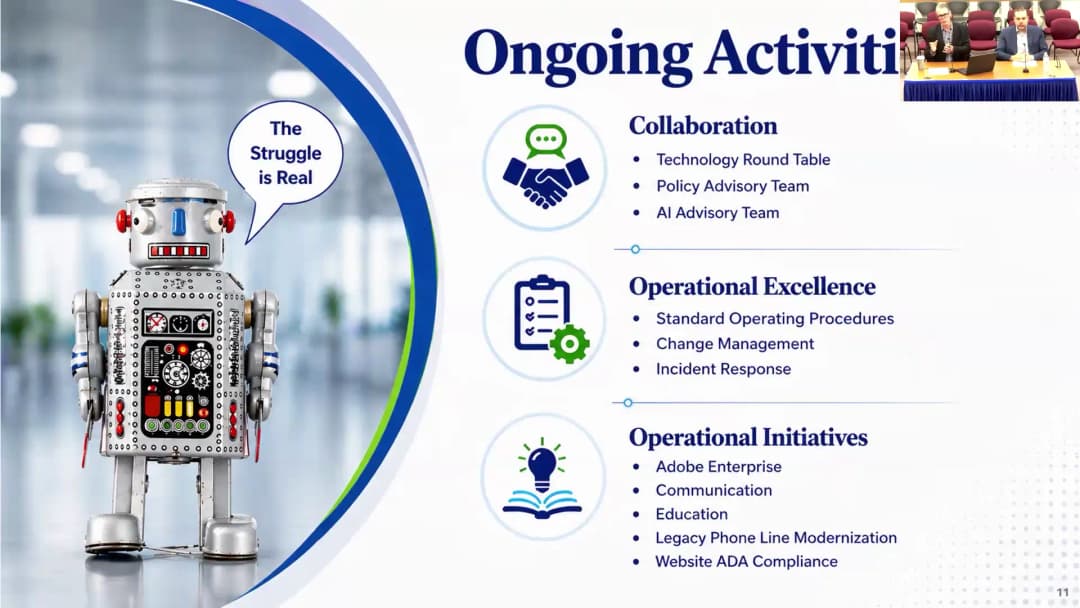
The Lake County Technology Committee met on May 1, 2026, at 8:30 AM. Chair Clark called the meeting to order, followed by the Pledge of Allegiance and roll call. Members present: Altenburg, Vice Chair Kasman, Chair Clark, Frank, Peterson, and Roberts. Member Dan Ford was absent. Remote attendance was available via Zoom. The meeting was recorded. The committee approved several policies, a contract for external threat monitoring, received an annual IT update and an ERP implementation update, and held an executive session. Consent Calendar - Item 8.1 – Consent Agenda: Motion by Altenburg, second by Frank. All in favor, motion carried. No further details provided. Discussion Items - Item 8.2 – Joint Resolution Approving an Access Control Policy: CIO Chris Blandy and Eric Carlson presented the policy, based on the NIST framework, to ensure that personnel have appropriate access to IT resources and that access is reviewed and removed when roles change. The policy formalizes existing practices. Questions arose about auditing access, inventory control of devices (monitors, printers), and the process for changing access based on role. The policy was approved unanimously. - Item 8.3 – Joint Resolution Approving a System and Communications Protection Policy: Eric Carlson explained the policy protects county data through secure configurations, encryption, network segmentation, and firewalls. Examples included securing databases, encrypting remote email access, and deploying servers with security baselines. The policy was approved unanimously. - Item 8.4 – Joint Resolution Authorizing a Contract with CDWG of Vernon Hills, Illinois, for External Threat Monitoring Software (Amount: $64,855): Chris Blandy and Eric Carlson described the tool as an attack surface management solution that continuously scans over 200 internet-facing county sites and services for vulnerabilities, addressing the increasing use of AI by intruders. The contract was approved unanimously. A deeper security program review is planned for next month. - Item 8.5 – Enterprise Information Technology Annual Update: Chris Blandy presented an overview of current projects including Workday ERP, external threat monitoring, Microsoft cloud backup (70 terabytes of cloud data, plus 70 terabytes backup), network switch replacement, remote support modernization, and incident response tabletop exercises. Discussion covered data retention, storage costs, carbon footprint, cybersecurity maturity, and the role of AI agents. The committee expressed interest in retention policies and education for employees. - Item 9.1 – Enterprise Resource Planning (ERP) System Implementation Update: Patrice Evans, internal project manager, provided an update. The transformation alignment phase is complete. The project is currently in foundation data model redesign, business process configuration, and preparing for test scenario creation in mid-May. End-to-end testing begins at the end of June, with a go-live date of December 1, 2026. Post-production support (hyper care) from the implementation partner Strata will last six weeks after go-live. Risks include remaining work on HCM requirements and FDM alignment; mitigation includes increased meeting cadence. The project is in yellow status. Key Outcomes - Item 8.2 (Access Control Policy): Approved unanimously. - Item 8.3 (System and Communications Protection Policy): Approved unanimously. - Item 8.4 (Contract with CDWG for $64,855): Approved unanimously. - Item 8.1 (Consent Agenda): Approved unanimously. - Executive Session (Item 12.1): Motion by Roberts, second by Altenberg to enter executive session to review closed session minutes. Roll call: all ayes. - Item 13.1 (Approving Executive Session Minutes of October 31, 2025): Motion by Frank, second by Roberts. Approved unanimously. - Item 13.2 (Periodic Review of Closed Session Minutes): Motion by Kasmin, second by Peterson. The state's attorney's office recommended that all six items remain confidential. Approved unanimously. - Next Meeting: May 29, 2026.
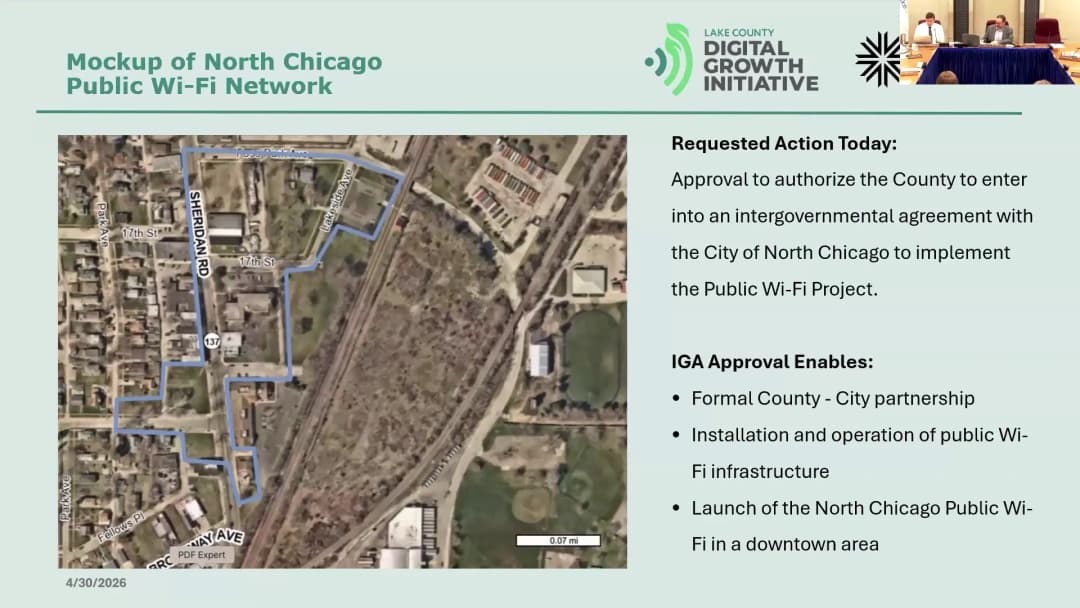
Date: Thursday, April 30, 2026 – 8:31 AM Committee: Financial and Administrative (FA) Chair: Frank Members Present: Clark, Hewitt (remote – medical), Maine, Vice Chair Park (remote – work/family emergency), Peterson, Volitzik Also Attending: County Administrator Patrice Sutton, CFO Regina Tuzak, HR Director Darcy Edka, Deputy County Administrator Matt Myers, and other staff. The committee convened with a quorum and approved routine consent items. The majority of the meeting was devoted to a detailed review of proposed budget policies for Fiscal Year 2027, followed by informational updates on human resources and several action items. Consent Calendar - Items 8.1–8.3: Approved unanimously. Discussion Items - 8.6 – FY2027 Budget Policies Review CFO Regina Tuzak presented proposed revisions to budget development policies (Policy 3.5) based on earlier feedback and a department comment period. Key topics and committee guidance included: - Small Grant Amendments: The Health Department requested a $75,000 budget to allow small-dollar grant amendments (<$20,000) to bypass HCS and FA Committee approval. Staff proposed a countywide alternative of $125,000 total for all departments. The committee expressed support for the countywide approach, seeing it as a streamlining improvement that also applies to other departments. Staff will include this in the final policy. - Elimination of Positions Vacant 12 Months (Policy 5.9.8): Several departments expressed anxiety over the automatic elimination of positions vacant for more than a year. The committee discussed maintaining the 12-month justification requirement but adding an exemption for positions under active recruitment. Members generally favored this approach, with some suggesting that the justification burden be placed on positions vacant 6 months for budget instructions. Staff will modify the policy to include an active recruitment exemption. - Compensation / Grade Table Movement (Policy 5.9.10): Departments requested that grade tables be adjusted by CPI plus a merit component (e.g., 3% total), rather than the current formula (CPI or non-union wage increase, whichever is less). Staff recommended leaving the policy as written, consistent with a 2024 compensation study that advised against moving grade tables at the same pace as merit increases. The committee agreed to maintain the current policy but noted that a separate COLA-plus-merit approach for non-union employees is being explored for the balanced budget. - Dedicated Stormwater Capital (Policy 5.19 Request): The Stormwater Management Commission (SMC) requested a minimum 10% allocation of capital funds for stormwater improvements. Committee members generally did not support this, arguing that capital should be prioritized through a unified process alongside other needs, and that SMC had recently benefited from $120M in state grants. No change was made. - Medicaid Match / Health Department Capital (Policy 5.10.8): Discussion arose about aligning Health Department capital planning with the county’s consolidated capital improvement process. Opinions were divided; some members favored consistency across all departments, while others noted the Health Department has its own levy and board with expertise. No consensus was reached, and the topic was tabled for further consideration. - Other Policy Items: The committee discussed departmental input on budget targets, clarification of reclassifications/reorganizations, and a request to fund new program requests more proactively. The committee generally supported leaving the current competitive NPR process in place, while encouraging departments to reallocate existing resources. - 8.7 – Human Resources Annual Update (Informational) HR Director Darcy Edka and Deputy Director Caitlin Everett reported on major initiatives: the Workday ERP implementation (HCM, payroll, scheduling, talent, etc.), progress on union bargaining (multiple groups, 485 employees affected), benefits administration, risk/safety improvements (fire drills, tornado drill, CPR training scheduled), and organizational development (employee data dashboard, training). The committee commended the team on safety advancements. - 8.10 – Elected Official Compensation Resolution (Postponed) Deputy County Administrator Matt Myers presented compensation increases for countywide elected officials (County Clerk, Treasurer, Clerk of the Circuit Court, Coroner) and County Board members per the established policy. A debate arose over whether the countywide offices – whose salaries are set every four years – should receive a three percent increase only once per term rather than a biennial adjustment. Member Clark moved to postpone the item to the next meeting and direct staff to prepare an amendment providing a three percent increase every two years for these offices. The motion passed. The policy will also need companion amendments. - Other Action Items: - 8.4: Generator maintenance contract with Altior Power Systems, $32,338 – approved. - 8.5: Fire protection equipment service contract with Johnson Controls, $193,141 – approved. - 8.8: Emergency appropriation of $3,807 for CPACE fees – approved. - 8.9: Intergovernmental agreement with City of North Chicago for public Wi-Fi – approved. - 8.11: Property conveyance to IDOT for Route 60/83 improvement – approved. - 8.12: Authorization for County Administrator to execute subrecipient agreements for federal contingency funds (up to $500,000 of $2M total) for continuum of care – approved. Key Outcomes - Approved all consent items (8.1–8.3) and action items 8.4, 8.5, 8.8, 8.9, 8.11, 8.12. - Directed staff to incorporate several policy amendments for FY2027, including: - Countywide small grant amendment budget ($125,000); - Exemption from automatic position elimination for vacancies under active recruitment; - Review of biennial compensation adjustments for four-year countywide elected officials (to be voted next meeting). - Tabled decisions on stormwater capital dedication and Medicaid match alignment. - Committee will reconvene next week to consider the revised compensation resolution and finalize budget policies. Next Meeting: May 7, 2026 (tentative).
The Planning, Building, Zoning, and Environment Committee met on April 30, 2026, to discuss and adopt several ordinances related to building codes and stormwater management. The committee approved the consent agenda, adopted amendments to multiple building codes, and endorsed the Manitou Creek Fish Lake Drain Watershed Plan. Staff also provided updates on data centers, housing initiatives, and recent flood mitigation successes. Consent Calendar - Item 8.1 (Consent Agenda): Approved unanimously by voice vote (motion by Member Keniznik, second by Member Frank). Discussion Items - Building Code Adoption and Amendments (Item 8.2): Planning, Building, and Development (PBD) staff presented an ordinance to adopt the 2024 International Existing Building Code (IEBC) and amend the 2024 International Building Code, 2024 International Residential Code, and 2023 National Electrical Code (NEC). Key amendments included: - Reducing fence registration threshold from 7 feet to 6 feet to simplify permitting. - Electrical code clarifications: requiring removal of abandoned wiring in accessible areas, additional securing requirements for non-metallic sheathed cable (Romex) in attics and crawl spaces, and allowing arc-fault circuit interrupter exceptions when wiring is encased in metal conduit. - The new codes take effect July 12, 2026; projects submitted before that date will follow prior codes. - Members Keniznik, Wasik, and Frank asked clarifying questions. Member Wasik sought to distinguish between residential and commercial applicability; staff confirmed the IEBC applies only to commercial projects. Member Frank asked for terminology clarification on code adoption standards. - Director’s Report (Item 8.3): Director Eric Wagner provided updates on: - Research into data center regulations, with a report expected early summer 2026. - Finalizing two amendment packages: one for sustainable development incentives and a comprehensive set of general amendments to streamline planning and development processes, including promoting housing. These will go to ZBA public hearing later in 2026. - Housing Lake Phase II: deepened discussions with CMAP and outreach to housing partners following adoption of a memorandum of understanding. - Stormwater Management – Manitou Creek Fish Lake Drain Watershed Plan (Item 8.4): Executive Director Kurt Wolford and Watershed Planning Supervisor Mike Priscella presented the adoption of a watershed-based plan. Highlights: - The 50-square-mile watershed in western Lake County includes over 20 local government units and 49% unincorporated land. - The plan identifies 83 flood problem areas, 18 impaired lakes, and over 1,000 structures in flood hazard zones. - A site-specific action plan lists over 700 potential projects with an estimated cost range of $85–201 million. Implementation is voluntary. - Public engagement included over 160 comments, a record for SMC. - Members discussed flood mitigation successes. Kurt Wolford recounted recent positive feedback from local officials that stormwater projects are reducing damage during the current Fox River flood event. Member Frank requested better documentation of return on investment for stormwater infrastructure. Member Wasik noted wetland restoration’s flood storage benefits, citing a project in Third Lake. - Executive Session and Minutes Review: The committee entered executive session to review minutes from October 8, 2025 (Item 11.1) and periodic review of closed session minutes (Item 11.2). Both were approved by roll call votes. Key Outcomes - Ordinance adopting the 2024 International Existing Building Code and amending the 2024 International Building Code, 2024 International Residential Code, and 2023 National Electrical Code – Passed (motion by Member Frank, second by Member Schlick; all in favor). - Ordinance adopting the Manitou Creek Fish Lake Drain Watershed Plan as an amendment to the Lake County Comprehensive Stormwater Management Plan – Passed (motion by Member Schlick, second by Member Wasik; all in favor). - Approval of executive session minutes from October 8, 2025 – Passed (motion by Member Keniznik, second by Member Wasik; all in favor). - Approval of periodic review of closed session minutes – Passed (motion by Member Schlick, second by Member Wasik; all in favor). The meeting adjourned. The next regular meeting is scheduled for May 6, 2026.
The Lake County Board met on Tuesday, April 14, 2026, at 9:00 AM in Waukegan, Illinois. The meeting was live-streamed and included remote participation by Vice Chair Cunningham and members Hewitt and Parrack. The board considered several special recognitions, a presentation on America 250 celebrations, public comments, a consent agenda, committee reports, and multiple resolutions. Key actions included the creation of a special service area for stormwater improvements, approval of opioid settlement and video gaming grants, a bridge rehabilitation contract, and an emergency appropriation for liability insurance. Consent Calendar - Items 6 through 31 were approved as a consent agenda, with recusals recorded: Member Hunter recused on items 12 and 13 (fire protection districts), and Member Kasmin recused on items 14 and 15 (health and community services reappointments). The motion passed by a voice vote. Public Comments & Testimony - Margaret Carrasso: Criticized the board for failing to recognize Mario Pena, a community leader who helped over 5,000 immigrants become U.S. citizens and registered them to vote. She also alleged unfair treatment by the Lake County State's Attorney's Office regarding a case involving a victim of a narco gang member, urging the dismissal of charges against the victim. - Rayon Edwards: Expressed strong support for the Lake County State's Attorney's Office, stating, "I am extremely proud of the work that our lake county states of attorney office is doing." He also raised concerns about the condition of a local hospital in the largest city of the county and criticized HUD-funded housing conditions in gated communities and apartment complexes, stating, "We are asking our people... to live in squalor." He called for fair, affordable, and livable housing. Special Recognitions - Maureen Reedy (22 Years of Service at Visit Lake County): Member Kasbin read a proclamation honoring Reedy for her leadership. Under her tenure, visitor spending reached $1.96 billion in 2024, and Lake County became the third largest tourism economy in Illinois. Reedy thanked the board and noted upcoming events for America's 250th anniversary and Six Flags Great America's 50th anniversary. Several board members offered remarks praising her legacy. - ALS Awareness Month (May 2026): Chair Hart read a proclamation recognizing May as ALS Awareness Month. Jim Chamernick, whose wife Amy was diagnosed with ALS in 2004, spoke about the devastating effects of the disease, noting that every 90 minutes someone is diagnosed and someone dies, and that patients typically live 2–5 years after diagnosis. He highlighted the importance of awareness and advocacy, citing the ALS Disability Insurance Access Act and the ALS Registry Act. - Fair Housing Month (April 2026): Member Altenberg read a proclamation designating April as Lake County Fair Housing Month. Maya Zavella of Prairie State Legal Services stated that in 2025, their Lake County office served 1,600 clients, including over 470 older adults, nearly 700 individuals with disabilities, and over 340 survivors of domestic violence. She highlighted cases where legal help prevented eviction and homelessness. Several board members spoke about the importance of housing equity and the new "Housing Lake" initiative. - National Child Abuse Prevention Month (Blue Kids): Member Roberts read a proclamation recognizing April as National Child Abuse Prevention Month. Carrie Flanagan, Executive Director of the Lake County Children’s Advocacy Center, reported that the center conducts nearly 1,000 forensic interviews and serves over 2,000 families annually, and reached 7,000 children and adults through awareness efforts. Board members thanked the center for its work protecting children. Presentation - America 250 Celebration: County Administrator Dur Sutton presented updates on Lake County's America 250 initiatives. The Lake County Independence Academy will begin next week; the K–12 art and essay contest submissions are due by April 15, 2026. A new interactive Self-Guided History Tour map was introduced, allowing residents to explore historic sites and submit photos. The tour will be available on the county website. Board members expressed enthusiasm for the initiative. Discussion Items - Board of Health Report: Member Maine reported that National Public Health Week (April 6–12) was observed, and National Infant Immunization Week will be April 20–27. He noted a dramatic rise in measles cases: 285 in 2024, 2,285 in 2025, and an on-pace projection of over 6,000 cases this year. He urged residents to follow recommended immunization schedules. - Item 33 – Opioid Settlement Funds: A joint resolution approving $405,000 in program year 2026 opioid settlement funding recommendations. Motion by Member Altenberg, seconded by Member Kyle. Approved unanimously. - Item 34 – Video Gaming Grant Funding: A joint resolution approving $841,100 in video gaming grant recommendations and an emergency appropriation of $16,100 from the video gaming revenue fund balance. Member Kasmin recused herself (abstained). The roll call vote passed (15 ayes, 1 abstention). - Item 35 – Special Service Area 18 (Delmar Woods): An ordinance to create Lake County Special Service Area 18 in the Delmar Woods Subdivision to fund storm sewer improvements. Motion by Member Clark, seconded by Member Parrack. Members praised the years-long effort to resolve this intractable problem. Approved unanimously. - Item 36 – Dillies Road Bridge Rehabilitation: A joint resolution authorizing a contract with Roush Infrastructure LLC for $2,152,618.82 and appropriating $2,584,000 from matching tax funds for the bridge rehabilitation at Mill Creek. Motion by Member Clark, seconded by Member Kasmin. Roll call vote passed. - Item 37 – Unified Development Ordinance Amendment: An ordinance amending Chapter 151 (Unified Development Ordinance) relating to logistics facilities in unincorporated Lake County. Motion by Member Altenberg, seconded by Member Schlick. Approved unanimously. - Item 38 – Emergency Appropriation for Liability Insurance: A resolution authorizing an emergency appropriation of $2 million from the fund 206 balance for settlement expenses. Motion by Member Frank, seconded by Member Clark. Roll call vote passed. - Item 39 – Appointment to Public Aid Committee: A resolution appointing Nancy Chowzah Schaefer as an alternate member of the Lake County Public Aid Committee. Motion by Member Frank, seconded by Member Kyle. Approved unanimously. Key Outcomes - Consent Agenda Approved: Items 6–31 passed with recusals by Members Hunter (12-13) and Kasmin (14-15). - Opioid Settlement Funding: $405,000 approved for FY2026. - Video Gaming Grants: $841,100 approved, plus $16,100 emergency appropriation; Member Kasmin abstained. - Special Service Area 18 Created: For Delmar Woods storm sewer improvements. - Dillies Road Bridge Contract: $2,152,618.82 awarded to Roush Infrastructure LLC; $2,584,000 appropriated. - UDO Amendment: Passed regarding logistics facilities. - Liability Insurance Emergency Appropriation: $2 million approved. - New Appointment: Nancy Chowzah Schaefer as alternate to Public Aid Committee. - Next Meeting: The board will reconvene on May 12, 2026.
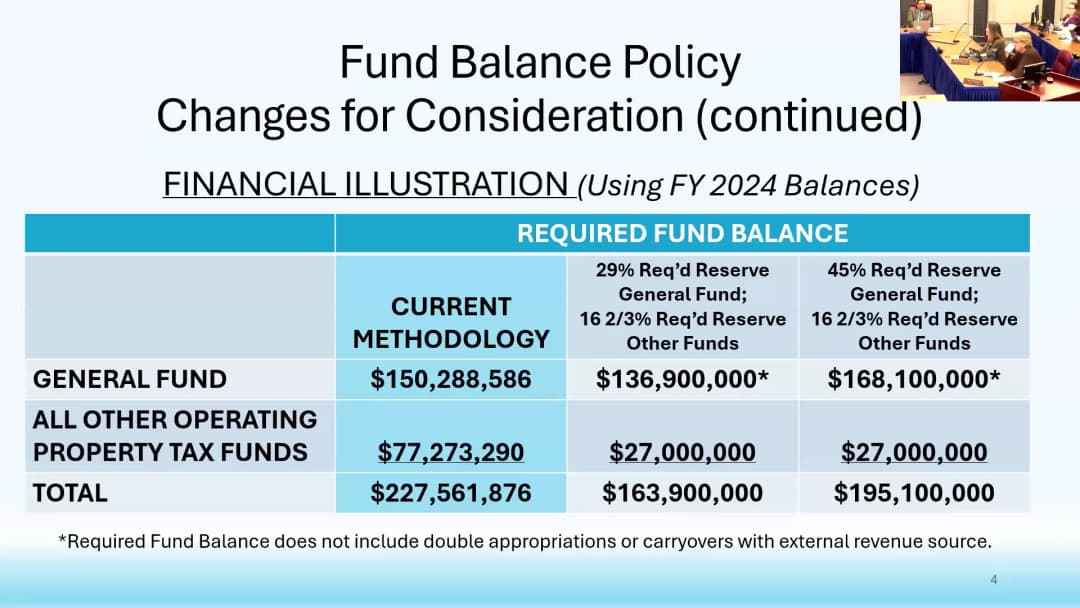
The Financial Administrative Committee of Lake County met on Thursday, April 9, 2026, to consider several financial resolutions including the creation of a new stormwater management fund, reallocation of capital reserves, carryover appropriations, and a discussion on proposed changes to the fund balance reserve policy. All consent agenda items were approved, and the committee voted to enter executive session for pending litigation. Consent Calendar - Items 8.1 through 8.8, including the treasurer's report, were approved unanimously via motion by Member Clark, second by Member Valitzek. No items were pulled. Discussion Items - Item 8.19 – Stormwater Management Project Expense Match Fund: Director Wolford explained the need to segregate project expense match funds paid by local project partners under intergovernmental agreements from both the state DCO grant funds and operational funds. The resolution authorizes the creation of a new fund, transfer of $2,526,406.68 from the stormwater management fund, and an emergency appropriation of $1,545,960 to establish the FY26 budget while reducing the stormwater fund budget by $335,960. Wolford noted that these funds are not property tax revenue and will be used for engineering design to prepare unfunded projects for future grant rounds. The resolution was approved. - Item 8.20 – Reallocation of FY2024 Capital: CFO Regina Tuzak presented a proposal to reallocate $46,276,796 in excess reserves from the general fund to the capital improvement fund (Fund 106) for long-term capital needs. She explained that the fund balance reserve policy requires excess above the 29% minimum to be used for capital or one-time expenditures. The county has an estimated $300 million in unfunded maintenance capital. Discussion included the need for proactive capital budgeting, flexibility in case of federal funding cuts (e.g., Medicaid/SNAP), and the plan to use bonding after 2028. The resolution was approved. - Item 8.21 – Emergency Appropriations for Carryovers: Budget Manager Michael Wheeler requested approval of carryover appropriations for projects and grants not completed in FY25. The resolution was approved. - Item 8.22 – Fund Balance Reserve Policy Changes: CFO Tuzak presented four proposed concepts: (1) evaluating and maintaining excess reserves separately for each fund rather than as a bundle; (2) establishing a reserve range for the general fund (29% to 45%) to provide flexibility; (3) reducing reserve requirements for other operating property tax funds to 16⅔% (two months); and (4) refining the calculation to exclude double appropriations and carryovers with external revenue sources. She illustrated that under current methodology, the required reserve is $227 million (general fund $150M, other funds $77M). Under the proposed approach, at the low end the general fund would require $137M and other funds $27M (total $164M); at the high end, general fund $168M plus other funds $27M (total $195M). The changes are intended to improve flexibility and clarity, not necessarily to reduce the property tax levy. Committee members discussed the impact on bond ratings, the need for a proactive capital plan, and the advantage of holding more reserves in the flexible general fund. The concepts received favorable feedback, but formal action is deferred until after internal review; possible return in May or June. - Item 8.23 – Director's Report: CFO Tuzak provided a final list of line item transfers for FY25 year-end close, for information only. Key Outcomes - Consent agenda (8.1-8.8) approved unanimously. - Resolution 8.19 (stormwater fund) approved. - Resolution 8.20 (capital reallocation) approved. - Resolution 8.21 (carryovers) approved. - Committee discussed fund balance reserve policy changes; no vote taken. CFO will refine based on feedback and bring back for formal action in a future meeting. - Motion to enter executive session for pending litigation approved by roll call; committee returned to regular session and adjourned. Note: No public comments or chair's remarks were made.
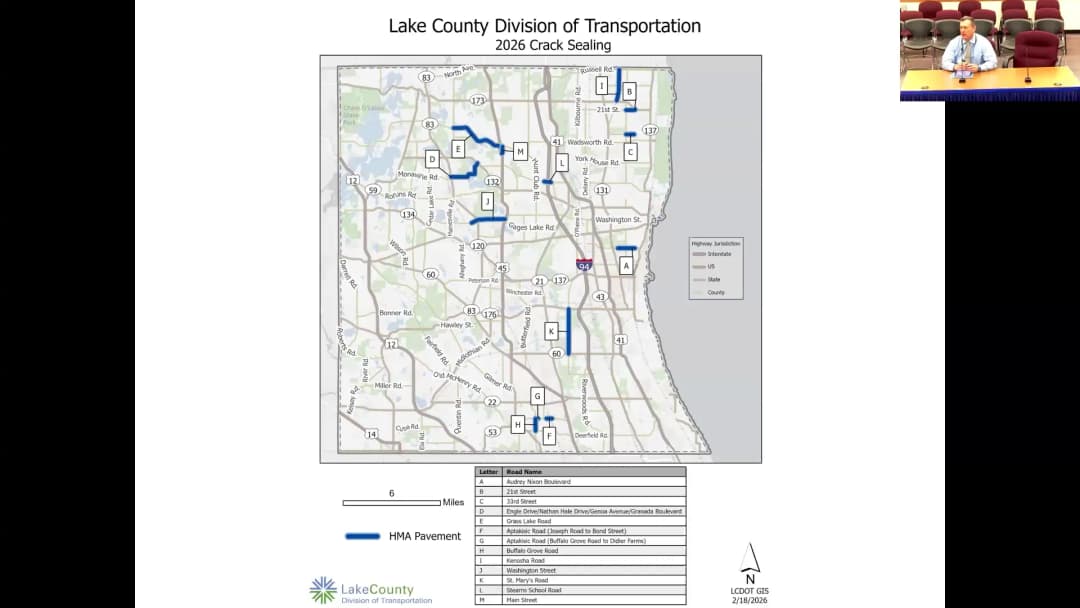
The Lake County Public Works and Transportation Committee met on April 8, 2026, at 8:30 a.m. to consider a series of routine and operational items, including updates to water and sewer ordinances, modernization of the Adopt-a-Highway program, and several infrastructure maintenance contracts. All votes were unanimous. Discussion Items - Ordinance Amending Water, Sewer, and Pretreatment Regulations (Item 8.1): Director Austin McFarland presented the ordinance, driven by USEPA requirements for a formal pretreatment program. The committee approved the ordinance after discussion. No further questions. - Adopt-a-Highway Program Ordinance Update (Item 8.2): DOT Director Shane Schneider and Assistant County Engineer John Nelson proposed changes to streamline the enrollment process, including year-round applications, 15-day review turnaround, and formalizing the Adopt-a-Path program. The current process requires waiting up to nine months. The committee expressed strong support, noting it would improve participation and community engagement. Member Hunter requested updates when new participants join his district. The ordinance passed. - Contract for Crack Sealing (Item 8.3): A contract with Denler Inc. for $59,386.94 to seal cracks on various county highways. Vice Chair Maine asked about pricing volatility and force majeure clauses. Member Hunter clarified that force majeure allows reopening discussions but does not unilaterally increase prices. The contract was approved. - Contract for Hot Mix Asphalt Maintenance (Item 8.4): A contract with Everlast Blacktop Inc. for $499,667.29 for annual pavement patching. The committee approved the contract. - Dillies Road Bridge Rehabilitation (Item 8.5): A contract with Roush Infrastructure LLC for $2,152,618.82 to replace the bridge deck and beams at Mill Creek. The bridge will be closed for approximately 90 days this summer. Environmental reviews cleared. Approved. - Township Road Resurfacing (Items 8.6 & 8.7): Contracts for resurfacing roads in Cuba Township ($303,290.71) and Shields Township ($110,418.90), using township motor fuel tax funds. Approved together. - Speed Zone Change on Trinity Terrace Subdivision (Item 8.8): Reduction from 30 mph to 25 mph on Trinity Lane, Terry Lane, and Tracy Lane in Antioch Township, based on a speed study. Approved. - AV Upgrade at DOT Conference Room (Item 8.9): Contract with CTI for $49,419 to upgrade audio/video components for cross-platform compatibility. Work expected by mid-summer. Approved. - Emergency Appropriations for FY2026 (Item 8.10): Carrying forward approximately $215 million for multi-year projects. Approved. Key Outcomes - All resolutions and ordinances (Items 8.1 through 8.10) were approved unanimously by the committee. - The committee will receive a report on the annual construction program (30 projects, $98 million) later this week. - The next meeting is scheduled for April 29, 2026. No public comments were received, and no executive session was held.
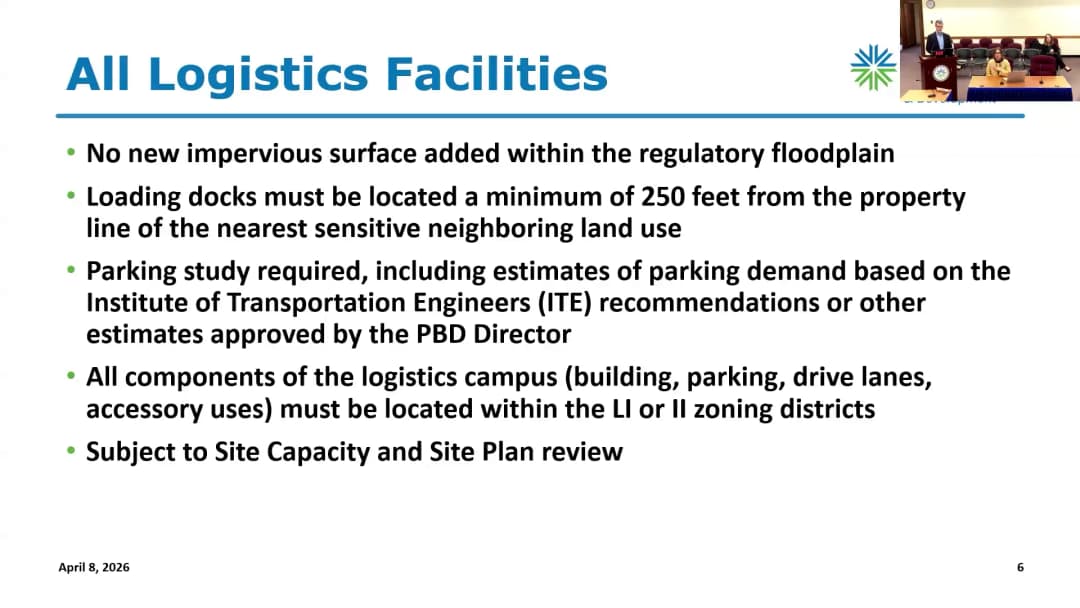
The Planning, Building, Zoning, and Environment Committee of Lake County, Illinois, met on April 8, 2026, at 5:00 AM (UTC) to consider several items including a presentation on the Chicago Metropolitan Agency for Planning (CMAP) comprehensive climate action plan, a new sustainable model ordinance engagement program, an emergency appropriation for a flood risk assessment project, and amendments to the unified development ordinance for logistics facilities. The meeting was held in person with remote attendance options via Zoom, and a quorum was present. Public Comments & Testimony - No public comments were made during the meeting. Discussion Items - CMAP Comprehensive Climate Action Plan for Greater Chicago – Jesse Altman, policy analyst from CMAP, presented the plan, noting that the 13-county region produces about 152 million metric tons of CO2 equivalent annually, driven primarily by buildings and transportation. The plan sets a target of 80-85% reduction in emissions by 2050 compared to 2005 levels. Six core actions were highlighted: clean and modernize the grid, improve building efficiency, transition to clean heat, reimagine mobility (reduce VMT by 5% by 2035 and 16% by 2050), electrify vehicles (100% of new light-duty EVs by 2035), and decarbonize industry. Committee members discussed the role of data centers, the need for state-level legislative support, and the potential for Lake County to adopt stretch codes. CMAP and county staff will explore further collaboration. - Sustainable Model Ordinance Engagement Program – Robin Halgram, Sustainability Programs Manager, presented a program design to catalog and promote adoption of the county's sustainability regulations by other public entities. The program includes a master inventory of sustainable model ordinances (SMOs) hosted on the county website, notification of public partners, surveys to gauge interest, assistance with adoption, and tracking of adoptions. The inventory is ready for immediate upload. Committee members expressed strong support, noting that the program will serve as a communications tool and help municipalities adopt similar regulations. - Emergency Appropriation for Nippersine Creek Project – Sharon Osterby, water resources professional from SMC, presented a joint resolution authorizing an emergency appropriation of $41,043.83 for a structure-specific risk assessment in Grant Township and the Fox Lake area, funded through FEMA's Hazard Mitigation Grant Program and administered by IEMA. The project was originally requested in 2024 but funds were not carried over. The committee voted to approve the motion. - Ordinance Amending UDO for Logistics Facilities – Eric Wagner, PBD Director, and Natalia Fick, planner, presented amendments to Chapter 151 of the Lake County Code to establish specific standards for logistics facilities. The amendments add definitions for logistics facilities and warehouses, differentiate between small (≤50,000 sq ft) and large (50,000 sq ft) facilities, impose setbacks for loading docks (250 ft from sensitive land uses for small, 500 ft for large), require operational and environmental impact analyses for large facilities, and mandate enhanced landscaping and transition areas. The ZBA approved the draft with one modification to clarify that logistics facilities are not data centers. The committee voted to approve the ordinance and forward it to the county board for final action on April 14, 2026. - Future Work on Data Centers – Eric Wagner informed the committee that a report on data center regulation best practices is expected in May or June 2026, given ongoing developments at the state and national levels. Key Outcomes - Vote on Item 8.4 (Emergency Appropriation for Nippersine Creek Project): Motion carried by voice vote (all in favor). - Vote on Item 8.5 (UDO Amendments for Logistics Facilities): Motion carried by voice vote (all in favor). The ordinance will proceed to the Lake County Board for final action on April 14, 2026. - Next Meeting: The committee's next scheduled meeting is April 29, 2026.