Browse by city
Date range
Search help

Search titles, summaries, topics and stored transcripts together. Keywords may match separately; put the whole query in double quotes for a phrase. Matching follows word analysis, so punctuation is not exact. Both dates are included. Documents are not searched.

SHOWING 1–10 ENTRIES
01
NEWNOV 3, 2026 · LAKE OSWEGO, OREGON · CITY COUNCIL
Lake Oswego City Council Regular Meeting - November 3, 2026

The Lake Oswego City Council met on Tuesday, November 3, 2026, for a regular meeting. The council approved proclamations for Veterans Day and Native American Heritage Month, adopted a consent agenda, held a public hearing on annual code amendments, and adopted resolutions related to the city's economic development strategy and a sub-regional transit study. All votes taken during the broadcast portion of the meeting were unanimous (6-0). The meeting concluded with a council report period and an executive session. Consent Calendar - The council unanimously approved Resolution 2612, appointing members to the Historic Resources Advisory Board, and an intergovernmental agreement extension for the River Grove Wastewater project. Public Comments & Testimony - No members of the public spoke during the designated public comment period. - No testimony was given during the public hearing for Ordinances 2979 and 2984 (the annual code amendments). Discussion Items - Proclamations: Mayor Buck proclaimed November 11, 2026, as Veterans Day in Lake Oswego, noting a ceremony at Foothills Park featuring a Gold Star Families Monument dedication. November was also proclaimed Native American Heritage Month, with programming highlighted at the Lake Oswego Public Library. - Annual Code Amendments (Ordinances 2979 & 2984): Senior Planner Alan Davis presented the 2026 code amendments. The package included 13 maintenance items and three policy amendments. The policy amendments covered: exempting middle housing land divisions from neighborhood meetings, creating a minor variance path for carport-to-garage conversions (allowing up to a 20% expansion of footprint or 450 square feet, whichever is greater), and an interim compliance pathway for state-mandated detached duplexes, triplexes, and quadplexes (House Bill 2138). - Detached Plex Discussion: Multiple councilors expressed strong opposition to the state mandate allowing detached multiplex units, arguing it contradicts community input and established definitions. Councilors Wenlin and Afkin criticized state overreach and stated that the community overwhelmingly preferred attached units. Staff explained the interim approach (effective Jan 1, 2027, to Jan 1, 2028) was designed to comply with state law while allowing for state rulemaking before permanent siting and design standards are set. - Garage Variance Discussion: Councilor Mans questioned why the new minor variance pathway for carports could not also apply to existing garages. Community Development Director Jessica Newell cautioned that applying the same criteria to existing garages could allow the expansion of already large non-conforming garages. The council broadly supported referring the potential expansion of this policy to the broader code audit project. - Economic Development Strategy (Resolution 26-36): Program Manager Megan Bronson presented the 2026-2029 Economic Development Strategy. The plan builds on a 2022 pilot project and a contract with the Chamber of Commerce. The approved version includes specific marketing efforts toward minority-owned, women-owned, veteran-owned, and COBID-certified businesses. Councilor Afkin suggested exploring ways to increase the Chamber of Commerce's capacity in the future. - Sub-Regional Transit Study (Resolution 26-57): Assistant City Engineer Will Farley presented an IGA with Sherwood, Walleton, and West Lynn to fund a transit study by consultant Nelson Nygard. The study aims to assess transit demand and solutions for both intra-city and inter-city services. Councilors Wenlin and Afkin emphasized the need for the study to be an independent analysis, separate from TriMet's data and conclusions, citing frustration with past TriMet service. The council unanimously supported the collaborative, independent study. Key Outcomes - Code Amendments (Ordinances 2979 & 2984): The council voted 6-0 to tentatively approve the ordinances. Staff were directed to return at the November 17, 2026, meeting with a final version including findings. A potential expansion of the carport variance to include existing garages was referred to the ongoing code audit project. - Economic Development Strategy (Resolution 26-36): The council voted 6-0 to adopt the 2026-2029 Economic Development Strategy. - Transit Study IGA (Resolution 26-57): The council voted 6-0 to approve the resolution and authorize the city manager to execute the intergovernmental agreement for the sub-regional transit study. - Council Reports: The mayor noted upcoming events including a Mayors Roundtable with African American Women of Lake Oswego and surrounding communities on November 12 and the kickoff of the youth leadership council capstone project. Councilor Mans highlighted the new OnPoint Bank branch on A Avenue.

URBAN PLANNING 48% · ECONOMIC DEVELOPMENT 19% · PUBLIC ENGAGEMENT 14% · PROCEDURAL 7%
02
OCT 26, 2026 · LAKE OSWEGO, OREGON · PLANNING COMMISSION
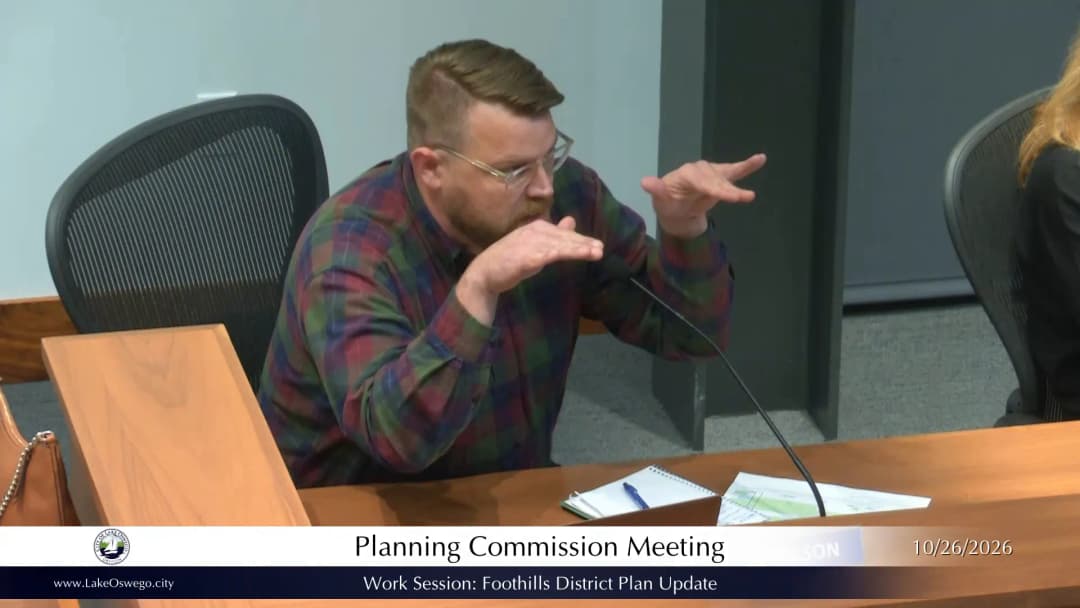
Lake Oswego Planning Commission Work Session: Foothills District Plan Update (October 26, 2026)

The Lake Oswego Planning Commission convened on Monday, October 26, 2026, for a work session primarily focused on the Foothills District Plan Update (PP 25-0005), Work Session 7. The meeting included updates on city council activities, project engagement, and a detailed presentation on the evolving schematic plan for the district's redevelopment. Consent Calendar - The Commission unanimously approved the meeting minutes from October 12, 2026, as written. Public Comments & Testimony - No members of the public provided oral comment during the open comment period or signed up to speak on the work session agenda item. Discussion Items City Council Update Councilor Burdick provided an update on recent council activities, including the start of new City Manager Denzel Maxwell, a tight but stable city budget, and a planned 28% one-time rate increase for the new wastewater treatment plant (Jacobs design-build-operate), which was chosen over smaller incremental increases as a better long-term financial decision. Council also received updates on the South Shore Fire Station, Republic Services (no rate increase), the communication strategy, economic development, and the rezoning housing project. Foothills District Plan Update (Work Session 7) Jason Graff (First 40 Feet) and Eric Olson (Long Range Planning Manager) led the presentation. Vision and Process: The project vision was condensed to: "the district will complete downtown's connection to the Willamette River, and it's going to create a vibrant waterfront district that extends the civic heart of Lake Oswego." The framework plan process is at the schematic stage, with technical analysis ongoing. Engagement and Technical Coordination: Olson reported extensive community engagement, including three Community Advisory Committee (CAC) meetings, an open house in the Foothills district (50 attendees), a farmers market booth, and ongoing technical meetings with ODOT (State Street Special Transportation Area), the Tryon Creek Watershed Council (fish passage/culvert project), the Willamette Shoreline Trolley Consortium, PGE (substation consolidation), and City Parks. Key Development Moves: Graff introduced eight key elements of the schematic plan: 1. State Street Gateway: Proposals for improved crossings at B Avenue (walk/bike bridge), A Avenue (potential elevator/landing), and the lower Millennium Plaza. Commissioner Sly noted the "fantasy" of the A Avenue landing, highlighting land acquisition and rising property values as significant hurdles. 2. The Grand Connection: A central multimodal street with a 74-foot right-of-way, featuring two travel lanes, parallel parking, separated bike facilities, and generous pedestrian zones. The potential for future pedestrianization was discussed. 3. Park Plaza & Active Waterfront: A new urban plaza additive to Foothills Park, designed to host festivals and events. Commissioner Avison questioned how this space would differentiate itself from Millennium Plaza. Staff noted it would be a more waterfront-oriented space. 4. Development Capacity & Character: The schematic currently envisions approximately 1,300 residential units and 30,000 square feet of retail. Building types include townhomes, podium buildings, and a small tower. Design priorities include the Foothills Mixed-Use Zone, building stepbacks, and usable "fifth facade" rooftops. 5. Housing Affordability: Eric Olson reviewed the Housing Action Plan, noting a city need for approximately 2,000 units over 20 years. Chair Najok clarified that affordable housing is defined by HUD percentages of Area Median Income (AMI), citing low-income (60% or below), workforce (80-120%), and market rate (above 120%). Tax Increment Financing (TIF) is a potential tool but staff stressed funds would be tight. The city-owned former wastewater treatment plant site was noted as a potential asset for future development. 6. Parking: The plan models roughly 1.14 structured parking spaces per unit, driven by the floodplain fill strategy. Commissioners Sly and Call raised major concerns about a lack of dedicated public parking for the waterfront and retail. Graff cited shared parking with The Foundry and on-street parking as potential partial solutions but acknowledged the challenge. 7. Trails & Lake-to-River Connection: A comprehensive trail network is planned linking Lakewood Bay to the Willamette River via the Grand Connection, Curly Q trail, and a future Tryon Creek crossing linked to the fish passage project. A State Street corridor study for bikes was identified as a future need. 8. Access & Infrastructure (North & South Portals): - The South Portal realigns roads to push traffic away from Oswego Point condominiums and adds parking. - The North Portal is deemed critical for development beyond a threshold of 700 to 900 units. Two options remain under study: a route through the public storage yard (requiring property acquisition) and a route connecting to Terwilliger Boulevard (more expensive but offering partnership potential around the Tryon Creek fish passage project). Commissioner Sly strongly urged selecting a preferred route, expressing concern about project feasibility. Staff indicated council direction is to keep both options open to leverage strategic partnerships and funding opportunities. Key Outcomes - The Commission generally supported the vision and design character of the schematic plan, seeing it as a natural extension of downtown. - Significant concerns were registered regarding the feasibility of land assembly for the road network and the lack of a comprehensive public parking plan for the waterfront district. - Staff was directed to document lessons from similar developments (e.g., Vancouver, WA waterfront) and to develop a detailed pros and cons analysis of the North Portal options. - The project schedule was confirmed: Draft Framework Plan for Planning Commission review on February 22, 2027, City Council adoption in April 2027, and implementation code amendments beginning in June 2027, concluding by the end of 2027. - The regular Planning Commission meeting scheduled for November 9, 2026 was canceled. The next meeting is November 23, 2026.

URBAN PLANNING 39% · AFFORDABLE HOUSING 12% · ENGINEERING AND INFRASTRUCTURE 9% · PUBLIC ENGAGEMENT 7%
03
OCT 20, 2026 · LAKE OSWEGO, OREGON · CITY COUNCIL
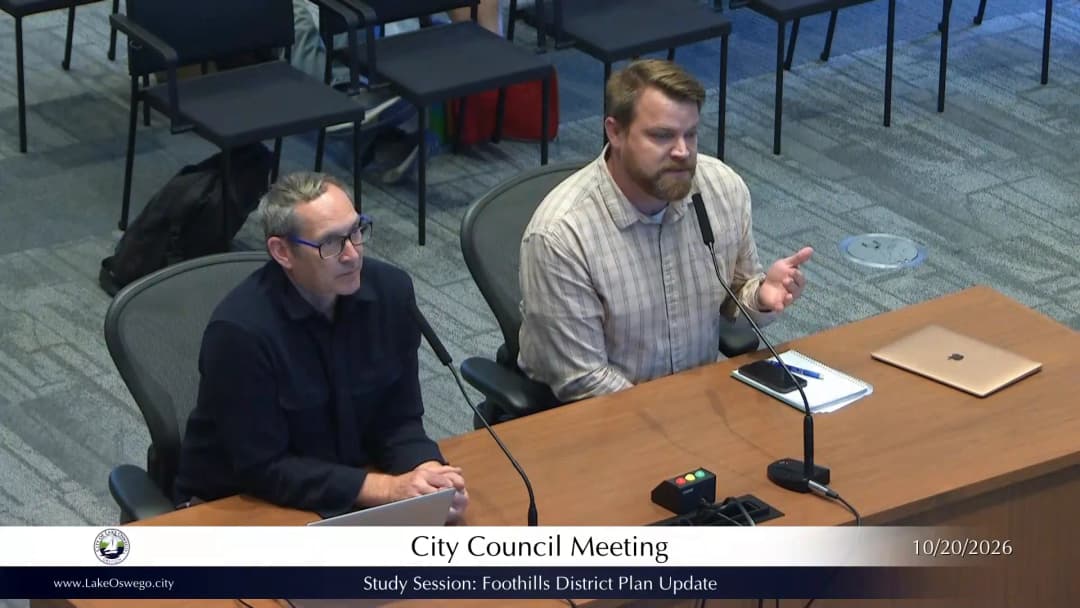
Lake Oswego City Council Meeting: October 20, 2026

The Lake Oswego City Council met on Tuesday, October 20, 2026, at 7:00 PM. The meeting included public comment, approval of the consent agenda, an update on the South Shore Fire Station project, approval of an owner's representative contract for the library project, and two study sessions: one on the Foothills District Plan update and another on the rezoning for housing project. Key themes included housing needs, infrastructure, community engagement, and sustainability. Consent Calendar - Approved meeting minutes from June and July 2026. - Approved Resolution 26-56 ratifying a collective bargaining agreement with the Lake Oswego Police Officers Association Supervisors Bargaining Unit. Motion passed 6-0. Public Comments & Testimony - Charles Oldham spoke in favor of banning fireworks in Lake Oswego, citing global warming, fire hazards, and impacts on pets and wildlife. He noted that other Oregon cities (Portland, Eugene, Bend, etc.) have banned consumer fireworks and referenced Fort Collins, Colorado's complete ban with fines up to $1,000. - Dorothy Atwood, President of the Lake Oswego Sustainability Network, thanked the council for a grant to evaluate a clean energy district in the Foothills area. She requested that the framework plan include a placeholder for a clean energy district, referencing potential district heating/cooling, energy-efficient construction, and use of waste heat from the wastewater treatment plant. - McKenzie Meyer, a fourth-grade student at Hallinan Elementary, thanked the city for smoothing the trail in Waluga Park, expressed support for the Foothills plan (including the "bunny trail" light idea and an elevator for older friends), and advocated for an all-abilities playground in Foothills. Discussion Items South Shore Fire Station Project Update - Assistant Chief Chris Hartman reported that an owner's representative (Cumming Group) has been onboarded. Schematic design for both temporary and main stations completed in September; initial estimating completed in October. The land use application for the main station was submitted in October. - Design refinements include a sloped metal roof for longevity and changes to bay doors to reduce building footprint. The boat and tow rig will be moved to another station to save costs on the temporary facility. - Current budget includes $935,000 for unforeseen conditions (increased from $650,000). Key risks: basalt/rock fields, cost escalations, retaining wall (possible cantilever design), and permitting/lead times. - Schedule: temporary station groundbreaking in March 2027, permanent station in June 2027. Library Project Phase 1 – Owner's Representative Contract - Library Director Melissa Kelly presented a request to approve a contract with Shields Oblist Oblitz Johnson Inc. (SOJ) as owner's representative for phase one (planning, site selection, pre-design, financial planning). The contract is based on actual hours worked. The timeline extends through June 2028. Motion passed 6-0. Study Session 1: Foothills District Plan Update - Jason Graf (First 40 Feet) and Eric Olson presented a schematic plan derived from three concepts. Eight key moves were discussed, including State Street arrival, the Grand Connection, housing, and north/south portal access. - Council members discussed trade-offs: concerns about parking on State Street, pedestrian safety, the need for a north portal (traffic capacity), and preserving view corridors. There was general support for the plan's direction, but no formal vote. - Housing density was debated: 900–1,400 units are anticipated. Council had differing views on affordable housing requirements and market feasibility. The plan will continue to evolve with technical analysis. Study Session 2: Rezoning for Housing Project - Associate Planner Michael and consultants from Cascadia Partners presented a methodology to identify commercial/mixed-use areas suitable for rezoning to increase housing capacity. The methodology weighs three themes: favorable development economics, land suitability, and advancing community goals. - Four potential focus areas were identified: Eastern Cruise Way, Westlake Grove, Boones Ferry Road/Lakeview Boulevard, and First Edition/Downtown. Lower-scoring areas (e.g., Mountain Park, McVay, Merrillhurst) were deprioritized. - Council directed staff to proceed with further study of the focus areas while respecting existing community plans (e.g., Lake Grove Village Center). Resolution 26-16, authorizing an intergovernmental agreement with DLCD and related funding ($14,815 from existing budget), passed 6-0. Key Outcomes - Consent agenda approved (6-0): minutes and Resolution 26-56. - Library owner's rep contract approved (6-0). - Resolution 26-16 approved (6-0): authorizing IGA with DLCD for rezoning project. - Foothills District Plan: Council provided directional feedback; staff will incorporate input and return in February 2027 with a draft framework plan for adoption in May 2027. - Rezoning for Housing: Council supported the methodology and focus areas; staff will conduct further study and community engagement, returning with alternatives.

URBAN PLANNING 44% · HOUSING AND DEVELOPMENT 20% · ENGINEERING AND INFRASTRUCTURE 7% · AFFORDABLE HOUSING 6%
04
OCT 13, 2026 · LAKE OSWEGO, OREGON · CITY COUNCIL
Lake Oswego City Council Meeting and Study Sessions - October 13, 2026

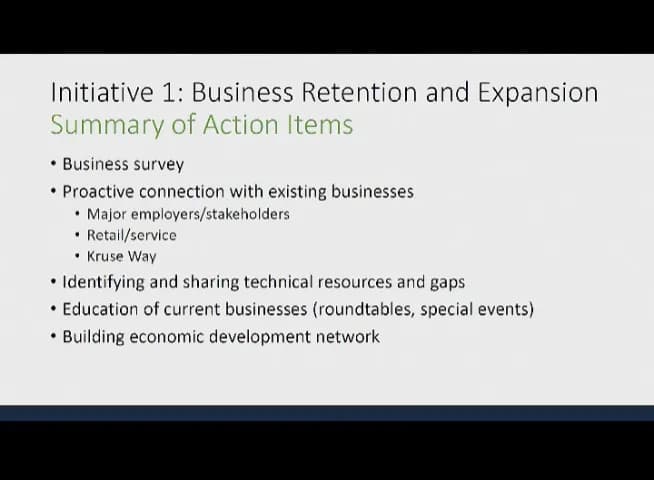
No written agenda or minutes were available; this summary is reconstructed from the meeting transcript. The Lake Oswego City Council met on Tuesday, October 13, 2026, beginning with the pledge of allegiance and roll call, followed by public comment, a state presentation on Oregon's Building Performance Standard, two action items on the wastewater treatment facility project, and two study sessions on city communications and economic development. Public Comments & Testimony - Jim Edelson, a Westlake resident and retired building energy policy professional, expressed strong support for the state Building Performance Standard (BPS), describing it as Lake Oswego's best tool to meet building-related climate action goals. He urged the council to support affected building owners with funds, staff time, and recognition, and encouraged the city to prepare to adopt a more stringent local BPS or greenhouse gas standard aligned with the 2029 state code revision. - Jeff Goodman, speaking on behalf of the Oswego Heritage Council, invited the council to a joint exhibition with the Hunt Club and noted the city's support for community events such as the car and boat show, farmers market, and festival of the arts. Oregon Department of Energy Building Performance Standard Presentation - Sustainability Program Manager Sarah Stith introduced Madeline O'Dwyer, policy analyst with the Oregon Department of Energy (ODOE), who presented on Oregon's Building Performance Standard created by House Bill 3409. - O'Dwyer explained that the BPS uses energy use intensity (EUI) as its metric. Tier one applies to non-residential, hotel, and motel buildings 35,000 square feet and above; tier two applies to those between 20,000 and 35,000 square feet. Multifamily, hospital, school, university, dormitory, barracks, prison, and residential/senior care facilities are covered at 35,000 square feet and above. - ODOE records indicated 150 buildings in Lake Oswego may be covered, though the transcript also referenced 152; 16 had already claimed their buildings in the state's BEAM portal, leaving about 136 unclaimed. - Compliance dates: tier one buildings 200,000+ square feet by June 1, 2028; 90,000-200,000 square feet by 2029; 35,000-90,000 square feet by June 1, 2030. Tier two and special tier two buildings have a compliance date of July 1, 2028. - Tier two buildings must benchmark and determine their EUI target. Tier one buildings must also attest to operations and maintenance and energy management plans and take action toward their target, which may include an ASHRAE Level 2 energy audit. - Exemptions exist for manufacturing, industrial, and agricultural activities; buildings without certificates of occupancy; buildings with less than 50% leased occupancy; buildings with large unconditioned floor area; and financial hardship. Exemptions must be applied for and are not automatic. Historic buildings are not exempt, but measures that would compromise historic integrity do not need to be implemented. - O'Dwyer described three tiers of energy professionals: qualified energy manager, qualified person, and qualified energy auditor. Penalties apply only to tier one buildings and are capped at $5,000 plus $1 per square foot per year for each five-year cycle. - The Building Energy Reduction Incentive (BERI) offers up to $100,000 for tier one buildings, currently on a first-come, first-served basis and open until about mid-December. An energy audit is the biggest barrier to using it. - Statewide, about 20,000 buildings are covered; O'Dwyer estimated 75% are tier two. She noted the program is new, with only one building statewide having come into compliance so far. - Council members asked about costs, audits, climate targets, newer buildings, and potential impacts on tenants. One councilor expressed concern about the commercial real estate market, rent pass-throughs, and the cost burden on older building owners, and advised ODOE to "educate, don't penalize." Another councilor emphasized climate goals and asked how the city could help Lake Oswego building owners access the BERI funding. - O'Dwyer said no action is mandatory from the city and offered ODOE as a resource. She also acknowledged uncertainty about audit costs and said the city of Portland's benchmarking study found costs lower than anticipated. Lake Oswego Wastewater Treatment Facility Project and Sewer Rate Resolution - Public Works Director Erica Rooney introduced the item, noting the project has been in development for nearly 10 years and is a major generational investment. - Special Projects Director Stefan Bradis, Corolla Engineers owner's advisor Wayne Gresh, and Jacobs project manager Michelle Green presented the design-build-operate-maintain (DBOM) proposal with the City of Portland. - The new facility will provide proven treatment with increased capacity, improved pollutant removal, enhanced seismic resiliency, robust odor control, and noise and lighting controls compatible with the Foothills district. - Costs are shared approximately 70% by Lake Oswego and 30% by the City of Portland based on flow contribution. The fixed design-build price shown was $3 million higher than previously presented because $3 million was moved from the owner-controlled account into the fixed design-build fee; staff emphasized this was a cost shift, not a cost increase, and did not change the rate model. - Separate construction management and inspection services are estimated at about $10 million and were described as consistent with industry standards. - Staff outlined two rate options. Option one is an approximate 28% sewer rate increase effective July 1, 2027, followed by inflationary increases. Option two is an 8% annual increase for 10 years, which raises the rate more gradually but results in higher long-term costs. For a median single-family residence, option one is about $20 per month more early on, but by 2038 option two would be about $37 per month more. - Public outreach meetings were held September 10, September 16, and October 1, 2026; staff said feedback was generally positive but attendance was low. - The council unanimously authorized the city manager to execute the DBOM contract with Jacobs and unanimously approved Resolution 26-55 directing staff to proceed with the sewer rate adjustment under option one, effective July 1, 2027. Study Session: Communications Strategy and Website Update - Deputy City Manager Madison Thesing, joined by Dana Tyrrell and Renee Buchanan of Tyrrell Group, presented findings from a communications and brand assessment. - The work was tied to the 2025 council goal of increasing informed participation and equitable access to city services. The website modernization project will be discussed separately in December. - Tyrrell Group conducted 31 interviews with 32 people, a discussion group with six DEI Board members, an online survey with 283 responses, a farmers market intercept, and a youth engagement session. - Survey data showed 97% of residents rate quality of life as excellent or good, 95% rate Lake Oswego as an excellent or good place to live, and 70% are satisfied with customer service. - Hello LO reaches 93% of survey respondents and print remains the primary source of city information. However, fewer than one-third of respondents see city communications as coming from one unified city, and only about one-third use the website as a primary source. The website ranked sixth as an information source. - Findings showed departments work in silos, each with its own logos, templates, and processes. One example cited was a library calendar carrying eight separate city logos. - Recommended next steps include a shared "hub" communications model, a citywide writing style guide, coordinated templates, shared photo asset management, and a family of marks rather than a full rebrand. - Staff noted the website RFP is currently published and closing in a few weeks. Federal ADA accessibility requirements apply by April 2028, and a website overhaul of this size typically takes 12 to 18 months. - Council feedback was broadly supportive, with emphasis on collaboration, efficiency, and consistency, as well as cost, translation, accessibility, mobile apps, and avoiding duplication with the new website. No formal action was taken. Study Session: Draft Economic Development Strategy 2026–2029 - Economic Development Program Manager Megan Bronson presented the draft strategy developed with an ad hoc council subcommittee. - Background included the 2022 council goal, a pilot contract with the Lake Oswego Chamber of Commerce, a permanent business license fee funding source, and the January 2026 presentation by consultant Mary Bosch. The ad hoc committee voted on September 1, 2026, to forward the draft to council. - The draft vision describes Lake Oswego as a center of talent and innovation with vibrant, walkable districts and a thriving local economy. - Six strategic initiatives were presented: (1) business retention and expansion, (2) business recruitment focused on the Kruse Way corridor, (3) customer attraction and tourism, (4) economic vitality marketing, (5) expanding or revising real estate inventory, and (6) organizing for success. - Key data included: about 2,800 businesses and almost 25,000 employees; more than 90% of the workforce commutes from elsewhere; 71% of businesses are in office environments; Kruse Way office vacancy is over 20%; Lake Oswego/West Linn overall office vacancy is 8.5%; retail vacancy is 1.9%; and residents spend about $781 million per year outside Lake Oswego at brick-and-mortar businesses, representing roughly 2.1 million square feet of potential retail demand. - Bronson cited the 2026 State of the Workforce report, which predicts a decade of little or no regional population growth and notes that 35% of those who can work in the Tri-County area do not currently work. She connected this to workforce development, child care, and training. - Event data from Placer AI showed 7,200 visitors attended the July 4, 2026 parade, a 14% increase over the prior year, with visitors staying an average of 73 minutes. - Staff stated there is currently no permanent economic development budget and that a request will be made in the next biennium. The draft plan uses green actions for current resources and blue actions for items requiring additional resources. - Council members expressed general support for the strategy, asked for more concrete costs and staffing numbers, and requested attention to home-based businesses, minority-owned businesses, workforce housing, child care, Kruse Way revitalization, and continued partnership with the Chamber of Commerce. - Next steps are to return in November for possible adoption of the strategy; if adopted, staff would issue an RFP for a marketing strategy and contract with OSU's Destination Lab for a business survey. Key Outcomes - No formal votes were taken on the two study sessions; both were informational. - The council voted 6-0 to authorize the city manager to execute the design-build-operate-maintain contract with Jacobs for the Lake Oswego Wastewater Treatment Facility project. - The council voted 6-0 to approve Resolution 26-55, adopting the sewer rate adjustment approach known as option one, effective July 1, 2027. - Staff will continue work on the communications hub model, writing style guide, brand family, and website RFP, with a website update scheduled for December. - The economic development strategy is scheduled to return to council in November 2026 for adoption.

ECONOMIC DEVELOPMENT 23% · PUBLIC ENGAGEMENT 19% · ENERGY AND INFRASTRUCTURE 16% · WATER AND WASTEWATER MANAGEMENT 14%
05
OCT 12, 2026 · LAKE OSWEGO, OREGON · PLANNING COMMISSION
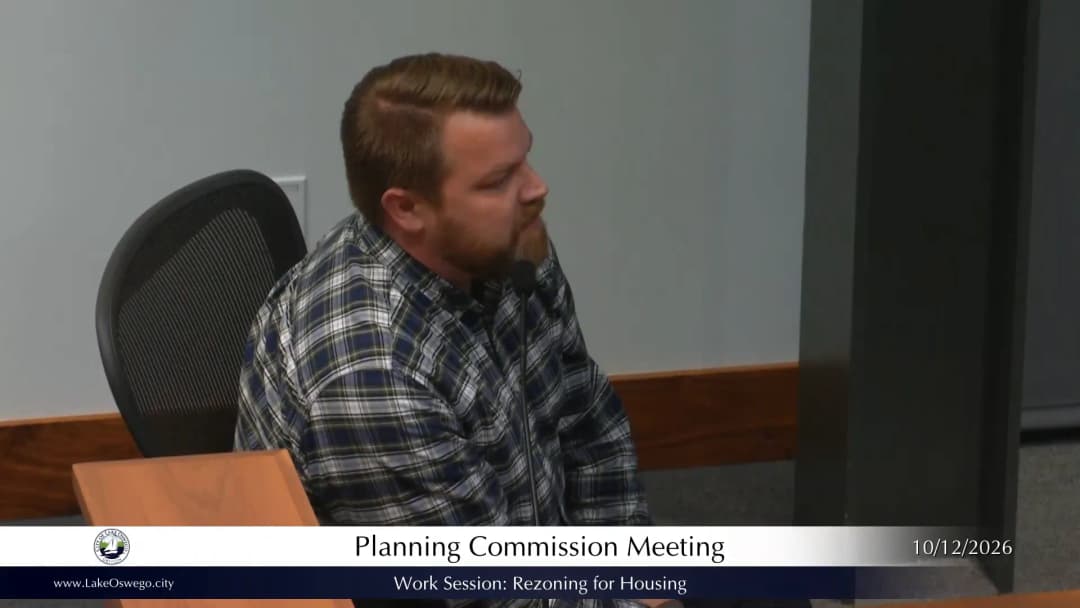
Planning Commission Work Session on Rezoning for Housing – October 12, 2026

The Lake Oswego Planning Commission held a work session on October 12, 2026, primarily to review the draft methodology for the Rezoning for Housing project (PP 25‑0001). The project aims to identify commercial, mixed‑use, and non‑residential areas that could be rezoned to address a shortfall of approximately 600 housing units identified in the city's 2023 Housing Capacity Analysis. Staff from Cascadia Partners presented three analytical themes – favorable development economics, land suitability, and advancement of community goals – equally weighted to score candidate parcels. Commissioners discussed the methodology, weighting, the role of landowner interest, and the appropriate focus areas for further study. Consent Calendar - September 14, 2026 Minutes: Approved unanimously (motion by Commissioner Guinea, second by Commissioner Sly). - September 28, 2026 Minutes: Approved unanimously (motion by Commissioner Avishon, second by Commissioner Sly). Public Comments & Testimony - No oral public comment was offered. - A written comment from Ms. Anderson was received earlier in the day and shared with the commission. The comment raised concerns about preserving employment land. Staff and consultants noted that the rezoning effort would expand allowances rather than preclude existing uses and that the city’s Economic Opportunities Analysis (EOA) shows sufficient employment land remains available. Discussion Items 1. Rezoning for Housing (PP 25‑0001) – Draft Methodology Presentation - Ray Haggerty and Paul Runsch of Cascadia Partners presented the project background, timeline (through June 2027), and the three‑theme scoring methodology: - Favorable development economics: parcel size and utilization (underused parcels preferred). - Land suitability: infrastructure capacity, natural hazard risk, physical constraints. - Advances community goals: walkability, proximity to transit, parks, jobs, grocery stores, schools. - The methodology was applied to all candidate non‑residential parcels; scores were mapped. Higher‑scoring clusters emerged in: eastern Cruise Way, Boons Ferry/Lakeview Boulevard, Westlake Grove, and First Edition/Downtown. Lower‑scoring areas included Mountain Park, McVay, Foothills, and the former Marylhurst campus. 2. Commission Discussion on Methodology - Commissioner Guinea asked whether landowner interest is considered. Staff noted it is not part of the current methodology but will be addressed through stakeholder interviews with large property owners. Commissioner Guinea suggested a survey to gauge owner interest. - Commissioner Call questioned the minimum parcel size for viable redevelopment and whether very small parcels should be excluded. The consultant explained that smaller parcels are scored lower but are not excluded because they can be assembled over time. - Commissioner Sly raised a concern about underutilized commercial space, questioning why the city is not first trying to fill office vacancies (e.g., the 20% vacancy on Meadows Road). Staff noted a separate economic development strategy is being drafted to address that issue. - Commissioner Tween asked about the logic of equal weighting across the three themes. Staff responded that the equal weighting serves as a neutral baseline, and input from the commission, council, and public will inform any adjustments. Several commissioners supported keeping equal weighting until more public feedback is gathered. - Commissioner Avishon noted that market‑driven development is already occurring in the identified high‑scoring areas, validating the methodology. He also cautioned against re‑zoning western Cruise Way due to the presence of major office employers (e.g., Yakima headquarters) and supported preserving industrial land on lower Boons Ferry. - Commissioner Guinea emphasized that rezoning only enables development, it does not guarantee it, and that larger parcels attract developers more effectively, though smaller infill projects are also possible. - Commissioner Avishon and others reiterated that the project is not about forcing changes but about expanding long‑term options; the city wants to maintain local control over land use rather than have state mandates. 3. Public Open House Planning - The first public open house is planned for early November 2026. Commissioners advised that the open house should clearly communicate that the project does not force anyone to change current uses or displace businesses, and that the goal is to raise the theoretical housing capacity to meet identified needs. Emphasizing local control and the connection to the Housing Needs Analysis and Housing Production Strategy was also recommended. Key Outcomes - The commission expressed general support for the draft methodology and for proceeding with the four identified high‑scoring areas (eastern Cruise Way, Boons Ferry/Lakeview Boulevard, Westlake Grove, First Edition/Downtown) as focus areas for further study. - Lower‑scoring areas (Mountain Park, McVay, Foothills, Marylhurst campus, western/central Cruise Way) were set aside for potential master planning efforts rather than near‑term rezoning. - No formal vote was taken; the feedback will inform the project team’s revisions and presentation to city council. - The commission did not direct a change in the equal weighting of the three themes, but agreed to gather public input before finalizing. - Schedule update: the next commission work session is October 26, 2026 (Foothills schematic plan). The November 9 meeting is canceled; the November 23 meeting will include the code audit work session and work plan review.

URBAN PLANNING 37% · ECONOMIC DEVELOPMENT 19% · HOUSING AND DEVELOPMENT 18% · PUBLIC ENGAGEMENT 11%
06
OCT 6, 2026 · LAKE OSWEGO, OREGON · CITY COUNCIL
Lake Oswego City Council Meeting – October 6, 2026: Proclamations, Franchise Approval, Rate Review, Budget, Lorac Update

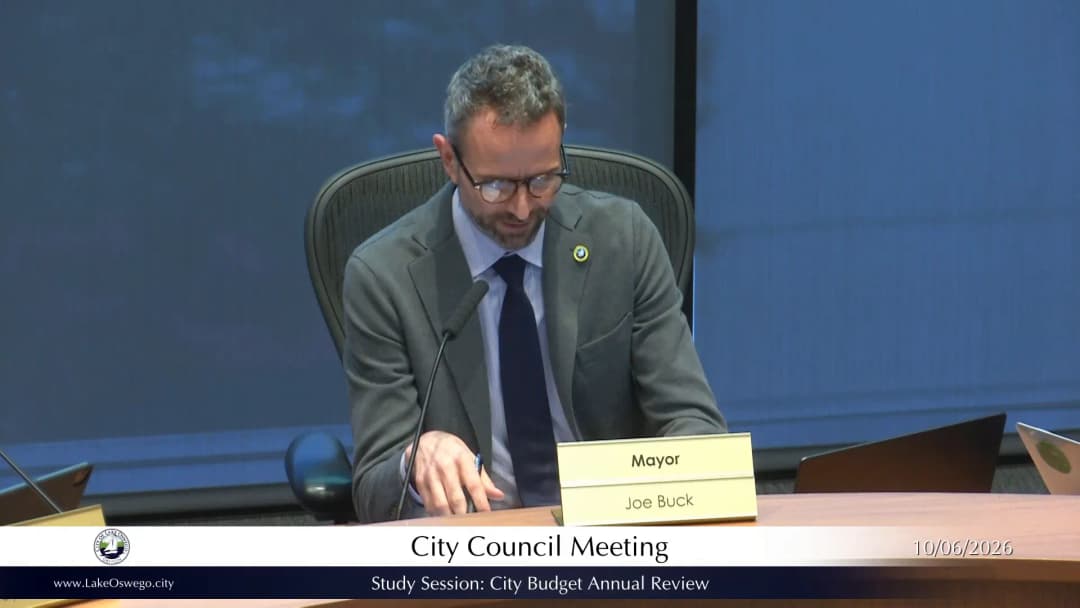
The Lake Oswego City Council met on Tuesday, October 6, 2026, at 7:00 PM. The meeting included proclamations, the adoption of the consent agenda, a public hearing and approval of a cable franchise renewal with Comcast, a study session on solid waste and recycling rates (resulting in no rate adjustment), a detailed mid-biennium budget review, a one-year operational update on the Lorac Recreation and Aquatics Center, and council committee reports. All votes were unanimous (6-0) with Councilor Wenlin excused. Consent Calendar - Ordinance 2981 and Ordinance 2983: Annexed property into the city. - Resolution 26-35: Transferred roadway responsibility to Clackamas County for certain roadways. - Resolution 26-53: Approved appointments to the ad hoc code audit technical advisory committee. - A public hearing on Ordinance 2982 was removed at the applicant’s request. - The consent agenda was adopted by a motion from Councilor Verdick, seconded by Councilor Corgan, with a vote of 6-0. Public Comments & Testimony - No members of the public signed up to speak during the public comment period or the cable franchise hearing. Discussion Items Proclamations - Mayor recognized Meals on Wheels Month (50+ years of service in Lake Oswego), Domestic Violence Awareness Month, and Indigenous People's Day, emphasizing community care and recognition. - A special recognition was given to Megan Phelan for nearly two decades of service, including acting city manager and HR director roles. Cable Franchise Renewal (Comcast) - Chief Technology Officer Weston Pay and MAC Interim Director Jonathan Kaufman presented a 10-year non-exclusive cable franchise (through June 2036) for Comcast. - The franchise preserves the 5% cable franchise fee, expands HD access to all five PEG channels, and changes PEG/PCN funding from $0.80 per subscriber per month to 1.75% of gross cable revenue – estimated to increase Lake Oswego’s annual funding from $500,000 to $1.6 million. - Council clarified the fee increase will be passed through to Comcast customers (estimated $0.80 to $2.50 per month on the video portion only). - Motion to adopt Ordinance 2985 by Councilor Afkin, seconded by Councilor Mands; passed 6-0 after a brief public hearing with no testimony. Solid Waste & Recycling Rate Review - Sustainability Program Manager Sarah Stith and Lindsay Waldron of Bell & Associates presented the annual rate review for Republic Services. - Republic’s adjusted return on revenues was 13.9% (2025), projected at 12.24% for 2026 after factoring labor, disposal, and inflation increases, offset by the Oregon Recycling Modernization Act (37.4% decrease in recycling processing cost). - The projected return remained within the target range; no rate adjustment was proposed through December 2027. - Council asked about tonnage trends (weights declining) and whether rates could be reduced if returns exceeded 8%; staff will follow up. City Budget Annual Review (Mid-Biennium) - Finance Director Sean Cross presented trends and budget-to-actuals for the general fund and other funds. - Key trends: inflation now 3-4% vs. historical 2-3%; interest rates near 7-8%; unemployment near 4-5%; assessed values growing 3-4% annually; workers’ comp premiums doubled to $700,000/year; liability insurance rose to $1.5 million (from $200,000 in 2012) due in part to new facilities. - General fund revenues (property taxes, franchise fees, state shared) are growing steadily but slower than expense growth. - Fire department personnel costs are running over budget by $400,000-$600,000 annually due to overtime covering sick leave and paid leave Oregon (PLO) staffing gaps. Fire has used its biennial contingency and is “treading water.” Staff will return in January/February for a supplemental budget request. - Parks and Recreation overall operating at $400,000 deficit, primarily driven by the Lorac dry side. - Building department revenues are slowing (35% of budget through year one), indicating a downturn in construction. - Tennis revenues significantly exceeded budget. - Water and sewer funds: Capital projects (e.g., McVay pump station, Cornell Road pipeline) are on schedule or slightly delayed; the wastewater treatment plant will require a budget supplement. - Lorac year-one analysis: Operating revenues exceeded budget by $250,000 but expenses were $600,000 over (personnel 75%, building maintenance and utilities 25%). The wet side (pool) is nearly breaking even; the dry side accounts for most of the deficit. - Council noted the city can maintain current service levels but has little to no extra capacity for new projects. The East End urban renewal district ending will provide additional revenue. Lorac One-Year Operational Update - Parks Director Jeff Munro presented usage statistics from the first year (April 2025 – April 2026) and the first four months of the second year. - First year totals: 1,337 swim lesson students; 6,000 aqua fitness participants; 94 lifeguards certified; 2.5 million golf balls dispensed; 5,400 open gym participants; 1,600 camp/class participants; 127 rentals with 10,000 guests; 3,000+ members sold with 19,000 membership uses; 22,000 drop-ins. - Last four months: Additional 449 sports participants, 14,483 golf rounds, and 743 memberships sold; membership uses grew to 15,000 in just four months behind the first year’s 19,000. - Notable facility improvements: upgraded chemical control system, automated pool filtration, improved dehumidification (reducing corrosion). - Unplanned expenses: $34,000 for landscaping, $30,000 for security cameras, new furniture, and electrical upgrades for food carts – attributed to startup “learning curve” costs. - Council praised staff for excellent service and noted the importance of finding efficiencies in the next nine months. Council Reports & Updates - Councilor Verdick: The Library Reuse Task Force has held two meetings; it was clarified that operating two libraries is not within the budget. The task force is proceeding with its charge. - Councilor Afkin: Attended the Hillsdale–Lake Oswego Trail opening; also acknowledged a land donation offer that Parks & Rec declined due to location and cost. - Councilor Mands: Reported on the Mayor’s Golf Tournament (successful) and the Cultural Exchange event (positive community engagement). - Mayor: Provided updates on the Youth Leadership Council (first meeting, planning capstone project) and the Student Advisory Board (focusing on transportation issues). Also reported on regional work regarding the Supportive Housing Services measure oversight board – cities are advocating for a larger role in the region’s homelessness response. - New City Manager Denzel Maxwell thanked everyone for the warm welcome. Key Outcomes - Consent agenda adopted 6-0. - Ordinance 2985 (Comcast cable franchise) approved 6-0; 10-year term through 2036. - No rate increase for Republic Services solid waste and recycling through at least December 2027. - Finance Director will return with a supplemental budget request for the fire department (likely January/February 2027). - Council directed staff to explore cost-saving opportunities in the Lorac dry side and other departments ahead of the next budget cycle. - City Manager Maxwell began his role; will engage with budget and operational issues.

FISCAL SUSTAINABILITY 22% · PARKS AND RECREATION 22% · BUDGET EQUITY ANALYSIS 17% · TECHNOLOGY AND INNOVATION 7%
07
SEP 28, 2026 · LAKE OSWEGO, OREGON · PLANNING COMMISSION
Lake Oswego Planning Commission Work Session on Code Audit and Housing – September 28, 2026

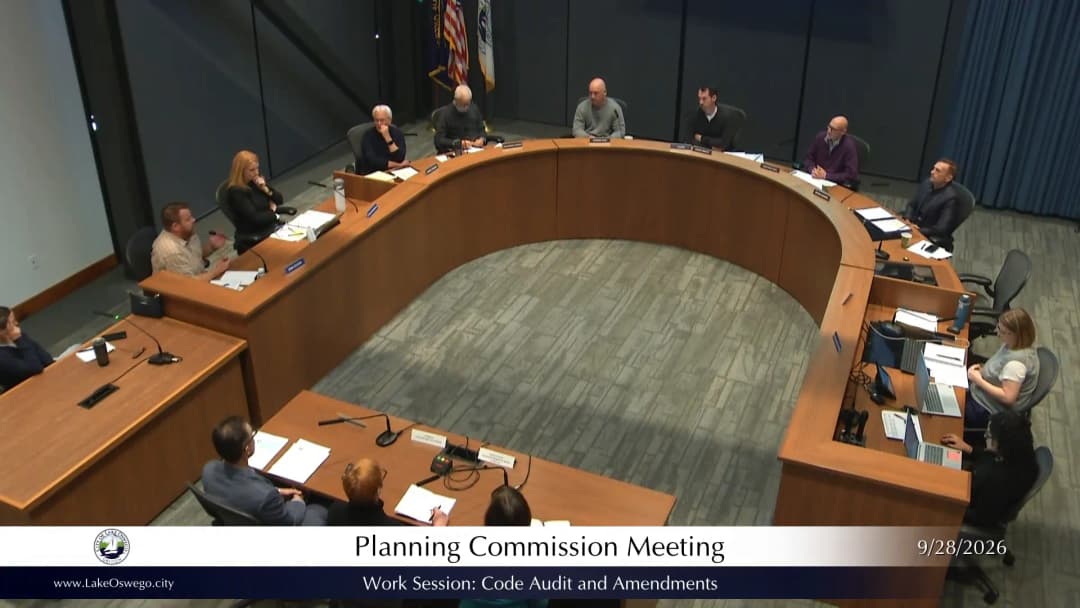
The Lake Oswego Planning Commission met on September 28, 2026, at 7:00 p.m. for a regular meeting that included a city council update, neighborhood association announcements, adoption of findings for a land use case, and a fourth work session on the code audit and amendments for housing and business (PP 25-0002). The meeting was chaired by Vice Chair James Bruce, with Commissioners Avishon, Guinea, Call, Sly, Twing, and Vice Chair Bruce present. Commissioner Avishon initially abstained from the findings vote due to not attending the original hearing, but the vote was retaken and approved. City Council Update - Councilor Verdick reported on several city matters: (1) A new city manager, Denzel Maxwell, will start on Monday, September 30. (2) An update on the wastewater treatment plant, with the council deliberating on a rate increase—either a one-time large increase or a gradual increase over ten years. No decision has been made. (3) Republic Services has increased staff and resolved garbage and recycling issues; apologies were issued for prior service problems. (4) The Arts Council is active: the August Trunk sculpture (the elephant on Boone's Ferry) requires maintenance; the Ferry Tree art piece at George Rogers Park is being decommissioned, with plans for 3D renderings to archive it; a new art piece was unveiled at the library. (5) Municipal grants will now be awarded once a year instead of twice. (6) Updates on e-bike and micro-mobility device regulations are underway to improve safety and control. Neighborhood Association Announcements - The Palisades Neighborhood Association, along with four other neighborhoods, will co-host a city council candidate forum on October 23, 2026, at 6:30 p.m. at Park Academy (1915 South Shore Boulevard). Questions will be submitted by neighborhood associations. Contact Chris Durke, Palisades Chair, for involvement. - The Old Town Neighborhood Association announced its new website: oldtownlakeoswego.org. The site will provide neighborhood news, blog updates, upcoming meetings, city council candidate forum information, and fun activities. Findings for LU 26-0019 - The draft findings for this land use case were distributed earlier. A motion to approve was made and seconded; a voice vote was taken with all ayes, and the findings were approved. Later, during Other Business, Commissioner Guinea raised a procedural question: Commissioner Avishon was not present at the original hearing and had not reviewed the record. To ensure proper procedure, the vote was retaken. Commissioner Call made a new motion, seconded by Commissioner Guinea. The findings were approved with Commissioner Avishon abstaining. Work Session on Code Audit and Amendments for Housing and Business (PP 25-0002) - Senior Planner Evan Franstead introduced the project team, including consultants Lee Oligode (3J Consulting) and Karen Tolstad (Veritas Collaborations). The code audit is part of the economic development strategy and housing production strategy, alongside a separate rezoning for housing project. The audit focuses on removing barriers to housing and economic development while retaining quality standards, streamlining the code, and ensuring compliance with state legislation. - Key findings from focus groups and interviews: The current code is difficult for applicants and staff due to complexity, numerous neighborhood overlays (at least 52 zone combinations), conflicting standards, and barriers to middle housing (e.g., commercial building code for triplexes/quadplexes). Initial recommendations include reorganizing the code, combining design standards, streamlining overlays, addressing housing development standards, and improving business use categories. - Legislative compliance updates: New state laws effective July 2026 and January 2027 require updates to procedures for housing applications, new housing types (including single room occupancies), and updated rules for cottage clusters and middle housing (e.g., floor area averaging, reduced minimum lot sizes). The team will distinguish mandatory state requirements from discretionary local choices. - Public involvement strategy: A draft plan emphasizes educational outreach, casual engagement (e.g., QR codes at parks, library events, bus stops) to reach busy residents and underrepresented groups. The goal is to gather input on key policy choices as the audit progresses. Commissioners stressed the importance of engaging the general public who may not attend formal meetings. - Discussion on housing need numbers: Staff noted the city's 2023 housing needs analysis projected 2,000 new units over 20 years, but the state's new Oregon Housing Needs Analysis (OHNA) methodology indicates a need of 4,850 units. The city aims to plan for the higher number to avoid underproducing. Commissioners questioned the discrepancy and requested clarity on mandatory vs. discretionary changes. Staff confirmed that the code audit will include a table labeling recommendations as legislative mandates, local policy, or best practices. - Additional topics: The audit will identify existing requirements that add cost or delay (e.g., material standards, dimensional rules). The commission discussed the evolution of neighborhood overlays and the need to prevent future complexity. Commissioner Guinea referenced a new state report (SB 1537) highlighting fragmentation in housing production policies. - Next steps: The first Technical Advisory Committee (TAC) meeting will occur at the end of October. The consultant team will work on the code audit and action plan through early 2026. The next commission work session on this topic is scheduled for November 23, 2026, with a city council briefing on November 3, 2026. Other Business - Commissioner Guinea raised a procedural point regarding the adoption of findings earlier in the meeting. Since Commissioner Avishon was absent for the original hearing, she abstained. The vote was retaken, and the findings were approved with one abstention. Schedule Update - October 12, 2026: Work session on the rezoning for housing project, led by Associate Planner Michael McNamee. - October 13, 2026: Citizens Advisory Committee (CAC) meeting. - October 20, 2026: City council study session on Foothills. - October 26, 2026: Work session on Foothills progress, including schematic plans, massing, 3D views, financial feasibility, and density analysis. - November 9, 2026: Remote meeting to begin planning the 2027 work plan. Key Outcomes - Findings for LU 26-0019 approved (motion by Commissioner Call, second by Commissioner Guinea; vote: 4 ayes, 0 nays, 1 abstention (Commissioner Avishon)). - Direction for code audit: Staff and consultants received feedback to include clear labeling of mandatory vs. discretionary changes, focus on cost-effective improvements, and implement a broad public engagement strategy targeting underrepresented groups. The commission emphasized the need to plan for the higher housing need projection (4,850 units) and to avoid future code complexity. - TAC formation: The Technical Advisory Committee will have its first meeting in late October 2026, with a representative from DLCD invited.

HOUSING AND DEVELOPMENT 42% · URBAN PLANNING 16% · PUBLIC ENGAGEMENT 15% · COMMUNITY ENGAGEMENT 13%
08
SEP 15, 2026 · LAKE OSWEGO, OREGON · CITY COUNCIL
Lake Oswego City Council Meeting - September 15, 2026

This is the meeting summary for the Lake Oswego City Council meeting held on Tuesday, September 15, 2026. The meeting covered a wide range of topics, including a presentation from Republic Services on their return to excellence plan, updates on city council goals, a municipal grant awards resolution, a legislative feedback session for the League of Oregon Cities, approval of the Arts Council's annual public art plan, enactment of an e-micromobility device ordinance, and a work session on the code audit project. The meeting also included public comments and recognitions. Call to Order and Proclamation - The meeting was called to order at approximately 7:00 AM? (time not specified). The pledge of allegiance was recited. - A proclamation was issued recognizing the rich histories, cultures, and contributions of Hispanic and Latin communities (Hispanic Heritage Month), with the theme "Unidos Somos Mass" (Together We Are More). Republic Services Return to Excellence Plan - Presentation by Cindy Rogers (Municipal Relationship Manager), John Oliveras (General Manager, Republic Services, and Lake Oswego resident), and Steve Baker (Operations Manager). - Republic Services serves 11,846 residential customers, 412 commercial customers, and 1,769 industrial halls in Lake Oswego. Residential service involves three separate trucks (trash, yard debris/food waste, commingled recycling including glass) for each of the 11,846 homes, totaling 35,000 stops every week. - The presentation provided an overview of services, including two annual bulky waste events (186 vehicles in spring, over 500 in fall), partnership with the Mattress Recycling Council, and community involvement events like TetraTrucks, birthday drive-bys, Earth Day e-waste events, and in-kind donations for various local organizations. - The "Return to Excellence Plan" was presented to address staffing challenges experienced from March through July 2026. The challenges included unexpected retirements, relocations, terminations, and a transition in General Manager, leading to staffing shortages (goal of 26 drivers to cover 19-21 daily routes). Customer complaints and missed pickups approximately doubled during this period, but by August 2026, complaints dropped to three total (two missed pickups), indicating a return to standard service levels. The plan includes enhanced communication (ensuring accurate phone numbers) and increased supervisor presence. - Council members expressed appreciation for Republic Services' service, professionalism, and partnership. Specific comments highlighted the high standard of service, the company's sustainability efforts (electric and natural gas trucks), and the need to learn from the experience. Questions were raised about the duration of the staffing issues (March-July) and remedies for affected customers. 2026 Council Goals Update - Assistant City Manager Megan Phelan provided the third-quarter update on 2026 city council goals, noting progress on some goals and continuation of others into the fall. - Councilor Corrigan reported on a tabletop exercise using AI modeling for wildfire spread, noting its impact and encouraging broader participation. Public Comments - Steve Dole: Submitted a packet of correspondence regarding an anti-Semitic trope displayed on a Lake Oswego marquee. He criticized the council's response (boilerplate emails about First Amendment) as silence and a double standard, highlighting a documented pattern of incidents (concentration camp poster, anti-Semitic flyers, vandalized swastika). He proposed three concrete actions: (1) Adopt a baseline condemnation policy for targeted rhetoric against any minority group, (2) utilize city media channels to explicitly condemn anti-Semitism, and (3) partner with regional organizations like the Jewish Federation to provide resources. He requested a public hearing on the matter. - Andrew Edwards: President of the Friends of the Lake Oswego Public Library. He spoke in support of the library, highlighting the Friends' support for over 100 annual programs (including Lake Oswego Reads), the success of the Summer Library Challenge (1,073 youth, 565 adults, over 1 million minutes of reading), and the need for a larger facility given the current space limitations (staff forced to hold programs in parks; poor air quality/heat forced a performer to move indoors, accommodating 171 people). He invited councilors to become members. Consent Agenda - Items included: Approval of meeting minutes (May 15 and May 28, 2026), Resolution 26-34 (adopting a tree retention deficit fee), and Resolution 26-48 (approving Megan Phelan as City Manager Pro Tem). - Motion made by Councilor Corgan, seconded by Councilor Mance. Passed 7-0. Discussion Items: Municipal Grant Awards (Resolution 26-38) - Presented by Management and Program Analyst Teo Ramirez. A subcommittee (Councilors Afkin and Corrigan) reviewed 19 applications. Total funding requests: $62,000 (Council Goals), $46,000 (Social Services). - Recommendations for funding (8 initiatives in Council Goals, $43,450 total): Lake Forest Neighborhood Association (Emergency Preparedness), Evergreen Neighborhood Association (Emergency Preparedness/Emergency Cash), Oswego Lake Watershed Council (Emerald Ash Borer outreach), Gifting Gears (safety equipment), Lake Oswego Sustainability Network (feasibility study for clean energy district/thermal energy network in Foothills District - $15,500, the largest individual award). - Recommendations for funding (4 initiatives in Social Services, $27,000 total): Tualatin Food Pantry, The Children's Center, Clackamas Women's Services, Lake Oswego Monsters Robotics. - Not funded: Applications determined to be below scoring thresholds (75% for Council Goals, 70% for Social Services). - Additional recommendations: Reserve $10,000 for LO for Love (maturing out of three-year funding limit) while developing a sponsorship pathway. Explore sponsorship pathways for recurring high-performing organizations (Children's Center, Clackamas Women's Services). - Discussion: Councilor Wenlin raised a concern that the LOSN project ($15,500) might be more appropriately a city-funded government project rather than a community grant. Councilor Afkin defended it as supporting the city's climate change council goal. Councilor Verdick praised the subcommittee's work and fiscal responsibility. Councilor Mance thanked the 2025 council for improving the grant program. - Motion made by Councilor Verdick, seconded by Councilor Wenlin. Discussion concluded. Passed 7-0. Discussion Items: League of Oregon Cities (LOC) 2027-28 Legislative Priorities - Deputy City Manager Madison Thiesing presented the request to narrow down the LOC's top eight priorities to the top five for the city's survey submission. - Top eight identified: (1) Right-of-way authority/revenue, (2) Public meeting law clarity, (3) Full funding and streamlining for housing production, (4) Energy grid hardening/modernization, (5) Economic/workforce development, (6) 2027 transportation package, (7) Infrastructure funding, (8) Ratepayer assistance. - Council discussion to narrow to five: There was strong consensus (Councilors Corrigan, Wenlin, Verdick, Corgan, Mayor Buck) to include public meeting law clarity (due to confusion for volunteer board/commission members and previous vetos). The final five selected were: (1) Public meeting law clarity, (2) Full funding/streamlining for housing production, (3) Energy grid hardening and modernization, (4) 2027 transportation package, (5) Infrastructure funding. - Mayor Buck emphasized the need for carrots over sticks from the state and urged less preemption. Councilor Mance raised cybersecurity and AI guardrails as additional concerns. Councilor Wenlin and Mayor Buck called for a pause on new housing mandates to let existing ones work. Discussion Items: Arts Council of Lake Oswego Annual Public Art Plan - Presented by Arts Council Executive Director Nicole Nathan. The plan is a new requirement stemming from the 2024 Public Art Master Plan. - Contractual commitments: Maintenance/conservation (e.g., rust mitigation on elephant sculpture on Boons Ferry Road, plaque replacement at Glenmorrie Park), acquisition (installation of "Echoes of Belonging" by Sahara Defrize at the library, dedication on Saturday), deaccession of "Fairy Tree" (3D scanned for historical record, Christmas tree ornament fundraiser planned), annual exhibition "What We Behold" (on view through October 30, curated by Kendra Roberts), percent-for-art projects (South Shore Fire Station, Rassekh Park phase two mural on restroom/maintenance building), Gallery Without Walls (8 new pieces in 2026 cohort, new call opens October 1), Cultural Exchange (September 27, including People's Choice Award to PUP by Ben Dye). - Non-contractual programs: Exhibitions (holiday marketplace, Artmart, student art show, winter/spring, spring/summer), docent tours, programs aligning with exhibitions (e.g., Ikebana demo), public art in private developments (Hacienda, Habitat for Humanity on Boons Ferry), Highway 43 art corridor collaboration with West Linn and Oregon City (currently on hold). - Council members praised the Arts Council for maintaining the collection, managing volunteerism, integrating art into new developments, and fostering inclusivity (especially at Hacienda and Habitat for Humanity). Councilor Mance highlighted the City's volunteer ethic. - Motion made by Councilor Wenlin, seconded by Councilor Verdick. Passed 7-0. Discussion Items: Ordinance 2980 (E-Micromobility Device Usage) - A legislative public hearing was held. No public testimony was offered. - Presented by Police Chief George Burke and Captain Clayton Simon. The ordinance amends Chapter 32 of the Lake Oswego City Code. - Key provisions: Simplifies device terminology, updates bicycle provisions to align with state statute, adds clarifying information on lawful operation and locations, defines "unsafe operation" and "unreasonable speeds," establishes an escalation of penalties for subsequent violations within 12 months, and includes an educational component (public information materials developed, distributed via social media, city website, Parks, Library, ACC; future partnerships with school district). - Discussion: Councilor Mooer expressed concern about children using e-bikes instead of pedaling for health. Councilor Mance inquired about enforcement and education plans. Councilor Afkin volunteered to be an ambassador at the Farmers Market to reduce confusion. Chief Burke confirmed the goal is safe behavior, not prohibitive on use, barring non-compliant devices (e-motos without pedals, license, etc.). Captain Simon noted many non-compliant devices are sold online. Captain Simon also confirmed that cameras on trucks are primarily outward-facing for safety, not license plate recording. - Motion made by Councilor Mooer, seconded by Councilor Verdick. Passed 7-0. Work Session: Code Audit Project & Technical Advisory Committee (TAC) Formation - Presentation by Associate Planner Evan Franstead, consultants Lee Alligator and Karen Tolstadt (3J Consulting). The project is a comprehensive 18-month review of Lake Oswego's Community Development Code (Chapter 50). - Background & Purpose: The code has become increasingly complex due to multiple amendments, overlays, design standards, and new state requirements. The project aims to remove regulatory barriers to housing and economic development while retaining high-quality development standards and ensuring compliance with state housing mandates (e.g., middle housing, cottage clusters, SROs). It works in tandem with a separate rezoning for housing project. - Findings from Background Report (Phase 1): Code is difficult to use; 52+ unique combination zones due to overlays and design districts that sometimes conflict; building code thresholds can hinder middle housing; tenant improvements face unanticipated requirements; food carts are only temporary; state legislative compliance is needed (review procedures, SRO types). Items outside scope (sign code, SDCs) were noted for awareness. - Draft Public Involvement Strategy: Proposed a two-phased approach: (1) Early education and outreach to stakeholders (interviews done) and neighborhood associations. (2) Later (when specific proposals exist) use broad tools (website, public meetings, media) PLUS targeted "intercept conversations" (face-to-face at casual settings like church coffee hours, PTA meetings) to reach underrepresented audiences (busy families, renters, lower-income, diverse ethnic groups). Strategy emphasizes being clear on what the city can vs. cannot control due to state mandates. - Council Feedback: Councilor Mooer expressed confusion with technical language and requested concrete, discrete questions for the public (e.g., "Should overlay X be removed?"). Councilor Mance emphasized retaining Lake Oswego's character while simplifying complexity. Councilor Mance also noted that the city should not remove all overlays but instead streamline them; Councilor Verdick cautioned overlays were created for neighborhood character. Councilor Mooer also questioned the timeline relative to potential LUBA appeals (staff clarified this is a code change, not a land use decision). Mayor Buck requested that the city's goals be measured with metrics to ensure accountability (e.g., housing production, permit times). Councilor Wenlin called for a pause on new state mandates. Councilor Afkin stressed kindness to overlays due to their historical purpose. - Technical Advisory Committee (TAC): Resolution 26-52 to form an ad hoc TAC was presented. Motion made by Councilor Mooer, seconded by Councilor Afkin. Councilor Mance suggested the TAC include a builder who does not currently work in Lake Oswego to get an outside perspective on barriers. Motion passed 7-0. Recognitions - Farewell to Pro Tem City Manager Lynn: Mayor Buck delivered heartfelt remarks thanking Lynn for stepping into a temporary leadership role during a transitional period. He praised her community engagement, solutions-oriented approach, and the support she provided to the council and staff on regional issues. Lynn (Lynn) expressed gratitude for the opportunity and apologized for "overlays" she passed 20 years ago, joking that the city is unique. She thanked the council and staff for their dedication. Executive Session - The council moved into executive session under ORS 192.660(2)(d) (labor negotiations) and (f) (exempt information). No final decisions were to be made. The meeting adjourned following the session. Key Outcomes - Public Comments: Received; no specific council action taken, but the Mayor acknowledged the requests regarding the anti-Semitic marquee. - Republic Services: Presentation given; discussion held. Service reliability appears to be recovering. - Consent Agenda: Approved (7-0). - Municipal Grants (Resolution 26-38): Adopted (7-0), awarding funds as recommended. Staff directed to develop sponsorship pathways for certain recurring organizations. - LOC Legislative Priorities: The city will submit its top five priorities (public meetings clarity, housing funding/streamlining, grid hardening, transportation package, infrastructure funding). Council also noted additional concerns (cybersecurity, state preemption, pausing new housing mandates). - Arts Council Public Art Plan: Approved (7-0). - E-Micromobility Ordinance: Adopted (7-0). Effective upon enactment. - Code Audit Project: Work session held; staff directed to incorporate council feedback, particularly on community engagement (discrete questions, intercept strategy) and metrics for effectiveness. Formation of TAC approved (7-0); membership currently being considered. - Pro Tem City Manager Farewell: Recognized and thanked.

COMMUNITY ENGAGEMENT 16% · PUBLIC ENGAGEMENT 15% · PUBLIC WORKS 12% · ARTS AND CULTURE 11%
09
SEP 14, 2026 · LAKE OSWEGO, OREGON · PLANNING COMMISSION
Lake Oswego Planning Commission Meeting - September 14, 2026

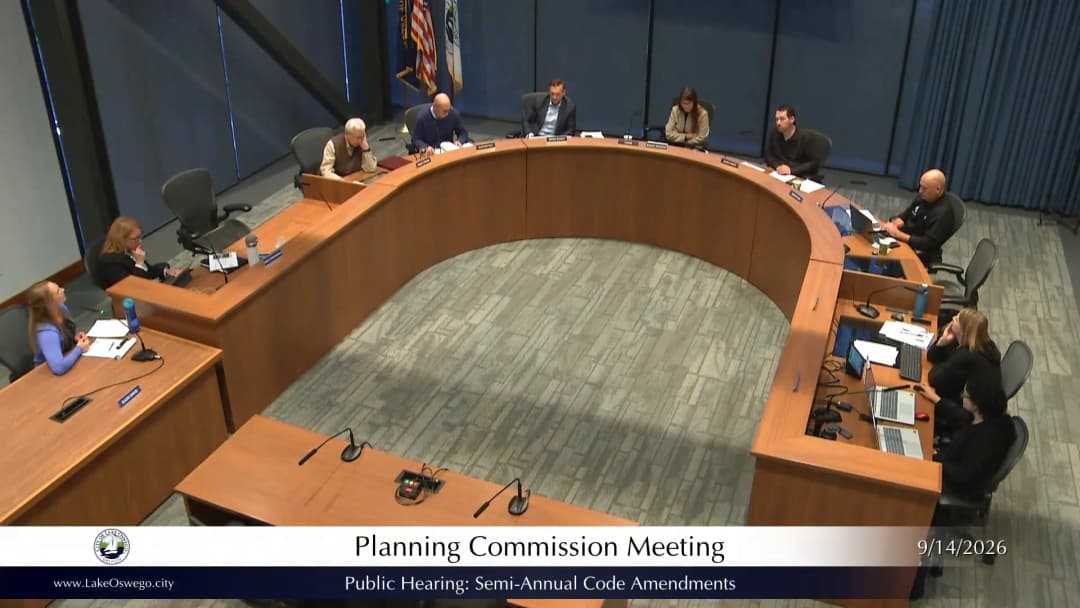
The Lake Oswego Planning Commission held a regular meeting on Monday, September 14, 2026, at 7:00 PM. The meeting included approval of previous minutes, updates from neighborhood associations, and a public hearing on the 2026 semi-annual code amendments package, which was ultimately recommended to the City Council unanimously. Consent Calendar - Approval of Minutes (July 27, 2026): Motion by Commissioner Bruce, second by Commissioner Guinea. The minutes were approved unanimously by roll call: Chair Najak (Aye), Vice Chair Bruce (Aye), Commissioner Guinea (Aye), Commissioner Call (Aye), Commissioner Sly (Aye), Commissioner Twing (Aye). Commissioner Albassan was absent. Public Comments & Testimony - No public comments were received for items not on the agenda. - For the public hearing on LU 26-0019, no members of the public signed up to testify. Discussion Items - Commission for Citizen Involvement Updates: Staff announced three upcoming neighborhood association events: - Forest Hills Neighborhood Association picnic on September 18, 2026, at 5:00 PM at Rossman Park (live music, ice cream, popcorn). - Uplands Neighborhood Association general meeting on October 15, 2026, at 7:00 PM at Lake Oswego Middle School Library (speakers on school bond and Firewise). - Waluga Neighborhood Association meeting on October 14, 2026, at 7:00 PM at Our Savior's Lutheran Church (board elections, schools update, library and community center). - Public Hearing LU 26-0019 – 2026 Semi-Annual Code Amendments: Senior Planner Ellen Davis presented the amendment package, which includes 13 maintenance amendments and 3 policy amendments. Key items: - Maintenance Amendments: Items 1-12 (e.g., removing pandemic-era outdoor seating allowance, fixing eve depth conflict for townhouses, clarifying accessory structure entrance requirements, updating sensitive lands code, improving bicycle parking references, aligning with state parking minimum elimination, etc.). Item 13 (new) updates the tree code (Chapter 55) to reflect state law (HB 4037) limiting public notice for tree removal applications related to clear-and-objective housing. - Policy Amendment 1 (Middle Housing Land Divisions): Removes the neighborhood meeting requirement for middle housing land divisions that only divide ownership, since state law limits public notice and appeals. Combined applications with traditional subdivisions would still require a neighborhood meeting. - Policy Amendment 2 (Carport Enclosure): Allows existing non-conforming carports to be enclosed into garages via a minor variance instead of a major variance, with a 20% expansion limit or a maximum footprint of 450 square feet. This aims to streamline approvals for low-impact conversions. - Policy Amendment 3 (Detached Plexus): Interim compliance with HB 2138, effective January 1, 2027, allowing detached duplexes, triplexes, and quadplexes on single residential lots while awaiting state administrative rules. The city will retain existing standards for attached units and will develop permanent siting/design standards later. - Commissioner Guinea expressed interest in the detached plex amendment and noted the complexity of HB 2138, particularly regarding potential statutory bonus units that could require density/height increases. He suggested future study once state rules are clearer. Commissioner Call asked a clarifying question about tree code amendment notice procedures. Commissioner Guinea declared a potential conflict of interest regarding the carport amendment (family member may own a non-conforming carport), but after discussion it was noted that the amendment only applies to non-conforming carports; no further action was taken. Key Outcomes - Motion: Commissioner Guinea moved to approve the staff’s proposed code amendments as presented for recommendation to the City Council. Commissioner Bruce seconded. The motion passed unanimously by voice vote (all aye). - Next Steps: The recommendation will be forwarded to the City Council for a public hearing in early November 2026. Findings will be presented at the Planning Commission’s next meeting on September 28, 2026. The effective date of the amendments is expected to be January 1, 2027, or as determined by the City Council. Other Business - Planning Manager Olson provided a brief update on the NCLO (Neighborhood Community Liaison Organization) annual meeting, which reviewed insurance requirements for neighborhood associations (notably, no alcohol allowed at meetings for insurance coverage). Schedule Review - The next Planning Commission meeting is scheduled for September 28, 2026, to review findings for the code amendments.

URBAN PLANNING 36% · PROCEDURAL 35% · HOUSING AND DEVELOPMENT 10% · TREE MANAGEMENT 6%
10
SEP 1, 2026 · LAKE OSWEGO, OREGON · CITY COUNCIL
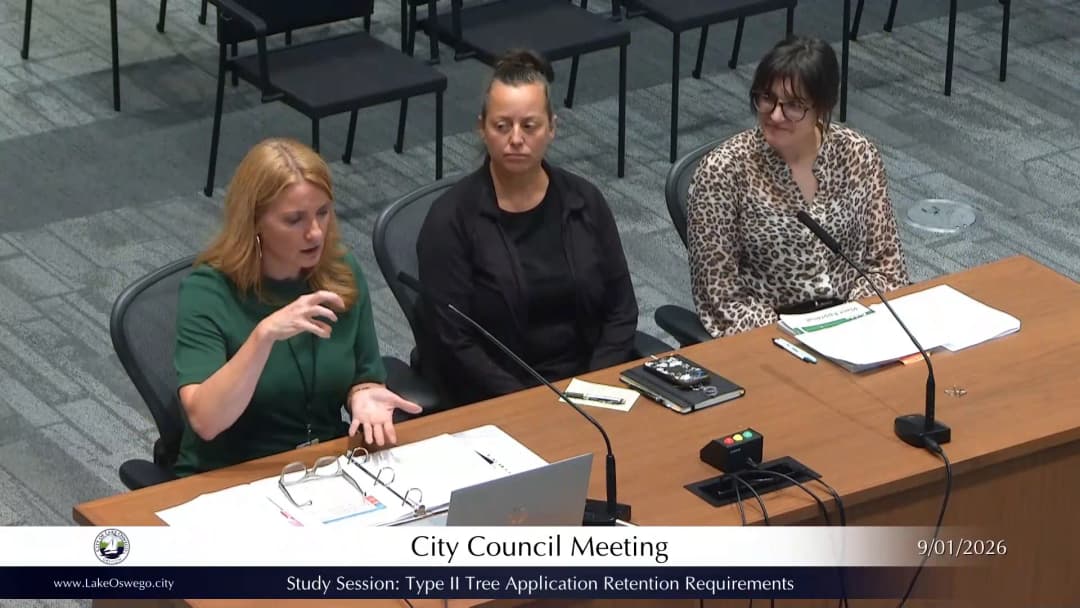
Lake Oswego City Council Meeting: Wastewater Treatment Plant Update and Tree Retention Fee Direction – September 1, 2026

The Lake Oswego City Council met on Tuesday, September 1, 2026, at 7:00 PM. The meeting included adoption of a consent agenda, an update on the wastewater treatment plant project with a cost proposal and rate increase options, and a study session on establishing a per-inch fee for tree retention deficits under the new clear and objective track. Council also heard proclamations for National Preparedness Month, Recovery Month, and Suicide Prevention Month. Consent Calendar - The council unanimously (7-0) adopted the consent agenda, which included: - Ordinances 2974 and 2978 adopting findings for trade regulations. - Resolution 2645 for a grant for body-worn cameras for the police department. - Resolution 26-47 approving the city manager employment agreement. Public Comments & Testimony - No members of the public signed up to speak, and none were present. Discussion Items - Wastewater Treatment Plant Update - Director of Special Projects Stefan Bradis, along with Kyle Rohr (Corolla Engineers) and Michelle Green (Jacobs), presented an update on the proposed design-build-operate-maintain (DBOM) project for a new wastewater treatment plant to replace the aging Tryon Creek facility (nearly 70 years old). - The fixed price to design and construct the facility is approximately $370 million, with a year one operating and maintenance cost of $6.5 million (including major repair/replacement, biosolids hauling, and an energy guarantee). The O&M fee will be indexed annually over a 10-year term. - The project is a partnership with the City of Portland, which will cover roughly 30% of costs based on flow contributions. - Council discussed two rate increase options to fund the project: - Option 1: A 28% sewer rate increase in July 2027, returning to 3.9% annual increases thereafter. - Option 2: An 8% annual increase for 10 years, then dropping to 3.9%. - Staff indicated a preference for Option 1 as more sustainable long-term, though Councilor Mans raised concerns about impacts on fixed-income residents. The city has utility assistance programs (about 50 residents enrolled) that cut bills in half for qualifying households. - Councilors asked about odor control, seismic resiliency, and contract flexibility. Staff confirmed robust odor control measures (with financial penalties) and that the plant is designed to meet hospital-level seismic standards. - Next steps: Two virtual public information sessions on September 16 and October 1, followed by a special council session on October 13 to seek contract authorization and rate adoption. - Study Session: Tree Retention Deficit Fee - Community Development Director Jessica Numanalu presented three options for a per-inch fee when new housing development cannot meet the 45% tree retention requirement under the new clear and objective track (effective October 1, 2026). - Options: Low ($100/inch), Moderate ($250/inch), High ($400/inch). Staff did not recommend the low option as it would encourage pay-to-cut behavior. - Council debated the appropriate fee level. Councilor Corrigan advocated for $400/inch with no sliding scale, while Councilors Manns and Winland supported a sliding scale (e.g., $300/inch for deficits of 6 inches or less, $400/inch above). Councilor Boop favored $400/inch to strongly deter removal. - The mayor sought compromise but the council did not reach a final consensus; however, staff was directed to bring back a resolution with a fee of $400 per inch (the high option) and to include an exemption for affordable housing developments (consistent with existing fee waiver policy for projects at 80% AMI or below). - Council also discussed that the fee is in addition to on-site mitigation tree planting requirements. Key Outcomes - Consent agenda adopted 7-0. - Wastewater treatment plant: Council directed staff to proceed with public outreach and return on October 13 for contract authorization and rate adoption. Council expressed general support for Option 1 (28% one-time increase) as more sustainable. - Tree retention fee: Staff directed to prepare a resolution establishing a fee of $400 per inch for tree retention deficits under the clear and objective track, with an exemption for affordable housing. The resolution will be placed on the consent agenda at the next council meeting.

WATER AND WASTEWATER MANAGEMENT 37% · TREE MANAGEMENT 33% · PUBLIC ENGAGEMENT 8% · FISCAL SUSTAINABILITY 6%
0102
NEXT →
OPENPUBLICA · PUBLIC MEETING INDEXUPDATED DAILY · openpublica.com