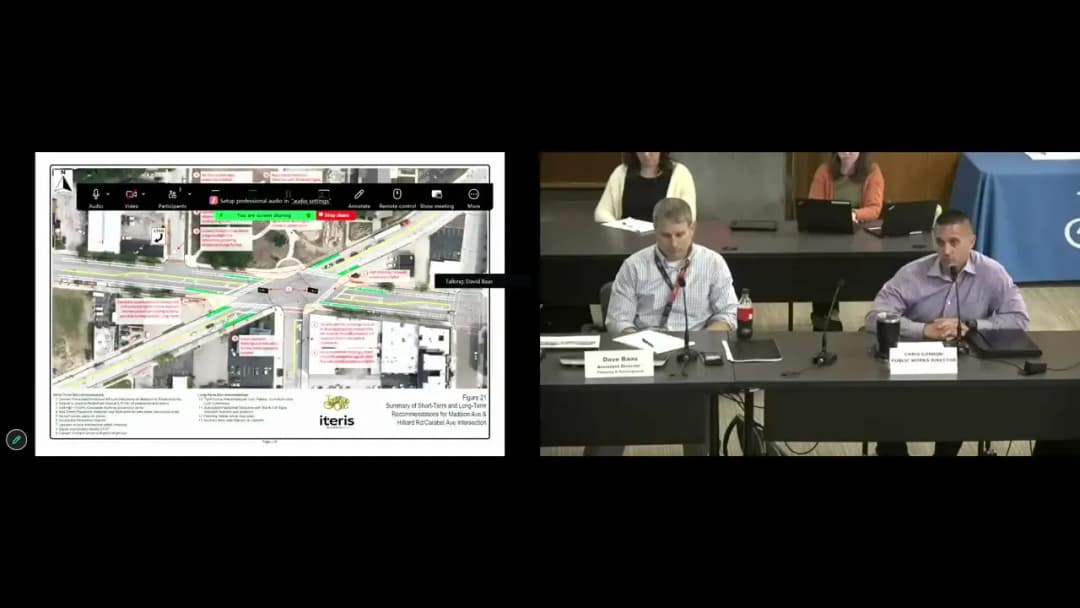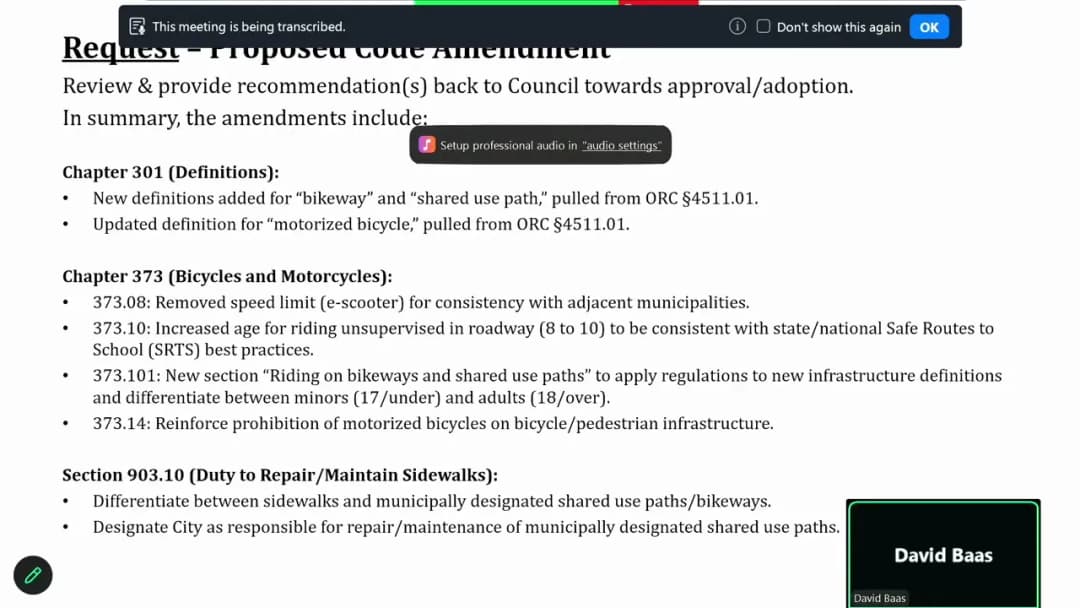
The Complete and Active Streets Education and Advisory Board (CASE) held a special meeting on March 24, 2026, at 3:15 PM via hybrid format. The board reviewed two referrals: the Madison/Hilliard Safety Study and the Shared Use Path Code Amendments. After discussion, the board approved short-term recommendations for the safety study and deferred both the long-term study recommendations and the code amendments to future meetings. Consent Calendar - Approval of Minutes (February 24, 2026): Motion made and seconded; approved unanimously by voice vote. Discussion Items - Madison/Hilliard Safety Study Referral - John Albeck, engineer from iTerrace, presented priority recommendations for the intersection. Short‑term items (1‑9) include converting to protected‑only left turns, leading pedestrian intervals, accessible pedestrian signals, and converting Orchard Grove Avenue to right‑in/right‑out. Items 3, 4, and 5 (high‑visibility crosswalks, green pavement markings, and no‑right‑on‑red) are already installed. The short‑term worklist is estimated at under $20,000 and could be implemented within weeks. - Long‑term recommendations (10‑13) address geometric changes (curb bump‑outs, additional signal structures) and advanced detection systems; these have higher cost and maintenance implications. - Chris Gordon, Public Works Director, noted that curb bump‑outs require significant engineering and emergency‑service coordination and are therefore long‑term. He emphasized the city’s proactive approach in larger capital projects (e.g., Bunts Road, water‑main projects) where complete‑street elements are incorporated. - Board members discussed bike‑lane protection, leading pedestrian intervals for bikes, and compliance with the proposed right‑in/right‑out. Several members urged greater education and monitoring of compliance before installing physical barriers. - Motion: Forward the short‑term recommendations to administration/council, with an added recommendation to notify all residents on Orchard Grove of the new turn restriction. The motion passed (voice vote). Long‑term recommendations were deferred to a future meeting. - Shared Use Path Code Amendments Referral - Dave Voss, city engineer, outlined proposed amendments to Chapter 373 (bicycle and motorcycle operation) and Section 903.10 (sidewalk maintenance). Key changes include: - Adding definitions for “bikeway” and “shared use path” (from Ohio Revised Code). - Removing the 12 mph speed limit for e‑scooters (a hazard in traffic) – a carry‑over from the now‑defunct scooter‑share program. - Raising the age for unsupervised bicycle riding on roadways from 8 to 10 (consistent with Safe Routes to School guidance). - Codifying that the city is responsible for maintaining municipally designated shared use paths, relieving adjacent property owners of that duty. - Board member Emily raised several concerns: - The term “mobility device” (used in existing code for e‑bikes/e‑scooters) conflicts with adaptive mobility devices used by people with disabilities; signage should clarify access for persons with disabilities. - The proposed prohibition on adults (18+) using e‑bikes/e‑scooters on shared use paths is too restrictive; regulation should focus on safe operation and speed, not device type or user age. - Chris Gordon noted that enforcement of speed limits on shared paths is difficult, and the “reckless operation” standard already exists in code. - The board agreed that the definition of “mobility device” should be re‑examined and that the entire section of code should be provided in redline format for a holistic review. - Motion: Defer the shared use path code amendments to the next meeting for further discussion. The motion passed (voice vote). Key Outcomes - Motion approved: Forward short‑term recommendations for the Madison/Hilliard intersection to administration/council, including the notification of residents on Orchard Grove. (Voice vote; all in favor.) - Deferred items: Long‑term recommendations from the safety study and all proposed Shared Use Path Code Amendments will be reconsidered at a future meeting (likely early June 2026). - The board also deferred discussion of board rules and regulations to a later meeting. - The next regular meeting will be on a quarterly cycle; a Doodle poll will be circulated for the next meeting date.
Public Meetings - Lakewood, Ohio
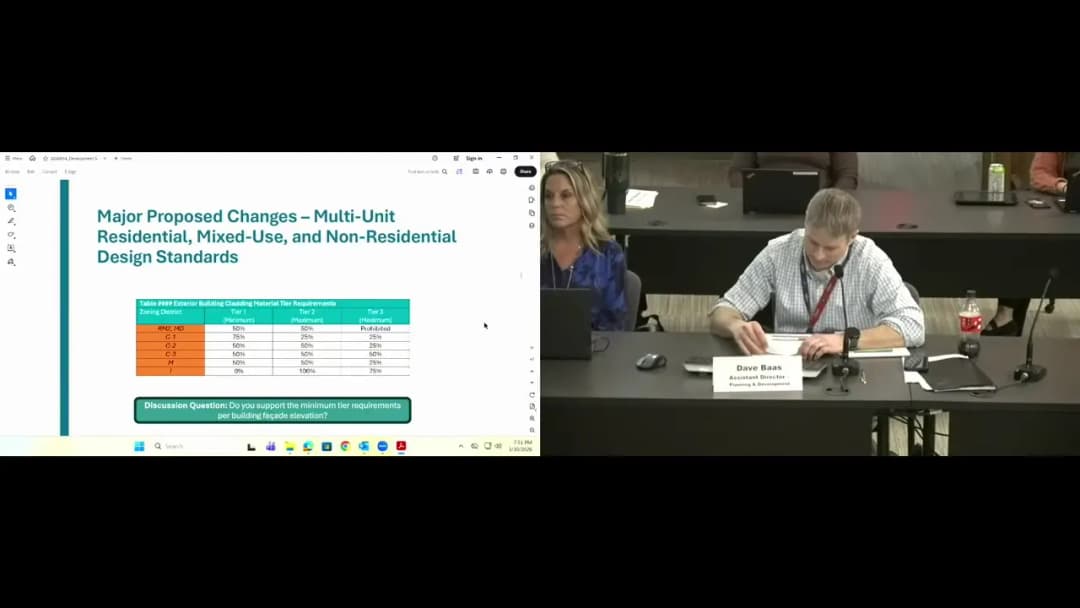
Public Meetings - Lakewood, OhioThe Housing, Planning, & Development Committee of Lakewood City Council met on March 30, 2026, at 7:00 PM in the City Hall Auditorium. The meeting focused on the Zoning Refresh Project, specifically updates to Development Standards (Chapters 1104-1107) as presented by Assistant Planning Director David Baas. Discussion covered proposed standards for fences, screening, outdoor lighting, landscaping, building design materials and articulation, parking, and signs. No votes were taken; the committee received information and provided feedback for further refinement. Consent Calendar - Approval of Minutes: The minutes from the March 9, 2026 meeting were approved unanimously. Discussion Items - Zoning Refresh – Development Standards Update: Assistant Planning Director Baas presented draft chapters from the Zoning Policy Advisory Committee (ZPAC) meeting 4, covering General Development Standards (fences, screening, vision triangles, lighting, buffers), Building Design Standards (material tiers, glazing, façade articulation, porches), Parking and Access Standards (minimum/maximum spaces, driveway dimensions, bicycle parking), and Sign Standards (types, illumination, temporary signs). Key points included: - Fence Opacity: New concept requiring maximum opacity percentages per district and yard type (e.g., 20% in front yards for visibility, 100% in rear yards for screening). - Building Materials: Introduction of Tier I (premium), Tier II (medium), and Tier III (budget) materials with percentage requirements per zone; discussion on balancing cost with design quality, especially for affordable housing. - Parking Minimums: Baas noted that national best practices were rejected in favor of current code, which works well 95% of the time, but specific uses (e.g., public assembly) will be better defined. - Garage Requirement: The current rule requiring one parking space in a garage for single-family units was debated; Council members noted both support for retention and removal, with potential for a sliding scale. - Sign Glare and Temporary Signs: Concerns were raised about overly bright signs and lingering temporary signage; Baas acknowledged enforcement challenges and plans to add clarity on lighting limits and duration. - Affordable Housing Considerations: Councilman Baker and Councilwoman Hamilton Steiner emphasized the need to align zoning with housing affordability goals. Baas noted that allowing more density and streamlining processes can reduce costs. - Process for Final Review: Baas outlined next steps: ZPAC meeting in May for subdivision standards/procedures, committee review in June, then joint review with Committee of the Whole and Planning Commission over summer/fall, targeting final approval by end of 2026. Key Outcomes - No formal decisions or votes were taken. The committee received the presentation and provided guidance for continued drafting. - Next ZPAC Meeting: Scheduled for May 19, 2026, to review subdivision standards, zoning procedures, and definitions. - Next Committee Update: Expected in June 2026 to review ZPAC outcomes.
On March 24, 2026, the Lakewood Committee of the Whole met to discuss the Madison Avenue and Hilliard Road/Carabel Avenue safety analysis study conducted by Iteris. The meeting focused on short-term and long-term safety recommendations, implementation timelines, and public education. Council members expressed support for the short-term measures and emphasized the need for timely execution and community outreach. Consent Calendar - The minutes of the March 16, 2026 Committee of the Whole meeting were approved without objection. Discussion Items - Presentation of the Madison & Hilliard Safety Study – John Albeck, the Iteris traffic engineer, presented the study’s findings. The study analyzed five years of crash data (2020–2024) at the five-leg signalized intersection. Key statistics: 83% of crashes were property damage only, 14% injury, and 3% fatal (one pedestrian fatality in December 2024). Rear-end collisions accounted for 41% of crashes. Recommendations were divided into short-term (quick, low-cost) and long-term (capital-intensive) improvements. - Short-Term Recommendations (cost $13,200–$19,000) include: converting eastbound and westbound left turns from protected/permissive to protected-only; implementing Leading Pedestrian Intervals (LPIs) for all crosswalks; installing Accessible Pedestrian Signals (APS); updating safety intervals; signal coordination along Madison Avenue (STOP project); and converting Orchard Grove Avenue to a right-in/right-out configuration. Several measures (high-visibility crosswalks, green bike lane markings, no-turn-on-red signs) were already in place. - Long-Term Recommendations (cost $176,000–$486,000) include: tight corner radii/curb bulb-outs, automated pedestrian detection with blank-out signs, flashing yellow arrow operation, and auxiliary near-side signal heads. These would require design, utility coordination, and longer implementation. - Operational Impact – The study estimated that converting left turns to protected-only would increase intersection delay from LOS C/D to LOS D across all peak periods, but remained within acceptable thresholds. LPIs add minimal delay but improve pedestrian safety. - Council Discussion – Council members raised concerns about: sun glare not being a documented factor in crashes (John Albeck confirmed it was not identified in crash data, though Councilmember Hamilton Steiner noted a March 2025 crash involving a bicycle trailer was reportedly due to sun glare); the effect of reduced curb radii on emergency vehicles and buses (Chris Gordon explained complexities with RTA Route 25, fire trucks, and snow plowing); the Orchard Grove conversion’s potential for illegal U-turns and neighborhood detours (Councilmember Evans and Bixenstine noted that residents may use alternative routes like Westwood, but traffic volumes are low); the need for public education on new signal behaviors (David Baas suggested one-page flyers, door hangers, and social media campaigns). - Planning Commission and CASE Board Input – Both bodies recommended implementing the short-term recommendations and supporting long-term measures as soon as feasible. CASE requested that if Orchard Grove is restricted, the city provide direct notification to affected residents. - Implementation Timeline – Chris Gordon stated that some equipment has already been ordered, but lead times (especially for APS) could take months. The full set of short-term improvements, including signal retiming under the Madison STOP project, is expected to be completed by the end of 2026. The long-term items will require additional budgeting and design review. Key Outcomes - The committee unanimously voted to receive and file the report. - The administration committed to proceeding with all short-term recommendations as quickly as possible, prioritizing this intersection over other projects. - Council members urged the administration to develop a communications plan to inform the public about upcoming changes (e.g., LPIs, protected left turns, no-turn-on-red enforcement). - The committee suggested exploring budget allocations in the upcoming capital plan for long-term improvements, particularly curb bulb-outs and automated detection systems.
The Finance Committee of Lakewood City Council met on March 20, 2026, chaired by Kyle Baker. The committee considered two ordinances: one to establish a Host Community Cannabis Fund (Ordinance 15-2026) and one to restructure the Audit Committee (Ordinance 27-2025). Both items were discussed am ended and recommended favorably to full Council. Consent Calendar - The minutes of the March 2, 2026 Finance Committee meeting were approved without objection. Discussion Items - Ordinance 15-2026 (Host Community Cannabis Fund): The committee reviewed and amended a substitute version of the ordinance. Key changes included: (1) removing the designation as a "capital projects fund" to a general fund, (2) expanding authorized expenditures to include public safety, Complete Streets, ADA Transition Plan, Lakewood Community Health Needs Assessment (capitalized) and Lakewood Action Plan implementation, and (3) adding "and operations" to cover operational costs. Director of Finance Mahoney committed to providing an annual look-back report (separate from the budget) on fund expenditures, to be presented in March or April to inform Council priorities. The fund will hold approximately $750,000, representing two to three years of revenue from a 3.6% share of the state's 10% cannabis excise tax. A new dispensary (Standard Wellness) is expected to open in the former Harry Buffalo location, while the RISE dispensary is moving out, maintaining two dispensaries in the city. The finance director noted that additional appropriation legislation is needed before funds can be spent. The amended substitute was favorably referred. - Ordinance 27-2025 (Audit Committee Amendment): Originally proposed to repeal the Audit Committee (Chapter 160), the committee substituted language to instead amend the chapter, merging the Audit Committee's functions into the Finance Committee. Key provisions: membership is limited to the Finance Committee; the Director of Finance shall provide the annual audit at least annually and make the independent auditor available for a public exit conference. This change ensures transparency as the meeting will be recorded and broadcast. The substitute was amended (replacing "repealing" with "amending") and favorably referred. Key Outcomes - Approved the March 2,2026 meeting minutes. - Passed an amended substitute for Ordinance 15-2026 (Host Community Cannabis Fund) and favorably referred it to full Council. The fund will be created; a subsequent appropriation ordinance will be needed to allocate funds. - Passed an amended substitute for Ordinance 27-2025 (Audit Committee) and favorably referred it to full Council. - Director of Finance committed to providing an independent annual report on cannabis fund expenditures, separate from the budget process, typically in March or April. - No public comments were received.
The Health & Human Services Committee met to receive and discuss the Community Health Action Team (CHAT) Annual Report covering September 2024 through December 2025. The report detailed progress across five priority areas—behavioral health, food access, community resource guide, adaptive/middle-school programming, and housing—and proposed a revised CHAT structure focusing on coordination, identification, and advocacy. Committee members and presenters shared updates, discussed funding challenges, and explored opportunities for collaboration. Consent Calendar - The committee unanimously approved the minutes of the November 10, 2025 Health & Human Services Committee meeting. Discussion Items - CHAT Annual Report Overview: Assistant Planning Director David Baas introduced the report, explaining CHAT’s origins from the 2022 Community Health Needs Assessment (CHNA) and its work developing interventions across five social determinant categories. He noted that a key 2025 development was CHAT’s recognition that its strengths lie in convening and coordinating rather than direct implementation, leading to a proposed restructuring with clearer accountability frameworks. - Access to Behavioral Health Care: Kristen Broadbent (Three Arches Foundation) described the formation of a healthcare provider roundtable and investigation of a co-responder program (First CALL model). Laura from Human Services reported that the department has hired a clinical manager and realigned staff to better respond to behavioral health crises, adapting the co-responder concept to Lakewood’s unique structure (having an internal Human Services department). The roundtable paused meetings in late 2025 due to organizational strain, but interest remains. The report recommends transitioning behavioral health lead responsibility to the Department of Human Services. - Funding Challenges: Laura noted a 25% cut (approximately $159,126.83) to the county’s Community Based Services (CBS) contract, retroactive to January 1, 2026, reducing the contract from $650,000 to $490,873.17. Simultaneously, caseloads are increasing and referrals are more complex. The department avoided layoffs by not filling vacant positions. Councilmember Hamilton Steiner urged the city to invest local dollars in mental health, stating “the county is not going to save us.” - Food Access: Kate Ingersoll (City staff) discussed efforts to establish a summer feeding program, noting the complexity of state reimbursement and infrastructure requirements. Harrison Elementary is closest to meeting universal eligibility standards (approximately 60% free/reduced lunch). District-wide eligibility is 38.7%, just below the 40% threshold for universal free lunch. Three schools (Franklin, Roosevelt-Garfield, Emerson) might qualify per-school, but this increases district costs. Councilmember Strebig suggested exploring the library as a meal site, but the library currently prohibits food distribution. - Adaptive and Middle-School Programming: Recreation Director Walters reported on successful adaptive swim lessons (trained three instructors via Healthy Lakewood Foundation grant) and partnership with Empower Sports, which now runs two weekly sessions in Lakewood. Middle-school programming is addressed through summer H2O and 54 other programs. Councilmember Baker raised the idea of unstructured open gym time, noting lost gym space and increased organized sports participation (60% increase in basketball over 4 years). Walters cited limited gym availability and staffing challenges. - Housing: The report notes progress on affordable housing (84 new units under CRA program), a new zoning inspector, and work on zoning code rewrite. - Community Resource Guide: Updated by Case Western Reserve University students and will remain under CHAT oversight. A rollout with “Community Resource Guide Ambassadors” is planned. - Other Partners: Kevin Borncrow (Lakewood Family YMCA) offered to partner, noting the Y provides food distribution (15,000+ pounds in 2025), mental health programs, and adaptive programming. Key Outcomes - The committee voted unanimously to receive and file the CHAT Annual Report (motion by Chair Strebig, seconded). - The report’s recommendations—including transitioning behavioral health to Human Services, retaining oversight of the Community Resource Guide, and continuing to coordinate across sectors—were accepted for filing and further consideration. - Councilmembers expressed interest in exploring additional funding for mental health and food access, and requested follow-up discussions on the county funding situation and potential joint meeting with the school board regarding gym access.
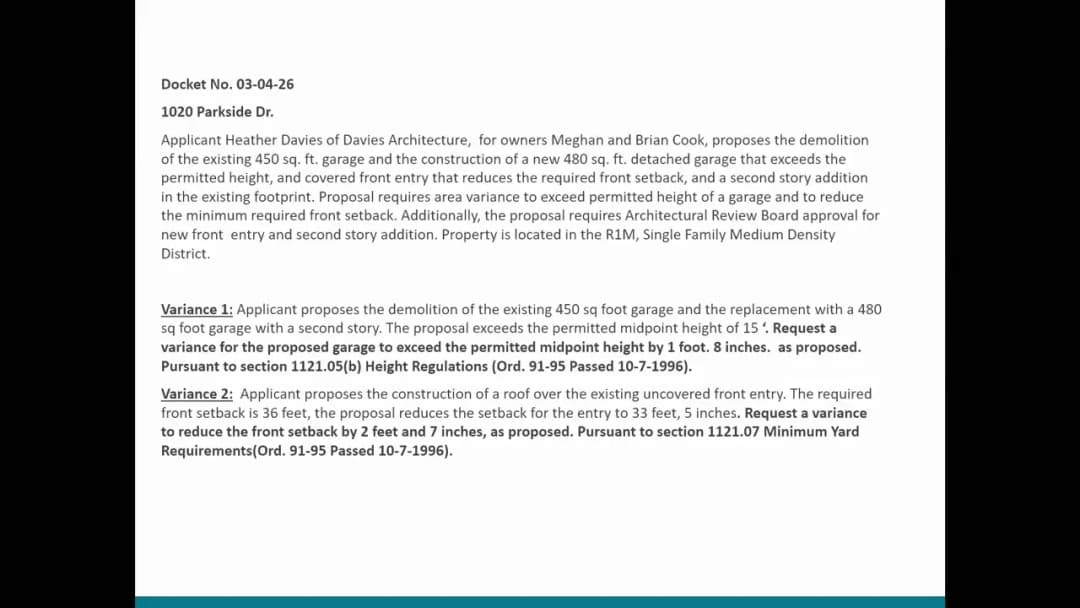
The Board of Zoning Appeals of Lakewood, Ohio, met on March 19, 2026, at 11:45 AM to consider two variance requests for 1020 Parkside Drive. With three members present (Jillian Bellino, Angela Hare, Matt Markling) and two members excused (Jeffrey Piggott and Anthony Santiago), the board approved the minutes from the February 19, 2026 meeting and voted unanimously to grant both variances as proposed. No public comments were received. Consent Calendar - Approval of the minutes from the February 19, 2026 meeting. Public Comments & Testimony - None. Discussion Items - Docket 03-04-26 – 1020 Parkside Drive (Heather Davies, agent for Brian and Megan Cook): The applicant requested two variances: 1. A height variance of approximately 8 feet for a proposed new detached garage (from existing 12.5 ft to proposed 20 ft at peak, with a midpoint height of 16 ft 8 in), and a footprint increase from 450 sq ft to 480 sq ft. The existing garage is non-conforming and too shallow to accommodate modern vehicles. The new garage would be oriented with its gable perpendicular to the neighbor's to reduce visual impact. The rear yard is shallow, limiting horizontal expansion. The property abuts Lakewood Park to the north, reducing the number of directly affected neighbors. 2. A front yard setback variance of 2 ft 1 in to allow a roofed front porch with columns over an existing stoop. - Board members expressed concerns about the increasing prevalence of large garages but acknowledged the practical difficulties of the site, including the undersized lot (8,190 sq ft vs. 9,000 sq ft minimum) and the deep front setback (36 ft). They noted that the garage height increase (which exceeds the 15 ft midpoint height limit by about 1 ft 8 in) was mitigated by the park adjacency and the modest square footage increase. - The board's three members voted to approve both variances as proposed. Key Outcomes - Motion to approve both variances for 1020 Parkside Drive (docket 03-04-26) passed unanimously (3–0). - The meeting was adjourned following the decision.
The Lakewood City Council held a regular meeting on March 17, 2026 (the meeting convened on the evening of March 16, 2026 and extended into the early hours of March 17). The Council addressed a broad agenda, including passage of a Trap-Neuter-Return (TNR) ordinance for community cats, a front yard planting ordinance, resolutions supporting a school levy and honoring local institutions, and deferral of multiple proposed charter amendments. Public Comments & Testimony - School Levy (Issue 2): Several residents spoke during the discussion of Resolution 2026-16. Beth Blackmire opposed the 6.9-mill levy, arguing that Lakewood's property taxes are already among the highest in Cuyahoga County and that an additional $36/month (on an average $300,000 home) would further reduce affordability, particularly for seniors. Mitch Zacom, a landlord, also opposed, stating that high taxes drive tenants away and criticized the framing of opposition as not supporting schools, suggesting an income tax levy instead. Martha Warner supported the levy, emphasizing that public schools require shared community investment and noting that levy funds do not increase with property assessments. - TNR Ordinance (Ordinance 03-2026): Nancy Binder, Chair of the Lakewood Animal Safety & Welfare Advisory Board (LASWAB), and Megan Galeda, a volunteer with the Citizens Committee for Lakewood's Animals and Shelter (CLAWS), spoke in strong support of the ordinance, thanking Council and the administration for two years of collaborative work. - Transgender Day of Visibility (Resolution 2026-17): Four residents spoke in favor: Eugene Miller, Cuyahoga County Council President Dale Miller, 17-year-old transgender Lakewood student Sean Miller, and Ben Van Learn. They underscored the importance of affirming transgender residents and standing against rising anti-LGBTQ+ legislation. - General Public Comment: Anson Hall urged stronger city-school collaboration on traffic safety around schools, especially with the Lincoln School repurposing. Chris Bindle supported Ranked Choice Voting (RCV) but asked for careful consideration of financial impacts and state law changes. Kelly McCarthy, representing Clean Fuels Ohio, presented the City with an "Empower Workplace Charging Project" certificate for leadership in installing public electric vehicle charging stations. Discussion Items - Shore Restaurant 40th Anniversary (Resolution 2026-15): Councilmember Bixenstine introduced a communication and resolution celebrating the family-owned Shore Restaurant, which opened on March 25, 1986. Council members praised its role as social infrastructure and its historic facade restoration after a 2014 collapse. The resolution was adopted unanimously. - School Levy Endorsement (Resolution 2026-16): Vice President Baker sponsored a resolution endorsing Issue 2, a 6.9-mill levy on the May 5, 2026 primary ballot proposed by Lakewood City Schools. Baker noted the levy would cost the average homeowner about $36/month. Multiple Council members spoke in favor, drawing on personal experiences as graduates or parents. Council President Kepple abstained because her business works with the Lakewood Recreation Department (which is part of the schools' programming). The resolution passed 7-0-1. - Transgender Day of Visibility (Resolution 2026-17): Councilmember Strebig presented the resolution declaring March 31, 2026 as Transgender Day of Visibility. Council members highlighted that 616 anti-LGBTQ+ bills were introduced in state legislatures in 2025 and affirmed the value of transgender residents. The resolution passed unanimously. - College Club West 100th Anniversary (Resolution 2026-18): President Kepple presented the resolution recognizing College Club West's century of service, including its scholarship program awarding over $10,000 annually to local women. The resolution passed unanimously. - Trap-Neuter-Return Ordinance (Ordinance 03-2026): Councilmember Hamilton Steiner reported from the Public Safety Committee. The Committee had amended Section 9(b)(4) to clarify that a cat could be held over 24 hours for TNR with proper care. A further technical amendment (correcting a code citation to 955.16) was adopted on the floor. Council then adopted the ordinance as amended, updating Chapter 505 (Animals and Fowl) to formalize TNR procedures, define community cat caregivers, and provide legal protections for them. - Front Yard Planting Ordinance (Ordinance 02-2026): Councilmember Evans reported from the Housing, Planning & Development Committee. The committee's substitute version included updated diagrams for clarity. Council substituted and then adopted the ordinance, which requires that plantings within two feet of the property line be managed to preserve sight lines for public safety. - Tree Advisory & Education Board Appointment (Resolution 2026-03): Councilmember Bullock reported from the Public Works & Sustainability Committee, which recommended Marco Oriella to fill a vacancy. The resolution was adopted. - Committee of the Whole Report: President Keppel reported on a pre-meeting discussion covering a public art master plan update and the proposed charter amendments. Following the report, Council moved to defer Ordinances 16-2026 through 21-2026 (which would put six charter amendments on the November 2026 ballot concerning: Civil Service Commission salary review frequency, vacancy appointment process, legislative amendment formatting, ward redistricting, charter amendment clarification, and Ranked Choice Voting). These items remain in committee for further discussion. - Community Recreation & Education Commission (CREC) Report: Councilmember Strebig shared updates from the February CREC meeting, including record basketball participation, planned fitness equipment upgrades, and the upcoming Purple and Gold Classic (April 18, 2026) requesting hygiene product donations. - Building Safety Month (Resolution 2026-19): Building Commissioner Christopher Parmelee presented the "Built to Last" campaign for May 2026. Council adopted the resolution declaring May as Building Safety Month. Key Outcomes - Adopted 4 resolutions: (1) Shore Restaurant 40th anniversary recognition; (2) Endorsement of Lakewood City Schools Issue 2 levy (7-0-1, with President Kepple abstaining); (3) Transgender Day of Visibility declaration; (4) College Club West 100th anniversary recognition. - Adopted Ordinance 03-2026 (TNR for community cats) as amended, updating animal control provisions. - Adopted Ordinance 02-2026 (Front yard plantings) as substituted, establishing setbacks and public safety requirements. - Adopted Resolution 2026-03 appointing Marco Oriella to the Tree Advisory & Education Board. - Deferred six charter amendment ordinances (16-2026 through 21-2026) for further committee discussion. - Adopted Resolution 2026-19 declaring May 2026 as Building Safety Month. - Received and filed all committee reports and the February 2026 vendor report.
The Standards Architectural Board of Review and Sign Review Board met on March 12, 2026, at 10:45 AM. The board approved minutes from February 12, 2026, and considered multiple dockets including new construction, additions, signage, and front porch enclosures. Several items were approved with conditions, and two were tabled. Consent Calendar - Minutes: Unanimously approved from February 12, 2026. - Docket 032326 for 14718 Detroit Road (Speed Trap Racing): Approved with a condition that an updated rear elevation be submitted and wall sign not exceed 16 feet in length, and updated signage on the door. - Docket 032426 for "Bring on the Butter": Approved with a condition that any window signage be submitted separately for approval. - Docket 032526 for 14869 Detroit Avenue (ATT): Approved with conditions that any additional window signage be approved by the board prior to installation and that window square footage be submitted for administrative approval. Public Comments & Testimony - No members of the public offered comments on any agenda items. Discussion Items - Docket 09725 for 11730 Detroit Avenue (North Coast Apartments): Tabled at the applicant's request. - Docket 010726 for 15501 Madison Avenue (Vital Pilates and Wellness): Presented with updates to elevations, arch symmetry, window adjustments, raised light fixtures, and a landscape plan. Board members expressed satisfaction with changes, and the item was approved as presented. - Docket 021626 for 1374 West 117th Street (Norton Industries): Tabled at the applicant's request to investigate masonry repairs. - Docket 021826 for 1337 Edenola (Bennett Builders): Presented revisions after previous meeting feedback, including a dormer over the garage, increased massing in the center portion, and added trim detail. Board complimented the improvements; approved as presented. - Docket 115021 for 17801 Detroit (Beck Center for the Arts): Return for modifications. Landscape architect Jamie Schwartzberg presented donor furnishings, benches, and removal of a stage for cost concerns. Board found the modifications aligned with original approval and approved as presented. - Docket 032026 for 13326 Madison Avenue (Tabitha in Motion): Sign review discussion. The applicant proposed a hanging sign with a battery-operated light strip. Board had questions about sign placement and illumination. Motion to defer until additional information (updated elevations and light strip details) is submitted passed. - Docket 032626 for 1285 St. Charles (Front Porch Enclosure): Applicant presented changes including adding a column, railings on both sides, brick base, and widened stairs. Board clarified that approval is based on the elevation drawing, not the AI rendering. Approved with condition referencing sheet eight two. - Lakewood Seventh-day Adventist Church Addition (Architect Michael Horton): Proposed a new entry, ADA accessibility, and screening for dumpster. Board praised the design but requested a dumpster enclosure. Applicant asked for administrative approval of the enclosure to avoid delaying the project. Approved with condition that a dumpster enclosure or screening be submitted for administrative approval. - Docket 032926 for Marlowe Avenue (Marlowe Park Townhomes): Frank Camardo presented modifications to previously approved plan, including moving buildings closer to the street, adding a brick privacy wall, and staggered building placement. Board discussed window alignment, roof continuity, and materials. Approved with conditions: exterior light fixtures submitted for administrative approval, Madison building windows to include Rolox hills and soldier course headers, and approval based on elevations not renderings. Key Outcomes - Motion to approve minutes: Passed unanimously. - Motion to approve docket 032326: Passed (3-0). - Motion to approve docket 032426: Passed (3-0). - Motion to approve docket 032526: Passed (3-0). - Motion to table docket 09725: Passed (3-0). - Motion to approve docket 010726: Passed (3-0). - Motion to table docket 021626: Passed (3-0). - Motion to approve docket 021826: Passed (3-0). - Motion to approve docket 115021: Passed (3-0). - Motion to defer docket 032026: Passed (3-0). - Motion to approve docket 032626 with condition: Passed (3-0). - Motion to approve Seventh-day Adventist Church addition with condition: Passed (3-0). - Motion to approve docket 032926 with conditions: Passed (3-0). - Motion to adjourn: Passed (3-0).
This meeting of the Lakewood City Committee of the Whole included a presentation on the Public Art Master Plan and discussion of six proposed charter amendments for the November 2026 ballot. Council approved the minutes of the February 23 meeting, received and filed the public art communication, and referred two charter amendments favorably to full council. The remaining four amendments were kept in committee for further deliberation. Consent Calendar - Approval of Minutes: The minutes of the February 23, 2026 Committee of the Whole meeting were approved unanimously without a reading. Public Comments & Testimony - Jim Woolley (Charter Review Commission member): Stated that the Charter Review Commission did not recommend full ranked-choice voting, but rather a specific flexible option for council, and urged careful public messaging to avoid misrepresentation. - Dean (Charter Review Commission member): Expressed concern that the legal risk environment has changed since the commission's recommendation; asked that the law department's legal assessment be made public so voters can make an informed decision; and argued that Lakewood should signal willingness to fight for home rule rather than acquiescing to state pressure. - Michelle B. Jackson (Rank the Vote Ohio): Emphasized the importance of not acquiescing to state threats, highlighted the severability clause in the proposed ordinance, and urged council to focus on values and democratic participation. Discussion Items - Public Art Master Plan Update: Amanda Kramer (Planning Department) presented the plan, developed with the Cuyahoga County Planning Commission. Key points included: a community survey with 800 responses, over 90% favorable; goals to diversify art forms (temporary, performance, functional); improve accessibility and equity; establish maintenance plans and a budget line item; and explore funding strategies. Council members expressed support and suggested additional locations (e.g., I-90 gateways, residential areas) and emphasized volunteer engagement. The communication was received and filed. - Charter Amendment Ordinances – Council discussed six proposed amendments from the 2024 Charter Review Commission. All require a two-thirds vote to place on the November 3, 2026 ballot. - Ordinance 18-2026 (Redlining): Would allow amendments to ordinances to show inserted language underlined and removed language struck through, replacing the current requirement to repeal and re-enact entire sections. Council supported and voted to refer favorably out of committee. - Ordinance 20-2026 (Charter Amendment Paths): Clarifies that charter amendments can be initiated by council (two-thirds vote) or by voter petition (10% of registered voters). Council supported and voted to refer favorably out of committee. - Ordinance 16-2026 (Salary Review Frequency): Would change the Civil Service Commission's salary review from the year of a presidential election to a municipal election year (March 1 instead of July 1) so elected officials know salaries before filing deadlines. Kept in committee for further discussion. - Ordinance 17-2026 (Council Appointments): Would codify the current practice of open call for applicants and public interviews when filling vacancies; also adjusts the timeframe for appointee terms. Kept in committee due to connections to ranked-choice voting and need for additional refinement. - Ordinance 19-2026 (Ward Redistricting): Would require the Planning Commission to review ward boundaries every decade after the federal census, with council adoption unless boundaries fail contiguity or population equality standards. Council members expressed support for a process but raised concerns about preserving north-south ward orientation. Kept in committee. - Ordinance 21-2026 (Ranked Choice Voting): Would adopt ranked-choice voting for municipal elections (instant runoff for single-winner, single transferable vote for at-large seats), eliminating primaries, effective 2029. Council discussed legal risks from state legislation (Senate Bill 63) that threatens local government fund withholding. The proposed language includes a severability clause. No vote taken; will continue in committee. - Councilmember Hamilton Steiner recused from voting on charter amendments due to her prior service on the Charter Review Commission. Key Outcomes - Approved: Minutes of February 23, 2026. - Received and Filed: Communication regarding the Public Art Master Plan. - Referred Favorably to Full Council: - Ordinance 18-2026 (Charter amendment for legislative redlining) – passed unanimously with one abstention (Hamilton Steiner). - Ordinance 20-2026 (Charter amendment clarifying amendment paths) – passed unanimously with one abstention (Hamilton Steiner). - Kept in Committee for Further Discussion: Ordinances 16-2026, 17-2026, 19-2026, and 21-2026. These will be revisited in future committee meetings. The deadline to place measures on the November 3 ballot is early September 2026. - Next Steps: Council will work with the Law Department to refine language on remaining amendments, and may hold public engagement sessions on ranked-choice voting.
The Lakewood Planning Commission met on Thursday, March 5, 2026, at 6:00 PM in the Auditorium. The meeting included old business (minor modifications to the Marlowe Townhomes planned development) and new business (a request for an exception to garage replacement at 1445 Gridley St). Both items were discussed and voted on. Consent Calendar - Minutes Approval: The minutes from the February 5, 2026 meeting were approved unanimously after a correction noted that Commissioners Gall and Sanderson abstained from a motion to defer the Marlowe Townhomes item. Public Comments & Testimony - Marlowe Townhomes: No members of the public spoke during the public comment period. - 1445 Gridley St: No oral public comments were made, but a letter from a neighbor at 1441 Gridley Street expressing no objection to the proposal was read into the record. Discussion Items - Marlowe Townhomes (Docket 02-02-26): Applicant Frank Camardo (Greenlight Building Company) presented minor modifications to the approved planned development for 16 townhomes at the southeast corner of Marlowe and Madison Avenues. Proposed changes included moving units closer to the street (setbacks reduced from 12-21 feet to 7-12 feet) and increasing unit sizes to allow a third bedroom in end units. City staff confirmed the plat and overall site design remain unchanged. Commissioner Reese requested a finished floor height of at least 24 inches above sidewalk grade to maintain privacy and a masonry street screen (15-18 feet long) to block direct views of the driveway from the sidewalk. The applicant agreed to these conditions. Other topics included landscaping at the Madison frontage, trash pickup logistics, and sidewalk curb cut removal. - 1445 Gridley St (Docket 03-05-26): Property owner Charlotte Krach requested an exception from the requirement to rebuild a single-car garage after demolishing it in 2025. She cited safety concerns due to a narrow lane used by cut-through traffic, unique lot dimensions with a bluff, and the impracticality of a garage. Proposed alternative included a gravel parking pad, a shed, rain barrels, and landscaping. City staff outlined criteria for such exceptions. Commissioner Sanderson voiced opposition, stating the code should not be changed on a case-by-case basis. Other commissioners discussed conditions including a dye test for storm/sanitary connections, removal of old garage foundation, and a six-month implementation timeline. Key Outcomes - Marlowe Townhomes: Motion to approve minor modifications with conditions: - ABR review of landscaping (especially Madison frontage). - Safety and fire review. - Continuous sidewalk (no curb cut). - Installation of a masonry street screen approximately 15-18 feet long from the Madison frontage building rear to screen the driveway. Motion passed unanimously. - 1445 Gridley St: Motion to approve the exception with conditions: - Perform a dye test and complete any required sanitary/stormwater corrections. - Remove remnants of the old garage foundation. - Install a new gravel parking pad with proper offset from right-of-way. - Implement landscaping and install rain barrels. - Complete all requirements within six months. Motion carried 4-1, with Commissioner Sanderson opposing.