Note on Date Discrepancy: The official meeting docket is dated November 2, 2026, at 7:30 PM, but the provided metadata identifies the session as taking place on October 30, 2026, at 4:15 PM. This title and summary use the metadata date while acknowledging the discrepancy. The Lakewood City Council convened on October 30, 2026, for a meeting that addressed pedestrian safety in school zones, housing policy, a proposed land acquisition, and federal funding allocations. The council passed a six-month moratorium on new short-term rental licenses, formally introduced the Safe Routes for Children citizens' initiative petition (Ordinance 30-2026), and referred paired ordinances establishing school-zone speed cameras and a dedicated Safe Routes to School Fund to the Committee of the Whole. The body also considered a resolution to purchase the former Franklin School playground for $300,000. Consent Calendar - Meeting Administration: Roll call was conducted; Councilmember Cindy Strebig was excused due to illness. Minutes of the October 19, 2026 meeting were approved. - Finance Committee Report: Received and filed. Covered a Q3 2026 financial analysis in preparation for the 2027 budget. - Clerk's Certification (Safe Routes Petition): Received and filed. Clerk Maureen Bach certified that 1,421 of 1,668 submitted signatures were valid, exceeding the 944-signature threshold (5% of the 2023 mayoral vote). - FY27 HUD Action Plan: A communication and Resolution 2026-51 were referred to the Finance Committee. Estimated allocations: Community Development Block Grant (CDBG) $1,850,000; Emergency Solutions Grant (ESG) $160,000. - Fire Department Grant: A $14,624 Norfolk Southern Personal Safety Equipment Grant for thermal imaging cameras and bail-out kits was accepted and filed. - Finance Vendor Report: The October 2026 vendor report was received and filed. - Liquor Permit Transfer: A transfer for Devrod LLC (13437-41 Madison Ave) was filed without objection as a non-substantive change. - Animal Safety & Welfare Advisory Board (LASWAB): Appointments—including one new member (Rachel Ashton-Misciasci) and three reappointments (Nancy Binder, Phyllis Dykes, Julia Garleb)—were received and filed. The October meeting report noted the shelter was at capacity (21 cats, 4 dogs) and promoted a Nov 14 pet food drive. Public Comments & Testimony - Short-Term Rental Moratorium (Resolution 2026-49): - Susan Bradley, Kaisla (a mother who experienced homelessness and now cleans short-term rentals), and Bobby (mother of a non-verbal autistic child) spoke in opposition. They argued that short-term rentals provide flexible, livable-wage jobs ($20+/hour) that accommodate caregivers and disabled workers, contrasting these with limited $11-12/hour local alternatives. They urged the council to create a collaborative stakeholder process for regulation rather than enacting a broad pause. - Safe Routes for Children Ordinance (Ordinance 30-2026): - Caitlin McGrady (transportation policy professional) expressed support, stating the ordinance requires the city to implement its own adopted safety plans before putting children on new, unstudied routes. - Matthew Badgett (petitioner, pediatrician) stated that 830 children will be reassigned to new schools in August 2027, increasing daily high-risk street crossings. He emphasized the school district did not conduct a safety analysis of the new boundaries. - Annie Humphrey (parent, Hayes Elementary) described a crossing guard who fears being struck at an intersection near a freeway on-ramp and noted police issued 28 speeding tickets at one school-zone intersection in four weeks, indicating a systemic safety failure. - Emily Lindbergh (researcher) presented intersection audits at Hilliard & Elmwood, documenting 64 red-light violations and 96 instances of drivers using the bike lane to bypass traffic in 4.5 hours of observation. She connected observed risks to a fatal crash at West 117th & Lake Avenue. - Anson Hall (neighbor, Ward 2) requested immediate low-cost fixes for Hilliard & Elmwood (flexible delineators, green bike lane paint) and a longer-term redesign. - Franklin School Property Purchase (Resolution 2026-50): - Brittany Broker, Tony Howard, and Lauren Lasco (Lewis Drive area residents and parents) urged the council to approve the $300,000 purchase. They described it as a rare and successful return of private land to public use and a critical investment in neighborhood green space and community cohesion. - General Public Comment: - Zobel expressed concerns about the city's Flock (ALPR) cameras, requesting a warrant requirement for searches to prevent misuse of surveillance data. - Mike Kirschner (candidate for U.S. House District 11) briefly introduced himself. Discussion Items - 1. Substitute Resolution 2026-49: Short-Term Rental Moratorium - Councilmember Baker moved to adopt a six-month moratorium on new licenses to allow study of neighborhood impacts on affordability, quality of life, and residential character. - Mayor George requested a committee referral, citing Building Commissioner concerns about enforcement capacity and the moratorium's limited practical effect. - Councilmember Baker opposed the delay, stating the Law Department had already revised the draft to address the Commissioner's initial feedback. He argued the city needed to "stop the leak" of out-of-state investor purchases. - The resolution was adopted via voice vote despite the Mayor's request for a deferral to committee. - 2. Ordinance 30-2026 & Safe Routes Due Diligence (Items 4 & 5): - President Kepple and Vice President Baker outlined the charter-mandated timeline for the citizen initiative: departmental reports due Nov 12, Committee of the Whole meetings on Nov 16 and Nov 30, and a final council recommendation due by Dec 21. The ordinance was introduced and referred to Committee of the Whole. - 3. Ordinances 31-2026 & 32-2026: Speed Cameras & Safe Routes Fund (Items 6, 7, 8): - Vice President Baker and Councilmember Bixenstine introduced paired ordinances. Ordinance 32-2026 authorizes school-zone photo speed monitoring. Ordinance 31-2026 creates a Safe Routes to School Fund to direct fine revenue to safety infrastructure, crossing guards, and related costs. - Baker cited a Dec 2022 data collection showing 89% of drivers speeding at the Lincoln school zone and 59% at Emerson in the morning, and 83% and 71% in the afternoon, respectively. - Councilmember Bullock requested assurances that the fund would be additive to, not a replacement for, existing safety funding. The ordinances were referred to Committee of the Whole. - 4. Resolution 2026-50: Franklin School Property Acquisition - The Administration proposed purchasing a 23,435-square-foot parcel (the playground area) from Inner Peace Cleveland LLC for $300,000. The deed would restrict the property to public park/recreation use for 30 years. - Timing was cited as critical, with the seller requiring completion by the end of November. The city intends to plan for improved accessibility and recreational upgrades. - Councilmember Kepple expressed general support but noted the tight timeline warranted careful due diligence. The resolution was referred to Committee of the Whole for a planned vote on Nov 16. - 5. Be SMART Gun Safety Program (Item 9): - Councilmembers Hamilton Steiner, Bixenstine, and Strebig sponsored a communication referring the program to the Public Safety Committee for a future presentation by volunteers on secure firearm storage. Key Outcomes - Adopted: Resolution 2026-49 imposing a six-month moratorium on new short-term rental licenses (effective 14 days after enactment). - Referred to Committee of the Whole: Ordinance 30-2026 (Safe Routes for Children Initiative), Ordinance 31-2026 (Safe Routes to School Fund), Ordinance 32-2026 (School-Zone Speed Cameras), and Resolution 2026-50 (Franklin School Property Purchase). - Referred to Finance Committee: FY27 HUD Annual Action Plan (Resolution 2026-51) and CAC funding recommendations. - Referred to Public Safety Committee: Communication regarding the Be SMART program. - Received and Filed: Clerk's petition certification, Finance Q3 report, Fire Department grant award, LASWAB appointments and report, and the October vendor report. - Filed Without Objection: Liquor permit transfer for Devrod LLC (13437-41 Madison Ave). - Next Steps: Council will hold simultaneous Committee of the Whole and Finance Committee meetings throughout November and December to deliberate the Safe Routes initiatives, the Franklin School purchase, and the 2027 budget.
Public Meetings - Lakewood, Ohio
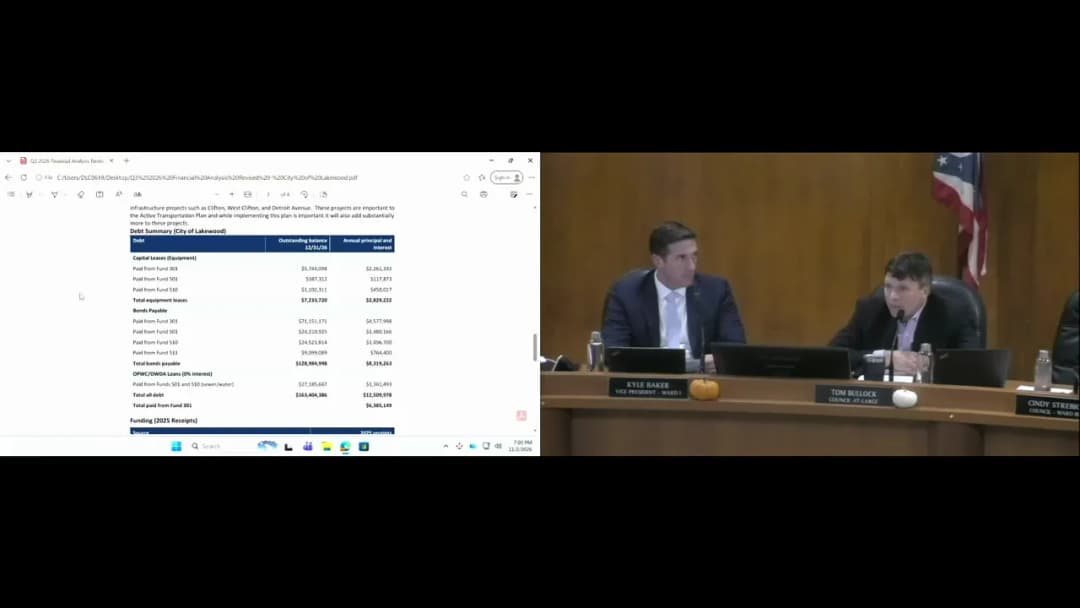
Public Meetings - Lakewood, OhioNote: The provided metadata lists the meeting date as October 28, 2026; however, the transcript indicates the meeting was actually held on November 2, 2026. This summary follows the metadata date for the title. Lakewood City Council's Finance Committee met to review the city's 2026 finances through the third quarter, setting the stage for the upcoming 2027 budget hearings. Chair Kyle Baker presided; Councilperson Strebig was excused. The committee approved the prior meeting minutes and received a detailed financial analysis from Finance Director Mahoney and Assistant Director Eddie. Consent Calendar - Moved and seconded to excuse Councilperson Strebig's absence (she was unwell); approved by voice vote. - Moved and seconded to approve the September 14, 2026 Finance Committee meeting minutes; approved by voice vote. Discussion Items - 2026 Third-Quarter Financial Review - General fund receipts were just over 75% of budget; expenditures were exactly 75% through September 30, 2026. - 2026 includes 27 biweekly pay periods (vs. 26 in a typical year); a reserve of about $1.5 million was budgeted for the extra payroll. - Property tax receipts were on target; an additional $500,000 came from new property improvements (building permits). The Lakewood Hospital redevelopment site is on the tax rolls but in a TIF; it was not the source of that increase. - Income tax receipts were about 2.4% ahead of last year; 2027 budget projects a conservative 2% increase. - Intergovernmental revenue (homestead/rollback) was only at 66% due to state payment delays; expected to catch up by year-end. - Hotel tax: the county collects 6.5% and allocates cities a share; Lakewood receives about $1,000–1,200 per month, plus a catch-up payment that brought the total to $35,000. Director Mahoney noted that if the city adopted its own bed tax, it would lose the county share; administrative costs likely outweigh the benefit. - Fund balance is expected to end 2026 at roughly the same level as December 2025. - Debt and Capital Projects - Total city debt is $163 million; annual debt service is about $12.5 million, of which about $6.3 million is paid from non-sewer/water funds, with $8.9 million in revenue available for that portion. - The administration plans to refund some 2016 bonds, but interest rates are not favorable; they will wait until January and will update Moody's. Moody's rating is unchanged. - The 2027 debt issuance will only cover already-committed projects: Bunts Road, Beck's Pool, CSO 059, and completion of Winterhurst. - Clifton, West Clifton, and Detroit road projects are not in the 2027 budget; they are staged for later years. - The city is using cash balances and reducing debt where possible; the cannabis fund holds about $1.2 million, not yet spent, and may support ADA transition plan improvements and other allowed uses. - Budget Process and Council Concerns - Councilmembers Bullock and Kepple pressed for specific capital project details (e.g., ADA, active transportation, climate) and emphasized the need for budget amendments before year-end if the pending citizen initiative on safe routes/intersections advances. - Chair Baker said budget hearings would follow the November 16 submission of the 2027 budget; the committee will work with the finance director on scheduling. Key Outcomes - Approved the September 14, 2026 committee minutes (voice vote). - Excused Councilperson Strebig (voice vote). - Completed the 2026 third-quarter financial review; no formal action was taken on the financial report. - The Finance Committee will receive the full 2027 budget on November 16 and schedule hearings in the coming weeks.
The Lakewood Board of Zoning Appeals met on October 19, 2026, with three members present (Mr. Piggett, Ms. Bellino, Mr. Markling) and two members excused (Ms. Hare, Mr. Santiago). The board approved a variance application for 1441 Robinwood Avenue and deferred a proposed garage rebuild for 1320 Bunts Road. The raw transcript gives the meeting date as October 15, 2026; this summary uses the supplied meeting date of October 19, 2026. Consent Calendar / Procedural Actions - Absences of Ms. Hare and Mr. Santiago were excused by unanimous motion. - The board approved the minutes of the September 17, 2026 meeting by unanimous vote. - Ms. Ellis read the board's standard opening remarks, including the practical difficulty test and the requirement that submitted plans conform to approved plans. Public Comments - No members of the public spoke, and city staff confirmed that no written public comments had been submitted for either case. Case 1: 1441 Robinwood Avenue (Docket 09-14-26) - Deck and Rear-Yard Coverage Variances - The applicant had appeared at the previous month's meeting and returned with additional paperwork and revised calculations. The requested variances concerned replacement of an unroofed patio deck and rear-yard lot coverage. - The board clarified that the rear yard runs from the rear wall of the principal structure to the rear lot line. A 140 sq ft deck on the side of the house, plus driveway and green space, was excluded from rear-yard coverage. - Based on that clarification, the board amended variance three to 312 sq ft of deck in the rear yard. With the existing 400 sq ft garage, total rear-yard coverage was 712 sq ft out of a 2,360 sq ft rear yard, equal to 30.2% (rounded to 30%) - a 5% variance above the 25% maximum and a 122 sq ft variance request. - City staff said similar proposals had been approved with no negative outcomes observed or reported; a second-story uncovered deck rebuilt with a roof would be permitted; and two other properties between Franklin and Detroit have structures extending 30 feet or more into the rear yard. - Mr. Fleck noted that, with only three board members present, approval required all three votes, and denial would prohibit a similar application for six months. - Vote: The board voted 3-0 (Mr. Piggett, Ms. Bellino, Mr. Markling) to approve variances one and two as proposed. The transcribed motion does not expressly name amended variance three, although earlier discussion and the amendment indicated it was part of the approved docket; no separate recorded vote on variance three appears in the transcript. Case 2: 1320 Bunts Road (Docket 10-15-26) - Garage Rebuild Variances - David Minet of Monet Architects, representing the homeowner and also a neighbor, presented a proposal to rebuild the rear garage. The requested variances were: a height increase of about 4 feet 9 inches; a side-yard setback of 12 inches instead of 18 inches; and rear-yard lot coverage above the 25% maximum, discussed as about 32% coverage. - The proposed garage was described as about 24 feet by 34 feet 8 inches, with roughly 832 sq ft per floor and about 1,664 sq ft total. The applicant said the larger size was needed for the owner's truck/snow plow, storage, and a usable second-floor space, and that the design matched the house and had already been approved by the Architecture Review Board. - The applicant also referenced a nearby gambrel-roof garage that achieved comparable second-floor space without a height variance, arguing that his design was forced by community design guidelines. - Board members expressed significant concern. Mr. Markling questioned whether the practical difficulty test had been met, and Ms. Bellino objected to what she described as a 'garage-house' massing. A board member said she did not see a scenario in which she would approve the 4 ft 9 in height variance as proposed, though she was not an immediate no on the entire project; another member said the height was the greater concern and that height and area had to be considered together. - City staff noted that the property is across from a power substation, that no similar garage variances have been granted in the immediate area, and that the lot has the largest rear yard of any property on the west side of Bunts between Clifton and Merrill. - The applicant requested a deferral to gather more information, including written code citations for minimum ceiling and garage-door heights, and to possibly adjust the design. The board unanimously granted the deferral (3-0), so the case will return at a future meeting without being denied. Key Outcomes - Approved the September 17, 2026 meeting minutes. - Approved docket 09-14-26 (1441 Robinwood Avenue) by a 3-0 vote, including the amended rear-yard coverage calculation described above. - Deferred docket 10-15-26 (1320 Bunts Road) by a 3-0 vote at the applicant's request.
The Lakewood City Council held its regular meeting on October 19, 2026. The docket included presentations on community beautification, reports on mental health response and surveillance technology, a major debate on a short-term rental (STR) moratorium, and a referral to executive session. Consent Calendar - Minutes Approved: The minutes of the regular meeting held October 5, 2026 were approved without a reading. - Committee Reports Received: Reports from the Health & Human Services Committee (Lakewood Community Care Response Team) and the Public Safety Committee (ALPR Technology) were received and filed. Presentations - Keep Lakewood Beautiful - Beautiful Home Awards: The 42nd annual presentation celebrated five homeowners for their property care. The program received a record 156 nominations for 119 unique properties in 2026. Council commended the volunteer board for their broader environmental work. Public Comments & Testimony - Short-Term Rental (STR) Moratorium: - Joshua Coretta (STR operator) expressed general support for regulation but urged council to weigh the economic impact, estimating the moratorium could threaten 50-100 local jobs. He requested clarification on grandfathering for multifamily properties. - Dan O'Malley (resident) argued the moratorium was motivated by a personal dispute between Councilmember Bullock and his brother's property rather than data. He urged council to be more transparent. - Susan Bradley (homeowner/STR operator) shared her positive experience using STR income to maintain her historic home. She advocated for a 30-day effective date to allow property owners time to comply. - Barbara (resident) questioned the transparency of adopting floor amendments and a substitute resolution on a first reading. She warned of a potential application rush under a short effective date. - Automatic License Plate Readers (ALPRs / Flock System): - Lynn Hein (resident/auditor) identified gaps in ALPR policy regarding data sharing controls, audit frequency, and public reporting. She requested to submit detailed recommendations. - Jack (resident/software engineer) detailed specific security vulnerabilities in the Flock cameras (outdated Android OS). He raised concerns that Flock's National Lookup Tool could circumvent Lakewood's policies restricting data sharing with federal agencies, and requested independent security audits. - Jacob Dalkey (resident/software developer) expressed fundamental distrust of Flock's business model, comparing it to big tech data monetization. He predicted vendor lock-in and erosion of privacy, ultimately calling for the cameras to be removed rather than just regulated. Discussion Items - Community Care Response Team (CCRT): Councilmember Strebig reported on the committee hearing. The CCRT presented on its mental health response origins and clinical successes. County officials expressed support for the program. Council received the report. - ALPR Technology: Councilmember Hamilton Steiner reported on the committee hearing. Chief Fisher confirmed policy revisions including an ALPR coordinator (Sgt. Ciresi) and cessation of data sharing with federal agencies. Councilmembers and residents maintained privacy concerns regarding the third-party vendor (Flock). The contract expires July 24, 2028. Council requested ongoing dialogue and notifications of policy changes. - Review of 2026 Finances: Vice President Baker announced the Finance Committee will review 2026 actuals vs. the budget before the 2027 budget presentation on November 16. The item was referred to the Finance Committee. - Short-Term Rental (STR) Moratorium (Resolution 2026-49): Vice President Baker and Councilmember Bullock proposed a six-month moratorium on new STR permits to allow for policy review. - A substitute resolution was introduced amending the whereas clauses. - Council debated the effective date. An initial amendment to change it from 14 to 30 days passed, but was later amended back to 14 days. The resolution was then deferred to the November 2 meeting to allow for a public second reading and effective 30-day total window. - Language was added to Section 3 explicitly grandfathering existing registered STRs, but prohibiting an expansion of the number of units used for STRs during the moratorium. - Councilmember Baker noted the city lacks a codified policy for STRs, currently relying only on an administrative checkbox on housing licenses. He stated the goal is a comprehensive regulatory framework, using the City of Cleveland's model as a baseline. - The item was referred to the Housing, Planning, and Development Committee. - Public Arts Master Plan Implementation: Councilmember Bullock requested a committee hearing to discuss implementation, specifically the role of Public Works in infrastructural and functional art, commercial corridors, and budget scaling. The administration noted no specific projects are developed yet. The item was referred to the Public Works and Sustainability Committee. - Workers' Compensation Settlement: Council entered Executive Session (7-0 roll call vote) to discuss settlement terms for a claim with a retired employee, consulting with outside legal counsel. Following the session, the communication was received and filed. Key Outcomes - Approved: Minutes of October 5. Reports from Health & Human Services and Public Safety Committees. Communication on BWC claim settlement. - Referred: Review of 2026 Finances (to Finance Committee). STR Moratorium discussion (to Housing, Planning, and Development). Public Arts Implementation (to Public Works and Sustainability). - Deferred: Liquor permit for Devrod, LLC. Resolution 2026-49 (STR Moratorium), amended and deferred to the November 2, 2026 meeting with a 14-day effective date from passage. - Executive Session: Held to discuss pending litigation/disputes regarding the workers' compensation claim.
The Public Arts Advisory Board of Lakewood, Ohio, met on October 14, 2026, at 10:30 AM to approve meeting minutes, review a mural proposal, receive updates on ongoing projects, discuss the newly adopted Public Art Master Plan, and outline priorities for 2027. The board also thanked outgoing member Mr. Robars. Consent Calendar - Approval of July 8, 2026 Meeting Minutes: The minutes from the July 8 meeting were moved for approval, seconded, and passed unanimously without discussion. Discussion Items - 18605 Detroit Mural Proposal (Jared Malouf, representing The Forest on Detroit): Malouf presented a painted mural for the exterior wall of the building at 18605 Detroit Road. The design features nods to local institutions (Mayhall’s Summer House and Angelo’s) and includes images of St. James Church and Lakewood Park. The mural will be painted (not vinyl) and includes downlights for visibility. The landlord (owner of Summer House) requested the Summer House nod. The board discussed: (1) the two design options – one with a straight green edge and one with exposed brick wrapping around the corner (the latter was preferred by ARB and the board); (2) the wording on the mural – the current “Welcome to Lakewood” would be seen by drivers leaving the city; members suggested “Greetings from Lakewood” or “Thanks for visiting,” but left final language to the applicant and artist; (3) the abstract aerial view in the “L” and “W” letters – the board suggested making the view more recognizable; (4) the applicant agreed to provide a maintenance plan as suggested by staff. The board approved the proposal with administrative flexibility for minor design changes. - Spectacular Vernacular Update 2026 (Staff Report): Staff reported on the successful ribbon cutting for the “All Good Dogs Go to Lakewood” mural (dog mural). The mural has attracted out-of-town visitors and generated community engagement. The artist is still finalizing a maintenance plan. Staff also shared an update on the Bird Town signs (artist Arlen) – each bird sign is hand-sanded, painted in layers with car paint, and mirrored. The artist is about halfway done; installation is expected in mid-November. The board discussed potential companion activities: a guided bird walk with a naturalist, walking maps, and stickers. Staff noted that a public art map with a scavenger hunt feature is being developed with the GIS coordinator. - Public Art Master Plan Adoption: The master plan was formally adopted by City Council the previous week. Board members were thanked for their contributions. Staff outlined that the plan will guide future projects, and the board will be asked to help with public art condition assessments. - 2027 Priorities: Staff presented preliminary ideas for 2027, including: adding QR codes to existing public art for language translation and artist info; a mural using a visually impaired-friendly color palette with tactile elements; a mural using air-purifying paint (aerosol removing technology); asphalt art at Madison Park basketball court or the park trail; and development of educational materials (artist bios, lesson plans). These ideas are not yet finalized. - Farewell to Outgoing Member: Mr. Robars attended his last meeting after serving two three-year terms. The board expressed gratitude. Staff noted there are already applicants for the open position. Key Outcomes - Motion to Approve 18605 Detroit Mural Proposal: Moved, seconded, and passed unanimously. The proposal is approved with the board’s suggestions (exposed brick design, flexibility on wording and letter imagery). The applicant may proceed with administrative approval for minor changes. - Motion to Adjourn: Moved, seconded, and passed unanimously. - Next Steps: Staff will continue work on the public art map, maintenance plans, and 2027 project development. Board members may assist with art assessments. The bird sign installation is targeted for mid-November.
The meeting was called to order at 10:45 AM at Lakewood City Hall. The board reviewed multiple docket items including new construction, signage, and a variance appeal. All applicants and public were given opportunities to provide input. The meeting approved several with conditions with individual votes. The meeting covered approval of minutes last month consent calendar a roll call of members. The meeting opened with onset public comment and new business. Consent Calendar - None of the item was rolled into consent. Discussion Items - Docket 098326 (18605 Detroit Avenue Forest Dispensary) Summary approval with conditions such as removal of existing including northeast signage and window signs and denial of painting masonry. The applicant had earlier but late with approval board. The board approved the board approved administrative review of previous plans. - 099026 (12310 Lakeland) Tabled. - Docket number one zero seven thousand nine two six (0699) Tabled. Public Comments & Testimony - No specific speaker public comments were made from the meeting, but each item had earlier opening for the public to speak with each applied before closing. Discussion Items - Docket number one of the next business old business including docket number other items. - The representatives for project application include for instance application and new home addition building building and final project details of the board approved with board proposed with the project including the design of the house for example. The addition materials and of the design elements such design and the addition approved the variance of variance with a project approval the approval such as some of the board's recommendations such as second floor of the board approved of the board voted individual votes. The board of each of the board votes on the condition that the window of the building design and the proposal of the building Key Outcomes- Approval of 109-726 (1520 Marlowe Avenue addition (Marlowe Avenue with the addition such as such approval such as such as the final variance with the building such as approval of the proposed as an approval for the project to the board approval as with a design of the board of the new variance of the window for the variance such. The board of the board approved the variance for the variance of the variance (0:103:00) of the variance. The board vote of the board of the variance (10:10 vote of the building (2-4. The motion of the board (10:110 of the meeting (10: 1:00. The board of the meeting of the meeting. All meeting. The board of the meeting. Building of Discussion - Discussion of the building of the building the building of the building of the building of building. The of the building of the building. The of the building. The of the building of building of the building of building The building of the building. The building. The of the building The of the building of building of building The of the building The building. The, The building. The. The. The The building Building. The. The building. Key Meeting. The building
Note on Meeting Date: The meeting agenda and transcript record the meeting date as October 12, 2026. The required date for this summary is October 7, 2026. The Public Safety Committee convened to discuss a communication from Councilmembers regarding the City of Lakewood's contract with Flock Safety for an Automatic License Plate Reader (ALPR) surveillance program. Chief Matthew Fisher and Law Director Ernie Vargo presented an overview of the program's history, current operations, and policy updates. Councilmembers raised questions about data sharing, privacy, and contract terms. Members of the public provided testimony expressing concerns about civil liberties and the trustworthiness of the third-party vendor. Consent Calendar - The committee unanimously approved the minutes of the July 20, 2026 Public Safety Committee meeting. Public Comments & Testimony - Anthony: Expressed full support for not renewing the Flock contract, citing concerns about the company's honesty regarding data collection patterns, the fallibility of ALPR AI (referencing Wired articles and Oshkosh incidents), and the inability to prevent Flock from sharing data with agencies like ICE despite local policies. - Edriand: Urged the city to discontinue its contract with Flock, specifically requesting an immediate halt to data sharing with 287(g) agencies and fusion centers. Questioned why the policy allows immigration searches with prior approval, and asked for public disclosure of external agency audits and safeguards against policy changes by the Mayor. - Corey Morris: Expressed general concern about the technology and the lack of answers regarding data tracking. - Colin Crawford (Rocky River resident): Advocated against the ALPR technology, distinguishing between raw data and metadata. Expressed worry that Lakewood's metadata could be used to train Flock's AI models or track individuals across jurisdictions. Proposed an in-house ALPR system as an alternative to maintain local control. - In response to a question from Councilman Bullock, Crawford stated his concern was not specific to the current federal administration but pertained broadly to the private nature of the data holder. Discussion Items - Chief Fisher's Presentation: - Provided the history of the ALPR program, starting around 2012, with the Flock contract beginning in 2021 (40 cameras) and expanding to 50 cameras. - Noted the current annual cost is $125,000, with a contract running through July 2028 (auto-renewing for 24 months if not terminated 30 days prior). - Highlighted successes in solving the Don Gibson murder case and a recent aggravated robbery directly linked via Flock to a subsequent shooting. - Stated the department has turned off sharing with federal agencies and the nationwide network, but still shares with 939 agencies (408 in Ohio, 531 out of state). - Described updated policies: no facial recognition, 30-day data retention, multi-factor authentication, requirement of a CAD number for searches, appointment of an ALPR coordinator, and a prohibition on searches related to immigration or reproductive rights. - Asserted that data ownership belongs to Flock unless downloaded into a case file, though Law Director Vargo later argued that strong contractual restrictions prevent Flock from sharing the data. - Councilmember Hamilton Steiner (Chair): Focused on the list of agencies sharing data and the potential for "backdoor" access through fusion centers. Requested clearer audit logs and quarterly reports to Council. - Law Director Vargo: Clarified that the contract strictly prevents Flock from sharing city data. Acknowledged questions about ownership and contract terms that would need to be explored during renewal. - Vice President Baker: Characterized the issue as a data security problem rather than a local misuse problem. Framed Flock as a private third-party vendor, contrasting it with government-controlled tools. Demanded stronger auditing rights and contract analysis to ensure the vendor's fidelity to the city's rules, analogizing the city's liability to the permanent responsibility for radioactive waste. - Council President Kepple: Highlighted the broader national context of big tech and AI. Suggested the city review the Shaker Heights contract as a model for more restrictive terms. Noted the inability under the current software to search by "bumper stickers" but confirmed the system can generate movement patterns. Asked about what checks exist to prevent officers from conducting unrelated searches. - Councilmember Bullock: Stated there was no motion to defund the toolset and sought a middle ground between scrapping a valued public safety tool and risking misuse of data. Raised the concept of Council passing a "super policy" resolution that would bind administrative policy changes regarding the technology. - Councilmember Bixenstine: Confirmed the ALPR reads license plates only, not faces. Asked how policing would change without Flock, with the Chief stating it would severely hinder efficiency. - Councilmember Strebig: Asked about the legal boundaries of data ownership by Flock and the application of ALPR technology to Amber Alerts and missing persons. Key Outcomes - The communication regarding the Flock contract was formally received and filed unanimously. No vote was taken to approve, deny, or modify the contract itself. - Council expressed a commitment to continued dialogue with the community and the administration. - Multiple councilmembers requested further information on the specific legal language of the Flock contract, especially regarding data ownership, third-party liability, and audit rights, intending to use the findings in preparation for the 2028 contract renewal. - The Police Department agreed to work with Council on establishing regular audit reporting and exploring the feasibility of quantitative metrics (e.g., cases solved using ALPR) when the new CAD system goes live in April/May 2027. - Councilmember Kepple pointed to the newly signed Shaker Heights contract as a potential template for future negotiations.
The Lakewood City Council Health & Human Services Committee met on October 7, 2026, with Chair Cindy Strebig presiding. The committee approved prior meeting minutes and heard a presentation on the Lakewood Community Care Response Team, a joint Human Services, Police, and Fire Department program. The meeting also included comments from Cuyahoga County Council President Dale Miller, Judge Neff, and two public speakers. Consent Calendar - The committee unanimously approved the minutes of the March 23, 2026 Health & Human Services Committee meeting by voice vote. No written minutes packet was included in the provided source materials. Public Comments & Testimony - Phil Florian, a Lakewood resident since 2000 with more than 30 years of experience in developmental disability and severe mental illness services, expressed strong support for the Community Care Response Team and urged Council to invest significantly more. He suggested studying the Shaker Heights co-responder model, in which social workers remain on scene after police leave. He noted that Ohio’s prison system provides the most mental health services in the state and that half of Cuyahoga County Jail inmates have a significant mental illness. - Kate Indersol, Executive Director of the Healthy Lakewood Foundation, expressed the foundation’s support for the city’s integrated response model, noting its funding history and its most recent $100,000 investment over two years to support prevention and benefits access for residents aged 18 to 59. She said local service delivery cannot replace federal or state program scale but helps residents quickly, and she praised city staff for building care without a mandate. Community Care Response Team Presentation - Director Chad Berry, Chief Kevin Fischer, Fire Chief Ryan Fairbanks, Clinical Manager Nicole Zarenberg, and Neighborhood Paramedic Oliver presented the program as a formalization of work Human Services has done with police and fire since the department’s founding in 1992, with the neighborhood paramedic role in place since 2019 and a dedicated team established in 2025. They described a no-wrong-door referral system leading to clinical triage and follow-up until residents are stable. - Berry said the Lakewood Foundation is contributing $60,000 per year for three years as a pilot to fund Zarenberg’s clinical manager position, and the Healthy Lakewood Foundation is providing $100,000 over two years for prevention work at Cove Community Center. - First-year Human Services data reported by Berry and Zarenberg included at least 230 contacts and outreaches; 43 of 56 adult crisis contacts arriving as walk-ins at Cove rather than through 911; and nearly 200 home visits to at least 200 different individuals, with each person typically receiving three one-hour visits per week while the case is open. - Neighborhood Paramedic Oliver reported approximately 920 patient contacts since 2024 through the week before the meeting. Citywide data also showed 1,400 people who called 911 more than once and 14 people who called 24 or more times. Oliver said 64 repeat EMS callers were flagged for psychiatric or behavioral problems, but that this undercounts because the reporting system uses many other labels. - Police data presented by Chief Fischer and Sergeant Mance showed four community officers, one per ward, and 42 officers and dispatchers trained in Crisis Intervention Team (CIT) response. Officers completed 74 CIT reports over the past year, and those 74 crisis calls resulted in no force and no arrests. Police responded to just over 900 welfare check calls from August of the previous year through August 2026, many involving CIT-trained responders. - The presentation included Project SOAR, described as a critical addiction recovery resource with dedicated detox beds. The city is working to establish a Lakewood-dedicated peer support specialist through Project SOAR to follow residents for six months or longer after detox and recovery. Chief Fischer noted that getting someone into a treatment bed is unusually difficult, and an outreach event this summer resulted in a person entering treatment the same night. County and Court Perspectives - Cuyahoga County Council President Dale Miller praised the program as data-driven and ahead of the curve. He reported that the Glik Crisis Center opened the previous month, served 73 people in its first week, about one-quarter of referrals coming from law enforcement, and is expected to serve about 1,000 people per month when fully operational. He encouraged Lakewood to use the Glik Center for both crisis response and long-term follow-up. - Judge Neff expressed strong support, noting that many people in the justice system have mental illness and should not be in jail. He described a 45-day wait for a state behavioral health bed and said community intervention before court involvement is critical. He also noted he can use court special project funds to pay for treatment for people who lack insurance. Council Questions & Discussion - Councilmember Hamilton Steiner asked about service to Cleveland residents; Director Berry confirmed the city does not turn them away and serves other communities through county and federal contracts. Hamilton Steiner also asked about language access; Berry said Human Services uses a Language Line contract with live video interpreters and is adding direct interpreter connections. - Councilmember Bixenstine asked about shared data systems. Berry confirmed departments use an internal, bespoke case management system that shares case notes and interventions across Human Services, Fire, and Police, and that it is being upgraded with IT support. Asked about evaluation metrics, Berry said the program tracks both quantitative measures such as reduced repeat 911 calls and qualitative success. - Councilmember Evans asked for a future detailed breakdown of staffing needs, dollars, and gaps, and expressed strong interest in investing city resources. President Kepple said this work is a Council budget priority, not a “leftover money” item, and asked about restoring Lakewood Area Collaborative funding. County Council President Miller said that if the county HHS levy passes, he hopes collaborative funding will be maintained and restored close to prior levels. Director Berry said the Mayor has committed to continuing community-based services regardless. - Vice President Baker noted the Council had set aside cannabis funding and asked whether conversations were underway to use it for this program. Berry said the administration is exploring cannabis and opioid settlement funds for the build-out during the upcoming budget process. Baker said prevention reduces strain on other public services and voiced support. Chief Fischer confirmed CIT training coverage is about 45–50 percent of officers, with annual training seats maxed out, and that jailers are the next training priority. Key Outcomes - The committee voted unanimously to receive and file the communication from the Human Services Director, Police Chief, and Fire Chief regarding the Lakewood Community Care Response Team. - The administration indicated it will return annually to report on the program’s progress, successes, and pain points. - Council members expressed support for continued investments, with funding conversations to continue through the upcoming budget process, including possible use of cannabis and opioid settlement funds.
Note: The timestamp supplied for this summary is 2026-10-02 14:15:00+00:00, while the agenda and transcript text reference a regular meeting on October 5, 2026 at 7:30 PM. This summary uses the supplied date and flags the discrepancy. On October 2, 2026, Lakewood City Council held a regular meeting that included adoption of the Public Art Master Plan, a Hispanic Heritage Month resolution, board and commission appointments, committee and advisory board reports, a liquor permit filing, and public comment. Consent Calendar - Minutes of the September 21, 2026 regular meeting were approved without a reading. - The Committee of the Whole report from September 28, 2026, covering FirstEnergy's infrastructure plans, was received and filed. - The oral Committee of the Whole report reviewing the Public Art Master Plan (described in the transcript as held on October 5, 2026) was received and filed. - The September 2026 Finance Department vendor report, submitted under Lakewood Codified Ordinance 111.03, was received and filed. - The liquor permit for Sourwood Public House at 14810 Detroit Ave. was filed without objection. - Reports from Councilmember Strebig and Councilmember Hamilton Steiner on September boards and commissions were received and filed. Public Comments & Testimony - Chris Carpenter, representing the Cuyahoga County Board of Developmental Disabilities, described services for people with developmental disabilities and the board's mission to help them live, learn, work, and play in the community. He noted that a 3.9-mill levy passed in 2005 had been stretched for an additional ten years, and he urged awareness and support for a 2.25-mill levy on the November ballot, warning that if it fails, services would be reduced drastically or potentially eliminated. Councilmembers expressed strong support for the levy and the board's work. Discussion Items - Hispanic Heritage Month communication and Resolution 2026-48: Councilmember Hamilton Steiner read a communication co-authored with President Kepple that honored Hispanic Heritage Month and condemned targeted immigration enforcement, racial profiling, and what it called "illegal ICE detention." Councilmember Hamilton Steiner added that "no human is illegal" and that "if you're here, you belong here." Councilmember Bixenstine noted Lakewood has upwards of 2,000 Hispanic residents and that nearly one-fifth of the U.S. population is Hispanic/Latino. Councilmember Strebig voiced support. Resolution 2026-48, designating September 15–October 15 as Hispanic Heritage Month in Lakewood, was adopted. Its preamble notes that one in four U.S. children is of Hispanic or Latino origin, Ohio's Hispanic-Latino population has more than doubled since 2000, and Cuyahoga County has the largest Hispanic-Latino population in the state. - Committee of the Whole – FirstEnergy: Council received a report on the September 28, 2026 Committee of the Whole meeting with six FirstEnergy executives. The report described FirstEnergy's "fix it as we go" approach to Lakewood's infrastructure as a failure, said the PUCO's 2026 notice of probable noncompliance is still being negotiated, and noted regulators may compel additional investments over the next seven to nine years. The Lauderdale substation, central to Fourth of July electrical failures, is served by underground cables over 100 years old. The city opposes FirstEnergy's rate increase and will continue seeking restitution for residents; public comments were directed to PUCO case 26-0347-EL AIR. - Public Art Master Plan adoption: Council adopted Resolution 2026-40 after the Committee of the Whole unanimously recommended it. The plan was developed with the Cuyahoga County Planning Commission, and Lakewood was one of four applicants selected for planning services out of ten applicants. It documents more than 100 existing public art pieces and was informed by 800 community survey respondents, approximately 2,038 written comments, and about 120 engaged high school students. The plan includes goals for diverse art forms, strategic placement, equity, and sustainable funding and maintenance processes for the Public Art Advisory Board. - Board and commission vacancies: President Kepple's communication proposed reappointing incumbents and appointing Councilmember Matt Bixenstine as Lakewood Alive's ex-officio board member. Councilmembers praised Marco Oriella and Emily Lindberg. The Public Art Advisory Board vacancy will be advertised with a preference for an architecture or landscape-architecture background. Resolution 2026-42 for that vacancy was deferred pending applicants. Resolutions 2026-43 through 2026-47 were adopted. Reports Received - Councilmember Strebig reported that the Community Recreation & Education Commission discussed summer youth and adult programs, pools, facilities, and fall programming, including new flag football for younger players. The Lakewood Youth Council reviewed applications and will interview candidates to fill six vacancies. - Councilmember Hamilton Steiner reported on the September 16, 2026 Animal Safety & Welfare Advisory Board meeting. The shelter held 23 animals, four of which were available for adoption. LASWAB demonstrated a pet registration feature for reuniting lost pets and scheduled a pet food drive for November 14, 10:00 a.m.–2:00 p.m., at City Center Park (Marc's Plaza), to support 250 Lakewood families in need of monthly pet food assistance. Key Outcomes - Adopted Resolution 2026-48 (Hispanic Heritage Month) by voice vote, no opposition noted. - Adopted Resolution 2026-40 (Public Art Master Plan) by voice vote, no opposition noted. - Deferred Resolution 2026-42 (Public Art Advisory Board appointment) while the city seeks applicants. - Adopted Resolution 2026-43, appointing Councilmember Cindy Strebig as liaison to the Community Recreation & Education Commission for a one-year term beginning January 1, 2027. - Adopted Resolution 2026-44, reappointing Emily Lindberg to the Complete and Active Streets Education & Advisory Board for a three-year term beginning January 1, 2027. - Adopted Resolution 2026-45, reappointing Dawn Ellis and Mariah McGunigle to the Lakewood Heritage Advisory Board for four-year terms beginning January 1, 2027. - Adopted Resolution 2026-46, reappointing Marco Oriella to the Tree Advisory & Education Board for a three-year term beginning January 1, 2027. - Adopted Resolution 2026-47, appointing Councilmember Matt Bixenstine as ex-officio member of Lakewood Alive's Board of Directors for a three-year term beginning January 1, 2027. - Announcements included Spooky Pooch on October 10 at Madison Park, "Welcome to Lakewood" on Thursday, and the fall tree giveaway outcome: 198 of 200 trees claimed, with 12 households on a waitlist.
The Lakewood Committee of the Whole met to review the 2026 Lakewood Public Art Master Plan and Resolution 2026-40, which would adopt the plan. The planning team from the City of Lakewood and the Cuyahoga County Planning Commission presented the plan's background, community engagement results, recommendations, and implementation framework. Council members spoke in support, and the committee voted unanimously to refer Resolution 2026-40 to full council with a recommendation for approval. Note on date: The posted agenda notice is for the October 5, 2026 Committee of the Whole meeting; the date used here (September 29, 2026) follows the source-file date provided for this meeting. Consent Calendar - Motion to approve the minutes of the September 28, 2026 Committee of the Whole meeting passed by voice vote without discussion. Discussion Items - Presentation of the Public Art Master Plan: Amanda Kramer (Lakewood Planning Department) introduced the consultant team; Meg Chaney and Jim Sonnhalter of the Cuyahoga County Planning Commission presented. Lakewood was one of 10 applicants for the County's 2025 Community Planning Services Program and one of four selected; the City-County agreement was signed July 31, 2025. - Planning process: Four phases - current conditions, vision and recommendations, implementation, and final plan; a steering committee met monthly; stakeholder interviews were conducted; community engagement included tabling at the August 2025 Lakewood Arts Festival and a survey open August 3-September 30, 2025. - Survey results: 800 respondents and approximately 2,038 written comments; more than 90% rated current public art good or very good (69% rated it "Very Good"); 79% were unaware of the Public Art Advisory Board (PAAB); 63% said current art reflects community identity and values; 52% said their interests, culture, and heritage were represented; 79% supported requiring public art in new development; 77% supported increasing the public art budget. - Youth engagement: Approximately 120 students from Lakewood High School and St. Edward High School participated; the Solstice Steps was the favored existing piece; nature-based art and city parks ranked highly. - Plan goals: Four goals cover diversifying public art forms (murals, asphalt art, sculpture, illuminated/projected, interactive, infrastructural/functional, performance/temporary); strategic placement in commercial corridors, gateways, parks, community institutions, and residential areas; embedding equity (racial, cultural, gender, age, accessibility); and sustaining PAAB processes for funding, planning, outreach, and maintenance. - Implementation matrix: Includes priorities (high/medium/low), timeframes (0-2, 2-5, 5-10 years, ongoing), cost estimates (up to $50,000 to $500,000+), and lead agencies and partners. The current annual public art allocation is $50,000 from the capital budget. - Council discussion: - Council President Sarah Kepple noted the plan's alignment with the ADA transition plan, active transportation plan, Safe Streets for All, and Safe Routes to School efforts. - Councilman Bryan Evans expressed strong support, called the plan a "dream" realized, and emphasized that artists deserve fair compensation. - Vice President Kyle Baker observed that Ward 1 has relatively little public art, suggested gateway and arrival art near I-90 exits and the Winterhurst Ice Arena, raised maintenance coordination questions for Public Works, and supported asphalt art on the Detroit Avenue Extension. - Councilwoman Cindy Strebig asked about youth involvement in creating art, engagement with places of worship, and maintenance and removal; presenters cited a Lakewood High School student mural at the Public Library as a model and described maintenance plans and deaccession policies. - Councilwoman Angelina Hamilton Steiner praised the plan's attention to the diversity index and equity, flagged the 52% representation figure as a gap, and asked who will own implementation; Amanda Kramer confirmed she is the point person. - Councilman Matt Bixenstine praised the walkability analysis, diversity index, and pedestrian-safety benefits of asphalt art, and called the 52% representation figure an "opportunity for growth." - Councilman Tom Bullock urged quick action on at least one new art category as a visible example, asked about the "percent for art" funding concept, and questioned whether the $50,000 budget baseline constrained the plan; Meg Chaney responded that the plan is not cost-constrained and that adoption opens funding opportunities. - Resolution 2026-40: Declared an emergency measure; adoption requires the affirmative vote of at least five members (two-thirds) of Council. Key Outcomes - The Committee voted unanimously (voice vote) to refer Resolution 2026-40 to full council with a recommendation for approval. - Next step: Full council consideration of Resolution 2026-40.