Browse by city
Date range
Search help

Search titles, summaries, topics and stored transcripts together. Keywords may match separately; put the whole query in double quotes for a phrase. Matching follows word analysis, so punctuation is not exact. Both dates are included. Documents are not searched.

SHOWING 11–20 ENTRIES
11
OCT 19, 2026 · LOUDOUN COUNTY, VIRGINIA · COMMISSIONS & ADVISORY BOARDS
Western Loudoun Rural Uses and Standards ZOAM Ad Hoc Committee Meeting - October 19, 2026

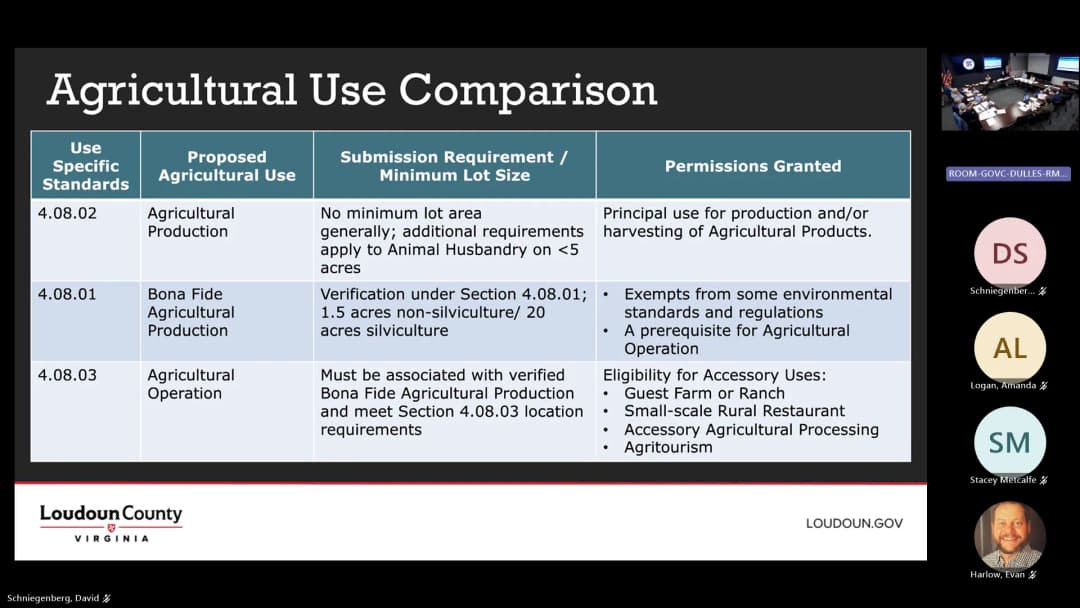
The Western Loudoun Rural Uses and Standards Ad Hoc Committee met on October 19, 2026, to continue its detailed review of proposed Zoning Ordinance amendments. The meeting focused on defining agricultural terms, creating a tiered system for agricultural uses, establishing verification processes for bona fide agricultural production, and setting standards for agricultural processing. The committee made significant progress, voting on a series of motions to refine staff draft language, often deviating from initial proposals to better support local farming operations. Consent Calendar - The committee approved the meeting minutes from September 29, 2026, with amendments addressing errors in attribution, word choice corrections ("received" vs. "questioned"), and inconsistencies in how voice votes were recorded across the document. Disclosures - Bill Hatch disclosed that his family owns and operates a farm in Western Loudoun that would be affected by the provisions under discussion. - Mark Miller disclosed that on October 1, 2026, he had met with staff and stakeholders to discuss the draft language before the committee. Discussion: Agricultural Definitions (Motions 27 & 30) - Staff presented revisions to replace the existing "agriculture" use with "agricultural production" and add a definition for "agricultural products." - Committee members Eric Combs and Beth Erickson found the draft definitions of "agricultural production" and "agricultural products" to be circular, where each term simply referred to the other. Eric Combs advocated for rooting the "agricultural products" definition in the state's Right to Farm Act (Va. Code § 3.2-300) rather than the agritourism liability code to eliminate this circularity. Staff had combined language from multiple code sections. - A significant debate centered on the exclusion of "direct market retail or wholesale" of agricultural products from the "agricultural production" definition. Beth Erickson, Bill Hatch, and Dale Myers argued that on-farm sales to clients (e.g., purchasing meat from a freezer, CSA pickups) is a standard and essential practice for working farms in Loudoun County. The committee stressed that this activity should remain clearly permitted, where the staff draft had struck it out with the intent to move it to "agritourism." - Dale Myers criticized the "30-day" requirement for active agricultural activity and specific material exclusions, calling them unrealistic for standard agricultural practices like preparing fallow fields. - The committee found that the staff's draft was not consistent with the board's direction in Motions 27 and 30. Discussion: Bona Fide Agricultural Production (Motions 18 & 28) - Staff outlined a shift in the verification process, removing the Loudoun Soil and Water Conservation District from a "de facto zoning approval" role and placing it with the Zoning Administrator in consultation with Virginia Cooperative Extension. - Staff announced they were removing proposed minimum acreage limitations (1.5 acres for silviculture, 20 acres for others) due to complications with state requirements and the potential for creating expensive hurdles for small-lot farmers. - The verification timeline was a major point of contention. A motion by Dale Myers to align the re-verification of bona fide agricultural production with the Land Use Assessment Program's cycle (every 6 years) passed (5-3). Robin-Eve Jasper led the opposition, arguing that a 6-year cycle was too long to effectively prevent abuse of exemptions, particularly in environmentally sensitive areas like the Mountainside Overlay District. She expressed concern that the Land Use program's initial certification does not guarantee active inspection. - Robin-Eve Jasper successfully passed a subsequent motion requesting staff to provide the committee with a detailed breakdown of the practical verification procedures used by the Commissioner of Revenue's office. - The committee supported the distinction between general agricultural production and "bona fide agricultural production," which acts as a gateway for exemptions and higher-tier agricultural uses. Discussion: Agricultural Operation (Motion 29) - Staff presented the new "Agricultural Operation" tier, defined consistently with state code (Va. Code § 3.2-300). To qualify for this use, a farm must first be verified as "bona fide agricultural production." - Staff introduced a "tier chart" showing the hierarchy: Agricultural Production - Bona Fide Ag Production - Agricultural Operation. This chart clarifies the building blocks and was praised by the committee. - The committee unanimously found the definition of "agricultural operation" consistent with board direction, with the understanding that the list of accessory uses (such as guest ranches and small-scale restaurants) in Section 4.0803(D) was incomplete and would be finalized for the next meeting. Discussion: Agricultural Processing (Motions 42, 43, 44) - Staff presented a framework distinguishing between processing as part of agricultural production, accessory agricultural processing, and principal agricultural processing. - The sourcing requirement for accessory processing was extended to a 50-mile radius, following a motion to match the principal processing standard. - The committee revised the building size allowances to decouple cold storage from the main processing area. Cold storage was capped at a maximum of 5,000 square feet and is not counted towards the overall structure size limit. - The committee moved to add explicit language that Section 4.08.12 (Agricultural Processing) does not apply to ABC-regulated uses such as farm wineries, limited breweries, and distilleries, to avoid conflicting regulations. - Dale Myers requested documentation on how the specific square footage limits (2,500, 10,000, 15,000) and cold storage caps were derived, indicating the numbers seemed arbitrary. Key Outcomes - Motion 1 (Unanimous): Found staff's draft for Motions 27 & 30 inconsistent with board direction regarding definitions and sales permissions. - Motion 2 (Unanimous): Directed staff to add explanatory text to agricultural use categories to help lay readers distinguish between them. - Motion 3 (Unanimous): Directed staff to develop language for a new section or standards clarifying permissible sale and distribution activities (direct sales, wholesale, third-party sales) for agricultural products. - Motion 4 (Unanimous): Directed staff to root the definition of agricultural products within the "agricultural production" definition, referencing the state's Right to Farm Act. - Motion 5 (Unanimous): Directed that all defined terms in the draft text be capitalized for clarity. - Motion 6 (Passed): Recommended the Planning Commission review the prohibition on animal husbandry on cluster subdivision lots (Dale Myers opposed, citing scope). - Motion 7 (Unanimous): Found staff's draft for Motion 18 consistent (moving verification from Soil & Water to Zoning/VCE). - Motion 8 (Passed 5-3): Aligned the re-verification timeline for Bona Fide Agricultural Production with the county's Land Use Assessment Program cycle. - Motion 9 (Unanimous): Directed staff to add an explanatory clause to the "bona fide agricultural production" section explaining its distinction from general agricultural production. - Motion 10 (Passed): Information request for staff to report back on the Commissioner of Revenue's specific verification procedures for the Land Use Assessment Program. - Motion 11 (Unanimous): Found the definition of "Agricultural Operation" (Motion 29) consistent with board direction. - Motion 12 (Unanimous): Found the agricultural processing framework (Motions 42, 43, 44) consistent with board direction, with specific revisions: (a) Cold storage capped at 5,000 sq. ft. and excluded from main floor area limits; (b) Exclusion of ABC-regulated uses from the section; (c) Extension of the 50-mile sourcing radius to accessory agricultural processing. - The committee requested staff create master comparison charts of all proposed agricultural uses and tiers for the next meeting.
AGRICULTURAL OPERATIONS 46% · ZONING REGULATIONS 17% · PROCEDURAL 15% · ZONING ORDINANCE 13%
12
OCT 9, 2026 · LOUDOUN COUNTY, VIRGINIA · COMMISSIONS & ADVISORY BOARDS
Loudoun County Facility Standards Manual Public Review Committee Meeting – October 9, 2026

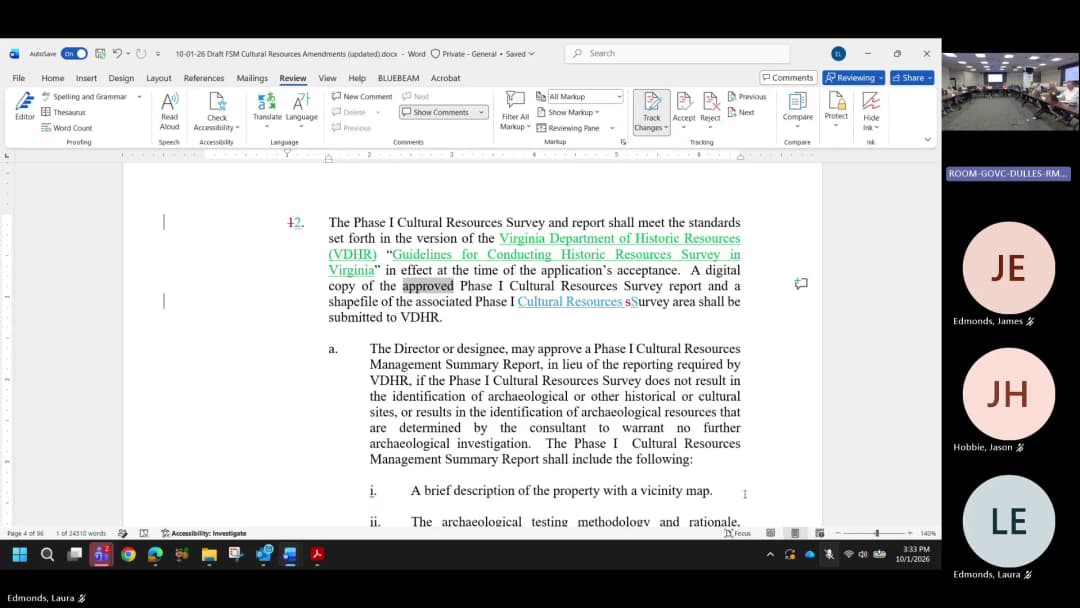
The Facility Standards Manual (FSM) Public Review Committee met on October 9, 2026, to review proposed cultural-resources text changes, discuss draft gabion-basket standards for stormwater facilities, and preview the FSM's transition into the ENCODE platform. The provided meeting timestamp is October 9, 2026, although the chair's opening words in the transcript say 'October 1st, 2026.' The committee was not quite at a quorum at the start; no remote members participated. Administrative Items - The committee reviewed the draft minutes from the prior meeting and discussed one suggested edit to the fourth-to-last bullet on stormwater pond treatment. Formal approval was deferred to the next meeting. - Members discussed the 2027 meeting calendar and generally agreed to propose first and third Thursdays from 3:00 to 5:00 p.m., alternating months with two meetings and one meeting, with additional meetings if urgent items arise. - Staff noted the work plan is awaiting a comprehensive plan amendment related to the 'Quick Fix' items, with an update to the Board scheduled for the October 20 board meeting. Sidewalk/shared-path work was mentioned as a possible future topic. Discussion: Cultural Resources and Archaeology Amendments - Staff walked through track changes intended to prepare for the October 27 Planning Commission public hearing. Edits were largely structural: an introductory sentence explaining that cultural resources include the phase one survey and reconnaissance survey described below; reorganized provisions for preliminary plats and record plats; and a change from 'structure plan' to 'sketch plan.' The requirement for phase one cultural-resources testing on residential lots two acres or less was retained. During discussion, a member noted the FSM uses the word 'recommend' about 26 times. - Members debated the existing statement that a phase one survey is 'recommended for the entire property.' Some members objected to using 'recommended' in a regulatory document, while staff explained it puts applicants on notice that additional testing may be needed if limits of disturbance change. The committee ultimately agreed to keep the original formulation with minor wording changes. - The committee agreed to add a 'digital submission' requirement in Chapter 7 for digital files—DWG, DXF, KML, KMZ, or shapefile—of the phase one and reconnaissance survey boundaries, provided with the initial submission. The equivalent digital-file language was removed from the preliminary-plat, CPAP, and site-plan sections in Chapter 8. Staff will continue to send approved survey boundaries and reports to the Virginia Department of Historic Resources and maintain the countywide GIS survey layer. - A footnote reference to 'section 7800 archaeology' will be updated to 'cultural resources.' Discussion: Gabion Baskets in Stormwater Facilities - Stormwater staff Chris Stone and BMP reviewer Alex Morgan presented draft FSM text and discussed a study on gabion baskets in wet environments. The study estimated PVC-coated gabion baskets could last about 16 years before corrosion, while county maintenance representatives reported seeing some baskets corroding within about two years. - County maintenance representatives explained that Loudoun County, not homeowners associations, maintains wet ponds subject to easements and wet-pond agreements, so a landowner replacement/maintenance scheme would not fit the current structure. The idea of a replacement fund was discussed but not decided. - The original draft proposed allowing PVC-coated gabions in detention and extended-detention ponds while prohibiting them in retention ponds or completely submerged environments. Several members found the text too restrictive or confusing. Discussion moved toward a simpler rule: gabion baskets installed in stormwater facilities where any part is subject to inundation must be PVC-coated, and gabion baskets should not be used where they would be completely submerged in a permanent pool. - Staff are developing a riprap/stacked-stone alternative, likely with graded riprap on a roughly 2:1 slope, and will bring the gabion language back for further review. Discussion: ENCODE Migration and DOAM Request - Staff reported that the FSM and LSD standards will be moved into ENCODE, with all 32 FSM figures recreated in AutoCAD-based, downloadable, searchable format and an AI search feature. - Because minor formatting changes require a DOAM, staff plan to ask the Board at the October 20 business meeting to authorize a non-substantive cleanup. Examples shown included bolding subsection labels, restructuring water-system definitions, placing chapter figures at the end with titles, updating cross-references, and correcting small figure and text inconsistencies. - Committee members indicated support for proceeding with the ENCODE formatting work, understanding that substantive FSM changes would come back separately. Key Outcomes - Minutes approval was postponed to the next meeting. - The archaeology/cultural-resources edits were accepted for further drafting, with the digital-file requirement moved into Chapter 7 and removed from Chapter 8. - Gabion-basket language was not finalized; staff will continue work on a riprap/stacked-stone alternative and return with revised text. - The committee supported taking a DOAM to the October 20 Board meeting for minor ENCODE-related FSM formatting changes. - No formal counted votes were recorded; the committee was without a full quorum at the beginning of the meeting.

CULTURAL RESOURCES 30% · STORMWATER MANAGEMENT 19% · GABION BASKET MAINTENANCE 11% · WETLAND MANAGEMENT 7%
13
OCT 8, 2026 · LOUDOUN COUNTY, VIRGINIA · BOARD OF SUPERVISORS & PLANNING COMMISSION
Loudoun County Planning Commission Work Session - October 8, 2026

On October 8, 2026, the Loudoun County Planning Commission held a work session in Leesburg, Virginia. The commission approved prior meeting minutes, heard presentations on the Western Loudoun Recreation Complex, voted to recommend that application to the Board of Supervisors, and received staff briefings on the October 27, 2026 public hearing agenda. Minutes Approval - Vice Chair Muttery moved and Commissioner Combs seconded approval of the September 17, 2026 work session minutes. The motion carried 7-0-2, with Commissioners Banks and Jasper absent for the vote. Disclosures - Commissioner Myers disclosed a brief discussion with Jamie Imory about the evening's agenda item. - Commissioner Combs disclosed a meeting about two weeks prior with Paragon Holmes regarding the Aspen Station application expected before the commission by the end of the calendar year. - The chair disclosed attending the September 28 data center standards phase two community meeting at Broad Run with Commissioner Frank, and an October 7 site visit to the Evergreen Energy Battery Energy Storage Facility off Evergreen Mill Road. Work Session Item: Western Loudoun Recreation Complex - LEGI-2025-0001, CMPT-2025-0001, CMPT-2025-0003, SPEX-2025-0012, SPEX-2025-0013, and SPEX-2026-0033 (Catoctin District) were presented by Megan McCarthy (DTCI), Cody Smith (Kimley-Horn), Glenn Barber (Public Affairs), and Jeremy Pain (Parks, Recreation, and Community Services). The project was procured as a construction management at-risk project. - The applicant stated that, since the previous work session, over 3.5 acres of additional tree conservation area had been conditioned in the northeast portion of the property and a 10-foot berm had been added on the east side adjacent to existing residences. - Glenn Barber described public engagement exceeding routine practices, including three community meetings during design, at least a dozen subscriber updates, multiple news releases, and more than 250 online comments. A community information meeting was scheduled for October 19, 2026, and will include groundwater and transportation topics. - DTCI submitted a response letter addressing water impacts, traffic impacts, well drawdown comparison with Valley Commerce Center, athletic field lighting, and operational comparison with Franklin Park. The applicant requested that the application be forwarded to the Board of Supervisors. Commission Questions and Discussion - In response to a question about the 250 online comments, the applicant said the predominant comment theme was "pickleball"; comments were categorized and answered in a FAQ format rather than individually. - Commissioner Myers questioned water supply data. The applicant stated average daily demand is 15,000 gallons per day, maximum daily demand is roughly 30,000 gallons per day, and a 27-day test in early 2026 pumped about 36,000 gallons per day to assess impacts on surrounding wells, which were found to be de minimis. The design includes a 40,000-gallon storage tank. - The applicant explained that three production wells would supply a communal system with individual pumps, electronic monitoring, and automatic shutoff based on tank levels. It said no hydraulic fracturing was involved and described the wells as drawing "in tandem" rather than from each other. - Commissioner Myers noted that 21 nearby homes on wells were identified, 15 homeowners had agreed to pre-construction monitoring, and no formal agreements existed to repair or replace private wells if impacts occurred. She said this was an important requirement commonly applied to private land applications and should be considered as the item moved forward. - Regarding pools, the applicant said initial fill and complete refills would use trucked-in water, while normal makeup water would come from the on-site well system and was included in the 15,000 gallons per day estimate. - Commissioner Barnes questioned whether pool refill and showers were the main water uses; the applicant said the estimate was based on existing similar Loudoun County facilities. - Commissioner Combs said she could not support the commission permits, describing the facility as too large a "pin in the map" adjacent to residential uses and inconsistent with rural policy area policies, strategies, and actions. Commissioner Myers also stated opposition because the wastewater system had been described as conventional but is actually an alternative system, and because of continued well concerns. The chair expressed support for the location adjacent to Purcellville along Route 7, stating it would be next to impossible to find another rural policy area location capable of supporting the facility. Key Outcomes - Commissioner Miller (Catoctin District) moved to approve CMPT-2025-0001 and CMPT-2025-0003, subject to commission permit plans dated August 31, 2026, and based on findings in attachments 1 and 3 to the October 8, 2026 work session memorandum. The motion also forwarded LEGI-2025-0001, SPEX-2025-0012, SPEX-2025-0013, and SPEX-2026-0033 to the Board of Supervisors with a recommendation of approval subject to conditions dated September 25, 2026, and based on findings in attachments 2 and 3. - Commissioner Barnes seconded the motion. A friendly amendment, requested by Commissioner Myers and accepted by the mover and seconder, recommended that the Board of Supervisors consider adding a condition requiring repair or replacement of surrounding private wells if monitoring showed impact, similar to the Valley Commerce Center approach. - The motion carried 5-2, with Commissioners Combs and Myers opposed and Commissioners Banks and Jasper absent for the vote. Briefing of October 27, 2026 Public Hearing Items - One Loudoun Animal Hospital (SPEX): requested a special exception for an animal hospital in the One Loudoun development (TC zoning district) with up to 20 animals; no overnight boarding is planned; staff found no outstanding issues. - Residences at University Center (ZMAP): proposed rezoning approximately 17 acres from PDRDP (1972 ordinance) to SCN-16 for up to 269 dwelling units with modifications to yards and building height. Two scenarios were presented, one including a 52-unit LITEC building. Staff identified outstanding issues related to land use incompatibility and transportation. - Berwick Energy Storage (CMPT/SPEX): proposed an approximately 30,000-square-foot utility-scale energy storage use east of Sycolin Road and north of Cochran Mill Road adjacent to a county memorial park. Staff emphasized screening, visibility, and fire safety; outstanding issues include stormwater and pedestrian improvements. Questions were raised about how the facility would connect to nearby substations. - Loudoun County Adult Detention Center (SPEXs and minor SPEX): proposed a 55,500-square-foot expansion of the existing adult detention center, with reduced parking and a building setback reduction to 75 feet. Staff identified no outstanding issues. - DOAM - FSM Standards for Cultural Resources: proposed facility standards manual amendments incorporating a practice in place since about December 2020, adding cemetery and burial ground identification on certain plans, and updating terminology from archaeology to cultural resources. Staff and the FSM review committee recommend approval. - DOAM - FSM Fire Apparatus Access Road Shoulders: proposed amendments to address deterioration at travel-way edges that could impede fire apparatus access, developed with the Fire Marshal's office. Staff recommend approval. - CPAM - 2026 CTP Update (Phase One): first phase of updates to the 2019 Countywide Transportation Plan, focused on minor cleanup and alignment with current policies; a second, more substantive phase is anticipated to begin in spring/summer 2027. - ZOAM/ZMAP - Route 28 Tax District: amendments to revise or remove provisions tied to the Route 28 tax district, remap affected 1972-ordinance commercial and industrial properties to equivalent current zoning districts, and remove the Route 28 corridor optional overlay. This followed anticipated payoff of the district's monetary obligations by December. - Staff noted that some previously identified applications are not yet scheduled but are expected to be resubmitted before the end of the year. Administrative Items - The county is replacing the Granicus platform with EScribe; commissioners were being scheduled for 30-minute training sessions, with Chair Kears and Commissioner Combs already trained. - The chair noted that the November 9 meeting was canceled, with meetings rescheduled to November 16 and November 30. A November work session is not currently anticipated but will be confirmed at the public hearing.

WATER AND WASTEWATER MANAGEMENT 29% · PARKS AND RECREATION 24% · PROCEDURAL 10% · ZONING ORDINANCE 10%
14
OCT 7, 2026 · LOUDOUN COUNTY, VIRGINIA · COMMISSIONS & ADVISORY BOARDS
Loudoun County Zoning Ordinance Committee Meeting - October 7, 2026

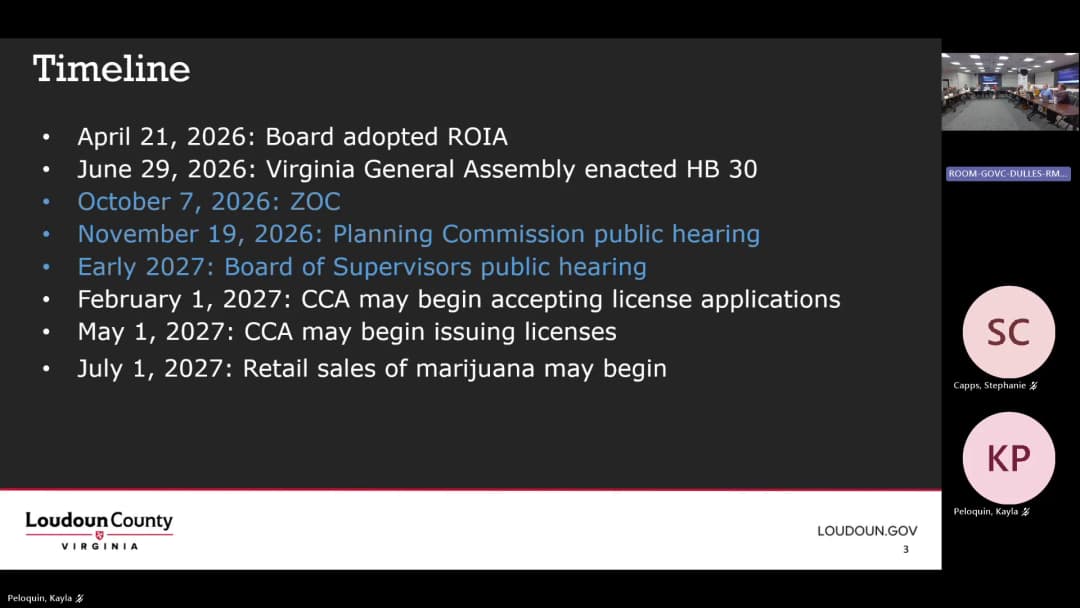
The Loudoun County Zoning Ordinance Committee (ZOC) met on Wednesday, October 7, 2026, in the Dulles Room of the Government Center. The committee approved the September action report, recommended floodplain overlay zoning amendments, received status updates on data center, cannabis, and other zoning ordinance amendments, and re-elected its chair and vice chair. No public input was offered. Call to Order and Administrative Items - ZOC moved agenda item 7 (Floodplain Overlay District) up to follow item 4; members agreed. - No public input and no disclosures were reported. - The September 2, 2026 action report was approved after the chair noted that public input submitted by Mara had been omitted. The chair also said Mara had alerted the committee that submitted public comments had not been included in ZOC action reports for roughly the last three years. Staff was asked to review the issue and report back at the next meeting. - New members introduced: Madeline Skinner (preservation/conservation organizations), Michelle Rosati (a building industry association), and Ben Wales (Economic Development Advisory Group). Floodplain Overlay District Amendments - Staff member Maggie Howard presented the proposal to replace the Floodplain Overlay District regulations in Chapter 5 with revised floodplain provisions in Chapter 6 as an environmental feature. The package also includes an associated development ordinance amendment and FSM amendments. - Staff said ZOC comments and agency referral comments were incorporated; one item remained in disagreement, and the committee's requested accessory-structure language was included in the second motion. - A member noted that ZOC had previously voted to add active recreation as a use in the major floodplain, but TLUC did not accept that change. - The committee amended the first motion to direct staff to include accessory structures to an existing single-family detached dwelling as a permitted use under the new floodplain regulations. - The committee approved the recommended motion and the associated zoning ordinance amendment on voice votes; staff reported the vote counts as 8-1-6 (8 in favor, 1 opposed, 6 absent) for both. - Staff said the item is expected to go to a Board of Supervisors resolution of intent to amend in November, with Planning Commission review targeted for January/February 2027. Mandatory notices will be sent to affected floodplain property owners and adjacent owners. Data Center Standards and Locations - Phase 2 Update - Staff gave a status update on CPAM-2025-0001/ZOAM-2024-0001. Two open houses were held September 28 and 30, 2026. - Proposed ZOAM changes include revised data center use standards, new electrical substation standards (AIS, GIS, and hybrid), on-site power generation standards, battery energy storage standards, and new or revised definitions. - Several design standards would move from the zoning ordinance to the Comprehensive Plan and be applied as guidelines by the Board during special exception review. - Some members expressed concern that moving design standards to the Comprehensive Plan gives the Board too much discretion because the Comprehensive Plan is often treated as a suggestion rather than a requirement. - Members also questioned limiting detailed standards to battery storage and the 5 MW capacity cap in the IP district. Staff said other energy storage technologies are not categorically barred, but detailed standards have only been developed for battery storage because of available information and application history. - Staff said the ROIA is targeted for December 2026, Planning Commission review for February 2027, and a public hearing around June/September 2027, subject to change. Cannabis Regulation ZOAM-2026-0006 - Planner Kayla Peloquin reviewed Virginia House Bill 30, enacted June 2026, which creates a regulated adult-use marijuana market, authorizes the Virginia Cannabis Control Authority to license establishments, and preserves limited local zoning authority. - Key dates: the Board adopted its resolution of intent in April 2026; Planning Commission public hearing is scheduled for November 19, 2026; Board of Supervisors public hearing is anticipated in early 2027; license applications begin February 1, 2027; licenses may be issued May 1, 2027; retail sales begin July 1, 2027. - The draft would add marijuana uses to zoning districts, add use-specific standards, and amend definitions. The proposal retains the state's 1,000-foot minimum distance from schools, hospitals, child day programs, and institutions of higher education, and proposes 8 a.m.-11 p.m. hours of sale. - Staff proposed definitions for indoor and outdoor cultivation. Outdoor canopy is limited under state licensing to about 10,000 square feet, indoor to about 35,000 square feet, and a secured agricultural greenhouse counts as indoor cultivation. - Several members argued the county should restrict marijuana-related uses to as few zoning districts as state law allows and should not adopt an overly permissive starting point, noting that once licenses are issued they cannot easily be pulled back. - Other discussion points included the zoning districts of existing medical dispensaries, potential conflicts with the Western Loudoun Rural Uses and Standards work, right-to-farm considerations, water consumption, agritourism, double-licensing questions, and public consumption rules. - One member noted the state will issue no more than 350 licenses statewide, generally apportioned by population density, and that this was an increase from an earlier proposal of about 100 licenses. - Staff acknowledged the compressed timeline, noting the legislation passed through the budget process and draft regulations were released only about two weeks earlier. Staff agreed to gather comments and research the zoning classifications of existing medical dispensaries for the November 4 ZOC meeting. Other Status Updates - Zoning Ordinance Rewrite Adjustments 1: Information item only. Staff said work is delayed by workload, with a tentative goal of winter 2026; the ROIA is already complete. Members noted the quick fixes are needed before subsequent fast-track amendments. - Placards (ZOAM-2026-0003): Approved at the September 9, 2026 Board of Supervisors public hearing. The chair said ZOC concerns about placard size, content, and QR codes are still being reviewed with PAC. - Affordable Housing by Tax-Exempt Religious and Nonprofit Organizations (ZOAM-2026-0004): Approved at the September 22, 2026 Planning Commission public hearing; scheduled for Planning Commission public hearing November 12, 2026, with possible Board adoption December 1, 2026. Staff said the number of potentially eligible properties is limited, though the exact number was not clearly stated in the meeting. - Western Loudoun Rural Uses and Standards (WLRUS): Meetings are proceeding on schedule, with some adjustments to accommodate Planning Commission workload. The Mountainside Overlay District meeting was described as spirited and ran long; a motion from the August 24 meeting will be revisited and separated into individual votes as time allows. Committee Membership and Elections - Three ZOC seats remain vacant: the DAR representative, the Loudoun County Chamber of Commerce representative, and the environmental organization representative. - The current chair and vice chair were nominated and re-elected by voice vote; the tally was reported as 9-0-6 (9 in favor, 0 opposed, 6 absent). Next Meetings - November 4, 2026, 9:00 a.m., Dulles Conference Room - December 2, 2026, 9:00 a.m., Dulles Conference Room Key Outcomes - Approved the September 2, 2026 action report with a commitment to address omitted public comments. - Recommended Board adoption of the floodplain overlay zoning amendment, including the accessory-structures addition, and approved the related zoning ordinance amendment on voice votes; staff tallies were 8-1-6. - Received updates on data center standards, zoning ordinance rewrite adjustments, placards, affordable housing, and WLRUS; no formal ZOC motions were taken on those updates. - Directed staff to compile cannabis-related zoning comments and research existing medical dispensary zoning classifications for the November 4 meeting. - Re-elected the chair and vice chair for the coming term.

ZONING REGULATIONS 38% · CANNABIS REGULATION 28% · PUBLIC ENGAGEMENT 10% · ENERGY AND INFRASTRUCTURE 9%
15
OCT 7, 2026 · LOUDOUN COUNTY, VIRGINIA · COMMISSIONS & ADVISORY BOARDS
Loudoun County Heritage Commission Meeting - October 7, 2026

The Loudoun County Heritage Commission met in person at the Government Center in Leesburg on October 7, 2026. The meeting covered a range of topics including a proposal to add the county seal to the flag, updates on the courthouse grounds master plan, a new public comment procedure, several heritage register nominations, and a letter to the Board of Supervisors regarding data center impacts. Key decisions included adopting a formal public comment period, approving four Aldie heritage nominations, sending a data center letter with amendments, and forming a working group to consult the Royal College of Arms on flag changes. Consent Calendar - The agenda for the October 7, 2026 meeting was approved unanimously without amendments. - The draft minutes from the September 14, 2026 meeting were approved with no corrections. Public Comments & Testimony - No public comments were made at this meeting. The commission adopted a new resolution (see Discussion Items) to institute a regular public comment period at future meetings. Discussion Items - County Flag Board Member Initiative (Presentation by Glen Barbour) Glen Barbour, County Public Affairs Officer, presented the Board of Supervisors’ request for the Heritage Commission’s input on adding the county seal to the Loudoun County flag. He reviewed the history of the flag (adopted in 1968 based on the Earl of Loudoun’s coat of arms) and showed examples of flag modifications. Commissioners discussed the need to consult the Royal College of Arms before altering the flag. A motion passed to form a working group (Commissioners Bill Wilkins and Elizabeth Erickson) to draft an inquiry to the Royal College of Arms about proper procedures for modifying the granted emblem. The commission also agreed to respond formally to the Board of Supervisors at a later date. - Courthouse Grounds Master Plan Stakeholders Meeting (Update by Roger Kimball and Heidi Sternitzke) Commissioners Kimball and Sternitzke reported on a September 20/21 Zoom meeting with consultants for the courthouse grounds master plan. A list of questions was circulated to the full commission for input, with comments due to staff by October 9 (midday) for a Friday deadline. The commission emphasized preserving the historic integrity of the old courthouse grounds (a National Historic Landmark) and recommended focusing new memorials on the newer courthouse plaza. Future opportunities for formal public input on the master plan were requested. - Introducing Public Input (Resolution) Chair Gulland presented a resolution to establish a 15-minute public comment period at the beginning of each regular meeting. After debate, the commission adopted the resolution with a three-minute limit per speaker and chair discretion to adjust the total comment period. The commission also directed staff to publicize the new comment period and the work of the commission to increase public participation. - Manassas Gap Railroad Update (Presented by Steve Thompson) In recognition of Virginia Archaeology Month, Thompson updated the commission on a project to document and publicize the history of the Loudoun branch of the Manassas Gap Railroad (pre-Civil War). A monograph has been completed, and a web-based story map is in development. A photography campaign is planned for fall 2026 to capture images of the railroad bed, which lies mostly on private land. - Section 106 Update (Chair Gulland) - Old Arcola Memorandum of Agreement (MOA): Staff reported that the developer (Wellington) has spent over $100,000 to shore up a wing of the Arcola school building. Preservation measures are expected to carry through to a Q1 2027 closing and construction start. The commission requested continued monitoring. - Proposed Changes by the Advisory Council on Historic Preservation (ACHP): The ACHP has postponed its meeting to finalize proposed changes to Section 106 regulations due to intense public response. A legislative proposal in Congress could functionally eliminate Section 106 consultation. Public comment on the regulatory changes may open in mid-November 2026. - Stewardship Responsibilities of County Agencies Chair Gulland reported that county staff (including department heads from Planning, Parks, and General Services) are preparing a list of potential improvements and costs for historic structure maintenance. A meeting with Mr. Hemp Street is expected to be scheduled soon. - Banshee Reeks Project The Stewardship Subcommittee reported that stabilization work is ongoing at Banshee Reeks, but a report from architectural historian Morel Calbion has not yet been received. Staff is following up. - Heritage Register - Aldie Nominations (Presented by Heidi Sternitzke) The commission approved four nominations to the Loudoun County Heritage Register: - Aldie Presbyterian Church (23260 Meeting House Lane) – circa 1892 Carpenter Gothic church. - Aldie Stovepipe Academy (23251 Meeting House Lane) – circa 1875 school building, rehabilitated 2023–2024. - Aldie United Methodist Church (39325 Little River Turnpike) – circa 1882 church building. - Bodmer House and Wheelwright Barn (39472 Little River Turnpike) – circa 1832–1849 dwelling and 1865–66 barn. All nominations were moved and passed unanimously. - Heritage Map Publicity (Emily Sternitzke and Roger Johnson) Staff is working with Public Affairs to promote the heritage map. Printed questionnaires will be made available at the November meeting for public input, and a formal meeting with the public affairs officer is planned. - Oak Hill The commission learned that Oak Hill has received a $750,000 Save America’s Treasures grant to address roof issues, repointing mortar, and replacing heat pumps. A friends group is needed to manage fundraising. It was suggested to reach out to the Community Foundation to hold funds. - Data Center Working Group (Presented by Tara Connell) The commission discussed a letter and white paper on data center impacts. After amendments (including language on fiscal risk from over-reliance, inseparability of data centers and power infrastructure, and threat to natural/historic landscapes), the letter was approved for transmission to the Board of Supervisors. The commission also discussed timing: the board will vote on grandfathering on October 8 and on the pause on October 20. The letter will be sent before October 20, with a request to speak at that meeting. Key Outcomes - Public Comment Procedure Adopted: The commission voted unanimously to establish a 15-minute public comment period at the start of each meeting, with a three-minute limit per speaker and chair discretion. - Flag Inquiry Working Group Formed: Commissioners Bill Wilkins and Elizabeth Erickson were authorized to draft an inquiry to the Royal College of Arms regarding modification of the county flag. The working group will consult with the chair on language. - Aldie Heritage Nominations Approved: All four nominations were approved unanimously. - Data Center Letter Approved: The letter and white paper were approved as amended, with instructions to send to the Board of Supervisors before October 20, 2026, and to request to speak at that meeting. - Courthouse Grounds Input Deadline: Commissioners' comments on the master plan questions are due to staff by October 9; staff will compile and submit to consultants by October 10. - Annual Report Input Due October 15: Chair Gulland asked commissioners to submit bullet points for the annual report by October 15. - Next Meeting: Scheduled for November 2, 2026.

FLAG DESIGN 19% · DATA CENTER DEVELOPMENT 19% · PUBLIC ENGAGEMENT 15% · HISTORICAL PRESERVATION 14%
16
OCT 7, 2026 · LOUDOUN COUNTY, VIRGINIA · COMMISSIONS & ADVISORY BOARDS
Loudoun County Heritage Commission Stewardship Subcommittee Meeting – October 7, 2026

The Stewardship Subcommittee of the Loudoun County Heritage Commission met in person in the Dulles Room at the Loudoun County Government Center in Leesburg, Virginia, to review draft Stewardship Management Plans (SMPs) for Lanesville Heritage Area and Lovettsville Park. Commissioner Kimball called the meeting to order. Participants included Commissioner Sternitsky (Department of Planning and Zoning), Heidi Steventrant and Jennifer Moore (Department of General Services), Artie Wright, and Mark Novek (Department of Parks, Recreation and Community Services). Note: The meeting record is dated October 7, 2026, while the agenda and transcript text state October 5, 2026. Discussion Items - Lanesville Heritage Area SMP – Artie Wright said both draft SMPs were well done overall, but the executive summaries did not give enough weight to serious structural problems. For Lanesville, he described racked window and door frames, cracked glass, and other deficiencies from decades of deferred maintenance and said the structural engineer’s report shows urgent rehabilitation needs. He wanted CPG to revise the executive summary and resource descriptions so the Board understands the house needs a major project, not routine maintenance. A rehabilitation cost estimate in the range of $815,000 was referenced. - Artie explained that Parks and Recreation and General Services can maintain grounds and structures but cannot undertake major rehabilitation, which would require a capital improvement project and direction from the Board. He supported a modern intervention approach, similar to the 24 Union Street schoolhouse project, carefully removing and reusing existing siding while adding sheathing and house wrap to protect the historic fabric. - One commissioner cautioned that removing Secretary of the Interior Standards from the SMP could allow a future caretaker to justify inappropriate changes such as aluminum siding. Staff agreed the standards should remain the high-level recommendation, while the executive summary and staff reports could explain the property-specific context and wiggle room. - Lovettsville Park SMP – Artie and others said the Lovettsville SMP also needed a blunter executive summary on urgent stabilization and structural defects. Artie questioned whether the dairy barn is realistically salvageable without removing and replacing the entire superstructure after years of missing roof panels and rotted hay, and asked CPG to revisit the structural engineer’s report. Mark Novek noted the plan lacked clear priorities or a recommended order of work. Discussion also touched on including historic photographs of the house and documenting stored log components in Ashburn. Other Business - Banshee Reeks – Structural stabilization work was described as around 60 percent design and expected to go through DTCI review within about two weeks, though slower than desired. - Broad Run Tollhouse – The DTCI project manager is aware of earlier Heritage Commission concerns; a consultant was brought back on board for specifications, and the Heritage Commission may invite the project manager to discuss treatment. Key Outcomes - The subcommittee agreed to send its comments to CPG and ask CPG to revise both executive summaries so they clearly state structural deficiencies, urgent stabilization needs, and the level of investment required. - Artie said CPG expected to provide a revised Lanesville executive summary that evening; he will share it with the subcommittee when received. - The subcommittee agreed not to target a November Heritage Commission meeting. A follow-up work session will be scheduled during the week of October 19, with October 20 or 21 mentioned as possible daytime dates. - They also agreed to follow the Board-directed review process: staff and subcommittee comments now, Heritage Commission review next, and public or stakeholder input when the SMPs go to the Board of Supervisors. - Staff discussed broader work on historic property maintenance funding, including a possible future Board presentation and the county administrator’s request for budget implications of treating historic properties with best practices.

HISTORIC PRESERVATION 66% · PERSONNEL MATTERS 12% · PROCEDURAL 11% · PUBLIC ENGAGEMENT 6%
17
OCT 7, 2026 · LOUDOUN COUNTY, VIRGINIA · COMMISSIONS & ADVISORY BOARDS
Loudoun County Heritage Commission Land Use Subcommittee Meeting - October 7, 2026

The Land Use Subcommittee of the Loudoun County Heritage Commission met to review pending applications and craft the commission's position on data center development. Key discussions centered on the Lucketts Bypass compromise, the Data Center White Paper strategy, and updates on several other land use cases. Note on Meeting Date: The agenda for this meeting listed the date as October 5, 2026, while the official timestamp for the record is October 7, 2026. Discussion Items Heritage Commission Data Center Position - Commissioners reviewed proposed amendments to the Data Center White Paper, including adding language on leveraging the goodwill of the data center industry for historic preservation and incentivizing existing data centers. - A significant point of debate was the exact number of data centers in Loudoun. The white paper used "more than 260", County Chair Randall cited 257 with 17 in the pipeline, a county fact sheet listed 233, and the data center dashboard showed 210. The subcommittee agreed to attribute the figure to the chair or use a conservative estimate. - Members expressed frustration that recent public information meetings on data center standards did not address heritage concerns. The subcommittee devised a two-track strategy: have Commissioner Gene present the commission's letter to the Board of Supervisors, and have individual commissioners ask their respective supervisors to raise specific questions during the December Board information item. - Specific policy concerns included the lack of setback requirements for data centers from historic resources, the cumulative pollution impacts, and the destruction of historic sites like the Tippett's Hill cemetery setting and the old Ox Road roadbed. - The subcommittee decided to first follow up with Bill Joffrey, the project manager for the data center standards, on questions left unanswered from an August presentation before formally escalating issues to the Board of Supervisors. Lucketts Bypass (Route 15) - Commissioners received a detailed update on the county's plan for Route 15. The plan has shifted from a $300 million, 70-property-capturing large bypass to a two-lane "mini-bypass" around the village of Lucketts. - While a win for historic preservation by maintaining the rural character and avoiding extensive takings, the mini-bypass would take 10 acres from the JK Black Wildlife Sanctuary, a globally rare wetland. A member noted Tom of the Wildlife Conservancy's characterization of it as "a compromise, but it is still a devastating compromise." - The subcommittee agreed to contact the Wildlife Conservancy to determine if a joint letter of support from the Heritage Commission would be helpful, emphasizing alignment with other conservation groups. Micki Gordon Park Plans - Commissioners considered the park plans resolved. The ballpark has been preserved, and the previously controversial lighting issue has been addressed. The item was removed from the active agenda. Paris Mountain Application - The site plan remains stalled as the applicant contests the county's determination that a special exception is required. Commissioners criticized the archaeological survey for failing to align the study area with the limits of disturbance and for omitting metal detection on a known battlefield. Spoonbill Facilities - Spoonbill Storage Facility: Archaeology is progressing, but the applicant is contesting a county determination that a zoning map amendment is needed. - Spoonbill Energy Storage: The subcommittee was directed by Supervisor Laura Teer's office to not send any letter regarding this application. The matter has been referred to the County Manager, leaving the commission in a holding pattern. National Conference Center - The application for housing and demolition is inactive at the request of the developer. A Phase II significance evaluation of the historic building is ongoing. Spring Valley Tech Park - The proposal, recommended for denial by the Planning Commission, has been deferred from its scheduled October 14 Board of Supervisors hearing. Commissioners noted the threat a data center would pose to the transition character and setting of the adjacent LZ Cemetery. Key Outcomes - Data Center White Paper: Subcommittee will introduce amendments, follow up with Bill Joffrey, and time a formal letter to the Board of Supervisors for its December information item. - Lucketts Bypass: Staff will contact the Wildlife Conservancy to explore a joint letter. - Micki Gordon Park: Removed from the active agenda. - Spoonbill Energy Storage: Letter placed on indefinite hold per Supervisor Teer's office. - Paris Mountain: Commission will provide formal comments during the special exception process. - The meeting was adjourned following the conclusion of agenda items.

HISTORIC PRESERVATION 41% · DATA CENTER DEVELOPMENT 29% · PUBLIC ENGAGEMENT 9% · LAND USE PLANNING 8%
18
OCT 5, 2026 · LOUDOUN COUNTY, VIRGINIA · BOARD OF SUPERVISORS & PLANNING COMMISSION
Joint Board of Supervisors & School Board Committee Meeting - October 5, 2026

The Joint Board of Supervisors and School Board Committee met on October 5, 2026, at the LCPS boardroom. The meeting covered public comments, co-chair reports on school and county activities, and two information items: the use of publicly owned property for attainable housing and the expansion of the Safe Passages to Schools program. The committee also voted to add adult personal enrichment education programs to its work plan. Public Comments & Testimony - Madeline Marlowe, a 10-year Loudoun County resident and parent, expressed strong support for the Safe Passages to Schools program and urged a comprehensive, holistic approach that benefits the entire community, not just students walking to school. She referenced her prior outreach about a crosswalk request program. - Susan Jones, a Broad Run District resident, proposed the creation of a Loudoun County Citizens Academy for adults to learn about state and local government, citing similar programs in other Virginia localities. She noted her own late discovery of the Dillon Rule and emphasized the need for civic education. Co-Chairs Reports - Co-Chair Chandler (School Board) reported on the start of the school year and highlighted: - SOL proficiency rates for 2026: LCPS students outperformed state averages by 9+ percentage points in reading, math, and science; 13 points in writing (89% vs. 76%); and 18 points in history (88% vs. 70%). - Six LCPS middle schools recognized as 2026 Schools of Distinction by the Association of Middle Level Education. - Launch of two mobile health clinics in partnership with HealthWorks for Northern Virginia, providing medical, dental, and mental health services at three pilot locations (Sully ES, Sterling MS, Parkview HS), with expansion planned. - Co-Chair Glass (Board of Supervisors) reported on: - BOS attendance at graduations and recognitions of LCPS state championship teams (Rock Ridge debate, Freedom tennis and track). - Adjustment of Capital Intensity Factors (CIFs) to remove school capital costs, based on LCPS indication that no new school seats are needed for the next 10 years. (Dr. Spence clarified this means no new seats, not necessarily no new buildings – replacement construction may still occur.) - Upcoming public hearing to approve a joint central Loudoun Services and Storage Center off Sycolin Road and renovation/expansion of Waterford Elementary School. Discussion Items - Use of Publicly Owned Property for Attainable and Workforce Housing (Item 4.01) - Travis Perlman and Eric Keeler (Housing and Community Development) presented a property suitability analysis using an ArcGIS dashboard. Key findings: - County owns 256 parcels (5,248 acres); LCPS owns 114 parcels (3,214 acres). - 46% classified as not suitable (encumbered by floodplain, conservation easements, or airport overlay). - 54% classified as potentially suitable (existing or planned non-residential uses; housing could be co-located or redeveloped with board action). - No parcels classified as suitable because all land is either improved or planned for a specific public purpose. - LCPS applied narrower criteria, classifying fully developed school sites as not suitable. - Discussion included questions about moving parcels from potentially suitable to suitable (requires policy decisions), the impact of House Bill 1130 (allowing school entities to retain ownership for workforce housing), and potential preferences for teachers/staff (pending legal review). Supervisor Shakrony suggested land banking near schools and mentioned the upcoming housing authority discussion. - Next steps: A BOS item requesting conceptual approval for attainable housing on an existing county-owned property; continued comparative analysis of ownership/project delivery models for LCPS property. - Expansion of the Safe Passages to Schools Program (Item 4.02) - Everett Lott, Kelly Griffin, and Enrique Gonzalez (Transportation and Capital Infrastructure) presented the proposal. Key details: - Eight pilot locations were previously approved and are funded through the federal Transportation Alternatives Program (TAP). Design/construction for pilots is proceeding. - The new proposal requests $285,000 for a consultant study (10-12 months) to develop a countywide expansion program, including assessment of walk zones, identification of gaps, and prioritization criteria. - The program will be renamed "Safe Passages to Schools" (formerly Safe Routes to School). - Committee members raised specific issues: Guilford Elementary crosswalk (not in pilot but can be included in expansion), Portsmouth/Middlebury crosswalk concerns, missing sidewalk near Willard Middle School (0.21 miles along Braddock Road). Staff clarified that the expansion will evaluate all schools and prioritize based on need. - Construction timeline estimated at up to 4 years from funding, contingent on future appropriations. Key Outcomes - The committee voted 4-1 (Mrs. Griffiths opposed) to add an information item on adult personal enrichment education programs to the joint committee's work plan. The motion, made by Co-Chair Glass and seconded by Supervisor Shakrony, directs staff to present existing adult education offerings (e.g., LCPS adult education, library/parks & rec programs) and explore creation of a civics academy as suggested in public comment. - No formal votes were taken on the information items; they were presented for discussion and feedback. - The meeting was adjourned after the vote.

AFFORDABLE HOUSING 28% · TRANSPORTATION SAFETY 22% · EDUCATION 14% · LAND USE PLANNING 13%
19
SEP 30, 2026 · LOUDOUN COUNTY, VIRGINIA · COMMISSIONS & ADVISORY BOARDS
Western Loudoun MOD ZOAM Committee Meeting - September 30, 2026

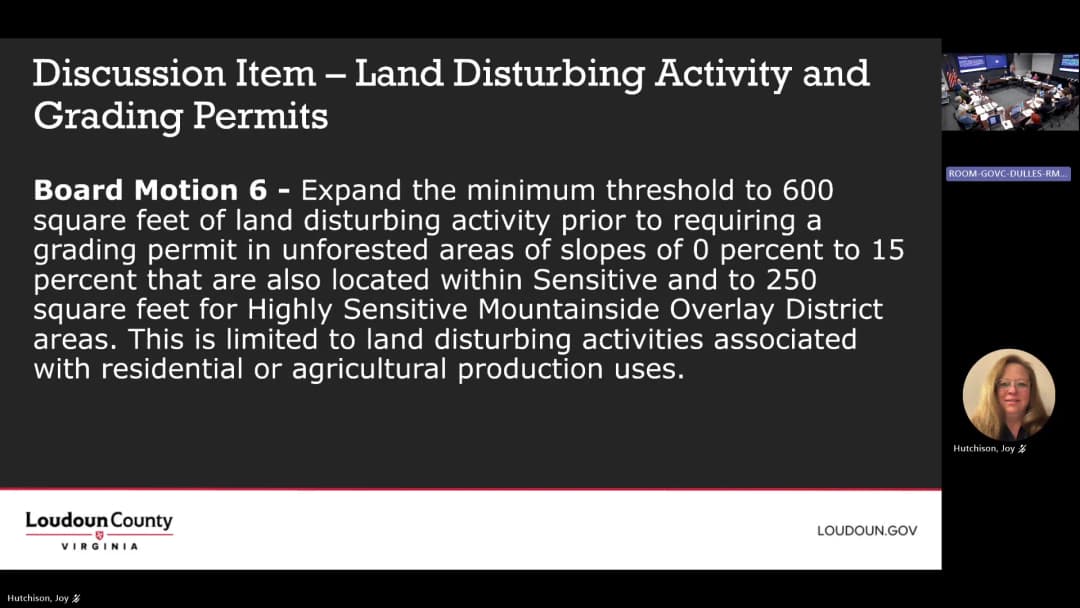
On September 30, 2026, the joint Planning Commission/Zoning Ordinance Committee and Western Loudoun Ad Hoc Committee met to continue deliberations on the Mountainside Overlay District (MOD) text amendments. The meeting focused on a series of specific development standards and permitted uses within the MOD, following board direction. The committee adopted a revised meeting schedule, adjusted the public comment submission timeline, and voted on numerous draft text provisions. A notable discrepancy exists between the agenda date (September 29, 2026) and the provided meeting date (September 30, 2026). Consent Calendar - The meeting summary from September 15, 2026, was adopted unanimously. Public Comments & Testimony - No public testimony was heard during the meeting. Committee members discussed the timing of public comment submissions; a motion passed to have the supplemental packet sent to committee members the business day before each meeting, with public comment cutoff adjusted accordingly. Discussion Items - Calendar Adjustment: The committee voted unanimously to move meeting six from November 9 to November 16, 2026, and meeting seven from November 16 to December 1, 2026, to avoid back-to-back planning commission meetings. - Supplemental Packet Timing: A motion passed to require the supplemental packet (including public comments) to be distributed to committee members the day before each meeting, to allow adequate review time. - Non-Habitable Accessory Structures in Highly Sensitive Areas (Motion 3): The committee found the draft text consistent with board direction after amendments: striking the phrase "either or but not both" to allow up to 600 square feet of land disturbance in aggregate (across highly sensitive and ridge feature areas), requiring a written zoning administrator determination that no alternative location exists, and referencing the agreement-in-lieu (AIL) process under Chapter 1096. A separate motion limited structures to 15 feet in height from grade to peak. Both motions passed unanimously. - Non-Habitable Accessory Structures in Ridge Feature Protection (Motion 4): Similar amendments were adopted, including aggregate 600 sq ft limit, 15-foot height restriction, administrative approval standards, and a correction to clarify that the limit applies within protected areas only, not the entire lot. Unanimous. - Spring Feature Protection Setback (Motion 5): An initial motion to find the draft text (100-foot setback inside and outside MOD) consistent with board direction failed (5 opposed, 4 in favor). A subsequent motion to recommend the 100-foot setback passed 7-1-1, with a friendly amendment that the setback be subject to a county hydrological study and that notice be provided to property owners outside the MOD who are affected. The committee also requested study of steeper slope impacts. - Grading Permit Exemption for Small Disturbances (Motion 6): The committee voted 7-0-1 to not include a proposed exemption for 250 sq ft of land disturbance in highly sensitive areas (staff recommendation). The exemption for up to 600 sq ft of land disturbance for a non-habitable accessory structure (≤15 ft height) in somewhat sensitive and sensitive areas (unforested, 0-15% slope) was approved unanimously, with language clarifying aggregate limits and administrative approval. - Fences (Motion 7): The committee unanimously approved allowing fences in all MOD areas without a grading permit, subject to a zoning permit and a requirement that fences allow water flow (to be clarified in final language). - Driveway Repair/Replacement (Motion 8): Staff noted no amendments were needed; the motion was tabled without action. - Tree Cover Clearing and Land Disturbance Tables (Motion 9): The committee unanimously found the consolidated table consistent with board direction. - New Residential Driveways in Highly Sensitive Areas (Motion 10): The committee voted unanimously to defer this item to the Planning Commission for further study, requesting additional performance standards, data on affected lots, and consideration of limiting the provision to existing lots of record. - Non-Residential Development Standards – 50% Tree Cover (Motion 11): The committee found the draft text (increasing tree cover preservation from 30% to 50%) consistent with board direction, but added a recommendation that staff clarify the baseline for "existing forested areas" (e.g., effective date of amendment). Passed with one opposed. - General Consistency Items (Motion 57): The committee approved staff’s recommended language for on-site sewage treatment replacement (with a revision to size based on existing bedrooms) and for uncovered decks in ridge feature protection (allowing hand-dug footers within previously disturbed areas without a grading permit). Both passed unanimously. - Minor Special Exception for Non-Residential Covered Activities (Motion 58): The committee voted unanimously to defer this topic to meeting seven (December 1, 2026) for further discussion, with requests for cost data, use definitions, and performance standards. Key Outcomes - The committee approved most draft text provisions as presented or with amendments, forwarding them to the Planning Commission with recommendations. - Key changes include: allowing up to 600 sq ft of land disturbance for non-habitable accessory structures in highly sensitive and ridge feature areas (aggregate, with administrative approval); reducing spring feature setback to 100 feet (subject to further study); exempting certain fences from grading permits; and increasing tree cover preservation requirements for non-residential uses to 50%. - Several items were deferred for additional analysis: new residential driveways, minor special exception for non-residential uses, and clarification of baseline definitions for tree cover. - The committee adjusted its meeting schedule to November 16 and December 1, 2026, and revised the public comment submission timeline to allow earlier review by members.

ZONING REGULATIONS 60% · PROCEDURAL 9% · ZONING ORDINANCE 9% · PUBLIC ENGAGEMENT 6%
20
SEP 30, 2026 · LOUDOUN COUNTY, VIRGINIA · COMMISSIONS & ADVISORY BOARDS
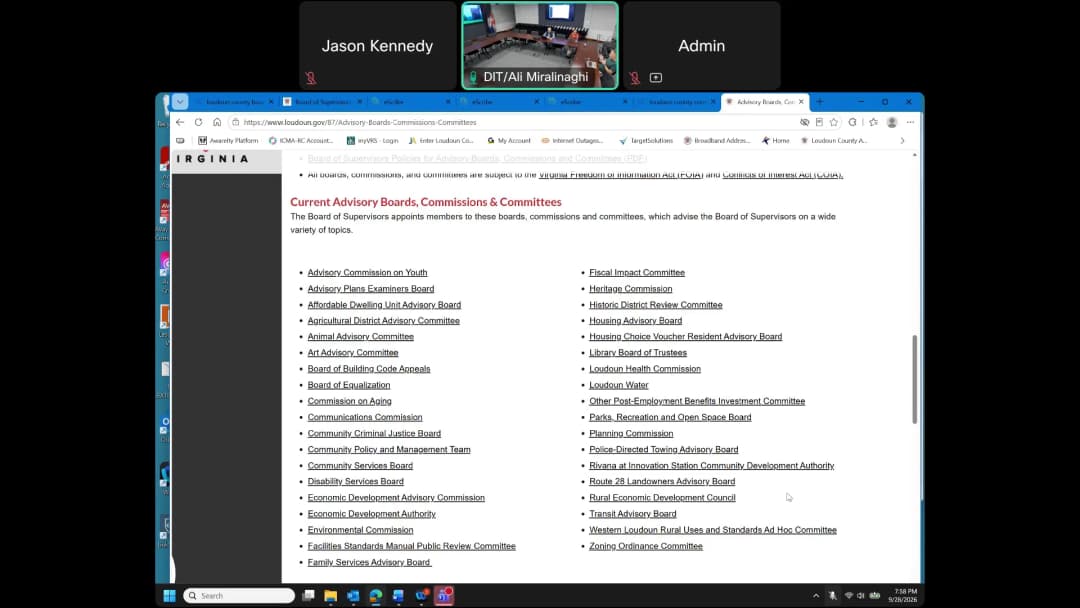
Loudoun County Communications Commission Meeting - September 28, 2026

The Loudoun County Communications Commission met on September 28, 2026, at 7:03 PM in the Dulles Room of the Loudoun County Government Center. Seven members were present, establishing a quorum. The meeting focused on Verizon's copper replacement program, the Commission's annual update and direction from the Board of Supervisors, and an update on the All Points/BATTI broadband project. Consent Calendar - Approved the agenda as presented without changes. - Approved the July 27, 2026, meeting minutes as drafted. Public Comments & Testimony - No members of the public signed up for comment. Discussion Items - Verizon Copper Replacement Program: Matt Ogburn, Director of Government Affairs for Verizon in Virginia, presented an overview of the FCC-mandated copper discontinuation process. Approximately 6,500 copper customers in Loudoun County received notices in August. Migration to alternative services (fiber or wireless) will only occur if a viable alternative exists; customers without alternatives will retain copper lines. Alternatives listed include Cox, Comcast, Spectrum, Chantel, Breeze Line, AT&T, and T-Mobile, but not All Points. Pricing will be "comparable" (roughly $20–$40/month). Battery backups are available for power outages. Commissioners raised concerns about public confusion over hard dates in letters, 911 readiness in power outages, and the exclusion of All Points from the alternative list. - Commission Annual Update and Board Direction: The Commission's annual report was presented to the Board of Supervisors on September 15 but was moved to the consent agenda due to a data center discussion overload. The Board recommended that the Communications Commission focus on cross-commission collaboration in 2027, rather than expanding its charter. Commissioners expressed disappointment at the lack of direct dialogue but agreed to proceed. Initial target commissions for collaboration include EDAC, EDA, REDC, zoning, and planning. Homework assignments were given: each commissioner will identify additional commissions, research current projects for low-hanging fruit, and draft introductory letters. Dave volunteered to draft initial communications. - VATI Broadband Update: Dave (from DIT) provided an update: Over 2,500 addresses are now in the marketing phase, with 600 signed up and 200 active customers. 147 miles of fiber have been completed. ARPA funds are fully spent by the county; DHCD has $7 million remaining. The construction timeline extends into 2027, but the contract extension only covers end of 2026 to avoid Treasury red flags. Commissioners raised concerns about vague updates (missing street names and detailed maps) and the repeated extensions. Dave noted that DHCD did not coordinate with utility partners (e.g., NOVEC, VDOT) which contributed to delays. All Points is not listed as a Verizon alternative, but customers can port numbers to All Points IP phone service. Key Outcomes - The Commission adopted the agenda and minutes. - The Commission will pursue cross-commission collaboration as recommended by the Board of Supervisors. Three action items were created: (1) each member reviews the list of county advisory boards/commissions for additional targets beyond the initial five; (2) research current projects for easy engagement; (3) Dave will draft introductory letters to the five initial targets. - The next regular meeting is scheduled for October 26, 2026; the November/December meeting will likely be combined in early December.

TELECOMMUNICATIONS 28% · BROADBAND ACCESS 20% · PUBLIC ENGAGEMENT 18% · PROCEDURAL 17%
OPENPUBLICA · PUBLIC MEETING INDEXUPDATED DAILY · openpublica.com