Browse by city
Date range
Search help

Search titles, summaries, topics and stored transcripts together. Keywords may match separately; put the whole query in double quotes for a phrase. Matching follows word analysis, so punctuation is not exact. Both dates are included. Documents are not searched.

SHOWING 21–30 ENTRIES
21
SEP 17, 2026 · LOUDOUN COUNTY, VIRGINIA · COMMISSIONS & ADVISORY BOARDS
Loudoun County Heritage Commission Meeting - September 17, 2026

Note: The meeting agenda and transcript indicate the meeting occurred on September 14, 2026, but the provided instruction specifies the date as September 17, 2026. This discrepancy is noted per accuracy rules. The Loudoun County Heritage Commission held a regular meeting on the above date, covering a range of heritage-related topics including a presentation on the Courthouse Master Plan, discussions on public input procedures, updates on Section 106 matters, and a proposed letter on data centers. The commission also reviewed and approved minutes and heard committee reports. Consent Calendar - Agenda Approval: The draft agenda was adopted without modifications after a motion and second, with all in favor. - Minutes Approval: The minutes of the August 3, 2026 meeting were approved with two amendments. The first amendment corrected language regarding stewardship management plan drafts to specify they would be available to county staff and the SMP subcommittee, not the full commission. The second amendment clarified a description of a transmission line project (Valley Link North) by substituting "a different" with "this." The amended minutes were approved with one abstention. Presentations - Courthouse Master Plan: Glenn Barber (Public Affairs) and Jackie Creighton (DTCI) presented an overview of the Courthouse Grounds Master Plan. The plan aims to provide a framework for evaluating future requests for permanent uses of the courthouse grounds, replacing the ad hoc process. Key points include: the last plan was from 2005; a consultant (Bowler Engineering) is conducting surveys and stakeholder interviews; the project is expected to last 8–12 months with a draft plan by spring/summer 2027; current requests include a fountain (Rotary Club), peace officers memorial (sheriff’s office), and a commemorative brick project (Daughters of the American Revolution). The plan does not prescribe development but will consider historic preservation, security, and compliance with Virginia Code. Commissioners asked about signage, veteran stakeholder engagement, and the use of the new plaza. Public Comments & Testimony - There was no formal public comment period during this meeting. The commission discussed establishing a regular 15-minute public comment period at the beginning of future meetings. Chair Gulland noted that the current bylaws do not provide for public comment, but the website allows advance sign-up. A consensus emerged to pursue a formalized 15-minute period, subject to legal advice from the county attorney’s office. Commissioners expressed support for better outreach to inform the public about the opportunity to speak. Discussion Items - Introducing Public Input: The commission debated whether to institutionalize a public comment period. Chair Gulland preferred better publicity of the existing sign-up process, but a majority of commissioners voiced support for a 15-minute comment period at each meeting, consistent with other county commissions. The chair asked staff (Jennifer) to consult with the county attorney on whether a bylaw change is required and to report back at the next meeting. - Section 106 Update: - Old Arcola MOA: The Memorandum of Agreement for the Old Arcola School has been signed. It requires monitoring of preservation milestones (e.g., maintaining chalkboards, fenestration, original grills). Commissioner Wilson expressed concern about demolition by neglect and asked for a timeline on the developer’s progress. Staff will follow up. - ACHP Proposed Changes: The Advisory Council on Historic Preservation has proposed rulemaking that would reduce mandatory consultation for federal actions affecting historic properties. The commission has drafted a letter for the Board of Supervisors to send to state and federal officials opposing the changes. Additionally, the commission will gather examples of successful Section 106 consultations in Loudoun County to submit to the National Trust and prepare formal comments once the Federal Register notice is published. A list of past 106 comments is being compiled. - Stewardship Responsibilities of County Agencies: A letter sent to the county administrator in May has prompted discussions among department heads about incorporating heritage resource review into standard operating procedures. A follow-up meeting with the county administrator is pending. - Banshee Reeks Project: An outside consultant was hired to evaluate the building, and recommendations are being followed, but the commission has not yet seen the consultant’s report. - County Flag BMI: Staff announced that Glenn Barber will present research on vexillology (flag design) at the October meeting to inform a recommendation to the Board of Supervisors regarding adding the county seal to the flag. - Heritage Register Publicity: Roger Sternitzke and Emily Johnson updated that they are compiling a list of historic organizations and will coordinate with Allie from public affairs for outreach. A raft of nominations from Aldie is expected at the October meeting. - Oak Hill: No new updates. - Data Center Working Group: The land use committee (Tara Clarke, Bob Pollard, Derek Khanna) presented a draft letter calling for a temporary pause on data center approvals and the formation of a blue ribbon panel to thoroughly assess threats, alternatives, and implications. Commissioners expressed strong support for the concept, noting the existential threat to county heritage. The letter will incorporate specific examples of impacts on historic resources, to be provided by the working group by September 25. A revised draft will be presented at the October 5 meeting, with the goal of having a commissioner present the position at the Board of Supervisors meeting on October 6. Key Outcomes - Minutes Approved with two amendments (one abstention). - Public Input Process: Directed staff to obtain legal guidance on implementing a 15-minute public comment period; further discussion at next meeting. - Section 106 Opposition: Commission will support the Board of Supervisors’ letter to elected officials and prepare a formal comment on the ACHP rule changes; staff to compile a list of past 106 consultations. - Data Center Letter: Land use committee to draft revised letter incorporating data from the working group; deadline for input September 25; draft to be circulated before next meeting and adopted at October 5 meeting for presentation to the Board on October 6. - Stewardship SOPs: County agencies are developing checklists to ensure heritage review, as a result of the commission’s May letter. - Courthouse Master Plan: Commissioners will participate in stakeholder meetings; next update anticipated at a future meeting. - Annual Report: Chair requested bullet points from committee chairs and members by October 15 for the commission’s annual report to the Board of Supervisors. - Next Meeting: October 5, 2026, with a special presentation on the county flag and likely data center letter adoption.
PUBLIC ENGAGEMENT 30% · HISTORIC PRESERVATION 28% · DATA CENTER DEVELOPMENT 14% · PROCEDURAL 13%
22
SEP 17, 2026 · LOUDOUN COUNTY, VIRGINIA · BOARD OF SUPERVISORS & PLANNING COMMISSION
Loudoun County Planning Commission Work Session – September 17, 2026

The Loudoun County Planning Commission held a work session on September 17, 2026, continuing from a September 10 session that was adjourned due to lack of quorum. The commission reviewed four legislative applications: Dulles Technology Park, Dulles Landing South, Fox Gate Mixed Use, and Western Loudoun Recreation Complex. Votes included one denial, two approvals with conditions, and a deferral to a future work session. Additionally, the commission received a briefing on the September 22 public hearing items and discussed administrative matters including a special WLRUS meeting schedule and a new agenda management platform. Discussion Items - Dulles Technology Park (LEGI‑2024‑0056): The applicant sought a zoning conversion from PDIP (1972 ordinance) to IP (current ordinance) for three data center buildings on 37 acres in the Sterling Election District. Staff supported approval. Chair Kerr moved to deny based on the findings for denial provided as Attachment 5, citing concerns about removal of existing economically viable commercial uses (hotels, offices) and lack of identification of an electric substation (though a separate substation application was previewed). After debate, the motion to deny passed 5‑4 (Commissioners Combs, Miller, Banks, Myers opposed). Commissioners supporting denial emphasized data center proliferation and impacts on other businesses; opponents noted the applicant had addressed design and height concerns (70‑ft height, tier‑4 generators, improved elevations) and argued the site is appropriate within the Route 28 corridor. - Dulles Landing South (LEGI‑2023‑0081): Proposal to rezone 18 acres of vacant land from PD‑RC (revised 1993) to PDIP for up to 250,000 sq ft of industrial uses, including data center (limited to 30% per building, 75,000 sq ft total) and flex industrial, with a zoning modification for lot size. Staff identified outstanding issues (land use compatibility, open space, traffic study scope). Commissioner Motoretti moved to approve subject to the July 21, 2026 proffer statement and findings, with modifications including right‑in‑only access to land bay four, commitment to four‑sided architecture, and conditions from the September 16 email and presentation. The motion passed 8‑0‑1 (Commissioner Barnes absent). - Fox Gate Mixed Use (LEGI‑2025‑0008): Application for a PUD rezoning of 22 acres (assembling five parcels) for up to 300 multifamily units, 440,000 sq ft of commercial uses, and existing church. Staff requested commission feedback on uses and Route 50 access. Commissioner Motoretti moved to approve subject to the July 24, 2026 proffer statement, with conditions including right‑in‑only access to land bay four (church access preserved), commitments from the September 16 email and presentation, and four‑sided architecture (with friendly amendment: no rear elevation facing Route 50). Motion passed 9‑0. - Western Loudoun Recreation Complex (LEGI‑2025‑0001): County‑led project for a 142‑acre regional park and recreation center (including cricket fields, water park, indoor recreation) west of Purcellville. Staff supported approval with conditions. Commissioner Miller moved to forward the application to a future work session for further discussion, citing remaining concerns over water availability (well drawdown, impact on neighboring wells), traffic (not incorporating Valley Commerce Center), lighting (5700K brightness), and desire for a community meeting. The motion passed 9‑0. Commissioners expressed concerns about compatibility with rural character and intensity of use. Key Outcomes - Dulles Technology Park: Denied (5‑4) – recommendation of denial to Board of Supervisors. - Dulles Landing South: Approved (8‑0‑1) with conditions. - Fox Gate Mixed Use: Approved (9‑0) with conditions. - Western Loudoun Recreation Complex: Deferred to future work session (9‑0). Staff to provide additional information on water studies, traffic analysis incorporating Valley Commerce Center, Franklin Park lighting conditions, and schedule a community meeting. - Other: Briefing on September 22 public hearing items (six items: agricultural district additions, mini storage, ZCPA for Old Arcola, mezzanine FAR increase, Dulles Tech substation, affordable housing ordinance amendment). Commission set placeholder dates for WLRUS special meetings (pending further discussion), received updates on new agenda management software (EScribe) and data center open houses, and discussed the Board of Supervisors’ pause on data centers.

ZONING REGULATIONS 28% · PROCEDURAL 17% · DATA CENTER DEVELOPMENT 10% · PARKS AND RECREATION 10%
23
SEP 17, 2026 · LOUDOUN COUNTY, VIRGINIA · COMMISSIONS & ADVISORY BOARDS
Historic District Review Committee Meeting Approves Pavilion Project and Defers Unison Rezoning on September 17, 2026

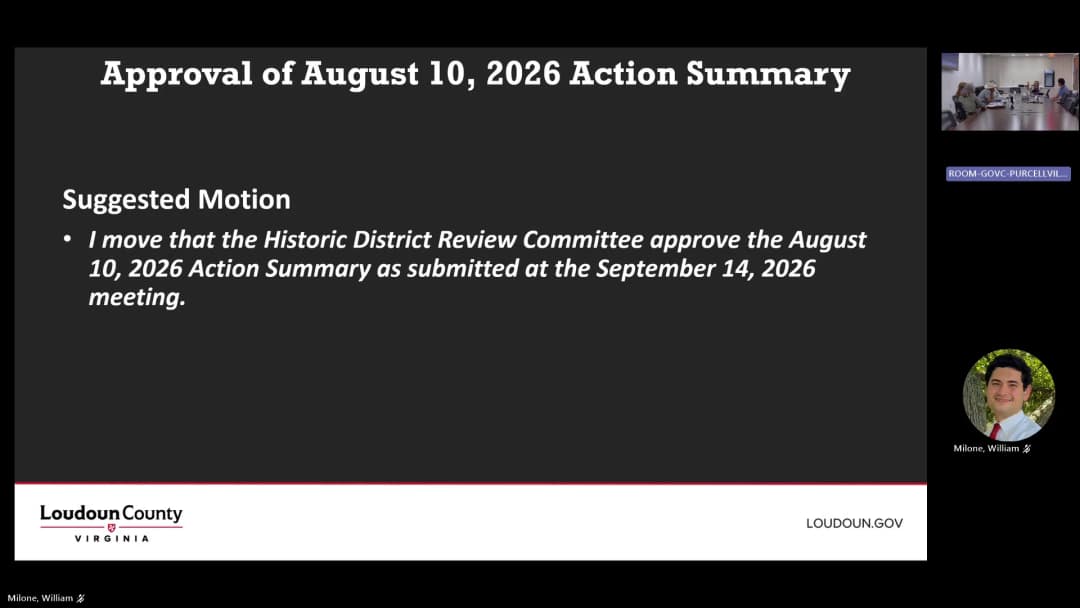
The Loudoun County Historic District Review Committee (HDRC) met on September 17, 2026, to consider two action items and one new business item. The major agenda item was a certificate of appropriateness application for a pavilion, hardscaping, and outdoor kitchen in the Goose Creek Historic District. The committee approved the application with a condition regarding stone veneer material. A rezoning application for the Unison Historic Overlay District was deferred due to the addition of approximately 200 acres of adjacent properties. The committee also approved the August 10, 2026 action summary. Consent Calendar - Approval of August 10, 2026 Action Summary: The committee unanimously approved the action summary from the August 10, 2026 meeting as submitted. Unison Historic Overlay District Rezoning (Deferred) - Deferral: Staff announced that the LEGI-2025-0066 Unison HOD rezoning application was deferred from the agenda after staff learned that adjacent property owners were seeking to be added to the district, expanding the application by roughly 200 acres. Additional review was deemed necessary. The historic district guidelines component of the project will continue moving forward, with a community meeting scheduled for September 27, 2026. CAPP-2026-0010: Wali Raheen – Pavilion, Hardscaping, and Outdoor Kitchen - Project Description: The application (deferred from August 10, 2026) proposed approximately 3,100 square feet of hardscaping behind an existing dwelling at 19184 Partridge Crossing Court in the Goose Creek Historic District, including a pre-cast paver patio, path, steps, fire pit with bench seating, outdoor kitchen, prefabricated pavilion with fireplace, and low walls. A pool house on the property had been approved in 2023 but not yet constructed. - Changes from Previous Submission: The vertical elements (pavilion columns, outdoor kitchen, fireplace, low walls) were now proposed to be clad in a natural stone veneer (random ashlar profile) instead of precast material. The pavilion roof form was changed to a gable to match the house, with wood construction and corrugated metal roofing. - Staff Presentation: Staff noted that the HDRC has purview over all structures under the zoning ordinance, but that horizontal elements (pavers, patio) had no visual impact on the historic rights-of-way or adjacent historic properties. Vertical elements were potentially visible from one angle at the adjacent historic Isaac Nichols House property but not from Telegraph Springs Road. Staff recommended approval, finding the proposed stone veneer and roof materials consistent with guidelines, and that the improvements were appropriately sited and subordinate to the dwelling. - Committee Discussion: - Members questioned the stone veneer appearance and profile. The applicant confirmed the use of a random ashlar stone veneer and showed samples. - Significant discussion centered on the HDRC's purview and how to apply guidelines to elements not visible from public rights-of-way. Staff explained that while all structures are technically within purview, the committee's focus should be on visual impacts to the historic district and public interest. Members expressed concerns about setting precedent for using modern materials in a historic district even when unseen, but staff emphasized the zoning tool's limitation as mitigation rather than preservation. - The committee discussed code compliance issues (e.g., need for railings) and the possibility of deferring applications when missing code information was significant. Staff clarified that the committee could defer for incomplete information. - Decision: The committee approved the certificate of appropriateness with the condition that the vertical elements (walls, outdoor kitchen, fireplace) be constructed of random ashlar stone veneer as shown in the latest application materials. The motion passed unanimously. Key Outcomes - Unison HOD Rezoning: Deferred for additional review; community meeting to proceed September 27, 2026. - Wali Raheen Application: Approved with condition requiring random ashlar stone veneer on vertical elements. - August 10, 2026 Action Summary: Unanimously approved. - Process Clarifications: Staff clarified that the HDRC may defer applications if code non-compliance would significantly alter the approved design, and that the committee's purview covers all structures but its discretion is guided by visual impact and public interest within the historic district.

HISTORIC PRESERVATION 62% · ZONING REGULATIONS 22% · BUILDING CODES 10% · MISCELLANEOUS 3%
24
SEP 17, 2026 · LOUDOUN COUNTY, VIRGINIA · COMMISSIONS & ADVISORY BOARDS
Loudoun County Heritage Commission Land Use Subcommittee Meeting - September 17, 2026

The Land Use Subcommittee met to discuss a draft position paper on data center development, along with updates on several land-use applications and heritage projects. The meeting was called to order at 5:36 p.m. (the agenda listed Sept. 14, 2026, but the meeting occurred on Sept. 17 per official record). Data Center Position Paper (New Business) The subcommittee extensively reviewed a draft letter/position paper addressing data center growth in Loudoun County. Key points: - The paper calls for a "pause" on new data center applications and a comprehensive study via a "blue-ribbon panel" of experts to understand long-term impacts, especially with AI-driven energy demands. - Members debated terminology: "moratorium" is politically charged; recommended using "pause." The paper should avoid using "moratorium." - Discussion on existing county work groups: Phase 2 of Data Center Standards (CPAM) is moving forward with public input meetings Sept. 28 and 30. The subcommittee expressed concern that this process should be paused until broader study is done. - The paper will request the Board of Supervisors to suspend approvals until the panel completes its work, and also consider advocating for a state-level pause. - The subcommittee decided to task the Data Center Committee with providing specific examples of impacts to cultural, environmental, and scenic resources to strengthen the paper. - Timeline: The Board of Supervisors will consider a motion on a pause tomorrow (Sept. 18). The subcommittee will not finalize the paper until after that vote and plans to present it to the full Heritage Commission in October. Old Business - Spoonbill Energy Storage: Application still incomplete; cultural resource survey was rejected in August. No immediate action taken. - Micki Gordon Park: Under review; issues with relocation of recycling center and multi-use paths requiring additional archaeological survey. PRCS recommended signage coordination with Heritage Commission. - Event Center Proliferation: Member Emily reported a surge in pre-meeting applications for event centers in rural areas, possibly in anticipation of zoning changes. At least three active applications (Eastwind, Paxson Road, Picnic Woods) and nine pre-meetings in the past year. The subcommittee will monitor. Updates - National Conference Center: No new developments. - Paris Mountain Application: New submission faces issues – site entrance grading, multiple uses (restaurant, spa) submitted as by-right but likely requires special exception. Staff review pending. - Paxson Road Event Center: Stalled. - Goose Creek Stone Bridge: Engineering contract awarded ($750,000); heritage engineer not retained as requested. - Training Track (Army Meeting): Army non-committal on public access; they may need to demolish barns to build indoor ring. Archaeological work on family cemetery ongoing; public access allowed only with Army escort. - Preservation Plan: Monthly focus continues on various heritage topics (environmental, maintenance, archaeology, underrepresented communities, etc.). Key Outcomes - The data center position paper will be revised to include specific examples from the Data Center Committee and adjusted based on the Sep. 18 Board vote. - The subcommittee will not issue a letter before the Board vote; instead, the paper will be finalized for the full Heritage Commission meeting in October. - No votes taken at this subcommittee; all items were discussions and directives. - Discrepancy noted: Agenda dated Sept. 14, but meeting held Sept. 17.

DATA CENTER DEVELOPMENT 47% · LAND USE PLANNING 33% · ARCHAEOLOGICAL SURVEY 8% · ENERGY AND INFRASTRUCTURE 4%
25
SEP 16, 2026 · LOUDOUN COUNTY, VIRGINIA · COMMISSIONS & ADVISORY BOARDS
Western Loudoun Rural Uses and Standards ZOAM Committee Meeting - September 16, 2026

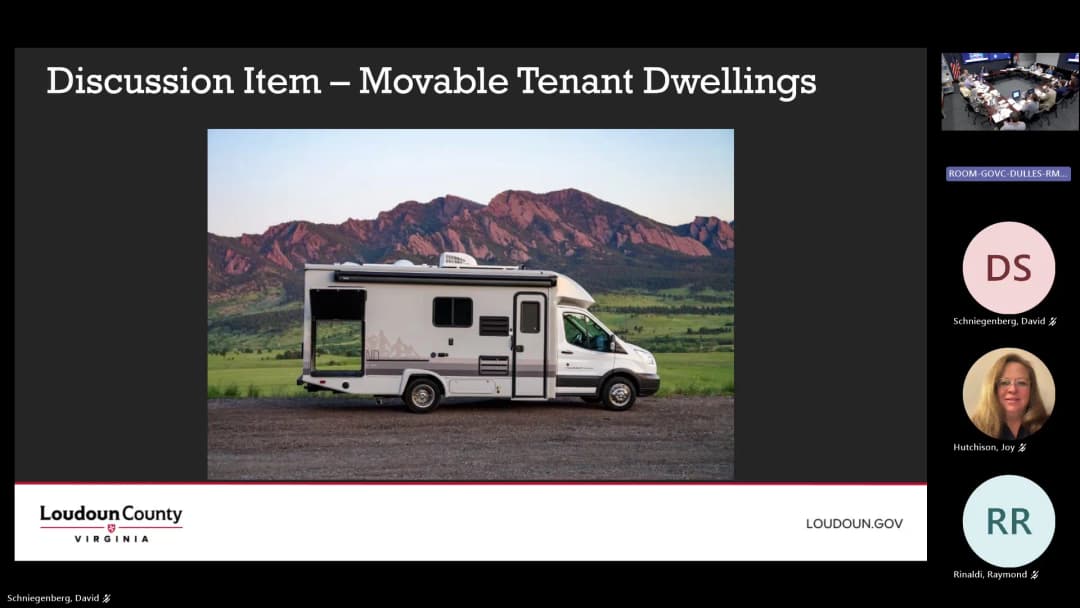
The Planning Commission/Zoning Ordinance Committee's Western Loudoun Ad Hoc Committee met on September 16, 2026, to discuss and vote on a series of zoning ordinance amendments related to Western Loudoun rural uses and standards, including lodging uses (bed and breakfasts, country inns), guest farm or ranch, farm worker housing (seasonal labor dormitories, tenant dwellings, movable tenant dwellings), and seasonal agricultural worker camps. The committee reviewed staff-proposed language, debated whether it reflected board direction, and passed numerous motions with recommendations for the Planning Commission. Consent Calendar - Adoption of Meeting Summary (August 24, 2026): Approved unanimously after amendments to correct language (e.g., replacing "argued" with "discussed") and ensure proper identification of motion makers and seconds. Public Comments & Testimony - No public testimony was presented; committee disclosures included meetings with wineries associations, farm bureau, and private citizens. Discussion Items - Bed and Breakfast Homestays, Inn, Country Inns, and Private Parties: The committee found the draft language generally consistent with board direction (motions 19, 21, 23-26, 56) by a 5-4 vote. Separate votes approved: (1) expanding proof-of-operation options for lodging uses (unanimous); (2) confirming field parking on land owned/operated by the lodging operator (unanimous); (3) aligning outdoor music cutoff with permitted hours and referencing the noise ordinance (unanimous); (4) allowing amendment of annual private party zoning permits without new fee (unanimous); (5) recommending that the board reconsider motion 24 (comprehensive standards table) (unanimous). A motion to increase field parking setbacks to 60 feet for B&B uses was tabled for further study. - Guest Farm or Ranch: The committee unanimously agreed the staff language reflects board direction (motion 39) and added a recommendation that minimum parcel size be 20 acres for up to 10 guest rooms and 40 acres for up to 20 rooms (unanimous). An additional motion provided that the use is subordinate to and ceases upon discontinuance of the agricultural operation (unanimous). A friendly amendment to add a reconciliation clause was not accepted but noted for future discussion. - Seasonal Labor Dormitories: Unanimously approved that staff language reflects board direction (motion 36, reducing square footage from 200 to 100 sq ft and allowing income from any county ag operation). A subsequent motion added that residents must derive a majority of their hours from agricultural labor during occupancy (unanimous after amendment). - Tenant Dwellings: Approved that draft text reflects board directions (motions 46 and 47) by a 7-1 vote (one opposed). The committee then passed: (1) a five-year self-certification renewal without fee (7-2) instead of the proposed three-year zoning permit renewal; (2) confirmation that compacted gravel satisfies the dust-free parking surface requirement (unanimous). Scrivener's errors (e.g., explicit prohibition on short-term rentals) were noted for correction. - Movable Tenant Dwellings: After debate, the committee voted 6-2 to include self-powered units (RVs and tiny houses on wheels) in the definition, directing staff to incorporate this change. An additional motion (unanimous) removed the Virginia-only license restriction, allowing any U.S. state registration. Minor corrections (e.g., "should" to "shall", placeholder zoning districts) were added as friendly amendments. - Seasonal Agricultural Worker Camp: Unanimously agreed that staff language meets board direction (motion 49). The committee then voted 6-2 (with one member absent) to keep this use separate from seasonal labor dormitories, noting differences in health department permitting and family occupancy. Key Outcomes - Adopted: Meeting summary of August 24, 2026 (unanimous). - Approved (with recommendations to Planning Commission): All lodging, guest farm, and farm worker housing provisions as amended, with specific votes as noted. - Deferred: Proposal to increase field parking setbacks for B&B uses (to be revisited at wrap-up meeting). - Noted: Scrivener's errors to be corrected; committee will revisit certain items on November 9, 2026, to harmonize with agritourism discussions.

ZONING REGULATIONS 45% · AGRICULTURAL OPERATIONS 25% · PROCEDURAL 9% · ZONING ORDINANCE 6%
26
SEP 2, 2026 · LOUDOUN COUNTY, VIRGINIA · COMMISSIONS & ADVISORY BOARDS
Zoning Ordinance Committee Meeting - September 2, 2026

The Zoning Ordinance Committee (ZOC) met on September 2, 2026, at 9:00 AM in the Dulles Room of the Government Center. The meeting included public comment, approval of the action report, status updates on several comprehensive plan and zoning ordinance amendments, discussion of the Western Loudoun Rural Uses and Standards (WLRUS) project, and farewells to outgoing members. The committee passed motions expressing frustration over the lack of substantive items referred to ZOC and requesting prioritization of zoning ordinance 'quick fixes.' Public Comments & Testimony - Maura (last name not given) delivered a farewell comment, stating she supported the RADC ZOR ad hoc committee for fair business input. She noted that a preliminary inventory she prepared was a proof-of-concept sampling of county data showing anomalies between permits, inspections, and operations, and that compliance is pro-public health and safety. She introduced Madeline Skinner as her replacement. She also referenced 2,487 pages of public input used by staff, and urged that public input and board direction not be overturned. Discussion Items - Approval of Action Report for June 3, 2026: The report was approved with one abstention from a member who was absent at the prior meeting. - CPAM-2025-0001/ZOAM-2024-0001 – Data Center Standards & Location, Phase 2: Ryan Reed reported that staff are deep in text amendments. Two public outreach meetings are scheduled for September 28 and 30, 2026, at Broad Run High School (format: stations and small conversations). Draft text will likely not be released until October, prompting discussion about whether to delay the open houses so the public can respond to actual proposals. Staff noted they are also meeting with data center industry groups. ZOC will receive a project update in October; staff will determine how to engage ZOC further. - ZOAM-2025-0001 – Zoning Ordinance Rewrite Adjustments 1 (Information Item): No update from staff. The 'quick fixes' list was discussed. Colleen described three categories of ordinance wording issues: those with no workaround, those with interpretive workarounds, and those requiring excessive staff time. A motion was made by Joe (seconded) that ZOC express concern about the priority of this item and send a letter to the Board of Supervisors. The motion was amended (friendly amendment by Michael) to also include broader concerns about the lack of items referred to ZOC. The motion passed unanimously. - Resolution of Intent to Amend – Chapter 10 Procedures (Placards): This item is headed to the Board of Supervisors public hearing on September 9, 2026. The Planning Commission recommended including county-owned properties in the placard requirement. Discussion included the size of placards and use of QR codes; staff acknowledged concerns about placard size but noted it's not a zoning ordinance issue. - Resolution of Intent to Amend – Affordable Housing by Religious and Nonprofit Organizations (YIGBY): This is a response to state mandate, fast-tracked to the Planning Commission public hearing on September 22, 2026. Staff are coordinating with the Department of Housing and Community Development. - Department of Planning & Zoning Work Plan: Michael reviewed the work plan and noted that only 3 of 8 listed items are coming to ZOC for action. He expressed frustration that ZOC is being underutilized, leading to the amendment to the motion above. - CPAM/ZOAM-2024-0002 – Western Loudoun Rural Uses and Standards (WLRUS): The ad hoc committee has held an orientation and one work session, covering non-conforming structures, conservation easements, density calculations, sawmill uses, food vendors, rural restaurants, equine uses, and agricultural business lighting. Upcoming sessions on September 15 and 29 will cover lodging, farm worker housing, and the mountainside overlay district. Staff packets are described as well-organized. - ZOC Member Reappointment: Stacey Metcalfe was confirmed as the Rural Economic Development Council representative (term expiring 9/30/2030). Key Outcomes - The committee approved the action report from June 3, 2026, with one abstention. - A motion passed unanimously (with friendly amendment) to send a letter to the Board of Supervisors expressing concern about the low priority of the Zoning Ordinance Rewrite Adjustments (quick fixes) and the lack of substantive items being referred to ZOC. The letter will be drafted by the chair, circulated for input, and signed by outgoing members before the end of September. - Upcoming meetings were set: October 7, November 4, and December 2, 2026, all at 9:00 AM in the Dulles Conference Room. - Multiple outgoing members (Joe, Maura, Bill, Colleen, etc.) gave farewell remarks, reflecting on the committee's past effectiveness and current frustration with underutilization. Note: The transcript and agenda do not note any votes on individual zoning ordinance amendments; only the motion regarding the letter was voted on.

COMMUNITY ENGAGEMENT 32% · ZONING REGULATIONS 23% · PUBLIC ENGAGEMENT 20% · DATA CENTER DEVELOPMENT 10%
27
AUG 25, 2026 · LOUDOUN COUNTY, VIRGINIA · COMMISSIONS & ADVISORY BOARDS
Western Loudoun Ad Hoc Committee Meeting Summary - August 24, 2026

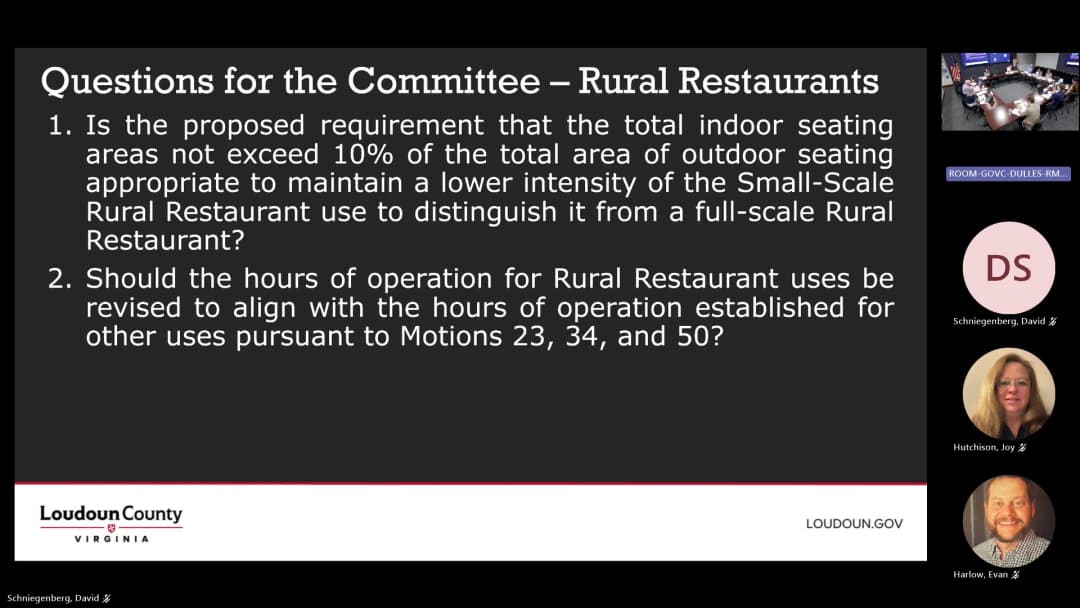
Note: The agenda and transcript indicate the meeting occurred on August 24, 2026, while the user instruction states the meeting took place on August 25, 2026. This summary uses the date from the source documents. This was the first working meeting of the Western Loudoun Ad Hoc Committee, tasked with reviewing and recommending revisions to the Zoning Ordinance for seven topics: nonconforming agricultural structures, conservation easement density, sawmill use permissions, food vendors, rural restaurants, equestrian uses, and agricultural exterior lighting. The committee discussed each topic, debated motions, and voted on recommendations to the Planning Commission and Board of Supervisors. Discussion Items 1. Nonconforming Agricultural Structures (Motion 55) - The committee considered expanding permissions to replace or reconstruct legally established nonconforming agricultural structures damaged by casualty beyond the owner's control. The proposed language required the replacement to match the original footprint, floor area, and height, and to be completed within two years of removal. - Key discussion points: definition of "agricultural structure," "footprint," and "legally established"; concern that the two-year clock starts at removal without a permit documenting dimensions; desire to allow the replacement structure to be used for agritourism activities; and a proposed 10% dimensional tolerance. - Motion 1 (find consistent with board direction) failed 3–6. - Motion 2 (endorse with revisions) passed 7–1–1 (1 abstention). Revisions included: permit non-conforming portions for agritourism, define agricultural structure broadly per Virginia Code, add 10% tolerance, run the two-year period from permit issuance (with zoning administrator discretion to extend), and require a permit before removal documenting dimensions, with limitations noted on the replacement permit. 2. Conservation Easement Density (Motion 41) - The proposal clarified that land subject to a conservation or open space easement cannot be used to calculate subdivision density or count as required open space. The committee debated unintended consequences for landowners who retain residual lots after placing land in easement, and recombination scenarios. - Motion passed unanimously with a revision to replace specific statutory citations with a functional description (e.g., "any recorded instrument that limits the number of dwelling units or lots"). 3. Sawmill Use Permissions (Motion 3) - The proposal changed sawmill use from a special exception to a minor special exception in AR-1 and AR-2 districts. The committee clarified that portable sawmills used by the property owner or occupant are not included in this use. - Motion passed unanimously. 4. Food Vendors (Motions 14 & 15) - The committee separated mobile vendors into temporary and permanent categories. Discussion focused on defining permanent food vendors, acreage-based limits, sourcing requirements, and whether they should be accessory or principal uses. - Motion 3 (permanent food vendors should be accessory use, not principal) passed unanimously. - Motion 1 (acreage thresholds and maximum numbers as proposed) passed 7–0–1–1 (1 abstain, 1 absent). - Motion 2 (subject permanent food vendors to sourcing requirements of rural restaurants) failed 2–6–1 (1 absent). - Overall motion (endorse with revisions requiring the vendor remain a licensed, titled wheeled vehicle, prohibit permanent foundations, and allow permanent utility connections subject to health department approval) passed 7–0–2 (2 absent). The committee also noted that further discussion on defining agricultural operations and ABC uses would occur in October and November. 5. Rural Restaurants (Motions 16 & 17) - The proposal established a 25% sourcing requirement (down from 51%), created a "small scale rural restaurant" category, and added a 10% indoor seating limitation. Discussion included whether to include processing, the difficulty of sourcing locally in winter, and enforceability. - Motion 4 (hours of operation aligned with other uses) passed with one abstention. - Motion 1 (25% sourcing requirement with processing added back, and “offered for sale” instead of “served”) passed 5–3–1 (1 absent). - Motion 2 (annual self-certification with zoning permit renewal, records retained on site) passed. - Motion 3 (retain the 10% indoor seating limitation for small scale rural restaurants) passed 5–3–1 (1 absent). - Overall motion (endorse as amended) passed (voice vote, no tally given). 6. Equestrian Uses (Motions 40, 49, 50, 52) - Proposals established specific setbacks (60 feet), hours of operation, and removed fixed vehicle limits in favor of event-based standards. Discussion included the need for earlier hours (7 a.m.) and later nights (11 p.m.), distinguishing non-public activities, and the 0.00 foot-candle lighting standard. - Separate motion (hours of operation 7 a.m. to 11 p.m. daily) passed (voice vote). - Separate motion (remove structure size limitations for equestrian event facilities) passed. - Overall motion (endorse with revisions: 7 a.m.–11 p.m. hours, and add exception for enclosed or partially enclosed equestrian barns) passed (voice vote). 7. Agricultural Exterior Lighting (Motion 51) - Proposed standards included 25-foot poles for parking and non-riding areas, 35-foot poles for outdoor riding arenas, and a 0.00 foot-candle spillover limit. The committee debated whether 0.25 foot-candles was more appropriate for safety and practicality. - Motion (endorse with replacement of 0.00 with 0.25 foot-candles, retain 35-foot pole height for livery stables and equestrian event facilities) passed with one opposition on the lighting issue. Key Outcomes - The committee adopted the meeting summary from August 11, 2026. - All seven topics received recommendations to the Planning Commission, with specific revisions on most items. - The committee will meet next on September 15, 2026, to discuss lodging and farm worker housing. - Several items were noted for future discussion (October 13: agricultural production definitions; November 9: ABC uses).

ENGINEERING AND INFRASTRUCTURE 20% · PROCEDURAL 17% · FOOD VENDOR REGULATIONS 16% · FOOD SERVICE REGULATIONS 14%
28
AUG 14, 2026 · LOUDOUN COUNTY, VIRGINIA · COMMISSIONS & ADVISORY BOARDS
August 14, 2026 FSM PRC Meeting: ADU Agreements & Gated Community Standards

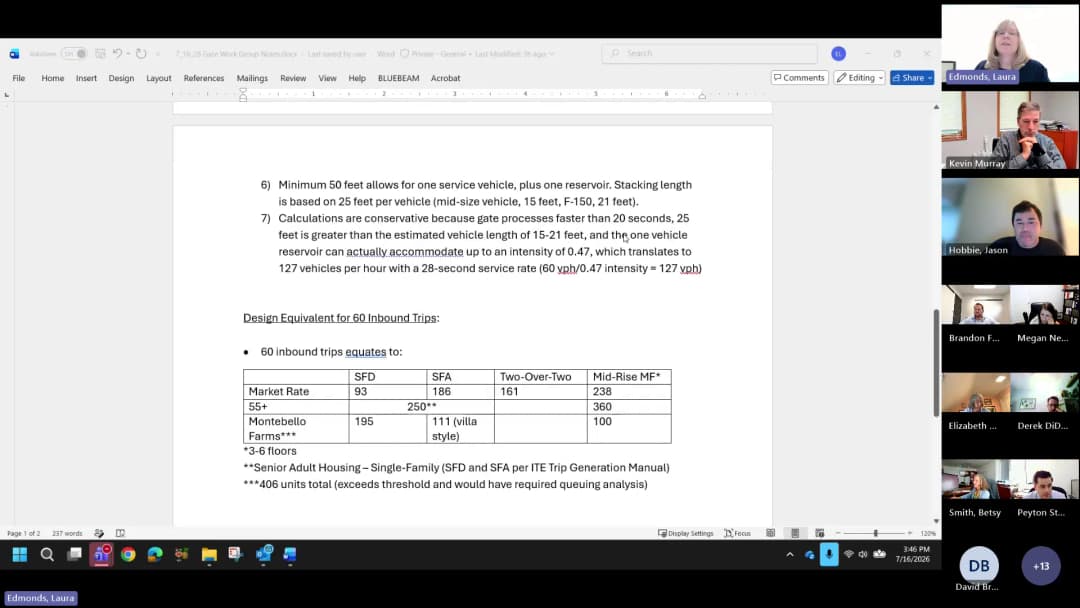
The Facility Standards Manual Public Review Committee (FSM PRC) met virtually on August 14, 2026, to discuss a model ADU written agreement and proposed amendments for gated community standards. The committee also approved previous meeting minutes, received an update on the plan clearance technical memo, and bid farewell to county staff member Zeb Fults. Note: The agenda and transcript indicate the meeting date as July 16, 2026, but the provided date is August 14, 2026; this summary uses the provided date. Consent Calendar - The committee unanimously approved the minutes from the June 18, 2026 meeting. Plan Clearance Tech Memo Update - County staff reported that work with the county attorney on a written analysis of an alternative interpretation is ongoing. The system is currently functional and has been used successfully on at least one project. Staff indicated they are available to assist applicants interested in exploring the plan clearance option. Discussion: ADU Written Agreement - Laura and Adrian (County Attorney’s Office) presented a model agreement required under Zoning Ordinance Section 9.01A2 for applications yielding less than 24 dwelling units that could potentially trigger ADU requirements on adjacent land under common ownership or control. The model agreement records a covenant binding future owners to comply with ADU program requirements if the collective dwelling unit count reaches 24 or more. Key points included: - The agreement is recorded as a covenant running with the land to put all owners and future buyers on notice. - The model uses a 24-unit threshold (reduced from 50) to reflect smaller infill developments; the specific calculus for 24 is not documented but aligns with town of Leesburg practice. - The agreement does not impose current ADU obligations; it only triggers if later applications increase the total to 24 or more. - Discussion centered on the timing of recordation (prior to administrative approvals such as subdivision plats or site plans, but not before legislative approvals), the need for a release mechanism if the threshold changes in the future, and the definition of “common ownership or control” (1% equity or trust/beneficiary interest). - Teresa Miller will issue an advisory opinion with the template. Committee members were asked to submit comments directly to Laura by early August (first Monday in August) for consideration before the template is finalized. Discussion: Gated Community Standards - Laura presented draft language developed by the gated community work group, which met four times. The standards address vehicle stacking, queuing, emergency access, and signage for gated entrances on private roads serving residential communities. - Minimum storage length: 50 feet from the edge of right-of-way or pedestrian crosswalk to the process location (the point where the vehicle stops for transaction). This accommodates one vehicle at the gate and one behind it (two 25-foot spaces), based on a conservative 20-second transaction rate and 60 inbound peak-hour trips. (Actual RFID systems average 8 seconds.) The 60 peak-hour trips correspond to approximately 93 single-family detached, 186 single-family attached, or 232 multifamily units. - Queue analysis required: If inbound peak-hour trips exceed 60, a queuing analysis using the Highway Capacity Manual (or alternative approved by the director) must be submitted. The analysis may allow reduction of the 50-foot minimum. - Other requirements: The analysis must describe operations (number of access points, lane distribution, resident/visitor/service vehicle access, visitor rejection, etc.). Signage and pavement markings must direct users. Gate failure provision: electrically operated gates must be capable of manual operation (broadened from just power failure to any failure). Emergency access: gates must have an emergency access system approved by the Fire Marshal (placeholders for future specificity on click-to-enter systems). - Discussion included clarifying the measurement point (edge of right-of-way vs. process location) and noting that the 50-foot minimum is conservative; typical sedan vehicles could fit three cars in 50 feet. The threshold of 60 inbound trips was questioned as low for 238 condos, but the work group defended it based on ITE trip generation and the fact that multiple entrances distribute traffic. - No formal vote was taken. The committee indicated the draft is close to final and will proceed to agency referral. Next steps include attorney review and a resolution of intent to amend. Key Outcomes - Minutes approved: The June 18, 2026 minutes were approved unanimously. - ADU written agreement: Committee members must submit comments on the model agreement to Laura by early August. The advisory opinion and final template will follow. - Gated community standards: The draft text will be sent for agency referral; the committee expects to discuss comments at the September 10 meeting. No formal vote today. - Next meetings: Thursday, September 10, 2026 (Dulles Room) and Thursday, September 24, 2026 (Dulles Room). The August meetings are cancelled. - Zeb Fults’ departure: Zeb Fults, county staff liaison, attended his last PRC meeting; his last day is August 5, 2026. The committee thanked him for his contributions.

ENGINEERING AND INFRASTRUCTURE 36% · ZONING ORDINANCE 19% · PROCEDURAL 13% · TRANSPORTATION SAFETY 9%
29
AUG 14, 2026 · LOUDOUN COUNTY, VIRGINIA · COMMISSIONS & ADVISORY BOARDS
Western Loudoun Rural Uses and Standards Ad Hoc Committee Orientation – August 14, 2026

The Western Loudoun Rural Uses and Standards Planning Commission/Zoning Ordinance Committee Ad Hoc Committee held an orientation meeting on August 14, 2026, to launch its work reviewing zoning text amendments for rural uses and standards in western Loudoun County. Staff presented the project’s scope, background, timeline, meeting schedule, and proposed operating procedures. The committee adopted a revised meeting time for future sessions and set ground rules for questions and public input. The printed agenda listed the meeting date as August 11, 2026, while the event date supplied with the transcript is August 14, 2026; no formal minutes were available. Opening Remarks and Introductions - Judy Burkett, Deputy Director of Planning and Zoning, welcomed members and explained that the Board of Supervisors created the committee by merging the Planning Commission and Zoning Ordinance Committee to expedite review of the Western Loudoun Rural Uses and Standards zoning text. She said the Board’s goal is to adopt zoning ordinance amendments by July of next year and urged members to maintain a positive, collaborative, and solution-oriented dialogue. - Committee members introduced themselves and described their backgrounds in farming, equestrian activities, planning, tourism, and rural land use. Several members stated goals for the process: Dale Myers, a former Planning Commission and Board of Supervisors member, cautioned against overregulation, cited the Virginia Right to Farm Act and winery legislation, and urged the committee to remember that “if you want to save the farm, you have to save the farmer.” Bill Hatch, a Zoning Ordinance Committee member, said his goal was to preserve his farm without dividing the countryside into tiny house lots. Mark Miller, a Planning Commission member, said farmland preservation depends on allowing landowners to keep farming, because the alternative is housing. Beth Merrick, a Zoning Ordinance Committee member, said she hoped to bring forward information from the earlier TLUC process. - Staff introduced themselves, including project managers Brian Wilson and Dave Schmidtenberg, Deputy County Administrator Danny Davis, and staff from Planning and Zoning, Building and Development, the County Attorney’s Office, and Public Affairs. Staff Presentation: Scope, Background, and Timeline - Staff described the project scope as focused on zoning text amendments for western Loudoun rural uses, with comprehensive plan amendments limited to clarifying language that avoids conflicts with the zoning text; staff said they are not seeking to change the general policy of western Loudoun in the comprehensive plan. - The project timeline began officially in March 2024. Staff said the TLUC facilitated public input, with nine stakeholders, eight stakeholder meetings, and subject matter experts in business/tourism, agricultural conservation, and residents. TLUC later held formal direction meetings and made recommendations to the Board of Supervisors in May. Staff cited a master board-direction worksheet containing 55 motions, and noted the Board altered the project plan in June by creating this ad hoc committee. - The schedule calls for two meetings per month, with the first substantive meeting on August 24 covering equestrian uses, rural restaurants, and mobile vendors, and completion of recommendations before Thanksgiving. The Planning Commission public hearing is anticipated in January, and the Board of Supervisors public hearing is expected by early summer. - Staff said meeting packets will be distributed electronically one week before each meeting, posted to the public the same day, and will include the agenda, draft meeting summaries, staff report, draft text, and public comments. Kimley Horn will prepare meeting summaries to serve as minutes. Meeting Schedule and Procedural Decisions - The committee voted to change all upcoming meeting times from 3:00–7:00 p.m. to 5:00–9:00 p.m.; the motion carried with one abstention. Meetings will be held in the Dulles Room, with dinner provided and a hybrid option available. - Staff presented a meeting model based on the TLUC process: a staff presentation, committee questions, topic-by-topic discussion, and votes on motions. Each committee member would have two minutes for questions, followed by a 20-minute topic discussion with a two-minute timer per member, and recommendations would be approved by a simple majority of members present. - After debate, the committee voted to keep the two-minute question limit for committee members but to allow staff response time not to count against the member’s two minutes. Transparency, Stakeholder Contact, and Public Input - Staff said the committee meetings will not be live-streamed and that they are working with Public Affairs on the logistics of recording. A committee member raised transparency concerns about the lack of live streaming and the frequency of staff meetings with stakeholders. - The committee discussed whether members and staff should disclose stakeholder meetings at the beginning of each meeting. Planning Commission members noted that disclosure is their regular practice. No formal vote was taken, but staff indicated disclosures could be accommodated. - Staff said there will be no public speaking session at committee meetings, but the public is invited to attend and may submit comments through the county’s online public comment form. Comments will be compiled into meeting packets. Because packets are prepared a week in advance, the committee agreed that supplemental public comments would be provided by noon on the day of each meeting. Key Outcomes - Approved a revised meeting schedule with all upcoming meetings from 5:00–9:00 p.m., with one abstention. - Adopted a two-minute committee question limit with staff response time excluded from the member’s two minutes. - Confirmed the seven-meeting topic schedule beginning August 24 and targeting completion before Thanksgiving. - Confirmed the Planning Commission public hearing is anticipated in January and the Board of Supervisors public hearing is expected by early summer. - Agreed to use the existing online public comment form as the central channel for public input, with supplemental comments provided by noon on meeting day. - Discussed, but did not formally vote on, stakeholder meeting disclosure procedures.

PROCEDURAL 38% · ZONING ORDINANCE 26% · PUBLIC ENGAGEMENT 22% · ZONING REGULATIONS 8%
30
JUL 28, 2026 · LOUDOUN COUNTY, VIRGINIA · COMMISSIONS & ADVISORY BOARDS
Loudoun County Communications Commission Meeting - July 28, 2026

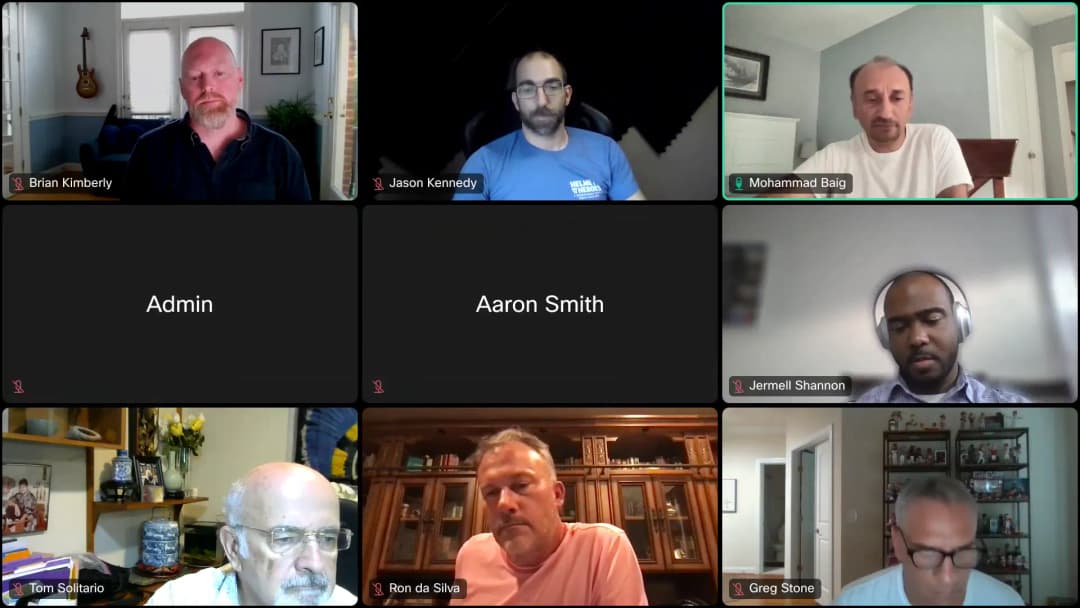
This all-virtual meeting of the Loudoun County Communications Commission convened at 7:00 PM on the date provided (agenda and transcript indicate July 27, 2026; the assigned date is July 28, 2026 per instruction). Key actions included welcoming new Commissioner Mohammed Beg, approving the agenda and minutes (with one abstention), discussing the status of the commission's annual report before the Board of Supervisors, closing several outstanding action items, and receiving updates on broadband deployment. Consent Calendar - Agenda approved unanimously (no objections). - Minutes from May 12, 2026 approved with Commissioner Jason Kennedy abstaining; no other objections. Public Comments & Testimony - No members of the public signed up to speak. Discussion Items - Annual Report Status: Chair Ron DeSilva reported that the commission's annual report was placed on the consent agenda for the Board of Supervisors' Budget and Business Committee meeting in mid-July. Chair of that committee, Supervisor Bisckman, opted to defer the report to the September Board of Supervisors business meeting (approximately September 9), stating that the commission needed additional time to work on the report. DeSilva sent an email seeking clarification but received no response. Deputy CIO Brian (staff liaison) noted he reached out to his reporting chain (Deputy County Administrator Monica Spells and Tim Street) for guidance on coordinating with board offices but had no new direction. Commissioner Tom Solitario emailed his supervisor encouraging discussion of the report; Commissioner Kennedy met with his supervisor (Chris Numstead) who had no comment. Commissioner Greg Stone contacted Supervisor Sylvia Glass about six weeks prior and received a noncommittal response. DeSilva plans to attend the September business meeting to represent the commission. - Commission Purpose: New Commissioner Mohammed Beg asked about the original mandate. DeSilva explained that the commission was created around 1998 to serve as a bridge between the public and cable franchisees (Comcast, Verizon). Its role was broadened in approximately 2012 to include over-the-top video services, and later addressed wireless and broadband issues in western Loudoun. After franchise renewals were handled without commission input, the body has been redefining its purpose. - Broadband Deployment Update (Patrick Ryan's inquiries): - The DHCD extension for fiber buildout has been approved through December 2026; the county counter-signed documents. - VDOT and All Points have agreed on a process to limit monthly right-of-way permit applications, with one VDOT staffer assigned to All Points applications in Loudoun County. - Regarding construction progress: the county reports 125 miles of last-mile fiber constructed, while the VATI dashboard shows 44% completion of total fiber mileage. Ryan noted the discrepancy; staff could not explain the difference, stating their numbers come from monthly reports to DHCD. - Nearly 800 addresses in Fiber Area Two are eligible for broadband; as of about one week prior, 167 addresses had active service. Key Outcomes - New Commissioner: Mohammed Beg (Algonkian District) officially joined the commission; introductions were made. - Action Items Closed: - Item 269 (telecommunications applications list for 2025–2026) was closed after staff provided the requested list. - Items 249 and 254 (outstanding franchise questions for Verizon that received no response) were closed without further action. - No New Action Items: All previous items are now closed; no new ones were generated. - Next Meeting: Scheduled for September 28, 2026 (subject to the Board of Supervisors' schedule). The commission will not meet in August due to county recess. - Direction on Annual Report: Commissioners are encouraged to engage with their supervisors before the September business meeting. Staff will continue coordinating with county administration and supervisor offices to prepare for the report's presentation.

PROCEDURAL 42% · TECHNOLOGY AND INNOVATION 39% · COMMUNITY ENGAGEMENT 16% · PUBLIC ENGAGEMENT 3%
OPENPUBLICA · PUBLIC MEETING INDEXUPDATED DAILY · openpublica.com