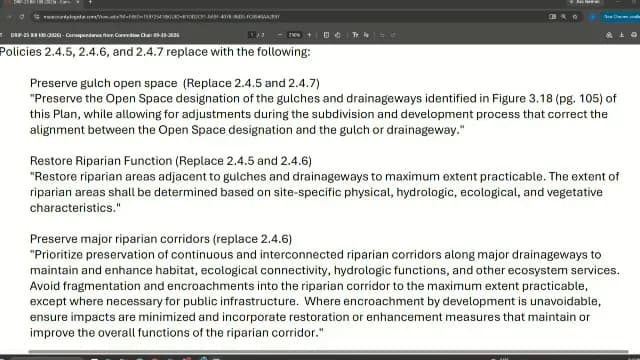
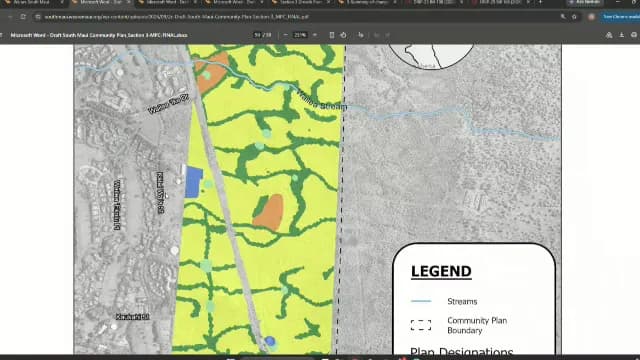
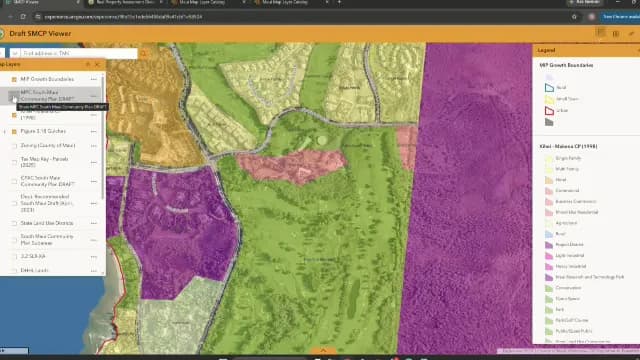
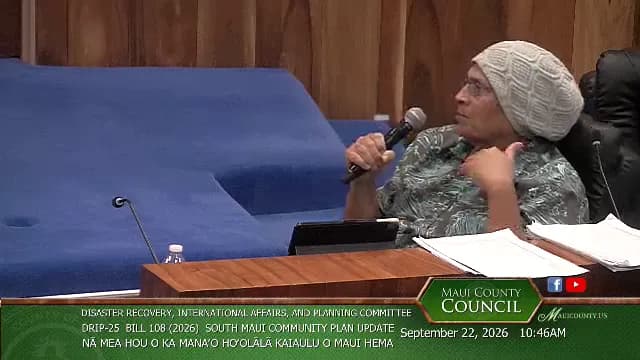
The Disaster Recovery, International Affairs, and Planning Committee (DRIP) of the Maui County Council convened on October 7, 2026, from 9:17 a.m. to 4:08 p.m. to continue its detailed review of Bill 108 (2026), the South Maui Community Plan. The meeting featured public testimony, legislative action on action items, and the adoption of revised land use and resource management policies. Note: The published agenda for this meeting stated that no legislative action would be taken on Section 3 (Growth Framework). However, the committee proceeded to formally amend several action items within that section (e.g., Actions 3.16, 3.17, 3.19, and 3.29). Public Comments & Testimony - Kay Anderson (President, Wyelea 808) urged the council to require comprehensive infrastructure, public safety, and economic analysis before approving the proposed Wyalayacolf course redevelopment, citing emergency access and water deficiencies. She questioned whether the project should proceed without enforceable commitments to address existing infrastructure deficits. - Travis Liggett advocated for UV disinfection in South Maui and a greenbelt firebreak, and expressed concerns about health impacts from chlorine disinfection at the Ma'alaya Triangle. - Gasil (anonymous testifier) raised an ethics grievance regarding a council member's attendance and expressed concerns about security cameras. - Johan Lal supported the draft definitions for native plants and requested the inclusion of invasive and canoe plant definitions. - Rory Frampton (Haleakala Ranch) advocated for the designation of the Kokea Industrial Area, detailing its history and potential for enhancing self-sustainability. - Frank Wonka asked the committee to require the county to enforce its own shoreline management area (SMA) determinations and to respond to property owner inquiries regarding compliance. - James Langford raised concerns about international ownership of local water treatment infrastructure and its potential implications for reef and community health. Discussion Items - MEMA Action Items (Section 3): Administrator Amos Lonokailua Hewitt presented responses to several action items. The committee amended Action 3.16 to create a "post-disaster recovery and reconstruction framework" led by the Office of Recovery. Action 3.17 was amended to include "all suitable private roads" and Malka routes for evacuation. Action 3.29 was amended to add an education component for siren use. New action items on tsunami safe zones and private road access agreements were created. - Gulch and Drainage Ways Policies (2.4.5, 2.4.6, 2.4.7): After extensive debate, the committee voted to replace the three existing policies with new language recommended by the Department of Public Works. The new policies remove the universal 100-foot buffer in favor of a site-specific approach with a 50-foot minimum riparian buffer, remove the low-impact development exception, and restrict encroachments to necessary public-serving infrastructure. - Appendix D Definitions: The committee adopted a definition for "Natural Drainage Way" to replace the broader "Drainage Way" definition. Definitions for "Native Plants," "Canoe Plants," and "Invasive Plants" were also adopted. - Historic Properties Policies (2.5.11 A & B): Language was refined to clarify mitigation requirements for projects within or adjacent to historic properties (wahi kūpuna), specifying that consultation includes the Department of OEB Resources. Key Outcomes - Votes on Action Items: Amendments to Actions 3.16, 3.17, 3.19, and 3.29 were passed. New action items for tsunami safe zones, private road access, and an emergency evacuation study (led by Department of Management) were created (various voice votes, all carried). - Gulch Policies Adopted: The replacement of policies 2.4.5, 2.4.6, and 2.4.7 was approved (voice vote 8-0-1). - New Policy Encouraging LEED Certification: The committee adopted a policy encouraging hotels and resorts to strive for LEED certification (voice vote 8-0-1). - Definitions Adopted: "Natural Drainage Way" definition was adopted on a roll call vote of 6-2-1. Native, Canoe, and Invasive plant definitions were adopted (voice vote 8-0-1). - Deferred Agenda: The committee recessed until October 8, 2026. Outstanding work includes finalizing Appendix E (Hawaiian terms) pending a comprehensive review by Planning and OEV, and housing and water policies pending department director input.
Public Meetings - Maui County, Hawaii
Public Meetings - Maui County, HawaiiThe Disaster Recovery International Affairs and Planning Committee (DRIP) of the Maui County Council reconvened at 9:04 a.m. from its Oct. 5 recessed meeting to continue its review of DRIP 25, Bill 108 (2026), the South Maui Community Plan. Oral testimony had been closed the previous day, but written testimony remained open. Council Chair Lee led the meeting, with seven members participating in person or remotely; Councilmember Gabe Johnson joined later after a medical appointment. The committee took multiple recesses and reconvened, then adjourned at 4:42 p.m. Public Comments & Testimony - Oral testimony on the community plan was closed on Oct. 5; written testimony will continue to be accepted. - Testimony referenced during discussion included a request to add Kalani Heao in the Garcia subdivision to Appendix G significant sites. - CPAC Chair Weltman recalled property-owner testimony, including ATC Makena representative Kaimi Judd's Oct. 4 testimony about a long, skinny portion of a large Makena parcel requested to be designated open space. Discussion Items - Attachment 3B – Map Designation Changes: The committee continued parcel-by-parcel review of the planning department's matrix of changes made by the Community Plan Advisory Committee (CPAC) and the Maui Planning Commission (MPC). - Maui Research and Technology Park / Lipoa: CPAC had changed the designation to special purpose district, while the MPC recommended transit-oriented corridor (TOC) and removed gulches and drainage ways from open space. The committee heard the MPC discussion, which focused largely on parks rather than gulches, and deliberated whether one development should be exempt from the pattern of designating gulches and drainage ways as open space. Deputy Corporation Counsel Michael Hopper advised that consistency and reasoning matter, and that a drainage-way or gulch ordinance may be a better tool than open-space designation. The committee deferred a final decision and asked staff to obtain the relevant planning commission pages and continue analysis. - Waipuilani Parcels: Three parcels were changed from residential to open space. Councilmember Cook said these are four parcels the county is trying to acquire for $6,150,000, with a tentative closing by end of January 2027 if the council agrees. The committee discussed whether open-space designation is appropriate while parcels are still privately owned and whether it would still allow flood-control maintenance. The managing director's office reported that acquisition is being actively pursued. - Honuaʻula / Wailea 670: The committee reviewed Exhibit 53, the drainage master plan accepted by the MPC. The approved map appears to place the planned fire station and affordable housing over or near proposed retention basins. Councilmembers voted to send a transmittal to project representative Chip Chase and to the Department of Public Works to clarify the proposed locations and how the drainage master plan relates to regional drainage planning. - Wailea Beach Marriott Parking Garage: The CPAC changed the parking garage parcel from small town center to resort hotel. Members discussed the existing parking need for hotel employees and guests; the resort hotel designation would support a future zoning change to hotel use but would not automatically allow new hotel construction. - Wailea Gateway and Shops at Wailea: The gateway parcels were changed from TOC to small town center, and the Shops at Wailea was changed from small town center to resort hotel. Members generally accepted these changes. - Wailea Golf: The committee considered three options: the MPC-recommended map, the owner Christian Chan's map with a neighborhood center, or the Kihei/Wailea version. No decision was made. - Twenty-seven Undeveloped Parcels: Most are zoned residential with one apartment-zoned parcel, consistent with residential and small town center designations. - Makena Skinny Parcel (TMK 21005108): A roughly 1,000-foot-long by 350-foot-wide sliver of a 489.432-acre parcel south of Pūlehu was recommended by CPAC and MPC for change from agriculture to open space based on cultural sites. The committee had difficulty locating the legal description and the CPAC rationale. CPAC Chair Weltman later reported a July 14, 2023 CPAC motion passed unanimously to designate the area as open space because it contained cultural sites. Corporation Counsel said the description should be sufficient to identify the portion and staff would work with planning on the exact wording. The committee agreed to consult ATC Makena representative Brad Anderson. - Four Parcels Outside the Urban Growth Boundary: Three McKenna-related parcels and one state-owned parcel were recommended to change from residential to agriculture because they are outside the Maui Island Plan urban growth boundary. One owner-occupied parcel is held by the Harriet Tavares Trust; another belongs to the state. Councilmembers raised concerns about impacts on existing homeowners, farm-dwelling requirements, subdivision limitations, and the need for owner notification. The committee directed staff to reach out to the owners and, for the state parcel, ask whether the state prefers agriculture or another designation such as state conservation. - Maluaka Parcels: Changes from resort hotel to residential were supported by CPAC testimony and the ongoing residential development use; no added outreach was required. - 7000 Makena Road (Sturgis Trust): A state land-use layer error was corrected by the state, and the 0.8-acre parcel will be rural residential, consistent with prior rural designation and landowner testimony. - Appendix F – Designations and Zoning Districts: The committee discussed the alignment table, including A1/A2 phase-out and new H3/H4 hotel districts, and whether urban reserve belongs under TOC or mixed-use designations. A motion to amend page 173 passed. - Appendix G – Significant Sites: Department of ʻŌiwi Resources Director Kapono Aemolitao supported adding Kalani Heao and other requested sites, and described the cultural significance of ʻōniuli heiau, rain koa, and places such as Puʻu Hele. The committee discussed adding asterisks or references for degraded sites and place-name information. The department will transmit a fuller list of significant sites. - Appendix H – Infrastructure Report: The appendix was created in response to a CPAC request for an infrastructure report with estimated timelines and costs. The committee discussed the low/medium/high priority rankings, the large unfunded costs, and whether priorities should be ranked by department. CPAC's 2023 digital rankings were uploaded as Granicus item 57. Staff will prepare a revised prioritization proposal, including the new items transferred into Appendix H. The committee also agreed to consider adding a disclaimer that inclusion is a community priority subject to future funding and implementation. - Process Appendices: The committee requested updates to Appendix A describing public engagement, the August 8, 2023 wildfire pause, the creation of the Department of ʻŌiwi Resources, and dates for completed phases. Members asked for publication years on related studies and plans. - Definitions: The committee discussed aligning the drainage-way definition with Maui County Code, adding a native-plants definition, and clarifying gray vs. green infrastructure. Councilmember Rollins Fernandez was assigned to draft a native/endemic/canoe plant definition. Staff will also check whether the code definition of drainage way should be used throughout the plan. Key Outcomes - Motion passed (7-0-0): Amend page 173, resort hotel row, to remove A1/A2 zoning districts and add H3/H4 as the most compatible zoning districts. Moved by Councilmember Cook, seconded by Councilmember Batangan. - Motion passed (7-0-0): Amend page 152 by adding an appendices header and the statement that appendices include supplemental information. Moved by Councilmember Johnson, seconded by Councilmember Cook. - Motion passed (7-0-0): Amend page 151 references to list both the 2020 Draft Kihei Drainage Master Plan Ecological Alternatives Analysis and the 2016 Draft Kihei Drainage Master Plan. Moved by Councilmember Cook, seconded by Councilmember Johnson. - Motion passed (7-0-0): Add publication years for the Southwest Maui Watershed Management Plan (2019) and the Kihei Subarea Transportation Plan (2020). Moved by Councilmember Uu-Hodgins, seconded by Councilmember Rollins Fernandez. - Referrals and directives: Staff will send transmittals to project representatives and the Department of Public Works regarding Honuaʻula; consult ATC Makena about the Makena open-space sliver and McKenna parcels; contact owners of parcels outside the urban growth boundary; provide revised Appendix H priorities; and continue written testimony review. The meeting was recessed and reconvened with a new meeting planned for the following day, when oral testimony would be taken again.
The Disaster Recovery, International Affairs, and Planning Committee of the Maui County Council met on October 5, 2026, to continue deliberations on Bill 108 (2026) regarding the South Maui Community Plan Update. The committee focused on Section 3 (Growth Framework) and other sections, with no legislative action taken on Section 3. The meeting included public testimony, discussion of area-specific policies, and resource input from community plan advisory committee (CPAC) members, planning staff, and other stakeholders. Public Comments & Testimony - Mike Carlson (Koa O Wailea resident): Opposed the Wailea Golf plan, stating it lacked community outreach and would eliminate championship golf courses, harming tourism and charity events. Urged rejection. - Steve Bishop (South Maui resident): Supported the Wailea Community Association (WCA) revised plan, arguing it keeps two 18-hole golf courses intact and has broad community support, while Wailea Golf's plan lacks community input and could face legal delays. - Wayne Levine (Koa O Wailea homeowner): Supported the WCA compromise, preserving the Blue Course and concentrating development on the Emerald Course with fewer direct impacts on existing neighborhoods. - Johan Law (self): Testified on Appendix G, requesting addition of Kalani Heiau to the significant sites list. Also argued gulches should remain open space by default, with developers seeking amendments for changes. - Christian Chan (Wailea Golf representative): Clarified that community engagement occurred, and the WCA plan elements are possible under the existing map. He was later designated a resource. - Albert Perez: Referenced a historic promise of 70% open space for Wailea and stated the Wailea Golf proposal was improperly presented late in the process. - Anonymous caller (4945): Criticized barriers to public participation and expressed concerns about golf course water use. Discussion Items - North Kihei Mauka (policies 3.4.5–3.4.6): Continued discussion on the two-lane collector road connecting East Lipoa Street to Veterans Highway, with a proposal for a route study by MPO. Policy 3.4.6 on housing for Maui residents was debated—members favored “may” over “must” to allow flexibility, while ensuring owner-occupied or long-term rentals. Infrastructure subsidies from county/state noted. - Pi'ilani Promenade (policies 3.4.7–3.4.13): Reviewed policies on cultural involvement (3.4.7), mixed-use 80/20 residential-to-commercial split (3.4.8), and live-work units (3.4.9). Corporation counsel flagged legal concerns due to existing Land Use Commission (LUC) order prohibiting residential; committee considered if-then language for future LUC amendments. Policies 3.4.11–3.4.13 were deleted per counsel recommendation. Policy 3.4.12 (canopy trees) retained. - Central Kihei: Discussed the downtown Kihei infill project, with small town center and resort hotel designations. Questions raised about hotel-zoned parcel being taxed as apartment; committee requested letter to finance for clarification. - Maui Research & Technology Park: Review of special purpose district vs. transit-oriented corridor designation. Ongoing Title 19 rewrite noted. - County-Owned Parcel (150 acres near Kihei Police Station): Designation as public/quasi-public supported, with potential for affordable housing, emergency shelter, and preservation of wiliwili forest. Planning suggested a feasibility study. - Honua'ula (Wailea 670): Previously approved; no further changes needed. - Wailea Golf (pages 100-101): Extended discussion on two competing maps: owner-proposed (Wailea Golf) and WCA revised (preserving Blue and Gold courses). Christian Chan stated unit counts unknown but could range 600–1,000 units; committed to 30% affordable under 2.96. David Good (WCA president) noted unanimous board support for compromise. Committee urged parties to continue dialogue; no decision made. - Makena: Reviewed changes from resort hotel to residential/rural residential designations. Landowner consent noted. Committee requested information on TMK 21005085 (tax classification). - Gulches and Drainage Ways (section 3.5): Discussed open space designations and proposed policy language from Director Molina (Granicus 45). Corporation counsel cautioned that open space adjustments would require community plan amendments, not subdivision changes. Liaised with Department of OEV Resources on unnamed gulches. Key Outcomes - No votes were taken; all discussion was informational and preparatory for future decision-making. - The committee will reconvene on October 6, 2026, to continue reviewing Section 1, 5, Appendices F & G, and complete the growth framework matrix. - Staff was directed to: (1) note potential MPO route study for the North Kihei Mauka collector road; (2) draft a letter to finance regarding TMK 21005085 (hotel-zoned parcel taxed as apartment); (3) reach out to developer Harry Lake for Pi'ilani Promenade input; (4) bring back the gulch policy language (Granicus 45) for future voting. - The Wailea Golf/WCA parties were encouraged to continue meeting to resolve map differences before committee action.
On October 2, 2026, the Disaster Recovery, International Affairs, and Planning Committee (DRIP) of the Maui County Council reconvened from its September 30 meeting to continue deliberations on Bill 108 (2026), the South Maui Community Plan update. The meeting focused on Section 3 – Growth Framework and specific "areas of change," including Maʻalaea, Central Maui Base Yard, and North Kihei-Māʻalaea. No legislative action was taken on Section 3, but the committee discussed potential amendments to other sections. Written testimony remains open; oral testimony was closed on September 30. Discussion Items - Mapping and Designation Clarifications: Senior Planner Karen Komkowitz and CPAC Chair Rob Weltman explained the conversion of parcel designations from the old Kihei-Makena Community Plan to updated categories. They noted that changes were based on community input and project proponent requests, not purely administrative conversions. The Maʻalaea triangle area was highlighted: the Planning Department initially proposed Transit-Oriented Corridor, but CPAC and the Maui Planning Commission changed it to Small Town Center, which offers more flexibility for mixed-use development. Councilmember Batangan confirmed that no property rights were diminished solely by the conversion. - Central Maui Base Yard Expansion: The committee reviewed a proposed expansion of industrial land by 66 acres within the Maui Island Plan urban growth boundary, changing agriculture to industrial and open space. A 100-foot buffer from Pulehu Gulch was recommended to protect the gulch from industrial runoff, a suggestion supported by both the landowner and CPAC. Councilmember Johnson raised concerns about buffer width depending on land use, and CPAC affirmed that 100 feet was sufficient. - North Kihei-Māʻalaea Area-Specific Policies: Extensive debate centered on policies for this area: - Policy 3.4.1 (Stakeholder Committee): The committee discussed forming a diverse stakeholder committee to guide development, including input from the Department of ʻŌiwi Resources (ʻOEV). - Policy 3.4.2 (Comprehensive Master Plan): CPAC and landowner representative Rory Frampton agreed on a conceptual master plan before development, though Frampton requested adding the word "conceptual" to clarify the level of detail. - Policy 3.4.5 (Connector Road): This policy sparked the most contention. The draft language required a two-lane collector road from East Lipoa Street to Veterans Highway with a separated bike path, built before or concurrent with development. CPAC Chair Weltman argued the road is essential for evacuation and reducing congestion on Piʻilani Highway, citing severe gridlock during a tsunami warning earlier in 2026. Rory Frampton (representing landowners Haleakala Ranch and ʻAoʻao Ranch) warned that requiring the full road upfront could kill the project and proposed phasing improvements per development phase. Councilmember Cook emphasized the road's necessity as an evacuation route for both tsunami and wildfire hazards. Councilmember Sugimura and Uʻu-Hodgins suggested alternatives like roadway easements, phased construction, or a community facilities district (CFD) to fund crossings. Corporation Counsel Michael Hopper advised the council to clarify the timing language to avoid ambiguity. - Gulch and Stream Identification: The committee noted that several sub-areas (e.g., Mākena, Wailea) lacked names for gulches and streams. Members agreed to request information from the Department of ʻŌiwi Resources. Proposed listing Moʻo Kapu and Kīʻawaʻapū beaches as environmentally significant features. Key Outcomes - No votes were taken; the meeting served as a working session to gather information and refine potential amendments. - The committee will reconvene on Monday, October 5, 2026, to continue discussion, with oral testimony reopened. - Staff and councilmembers will research phasing options for the connector road and consider outreach to the Maui MPO for a route study. - Written testimony continues to be accepted, and the public is encouraged to submit comments via eComment or email.
This limited meeting was held at various restoration areas on the upland slopes of Kahoʻolawe, guided by Michael Nāhoʻopiʻi, Executive Director of the Kahoʻolawe Island Reserve Commission. The meeting was not open to the public, and no oral testimony or legislative action was taken, in accordance with HRS § 92-3.1(a). Discussion Items - Committee members discussed reviving the Nāulu Cloud Bridge, including restoration and reforestation plans to encourage rainfall from leeward Haleakalā to Kahoʻolawe. Other related matters were also discussed during the site inspection. Key Outcomes - No legislative action was taken. The committee conducted an on-site inspection and held discussions, but no votes, directives, or referrals were made.
The Disaster Recovery, International Affairs, and Planning Committee (DRIP) of the Maui County Council met on September 30, 2026, at 9:00 a.m. (HST) to continue reviewing Bill 108 (2026), which proposes adopting the updated South Maui Community Plan. The meeting focused on Section 3 (Growth Framework), new community plan designations, sub-area maps, and action item revisits. No final legislative action was taken on Bill 108; the main motion to recommend passage on first reading carried over from the previous meeting. The committee recessed at approximately 3:50 p.m. and will reconvene on Friday, October 2, 2026, at 1:30 p.m. Public Comments & Testimony - Kay Anderson (President of Wailea 808) urged the county not to redevelop the Wailea Golf property until the applicant demonstrates safe service with adequate water, wastewater, traffic, and emergency evacuation analyses. She requested preservation of the golf course as open space and retention of existing land use designations pending a better alternative. - Christian Chan (representing Wailea Golf) expressed support for the proposed plan for the property, describing extensive community engagement and a plan that addresses transportation, workforce housing, water, and cultural resources. He emphasized that the community plan is only the first of several discretionary steps needed for development. - Johan Law (testifying on his own behalf) praised the presentation and urged consistency in land use designations across all community plan areas to avoid confusion for GIS users and planners. He noted that the designation for Palawea might better fit public/quasi-public; also flagged map accuracy concerns and suggested considering transit-oriented corridor for the Ma‘alaea Triangle. - Travis Liggett (individual) requested amending language about cesspools to injection wells in Ma‘alaea, provided drawings of injection well locations, and advocated for a community facilities district to connect cesspools to the Kīhei treatment plant. He also shared personal health experiences from his work. - Mike Moran (CPAC member and Kihei Community Association board member, testifying as an individual) advocated changing the Pōʻoleni Promenade (80 acres in North Kīhei) designation from “small town center” back to “residential” to ensure housing for residents. He supported potential relocation of a fire station to that area. - Representative of the Royal Pentecost Kingdom (unidentified testifier) asserted that the county lacks authority over royal patented lands and that land commission awards must be properly reflected on TMK records. He also criticized the use of cultural practitioners to bless developments. - Amy Schwin (owner in Kīhei-Wailea) raised concerns about irreversible loss of open space from the Wailea Golf plan, cumulative infrastructure burdens (water, roads, wastewater, emergency evacuation), and cited the 2025 tsunami as an example of severe evacuation failures. She called for a cumulative infrastructure analysis before additional density. - Caller 4945 (individual) opposed new development, citing insufficient water and infrastructure, and advocated for preserving agriculture and conservation. He criticized the planning process as too developer-friendly. - James Langford (individual) urged the committee to ensure that developers and banks involved in South Maui are vetted for connections to criminal activities (e.g., Epstein-related files) and that money laundering or human trafficking does not taint projects. - Rory Frampton (land use consultant for Pā‘iakala and Kōʻonoulu ranches) discussed two projects: the North Kīhei/Ma‘alaea residential area (requesting phased infrastructure policies) and the Ka‘ōkea industrial area (about 80 acres above the wastewater treatment plant, outside the urban growth boundary, supported by a concurrent Maui Island Plan amendment). He requested policy language allowing phased implementation of drainage and roadways. - Robert Bence (individual) opposed further development in South Maui, citing lack of water and infrastructure, and expressed disappointment that developers are designated as resource persons while community members like Professor Mayer and Mr. Moran are not. Discussion Items - Presentation on Community Plan Designations: Planning staff presented the updated designations (e.g., Rural Residential, Residential, Neighborhood Center, Small Town Center, Transit-Oriented Corridor, etc.) and conducted a quiz to familiarize the committee with each designation's characteristics and intended uses. The presentation also demonstrated the interactive online map showing changes from the previous Kihei-Mākena Community Plan. - Sub-Area Review (Section 3 Growth Framework): The committee began reviewing six sub-areas of the South Maui Community Plan map. For each sub-area, a new table (introduced by the Maui Planning Commission) summarizes moku, ahupua‘a, streams/goalches, size, housing units, population, visitor counts, culturally and environmentally significant features, government facilities, future growth areas, and other information. The committee discussed: - The need for consistent terminology (e.g., “area” vs. “region”). - Inclusion or removal of the “Rural Village” designation (no such areas exist in South Maui; CPAC recommended removal, but some members favored keeping it for consistency across plans). - Clarifications on vacancy data (from American Community Survey, classified as “vacant housing” – some members suggested “transient” or “second homes” might be more accurate). - Importance of identifying streams and gulches for flood mitigation; the Department of OEV Resources agreed to research unnamed gulches in sub-area six (Ahihi-Kīna‘u). - The need to improve map readability (e.g., adding abbreviations for designations on printed maps, and possibly reorganizing the booklet so sub-area tables face their maps). - Potential changes to the Ma‘alaea Triangle designation (from Transit-Oriented Corridor to Small Town Center, as recommended by CPAC and Planning Commission) and the ability to accommodate a transit hub within Small Town Center. - Discussion about the North Kīhei-Ma‘alaea area: a possible wastewater treatment plant (private, serving a public good) on agriculture land, managed retreat for shoreline areas, and the need for a comprehensive north-south collector road (bypass) that connects to Veterans Highway. The committee considered securing easements before development, but deferred detailed policy discussion to a later date. - The Honua‘ula and Wailea 670 designations were noted as based on adopted maps. - Action Item Revisits with Director Molina (DPW): The committee considered amendments to several action items: - 1.03 (North-South Collector Road and Kīhei Bikeway): Split into 1.03A (new road phases with estimated $110 million) and 1.03B (improving Kenolio Road northward, estimated $40 million). Both remain high priority, with county/state/federal funding. Motion passed 8-0. - 4.03 (MS4 Stormwater Management Plan): Deleted 4.03A and 4.03B and replaced with new action items focused on developing and implementing site-specific Best Management Practices for county facilities in South Maui (plan = high priority, program = high priority; both long-term). Two separate motions passed 9-0. - 4.26 (No change): No objection, kept as is. - 4.27 (Substantial Improvement Regulations): Amended language to “improve oversight of repairs and improvements to properties in special flood hazard areas to improve enforcement of substantial improvement regulations under the National Flood Insurance Program.” Removed the 20-year timeframe (DPW indicated difficulty administering the current 10-year). Motion passed 9-0. - 4.28 (Flood Mitigation Projects): Amended to “pursue funding opportunities for community-wide flood mitigation projects, prioritize nature-based solutions and natural infrastructure,” added MEMA as co-lead and state as a funding source. Motion passed 9-0. - 4.29 (Pilot Project): Initially recommended for deletion as covered by 4.02A/B, but CPAC chair and planning staff favored keeping a separate pilot to show progress. Deferred further discussion; DPW may propose revised language later. - 5.04 (Cultural Advisory Engagement): Deleted after CPAC chair revealed it was included without proper discussion or record. Motion passed 9-0. Key Outcomes - Votes on Action Item Amendments (all passed unanimously with 9 ayes, 0 noes): - Amendment to Action 1.03: split into 1.03A ($110 million) and 1.03B ($40 million), high priority, DPW lead, funding from county/state/federal. - Amendment to Action 4.03: replace with two new actions – develop a site-specific BMP plan for county facilities in South Maui (high priority, long-term, DPW lead, cost TBD, county funds) and implement that plan (same classification). - Amendment to Action 4.27: improve oversight of repairs/improvements in special flood hazard areas to enforce substantial improvement regulations under NFIP. - Amendment to Action 4.28: pursue funding for community-wide flood mitigation projects prioritizing nature-based solutions; MEMA co-lead, state added as funding source. - Deletion of Action 5.04 (cultural advisory engagement database). - Future work: The committee will resume discussion of Section 3 sub-areas, area-specific policies, and remaining action items on Friday, October 2, 2026, at 1:30 p.m. The Department of OEV Resources will research gulch names for Ahihi-Kīna‘u. Staff will coordinate with the Department of Transportation regarding the Transit-Oriented Corridor study for South Kīhei Road. The meeting was recessed at approximately 3:50 p.m.
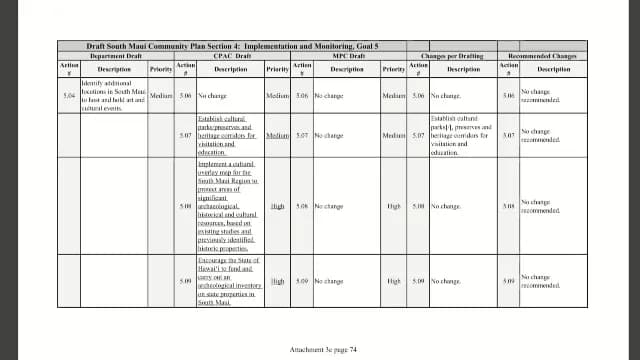
The Disaster Recovery, International Affairs, and Planning Committee continued its review of the draft South Maui Community Plan (Bill 108), focusing on Section 4: Goals 2.4 (Mauka to Makai Watershed Management) and 2.5 (Cultural and Natural Resources). The meeting included public testimony, department check-ins, and amendments to numerous action items. The committee did not take legislative action on Bill 108. Public Comments & Testimony - Matt Cherok (General Manager, Walea Community Association) expressed support for the South Maui Plan but advocated for a revised Wailea Golf Plan, developed in collaboration with Wailea Golf, which he said balances development and open space. He noted majority support among condo associations. - Steve Bishop (Board of Directors, Keola Owailea) supported the revised Wailea Golf Plan and commended workforce housing efforts by White Corps. He opposed any plan altering the Blue Course or allowing residential development on it. - Don Carlson (individual, full-time Wailea resident) opposed any development but considered the WCA compromise acceptable. He argued the original Wailea Golf plan would eliminate two championship courses, leaving possibly zero public courses. - Rory Frampton (representing Haleakala and Kaonoulu Ranches) argued in favor of including the Kihemauca residential area, stating the planning process is not designed as a growth management tool. He rebutted claims of excessive unit projections and noted planning for a North Kihei bypass. - Kay Anderson (South Maui resident) urged the council to stop approving luxury housing, citing inadequate evacuation routes, water, and infrastructure. She referenced a recent wildfire in Olawalu and said the original Wailea Golf map was not the one in the draft plan. - Anonymous Caller (last four digits 4945) expressed concern that only wealthy people can participate and that Hawaiian aspects are deprioritized in the plan. - Robert Bence opposed adding additional development capacity, arguing infrastructure and evacuation capacity must precede growth. He opposed all mauka development. - Albert Perez (Maui Tomorrow) corrected statements about planning code, noting Maui County Code 2.80B mandates sequencing and concurrency. He urged binding commitments for future development. - James Langford alleged white-collar crimes related to wildfires and said they affect South Maui. - Representative of the Royal Panic Kingdom opposed all development, citing defects in land title and lack of notification to heirs. - Johanna Law cautioned that adding roads is not a solution for public safety; recommended multiple solutions including resiliency hubs. Discussion Items - Section 4, Goal 2.4 (Mauka to Makai Watershed Management) - Action 4.18 (Dune management coordinator positions): Amended to “seek funding” and added lead agencies: Planning, OEV Resources, and EPNS. Timing changed to ongoing. (Motion by Johnson, seconded by Sinanci; passed 8-0-1). - Action 4.19 (Ridge to Reef initiative): Amended to “support the creation of a South Maui ridge-to-reef initiative or other similar nonprofit.” Lead: Department of Management. (Johnson, Cook; passed 8-0-1). - Actions 4.12/4.20 (Water quality monitoring): Combined and amended to “continue to support a program in compliance with DOH QuAP to monitor water quality for all South Maui nearshore waters, paying particular attention to runoff after big rain events.” Lead: Department of Management; added state and county funding. (Fernandez, Johnson; passed 7-0-2). - Action 4.24 (Wetland acquisition via conservation easements): Amended to include the Conservation Planning Committee and added state/federal funding. (Johnson, Fernandez; passed 7-0-2). - Action 4.31 (Database of coastal hazards): Retained as written; Department of Management lead. (Consensus). - Action 4.32 (Native seed banks): Amended to add state and private funding, ongoing timing, Department of Management lead consulting with OEV, Ag, EPNS. (Sinanci, Johnson; passed 7-0-2). - Section 4, Goal 2.5 (Cultural and Natural Resources) - Action 5.01 (Code of conduct for county parks with cultural sites): Approved as written; OEV lead. (Consensus). - Action 5.02 (Collaborative restoration): Amended to add “loko” (spring) to the list, changed lead to OEV, timing to ongoing, added state/federal/private funding. (Johnson, Sinanci; passed 9-0). (Subsequently a separate motion changed lead to OEV, passed 9-0). - Action 5.03 (Reporting procedures for developments): Amended to track developments with discretionary approvals and settlement agreements the county is aware of. (Johnson, Sugimura; passed 9-0). - Action 5.05 (Identify significant historic properties for preservation): Amended to ongoing timing and added state/federal/private funding. (Cook, Sinanci; passed 8-0-1). - Action 5.06 (Identify locations for art and cultural events): Timing changed to ongoing. (Cook, Sugimura; passed 8-0-1). - Action 5.07 (Cultural parks, preserves, and heritage corridors): Amended to add federal/private funding, ongoing timing. (Sinanci, Sugimura; passed 9-0). - Action 5.08 (Cultural overlay map): Amended to “introduce legislation” to adopt the map, added OEV as co-lead, state funding. (Sinanci, Johnson; passed 9-0). - Action 5.09 (State archaeological inventory on state lands): Timing changed to ongoing. (Sinanci, Johnson; passed 8-0-1). - Action 5.10 (Cultural centers/museums in Kulakai and Honua‘ula Kai): Added federal and private funding. (Johnson, U‘u-Hodgins; passed 8-0-1). - Action 5.11 (Study for restoration of Pu‘u Hele): Retained as written; OEV lead. (Consensus). - Action 5.12 (Signs identifying significant sites): Lead changed to OEV. (U‘u-Hodgins, Johnson; passed 9-0). - Action 5.13 (Partner to address negative repercussions of tourism): Amended to prioritize Native Hawaiian cultural resources and practices, made ongoing, added private funding. (Johnson, Sinanci; passed 7-0-2). - Revisits: Department of Public Works (Director Molina) agreed to submit written responses on several action items (1.03, 4.03, 4.26-4.29, and gulch policies). Key Outcomes - Votes: All amendments passed with varying margins (typically 7-0-2, 8-0-1, or 9-0). Member Sugimura was excused for the morning session; Member U‘u-Hodgins was excused for parts. Member Batangan excused for the entire meeting. - Actions: The main motion as amended carries over to the next meeting. - Next Steps: The committee will reconvene on Wednesday, September 30, at 9:00 a.m. to review Section 3 (Growth Framework) following a presentation from the Planning Department on new community plan designations. Oral testimony will be taken again. The meeting will recess on Wednesday and continue on Friday, October 2, at 1:30 p.m. (due to a council meeting on Tuesday and a DAR committee on Thursday). - Public Works Revisits: Department of Public Works will provide written comments on outstanding items. - No Final Action: The committee did not vote on Bill 108 itself; only amendments to the plan's action items were adopted.
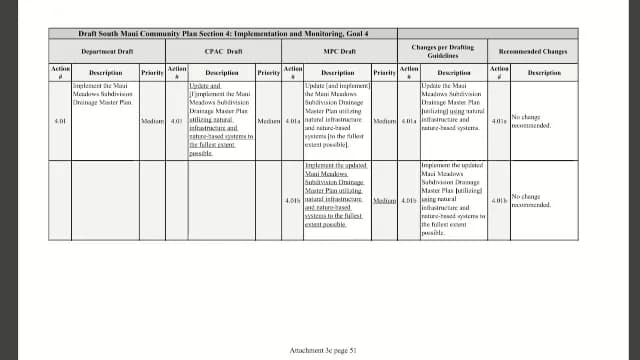
The committee reconvened from September 21-23, 2026, to continue discussion on Bill 108 (2026), which would adopt the updated South Maui Community Plan. The meeting focused on Section 4 (Implementation and Monitoring) and Section 3 (Growth Framework), with extensive consultation from Department of Public Works Director Molina, Department of Environmental Management Director Agawa, Department of Water Supply Director Stufflebean, and other county officials. Numerous amendments were made to action items, and multiple votes were taken. Oral testimony had been closed on September 21, but written testimony continued to be accepted. Discussion Items - North-South Collector Road (Action 1.03): The committee discussed breaking the action into three sub-segments (A, B, C) with Director Molina. A motion to amend was deferred pending specific language from DPW. - Kealia Bypass Road (Actions 1.04A, 1.04B): The committee approved separating the action into three items: plan the bypass (1.04A), develop the bypass (1.04B), and explore using part of North Kihei Road for a walking/bike path (1.04C). Added MPO and state DOT as lead agencies. Motion passed unanimously (9-0). - South Kihei Road Adaptation (New Action): Added a new action item to plan and implement adaptation measures for portions of South Kihei Road failing due to coastal hazards and increased flooding. Lead agencies: DPW, MPO, state DOT, MEMA. Cost TBD. Motion passed (9-0). - Makena Alanui Bike Lane (Action 1.10): Approved as written with no changes. DPW lead, cost $10,000-$50,000. - Vulnerability Assessment (Actions 3.01, 3.05): Combined into a single action (3.01) to assemble a detailed vulnerability assessment of county infrastructure likely impacted by coastal hazards. Deleted 3.05. Cost $1 million, county funding. Motion passed (9-0). - Streetscape Beautification & Litter (Actions 2.02, 2.03): Added Department of Environmental Management to lead agencies for litter programs. Motion passed (9-0). - Parking Lot Trees (Action 2.22a): Changed from "require" to "encourage" 50% canopy coverage, with understanding code changes would be pursued later. Lead agencies: Planning, DOM, MPO, DPW, DPR. - Arborist Training (Action 2.23): Amended to include Maui County Arborist Committee. Lead agencies: DPW, DPR, DOM. Motion passed (9-0). - Disaster Preparedness Plans (Actions 3.15-3.17): Deferred to MEMA for feedback. Added language to "identify and develop" additional emergency evacuation routes. - Tsunami Evacuation Sites (New Action): Added a new action to identify evacuation sites outside tsunami inundation zones, with education and signage. Lead agency MEMA. Motion passed (9-0). - Wildfire Protection (Actions 3.10, 3.11): Amended 3.10 to "introduce legislation to ensure landowner compliance with the 2024 Community Wildfire Protection Plan for South Maui." Amended 3.11 to "implement the 2024 South Maui Community Wildfire Protection Plan." Both motions passed (9-0 and 9-0). - Recycled Water (Actions 3.23, 3.27): Split 3.23 into two parts: (1) identify and encourage new recycled water users with highest potential to offset potable water (project), and (2) expand recycled water storage and distribution in South Maui including scalping facilities and natural earth filtering systems (CIP). Added DWS as co-lead. Motion for part 1 passed (9-0); motion for part 2 (replacing 3.27) passed (9-0). - RO Potable Reuse (Action 3.25): Amended to conduct feasibility study as state regulations are developed. Cost increased to $500,000. Lead agencies: DWS, DEM. Motion passed (9-0). - Desalination Feasibility (Action 3.24): Amended to continue studying feasibility of a modern desalination facility, including exploration of a demonstration facility. Cost $500,000. Lead agencies: DWS, DEM. Motion passed on a roll call vote (6 ayes, 3 noes: Councilmembers Sugimura, Sinenci, Johnson, Cook, Batangan, Lee in favor; Rawlins-Fernandez, U‘u-Hodgins, Paltin opposed). - Drought Management (Action 3.26): No changes needed. Supportive. - Compliance Monitoring (Action 3.28): Amended to encourage the residency area council member to provide updates to the community on progress of action items and policies. Lead agencies: OCS and Planning. Motion passed (7 ayes, 0 noes, 2 excused). - Watershed Management (Actions 4.13A, 4.13B): Amended to create a watershed management program for South Maui (4.13A) and implement it (4.13B). Added DPW as lead agency. Both motions passed (6-0 and 7-0 with excused). - Dune Restoration (Actions 4.16A, 4.16B): Amended to focus on North Kihei area and changed priority to medium. Added DPW as co-lead. Motion passed (7-0). - Riparian Zone Rehabilitation (Action 4.21): Amended to include condition "upon anticipated development of a county water source in South Maui." Motion passed (8-0). - Drainage Master Plans (Actions 4.01, 4.02, 4.03): Various amendments including adding CIP status, consulting with Department of OEB Resources, and prioritizing traditional Hawaiian cultural practices and nature-based solutions. Several motions passed. - Sediment Basins and Gulches (Actions 4.04, 4.05): 4.04 amended to remove "mauka" and reword. 4.05 amended to focus on developing a program for clearing gulches, with short timing. Motions passed (7-0 and 8-0). - Stormwater Park (Action 4.09A, 4.09B): Amended to include DPR as lead, changed priority to medium and timing to long. Added FEMA definition of stormwater park to definitions section. Motion passed (9-0). - Wetland Restoration (Action 4.15): Deferred due to DPW not having current role; to be revisited. - Flood Mitigation (Actions 4.26-4.29): Brief feedback from Director Molina; 4.26 to add MEMA, 4.27 to revisit, 4.28 acceptable, 4.29 recommended deletion. Deferred to next meeting. - R1 Water for Green Buffers (Action 4.22): Amended to prioritize potable water offset and use R1 if feasible for green buffers, livestock, etc. Timing changed to mid. Motion passed (8-0). Key Outcomes - The committee passed numerous amendments to action items, many unanimously (9-0 or 8-0), with occasional dissenting votes on the desalination demonstration facility (6-3). - Several items were deferred for further input from MEMA, DPW, or planning, including action 1.03 (North-South Collector Road segments), action 3.03 (managed relocation guidance), and actions related to MEMA (3.15-3.17). - The committee planned to continue deliberations on Monday, September 28, 2026, due to the upcoming storm and scheduled council meeting. - Written testimony on Bill 108 remains open.
The Disaster Recovery, International Affairs, and Planning Committee (DRIP) of the Maui County Council reconvened on September 23, 2026, from 9:00 a.m. to 4:01 p.m. to continue its line-by-line review of Section 4 (Implementation and Monitoring) of the draft South Maui Community Plan (Bill 108). The meeting focused on amending action items under Goal 2.2 (Safe, Healthy, Livable Communities) and Goal 3 (Ready and Resilient Systems). Oral testimony had been closed on September 21, 2026, but written testimony continued to be accepted. The committee approved numerous amendments and deferred several items for further review with additional county departments. Discussion Items Procedural Timeline: Chair Paltin proposed an aggressive schedule to complete the review by early October, noting the process mirrors the West Maui Community Plan. Several members expressed concerns about balancing other committee obligations and the likelihood of final adoption this term, given pending H3/H4 zoning decisions from the Planning Commission. After a roundtable, a majority of members supported continuing the current pace. Action Item 2.22A (Tree Canopy Plan): The committee amended the action to change "required" to "encourage," added Department of Management and Department of Planning as co-lead agencies alongside MPO, and noted that a code amendment for 50% canopy coverage would be pursued separately. Action Item 2.23 (Arborist Training): Amended to specify "work with Maui County arborists to provide free training workshops for landscapers and arborists annually in South Maui on maintaining full canopy trees," adding DPR and Department of Management as lead agencies. Action Item 2.24 (Residency Preferences): Amended to include examples such as the Lahaina Community Land Trust lottery preference and workforce preference like Summit County Colorado, with the addition of "examples include" instead of "will include" to avoid being restrictive. Action Item 2.25 (Vacant Commercial Spaces): Amended to read "incentivize owners to rent or repurpose vacant commercial spaces," with lead agencies changed from Department of Management alone to include OED, and funding sources including private. Action Item 2.26 (Green Initiatives): Amended to specify "work with the South Maui hospitality industry" and added "limit water use" to the list of green initiatives. Lead agencies: DEM and DWS. Action Item 2.27 (Visitor Transportation): Amended to add OED as co-lead agency and specify "work with South Maui hotels." Action Item 2.28 (Affordable Housing Program): Amended to "maintain a South Maui affordable housing program that secures existing and future affordable housing inventory exploring deed restrictions," with timing changed to ongoing and funding subject to availability. Action Item 2.29 (ADU Program): Amended to "support funding for the program to facilitate expedite approvals and incentivize residential owners to build ADUs" and changed timing to ongoing. Action Item 2.30 (Illegal Short-Term Rentals): Amended to "investigate and eliminate unpermitted transient accommodations, including TVRs, B&Bs, and STRHs," with timing changed to ongoing. Action Item 2.31 (Public Performance Space): Cost estimate changed from $3 million to TBD. Action Item 2.32 (Residency Preference for South Maui): Deleted as duplicative of amended 2.24. Action Item 2.13 (Kilohana Park Expansion): Amended to "assess the feasibility of expansion as a passive park; if feasible, fund design and implement," with priority changed from high to medium. Action Item 3.01 (Vulnerability Assessment): Held for revisit pending input from DPW and DEM. Action Item 3.02 (Managed Relocation Strategy): Deleted after discussion that the county should not take the lead on private property relocation. Action Item 3.03 (Guidance on Managed Relocation): Held for planning to propose language on annual educational shoreline meetings. Action Item 3.04 (Training Staff for Coastal Retreat): Deleted on recommendation of Planning Department, as the work is already underway. Action Item 3.05 (SLR-XA into CIP): Held for revisit with DPW and DEM to consolidate with 3.01. Action Item 3.06 (Cesspool Conversion): Amended to read "work with Department of Management, State DOH Clean Water Branch, and property owners in South Maui to identify next steps in addressing impacts to on-site disposal systems (cesspools and septic) and develop conversion or connection plans by the deadline established by state statute." Added private funding source. Action Item 3.07 (Natural/Cultural Resource Inventory): Amended to include "along the shoreline areas" and added Department of OEV Resources as co-lead agency. Action Item 3.08 (Shoreline Access Inventory): Amended to break into three sentences clarifying development impacts and adding "strive to preserve." Action Item 3.09 (New Fire Station): Cost estimate increased from $5 million to $10 million. Noted that relocation of existing Kihei station is also being planned. Action Items 3.10 & 3.11 (Wildfire Protection Plan): Held for review to update references from the 2016 plan to the 2024 plan; legal review on wording requested. Action Item 3.12 (Cost of Government Commission Report): Amended to "review relevant studies and reports that deal with wildfire prevention or after actions and implement recommendations to the extent practicable." Action Item 3.13 (Wildfire Data Set): Amended to specify partnership with Hawaii Wildfire Management Organization, changed priority to high, timing to ongoing, and added MFD as co-lead agency. Action Item 3.14 (Defensible Space): Amended to add "to the extent permissible by law" and added MEMA as co-lead agency. Key Outcomes The committee voted on and passed amendments to 20 action items, with votes generally 7-0 or 8-0 (with some members excused). Several action items were deferred for revisit pending input from the Departments of Public Works, Environmental Management, and the Corporation Counsel. The meeting was recessed at 4:01 p.m. and will reconvene on Thursday, September 24, 2026, at 9:00 a.m. via the same Teams link.
The committee reconvened at 9:04 a.m. to continue its review of Bill 108 (2026), which would adopt the updated South Maui Community Plan. Members discussed and voted on multiple action items in Sections 2 (Livable for All) and 3 (Growth Framework), amending language, reclassifying items, and referring others for further interdepartmental consultation. The meeting recessed at 11:59 a.m. with plans to continue on Wednesday, September 23, 2026. Discussion Items - Action 2.14 – Homelessness Strategic Plan: The committee amended the language to “develop a strategic plan for South Maui to house individuals who are unsheltered, using relevant studies and plans as a starting point.” The motion passed 7–0 with one excused (Councilmember Sugimura). - Action 2.15 – Puhonua / Low‑Barrier Shelter: After extensive discussion about the cultural appropriateness of the term “Puhonua,” the committee approved language: “build at least one culturally infused low‑barrier shelter or puhonua with proper sanitation and utilities for those with no or very limited income.” The cost estimate was raised from $10,000 to $30,000 per unit. Motion passed 7–0 with one excused. - Action 2.16 – Infrastructure for Affordable Housing: The committee struck the action item and moved it to policy Goal 2.2 (Livable for All) as: “Prioritize infrastructure improvements for housing developments that are 100% affordable or workforce housing reserved for resident households that are supported by the community plan land use designation.” Motion passed 7–0 with one excused. - Action 2.17 – Duplex Definition: The committee deleted this action item, noting that recent council legislation (allowing kitchenettes and two ADUs per lot) already addressed the intent. Motion passed 7–0 with one excused (Councilmembers Rollins‑Fernandez and Sugimura excused). - Action 2.18 – Green Waste Collection and Compost Program: The committee moved this from an action item to a policy under Goal 2.2: “Support land use entitlements to implement a green waste collection and compost use program within the South Maui Community Plan Area.” Motion passed 7–0 with one excused. - Action 2.19 – Feasibility Study for County Parcel Adjacent to Kihei Police Station: The committee deferred this item, requesting the Departments of Housing, Management, and ʻŌiwi Resources to consider including protections for the wiliwili forest, a 100‑foot gulch buffer, and cultural resources before finalizing language. - Action 2.20 – Shoreline Management Plan (including relocation of North Kihei Road): The committee amended the lead agency to include the Maui Metropolitan Planning Organization and the Department of Public Works, and changed “may” to “must” regarding addressing coastal resilience, recreation, resource conservation, and the inevitable relocation of North Kihei Road. Motion passed 7–0 with one excused. - Action 2.21 – Exceptional Tree Designations: The committee accepted the item as drafted, noting that the County Arborist is now under Public Works while the Arborist Committee remains under Parks and Recreation. A post‑plan action item will be noted to address interdepartmental coordination. Key Outcomes - Amendments approved: Actions 2.14, 2.15, 2.16, 2.17, 2.18, 2.20, and 2.21 were amended and passed with votes ranging from 7–0 to 7–0 with one or two excusals. - Deferral: Action 2.19 was deferred for further consultation with the Departments of Housing, Management, and ʻŌiwi Resources. - Revisits scheduled: The committee will continue reviewing remaining action items (including Kilohana Park) and deferred items on Wednesday, September 23, 2026, at 9:00 a.m. via the same Teams link. - Written testimony: The committee continues to accept written testimony on Bill 108 (2026).