This public hearing was called to order on February 4, 2026, at 9:00 AM (though the raw transcript states the meeting was gaveled in on February 3, 2026). Seven council members were present (Vice Chair Yuki Lee Sugi Mura, Councilmember Tom Collin, Councilmember County Rollins Fernandez, Councilmember Tamara Poulton, Councilmember Nohi Lani Uuhajans, Councilmember Gabe Johnson excused, Councilmember Shane Senansi excused, Council Chair Alice Lee, and Councilmember Kawanoy Batangan), forming a quorum. The sole agenda item pertained to proposed three-story buildings in the Lahaina Historic District, with only one member of the public providing oral testimony. No testimony was received from any other party, and the hearing was adjourned after public comment. Public Comments & Testimony - Unidentified Female Speaker (former resident, late husband had a business on Front Street for over 30 years): Stated that three-story buildings in the historic district exceed the desires of the majority who respect the historic character. Supported exemptions for individual buildings but opposed a general height increase. Also urged that any three-story apartments on Front Street include elevators to accommodate elderly residents, as she is elderly and may not always be able to use stairs. Clarified that she is no longer an active board member of the Lahaina RS 13 (likely the Lahaina Restoration Society or similar historic board) and cannot speak on its behalf; had only spoken with Theo about the agenda beforehand. No other members of the public testified. Key Outcomes - No decisions or votes were taken during this hearing; it was solely a public comment session. The hearing was adjourned after oral testimony closed. - Conflict Note: The instruction specified the meeting date as February 4, 2026, but the raw transcript opens with “The February 3, 2026 public hearing will now come to order.” This discrepancy is noted; the date used in the title follows the instruction, while the transcript reflects February 3, 2026.
Public Meetings - Maui County, Hawaii
Public Meetings - Maui County, HawaiiThe Committee on Aloha, chaired by Councilmember Rollins Fernandez, held a meeting on January 31, 2026, to discuss two agenda items: transitioning Kalawao County to Maui County (via SB 1432) and the proposed Kalaupapa Memorial Monument. Both items were 7D presentations with no legislative action, but the committee heard extensive public testimony and resource person input. No votes were taken; both items were deferred. Public Comments & Testimony - DeGray Vanderbilt (Kauhano Kalapapa board member) expressed strong concerns about lack of community meetings, NPS requiring special permits for road access, and the need for more detail on costs and liabilities. He stated there has been no recent community discussion. - Lori Buchanan (beneficiary of DHHL) expressed full support for Maui County oversight, citing current lack of transparency and poor oversight by DHHL and NPS. She emphasized the need for county involvement to enforce coastal zone management rules and provide accountability. - Mark Aquino testified in support of keeping the community spirit of Kalapapa but did not take a firm position on the county transition, hoping for continued community involvement and opportunities for subsistence and restoration. - Philip Kikukawa opposed transition to Maui County, preferring to keep Kalawao County as is or create Molokai County. He advocated for limited visitor numbers, ecotourism, and maintaining the hospice character of Kalapapa. - Sharilyn Rollins Kamakana (Hoolihewa homesteader) favored Molokai County over Maui County, but if forced, would accept Maui County as second choice. She expressed concerns that transition would destroy the area's natural beauty. - Dita Ramler (descendant of a patient) urged for a memorial to honor unnamed ancestors, including her auntie Rose Ahuna, and spoke about the need for a place to touch names and heal. - Sybil Lopez (fourth-generation homesteader) opposed SB 1432, advocating instead for Molokai County. She urged the county to fix enforcement on topside Molokai before considering Kalawao. - Walter Riddy supported Molokai County and expressed concerns about water resources and NPS control, feeling that Hawaiian Homelands should be returned to beneficiaries. - Kahikili Pakala (homesteader) opposed becoming Maui County, supporting Molokai County due to Molokai's unique culture and sustainability. - Carol Lee Kamekona opposed Maui County transition, favoring Molokai County or Kalawao staying as is. She called for a special board within Maui County with elected representatives. - Yama Kaholoa (three-quarter blood Hawaiian) stated that discussions about Hawaiian Homelands should happen separately with DHHL, not the county committee. He called for more transparency from DHHL. - Halona Keiki (homesteader) shared family history and opposed transition, preferring Molokai County. - Martin Kamuala Purdy (fifth-generation homesteader) opposed Maui County, suggesting instead that Kalawao become part of DHHL or a separate county. - Kalani Johnson Sr. (fourth-generation homesteader) opposed transition, favoring return to DHHL. He emphasized cultural and spiritual connections and criticized NPS. - Palmer Naki supported Molokai County 100%. - Dickinson Stone opposed Maui County, supported Molokai County, and wanted recreational access to Kalaupapa. - Michelle Tankayo (VP of RW Meyer Limited) stated she lacked enough information to decide, but requested that RW Meyer Limited be kept in discussions due to its access road ownership. - Hala Pakala (on phone) opposed transition to Maui County, preferring Molokai County. - Leymana Naki shared family history and opposed transition, emphasizing the need for accountability. - Kainoa Le McDonald (Sovereign Council of Hawaiian Homelands) opposed transition, citing lack of beneficiary consultation and legal/fiduciary duties. He urged pause and full consultation. - Stacey Helm Crivello questioned costs and burden on Maui taxpayers, stressing protection of cultural riches. She noted that a transition plan from DOH was discussed but never completed in writing. - Luan Fabrido (homesteader) opposed transition, supporting Molokai County. - Mikiala Peskaya (descendant and former NPS employee) emphasized complexity, noting all residents are employer-bound, and that county regulations don't apply the same. She warned of hidden costs and urged more boots-on-the-ground conversations. She offered herself as a resource. Discussion Items - Transition of Kalawao County to Maui County: Presentations from DHHL (Nancy McPherson), NPS (Nancy Holman), and DOH (Deputy Director Debbie Morikawa) outlined current roles and the legislative effort (SB 1432). DHHL stated little would change for the county because NPS handles infrastructure, but noted that DHHL asserts exclusive control over land use on Hawaiian Homelands under the Hawaiian Homes Commission Act. DOH emphasized that its withdrawal after the last patient is unaffected by the legislation. NPS clarified that costs for roads and buildings remain with state/private owners, but solid waste management is handled by NPS. Discussion highlighted confusion between county transition and overall transition. Committee members asked about costs, SMA jurisdiction, and community engagement. Managing Director Josiah Nishita acknowledged the need for a clear plan and cost analysis. Public testimony overwhelmingly opposed Maui County takeover, preferring Molokai County or status quo. - Kalaupapa Memorial Monument: Valerie Monson (Ka'ohana O Kalaupapa) and DeGray Vanderbilt presented the memorial project, which has congressional authorization, a $5 million state appropriation (via DOH), and a design approved by NPS and DLNR. However, the project is stalled due to DLNR's failure to grant a lease, funding shortfalls (estimated cost over $8 million), and bureaucratic hurdles. Many descendants testified in support, citing the need to honor names. Mikiala Peskaya raised concerns about patients who may not want their names displayed. DOH (Dr. Diane Felton) confirmed the grant is for $5 million, with a sole-source contract to Ka'ohana, but requires a matching budget before construction can proceed. Committee members explored options for additional funding and called for a process to handle objections to name listing. Key Outcomes - Both agenda items were deferred with no legislative action. - The committee requested that DOH provide transition updates and transfer plans (linked in chat) be added to the record. - Managing Director Nishita agreed to develop a cost estimate for short-term and long-term governance of Kalawao County if Maui County were to take over. - DOH Deputy Director Morikawa noted that Senator Lynn DeCoite introduced SB 2799, which requires a transition plan from DOH, DLNR, and DHHL, running concurrently with SB 1432. - The committee encouraged Ka'ohana O Kalaupapa to present to the Hawaii State Association of Counties and other counties for fundraising, and to develop a process to accommodate patients/families who do not want names on the memorial. - The county administration expressed willingness to work with the community and other agencies, but emphasized the need for a clear plan and community consensus.
On January 30, 2026, the Agriculture Diversification, Environment, and Public Transportation Committee of Maui County met to consider two agenda items aimed at reviving the Naulu Cloud Bridge on Kahoolawe. The primary purpose was to vote on holding a limited meeting on the island, citing health, safety, and practicality concerns. The committee unanimously approved the motions and deferred the items pending final arrangements. Public Comments & Testimony - Royal House of Hawaii (testifier): Opposed the limited meeting and the project, arguing that Kahoolawe is Royal Patent Alodio title land belonging to descendants and heirs, who have not been contacted. The testifier stated the meeting must be public and that the land should be prioritized for descendants first, then other Hawaiians, and finally the public. They expressed concern that the County is participating in illegal occupation. - James Langford (testifier): Expressed excitement about the committee's visit to Kahoolawe, framing the cloud bridge as a spiritual opportunity and a smart way to address climate impacts like melting Arctic ice caps. He urged council members to develop empathy and spiritual connection during the visit, emphasizing that the public needs to be informed. Discussion Items - Limited Meeting on Kahoolawe (Item 1): Chair Johnson explained the statutory requirements under HRS §92-3.1(a) for a limited meeting, where public access is restricted or closed. He cited dangerous conditions (unexploded ordnance, harsh environment, remote location) and impracticalities (need for liability waivers, boat transport requiring swimming, weak Wi-Fi) as reasons. Executive Director Mike Nahoopi of the Kahoolawe Island Reserve Commission confirmed visitors must be escorted by trained access guides, travel is via ATV on rough terrain, and facilities are basic with no ADA access. - Scheduling and Video Recording Waiver (Items 2 & 3): The committee considered a second motion on the necessity of the site inspection and public attendance impracticability (citing ADA issues, liability waivers, and limited facilities), and a third motion to waive the video recording requirement due to charging limitations and safety concerns. Key Outcomes - Motion 1 (Necessity and Danger): Motion carried 6-0. The committee determined that a limited meeting on Kahoolawe is necessary and the location is dangerous to public health/safety due to unexploded ordnance, harsh environment, limited facilities, and lack of emergency services. - Motion 2 (Necessity and Impracticability): Motion carried 6-0. The committee found that public attendance is impractical due to ADA issues, required liability waivers and fees, hazardous conditions, and limited transportation and communication infrastructure. - Motion 3 (Video Recording Waiver): Motion carried 5-0 (one member excused). The committee waived the video recording requirement because of limited power sources, the need for staff to take handwritten notes, and dangerous terrain for filming. - Deferral: Chair Johnson deferred both agenda items, noting that a memo with travel details (including the proposed date of February 12, 2026) would be forthcoming.
The Disaster Recovery, International Affairs and Planning Committee of the Maui County Council met on January 28, 2026, at 9:00 AM. The meeting addressed two main agenda items: a resolution to accept a donation of emergency communication equipment (DRIP-21) and a presentation on the social host liability ordinance (DRIP-99). The committee voted to approve the donation resolution with amendments and later held an executive session to discuss constitutional concerns regarding the social host ordinance. No votes were taken on the social host item, which will be considered at the February 6 council meeting. DRIP-21: Resolution 26-5 – Acceptance of Compact Rapid Deployable Towers (CRDs) - The resolution authorizes acceptance of a one-year loan of four compact rapid deployable towers (CRDs) from ST Comms Inc. via AT&T FirstNet for use by the Department of Fire and Public Safety. The equipment includes one large CRD (size of a golf cart) for Maui and two smaller suitcase-sized units for Molokai and Lanai, intended to provide emergency cell coverage during disasters. - Public Testimony: Don Adam James asked why this equipment was chosen over options used during the 2023 wildfires and about the decision-making process for disaster funds. Jim Langford testified on Teams regarding HRS 92-4 and requested an executive session. - Discussion: Committee members asked about costs (none for use; replacement costs: $34,999 for mini CRDs, $98,999 for CRD), deployment timeline (within one hour), storage locations (fire stations), compatibility with existing FirstNet devices, and the difference from Starlink. The fire department explained the equipment provides priority and preemption for first responders on the network. The committee adopted a CD1 version clarifying that the resolution accepts only the use donation and does not imply consent to the attached agreement's terms. The motion to replace with CD1 passed 8-0-1 (Councilmember Sugimura excused), and the main motion as amended also passed 8-0-1. - Key Outcomes: Resolution 26-5 adopted with CD1 amendments. The donation acceptance will proceed; the council has no authority over the underlying contract. DRIP-99: Social Host Liability Ordinance (Chapter 9.40) – 7B Presentation - This item stemmed from a required two-year review of the ordinance, which took effect September 1, 2021. The Maui Police Department (MPD) raised concerns about enforceability and constitutionality, leading to the introduction of Bill 17-2026 to repeal Chapter 9.40. The bill was tabled to allow this discussion. - Opening Remarks: Deputy Corporation Counsel Tom Colby advised that constitutional discussions should occur in executive session. MPD Chief John Pelletier stated the ordinance has never been enforced, supports repeal, and noted an existing criminal statute (misdemeanor) for similar offenses. He expressed intent to work with HI5 (Maui Coalition for Drug for Youth) on preventive education. Prosecuting Attorney Chad Kumagai deferred constitutional comments to executive session. - Public Testimony: Rick Collins (Director, Maui Coalition for Drug for Youth) opposed repeal, arguing the civil law provides deterrence for underage drinking parties. He cited an independent legal analysis that the law is enforceable and expressed willingness to collaborate on alternative strategies. Jim Langford again referenced HRS 92-4 and requested an executive session with supporting documents. - Discussion: Councilmembers noted the ordinance does not apply to Molokai and Lanai. Questions were raised about the definition of responsible parties (e.g., hotel renters vs. owners), enforcement challenges, and the constitutionality. Multiple members supported an executive session to hear legal advice. - Executive Session: The committee unanimously (9-0) voted to go into executive session under HRS 92-5(a)(4) and (a)(6) to consult with legal counsel on the county's liabilities and public safety matters. Participants included all council members, Corporation Counsel, Prosecuting Attorney, MPD Chief and Deputy Chief, and OCS staff. After the session, Legislative Attorney Carla Nakata summarized that the committee discussed rights and liabilities related to the ordinance and reviewed the chief's letter. No further action was taken. - Key Outcomes: No vote was taken on the repeal. The committee noted that the vote on Bill 17-2026 will occur at the February 6, 2026 council meeting. The meeting adjourned at 11:08 AM following the executive session summary.
Note: The meeting transcript states the date as January 27, 2026, but the user-provided date for this summary is January 28, 2026. This discrepancy is noted per accuracy rules. The Government Relations, Ethics and Transparency Committee convened at 1:39 p.m. under new Chair Kalonaro Batungin. The meeting addressed two resolutions: a settlement for a wrongful death lawsuit (Resolution 25-214) and the appointment of special counsel for a police arbitration (Resolution 25-218). Both items were discussed in open session, moved to executive session for confidential legal consultation, and subsequently recommended for adoption by the full council. No public testimony was offered. Public Comments & Testimony - No members of the public signed up to testify at the beginning of the meeting or for either agenda item. Oral testimony was closed without objection; written testimony remained open. Discussion Items - Resolution 25-214 – Settlement of Estate of Matthew Louis Pereira v. County of Maui: Deputy Corporation Counsel Glenn Pascual described a December 13, 2020 motorcycle vs. truck collision at Dairy Road and Hukilike Street in Kahului. The motorcyclist, Matthew Pereira, died from head injuries; the truck driver, Patrick Ventura, tested positive for methamphetamine, was uninsured, and later convicted of negligent homicide. The county was named as a defendant because it owns Hukilike Street, with allegations of obstructed sight lines. Other defendants are the State of Hawaii, Alexander & Baldwin, and Ventura. A mediated settlement was reached in November 2025, subject to council approval, ahead of a February 2, 2026 trial date. Councilmembers asked about the county's role, the number of parties, and the road's condition at the time of the accident. The committee then voted to enter executive session under HRS §92-5(a)(4) and (a)(8) to discuss legal liabilities and confidential settlement terms. - Resolution 25-218 – Designation of Hawaii County Corporation Counsel as Special Counsel (SHOPO Arbitration): Deputy Corporation Counsel Kristen Tarnstrom explained that the Department of Corporation Counsel is conflicted out of an arbitration grievance between SHOPO and the Maui Police Department (case M-2022-021). The Hawaii County Corporation Counsel has agreed to serve as special counsel at no fee, only covering travel costs. Deputy Chief Wade Mayeda stated MPD is not opposed. Councilmember Tamara Paulton clarified the scope of executive session, and Councilmember Keani Rollins Fernandez requested strict adherence to discussing only the conflict, not case details. The committee voted to enter executive session under the same statutory provisions. Key Outcomes - Resolution 25-214: After the executive session (2:07–2:33 p.m.), Legislative Attorney Peter Hanano summarized the discussion as "settlement efforts to date and pros and cons of settlement before going to trial." The committee voted 6–0 (with three members excused) to recommend adoption of the resolution, including any non-substantive revisions. The item moves to the full council. - Resolution 25-218: Following a second executive session (2:55–3:10 p.m.), the summary noted the committee discussed "the county's duties and liabilities and the necessity of requiring special counsel." The committee voted 8–0 (with one excused) to recommend adoption, including any non-substantive revisions. The item moves to the full council. - The meeting adjourned at 3:12 p.m.
The committee convened at 11:15 AM (originally scheduled for 10:00 AM) under Chair Tamara Paulton to discuss three informational items under Rule 7B: the FBI Joint Terrorism Task Force (JTTF) intergovernmental agreement (Bill 92 CD1), electric bicycle safety, and strengthening public safety through technology. No legislative votes were taken. Consent Calendar - None. Public Comments & Testimony - Marnie Masuda (Maui Indivisible): Expressed concern that the JTTF MOU, under the current administration, opens the door to policing dissent and targeting communities, citing the murder of a woman in Minnesota by a JTTF officer. She urged the council to reject the agreement. - Jake Carton (Maui Indivisible): Detailed legal arguments that the MOU creates a financial obligation (county pays salaries of assigned officers) and gives the FBI operational control. He argued the budget committee's findings were incorrect and requested a full public hearing. He urged a no vote and renegotiation with safeguards. - Chief John Pelletier (MPD): Stated the MOU is solely about terrorism prevention, not immigration enforcement. He announced he will pull the current MOU back to add explicit language prohibiting immigration enforcement involvement. - Member Yuki Sugimura (BFED Chair): Clarified the timeline and that she will recommend disapproving Bill 92 at the February 10 BFED meeting. She expressed support for rejecting the agreement. - Public testifiers (Donald Adam James, Annie Nelson, Gail Swanson, Kelly King, James Langford, Kahala Johnson, Anne [last name unknown], and others): All opposed the JTTF agreement, citing civil liberties, the Minnesota incident, historical parallels with Japanese internment, and distrust of federal agencies under the Trump administration. Several urged the council to vote no. - E-bike testimony (Mr. Chamberlain, testifier on e-bikes): Stressed that large retailers sell e-bikes to children under 15, violating state age requirements, and recommended parent liability legislation similar to California. - Technology testimony (Kiny Nishiki): Advocated for expanded use of camera and light towers in high-crime areas, noting MPD's no-chase policy emboldens criminals. She suggested shared resources across county departments. Discussion Items 1. FBI Joint Terrorism Task Force Agreement (Bill 92 CD1) - Chief Pelletier and Assistant Chief Joy Medeiros explained that MPD has participated in the JTTF since 2002 via successive MOUs. The current MOU remains in effect even if Bill 92 is rejected. Chief Pelletier will renegotiate language to clarify no immigration enforcement. - Jake Carton countered that the contract locks officers in for two years, gives the FBI supervisory control, and contains no limit on the number of officers assigned. He argued the county cannot unilaterally terminate the agreement. - Several council members (Rollins Fernandez, Cook, Sinansi, Johnson, Batangan) expressed distrust of federal agencies and indicated they would vote against the bill. Member Sugimura confirmed she will recommend disapproval at BFED on February 10. - Council members asked MPD to provide copies of past MOUs and information on currently assigned JTTF officers and their commitment dates. 2. Electric Bicycle Safety - Lee Chamberlain (Maui Bicycling League) presented on e-bike classifications, safety concerns, and California's 2026 reforms (parent liability, mandatory UL battery certification, labeling). He distinguished e-bikes from e-motorcycles (which are not street-legal). - Assistant Chief Medeiros reported 134 e-bike-related calls in 2025, resulting in 28 juvenile arrests and 12 bike seizures. Many incidents involve e-motorcycles (high-powered devices marketed as e-bikes). - Council members discussed the need for education, registration enforcement, and legislation. Member Cook noted his committee will handle e-bike legislation. Chair Lee shared her experience with registration difficulties. 3. Strengthening Public Safety Through Technology - Assistant Chief Medeiros outlined MPD's current technologies (body cameras, e-citations, e-warrants, rapid DNA testing, upcoming real-time operations center, drones) and plans to expand drone use as a first responder. - Council members raised questions about surveillance vs. privacy, community outreach, and the need for public education. Members noted that MPD does not currently use sound-measuring devices or intersection cameras beyond license plate readers. - MPD agreed to present technology plans at future town halls and include budget requests for the upcoming fiscal year. Key Outcomes - Bill 92 CD1 (JTTF agreement): No vote taken. Member Sugimura will recommend disapproval at the February 10 BFED committee meeting. Chief Pelletier will pull the current MOU for renegotiation. MPD will provide historical MOUs and current officer assignment details to the council. - E-bike safety: Informational only. Legislation will be handled by Member Cook's committee. Council may consider parent liability provisions similar to California. - Technology: Informational only. MPD will engage in community education and include technology proposals in the upcoming budget. - Meeting adjourned at 4:20 PM.
The Budget, Finance, and Economic Development Committee (BFED) met on January 27, 2026, at 9:05 AM to consider four agenda items: Bill 2 (2026) regarding Board of Ethics salaries and pay scales; a preliminary report on fiscal year 2025 carryover savings; Bill 9 (2026) amending the fiscal year 2026 budget for water supply integration; and Bill 10 (2026) amending the fiscal year 2026 budget for information technology services. The committee heard no public testimony on any item. All bills were advanced to full council. Public Comments & Testimony - No members of the public testified on any agenda item. Written testimony was accepted. Discussion Items - Bill 2 (2026) – Board of Ethics Salaries and Pay Scales - Executive Director Lauren Aketake explained the bill allows the executive director to set staff salaries within council‑approved ranges, authorizes the board to set the executive director’s salary (capped at $227,029), permits hiring additional attorneys (salaries per Maui County Code 2.44.015), establishes a paralegal pay scale, and allows part‑time hiring with prorated pay. - Aketake noted that the office issued 75 informal advisory opinions in 2025, closed 25 complaints, and is processing financial disclosure statements more thoroughly. Additional staff are needed to handle growing workload and future initiatives (e.g., anti‑nepotism rules, lobbyist updates). - Committee members discussed the balance between executive director discretion and oversight. Member Batangan expressed a preference for board approval of staff salaries. Member Paulton raised concerns about pay equity compared to civil service. Member Rollins Fernandez supported the bill, noting at‑will employees lack union protections. - Amendments were introduced to revise the bill title and section E to clarify that additional attorney hiring is limited by the annual budget ordinance and to set attorney salaries per the existing pay scale. The amendments were approved (9 ayes), and the main motion as amended also passed (9 ayes). - BFED 20 – Fiscal Year 2025 Carryover Savings (Preliminary Report) - Deputy Director Maria Zelinski presented the report. The general fund unrestricted balance as of June 30, 2025, was $261.1 million; after deducting $137.6 million used in the FY 2026 budget and $24.5 million in certifications, the estimated carryover savings stood at $98.9 million. - Revenue exceeded budget by $87.4 million, driven by interest earnings ($28.5 million), GET collections ($28.0 million), and TAT ($10.3 million). Unspent salary appropriations (Category A) totaled $45.6 million, with fire, police, and parks as the largest items. - Members discussed the high carryover amount. Chair Lee questioned whether residents are overtaxed when such large sums accumulate. Member Johnson requested a three‑year history and vacancy‑related breakdown. Member Batangan asked about unencumbered conditional appropriations. The committee deferred the item, with questions to be submitted in writing. - Bill 9 (2026) – Water Supply Integration and Staffing - Deputy Director Kimo Landgraf explained the bill reappropriates $10 million from GET funds (previously appropriated but expiring Dec. 31, 2025) for acquisition of private water systems, and creates 10 unfunded positions to allow rapid hiring when systems are acquired. - Budget Director Leslie Milner noted a technical amendment was needed to correct the GET fund appropriation. The committee received a CD1 version from the budget office. - Members expressed support. Member U Hodgins asked about timing and location of potential acquisitions; Landgraf could not be specific due to ongoing negotiations. Member Paulton requested alignment with the countywide policy plan. After a motion to replace with the CD1 version (approved 9 ayes), the main motion as amended passed 9 ayes. - Bill 10 (2026) – IT Services Funding - Chief Technology Officer Kim Albright and Budget Director Milner presented the bill, which recognizes $3 million in general fund carryover savings for the Department of Management’s Information Technology Services program. The funds will cover the higher‑than‑anticipated cost of the transit accommodation tax (TAT) software procurement ($4.6 million encumbered) and also support Microsoft subscriptions and cybersecurity contracts. - Member Batangan questioned why the over‑budget procurement was encumbered without prior council approval. Milner explained that carryover savings were recognized after the ACFAR was completed, and an amendment was the most efficient path given the urgency and auditor recommendations. - Members welcomed Albright and expressed support for modernizing IT. The committee requested a breakdown of the $3 million allocation in writing. The bill passed with 8 ayes (one member absent). Key Outcomes - Bill 2 (2026) : Amended and passed on first reading (9 ayes). Will move to full council. - Carryover Savings Report : Deferred; the committee will submit written follow‑up questions. - Bill 9 (2026) : Amended with CD1 and passed on first reading (9 ayes). Will move to full council. - Bill 10 (2026) : Passed on first reading (8 ayes). Will move to full council.
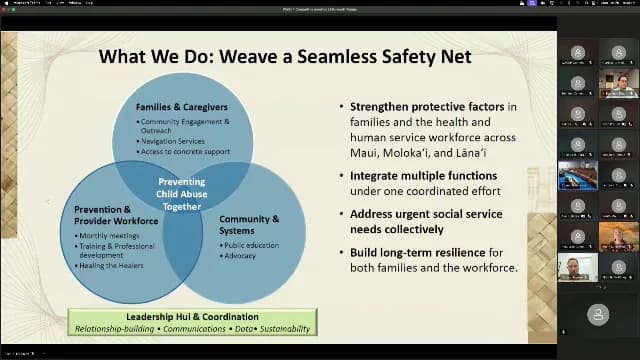
The Maui County Water, Social Services, and Parks (WASUP) Committee met on Monday, January 26, 2026, at 9:02 AM under Chair Shane Senense. The committee discussed two major items: an update on the eviction mediation process under Acts 202 and 278, and child abuse and human trafficking prevention in Maui County. Both items were deferred without objection after presentations, public testimony, and extensive discussion. Designation of Resources - For WhatsApp 115 (eviction mediation): Bavon Bowers, Executive Director of Maui Mediation Services, designated as resource under Rule 18A. - For WhatsApp 116 (child abuse/human trafficking): Deb Marwa (Ho'Okaika Partnership) and Kayla Kutaka (Parents and Children Together) designated as resources. Public Comments & Testimony - WhatsApp 115 (Eviction Mediation): No oral testimony was offered. Chair closed testimony after a countdown. - WhatsApp 116 (Child Abuse & Human Trafficking): - Kristen Mills (member of Ho'Okaika Partnership) testified in person emphasizing the lifelong impacts of Adverse Childhood Experiences (ACEs) and the need for building resiliency skills across the lifespan. She noted that ACEs underlie many chronic diseases and that community trauma (e.g., wildfires, homelessness) compounds home-based ACEs. - James Langford testified via Teams, sharing personal experiences of alleged corruption and cover-ups related to human trafficking in Maui County. He stated he had been blackmailed and threatened after reporting trafficking at a property managed by Paramount Hotels LLC. He called for truth and accountability, offering to collaborate with council members and providers. Discussion Items 1. Update on Eviction Mediation and Related Social Services (WhatsApp 1, Parent 15) - Bavon Bowers (Maui Mediation Services) presented data from Act 202 (effective Feb 5, 2025 – Feb 5, 2026): 653 cases opened, 336 proceeded to mediation, with an 80% agreement rate. Of 232 lead tenants requesting mediation, 129 were impacted by the 2023 Maui wildfires. Income data showed 48 households earning <$10,000, 57 earning $10k–$30k, 60 earning $30k–$50k, 32 earning $50k–$80k, 7 earning $80k–$100k, and 6 earning $100k. Only 13 tenants reported receiving rental assistance. Act 278 (a statewide two-year pilot) begins Feb 5–6, 2026, with a shorter 10-day tenant response period. - Mr. DeLima (Judiciary) reported that the judiciary is updating its website and documents to implement Act 278 and will have materials available online and in-person by Feb 4. - Ms. Kopwiki Santos (Office of Wellness and Resilience) noted her office will help disseminate information to the community, including through bi-weekly meetings with survivor-focused organizations. - Mr. Watanabe (Legal Aid Society) expressed concern about the 10-day timeline and lack of rental assistance, noting that tenants often miss deadlines. He clarified that FEMA housing contracts fall under different rules, often negating tenant rights. - Council discussion focused on the need for legal representation for tenants, tracking of eviction outcomes, rental assistance gaps, and the importance of public education. Members explored potential county support for mediation services and rental assistance programs. 2. Child Abuse and Human Trafficking Prevention in Maui County (WhatsApp 1, Parent 16) - Deb Marwa (Ho'Okaika Partnership) presented on child abuse prevention. She noted that founded child abuse reports in Maui County were almost halved between 2020 and 2023, but nearly 1 in 5 adults experienced 4+ ACEs before age 18. The partnership uses a protective factors framework (e.g., show Keiki aloha, talking is teaching) and provides navigation services (161 families served in 2025 by one part-time navigator). Funding from the county ($175,000/year) was delayed, causing a service gap; the contract was received only 10 days prior to the meeting, with plans to restore full-time staffing in February 2026. - Kayla Kutaka (Parents and Children Together) presented on human trafficking in Maui County. Key statistics: 80,000 online ads posted annually in Hawaii; 24% of trafficking victims are on Maui (vs. 11% of state population); 64% of victims identified as part-Hawaiian; 25% of victims were trafficked by a family member; 70% were trafficked while homeless; average age of first trafficking experience is 11. She noted only 19 arrests statewide for trafficking (2014–2020) and one federal conviction in 10 years. PACT operates Maui County's Trafficking Victim Assistance Program, providing case management, crisis response, and training. She emphasized the need for prevention, culturally grounded approaches, and improved data tracking. - Council questions addressed the role of bullying, school safety, housing insecurity, and the need for survivor-informed services. Members discussed the lack of youth shelters on Maui for trafficked youth, the importance of peer support (e.g., Youth Line), and the challenges of family-based trafficking within local culture. Key Outcomes - Deferral of Items: Both agenda items (WhatsApp 1, Parent 15 and Parent 16) were deferred without objection, meaning no immediate action was taken; discussion will continue at a future meeting. - Follow-Up Requests: - Member Batangan requested a 7B discussion on county rental assistance programs and convening stakeholders. - Members asked for written data from Bavon Bowers on household income, rent amounts, and months behind on rent. - Vice Chair Johnson expressed concern about the six-month delay in funding for Ho'Okaika Partnership and asked for specific budget needs for 2027. - The committee chair encouraged outreach materials from Maui Mediation to be shared with the public via council channels. - No votes were taken. The meeting adjourned at 11:32 AM.
The Maui County Water and Infrastructure Committee convened on January 26, 2026, at 1:34 PM, chaired by Councilmember Tom Cook. The committee considered two items: an intergovernmental agreement with DLNR for roadway maintenance (Bill 176, Y-20) and a bill to amend the water availability policy to allow concurrent review of subdivision construction plans (Bill 1, Y-21). Public testimony was taken on the second item. The committee passed Bill 176 on first reading and deferred Bill 1 to a future date pending legal clarification and input from the Board of Water Supply. Consent Calendar - No consent calendar was considered. Public Comments & Testimony - Bill Greenleaf (testifier) expressed concerns about unknown aquifer capacity, noting the county has rented a ground-penetrating machine to gauge the aquifer. He recommended deferring Bill 1 until a water survey is complete and suggested requiring private well owners to report pumping statistics. - Jeff Uyoka (testifier) supported Bill 1, stating it would allow subdivision construction plan review to happen simultaneously with water verification, potentially saving four to ten months of processing time. He clarified that developers would not proceed without confidence in water availability. - Kate Anderson (YLA 808) opposed Bill 1, arguing that Maui County is in a drought and that the bill weakens the "show me the water" requirement. She called for a centralized water authority and stronger language ensuring no building permit is issued without long-term sustainable water. - Leilani Pulmano (Pacific Rimland) supported Bill 1, stating that in her experience, water verification takes four to ten months, and concurrent processing would streamline the process. She emphasized that developers invest millions in engineering and would not proceed without certainty of water. - Greg Pullman (Lahaina resident) neither supported nor opposed Bill 1 but urged the committee to thoroughly consider the impact and potential waste of county resources if projects stall. - Michael Williams (My Tomorrow Foundation) opposed Bill 1, noting that the Department of Water Supply and Planning lack a system to review private engineering reports for private water sources. He also warned of added workload on county staff with no guarantee of final approval. - Jackie Keefe opposed Bill 1, citing community distrust and the need for better well monitoring and accountability. She argued that the bill could lead to irreversible aquifer salinity. - Robin Knox (phone testifier) opposed Bill 1, requesting more public education on the process and expressing concern that the bill would create political pressure to approve water permits after significant investment. - Travis Liggett supported Bill 1 philosophically but urged focus on reusing treated wastewater (R1 water) to address water scarcity, noting that approximately 10 million gallons per day go into injection wells. - Stacey Alaby opposed Bill 1, citing a UN report on global water bankruptcy and arguing the bill primarily benefits speculative real estate investments. She also highlighted that risk is often passed to future lot buyers. - Junior Nicola (in-person testifier) opposed Bill 1, arguing it only helps developers and not the community, and called for more community meetings before such bills are proposed. - Last testifier (name not clearly stated) supported Bill 1, noting that developers would not invest millions without high confidence in water availability and that the bill does not weaken "show me the water" requirements. Discussion Items - Bill 176 (Y-20) — Intergovernmental Agreement with DLNR for Road Maintenance - The bill authorizes the mayor to enter into a 10-year agreement with the State Department of Land and Natural Resources for maintenance of Pi Holo, Olinda, and Luana Roads near the Waiho Spring Forest Reserve. - A proposed CD1 version (Granicus number 5) amends the bill's title and makes non-substantive revisions. - Discussion: Councilmember Johnson asked about herbicide use by the state; Director Barony stated he is not aware of DOT using herbicides. Councilmember Johnson requested a letter to the state for clarification. Councilmember Paulton asked about the definition of "to the extent appropriate" and financial obligations; Director Barony explained it is a cooperative agreement with no guaranteed funding. Councilmember Paulton noted that hundreds of residents live off Huiak Road, which remains unresolved. Councilmember Hodgins expressed frustration over eucalyptus roots damaging the road and asked when repairs would begin; Director Barony said the agreement will enable resurfacing planning. The committee passed the CD1 and then the main motion as amended (8-0, with Councilmember Sugimore excused). - Bill 1 (Y-21) — Amending Water Availability Policy on Subdivision Construction Plans - The bill allows the Department of Water Supply to review subdivision construction plans concurrently with water verification, at the subdivider's risk, without weakening the requirement for a long-term reliable water source before final subdivision approval. - A proposed CD1 version (Granicus number 4) amends titles and clarifies cross-references. - Discussion: Councilmember Johnson expressed concern that the bill conflicts with the Countywide Policy Plan (Objective 1, Policy A) which requires adequate water before approval of subdivision or construction documents. Councilmember Rollins Fernandez asked if the bill would apply to commercial/industrial projects, as affordable housing subdivisions are already exempt. Director Barony confirmed it applies to all subdivisions. Councilmember Lee supported the bill, citing high costs of delays (carrying costs estimated at $50,000–$100,000 per month). Councilmember Cook emphasized the bill only changes the timing of review, not the approval requirements. - Legal Clarification: Corp Counsel noted a potential conflict with the Countywide Policy Plan if the CD1 language requiring approval of construction plans is interpreted as final approval before water verification. The committee agreed to seek legal guidance. - Next Steps: Councilmember Batangan proposed deferring the item, sending a letter to the Board of Water Supply for comments, obtaining legal clarification on the Countywide Policy Plan conflict, working with the Director of Water Supply on amendments, and adjusting the effective date to July 1, 2026. The committee agreed. Key Outcomes - Bill 176 (Y-20): Recommended passage on first reading (8-0, Sugimore excused). The bill moves to the full council. - Bill 1 (Y-21): Deferred to a future meeting. The Chair will send a letter to the Board of Water Supply requesting comments. Corp Counsel will provide legal clarification on the conflict with the Countywide Policy Plan. The Director of Water Supply will work with the Chair on potential amendments. The effective date may be set to July 1, 2026. - The meeting adjourned at 4:28 PM.
The Maui County Council convened on January 23, 2026, at 9:12 a.m. (with a scheduled start time of 19:15 UTC) under Chair Alice Lee. The meeting included ceremonial resolutions honoring a collegiate baseball star and healthcare heroes, public testimony on several bills, appointments to boards and commissions, and first- and second-reading votes on ordinances addressing water conservation, factory-built housing in the Lahaina burn zone, and property tax exemptions. Key debates centered on Bill 15 (factory-built housing), Bill 161 (interim swimming pool restrictions in West Maui), and Bill 168 (affordable housing property tax exemption). The council also took action on committee referrals and filings. Public Comments & Testimony - Ceremonial Resolution 26-6 (Vihiva Aloy): Family members and friends testified in support, expressing pride in the baseball player's achievements and his role as an ambassador of aloha. - Ceremonial Resolution 26-7 (Healthcare Honorees): Testifiers praised the dedication of awardees, including Richard Coloma (community health worker) and Eliza Sanaro (scholarship recipient), highlighting their work with kapuna and vulnerable populations. - Bill 15 (Factory-built housing): Mark Clemente (Hawaii Regional Council of Carpenters) raised concerns about inspection authority, liability, equal safety standards, and warranties. Noe Al Pitao questioned transportation logistics and insurance. Elikia Kona supported the bill, citing water shortage urgency. James Langford advocated for 3D-printed homes. - Bill 161 (Swimming pool moratorium): Joey Medeiros (pool builder) argued pools use less water than grass, suggesting alternatives like pool covers. Elikia Kona and others supported the temporary moratorium, citing West Maui's water system exceeding capacity by 41.8%. - Bill 168 (Property tax exemption): Alan Lloyd (Maui Tenants and Workers Association) supported the intent but argued the $400,000 exemption is too small to incentivize landlords, and recommended requiring participation and certification. - Bill 17 (Social host ordinance repeal): Rick Collins (Maui Coalition for Drug-Free Youth) requested the bill be moved to committee for refinement rather than repeal. Reverend Dennis Barger and Lori Tanner testified in support of retaining the ordinance to prevent underage drinking. Discussion Items - Resolution 26-6 (Congratulating Vihiva Aloy): Adopted unanimously after testimony and family remarks. - Resolution 26-7 (Healthcare Honorees): Adopted unanimously. - Resolution 26-8 (Real Property Tax Reform Committee roster): Adopted 9-0, replacing late councilmember Tasha Kama with Kawanoi Batangan. - Resolution 26-9 (South Maui Community Plan time extension): Adopted 9-0, extending the planning commission's deadline to June 30, 2026. - Resolution 26-10 (Appointing Faith Chase to Police Commission): After extensive discussion on multiple board service and qualifications, the motion to adopt failed 4-5. Subsequently, a motion to file the resolution carried 5-4. - Resolution 26-12 (HANA Advisory Committee): Amended to approve Cheryl Ann Leigh (designated cultural practitioner) and Bailey June Sprite, placing Faith Chase on the disapproval list. Adopted 9-0. - Resolution 26-13 (Commission on Healing Solutions for Homelessness): Amended to approve Zach Mathers (designated faith-based leader), term expiring 2031. Adopted 9-0. - Resolution 26-14 (East Maui Regional Community Board): Amended to reappoint Norman Bush Martin Jr. and Lurlin Scott for full terms, with Faith Chase and Verilyn Latham moved to disapproval. Adopted 9-0. - Bill 15 (Factory-built housing in Lahaina burn zone): First reading passed 6-3 after floor amendments to limit scope to residential housing only, exclude commercial structures, and add a sunset date of December 31, 2031, with a report to council on success metrics. The bill was referred to the Housing and Land Use Committee for further work before second reading. - Bill 161 (Interim swimming pool restrictions): Second reading passed 6-2-1 (excused). The moratorium applies to new private swimming pools in the West Maui community plan area until water supply capacity is determined. - Bill 168 (Property tax exemption for affordable housing): Second reading passed 7-0-2 (excused). The bill provides a $400,000 exemption for long-term rental properties, effective for the next tax year. - Bills 158, 177, 178, 3, 4, 5, 6, 7, 8, 11, 18, 19, 20: Passed on second and final reading with minimal debate, including appropriations for wastewater projects, historic preservation, EPA stormwater grants, and affordable housing programs. Key Outcomes - Votes and Decisions: - Resolution 26-6, 26-7: Adopted 9-0. - Resolution 26-8, 26-9: Adopted 9-0. - Resolution 26-10: Motion to file carried 5-4 (after initial failure 4-5). - Resolution 26-12, 26-13, 26-14: Adopted 9-0. - Bill 15 (first reading): Passed 6-3 (aye: Senecy, U Hodgins, Rollins Fernandez, Johnson, Paulton, Lee; nay: Cook, Sugimura, Batangan). - Bill 161 (second reading): Passed 6-2-1 (aye: Senecy, Rollins Fernandez, Johnson, Paulton, Batangan, Lee; nay: Cook, Sugimura; excused: U Hodgins). - Bill 168 (second reading): Passed 7-0-2 (excused: Batangan, U Hodgins). - Bills 158, 177, 178, 3, 4, 5, 6, 7, 8, 11, 18, 19, 20: All passed on second reading with 8-0-1 or 8-0-2 votes. - Referrals: Bill 13 (advertising on buses) to ADEPT; Bill 14 (workforce housing preference) to HLU; Bill 16 (low-speed electric bicycles) to Hawaii committee; Resolution 26-11 (charter amendment on council vacancies) to GRET. - Next Steps: Bill 15 will be heard in committee (HLU) before second reading, with a report from Public Works on success metrics. The social host ordinance (Bill 17) was postponed to the next council meeting pending a 7B discussion.