Browse by city
Date range
Search help

Search titles, summaries, topics and stored transcripts together. Keywords may match separately; put the whole query in double quotes for a phrase. Matching follows word analysis, so punctuation is not exact. Both dates are included. Documents are not searched.

SHOWING 21–30 ENTRIES
21
SEP 22, 2026 · MAUI COUNTY, HAWAII · COUNTY COUNCIL & COMMITTEES
Maui County Council GREAT Committee Recommends Settlement Resolution 26-147 – September 22, 2026

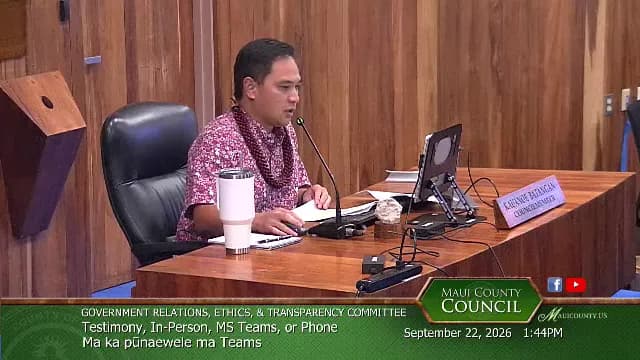
The Government Relations, Ethics, and Transparency (GREAT) Committee of the Maui County Council met on Tuesday, September 22, 2026, beginning at 1:31 p.m., by Teams videoconference and in the Council Chamber in Wailuku, Hawai‘i. The sole agenda item was Resolution 26-147, which would authorize settlement of Kathleen Platt v. County of Maui, et al., Civil Case 2CCV-25-0003688. The committee received the proposed resolution and an August 24, 2026 Corporation Counsel transmittal. The underlying claim—described in the agenda as a claim and by Corporation Counsel as the lawsuit—was filed October 8, 2025, and alleged negligence and premises liability from a March 8, 2024 incident at Kulamalu Park in Pukalani. After receiving testimony, discussing the item, and convening in executive session, the committee voted 7-0 to recommend adoption. Public Comments & Testimony - No testimony was initially scheduled, but one caller using the last four digits 4945 testified. The caller said he had no access to meeting information, recommended creating a public access point, expressed agreement with Parks Director Pat McCall about weather-related destruction of county buildings, and urged the County to stop money from “bleeding out” and to curb Corporation Counsel spending related to taking people to court on harassment-related privilege charges. - No other oral testimony was offered; the chair closed oral testimony after a final call. Written testimony remained available. Discussion Items - Deputy Corporation Counsel Abby Hoke stated that the plaintiff was carrying her granddaughter down stairs at Kulamalu Park, reached for a railing on a smaller landing and found none, fell, and claimed damages including a fractured hip, pain and suffering, and emotional distress. Hoke said the County received a confidential settlement offer and submitted Resolution 26-147 for consideration. - Parks Director Pat McCall said the Department of Parks and Recreation had discussed the matter with Corporation Counsel and agreed with the proposal. - Councilmember Tamara Paltin asked whether the County built the stairs and whether they met legal review. McCall replied that the park was built privately and later dedicated to the County; the stairway met code at the time of dedication in 2011 but is now out of code due to code changes. He offered further detail for executive session. Paltin also asked about prior injuries; McCall said Parks and Corporation Counsel had no record of other injuries. - Council Chair Alice Lee asked whether repairs had been made since the accident; McCall said no repairs had been made. Lee noted the park is used for sports, especially Pop Warner football, with children running on the stairs. - The committee voted 7-0 to enter executive session under HRS 92-5(a)(4) and HRS 92-5(a)(8) to consult with legal counsel and discuss confidential settlement information. Members Gabe Johnson and Keani Rawlins-Fernandez were excused. - After reconvening at 2:27 p.m., Legislative Attorney Peter Hanano provided the required public summary: the executive session covered the County’s powers, duties, privileges, immunities, and liabilities related to the lawsuit, including the strengths and weaknesses of the case, alleged damages, settlement efforts to date, Corporation Counsel’s recommendation, and proposed settlement authority. Key Outcomes - A motion to recommend adoption of Resolution 26-147, including any non-substantive revisions, was made by Councilmember Yuki Lei Sugimura and seconded by Vice Chair Nohelani U‘u-Hodgins. - The motion passed 7 ayes, 0 noes; Councilmembers Johnson and Rawlins-Fernandez were excused. - The committee meeting adjourned at 2:29 p.m.

PENDING LITIGATION 47% · PROCEDURAL 31% · PUBLIC ENGAGEMENT 11% · LEGAL COUNSEL 11%
22
SEP 21, 2026 · MAUI COUNTY, HAWAII · COUNTY COUNCIL & COMMITTEES
Maui County Council DRIP Committee Meeting on South Maui Community Plan Update - September 21, 2026

The Disaster Recovery, International Affairs, and Planning Committee (DRIP) met on Monday, September 21, 2026, from 9:04 a.m. to 4:36 p.m. (with recesses) to continue reviewing Bill 108 (2026), which would adopt the updated South Maui Community Plan. The day focused on Section 4 (Implementation and Monitoring) and some discussion of Section 3 (Growth Framework). Resource person Dick Mayer presented a detailed analysis of potential housing units, traffic impacts, water demand, and the need for a robust financial plan. The committee heard public testimony and then worked through numerous implementing actions, adopting several amendments and marking others for future review. Public Comments & Testimony - Johan Law: Expressed different views from Dick Mayer, noting that population growth is complex and that vacant housing and turnover affect numbers. Supported the plan's approach to financing and opportunities for recycled water and reducing car dependency. - Caller 4945 (Danny): Criticized county lawyers for limiting public participation and urged more spending on recycling and community programs rather than litigation. - Greg Rilski: A Lahaina fire survivor, emphasized the need for evacuation routes and fire mitigation infrastructure before adding more housing. - Albert Perez (Maui Tomorrow): Detailed the mandatory requirements under Maui County Code 2.80B.070 for a fiscally sound financial program and implementation schedule, arguing the current draft lacks adequate fiscal impact analysis. - Kay Anderson: Noted that the South Maui plan forecasts 3,700–6,100 new residents and 800–1,700 new homes, but 4,500 units are already in the pipeline. She urged the committee to stop at 4,500 and defer the additional 3,500 units to a future plan. - Kayola Whitaker: Advocated for changing 'require' to 'encourage' in policies 2.2.18 and 2.2.19 to avoid legal conflicts with Chapter 2.96 workforce housing agreements, and moving policy 2.2.26 (genealogical preference) to the code rather than the community plan. - James Langford: Raised concerns about drug and human trafficking in South Kihei and claimed whistleblower retaliation. Urged the committee to consider these issues in the plan. - Robert Bence: Echoed Dick Mayer's analysis, opposed pro-development attorneys, and supported the community plan as binding. Highlighted the need to protect wetlands and evacuation routes. Discussion Items - Presentation by Dick Mayer: Detailed analysis of 8,000 potential units (4,500 already entitled, 3,500 new) from projects such as North Kihei Mauka, Lapoa, LEDCO/Honokahua, Makena, and golf course conversions. Estimated 6,800 additional vehicles, water demand of 6 million gallons/day, and a de facto population of 50,000–70,000. Criticized the plan for lacking unit counts, traffic analysis, and a fiscally sound financial plan as required by code. Noted only 80 of 145 infrastructure items have cost estimates. - Review of Section 4 Implementing Actions (Goal 2.1 – Transportation and Infrastructure): - 1.01A/B (Kihei Transit Hub): Amended to change DOT to M. DOT (Maui County Dept. of Transportation) and add acronym. Approved. - 1.02 (Additional Transit Hub near Māʻalaea): Amended to expand existing hub (seating, shade) rather than build a new one, with cost estimate of $2 million. Approved. - 1.03 (North-South Collector Road): Discussion on connecting roads (Kanakanui, Kanani, ʻĀlana). Marked for revisit with DPW input, specifically the Kaʻonoulu to North Kihei Road segment. - 1.04A/B (Keālia Bypass Road): Marked for revisit with DPW to discuss alignment options (Mokulēʻle Highway to Kuihelani Highway or to North Kihei Road). - 1.05A/B (Multimodal Level of Service): Lead agency changed to MPO. Approved. - 1.06 (South Kihei Road Adaptation): Discussion on retreat vs. adaptation; deferred to Goal 2.3 (Ready and Resilient Systems). - 1.07–1.09: Various amendments to add private funding sources and clarify lead agencies. Approved. - 1.10 (Makena Alanui Bike Lane): Marked for revisit with DPW on feasibility and right-of-way. - 1.11–1.14: Approved with minor amendments (e.g., adding MPO for safe routes programs). - 1.15 (Acquire Parcels for Connectivity): Approved as written. - 1.16 (New Multimodal Corridor): Amended to include 'acquire easement' and added DPW and Finance as lead agencies. Approved. - 1.17 (Wayfinding Signage): Amended to consult with Dept. of ʻŌiwi Resources (OEV) and include DPW. Approved. - 1.18–1.23: Approved with non-substantive changes (M. DOT acronym) and amendment to change lead agency for EV charging from DOT to DPW. - 1.24 (Emergency Evacuation Routes): Amended to include private roads, changed priority to high, added MEMA as lead agency. Approved. - Goal 2.2 – Parks and Open Space: - 2.01 (Entryway Sign): Approved as ongoing, low priority. - 2.02 (Streetscape Beautification Adoption Program): Added Dept. of Management as lead agency. Approved. - 2.03 (Litter-Free Roads Program): Added Dept. of Management. Approved. - 2.04 (Park Acquisition Strategy): Split into 2.04A (update South Maui Region Parks and Open Space Master Plan) and 2.04B (obtain funding for acquisitions). 2.04A includes $250,000 cost estimate. Approved. - 2.05 (Support for Makaluapuna Preserve): Approved as written. - 2.06 (Community Gardens): Added Maui County Dept. of Agriculture (MDOA). Approved. - 2.07 (Overnight Camping Feasibility): Approved. - 2.08 and 2.09 (Government Trails and Shoreline Access): Timing changed from 'short' to 'ongoing'. Approved. - 2.10 (Shoreline Access Restoration): Added 'private' funding source and changed 'HRS 115-4 and 5' to 'mandated by state law' to avoid reference to specific code sections. Approved. - 2.11 (Waipuilani Beach Reserve Project): Added Dept. of Management and Parks & Recreation as lead agencies. Approved. - 2.12 (Environmental Footprint Plan): Incorporated into 2.04A (update master plan). Approved. - 2.13 (Kilohana Park Expansion): Discussion on passive park use; deferred to next meeting for final wording. Key Outcomes - The committee adopted multiple amendments to implementing actions, including adjustments to lead agencies, cost estimates, priority levels, and language to improve clarity and avoid legal conflicts. - Several items were marked for revisit when the Department of Public Works is available (e.g., 1.03, 1.04, 1.10, 1.16). - The committee voted to incorporate 2.12 into 2.04A and to add MEMA to 1.24. - All votes were unanimous (7-0, 8-0, or 9-0) with occasional excused absences. - The meeting recessed at 4:36 p.m. and will reconvene on Tuesday, September 22, 2026, at 9:00 a.m. to continue Section 4 review. The previously scheduled Wednesday meeting was canceled due to slower progress, and the committee will recess Tuesday's meeting into Wednesday and Thursday as needed.

PARKS AND RECREATION 13% · TRANSPORTATION 10% · PLANNING 9% · PROCEDURAL 8%
23
SEP 18, 2026 · MAUI COUNTY, HAWAII · COUNTY COUNCIL & COMMITTEES
Maui County DRIP Committee Advances South Maui Community Plan Update on September 18, 2026

The Disaster Recovery, International Affairs, and Planning (DRIP) Committee of the Maui County Council reconvened from September 17, 2026, at 9:05 a.m. to continue discussion on Bill 108 (2026), which would adopt the updated South Maui Community Plan. The meeting focused on Section 2 (Policy Framework) and included extensive deliberation on coastal retreat, watershed management, gulch protections, and cultural resource policies. Several policies were amended, and a number of items were deferred for further work with county departments. The committee aims to complete Section 2 review before moving to Section 4 (Implementing Actions). Public Comments & Testimony - Oral testimony on DRIP-25 (Bill 108) was closed on September 17, 2026, but written testimony continued to be accepted. Discussion Items - Policy 2.3.6 – Coastal Retreat (Revisit): Chair Paltin proposed a policy to support land use entitlements for coastal retreat through transfer of water credits. After discussion with Water Department’s James Jensen and Corporation Counsel, the committee agreed to table the item to develop broader language with input from wastewater and other utilities. The policy will be revisited later in the process. - Policy 2.4.2 – Prioritize Green Infrastructure: The committee voted to amend the policy to read: "Prioritize traditional Hawaiian cultural practices, other nature-based solutions, low impact design and green infrastructure strategies rather than gray infrastructure to manage flooding and prevent surface water pollutants from flowing into streams and reaching the ocean." Motion passed 6-0-3 (excused: Sugimura, Batangan, Johnson). - Policy 2.4.5, 2.4.6, 2.4.7 – Gulch and Drainage Protections: These related policies were deferred after Public Works Director Jordan Mulina raised concerns about flood mitigation and the definition of low impact development. The committee directed Planning, Public Works, and Corporation Counsel to draft revised language that balances water quality goals with flood control needs, to be discussed on Monday. - Policy 2.4.15 (Split) – Low Impact Development: The first part (require LID) passed unanimously. The second part (encourage management of flows 5-year storm event) was debated. After Director Mulina noted that existing drainage rules already require mitigation for 50- and 100-year events, the committee agreed to drop the second policy as redundant. - Policy 2.4.17 – Deleted: Because the SMA permit for new restrooms at McKenna State Park has already been approved, the committee voted to delete this policy (motion passed 6-0-3). - Policy 2.5.1 – Native Hawaiian Access: Amended to ensure development projects provide continued access to kuleana lands and areas where native Hawaiian rights were customarily exercised, citing applicable laws. Passed 8-0-1. - Policy 2.5.6 – Historic Roads: Amended to separate preservation from restoration: "Ensure existing government trails and historical roads are preserved... encourage the restoration... to the extent practicable." Passed 8-0-1. - Policy 2.5.7 – Tree Preservation: Amended to require preservation of healthy, mature, non-invasive trees during development, with consultation with Department of OEV Resources. Passed 8-0-1. - Policy 2.5.9 – Use of Ike Kupuna: Amended to incorporate traditional ecological knowledge in design of new development. Passed 6-0-3. - Policy 2.5.11A & 2.5.11B – Historic Properties: Deferred for Planning and Corporation Counsel to refine language, particularly regarding "adjacent" vs. "same parcel." - Policy 2.5.13 – Community Stewardship: Amended to include "culturally appropriate" community stewardship of wahi kupuna. Passed 8-0-1. - Policy 2.5.14 – Deleted as redundant with 2.5.6. - Policy 2.5.17 – Cultural Center: Amended to support a cultural center and museum in South Maui. Passed 8-0-1. - Additional Revisits: Chair Paltin noted three items requiring further work with departments: (1) coastal retreat policy (2.3.6) – with Water, Wastewater, and Corporation Counsel; (2) gulch policies (2.4.5, 2.4.6, 2.4.7) – with Planning, Public Works, and Corporation Counsel; (3) a new policy on natural resources (sand, sediment, pohaku) not being moved between moku without consultation – to be drafted by Councilmember Cook, Vernon Kalanikau, and OEV Resources. Key Outcomes - Votes passed on amendments to policies 2.4.2, 2.4.4, 2.4.12, 2.4.13, 2.4.15, 2.4.16, 2.4.17 (deletion), 2.5.1, 2.5.2, 2.5.6, 2.5.7, 2.5.9, 2.5.13, 2.5.14 (deletion), and 2.5.17. All passed with at least 6 ayes and no opposed votes; absent/excused members noted. - Deferred items: Coastal retreat policy (2.3.6), gulch policies (2.4.5-2.4.7), historic properties policy (2.5.11A/B), and new natural resources policy. These will be revisited after departments provide revised language. - Next steps: The committee will reconvene on Monday, September 21, 2026, to hear testimony on Section 4 (Implementing Actions) and receive guidance from Corporation Counsel on fiscal requirements. The target is to complete Section 2 review by end of that meeting. - Meeting adjourned at approximately 4:30 p.m.

PROCEDURAL 13% · PLANNING 12% · FLOOD RISK MANAGEMENT 12% · COASTAL MANAGEMENT 9%
24
SEP 17, 2026 · MAUI COUNTY, HAWAII · COUNTY COUNCIL & COMMITTEES
Disaster Recovery Committee Reviews South Maui Community Plan Update – September 17, 2026

The Disaster Recovery, International Affairs, and Planning Committee of the Maui County Council met on September 17, 2026, to continue its review of Bill 108 (2026), which would adopt the updated South Maui Community Plan. The committee focused on Section 2.3 (Ready and Resilient Systems) and heard a powerful presentation on flooding from former CPAC member Vernon Kalani Kao. Public testimony emphasized the need for strong, enforceable policies, especially regarding flood zones, wetlands, and infrastructure. The committee debated and voted on several policy amendments, held an executive session on legal considerations, and adjourned to reconvene on September 18, 2026. Public Comments & Testimony - Jeffrey Law testified in support of Vernon Kalani Kao's presentation, advocated for a return to traditional ʻāina-based systems, and expressed frustration with being unable to fully participate in the meeting process. - Johan Law praised the presentation as compelling and stressed the importance of science-based planning and proper buffers for gulches to mitigate flooding. - James Langford urged the committee to consider the cumulative costs of poor development and called for greater accountability from developers. - Randy Wagner highlighted the need for wide gulch protection (150 feet), reinstatement of policy 2.2.37 requiring infrastructure before development, and preservation of critical wetland parcels. - Albert Perez opposed building in flood zones, especially for affordable housing, and urged strong, enforceable language rather than vague terms like "encourage." He also criticized attempts to keep the plan toothless. - Dick Mayer requested to be scheduled as a resource person for a future presentation on cumulative impacts. Discussion Items - The committee began with Section 2.3 (Ready and Resilient Systems) after closing Section 2.2 the previous day. - Policy 2.3.1 (climate change/sea level rise) was amended to adopt the recommended language, striking "to development" to read "to minimize damages from future coastal erosion." Passed 8-0-1. - Policy 2.3.2 (proactive coordination) was accepted without amendment. - Policy 2.3.3 (shoreline protection) was amended to adopt the recommended language. Passed 7-0-2. - Policies 2.3.4 through 2.3.9 were accepted without amendment or with non-substantive changes, except 2.3.9 (renewable energy) was kept with an asterisk referencing similar countywide policies. - Policy 2.3.10 (sand removal) was debated at length. The committee adopted the recommended language adding Department of OEV Resources as a required consultant, with a note to add related action for emergency pre-authorized agreements. Passed 7-0-2. - Policy 2.3.13 was deleted because it was duplicated by Action 3.1.4 in Section 4. Passed 7-0-2. - Policy 2.3.14 (resilient transportation) had only a non-substantive change (pluralization) and was accepted. - Policy 2.3.15-2.3.16 were accepted as written. - Policy 2.3.17 (emergency shelters) was discussed; the committee left the language as adopted from the planning commission, noting that further specificity could be added via code or action items. - Policy 2.3.18 (water code consistency) was amended to the recommended language. Passed 6-0-3. - Policy 2.3.19 (landscaping) was amended to include "including canopy trees to the extent practicable" after debate. Passed 6-0-3. - Policy 2.3.20 (catchment/greywater) was amended to recommended language. Passed 6-0-3. - Policy 2.3.21 (water as highest priority) was accepted without change. - Policy 2.3.22 (recycled water connections) was amended to recommended language, removing specific code references. Passed 6-0-3. - Policy 2.3.23 (gray/recycled water in county parks) was amended to "require... when available and legally permissible" after discussion. Passed 6-0-3. - Policy 2.3.24 (Maʻalaea wastewater) was accepted as written. The committee briefly considered adding a similar policy for the HECO power plant but deferred pending further discussion. - Policy 2.3.25 (injection wells) was amended from "eliminate" to "move toward eliminating" based on input from the Department of Environmental Management. Passed 6-0-3. - Policy 2.3.26 (R1 water utilization) was accepted without change. - The committee held an executive session from approximately 11:05 a.m. to 1:33 p.m., consulting with Corporation Counsel on legal considerations regarding the general plan, state law, and county ordinances. The summary disclosed that the committee discussed the awkwardness of a community plan policy that itself amends the same plan, and general support for managed retreat. Key Outcomes - The committee completed its review of nearly all policies in Section 2.3, with several amended as noted. - The main motion on Bill 108 (2026) (recommending passage on first reading) carried over from the previous day and remains pending. - The committee will reconvene on September 18, 2026 at 9:00 a.m. to review revision of Section 2.3 introduction, any additional policies for 2.3, and begin Section 2.4 (Mauka to Makai Watershed Management) and Section 2.5 (Responsible Stewardship). - Written testimony remains open throughout the process.

WATER AND WASTEWATER MANAGEMENT 16% · FLOOD RISK MANAGEMENT 11% · PROCEDURAL 8% · RESOURCE MANAGEMENT 8%
25
SEP 16, 2026 · MAUI COUNTY, HAWAII · COUNTY COUNCIL & COMMITTEES
DRIP Committee Meeting – September 16, 2026: South Maui Community Plan Policy Review

The committee reconvened from September 15 to continue its review of Bill 108 (2026), which would adopt the updated South Maui Community Plan. The day was dedicated to examining Section 2 (Policy Framework) of the draft plan, focusing on policies 2.2.1 through 2.2.46. The committee debated redundancy, specificity, and legal implications of various policies, making numerous amendments and voting on each. Oral testimony had been closed the previous day, but written testimony was still accepted. The meeting recessed for lunch and continued into the afternoon, adjourning at 4:08 p.m. Discussion Items - Redundancy of policies across plans: The committee discussed policies that appear verbatim in the countywide policy plan and Maui Island Plan. Chair Paltin proposed adding an asterisk to denote redundancy while retaining the policy in the community plan. Members expressed support for case-by-case decisions. (Policy 2.2.5, 2.2.8, 2.2.1) - South Maui Tree Canopy Plan: A motion was passed (6-1-2) to amend policy 2.2.14 to require new development to comply with the urban forest management plan (Heinohona Ulu) until the South Maui Tree Canopy Plan is adopted. - Pedestrian-oriented development: After extensive debate, the committee voted unanimously (7-0-2) to split policy 2.2.17, requiring new developments to be pedestrian-oriented and, to the extent practicable, include mixed uses, jobs, schools, etc. - Workforce housing and credits: The committee struck a proposed policy requiring high-end/luxury developments to provide workforce housing on-site (motion passed 6-0-3). Members noted this would be better addressed through a countywide code amendment. - Affordable housing preferences: A motion to add “to the extent permitted by law” to a policy encouraging local residency preferences passed 7-0-2. - Shoreline access: Policy 2.2.33 was amended to separate guidelines on public shoreline access and environmentally sensitive access, adding “unobstructed” to the latter (passed 6-0-3). - Gated communities: A motion to add “to the extent permitted by law” to a discouragement of gated communities passed (voice vote). - Infrastructure prior to development: A motion to reinstate a policy requiring infrastructure before new development failed (4-1-4). - Grid hardening: Policy 2.2.45 was amended to include examples such as clearing and graveling near power lines (passed 5-0-4). - Deletion of two policies: The committee voted to delete policies 2.2.45 and 2.2.46, as they were covered elsewhere (passed 5-0-4). Key Outcomes - Bill 108 (2026) remains under consideration; the committee will continue with amendments tomorrow (September 17). - Votes: Multiple amendments passed with votes typically 7-0-2 or 6-0-3, reflecting two excused members (Councilmembers Sugimura and U‘u-Hodgins) and occasional absences. - Planning data: The Planning Director reported that only 12% of the 1998 Kihei-Makena plan actions have not begun; 34% are complete, 21% ongoing, and 33% in progress. - Next steps: The committee will resume at 9:00 a.m. on September 17, with public testimony, possible executive session, and review of remaining policies and actions.

LAND USE PLANNING 13% · AFFORDABLE HOUSING 11% · ZONING CODE REVISION 10% · PLANNING 9%
26
SEP 15, 2026 · MAUI COUNTY, HAWAII · COUNTY COUNCIL & COMMITTEES
Maui County DRIP Committee Reviews Bill 108 South Maui Community Plan Update – Sept 15, 2026

The Disaster Recovery, International Affairs, and Planning (DRIP) Committee of the Maui County Council met on September 15, 2026, to discuss Bill 108 (2026), which would update the South Maui Community Plan. The committee focused on Section 2 (Policy Framework), beginning with transportation policies (Goal 2.1) and continuing into safe, healthy, livable communities (Goal 2.2). The meeting included public testimony, discussion of proposed amendments, and votes on several policy changes. A main motion to recommend passage of Bill 108 on first reading was made and seconded, with work continuing through amendments section by section. The meeting adjourned in recess until September 16, 2026, at 9:00 a.m. Public Comments & Testimony - Multiple testifiers expressed that the plan was being rushed and that the public had insufficient time to review and respond. Some noted that the process has been ongoing since 2020–2021, but many residents only learned of the final details recently. - Kay Anderson alerted the committee that the Wailea Golf description in the plan is outdated; the Maui Planning Commission approved a revised Wailea Golf plan in March 2025, but the current draft still contains the old version. - Travis Liggett proposed the SMILAST framework to allow large philanthropic donations for wastewater disinfection, irrigation reuse, and a greenbelt firebreak along South Maui. - Lucianne Dinay criticized the inability to copy text from the draft plan and urged clearer, enforceable language (e.g., changing “encourage” to “require”) for infrastructure policies. - Nick Drance demanded an immediate moratorium on large-scale coastal zoning variances until an evacuation capacity study is completed and concurrency management is codified. - Robin Knox asked for facilitated community meetings with both in-person and remote capacity to improve public engagement. - Albert Perez (Maui Tomorrow Foundation) urged rejection of 3,500 additional housing units, stating South Maui already has 4,500 entitled units and needs infrastructure for existing residents first. - Doug Ballard argued that growth must pay for itself through impact fees and called for reinstating concurrency language in the plan. - Other testifiers raised concerns about cumulative impacts, lack of a financial plan, evacuation routes, and the need for housing for local residents rather than luxury investor units. Discussion Items - The committee established a process to work through the plan section by section, with a main motion on the whole plan and amendments considered as they arise. No straw polling or consensus decisions were used; the draft stands unless amended. - For Section 2.1 (Transportation), the committee debated several policies: - Policy 2.1.1: Kept “measurably efficient” (as added by CPAC) and added cross-reference to implementing actions 105A and 105B. Motion passed 7-0-2. - Policy 2.1.2: Kept “and implement” and cross-referenced actions 112–115. Passed 7-0-2. - Policy 2.1.3: Amended to include “when practicable” and delete “all.” Passed 6-0-3. - Policy 2.1.5: Set a 50-foot landscaped setback for undeveloped parcels along Piʻilani Highway, with a pedestrian/bike path where possible. Passed 5-0-4. - Policies 2.1.6 and 2.1.7 were combined: “For all new or redesigned intersections, a roundabout must be considered instead.” Passed 5-0-4. - Policy 2.1.8: Adopted recommended language broadening to “including affordable and workforce housing projects.” Passed 5-1-3. - Policy 2.1.10: Added reference to implementing action 102. Passed 5-0-4. - Policy 2.1.12: Amended to include “including in and around the Lipoa Business District.” Passed 5-0-4. - Policy 2.1.16: Added “to the extent practicable.” Passed 6-0-3. - Section 2.1 was closed for later revision; the committee noted they may add policies on evacuation routes or coastal retreat later. - The committee then began Section 2.2 (Safe, Healthy, Livable Communities). Amendments included: - Policy 2.2.2: Changed “may” to “should” regarding funding for park maintenance. Passed 6-0-3. - Policy 2.2.9: Changed “a hālau space” to “hālau spaces.” Passed 6-0-3. - Policy 2.2.11: Added “cultural sites” to protections. Passed 6-0-3. - Policy 2.2.12: Split into two policies (2.2.12 on native trees/plants; 2.2.13 on preservation of native seed banks). Passed 6-0-3. - Corporation Counsel advised that the committee has broad discretion to amend the plan without sending changes back to the Planning Commission, and that only a simple majority is needed (not two-thirds). - The committee deferred executive session until more members are present. Key Outcomes - Main motion to recommend passage of Bill 108 on first reading was made by Member Shane Sinenci and seconded by Member Yuki Lei Sugimura. Discussion and amendments proceeded under that motion. - Multiple amendments were adopted as detailed above, with votes recorded for each. - The committee will continue review on Wednesday, September 16, 2026, at 9:00 a.m., starting with the remainder of Section 2.2. - The committee directed staff to correlate implementing actions with policies and to renumber policies/actions as a non-substantive change. - Written testimony remains open; oral testimony will be taken at the start of each subsequent meeting.

PLANNING 16% · TRANSPORTATION 16% · PROCEDURAL 15% · LAND USE PLANNING 11%
27
SEP 15, 2026 · MAUI COUNTY, HAWAII · COUNTY COUNCIL & COMMITTEES
Disaster Recovery Committee Meeting on South Maui Community Plan - September 15, 2026

Note: The agenda listed the meeting as September 14, 2026, but the provided date for this summary is September 15, 2026. The meeting took place in-person at Kihei Community Center from approximately 5:07 p.m. to 7:32 p.m. (HST). The committee heard a presentation from the Planning Department and received public testimony on Bill 108 (2026) to adopt the updated South Maui Community Plan. No legislative action was taken; the meeting was for discussion and community input only. Public Comments & Testimony - Kay Anderson (resident): Expressed concern that the plan projects 3,700–6,100 new residents but identifies over 8,000 new units, potentially doubling the population. She questioned infrastructure, water (citing 98% sustainable yield of Central Maui system), and the lack of a financial plan. She also noted inconsistencies with the Wailea Golf Plan. - Nick Drance (resident): Criticized the plan for lacking specific infrastructure costs and benefits, called for detailed financial accountability, and highlighted erosion and evacuation risks. He stated the plan contradicts countywide policy and felt the process moves too fast. - MJ Duberstein (resident): Opposed the “rush to judgment,” cited conflicts of interest, and asked for detailed plans for affordable housing and policies for the unhoused. He referenced the 2012 Maui Island Plan. - Charlotte Chandrika McLaughlin (resident): Opposed additional development, citing traffic gridlock, flood risks, water shortages (Kamaole aquifer overdraft), and desalination harm to reefs. She urged preserving open space and requiring infrastructure upgrades before growth. - Stephanie Musbach (resident): Accused the council of ignoring community input, demanded infrastructure be completed before new housing, and referenced the county’s forecast of only 1,700 needed housing units. - Kelly King (former councilmember): Advocated returning to the CPAC version of the plan, noting that the Planning Commission removed strong infrastructure-first policies. She stated the Planning Commission lacked South Maui representation and urged slowing the process. - Eve Hogan (Ma'alaea condominium owner): Requested that South Maui’s updated plan recognize Ma'alaea as a mixed-use harbor area, not as conventional residential, noting sea-level rise exposure and lack of infrastructure. - Autumn Ness (resident): Shared personal experiences of flooding, wetland failure, and reef degradation. She urged mandatory language requiring water, wastewater, and stormwater upgrades before any development. - Robin Knox (resident, KCA member): Emphasized the need for infrastructure before growth, called transportation and evacuation routes inadequate, and supported the CPAC version. She noted the North-South Collector Road is not a full solution. - Brad Anderson (representing Makena Golf & Beach Club): Raised four technical points: stormwater retention basin conflicts, map alignment issues with gulches, affordable housing policy inconsistency with HUD rules, and a map mislabeling a private park as government facility. He said he would submit written details. - Randy Wagner (resident, design review): Urged returning to CPAC language, especially concurrent infrastructure requirements. Noted that the Kīhei Māʻalaea development’s occupancy should be tied to road completion. - George Rixie (architect, former KCA president): Stressed that the 1996 plan’s vision was good but implementation failed. He advocated using “shall” language for critical policies, especially drainage and traffic. - Lucien DeNay (historian): Advocated stronger cultural site protections and not rushing the process. Recommended prior due diligence on archaeological sites before zoning. - Sheila Walker (resident): Requested tsunami zone overlay be added to planning maps. - Anita Schmidt (resident, business owner): Called the development plan a “death trap” due to lack of evacuation routes, shared personal experience of traffic gridlock during tsunami warning, and urged stopping all new housing until infrastructure is in place. - Suzanne Lall (resident, facilitator): Asked to slow down and foster more community dialogue, noting climate change impacts and insurance concerns. - Keawe A. (kupuna) : Shared generational perspective, echoed need to slow growth, cited loss of cultural sites, and supported affordable housing only with infrastructure first. - ʻAlohalani Hill (former planning commissioner, cultural advisor): Emphasized listening to the earth and community, called South Maui a death trap in emergencies, and urged a slower, more deliberate process. - Anonymous (resident): Noted land use outpacing infrastructure, high cost of living, fire risk, and requested that the vision statement be read at each meeting and that council members “walk the land.” - Lexi Sawaki (resident): Highlighted lack of preparation for emergencies, referenced the Lahaina fire, and urged long-term planning starting with worst-case scenarios. - Kahea Lani Silva (resident): Expressed support for Bill 108, trusting the council to refine the plan. She hoped her grandkids could afford to live in South Maui. - Michelle Del Rosario (resident): Supported a moratorium on new construction until more than one evacuation route exists, paralleling Lahaina’s experience. - John Kukahiko Plunkett (kamaʻāina): Recalled childhood memories of healthy wetlands, expressed pain over cultural loss, and prayed for compromise. - Wendy Makahele (resident): Called for coastal retreat, wetland restoration, and a comprehensive water management approach; suggested condemnation of at-risk areas. Discussion Items - Planning Department Presentation: Long-Range Planner Karen Konkovich presented an overview of the Maui County General Plan structure, the update process (six phases from 2020 to 2026), and key challenges: flooding, road network deficiencies, and housing needs. The presentation highlighted that the draft plan accommodates projected growth and includes policies for multi-modal transportation and resilient systems. - Committee Discussion on Process: Chair Tamara Paltin outlined the review schedule: Section 2 (policy framework) first, then Section 4 (implementation), Section 3 (growth framework), Section 1, and Section 5 (appendices). The committee will meet daily through October 8, 2026, in hybrid format starting the next day. No legislative action was taken at this meeting. Key Outcomes - No votes or decisions: The meeting was informational only; no motions were made. - Next Steps: The committee will reconvene on September 16, 2026, in the council chambers in hybrid format. Public testimony will continue. The committee will proceed with line-by-line review of the plan using cross-referencing documents (Attachment 3, 4, and 10). The deadline for focused committee review is October 8, 2026. - Public Input: The majority of testifiers urged slowing the process, strengthening infrastructure requirements, returning to the CPAC version, and addressing evacuation, water, and erosion issues. A minority expressed support for the plan with trust in council refinements. - Discrepancy noted: Agenda listed meeting as September 14, 2026; summary date provided as September 15, 2026.

LAND USE PLANNING 38% · COMMUNITY ENGAGEMENT 11% · HOUSING 9% · INFRASTRUCTURE 8%
28
SEP 14, 2026 · MAUI COUNTY, HAWAII · COUNTY COUNCIL & COMMITTEES
Maui County Council Disaster Recovery Committee Site Inspection for Bill 108 South Maui Community Plan — September 14, 2026

The Disaster Recovery, International Affairs, and Planning Committee (DRIP) of the Council of the County of Maui conducted an in-person site inspection on Monday, September 14, 2026, in Kīhei, Maui, for Bill 108 (2026), the South Maui Community Plan update (DRIP-25). Based solely on the agenda, the committee inspected properties and surrounding areas and took no legislative action. Site Inspection Itinerary - 9:00 a.m. — Assemble at the mauka end of Kulanihakoi Road, past Kulanihako‘i High School, adjacent to the water tank, to view the Mauka North Kīhei Planned Growth Area. - 10:30 a.m. — Assemble at the northern side of the intersection of East Waipuilani Road and Liloa Drive, Kīhei, to view the North-South Collector Road area. Key Outcomes - No legislative action was taken on Bill 108 (2026); the meeting was a site inspection only. - No votes, public testimony, or committee discussion are documented in the available materials; no minutes or transcript were provided with the agenda. - The agenda states that the committee received Bill 108 (2026), correspondence from the Planning Director dated August 4, 2026, transmitting the proposed bill, the draft South Maui Community Plan, and related policy matrices. No action was scheduled or taken on item DRIP-25.

29
SEP 9, 2026 · MAUI COUNTY, HAWAII · COUNTY COUNCIL & COMMITTEES
Maui County HLU Committee Debates TVR Rezoning - September 9, 2026

The Housing and Land Use Committee (HLU) of the Maui County Council reconvened from previous sessions (August 5, 19, and 27, 2026) to consider Resolution 26-129 and Resolution 26-130, which would refer to the Maui Planning Commission proposed bills to amend community plans and rezone apartment-district properties in the Sea Level Rise Exposure Area (SLREXA) to hotel districts, allowing continued Transient Vacation Rental (TVR) uses. The meeting ran from 10:32 a.m. to 5:02 p.m., with multiple recesses for deliberation. Oral testimony was closed, but written testimony continued to be accepted. Public Comments & Testimony - No oral testimony was taken; the oral testimony period had closed prior to this meeting. Discussion Items Resolution 26-129 – Criteria and Conditions The committee focused on establishing criteria to determine which properties among eight listed (including Island Sands, Maalaea Kai, Kihei Bay Surf, Kihei Bay Vista, Lokelani, Hale Ono Loa, Pikake, and Hale Kai I) would qualify for referral to the planning commission. - Councilmember Paulton proposed a criterion that properties in Kihei must be makai (ocean side) of South Kihei Road to be included, arguing the county is defending that road’s infrastructure. She also proposed three conditions for the committee report: (1) public beach access from 8 a.m. to 10 p.m. where absent; (2) updated state certified shoreline assessment; and (3) requiring removal or bonding for structures within 40 feet of the certified shoreline, with removal when within 20 feet. - Councilmember Rollins Fernandez proposed a criterion based on historical residential use: properties where owner-occupied or long-term residential uses exceeded 25% of total units in calendar year 2008 (as a proxy for predominantly visitor accommodations) would be excluded from rezoning. She also proposed a condition requiring property owners to execute an agreement for removal of human-made objects if structures become threatened by sea level rise. - Councilmember Batangan and others debated the legal nexus for conditions, with Deputy Corporation Counsel explaining that conditions must have a rational nexus to the impact of the zoning change and be roughly proportional. - After extensive debate, a motion to adopt Paulton’s South Kihei Road criterion failed (4 ayes, 5 noes). A motion to adopt Rollins Fernandez’s original 25% criterion also failed (4 ayes, 5 noes). - A compromise amendment by Paulton to apply the 25% criterion except for properties in flood hazard areas was then passed (5 ayes, 4 noes). Under this, the three properties excluded from rezoning were Island Sands, Maalaea Kai, and Hale Kai I. - The committee then voted to amend Resolution 26-129 by incorporating the approved criteria (properties with 50% of structures in SLREXA, flood hazard area, or shoreline setback; properties not originally built for affordable/workforce housing; and the exclusion of the three properties identified under Paulton’s amended criterion). The amended resolution passed (5 ayes, 4 noes). - The proposed conditions (beach access, shoreline assessment, and removal agreements) were not voted on but will be transmitted to the Maui Planning Commission as ideas for their consideration, along with noting that there was no consensus on them. Resolution 26-130 – Two Additional Properties Councilmember Cook introduced Resolution 26-130 to rezone two properties: 10 Walaka Street (Kihei) and Makai Sunset Inn (Lahaina, which burned down in the Lahaina fire) to allow continued TVR use. - Councilmember Paulton moved to file the resolution, arguing that 10 Walaka Street had not paid correct property taxes until recently and that Makai Sunset Inn, destroyed by fire, should not create new shoreline hotel uses. That motion to file failed (4 ayes, 5 noes). - Councilmember Cook then moved to adopt the resolution. After discussion about the property tax history and lack of final payment verification, the committee voted to defer Resolution 26-130 to a future meeting, as key resource persons were no longer available and additional documentation was needed. Key Outcomes - Resolution 26-129 was recommended for adoption (5-4 vote) with the approved criteria: properties meeting the 50%+ footprint test in SLREXA, flood hazard area, or shoreline setback, and not originally intended for workforce housing, with the additional exclusion of Island Sands, Maalaea Kai, and Hale Kai I based on the 25% residential use criterion (excluding flood zone properties). - Proposed conditions from Paulton and Rollins Fernandez were not adopted but will be forwarded to the planning commission as discussion points, with a note that they lacked unanimous support. - Resolution 26-130 was deferred; no further action taken on September 9, 2026. - The meeting adjourned at 5:02 p.m.

SEA LEVEL RISE 20% · ZONING CODE REVISION 17% · FLOOD RISK MANAGEMENT 14% · LAND USE PLANNING 14%
30
SEP 3, 2026 · MAUI COUNTY, HAWAII · COUNTY COUNCIL & COMMITTEES
Maui County Council Disaster Recovery Committee Discusses License Plate Reader and Facial Recognition Bills on September 3, 2026

The committee reconvened from a previous meeting on September 2, 2026, at 9:03 a.m. to continue deliberation on two bills: Bill 113 (2026) regulating automated license plate reader (ALPR) data and Bill 112 (2026) on facial recognition technology. Oral testimony was closed from the prior day; written testimony remained open. Key speakers included Maui Police Department Lieutenant Christina Bonacorsi, Deputy Corporation Counsel Rowe, and Prosecuting Attorney Andrew Martin. Consent Calendar - There were no consent calendar items. Public Comments & Testimony - Oral testimony had been concluded the previous day (September 2). No new public oral testimony was taken during this session. Discussion Items - Bill 113 (ALPR Data): The committee reviewed the bill’s purpose to prohibit sale/commercial use of ALPR data and require contracts to protect data. MPD Lieutenant Bonacorsi clarified that the county owns and controls its Motorola ALPR cameras (27 new units plus 11 legacy, totaling about 32 operational). Data is stored on secured government servers (CJIS-compliant), not shared with Motorola or other entities. Cameras take still photos, not video or live feed. Data retention was discussed; MPD requested at least 3–5 years (longer than the proposed 7–30 days). The bill defines authorized use, disclosure limits, and vendor contract conditions. - Amendments to Bill 113: The committee adopted several amendments: (1) streamlined the definition of “documented law enforcement nexus” to reference “legitimate law enforcement purpose”; (2) clarified “private entity” excludes law enforcement and other governmental entities; (3) struck redundant disclosure categories; (4) revised language on data sharing between agencies and exigent circumstances; (5) adjusted contract wording to “special conditions consistent with the following”; (6) inserted “not” in vendor disqualification clause; and (7) added a savings clause for judicial warrants, mutual aid, etc. All amendments passed on voice votes (8-0-1 with Councilmember Sugimura excused). - Bill 112 (Facial Recognition Technology): The committee deferred action. Several members expressed reluctance to proceed given MPD does not currently use facial recognition technology. Councilmember Rawlins-Fernandez suggested a moratorium instead. Chair Paltin noted a third bill on data retention was also pending. The committee agreed to defer Bill 112 to a future meeting. Key Outcomes - Bill 113 (2026): Recommended passage on first reading as amended. Roll call vote: 7 ayes (Sinenci, Rawlins-Fernandez, Lee, Cook, Batangan, U‘u-Hodgins, Paltin), 1 no (Johnson), 1 excused (Sugimura). Motion carried. - Bill 112 (2026): Deferred without objection; no vote taken. - Next steps: The committee will take a monthlong hiatus due to the South Maui Community Plan process. Future meetings will address Bill 112 and the third related bill.

TECHNOLOGY AND INNOVATION 52% · LEGISLATION 29% · PUBLIC SAFETY 14% · PROCEDURAL 3%
OPENPUBLICA · PUBLIC MEETING INDEXUPDATED DAILY · openpublica.com