Browse by city
Date range
Search help

Search titles, summaries, topics and stored transcripts together. Keywords may match separately; put the whole query in double quotes for a phrase. Matching follows word analysis, so punctuation is not exact. Both dates are included. Documents are not searched.

SHOWING 31–40 ENTRIES
31
SEP 2, 2026 · MAUI COUNTY, HAWAII · COUNTY COUNCIL & COMMITTEES
Maui County Housing and Land Use Committee Meeting on Pāʻia Sugar Mill and Publication Notices – September 2, 2026

The Housing and Land Use Committee of the Maui County Council met on Wednesday, September 2, 2026, from 9:06 a.m. to 12:45 p.m. to consider two agenda items: Bills 109 and 115 (2026) for the Pāʻia Sugar Mill Redevelopment Project, and Bill 85 (2026) to amend public hearing notice publication requirements. The committee voted unanimously to recommend passage of all three bills on first reading, with significant amendments and conditions added to the Pāʻia project. Public Comments & Testimony - Bill Kamae (in person) testified in support of Bills 109 and 115, representing his long association with the applicants. - Barry Hulse (via Teams) testified in support, citing a similar successful manufacturing initiative in Vermont that he led. - William Spence (via Teams) testified in support, noting that the 1995 Pāʻia-Haʻikū Community Plan always intended industrial uses for the site. - Olena Aleck (via Teams) testified in support, born and raised in Pāʻia, describing the mill as the heartbeat of the town and supporting the reduction in zoning intensity from heavy to light industrial. - James Langford (via Teams) expressed concerns about a colonizing approach and urged more ʻāina-based solutions. - Jesse Long (via phone, last four digits 4945) raised historical questions about land patents and colonization, criticizing workforce development language as colonial. - For Bill 85, Jesse Long testified in support but urged better public posting at county buildings and criticized government “laziness.” Discussion Items Bills 109 and 115 (2026) – Pāʻia Sugar Mill Redevelopment Project - The committee considered two bills to rezone 19.933 acres (TMK (2) 2-5-005:023 and 054) from Heavy Industrial and Agriculture to Light Industrial (M-1 Conditional Zoning). The Maui Planning Commission had recommended approval with conditions limiting uses to those represented and requiring 20% open space in perpetuity. - Applicant presentation: Dan Ellis and Wayne Thibodeau of Pāʻia Village Company presented a vision for a manufacturing village, including workforce training, waste plastics recycling, ag processing, and community events. They emphasized restoring Pāʻia’s industrial heart and creating local jobs. - Councilmember Paltin proposed six conditions: (1) water conservation best management practices (BMPs) from Dept. of Water Supply, (2) no transient vacation rentals or bed-and-breakfasts (except humanitarian sheltering), (3) maintain/establish an emergency evacuation route, (4) build to hurricane Category 3 standards, (5) require an ag processing facility (e.g., commercial kitchen), (6) ban corporate franchises (or formula businesses). - Applicant supported conditions 1, 2, 3, and 5 in principle, expressed concerns about cost of hurricane standard, and requested flexibility on franchise ban language. - Councilmembers debated amendments. The committee voted to restore M-1 uses (including B-1, B-2, B-3) with removals: animal kennels, pet shops, boarding facilities, harbor facilities/marinas, sanitariums, nursing homes, car lots. B&Bs were also prohibited except in disasters. - Open space condition: Councilmember Rawlins-Fernandez moved to adopt the Planning Commission’s 20% open space requirement, with allowed uses including park, assembly area, agriculture, passive land use, and Native Hawaiian traditional/customary uses (including shade structures, weddings, etc.). Applicant called the 20% burdensome; after compromise, the evacuation route (approx. 1.74 acres) was allowed to count toward the 20% (amendment passed 6-1). - The main motion as amended passed 7-0. Bill 85 (2026) – Publication of Public Hearing Notices - The department-initiated bill would change publication requirements from a twice-weekly newspaper to a “suitable publication generally circulated throughout the County,” intended to allow use of the Maui News and save costs. - Planning staff noted support from all three planning commissions. - No public testimony beyond one brief supportive comment. - Motion to recommend passage on first reading with non-substantive revisions passed 7-0. Key Outcomes - Bills 109 and 115 (Pāʻia Sugar Mill): Recommended passage on first reading with amendments. Key conditions include: - Water conservation BMPs (list from Dept. of Water Supply) enforced by that department. - No transient vacation rentals, B&Bs, or short-term rentals (humanitarian sheltering excepted). - Emergency evacuation route to be maintained in consultation with MEMA; no upgrade required, but must be passable. - Restriction on formula businesses: no businesses with more than 10 locations worldwide sharing standardized features (architecture, uniforms, signage, menus, etc.). - 20% of property must remain in open space (non-contiguous, including the evacuation route), with allowed uses: parks, assembly areas (including food trucks, weddings, community events), agriculture, passive land use, and Native Hawaiian traditional/customary uses. - M-1 zoning with B-1, B-2, B-3 uses permitted, except removed uses (animal kennels, pet shops, boarding facilities, harbor facilities, marinas, sanitariums, nursing homes, car lots). - Bill requires six votes at full council due to planning commission recommendation. - Bill 85: Recommended passage on first reading with non-substantive revisions. Will move to full council. - Written testimony continues to be accepted for both items.
LAND USE PLANNING 29% · ZONING CODE REVISION 20% · ECONOMIC DEVELOPMENT 15% · PROCEDURAL 5%
32
SEP 2, 2026 · MAUI COUNTY, HAWAII · COUNTY COUNCIL & COMMITTEES
Disaster Recovery, International Affairs, and Planning Committee Meeting on License Plate Reader Data and Facial Recognition Technology - September 2, 2026

The Disaster Recovery, International Affairs, and Planning (DRIP) Committee of the Maui County Council met on September 2, 2026, to consider two bills: Bill 113 (2026), establishing Chapter 8.38 on the disclosure, sale, and commercial use of automated license plate reader (ALPR) data, and Bill 112 (2026), establishing Chapter 8.37 on facial recognition technology (FRT). The committee heard presentations from the Maui Police Department (MPD), the Prosecuting Attorney's Office, the Managing Director, and Corporation Counsel, followed by extensive public testimony. Due to time constraints, the meeting recessed at 4:15 p.m. to reconvene on September 3, 2026, at 9 a.m. No votes were taken. Public Comments & Testimony - Sheila Walker (South Maui resident) opposed the installation of surveillance cameras, questioning Fourth Amendment implications and urging the committee to ask whether cameras should be installed at all. She expressed concern about private companies (e.g., Flock) operating cameras and sharing data. - Jake Carton (Maui Indivisible) argued the bills are insufficient and contain loopholes, requesting stronger safeguards, a moratorium on mass surveillance, and that the Government Relations, Ethics, and Transparency (GREAT) Committee also take up the matter. He cited examples of potential abuse and called for transparency on contracts and federal ties. - Heather Hirshin called for a ban or strict pilot conditions, including annual council evaluation, sunset provisions, enforceable rights, public reporting, and independent audits. She stressed that regulating only two tools does not address the broader surveillance project. - Abe Vance posed a series of questions about data access, accountability, mechanisms to prevent mission creep, and the need for automatic public logging of system access. - Martin Hamilton supported the bills' intentions but requested amendments: a complete ban on FRT due to high error rates for people of color and the elderly, and for ALPR, mandatory public access logs and a requirement for a warrant or probable cause before queries. He asked for data on crime-solving effectiveness. - Sharon Minifee opposed both bills, citing risks of hacking (e.g., by foreign entities) and insider abuse. She referenced Hawaiian constitutional privacy protections and state laws against mobile tracking devices. - Robert Bence urged amendments to ban acquisition and use of both technologies, arguing that even with safeguards, systems are vulnerable to hacking and abuse. He called for decommissioning existing ALPRs. - Stacy Alapai supported the bills' intent but expressed concern about contradictions between MPD's statement that the county has no Flock contracts and the presentation of ALPR photos. She requested a cost-benefit analysis, data retention limits, automatic audits, and stronger access controls. - Kevin (in chamber) submitted written testimony proposing a full cancellation of contracts, public audit, deletion of databases, and a promise not to reinstate such technologies. He emphasized the need for proactive privacy protections. - Greg Rilski acknowledged cameras helped in Lahaina recovery but raised concerns about how hot lists are generated, whether warrants are required, data encryption, and where data is processed. He supported sunsetting funding and requiring metrics on effectiveness. - Other testifiers: Jesse Lobb (calling in) criticized government surveillance practices, and a caller (last four digits 4945) raised concerns about insider abuse and the need for strict legislative oversight. Discussion Items - Opening Remarks: Chair Tamara Paltin explained that the two bills were referred to the committee on August 25, 2026, and that a third related bill (on data retention) was not yet ready. She clarified that the county has no contracts with Flock, as confirmed by the Managing Director. - MPD Presentation: Lieutenant Taylor Kamakawiwo'ole and Officer Aaron Mark described current ALPR use (fixed cameras at traffic gateways, hot list alerts via email, no facial recognition currently in use). They emphasized that FRT would only be used for documented criminal investigations, missing persons, and identifying deceased individuals, and that all queries would be logged and audited. They stated that ALPR does not identify drivers and that alerts require human verification before action. - Prosecuting Attorney Andy Martin: Supported the bills' intent but cautioned that Section 8.37.030 of Bill 112 attempts to limit what constitutes probable cause and reasonable suspicion, which are constitutional matters for courts. He suggested replacing the “imminent threat of death or serious bodily injury” language with “exigent circumstances” to align with legal standards. He also raised concerns about prohibitions on using racial or other descriptions in investigations, noting such descriptions are often legitimate parts of a suspect's profile. - Managing Director Sandy Nishita: Confirmed no county contracts with Flock or similar vendors. He noted that cameras at Wahikuli are operated by the Department of Law Enforcement, not the county. He offered to follow up with detailed information. - Corporation Counsel Caleb Rowe: Identified two amendments: (1) In Bill 112, Section 8.38.060, a typo—

TECHNOLOGY AND INNOVATION 50% · PUBLIC SAFETY 34% · PROCEDURAL 6% · LEGAL COUNSEL 6%
33
SEP 1, 2026 · MAUI COUNTY, HAWAII · COUNTY COUNCIL & COMMITTEES
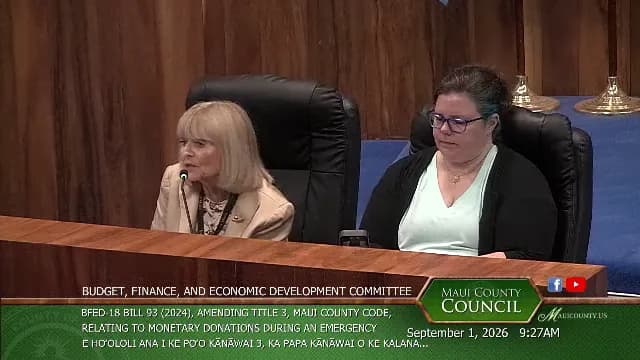
Maui County Council Budget Committee Discusses Emergency Donation Fund and Vehicle Disposal Fee Program on September 1, 2026

On September 1, 2026, the Budget, Finance, and Economic Development Committee of the Maui County Council met from 9:04 a.m. to 11:32 a.m. to discuss two agenda items: Bill 93 (2024), establishing the Maui County Kokua Fund for monetary donations during emergencies, and the Vehicle Disposal Fee Fund and program. The committee took no final votes but deferred both items for further work. Public Comments & Testimony - Bill 93 (2024): One testifier, James Langford, expressed support for the bill and broader oversight of county funds, urging the extension of subcontracting audits to all agencies receiving county funds. - Vehicle Disposal Fee Program: One testifier, Ms. Nishiki, advocated for expanding the program to allow disposal of vehicles not owned by the person requesting removal (e.g., abandoned on private property) and suggested including community cleanup days. She noted that current rules require the registered owner to initiate disposal, which is a barrier. Discussion: Bill 93 (2024) – Monetary Donations During an Emergency - Chair Alice Lee introduced the bill, explaining its purpose: to create a special fund (Maui County Kokua Fund) to accept and directly use monetary donations during a declared state of emergency, with council oversight. She noted that after the 2023 wildfires, over $140 million in donations were directed to nonprofits like Hawaii Community Foundation, largely outside council oversight, motivating the need for a county mechanism. - Administration representatives (Chief of Staff Lalo, Deputy Director of Finance Zelinski, Budget Director Milner) expressed concerns about establishing a special revolving fund, preferring a grant fund classification to avoid financial reporting mismatches. They stated that the county currently lacks capacity to manage large donations and recommended directing donations to community partners. They also noted that a $200,000 grant fund related to the fires still exists at the Office of Recovery. - Council discussion: Councilmembers supported the bill’s intent but raised issues: - Vice Chair Batangan asked about the difference between special and grant funds; administration confirmed a grant fund would achieve the same goals with simpler reporting. - Councilmember Paltin suggested pre-identifying partner nonprofits (e.g., MEO, Humane Society) for specific needs and noted that the county should not be the primary recipient of donations. - Councilmember Johnson inquired about the $3 million donation from Japanese billionaire Mr. Yanai and the need for regular reporting. The administration indicated they could provide reports. - Councilmember Rawlins-Fernandez supported the intent but regretted the bill was not vetted with administration earlier. She also noted that the committee could have invited Hawaii Community Foundation to testify. - Councilmember U'Hodgins emphasized transparency and accountability. - Councilmember Sinenci questioned tax deductions for donors and the distinction between donations for social vs. government purposes. - Corporation Counsel Wigglesworth stated that she could not sign the bill as to form until the related general budget provisions are also revised, requiring more time. - Outcome: The committee deferred Bill 93 to the October 20, 2026 meeting. Chair Sugimura proposed forming a task force (TIG) to develop a list of pre-vetted partner organizations and best practices, with Councilmembers Sinenci, Paltin, and Johnson volunteering. The committee will also invite Hawaii Community Foundation to a future meeting. Discussion: Vehicle Disposal Fee Fund and Program - Chair Sugimura opened the discussion, noting that the fund, supported by a $25 fee per vehicle registration, has accumulated a balance of approximately $19 million (as of August 28, 2026), with average annual collections of $4.2 million and annual expenditures ranging from $259,000 to $1.4 million. The projected balance at the end of FY27 is $18.9 million. - Administration (Deputy Director Peterson, Budget Director Milner, Deputy Director Zelinski) provided fund details: the current balance is $19,213,139; FY27 appropriations are $3 million. The program is operated by the Department of Environmental Management (EPNS) and covers towing and disposal of vehicles for registered owners. The department expressed a desire to keep the $25 fee in place given future needs, including potential capital projects for electric vehicle battery disposal. - Council discussion: - Councilmember Paltin noted that other county departments (e.g., MEMA, Parks) also deal with abandoned vehicles and suggested using the fund for those efforts. The administration clarified that the fund is dedicated to the vehicle disposal program, but they have used it for county property cleanups (e.g., Ukumehame, Pulehu). - Councilmember Johnson asked about vehicles on county land on Lanai; the department confirmed they have removed about 50 vehicles from Lanai this year using the fund. - Councilmember Cook asked about obstacles to expanding the program; the department cited the need to amend the ordinance to allow non-owners to dispose of vehicles, as well as issues with electric vehicle batteries (shipping constraints). - Councilmember U'Hodgins inquired about Hawaii Island’s model for abandoned vehicle removal; the department is studying it. - Councilmember Sinenci advocated for more metal collection events on East Maui and Haiku, and suggested using the fund to purchase metal shredders for Molokai and Lanai. The administration noted that a feasibility study might be allowable under the fund’s purpose. - Councilmember Paltin raised the issue of electric vehicle battery disposal, noting that without a processing facility, batteries are stockpiled or end up in the bushes, posing fire risks. The department mentioned a 99-acre parcel near the landfill that could host a neutralization/storage facility, and that they are working on a statewide solution for shipping. - Councilmember Batangan asked if the fund could assist businesses with vehicle disposal; the current program is residential only. - Councilmember Rollins-Fernandez questioned the timeline for clearing abandoned vehicles from roadsides, citing long delays. The department explained that factors like police reports, debris, or occupancy can delay towing, but offered to provide data. - Outcome: The committee deferred the item with no legislative action. Chair Sugimura indicated that the department will continue to explore ordinance amendments to expand eligible uses (e.g., non-owner disposals, EV battery processing) and report back. The committee discussed possibly reducing the $25 fee in the future but took no action. Key Outcomes - Bill 93 (2024): Deferred to October 20, 2026, pending revisions to change the fund from a special revolving fund to a grant fund and to amend general budget provisions. A task force (TIG) was formed with Councilmembers Sinenci, Paltin, and Johnson to develop a list of pre-vetted partner organizations and best practices for donation transparency. - Vehicle Disposal Fee Program: Deferred; no legislative action taken. The committee directed the administration to explore amendments to Chapter 3.27 of the Maui County Code to expand the program’s eligibility (e.g., non-owner disposals, community cleanups) and to consider options for electric vehicle battery disposal, including potential facilities. The $25 fee remains unchanged for now.

BUDGET 22% · DISASTER RECOVERY 21% · TRANSPORTATION 14% · VEHICLE DISPOSAL 12%
34
SEP 1, 2026 · MAUI COUNTY, HAWAII · COUNTY COUNCIL & COMMITTEES
GREAT Committee Meeting on Settlement Resolution 26-141 - September 1, 2026

The Government Relations, Ethics, and Transparency Committee met on September 1, 2026, at 1:34 PM to consider Resolution 26-141, which would authorize settlement of a federal lawsuit filed by a former Maui Police Department officer alleging the County failed to make required retirement and pension contributions during his U.S. Air Force service. The committee heard public testimony, discussed the case in open and executive sessions, and voted to recommend adoption of the resolution. Public Comments & Testimony - Jesse Lall testified via phone. He expressed confusion about which government is in control of Maui, referencing "Maui money" and the royal treasury. He claimed inside knowledge that the plaintiff "did something wrong" and had to leave the police department. He also complained about not being informed of a budget meeting earlier that day, stating that some members of the public are not afforded the same rights as others. He recognized the voice of a corporation counsel attorney, asked the committee to follow Hawaii laws over federal laws, and urged the committee to listen to the public more. Discussion Items - Deputy Corporation Counsel John Gores provided an overview of the case: Plaintiff Gershom Slonim was employed by the Maui Police Department in January 2015, enlisted in the U.S. Air Force, left for basic training on January 27, 2015, returned in January 2019 with an honorable discharge, and resigned in 2021. He currently resides in California. The lawsuit alleges that the County violated the Uniformed Services Employment and Reemployment Rights Act (USERRA) and HRS §88-132 by failing to make Employee Retirement System (ERS) contributions during his four years of active duty. After receiving the lawsuit, the County learned that Slonim had already cashed out his ERS account. - Councilmembers asked questions in open session: Councilmember Tamara Paltin asked about cashing out ERS and the meaning of "willfully and knowingly" in the complaint. Councilmember Gabe Johnson inquired about cashing out before reaching ten years of service. Councilmember Keani Rawlins-Fernandez asked about the length of Slonim's military service (four years active duty). Councilmember Nohelani U‘u-Hodgins asked how long Slonim worked for MPD (ten years). Deputy Chief Wade Maeda also answered questions. - The committee moved into executive session under HRS §92-5(a)(4) (consultation with legal counsel on powers, duties, privileges, immunities, liabilities, and case strategy) and §92-5(a)(8) (deliberation on matters requiring confidentiality by state/federal law or court order). All eight attending members, committee staff, and corporation counsel deputies participated. Councilmember U‘u-Hodgins briefly left to pick up her child but was permitted to rejoin upon her return. Legislative Attorney Peter Hanano provided the required summary after reconvening: the executive session discussed case strategy, assessment of strengths and weaknesses, settlement authority, and settlement efforts to date. Key Outcomes - Motion and Vote: Councilmember Tom Cook moved, seconded by Council Chair Alice Lee, to recommend adoption of Resolution 26-141 with non-substantive revisions. The motion passed 8–0 (Councilmember Yuki Lei Sugimura was excused for the entire meeting). - Next Step: The resolution will be forwarded to the full Maui County Council for final consideration. Meeting Adjournment The meeting adjourned at 3:02 PM.

PROCEDURAL 44% · PENDING LITIGATION 32% · PUBLIC ENGAGEMENT 24%
35
AUG 31, 2026 · MAUI COUNTY, HAWAII · COUNTY COUNCIL & COMMITTEES
Maui County WASSP Committee Receives Update on Maui Wildfire Exposure Study on August 31, 2026

The Maui County Council’s Water Authority, Social Services, and Parks (WASSP) Committee met on Monday, August 31, 2026, at 9:05 a.m. The sole agenda item was an update on the Maui Wildfire Exposure Cohort Study (MauiWES), including its latest report, “The Road to Recovery: Strengthening Health, Stability, and Resiliency Three Years After the Maui Wildfires.” The Committee received a presentation from the study’s principal investigators, Dr. Alika Maunakea, Dr. Ruben Juarez, and Dr. Christopher Knightsbridge. No legislative action was taken. Public Comments & Testimony - Travis Liggett testified about the need for disinfection infrastructure and genetic testing, urging a $1.8 million budget amendment for CBS 1169, unrelated to the agenda item. He stated he could find a donor for construction. - James Langford, a wildfire survivor, shared his personal experience and emphasized the need for the county to produce educational videos on how to communicate with wildfire survivors. He expressed support for the study and called for incorporating community-led approaches. Discussion Items - The presentation summarized key findings from the MauiWES, which has completed more than 4,000 appointments involving over 2,500 children and adults. Progress was noted: employment increased from 62% to 81%, insurance coverage rose to over 90%, and temporary housing declined from about 40% to 30%. However, severe food insecurity remained at about 25%, PTSD symptoms persisted at 30%, stage 2 blood pressure in 31% of participants, and lung function worsened (FEV below normal in 20% of participants). Social support declined from 60% to 50% of participants reporting strong networks. - The team introduced Hoʻala (Health Outreach ʻĀina-based Labor Alliance), a strategy to turn study findings into lasting health infrastructure through free community screenings, care navigation, and workforce capacity. They requested assistance from council members to identify community spaces for events, particularly for children. - Councilmembers asked about funding (secured via Maui County and NIH for the next year), school partnerships (difficult due to DOE bureaucracy, but prioritizing children), coordination with the Office of Recovery and Department of Human Concerns, and barriers to care such as language and transportation. - Dr. Knightsbridge noted that the most severe mental health concerns worsened among children: severe depression increased from 11% to 15%, severe PTSD from 2% to 4%, and low self-esteem from 13% to 26%. - Councilmember Johnson suggested using county parks for outreach, but Dr. Maunakea reported that parks had denied permission due to blood collection from adults. A potential resolution through the parks department was discussed. - Councilmember Batangan highlighted prior interagency efforts (e.g., with DOE and teens CERT training) that had stalled, and the Office of Recovery confirmed a new dedicated position for health and human services coordination would be posted. - Dr. Juarez noted that a Kaiser Permanente charitable insurance program had reduced the uninsured rate among Latinos from 40% to 3%, but the program is limited to three years and enrollment opens November 1. Key Outcomes - No formal action or vote was taken; the item was deferred. - The committee agreed to follow up with the study team to schedule meetings in each council district to identify locations for future Hoʻala events. - The Office of Recovery will re-engage on previously stalled initiatives (e.g., teens CERT, school-based mental health normalization) and is filling a health coordination position. - The parks department issue will be addressed to allow use of county parks for health screenings. - The study team will post a public schedule of events on their website and continue hiring community facilitators and paid high school interns. - Councilmembers were encouraged to help connect the team with schools, community organizations, and sports leagues for outreach.

MENTAL HEALTH AWARENESS 31% · DISASTER RECOVERY 21% · COMMUNITY ENGAGEMENT 11% · HEALTH 7%
36
AUG 31, 2026 · MAUI COUNTY, HAWAII · COUNTY COUNCIL & COMMITTEES
Maui County Water and Infrastructure Committee Meeting - August 31, 2026

The Water and Infrastructure Committee of the Maui County Council met on August 31, 2026, at 1:37 p.m. via Teams and in-person in Wailuku. The committee considered two agenda items: Bill 97 (2026) authorizing an intergovernmental agreement with the Department of Hawaiian Home Lands (DHHL) for development of Waiohuli Wells, and Resolution 26-123 seeking a two-year waiver from county pesticide restrictions for targeted herbicide use on county roadways. Both items received public testimony and extensive discussion. Bill 97 was recommended for passage on first reading (7-0). Resolution 26-123 was deferred for further discussion. Public Comments & Testimony - Bill 97: The first testifier, representing the Royal Patent Kingdom of Hawaii, questioned DHHL's authority to develop lands outside crown lands, stating that heirs of royal patent lands have not been contacted. The second testifier (anonymous by phone) expressed general support for DHHL and the Department of Water Supply, trusting the water department more than other county offices, but noted uncertainty about the use of “Hawaiian” labels. - Resolution 26-123: Jesse Law testified remotely, stating he initially opposed herbicide use but recognized the difficulty of managing vegetation with limited resources. He suggested community organizations could help maintain roadways instead of relying solely on the county. A second testifier, identifying as a representative of the Kingdom of Hawaii, strongly opposed the resolution, calling the county and state “murderers” and asserting that Hawaii is not part of America. Discussion Items – Bill 97 (Waiohuli Wells Intergovernmental Agreement) The committee received a presentation from DHHL project manager Elijah Davidson, who explained the project would develop three wells in Waiohuli to provide 1.728 million gallons per day (MGD) for DHHL beneficiaries. Advanced water credits would allow 39.5% of DHHL's needs to be met immediately, supporting over 2,800 residential units. The Department of Water Supply (DWS) supported the bill, noting the agreement would expedite housing for beneficiaries and add customers to the DWS system. Councilmembers asked about source credits vs. advanced water credits, operating cost liabilities, chloride levels, and force majeure clauses. Chair Tom Cook raised a concern about language in Section 5 vs. Section 1.03; DWS clarified that “for its own use” allows flow adjustments without violating use restrictions. An amendment was offered to remove the specific gallon figure (1,728,000) from the source credits clause, making credits equal to the operating capacity of the wells. Both DWS and DHHL agreed. The amendment passed 7-0, and the main motion (as amended) passed 7-0. Member Alice Lee expressed reservations but voted yes. The item will move to the full council. Discussion Items – Resolution 26-123 (Herbicide Waiver for County Roadways) DPW Director Jordan Molina presented the waiver request, which would allow limited, targeted use of herbicides (glyphosate and others) on pavement cracks, guardrails, signs, and intersections where non-chemical methods have proven ineffective. The waiver is for up to two years. Molina cited public safety hazards from overgrown vegetation and noted that manual removal requires crews to work six days a week. Councilmembers raised concerns about the lack of specific location maps (except for seven intersections), proximity to water bodies, potential risk to children and the environment, and the fact that the county had purchased steam equipment and hired extra staff after the 2021 pesticide ban. Some members suggested trying cinnamon-based herbicides on small cracks or using steam on sidewalks. Member Tamara Paltin proposed a shorter waiver period (six months), and Member Keani Rawlins-Fernandez noted the waiver application did not include plans for soil health or a clear exit strategy. Several members indicated they could support limited applications for specific intersections but not a blanket waiver. Chair Cook recommended deferral for further discussion and clarification. No objections, and the item was deferred. Key Outcomes - Bill 97 (2026): Recommended for passage on first reading, as amended. Vote: 7 ayes, 0 noes (Members Nohelani Uʻu-Hodgins and Yuki Lei Sugimura excused). The amendment removed the specific gallon-per-day figure from the source credits clause, making credits equal to total operating capacity of the three wells. - Resolution 26-123: Deferred without objection. The committee requested more specific location maps (including for East Maui) and further evaluation of alternative methods, such as cinnamon-based herbicides and steam treatment, before reconsideration.

HERBICIDE USE 19% · WATER AND WASTEWATER MANAGEMENT 16% · HAWAIIAN HOMELANDS 15% · ENVIRONMENTAL PROTECTION 12%
37
AUG 27, 2026 · MAUI COUNTY, HAWAII · COUNTY COUNCIL & COMMITTEES
Maui County HLU Committee Reconvenes on August 27, 2026 to Discuss TVR Conversions in Sea Level Rise Areas

The Housing and Land Use Committee reconvened on August 27, 2026, at 9:12 a.m. to continue public testimony and deliberation on Resolutions 26-129 and 26-130. These resolutions would refer to the Maui Planning Commission proposed bills to amend community plans and change zoning for certain Apartment District properties in the Sea Level Rise Exposure Area (SLREXA) to allow continued Transient Vacation Rental (TVR) uses. The meeting included extensive public testimony, followed by committee discussion on criteria for selecting properties under Resolution 26-129. The committee voted to adopt criteria for that resolution and recessed further consideration to September 9, 2026. Public Comments & Testimony - Nicole Fox (owner, Hale Kai O Kihe) testified in support of including her building in the hotel rezoning list, citing 30% of the property impacted by sea level rise at the 3.2-foot threshold, location in FEMA Flood Zone AH, and the building's age (1969) and condition. She argued that placing local families in such risk-prone units is unwise. - Tyler Sonamaker (journalist, Kahea Vaya Media) questioned why the county was creating carve-outs that undermine Bill 9's intent, and noted inconsistency among testifiers' motivations—those opposing Bill 9 tended to argue personal financial hardship rather than broader policy goals. - Jade Moreno (principal researcher, Maui Housing Hui) opposed both resolutions, arguing that the cumulative effect of zoning changes weakens Bill 9 before its impact can be evaluated. She distinguished between legitimate private interests and the county's responsibility to protect housing supply for residents. - Albert Perez (Maui Tomorrow Foundation) opposed both resolutions, stating that H-3/H-4 zoning would increase property values and incentivize shoreline hardening, contrary to coastal management goals. He also noted that STR-driven HOA fee increases have historically priced out long-term residents. - Kaya Nishiki testified against both resolutions, calling for a comprehensive coastal analysis including structural condition, shoreline certification, financial reserves, and a managed retreat plan. She referenced Senate Bill 3034 (voluntary acquisition of vulnerable coastal properties) as a more appropriate approach. - Travis Liggett testified only on Resolution 26-130, raising concerns about wastewater discharge compliance and broader climate risks. - Additional testifiers opposing the resolutions included: Charles Nahalley (fire survivor in limbo), Jordan Hawker, Leandre Makakoa, Kelsey Salah-Maupa, Paul Carter, John Cardi, Robert Bence, and Jaclyn Thine. They argued the resolutions undermine Bill 9, prioritize investors over local residents, and ignore sea level rise risks. - Sati Brown testified in support, arguing that property owners—local or not—have the right to support their families through STR income and that STR owners already pay the highest tax rates. - Shane Albertin (teacher, Baldwin High School) opposed the resolutions, noting his family's experience paying $6,000/week for a vacation rental while their home was being remediated after flooding. He distinguished between properties that function as hotels (e.g., Honua Kai) and those that are clearly apartment buildings. - Sarah (a nurse and local resident) supported the resolutions, stating that her unit has lost value and that many local owners are being harmed by Bill 9. Discussion Items After closing oral testimony, the committee discussed criteria for selecting properties to include in Resolution 26-129. Chair U‘u-Hodgins proposed criteria based on structures fully inundated by the 3.2-foot SLREXA or special flood hazard areas. Members debated the definition of "fully inundated" versus "majority impacted" (51% or more) and whether to include properties subject to shoreline regulations as adopted by the Maui Planning Commission. Councilmember Cook offered an amendment to add the shoreline regulations criterion and clarify that properties originally intended for affordable workforce housing should be excluded. The committee also discussed potential conditions (e.g., structural assessments, no further shoreline armoring, hazard mitigation plans) to be recommended to the Planning Commission; these were deferred for further legal review. Key Outcomes - Vote on main motion (criteria for Resolution 26-129): The committee voted 5-4 to adopt the following criteria: structures must be majority impacted by the 3.2-foot SLREXA, subject to shoreline regulations adopted by the Maui Planning Commission, or in a special flood hazard area; and the property must not have been originally intended for affordable workforce housing. Voting Aye: Cook, Sugimura, Batangan, U‘u-Hodgins, Chair Lee. Voting No: Johnson, Paltin, Rawlins-Fernandez, Sinenci. - Pending criteria: Councilmember Rawlins-Fernandez proposed an additional criterion based on the percentage of owner-occupied units in 2008 (not less than 25%). She will refine the language with staff before the next meeting. - Next steps: The meeting was recessed to September 9, 2026, at 10:00 a.m. via the same virtual and in-person connections, to continue discussion on Resolution 26-129 and address Resolution 26-130. - No action taken on Resolution 26-130 at this session.

AFFORDABLE HOUSING 18% · HOUSING 16% · SHORELINE ACCESS 11% · ZONING CODE REVISION 10%
38
AUG 24, 2026 · MAUI COUNTY, HAWAII · COUNTY COUNCIL & COMMITTEES
HLU Committee Meeting: Haʻikū Fire Station Bills - August 24, 2026

The Housing and Land Use Committee reconvened on August 24, 2026, at 9:08 a.m. to continue deliberations on Bills 89, 90, and 91 (2026), which seek land use entitlements for a proposed Haʻikū Fire Station on a 6.097-acre portion of TMK (2) 2-7-007:008 in Hāmākualoa, Hawaiʻi. The committee heard additional testimony from the public and resource persons, held an executive session, and ultimately voted to recommend passage on first reading of all three bills with amendments. Public Comments & Testimony - Kaneali Williams (native Hawaiian and resource person) provided extensive testimony opposing the project. He argued that the County lacks jurisdiction over the property because the entire ʻāina of Kuyaha was never lawfully transferred to the United States under the Newlands Resolution. He presented historic maps (1879 Hawaiian Government Survey and a County of Maui overlay map) showing Royal Patent 383 to Richard Armstrong, covering the entire East Kuyaha ahupuaʻa, including the proposed site. He stated that the County’s title report and title insurance do not account for this pre-existing royal patent, and that the County is on notice of a land dispute. He warned that proceeding could lead to criminal trespass charges against native tenants, which he said would be unlawful, and that he would seek injunctive relief if necessary. He also submitted written testimony with exhibits, including a cease-and-desist notice. Discussion Items - Fire Station Needs and Site Challenges: Fire Chief Brad Ventura explained that the 6.1-acre site was chosen because it is previously disturbed and can accommodate an elevated water tank for fire suppression. He contrasted it with alternative “Site D,” which lacks adequate water supply and would require purchasing adjacent land. He described the need for a modern, hardened fire station with hot/warm/cold zones, 300-amp electrical service, and capacity for future growth (up to four apparatus). He noted that the project has been in development for 17 years and that the County bought the property in 2007. - Alternative Proposals: Councilmembers discussed the possibility of purchasing an existing house on a larger parcel, similar to the Pūkoʻo fire station relocation on Molokaʻi. Chief Ventura stated that a house would not meet modern fire station requirements (e.g., contamination control, generator, hurricane resistance) and that the water meter needs (two 5/8-inch meters plus a fire line) are more demanding than typical residential. - Title and Jurisdiction Concerns: Extensive debate centered on whether the County has clear title. Kaneali Williams presented historic maps showing the site lies within Royal Patent 383, which he argues the title report omits. Councilmembers Cook and Paltin asked about the broader impact on other Kuyaha residents. Deputy Corporation Counsel indicated that title issues would ultimately be a court question. An executive session was held from 9:50 a.m. to 10:49 a.m. to consult with legal counsel on powers, duties, and liabilities. - Amendments: Councilmember Paltin proposed an amendment to require that the remaining agricultural land (approximately 21 acres of the 27.9-acre parent parcel) be used for subsistence farming through a pilot program involving the Department of ʻŌiwi Resources, Department of Agriculture, Fire Department, native tenants, and the community. The amendment was adopted as part of the conditions for Bills 89 and 91. Key Outcomes - Bill 89 (District Boundary Amendment): Moved to recommend passage on first reading with an amended staff-recommended ASF that includes: (a) conditions required under HRS §205-3.5 (right-to-farm notification and non-interference with adjacent farming), and (b) the subsistence farming pilot program amendment. Vote: 6 ayes (Lee, Cook, Paltin, Sugimura, Uʻu-Hodgins; Sinenci with reservations), 2 noes (Rawlins-Fernandez, Johnson), 1 excused (Batangan). Carried. - Bill 90 (Community Plan Amendment): Moved to recommend passage on first reading without amendments. Vote: same 6-2-1. Carried. - Bill 91 (Change in Zoning): Moved to recommend passage on first reading with the same amendments as Bill 89 (right-to-farm conditions and subsistence farming pilot program). Vote: same 6-2-1. Carried. - Next Steps: The bills will now move to the full Council for further consideration. The committee also directed staff to include Kaneali Williams’ full June 5, 2026 council testimony (106 pages) as part of the record for these items.

NATIVE TENANT RIGHTS 21% · PROCEDURAL 17% · LAND USE PLANNING 9% · ENGINEERING AND INFRASTRUCTURE 8%
39
AUG 21, 2026 · MAUI COUNTY, HAWAII · COUNTY COUNCIL & COMMITTEES
Maui County Kōmike Aloha ʻĀina Meeting on Kalawao County Transition - August 21, 2026

Note: The meeting agenda lists Thursday, August 20, 2026, but the instruction for this summary specifies the date as August 21, 2026. The transcript indicates the meeting began at 1:13 p.m. on August 20 and adjourned at 5:17 p.m. on that same day. The Committee on ʻĀina Aloha (Kōmike Aloha ʻĀina) convened to discuss the transition of Kalawao County into Maui County following the enactment of Act 171 (2026), formerly Senate Bill 1432. The session was informational only, with no legislative action planned. Presentations were delivered by representatives from the National Park Service (NPS), Department of Hawaiian Home Lands (DHHL), Department of Land and Natural Resources (DLNR), Department of Health (DOH), and the County administration. Public testimony was heard, and committee members engaged resource persons on operational, legal, and community concerns. Public Comments & Testimony - Valerie Munson (Executive Director, Kaʻohana o Kalaupapa) expressed support for the transition process but raised questions about the future of the NPS lease, potential homesteading, and community input on access and storytelling. She noted that her organization was founded by patients to amplify their voices and urged continued community dialogue. - Lori Buchanan (longtime Molokai resident) voiced strong support for the transition, citing the county’s history of community engagement. She criticized the NPS general management planning process, asserting that stakeholder consultation was cut short and that the programmatic agreement was signed by only one entity. She advocated for transparent process and raised concerns about burial sites and infrastructure costs. - Jantel Lindo supported the transition as the safest path to ensure a public process, but cautioned against treating the county as merely a service provider for emergency services. She recommended including experienced emergency personnel in the advisory group and emphasized that Molokai emergency services have operated through personal relationships, not policy. - Iruka Cassera spoke in support of eventual Molokai County status, referencing ancestral visions and the need for self-sufficiency. He suggested that Molokai could become its own county using Kalawao’s transition as a catalyst. - James Langford offered to assist with Vatican funding connections for Kalaupapa and noted that separate county status for Molokai could be justified based on natural boundaries. - DeGray Vanderbilt asked whether NPS Superintendent Nancy Holman planned community meetings (as requested by Representative Tokuda), and inquired about NPS plans for access, fishing regulations, and public portions of Kalaupapa. He also referenced a 2015 NPS internal letter that expressed concerns about the draft general management plan. - Lika Wallace expressed support for the transition but noted that recent NPS meetings felt more like briefings than listening sessions. - Kanani Costales shared her personal history as a descendant of Kalaupapa patients and urged the committee to honor the legacy of those exiled there. She opposed homesteading by anyone other than Molokai residents and emphasized the cultural and burial significance of the site. - Jesse Law (caller) expressed skepticism about federal control and encouraged the committee to think critically about U.S. governance. - Walter Riddy stated he came to the meetings hoping Molokai could become its own county, but acknowledged the complexity. He supported the transition as a practical first step and emphasized the need to prepare for the long-term goal of a separate county. Discussion Items - NPS Superintendent Nancy Holman provided an extensive overview of Kalaupapa National Historical Park’s operations, including its mission, staff (46 employees, over half Native Hawaiian from Molokai), annual budget ($5 million base plus $10 million in project funds), and the significance of the 1980 enabling legislation and general management plan. She noted that only four patients remain. She clarified that access rules (100 visitors/day) cannot change until after the last patient leaves, and that NPS is working with landowners on future management. She offered to hold regular office hours topside for community questions. - DHHL Deputy Director Katie Lambert reported that beneficiary consultation for the Molokai Island Plan, which will include Kalaupapa, is expected to begin in February–March 2027. She addressed the legal primacy of DHHL over certain county roles and noted that beneficiary consultation was not triggered for the county jurisdiction change. She confirmed that the department is exploring “pīlina-based” rules for lineal descendants and that homesteading in Kalaupapa would require extensive community discussion. - DLNR Director Ryan Kanakaʻole (participating online) updated the committee on DLNR-managed lands (two-thirds of the peninsula, airport, forest reserves). He noted that a cooperative agreement with NPS expires in 2029 and will be renegotiated. He announced that the Board of Land and Natural Resources will consider final approval of a 65-year lease for the Kalaupapa Memorial on August 28, 2026. He also raised concerns about fishing regulations after DOH’s departure, as current exemptions will lapse; DLNR’s aquatic resources division plans place-based management regulations. - DOH Deputy Director Debbie Morikawa reported continued environmental remediation and collaboration with NPS. She noted that the Kalaupapa Memorial project is over budget and that DOH is awaiting additional information from Kaʻohana o Kalaupapa. DOH staff will continue care until the last patient leaves, then transition out or be reassigned. - Committee questions and discussions focused on: county operational preparations (Chair Rawlins-Fernandez noted she is spearheading an advisory hui with community members); mutual aid agreements for fire and police (a project assignment form has been initiated); property tax exemptions (most lands already exempt; churches can apply); vehicle registration issues (Chair exploring exemptions); and integration into the Molokai Planning Commission (Hawaiian Home Lands are SMA-exempt). Members expressed concern about the short one-year transition timeline and the need to prepare legislation in advance. - Resource persons added: Valerie Munson, Lori Buchanan, Jantel Lindo, Kanani Costales, and Walter Riddy were designated as resource persons by the committee (no objections). Key Outcomes - No legislative action was taken; the item was deferred for future discussion. - The committee accepted written testimony and will continue to accept submissions via eComment and email. - The Chair will transmit written questions to the administration regarding county transition preparations and to DLNR regarding land titles and original land awardees. - The Chair noted that an advisory hui (community working group) has been formed and has held three meetings. The group’s immediate focus includes updating the Molokai Community Plan to include Kalawao County, amending mutual aid agreements, and addressing property tax and DMV exemptions. - NPS Superintendent Holman agreed to consider holding regular office hours topside for community access and questions. - The committee acknowledged the need for continued collaboration among all stakeholders to ensure a smooth transition after the last patient leaves Kalaupapa.

PROCEDURAL 16% · HAWAIIAN HOMELANDS MANAGEMENT 16% · HAWAIIAN HOMELANDS 16% · HISTORIC PRESERVATION 11%
40
AUG 19, 2026 · MAUI COUNTY, HAWAII · COUNTY COUNCIL & COMMITTEES
Maui County Housing and Land Use Committee Meeting - August 19, 2026

The Housing and Land Use Committee reconvened on August 19, 2026, at 9:08 a.m. to continue consideration of Resolution 26-129 and Resolution 26-130, which propose referring bills to the Maui Planning Commission to amend community plans and rezone certain apartment district properties within the Sea Level Rise Exposure Area (SLR-XA) to hotel districts (H-3 and H-4) to allow continued transient vacation rental (TVR) use. The meeting included extensive public testimony and clarifying questions from council members. No votes were taken; the committee recessed and will reconvene on August 27, 2026, at 9:00 a.m. Public Comments & Testimony - Jenny Hendricks (condo owner at Waiʻalae Beach Hale, Kihei) supported including her property in Resolution 26-129, stating it lies within the 3.2-foot sea level rise exposure area and is eligible under Ordinance 6008. - Bob DeSoto (board member at Line of Roads, Lahaina) supported rezoning, citing high maintenance costs and the unsuitability of his oceanfront property for long-term housing. He noted that only 7 of 42 units are owner-occupied. - Travis Leggett (individual) opposed the resolutions, raising concerns about wastewater discharge, infrastructure failures, and public health risks associated with short-term rentals in the SLR-XA. - Paʻa Lāʻakea Kīʻakona (Laʻakea Strong) opposed both resolutions, arguing that the rezoning would exacerbate the housing crisis and that many properties were historically owner-occupied. He supported upzoning only for properties operating as de facto hotels (e.g., El Dorado). - Caitlin Miller (Maui Vacation Rental Association) supported the resolutions, presenting sales data showing that only 13% of Minatoya-list property purchases (21 of 162) since December 2025 were owner-occupied by Maui residents. She argued that the economic losses from phasing out TVRs outweigh housing gains and that the county should leverage tax revenue for affordable housing. - Corrine Baker (owner at Nohonani, West Maui) requested inclusion in Resolution 26-129, stating her property is 100% within the SLR-XA and adjacent to included properties. - Nara Boone (Maui Housing Hui, Wisdom Circles Oceania) opposed the resolutions, arguing that Bill 9 is working and that adding more properties undermines community voice. She advocated for rent stabilization and using existing units for housing. - Johan Lal (individual, GIS analyst) provided a geographic analysis, noting that only half of the eight original properties listed are entirely within the SLR-XA, and that 11 other Minatoya properties are fully within the zone but not included. He urged consistent criteria. - Kevin Smith and Kim Smith (board member and owner at Waiʻalae Beach Hale, Kihei) supported including their property, arguing it was never built for long-term housing and that oceanfront location makes it unaffordable for locals. - Ari Minasyan (owner at Halekai Okihe, Kihei) requested inclusion, stating 25-30% of his parcel is within the SLR-XA and that neighboring properties are included. - Autumn Ness (West Maui resident) opposed the resolutions, particularly for Kihei Bay Surf, Kihei Bay Vista, and 10 Walaka Street, arguing these properties are not on the shoreline and should remain in the housing stock. She noted price declines in Minatoya units and that market values are inflated by income potential. - Other testifiers (both in person and via Teams) expressed opposition to the resolutions, with some highlighting cultural and community impacts, and others supporting specific amendments. Key Outcomes - The committee did not take a vote on either resolution. - The meeting was recessed at 12:07 p.m. to be reconvened on Thursday, August 27, 2026, at 9:00 a.m. via the same Teams link and in-person at the Council Chambers, Kalana O Maui Building, 8th Floor, 200 South High Street, Wailuku. - Written testimony remains accepted via eComment or email.

HOUSING 35% · SHORELINE ACCESS 12% · AFFORDABLE HOUSING 9% · LAND USE PLANNING 7%
OPENPUBLICA · PUBLIC MEETING INDEXUPDATED DAILY · openpublica.com