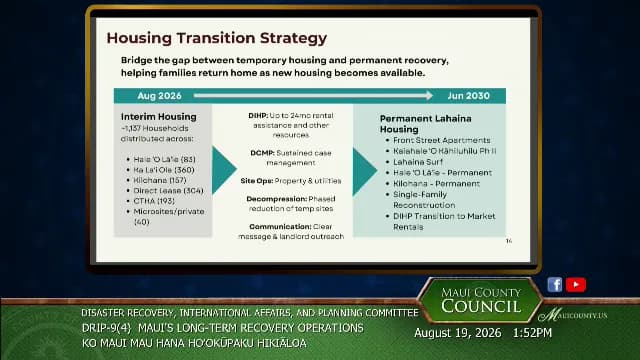
This reconvened meeting of the Disaster Recovery, International Affairs, and Planning (DRIP) Committee focused on Maui's long-term recovery operations, including the transition from temporary to permanent housing for fire survivors, the status of the Disaster Case Management Program (DCMP), and a proposed acquisition of water infrastructure assets. The committee also held an executive session regarding the Launiupoko Irrigation Company water assets. The meeting ran from approximately 1:34 p.m. to 4:00 p.m. Discussion Items - Interim Housing Transition (Temp to Permanent): Administrator John Smith (Office of Recovery) presented a slide detailing current interim housing for disaster survivors, including sites at Haleola Ea, Kilohana (157 homes), Calayola, direct lease, CTHA, microsites, and private sites. The plan is to transition Haleola Ea and Kilohana to county control for the next 3–4 years while permanent housing is built. Residents will need to be recertified into a county-led program. Smith noted that a request for a limited FEMA extension has been submitted, and the current FEMA assistance deadline is February 2027. He also announced that FEMA approved a donation program for the Kilohana units, transferring them to the county via the state at no cost, with potential use as permanent housing. - Disaster Case Management Program (DCMP) Transition: The county has already taken over the DCMP from the state, hiring existing providers through September and finalizing a long-term procurement. Deputy Director Trista Spear (Department of Human Services) confirmed that a formal communication extending the move-out date for Haleola Ea residents is in final stages of approval. - Workforce and Infrastructure Updates: The presentation also covered Maui’s Long-Term Recovery Plan, including infrastructure and workforce development. Managing Director Josiah Nishita noted that the county is actively seeking additional federal funding (e.g., from EPA) to extend recovery efforts beyond the CDBG-DR deadline of 2031. - Launiupoko Irrigation Water Assets: The committee briefly discussed the proposed acquisition of Launiupoko Irrigation Company water infrastructure assets (non-potable side). Deputy Director Kimo Langraff (Department of Water Supply) was present. The committee then moved to executive session to negotiate the acquisition and consult with legal counsel. Key Outcomes - Executive Session Vote: The committee voted 7-0 (with Councilmembers Batangan and Sinenci excused) to convene an executive meeting under HRS §92-5(a)(3) and §92-5(a)(4) to discuss negotiations for the acquisition of public property and to consult with legal counsel. The executive session was limited to the Launiupoko irrigation water assets. - No Legislative Action Taken: As noted in the agenda, no formal action was taken on DRIP-9(4) in open session. The meeting concluded at 4:00 p.m. - Next Steps: The Office of Recovery will provide a copy of the FEMA extension letter to the committee. The Department of Human Services will finalize and distribute the formal move-out extension notice for Haleola Ea residents. The committee deferred further discussion on the water asset acquisition following the executive session.
Public Meetings - Maui County, Hawaii
Public Meetings - Maui County, HawaiiThe Budget, Finance, and Economic Development Committee (BFED) convened on Tuesday, August 18, 2026, at 9:05 a.m. via Microsoft Teams and in-person in Wailuku. The meeting focused on two agenda items: an update on the Community Development Block Grant – Disaster Recovery (CDBG-DR) funding and program status (BFED-20(17)), and a discussion on proposed countywide administrative rules for grant management (BFED-20(12)). No legislative action was taken on either item. Public Comments & Testimony - Jesse Law (testifying on both items): Expressed frustration with lack of public access to meeting information, read historical text about Hawaii-U.S. relations, and accused the Chair of violating the Sunshine Law. On the grant rules item, he recited state open-meeting statutes and urged the public not to vote for Chair Sugimura. - James Langford (testifying on recovery funding): Stated he submitted approximately $2.4 billion in grants and sought clarity on the grant process, including how the county works with local experts. He requested better communication and involvement. Discussion Items Community Development Block Grant – Disaster Recovery (CDBG-DR) Update - Presentation by John Smith (Office of Recovery) and BDO Government Services staff: Provided a comprehensive update on the $1.6 billion CDBG-DR grant from HUD. Key points: - $1.39 billion has been obligated; $239 million remains to be obligated. - Funds are allocated to single-family construction/reconstruction, first-time home buyer program ($92.5 million), multifamily rentals, public services, mitigation, administration (5% cap), and infrastructure. - Reimbursement process is efficient – average drawdown time to county is 72 hours. - HUD visited Maui early; the county is leading other grantees nationwide in spending pace. - Key risks: escalating infrastructure costs and contractor capacity. - Housing progress: 577 units completed, 400 under construction, 597 in process – representing 81.5% of all units lost in the fire zone. - First-time home buyer program: 83 shopping letters issued out of 2,900 applicants; target is 120. - Multifamily rebuilds are scheduled through 2031; a timeline by project will be provided. - Interim housing plan: 1,100 households temporarily housed; county will take over Kilohana site (167 units) from FEMA in February 2027; rental assistance programs are being developed. - Discussion on older homes (pre-1978) and lead-based paint waiver; HUD approved conditional waiver. - Question on using CDBG-DR funds for land trust homes: a path forward is being developed. - Chair Sugimura asked about action plan amendments – the $50 million Front Street buyout program and $100 million for the bypass project are already obligated. - Councilmember Paltin requested detailed reports on reconstruction disqualification reasons, home purchases by location, and projected schedules for multifamily rebuilds. - Councilmember Johnson asked about staffing capacity and using J-1 visas for engineers; Director Smith noted difficulty hiring engineers but overall staffing is adequate with consultants. - Councilmember Rawlins-Fernandez asked about communication strategy for the housing transition – Director Smith acknowledged challenges and said the county is taking over lead role with improved internal/external communications. - Councilmember U'u-Hodgins asked about contingency for rising construction costs and how the Office of Recovery adjusts for new disasters (referencing Tropical Storm Lala). Director Smith said they surge staff with MEMA for damage assessments and will seek additional federal help if a disaster declaration is made. Administration and Management of Grants – Proposed Countywide Rules - Presentation by Chief of Staff Lalo, Budget Director Milner, and First Deputy DeJardin: The draft administrative rules were transmitted to the committee on August 17, 2026. They cover general provisions, procedures (including fiscal sponsors), insurance, disbursement options (installment, reimbursement, advance), reporting, monitoring, and non-compliance. The rules are not retroactive. Timeline: - Council input due by August 25, 2026 at 5 p.m. - Notice of public hearing to be published in early September. - Public hearing scheduled for October 7, 2026 at the Velma McQueen Community Center. - Final certification by County Clerk after hearing. - Discussion: - Councilmember Lee asked about application processing times – Director Milner said timelines are not in these rules but will be addressed in forthcoming standardization of application materials and evaluation criteria. - Councilmember Paltin asked if Corporation Counsel has signed off – First Deputy DeJardin said rules will not go to public hearing until approved as to form and legality. - Councilmember Batangan asked if all grant-making departments were consulted – yes, including Water Supply, OED, Finance, Human Concerns, Housing, Agriculture, Parks, Environmental Management. Transportation did not submit comments. - Councilmember Batangan asked about the Gold Division’s role – Director Milner clarified it will serve as a central knowledge repository without authority over department awards. - Councilmember Johnson asked about department handbooks – the intent is to develop a countywide handbook with minor department-specific amendments. - Councilmember Rawlins-Fernandez flagged that the definitions of nepotism and conflict of interest may need to align with forthcoming ethics legislation. First Deputy DeJardin acknowledged and said rules can be amended if needed. - Chair Sugimura raised concerns about nonprofit grantees not receiving timely payments (citing Kalima Omaui contract issue). Director Martin said they will follow up. - No legislative action was taken; the item was deferred for continued discussion. Key Outcomes - No formal votes or decisions were made on either agenda item as both were Rule 7(B) discussions. - The committee requested written responses from the Office of Recovery on multiple data requests (detailed housing numbers, reconstruction disqualification reasons, first-time home buyer statistics, project schedules, and breakdown of housing by owner-occupancy and affordability). - Councilmembers were asked to submit comments on the draft grant administrative rules to Chief of Staff Lalo, Budget Director Milner, and First Deputy DeJardin by August 25, 2026. - The public hearing on the grant rules is scheduled for October 7, 2026. - The meeting adjourned at approximately 11:15 a.m.
The Government Relations, Ethics, and Transparency (GREAT) Committee of the Maui County Council met on Tuesday, August 18, 2026, at 1:35 PM at the Kalana O Maui Building in Wailuku, with remote participation via Microsoft Teams. The meeting was chaired by Councilmember Kauanoe Batangan and addressed three resolutions authorizing additional compensation for special counsel in two lawsuits and approval of a settlement agreement with the Hawaii Fire Fighters Association. The committee voted to recommend adoption of all three resolutions after executive sessions on the first two items. Vice Chair Nohelani U‘u-Hodgins recused herself from the second item. Councilmember Shane Sinenci was excused. Councilmember Yuki Lei Sugimura left at 3:30 PM. Public Comments & Testimony - Resolution 26-131 (Evans v. Martin): Jesse Long testified, expressing support for both sides but stating the family should receive “10 times more” than the lawyers are making. He also voiced appreciation for Deputy Fire Chief Fujioka. James Langford urged the committee to obtain an ethical review from the ethics committee before expending additional funds. - Resolution 26-133 (Fire Fighters Settlement): Jesse Long testified again, opposing general pay raises for firefighters who he considered not “PONO.” Testifier Mochure, Maui Division Chair for the fire department, strongly supported the resolution, calling it “instrumental” for recruitment and retention. James Langford seconded that support and emphasized the need for mental health and childcare resources for firefighters. - Resolution 26-132 (Salem v. County of Maui): Catherine Splint protested the additional $75,000 in legal fees and demanded an investigation into the developer (48A LLC) for failing to complete SMA permit requirements, including a fire hydrant. She stated that the county is suing the wrong party. A representative of the Royal Patent Kingdom testified that subdivision lands belong to original title holders and that heirs have not been contacted. Christopher Salem, the plaintiff in the case, testified that he is willing to settle with the county, accused corporation counsel of concealing facts, and highlighted what he called a long history of misconduct by county officials. He urged the council to investigate and settle rather than continue litigation. Discussion Items - Resolution 26-131 – Additional Compensation for Special Counsel ES&A, Inc. (Evans v. Martin): Deputy Corporation Counsel Glenn Pasqual requested a $250,000 increase (from $200,000 to $450,000) for defending Captain Scott Martin in a wrongful death lawsuit filed by Chelsea Evans. Trial is set for June 7, 2027. The committee spent about 35 minutes in executive session (2:10 PM to 2:45 PM) to consult with legal counsel on confidential matters. Special counsel Isaac Rao was excluded from the executive session because he does not represent the county. - Resolution 26-133 – Settlement Authorization (Hawaii Fire Fighters Association): Deputy Corporation Counsel Jared Gores presented a settlement of two prohibited practice complaints arising from an interest arbitration award dated March 26, 2026. Key terms: continue step movements for Unit 11 employees (July 1, 2025–June 30, 2029); add 1.5% salary increases on top of the 2.5% arbitration award for FY 2027 and FY 2028 (totaling 4% each year); extend the drug and alcohol testing MOU through June 30, 2029, with no unilateral withdrawal. Both sides will dismiss complaints with prejudice. The committee went into executive session from 3:18 PM to 3:55 PM to discuss specific terms and financial impact. - Resolution 26-132 – Additional Compensation for Special Counsel Kobayashi Sugita & Goda, LLP (Salem v. County of Maui): Deputy Corporation Counsel Gores requested an additional $75,000 (for a total of $1,000,000) to cover post-judgment motions, reconsideration proceedings, a motion to recover costs (over $88,000 awarded to the county), and a potential appeal to the Hawaii Intermediate Court of Appeals. Craig Shikuma of KSG confirmed that the court dismissed all of Salem’s claims with prejudice. Councilmember Johnson expressed concern that the office had incurred obligations exceeding appropriations despite prior warnings. No executive session was held for this item due to time constraints; the committee moved directly to a vote. Key Outcomes - Resolution 26-131 – Motion to recommend adoption (with non-substantive revisions) passed 8-0 (Councilmember Sinenci excused). The committee authorized a total compensation of $450,000 for ES&A, Inc. - Resolution 26-133 – Motion to recommend adoption passed 6-0 (Councilmembers Sugimura and Sinenci excused; Vice Chair U‘u-Hodgins abstained due to recusal). The settlement agreement was approved, avoiding litigation of prohibited practice complaints. - Resolution 26-132 – Motion to recommend adoption passed 7-0 (Councilmember Sinenci excused). The committee authorized an additional $75,000, raising the total compensation for Kobayashi Sugita & Goda, LLP to $1,000,000. The meeting adjourned at 4:28 PM.
The Housing and Land Use Committee of the Maui County Council reconvened on August 10, 2026, to consider Bills 89, 90, and 91, which would amend land use designations for a 6.097-acre portion of TMK (2) 2-7-007:008 in Hāmākualoa for the proposed Ha‘ikū Fire Station. Oral testimony had been closed at the prior meeting; 68 written testimonies were received. The meeting featured extensive discussion on archaeological compliance, water supply, and unresolved native tenant rights claims, culminating in a recess to executive session for legal consultation and a decision to continue the meeting on August 24, 2026. Public Comments & Testimony - Oral testimony was not taken; the committee acknowledged 68 written submissions received via eComment. No oral public testimony was heard. Discussion Items - Project Overview (Temporary Chair Tamara Paltin): The three bills would reclassify state land use from Agricultural to Rural (Bill 89), amend the Pa‘ia-Ha‘iku Community Plan land use designation from Agriculture to Public/Quasi-Public (Bill 90), and change zoning from Agricultural to P-1 Public/Quasi-Public (Bill 91). The project is county-funded; no federal funds are used. The process is not under RCD9 (recovery directive for Lahaina). - Archaeological and Cultural Compliance (Dr. Janet Six, OED Resources; Jay Raposa; Mike Dega): An Archaeological Inventory Survey (AIS) was completed in 2010, covering the project area and waterline corridor via pedestrian survey and 11 trenches. One historic property (a 1940s rock wall) was identified. No subsurface cultural features were found on the 6.1-acre footprint. For the waterline, additional 100% AIS monitoring was recommended to avoid inadvertent burials. Ground-penetrating radar may be considered after site clearing. Dr. Six noted that the county has redesigned projects in the past to preserve in situ finds. - Water Infrastructure (Diane Kodama, AECOM; Jason Miyabuchi, DWS): Three water meters are planned: two domestic for the fire station and one fire line for an on-site 40,000-gallon tank. The meters are sized for the fire station; no additional capacity is available for agriculture on the remaining 20 acres without new meters, which are not on the priority list. Catchment water could support agriculture, per the Department of Agriculture. - Native Tenant Rights and Title Challenges (Kaneali‘i Williams, descendant and native tenant): Mr. Williams argued that the county’s title to the property, derived from Land Patent 6553 to Florence Wood (1916), is invalid. He presented extensive documentation (exhibits A–P) asserting that the land is private property under Royal Patent 383 and Land Commission Awards from the Great Māhele (1850s), and that native tenant rights of his ‘ohana were never extinguished. He claimed the Newlands Resolution did not transfer this private property to the U.S. territory, and that the Land Patent lacks a president’s signature as required by the Land Act of 1895. He stated that any construction on the site would infringe on his rights and could lead to litigation, as the county’s title insurance policy does not cover claims based on earlier instruments not in the public record. He expressed openness to negotiation only with his attorneys present. - Departmental Responses: Planning Director’s office (Zachary Stackhouse) noted that zoning is a legislative action and does not depend on ownership; the department’s land use recommendations stand. Director Kapono‘ai Molitau of OED Resources stated his department’s role is to uplift natural and cultural resources and would not oppose native tenant rights. - Feasibility of Alternative Site D (Mark Roy, project consultant): The feasibility study examined multiple sites; Site D (state-owned) was considered but deemed less advantageous due to infrastructure requirements, ownership, and the need for a new Maui Island Plan amendment, which would restart the entire approval process. - Executive Session: The committee voted 6-0 (with 3 excused) to recess and convene in executive session at 1:00 p.m. under HRS §92-5(a)(4) to consult with legal counsel on the council’s rights, duties, and liabilities. Deputy Corporation Counsels Nahulu Nunokawa, Catherine Hall, and Nancy Zhao attended. The executive session was held and then adjourned; the open meeting reconvened at 2:26 p.m. Key Outcomes - No final action was taken on Bills 89, 90, or 91. - The committee recessed the open meeting to August 24, 2026, at 9:00 a.m., at the same location (Planning Conference Room, Kalana Pakui Building) and via the same Microsoft Teams link, with the intention to possibly hold another executive session to continue legal consultation. - The executive session resulted in no public disclosure; the committee will reconvene to further discuss the bills and legal issues.
The Agriculture, Diversification, Environment, & Public Transportation (ADEPT) Committee met on August 6, 2026, at 9:00 a.m. via Microsoft Teams and in person at the DPS Conference Room in Wailuku. The committee considered Bill 98 (2026), which would codify the Maui County Food and Nutrition Security Plan into Title 22 of the Maui County Code. After receiving presentations from the Department of Agriculture and Department of ‘Ōiwi Resources, testimony from the public, and committee discussion, the committee voted 6–0 (with one member excused) to recommend passage of the bill on first reading, as amended by a CD1 version and a minor amendment. Public Comments & Testimony - Hugh Starr, representing the Maui County Farm Bureau, initially requested deferral of the bill to allow producers to provide input on how the Title 19 rewrite and Important Ag Lands Act implementation should inform the bill. After clarification from Councilmember Paltin that the bill is at the committee working stage and that producers could submit comments before second reading, Starr withdrew the deferral request and asked only that the Farm Bureau have an opportunity to comment before second reading. - Johan Law testified in support of the plan, noting the importance of planning to create food security and highlighting components such as invasive species management and watershed conservation. He also called for enforcement of agricultural zoning regulations. - JC Law testified about personal difficulties in finding farm work and frustrations with government participation, but his testimony was not directly related to the bill. - RL (anonymous) testified, questioning the role of farms versus individual home food production and the involvement of native Hawaiian ‘āina stewards in land use decisions. Discussion Items - Department Presentations: - Department of Agriculture Director Kali Arcy described the food insecurity situation (60% of Maui County residents and 70% of fire survivors cutting back on groceries), the plan’s development with input from over 900 residents, and expressed support for codifying the plan to guide the department’s work. - Food Access Coordinator Laura Nelson noted the committee’s enthusiasm and ongoing use of the plan to improve metrics for grants and programs. - Deputy Director Kakai Robinson (Department of ‘Ōiwi Resources) emphasized the importance of integrating Native Hawaiian knowledge and ahupua‘a management, and requested a defined ongoing role for the department in the plan’s implementation and updates. - Committee Deliberations: - Councilmembers discussed the proposed online dashboard, with the Department of Agriculture indicating it would be maintained in-house and modeled after the Climate Action and Resiliency Plan dashboard. A draft was expected in Q2 of the following year. - Councilmember Lee raised concerns about unfunded mandates and the need for economic incentives. Chair Johnson clarified that the amended bill language replaced “for the purpose of ensuring” with “to guide policy towards the goal of ensuring,” making it advisory rather than mandatory. - Councilmember Batangan questioned the legal weight of codifying action items that lack identified leads or measurable metrics. Corporation Counsel confirmed that outside of reporting requirements, the plan is advisory and action items do not impose legal mandates on external partners. - Councilmember Cook expressed support but cautioned against creating additional regulatory hurdles for farmers, noting challenges such as water access and the need for practical solutions. - Councilmember Paltin proposed an amendment to add “or their designee” after references to the managing director to accurately reflect responsibility for the dashboard. Corporation Counsel stated it was not necessary but could be added for clarity; the committee did not adopt this amendment. - A minor amendment was adopted to change “submitted to the county” to “submitted to the council” in Section F of the bill (updated plan approval). - The committee also discussed the effective date and its interaction with the five-year update cycle but chose to retain the original language, keeping the plan evergreen. Key Outcomes - Motion to amend and replace Bill 98 with CD1 version: Passed unanimously (voice vote). The CD1 version included three changes: (1) amended title to identify the new chapter; (2) changed purpose language from “for the purpose of ensuring” to “to guide policy towards the goal of ensuring”; (3) added a definition for “food security.” - Motion to amend Section F (change “county” to “council”): Passed unanimously (voice vote). - Main motion to recommend passage of Bill 98 (2026) on first reading as amended: Passed 6–0. Voting members present: Gabe Johnson, Kauanoe Batangan, Tom Cook, Alice L. Lee, Tamara Paltin, Nohelani U‘u-Hodgins. Vice Chair Shane M. Sinenci was excused. The bill will now proceed to first reading before the full Council. - The committee recessed from 10:25 a.m. to 10:30 a.m. and adjourned after the vote.
The Housing and Land Use Committee met on August 5, 2026, at 9:00 a.m. to consider two resolutions (26-129 and 26-130) that would refer to the Maui Planning Commission proposed bills to amend community plans and change zoning for certain apartment district properties to hotel districts (H-3 and H-4), allowing continued transient vacation rental (TVR) uses. The meeting featured extensive public testimony and committee discussion before being recessed due to the chair's personal scheduling need. Public Comments & Testimony - Craig Emmerich (President, Kamaole One HOA) testified in support of inclusion, describing sea level rise impacts and financial challenges. He had no formal retreat plan but acknowledged the board would need to address sea level rise. - Peg Kelly (VP, Kihei Bay Vista board, full-time resident) described severe flooding, lost vehicles, and unsafe conditions for long-term residents. She supported rezoning to allow short-term rentals to generate funds for mitigation. - Eve Hogan (owner at Island Sands and Maalaea Kai) testified in favor, arguing that condominiums are not structured as apartments, that sea level rise makes residential use risky, and that tourists can leave during flooding whereas residents cannot. - Linda Price Berry (Waihee Beach Hotel owner) provided a sea level rise analysis comparing properties and requested Waihee Beach Hotel be added to Resolution 26-129. - Phil Mills (President, Hale Ono Loa board) testified in support, citing FEMA flood zone and SLREXA designation, and noted the board is working with an engineering firm on seawall maintenance. - Daniel Holtz (part-owner, Waihee Beach Hotel) supported inclusion based on original condominium documents permitting transient use and sea level rise projections. - Volker Joe Hug (President, Kihei Resort AOAO) requested Kihei Resort be added to 26-129, noting 80% of units fall within coastal flood hazard zone and a board mandate (93.4% owner vote) to pursue rezoning; the reserve study projects operational closure by 2046. - Rebecca Krill (general counsel for several associations) argued for consistent application of criteria and warned of potential litigation if not applied uniformly. - McKenna Woodward (Office of Hawaiian Affairs) testified in opposition to both resolutions, stating that Bill 9 is already returning housing to local ownership and that 2,500 units have been placed on a path to hotel zoning. She urged deferral. - Andrew Church (Kihei Bay Vista board, owner/manager) supported 26-129, showed photos of flood damage, and provided a $744,000 estimate for a protective wall. - Tony Spence (Kihei Bay Surf owner) thanked the committee and urged a yes vote on 26-129. - Joe Ehrlman (Hale Kai O Kihei owner) requested his property be added to 26-129, citing identical sea level rise vulnerabilities and $9,500/year flood insurance cost per unit. - Rory Frampton (representing Makai Sunset Inn) supported 26-130, explaining the property was legally operating TVR but not on the Minatoya list; he noted the inn burned in the Lahaina fire and owners wish to rebuild as hotel. - James Lingford raised concerns about social impacts of tourism, including crime and money laundering. - Jackie Keefe (Lahaina resident, wildfire recovery worker) opposed both resolutions, arguing they undermine Bill 9's intent to reclaim housing, criticized inconsistency, and called for comprehensive shoreline retreat planning. Discussion Items - Chair Nohelani U‘u-Hodgins opened with context: Resolution 26-129 includes properties in the Sea Level Rise Exposure Area (SLREXA) at 3.2 feet of sea level rise; Resolution 26-130 addresses 10 Walaka Street (single owner) and Makai Sunset Inn (hotel-like, in SLREXA). She noted the committee could amend to add or remove properties. - Deputy Planning Director Anna Lillis provided technical details on SLREXA mapping (via PacIOOS website), history of 59 apartment district TVR units, and noted that for 10 Walaka Street and Makai Sunset Inn, tax records were not updated but use was lawful. - Councilmembers asked clarifying questions of testifiers regarding flooding mitigation plans, insurance costs, sea level rise adaptation, and the need for consistent criteria. - The committee did not take any votes on the resolutions during this meeting. Key Outcomes - The meeting was recessed at 11:47 a.m. and will reconvene on August 19, 2026, at 9:00 a.m. using the same Microsoft Teams link and in-person location (Planning Conference Room). - No decisions or votes were made; public testimony will continue at the next meeting. - The chair indicated that approximately 13 testifiers remain to speak, and additional committee deliberation will follow.
The Disaster Recovery, International Affairs, and Planning (DRIP) Committee of the Maui County Council met on August 5, 2026, to receive updates on Maui's long-term recovery operations. The agenda listed a 1:30 p.m. start; the meeting convened at 1:37 p.m. Presentations were given by the Office of Recovery, the Department of Water Supply, and the Hawaiʻi Department of Human Services. The committee heard public testimony, held an executive session, and took no legislative action. Recovery Plan and Program Updates - Managing Director Josiah Nishita described the recovery as community-led and government-supported, marking the three-year anniversary of the August 2023 wildfires. He cited the public sentiment analysis, recovery needs assessment, long-term recovery plan, and CDBG-DR action plan as foundational documents. - Office of Recovery Administrator John Smith reported that the Maui Wildfire Recovery Story Map went live that day. He also noted the Kona Low disaster declaration now includes parks and that a sinkhole had been paved. - Smith said Maui County received $1.6 billion in federal recovery funding and has obligated $1.278 billion to date, with two more programs expected to obligate the remainder. He stated the county is leading the nation in program-launch efficiency among roughly 47 grantees. - Among cleared properties with structures, 58.5% have submitted permits, completed work, or are on their way to completion. - Smith described a housing gap expected until multifamily projects come online between 2029 and 2030. More than 1,100 households are currently in transitional housing. The county will take over the Disaster Case Management Program (DCMP) from the state in August and is launching a Disaster Interim Housing Program. The Kilohana site will transition from federal to county operation. - Deputy Director Kimo Langraf (Department of Water Supply) presented the proposed Launiupoko Irrigation Company (LIC) water infrastructure acquisition. The non-potable system includes two stream diversions, two shaft wells, one well, three reservoirs, booster pumps, and about 19.75 miles of water mains. It had 416 customer connections in 2025 and produced 497 million gallons of water. The purchase price is $1.5 million; the system was appraised at $955,000. - Langraf said post-closing improvements requested of the seller would total $2.9 million, including reservoir dredging, relining, fencing, permanent power, transmission line upgrades, and automation/communications systems. - State Department of Human Services Director Joseph Campos and Deputy Director Trista Speer presented on emergency shelter and DCMP. By August 15, 2023, roughly 1,700 people had been moved into temporary housing, including 996 in hotels and 790 in short-term rentals. - At Kalayola, 358 households occupy 396 units, housing 960 individuals; 15 households have moved back into pre-disaster housing. The site has 432 units plus 18 additional units on private property, a 500,000-gallon water tank, and a program running through August 2029 before transfer to DHHL. - The RAP and GAAP rental assistance programs ended August 2025; 340 households transitioned, with 48% moving to permanent housing and 44% to other interim housing. - DCMP currently has 1,204 active cases representing 2,852 individuals, with 898 cases closed. The program has made over 19,000 referrals resulting in more than $173 million in services. Of active cases, 55% involve children and about one-third involve seniors. Housing remains the number one unmet need; 382 cases are in state housing programs and 440 in FEMA housing programs. Public Comments & Testimony - Autumn Ness, a land trust and HUI participant, commended the work but raised concerns about water supply, the timeline for developing raw land, and the new single-family construction policy. She said sections such as 10.1 on homebuyer requirements are far removed from national best practices and questioned whether the program would truly preserve affordability. She offered to remain available as a resource. - James Langford, a Lāhainā resident and wildfire survivor, said he was FEMA-ineligible and experienced significant hardship. He stated he has a court case in eight days, alleged corruption and misuse of funds in state-run facilities, and urged the county to conduct audits as DCMP transitions to county control. - A phone testifier, Jesse Long, expressed concerns about public participation, saying he had been barred from parts of the process, and questioned the use of terms like “community” and “stakeholders” when public access had decreased. - Kay Anderson thanked the recovery team, urged the county to never lose sight of the 102 lives lost, and called for a well-communicated countywide disaster preparedness and evacuation plan. She cited a 3.5-hour tsunami evacuation traffic jam, noted that the 1998 Kīhei/Mākena community plan infrastructure requirements went unimplemented for 30 years, and referenced a PNAS study predicting another wildfire fatality based on infrastructure gaps. - Carolyn Awelilha, wearing a Kāhuʻoi Coalition hat, advocated for careful water planning in West Maui. She said Lāhainā's water resources are at least at 90% of sustainable yield, faces saltwater intrusion, and that adding DHHL expansion, FEMA-unit occupancy, and new construction would add roughly six million gallons per day to an already strained water budget. - A testifier discussed Senate Bill 3034, which proposed voluntary acquisition of vulnerable coastal properties at hazard-adjusted residual value. She said roughly 2,000 West Maui properties are on such a list, suggested partnering with the Lahaina Community Land Trust, and asked the Office of Recovery to evaluate the concept. - A representative of the Royal Pentecost Kingdom of Hawaiʻi stated that the lands at issue are not public lands, that royal patent holders and their descendants have not been contacted, and that the lands should be returned to aboriginal descendants rather than acquired or developed. - Mr. Kamaunu testified that native tenant water rights are vested and cannot be extinguished, that some waterway corridors may be subject to land commission awards, and that the county should require proof of clear title and authority before purchasing the LIC system. Executive Session - After presentations and public testimony, the committee considered whether to discuss the proposed Launiupoko Irrigation Company water asset purchase and the Kamehameha Schools land portion in executive session. No members raised open-session questions on the acquisition specifics. - Councilmember Cook moved, and Councilmember Johnson seconded, to enter executive session under HRS 92-5(a)(3) (negotiations for acquisition of public property) and HRS 92-5(a)(4) (consultation with legal counsel). The motion passed 7-0, with Councilmember Lee and Councilmember Sinenci excused. - The committee reconvened at 4:43 p.m. Legislative Attorney Nakata disclosed that the executive session was covered by the two announced statutory bases, and that the only potentially open-session matter raised was whether to publicly discuss policies and procedures related to the Kumuhō program. Key Outcomes - No legislative action was taken on the recovery plan, DCMP transition, or the proposed acquisitions. - The committee will meet next on August 19, 2026, at 1:30 p.m. - Following the executive session, Director Mitchell said he was not aware of a reported mold issue at Haleola EA, would follow up with Paramount property management, and noted the RFP process had been paused so there was no immediate urgency for residents to move. The county is scheduled to take over the property in February 2027. - Councilmember Uʻu-Hodgins thanked staff for their work, including coordination with HUD under a difficult federal administration.
The Budget, Finance, and Economic Development Committee of the Maui County Council met on Tuesday, August 4, 2026, at 9:04 a.m. via Teams and in the Finance Conference Room, Kalana O Maui Building, Wailuku. Chair Yuki Lei Sugimura presided. The committee considered three agenda items: a resolution to authorize the acquisition of water system assets from Launiupoko Water Co., Inc. and Olowalu Water Company, Inc. for up to $6 million; a discussion-only item on taxicab rates of fare and baggage charges; and Bill 101 (2026) to update taxicab baggage and equipment charges. Members present: Tom Cook, Gabe Johnson, Alice L. Lee, Tamara Paltin, Keani N.W. Rawlins-Fernandez, Shane M. Sinenci (excused partway), Nohelani U‘u-Hodgins, Kauanoe Batangan, and Chair Sugimura. Managing Director, Deputy Director of Water Supply Landgraf, Director of Finance Marcy Martin, and other resource personnel participated. Public Comments & Testimony - Water system acquisition (Resolution 26-116): No public testimony was offered despite a last call. A potential testifier named Jonas did not connect. - Taxicab items: One member of the public testified as a citizen of the Hawaiian kingdom, asking that native Hawaiians and Kanaka Maoli be exempt from any new taxicab fees. No other testimony was received. Discussion Items 1. Resolution 26-116 – Acquisition of Water System Assets (Launiupoko & Olowalu) The committee discussed the proposed $6 million purchase of two water systems. Deputy Director Landgraf, Managing Director, and resource persons (including Corollo Engineering’s Felicia James and appraiser Zach Wright) answered questions about pipe materials (ductile iron, C900 PVC, copper), the condition of the snake and pig reservoirs, water availability (approximately 200,000 gallons per day portable in each system), operating costs and revenues (Launiupoko: $879,664 cost vs. $2,561,044 revenue; Olowalu: $671,554 cost vs. $734,363 revenue), and the Public Utilities Commission (PUC) process for approving the sale. Members asked about encumbrances, leaks, backup flow prevention, fire hydrant hardening, and whether the County would be obligated to serve existing customers. Managing Director clarified there is no requirement to continue existing contracts, but the PUC will evaluate the County’s ability to provide service. Chair Lee expressed concern about the county’s financial condition and wanted to hear from the Board of Water Supply, which is scheduled to meet later in the week on related TIG report matters. Other members (Paltin, Johnson, Rawlins-Fernandez, U‘u-Hodgins, Cook, Batangan) supported the acquisition, citing public control over water, the systems’ operating surplus, and the willingness of the seller. The managing director noted that delaying could affect the seller’s timeline. A motion to recommend adoption of Resolution 26-116 was made by Member Paltin and seconded by Member Rawlins-Fernandez. 2. Taxicab Rates and Baggage Charges – Discussion (BFED-20(30)) The committee reviewed the Director of Finance’s biennial report on taxicab rates. Director Martin and DMBL Administrator Lito Villa stated no concerns. Member Johnson inquired about enforcement of rates, particularly at harbors. Discussion revealed that harbors are under state jurisdiction and that PUC-licensed operators and taxicabs have different licenses. No legislative action was taken on this item. 3. Bill 101 (2026) – Taxicab Baggage and Equipment Charges Bill 101 proposes to increase the general baggage charge from $0.50 to $1.00 per piece per trip and add a $10 charge for oversized or heavy items (e.g., large pet crates, bicycles, surfboards, items over 50 pounds). Member Paltin offered two amendments: (1) change the permissive language “may be added” to “applies” for clarity; (2) change “more than 50 pounds” to “50 pounds or more” to align with airline overweight stickers. The amendments were seconded and adopted unanimously with Member Sinenci excused. The committee then voted on the main motion as amended. Key Outcomes - Resolution 26-116 – Motion to recommend adoption to the full Council passed 7-1-1 (Ayes: Cook, Johnson, Paltin, Rawlins-Fernandez, U‘u-Hodgins, Batangan, Sugimura; No: Lee; Excused: Sinenci). The resolution now proceeds to the Council for first reading. - Taxicab rates discussion – No action taken; information only. - Bill 101 (2026) – Motion to pass the bill on first reading, as amended, passed 8-0-1 (Ayes: Cook, Johnson, Lee, Paltin, Rawlins-Fernandez, U‘u-Hodgins, Batangan, Sugimura; Excused: Sinenci). The bill will be transmitted to the Council chair’s committee for further consideration. - The meeting adjourned at 10:50 a.m.
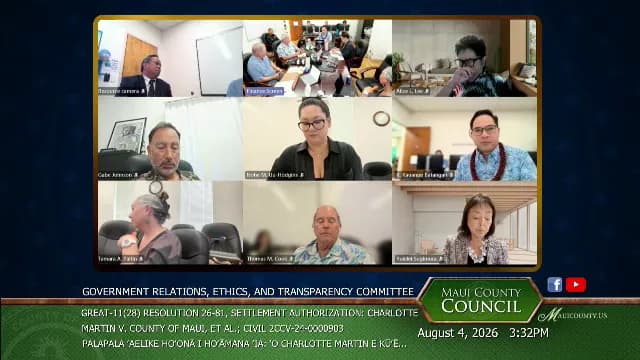
The Government Relations, Ethics and Transparency Committee of Maui County met on August 4, 2026 from 1:33 PM to 4:53 PM under Chair Colin Button. The committee addressed three settlement resolutions involving litigation against the county, each requiring executive session consultations with legal counsel. All three resolutions were recommended for adoption after closed-door discussions. Public Comments & Testimony - One member of the public, Jeffrey Long (testifying via phone, last four digits 4945), testified on all three agenda items. He expressed general disappointment with government transparency and procedure, particularly regarding the lack of visual/audio cues during executive session recesses. On the seabird settlement (Resolution 26-128), Mr. Long stated he was on the side of the C-Bird (seabird) and opposed quick killing of CBOs. On the Charlotte Martin pedestrian incident (Resolution 26-81), he leaned in favor of the plaintiff, citing distrust of government. On the bicycle incident (Resolution 26-122), he questioned whether riding a bicycle on the sidewalk was prohibited and suggested paying the plaintiff while urging more caution by county drivers. Discussion Items Resolution 26-128 – Seabird Threat Claim Settlement - Deputy Corporation Counsel Bill Barry provided an update: the case was filed November 19, 2024 alleging that street lights owned by Hawaiian Electric and operated on behalf of the county threaten three endangered seabird species under the Federal Endangered Species Act. Discovery and expert deadlines have passed, both parties’ summary judgment motions were denied, and trial was originally set for June 1, 2026 but continued to February–April 2027. Settlement discussions are ongoing with plaintiffs and co-defendant HECO. - Councilmember Cook asked about the timeline and who pays for experts; Barry replied each party pays its own experts; discovery and motions took most of 2025-2026. - The committee moved into executive session to discuss settlement strategy and case strengths/weaknesses. Resolution 26-81 – Charlotte Martin v. County of Maui (Pedestrian Incident) - Deputy Corporation Counsel Glenn Pasqual explained: the lawsuit arose from a February 5, 2023 incident at Kipani White Park where MPD Officer Mitchell Navarro, driving a marked police SUV, struck pedestrian Charlotte Martin. Martin suffered crushed foot/ankle injuries and a torn meniscus requiring surgery. Trial was initially set for June 8, 2026, but after a settlement conference on April 23, 2026, the judge ordered mediation, now scheduled for August 10, 2026. Trial has been continued to June 21, 2027. - Councilmember Falton asked for details from the police report. Pasqual clarified the officer was rolling slowly into the park, looking right to avoid a parked car, when Martin stepped backward to take a photo of two dogs; the collision involved the heel of her foot. No police report was provided to the committee. - The committee moved into executive session to discuss case assessment, damages, and settlement. Resolution 26-122 – Tran v. County of Maui (Bicycle Incident) - Deputy Corporation Counsel Pasqual described: on September 19, 2022, parks employee Lane Bellin, while driving a county vehicle and showing a new employee facilities, was turning right onto Wailea Alanui Drive from Wailea Beach Access Road. Plaintiff Nina Tran was riding a hotel bicycle on the sidewalk against traffic (left side). Bellin looked left, saw no traffic, and accelerated, colliding with Tran, who suffered left ankle and leg injuries with scarring. Trial is set for September 14, 2026, with a settlement conference before Judge Drewer on August 6, 2026. - Councilmember Falton asked if Bellin was sued in her personal capacity; Pasqual confirmed she was being sued individually but would discuss further in executive session. - The committee moved into executive session to discuss settlement efforts, damages, and case strengths/weaknesses. Key Outcomes - Resolution 26-128: Motion to recommend adoption (including non-substantive revisions) passed 7-0-1 (Councilmember Sensi excused). - Resolution 26-81: Motion to recommend adoption passed 7-0-2 (Councilmembers Rollins Fernandez and Sensi excused from the vote). - Resolution 26-122: Motion to recommend adoption passed 7-0-2 (Councilmembers Sukimura and Sensi excused). - All three resolutions authorize settlements under terms discussed in executive session, subject to full council approval.
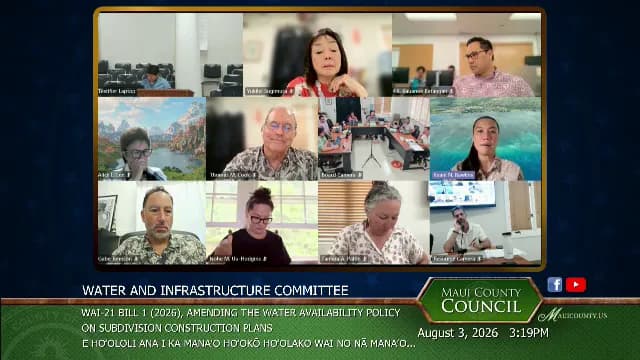
The Water and Infrastructure Committee of the Maui County Council met on August 3, 2026, at 1:35 p.m. to consider Bill 1 (2026), which would allow the Department of Water Supply to review subdivision construction plans concurrently with other departments before written verification of a long-term water supply is obtained. The committee heard public testimony, deliberated, and voted to defer the bill for further review by the Board of Water Supply. Public Comments & Testimony - Leilani Pulmano (Pacific Rimland) testified in support, stating that the bill streamlines processing while still requiring water verification before final approval. She noted her familiarity with subdivisions and that the bill allows concurrent review. - Lucien Denet (private citizen, former staff for Councilmember Michelle Anderson) testified in opposition, expressing concern that changing "shall" to "may" in Section 14.12.040 creates uncertainty and weakens the "show me the water" ordinance. She questioned whether the Board of Water Supply had reviewed the July 28 amendment summary form and recommended earlier verification rather than later. - Travis Liggett testified, but his testimony focused on unrelated concerns about water quality and health risks; he was redirected to the agenda item. He expressed skepticism about routing new water into non-compliant systems. - Dr. John Helly (individual, not representing the Board of Water Supply) urged the committee to file or defer Bill 1. He argued that the Department of Water Supply already has administrative authority to re-sequence workflow, that the bill lacks evidence of time savings, and that it may interfere with the director's statutory authority over water sufficiency determinations. He noted the Board of Water Supply's May 21, 2026 letter was absent from agenda materials. - Albert Perez (former county employee) testified in opposition, stating that changing "shall" to "may" makes the requirement less clear, the department already has discretion to prioritize, and the bill could waste staff time on projects without water. - A representative from the Royal Patent Kingdom of Hawaii testified, asserting that all lands in Hawaii are royal patented and that subdivisions without title verification violate state law. - Stacey Alapai testified, asking for deferral to allow all relevant entities to review the July 28 amendment. She stated the bill appears "half-baked" and urged keeping the teeth in the "show me the water" ordinance. Discussion Items - Chair Tom Cook introduced Bill 1, explaining its purpose is to allow concurrent plan review without changing final water verification requirements. The proposed CD1 version from July 28, 2026, restores written verification language in Section 14.12.040 and adds a new subsection stating that verification must not delay the Director's review. - Department of Water Supply Chief Engineer James Jensen stated the department can operate either way and views the bill as a council policy decision. He noted that the department typically reviews in order received but can prioritize; the bill would require review of projects without water, which is now supported by review fees in place since July 1, 2026. - Councilmember Tamara Paltin questioned the legal difference between "shall" and "may" and requested that the Board of Water Supply review the new amendment. She also asked about prioritization of projects with water versus affordable housing. - Councilmember Gabe Johnson expressed concern that the bill could interfere with the department's ability to prioritize projects that have water (e.g., affordable housing, West Maui recovery), and noted that the department already has that discretion. He agreed with Dr. Helly that the bill may not achieve its stated goal. - Councilmember Yuki Lei Sugimura noted that the bill would codify current good practice and prevent future administrations from shelving projects without water. She supported deferral for further review. - Councilmember Keani Rawlins-Fernandez asked whether the bill should be sent back to the Board of Water Supply and whether planning's concerns about Native Hawaiian water rights should be incorporated. Director of Water Supply clarified that public trust considerations are already in code (Section 14.06A.010). - Councilmember Shane Sinenci was excused. - Councilmember Nohelani Uʻu-Hodgins asked for a process diagram of subdivision review from the Department of Water Supply and requested that the Board of Water Supply review the new ASF. She questioned which projects the bill would help, given that affordable housing is already exempt. - Councilmember Alice Lee supported the bill's intent to expedite subdivisions, noting that delays increase housing costs. She supported further review by the Board of Water Supply. - Councilmember Kauanoe Batangan supported transmitting the bill to the Board of Water Supply with a statement of need, noting that while the department has authority to re-sequence, that hasn't always been practice. He opposed codifying prioritization, calling it an administrative matter. Key Outcomes - The committee voted to defer Bill 1 (2026) and transmit the proposed CD1 version (as amended by the July 28, 2026 Amendment Summary Form) to the Board of Water Supply for further review and comment. - The transmittal will include a request to change the word "may" back to "shall" in Section 14.12.040, as Corporation Counsel stated the terms are functionally equivalent but "shall" provides greater clarity for the public. - The transmittal will also request that the Board of Water Supply clarify its prioritization process for reviewing subdivision construction plans, particularly regarding projects with versus without confirmed water availability, affordable housing, and other public trust priorities. This information is to be provided for transparency, not necessarily for codification. - The committee also requested that the Department of Water Supply provide a subdivision review process PowerPoint that was presented to the Board of Water Supply. - The meeting adjourned at 3:33 p.m.