The Housing and Land Use (HLU) Committee of the Maui County Council convened on July 1, 2026, at 10:38 AM (scheduled for 9:30 AM) to consider two resolutions: Resolution 26-110 and Resolution 26-111. These resolutions would initiate county-led rezoning of certain apartment district (A1/A2) properties to the newly created H3 and H4 hotel districts, and corresponding amendments to the Kihei-Makena and West Maui Community Plans. The committee heard extensive public testimony and deliberation, but took no final action, recessing the meeting to be continued on July 6, 2026, at 11:00 AM. Public Comments & Testimony Planning Department (Greg Post): Identified several inconsistencies in the property lists, including incorrect land use designations for 1444, 1440, and 1470 Halama Street (single-family, not multifamily), missing TMKs for Kahana Outrigger, and a recommendation to retain A1/A2 as compatible uses in the West Maui plan. He noted that some smaller properties (less than four units) may not have documented TVR use prior to September 24, 2020, a key eligibility criterion, and urged owners to provide proof. He also stressed the need for the council to provide clear policy direction to the Maui Planning Commission. Property Owners & Associations (Supporting Inclusion): Numerous testifiers urged the committee to include their properties on the rezoning lists, emphasizing long-standing lawful TVR operations, hotel-like characteristics, and economic contributions. John Chasen (Maui Sands 1): Requested inclusion of Maui Sands 1, a leasehold property built in 1966, arguing it is identical to its sister property, Maui Sands 2, which is already on the list. He noted leaseholds expire in 2037, making long-term mortgages difficult. Brian Banks (Small business owner): Supported Resolution 26-111 and requested inclusion of Grand Champions condominiums, which is similar to three other Wailea properties already listed. Rory Frampton (Makai Cam LLC): Sought inclusion of the burned Makai Sunset Inn property (1411 and 1415 Front Street), which operated as a hotel prior to the Lahaina fire. Jeff Ulioka (Maui El Dorado): Supported the rezoning, noting the property was purpose-built for TVR, has a front desk, and employs 14 ILWU workers. Greg Sheehan (Honokai Resort): Testified in support, noting 90% of units are short-term rentals, built in 1970, and a dedicated check-in office. He clarified three units are leasehold with eight years remaining. Andrew Reinhardt (Hale Maui): Requested inclusion of the 11-unit Hale Maui, which has no kitchens and has operated as a de facto hotel since 1988, with TVR tax records back to that year. Steve Collie (Kahana Outrigger): Asked that the fourth building (missing TMK) be added to Resolution 26-110. He noted all four buildings are leasehold, built in 1981, and recently renegotiated ground leases extending to 2041 or 2071. Sunny Cave (Ma'alaea Kai): Supported the rezoning, noting the property is in the sea level rise exposure area and not suitable for affordable housing. Mike Pitlinski (Honokawai Palms): Requested inclusion, stating the property was built as a hotel in 1965 and has mixed use (7 long-term, 22 short-term rentals). Tina Evans (Maui Vista): Supported rezoning, highlighting the property's history as a tennis resort, hotel-style management, and 75% of units being one-bedroom under 600 sq ft. Phil Mills (Hale Ono Loa): Supported Resolution 26-110, describing the 68-unit oceanfront complex as a small resort with a resident manager, pool, and amenities. He clarified the property is now fee simple. Timothy O'Shaughnessy (Koa La Kai): Supported rezoning, citing the 1974 condominium public report that allowed hotel/transient use and noted timeshare units on the property. Community Organizations & Residents (Expressing Caution or Opposition): Jordan Ruitas (Lahaina Strong): Expressing conditional support, she opposed adding properties that do not meet hotel-like criteria, particularly in Ma'alaea, and urged a case-by-case approach for leasehold properties. She noted that some properties, like Kanapali Royal and Hale Ono Loa, once had high owner occupancy but now have very few long-term residents. Caitlin Miller (Maui Vacation Rental Association): Encouraged objective criteria focused on long-standing lawful uses, not operational models. She argued that technological changes (e.g., mobile check-in) do not alter land use. Autumn Ness (LCLT): Challenged the assumption that leasehold properties are not mortgageable, citing examples of lenders willing to lend on long-term ground leases. She urged the committee to get opinions from multiple lenders, not just conservative ones. Albert Perez (Maui Tomorrow): Opposed batch rezoning, arguing that each property should be evaluated individually for impacts on neighborhoods and housing. He recommended criteria similar to those in Maui County Code Section 19.65 for short-term rental homes. Tom Crowley (Public): Raised concerns about the notice process for public hearings and urged the council to provide clear direction to the planning commission on why each property meets the criteria for zoning change. Kaina Shiki (Resource): Emphasized climate risk and sea level rise, urging the council to require environmental review, shoreline certification, and hazard mitigation planning for shoreline properties before rezoning. Lauren Rigo (Lahaina Strong): Provided detailed comments on specific properties, advocating for single-owner properties to be separated into a clean list, and opposing rezoning in Ma'alaea due to loss of housing and infrastructure investments. Royal Patent Kingdom Testifier: Opposed all land use decisions, asserting that the county lacks jurisdiction over royal patented lands without consent of descendants. Discussion Items Planning Department Process Clarification: Deputy Director Lillis and Greg Post explained the difference between applicant-initiated and council-initiated zoning changes. For council-initiated changes, no 500-foot radius notification is required, but the planning commission will hold a public hearing with newspaper notice. Council Member Questions on Criteria: Members debated whether to separate properties into categories (timeshares, leaseholds, single-owner, etc.) within the resolutions. There was discussion about requiring verification of TVR use prior to September 24, 2020, for smaller properties before forwarding to the planning commission. Leasehold and Timeshare Issues: Members raised concerns about including leasehold properties with short remaining lease terms, as they may not be suitable for long-term housing. The possibility of including properties with variances or 100% timeshare (which are not affected by Bill 9) was discussed to simplify zoning consistency. Future Process: Chair U'u-Hajans indicated that additional properties from the TIG's Exhibit 2 list would be brought forward in later resolutions. She noted that the committee would send letters to affected property owners requesting meets and bounds and verifying eligibility. Key Outcomes No Final Action Taken: The committee did not vote on either resolution. The meeting was recessed at 4:25 PM and will continue on July 6, 2026, at 11:00 AM, using the same meeting link and location. Executive Session Planned: Councilmember Rollins Fernandez requested a closed meeting for legal consultation on Monday, July 6, subject to a six-vote approval. Ongoing Verification: The planning department will work with the committee to verify that properties meet the H3/H4 eligibility criteria, including TVR use prior to September 24, 2020. Property owners of smaller units (under 4 units) will be asked to provide proof. Written Testimony Continued: The public may still submit written testimony via the e-comment link. Potential Amendments: Members discussed separating the single-owner properties into a distinct category or resolution. The chair will work with the corporation counsel on the legality of such amendments.
Public Meetings - Maui County, Hawaii
Public Meetings - Maui County, HawaiiThe Government Relations, Ethics and Transparency Committee of the Maui County Council met on June 30, 2026 at 1:35 p.m. to review and discuss the County of Maui Fraud Risk Assessment report prepared by Spire Hawaii LLP (dated February 2026). Chair Kamanoi Batangan presided, with committee members participating in person and remotely. The meeting was part of an ongoing effort to strengthen good governance, transparency, and accountability. No decisions or votes were taken; the item was a discussion-only (7B) item. Public Comments & Testimony - Konamu Balending expressed support for the fraud assessment and urged adoption of a nepotism policy, noting that some employees may be in positions due to personal connections. - Kaneali Williams raised concerns about the Department of Finance’s real property assessment division, alleging that TMK property reports may misrepresent ownership by omitting references to royal patents. He argued this constitutes fraud risk and urged the council to consider this when evaluating related bills. - Lala Johnson highlighted the need for strong internal controls as the county expands grant programs, citing proposed $1.09 million for a new grants division. She asked for transparency in recipient selection, performance standards, and conflict-of-interest reviews. - Christopher Salem challenged the SPIRE report’s conclusion that no countywide fraud reporting process exists, pointing to the Office of the County Auditor’s stated adherence to GAGAS (Yellow Book) standards. He questioned whether the auditor properly investigated allegations and raised concerns about legal fees and the auditor’s independence. - Sam Small argued that the charter already provides the council authority to initiate forensic investigations, and that lack of political will has prevented action. He alleged conflicts of interest involving Corporation Counsel and outside counsel, and connected these to deferred agreement audits and improper warranty deeds. - Kohava'i Paiina testified that all decisions on royal patented allodial title lands are fraudulent because no treaty of annexation exists. He requested return of such lands to descendants of original patent holders. - James Langford submitted a list of federal grants he had written that align with county needs, and offered to collaborate with the county on recovery programs. Discussion Items - Presentation by the County Auditor and Spire Hawaii LLP: Lance Taguchi, County Auditor, explained the impetus for the fraud risk assessment, citing past employee bribery convictions, emergency procurements during COVID-19 and wildfires, and observations of possible fraud, waste, and abuse. Tyler Kimura of Spire presented findings: (1) existing controls are not adequately designed to mitigate fraud risks, with gaps in emergency procurement guidance, vendor fraud monitoring, overtime approval, nepotism policy, hiring screening, and unclear oversight roles between the Department of Water Supply and Department of Finance; (2) there is no countywide policy for handling fraud complaints, leading to potential forum shopping. The report made five recommendations: develop fraud mitigation systems following GAO/COSO frameworks; address policy gaps; provide employee fraud awareness training; convene a cross-departmental fraud reporting working group; and develop a communications plan for the reporting system. The administration agreed with all recommendations. - Managing Director’s Response: The Managing Director acknowledged the report and noted that many corrective actions were already underway, including training, RFP for internal controls, and collaboration with the Board of Ethics on a nepotism policy. He emphasized that the administration disagrees with some findings but is committed to implementation. He also noted that the CDBG-DR program has strengthened internal controls due to federal oversight. - Councilmember Questions and Discussion: - Emergency Procurement: Councilmembers asked about balancing speed with controls in emergencies. Spire clarified they recommend guidance on when emergency proclamations no longer justify non-competitive procurements. The administration highlighted pre-positioned contracts, training, and post-disaster accountability. - Direct Pay: The Department of Water Supply reported 6,223 direct pay transactions totaling $21 million, with $16 million for utilities; the remaining $5 million was for other goods/services. Councilmembers questioned whether utilities should be processed through purchase orders to maintain fraud safeguards. The finance director noted the RFP will address these gaps. - Nepotism Policy: Multiple members expressed support, and the Chair noted a draft policy will be considered on July 28, 2026. - Perception Gap: 86% of elected officials rated fraud risk as medium, while 95% of department heads rated it low. Spire suggested department heads may have a narrower view. - Non‑responding Departments: Several departments (e.g., Personnel Services, Police) did not fully participate in surveys or interviews. Councilmember Paulton suggested transmitting the report and concerns to oversight commissions (Civil Service Commission, Police Commission). - Sole‑Source Procurements: Not specifically covered in this assessment, but a state auditor review is underway. - Hotline: The county auditor announced a live fraud, waste, and abuse hotline (24/7, phone and web) managed by a third party. Key Outcomes - The administration confirmed it agrees with all five SPIRE recommendations and is implementing several: developing GAO/COSO framework, addressing policy gaps (including nepotism), and providing fraud awareness training. - The Office of the County Auditor launched a countywide fraud hotline effective June 30, 2026. - The Department of Finance has drafted an RFP (funded at $125,000 for FY27) to strengthen internal controls and provide training; solicitation expected in early July 2026. - The FY27 audit plan includes a review of direct pay transactions by the Department of Water Supply and a review of county travel policy regarding private jet travel provided by entities doing business with the county. - The council will transmit the fraud risk assessment report and concerns about non‑participation to the Civil Service Commission and other oversight bodies responsible for departments that did not fully cooperate. - The committee’s next meeting is scheduled for July 28, 2026 at 1:30 p.m., when it will consider Board of Ethics legislative proposals, including nepotism and lobbyist regulation bills. - Chair Batangan will work with committee staff to develop a detailed plan to address remaining unmet needs identified during the discussion.
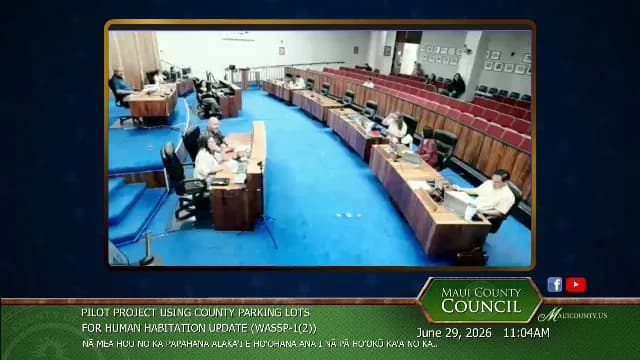
The Water, Social Services, and Parks Committee of the Maui County Council met on June 29, 2026, to receive an update on the pilot project allowing vehicle habitation in designated county parking lots. The meeting, chaired by Councilmember Shane Sinensi, focused on persistent delays, site challenges, and the urgent need for solutions for the houseless population. No votes were taken; the item was deferred. Public Comments & Testimony - Tim Ordin urged the committee to act with urgency, emphasizing the human toll of homelessness and the need to cut through bureaucracy. - Melvin Johnson, principal of AGON (the contractor selected for the pilot), explained that site preparation at the MEO property (behind Target) has been delayed by subcontractor changes, flooding from Kona low storms, and the need for topographic mapping. He stated that AGON is ready to implement but faces challenges with the site and NIMBY opposition from potential alternative property owners. - Lisa Darcy, founder of Share Your Mana, expressed confusion, asserting that the current project differs from the original safe parking concept and criticized the county for leaving people in danger. - Gordon Jackson (Stitch) noted that Google's estimate of 651 houseless individuals is conservative (he believes closer to 1,000) and questioned why the county spends large sums on other projects while neglecting the homeless. - Bill Greenleaf reiterated the urgency, criticized the mayor for continuing sweeps, and called for a larger vision including villages and farming. - Karina O'Malley (via video from Kirkland, Washington) shared her experience running a safe parking program for 15 years and offered to help the county set up sites quickly. - Dr. Graham Press, Executive Director of the National Vehicle Residency Coalition, supported the program and offered resources to address safety and management concerns raised by police and fire departments. Discussion Items Update on the Safe Parking Pilot Project: - Director Maggie Willis (Department of Human Concerns) reported that the contract with AGON has been executed but no funds have been expended. Site readiness at the MEO property (Hansen Road) is now estimated at approximately five months due to the need for topographic mapping, engineering plans, and permitting after flooding damage from Kona low storms. - The county is exploring alternative county-owned parcels for potentially combining safe parking with safe sleeping, but the primary focus remains the MEO site. - Police Captain Angel raised concerns about restrooms, enforcement, increased calls for service, and abandoned vehicles. Fire Captain Purdy cited access, water supply, and fire safety issues. - Deputy Director Robinson (OEV Resources) offered indigenous perspectives on caring for the houseless. - Councilmembers expressed frustration with the slow pace and lack of a comprehensive plan. Councilmember Sugimura asked for an overall homeless plan from the administration. Director Willis stated she is working on a master plan but needs time to gather community input. Councilmember Johnson noted the difficulty of implementing a Housing First model in a housing shortage. - Suggestions included engaging faith-based organizations, using church parking lots, starting with women and children only, and separating men for safety. Key Outcomes - The committee received the update and deferred the item for future discussion. - No votes or formal actions were taken. - The committee will send correspondence to the Homeless Coordinator (Naomi Crozier) requesting a comprehensive homeless plan and a timeline for its delivery. - Committee members urged the administration to act with greater urgency and to consider alternative sites that can be brought online more quickly.
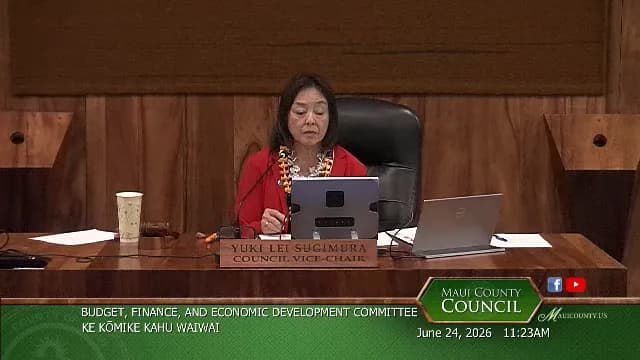
The Budget Finance Economic Development Committee (BFED) met on June 24, 2026, at 9:03 a.m., recessed for a training session, and reconvened at 11:02 a.m. The committee considered two agenda items: a resolution authorizing a tax‑exempt lease purchase agreement with TD Equipment Finance Inc. for the Johnson Controls energy performance contract (Phase 3), and a bill amending the Maui County Code to establish uniform administrative rules for the county grants program. Both items advanced out of committee. Public Comments & Testimony - Kai Miley Makekao testified at length in opposition to the Johnson Controls lease purchase agreement, asserting claims as a freeholder under royal patent title deeds and citing international law. They argued the county lacked authority to proceed and demanded respect for Hawaiian land rights. Their testimony exceeded the time limit and was concluded after six minutes. - Jim Langford deferred his time to the previous testifier but later testified on the Johnson Controls item, recommending that council members consider recusal and offering auditing services. - A representative of the Royal Patented Kingdom testified on both items. They stated that descendants of royal patent landholders do not approve or consent to any energy contracts, calling such agreements illegal. They also objected to the removal of the first testifier, calling it a violation of international law, and demanded the return of lands and assets. Discussion Items - BFED‑61 – Resolution 26100 (Johnson Controls Energy Performance Contract – Phase 3): Budget Director Milner requested an amendment to add the phrase “up to” before the dollar amount to allow flexibility if the final financed amount is lower than originally stated. The proposed cost is $9,021,259 plus interest at 4.49%, financed through a tax‑exempt lease purchase agreement with TD Equipment Finance Inc. Councilmember Batangan questioned why the financing is structured as a lease, given that the improvements (irrigation controls, window film, roof upgrades, electrical service upgrades, and wells) would be difficult to remove if the county failed to make payments. Budget Director Milner explained that the lease structure allows the financier to repossess equipment if payments cease, and the county would be responsible for replacement. Councilmember Cook asked about the relationship between capital costs and energy savings; a Johnson Controls representative clarified that the project is budget‑neutral under Hawaii Revised Statutes §36‑41, with savings from energy‑efficient measures paying for non‑saving improvements like roofs. The committee discussed the pending third‑party audit of Phase 1 savings. The CD‑1 amendment (adding “up to”) was adopted by voice vote (6 ayes, with Chair Lee, Member Palten, and Member Rollins Fernandez excused). The main motion as amended was then approved by the same 6‑0 vote. - BFED‑58 – Bill 73 (2026) – Amendments to Maui County Code §3.36.020 (Grants Program): The bill requires the county to adopt uniform countywide administrative rules under HRS Chapter 91 for the grants program, and permits agencies to adopt supplemental internal policies and procedures that do not conflict with those rules. Budget Director Milner noted that the administrative rules are still under development by corporation counsel, with a target adoption date of late August 2026 (previously August 15). Chief of Staff Lalo emphasized collaboration across departments and plans for public workshops and training. Councilmember Batangan raised concerns that subsection (b) could allow agencies to bypass formal rulemaking for policies affecting public rights, referencing HRS §91‑1. Office of Council Services (Mr. Hanano) opined that policies and procedures that do not fall under the definition of a “rule” are permissible, but suggested the provision might be unnecessary. Corporation counsel confirmed that agency‑specific policies will be reviewed by assigned corporation counsel to determine if rulemaking is required. The CD‑1 version, which identifies the Department of Management as the agency responsible for adopting the countywide rules, was adopted by voice vote (6 ayes, same excused members). The main motion as amended then passed 6‑0. Key Outcomes - Resolution 26100 (Johnson Controls Phase 3) passed out of committee with the CD‑1 amendment (adding “up to” to the principal amount). The vote was 6 in favor; Chair Lee, Member Palten, and Member Rollins Fernandez were excused. - Bill 73 (2026) passed out of committee on first reading with the CD‑1 amendment (designating the Department of Management as the rule‑making agency). The vote was 6 in favor; the same three members were excused. - The committee directed staff to transmit a written question to the administration regarding the appropriate use of administrative rulemaking versus internal policies and procedures for grant programs, with further clarification expected before second reading.
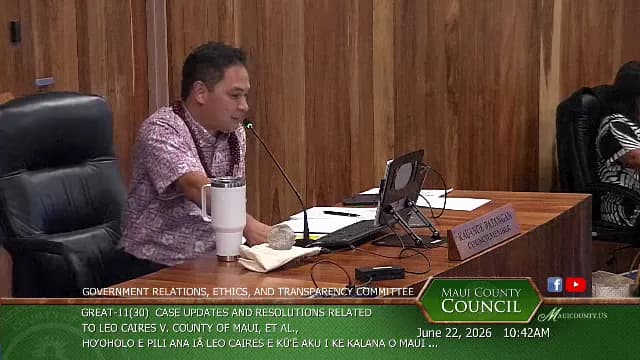
The Government Relations, Ethics, and Transparency Committee met on June 22, 2026, to receive a status update on the lawsuit Leo Kairas v. County of Maui et al. (Civil File 2CCV-26-000138) and to consider Resolution 26-99, which aims to address conflicts of interest by requiring all written settlement offers to be transmitted to the Council and all invoices from special counsel to be reviewed by the Office of Council Services (OCS). The meeting began at 9:21 AM, recessed until 9:40 AM to allow late-arriving members to join, and reconvened at 9:41 AM. After an executive session from 10:42 AM to 2:03 PM, the committee reconvened and approved the resolution. Public Comments & Testimony - Christopher Salem (former chief judge and prosecuting attorney): Expressed concern that the mayor publicly characterized the whistleblower lawsuit as "100% politically motivated" before discovery, calling such statements ethically out of bounds. He argued that county employees remain vulnerable to retaliation and that the council authorizes outside counsel without prior investigation. He supported Resolution 26-99 as an opportunity for oversight. - Sam Small: Testified that the council is currently kept in the dark when settlement offers are rejected by corporation counsel, citing an earlier case (Salem) where a $75,000 offer was not disclosed. He stated that this issue extends beyond the Kairas case and supported the resolution as a necessary charter revision. - Travis Liggett (mayoral candidate): Stated he was fired 20 minutes after uncovering permit violations at Malaya Harbor and faces retaliation from a large law firm. He urged the committee to gather all facts and not let fixed beliefs impede the process. - Royal House of Hawaii: Raised concerns about fraud in land title changes and settlements related to Kanaka people. The Chair directed them to keep testimony germane to the agenda item. Discussion Items - Status of the Lawsuit: Special counsel Richard Rand (Marr Jones & Wang LLP) reported that the lawsuit was filed in April 2026 but not served until June 5, 2026. He has drafted an answer (due June 25) and spent approximately 25 hours on it. He noted that prior investigations related to the case include an investigation of the Office of Economic Development (OED) and a truncated internal investigation of a mayoral staffer who resigned. Rand stated that a criminal investigation is possibly ongoing with the Attorney General's office. He also confirmed that an initial demand letter included a monetary settlement offer, but timing (budget season) prevented earlier council engagement. - Conflicts of Interest: Corporation counsel (Deputy Corporation Counsel Susan Leader) stated that the department is conflicted out due to the lawsuit's allegations, so she acts only as a liaison for factual information. OCS attorney Hanano confirmed that Resolution 26-99 was reviewed and approved as to form and legality by OCS because corporation counsel could not sign it. Chair Baton noted that the conflict extends to the entire chain of command (corporation counsel hired/fired by mayor), and the resolution aims to create a firewall by having special counsel report to OCS. - Resolution 26-99 Deliberation: The resolution requires all written settlement offers in this case to be transmitted to the Council via attorney-client privilege, and all invoices from special counsel to be sent to OCS for review and approval. Members clarified that this applies only to the Kairas case, not all complaints. Vice Chair Uu Hodgins asked about mechanics; Hanano explained how offers would be transmitted confidentially. Corporation counsel indicated they would still receive notice and participate as needed. Key Outcomes - Motion to go into executive session passed unanimously (7-0) to consult with legal counsel on case strengths, settlement considerations, and liabilities. Executive session lasted from 10:42 AM to 2:03 PM. - After executive session, the committee discussed and voted on Resolution 26-99. The motion to recommend adoption (including non-substantive revisions) was made by Member Sugi Mora and seconded by Member Cook. The vote was 6 ayes, 0 nays (Members Paulton, Rollins Fernandez, and Senency excused). The resolution will move to the full Council for consideration. - The committee also noted upcoming meetings on the fraud risk assessment report and good governance reform bills.
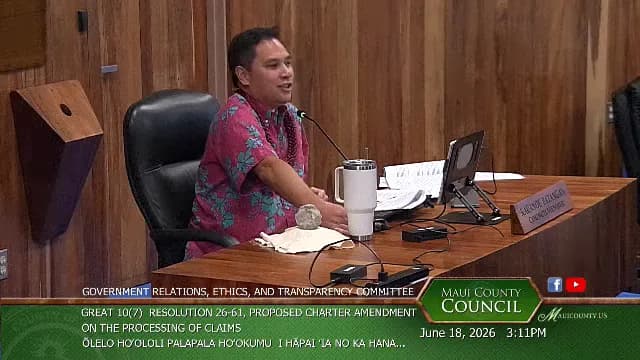
The committee, chaired by Connor Batangan, convened at 9:00 AM to complete deliberations on proposed charter amendments for the November 2026 ballot. The meeting included discussion and votes on several resolutions, public testimony, and prioritization of amendments. The committee recommended passage of six charter amendments, filed one, deferred one, and discharged one without recommendation. The meeting adjourned at 4:14 PM. Key Outcomes - Resolution 26-88 (emergency appropriations): Recommended passage on first reading (8-0). - Resolution 26-89 (transfer of appropriations): Initially recommended passage (6-3), but later reconsidered and filed (9-0). - Resolution 25-215 (notice and conduct of public hearings): Filed (9-0) after clerks withdrew support. - Resolution 25-217 (computation of time): Recommended passage on first reading as amended (9-0). - Resolution 26-93 (independent nomination board dissolution): Recommended passage on first reading as amended (9-0). - Resolution 26-61 (processing of claims): Discharged from committee without recommendation (9-0). - Resolution 26-11 (council vacancies): Deferred without objection. - Total recommended charter amendments for the ballot: Eight (including one previously approved). Public Comments & Testimony - No oral testimony was received on any item. Written testimony continued to be accepted. Discussion Items Resolution 26-88 – Emergency Appropriations - Budget Director Milner explained the need to clarify the 1% limitation and allow a line of credit for major emergencies. Members expressed support, with Vice Chair Uu Hodgins asking about qualifying emergencies. The resolution passed unanimously. Resolution 26-89 – Transfer of Appropriations - Director Milner proposed allowing the council by ordinance to set thresholds for intra-departmental transfers without a resolution. Members divided: Chair Lee and Chair Batangan opposed, citing loss of oversight and budget discipline. Others, including Member Rollins Fernandez and Vice Chair Uu Hodgins, supported flexibility. The initial vote was 6-3 in favor (ayes: Cook, Johnson, Rollins Fernandez, Senensi, Uu Hodgins, Batangan? Wait, Batangan voted no? Transcript: Batangan said "No" at end. So ayes: Cook, Johnson, Rollins Fernandez, Senensi, Uu Hodgins, and? Actually vote: Cook aye, Johnson aye, Chair Lee no, Paulton? She voted with reservations, but it's aye. Rollins Fernandez aye, Senensi aye, Sugimura no, Uu Hodgins aye, Batangan no. That's 6 ayes (Cook, Johnson, Paulton, Rollins Fernandez, Senensi, Uu Hodgins) and 3 noes (Lee, Sugimura, Batangan). Later, during prioritization, the committee reconsidered and voted to file (9-0). Resolution 25-215 and 25-217 – Notice and Computation of Time - The clerks proposed combining these resolutions. Corporation Counsel Colby raised concerns about conflict with state law on newspaper publication. Extensive debate led to filing 25-215. A CD1 version of 25-217 was adopted, including amendments to clarify deadlines (referencing Section 4-3.3 instead of Article 9). The amended resolution passed 9-0. Resolution 26-93 – Independent Nomination Board - The mayor’s office recommended dissolution with an amendment to allow ordinance-based board appointment policies. Corporation Counsel advised removing language about mayor identifying applicants due to privacy concerns. Member Rollins Fernandez moved to restore omitted language and add "in conformance with public notice requirements of state law." The amendment passed 8-0 (one excused). The main motion as amended passed 9-0. Resolution 26-61 – Processing of Claims - Clerks argued for moving claims filing to the Department of Corporation Counsel for better public service. Corporation Counsel warned of conflicts of interest, citing potential for special counsel costs. Member Sugimura moved to amend to direct claims to the Director of Finance, which passed 5-4. After further debate and the absence of Finance input, the committee voted to discharge the resolution without recommendation (9-0). Resolution 26-11 – Council Vacancies - A proposed draft was distributed but members felt more work was needed. The item was deferred without objection. Consent Calendar - No separate consent calendar was used; all items were deliberated individually. Prioritization of Ballot Questions - The committee reviewed the list of eight recommended amendments. To avoid overwhelming voters, members agreed to file Resolution 26-89 (transfer of appropriations) and considered filing Resolution 26-85 (Hawaii state model) and Resolution 25-217 (computation of time). Only the motion to file 26-89 succeeded; 25-217 and 26-85 remained on the ballot. The final recommendation includes six amendments from this meeting plus one previously approved. Note: The agenda and minutes were not available; this summary is derived solely from the transcript.
The Housing Land Use Committee convened on June 17, 2026, to receive a status update on the Maui County Code Title 19 (zoning code) rewrite project from the Planning Department. No actions were taken; the meeting focused on presentation and discussion of the process, schedule, and key issues. Public testimony raised concerns about the incorporation of Native Hawaiian Kuleana land rights and chain-of-title requirements. Committee members asked questions about resources, modular review approach, and community engagement. Public Comments & Testimony - Kahala Johnson urged the committee to incorporate a Kuleana overlay district into the rewritten zoning code, which would require identification, mapping, and reporting of reserved native tenant property rights during permitting, rezoning, and other land use approvals. She argued that such rights are legally encumbered on many land titles from the Great Māhele and should be made visible in the zoning framework. In response to clarifying questions, she suggested using existing databases like Kīpuka and processes similar to the burial council to verify legitimate claims. - Connie Lee Kane Alie Williams testified that the county lacks a clear chain of title for many properties, as the Planning Department relies on tax assessment printouts rather than documents tracing back to royal patents from the Kingdom of Hawaii. She argued that without such chain-of-title proof, applicants cannot demonstrate legal interest in allodial titles, creating liability for the county. She urged that Title 19 require applicants to provide proof of a clear chain of title linking to the original allodial title. - Leilani Koʻolauloa Johnson (of Waiehu) supported the concerns raised by prior testifiers, describing her experience reviewing county records for Waiehu Beach Road. She noted that county land use decisions often proceed based on preliminary title reports without full historical chain-of-title analysis, which can impact cultural practices, access, and burial protections. She asked the county to acknowledge these issues in the rewrite. - Jesse Law (testifying via phone) expressed dissatisfaction with the lack of publicly posted agendas in Kahului and Kula and criticized the OCS office for failing to provide accessible information. He did not speak to the Title 19 rewrite directly. Discussion Items - Planning Department Presentation: Director Jackie Takakura and Planning Program Manager Scott Forsyth presented the background and process for the Title 19 rewrite. They noted that the current code, first adopted in 1960, is outdated, fragmented, and misaligned with community plans. The rewrite will be conducted in modules (draft code groupings) to allow incremental review. The goal is to have draft chapters introduced later in 2026, with formal adoption of a single ordinance after all modules are reviewed. The department emphasized that no action was being taken on the item and no new code content was presented today. - Committee Questions: - Vice Chair Batangan asked about staffing and resources. Forsyth reported that the plan implementation division has three staff (soon to be two) and that the existing contract is about $690,000, with funds roughly halfway expended. The department has learned from other jurisdictions (e.g., Kauai and Hawaii County) and pivoted to a modular approach to avoid past failures. - Councilmember Paltin asked about incorporating conditions from change-in-zoning ordinances into the code to ensure institutional knowledge. The department acknowledged that conditions are currently tracked via land use designation forms but noted that clearer ordinance language would help new planners. - Councilmember Johnson asked whether the code could include zones for affordable or workforce housing. The department and consultant (Orion Planning and Design) indicated that this would be explored in later modules (4-7) dealing with district composition, noting that legal constraints on regulating who can occupy housing exist. - Councilmember Cook asked about the projected cost and whether the code would grow or shrink. The department stated the current contract is $690,000 and that the code is being reorganized for clarity, but the total size may not decrease. - Chair Lee expressed frustration with the complexity of the current code and asked for simplification for the average user. The department promised more graphics, tables of uses, and simplified processes. - Councilmember Senancy asked about agricultural zoning updates (Module 5) and whether the Hana Advisory Committee would be involved. The department confirmed they would seek referral to the Hana Advisory Committee for East Maui community input. - Councilmember Rawlins Fernandez noted the importance of education about Kuleana land rights and requested a presentation from experts (Professors McKenzie and Beamer) to her committee in July. - Councilmember Paltin probed the modular review process, asking what happens if a module is accepted but later changes are needed. The department and corporation counsel indicated that the process is still being refined, and changes might require revisiting earlier modules depending on scope. Key Outcomes - No votes were taken and no decisions were made. The meeting was informational only. - The committee will receive future modules informally for feedback before formal planning commission and council hearings. - Written testimony is still being accepted. - The committee will continue to discuss the process in subsequent meetings, with module one draft chapters expected in fall 2026. - A request for a written answer on whether council changes after planning commission review would require re-referral was noted, with responses to come from planning and corporation counsel.
The Maui County Council's Disaster Recovery, International Affairs, and Planning (DRIP) Committee met on June 17, 2026, to receive updates on long-term recovery operations from the March 2026 Kona Low storms. The meeting featured presentations from the U.S. Small Business Administration (SBA) and the Office of Recovery (OOR), followed by extensive committee discussion. No legislative action was taken. Public Comments & Testimony - No oral or written testimony was offered. The chair closed public testimony after a final call. Discussion Items 1. SBA Disaster Assistance Update (Elizabeth Vargas) - SBA offers disaster loans to homeowners, renters, businesses, and nonprofits of any size. - Homeowners may borrow up to $500,000 to repair/replace their primary residence; renters and homeowners can borrow up to $100,000 for personal property. - Businesses and nonprofits can borrow up to $2 million for physical damage and economic injury. - Interest rates: 2.8% for homeowners/renters, 4% for businesses, 3.6% for nonprofit organizations. - Repayment terms up to 30 years; no cost to apply, no prepayment penalty, and no obligation to accept a loan if approved. - The deadline to apply for physical damage loans had an initial deadline of June 14, but a 60-day grace period extends it to August 13, 2026. Economic injury loan applications are open until January 2027. - As of the meeting, SBA had approved over 170 loans totaling over $11 million. The majority were home loans. - No payments are due for the first 12 months after the first disbursement. - An additional 20% of verified losses may be available for mitigation measures. - An SBA Disaster Loan Outreach Center is open in Kihei (1501 Liloa Drive, Monday-Friday 9am-6pm). 2. Office of Recovery (OOR) Presentation (John Smith) - The Kona Low storm (March 10-24, 2026) caused widespread damage across Maui, Molokai, and Lanai. - The county documented 92 damaged infrastructure sites, with total damage estimated at over $100 million. This adds to the existing $2.36 billion recovery need from the 2023 wildfires. - FEMA declared disaster 4909. - FEMA Funding and Timeline: OOR is streamlining the process. FEMA is moving to a faster reimbursement model (targeting under 2-3 years instead of 5-7), but this imposes tight deadlines. The county is ahead of schedule on recovery scoping meetings. - Cost Share: FEMA reimbursement is typically 75% federal, 25% local. - Eligibility Challenges: Parks facilities ("Category G") were specifically excluded from FEMA reimbursement. The state has appealed this exclusion. Exception: The damaged Paia gym was successfully reclassified from a park to a general building category to secure eligibility. - Sediment Removal: Approximately 300,000 cubic yards of sediment is trapped in Kihei gulches. The county has applied for $20 million from the USDA NRCS Emergency Watershed Protection Program to remove it. - Sinkholes: Major sinkholes occurred in Molokai (linked to a road construction project), Lahaina, and South Kihei Road. The South Kihei sinkhole was caused by a water main break during the storm. Repairs are being redesigned with stronger engineered solutions for resilience. - Funding Strategy: The OOR is incorporating the Kona Low needs into the overall county funding strategy. Future budget amendments may be needed for the local match on FEMA projects in FY27 or FY28. 3. Councilmember Questions & Discussion Councilmember Rollins Fernandez (South Maui): - Expressed appreciation for in-person outreach on Molokai. - Asked about bonding for recovery costs and whether FEMA reimburses debt service. Budget Director Milner confirmed FEMA does not cover debt service. Chair suggested lobbying FEMA for this change. - Discussed the parks exemption appeal, noting Oahu has a stronger case which might benefit Maui. Councilmember Cook (South Maui): - Inquired about right-of-entry and liability issues for sediment removal on private property. - Discussed the challenge of documenting damage for FEMA reimbursement when cleanup happens quickly. OOR confirmed they use detailed before/after photos, truck logs, and cubic yard records. - Learned the South Kihei Road sinkhole was triggered by a water main break. - Asked how the county is building back more resiliently (larger culverts, engineered solutions). Councilmember Tenenti (Hana): - Expressed that Hana was impacted, though the damage map showed no blue dots in his district specifically. - Asked about competition for contractors, acknowledging the volume of work drives up costs. Councilmember Sugimura (Upcountry): - Sought details on the Paia gym. OOR explained it is likely a total loss, pending a structural engineer's report (expected in 60 days). Due to its historical status, reconstruction involves archaeological and accessibility reviews. - Stated the gym was moved from "parks" to "buildings" category for FEMA eligibility. - Advocated for Kula Hospital (a state facility), which is displaced. OOR stated they are advocating for it as a community resource but are not decision-makers. Councilmember Batongan: - Asked for a clearer distinction between roles in mitigation vs. resiliency. OOR said this work is in progress. - Clarified that there are no unrestricted block grants (e.g., CDBG-DR) for this event; all applied grants have specific scopes. - Discussed the process for the council to appropriate matching funds. Budget Director Milner noted matching funds could be through existing CIP projects or a future budget amendment for new needs. Councilmember Gabe Johnson: - Asked about plans for the upcoming El Nino season. OOR stated staff are gaining experience from the current disaster, which acts as workforce development. They are expanding office space and engaging earlier in the disaster cycle. - Proposed extending the factory-built home allowance (from the wildfire zone) to Kona Low-affected areas. OOR expressed openness to supporting such code changes. - Questioned placement of removed sediment. OOR explained it follows a county debris plan (landfill, ag properties) with careful analysis to prevent re-entry into gulches. Councilmember Charlie: - Specifically worried about Kula Hospital patients displaced to Oahu and the urgency of bringing them back. - Asked if SBA loans require a second mortgage. Ms. Vargas clarified yes, over $50k collateral is required, but lack of collateral won't cause a decline. - Confirmed renters do not need collateral. Key Outcomes & Next Steps - No legislative action was taken. The item was defrayed. - SBA Deadline: The SBA encouraged residents to apply before the August 13, 2026 grace period deadline, emphasizing no obligation to accept the loan. - FEMA Validation: OOR is actively validating the 92 damaged sites with FEMA and HI-EMA. - Gym Study: The structural evaluation of the Paia gym will conclude in 60 days. - Sediment Removal: A decision on the $20 million NRCS grant for Kihei gulches is expected soon. Follow-up letters were requested regarding HHFDC detention/retention basins above Waihee. - Funding Requests: The administration will likely return to the council in FY27 for budget amendments to cover the local cost share of recovery projects. - Disaster Preparedness: The administration emphasized the need to partner with council members to identify small district problems before they become large storm emergencies. They are also building networks with property managers to improve communication before events.
The Budget Finance Economic Development (BFED) Committee of Maui County, Hawaii, convened at 9:07 AM on June 16, 2026, under the chairmanship of Yukile Sugimora. The meeting was conducted in accordance with the Sunshine Law. However, persistent technical difficulties prevented members Johnson and Rollins Fernandez from being heard, and the committee was unable to proceed with its agenda. After a brief recess and attempts to resolve the issue, the chair recessed the meeting. Key Outcomes - The meeting was recessed due to unresolved audio problems with remote participants. - The committee will reconvene on June 24, 2026, at 9:00 AM using the same Microsoft Teams link and in-person viewing in the council chamber. - No agenda items were discussed, and no votes or decisions were taken.
The committee convened at 1:34 PM to continue its June 2, 2026 deliberations on proposed charter amendments. The meeting included discussion of four resolutions (2611, 2686, 2695, 2687, 2693) and ended with a recess at 5:10 PM to be continued on June 18, 2026 at 10:00 AM. Public Comments & Testimony - Resolution 2611 (Council vacancies): Sam Small attempted to testify on an unrelated charter amendment but was ruled out of order; Christina De Leon sought to testify on a later item and was asked to wait. - Resolution 2686 (COGC staggered terms): Dick Mayer testified in support of staggering terms but suggested moving the effective date to February 1, 2027 and extending the concept to other boards. - Resolution 2695 (Board of Ethics reappointment): No oral testimony was received. - Resolution 2687 (Climate Action Fund): Multiple testifiers spoke in support: Lucienne DeNaie (Sierra Club Maui) supported the fund but urged focusing on proven resilience projects; Alex DeRode (former county staff) emphasized dedicated funding for the Climate Action and Resiliency Plan (CARP); Suparna Vashisht and Hannah Leely (Surfrider Foundation) also expressed support, with Leely calling for clear guardrails. - Resolution 2693 (INB dissolution): Dick Mayer provided history of the Blue Ribbon Committee and urged retaining and improving the INB; David Good suggested mechanisms to extend board members' service; a testifier from the Kingdom of Hawaii advocated for reverting to original hiring laws. The COGC chair recommended keeping but strengthening the INB with additional staff and resources. Discussion Items - Resolution 2611 (Council vacancies): Introducer Councilmember Rollins Fernandez proposed amendments to require a special election if the unexpired term is 6+ months, remove the mayor's appointment authority if the council deadlocks, and eliminate the council's deadline to fill vacancies. Discussion focused on whether the trigger should be 365 days instead of 6 months, whether the council chair should act as tiebreaker (opposed by some), and whether to adopt timelines similar to Honolulu (10 days to call election, 120 days to hold it). The committee deferred the item to June 18 with direction to staff to draft language reflecting: removal of mayor’s role, 365-day trigger, no tiebreaker mechanism, and provisions for multiple vacancies. - Resolution 2686 (COGC staggered terms): Vice Chair Uu Hodgins introduced the proposal. COGC Chair Dina Gusens Larson noted the commission prefers a code amendment over charter amendment to avoid shortening existing terms. Legal counsel initially opined that a charter amendment is required, but later discussion suggested that the phrase “unless otherwise provided” in the charter may allow a code amendment. The committee deferred the item pending further legal review. - Resolution 2695 (Board of Ethics reappointment): Director Lauren Akitake supported allowing reappointment for one successive term (currently a two-year waiting period). The committee discussed extending terms to two five-year terms versus one ten-year term. An amendment was made to correct the effective date from July 1, 2026 to July 1, 2027. The committee voted to recommend passage on first reading (voice vote, no dissents noted). - Resolution 2687 (Climate Action Fund): Councilmember Johnson proposed setting aside 20% of TAT revenues into a dedicated climate fund. Budget Director Milner noted that FY27 TAT is estimated at $65 million, so 20% would be $13 million; current county spending on CARP-related projects is about $90 million. Several members opposed using TAT for this purpose, citing dwindling revenues and competing needs (housing, homeless services). A motion to file the resolution passed 8–1 (Councilmember Johnson opposed). - Resolution 2693 (INB dissolution): Councilmember Rollins Fernandez proposed repealing the 2022 charter amendment that created the Independent Nomination Board (INB). Testimony highlighted recruitment challenges and quorum failures. Chief of Staff Lalo Alcon shared the administration’s openness to co-creating a more efficient system. The committee deferred the item to June 18 and requested data on board vacancies and canceled meetings before and after the INB’s creation. Key Outcomes - Resolution 2695 (Board of Ethics): Approved on first reading (as amended) and will move to full council. - Resolution 2687 (Climate Action Fund): Filed (8–1). - Resolutions 2611, 2686, 2693: Deferred to June 18, 2026, with specific direction to staff for further drafting or legal review. - The committee recessed at 5:10 PM and will reconvene at 10:00 AM on Thursday, June 18, 2026 to consider remaining charter amendments and reconsider any items as needed.