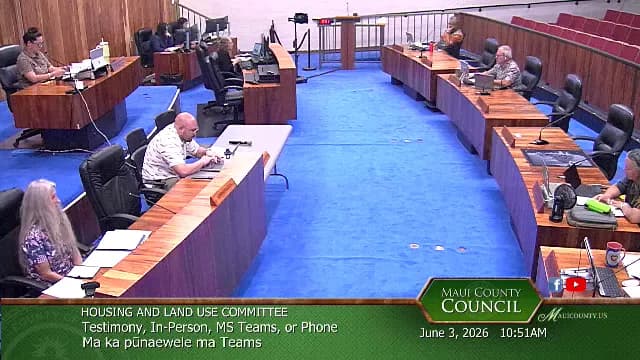
Chair Shane Senancy convened the meeting at 9:03 AM to discuss Bill 77, which would require a portion of the affordable housing fund to be used to provide suitable living environments for county residents who are houseless. The committee heard public testimony, debated the bill's scope and implementation, and ultimately deferred action pending further input from the Department of Human Concerns and advocates. Public Comments & Testimony - Lori J.: Expressed strong support for Bill 77, sharing personal experience with outreach and being unshelled. She urged the county to refurbish existing spaces and create community-based housing. She estimated about 10% of unshelled need dual diagnosis facilities. - Lisa Darcy (founder of Share Your Manna): Supported the bill but emphasized that housing must be paired with appropriate programs and design. She stressed that existing shelters often fail due to lack of wraparound services, and that local control and cultural sensitivity are critical. She opposed the “housing first” model without supports. - Hadas Avas (resident of Kalana Mahina): Testifieded about alleged contract violation at Kalana Mahina (free parking not provided), retaliatory termination of her lease, and lack of accountability. She urged the county to enforce afdordable housing agreements and protect tenants’ rights. - Lalla Johnson (advocate): Strongly supported Bill 77, noting that the housing crisis existed before the Lahaina fires. She urged priority for cultural connection,, community-based refuge spaces, and respect for Kanaka Maoli practices. She also referenced the 2021 Kuhimana sweep as an example of ineffective displacement. Discussion Items - Bill 77 Overview: Chair Senancy explained the bill’s purpose: to direct the housing director to set aside a portion of the affordable housing fund specifically for houseless residents. The bill also adds a definition of “houseless” to county code. - HUD Policy Changes: Senancy noted that HUD restructured continuum of care funding on June 1, 2026, moving away from housing first toward transitional housing and mandatory treatment programs. Members expressed concern about barrier-riden models, with Director Mitchell cautioning that not all houseless need transition – some require permanent supportive housing. - Implementation Concerns: Several council members questioned how the bill would work given limited unencumbered affordable housing funds and the need to coordinate with the Department of Human Concerns. Director Mitchell proposed two approaches: adding bonus points in RFPs for projects including houseless units, or issuing RFPs for county-owned land. He recommended softening the bill’s language from “shall ensure” to “endeavor to use.” - Need for Interdepartmental Collaboration: Members agreed that housing and human concerns must work together on program design and wrap-around services. The committee decided to invite Director Willis (Human Concerns) and Director Molitao (Office of Economic Vitality?) to future meetings. - Alternative Models: Director Mitchell mentioned the Lima Ola project on Kauai (a mixed-use development including transitional housing) but noted its long development timeline. He also referenced a potential large-scale development at the Kihei Police Station parcel. Councilmember Paulton advocated for new zoning categories to accommodate smaller, village-style housing. Key Outcomes - Deferral of Bill 77: The committee deferred action on the bill, pending additional input from the Department of Human Concerns, housing advocates, and further analysis of the gap between shelter usage and unsheltered need. - Amendments Agreed: Director Mitchell’s suggestion to soften the language in Section 4 (from “ensure” to “endeavor”) was accepted by multiple members and will be incorporated. - Future Meetings: The committee will continue discussion on June 29, 2026, focusing on the safe parking program. A follow-up agenda item on Bill 77 will include testimony from Director Willis and community advocates, as well as information on county-owned properties and zoning options. - Data Gathering: Director Mitchell committed to working with council members and advocates to better understand the gap between bed usage and actual houseless needs, and to present a clearer plan for potential RFPs and county land use.
Public Meetings - Maui County, Hawaii
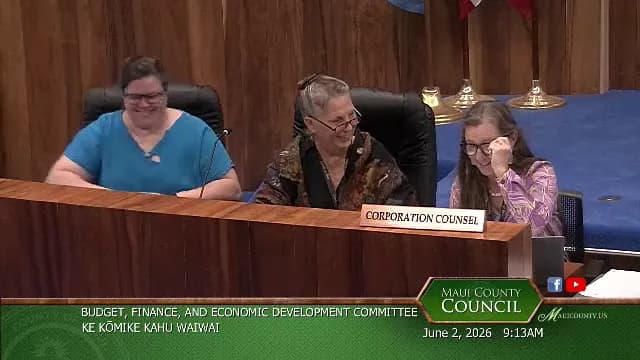
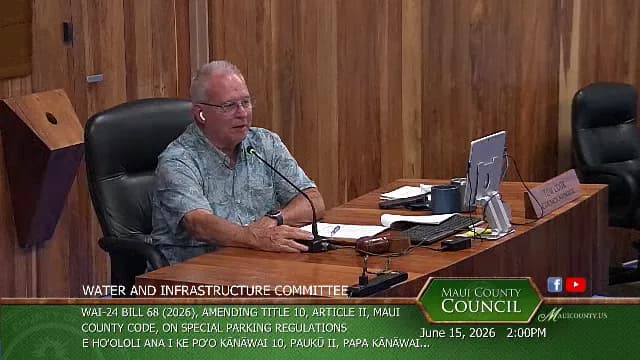
Public Meetings - Maui County, HawaiiThe Water and Infrastructure Committee, chaired by Tom Cook, met on June 15, 2026, at 1:34 PM to consider Bill 68 (2026), which proposes amendments to Title 10 of the Maui County Code regarding special parking regulations under the Park Maui program. The meeting concluded with a unanimous vote to recommend passage of the bill on first reading. Discussion Items - Bill 68 (2026) - Parking Code Amendments: The Department of Transportation presented three main updates: (1) establishing a resident town benefit for the Wailuku Garage and West Maui parking lots, and updating the South Maui resident recreation hour map; (2) establishing paid parking zones for West Maui; and (3) creating a permit parking zone for the 750 Luakini lot in West Maui. The bill allows the department to post the number of free parking hours at each location on signage, providing flexibility rather than locking specific hours in ordinance. - Resident Town Benefit: For the Wailuku Garage, Hawaii residents who scan a valid Hawaii driver's license receive the first two hours free; the garage is free from 6 PM to 8 AM and free for vendors during First Friday. The 750 Luakini, 116 Prison Street, and 500 Front Street lots in West Maui are also designated as resident town benefit locations. - South Maui Update: Kamole Beach 3 parking lot two (a dirt area with about 10 stalls) is removed from the resident recreation hour designation. Non-residents will still be required to pay $10 per day at this lot, which has signage and a QR code, though the pay station is across the street. - West Maui Concerns: Councilmember Tamara Palton questioned the funding source for the Hawaiian Cultural Restoration Revolving Fund if 500 Front Street is restored to Mokuula. The department clarified that only that lot's revenue goes to the revolving fund; the other two lots' revenue goes to the Park Maui program. Palton requested clarification from the Department of Management and the Office of Environmental Resources on earlier budget promises. - Rates and Fees: Councilmember Palton noted that the budget ordinance sets fees for beaches and parks, including free resident parking with a valid Hawaii driver's license scan. She questioned whether the convenience fee (25 cents per transaction) is authorized by the budget ordinance; Corporation Counsel deferred answering until consulting with the Budget Director. The department stated the convenience fee is an industry standard for software transactions. - App Features: Councilmember Keani Rollins Fernandez expressed interest in features showing real-time parking availability, which the department noted would require future camera technology. Public Comments & Testimony - No members of the public signed up to testify, and a final call yielded no testifiers. Key Outcomes - Vote: The committee voted unanimously (9 ayes, 0 no's) to recommend passage of Bill 68 (2026) on first reading. The item will now move to full council consideration. - Next Steps: The Department of Transportation will continue public information efforts at Parkmaui.com. Staff will transmit the question regarding the convenience fee's authorization to the Budget Director for a written response, and will coordinate with the Department of Management and Office of Environmental Resources on budget-related promises about revenue from county lots.
The Housing, Land Use, and Planning (HOU) Committee of the Maui County Council met on June 3, 2026, starting at 9:08 AM and adjourning at 11:09 AM HST. The committee considered three bills: Bill 78 (2026) to comply with state law on accessory dwelling units (ADUs), Bill 84 (2026) to set a cap and spacing requirements for bed-and-breakfast homes on Molokai, and Bill 37 (2026) to create a real property tax exemption for qualified workforce housing developments. The committee voted to advance the first two bills and deferred the third. Public Comments & Testimony - Jonathan Johan Lal (on Bill 78) suggested that when ADU permits are submitted, the Planning or Public Works departments should coordinate with the Department of Health to review cesspool or septic capacity. - Keo Pouni Kahovay Ipaina testified on Bill 84 and Bill 37, asserting that decisions regarding royal patent lands are being made without notifying the descendants of original patent holders, and requested that such notification occur. They also stated that TMK information is being illegally changed. - Tom Crowley (on Bill 37) described the problem of new affordable homeowners being subject to much higher property taxes if they miss the filing deadline for the homeowner exemption, and urged the committee to address the underlying issue. Discussion Items Bill 78 (2026) – Accessory Dwelling Units - Purpose: To amend the Maui County Code to allow at least two accessory dwellings per residentially zoned lot, consistent with state Act 39 (2024), which requires counties to adopt an ordinance by December 31, 2026. - Planning Department Presentation: Gregory Post, Administrative Planning Officer, reviewed the bill’s background. Current code allows one ADU per lot under 7,500 sq ft and two for larger lots (with island-specific limits for Lānaʻi and Molokaʻi). The proposed change would allow up to two ADUs regardless of lot size or island location. The department recommended 13 modifications to the planning commissions, including: (4) exempting Lānaʻi project districts because they are low-density; (8, 11) allowing ADUs in zero-lot line districts; (9, 10) removing limitations in specific project districts; (12) maintaining existing limits in rural districts (not subject to state law); and (13) requiring a determination of adequate water supply. The Maui, Molokaʻi, and Lānaʻi planning commissions all recommended approval with the department’s modifications. - Fire Department Concerns: Captain Voss noted that increased density could tip access and water supply requirements, especially in subdivisions originally designed for fewer dwellings. He cautioned that owners might not realize infrastructure is inadequate until they apply for permits. - Committee Discussion: Members raised issues of lot size, setbacks, existing CC&Rs that prohibit ADUs (which state law does not override for covenants recorded before Act 39’s effective date), infrastructure capacity, and the need for public education. An amendment was offered by Member Paulton to add language clarifying that the ordinance does not affect conditional zoning agreements executed before its effective date. The chair also proposed amendments to Section 19.35.050 (rural district limits) and Section 19.35.070 (parking language referencing Chapter 19.36B). Both amendments were approved by voice vote (7 ayes). - Vote: The committee voted 7 ayes (with Members Batangan and Sugimura excused) to recommend passage on first reading of Bill 78 as amended (CD1). Bill 84 (2026) – Bed-and-Breakfast Cap on Molokaʻi - Purpose: To establish a maximum of five bed-and-breakfast (B&B) home permits island-wide on Molokaʻi and require a minimum separation distance of 1,000 feet between B&Bs (as originally proposed). - Molokaʻi Planning Commission Recommendation: The commission recommended approval with a cap of five B&Bs allocated to specific areas (Kualapuʻu, Kaunakakai, Pukoʻo, and Wailua) and a minimum separation of 3,000 feet (measured from property lines). The motion before the committee included this recommendation. - Discussion: Member Rollins Fernandez, the bill’s introducer, supported the commission’s approach, noting that setting a cap early avoids the problems seen with short-term rental homes in other areas. - Vote: The committee voted 8 ayes (with Vice Chair Batangan excused) to recommend passage on first reading. Bill 37 (2026) – Real Property Tax Exemption for Workforce Housing - Purpose: To create a property tax exemption for developers of qualified residential workforce housing developments, aimed at preventing new owner-occupants from being charged higher non-owner-occupied rates if they miss the homeowner exemption filing deadline. - Views: Council Chair Lee, the introducer, requested the item be deferred, citing lack of support from the Finance Department and the need for more time to develop a workable solution. Finance Director Martin stated the department is open to discussion but noted software and staffing limitations. Councilmembers Johnson and Paulton expressed interest in finding a path forward, with suggestions to model the exemption after the Hawaiian Home Lands program or the existing deed-restricted valuation process. - Outcome: The committee voted without objection to defer Bill 37. Key Outcomes - Bill 78 (2026) – Passed out of committee on a 7–0 vote (with two excused) as amended. The amendments included: (1) inserting language preserving existing conditional zoning agreements; (2) maintaining current ADU limits in rural districts (1 per lots <7,500 sq ft, 2 for larger, with island-specific limits for Lānaʻi and Molokaʻi); and (3) clarifying that ADU parking must comply with Chapter 19.36B (bedroom-count-based parking). The bill proceeds to the full Council for first reading. - Bill 84 (2026) – Passed out of committee on an 8–0 vote (one excused), incorporating the Molokaʻi Planning Commission’s recommendation of a 5-cap and 3,000-foot separation requirement. Proceeds to first reading. - Bill 37 (2026) – Deferred without objection. The committee will continue to work with the Finance Department and other stakeholders to address the underlying tax burden on new affordable homeowners.
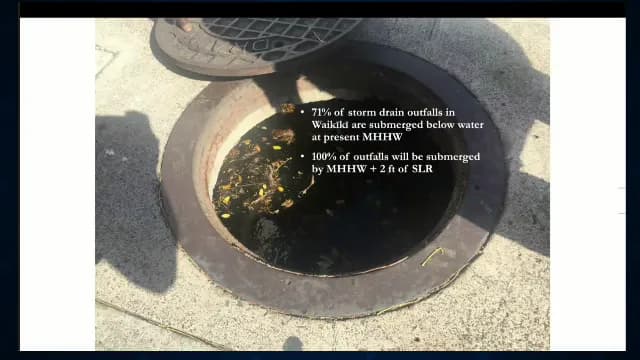
The Disaster Recovery, International Affairs, and Planning Committee of the Maui County Council met on June 3, 2026, at 12:30 PM HST to discuss DRIP 9.11, focusing on shoreline erosion impacts on coastal properties and sea level rise. The meeting featured presentations by Dr. Chip Fletcher (Dean, School of Ocean and Earth Science and Technology, University of Hawaii at Manoa) and Tara Owens (Coastal Processes and Hazards Specialist, University of Hawaii Sea Grant College Program). The committee heard public testimony and engaged in extensive discussion about policy options for mitigating climate change effects on coastal properties. Public Comments & Testimony - Kai Nashiki urged the council to consider whether encouraging local families to invest life savings in coastal hazard areas is wise, and cautioned against inflating property values for offshore investors. He highlighted the Hawaii Coastal Resilience Acquisition and Lease Back program (a state legislative bill) that could allow acquisition of shoreline properties for workforce housing with hazard-adjusted values. He also called for strong funding guardrails to prevent county adaptation funds from being used to entrench development in hazard zones. - Christian Balagso (Upcountry resident) emphasized the interconnectedness of the ahupuaʻa system, stating "what affects one affects us all." He invoked the Titanic analogy, saying the community is in an emergency situation and must act immediately. - Kaya Pooninko Hawaiiana (representative of Ko Kohavaipaina) called for restoring native Hawaiians to their ancestral lands, arguing that those who hold original title know how to care for the land. They demanded that the council restore the "true land title holders" and follow Hawaiian Kingdom law. Discussion Items - Dr. Chip Fletcher presented a detailed overview of sea level rise science, including: - Global warming is accelerating, with the rate of surface temperature rise increasing. - Sea level rise rate has doubled over the last 30 years (from 2 mm/year to over 4 mm/year). - Greenland and Antarctic ice sheets are melting irreversibly; Thwaites Glacier has more than doubled its flow rate. - Hawaii will experience 15-20% more sea level rise than the global mean due to gravitational and land motion effects. - Multiple types of flooding were explained: marine (passive) flooding, wave-driven flooding (even seasonal swell becomes destructive with sea level rise), shoreline erosion (which also exposes cesspools), drainage failure (gravity-based drainage will be lost with 2 feet of sea level rise), groundwater inundation (saltwater rising into infrastructure), and compound flooding (rain + high tide). - Tara Owens presented a local perspective on Maui, showing: - Photographs of shoreline erosion, road undermining, and building collapses (e.g., a condominium in North Kihei that collapsed after repeated erosion and flooding events). - Examples of managed retreat and dune restoration success stories at Kapalua Bay (where a turtle nested after seawall removal) and Baldwin Beach. - The Mantukuji Mission, a 100+ year old historic and culturally significant structure, is threatened by erosion despite temporary sandbag protection, which is causing flanking erosion. - The county has made progress: several departments have completed vulnerability assessments, community plans incorporate sea level rise data, shoreline setback rules were updated in 2024 to include erosion projections, and a managed retreat revolving fund was created. - However, Maui still uses a planning target of 3.2 feet of sea level rise, while the intermediate scenario is now projected at 4 feet. Updated mapping for Maui is not yet available due to loss of federal funding. - Councilmember Cook asked about offshore solutions (e.g., artificial reefs) to mitigate storm surge. Dr. Fletcher noted they create an "energy shadow" that traps sand, but sand is a zero-sum game—taking sand from one area harms another. Ms. Owens added that permitting for erosion mitigation artificial reefs would be very difficult in Hawaii. - Councilmember Sugimura raised the Kahana Bay community facilities district (CFD) issue: the county would own groins and would be liable for maintenance, while the state would own the infrastructure in the ocean. Dr. Fletcher recommended a removal bond as a management tool. Ms. Owens noted that a state bill passed in 2026 allowing property owners to develop "adaptation plans" for BLNR review, but it's ambiguous and doesn't require approval. - Councilmember Rollins Fernandes questioned whether the county should guarantee shoreline access in perpetuity, stating "individual owners must take responsibility for business decisions made building on the shoreline." She also asked about restoring Uhu (parrotfish) to increase sand production. Dr. Fletcher explained that beach sand is centuries to millennia old; modern sand production is too slow to build beaches on human time scales. - Councilmember Gabe Johnson asked about funding a coastal viewer for Maui County similar to the Waikiki model. Dr. Fletcher estimated it would take 2-3 years and cost about $1 million per year. - Councilmember Johnson also inquired about immediate actions for the coming El Niño season. Recommendations included clearing drainage ways, reducing fuel loads on fallow lands, and retiring offshore windows and doors to reduce building loss in high winds. - Councilmember Senensi asked about the stormwater drainage system in Kahului (Panaha Pond) compared to the Ala Wai Canal on Oahu. Dr. Fletcher confirmed that both face similar issues with high sea levels. He cited Miami Beach's use of pumps, raised roads, and landscaped areas to direct water to pumps as a management model. - Councilmember Nohe Hodgings discussed the Molokai wharf road where culverts were filled in, causing sand to accumulate on one side and erode the other. She questioned why the road isn't designed as a causeway to allow natural water and sand movement. Ms. Owens noted that the realignment of Honoapiʻilani Highway will include causeway segments over wetlands. - Councilmember Rawlins-Fernandez asked about purchasing wetlands in North Kihei to improve drainage. Ms. Owens confirmed that a working group (including MEMA, Public Works, and community members) is working on a grant proposal to turn an undeveloped parcel into a "stormwater management park" and to slow water from the upper watershed. - Councilmember Palten asked about assessing oceanfront properties at lower values given future liability. The planning director noted that this is a broader conversation involving multiple departments, but for Lahaina rebuilds, hold-harmless and unilateral agreements are being required. Key Outcomes - The committee received extensive expert testimony and discussion on coastal hazards, sea level rise, and potential policy responses. - No formal votes or decisions were taken on DRIP 9.11; the item was deferred. - The chair (Councilmember Palten) summarized key takeaways for the council: clear drainage ways, reduce fuel loads, and retrofit homes in preparation for El Niño. - Several council members expressed a need for a regional approach to shoreline management, with policies tailored to specific community plan areas rather than island-wide rules. - It was acknowledged that Maui County needs updated sea level rise mapping (for the 4-foot intermediate scenario) and that this would require substantial funding ($1 million/year for 2-3 years). - The committee concluded that managing sea level rise will require collaboration among all decision-makers, community members, and experts.
On June 3, 2026, the Budget Finance Economic Development Committee (BFED) of the Maui County Council met to continue deliberations on the proposed Fiscal Year 2027 budget. The meeting began at 9:07 AM and included a moment of silence for former Governor George Ariyoshi, who died at age 100. The committee heard public testimony, discussed departmental budgets, and voted on numerous amendments. The meeting recessed for lunch and reconvened, continuing until adjournment at approximately 6:40 PM. Key actions included adjustments to the Department of Environmental Management, Finance, Fire & Public Safety, Housing, and other departments, with a net increase of $2.6 million from the previous day’s changes. Public Comments & Testimony - Tutu and Me Traveling Preschool: Several parents and a program representative testified in support of continued funding. Kiana Kawe, a parent, described the program’s importance for her toddler and grandmother, noting that all four Maui sites are closing due to loss of federal Native Hawaiian Education funding. She stated the program costs approximately $600,000 per teaching team supporting two sites. Brittany Ake (Partners in Development Foundation) clarified that the 1.2 million in the mayor’s budget is needed to maintain four Maui sites, with one-third match already secured. Multiple parents (Joseph Cutney, Amina Grumet, Carolina Glover, Angela Sarsona, Diana Shembri, Serena Fukushima, Monique Duplantis) shared emotional testimonies about the program’s impact on early childhood development, family bonding, and mental health support for wildfire-affected families. - Ho’ala Health Outreach: Alika Monakea (University of Hawaii, Maui Wildfire Exposure Study) testified in support of $2 million co-funding for Ho’ala, a health initiative to expand screening and prevention services for Maui residents affected by the 2023 wildfires. He noted that over 2,000 residents have participated, with high rates of depression (1 in 2) and respiratory impairment. The program partners with multiple community organizations. - Camp Maluhia: Glenn Katagawa (Scouting America) and Leaf Adachi (Camp Ranger) requested $500,000 for upkeep and development of the camp, noting roof damage from storms and the need for pool and building maintenance. - Housing Projects: Director Richard Mitchell and Deputy Director Mata Afa (Department of Housing) discussed the Affordable Housing Fund RFP process, supporting Aloha House ($1 million for supportive housing), Habitat for Humanity Hana ($6.595 million for homeownership), and Kui Kahi projects. They also mentioned the potential acquisition of Cove Beach Park (32 units, appraised land value $2.5 million, asking $8.5 million). - Managed Retreat Fund: Kaina Shiki testified against using $2.5 million for Pa’ia Mantokuji without a clear project, urging relocation instead of shoreline hardening. She noted that the applicant is seeking state legislation to exempt themselves from environmental review (SB 3169, HB 2490), which did not pass. - Other Testifiers: Ruben Juarez (HMSA professor) supported Ho’ala; Matt Bachman (Habitat for Humanity) emphasized the need for homeownership; Nicole Hokoana requested $2 million for Aloha House; Tom Crowley criticized water rate increases; Christopher Salem raised concerns about unaccounted developer infrastructure agreements. Discussion Items - Department of Environmental Management (DEM): Members prioritized several items. Member Paulton moved to add $300,000 condition for Marine Maui Ocean Center Institute (coral reef restoration). Member U’u Hodgins moved to add $40,000 for Haiku Community Association stream testing. Member Johnson moved to insert $2.4 million for ‘Ulu Cloud Revival (reforestation with Malama Haleakala Foundation, ʻUiwai OʻHaleakala, and Kahoolawe Island Reserve Commission). Member Paulton’s second priority (Malama Kakanilua) was moved to OEV resources. A $500,000 cut from wastewater operations (Category B) was approved to reduce bond funding for Waiahuku wastewater pump station modifications. - Department of Finance: Member Paulton proposed several cuts to expansion positions (e.g., accountant, motor vehicle licensing) based on vacancies and historical carryover. A motion to defund two accountant positions from FY21 was approved 7-1. A subsequent reconsideration restored funding for the accounts program per department request. A motion to cut $50,000 for internal control software failed 3-6. - Department of Fire & Public Safety: Member Paulton cut $94,556 from admin positions and $300,000 based on carryover. A cut of $65,000 for a motor vehicle was approved. A motion to cut $71,656 for ceremonial uniforms (hats and ties) was amended to cut half ($35,828) and passed. A cut of $115,000 for training yard repavement was approved. An increase for explosive materials fees from $100 to $500 was deferred for research. - Department of Housing: Member Paulton added $6 million for Lahaina Community Land Trust (passed). Member Johnson added $4.5 million bond for transitional housing for victims of domestic violence (passed). Chair Lee added $165,000 for Hali‘imaile Homeowners Program (passed). Member Batangan added one EP for a long-term rental program. Member Johnson amended the first-time homebuyers fund condition to remove the $30,000 cap. Chair Lee proposed $8.62 million for Cove Beach Village acquisition, but after discussion, the amount was amended to $2.5 million (bond) and passed. Member Rollins Fernandez added $2 million for the voluntary deed restriction program. A motion to add $3 million for the Paris program (Homestead CDC) was withdrawn for further information. - Department of Liquor Control: Minor corrections to fees were approved. A motion to incorporate missing classes and increase penalty maximum from $2,000 to $5,000 passed. - Department of OEV Resources: Member Paulton added $250,000 for Malama Kakanilua (passed). A $140,000 cut to Category A was approved. A motion to cut $20,000 from the B account (for travel, training, advertisements) was withdrawn after discussion. - Department of Personnel Services: A motion to cut $35,000 for training space rental failed 4-5. - Department of Planning: A $200,000 cut from Category B was approved, offsetting street medicine funding. - Department of Transportation: A $170,000 increase for security at Kahului Transit Center was approved. Member Johnson amended transit fares to remove the age cap (24 and under) for free fares, extending to all students with valid ID (passed). - Department of the Prosecuting Attorney: A $3.35 million bond increase for 24 North Church Street renovation was approved, with an offset from police. Key Outcomes - Votes on Major Amendments: - Tutu and Me funding: $1.2 million remained in mayor’s budget; no additional cuts. The committee expressed support but did not increase funding beyond the proposed amount. - Ho’ala health initiative: $2 million co-funding request from University of Hawaii was supported by members but not formally voted as a separate item; it was included in the overall budget discussion. - Camp Maluhia: $500,000 request deferred to later discussion (not voted on this day). - Cove Beach Village acquisition: Approved $2.5 million bond (amended from $8.62 million) for land and entitlements, with negotiation authority for Department of Housing. - Pa’ia Mantokuji managed retreat: $2.5 million request was not removed; the motion to delete failed 4-4 (one excused). The item remains in the budget. - Ma’alaea Village injection well project: Motion to delete $2.5 million failed 4-4 (one excused). The funding remains. - Net Changes: The committee added $2.6 million in net changes from the previous day, distributed across departments. - Next Steps: The committee will continue deliberations on June 4, 2026, at 10:00 AM, covering Departments of Human Concerns, Management, Mayor, Parks, Police, Public Works, Water Supply, and countywide items. Staff will accept written testimony and proposed amendments by 9:00 AM. Consent Calendar - None included; all items were discussed individually. Public Comments & Testimony - See above for detailed testimony on Tutu and Me, Ho’ala, Camp Maluhia, housing projects, managed retreat, and water rates. Discussion Items - See above for departmental discussions and amendments. Key Outcomes - See above for votes on major amendments and net budget changes.
The Budget Finance Economic Development Committee (BFED) met on June 2, 2026, starting at 9:10 AM and adjourning at 11:11 AM, with a brief recess. Chair Yukile Sugimore presided. The meeting addressed two major items: a proposed Phase 3 of the Johnson Controls Inc. Energy Performance Contract (BFED-20) and Bill 181 (2025) to increase homeowner and long-term rental property tax exemptions. Key discussions included savings verification, financing, equity of tax relief, and council oversight. Public Comments & Testimony - Jesse Law (via Paia office, after technical delays) spoke generally about perceived conflicts between legislative and judicial branches, and urged the council to focus on running government and helping people. He did not directly address the Johnson Controls item. - Tom Crowley (via Teams) provided detailed testimony on Bill 181, analyzing the distributional impact of the proposed $100,000 exemption increase. He noted that under the current progressive tier system: - Of 28,000 owner-occupied properties, about 3,000 pay minimum tax and receive no benefit; 21,000 would see a $165 reduction; 2,700 would see $180; and only 199 (top tier) would see $500. - For long-term rentals (4,350 properties): 3,890 in tier 1 would get $290; 387 in tier 2 would get $500; 73 in top tier would get $850. He argued the rate structure already gives disproportionate benefit to high-value properties and suggested a larger exemption (e.g., $1 million) combined with rate adjustments could better target relief to lower-value rentals. Discussion Items 1. Johnson Controls Inc. Energy Performance Contract (Phase 3) – BFED-20 - Administration presentation (Budget Director Milner, Finance Director Martin, Chief of Staff Lalo, Deputy Corp Counsel Dejardin): Phase 1 is complete, delivering $2.283 million in actual savings in year one; Phase 2 (solar PV) is underway. Phase 3 ($9 million) is described as a budget-neutral transaction funded by tax-exempt lease purchase financing, supported by guaranteed energy savings. The administration intends to seek council approval via a resolution before committing to financing. - Johnson Controls representatives (Joel Caldwell, Leaf Shogard): The total project cost is about $25 million, with guaranteed lifetime savings of $50 million and net savings of $11.9 million. Phase 3 would be financed at an estimated 4.4% over 20 years. The 20-year term is enabled by HRS 36-41. - Council questions and concerns: - Member Senancy asked about expended funds and timeline; the administration noted no funds have been spent on Phase 3 yet. - Member Uhodgins asked about total savings; the $50 million lifetime guarantee was cited. - Member Rollins Fernandez inquired about Molokai projects and battery storage; JCI confirmed community feedback and progress on permitting. - Member Johnson asked about the $150,000 encumbered payment; Dejardin explained it covers JCI’s preparatory work if the county decides not to proceed. - Member Palton questioned solar backup during overcast conditions, end-of-life panel disposal, and the cost of a third-party audit ($29,000). JCI noted that disposal costs would fall on the solar provider per the PPA, and the county’s audit is ongoing. - Chair Lee asked about the project list; the final Phase 1 list (Amendment 5) is complete; Phase 3 projects are not yet finalized. - Outcome: The item was deferred without objection, pending further information and the anticipated resolution from the administration. 2. Bill 181 (2025) – Increasing Homeowner and Long-Term Rental Exemptions - Finance Director Martin presented the bill: raising the homeowner exemption from $300,000 to $400,000, and the long-term rental exemption from $200,000 to $300,000. Estimated revenue loss: $4.919 million for homeowner, $1.4 million for long-term rental, affecting 25,063 parcels. The department noted flexibility with tiers and rates, and recommended removing a section referencing a six-month lease for wildfire survivors (no applicants for FY26). - Council discussion: - Member Rollins Fernandez argued the exemption is a blunt tool that benefits higher-value properties disproportionately, and preferred using rate adjustments to target relief to lower-income homeowners. She noted past attempts to reduce tier 1 rates failed due to lack of votes. - Member Palton expressed concern that the $6.3 million in relief is not progressive; the highest tier gets $500 while the lowest gets $165. She advocated for a more targeted approach via rates and tiers. - Member Uhodgins asked about better targeting; Director Martin noted that exemption changes are less flexible than annual rate/tier adjustments. - Member Senancy clarified that the majority of properties (over 20,000) are in tier 1, so most benefit goes to lower-valued homes, but the dollar amount per parcel is small. - Motion to file was made by Member Rollins Fernandez, seconded by Member Johnson, but later withdrawn after Member Uhodgins requested more time to study the issue. The bill was deferred for further discussion, with a request for a white paper from Tom Crowley. Key Outcomes - Johnson Controls Phase 3 (BFED-20): Deferred. The administration will bring a resolution for council approval before proceeding. A third-party audit of savings is underway. - Bill 181 (2025): Deferred. The committee will hold additional discussions, incorporating stakeholder input and analysis of tiered relief options. No vote was taken.
The Government Relations, Ethics and Transparency Committee met on June 2, 2026, at 1:46 PM, with Vice Chair Nohelani Uuhajans acting as chair in the absence of Chair Batangan. The committee considered 14 proposed charter amendments, one of which (Resolution 25-135) had already been adopted. The meeting focused on the first seven resolutions related to the Office of the County Clerk. The meeting lasted approximately 2 hours and 47 minutes, recessing at 4:33 PM to reconvene on June 16, 2026, at 1:30 PM. Public Comments & Testimony - Lauren Akitake, Executive Director and Legal Counsel to the Maui County Board of Ethics, testified in support of Resolution 2695, which proposes a charter amendment allowing reappointment of Board of Ethics members for one successive term without an intervening waiting period. She emphasized the board's expanded workload, need for institutional knowledge, and ongoing policy initiatives (nepotism ordinance, lobbyist rules). She answered questions about the total term length (10 years) and the board's quasi-judicial nature. - Mike Moran, testifying for the Kīhei Community Association, spoke in support of Resolution 2687, which would fund climate action and resilience planning. He highlighted the need for walkable, bikeable communities and improved north-south connectivity, especially after Kona Low damage. - Kai Nashiki testified in support of Resolution 24-100 (use of open space fund for safety and clean-up) and Resolution 2687. He noted the need for dedicated funding for climate resilience, suggested either ordinance or charter amendment, and urged guardrails to ensure funds are spent on appropriate priorities such as beach protection rather than shoreline hardening. Discussion Items - Resolution 25-215 (Notice and Conduct of Public Hearings): Proposed eliminating the requirement to publish notices in a newspaper and replacing "public hearing" with "public meeting" to comply with state law. Deputy Corporation Counsel Colby raised concerns about conflicting state statutes (HRS 1-28.5 and 46-2) and the distinction between hearings and meetings. After discussion, the item was deferred to combine with Resolution 25-217 for the June 16 meeting. - Resolution 25-216 (Standardizing Deadlines for Petitions): Proposed standardizing the timeframes for processing voter initiative, recall, and charter amendment petitions to 45 days for initial review and 30 days for supplementary petition review. The County Clerk explained the need due to increased voter registration (e.g., 10,509 signatures required for initiatives). The resolution passed on first reading with a 6-0-3 vote (Councilmembers Cook, Sugimura, and Batangan excused). Members requested that the ballot question include the current and proposed deadlines and a brief explanation of the clerk's workload. - Resolution 25-217 (Computation of Time): Proposed specifying that time periods exclude the first day and include the last, unless the last day is a Saturday, Sunday, or holiday. Some members suggested achieving this via code amendment rather than charter amendment. The item was deferred to combine with Resolution 25-215. - Resolution 26-61 (Processing of Claims): Proposed directing claims for personal injury or property damage directly to Corporation Counsel instead of the County Clerk. The Clerk argued the current process confuses the public and burdens her small staff. Corporation Counsel raised concerns about attorneys becoming witnesses and logistical issues (no public reception area). The item was deferred for further discussion on June 16. - Resolution 26-94 (Publishing Digest of Bills): Proposed publishing the digest of council bills online instead of in a newspaper. Since it overlapped with Resolution 25-215, the committee voted to file it (6-0-3). - Resolution 26-85 (Removing English Translation of State Motto): Proposed removing the English translation of the Hawaiian state motto from the charter preamble, allowing the original phrase to stand alone. Councilmember Fernandez explained that no direct translation captures the full meaning. The resolution passed on first reading (6-0-3). - Resolution 24-100 (Use of Open Space Fund for Fuel Hazard Removal): Proposed authorizing use of the open space fund for regular removal of fuel hazards to minimize wildfire risk. The sponsor, Councilmember, chose to file the resolution, noting that the council has addressed maintenance through the budget and that too many proposals would overwhelm voters. The motion to file passed (6-0-3). Key Outcomes - Resolution 25-216: Passed on first reading (6-0-3). The ballot question will be revised to include specific day changes and a brief explanation of the clerk's responsibilities. - Resolution 26-85: Passed on first reading (6-0-3). - Resolution 26-94: Filed (6-0-3). - Resolution 24-100: Filed (6-0-3). - Resolution 25-215: Deferred to June 16, to be combined with Resolution 25-217. - Resolution 25-217: Deferred to June 16, to be combined with Resolution 25-215. - Resolution 26-61: Deferred to June 16 for further discussion. - The meeting was recessed to 1:30 PM on June 16, 2026, to continue consideration of the remaining charter amendments.
The Water Authority Social Services and Parks (WASSP) Committee met on Monday, June 1, 2026, at 9:07 AM under Chair Shane Senensi. Members present included Vice Chair Johnson, Councilmembers Nohe Wu-Hudgins, Lee, Poulton, Sugimura, and Rollins Fernandez. Two agenda items were discussed: a presentation on Youth Line Hawaii's mental health crisis services and an overview of a proposed community resilience and youth development campus on the former Kahili golf course. No public testimony was offered. Both items were deferred without objection. Discussion Items Mental Health Crisis Intervention and Support for Youth (WhatsApp 1 Parent 19) Danielle Bergen (Mental Health Trainer and Community Affairs Consultant, Youth Line Hawaii), Ashley Tone (Deputy Director), and volunteer Kelsey Lori presented on Youth Line Hawaii, a peer-to-peer crisis support and help line for youth ages 10–24. Key points: - Youth Line is a service of Lines for Life (Oregon-based 988 center) and has operated for 26 years. It provides confidential, anonymous support via call, text, or chat. - Since opening a call center on Maui in January 2025, Hawaii call volume has increased 225% through April 2026. In 2024, the national line assisted approximately 25,000 youth. - Volunteers undergo 70+ hours of training, including Youth Mental Health First Aid and SafeTALK (applied suicide intervention skills). After six months, advanced certification in ASIST is offered. - 96% of contacts are de-escalated without requiring emergency services. Over 50% of volunteers pursue careers in behavioral health, education, or social services. - The service is free and does not require parental consent for youth to reach out. Current funding comes from federal and state grants (not county). - Council members asked about reaching at-risk youth through courts and schools, measuring success, cultural competency, and volunteer support. Representatives emphasized their openness to collaboration and noted they are not currently seeking county funding. The item was deferred without objection. Proposed Community Resilience and Youth Development Campus (WhatsApp 1 Parent 20) Milton “Bubba” Thibodeau (President, Koupa Enterprises) and Mike Diaz (Hoʻoilina Group LLC) presented a conceptual vision for developing approximately 320 acres of the Kahili golf course in Wailuku into a multi-use community hub. Proposed features: - Youth sports and recreation facilities (baseball, softball, soccer, football fields, indoor gymnasium), workforce training, community and cultural programming, and resilience infrastructure (emergency shelter). - Approximately 60–100 acres of sports fields with astroturf; active agriculture (orchards, farm market) on surrounding land to align with agricultural zoning. - The project would be phased, with an initial focus on tournament-capable fields to generate revenue. Estimated stadium cost: $80 million (5,000 seats). Additional funding via grants, sponsorships, and private investment. - The land is currently owned by a Japanese entity; a new buyer is in escrow for the combined Kamehameha Golf Club and Kahili course. The buyer has expressed willingness to allow use of the Kahili portion for the campus. - Presenters stated they are not requesting approvals or funding at this stage, but seek guidance on alignment with county priorities and community needs. - Council members raised concerns about land use permanence (special use permit vs. rezoning), water availability, community outreach, and potential conflicts with agricultural rights. Diaz noted they have consulted with professionals but intend to conduct broader community engagement. The item was deferred without objection. Key Outcomes - Both agenda items were deferred by consensus (no objections) with no votes taken. - No requests for funding or approvals were made; the committee noted the presentations as informational and open for future discussion. - The meeting adjourned at 11:21 AM.
The Housing and Land Use Committee of the Maui County Council met on May 26, 2026, at 9:33 a.m. to discuss Bill 88 (2026), which would amend the comprehensive zoning ordinance to establish new H3 and H4 hotel districts. The bill is a recommendation from the Temporary Investigative Group (TIG) formed to address policies for transient vacation rentals (TVRs) in apartment districts. The H3 and H4 districts would mirror the A1 and A2 apartment districts in development and use standards, but would permit TVR uses that were phased out by Ordinance 5909 (Bill 9). The bill does not rezone any properties; that would require separate future legislation. The Maui, Lanai, and Molokai Planning Commissions all recommended denial. After public testimony and discussion, the committee voted 6-1-2 to recommend passage to the full council, with amendments. Public Comments & Testimony - Mayor Richard Tepison Jr. testified in strong support, stating Bill 88 creates a structured framework for properties to be considered for continued visitor accommodation use through future land use actions, and that it is an intentional next step in implementing Bill 9. - John Chasen (20-year owner at Maui Sands One) supported Bill 88, saying it provides jobs and a balance of TVR condos and hotels. He urged inclusion of Maui Sands One in future rezoning. - Travis Leggat (unsheltered citizen, founder of FleshAware.com) urged caution, citing wastewater and safety concerns, and asked for more time and a section seven for philanthropy. - Greg Reliske questioned why H1 and H2 zoning are not sufficient, noted all three planning commissions rejected the bill, and asked for shoreline armoring and parking provisions. - Cara Burkholtz (Kihei resident) supported passage of a clean Bill 88. - Eve Hogan supported the bill, arguing the planning commission misunderstood it and that council members committed to passing H3/H4 zoning when Bill 9 passed. - Sonny Cave (owner at Maalaea Kai) supported, saying it modernizes zoning to match real-world uses and mitigates litigation risk. - Paele Kiyokona (Lahaina Strong) opposed, fearing the new zoning would be used incrementally to undo Bill 9's work; suggested attaching conditions to H1/H2 rezoning instead. - Malama Min (Realtors Association of Maui) supported, noting many properties are not feasible as long-term housing. - Jackie Keith opposed, expressing frustration and arguing the planning commissions' recommendations should be respected. - Jordan Rudis (on own behalf) opposed blanket approach, supported targeted upzoning for about 10 properties that truly operate as hotels. - Corey McKim supported, calling it a crucial step for zoning modernization. - Pamela Tumpap (Maui Chamber of Commerce) supported, noting the bill was supported by the mayor and planning department. - Stephen West (ILWU) supported with caveats: properties must have security, housekeeping, front desk, and sustainable wages. - Lauren Rago (Our Hawaii) opposed, presented updated Minatoya property analysis showing most properties are not hotels. - Kaina Nishiki urged requiring a sunset provision for shoreline properties affected by sea level rise. - Many other testifiers expressed support or opposition. Discussion Items - Bill 88 Overview: Chair Nohelani Uuhajans introduced the bill, noting it originates from TIG recommendations and would establish H3 and H4 hotel districts mirroring A1 and A2 apartment districts but allowing TVR uses phased out by Ordinance 5909. The bill does not rezone any properties; that would require separate future legislation. - Planning Department Presentation: Deputy Planning Director Anna Lillis and Greg Post presented. The department supports the bill, noting it only creates zoning districts and does not affect any property. They recommended a slight modification to clarify that only properties meeting existing TVR criteria in A1/A2 can move to H3/H4. They also noted a technical correction on side setbacks (15 feet instead of 20 for buildings over 35 feet). - Discussion: Councilmembers debated the bill extensively. Key points included: the need for a clean zoning category to avoid forcing properties into ill-fitting H1/H2 zones; concerns about non-conformity; the potential for additional units from the 1,700 unlisted properties; and the importance of honoring commitments made during Bill 9 deliberations. Councilmember Johnson urged site visits and expressed concern about a blanket approach. Councilmember Rollins Fernandez opposed, citing planning commission denials and policy inconsistencies. - Amendments: - Amendment 1 (Paulton): Added criteria to clarify that only properties meeting existing TVR criteria in A1/A2 districts (including notification and confirmation by the department before the effective date of the ordinance) are permitted in H3/H4. Also corrected a side setback on page 6. Passed 7-0-2. - Amendment 2 (Rollins Fernandez): Exempted the island of Molokai from the H3 and H4 districts, as recommended by the Molokai Planning Commission. Passed 7-0-2. Key Outcomes - Motion to recommend passage of Bill 88 (2026) on first reading, as amended, to the full council: Passed 6-1-2 (Ayes: Chair Uuhajans, Chair Lee, Councilmembers Cook, Paulton, Senancy, Sugimura; No: Councilmember Rollins Fernandez; Excused: Councilmembers Batangan and Johnson). - The bill will now proceed to the full Maui County Council for consideration. - The committee also directed staff to incorporate the amendments into the bill text. - The meeting adjourned at 4:15 p.m.
The Agriculture, Diversification, Environment and Public Transportation (ADEPT) Committee convened on May 21, 2026, at 9:07 AM, recessed at 10:00 AM, and adjourned at 11:16 AM. The committee considered two items: Bill 13 (County Transit Bus Advertising) and an informational discussion on climate change impacts and a proposed Climate Action and Resiliency Revolving Fund. Public testimony was limited to one speaker on the second item. Public Comments & Testimony - Bill 13 (Transit Advertising): No public testimony was offered. - Climate Change Impacts / Resiliency Fund: Christina DeLeon (Taryn James Young Foundation) testified in full support of creating a dedicated fund, arguing that tourism revenue should help sustain the islands’ environment. Discussion Items - Bill 13 – County Transit Bus Advertising (ADEPT 6): Director Mark Takamori (Department of Transportation) presented the CD1 version, which limits third-party ads to commercial transactions, formalizes county-sponsored ads with the county seal, prohibits political/advocacy content, and extends rules to bus passes. He explained past difficulties with open-forum advertising (e.g., a vegan advocacy group’s request) that led to program shutdowns. Chair Kayla Kutaka (Commission on Children and Youth) described the “Talking is Teaching” campaign now displayed on buses, noting about one QR code scan per month. Councilmembers discussed content restrictions, vendor selection via RFP, and the need to prevent implied county endorsements. Corporation Counsel clarified that existing code gives the department discretion to reject ads that imply endorsement. - Climate Change Impacts on Maui County (ADEPT 10): Chair Johnson (proposer of Bill 66) introduced the concept of a Climate Action and Resiliency Revolving Fund, funded by 20% of transient accommodations tax (TAT) revenue (roughly $14 million). Representatives from DEM, EPNS, OEV Resources, and Budget Director Leslie Milner offered support with concerns: EPNS worried about overburdening their division; Budget Director flagged that a charter mandate could affect bond ratings (county is AA+/Aa2). Deputy Director Zalinski noted bond agencies value revenue flexibility. Councilmembers debated whether a charter amendment or ordinance was preferable, with many favoring an ordinance to retain nimbleness. The discussion referenced the 169‑item Climate Action and Resiliency Plan (CARP) and the existing managed retreat fund. No action was taken. Key Outcomes - Bill 13 (CD1): The committee voted 6‑0‑1 (Councilmember Senancy excused) to recommend passage of Bill 13 (as amended by CD1) on first reading. The amendment replaced the original bill with the CD1 version that broadens the title, adds bus pass advertising, deletes “solely” from code, and clarifies that non‑county ads must comply with Title 11. The department will issue a new RFP for an advertising vendor once the ordinance is enacted. - Climate Resiliency Fund: The item was deferred. Chair Johnson indicated he will bring Bill 66 (the ordinance version) forward for further discussion, rather than pursue a charter amendment at this time.