Browse by city
Date range
Search help

Search titles, summaries, topics and stored transcripts together. Keywords may match separately; put the whole query in double quotes for a phrase. Matching follows word analysis, so punctuation is not exact. Both dates are included. Documents are not searched.

SHOWING 1–10 ENTRIES
01
OCT 21, 2026 · MILWAUKIE, OREGON · CITY COUNCIL
Milwaukee City Council Meeting - October 21, 2026

The Milwaukee City Council held its 2459th meeting on October 21, 2026, addressing recognitions, public comments, consent agenda, and four public hearings on code amendments, a rezoning, and contracting authorization. The meeting included student and business recognitions, a Veterans Day proclamation, and community testimony on parking, utility advocacy, and harassment. Presentation & Recognitions - Student of the Month: Milwaukee High School senior Lucy Scarpino was recognized for a 4.0 GPA, AP coursework, cheerleading leadership, and community volunteerism. She is exploring college and a career in education or mathematics. - Veterans Day Proclamation: Councilors Massey and Koserobadi presented remarks and read the proclamation designating November 11, 2026, as Veterans Day in Milwaukee. They emphasized honoring service and supporting local veterans through the Corporal Diffie Veterans Fund. - Business Introductions: - Bach West Food Equipment Group: Celebrating 60 years in business, 44 in Milwaukee. Owner Peter Bach highlighted the company's growth and requested continued road maintenance on International Way. - Bridge City Improv: Opened at 1924 SE Monroe, offering weekly improv shows, team-building, and children's events. Owner Bo noted the need for later evening downtown activity. - Sadies on Main: A maximalist gift shop at 10909 SE Main Street, owned by Cora and her mother, celebrated its first anniversary and community support. Public Comments & Testimony - Bernie Stout (Milwaukee resident): Discussed parking and safety concerns with infill development, citing a Portland lawsuit over sightline visibility. Urged the city to address unlicensed vehicles and enforcement. - Jennifer Murphy (Milwaukee resident): Advocated for the Oregon Citizens Utility Board (CUB), noting PGE rate increases for eight years and 75,000 shutoffs in 2025. Encouraged residents to share stories with CUB. - Charles Mays (Casa de Tamales, veteran): Reported receiving hateful text messages and harassment about his business's appearance, including racist and threatening language. Expressed frustration with lack of city support over 20 years. The city manager will follow up at the next meeting. Consent Calendar - Approved minutes from August 18, 2026, and September 1, 2026 (work and regular sessions). - Authorized a sole source contract with NOT Studio for Milwaukee Bay Park final design and construction support. - Authorized a purchase order with Petro Card for fuel services. - Authorized a grant application to Oregon Parks and Recreation Department for Milwaukee Bay Park Phase III construction. - All items approved unanimously. Discussion Items - Business License Code Amendments (Ordinance 2266): Staff proposed changes to Chapter 5.08, including reduced fees for home-based businesses and small rental properties (two or fewer units), per-unit rental fee structure, and broader code purpose. Mayor Beatty recused herself due to owning rental units. After a procedural re-vote, the ordinance passed 4-0 with an amendment adding a definition for "income restricted units." The accompanying fee schedule resolution also passed 4-0 (mayor abstaining). - Housekeeping Code Amendments (Ordinance 2267): Staff presented a package of clerical corrections, clarity improvements, and minor policy alignments across multiple code titles. Council debated removing the back/flag lot screening requirement; decided to retain it pending a future broader discussion on middle housing. Also voted to remove the unused definition of "bike boulevard." The ordinance passed 5-0. - Rezoning for Neighborhood Hub (Ordinance 2268): Rezoned 0.09 acres at 9770 SE Stanley Avenue from RMD to Small Scale Mixed Use (SMU) to establish a Ball-Michelle Park neighborhood hub. The site already operates as a live-work unit. Staff engaged the Llewellyn Neighborhood Association, which expressed support. Passed 5-0. - CMGC Alternative Contracting for Milwaukee Bay Park: Authorized the use of a Construction Manager/General Contractor (CMGC) method to bring the contractor on during design (currently 50% complete) to control costs and schedule. The contractor will later provide a guaranteed maximum price for council approval. The resolution passed unanimously. Key Outcomes - Ordinance 2266 (Business License Code Amendments) adopted 4-0 (mayor abstaining). - Ordinance 2267 (Housekeeping Code Amendments) adopted 5-0. - Ordinance 2268 (Rezoning 9770 SE Stanley Avenue) adopted 5-0. - Resolution approving CMGC alternative contracting for Milwaukee Bay Park approved unanimously. - Consent agenda approved unanimously. - Council directed staff to proceed with parks governance and funding outreach, attending existing community events and launching an Engage Milwaukee page. - King Road reopened earlier that day, celebrated by council and staff.
ZONING CODE AMENDMENTS 17% · ECONOMIC DEVELOPMENT 14% · PROCEDURAL 12% · YOUTH PROGRAMS 9%
02
OCT 20, 2026 · MILWAUKIE, OREGON · CITY COUNCIL
Milwaukie City Council Work Session: Economic Development Update and Middle Housing Code Discussion – October 20, 2026

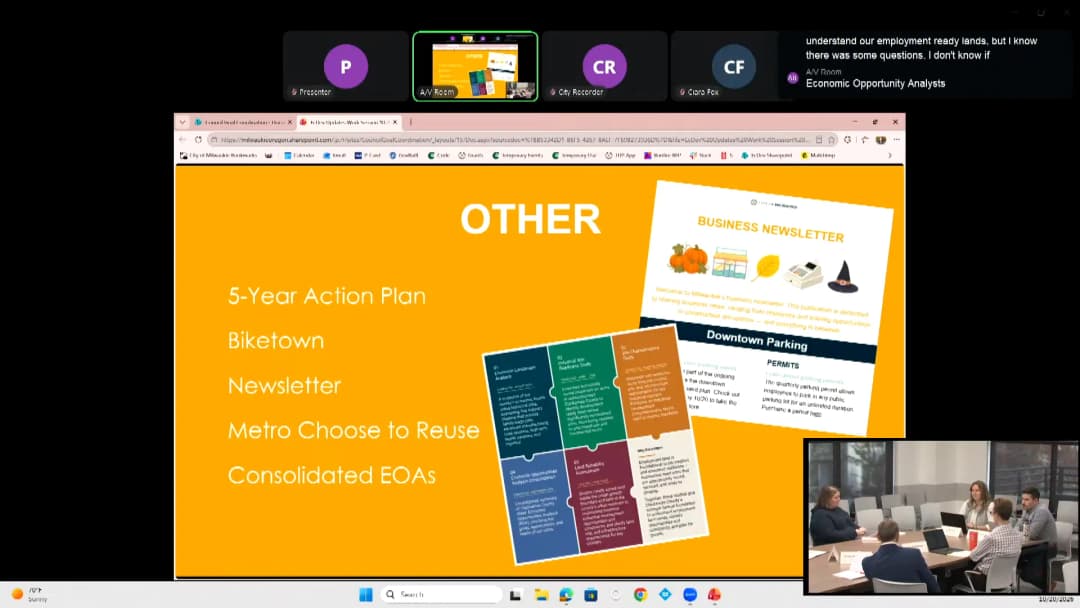
The Milwaukie City Council held a work session on October 20, 2026, to receive the final quarterly update on economic development goals and discuss potential changes to the city's middle housing code in response to state law requirements and recent development trends. Discussion Items - Economic Development Update: Assistant City Manager Joseph Brillo and Economic Development Coordinator Sierra Fox presented highlights from the last two years of the council's economic development goals. Key initiatives included marketing and tourism efforts: two billboard campaigns (November 9 to January 3 on 99E and 224), plans to procure a marketing firm for influencer campaigns during shoulder seasons, and use of a city sponsorship fund to support business-oriented events. Staff reported over 75 actions since 2025, 39 grants totaling $1.3 million invested, and that foot traffic has returned to pre-2020 levels. Other topics included a Metro Choose to Reuse pilot at Milwaukee Station, potential bike-share expansion with Biketown, and the launch of a business newsletter. - Middle Housing Code: Planning staff presented options for revising middle housing development standards following community questions about variances, Senate Bill 1537 exemption, and recent cottage-cluster projects. Staff noted that since 2021, 41 Type II variances were issued, of which 15 were for fence height. Council considered four areas where the city's code is more generous than state law: (1) reducing the allowable variance reduction for residential setbacks from 25% to 10%; (2) minimum lot size for middle housing (currently 3,000 square feet vs. the state's 5,000); (3) cottage spacing (currently 6 feet, state allows up to 10 feet); (4) other incentives for desired designs. Council also discussed maintaining the SB 1537 exemption to retain local control over Type II variances. Key Outcomes - Council directed staff to draft code amendments based on the following consensus: - Reduce the residential setback variance flexibility from 25% to 10% to match state law, applicable to residential development only. - Keep the minimum lot size for middle housing at 3,000 square feet (no increase to 5,000), and allow single-family homes on smaller lots. - Increase the required separation between cottages to 10 feet, but allow a reduction to 6 feet if the common courtyard area is correspondingly enlarged. - Maintain the city's exemption from SB 1537 mandatory adjustments, preserving local control over Type II variances. - Staff will incorporate these changes alongside previously identified policy-light clarifications in an upcoming code amendment package. - No formal votes were taken; these are staff directions to proceed with drafting. A broader discussion on additional incentives and upcoming state rulemaking will occur later.

ZONING CODE AMENDMENTS 41% · ECONOMIC DEVELOPMENT 28% · TOURISM 8% · HOUSING 5%
03
SEP 29, 2026 · MILWAUKIE, OREGON · CITY COUNCIL
Special Meeting of the Milwaukie City Council - September 29, 2026

This was a brief special meeting of the Milwaukie City Council, convened solely to authorize the city manager to execute a settlement agreement with Hunter Newton based on terms previously discussed in executive session. The meeting lasted only a few minutes, and the council also noted an intention to submit the meeting for recognition as the shortest city council meeting ever. Key Outcomes - The council voted unanimously (4-0) to authorize the city manager to execute a settlement agreement with Hunter Newton based on terms discussed in executive session. - The details of the settlement remain confidential pending finalization and signature by all parties, at which point they will become a matter of public record. - The council adjourned immediately following the vote.

PROCEDURAL 100%
04
SEP 24, 2026 · MILWAUKIE, OREGON · CITY COUNCIL
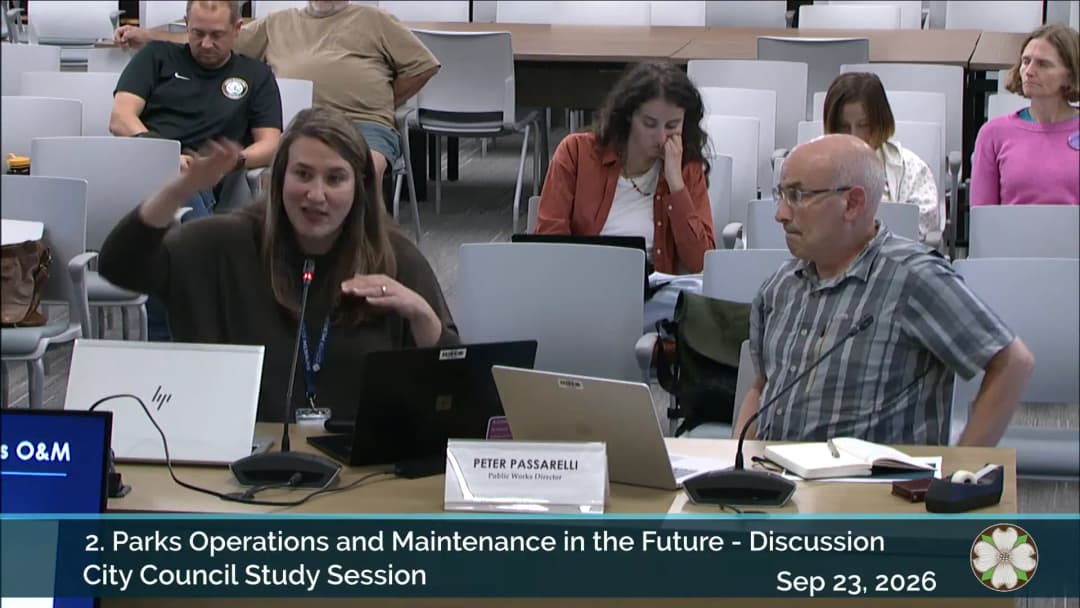
Milwaukee City Council Meeting: Parks IGAs, Operations, and Milwaukee Bay Park – September 24, 2026

The city council held a special session on September 23, 2026 (recorded as September 24, 2026), focused on three parks-related agenda items: an update on intergovernmental agreement (IGA) negotiations with North Clackamas Parks & Recreation District (NCPRD), a discussion on the future of parks operations and maintenance (OM) funding, and an update on Milwaukee Bay Park Phase 3 capital project. The meeting included public testimony, extensive council deliberation, and unanimous votes. Public Comments & Testimony - Jacob Sherman, a community member, expressed full support for the city leaving NCPRD, characterizing the relationship as an “abusive relationship.” He thanked staff and council for their efforts and urged the council to move forward with creating an independent parks department. He expressed interest in exploring scenarios B1.2 and B2 (specific funding and service-level options) and requested more information on how the 75-cent rate compares to other districts. Discussion Items 1. IGA Negotiations Update - City Manager Emma Sagor provided a history since January 2025: the city sought to restart Milwaukee Bay Park Phase 3 (stalled since 2022). NCPRD agreed to discuss only if the city amended the cooperative IGA. After 20+ staff meetings and six elected-to-elected sessions, two agreements were drafted: an addendum to the cooperative IGA and a specific IGA for Milwaukee Bay Park. The city’s “gives” included assuming capital maintenance at the Milwaukee Community Center (estimated $560,000–$1 million over 5 years) and ongoing costs; NCPRD’s “gains” included $3.1 million in SDCs, $900,000 in Metro local share, and a trolley trail grant. The city council approved the agreements on April 21, 2026. However, NCPRD delayed a vote in June, asked for DAC input, and in August the DAC recommended approval with conditions (regional input, parking, levy support, utility costs). In September, the NCPRD board again postponed, citing need for more time and scheduling a work session (reportedly in executive session). The city manager noted that NCPRD has not fully paid utility bills (over $45,000 outstanding). - Mayor Beatty expressed frustration, calling NCPRD’s actions “dithering” and “moving the goalposts.” He stated, “I don't think it's a good deal for us anymore,” and recommended withdrawing from the IGAs. - Council President Massey detailed the expanded scope (master IGA, parking, regional input, levy support) that went beyond original negotiations. He noted the NCPRD levy has not been raised since 1990 despite 155% CPI increase and 180–250% construction cost increases. He argued the deal “keeps getting worse” and said, “I think the time is now” to end negotiations. - Councillor (Coserbody) stated the city has been “decisive” but NCPRD is “like a bad boyfriend” stringing them along; it’s time to “pull the plug.” - Councillor Salinger questioned the DAC’s additional items (regional input, parking, levy support) that were not part of the original negotiations. She noted that the NCPRD board has not communicated directly since June, representing a lack of transparent, collaborative leadership. She agreed that the process feels like “a delay on purpose.” - Council discussed a resolution to rescind authorization for the city manager to sign the IGAs. The resolution was introduced and amended (council president’s change: “unilaterally changing the scope” instead of “withdrawing”). 2. Future of Parks Operations & Maintenance Funding - City Manager Sagor and Public Works Director Peter presented an analysis of OM costs if the city proceeds with all planned capital projects (Milwaukee Bay Park, Metro community choice grants, etc.). Without new revenue, the city would face approximately $200,000 annually in additional OM costs. Scenarios included: - Stay in NCPRD: new revenue needed (utility fee $2.50–$4/month, or 7 cents tax rate), or cut services. - Leave NCPRD: at current 54-cent rate, all parks except Community Center and North Clackamas ball fields would be covered (deficit if all parks included); at 75-cent rate, all parks could be funded with a reserve. - Enhanced service level (+20%) would require 75 cents but still run a deficit. - The city does not currently have a parks department; all OM is done by NCPRD. Happy Valley’s departure experience was shared. - Councillors discussed concerns about affordability, equity, and the need for deep community engagement, particularly with vulnerable populations. - Council President Massey favored leaving but had questions about the Community Center and ball fields. He warned that a 54-cent levy might fail due to insufficient service expectations. - Councillor (Coserbody) emphasized fiscal responsibility and the city’s affordability goal, noting that any tax increase disproportionately affects low-income residents and seniors. He opposed rushing into higher rates and stressed the need for a broader conversation about budget trade-offs. - Councillor Salinger supported leaving but wanted robust community meetings with specific scenarios, not just surveys. - Council President (Anderson) suggested the 54-cent rate could be a no-tax-increase option, and a system plan would help determine long-term investments. - Consensus emerged to explore departure from NCPRD and to communicate that intent, including asking NCPRD to drop its pending Supreme Court appeal (a case on the city’s right to leave the district under ORS 222). 3. Milwaukee Bay Park Capital Project Update - Public Works Director Peter presented the procurement plan: a sole-source contract with Not Studio (former Two Ink, the project’s original designer) to complete design from 50% to 100% construction documents, and a competitive solicitation for a Construction Manager/General Contractor (CMGC). - The CMGC will provide cost estimating, constructibility reviews, and a guaranteed maximum price. Awards expected: Not Studio in October 2026, CMGC in January 2027. - The city manager noted that a $658,000 Metro trolley trail grant (currently held by NCPRD) is needed and discussion with NCPRD about assignment should follow the appeal request. - The city also applied for a federal LWCF grant (due November 12), and will reapply for a state grant in 2027 after better timeline alignment. Key Outcomes - Unanimous vote (4-0) to approve a resolution rescinding the city manager’s authorization to sign the IGAs with NCPRD, effectively ending the negotiation process. The resolution was adopted on September 23, 2026. - Council consensus to direct the mayor and negotiation team to send a letter to NCPRD stating the city’s intent to explore departure from the district and requesting that NCPRD drop its Supreme Court appeal. The city manager was also asked to informally communicate this direction to NCPRD’s administrator. - Council directed staff to return at the earliest opportunity (targeting October 6) with proposals for community engagement (deep, inclusive meetings with specific scenarios), timeline options for a potential May 2027 parks levy or permanent rate increase, and additional financial analysis (e.g., hybrid progressive tax, impact on affordability). - Staff was also asked to discuss with NCPRD the assignment of the trolley trail grant, but the appeal drop is the priority. - The city will move forward with Milwaukee Bay Park Phase 3 independently, using the CMGC and design contracts as presented.

PARKS AND RECREATION 57% · PROCEDURAL 9% · COMMUNITY ENGAGEMENT 8% · PUBLIC ENGAGEMENT 7%
05
SEP 16, 2026 · MILWAUKIE, OREGON · CITY COUNCIL
Milwaukee City Council Meeting - September 16, 2026

The Milwaukee City Council held its 2,457th meeting on September 16, 2026, at City Hall and via video conference. The meeting included proclamations, public comments, consent agenda approvals, discussions on tobacco policies and speed reduction, and a key vote on a grant application for the Kellogg Creek Restoration Project. The council also scheduled an executive session. Consent Calendar - Approved minutes of the July 21, 2026 work session. - Authorized a grant application with Business Oregon and the Oregon Health Authority for PFAS treatment construction. - Approved a contract with FCS, a Bowman company, for on-call utility and infrastructure financial consulting services. - Approved an Oregon Liquor and Cannabis Commission application for Bridgetown Spirits Corporation (2150 SE Hannah Harvester Drive). Public Comments & Testimony - Roger Wool (West Linn resident, Oregon Rail Heritage Foundation VP) requested the city send a letter to ODOT supporting the Oregon Connect Program and the purchase of the Oregon Pacific Railroad, noting potential transload facility benefits for Milwaukee’s industrial area. - Elvis Clark (Milwaukee resident) expressed concerns about the Short Stack affordable housing project, questioning slow sales at $250,000, reduced property tax revenue from the land trust structure, construction overruns financed by Metro, and potential foreclosure outcomes. He urged a lessons-learned review. - Terrell Grant (Greenway Recycling owner) described obstacles to recycling construction debris from the county’s hillside housing project, citing a mileage fee that penalizes hauling to his facility versus Metro South, and requested code changes to enable better recycling access. - Andy Costello (Milwaukee resident, 40+ years) asked the council to reconsider the code limiting pleasure craft/RVs to one per residence under one acre, suggesting a total length limit instead of vehicle count. - Jennifer Murphy (Milwaukee resident) provided an update from the Clackamas County Community Action Board (CAB), summarizing forum discussions on social service needs, including cohesive customer service, tiered safety nets, financial education, updated resource lists, universal intake forms, and resource hubs. - Teresa Breesaw (Milwaukee resident) advocated for maintaining adequate ground space for ladder safety when servicing homes, referencing OSHA guidelines, and expressed encouragement about potential code changes. Discussion Items - Tobacco Policies: The council discussed two items. First, Council President Anderson noted that Oregon City is forming a coalition to urge Clackamas County to adopt a flavored tobacco ban (similar to Multnomah and Washington counties, now upheld by the Oregon Supreme Court). All council members expressed support for joining this effort. Second, a downtown business requested expanding the smoking radius beyond the state’s 10-foot limit. The council directed the city manager to engage with business associations (led by the council president) and county public health staff, and to evaluate code enforcement capacity and mapping implications. - “20 is Plenty” Program: City Engineer Jennifer Garbie and Camilo Alvarez Tuta presented a resolution to authorize the city engineer to lower speed limits on non-arterial streets by 5 mph (from 25 to 20 mph), based on state Senate Bill 558 (2019) and the 2026 Transportation System Plan. Implementation will be phased, starting with bikeways (e.g., 29th Avenue), using in-house staff and CIP projects. The resolution was adopted unanimously. - Kellogg Dam Removal Grant: City Manager Emma Sager presented a resolution to apply for a $1 million Business Oregon Regional Infrastructure Fund (RIF) grant for the sewer line relocation at Kellogg Creek, due the next day. She clarified that the application does not obligate city funds or project delivery; other grants (Metro large-scale community vision funds, federal earmarks) could cover costs. She highlighted a delivery plan where the existing ODOT/Consort contract could be amended for design and permitting. Council members expressed concerns about Metro funding clarity (response expected October 7), inconsistent messaging on sewer line condition (city staff stated the line is in good condition with 20+ years of life, and relining would cost $120k vs. $5M relocation), and pressure from outside leaders. The resolution passed unanimously, with council members emphasizing the need for transparency and partnership. - Council Reports: Council President Anderson expressed disappointment that no elected officials from Milwaukee attended a Clackamas County Community Action Board forum (except one councilor for an hour), where two county commissioners were present. He noted it was a missed opportunity to discuss kitchen-table issues. Other councilors reported on a C4 meeting with governor’s office staff on prosperity council recommendations and transportation legislation. Key Outcomes - Approved consent agenda (4 items). - Directed staff to sign on to Oregon City’s flavored tobacco ban advocacy effort. - Directed the council president to lead business engagement on expanding the downtown smoking radius to 20 feet, with staff support from the city manager and code enforcement. - Adopted Resolution (unanimous): Authorizing the city engineer to implement a “20 is Plenty” program to reduce speed limits on non-arterial streets. - Adopted Resolution (unanimous): Authorizing a grant application for the Business Oregon RIF program for the Kellogg Creek sewer line relocation project (no commitment of city funds or project delivery). - The council adjourned and proceeded to executive session (ORS 192.660i) to evaluate the performance of the chief executive officer.

ENGINEERING AND INFRASTRUCTURE 15% · COMMUNITY ENGAGEMENT 12% · PUBLIC SAFETY 12% · TRANSPORTATION SAFETY 9%
06
SEP 15, 2026 · MILWAUKIE, OREGON · CITY COUNCIL
Milwaukie City Council Meeting - September 15, 2026: Mini Storage Ban, Revolving Loan Fund, and Solid Waste Franchise

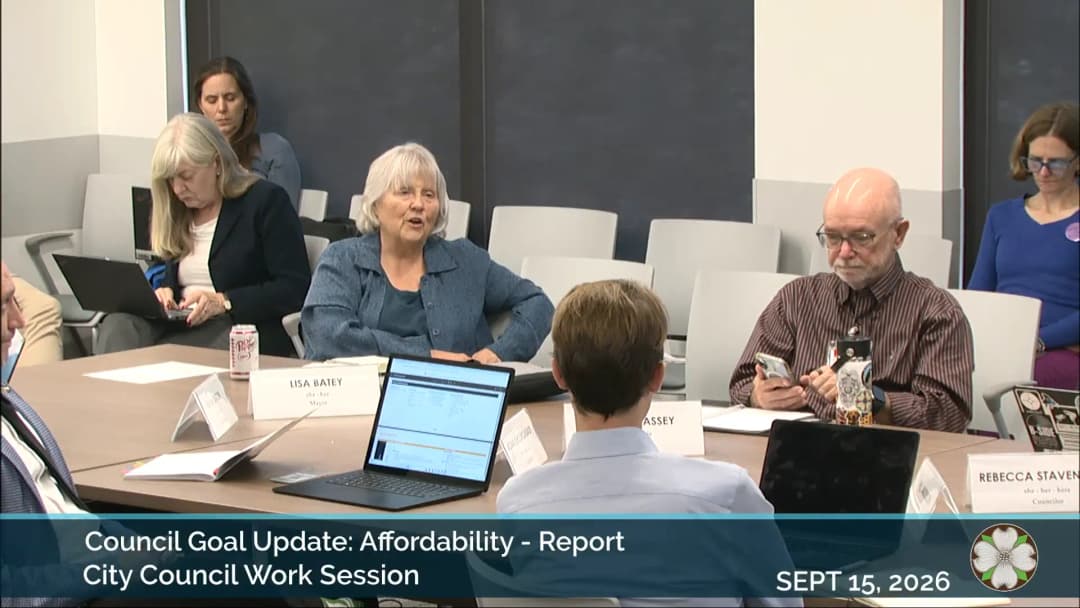
The Milwaukie City Council met on September 15, 2026, to discuss a potential ban on new mini storage facilities, consider a revolving loan fund for homeownership, and review the solid waste franchise system. Council also set direction for staff on several items, including allocating $300,000 for a pilot homeownership assistance program and forming a subcommittee to negotiate a new franchise agreement with haulers. Discussion Items Mini Storage Ban - Councilmember raised the idea of prohibiting new mini storage facilities in the M and VI zones, citing low job creation and existing abundance in Milwaukie. Council discussed options including outright prohibition, conditional use permits, or moratoriums. Concerns about legal challenges and unintended consequences (e.g., rent increases) were noted. Some members favored multi-story storage as a compromise. Council agreed to have staff include the topic in the next code fix package for further analysis. Revolving Loan Fund for Homeownership - Staff presented a proposal for a revolving loan fund to assist Milwaukie residents with homeownership, aligned with the Housing Production Strategy. Options from two vendors (Network of Oregon Affordable Housing and Dev Northwest) were reviewed. Council discussed eligibility criteria: income (preference for 80% AMI with flexibility up to 100%), residency requirement (six months), and flexibility for first-time or repeat buyers. Council directed staff to issue an RFP and allocated up to $300,000 from CET funds for a pilot program, with the expectation that vendors bring forward specific products (e.g., down payment assistance, mortgage rate buy-down). The program aims to support as many applicants as possible, with a maximum per-applicant amount to be determined based on vendor proposals. Solid Waste Franchise System Amendment - Finance Director Michael Osborne presented options for the solid waste franchise agreement, which currently has a 10-year rolling term set to end January 1, 2035. Haulers (Waste Management and Waste Connections) and Clackamas County Solid Waste representative Rick Winterhalter discussed the need for longer-term certainty to justify capital investments (e.g., trucks costing $450,000–$800,000). Council considered a shorter fixed or rolling term (e.g., 7 years) and whether to maintain multiple haulers or consolidate. Council decided to form a subcommittee of two councilors to work with haulers and staff to develop a new franchise agreement, aiming to bring a recommendation by spring 2027 (aligning with annual rate setting). The subcommittee will explore provisions that provide investment certainty without a 10-year rolling commitment. Key Outcomes - Mini Storage: Staff directed to include mini storage regulation options in the next code fix package. - Revolving Loan Fund: Council approved moving forward with an RFP for a homeownership assistance program, allocating $300,000 from CET funds. Key parameters: income target 80–100% AMI, six-month residency requirement, flexibility for first-time and repeat buyers, and preference for vendors offering additional leveraged funds. - Solid Waste Franchise: Council authorized formation of a two-member subcommittee to negotiate a new franchise agreement with existing haulers, with a target to present a draft to the full council in spring 2027. The subcommittee will focus on a shorter term (e.g., 7-year rolling) and provisions to support hauler investment. - General: Mayor committed to ending meetings promptly at 6:00 p.m. for a Historic Milwaukie event at Scott Park.

AFFORDABLE HOUSING 33% · WASTE MANAGEMENT 32% · PUBLIC CONTRACTING 12% · ZONING CODE AMENDMENTS 7%
07
SEP 2, 2026 · MILWAUKIE, OREGON · CITY COUNCIL
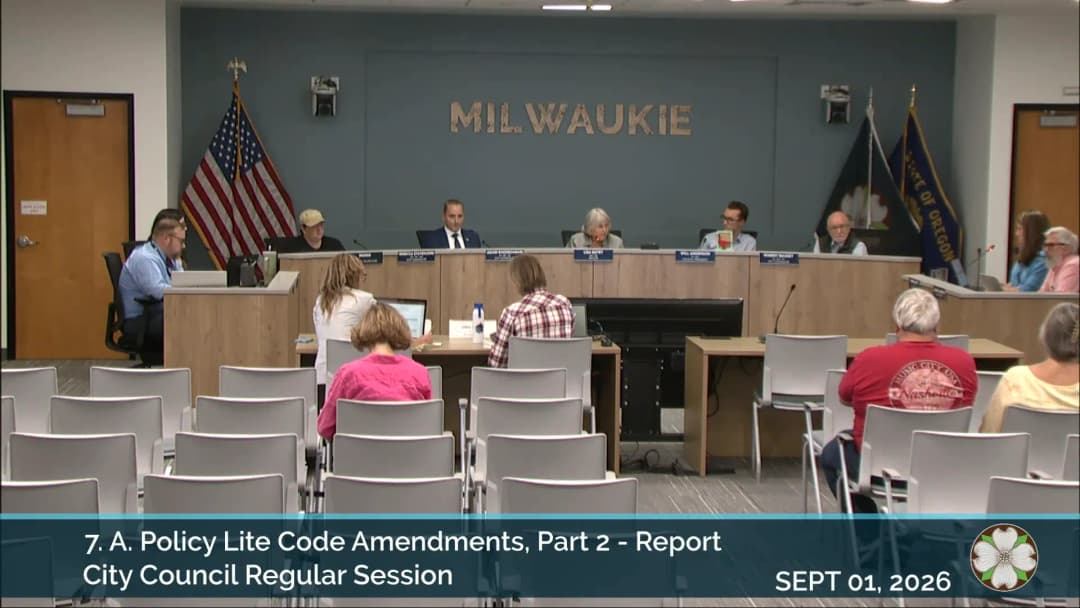
Milwaukie City Council Meeting - September 2, 2026: 9/11 Proclamation, Code Amendments, and Community Concerns

The Milwaukie City Council held its 2,456th meeting on September 2, 2026, at City Hall and via video conference. The agenda included a proclamation for the 25th anniversary of the September 11 attacks, community comments on the King Road construction project and utility billing practices, a public hearing to adopt amendments to manufacturing and business industrial (MBI) zoning, a work session on policy light code amendments (with middle housing items deferred), and council reports on freight rail merger, Kellogg restoration project, and other city business. 9/11 Proclamation Mayor Lisa Beatty read a proclamation recognizing September 11, 2026 as the 25th anniversary of the September 11 attacks. Chief Verdick and several council members shared personal reflections on the attacks and their aftermath. The proclamation was unanimously approved. Public Comments - Elvis Clark (Milwaukie resident) commented on climate trends, noting that recent summers have been cooler than predicted despite rising emissions, and expressed concerns about preserving energy choice and democratic values in climate action. - Kent McCarty (owner of Great American Video and Espresso, representing King Road businesses) testified about the severe impacts of ongoing construction on his drive-thru business, reporting his worst coffee month in 3.5 years. He questioned the plan to close westbound lanes to one-way traffic, noting the bid originally required two-way traffic. He asked for consideration of grant relief. - Karen Galloway (Milwaukie resident) described confusing and unsafe traffic control on King Road, including wrong-way drivers and lost residents. She urged the council to advocate for residents and businesses, and asked that the contractor be held to the bid specification of two-way traffic. She questioned the proposed one-way closure. - Jennifer Murphy (Milwaukie resident) raised concerns about Ratio Utility Billing Systems (RUBS) in apartments, which can lead to eviction for non-payment of variable utility fees. She urged the council to consider regulations or disclosure requirements, as other cities have done. - During the Policy Light Code Amendments work session, Carl Reynolds (56-year resident) spoke in support of orderly planning and rules, urging that exceptions not undermine the intention of code. Amanda Cartwright (resident adjacent to a proposed cottage cluster) described a developer's threat after she appealed a variance, and questioned the cumulative impacts of such developments on safety, drainage, tree canopy, and neighborhood character. Discussion: MBI Zone Code Amendments Planning staff presented proposed amendments to modernize the manufacturing (M) and business industrial (BI) zones, including formatting updates, use tables, and revised standards. No public testimony was offered. Council made three amendments: 1. Strike an incorrect reference to Chapter 27 in the hazardous materials use definition. 2. Add a cross-reference to section 19.5.071 for marijuana retailer proximity restriction. 3. Re-add a 15% minimum vegetation requirement in the M zone. The ordinance (ZA-2026-002) was adopted unanimously (5-0) on first and second readings by title only. Discussion: Policy Light Code Amendments Planning staff reported that all items related to middle housing (e.g., parking design for cottage clusters, garage standards) would be deferred to a future work session to allow a broader discussion of state mandates and city code alignment. Two non-housing items were presented: 1. Minor modifications to community service uses (CSU): Staff recommended removing ambiguous language about open space and natural resources from the minor modification criteria, letting the natural resources code govern. 2. Modifications between preliminary and final plat: Proposed to allow small changes (e.g., up to 5% lot width/depth variation) without restarting the plat process, based on Portland's model. Council expressed support for exploring phasing and broader discussion. Public testimony raised concerns about developer accountability and the cumulative effects of cottage clusters. No vote was taken; staff will prepare responses and bring back recommendations for timing. Council Reports - King Road Construction Update: City Manager Sagar reported that the project is nearing paving. To avoid extending into spring, the contractor proposes closing King Road to westbound traffic for up to 4 weeks (one-way eastbound only). Staff will conduct outreach, detour signage, and attempt to support businesses. Grant relief is limited to the existing Business Improvement Grant program; no dedicated construction impact relief program exists. Council expressed concern about the change from two-way traffic as originally bid, and requested a memo analyzing phasing, business impacts, and potential fiscal options (including CET funds) to mitigate harm. - E-bikes: Police Chief reported that monitoring of the Trolley Trail and Springwater Corridor has been added to patrol routes. A new webpage on e-bike regulations was launched. No immediate regulatory changes were proposed. - Freight Rail Merger: The proposed Union Pacific/Norfolk Southern merger could increase Brooklyn Yard traffic by 22%. The City Manager will file a Notice of Intent to Participate (NOIP) with the Surface Transportation Board by the September deadline, coordinating with Portland on comments. - Kellogg Restoration Project: The city is eligible for a $1.06M state revolving loan (50% forgivable) for the sewer component, but council has not authorized taking on debt until project funding is more certain. The Protect grant (due October 9) requires the city to be lead applicant. A project team briefing will be scheduled for October 6 to address council questions on costs, rate impacts, and underpass design. - Parks DAC: The District Advisory Council prioritized a county parks levy for the November 2027 ballot. Key Outcomes - Adopted: MBI zone amendments (ZA-2026-002) unanimously (5-0) with three staff-recommended amendments. - King Road: Council directed staff to produce a memo on alternatives to the one-way closure, business grant options, and safety impacts before a final decision. - Policy Light: Middle housing items deferred; staff to recommend timing for a study session. Non-housing items (CSU minor modifications, preliminary/final plat changes) will be reconsidered after broader discussion. - Freight Rail: Staff will submit a NOIP to the STB and coordinate with Portland on comments. - Kellogg Restoration: Council requested that the project team present at the October 6 meeting with detailed cost and design information before any city funding commitment. - Parks Levy: The DAC will work toward a county parks levy for 2027.

ENGINEERING AND INFRASTRUCTURE 26% · PROCEDURAL 14% · ZONING CODE AMENDMENTS 11% · HOUSING 8%
08
SEP 1, 2026 · MILWAUKIE, OREGON · CITY COUNCIL
Milwaukie City Council Work Session on Transportation SDC Methodology – September 1, 2026

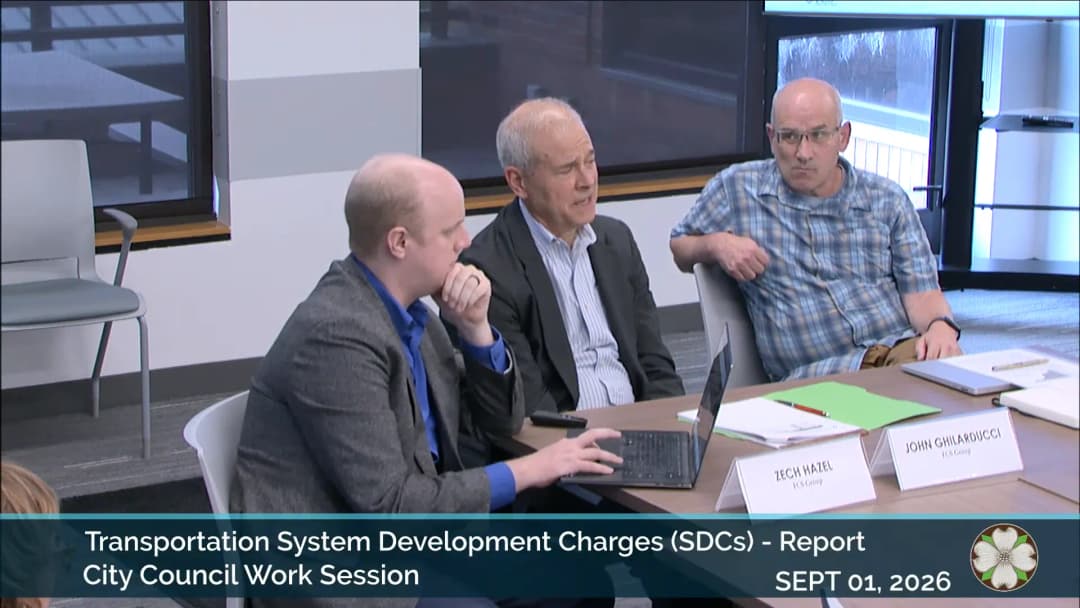
The Milwaukie City Council held a work session on September 1, 2026, to discuss the methodology for updating Transportation System Development Charges (SDCs). Staff presented two scenarios for calculating the maximum allowable charge: one based on all eligible projects from the Transportation System Plan (TSP) and one based only on the financially constrained project list. Council members debated the appropriate project list, scaling of charges by dwelling unit size, and potential transit proximity discounts. Discussion Items - SDC Overview and Methodology: Staff (Peter Pascarelli, John, Zach) explained SDC basics: one-time charges paid at development to fund capital projects, divided into reimbursement fees (buy-in to existing capacity) and improvement fees (future growth-related projects). Growth is measured in PM peak hour person trip ends. - Two Scenarios Presented: - All eligible projects (full TSP list): maximum charge of $14,560 per single-family dwelling unit. - Financially constrained project list (7% of total project list): maximum charge of $3,943 per single-family dwelling unit. Current SDC for single-family is $2,740. The constrained list represents a 59% increase; the full list a 489% increase. - Scaling by Dwelling Unit Size: Staff proposed scaling the SDC based on square footage, similar to existing water/wastewater SDCs. A slide showed potential charges for units under 500 sq ft ($2,366) to over 3,500 sq ft ($7,829) compared to a uniform $3,943. Council discussed whether middle housing (e.g., duplexes, triplexes, ADUs) should have a separate reduced factor or be included in the same square footage scaling. Councilor Em argued that the ITE manual shows lower trip generation for multi-family, but staff noted that scaling by square footage is more defensible and simpler. Consensus emerged to scale all residential (including middle housing) by square footage, not by separate typology. - Transit Proximity Discount: Staff presented examples from Oregon City (10% reduction along specific corridors) and Eugene (5–10% reduction within half or quarter mile of transit). Council debated whether to include such a discount. Some favored more information, while others opposed another work session. The mayor suggested potentially adding options without a separate work session, but no final decision was made. - Concerns About Impact on Businesses: Council members expressed worry that a significant increase (even 59%) would burden small businesses. They noted that developers often pass SDC costs to tenants, but some argued that the city’s current rates are among the lowest in the region. The constrained list would keep Milwaukee in the bottom four of comparable jurisdictions. Key Outcomes - Project List: Council reached a majority consensus to base the SDC methodology on the financially constrained project list (maximum $3,943 per single-family unit). This allows a 59% increase over current rates but provides a clear, achievable capital plan. Some council members (e.g., Mayor) preferred a buffer above the constrained list, but the consensus was to use the constrained list as the ceiling. - Scaling: Council directed staff to develop a residential SDC scaled by dwelling unit square footage for all housing types (including middle housing), consistent with the approach used for water and wastewater SDCs. No separate reduced factor for middle housing will be applied. - Transit Proximity Discount: Council did not make a final decision. Staff was asked to return with more information on options and potential impacts, possibly without requiring an additional work session. - Next Steps: Staff will revise the methodology based on council direction, prepare a 90-day public notice, and schedule a public hearing for adoption. Council may hold one more work session if needed to finalize transit discount details.

TRANSPORTATION SAFETY 45% · AFFORDABLE HOUSING 16% · FISCAL SUSTAINABILITY 15% · MISCELLANEOUS 6%
09
AUG 19, 2026 · MILWAUKIE, OREGON · CITY COUNCIL
Milwaukee City Council Meeting – August 19, 2026: PFAS Update, Budget Adjustments, and Parks IGA Progress

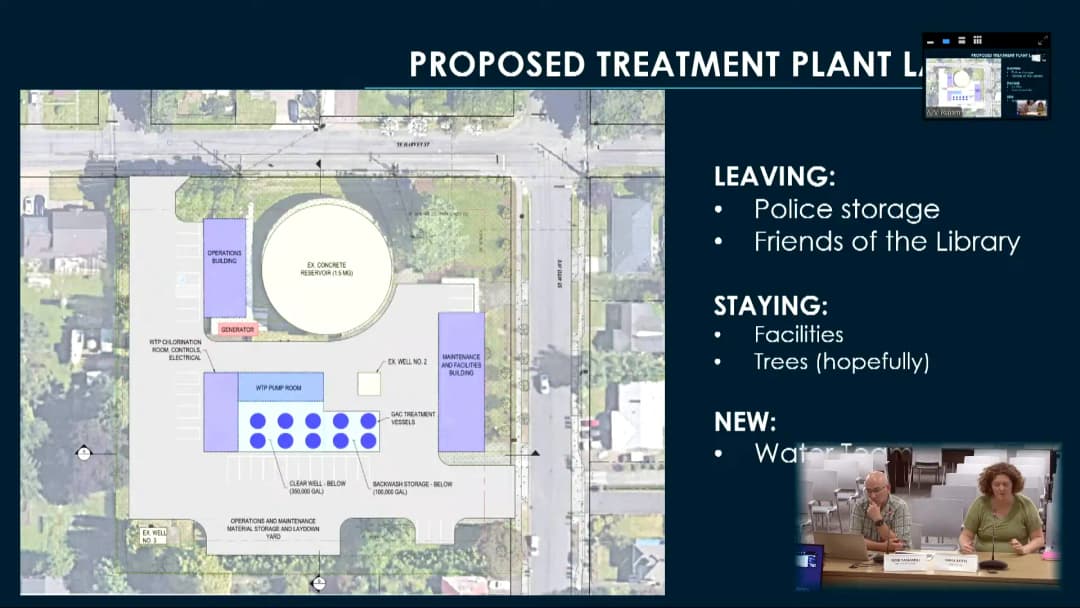
The 2045th meeting of the Milwaukee City Council was called to order at approximately 6:30 PM on August 19, 2026, in person and via video conference. The meeting included a PFAS (per- and polyfluoroalkyl substances) update, approval of a supplemental budget for the 2027-2028 biennium, a progress report on the North Clackamas Parks and Recreation District (NCPRD) intergovernmental agreement, and other business. All votes were unanimous unless noted. Consent Calendar - Approved the minutes of the July 14, 2026, study session. - Authorized a contract with DD Concrete and Utilities Inc. for the Monroe Street Greenway Central Segment Project (CIP 2023-T38). Public Comments & Testimony - No community comments were offered in person or via Zoom during the public comment period. - Staff reported receiving correspondence from Piers Challa regarding e-bike and pedestrian safety on the Trolley Trail near River Road and Bluebird. City Manager noted that police bike patrols will monitor the intersection and data will be shared with ODOT and NCPRD. - A seven-year-old resident, Clara, sent a letter to the Mayor praising Milwaukee as the best place in the universe. Discussion Items PFAS (PFOS/PFOA) Update - Public Works Director Peter Pasarelli, Engineer Tanya Batty, and Water Manager Steve Mauder presented an update on PFAS contamination in the city's drinking water wells. - Sampling since 2023 showed levels of PFOA and PFOS exceeding the EPA's new maximum contaminant level (MCL) of 4 parts per trillion at several entry points. Well 6 (Stanley) recently showed detections. - A feasibility study recommended centralized treatment at the 40th and Harvey site using granular activated carbon (GAC) filtration, which can also remove VOCs and allow future media flexibility. Estimated capital cost: $32 million (including 50-60% contingency). - The project includes a raw water transmission line from Well 6 to the upper treatment plant, demolition of existing facilities, and a new on-site hypochlorite generation system to replace chlorine gas. - The city is targeting EPA compliance by April 2029, with a potential extension to 2031. Funding sources include Safe Drinking Water Revolving Loan Fund grants ($9 million so far, additional $10 million possible), PFAS litigation settlements, and legislative appropriations. - Rate impacts: The current forecast assumes 8% water rate increases per year over the next three years, subject to refinement as design progresses. Parks IGA Update - City Manager provided an update on negotiations with NCPRD regarding the Milwaukee Bay Park Phase 3 project and amendments to the cooperative IGA. - The NCPRD District Advisory Committee (DAC) met on July 8 and August 12, 2026, and passed a motion recommending final negotiations with conditions including regional input on park design, parking, levy support, and maintenance/utility costs. - Council will hold a special session on September 22, 2026, at 6:30 PM to discuss next steps after the September 16 NCPRD board meeting. Budget Adjustment Hearing - Finance Director Michael Osborne presented a supplemental budget for the 2027-2028 biennium. - Adjustments included $745,000 from general fund contingency for a new three-year collective bargaining agreement with ASMI (3.5%/3.1%/3.1% COLA, market salary adjustments, health contributions, vacation cash-out); $5.4 million in CIP carryover from fiscal year 2025-2026; and smaller items for library lockers ($27,000), cooling center grant rollover ($55,000), and tree fund professional services ($43,000). - The five-year general fund forecast remains out of policy in the current biennium and negative in the next. - The public hearing was closed and the resolution was approved unanimously. Milwaukee Redevelopment Commission (MRC) Budget Adjustment - The MRC approved a $290,500 supplemental budget for the 2027-2028 biennium to cover salary and benefits for three staff (Executive Director, Economic Development Director, and a portion of Parks staff) due to the new collective bargaining agreement, funded from contingency and beginning fund balance. Council Reports - Council member welcomed new businesses: Cities on Maine (soft open) and Bridge City Improv (grand opening). - Council President proposed a joint voter pamphlet statement supporting the North Clackamas School District bond (no tax increase), with council members contributing personally ($100 each) rather than using council funds. Unanimous agreement. - Updates on C4 discussions regarding e-bike ordinances and a spot grant for bike lane delineation on 43rd Avenue. - Mayor reported on SHS (Supportive Housing Services) Oversight Committee discussions about direct city funding for services, and on the Oregon Mayor's Association conference (including recognition of former Milwaukee Police Captain Dave Rash as Oregon Chief of the Year). Key Outcomes - Consent agenda approved unanimously. - PFAS update: Staff will proceed with design and construction of centralized GAC treatment plant, seeking additional funding. Next rate impact update expected late winter/early spring 2027. - Parks IGA: Council will hold special session September 22 to determine next steps. - Budget adjustments (city and MRC) approved unanimously after public hearings. - Council reports: All members agreed to sign and fund the voter pamphlet statement for the NCSD bond.

WATER AND WASTEWATER MANAGEMENT 38% · PROCEDURAL 15% · BUDGET EQUITY ANALYSIS 11% · TRANSPORTATION SAFETY 8%
10
AUG 5, 2026 · MILWAUKIE, OREGON · CITY COUNCIL
Milwaukee City Council Regular Meeting - August 5, 2026

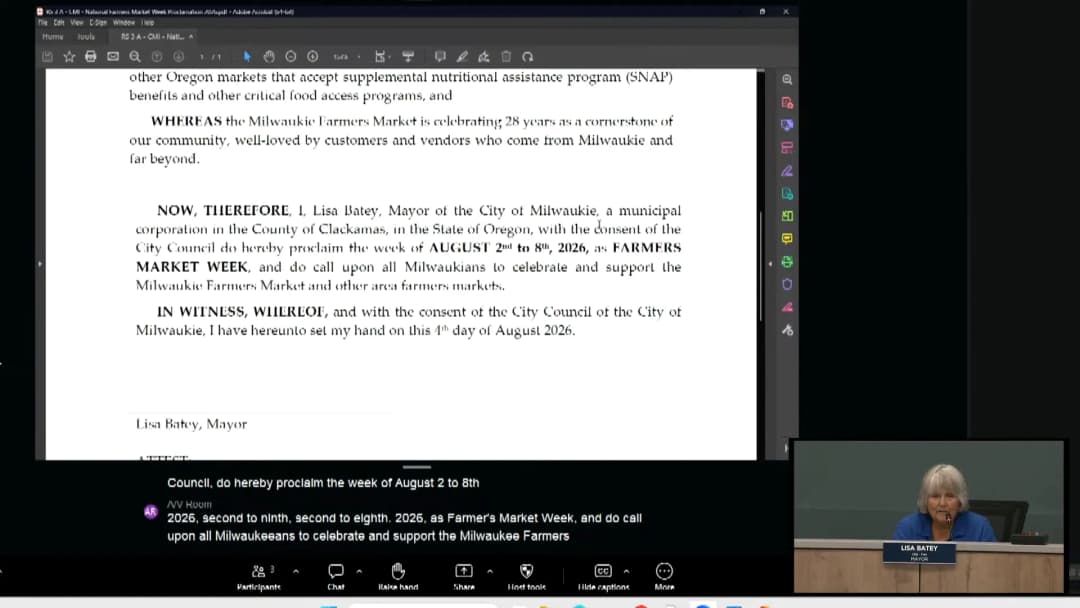
The 2,454th meeting of the Milwaukee City Council was called to order at City Hall and by video conference. Due to extreme heat and smoke, several outdoor events were postponed or rescheduled, and agenda item 7 (policy light code amendments and parks update) was deferred to a later date. The council recognized National Farmers Market Week with a proclamation and welcomed four new downtown businesses. The consent agenda was approved unanimously, and the council later adjourned to executive session regarding litigation. Consent Calendar - Minutes of the July 7, 2026 work session and regular session - Resolution acting as the local contract review board reinstating a personal services agreement with JLA Public Involvement for on-call public information and engagement services - Resolution assessing abatement costs for a nuisance at 5992 SE Monroe Street and entering it on the docket of city liens - Approval of an OLCC application for Social Poor, 10600 SE McLoughlin Blvd, new outlet - Approval of an OLCC application for Oak Union Brewing, 10909 SE Main Street, Suite B, additional location - Motion to approve a collective bargaining agreement with AFSCME - Motion to approve a cost-of-living adjustment for management and non-represented employees Public Comments & Testimony - No public comments were made in person or online. Discussion Items - National Farmers Market Week Proclamation: Mayor Lisa Beatty proclaimed the week of August 2–8, 2026 as Farmers Market Week. Jillian Hall, president of Celebrate Milwaukee Inc., accepted the proclamation and noted a successful season with many vendors and no early closures due to heat. - Business Introductions (New Downtown Businesses): - Kinder Home (Danielle Kinder): A lifestyle boutique open for three months, offering apparel, home decor, candles, gifts, and children's items. Open daily 10–5, with community events such as mahjong classes and artist features. - Elaine's Floral (Terry): A full-service floral shop named after the owner's mother, open Wednesday–Sunday (10–6, Sunday until 4). Features a bloom bar, specialty vases, local artists, and future workshops (terrariums, centerpieces). - Milwaukee Mini Mart (Michelle): A 400-square-foot mini market opened about a month ago on Main Street, offering chips, candy, beer, wine, soft drinks, personal care items, and fun merchandise. Owner hopes to host future events and bring more activity to that end of downtown. - The Vital Element (Cassandra): A jewelry and home decor business with a storefront above Toolbox Gallery on Jefferson Street. In business for 10 years, she creates botanical burnout-cast jewelry and offers lapidary services. Open by appointment Tuesday–Friday and every other Sunday; also teaches workshops. - Council Reports: Councilor noted the success of the Little Float event at Milwaukee Bay Park, with improved activities and attendance compared to the previous year. - Facility Update (City Manager Emma Sager): Due to combined heat and poor air quality, on August 5 the library will be closed, but library staff will operate a cooling/air quality space in the Dogwood community room (first floor of City Hall). Second and third floors of City Hall will be closed to the public; court is canceled; police records department closed; public works (Johnson Creek) operating normally. Staff will telework where possible. The public is advised to monitor social media for further updates. Key Outcomes - Consent agenda approved unanimously. - Agenda item 7 (policy light code amendments and parks update) deferred; parks update rescheduled to August 18 meeting. - Facility closure plan for August 5 adopted: Dogwood community room open as cooling center; records and court closed; City Hall upper floors closed; police maintain public safety services. - Council adjourned regular session and entered executive session to discuss current or likely litigation (ORS 192.660).

ARTS AND CULTURE 30% · ECONOMIC DEVELOPMENT 19% · PROCEDURAL 13% · PARKS AND RECREATION 10%
0102
NEXT →
OPENPUBLICA · PUBLIC MEETING INDEXUPDATED DAILY · openpublica.com