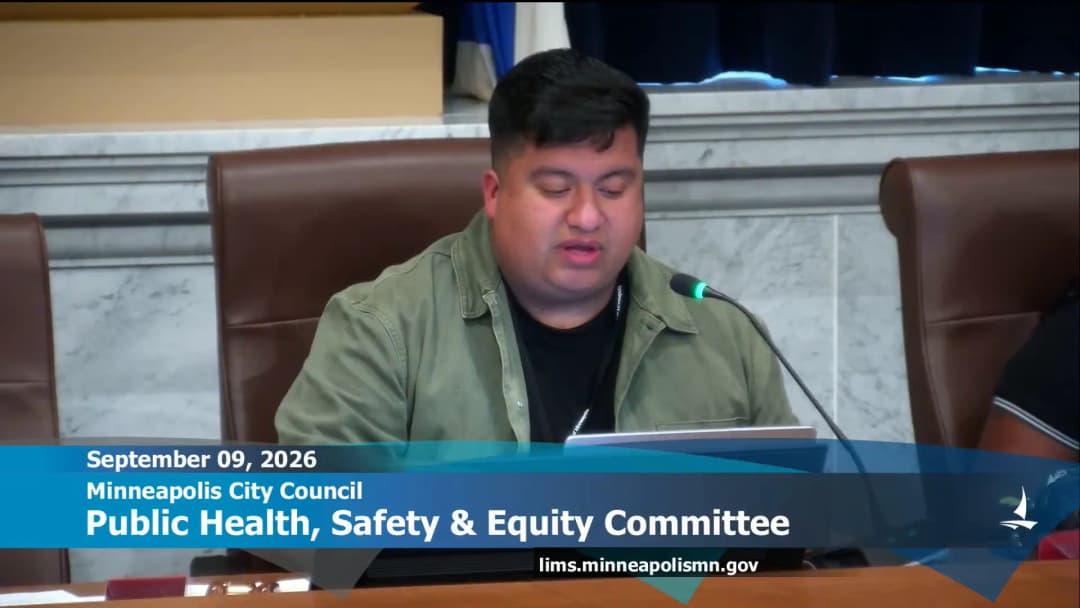
The Public Health Safety and Equity Committee met on September 9, 2026, with Chair Jason Chavez presiding. Five members were present, establishing a quorum: Councilmembers Payne, Beta, and Chavez; Councilmember Whiting and Vice Chair Stevenson were absent. The committee approved the consent calendar and adopted an ordinance related to neighborhood policy board elections. Chair Chavez also acknowledged several shootings that occurred in Minneapolis during the previous week. Chair's Remarks on Recent Violence - On September 2, 2026, a mass shooting occurred in the Lowering Park neighborhood. Three responding officers were injured: one sustained an apparent non-life-threatening gunshot wound to the leg, one underwent surgery, and a third was evaluated for an apparent non-life-threatening injury. Four additional people with apparent gunshot wounds were taken to the hospital; one died at the hospital and another was killed at the scene. - On September 5, 2026, a woman was left in critical condition after a shooting in a parking lot near 44th Avenue North and Lindo Avenue North. - On September 5, 2026, a man was shot on I-94 Eastbound between Portland Avenue and Chicago Avenue. - On September 6, 2026, two men were found with suspected gunshot wounds in Diggy Town near the University of Minnesota East Bank campus. - Chair Chavez expressed condolences to the families, friends, and loved ones of those killed, and to everyone recovering, including injured Minneapolis police officers, responders, and medical professionals. Consent Calendar - Item 2: Accepted a grant from the Subaru Loves Pets program to support animal care and control. - Item 3: Accepted Resolution 2026R201, a Gary Sinise Foundation First Responder Outreach Grant to purchase portable radio kits. - Item 5: Accepted reimbursement from the Minnesota Board of Firefighter Training and Education for approved trainings. - Items 6, 7, and 8: Accepted donations for staff conference attendance. - Item 9: Approved two appointments to the Advisory Committee on People with Disabilities. - Item 10: Waived the residency requirement for current Public Health Advisory Committee member Tavia. - The consent calendar was approved by voice vote without discussion or any items pulled. Public Comments & Testimony - The public hearing was opened for the ordinance item, but no members of the public signed up to testify. After multiple calls for speakers, the hearing was closed with no testimony offered. Discussion Item: Ordinance on Neighborhood Policy Board Election Location - Staff presented an ordinance affecting the policy board for the Neighborhood Revitalization Program (NRP). - The policy board membership includes the mayor's representative, a Minneapolis City Council representative (currently Councilmember Warren), a Park Board commissioner, Hennepin County, the Minneapolis School Board, and eight neighborhood representatives chosen by election. - There are six policy board districts for the city plus two at-large members. - The ordinance would remove the Community Connections Conference as the designated election location, allowing the policy board and city to determine the best location for future elections. - The change also ensures elections for neighborhood representation take place in even years; if the Community Connections Conference returns, it could still be used as the venue. Key Outcomes - The consent calendar was approved by voice vote. - The ordinance regarding neighborhood policy board election location was approved by voice vote; no opposing votes or abstentions were noted. - After the vote, the committee found no further business and adjourned.
Public Meetings - Minneapolis, Minnesota
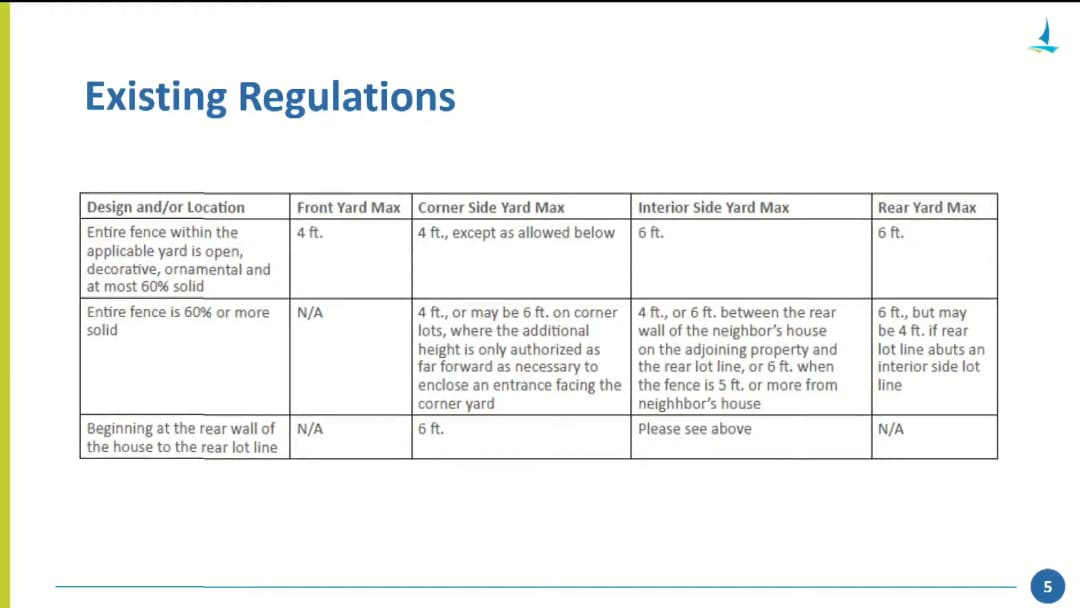
Public Meetings - Minneapolis, MinnesotaOn September 8, 2026, the Minneapolis Business, Housing and Zoning Committee met with six members present (quorum established) to consider consent agenda items, hold public hearings, and discuss several regulatory changes. The meeting featured votes to approve a liquor license, delay the 2027 license fee schedule, adopt a new event center license ordinance, and amend fence regulations. Consent Calendar - Items 4-16 were approved unanimously, including liquor license approvals and renewals, gambling licenses, contract amendments, grant authorizations, and a public hearing date setting. Councilmember Rainville asked about Item 13 (grants) and received details on a $1 million grant for the 250 Fremont project, a $410,000 grant for Dreamland on 38th, and authorization to apply for up to $300,000 in pre-development funding for the New Nicollet Phase One and Penn Lowry projects. No other items were pulled. Public Comments & Testimony - Tropico Liquor License (Public Hearing): Amy, co-owner of Tropico Colombian Street Food, testified in support of the license, explaining the relocation and business expansion. No opposition was voiced. - 2027 License Fee Schedule (Public Hearing): No public comments were received. - Event Center License Ordinance (Public Hearing): Keenan Shanahan, co-owner of Mugan Entertainment, testified in strong support, noting the ordinance would provide a clearer path for small venues to host public events and help his organization establish a permanent home. No opposition. - Fence Regulation Ordinance: Previous public hearings were held at the Planning Commission and Board of Adjustment with no public comment; no additional testimony was taken at this meeting. Discussion Items - Tropico Liquor License: Presented by Max Cervantes (Licenses and Consumer Services). The applicant requested an on-sale liquor, limited entertainment, and Sunday sales license at 10 5th Street South. The location had 78 interior seats, no exterior seats, with hours Sunday–Thursday 11 a.m.–9 p.m. and Friday–Saturday 11 a.m.–11 p.m. Notices were sent and one supportive comment received. Councilmember Schaefer (Ward 7) moved approval. The item was approved unanimously. - 2027 License Fee Schedule: Ben Zimmerman (Budget) and Jane DeSenza (Deputy CFO) presented. The recommendation was to keep fees flat for 2027, pending completion of a comprehensive fee study mandated by a 2024 legislative directive. The study, initially due August 1, 2025, was delayed due to difficulty finding a vendor and the volume of work. Draft findings indicated an aggregate cost recovery rate of 94%. Councilmember Chavez raised concerns about the rental license fee recovery rate (noted as 64% in a prior staff analysis) and suggested a minimum increase to avoid layoffs in Regulatory Services. He moved to delay the item to the September 22 committee meeting to allow review of the final fee study. After discussion, the motion carried unanimously (6-0). - Event Center License Ordinance: Amy Lingo (Licenses and Consumer Services) presented the ordinance amending Chapter 266 to allow rental halls to host both private and public events under a single license. Key features: public events do not require an alcohol license; alcohol remains prohibited unless a temporary license or caterer is used; a public hearing is required for each event center endorsement; a security review by Business Licensing and the Minneapolis Police Department is required. The change was supported by Councilmembers Schaefer and Chavez. Approved unanimously. - Fence Regulation Ordinance: Sarah Roman (CPED Planning) presented three proposed amendments to the fence code: (1) allowing six-foot tall fences at the front corner of corner lots (open/decorative or a mix), (2) restoring the allowance for three-foot opaque fences in front yards (reversing a 2023 change), and (3) requiring a three-foot minimum setback from existing side doors on interior side yards for safety. The Planning Commission and Board of Adjustment had expressed support. Councilmember Warren asked clarifying questions about measuring fence height above retaining walls. Approved unanimously. Key Outcomes - Tropico Liquor License: Approved unanimously. - 2027 License Fee Schedule: Delayed to the September 22, 2026 Business, Housing and Zoning Committee meeting to await the final comprehensive fee study report. - Event Center License Ordinance: Approved unanimously, establishing a new streamlined license for rental halls to host both private and public events. - Fence Regulation Ordinance: Approved unanimously, allowing greater flexibility for corner lot and front yard fences and adding a safety setback for side doors. - Committee adjourned without further business.
No agenda, minutes, or transcript were provided for this meeting. Therefore, no summary can be generated.
The Enterprise and Relations Committee met on Wednesday, September 8, 2026, with Chair Linne Palmasano presiding. Five members were present (Councilmembers Vietal, Schaefer, Chavez, Chang Time, and Chair Palmasano), constituting a quorum. The meeting addressed several consent items and a referral of a proposed ordinance back to staff. Consent Calendar - Items 1 through 4 were approved unanimously. Item 1 authorized a contract with State Ramp for a standardized approach to evaluating cloud service provider cybersecurity practices (no cost). Item 2 was a contract amendment for the My Minneapolis Employee Engagement Survey. Items 3 and 4 were not individually described in the transcript but were included in the approval. - Item 6, setting a public hearing for the Capital Range Improvement Committee reform ordinance, was referred back to staff for additional briefings and to allow more time for councilmember questions, with a report back in a future cycle. Discussion Items - Chair Palmasano moved to refer Item 6 back to staff, noting that previous council discussions indicated a feeling of being rushed. Councilmember Schaefer asked for clarification, and Chair Palmasano explained that the referral was not a restart but a pause to ensure all feedback is incorporated, with the goal of filling committee seats by the next CLIC meeting (early next year). Councilmember Schaefer confirmed this understanding. Key Outcomes - Unanimous approval (5-0) of Items 1 through 4. - Referral of Item 6 back to staff (5-0). - A separate roll call vote was held on Item 5, which passed unanimously (5-0). The nature of Item 5 was not specified in the transcript. - All approved items (1-5 and the referral of Item 6) were moved to the full council for consideration.
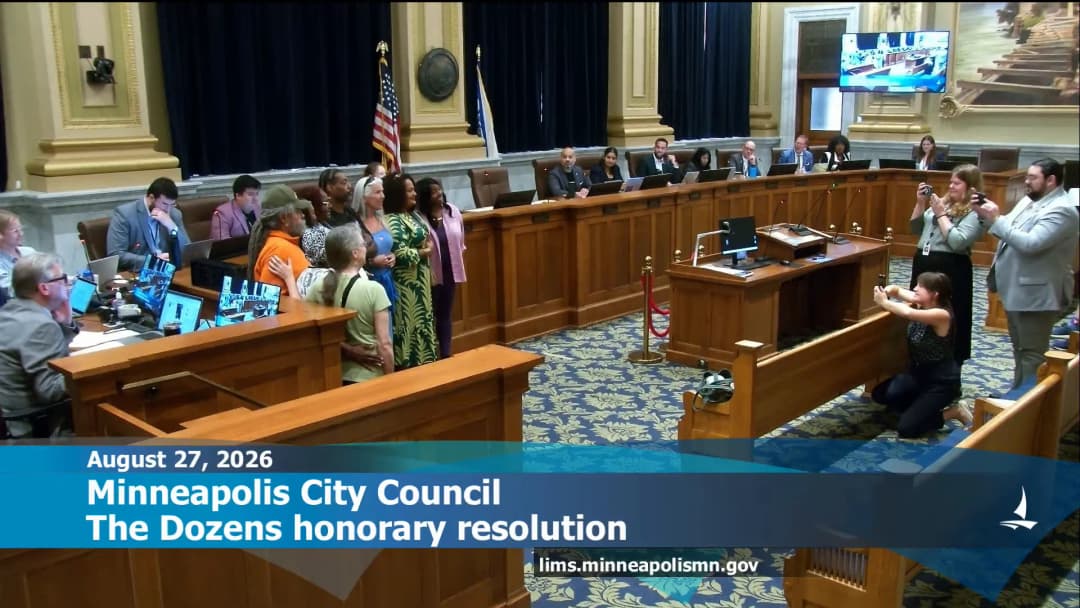
The Minneapolis City Council convened at 9:00 AM (approximate) on August 27, 2026, with 13 members present (Councilmember Wandsley initially absent, later joined). The meeting began with honorary resolutions for “The Dozens” community event on West Broadway and for Welcoming Week 2026, followed by the regular agenda. Key actions included approval of committee reports, a debate on noise ordinance changes for motion‑sensor devices, passage of pet ownership restrictions reform, and a procedural step toward revising the Capital Long Range Improvement Committee (CLIC). The meeting adjourned at approximately 11:30 AM. Consent Calendar - Adopted the agenda (12–0, later 13 after Wandsley arrived). - Accepted minutes from August 13, 2026 (12–0, later 13). - Referred petitions, communications, and reports to proper committees (12–0, later 13). Honorary Resolutions (Presented Before the Regular Meeting) - The Dozens (North Minneapolis Food‑Focused Future) – Councilmember Warren presented a resolution recognizing the August 29, 2026 community celebration on West Broadway. Multiple community speakers (Leslie Jackson, Chaz, and others) expressed full support for the event, emphasizing food access, green zones, and the need to restore Minneapolis Connects funding. The resolution was adopted unanimously. - Welcoming Week 2026 – Councilmember Traves presented a resolution for September 10–19, 2026, affirming the city’s commitment to immigrant and refugee communities. Director Michelle Rivera (Office of Immigrant & Refugee Affairs) and staff from St. Paul spoke in favor. The resolution passed unanimously. Committee Reports – Votes and Discussions 1. Business, Housing & Zoning (Vice President Osman) – Five items (dress code posting, liquor licenses, gambling licenses) passed 13–0. 2. Climate & Infrastructure (Councilmember Wandsley) – 14 items. Item 1 (Municipal Consent for Central Avenue/MnDOT) was initially tabled; later Councilmember Payne introduced an amendment to explicitly support the Northeast Minneapolis Arts District’s Art Walk concept. After discussion, the amended item passed 13–0. Remaining items (North Side Greenway Phase 2, Nicollet Avenue restrooms, Vision Zero Action Plan, etc.) passed 13–0. 3. Committee of the Whole (Councilmember Chowdhury) – Two items: resolution honoring Annunciation shooting victims (one‑year anniversary) and resolution rescinding delegated authority for non‑disclosure agreements. Passed 13–0. Councilmember Whiting noted that gun violence remains the leading cause of death for children. 4. Enterprise & Labor Relations (Councilmember Palmasano) – Four items (quarterly donations, gift acceptance, two Star Tribune legal settlements). Passed 13–0. 5. Public Health, Safety & Equity (Councilmember Chavez) – Six items. Item 1 (Noise Ordinance – motion‑sensor devices) was pulled for discussion. Councilmember Vita expressed concerns from North Minneapolis residents about disproportionate impact and public safety trade‑offs. Councilmember Warren and Stevenson noted the devices can deter crime and be adjusted. A motion to delay this item by one cycle passed 7–6 (Wandsley, Stevenson, Chavez, and others opposed delay). Item 2 (Pet Ownership Restrictions) was pulled by Councilmember Wandsley, who argued it removes a discriminatory barrier for justice‑impacted residents. Director Shendle confirmed the change only eliminates the fee and permit requirement for felony convictions (excluding domestic violence) and adds ability to restrict ownership for animal cruelty convictions. Councilmember Palmasano raised concerns about engagement with rescue organizations, but supported the change. The item passed 13–0. Remaining items (Axon contract, HUD grant, etc.) passed 13–0. Noticeable Ordinance Introductions - Councilmember Chowdhury and Vice President Osman gave notice to amend zoning and subdivision regulations for 1–3 unit dwellings. - Councilmember Chavez and President Payne gave notice for an ordinance requiring certain commercial leases to be in writing. Introduction and Referral Calendar - CLIC Reform (Councilmember Palmasano) – This item corrected a prior notice to keep the Capital Long Range Improvement Committee as a tier‑2 body by ordinance (instead of making it tier‑3 by resolution). After lengthy debate about representation, quorum, and the need for broader board/commission reform, the introduction and referral passed 13–0. It will go to the Enterprise & Labor Relations Committee for a public hearing. - Energy Disclosure Repeal (Councilmember Stevenson) – Ordinance to repeal commercial/multifamily energy disclosure requirements was referred to the Climate & Infrastructure Committee (13–0). Resolutions (from meeting opening) - The two honorary resolutions (The Dozens and Welcoming Week) were formally adopted (12–0, Vice President Osman absent, later recorded). Key Outcomes - Adopted: All consent items; all committee reports except the delayed noise ordinance item; two honorary resolutions; two ordinance introductions and referrals. - Delayed: Noise ordinance amendment for motion‑sensor devices (returned to next council cycle). - Passed (13–0): Pet ownership restrictions reform (removing barriers for justice‑impacted residents). - Referred: CLIC reform ordinance to Enterprise & Labor Relations Committee; energy disclosure repeal to Climate & Infrastructure Committee. - Next Steps: Community discussions on CLIC restructuring; further briefings on board/commission reform; a legislative academy for council members is being developed.
The meeting opened with an honorary resolution commemorating the one-year anniversary of the shooting at Annunciation School and Church on August 27, 2025. The council then received committee reports, approved a resolution rescinding delegated authority for non-disclosure agreements, discussed overdue legislative directives from the Minneapolis Police Department (MPD), and received a quarterly update on the state of the MDHR settlement agreement. Committee Reports - Budget Committee (Chair Chug Tai): Reported on capital long-range improvement, second-quarter financial status, FTE additions, and legislative budget processes. No items forwarded to council. - Business, Housing & Zoning Committee (Chair Osman): Forwarded five items for the Thursday council meeting, including an address code ordinance, one liquor license, four liquor license renewals, seven gambling license renewals, and one liquor license renewal for Ring in War 10. - Climate & Infrastructure Committee (Vice Chair Stevenson): Forwarded 14 items, including municipal consent for MINDAT's Central Avenue improvements, the Northside Greenway Phase 2 project, and the 2026-2030 Vision Zero Action Plan. Council President Payne noted a planned amendment to preserve space for an art walk along Central Avenue. Councilmember Chavez flagged the need to clarify intent regarding Nicolette Avenue public restroom funding. - Enterprise & Labor Relations Committee (Chair Palmasano): Forwarded four items: the second-quarter donations report, a gift acceptance, and two legal settlements with Star Tribune Media Company for $23,008 each. - Public Health, Safety & Equity Committee (Chair Chavez): Forwarded six items, including five noise ordinances, pet ownership restrictions, contracts for firefighter mental health services and Axon equipment, a Healthy Homes Production Grant application, and a grant amendment for Wellstone High School. The committee also received presentations on the city's opioid response and the mobile medical unit summer report. Discussion Item: Resolution to Rescind Delegated Authority for Non-Disclosure Agreements - Councilmember Chowdhury presented a resolution to revoke a 2008 delegation that allowed CPED to execute confidentiality/NDAs with developers, returning all such authority to the city council. She stated the move increases transparency and builds trust, especially in light of data center developments. Councilmember Schaefer added she had confirmed with former councilmember Goodman that there were no concerns. The resolution passed unanimously on a voice vote. Discussion Item: Request for Update on Overdue Legislative Directives - Councilmembers Chowdhury and Chavez requested updates on three MPD legislative directives: (1) leadership and interim changes (due August 10), (2) off-duty regulation and oversight (due August 5), and (3) fiscal year 2025 spending (requested response by July 14, insufficient response provided). Deputy Commissioner Jared Jeffries acknowledged delays, citing summer operations, vacations, and the need to prioritize budget-related directives. Several council members expressed frustration and stressed the importance of timely information for their oversight and budget duties. The request was filed; administrative follow-up will include a timeline update for all outstanding directives. Settlement Agreement Subcommittee – Quarterly MDHR Update - Chair Whiting convened the subcommittee for an update on the city's progress under the settlement agreement with the Minnesota Department of Human Rights (MDHR). - Bureau Chief Ganesha Martin reported that 22 policies are now effective, with 64 in the pipeline. The policy process typically takes 230–300 days through five phases. She highlighted the corrective action matrix (now open for public feedback) and policies on use of force, stops and searches, and non-discriminatory policing. - Commander Adam Mowen detailed the training approval process: after policy approval, training development takes 45-105 days for content, followed by 30-day MDHR/Alifa review, then rollout. He noted 13 training courses complete or in progress, including a four-day non-discriminatory policing/stop-search course. - Deputy Chief Troy Schoenberger discussed internal affairs (IA): a backlog of 260 historical misconduct cases (as of March 17, 2024) remains, 61% cleared. Leadership turnover has been severe (three deputy chiefs, three commanders, three lieutenants in three years). He outlined steps to stabilize leadership and plans to request external funding for a law firm to conduct supervisory reviews. - Director Barbara O'Brien (Property Services): Reported that 190 of 250 operational/maintenance projects and five of 25 long-range capital projects from the initial 2023 facility assessment are complete. The new Third Precinct/South Side Safety Center is under construction with a Q2 2027 estimated completion. A second triennial facility assessment will begin soon. - Associate Director Russell Purissa (OPCR): Noted that the Office of Police Conduct Review has cleared all backlog cases. A new case management system is delayed due to customization requirements; a pilot is expected in early 2027. He also highlighted the completion of a shared misconduct investigation SOP and the ongoing training rollout for investigators. - Deputy Commissioner Jeffries presented contractual spending: $1.5 million in Q1–Q2 2026 across four departments (CAO, Police, Civil Rights, OCS) for settlement agreement services. He identified four top priorities: moving misconduct cases, efficient policy/training, officer support, and timely data systems. - Councilmember Chavez pressed on internal affairs’ problems, asking about the absence of a transition plan and whether MPD promotes field training officers (FTOs) with pending misconduct. Commander Mowen confirmed that FTO applicants are checked for both closed and open cases, reviewed by the training commander and the deputy chief of professional standards. - Councilmember Palmasano asked about health and wellness; Dr. Meredith Martyr stated her ideal staffing would be 8–10 full-time personnel for an integrated on-site therapy and medical model. The EIS positions will be posted soon. - Councilmember Chugtai inquired about FTO program protections; the response reiterated the dual-review process. - Councilmember Whiting asked City Attorney Jennifer Sanders about encouraging signs and key concerns. She cited policy progress and training as foundational, but noted that behavior change and accountability audits are critical for full compliance. - The item was continued to the next subcommittee meeting on September 15, 2026. Key Outcomes - The resolution rescinding delegated authority for NDAs passed unanimously. - The request for MPD legislative directive updates was filed; OCS will provide administrative follow-up with timelines. - The settlement agreement quarterly update was continued to September 15, 2026. Several council members requested specific staffing and funding plans to address internal affairs backlogs and facility needs.
The Minneapolis Budget Committee, chaired by Aisha Chugtai, convened on Monday, August 24, 2026, to receive several presentations and reports. The meeting included the adoption of the mayor's recommended budget, a presentation from the Capital Long Range Improvement Committee (CLIC), the second quarter financial status report, administrative FTE updates, and a comparative review of legislative budget processes in other cities. No votes were taken; all items were filed for future consideration. Consent Calendar - The mayor's recommended budget was filed without discussion. - The CLIC annual report, the second quarter financial status report, and the administrative FTE report were filed. Public Comments & Testimony - No public comments were recorded in the transcript. Discussion Items - CLIC Annual Report: John Bernstein, chair of the Capital Long Range Improvement Committee, presented the committee's findings. CLIC reviewed 134 capital projects totaling over $1 billion in various city funds (plus other sources). CLIC recommended projects totaling roughly $775 million in city funds over the six-year window (2027–2032). The committee met 13 times and held three public meetings for over 40 hours. Bernstein highlighted several issues: - The net debt bond (NDB) allocations are decreasing over the six-year window, which CLIC believes is unrealistic given inflation and project needs. He urged a return to a gently rising trend line. - The Minneapolis Park and Recreation Board (MPRB) continues to submit projects that exactly match the MPP20 funding they will receive, effectively making CLIC a rubber stamp for those projects. Bernstein argued this practice contradicts Chapter 35 of city code and suggested a clarification or amendment to MPP20. - CLIC is concerned about proposed boards and commissions reform that would reduce membership from 33 to 23, impose term limits, and require eight appointees with specific professional backgrounds (appointed by the finance department). Bernstein argued these changes would reduce geographic and professional diversity, and make recruitment harder. He noted that the clerk's office had cut off recruitment for vacancies after 2026, leaving wards 5 and 12 unrepresented and wards 4, 6, 8, and 11 with only one representative. - Councilmembers Vita and Chowdhury discussed recruitment challenges, noting that new council members often lack training on boards and commissions and that the process for filling vacancies is unclear. Council President Payne committed to working with the clerk's office on a timeline for the reform ordinance. - Bernstein also discussed the trail condition marker project (public works) and the decline in the city's pavement condition index (PCI) from around 80% to 60% over 30 years, noting that MPP20 has not reversed the trend. - 2026 Second Quarter Financial Status Report: Controller George Hardgrove and Deputy Controller Rob Lang presented an overview of select city funds as of June 30, 2026. Key takeaways: - General Fund: Projected spend-down of $49 million, with a year-end fund balance of about $88 million (13–14% of budget) – $22 million below the 17% policy target. - Revenues: Property taxes $9.3 million under budget (97.5% collection rate, an improvement); licenses and permits $7 million under (including $2.4–2.5 million from Operation Metro Surge license fee forgiveness); service charges $3.5 million favorable. - Expenditures: Public safety overspent by $26.4 million: Police $21.6 million (primarily overtime, plus $4 million in contractual services), Fire $6.2 million (overtime and PTSD leave costs), 911 $550,000 (overtime due to paid family medical leave), Office of Community Safety $71,000. Public works $6.2 million over but offset by $6.7 million in additional revenue. - Other funds: Self-insurance fund net position improved by $23 million (still negative $135 million); river terminal enterprise fund has a negative net cash balance of about $4 million. - Discussion included the unbudgeted $3.4 million settlement agreement spending and the impact of overtime on future pensions. Councilmember Chavez sought clarification on unspent funds from the license fee forgiveness program; Lang explained the $2.4 million shortfall reflects lower than budgeted collections, not unspent funds. - Administrative FTE Additions Report: Bethlehem Uhalwork presented the second quarter administrative FTE changes. Eight FTEs were added administratively: two in Emergency Management (from grant to general fund), three in the Health Department (one grant-funded, two shifted from contractual services), and three in Public Works (grant-funded). Two departments (City Clerk and Police) reduced FTEs through organizational adjustments. All changes were budget-neutral. - Legislative Budget Process Presentation: A staff member (likely Director Hawkins) presented a comparative analysis of budget processes in Seattle, Detroit, and Milwaukee. Key findings: - Legislative budget timelines range from 1–2 months; Detroit's is compressed due to its bankruptcy recovery. - Seattle uses a segmented amendment process with a chair's balancing package and amendment classification, while Milwaukee condenses amendments into one long day. - All three cities leverage professional legislative research staff for overview, outreach, and analysis. - Options for Minneapolis include: condensing the budget schedule with upfront coordination, using standard memos for information requests, adopting amendment classification, and clarifying roles for legislative staff. - Chair Chugtai and Vice Chair Schaefer indicated further discussion on community engagement would occur at the next meeting on September 10th. Key Outcomes - All reports were filed without objection. - The next budget committee meeting is scheduled for Thursday, September 10, 2026, at 10 a.m., where department budget presentations will begin. - No votes, budget amendments, or formal decisions were made during this meeting.
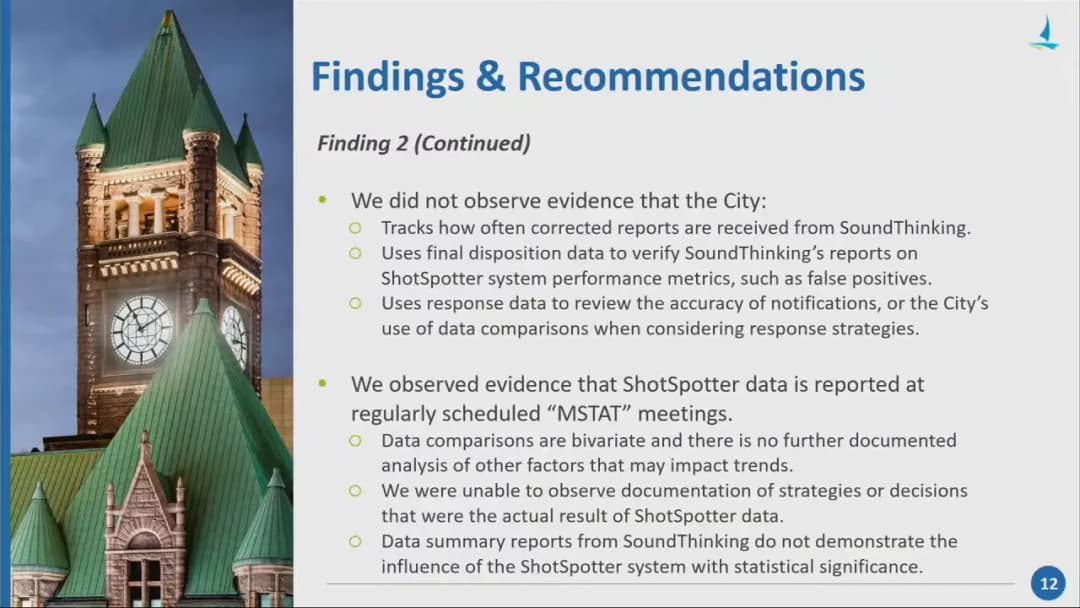
The Minneapolis Audit Committee convened on August 24, 2026, at 9:00 AM (Central) with Chair Elliot Payne presiding. The meeting included presentations on the 2025 State Auditor Management and Compliance Reports, an internal audit of software inventory and access management, a performance audit of the ShotSpotter gunshot detection system, and an advisory report on camera data security best practices. The committee also received and filed reports, approved a motion to conduct an independent audit of the Minneapolis Public Housing Authority's use of city funds, and discussed open corrective action plans. Consent Calendar - The agenda was adopted unanimously. - Minutes from the June 22, 2026 regular meeting were accepted without opposition. Public Comments & Testimony - No public comments were made during the meeting. Discussion Items 2025 State of Minnesota Office of the State Auditor Management and Compliance Reports - Karen Stackin, Audit Director from the Office of the State Auditor, presented the audit results for the City of Minneapolis, the Municipal Building Commission (MBC), and the Minneapolis Park and Recreation Board for the year ended December 31, 2025. - The city and park board received unmodified (clean) opinions on their financial statements and major federal programs. - Four findings were reported for the city: two related to internal control (service organization controls and prompt payment of invoices) and two related to federal program compliance (suspension/debarment and subrecipient monitoring). The park board and MBC had no current-year findings. - Audit Committee member Al Mwafok questioned the repeated SOC1 finding for a convention center service organization and asked about the inventory of third-party service organizations and the city's low-risk auditee status. Ms. Stackin explained that the city implemented additional controls but still lacked a full SOC report, and that the city could regain low-risk status after two consecutive years without material weaknesses. The committee received and filed the reports. Software Inventory and Access Audit - Sarartha Pujol, Director of Internal Audit, presented the audit of the Information Technologies (IT) department's software inventory and access management practices, focusing on the ServiceNow system. - Two findings were reported: (1) the centralized software inventory is incomplete and lacks a proactive process to capture new systems, and (2) IT does not conduct regular periodic reviews of ServiceNow user access; only ad hoc reviews occur when license limits are approached. - IT management agreed to the recommendations: document software management procedures and conduct annual documented reviews of all ServiceNow accounts, with completion dates of December 31, 2026, and March 31, 2027, respectively. - Committee members discussed the need for inventory completeness, self-reporting challenges, the use of SOC2 or FedRAMP reports for third-party software, and the appropriate frequency of access reviews. Member Hosbean suggested bi-annual reviews rather than annual, given the risk of terminated employees retaining access. - The report was received, filed, and ordered published. ShotSpotter Performance Audit Report - City Auditor Robert Timmerman introduced the audit, emphasizing the need for independent oversight of public safety technologies. Michael "Mac" Kwaters, Director of Special Reviews, presented the findings. - The audit covered calendar years 2023–2025 and found that the city relies on ShotSpotter data for performance oversight and operations but lacks independent mechanisms to verify the accuracy of alerts or evaluate public safety outcomes. - Two key findings: (1) the city does not independently validate ShotSpotter reports for contract oversight (e.g., sensor location accuracy, vendor KPIs); (2) the city uses ShotSpotter data in strategy meetings but does not isolate its impact or document how it drives decisions. - Recommendations include using city data for independent verification, establishing documented performance oversight, maintaining a confidential list of sensor locations, and documenting how verified data is used in strategies. - Committee members expressed strong concerns. Member Chugtai questioned why the city accepts ShotSpotter data without verification, especially given the lack of a comprehensive sensor location list. Member Hosbean criticized the public dashboard as creating fear rather than providing useful information for community safety. Chair Payne noted that the current contract expires March 21, 2027, and that the audit results make renewal unlikely without independent evidence of effectiveness. - MPD Chief of Staff Leslie Steletti appeared to answer questions but requested time to provide a written response memo due to limited subject matter knowledge. - The report was received, filed, and ordered published. Camera Data Best Practices Advisory Report - Mac Kwaters presented an advisory review of the city's camera-based surveillance technologies (excluding body-worn cameras and ALPRs, which were previously covered). - The review examined 19 contracts and found that contract provisions for data security vary across departments; policies and procedures are inconsistent; training for data and records liaisons is not enforced; and the city lacks a comprehensive list of data-sharing agreements with federal law enforcement. - Four findings were reported: (1) inconsistent contract oversight for camera services; (2) incomplete or insufficient departmental policies referencing the city's information security policy; (3) inconsistent training and engagement of data and records liaisons; and (4) insufficient compliance documentation with Minnesota Government Data Practices Act (Section 1305). - Recommendations include enforcing contract provisions, updating policies, formalizing training, ensuring compliance with state law, and adopting a periodic review of data security best practices. - Committee members questioned the absence of a comprehensive list of federal data-sharing agreements and the lack of specific procedures for federal law enforcement requests. Member Al Mwafok asked for a follow-up memo on this topic. The advisory report's management action plan is under development. - The report was received, filed, and ordered published. Request for Independent Audit of Minneapolis Public Housing Authority (MPHA) Use of City Funds - The committee considered a city council request for an independent audit of MPHA's use of city funds. City Auditor Timmerman expressed willingness to undertake the work but requested it be added to the 2027 audit plan. - A motion to proceed was made and passed on a roll call vote: 5 ayes (Committee members Al Mwafok, Hosbean, Peterson, Vice Chair Singleton, Chair Payne) with two absences (Chugtai, Engelhardt – later noted as present and voting aye via voice). City Auditor's Report on Open Corrective Action Plans - City Auditor Timmerman provided an update on open audit findings and corrective action plans. A total of 68 open items exist, with 44 from 2026 (none past due yet). - Five findings from 2025 and earlier were closed and validated since the last meeting. The committee was informed that MPD and fleet management have unresolved items and will be invited to the October audit committee meeting to provide updates. - A new public dashboard for tracking corrective action plans has been released, and the Office of City Auditor is connecting it with the clerk's legislative directives dashboard. - The committee discussed the upcoming peer review by the Association of Local Government Auditors (planned for January/February 2027) and the need for auditor independence. Chair Payne noted that the mayor's recommended budget includes cuts to the auditor's office, which he views as a challenge to independence. The committee agreed to include an annual independence discussion in the February meeting. - The committee also discussed the process for inviting departments with overdue corrective action plans to future meetings. The October meeting will include MPD, finance/property services, and health departments. Key Outcomes - The agenda and minutes from June 22, 2026 were approved. - The 2025 State Auditor reports, software inventory audit, ShotSpotter performance audit, and camera data advisory report were received, filed, and ordered published. - A motion to request an independent audit of MPHA's use of city funds was approved (5-0-2, with later confirmation of a 6th aye). The audit will be included in the 2027 work plan. - The city auditor's report was received and filed; follow-up on open corrective action plans is scheduled for the October 2026 audit committee meeting.
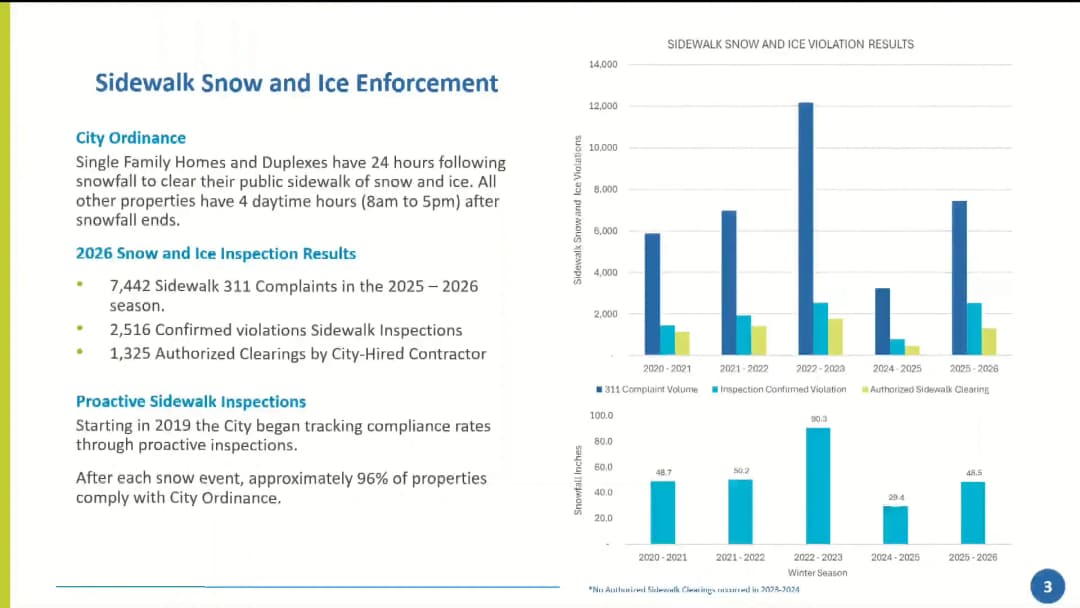
The Climate and Infrastructure Committee of the Minneapolis City Council held a regular meeting on Thursday, August 20, 2026, at 6:33 PM CT, chaired by Vice Chair Soren Stevenson. The meeting covered consent items, a public hearing on the Central Avenue/TH 65 reconstruction project, and discussions on the Vision Zero Action Plan, climate equity funding, sidewalk snow and ice clearing pilots, and a thermal energy potential study. Key decisions included approval of the consent agenda, adoption of the Central Avenue concept layout, approval of the Vision Zero Action Plan, and receipt and filing of several reports. Consent Calendar - Approved a walk-on item for a block event permit for the University of Minnesota Department of Public Safety welcome back event on September 9, 2026. - Approved 11 routine consent items, including construction easements for the Northside Greenway Phase 2 and Grand Avenue Bridge, returning Nicolette Avenue public restroom funding from the general fund to the value capture fund, contract amendments for Washburn Tower rehabilitation, Cedar Lake Trail water main, pond land care, lead service line replacement, Nicolette Avenue Bridge rehabilitation, graffiti abatement, and North Transfer Station revitalization. - Discussion on the Nicolette Avenue public restroom funding item: Councilmember Chowdry inquired about the timeline and assurance that funds would be used for restrooms. Public Works staff explained the administrative change preserves funding for the intended use. The item was approved as part of the consent agenda. Public Comments & Testimony - Public Hearing on Central Avenue/TH 65 (Trunk Highway 65) Municipal Consent - John Daniluk (representing Ideal Diner) expressed support for the project and appreciation for collaboration with the project team, emphasizing the need to maintain access to the business. - Paul Minard (representing businesses between 7th and 8th Streets) opposed the elimination of 14 essential on-street parking spaces, citing negative impacts on customer access and citing a prior 50% membership drop at a local cooperative due to parking reductions. He requested the council direct Metro Transit to reconsider and preserve parking. - Nancy Sineken (representing Syndican Investments, a commercial property owner at 726 Central Avenue) opposed the design, stating it would diminish property values, asset visibility, and customer access, with particular concern about one-way perpendicular streets making navigation difficult. Discussion Items - Central Avenue/TH 65 Municipal Consent (Item 1) - Peter Bennett (Transportation Planner, Public Works) presented the project: a full reconstruction from the Mississippi River to 37th Avenue NE, incorporating a four-to-three lane conversion with a bus lane for Metro Transit's F Line BRT, protected bike lanes, upgraded pedestrian facilities, and improved safety. The project is led by MnDOT and requires municipal consent. Construction is planned for 2029-2030. The public hearing was held; no further discussion occurred after testimony. The committee approved the resolution and concept layout. - 2026-2030 Vision Zero Action Plan (Item 2) - Antonio Rossell (Vision Zero Program Coordinator) presented the plan update, noting 74 traffic fatalities and over 1,600 serious injuries in Minneapolis from 2022-2025. Key priorities: safety improvements on high-injury streets (10% of streets account for 60% of severe crashes), reducing dangerous speeds through physical street design, and continuing the traffic safety camera pilot (launched fall 2025). Public engagement showed strong support. Councilmembers Chowdry and Warren discussed data privacy and surveillance concerns; Ethan Foley (Transportation Planning Manager) clarified camera data is not shared with law enforcement, cameras are not constant recorders, and data is anonymized. The committee approved the plan. - Climate Equity Action Plan Background and Overview (Item 3) - Patrick Hanlin (Deputy Commissioner, Health Department) updated on climate funding sources: franchise fees (2018, 2024, 2026) generating $21 million in total revenue, with program spending of $18.7 million. Specific questions from Councilmember Stevenson about the 2026 budget noted a proposed cut of $3.6-3.7 million in climate spending, potentially breaking a promise to use franchise fee increases for weatherization to offset utility costs. The report was received and filed. - Sidewalk Snow and Ice Pilot Programs Update (Item 4) - Ethan Van Offelen (Project Coordinator) reported on the second season of four pilots: Snow Ambassador (enforcement), Neighborhood Snow Patrol (assistance for seniors/disabled), Mobile Team (contractor clearing priority routes), and Snow Caseworker (outreach and coordination). Key findings: 96% citywide compliance; 13% of parcels in Snow Ambassador route had violations; repeat violators are common. Costs to date: $288,000 of a $595,000 budget. Chair Stevenson questioned enforcement timelines (up to 7 days) and requested follow-up on speeding up interventions. Councilmember Warren praised the Harrison neighborhood pilot. The report was received and filed. - Thermal Potential Study Overview (Item 5) - Megan Hoy (Director of Climate Equity Action) and Luke Hollenkamp (Sustainability Program Manager) presented on the study, which aims to guide development of thermal energy networks (district-scale geothermal systems). Phase 1 (technology review and geographic analysis) is largely complete; Phase 2 (stakeholder engagement and implementation pathways) is underway. The study does not include single-family homes but focuses on commercial, industrial, and multifamily buildings. Final deliverables expected summer 2027. The report was received and filed. Key Outcomes - Approved the consent agenda (including the walk-on event permit and all routine items) by voice vote, with no opposition. - Approved the Central Avenue/TH 65 concept layout and resolution for municipal consent by voice vote, following the public hearing. - Approved the 2026-2030 Vision Zero Action Plan and resolution adopting its policy goals and priorities by voice vote. - Received and filed the climate equity funding update (filed as report). - Received and filed the sidewalk snow and ice pilots update (filed as report). - Received and filed the thermal potential study update (filed as report). - Adjourned after completing all business.
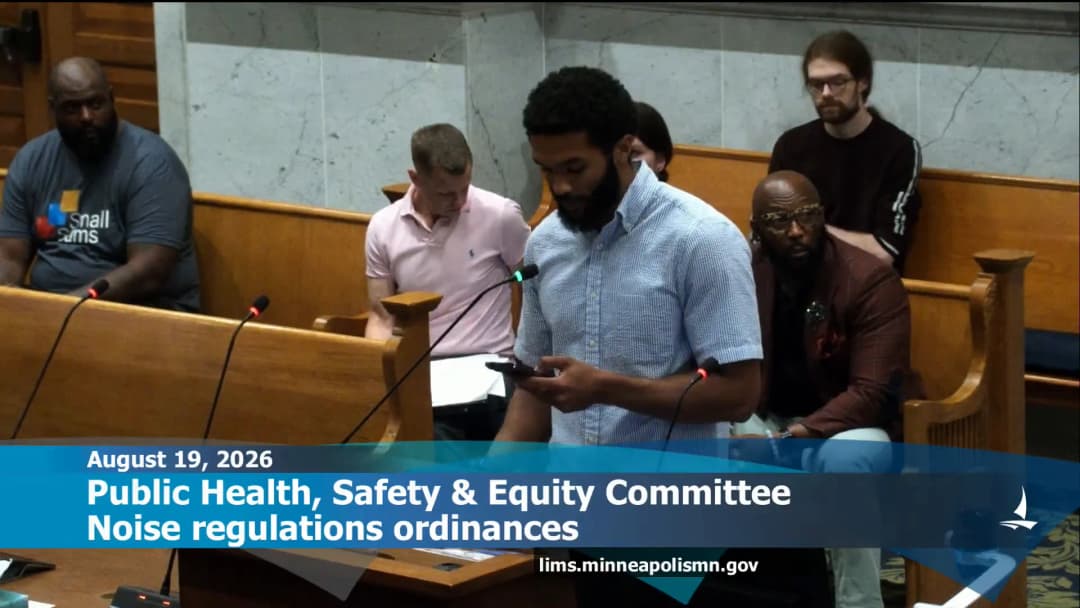
The Public Health, Safety, and Equity Committee met at 6:31 PM UTC on August 19, 2026. Chair Jason Chavez presided; six members were present, establishing a quorum. The committee approved the consent agenda, heard two public hearings on noise regulations and pet ownership restrictions, and received a report on opioid response and mobile medical units. All formal votes passed without opposition. Consent Calendar - Item 3: Authorized a contract amendment with Professional Recovery Organization Network for firefighter mental health services. - Item 4: Authorized a contract amendment with Axon Enterprise, Inc. for additional police department software licenses, body-worn cameras, digital video storage, Tasers, and related equipment. Vice Chair Stevenson asked about the $1.4 million request versus the $18 million contract cap; MPD staff explained this was a one-time purchase for additional equipment and a future replacement plan, not a lease or expansion. The item remained on the consent calendar. - Item 5: Authorized submitting a grant application to the U.S. Department of Housing and Urban Development for a Healthy Homes Production Grant. - Item 6: Amended Council Action 2023A-0535 to correct the Hennepin County Human Services and Public Health Department grant total to $2.56 million and to include a high-school health mentor model component. - Item 7: Referred to staff the subject of a commercial hood and exhaust cleaning program ordinance. - Item 8: Set a public hearing for September 9, 2026, on an ordinance related to Neighborhood Revitalization Program policy board elections. The consent calendar was approved as a block; Item 7 was referred and the Item 8 hearing was scheduled. Public Comments & Testimony - Noise ordinance hearing: Heroy Darmer, a Minneapolis resident, opposed the proposed motion-sensor clause. He noted the staff report acknowledged zero targeted resident engagement, called the restriction arbitrary and unenforceable, and asked the committee to strike the clause. - Pet ownership hearing: Daniel testified in opposition to eliminating the permit requirement, calling it a preventive safeguard and urging the committee to narrow or lower the fee instead of removing review entirely. - Pet ownership hearing: Mike, a resident with a felony conviction, testified in support. He described adopting a 73-pound dog from the city shelter, paying a $250 permit fee plus the standard $30 license fee, and called the extra fee "a tax." - Pet ownership hearing: John Tay Hudson, a northeast Minneapolis resident reentering the community after incarceration, testified in support, saying pets are family and that the extra fee unfairly burdens justice-impacted residents. Discussion Items Noise Regulations Ordinance (Chapter 389) Kelly Molman, Director of Environmental Programs, presented a full revision to Chapter 389 and four related ordinance amendments to reorganize sections, simplify language, improve consistency, and move noisy and unruly assemblies into a separate article. New language would prohibit motion sensors on private property from being audible at adjacent residential uses, a response to numerous service requests about ring camera motion alerts. Councilmember Rainville asked about ring camera volume controls; Director Molman confirmed sensitivity and volume settings. Councilmember Whiting asked whether the issue was isolated; Director Molman said there had been multiple complaints across Minneapolis, with inspectors seeing more frequent cases. The committee approved the ordinance. Pet Ownership Restrictions Ordinance (66.80) Tony Shendle, Director of Minneapolis Animal Care and Control, presented an ordinance originally authored by Councilmember Wandsley. The change would remove the current requirement that anyone convicted of a qualifying state felony obtain a permit and pay a $250 fee to own an animal over 20 pounds. It would instead give the city authority to deny permits for animal cruelty convictions under Minnesota Statute 343.21 and for negligent owners who use animals to cause harm under Minnesota Statute 609.205, clause 4. Shendle noted that since 2020, only 18 permit applications had been received, 11 approved and 7 denied, with denials based on public-safety aggression rather than felony status. Several councilmembers spoke in support, emphasizing fairness, reentry, and the importance of pets. Councilmember Whiting confirmed the ordinance does not change existing dangerous or potentially dangerous animal declaration processes. A roll call vote passed 6-0. Opioid Response and Mobile Medical Units Louisa Brendel, Director of Public Health Initiatives, presented the opioid response update. Minneapolis still faces high overdose rates, with Black and American Indian residents experiencing rates roughly 4 and 30 times higher than white residents, respectively, and Minneapolis representing about 7% of state population but a quarter of opioid-involved deaths. Program highlights included: - Naloxone vending machines at three fire stations, with a fourth planned at Fire Station 12, plus community training and distribution. - Syringe abatement using sweeps, 311 response, drop boxes, and education; 26 drop boxes installed with 15 more through a pilot, and over 1,000 needles collected via sweeps/311 in six months plus 700 more with local businesses. - The Mobile Medical Unit was deployed 168 times from August 22 through July, interacted with over 4,000 residents, provided medical care to more than 900 individuals (22% of encounters), distributed about 1,500 naloxone doses, and made over 600 referrals for housing, treatment, and clinics. - The First Step treatment program has provided medication to over 200 people in the first six months of 2026, with expansion through community navigators and clinical partners. - A youth prevention curriculum with the University of Minnesota was piloted at three school-based clinics, and a grant was submitted to expand it to five Minneapolis public schools. Councilmember Vito praised the program's responsiveness, especially during Operation Metro Surge, and noted increasing needle cleanup requests. Commissioner Richie confirmed continued funding for syringe mitigation. The report was received and filed. Key Outcomes - Consent agenda approved, including the Axon equipment amendment, the HUD grant application, the Hennepin County grant correction, referral of the commercial hood/exhaust ordinance to staff, and the September 9, 2026 public hearing date. - Noise ordinance revision approved by voice vote. - Pet ownership ordinance approved 6-0 by roll call vote. - Opioid response and mobile medical unit report received and filed.