The Public Health, Safety and Equity Committee met on September 23, 2026, at 6:30 p.m. under the chairmanship of Councilmember Jason Chavez. The agenda was lengthy, with every item pulled for discussion. Chair Chavez opened with remarks about the mayor’s directive limiting city staff attendance and stressed the committee’s oversight role. The meeting included a presentation on school‑based clinics, extensive debate on a new mobile crisis response contract, approval of multiple grants and contracts, and a resolution calling for the removal of automated license plate reader cameras operated by Hennepin County and the University of Minnesota. Public Comments & Testimony - No public comments or testimony were offered during the meeting. The chair noted that public participation is enabled through live broadcast and captioning. School‑Based Clinics Presentation - Polly Yang (manager of School Health Services) and Lisa Dornick (clinic manager/nurse practitioner) presented on the nine school‑based clinics serving Minneapolis high schools. The clinics have operated since the 1970s and provide medical, mental health, and health education services. During the 2025‑2026 school year, they recorded 10,000 visits from 2,231 students; 47% of students were on public insurance, 26% uninsured, and 17% non‑billable. Staff highlighted the program’s role as a safety net, keeping students in school. Questions covered HIPAA/FERPA compliance, medication dispensing, and the potential closure of Longfellow High School. Discussion Item: Mobile Crisis Response Contract (Community Bridges Inc.) - Deputy Commissioner Jared Jeffries presented a proposal to transition from the Behavioral Crisis Response (BCR) pilot to a Mobile Crisis Response (MCR) program with an expanded scope covering behavioral health and livability calls. The selected vendor is Community Bridges Inc., a national organization with experience in several states. The contract would be up to $5.9 million annually from January 1, 2027 through December 31, 2028, with three optional one‑year extensions. Many councilmembers raised concerns about the lack of an implementation plan, potential discontinuity of services, data on complaints against Community Bridges, the vendor’s familiarity with Hennepin County partners, and the inclusion of livability calls in the scope. Chair Chavez moved to delay the item to the October 7 committee meeting; the motion passed unanimously. Other Discussion Items and Votes - Joint Powers Agreement – Urban Search and Rescue (Item 3): Approved. The fire department’s participation in Minnesota Task Force One is fully reimbursed by the state. No fiscal impact to the city. - REACH Grant – Chronic Disease Prevention (Item 4): Approved. Accepting CDC funding (fourth year of a five‑year cycle) for chronic disease prevention focused on African American and American Indian populations. - SHIP Grant – Chronic Disease Prevention (Item 5): Approved. State grant of $754,253 for chronic disease prevention; funds about nine staff. - DWI Court Grant – Police Liaison (Item 6): Approved. $35,000–$58,000 from the state for overtime costs of an MPD liaison for DWI court. - DWI Traffic Safety Officer Grant (Item 7): Approved. $165,000 from the Minnesota Department of Public Safety to fund a dedicated DWI officer (cover wages, benefits, overtime). - BJA Grant – Medications for Opioid Use Disorder (Item 8): Approved. Grant application to expand low‑barrier access to long‑acting buprenorphine, partnering with the University of Minnesota and St. Paul. - BJA Grant – Police Initiatives (Item 9): Approved. $324,000 (50‑50 split between MPD and City Attorney’s Office) for a community attorney and equipment/ overtime. Funds follow a current community attorney assigned to the 2nd and 4th precincts. - Gift Acceptance – NYPD Conference (Item 10): Approved without recommendation. Accepts travel expenses for Commander Emily Olson to attend a counter‑terrorism summit in New York City, November 10‑14, 2026. The city will cover per diem ($250 estimated) and ground transportation. The RCA fiscal note was to be updated to reflect these expenses. - Gift Acceptance – Police Foundation/IACP Conference (Item 11): Approved without recommendation. Accepts up to $16,000 from the Minneapolis Police Foundation for travel of nine MPD command staff to Orlando, Florida for the Major Cities Chiefs Association and IACP conferences (October 21‑28, 2026). MPD will cover the remaining $13,922 from its conference budget, which had $82,000 remaining for the fiscal year. Discussion focused on why the entire command staff must attend and the impact on public safety; chair noted the need for a coverage plan. Motion to forward without recommendation passed. - Public Health Advisory Committee Appointment (Item 12): Approved. Blake Smith appointed to fill the vacant Ward 8 seat. - Resolution on Flock Safety Cameras (Item 13): Approved 4‑1 (Councilmember Rainville dissenting). The resolution calls on Hennepin County Sheriff’s Office and the University of Minnesota to terminate their contracts with Flock Safety for automated license plate reader (ALPR) cameras, citing privacy concerns, data sharing with ICE, and erosion of public trust. The city has no authority to remove the cameras; the resolution expresses the council’s position. - Law Enforcement Consent Decree Ordinance (Item 14): Postponed to November 4, 2026. - Regulatory Services Report (Item 16): Postponed to the next meeting (October 7, 2026). Reports from Office of Community Safety - Commissioner Todd Barnett provided an overview of the third‑quarter activities: national search for a police chief (listening sessions completed); fire chief (Reginald Freeman confirmed); updates on mobile crisis response (covered earlier). - Director Rachel Sayre (Emergency Management) reported on preparedness outreach, tabletop exercises, siren upgrades, and planning for the 2028 NFL draft. - Director Amanda Harrington (Neighborhood Safety) reported falling homicide rates, launch of the Cure Violence Global Dashboard, RFQ for GVI/YGBI, and expansion of Community Safety Ambassadors. - Assistant Director Latisha Cardenas (911) reported call volumes down 2‑7% year‑over‑year, call answer times (86% within 15 seconds), and staffing challenges (6.75% vacancy in PST3 positions). An embedded social worker placed 144 referrals in the quarter. - Fire Chief Reginald Freeman reported incident statistics, 9,394 training hours, and the upcoming graduation of 17 new firefighters. - A representative for the Safe and Thriving Communities Plan noted the plan is being finalized, and work group members have been appointed. - MPD Deputy Chief Charles Adams gave a recruitment update: 96 total hires in 2026 (10 laterals, 10 recruits, 45 cadets, 28 community service officers). The reports were received and filed; the chair noted that due to captioning time constraints, follow‑up questions would be handled via email. Key Outcomes - Delayed: Mobile Crisis Response contract (Community Bridges Inc.) to October 7, 2026. - Approved with recommendation: Joint powers agreement, REACH grant, SHIP grant, DWI court grant, DWI traffic safety officer grant, BJA opioid grant, BJA police initiatives grant, Public Health Advisory Committee appointment. - Approved without recommendation: NYPD conference gift acceptance, Police Foundation conference gift acceptance. - Approved (4‑1): Resolution calling for termination of Flock Safety cameras by Hennepin County and the University of Minnesota. - Postponed: Law Enforcement Consent Decree Ordinance (to Nov. 4, 2026); Regulatory Services Report (to Oct. 7, 2026). - Received and filed: Office of Community Safety quarterly reports from all five departments.
Public Meetings - Minneapolis, Minnesota
Public Meetings - Minneapolis, MinnesotaThe Business Housing and Zoning Committee met on September 22, 2026, chaired by Councilmember Jamal Osman. The meeting included a consent agenda, public hearings, and extended discussions on autonomous vehicle regulation, rental license fees, and several development items. A major theme was the absence of city staff due to a mayoral directive, which drew criticism from multiple council members and affected the committee's ability to obtain information on pulled consent items. Consent Calendar - Items 4 through 19 were approved as a block after items 7, 10, 12, and 13 were pulled for discussion. The approved items included liquor license approvals, gambling licenses, brownfield grant acceptance, contract authorizations, and referrals to staff. Public Comments & Testimony - Autonomous Vehicle Ordinance (“Workers Drive Minneapolis”): A large number of public speakers testified over a two-hour period. Key testimony included: - Kevin Driscoll (computer systems architect): Raised the “trolley car dilemma” and argued that a safety driver is needed until independent verification of ethical AI decisions is possible. - Abdirahman (SEIU Local 26) expressed concern that AVs cannot replace human drivers’ ability to provide care and that 15,000–20,000 driver jobs could be lost. - Afron Abdo (blind, with service dog) requested that the ordinance include consequences for AV companies that discriminate against people with disabilities, citing frequent ride denials by human drivers. - Matthew McGlory (North Minneapolis resident, 12-year rideshare driver) emphasized his role in the local economy and questioned AV reliability in winter and construction conditions. - Sean Stevenson (Downtown East resident) opposed the ordinance as a barrier to innovation and urged statewide rather than local regulation. - Jason Milner (speaker) argued that AVs could expand the market and that drivers could benefit by owning autonomous vehicles. - Marties Washington (driver) pleaded for workers not to be left behind. - Jeff Stromberg criticized the ordinance as lacking data, citing Waymo’s safety record (94% reduction in serious injury/death over 300 million miles) and argued the council was forcing higher costs on consumers. - Adam (drivers for 8 years) and others highlighted that human drivers assist elderly and disabled passengers, help with luggage, and provide community support that AVs cannot. - Said Mohammed (SEIU Local 26) noted that drivers have invested heavily in vehicles and cannot afford to lose their livelihoods. - Abdur Shad Mohammed (driver) stated that money earned by local drivers stays in Minneapolis, unlike AV profits sent to Silicon Valley. - Ezra Lee (President of Minnesota Uber Lyft Drivers Association, MULDA) said drivers are not against innovation but asked the council to consider human impact. - Justin Salisbury (blind person) expressed hope that AVs could reduce ride denials for people with disabilities, noting that some human drivers deny service due to bias. - Rachel Steiner cited a Reuters article about Waymo’s use of remote assistance workers in the Philippines, raising safety and privacy concerns. - Phoenix Tremsky (driver, owns a semi-autonomous Tesla) reported that autonomous features attempted to drive into a ditch during construction season, and questioned liability and insurance issues. - Forhan Badell (driver, father of three) called the ordinance a “baseline shield” and urged the council to protect immigrant workers over corporate profits. - Andrew Sparts (Marcy Holmes resident) argued that autonomous vehicles can be safer than human drivers, gave anecdotes of human driver errors, and cited the long-term inevitability of automation. Discussion Items - Item 10 – Dissolution of Minneapolis Development Finance Committee: Councilmember Chowdhury requested clarity on the committee’s dissolution and its effect on public transparency. Staff were absent. Councilmember Travis expressed concern that voting without understanding was wrong. The item was delayed to the next cycle by voice vote. - Item 13 – Release of Mortgage and Restrictive Covenants for Villa Nova Project (Aon): Councilmember Chavez pulled it for information. Rachel Robinson from Aon (nonprofit affordable housing provider) explained that Aon faces foreclosure and needs the city’s release to sell properties to avoid bank takeover. Aon manages 4,912 units total, including 1,902 affordable units in Minneapolis. Councilmembers criticized the mayor’s directive for leaving the council without staff to answer questions. After debate, the item was moved to Committee of the Whole (September 29) by a vote with a second. - Item 12 – Metro Blue Line Extension Contract: Councilmember Warren expressed opposition without staff input, noting the line’s potential tax increase impact on her ward (Ward 5). She moved to delay; the motion passed. - Item 7 – 2026 Spring Brownfield Grants: Councilmember ChukTai pulled it to discuss projects. Councilmember Schaefer argued for approval because the grants are already awarded and delay would disrespect applicants. Councilmember Warren supported approval. After back-and-forth, the item was moved to Committee of the Whole (September 29) on a revised motion. - Autonomous Vehicle Regulation Ordinance (Workers Drive Minneapolis): Presented by Councilmember Robin Wansley and co-authors (Osman, Chowdhury, Chavez). The ordinance requires AV companies to obtain a license, mandates a human safety monitor in the driver’s seat (with Minnesota driver’s license and minimum wage), and prohibits remote-only operation. It would take effect October 2027 to allow time for a city staff study and state legislative action. Key positions: - Supporters (Co-authors, many public speakers) argued the ordinance protects 10,000+ rideshare jobs, mainly held by low-income immigrant workers, and prevents exploitation by big tech. They emphasized a proactive approach to regulation. - Opponents (e.g., Sean Stevenson, Jeff Stromberg, Andrew Sparts) argued the ordinance is a de facto ban, ignores AV safety records, limits consumer choice, and should be addressed at the state level. - Councilmember Schaefer questioned why the ordinance was being brought to a vote before a Legislative Reference Officer (LRO) report was completed. Co-authors stated briefings had been offered to all council members. Councilmember Warren said she was not invited to a briefing. The public hearing was continued to Committee of the Whole on September 29. - 2027 License Fee Schedule: Councilmember Chavez proposed an amendment to increase rental license fees (tiers 1, 2, 3, including short-term) by 10% over 2026 amounts to move toward cost recovery (from 64% to an estimated 70%). Councilmember Schaefer preferred to wait for a comprehensive study and noted that rental properties already bear a large share of property tax increases. Councilmember Warren supported the increase but asked about inspection frequency. The amendment passed (7-0). Then a motion to delay the item to October 6 business housing and zoning committee passed. Key Outcomes - Consent agenda approved except items 7, 10, 12, 13 (pulled). - Item 10 (Dissolution MDFC): Delayed to next cycle. - Item 13 (Villa Nova/Aon mortgage release): Moved to Committee of the Whole (September 29) with a second. - Item 12 (Blue Line contract): Delayed. - Item 7 (Brownfield grants): Moved to Committee of the Whole (September 29). - Public Hearing – Cliff & Norms Bar entertainment license: Approved. - Public Hearing – 1029 Bar liquor license: Approved. - Autonomous Vehicle Ordinance: Public hearing continued to Committee of the Whole on September 29, 2026; full council vote scheduled for October 1 if passed from committee. - 2027 License Fee Schedule: Amendment to increase rental license fees by 10% passed; item delayed to October 6, 2026, for further staff input. Other Notable Themes - Multiple council members criticized Mayor Jacob Frey’s directive that city staff would not attend committee meetings for consent items unless pulled. Councilmembers Chavez, ChukTai, Chowdhury, and Travis argued it hindered transparency and governance. Councilmember Rainville called for finding a middle ground on time management. - Councilmember Osman, as chair, noted he would delay items when staff were absent, as occurred with several items.
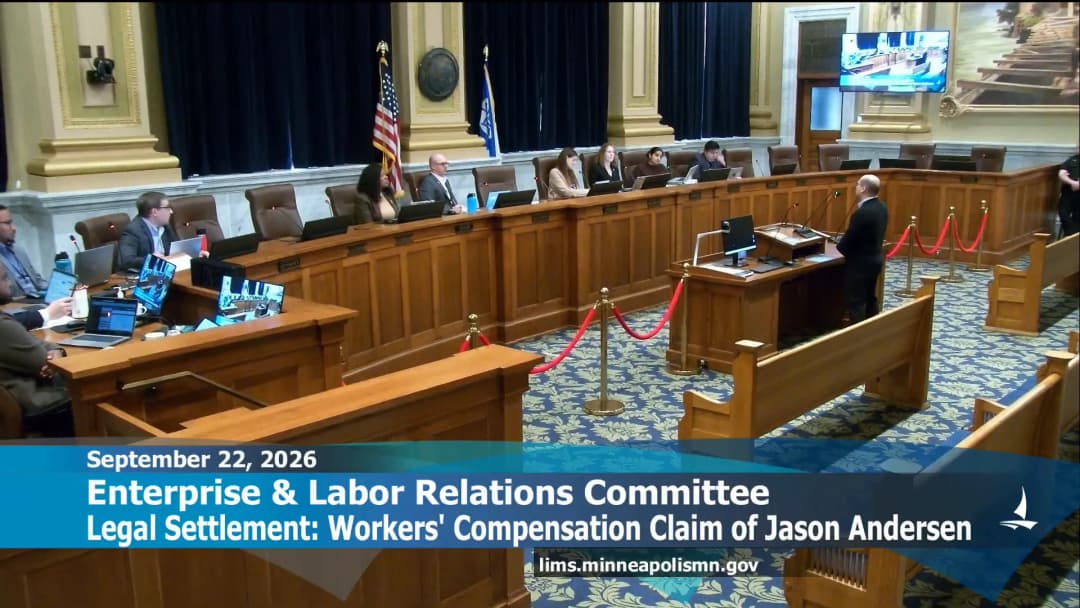
The Enterprise and Labor Relations Committee, chaired by Councilmember Linne Palmasano, met on September 22, 2026, to consider a consent agenda, discuss two pulled items, and address a workers' compensation claim referred back from the City Council. The meeting included roll call, discussion of contract amendments, legal settlements, and the city's obligations under state workers' compensation law. Consent Calendar - The committee approved Items 1 through 8 on the consent agenda, with Items 3 and 5 pulled for separate discussion and vote. Items included election judge appointments, a contract with Clearwater Analytics, a contract amendment with Terminal Four for website maintenance, a contract amendment with Met Council for housing programming, a legal settlement with the Minnesota Department of Human Rights (MDHR), and workers' compensation claims. Discussion Items - Item 3: Contract Amendment with Terminal Four for Website Maintenance – Councilmember Chavez expressed concern about the lack of detail in the Request for Council Action (RCA) for a $1.2 million increase to an existing contract, noting that much of the cost was for accessibility compliance. Councilmember Chugtai echoed the need for more information and noted the absence of staff to answer questions. Chair Palmasano proposed forwarding the item without recommendation, with a commitment to delay it at the full council if questions remained unanswered. The motion carried. - Item 5: Legal Settlement with MDHR – This settlement resolved a charge filed by a former employee and required a $10,000 payment. Councilmembers Schaefer and Chugtai requested more information but acknowledged that most details were confidential under personnel and data practices laws. Councilmember Chugtai expressed concern that the administration did not brief committee members beforehand. The item was forwarded without recommendation, with follow-up directed to the City Attorney's office. - Workers' Compensation Claim of Jason Anderson – Deputy City Attorney Abelson explained workers' compensation law, including the statutory presumption that PTSD for first responders is work-related unless the employee had a prior diagnosis. Councilmember Stevenson shared community frustrations about officers with misconduct histories receiving settlements, and noted plans to work with Chair Palmasano on state-level advocacy. Councilmember Chugtai asked whether the city had ever challenged a claim based on an officer's history of untruthfulness. Director of Risk and Claims Andrew Lathrop described the claim review process, including expert witnesses and surveillance. Chair Palmasano offered to follow up on the question about the city's litigation history. The item was forwarded without recommendation, subject to further discussion if answers were not provided. Key Outcomes - Items 3 and 5 were forwarded without recommendation to the full City Council, with the understanding that they could be delayed if information requests were not met. - The workers' compensation claim of Jason Anderson was forwarded without recommendation, with a commitment to follow up on the city's history of challenging claims based on untruthfulness. - The committee acted on all business and adjourned.
The Minneapolis City Council convened its regular meeting on September 17, 2026, at approximately 9:39 AM CDT. The meeting began with presentations of seven honorary resolutions, followed by the adoption of the agenda, minutes, committee reports, and other routine business. All items on the agenda passed unanimously except for one workers' compensation settlement, which was referred back to committee for further discussion. Presentations and Honorary Resolutions - Day of Transgender Child (September 26, 2026): Council President Payne read a resolution recognizing September 26, 2026 as the Day of Transgender Child in Minneapolis. The resolution noted that September 2026 marks the 10th anniversary of the day, that Minnesota became a trans refuge state in 2023, and that the city adopted a safe haven ordinance in June 2026. Hannah Edwards, executive director of Transforming Families Minnesota, thanked the council and noted that families have moved to Minnesota for safety, calling it "the only day set aside to celebrate trans youth." - Community Health Worker Day: Councilmember Vita presented a resolution honoring community health workers (CHWs). The resolution noted that Minnesota developed the nation's first statewide post-secondary CHW curriculum and established Medicaid reimbursement for CHW services. Speakers included a CHW consultant who thanked Councilmember Vita for her early mentorship, and Sonny Aileen, executive director of the Minnesota Community Health Worker Alliance, who stated that one in five Minneapolis residents speaks a language other than English at home (compared to one in eight statewide) and that CHWs were vital during the recent Metro Surge disruptions. - Latino Heritage Month (September 15–October 15, 2026): The resolution highlighted that according to the 2020 census, 6.1% of Minnesota's population and 10.4% of Minneapolis's population identified as Hispanic or Latino, with a 141% increase since 2000. It referenced Operation Metro Surge, an federal operation beginning December 2025 that sent over 3,000 agents, took at least 70 children, separated families, and caused hundreds of millions of dollars in economic damage. Community speakers emphasized resilience and resistance. - Salvadoran Independence (205th anniversary, September 15): The resolution noted that over 12,000 Salvadorans live in Minnesota, contributing through small businesses and labor. Consul General Santa Cruz expressed gratitude for the welcoming community. - Mexican Independence (216th anniversary, September 16): The resolution noted that Mexicans make up roughly two-thirds of Minnesota's 345,000+ Hispanic/Latino residents. Councilmember Chavez highlighted that Mexico is 60% indigenous. - Legacy of Former State Representative Karen Clark: The resolution honored Karen Clark, the first openly lesbian member of the Minnesota Legislature and longest-serving openly lesbian state legislator in the U.S., who died on June 30, 2026. She championed the 1993 Human Rights Act amendment banning sexual orientation discrimination, marriage equality (2013), environmental justice (including cumulative pollution legislation), and the East Phillips Urban Farm project. State Representative Samantha Centomera and community members spoke about her mentorship and relentless advocacy. - Life and Legacy of Chaz Millionaire (Charles Dillon): The resolution recognized Chaz Millionaire, a beloved DJ, radio host, and community activist who passed away. He hosted "Late Night Love and Jazz" on KMOJ, served the Park Board, North High School, and Job Corps, and for over 35 years hosted the Festival of Fathers. His daughter Maria announced the Chaz Vision Media and Legacy Fund for youth in creative arts. Friends, including Al Flowers and Q Bear, shared memories of his generosity and dedication. All seven resolutions were adopted unanimously. Consent Calendar The following routine items were approved unanimously without discussion: - Adoption of the meeting agenda and minutes from August 27, 2026. - Referral of petitions, communications, and reports to proper committees. - Committee reports: - Budget Committee: Approving a legislative directive related to city contracts. - Business, Housing, and Zoning Committee: 15 items including liquor licenses, gambling license renewals, contract amendments, bond approvals, and an ordinance on fence regulations. - Climate and Infrastructure Committee: 8 items including special service district charges, gift acceptance, and various contract amendments for street and infrastructure projects. - Committee of the Whole: A contract with Grant Thorson Advisors to support MPD Internal Affairs backlog (approved unanimously, no discussion). - Enterprise and Labor Relations Committee: Items 1-4 (cybersecurity services, employee survey, lab system maintenance, legal settlement) approved unanimously. Item 5 (workers' comp settlement for Jason Anderson) was pulled for separate discussion. - Public Health, Safety, and Equity Committee: 10 items including ordinance on neighborhood revitalization elections, grants, donations, and appointments to advisory committee. - Notice of ordinance introductions: two ordinances on zoning/land subdivision codes and one on commercial leases (referred to committee). - Adoption of resolutions (the seven listed above). - Unfinished business: amended noise regulations (see below). Discussion Items - Workers' Compensation Settlement – Jason Anderson (Item 5): Councilmember Chuctai pulled the item for discussion, requesting information on the pipeline of similar claims and financial implications. City Attorney Kristyn Anderson said outside counsel handles work comp claims and could provide a list. Councilmember Stevenson read from a 2010 MPR article stating that officer Jason Anderson was fired twice for untruthfulness and was involved in the 2006 shooting death of Thong Lee, whose family alleged a planted gun. Stevenson moved to refer the item back to committee, stating the officer “should be in jail.” Councilmember Chuctai supported referral, citing lack of administration engagement. Councilmember Palmasano noted that specific case details are not public but that periodic updates on settlements are typical. Councilmember Wansley supported referral and suggested closed-session updates and a review of state-level PTSD settlement language. The motion to refer passed unanimously (10-0). - Noise Regulations (Unfinished Business): Councilmember Chavez presented an amended ordinance addressing motion sensing devices. The amendment changes where the sound is measured from (inside a home with closed doors/windows rather than a yard) and prohibits triggering on public property (e.g., by pedestrians or cars). Councilmember Vita expressed concern about enforcement on small lots in North Minneapolis but supported the ordinance after staff assurance that adjustments could be made if problems arise. The amended ordinance passed unanimously (10-0). Key Outcomes - All agenda items passed unanimously except the Jason Anderson workers' comp settlement, which was referred back to committee for further discussion and information. - The council adopted an amended noise ordinance that tightens motion sensor sound standards and restricts triggering on public property. - Seven honorary resolutions were adopted recognizing the Day of Transgender Child, Community Health Worker Day, Latino Heritage Month, Salvadoran Independence, Mexican Independence, the legacy of Karen Clark, and the life of Chaz Millionaire. - Two ordinances on zoning/land subdivision codes and one on commercial leases were introduced and referred to the Business, Housing, and Zoning Committee. - Announcements included upcoming community events: West Broadway Open Streets (past), Taco Tour and Porch Fest (September 19), Battle of the Badges (September 19), U Rock Community Day (September 17), Nicolette Open Streets (September 26), and a public hearing for the Community Commission on Police Oversight regarding the police chief appointment (that evening).
The Committee of the Whole met on Tuesday, September 15, 2026, at 6:35 PM CT, with Vice Chair Aisha Chuktai presiding. The meeting included reports from five standing committees, a settlement agreement subcommittee item on a contract for internal affairs supervisory review, and a discussion on the Minneapolis Police Department's (MPD) budget overspend. Seven council members were present, constituting a quorum. Standing Committee Reports - Budget Committee (presented by Councilmember Schaefer): Approved a legislative directive on city contracts. The committee has begun reviewing the mayor's 2027 recommended budget, including presentations from the budget director, city auditor, and department heads. - Business, Housing & Zoning Committee (presented by Vice Chair Chuktai): Advanced 15 items to the Thursday council meeting, including liquor and gambling licenses, contract amendments for the convention center, changes to the access down payment assistance program, bonds for senior living, a public art agreement, brownfield grants, partial financing forgiveness, master contracts for planning consulting, and an ordinance on fence regulations. - Climate & Infrastructure Committee (presented by Councilmember Stevenson): Advanced 9 items, including special service district resolutions, a gift acceptance, contract amendments for street reconstruction and intersection safety, ADA ramp installation bids, green stormwater infrastructure, catch basin repairs, and a legislative directive to repeal commercial and multifamily energy disclosure. A public hearing on the repeal was set for September 24, 2026. - Enterprise & Labor Relations Committee (presented by Councilmember Palmasano): Advanced 5 items: contracts for cybersecurity evaluation, employee engagement survey, and laboratory information management system, plus two legal settlements (Thermospray – $162,000; Jason Anderson workers' comp – $150,000). - Public Health, Safety & Equity Committee (presented by Councilmember Chavez): Advanced 10 items, including an ordinance on neighborhood revitalization program elections, grants from Subaru Loves PETS and Gary Sinise Foundation, amendments for a cannabis substance use prevention grant, firefighter training reimbursements, donations, advisory committee appointments, and a residency waiver. Settlement Agreement Subcommittee — Contract with Grant Thornton Advisors Deputy Chief Troy Schoenberger presented a request to authorize a contract with Grant Thornton Advisors for up to $2.03 million over two years (with a possible one-year extension) to assist with the supervisory review of internal affairs (IA) investigations. The contract addresses a backlog of 266 cases awaiting supervisory review: 55 historical backlog (since March 2024), 203 non-compliant cases (exceeding the 180-day deadline), and 8 current cases. The scope includes supervisory review and, if needed, completing investigations for both administrative investigations and expedited disposition cases. Discussion: - Councilmember Chavez expressed grave concerns about the backlog, calling 258 late cases “damning” and stating it means a “lack of justice for victims of police brutality.” He supported the contract but demanded urgency. - Councilmember Stevenson welcomed the contract, noting concerns about retaliation and conflicts of interest among sworn officers investigating peers. - Councilmember Vita thanked Deputy Chief Schoenberger for his leadership and asked about IA staffing (19 total, with vacancies). She sought assurance that cases wouldn't stall at the chief's desk; Schoenberger confirmed the flow will move to the panel and chief. - Councilmember Schaefer clarified that 61% of the original backlog has been cleared; the remaining 39% is stuck due to lack of supervisory capacity. The contract aims to clear the backlog within one to two years, prioritizing the most significant cases. - Councilmember Chuktai asked about staff composition and the cause of the backlog. Schoenberger explained the supervisory review requirement was implemented in March 2024, and subsequent staffing changes left only one civilian supervisor, who is now on other projects. A lieutenant was moved in August 2026 to handle new cases but cannot address the historical backlog. - Council President Payne asked whether the expense was budgeted; Deputy Commissioner Jared Jeffries confirmed it was unbudgeted for 2026 and partially budgeted for 2027. Expenditures this year are expected to be minimal, drawing from contingency funds. Vote: The motion to approve the contract passed unanimously (7-0). MDHR Update (Filed) Councilmember Stevenson had questions saved from the August 25, 2026 meeting but left notes behind; no questions were asked. The update was filed by the clerk. Receive and File: MPD Budget Overspend Memo Vice Chair Chuktai introduced a memo from MPD in response to Legislative Directive 2026-00495 on the department's $21 million overspend in 2025 (approximately three levy points). No representatives from MPD or the Office of Community Safety were present. Councilmembers expressed strong disappointment and frustration. Discussion: - Councilmember Chavez noted that MPD overspent in 29 of 30 expense categories, including unbudgeted items like license plate readers and an armored Suburban. He said the overspend forces cuts to housing inspections, violence prevention, and other city services. - Councilmember Stevenson stated the administration told the council it cannot compel MPD presentations; he argued extra oversight is warranted because other departments do not have a pattern of racial discrimination or a history of murder causing billions in damage. - Vice Chair Chuktai revealed that MPD representatives were ready to present but were explicitly told by the mayor's office not to appear. - Councilmember Vita said her office had worked for over a year on the directive and expected follow-up questions. She cited items like four motorcycles and a Toyota Corolla in the ledger that needed explanation. - Councilmember Warren called the situation frustrating, noting North Minneapolis faces an 11–18% tax increase and that overspending shows a lack of fiscal responsibility. She requested that Mayor Fry attend the next meeting to provide answers. - Councilmember Palmasano noted that some overages (overtime and settlement costs) are being better budgeted next year but criticized broad overspending across many categories, damaging trust. - Council President Payne pointed to $129,000 unbudgeted spending on contractual services for the mounted patrol, which the council had previously defunded. He said the overspend reflects a “failure of government” and that the department lacks basic administrative competency. - Councilmember Schaefer requested a breakdown of overtime spending by category (e.g., shift coverage, special events) to inform future budgeting. - Vice Chair Chuktai added several follow-up questions, including justification for 125 take-home vehicles, unbudgeted fringe benefits, overspend on the largest food and beverage budget ($50,000), IT contractual services, and other unbudgeted contractual costs. Outcome: A motion to continue the item and request Mayor Fry to join the next Committee of the Whole meeting to answer questions directly passed by voice vote (no dissent noted). Key Outcomes - Approved: Contract with Grant Thornton Advisors for up to $2.03 million to clear the IA supervisory review backlog (unanimous). - Filed: MDHR update from August 25, 2026. - Continued: MPD budget overspend memo; the item will be taken up again at a future meeting with Mayor Fry requested to attend.
On September 14, 2026, the Minneapolis Budget Committee, chaired by Aisha Chugtai, met to hear the Mayor's recommended 2027 budget and departmental presentations from the City Attorney's Office, the Office of Public Service, and the Office of Community Safety. The meeting featured significant discussion on budget transparency, public safety investments, and the process for legislative directives. Consent Calendar - Approved a legislative directive related to city contracts for 2026 and 2027. The motion passed unanimously with no discussion. Public Comments & Testimony - Justice for Mara Samuels advocates (present in chambers): Speakers criticized the Minneapolis Police Department for allegedly destroying evidence in a murder case and expressed frustration with the Mayor's approach to public safety. They called for community collaboration to address violence and cover-ups. Discussion Items - Mayor's Opening Remarks: Mayor Frye outlined budget guiding principles: truth in budgeting, long-term stability, and focus on core services. He acknowledged difficult decisions, including FTE reductions and program changes, driven by fiscal challenges such as remote work's impact on property values and increased labor costs. - Procedural Dispute – Legislative Directives: Chair Chugtai and other council members raised concerns about the Mayor's decision to require written memos instead of in-person staff presentations for legislative directives. They argued this reduces transparency and public oversight. Councilmember Warren supported the memo process, citing accountability. Vice President Osman noted that council procedures belong to the council, not the mayor. - City Attorney's Office Presentation (Kristen Anderson): - Budget: $20,000 investment for traffic ticket appeals; FTE count decreasing to 109. - Criminal division handles over 10,000 cases annually, with attorneys at 70% above national caseload standards. - Civil division faces increased litigation related to federal administration and MDHR settlement agreement. - Divestments: one FTE reduction, training budget cut to $4,000. - Contracts include social worker JPA with Hennepin County, diversion programs, and workhouse costs. - Councilmembers questioned overtime oversight, outside counsel spending, and impact of staff reductions. - Office of Public Service Presentation (Margaret Anderson Kelleher): - Budget: $2.9 million (down from $3 million), with two FTE reductions. - PMI (Performance Management and Innovation) will be incorporated into OPS for better coordination. - Emphasis on right-sizing budgets and core service delivery. - Office of Community Safety Presentation (Todd Barnett): - Budget: $2 million (down from $2.2 million), one FTE reduction. - Departments under OCS include 911, Emergency Management, Fire, Neighborhood Safety, and Police. - Special topic: Better planning and monitoring to prevent budget overruns. Monthly meetings with budget chair and vice chair started; weekly overtime memos from police chief. - Councilmembers pressed on: - Oversight of police overtime (past $20 million overrun). - Implementation of off-duty fee system (Councilmember Wandsley noted $2 million potential savings but lack of action). - Cuts to violence interrupter programs (Councilmember Chavez and Osman argued these would increase crime; Commissioner Barnett referred specifics to Director Harrington). - Lack of transparency around which FTEs are cut and specific program changes. Key Outcomes - No votes on departmental budgets; presentations were informational. - Council members expressed intent to restore funding for violence interrupter programs during budget deliberations. - Chair requested that Director Harrington provide clear answers on violence interrupter cuts at her upcoming presentation. - The meeting adjourned to the next scheduled presentation on September 24, 2026. Note: The meeting date is September 14, 2026, as provided. No agenda or minutes were available; the transcript was the sole source.
Chair Aisha Chuktai convened the regular adjourned meeting of the Minneapolis Budget Committee on September 14, 2026. With nine members present, the committee had a quorum. The posted agenda was reordered so the biannual personnel report was heard first, followed by presentations on 2026 council dedicated funds (earmarks) and 2026 change items. The meeting was informational and ended with an adjournment to the afternoon budget session. Biannual Personnel Report - Deb Kruger, director of HR operations, presented the fourth biannual personnel report, required by council directive since 2024. Data was effective September 4, 2026. - Total city workforce was 4,603.78 FTEs, including budgeted, unbudgeted, and temporary employees. Council-approved FY2026 budgeted FTEs totaled 4,292.13; 311 additional active FTEs were above that approved count, including trainees, over-allocation positions, and temporary/seasonal staff. - 91.6% of budgeted FTEs were filled, about the same as September 2025; 8.4% (360.35 FTEs) were vacant. Police had 109 vacancies among 969 budgeted positions (11.3%, down from 13%). Public works had about 91 vacancies (8.7%). Convention center had about 31 vacancies (18.8%, down 3.6 points). - 40% of vacancies were open six months or less; 30% three months or less; 32% (about 130) were open a year or longer, with about 72% of those attributable to sworn police or seasonal positions. - FY2026 approved personnel budget was $654 million; $385 million had been spent through July (59%), about 1% above pace with 42% of the year remaining. - Overtime budget was $7.2 million; $19.1 million had been spent through July, with overages mainly in public safety, 911, and police. - 19 administratively added FTEs had been approved through Q2 2026, with a budgetary impact of about $1.2 million, generally funded by transferring non-personnel dollars or capital funds. 13 FTEs had been transferred between departments, including 9 communications positions. - Councilmember Palmasano asked whether the data reflected the mayor's proposed cuts to vacant positions; Kruger said it did not. Palmasano asked how to identify targeted vacancies; staff said department-level presentations would provide more detail. Kruger cautioned that longer vacancies, especially seasonal public works positions, should not automatically be considered nonessential. - Vice Chair Schaefer asked about administratively added FTEs and average salary calculations. Budget Manager Justin Carlson said budget-division salary figures generally covered permanent budget positions, not temporary employees or election judges. Schaefer requested a by-department pivot of FTEs hired since 2020, noted for administrative follow-up. 2026 Council Dedicated Funds (Earmarks) - Health Department: Heidi Ritchie reported $150,000 for South Minneapolis underserved communities opioid response, used for long-acting buprenorphine treatment training with California Bridge, including North Minneapolis organizations in the cohort. A $25,000 autism and water safety earmark was contracted with St. David's for water therapy and parent education. Councilmember Osman requested follow-up details; Councilmember Warren asked about North Minneapolis work. - Public Works: Tim Sexton reported the zero waste project manager position was about to be posted, with funding shifted to commercial/multifamily work; a zero waste work group was being fit into the city's tier four advisory structure. The sidewalk snow/ice plowing pilot, in its third year, had spent about $299,000 of its $595,000 annual appropriation as of September 1. - Office of Community Safety: Jared Jeffries said police off-duty fee implementation awaited a transition from Workforce Director to the UKG scheduling/time system and additional technology; $329,000 allocated for implementation had not been spent. The non-fatal shooting/Firearm Assault Shoot Team (FAST) was fully staffed and operating. Council President Payne called failure to collect off-duty fees unacceptable and asked for a resource conversation. Councilmember Warren questioned the non-fatal label for shooting investigations; Councilmember Chavez defended the task force as life-saving while criticizing the delayed off-duty fees. - Neighborhood Safety Department: Amanda Harrington reported $100,000 for Stevens Square safety initiatives; services began December 31, 2025 and continue through 2026. - CPED: Eric Hanson reported tenant organizing funds contracted; Tiny Homes and Big Dreams consultant contract signed for $15,000; emergency operation/shelter funding contracts in place. For the commercial adaptive reuse study and child care worker investment, CPED was taking alternative approaches and had not spent the $125,000 and $102,000 appropriations, which remained locked to their council-directed purposes. Hanson said redirecting them required council action. 2026 Change Items (Additional Spending) - George Floyd Square art preservation: $300,000 appropriation; projected 2026 spending of $50,000-$60,000 due to the later start of road construction; outside art conservators are under contract. Councilmember Stevenson asked about remaining funds; Brett Jelly said preservation needs would continue in 2027. - CPED program updates: Hanson described a wide range of items, including 38th Street Thrive implementation (with a legislative update due by the end of September), economic development/cultural activation grants and grocery store activation delayed until the 2027 budget was announced, emergency housing vouchers contracted with the Minneapolis Public Housing Authority, nighttime business license inspector positions affected by the mayor's reduction-in-force plan, a street vendor grant/compliance program, retail space 'demising' activation, the Affordable Housing Trust Fund awards coming in November, Minneapolis Homes awards, shelter response contracting with Hennepin County, Cowles Center and People's Way property maintenance, developer technical assistance, ownership opportunity funds, Great Streets, and youth workforce/Step-Up and 2050 plan funding. Hanson also said CPED held about 464 parcels and was working to move properties to the market more quickly. - Councilmember Stevenson questioned the City of Lakes land trust process for 38th Street Thrive and said she did not think a direct contract with City of Lakes should work; Hanson said procurement decisions had not been made. Stevenson also asked about People's Way trash removal; Hanson described complaint-driven property management. - Councilmember Chavez said council-approved programs should not be put on hold and warned that the $1.2 million in 38th Street Thrive funding should not become a 'slush fund' for MPD. Councilmember Vita argued many CPED programs duplicate existing county or nonprofit services and questioned long-term city ownership of the Cowles Center and People's Way. Councilmember Warren questioned the emergency housing voucher program as duplicative of Hennepin County's coordinated entry and requested a briefing. Councilmembers Stevenson and Chavez responded that the voucher program serves people newly experiencing homelessness and helps 50 families and 50 adults. - Public Works change items: Sexton said the downtown bathrooms project continued, with possible agency partnerships, aiming for spring 2027. Traffic Safety for All's $5.5 million was on track for full spending, with about $3 million for neighborhood traffic calming, $2.3 million for ADA improvements, and $700,000 for protected bikeways, covering about 165 project areas and nearly 300 traffic safety treatments. - Civil Rights: Director Kayla McConnell reported co-enforcement contracts with community partners, including the Workers Center, Restaurant Opportunity Center, and New Justice Project, totaling just under $350,000 and 5,810 hours. Outcomes included 79 know-your-rights presentations, 988 workers trained, 215 peer trainers, 534 worksites reached, 318 consultations, and 109 workers receiving ongoing case support. Councilmember Stevenson requested data on wages recovered; McConnell said she would follow up. Vice President Osman asked about the proposed 2027 budget; McConnell confirmed the $427,862 co-enforcement amount in 2026 was not in the proposed 2027 budget. - Communications: two one-time $12,500 amendments for cultural media and public access services were contracted and spent. Councilmember Osman requested the total cultural media budget as follow-up. - Finance and Property Services: a custodian position and an Animal Care and Control security position were filled; a mobile security position was still in hiring and expected to be filled by end of 2026. - Health Department: Patrick Hanlon reported the $3.8 million franchise fee weatherization allocation was spending at a record pace, with 60% of funding going to environmental-justice target areas, exceeding the 40% target, and about 600 projects moving forward. Utility assistance included $150,000 one-time and $50,000 ongoing; 93 households were enrolled, about $46,000 spent, and 800 applications were in progress. Councilmember Warren raised concerns about green zone remapping affecting North Minneapolis; Hanlon offered a follow-up conversation. Councilmember Vita thanked staff for rapid program rollout. - Convention Center: Jeff Johnson reported the city spent $500,000 from the Downtown Assets Fund to help secure WWE SummerSlam; tens of thousands visited from all 50 states, with hotel occupancy up 10% Thursday, 41% Friday, 71% Saturday, and 147% Sunday compared with 2025. A $100,000 competitive study had produced a final draft; the city had a three-year vendor agreement, with $70,000 spent initially and $30,000 remaining. - Neighborhood and Community Relations: Karen Moe reported additional 2026 funding for the Office of Immigrant and Refugee Affairs, including ongoing and one-time increases for immigrant legal services with five nonprofit providers. Funding expanded services to include habeas petitions and rapid response during Operation Metro Surge; over half the funds were spent. An additional staff person was hired in July. Moe said the proposed 2027 budget did not recommend cuts to immigration legal services, though the department merger made allocations harder to identify. Councilmembers Warren and Osman urged continued and expanded immigrant legal services. - Office of Community Safety/MPD: Jeffries reported a downtown safety and security resource partnership with the Minneapolis Downtown Improvement District for the Warehouse District Live effort, June through October 2026. Commander Chris Brown reported MPD's civilian case investigator appropriation increased from $3.4 million to $3.6 million; MPD was on track to spend the full amount, with 28 civilian case investigators currently employed and 3 hired in June-July. He said the need for civilian investigators would continue while sworn staffing remained low. Key Outcomes - The committee received and filed the biannual personnel report. - No formal votes were taken; the session was an update/reporting session for 2026 council dedicated funds and change items. - Administrative follow-ups were noted: by-department FTE hires since 2020; water-safety program delivery details; cultural media total budget; franchise fee contracting details; wage recovery data for co-enforcement; an emergency housing voucher briefing; and a meeting on off-duty fee implementation resources. - Chair Chuktai adjourned the meeting, with budget work to resume at 1:30 p.m.
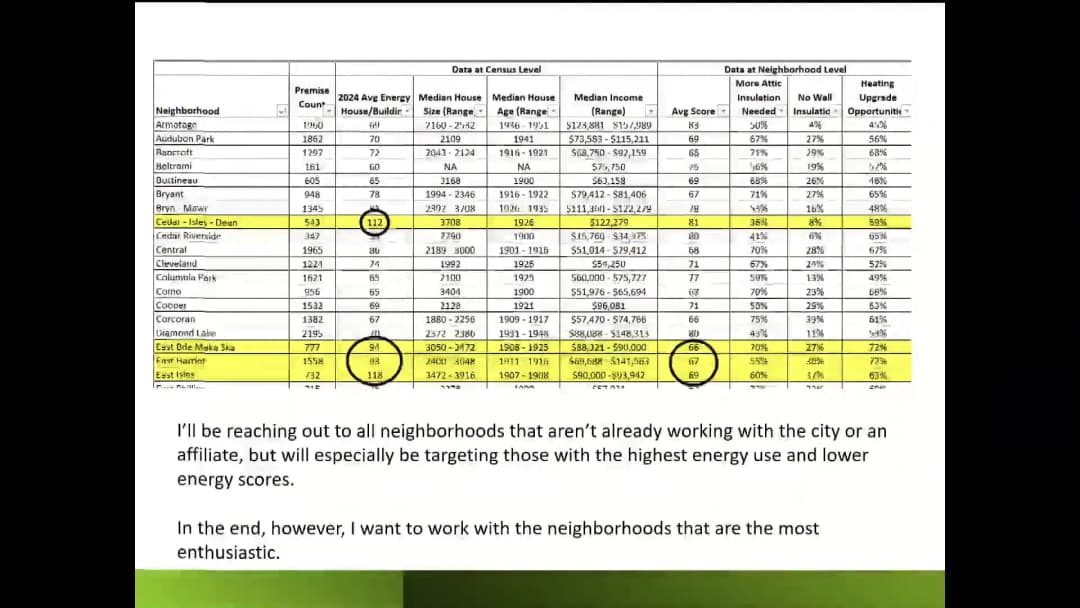
The Climate and Infrastructure Committee of the Minneapolis City Council met on Thursday, September 10, 2026, at 6:31 PM. Chair Robin Wansley presided. The meeting covered consent items, a public hearing on the Downtown Improvement District (DID) 2027 budget (continued due to a mailing error), approval of 428A special service districts, and a community presentation on the 25x25 natural gas reduction campaign. Councilmembers present: Wansley, Vita, Warren (joined later), Palmasano, Chuck Zai, and others. Consent Calendar - Items 3–11 were approved unanimously. These included a gift acceptance from Cities Today Institute, contract amendments for the First Avenue South Reconstruction Project and 42nd Street Intersection Safety Improvements, bid acceptance for ADA ramp installation and the Hearthorn Ramp Building Automation System, and setting a public hearing for September 24, 2026 on a commercial and multifamily energy disclosure repeal ordinance. Public Comments & Testimony - No members of the public signed up to testify on either the DID or 428A public hearings. Discussion Items - Downtown Improvement District (DID) 2027 Services and Service Charges: Jennifer Swanson (Public Works) introduced the public hearing, noting that due to a mailing error the hearing was not properly noticed. She stated the hearing would be continued to September 24, 2026. Adam Dunnik, DID President and CEO, presented the proposed 2027 budget of $9,541,841, a 3.98% increase from 2026. Cost drivers included contracted ambassador increases (collective bargaining), increased safety team presence, and deferred maintenance. He highlighted two programs: the community storage program (serving 3,000 residents, currently 550) and the Nicolette community space (12,000 visitors in 2025). Councilmembers expressed strong support for DID’s work. Councilmember Chuck Zai asked about ambassador staffing (approximately 50, hours 6 a.m. to 11 p.m.) and about efficiency measures (DID brought options to its board and discussed trade-offs). Councilmember Vita praised the diversity and empathy of ambassadors and called for smaller storefronts. Councilmember Warren thanked DID for being welcoming. Chair Wansley asked about police reserves spending ($412,000 for livability and outreach; staff clarified it is not currently used and funds have been reinvested in behavioral health outreach). DID’s motion to continue the public hearing to September 24 for final action passed unanimously. - 428A Special Service Districts (50th & France, 54th & Lyndale, Bloomington & Lake, Chicago & Lake, East Lake, Lyndale & Lake, West, and West Broadway): David Bauer (Public Works) presented the annual approval of 2027 operating plans and service charges. He described that property owners collectively impose charges for enhanced services. Each district’s advisory board developed priorities. Staff recommended passage. Councilmember Palmasano thanked staff for supporting small business districts. No public testimony. The committee voted unanimously to approve the resolution. - Community Presentation on 25x25 Campaign: Mary Britton, a data analyst from the Prospect Park neighborhood, presented the 25x25 initiative to reduce residential fossil gas use by 25% by 2025. She noted that natural gas use has not declined citywide because each building must be addressed individually (88,400 one-to-four-unit houses). She stated the average Minneapolis house produces more CO2 from natural gas in a year than the average car, and nearly a quarter of houses have no wall insulation. Prospect Park’s approach used outreach, tabling, and promotion of energy audits and rebates on a budget under $300/year. Although they did not achieve the 25% reduction, they developed a replicable model. She plans to partner with up to five neighborhoods and asked the council to include all neighborhoods in climate messaging, include energy audit info in newsletters, and encourage councilmembers to get home energy audits. Councilmembers engaged in discussion: Councilmember Vita noted the stress of costs for homeowners, especially in older homes; Councilmember Warren raised concerns about renters in poorly insulated rental properties and rising utility costs; Councilmember Chuck Zai discussed challenges with out-of-state landlords and the need to incentivize them. Britton suggested that data could help demonstrate financial benefits to landlords. The presentation was received and filed. Key Outcomes - Consent calendar: Approved unanimously. - DID public hearing: Continued to September 24, 2026, for final action (motion carried). - 428A districts: Resolution approving 2027 operating plans and service charges passed unanimously. - 25x25 presentation: Received and filed (motion carried). - Note: Councilmember Warren joined after the consent vote; her affirmative vote on consent was recorded with no objection.
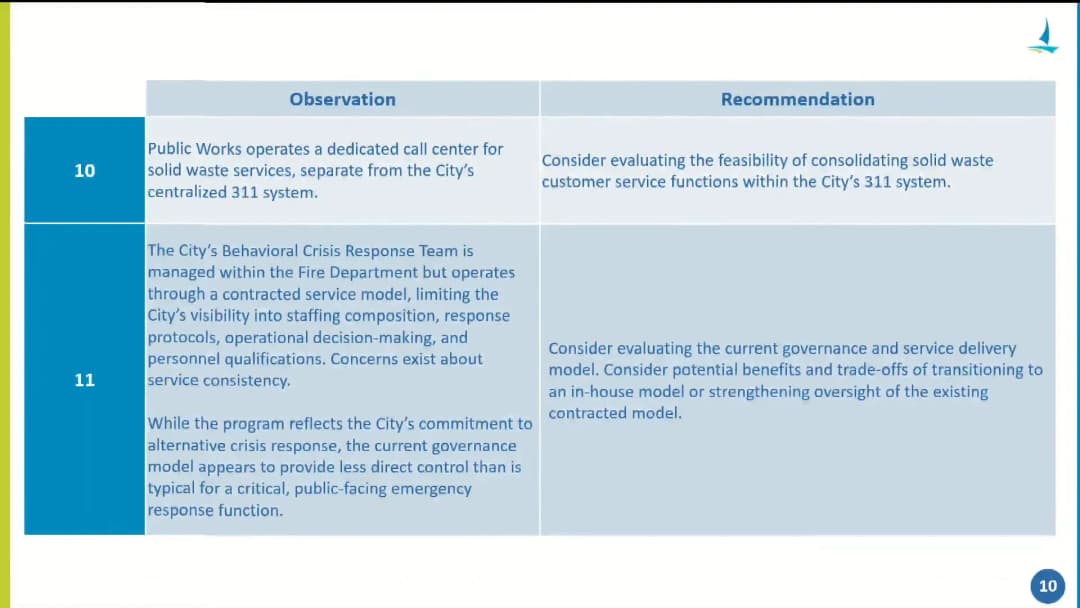
Chair Aisha Chuktai called the Minneapolis Budget Committee meeting to order on Thursday, September 10, 2026. Seven members were present, establishing a quorum; Councilmembers Payne, Rainbow, Osman, Stevenson, Whiting, and Chadry were absent. The committee received two presentations: budget director Sean Green's overview of the mayor's 2027 recommended budget and city auditor Robert Timmerman's workforce optimization and comparative benchmarking study. Mayor's 2027 Recommended Budget Overview - Director Green reported that the 2027 recommended budget totals approximately $2.29 billion with independent boards and transfers included, supports about 4,285 city FTEs (a net decrease of about seven), and includes a general fund of about $753 million, $97.3 million for the Minneapolis Parks and Recreation Board, $359 million in 2027 capital program funding, and about $11.85 million for the technology improvement plan. - The recommended property tax levy is approximately $606 million, an 11.3% increase. Green said the city faced more than $60 million in general fund pressure: a $28–$33 million current service level gap plus about $27 million from under-budgeted recurring costs such as police and fire overtime and settlement agreement compliance. - Without action, the implied levy requirement would have exceeded 17%. The mayor's budget includes about $33.5 million in investments and $23.7 million in divestments/cost savings, for a net general fund change of roughly $9.8 million. The roughly 100 FTE divestment figure is an estimate, not a final position list. - Green noted the unrestricted general fund balance is projected to fall to 13% by the end of 2026, below the 17% policy target, and that S&P Global affirmed the city's AAA rating but revised its outlook to negative. He said the budget avoids using reserves as an operating solution. - Revenue data presented included $2.16 billion total city revenue excluding independent boards and transfers (up 7%), a proposed $47.5 million downtown assets-to-general fund transfer, and local government aid of approximately $82 million total, with the city's share about $72.1 million. A second-quarter projection showed major general fund revenues underperforming the adopted budget by nearly $15 million. - Major investments include $13.1 million for police overtime, $3.4 million for fire overtime, 40 police community service officer and cadet positions, 23 community safety ambassadors, and 15 firefighters. Divestments include consolidating communications and NCR, reorganizing PMI and REIB functions, reducing violence interrupter contracts, and personnel budget reductions across departments. - Green said one levy point equals approximately $5.45 million, so reducing the recommended 11.3% levy to 11% would require about $1.6 million in recurring offsets, and to 10.5% about $4.4 million. Council Discussion on the Recommended Budget - Councilmember Chavez argued that police misconduct and legal settlements are a major driver of budget pressure and that cuts to housing inspections, violence prevention, and other services are paying for police liabilities. She asked for details on the proposed NCR/communications merger and employee impacts. She also cited over $700 million in impacts from the federal occupation, including a $62.8 million estimate of assistance needed from December through March. - Councilmember Wandsley criticized the ClearGov budget book for lacking line-by-line expenditure detail and for presenting merged departments before government structure ordinance changes are approved. She urged aggressive pursuit of LGA changes, alternative revenues such as PILOT and vacancy taxes, and off-duty police fee reform. She also asked why the settlement agreement now has dedicated funding after officials previously said it did not need it. - Councilmember Palmasano said department heads he consulted do not yet know which specific positions will be cut; he announced he would file notices of intent for ordinance changes needed to implement consolidations. He expressed concern about the negative bond outlook, the downtown assets transfer, and proposed cuts to the city clerk's office and elections support. He also suggested moving the budget amendment deadline earlier than November 18. - Vice Chair Schaefer asked how to locate the downtown assets transfer in the budget book and why prior five-year levy forecasts differed from current estimates. She praised the presentation's clarity and called on the council to work together to lower the levy. - Councilmember Vito said the 11.3% levy is difficult for North Minneapolis residents and that she had asked the mayor for deeper cuts, including a 5% target. She questioned duplicate services and public safety overruns and joined calls for more line-item transparency. - Councilmember Warren said some city-funded services, including health and human services functions and BCR, may belong under county jurisdiction rather than the city, and that the city should operate in its lane. She noted one-time ARPA dollars are gone and said Ward 5 residents face an estimated 11–18% tax increase. Workforce Optimization and Comparative Benchmarking Report - City Auditor Robert Timmerman presented a study conducted with 65th North Group using fiscal year 2024 data from benchmark cities Baltimore, Colorado Springs, Tulsa, St. Paul, and Portland. He said the nearly 200-page report was advisory, not an assurance audit. - The report's 11 recommendations included embedding REIB functions within HR; considering moving property assessment to the county; evaluating whether health department services should be shared with or delivered by the county; reviewing the Minneapolis Building Commission's governance; conducting a fraud risk vulnerability study; improving cross-departmental alignment; evaluating crime lab service delivery; assessing consolidation of parks police and administrative functions; reviewing council staffing and the full-time council model; consolidating the solid waste call center into 311; and evaluating BCR for in-house delivery or stronger contract oversight. - Timmerman said the administration responded with a letter committing to continuous improvement and that some recommendations were considered in the proposed budget. He encouraged the council to ask the administration which recommendations were implemented and which were not. He also noted that his office is conducting a full review of BCR, with a report anticipated in October. Council Discussion on Benchmarking - Councilmember Vito asked about fire inspections being housed outside the fire department. Timmerman said the arrangement appeared to be historical, no one in interviews said it made sense, and his office could provide additional background; Vito said moving fire inspections into the fire department is a priority for her. - Vice Chair Schaefer asked about duplication and fraud risk. Timmerman explained that enterprise risk management is a management responsibility, not an audit function, and that the absence of such a function increases fraud risk. - Councilmember Wandsley thanked the auditor for the study and said prior government structure reorganization felt piecemeal. She discussed REIB's unclear role, MBC governance, BCR and PMI history, and the need for thoughtful county coordination and shared-cost agreements. Councilmembers Vito and Warren added views on county versus city responsibility for social and community safety services. Key Outcomes - The committee filed both the mayor's 2027 recommended budget overview and the workforce optimization/comparative benchmarking study; no amendments or formal votes were taken. - Chair Chuktai said department budget presentations will continue through September and October, public hearing dates will be noticed later, amendments will be considered in early December, and the City Council public hearing and final adoption are scheduled for Tuesday, December 15, 2026, at 6:05 p.m. - The next budget committee meetings are scheduled for Monday, September 14, 2026, at 10 a.m., including presentations on the 2026 council dedicated funds, the 2026 change items report, and the biannual personnel report.
The Public Health Safety and Equity Committee met on September 9, 2026, with Chair Jason Chavez presiding. Five members were present, establishing a quorum: Councilmembers Payne, Beta, and Chavez; Councilmember Whiting and Vice Chair Stevenson were absent. The committee approved the consent calendar and adopted an ordinance related to neighborhood policy board elections. Chair Chavez also acknowledged several shootings that occurred in Minneapolis during the previous week. Chair's Remarks on Recent Violence - On September 2, 2026, a mass shooting occurred in the Lowering Park neighborhood. Three responding officers were injured: one sustained an apparent non-life-threatening gunshot wound to the leg, one underwent surgery, and a third was evaluated for an apparent non-life-threatening injury. Four additional people with apparent gunshot wounds were taken to the hospital; one died at the hospital and another was killed at the scene. - On September 5, 2026, a woman was left in critical condition after a shooting in a parking lot near 44th Avenue North and Lindo Avenue North. - On September 5, 2026, a man was shot on I-94 Eastbound between Portland Avenue and Chicago Avenue. - On September 6, 2026, two men were found with suspected gunshot wounds in Diggy Town near the University of Minnesota East Bank campus. - Chair Chavez expressed condolences to the families, friends, and loved ones of those killed, and to everyone recovering, including injured Minneapolis police officers, responders, and medical professionals. Consent Calendar - Item 2: Accepted a grant from the Subaru Loves Pets program to support animal care and control. - Item 3: Accepted Resolution 2026R201, a Gary Sinise Foundation First Responder Outreach Grant to purchase portable radio kits. - Item 5: Accepted reimbursement from the Minnesota Board of Firefighter Training and Education for approved trainings. - Items 6, 7, and 8: Accepted donations for staff conference attendance. - Item 9: Approved two appointments to the Advisory Committee on People with Disabilities. - Item 10: Waived the residency requirement for current Public Health Advisory Committee member Tavia. - The consent calendar was approved by voice vote without discussion or any items pulled. Public Comments & Testimony - The public hearing was opened for the ordinance item, but no members of the public signed up to testify. After multiple calls for speakers, the hearing was closed with no testimony offered. Discussion Item: Ordinance on Neighborhood Policy Board Election Location - Staff presented an ordinance affecting the policy board for the Neighborhood Revitalization Program (NRP). - The policy board membership includes the mayor's representative, a Minneapolis City Council representative (currently Councilmember Warren), a Park Board commissioner, Hennepin County, the Minneapolis School Board, and eight neighborhood representatives chosen by election. - There are six policy board districts for the city plus two at-large members. - The ordinance would remove the Community Connections Conference as the designated election location, allowing the policy board and city to determine the best location for future elections. - The change also ensures elections for neighborhood representation take place in even years; if the Community Connections Conference returns, it could still be used as the venue. Key Outcomes - The consent calendar was approved by voice vote. - The ordinance regarding neighborhood policy board election location was approved by voice vote; no opposing votes or abstentions were noted. - After the vote, the committee found no further business and adjourned.