On July 16, 2026, the New York City Council Committee on Aging held a meeting to vote on Proposed Int. No. 812-A, a local law requiring the commissioner of aging to develop a protocol for wellness checks on older adults during extreme weather events. Councilmember Gale Brewer chaired the meeting in the absence of Chair Susan Zhuang. The committee voted unanimously (6 in favor, 0 against, 1 absent) to approve the amended bill. Discussion Items - Int. No. 812-A (Wellness Checks on Older Adults): Councilmember Brewer presented the bill, sponsored by Councilmember Carcion, which would mandate the Department for the Aging, in collaboration with NYC Emergency Management and other agencies, to create a protocol for conducting wellness checks during cold weather alerts, extreme heat warnings, and heat-related emergencies. The checks would include a standardized set of questions to assess an older adult's well-being, including the temperature of the residence, functionality of climate control equipment, and availability of food and water. - Context and Statistics: Brewer noted that older adults are particularly vulnerable to extreme temperatures. She cited that 500 New Yorkers died prematurely due to preventable heat illnesses last year, and that the city had already issued three extreme heat advisories in 2026 (including one earlier that week). She also referenced the extreme cold experienced during the prior winter. - Amendment: The bill was amended by the committee prior to the vote (as noted in the minutes), though the specific amendment was not detailed in the transcript. Key Outcomes - Vote: The committee approved Int. No. 812-A by a roll call vote of 6-0 with one absence. Affirmative votes: Councilmembers Zhuang, Aldebol, Brewer, Dinowitz, Hudson, and Schulman. Councilmember Mealy was absent. The bill now advances to the full City Council for consideration. - Next Steps: The bill will be reported to the full Council with a favorable recommendation from the committee.
Public Meetings - New York City, New York
Public Meetings - New York City, New YorkThe New York City Council held a stated meeting on July 16, 2026, at 1:30 PM in Council Chambers. The meeting included votes on major land use applications adding over 3,200 housing units, legislation providing a $10,000 workforce stabilization payment for paraprofessionals, and a resolution declaring August 6 as Fatman Scoop Recognition Day. Speaker Julie Menin and Majority Leader Shaun Abreu presided. 49 members were present, with Council Members Mealy and Paladino absent. Consent Calendar - Land Use Call-Ups: M 0085-2026 (Flatiron NoMad Major Concessions) and M 0086-2026 (Queens CD 2 Walk to Park Site Selection/Acquisition) were approved by a consent roll call vote of 48 in the affirmative, 0 in the negative. - Numerous land use resolutions and committee reports were adopted by consent, including landmark designations (Public School 15 Annex, Church of Saint Mary, Lithuanian Alliance Building), zoning amendments, and special permits across all five boroughs. - Int. 0812-2026-A (Wellness checks on older adults during extreme weather) passed by consent. - Int. 0692-2026-A (Workforce stabilization payments for paraprofessionals) passed by consent as part of the consent agenda (see Discussion Items for separate vote details? Actually it was on the consent calendar and passed unanimously as per minutes - note: the transcript shows separate votes? The minutes show it was passed by consent roll call. However, the transcript shows many members speaking on it before the vote. The minutes list it under Reports of Standing Committees and then under Coupled on General Orders with a motion to approve by consent roll call. The vote tally at the end shows all consent items passed 49-0. So it was part of the consent agenda, not a separate roll call. But the transcript suggests a roll call? Actually the transcript has a roll call for land use call-ups, then later for the consent agenda. The paraprofessional bill was on the consent agenda. So I'll list it under consent, but note the extensive discussion.) - Int. 0955-2026-A (Red Tape Relief Act – coordinating business inspections) passed by consent. - Int. 0496-2026-A (Study and report on potential installation of art acknowledging the 1863 Draft Riots) passed by consent. - Int. 0398-2026 (Annual disclosure of financial interests) passed by consent with a Message of Necessity. - Res. 0371-2026 (Fatman Scoop Recognition Day – August 6 annually) adopted by voice vote. Public Comments & Testimony - No members of the public spoke during the stated meeting; only council members addressed the body. Discussion Items - Paraprofessional Workforce Stabilization (Int. 0692-2026-A): Councilmember Carmen De La Rosa, the sponsor, emphasized that starting paraprofessional salary is $32,500 per year and there are 1,600 to 3,000 vacancies citywide. The bill provides a one-time $10,000 payment in four installments for the 2026–2027 school year. Multiple council members (Banks, De La Rosa, Dinowitz, Epstein, Hanks, Hudson, Joseph, Lee, Louis, Maloney, Morano, Narcisse, Restler, Schulman, Thomas-Henry, Williams) spoke in strong support, citing the essential role of paraprofessionals, the inadequacy of pattern bargaining, and the need to retain staff. Councilmember Ariola called for similar action for EMS workers. No opposition was voiced. - Land Use Approvals: Speaker Menin summarized major projects: Monitor Point (1,324 units, 50% affordable, including 161 senior units and 110 supportive housing units, plus $300,000/year for 99 years for Bushwick Inlet Park and a new ADA-accessible G train elevator); DeWitt Clinton Park North (1,064 units, 286 affordable under MIH, plus air rights purchase for Hudson River Park Trust valued at $29.7 million); 2950 West 24th Street (408 deeply affordable units for Coney Island); 1166 Bedford Avenue (144 affordable senior units); 198-208 Richmond Terrace (118 units, 35 affordable); 1160 Pugsley Avenue (104 units with ground-floor supermarket); and 164th Street Rezoning (80 units, 24 affordable). Councilmember Restler noted that Monitor Point’s affordable housing was nearly tripled from the original proposal. Councilmember Brewer expressed a desire for more affordable units in Manhattan. Councilmember Santosuosso highlighted the need for quality maintenance at 2950 West 24th Street. - Police Officer Exam Age Limit (Int. 0913-2026-A): Sponsored by Councilmember Farías, raising the maximum age for the civil service exam from 35 to 43 to align with state law. Councilmember Feliz supported expanding the candidate pool. Passed 48-1 (Cabán opposed). - Unincorporated Business Tax Credit (Int. 0972-2026): Sponsored by Councilmember Lee, decreasing the credit against city personal income tax for residents’ share of UBT paid by partnerships. Councilmember Wong opposed, stating it would increase city taxes. Passed 43-6 (Ariola, Carr, Felder, Morano, Vernikov, Wong opposed). - Elected Official Compensation (Int. 0983-2026-A): Sponsored by Councilmember Williams, implementing an 18.2% salary increase for the mayor, public advocate, comptroller, council members, borough presidents, and district attorneys, based on the Quadrennial Advisory Commission report. Councilmember Epstein supported the need to attract leaders; Councilmember Wong opposed due to constituent hardships. Speaker Menin abstained. Passed 42-6-1 (Ariola, Carr, Morano, Vernikov, Wong, Zhuang opposed). - Other Introductions: Councilmember Louis introduced Int. 0978 (increasing income limits for SCRIE/DRIE for seniors and disabled). Councilmember Wong introduced Int. 0984 (establishing a NYPD street takeover unit). Councilmember Riley introduced Int. 0981 (task force to study a municipal public bank). Councilmember Hanif introduced Int. 0971 (study on private equity impact on small businesses). Councilmember Dinowitz introduced Res. 0548 (calling for Council representation on Panel for Educational Policy). Councilmember Thomas-Henry introduced Res. 0561 (calling for utility rate freeze). Councilmember Morano introduced Res. 0555 (calling for state legislation on utility transparency). - General Discussion: Councilmember Sanchez raised concerns about NYPD misconduct in the 46th Precinct and called for accountability. Councilmember Santosuosso noted a July 4th shooting in Coney Island injuring eight, including two children. Councilmember Avilés condemned ICE killings of two individuals in Maine. Council members recognized interns and staff. Key Outcomes - Vote on Int. 0972-2026: 43 in favor, 6 opposed (Ariola, Carr, Felder, Morano, Vernikov, Wong). - Vote on Int. 0983-2026-A: 42 in favor, 6 opposed (Ariola, Carr, Morano, Vernikov, Wong, Zhuang), 1 abstention (Speaker Menin). - Vote on Int. 0913-2026-A: 48 in favor, 1 opposed (Cabán). - Consent Agenda: All items passed with 49 affirmative votes. - Land Use Call-Up Votes: Both M 0085 and M 0086 approved 48-0. - Adjournment: The meeting adjourned to the next stated meeting scheduled for August 13, 2026.
The New York City Council Committee on Civil Service and Labor, chaired by Councilmember Shirley Aldebol, held a vote on Thursday, July 16, 2026, at 10:00 AM to consider Proposed Int. No. 692-A, a local law providing a one-time $10,000 workforce stabilization payment to New York City school paraprofessionals for the 2026-2027 school year. The bill, sponsored by Councilmember Carmen de la Rosa, aims to address the paraprofessional staffing crisis, particularly in District 75 schools, by incentivizing retention and recruitment amid low wages and high vacancies. Discussion Items - Chair Aldebol outlined the critical role of paraprofessionals, noting that starting pay for full-time paraprofessionals is around $32,000 and the maximum salary after 15 years of experience is roughly $54,000, compared to a March 2026 report estimating the true cost of living in New York City at about $70,000 for a single adult and $166,000 for a family of two adults and two children. She also highlighted that full-time paraprofessionals are entitled to only 10 days of paid leave per school year, and that substitute paraprofessionals receive no benefits. The resulting vacancies and attrition leave remaining staff to work doubly hard. - Councilmember de la Rosa, the bill sponsor, emphasized that the $10,000 one-time payment is a "drop in the bucket" compared to the benefits of stabilizing a workforce of over 25,000 paraprofessionals and reducing attrition rates that have left gaps of between 1,600 and 3,000 vacancies. She noted that the bill has support from 47 council members, the Public Advocate, the Manhattan Borough President, and the Brooklyn and Queens Borough Presidents. - Councilmember Narcisse voted aye but expressed concern that New York City, as "the capital of the world," is not showing up for paraprofessionals. - Councilmember Hankerson recalled the vital role paraprofessionals played in his own school experience and voted aye. - Councilmember Morano congratulated the sponsor and former council member Powers, noted that the bill is widely popular on a bipartisan basis yet became controversial, and expressed hope for future expansion of payments and a look-back period for paraprofessionals. He voted yes enthusiastically. Key Outcomes - The committee voted unanimously (7-0) to approve Proposed Int. No. 692-A. The roll call vote recorded all seven members present (Aldebol, Cabán, Gennaro, Hankerson, Hudson, Morano, Narcisse) voting in favor, with no abstentions. - The bill will now proceed to the full New York City Council for consideration.
On July 16, 2026, the New York City Council Committee on Finance, chaired by Councilmember Linda Lee, convened at 10:00 AM in City Hall Committee Room to consider two pre-considered items: a resolution adjusting designations of organizations for expense budget funding, and a local law decreasing the city personal income tax credit related to unincorporated business taxes paid through partnerships. The committee voted on both items via roll call, with all members present except Oswald J. Feliz and Darlene Mealy. Discussion Items - T2026-2224 – Resolution on Designation of Organizations for Expense Budget Funding: Sponsored by Chair Lee, this resolution approves new designations and changes to existing designations of organizations receiving funding in the expense budget. Members expressed no debate beyond procedural comments; Councilmember Morano asked to confirm the bill number for the second item. - T2026-2214 – Local Law Decreasing City Personal Income Tax Credit for Unincorporated Business Tax: This pre-considered introduction modifies the credit against city personal income tax for residents' share of unincorporated business tax paid by partnerships or proprietorships. Councilmembers Morano and Wong voted against the measure; other members voiced no opposition during discussion. Key Outcomes - T2026-2224: Approved by a roll call vote of 15 in the affirmative, 0 in the negative, with 2 absent (Feliz and Mealy). The resolution passed unanimously among voting members. - T2026-2214: Approved by a roll call vote of 13 in the affirmative (Lee, Abreu, Aldebol, Avilés, Brooks-Powers, Gennaro, Hudson, Maloney, Marte, Narcisse, Restler, Sanchez, Williams) and 2 in the negative (Morano and Wong), with 2 absent (Feliz and Mealy). The local law passed despite the divided vote. The committee concluded business after finalizing the roll call with all present members recorded.
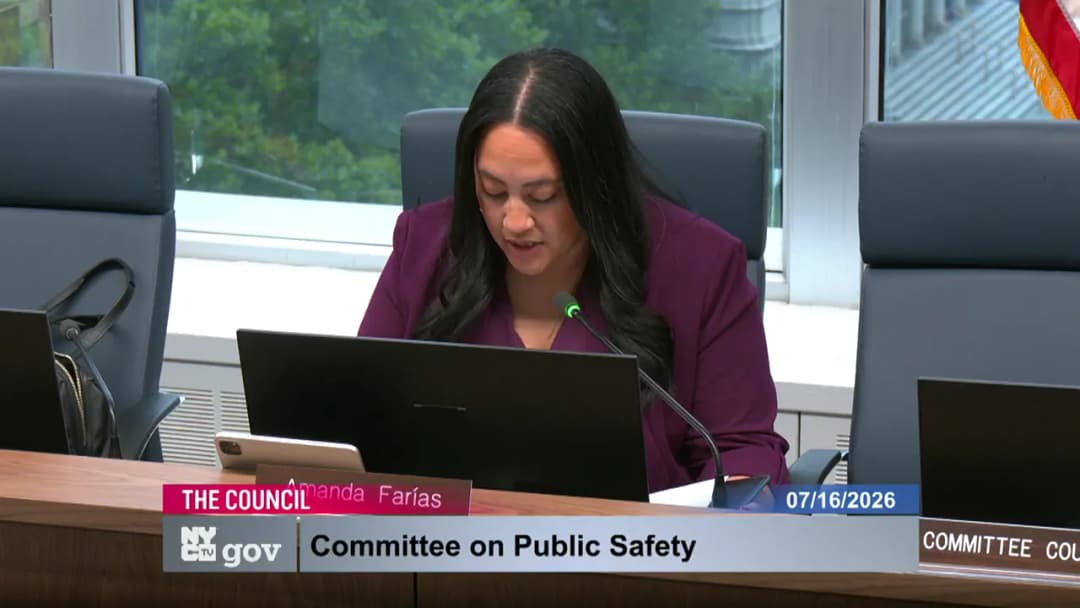
On July 16, 2026, the New York City Council Committee on Public Safety, chaired by Councilmember Oswald Feliz, convened to vote on Proposed Introduction No. 913-A, a bill to raise the maximum age for taking the police officer civil service examination from under 35 to under 43 years of age. The legislation also allows individuals who have served on military duty or terminal leave to deduct up to six years of service time from their age for eligibility purposes. The committee heard opening statements from Chair Feliz and the bill's sponsor, Councilmember Farías, before unanimously approving the measure. Discussion Items - Proposed Int. No. 913-A (Sponsor: Councilmember Farías): The bill amends the New York City Administrative Code to raise the maximum age for taking the NYPD police officer civil service examination from under 35 to under 43. It also preserves existing military service consideration, allowing candidates to deduct up to six years of active duty or terminal leave from their age. The sponsor stated that the bill was developed after conversations with local precinct councils about barriers discouraging qualified New Yorkers, noting that hundreds of candidates had exceeded the age limit during the hiring process in recent years. The sponsor emphasized that candidates must still meet all other requirements (civil service exam, background check, physical/medical/psychological/educational/character standards, and academy training) and that the age of under 43 aligns with the city's retirement framework to allow a full career. Key Outcomes - Vote on Proposed Int. No. 913-A: The committee voted unanimously, with 9 in the affirmative (Feliz, Ariola, Banks, Gutiérrez, Hankerson, Hanks, Nurse, Sanchez, Wong), 0 in the negative, and no abstentions. The bill was approved by the committee. Note: No consent calendar, public comments, or other agenda items were included in this meeting.
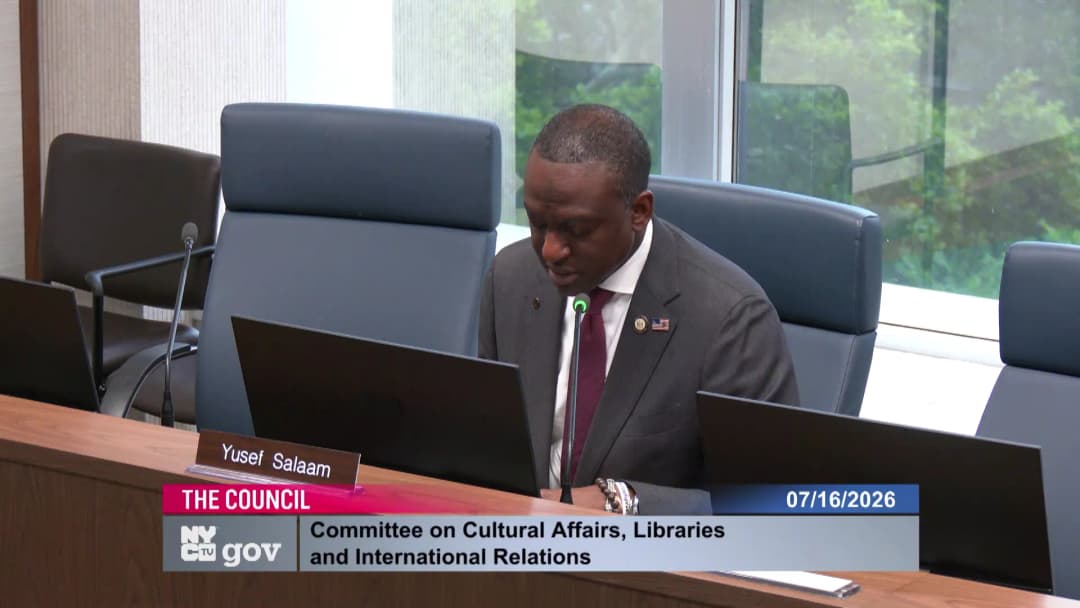
The Committee on Cultural Affairs, Libraries and International Relations met on July 16, 2026, at 10:30 AM in Hearing Room 3 at 250 Broadway. The committee voted on two items: a proposed local law (Int. No. 496-A) to study and report on the potential installation of public art acknowledging the 1863 Draft Riots, and a resolution (Res. No. 371) to declare August 6 annually as Fatman Scoop Recognition Day. All seven committee members were present: Chair Nantasha M. Williams, Crystal Hudson, Farah N. Louis, Virginia Maloney, Chi A. Ossé, Althea V. Stevens, and Sandra Ung. Council Members Salaam and Zhuang also attended. Discussion Items Int. No. 496-A – Study on Draft Riots of 1863 Public Art Chair Nantasha M. Williams, the sponsor, made opening remarks. She stated that New York City cannot tell its full story while leaving the racist violence of the 1863 Draft Riots unmarked and its victims unremembered. She described the riots: in July 1863, mobs of civilians instigated by the first federal military draft and by racial tensions targeted the city's African American community, beating and murdering innocent civilians and destroying property. The official death toll was 119, though historians estimate more may have died. The bill would bring together community voices, historians, and experts to determine how public art can honor those who suffered, educate future generations, and ensure truth has a permanent place in the city. She asked for her colleagues' support. Res. No. 371 – Fatman Scoop Recognition Day Council Member Yusuf Salaam, sponsor of the resolution, spoke. He noted that some resolutions are procedural, but this one is very personal. Isaac Freeman III, known as Fatman Scoop, was a child of Harlem, born in Manhattan and raised in the district Salaam represents. He graduated from Cardinal Hayes High School, attended New York Institute of Technology, and built a career as a Grammy-winning artist and radio personality on Hot 97, collaborating with Missy Elliott, Snoop Dogg, and others. Salaam shared that Freeman performed at his inauguration, giving everything every time. Freeman died on August 30, 2024, at age 56, while on stage. The resolution declares August 6, his birthday, as Fatman Scoop Recognition Day in New York City. Salaam asked for an aye vote. Key Outcomes - Vote on both items (coupled): Chair Williams voted aye; Council Member Louis voted aye; Council Member Hudson voted aye; Council Member Ossé voted aye; Council Member Stevens voted aye; Council Member Ung and Maloney also voted aye. The final vote was 7 in the affirmative, 0 in the negative, 0 abstentions. - Int. No. 496-A was approved by the committee, with a report required. - Res. No. 371 was approved by the committee. - Both items will now proceed to the full City Council for consideration.
The Committee on Governmental Operations, State & Federal Legislation, chaired by Gale A. Brewer, met on Thursday, July 16, 2026, at 10:30 AM in Hearing Room 2 at 250 Broadway. The committee voted on two items: a bill to increase compensation for elected officials (including the mayor, public advocate, council members, borough presidents, comptroller, and district attorneys) and a bill making technical amendments to the annual disclosure of financial interests. All members were present: Eric Dinowitz, Oswald J. Feliz, Frank Morano, Althea V. Stevens, Carl Wilson, and Susan Zhuang (via Zoom). Councilmember Zhuang experienced technical difficulties and could not vote. Discussion Items - Compensation for Elected Officials (Preconsidered Proposed Int. No. 983‑A): Chair Brewer introduced the bill, noting that elected official pay is set by local law and that a quadrennial commission reviews compensation every four years. The last raise for most city elected officials was in 2016; Mayor de Blasio declined to impanel the commission in 2020 and Mayor Adams in 2024, creating a 10‑year gap. The mayor and speaker jointly formed a commission in January 2026, which recommended an 18.2% salary increase retroactive to January 1, 2026, for the mayor, public advocate, controller, borough presidents, council members, and district attorneys. The commission also recommended regularly convening the commission, altering future commissions to occur in the third year of a term, requiring increases to take effect at the start of the next term, and giving commissions 120 days instead of 75 days. Chair Brewer argued that stagnant wages affect staff salaries (which are capped by elected official salaries), hinder recruitment, and limit who can afford to run for office. Councilmember Frank Morano voted against this bill. - Financial Disclosure Amendments (Int 0398‑2026): Chair Brewer explained that the administrative code requires certain city officers and employees to file disclosure reports with the Conflicts of Interest Board (COIB). The code sets seven value bands for reporting financial interests; COIB is required to update these bands every four years. In February 2026, COIB increased the definition of ownership interest to $64,000, creating a mismatch where the bottom of the third band is $64,000 but the top of that band remained $60,000. This bill resets the ranges of some bands to fix the incongruity, without changing which officers or employees must disclose. The bill passed unanimously. Key Outcomes - Int 0398‑2026 (Financial Disclosure Amendments): Approved by the committee with a vote of 6 in the affirmative, 0 in the negative, and 0 abstentions. Councilmember Zhuang was unable to vote due to technical difficulties. - Preconsidered Proposed Int. No. 983‑A (Compensation for Elected Officials): Approved by the committee with a vote of 5 in the affirmative (Brewer, Dinowitz, Feliz, Stevens, Wilson) and 1 in the negative (Morano). Councilmember Zhuang was unable to vote. The bill will advance to the full City Council.
The New York City Council Committee on Small Business, chaired by Councilmember Shanel Thomas-Henry, met on Thursday, July 16, 2026, at 10:45 AM to vote on Proposed Introduction No. 955-A, a bill aimed at accelerating the opening of new businesses by coordinating required inspections and plan reviews. The committee unanimously approved the legislation. Discussion Items - Proposed Int. No. 955-A (Council Member Zwang): Chair Thomas-Henry explained that the bill would require the mayor to establish a program to coordinate inspections and plan reviews, reducing the time it takes to open and operate a new business. She noted that current processes often involve uncoordinated inspections in a specific sequence unknown to many small business owners, causing delays. The bill aims to fix this inefficiency by ensuring inspections happen around the same time or shortly thereafter. - Councilmember Frank Morano expressed support and stated he was honored to be a prime sponsor of the legislation. Key Outcomes - Vote: The committee voted on the motion to approve Proposed Int. No. 955-A. The initial roll call showed 6 affirmative votes (Chair Thomas-Henry, Councilmembers Hanif, Maloney, Morano, Salaam, and Santosuosso) and 0 negative. The roll was held open, and Councilmember Brooks-Powers later voted aye, resulting in a final vote of 7 in the affirmative, 0 in the negative, with no abstentions. The bill was adopted by the committee.
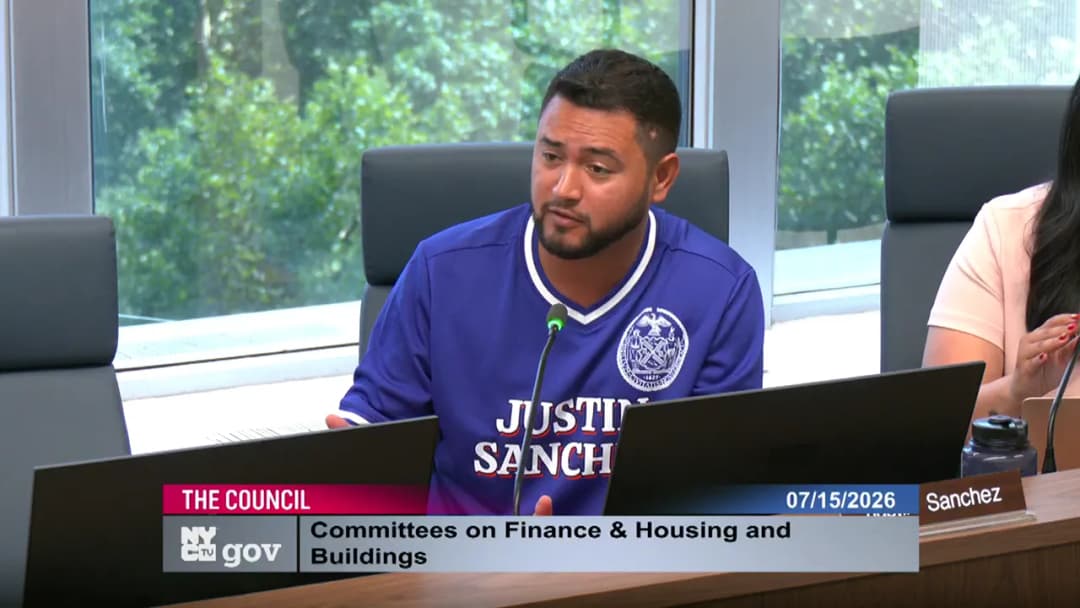
The Committee on Finance, jointly with the Committee on Housing and Buildings, held an oversight hearing on July 15, 2026, to examine financial tools for maintaining the affordability of Mitchell-Lama housing. Chaired by Councilmember Linda Lee and co-chaired by Councilmember Pierina Sanchez, the hearing featured testimony from the Department of Housing Preservation and Development (HPD), extensive questioning from council members, and public testimony from residents. Key topics included rising operating costs, deferred maintenance, steep rent increases, oversight failures, and potential solutions such as SCREE/DRiE enrollment, capital investments, and legislative changes. No votes were taken; the hearing was filed and a resolution (Res 0083-2026) was laid over. Public Comments & Testimony - Gene Hill (President, Tracy Towers Tenant Organization) described chronic building failures (elevators, plumbing, roof) and substandard repair work, stating that residents are not receiving services for the money paid. She noted that at least 60% of residents would not qualify for subsidies and face untenable rent increases. - Ed Yaker (Coordinating Council of Cooperatives) urged including all limited-equity housing (not just Mitchell-Lama) and called for reducing city-mandated costs that add financial burdens without improving safety. - Sally Strowman criticized the bidding process and change orders, calling for tenant committees to address citywide co-op issues. - Janice Brody and Ryan Schollenberger (Clayton Apartments Board) highlighted a $15,000/month operating deficit, $25–30 million in needed capital repairs, and insurance costs of $4,300 per unit, far above market rates. They argued that city capital is structured as loans, not grants, and asked for treatment as infrastructure. - Susan Peters (American Monetary Institute) discussed the role of private bank money creation in the city's financial challenges. - Richard Heitler (Village East Towers) presented a nine-page proposal for annual, simplified rent increase processes and faster loan processing, noting that delays in HPD loan closings cost hundreds of thousands of dollars. - Steven Torre (Tracy Towers) rejected SCREE as a band-aid for those above income limits and called for systemic change. - Sam Moskowitz (Gouverneur Gardens) recommended multi-year budget projections, standardized reporting, and tracking of vacancies and arrears as early warning indicators. - Gene Wall (Rochdale Village) requested a dedicated Mitchell-Lama capital fund and expansion of city capital programs to state-supervised developments. Discussion Items - HPD Testimony (First Deputy Commissioner Adam Phillips) : Mitchell-Lama portfolio faces massive operating cost increases (insurance, utilities, labor) and capital needs estimated in the billions over the next decade. HPD is legally required to approve rent increases sufficient to cover costs. In 2025, 37 developments saw average 26% increases over multiple years. HPD is exploring new revenue models, including selling unused land for development, and committed to proactive enrollment in SCREE/DRiE. The state budget lowered the shelter rent tax cap from 10% to 5% of shelter rent. - Councilmember Sanchez questioned HPD's asset management model, asking why increases are often large lump sums rather than gradual. HPD responded that they review financials regularly but buildings often wait until major capital projects are ready. - Speaker Julie Menon pressed for transparency, including a comprehensive list of rent increases and a review of financial distress. HPD promised to provide data after the hearing. She also asked about oversight of management companies and whether all refinancing options are exhausted before increases. - Councilmember Dinowitz focused on Tracy Towers, highlighting a 50% increase in security costs ($1.8M to $2.8M), substandard past repairs, and the ballooning debt structure. He questioned HPD's scrutiny of expenses and called for accountability. - Councilmember Hudson asked about tracking of capital loan effectiveness and assistance for households ineligible for SCREE/DRiE. - Councilmember Riley inquired about the capital plan ($1.1 billion over 10 years), development selection, and protections for residents if land is sold. HPD said co-op boards would drive such decisions. - Councilmember Banks raised the state comptroller's audit finding hazardous conditions and asked about accountability for management. HPD cited code enforcement programs and ability to disqualify managing agents. - Councilmember Ferrias emphasized the need for early intervention and gradual increases, noting that even short notice (30 days) is insufficient for families. - Councilmember Aldebol asked about ensuring savings from capital funds are passed to residents; HPD said analysis is done case by case. - Councilmember Brewer urged a roundtable with state and city agencies and opposed conversions from Mitchell-Lama to HDFC. - Councilmember Epstein advocated for proactive annual small increases rather than large lump sums and suggested zero-percent shelter rent tax and forgivable loans. HPD noted J-51 tax benefits can reduce liability. - Councilmember Lee raised questions about AEP (Alternative Enforcement Program) for Mitchell-Lamas, vacant units, and phased increase reviews. HPD said they monitor financials continuously. Key Outcomes - Hearing was filed, and Resolution 0083-2026 (calling on the state to pass A.6432/S.4236 protecting Mitchell-Lama residents) was laid over by committee. - HPD committed to provide a comprehensive list of rent increases and financial conditions for all city-supervised Mitchell-Lamas to the committees within days. - HPD agreed to collaborate on a roundtable discussion with council members, residents, and state officials to address systemic issues. - HPD reiterated support for increasing the SCREE income cap locally (from $50,000 to $75,000) and for additional federal Section 8 vouchers as operating subsidies. - Several council members pledged to follow up on specific developments (Tracy Towers, Clayton Apartments, Rochdale Village, etc.) and to push for reforms in loan processing, insurance oversight, and annual gradual rent increases.
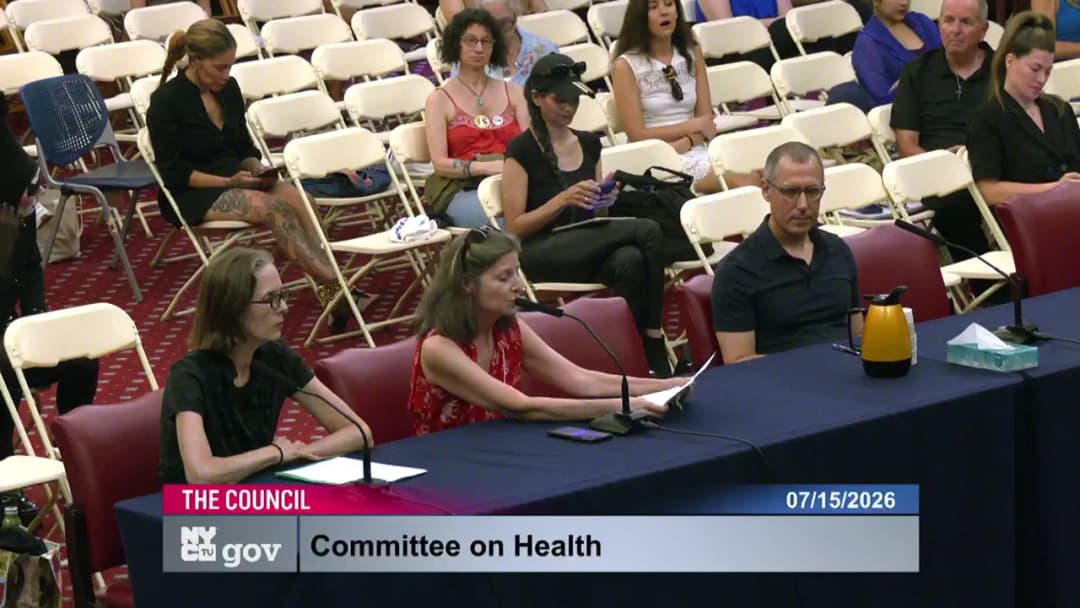
The New York City Council Committee on Health, chaired by Lynn C. Schulman, held a hearing on Wednesday, July 15, 2026, to discuss Introduction 943, a local law to prohibit the operation of horse-drawn cabs in New York City, also known as "Ramanch's Law." The hearing was prompted by the June 17, 2026 death of 18-year-old Ramanch Mahajan, who was killed when a horse-drawn carriage horse bolted in Central Park. The bill would prohibit new horse carriage operator licenses after June 1, 2028, and ban horse-drawn cab operations after that date. It also requires a workforce development program for displaced workers and humane disposition of horses. The hearing included emotional testimony from the victim's family, administration officials, industry representatives, union members, animal welfare advocates, and many members of the public. Public Comments & Testimony - Mahajan Family (Priya, Deepak, Gaurav, Natig, Sowjeta, Anish Thukral): The family described the tragedy in detail, expressing that Ramanch's death was preventable and that the industry should be banned immediately. They urged passage of Intro 943 to honor Ramanch's memory and prevent future deaths. They also requested a permanent memorial at the site of the accident. - Corinne Schiff (Deputy Commissioner, NYC Health Department) and Carlos Ortiz (Chief of Staff, DCWP): The administration expressed support for the intent of the bill but criticized insufficient worker protections. They provided data on horse licenses, driver training, and enforcement challenges. They noted 160 licensed horses, 208 driver licenses, and 68 carriage licenses. They acknowledged the need for better workforce transition language. - State Senator Eric Bocha (testifying): Expressed strong support for the bill, stating it is the best path forward for workers and that the industry cannot be reformed. - Assemblymember Linda B. Rosenthal: Supported the ban, citing decades of horse deaths and injuries. Named several horses that died in the industry. - Ashley Byrne (PETA): Argued that regulation cannot make the industry safe, and that the industry has a history of noncompliance. Supported the ban. - Edie Falco (actress and animal advocate): Urged the council to pass the ban, emphasizing that horses are not ours to use for entertainment. - Bob Holden (former Councilmember, original author of the bill): Stated that the bill would have shut down the industry on June 1, 2026, and that Ramanch died on June 17, 2026, because of obstruction by previous leadership. - Adita Berncrant (Night Class): Reported that some current carriage owners want to exit the business due to safety concerns, and that hitching posts are not a solution. - Dr. Craig Kulakowski (equine veterinarian, remote): Testified that independent veterinary exams last year revealed widespread scars, lameness, and lack of pasture access. Owners refused blood testing and lameness evaluations. - Borough President Brad Hoylman-Siegel: Presented data on 96 serious incidents and 40 horse deaths since 1982. A Columbia University forecast model predicts 16-30 more incidents by 2030 if no action is taken. - John Torello (TWU Local 100 President): Opposed the ban, arguing that the industry is safe and that workers' livelihoods will be destroyed. Called for tabling the bill and considering alternative safety measures. - Connor McHugh (carriage driver/owner, 40 years): Opposed the ban, stating that the industry is being targeted by real estate interests and animal rights activists. Denied claims of animal abuse. - Christina Hansen (shop steward, TWU Local 100): Defended the industry's safety record and the care horses receive. Argued that horses can work safely in the city. - Dr. Gabriel Cook (equine surgeon): Stated that the horses he treats are not abused, and that a ban would likely lead to horses being sent to slaughter due to lack of sanctuary capacity. - Sharice DeBose (political director, TWU Local 100): Criticized the legislative process, saying council members signed on without meeting workers. Called the hearing a "kangaroo court" and demanded just compensation for owners. - Numerous other public speakers testified both in support and opposition, with many drivers and owners expressing love for their horses and fear for their livelihoods, and many animal welfare advocates citing the inherent dangers and cruelty of the industry. Discussion Items - Councilmember Gennaro questioned the administration's lack of enforcement data and criticized the mayor's support for the ban, arguing that the industry can be reformed. He advocated for an alternative bill (Intro 937) that would increase safety measures. - Councilmember Marte (sponsor) rebutted claims that reform is possible, citing 128 documented accidents in 34 years and the industry's refusal to allow independent vet exams. He emphasized that the bill includes workforce development and that sanctuaries are ready to take horses. - Speaker Julie Menon committed to ensuring displaced workers find good-paying jobs, and to ensuring horses are treated humanely. She noted that 70% of New Yorkers support the ban. - Councilmember Epstein questioned the administration about worker protections and the timeline for workforce development. - Councilmember Morano pressed the administration on whether any regulation can eliminate the innate risk of horses bolting, and asked if the health department would approve such an industry today. Deputy Commissioner Schiff implied it would not. - Councilmember Ariola questioned the independence of contract veterinarians and expressed concern about oversight. - Councilmember De La Rosa raised concerns about other tourism-related industries (helicopters, pedicabs) that also have fatalities, urging a broader look at safety. Key Outcomes - No vote was taken. The hearing was for testimony only; the bill was laid over by the committee. - The administration expressed support for the bill's intent but requested stronger worker protection language. They committed to working with the council on amendments. - The committee will accept written testimony for 72 hours after the hearing. - Next steps: The committee will review all testimony and consider amendments before a potential vote. Speaker Menon stated a commitment to move the bill forward.