Browse by city
Date range
Search help

Search titles, summaries, topics and stored transcripts together. Keywords may match separately; put the whole query in double quotes for a phrase. Matching follows word analysis, so punctuation is not exact. Both dates are included. Documents are not searched.

SHOWING 41–50 ENTRIES
41
MAY 28, 2026 · OLYMPIA, WASHINGTON · CITY COUNCIL & COMMISSIONS
Community Livability and Public Safety Committee Meeting - May 28, 2026

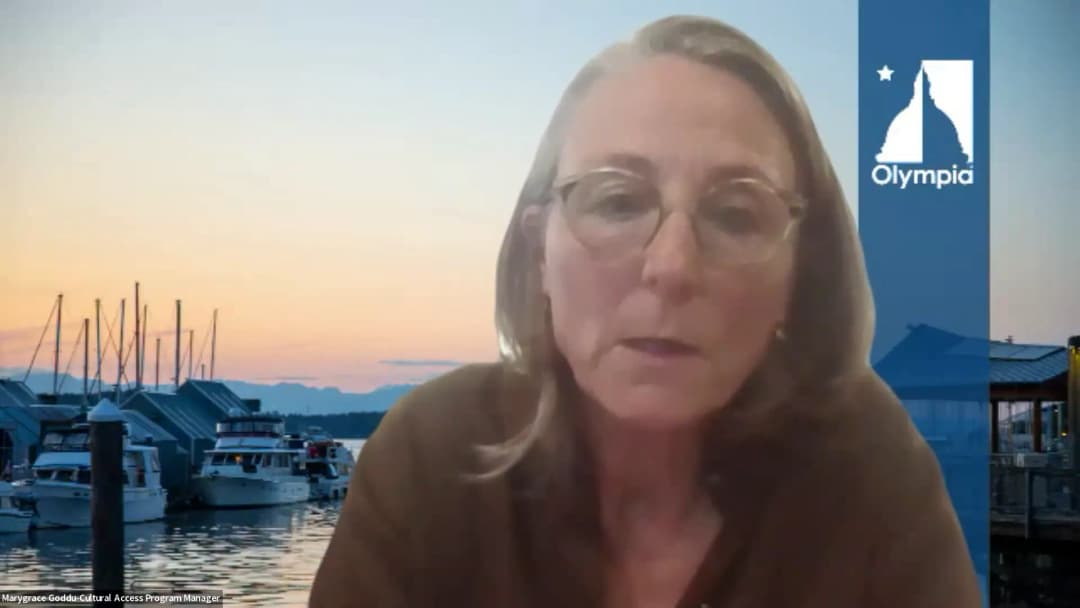
The Community Livability and Public Safety Committee of the Olympia City Council met on May 28, 2026, from 5:30 PM to 8:52 PM. The committee discussed recommendations for council-appointed advisory bodies, approved Inspire Olympia funding recommendations (with a split vote), and approved CDBG allocations. Public comment was received on the Inspire Fund and arts organizations. Note: The meeting minutes and transcript indicate the meeting occurred on May 27, 2026; this summary uses the date provided in the instructions. Consent Calendar - Approved the agenda unanimously. - Approved the minutes from the May 6, 2026 special meeting. Public Comments & Testimony - Anna Schlecht (Olympia resident for nearly 50 years) expressed strong support for the Inspire Fund, describing it as a voter-approved initiative that supports arts alongside housing and homelessness services. She emphasized the importance of public investment in both "bread and roses." - Schyler Raad (Dr. Schyler Raad, involved in the Olympia arts community) spoke about two items: first, the need to improve the qualitative assessment of arts grants, advocating for integrating quantitative and qualitative measures; second, urged protection of the Decay organization (Diverse Events and Creative Arts Yard), describing it as a vital space for trans people and vulnerable to gentrification. Discussion Items - Council Appointed Advisory Bodies (Item 6.A): Assistant City Manager Stacey Ray, Community Engagement Program Specialist Margo Morales, and independent consultant Genevieve Canceko Chan presented recommendations. Two options were discussed: (1) improvements to the current system (including recruitment process changes, standardized onboarding, and restructuring four advisory bodies) and (2) a transition to a multifaceted engagement approach with multidisciplinary advisory bodies aligned to comprehensive plan focus areas. The committee expressed support for Option 1. A motion to direct staff to further develop Option 1 and bring it to a full Council study session passed 3-0 (Madrone, Green, Huỳnh). - Inspire Olympia 2026-2027 Funding (Item 6.B): Inspire Olympia Program Manager Marygrace Goddu and Cultural Access Advisory Board Co-Chair Anne Larsen presented. They reported 94 applicants, a record number, with 85 organizations recommended for funding totaling $3,303,288. The committee discussed the need for more detailed information about funded organizations, including mission, requested amounts, and deliverables. A motion to recommend approval of the Cultural Access Advisory Board (CAAB) funding recommendations and advance them to City Council passed 2-1 (Madrone and Green in favor; Huỳnh opposed). Huỳnh expressed concerns about insufficient information to make an informed decision and frustration with the expectation to approve without deeper knowledge. The committee agreed to provide additional information to Council for the June 16 meeting. - CDBG Program Year 2026 Allocations (Item 6.C): Senior Housing Program Specialist Anastasia Everett presented staff recommendations for a direct award to existing subrecipients due to federal uncertainty, totaling $411,000 (including reallocation of $35,000 from revolving loan funds). Staff also proposed dissolving the rental rehabilitation program and amending the consolidated plan. The committee discussed the rationale. A motion to approve the recommended CDBG allocations and forward to full City Council passed 3-0. Key Outcomes - Advisory Bodies: Motion passed 3-0 to further develop Option 1 and present at a Council study session. - Inspire Olympia Funding: Motion passed 2-1 to recommend approval and advance to Council. Huỳnh voted nay, citing need for more information. - CDBG Allocations: Motion passed 3-0 to approve and forward to Council. - The committee decided to add a summary of funded organizations (mission, deliverables, requested vs. awarded amounts) to the Council packet for the Inspire Olympia item.

PROGRAM MANAGEMENT 42% · COMMUNITY ENGAGEMENT 24% · ARTS AND CULTURE 9% · PUBLIC ENGAGEMENT 7%
42
MAY 20, 2026 · OLYMPIA, WASHINGTON · CITY COUNCIL & COMMISSIONS
Olympia City Council Meeting - May 20, 2026: Heritage Month Proclamation, Public Comments on Homelessness, and Police Auditor Annual Report

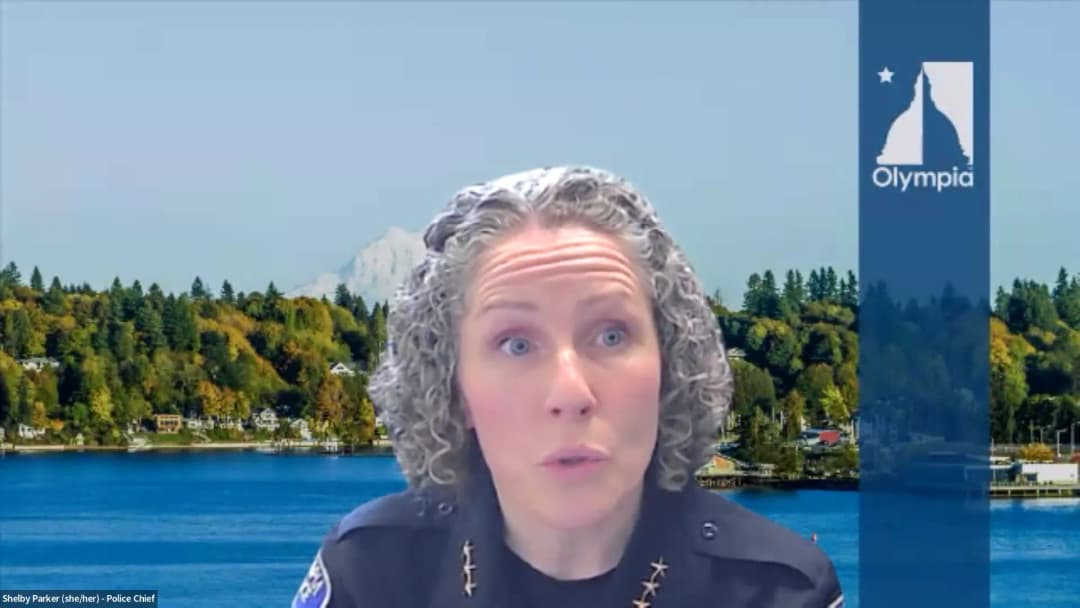
The Olympia City Council held a regular business meeting on May 20, 2026. The meeting included a special recognition proclamation for Olympia Heritage Month, public comments on homelessness and other issues, approval of the consent calendar, and a presentation and discussion of the Civilian Police Auditor 2025 Annual Report. The meeting concluded with council reports and an executive session on litigation. Consent Calendar - Approved the minutes from the May 5, 2026 City Council meeting and the May 12, 2026 Study Session meeting. - Adopted a resolution authorizing submission of a National Endowment for the Arts Grants for Arts Projects grant for the Daley Arts Center. - Approved an ordinance amending Ordinance 7454 (First Quarter Budget Amendment) on first reading, moving it to second reading. - The consent calendar was adopted by a 7-0 vote. Public Comments & Testimony Nine speakers provided public comment: - Cece Coates (35-year resident) spoke about the lack of affordable housing, criminalization of homelessness, and the difficulty of finding legal parking for vehicle dwelling. She urged compassion and highlighted that even churches cannot offer hospitality under current ordinances. - Dee Dee Smith (volunteer at shelters) shared stories of individuals experiencing homelessness in vehicles, including “Superman” Chris Hyde, and asked the city to find safe parking solutions. - Rick Hoonan (Emergency Habitat resident) complained about excessive vehicle noise on Capitol Way North, affecting residents with medical issues. Police Chief Shelby Parker invited him to discuss further. - David Webb criticized the city’s approach to closing “the Jungle” encampment, alleging that a by-name list with a May 28 cutoff date would exclude many people, especially non-English speakers, and that police oversight remains inadequate. - Tye Gundel (Executive Director, Olympia Mutual Aid Partners) expressed concern about the rushed timeline for creating a by-name list for the Jungle closure, noting that similar lists for smaller camps took months. He urged a slower, more careful process. - Molly O’Neill supported a pause on the Jungle closure and addressed a prior comment by Mayor Pro Tem Huỳnh regarding “victim Olympics,” calling it anti-black and harmful. She demanded accountability from the council. - Gary Meyers cited a fire code statute (OMC 16.32.050) regarding access roadways and expressed frustration that his requests for review under that statute have been ignored, risking denial of his permit. - Stephen Bramwell (WSU Extension Director) invited the council to a grasslands art and photography exhibit on May 28, part of the UN International Year of Rangelands and Pastoralists. - Mary Julezan (virtual) called for immediate closure of the Jungle, citing crime, drugs, and safety concerns, and criticized the city for enabling dangerous conditions. Councilmembers responded to comments, with Assistant City Manager Debbie Sullivan clarifying that the by-name list is a tool to access state-funded housing units and is not intended for a sweep. Mayor Payne emphasized balancing compassion with community safety. Discussion Items Civilian Police Auditor 2025 Annual Report - Community Engagement Specialist Margo Morales introduced the presentation. - Police Chief Shelby Parker presented 2025 use-of-force data: 80 incidents (up from 79 in 2024), with 2.5% of arrests involving force. One officer-involved shooting occurred (deemed justified by prosecutor). - Auditors from OIR Group (Stephen Connolly and Michael Gennaco) presented their first annual report, reviewing 50 use-of-force incidents. They found the department’s review process well-structured and effective, with no evidence of bias. They made 22 recommendations focusing on process improvements, including better trauma-informed interviews of subjects, enhanced supervisor training, and limiting taser use. They noted the department has already implemented 9 recommendations. - Chief Parker outlined implementation phases, including policy changes on taser deployment, profanity, and body-worn camera muting after force incidents. - Councilmembers asked questions about the complaint process, the WRAP restraint system, body-worn camera muting, and regional coordination. The report was received. Council Reports - Councilmember Madrone (liaison to police auditor) praised the collaboration. - Councilmember Vanderpool reported on Transportation Policy Board and Climate Collaborative meetings, including updates on Target Zero traffic safety and forest land management. - Councilmember Gilman reported on Finance Committee (budget outlook stable), park impact fees, refugee resettlement, and Board of Health issues regarding unpermitted food vendors. - Assistant City Manager Debbie Sullivan announced this was her last council meeting, thanking the council for their leadership. Key Outcomes - Consent calendar approved (7-0). - Ordinance 26-0347 (First Quarter Budget Amendment) approved on first reading. - Police Auditor 2025 Annual Report received; 22 recommendations noted, with 9 already implemented and the remainder scheduled for 2026. - The council recessed for an executive session on potential litigation (60 minutes) and adjourned at 9:31 p.m. No decisions were made in executive session.

PUBLIC SAFETY 39% · PROCEDURAL 20% · HOMELESSNESS 15% · COMMUNITY ENGAGEMENT 4%
43
MAY 20, 2026 · OLYMPIA, WASHINGTON · CITY COUNCIL & COMMISSIONS
Olympia Finance Committee Meeting - May 20, 2026

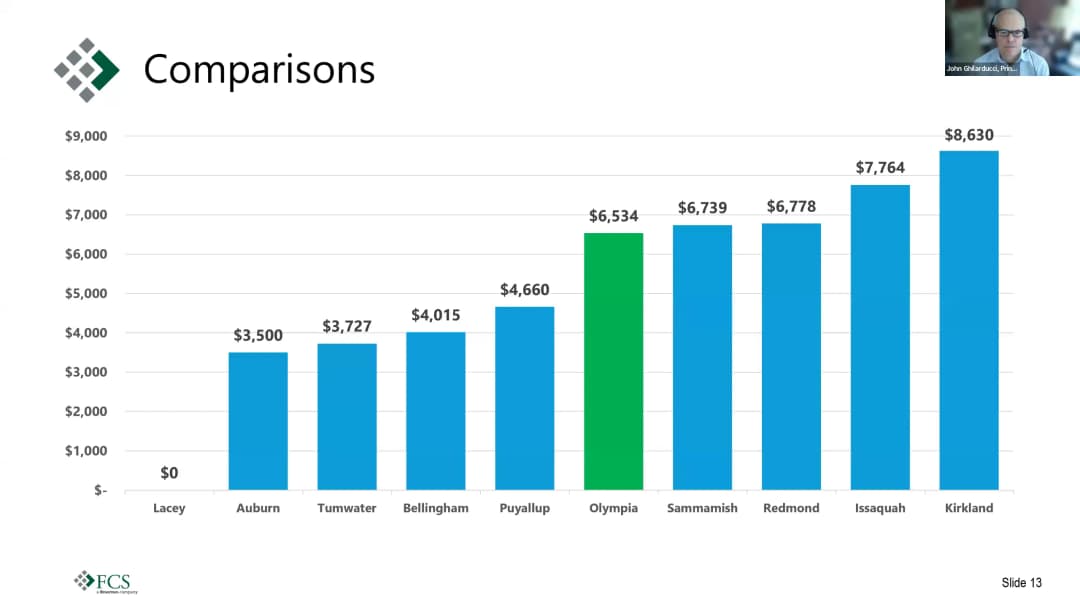
Note: The meeting minutes and transcript indicate the meeting occurred on Monday, May 18, 2026. This summary uses the date provided in the task (May 20, 2026) as requested, noting the discrepancy with the source materials. The Finance Committee of the Olympia City Council met from 4:31 PM to 6:09 PM to discuss the expenditure approval process, the 2027 budget process, preliminary 2025 year-end estimates, and a proposed new methodology for park impact fees. All three committee members were present: Chair Clark Gilman, Kelly Green, and Robert Vanderpool. Consent Calendar - Approval of Agenda: Approved unanimously. - Approval of Minutes: The minutes from the April 20, 2026 Finance Committee meeting were approved unanimously. Discussion Items 6.A Budget Spotlight: Expenditure Approval Process Finance Director Michael Githens presented a detailed overview of the city's expenditure approval process, including the paths invoices and payroll documents follow through internal controls (Workday system, departmental review, finance audit). He highlighted key checks: budget availability flags, payroll reconciliation, and fraud prevention measures. Committee members asked about discrepancy red flags and the balance between automated controls and human oversight. The discussion was informational with no action taken. 6.B 2027 Budget Process and Preparation Update City Manager Jay Burney outlined significant process changes for the 2027 budget. Instead of a standalone Budget Review Team, the entire Executive Team will collaborate on enhancements and decision-making, aiming for better transparency and earlier involvement. Key dates: enhancements prioritization May 28, council study session June 9, final adoption December 8 and 15. Committee members asked about how priorities are chosen, funding availability, and handling late-emerging needs. Burney noted that all enhancement requests will be reviewed collectively and the full list will be presented to council. 6.C Preliminary 2025 Year-End Estimates Update Senior Accounting and Budget Manager Joan Lutz presented preliminary 2025 year-end estimates (audit not yet complete). General Fund is estimated to end with $14.6 million balance, $2.49 million above the 10% reserve ($12.1 million). Pending items: carryover requests for first-quarter budget amendments totaling about $2.5 million, including $500,000 for purchase rehearsal. The 900 Plum Street transition costs are higher than initially projected due to increased material costs and tenant improvement assumptions; city staff noted that actual costs may come in lower. Committee members expressed concern about the change from the earlier net-zero projection for Plum Street and requested a full comparison when the issue goes to full council in June. Jay Burney added that leasing some OPD vehicles saved $400,000 this year. 6.D Parks Impact Fee Methodology FCS Consulting President John Ghilarducci presented a new methodology for park impact fees, required by recent state law to scale fees by square footage (or bedrooms) to produce proportionally lower fees for smaller units. The proposed approach uses dwelling unit square footage at $3.92/sq ft, with a minimum fee of $3,187.93 (for units ≤813 sq ft) and a maximum of $13,720 (for units ≥3,500 sq ft). This is designed to be revenue-neutral compared to the current fee schedule ($6,995 for a single-family home). The committee discussed comparability with other cities, the definition of habitable square footage, and the vested rights for projects already in the pipeline. Motion: Councilmember Green moved, seconded by Councilmember Vanderpool, to approve the recommended new park impact fee methodology and forward it to the full City Council. Motion carried 3-0. Reports and Updates Finance Director Githens reported that the state audit has officially started, including financial and federal grant audits, and a risk assessment call has been conducted. The quarterly financial report will be published monthly on the website and presented to the full council. The next study session on June 9 will focus on preliminary budget estimates and the enhancement picture. Key Outcomes - Approved New Park Impact Fee Methodology (vote 3-0) to be forwarded to full Council. - Staff directed to prepare a detailed comparison of Plum Street transition cost projections vs. current estimates for the June council meeting. - The committee received updates on the 2027 budget timeline and expenditure controls; no further action taken.

BUDGET EQUITY ANALYSIS 39% · FISCAL SUSTAINABILITY 13% · PARKS AND RECREATION 13% · ENGINEERING AND INFRASTRUCTURE 9%
44
MAY 13, 2026 · OLYMPIA, WASHINGTON · CITY COUNCIL & COMMISSIONS
Olympia City Council Study Session on Municipal Court Transition - May 12, 2026

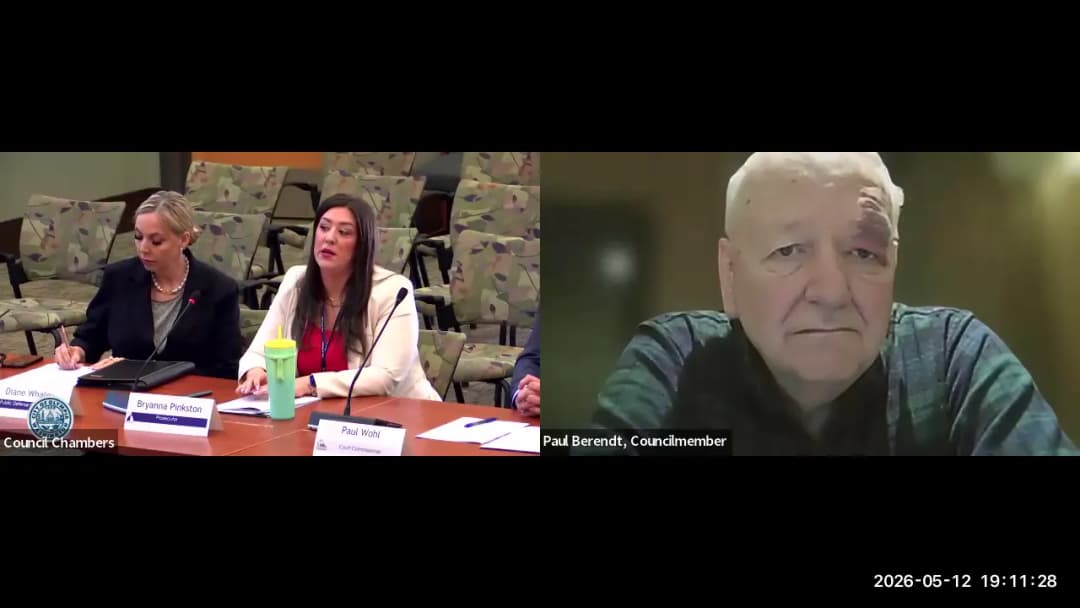
Olympia City Council Study Session on Municipal Court Transition - May 12, 2026\n\nThe Olympia City Council held a study session on Tuesday, May 12, 2026, from 6:00 PM to 7:32 PM to discuss the ongoing transition of municipal court services to Thurston County District Court following the 2025 Interlocal Agreement. The session included updates from Assistant City Manager Debbie Sullivan, Thurston County Court Executive Officer Frankie Peters, District Court Judge Sam Meyer, Court Commissioner Paul Wohl, City Prosecutor Bryanna Pinkston, and Public Defense Coordinator Diane Whaley. Councilmembers asked clarifying questions and received information on operational progress, parking ticket processing, financial rate studies, and plans to develop therapeutic courts for Olympia cases. No formal votes or decisions were taken; the session was informational to inform future negotiations for a new Interlocal Agreement beginning January 1, 2027.\n\n Discussion Items\n- Transition Update: Frankie Peters reported that the transition from Olympia Municipal Court to Thurston County District Court was completed in six months from the signing of the ILA in August 2025, a timeline he initially estimated at 18–24 months. Key milestones included: onboarding 14 staff (from over 1,000 applications and 100+ interviews), transferring 2,500 case files (each taking 15–45 minutes manually), and expanding into Building One for probation and therapeutic court space. The court experienced a 30% workload increase but saw a 15–20% reduction in non-compliance, attributed to probation counselors' supportive approach.\n- Parking Ticket Processing: A challenge remains with parking tickets issued via the City’s T2 system. Currently, tickets are manually walked to the court and entered by hand, causing delays for citizens seeking immediate payment. The City and County are working with the T2 vendor to automate data transfer directly into the court’s JIS system, with an online payment module expected soon. Judge Meyer explained that parking tickets are infractions issued against vehicles (not persons) and can be contested in court, with options for mitigation or deferral.\n- Comprehensive Rate Study: Frankie Peters noted that a four-year rate study will be conducted by an external contractor (vendor to be approved by the County Board the following week). The study will cover all partner cities (Tumwater, Lacey, Rainier, Tenino, and Olympia). Initial data sharing is expected in July 2026, with final results by September–October 2026, earlier than previous years, to allow more time for budget discussions.\n- Therapeutic Courts Development: City Prosecutor Bryanna Pinkston outlined plans to create a therapeutic court for Olympia cases, given the current absence of one post-transition. Options include a mental health court (which could launch as early as January 2027, building on existing County programs) or a community court model (targeting summer 2027, requiring more groundwork). Challenges include staffing—the prosecution team carries heavy caseloads (400–500 active cases per attorney)—and the need to tailor programs to Olympia’s specific clientele, which includes many individuals experiencing homelessness, mental health issues, and substance use disorders. Pinkston emphasized the importance of victim accountability, noting that crimes like domestic violence and DUIs may not be appropriate for shorter therapeutic programs due to protection orders and deterrence concerns. In the interim, the County’s specialty probation, resource hub, and diversion services (e.g., Friendship Diversion) provide support.\n- Community Engagement: Councilmembers stressed the need for inclusive community input, including from the Social Justice and Equity Commission, Thurston ACP, and other stakeholders. Public Defense Coordinator Diane Whaley acknowledged that extensive engagement was done when the original community court was created years ago, but a new process is needed. City Manager Jay Burney noted that communication strategies will be developed to ensure broad outreach.\n- Facilities and Long-Term Plans: Frankie Peters reported that temporary renovations are complete. The County is preparing an RFP for a contractor to develop a downtown building for court services, with all county services expected to be relocated by 2029, prioritizing courts sooner.\n\n Key Outcomes\n- No formal votes or decisions were taken; the session was a study session to inform council and staff for upcoming negotiations on the 2027 Interlocal Agreement.\n- Next Steps for Therapeutic Courts: Summer 2026 will involve observing existing County therapeutic courts, engaging community groups, and assessing resource needs. The goal is to launch an Olympia mental health court by early 2027 or a community court by summer 2027. City Manager Burney committed to ensuring staffing is not a barrier and will bring resource requests to council as needed.\n- Rate Study Timeline: The County will contract with a vendor by late May 2026, with preliminary data sharing in July and final results by fall 2026.\n- Parking Automation: The City and County will continue working with T2 vendor to automate parking ticket transfers and online payments, with a short-term manual process in place.\n- Community Engagement: The City will develop a communication strategy and identify a lead entity (likely public defense) to coordinate outreach and public updates on therapeutic court development.\n- Monitoring Data: Councilmember Gilman requested tracking of failure-to-appear rates and incarceration trends. Early data shows the daily jail population decreased from an average of 50–60 to 38–44, but prosecutors cautioned it is too early to identify trends.

THERAPEUTIC COURTS 23% · PUBLIC SAFETY 14% · COURT SYSTEM 13% · COURT MANAGEMENT 11%
45
MAY 7, 2026 · OLYMPIA, WASHINGTON · CITY COUNCIL & COMMISSIONS
Community Livability and Public Safety Committee Meeting – Public Safety Update – May 6, 2026

Note: The user-provided date (May 7, 2026) conflicts with the meeting transcript and minutes, which clearly state the meeting occurred on Wednesday, May 6, 2026. This summary uses the correct date from the source material. The Community Livability and Public Safety Committee (CLPS) of the Olympia City Council held a special meeting on May 6, 2026, at 5:33 p.m. The sole business item was a public safety update from Olympia Police Department (OPD) Chief Shelby Parker, covering 2025 operational data, staffing progress, and employee wellness initiatives. Consent Calendar - Approved the agenda unanimously. - Approved the minutes of the March 25, 2026 meeting unanimously. Public Comments & Testimony - No public comments were received. Discussion Items Olympia Police Department Public Safety Update – Chief Parker presented an overview of OPD’s 2025 performance and 2026 first‑quarter progress. Operational Data (2025) - OPD fulfilled over 3,600 public records requests, completed more than 6,600 incident reports, processed 860 civil orders, and handled nearly 54,000 dispatched calls for service. - The Crisis Response Unit (CRU) responded to nearly 5,900 contacts in 2025, nearly double the 2023 volume. CRU responded independently 81% of the time (up 10% from 2024) and co‑responded with law enforcement in 19% of instances. - Crime trends showed relative stability. Notable: no homicides in 2025; reported rapes increased to 44 incidents (attributed to improved reporting options, including the Seek Then Speak tool); commercial and residential burglaries declined; trespass arrests increased to 257 incidents. - A proactive policing unit launched in July 2025 with the Lacey Police Department arrested more than 22 chronic offenders in its first six months. - Juveniles accounted for 2.2% of all OPD arrests in 2025 (nearly 98% adult enforcement). Staffing & Recruitment - OPD is authorized 129 full‑time positions (88 sworn, 41 non‑commissioned). At end of 2025, 22 positions were vacant (including 13 officers, 1 sergeant, 4 CRU staff, 2 CSOs, and the chief position – since filled). - Despite hiring 15 staff in 2025, vacancies persisted. As of Q1 2026, vacancies stood at 13, with 6 new hires in the quarter. Two conditional offers for lateral officers were pending, potentially reducing vacancies to 11. - In Q1 2026, 129 individuals applied for officer positions; only 7 advanced to the oral board due to high standards (screening for theft, deception, aggression, substance use, etc.). - Chief Parker noted that staffing recovery is not linear: a new officer takes about 12 months to become fully operational. Lateral hires impact field staffing faster. - Recruitment incentives (lateral hiring bonus, employee referral program) are working; two additional officer applicants were added the week of the meeting. - Compared to other Washington agencies, OPD is not alone in facing staffing challenges; some large agencies have long waits for field training due to trainer shortages. - Resignations occur when the job is not a good fit or officers seek different policing models. Wellness Initiatives - OPD has a 14‑member peer support team (commissioned and non‑commissioned). - Partnership with Counseling Team International (TCTI) provides immediate access to culturally competent clinicians; every employee receives 10 confidential counseling sessions per year. - Partnership with Ready Rebound for injured employee medical care and recovery. - Through a WASPC grant, OPD partners with Sigma Tactical Wellness for intensive cardiovascular screening to detect early signs of heart disease and stroke. Committee Questions & Discussion - Committee member Kelly Green asked for clarification on CRU staff (non‑commissioned, unarmed). She also inquired about the decline in crime categories from 2023–2025; Chief Parker cited accountability of chronic offenders, technology improvements, and the special investigations response team. - Committee member Yến Huỳnh asked about retail theft; Chief Parker acknowledged it is a regional issue and that OPD is working with the Washington State Fusion Center. She noted that private security at large stores serves as a deterrent and that OPD has positive relationships with those security teams. She will provide more data at the next update. - Committee Chair Madrone asked about Community Service Officers (CSOs): they are specially commissioned, non‑academy trained; primarily transport inmates to jail and court, handle property, traffic control, and equipment needs. A reorganization is underway due to court changes. - Chair Madrone also asked how OPD’s staffing compares to similar agencies; Chief Parker said most are struggling, and that retention is challenging because many officers have other skills and may leave. OPD offers a team environment, full‑service policing, and 96 hours minimum training per year (state standard is 24 hours), which attracts laterals. Key Outcomes - The committee received the OPD public safety update (no formal vote required). - No further action items or referrals were made. - The next regular CLPS meeting is scheduled for May 27, 2026. - The meeting adjourned at 6:20 p.m.

PUBLIC SAFETY 54% · STAFFING 22% · PERSONNEL MATTERS 9% · PROCEDURAL 8%
46
MAY 6, 2026 · OLYMPIA, WASHINGTON · CITY COUNCIL & COMMISSIONS
Olympia City Council Meeting - May 6, 2026: Legislative Session Debrief, Opioid Funding, and Downtown Vacancy Study

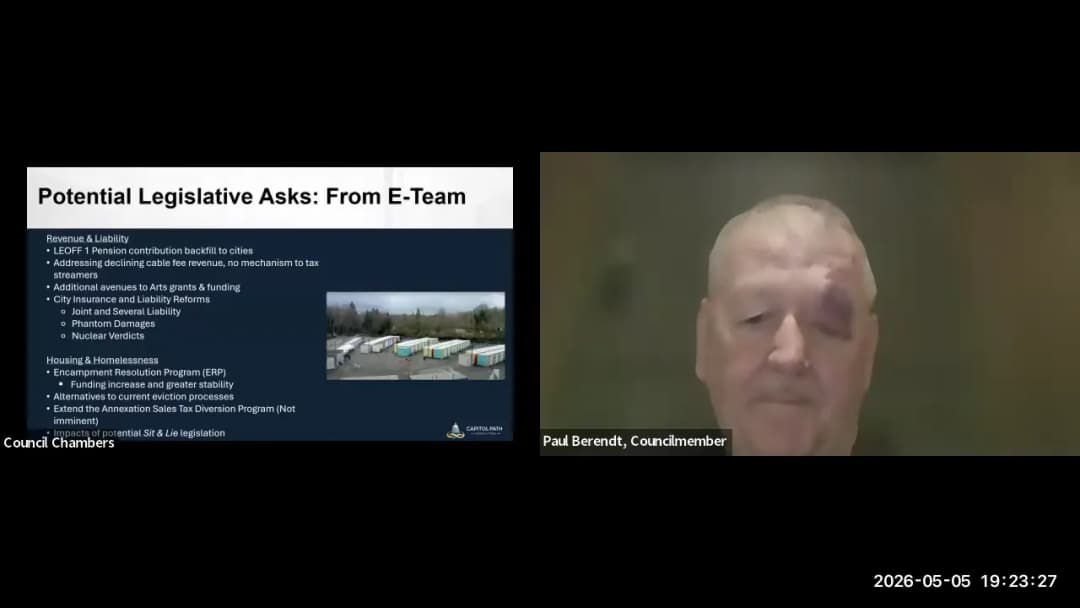
The Olympia City Council met on the date of May 6, 2026 (note: meeting minutes and transcript indicate the meeting took place on Tuesday, May 5, 2026; the provided date is used per instruction). The meeting included special recognitions for Asian American, Native Hawaiian, and Pacific Islander Heritage Month and Jewish American Heritage Month, public comments on various issues including the withdrawal of city sponsorship from a Juneteenth event and homelessness, approval of consent calendar items, a legislative session debrief, approval of opioid settlement fund pooling, and a discussion of the downtown commercial vacancy study. Special Recognition - Asian American, Native Hawaiian, and Pacific Islander Heritage Month: Council proclaimed May 2026 as AANHPI Heritage Month. Lin Crowley (Program Director, Asian Pacific Islanders Heritage Coalition of South Puget Sound) and board member Jay Chitra accepted the proclamation and invited the community to a May 23 celebration at South Puget Sound Community College. - Jewish American Heritage Month: Council proclaimed May 2026 as Jewish American Heritage Month. Daniel Farber (President, Temple Beth Hatfiloh) accepted and emphasized partnership with the city, thanking the city for support during anti-Semitic incidents. Public Comments & Testimony - Several speakers criticized the city's decision to withdraw sponsorship and funding from the Juneteenth celebration organized by Shawna Hawk of the Women of Color Leadership Movement. They questioned the timing (late April, eight weeks before the event) and perceived lack of engagement with original community leadership. Speakers expressed that the decision seemed contradictory to the city's stated equity values and asked the council to reverse it. Some speakers also called for a formal review of a February incident where a speaker was interrupted during Black History Month comments. - Multiple speakers addressed homelessness, urging the city to relax or not enforce ordinances targeting people living in vehicles, tents, or open air. They emphasized the need for affordable housing, low-barrier shelters, and transitional resources, arguing that the city has enough housing but lacks affordability. Speakers also highlighted the disproportionate impact on minorities and the trauma experienced by unhoused youth. - Councilmembers responded by acknowledging the need for more services and housing, and some noted ongoing meetings with advocates (Councilmembers Vanderpool and Gilman). Mayor Payne stated the city continues to observe Juneteenth as a holiday via proclamation and flag-raising, and is working with other partners for celebrations. Consent Calendar - The following items were approved unanimously (7-0): - Approval of April 28, 2026 City Council meeting minutes. - Resolution authorizing application for a Heritage Capital Projects 2027-2029 Grant for the Olympia Armory Building. - Resolution to amend the Ziply Fiber Master Use Permit. - Resolution authorizing a contract with Solid Waste Systems Equipment, LLC for one waste collection truck. Discussion Items - 2026 State Legislative Session Debrief and 2027 Legislative Agenda Check-in: Legislative Liaison Susan Grisham introduced lobbyists from Capital Path (Kyla Shkerich Blair and Daniel Pailthorp). They reviewed outcomes of the 2026 session: passage of a 9.9% millionaires tax on income over $1 million (effective January 2028), sales tax exemptions on diapers and hygiene products, $123 million investment in the Housing Trust Fund (largest for a supplemental budget), full funding for Deschutes Estuary design, and various bills expanding local taxing authority (e.g., councilmanic sales tax for children and families, expanded REET tax flexibility, extended public facility district authority). They discussed interim planning and invited council input for 2027 priorities. Councilmembers suggested: state engagement on homelessness and scaling up efforts (Councilmember Gilman), state acting as its own housing developer (Councilmember Vanderpool), tax flexibility and local pilot authority (Councilmember Vanderpool), amending SEPA to require traffic impact analysis for all modes (Councilmember Madrone), recycling and bottle deposit legislation (Mayor Pro Tem Huỳnh), small business support and vacancy tax (Mayor Pro Tem Huỳnh), and behavioral health resources (Mayor Payne). Mayor Payne also expressed interest in a state Department of Housing if it provides short-term shelter support. The council discussed the need for progressive local revenue options rather than regressive sales taxes. The information was received; staff will develop the agenda further. - Approval of Opioid Funding for Pooling with Opioid Abatement Council: City Manager Burney presented a proposal to contribute $562,714 (50% of the current opioid settlement fund balance of approximately $1.1 million) to a regional $2 million request for proposals through the Thurston County Opioid Abatement Council. The funds, part of national litigation settlements, will support prevention, treatment, and recovery programs aligned with the Thurston County Opioid Response Plan (2026-2027). Other jurisdictions are also pooling funds. Councilmember Gilman moved to authorize the contribution; the motion passed unanimously (7-0). The city's share must be committed by June 30, 2026. - Discussion of Downtown Commercial Vacancy Study: Economic Development Director Jennica Machado introduced consultants from Leland Consulting Group (Chris Zahas and Jennifer Shook). The study aimed to provide a data-driven understanding of commercial vacancies downtown. Key findings: overall downtown visits have recovered to near pre-pandemic levels (down only 2% from 2019); vacancy is concentrated in long-term chronic spaces (66% of retail vacancy in older historic buildings) and ground floors of newer mixed-use buildings (16% of retail vacancy). Office vacancy is high due to state remote work. A unique barrier identified is the city's half-street repaving requirement triggered by a change of use generating more than 20 additional vehicle trips per day on streets with low pavement ratings. Recommendations included: revising the repaving trigger, increasing transparency on city policies, exploring low-interest loan programs for tenant improvements, allowing live-work units on secondary streets, creating a downtown ombudsman position, prioritizing downtown sidewalk repairs, implementing a facade improvement program, exploring a downtown parking garage, and updating the downtown plan (last updated 2017). Councilmembers discussed the repaving issue (Councilmember Gilman emphasized pavement preservation from utility cuts), the potential for live-work conversions (Councilmember Barrett asked about barriers), and the need for a comprehensive downtown plan update. The study was received as information; staff will consider recommendations. Key Outcomes - The Consent Calendar was adopted (7-0). - The city authorized contribution of $562,714 in opioid settlement funds to the regional Opioid Abatement Council pooling fund (7-0). - The council received the 2026 legislative session debrief and provided preliminary direction for 2027 legislative priorities; staff and lobbyists will continue development through summer and fall. - The council discussed the downtown vacancy study; staff will consider the recommendations and may bring forward actions for further consideration. The council noted support for revisiting the downtown strategy.

ECONOMIC DEVELOPMENT 19% · RACIAL EQUITY 16% · LAND USE PLANNING 12% · PROCEDURAL 10%
47
MAY 5, 2026 · OLYMPIA, WASHINGTON · CITY COUNCIL & COMMISSIONS
Olympia Planning Commission Meeting Summary - May 5, 2026

The Olympia Planning Commission met online on May 5, 2026 (the meeting record cites Monday, May 4, 2026, at 6:30 p.m.) and adjourned at 8:45 p.m. Chair Greg Quetin presided with Vice Chair Daniel Garcia and Commissioners Elle Burger, Zainab Nejati, and Aaron Sauerhoff present; four commissioners were excused. The commission received a briefing on developing a long-term sidewalk repair policy, heard public testimony, and agreed to prepare a letter to City Council. Consent Calendar - The agenda was approved by voice vote. - The April 20, 2026 Planning Commission meeting minutes were approved by voice vote. Public Comments & Testimony - Jim Lazar spoke in support of using Transportation Benefit District (TBD) sales tax revenue for sidewalk repair. He noted that walking is the number one form of transportation and that 40% of people do not drive. He cited the TBD's approximately $3 million per year for active transportation and urged the city to hire three crews: one for major-street panel replacements, one for neighborhood streets, and one dedicated to grinding pavement irregularities under two inches. He said a grinding crew could fix 20 to 50 spots per day, called this the single most important TBD expenditure, and urged the Planning Commission to recommend hiring a dedicated sidewalk grinding crew as soon as possible. Staff Announcements - Staff reminded commissioners about a Department of Commerce short course on local planning scheduled for Wednesday, May 6, 2026, from 5:00 to 8:00 p.m. at Tumwater City Council Chambers and via Zoom. Staff requested 24 hours' notice for quorum purposes if five or more commissioners planned to attend. Discussion Items - Michelle Swanson, Principal Planner, and Max DeJarnatt, Associate Planner, presented the sidewalk repair policy briefing. - Timeline: City Council's Land Use and Environment Committee requested research in 2022; staff returned with policy options in 2023; a full sidewalk inventory was conducted in 2024; final inventory results were shared in 2025; and City Council directed creation of a four-person sidewalk repair crew in 2025. - Existing code makes adjacent property owners responsible for sidewalk maintenance, but enforcement has been difficult. The state Joint Transportation Committee's preliminary survey found that 72% of surveyed cities require adjacent property owners to fix sidewalks, more than half found that ineffective, and only 3% called it effective. - The 2024 inventory covered 226 linear miles of sidewalks and identified almost 28,000 locations needing repair. Damage was classified as 57% panel uplifts, mostly from tree roots, and 38% cracking or spalling; these two categories accounted for 95% of damage. - The Capital Sidewalk Repair Program is funded at $500,000 per year from TBD revenue. In 2025 the city repaired two block faces and plans to continue full block-face projects. - The new four-person crew is funded at $681,000 per year plus a one-time $149,000 excavator purchase, and is expected to repair 20 to 25 sites per year. DeJarnatt cited earlier rough estimates of $36 million to $76 million for severe panel replacements and 102 to 129 years to complete them with one crew. - A story map and online survey drew nearly 1,900 views and 363 responses. Among respondents, 49% supported prioritizing repairs near common pedestrian destinations, 21% preferred street tree corridors, and 29% offered another idea. When asked about requiring sidewalk repair on property sale, 45% supported it, 34% opposed it, and 21% were unsure. Staff noted the survey was not statistically valid; 83% of respondents identified as white, and no outreach was done to people without computer access. Commissioner Daniel Garcia questioned the representativeness and authority of percentages based on fewer than 1% of Olympia's population. - Commissioners discussed who should pay for sidewalk repair. Zainab Nejati said property owners should not be responsible because sidewalks are part of the transportation network, and costs to duplex or apartment owners can be passed to residents. Aaron Sauerhoff said the city should be responsible for the public right-of-way and opposed creating different classes of property owners. Daniel Garcia noted that requiring large property owners to pay could still pass costs to renters. Commissioners also discussed maintaining and expanding tree canopy, improving street tree standards, and addressing vegetation from private property that damages sidewalks. - On prioritization, commissioners supported focusing on pedestrian destinations such as schools, parks, bus stops, grocery stores, and public buildings, with attention to transit hotspots and visible downtown locations. Staff noted there is overlap between destination areas and street tree corridors, and that ADA considers any lift over one-quarter inch an accessibility barrier; the inventory recorded lifts of one-half inch or higher. - Commissioners discussed funding trade-offs within the TBD's roughly $3 million annual active transportation revenue, including whether more should go to maintenance rather than new bike and pedestrian infrastructure. They also raised potential partnerships with Intercity Transit, the school district, neighborhood associations, and nonprofit or philanthropic sources, and asked about the feasibility of a dedicated grinding crew. Staff said the city has a grinder and would know more after the crew's first year of work. Key Outcomes - The commission received the briefing and will prepare a letter to City Council with topics to consider when developing a sidewalk repair policy. - No formal motion was adopted. Chair Quetin and Vice Chair Garcia will prepare a draft letter, which can be shared with the Land Use and Environment Committee before its May 28, 2026 meeting and considered for formal adoption before the City Council study session scheduled for July 21, 2026. - The May 18, 2026 Planning Commission meeting is cancelled; the next scheduled meeting is June 1, 2026.

ENGINEERING AND INFRASTRUCTURE 21% · SIDEWALK MAINTENANCE 19% · PUBLIC ENGAGEMENT 18% · TRANSPORTATION SAFETY 17%
48
APR 29, 2026 · OLYMPIA, WASHINGTON · CITY COUNCIL & COMMISSIONS
Olympia City Council Regular Business Meeting - April 29, 2026

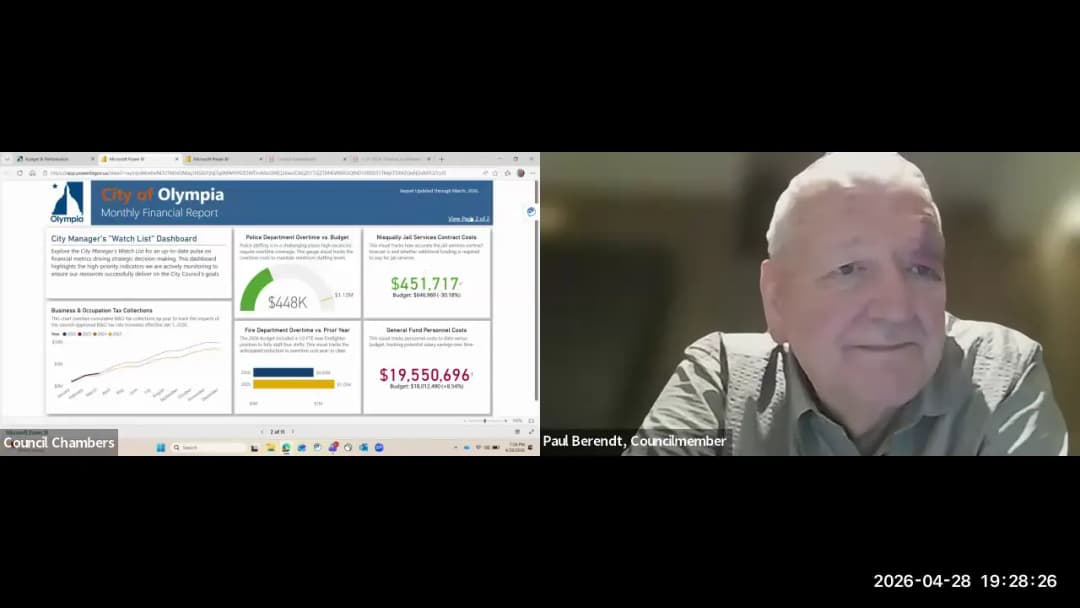
The Olympia City Council met on April 29, 2026 for its regular business meeting. Six council members were present (Mayor Dontae Payne, Mayor Pro Tem Yến Hu ỳnh, Councilmembers Vanderpool, Gilman, Green, and Berendt); Councilmember Madrone was excused. The meeting included special recognitions, public comment, approval of a consent calendar, and a report on a new monthly financial reporting tool and the 2027 budget calendar. Special Recognitions - Bicycle Month Proclamation (26-0313): The council recognized May 2026 as Olympia Bicycle Month. Senior Program Specialist Kristin Gilkerson and Intercity Transit Community Challenge Coordinator Alli Fuller accepted the proclamation and spoke about bicycling benefits and upcoming events (e.g., Bicycle Community Challenge, Bike Anywhere Day on May 14). - Public Service Employees Month Proclamation (26-0312): The council recognized May as Public Service Employees Month. City Manager Jay Burney highlighted the dedication of over 700 city employees and the various recognition weeks (e.g., Municipal Clerk Week, National Police Week, etc.). Public Comments & Testimony Over a dozen members of the public spoke, both in-person and online. The overwhelming majority of comments focused on concerns about the treatment of unhoused residents, particularly trans and disabled community members, and called for more compassionate policies and an end to police harassment. Specific speakers included: - CC Coates: Stated that subsidized housing programs are no longer issuing new subsidies and that police are aggressively targeting homeless people, calling for systemic change and more affordable housing. - Victoria Harmon (Regional Manager, Timberland Regional Library): Reported that due to staffing cuts, the West Olympia Library will close on Sundays effective May 17, with both libraries open Monday–Saturday 10–6. - Sezung Kim: Shared personal experience with a domestic violence case and alleged lack of proper response from authorities. - Georgia Aust: Expresed support for unhoused and trans community members, urging the city to stop harassing people who are just existing in their vans. - Jean Eerhardt: Spoke as a homeowner and neighbor of CC Coates, praising her as a good neighbor and questioning why she was forced to move. - Annette Ruzicka: Continued the discussion on how the city cares for its unhoused trans and disabled community, asking what has been done to ensure fair housing and calling for a review of ordinances that target the houseless. She also criticiized police oversight as ineffective. - David Webb: Criticized police oversight, stating that the Olympia Police Department investigates itself and that the civilian auditor system is insufficient. He also referenced the failure to hold officers accountable for the killing of Timothy Green. - Jennifer Robinson (voiced as Alexandrovic Garr? Actually later appears as separate comment): Expressed anger at police threats and harassment toward those living in motorhomes, questioning the legality of such actions and warning of potential lawsuits. - Alexandrovic Garr: Introduced him/herself as a new resident to Olympia. - Sybil Dooghan (virtual): Spoke in solidarity with unhoused neighbors, arguing that police uphold laws that criminalize poverty and that the city's actions contradict its comprehensive plan. - Crystal Snare (virtual): Supported CC Coates as a neighbor, praising her community contributions and urging creative solutions for affordable housing. Discussion Items - Report on New Format of Monthly Financial Report and 2027 Budget Calendar (26-0314): Finance Director Mike Githens presented a new interactive, web-based monthly financial reporting tool developed in-house, which allows the public and council to drill into revenues, expenditures, and watch list items (e.g.,B&O tax,collections, police overtime). The tool uses color-coded indicators (green, yellow, red) and includes notes for context. City Manager Burney emphasized that the tool increases transparency and saves money previously spent on third-party software. Githens also outlined the preliminary schedule for developing the 2027 budget, with study sessions planned for summer and fall 2026 and adoption in December 2026. Council members praised the tool and its transparency. Council Intergovernmental/Committee Reports - Councilmember Barrett: Noted that two anti-trans initiatives are on the ballot and encouraged the city to continue working on housing availability. - Councilmember Gilman: Reported from the Finance Committee that a deep dive on fleet and building costs showed that meeting the city's 2040 climate goals for internal operations would require an additional $6 million per year starting immediately (e.g., $61 million over 13 years for building condition, plus $37 million for decarbonization; $10 million for fleet charging infrastructure plus $26 million for EVs). This will require difficult decisions about revenue or service reductions. - Councilmember Vanderpool: Reported on Intercity Transit discussions about Route 41 changes (not possible to restore due to interlining); on Regional Housing Council progress (continued funding for services); on Land Use & Environment committee review of downtown vacancy study (will come to council next week) and renewal of the affordable housing emergency declaration for two years; on a neighborhood traffic safety concern on Boston Harbor Road; and noted a May Day event at Sylvester Park. - City Manager Burney: Announced the downtown vacancy study will be presented to council next week, and thanked staff and the community for a successful Spring ArtsWalk weekend. Key Outcomes - Consent Calendar adopted (6-0): Approved minutes of April 14 and April 21, plus resolutions for a children's museum restrictive covenant (26-0301), TCOMM911 asset transfer (26-0310), extension of OIR Group civilian police auditor services (26-0315), and appointment of Paul Horton to the Independent Salary Commission (26-0322). - Report received and discussion concluded: The new financial reporting tool will be posted monthly; the 2027 budget calendar was presented for awareness. - Direction: Councilmembers expressed openness to further discussions on unhoused policies, creative solutions for housing, and continued dialogue with the community. A follow-up was offered to the Korean-speaking commenter. - Adjournment: The meeting adjourned at 8:06 p.m.

HOMELESSNESS 24% · FISCAL SUSTAINABILITY 20% · PROCEDURAL 13% · ACTIVE TRANSPORTATION 9%
49
APR 24, 2026 · OLYMPIA, WASHINGTON · CITY COUNCIL & COMMISSIONS
Olympia Planning Commission Meeting – April 24, 2026

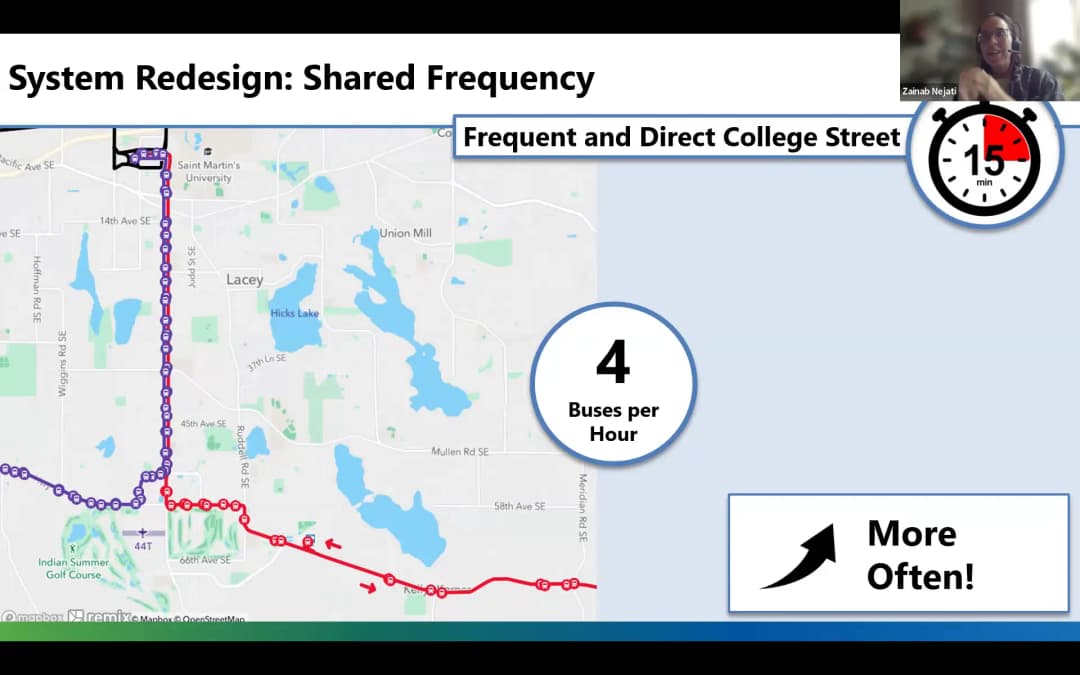
The Olympia Planning Commission met in City Hall Room 207 and online. The agenda, minutes, and transcript date the meeting as Monday, April 20, 2026, called to order at 6:31 p.m. and adjourned at 8:23 p.m.; the timestamp supplied for this summary is 2026-04-24 14:30:00 UTC. All nine commissioners were present: Chair Greg Quetin, Vice Chair Daniel Garcia, and Commissioners Elle Burger, Raphael Garcia, Jessica Grubb, Semir Ibrahimovic, Zainab Nejati, Aaron Sauerhoff, and Jason Taellious. The commission amended its agenda, received an Intercity Transit briefing, approved prior meeting minutes, heard staff announcements and reports, and discussed a future retreat. Consent Calendar - Agenda amendment: Commissioner Jason Taellious moved and Commissioner Jessica Grubb seconded to move approval of minutes and staff announcements to after business items; the motion passed by voice vote with no audible opposition or abstentions. - Agenda approved by voice vote. - Minutes of the April 6, 2026, Planning Commission meeting were approved. Commissioner Aaron Sauerhoff moved and Commissioner Jessica Grubb seconded; the motion carried, with Commissioners Raphael Garcia and Zainab Nejati abstaining. Public Comments & Testimony - No public comments were offered. One online attendee was noted, but no comment was made. Staff Announcements - Casey Schaufler, Associate Planner, announced a Washington State Department of Commerce short course on local planning on May 6, 2026, from 5:00 p.m. to 8:00 p.m. at Tumwater Council Chambers, with an online option; a quorum notice would be published if enough commissioners attend. - Schaufler said he would email the City of Olympia vacancy study prepared by the economic development team; Economic Development Director Jenica Machado was presenting it to the Land Use and Environment Committee later that week, then to City Council in late May or early June, and would later be invited to the Planning Commission. - He shared the annual Touch a Truck event on May 3, 2026, from 1:00 to 4:00 p.m. at Garfield Elementary School, with a sensory-friendly period from 1:00 to 1:30 p.m. Discussion Items - Intercity Transit Bus System Redesign Briefing (26-0294). Spencer Zeman of Intercity Transit presented the first full system redesign, which he said had been about 10 years in development and included community feedback, customer comments, sampling, and outreach. - Zeman said Intercity Transit has a static budget and is maintaining 315,000 revenue service hours while redistributing service to add coverage in previously unserved areas and to focus on hospitals, schools, and residential growth. He described the service portfolio: fixed route, vanpool, Village Vans, Bus Buddies, community vans, and Walk and Roll. - He said Intercity Transit is a municipal corporation funded by a 1.2% sales tax within a public transportation benefit area, and that ADA paratransit/dial-a-lift service operates within a three-quarter-mile boundary around the fixed-route network. - Most core routes remain largely unchanged but are being renumbered; some use interlining, where a bus changes route number mid-trip. Route 41 is being replaced by Routes 32 and 34, adding west-side and South Tumwater connections rather than only a downtown run. - The redesign launches May 3, 2026. The new Route 9X is the first express/BRT-light corridor, with limited stops, minimum four buses per hour (15-minute service), and 17 stops east-west. A new enhanced station at Fourth and Washington will be about 18 by 32 feet and is expected later in summer. Zeman said full BRT would require dedicated lanes, transit signal priority, and memorandums of understanding with jurisdictions. - Zeman said an initial small ridership decline is expected after launch, followed by ridership growth of about 5–10%. Intercity Transit had about 5 million annual rides before COVID and returned to that level in the prior year. Data comes from automated passenger counters and boarding/alighting patterns, not individual or facial tracking; surveys and outreach provide context. - He said the agency plans to reassess routes within 12–24 months, while major service changes typically take one to two years to plan and about three or four years in practice. About 3% of service is chronically delayed or has operational issues, and on-time performance compares well nationally. - Zeman stated that Intercity Transit tries to remain apolitical and respond to observed demand rather than intentionally inducing demand. Vice Chair Daniel Garcia questioned the word political, said limited resources made sense, and raised concerns about BRT-light versus full BRT, transit-oriented development, and equity impacts. A commissioner who said they ride Route 94 objected to the loss of a direct Olympia Transit Center-to-Amtrak connection and said they needed it the following month; Zeman replied that ridership data showed very few people used Route 94 for that trip and service had been redistributed elsewhere with transfers. - Zeman said West Bay is unlikely to receive fixed-route service because of the hill and lack of bus maneuvering; East Bay lacked sufficient demand in current data. Boston Harbor residents periodically request service, he said. - Commissioner Raphael Garcia asked how state housing capacity law changes factor into demand modeling; Zeman said he monitors development requests and comprehensive plan updates and uses census block data. He also requests transit-supportive frontage, sidewalks, ADA pathways, and bus pads, citing a 12-duplex Tumwater project as an example. He discussed equity and Title VI requirements and FTA protections that make service reductions difficult in lower-income or minority areas. - On safety and operations, Zeman said Intercity Transit has strengthened coordination with the Olympia Police Department, keeps an ambassador program with six full-time staff, and receives high safety ratings in satisfaction surveys. - On the fleet, he said labor is the largest expense, fuel is not a major cost, buses average about five miles per gallon, and the agency is piloting five hydrogen buses and exploring battery-electric buses. The fleet has 88 buses, with peak pullout around 67–69 buses; FTA now sets a 20% spare-ratio requirement for the agency as a large urban operator. - Outreach for the redesign includes tabling, social media, printed route maps, QR-code clings, and signage; Zeman said the first phase focuses on educating current riders before May 3, followed by efforts to reach new choice riders. He also mentioned planned future transit center placeholders and a system-wide stop inventory. Reports - Vice Chair Daniel Garcia reported that May is Bicycle Month, with events for safety, awareness, and bicycling as an alternative to vehicle transportation. Olympia's proclamation was noted as April 28, and a group bike ride with Intercity Transit was planned from Heritage Park Fountain to City Hall. Other Topics - Chair Greg Quetin discussed tentative planning-commission retreat plans for July or August 2026, with a Doodle poll to follow. Potential topics included the Plum Street corridor and the sidewalk conditions report; one commissioner suggested exploring a joint retreat with Lacey and Tumwater planning commissions. Key Outcomes - The Intercity Transit bus system redesign briefing was received as an information item; the commission took no formal recommendation or vote on it. - The agenda and minutes approvals are recorded above; the minutes motion carried with two abstentions. - Next steps and upcoming dates: the next regular Planning Commission meeting is May 4, 2026, and will include an update on the sidewalk conditions report; Intercity Transit's system redesign launches May 3, 2026; Touch a Truck is May 3, 2026; and the state planning short course is May 6, 2026.

TRANSPORTATION SAFETY 61% · PUBLIC ENGAGEMENT 11% · LAND USE PLANNING 9% · PROCEDURAL 5%
50
APR 24, 2026 · OLYMPIA, WASHINGTON · CITY COUNCIL & COMMISSIONS
Olympia Planning Commission Meeting Summary – April 24, 2026

[Note: The raw transcript repeatedly identifies the meeting as April 6, 2026, and references an April 20, 2026 next meeting, but the supplied meeting timestamp is 2026-04-24. This summary uses the supplied timestamp while preserving transcript details.] The Olympia Planning Commission met on April 24, 2026, to consider the proposed 2026 Olympia Municipal Code amendments. After a public hearing with no public testimony and a detailed staff presentation, the commission voted to recommend approval to the city council as proposed, and to transmit a letter flagging follow-up items for future consideration. Consent Calendar - No formal consent calendar was identified; routine approvals occurred at the start of the meeting. - The commission approved the April 24, 2026 meeting agenda as submitted by voice vote, with no opposition or abstentions noted. - The commission approved the March 2, 2026 Planning Commission meeting minutes by voice vote. - Roll call showed a quorum. Chair Queeton, Vice Chair Daniel Garcia, and Commissioners Berger, Grubb, Ibrahimovich, Saurow, and Talius were present; Commissioner Najati was excused. New Commissioners L and Smear were welcomed. Public Comments & Testimony - No members of the public offered comments during the general public comment period. - The public hearing for the 2026 code amendments was opened and closed at 6:55 p.m. with no speakers in person or online. Staff Announcements - Staff coordinator Casey asked commissioners to complete a city council survey on advisory committee experiences by April 14, with a fuller update planned for the April 20 meeting. Discussion Items 2026 Olympia Municipal Code Amendments – Presentation and Deliberation - Joyce Phillips, long-range planning manager, presented 45 proposed code amendments. She explained that the larger-than-usual package resulted from pausing routine code work during the comprehensive plan update and from new state requirements with a June 2026 adoption deadline. - State-required amendments include lot splitting with middle housing, allowing daycare centers as permitted uses in all residential and commercial zoning districts, added height and design flexibility for housing in existing buildings, residential parking standards, and conversion of existing buildings to housing. - Fire department proposals addressed definitions, access requirements, and fire safety and alarm provisions. Historic preservation proposals updated Heritage Commission duties and code citations. Randy Haynes and historic preservation officer Brittany Gillia were available to answer questions. Key discussion points and commissioner questions - Proposal 7 – Lot splitting: Commissioner Talius asked whether the restriction against imposing future dwelling-unit limits on split lots would apply in perpetuity. Phillips answered that the language comes directly from state statute, provides little local leeway, and future permits would be reviewed under the requirements in effect when applied for. - Proposal 14 – Housing units in existing buildings / ground-floor residential: Vice Chair Garcia expressed concern about the provision allowing the city to prohibit ground-floor residences on pedestrian-oriented streets, especially given downtown retail vacancies and upcoming Senate Bill 6026. Several commissioners discussed whether to strike the provision now or flag it for future action. Staff cautioned that removing only that provision could create inconsistencies with design guidelines and pedestrian-street chapters. The commission ultimately agreed to include this as a recommendation in the transmittal letter rather than as a formal code amendment. - Proposal 10 – Consolidated site plan for split-zoning parcels: Commissioner Talius asked for clarification about whether developing wholly within one zone would cause the property to lose the other zone’s future development potential. Phillips agreed the language could be clarified and offered to help draft a carve-out, noting the issue as 10C3. - Proposal 12 – Large multifamily units: Phillips clarified that the amendment would close a loophole in the November middle housing code by allowing seven-or-more-unit multifamily projects only in medium- and high-density zones. Lower-density lots could still reach additional units through lot splits or other subdivisions. - Proposal 18 – Facade modulation and upper-story stepbacks: A commissioner asked whether stepback and facade-modulation exceptions could be streamlined. Phillips explained that many exceptions are state-required and that stepbacks also serve transitional zoning and sunlight purposes. No formal recommendation was made on this topic. - Fire alarm provisions: Staff clarified that the “constantly monitored location” language aligns with the International Fire Code and relates to manual pull stations in control and riser rooms. - Minor corrections: Phillips acknowledged stray highlighting in proposal 44 and a missing item number in proposal 43, and said she would fix those formatting issues. Key Outcomes - Commissioner Saurow moved to recommend approval of the 2026 code amendments to the city council as proposed. Commissioner Grubb seconded the motion. - The motion passed by voice vote, with Commissioner L abstaining. - The commission will transmit a letter along with the recommendation. Expected letter items include: - Flagging the ground-floor residential/pedestrian-street issue for further review, tied to the downtown vacancy study and Senate Bill 6026 implementation. - Requesting possible clarification of proposal 10C3 regarding consolidated site plans on split-zoned parcels. - Noting minor formatting and renumbering fixes for proposals 43 and 44. - Next steps: The planning commission’s recommendation will go to the city council’s Land Use and Environment Committee on May 28, with a full city council date not yet scheduled. Certain state-required amendments must be adopted by June 2026. Reports and Other Business - A commissioner reported receiving a scholarship to attend the Strong Towns national gathering in Arkansas in May and said they would share lessons learned. - Commissioner Saurow announced an April 22 Northwest Eco Building Guild event on low-carbon concrete. - The chair relayed comments from a Rockaway planning commissioner about other cities looking to Olympia on middle housing. - The meeting was adjourned at 8:05 p.m.

LAND USE PLANNING 72% · PROCEDURAL 15% · PUBLIC ENGAGEMENT 8% · HISTORIC PRESERVATION 3%
OPENPUBLICA · PUBLIC MEETING INDEXUPDATED DAILY · openpublica.com