Browse by city
Date range
Search help

Search titles, summaries, topics and stored transcripts together. Keywords may match separately; put the whole query in double quotes for a phrase. Matching follows word analysis, so punctuation is not exact. Both dates are included. Documents are not searched.

SHOWING 51–60 ENTRIES
51
APR 24, 2026 · OLYMPIA, WASHINGTON · CITY COUNCIL & COMMISSIONS
Olympia Planning Commission Meeting – April 24, 2026

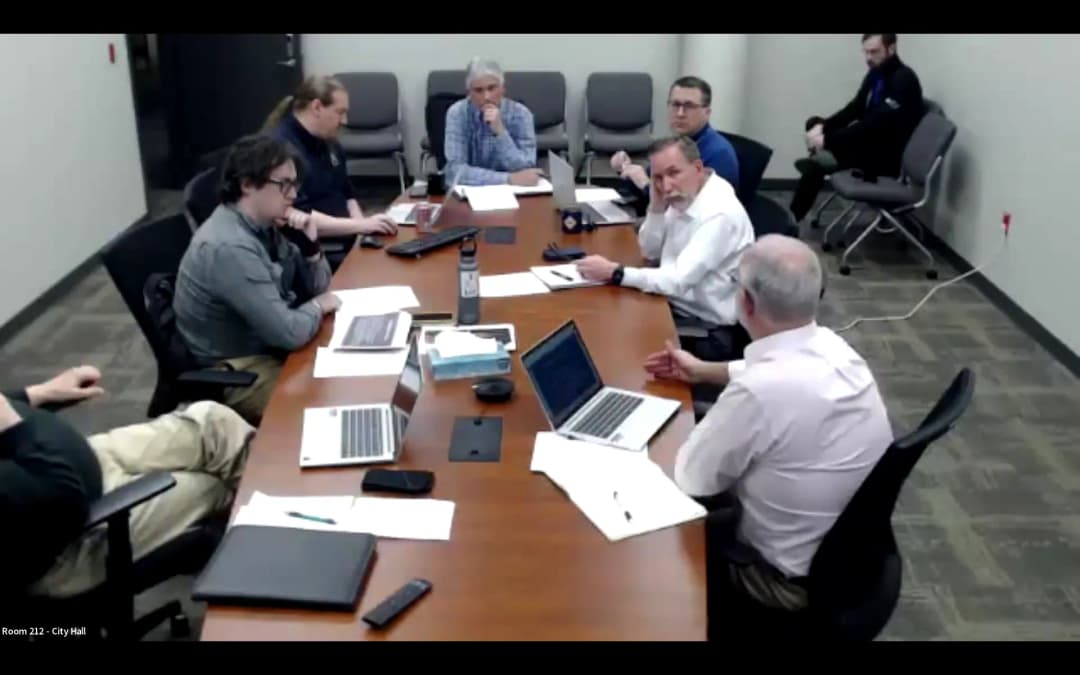
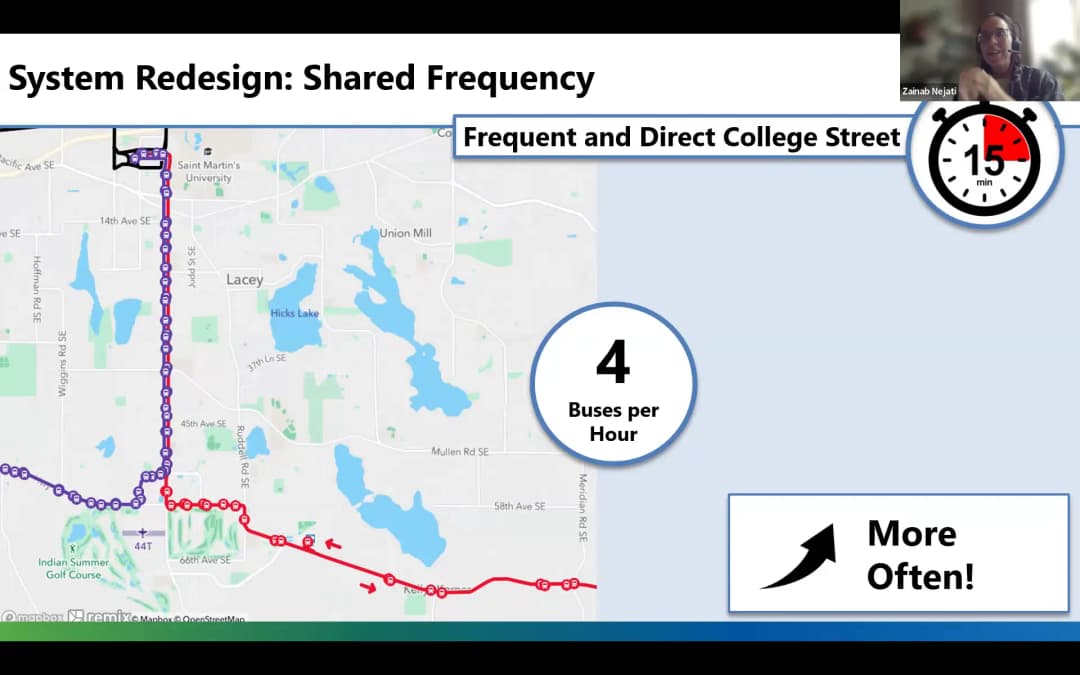
The Olympia Planning Commission met in City Hall Room 207 and online. The agenda, minutes, and transcript date the meeting as Monday, April 20, 2026, called to order at 6:31 p.m. and adjourned at 8:23 p.m.; the timestamp supplied for this summary is 2026-04-24 14:30:00 UTC. All nine commissioners were present: Chair Greg Quetin, Vice Chair Daniel Garcia, and Commissioners Elle Burger, Raphael Garcia, Jessica Grubb, Semir Ibrahimovic, Zainab Nejati, Aaron Sauerhoff, and Jason Taellious. The commission amended its agenda, received an Intercity Transit briefing, approved prior meeting minutes, heard staff announcements and reports, and discussed a future retreat. Consent Calendar - Agenda amendment: Commissioner Jason Taellious moved and Commissioner Jessica Grubb seconded to move approval of minutes and staff announcements to after business items; the motion passed by voice vote with no audible opposition or abstentions. - Agenda approved by voice vote. - Minutes of the April 6, 2026, Planning Commission meeting were approved. Commissioner Aaron Sauerhoff moved and Commissioner Jessica Grubb seconded; the motion carried, with Commissioners Raphael Garcia and Zainab Nejati abstaining. Public Comments & Testimony - No public comments were offered. One online attendee was noted, but no comment was made. Staff Announcements - Casey Schaufler, Associate Planner, announced a Washington State Department of Commerce short course on local planning on May 6, 2026, from 5:00 p.m. to 8:00 p.m. at Tumwater Council Chambers, with an online option; a quorum notice would be published if enough commissioners attend. - Schaufler said he would email the City of Olympia vacancy study prepared by the economic development team; Economic Development Director Jenica Machado was presenting it to the Land Use and Environment Committee later that week, then to City Council in late May or early June, and would later be invited to the Planning Commission. - He shared the annual Touch a Truck event on May 3, 2026, from 1:00 to 4:00 p.m. at Garfield Elementary School, with a sensory-friendly period from 1:00 to 1:30 p.m. Discussion Items - Intercity Transit Bus System Redesign Briefing (26-0294). Spencer Zeman of Intercity Transit presented the first full system redesign, which he said had been about 10 years in development and included community feedback, customer comments, sampling, and outreach. - Zeman said Intercity Transit has a static budget and is maintaining 315,000 revenue service hours while redistributing service to add coverage in previously unserved areas and to focus on hospitals, schools, and residential growth. He described the service portfolio: fixed route, vanpool, Village Vans, Bus Buddies, community vans, and Walk and Roll. - He said Intercity Transit is a municipal corporation funded by a 1.2% sales tax within a public transportation benefit area, and that ADA paratransit/dial-a-lift service operates within a three-quarter-mile boundary around the fixed-route network. - Most core routes remain largely unchanged but are being renumbered; some use interlining, where a bus changes route number mid-trip. Route 41 is being replaced by Routes 32 and 34, adding west-side and South Tumwater connections rather than only a downtown run. - The redesign launches May 3, 2026. The new Route 9X is the first express/BRT-light corridor, with limited stops, minimum four buses per hour (15-minute service), and 17 stops east-west. A new enhanced station at Fourth and Washington will be about 18 by 32 feet and is expected later in summer. Zeman said full BRT would require dedicated lanes, transit signal priority, and memorandums of understanding with jurisdictions. - Zeman said an initial small ridership decline is expected after launch, followed by ridership growth of about 5–10%. Intercity Transit had about 5 million annual rides before COVID and returned to that level in the prior year. Data comes from automated passenger counters and boarding/alighting patterns, not individual or facial tracking; surveys and outreach provide context. - He said the agency plans to reassess routes within 12–24 months, while major service changes typically take one to two years to plan and about three or four years in practice. About 3% of service is chronically delayed or has operational issues, and on-time performance compares well nationally. - Zeman stated that Intercity Transit tries to remain apolitical and respond to observed demand rather than intentionally inducing demand. Vice Chair Daniel Garcia questioned the word political, said limited resources made sense, and raised concerns about BRT-light versus full BRT, transit-oriented development, and equity impacts. A commissioner who said they ride Route 94 objected to the loss of a direct Olympia Transit Center-to-Amtrak connection and said they needed it the following month; Zeman replied that ridership data showed very few people used Route 94 for that trip and service had been redistributed elsewhere with transfers. - Zeman said West Bay is unlikely to receive fixed-route service because of the hill and lack of bus maneuvering; East Bay lacked sufficient demand in current data. Boston Harbor residents periodically request service, he said. - Commissioner Raphael Garcia asked how state housing capacity law changes factor into demand modeling; Zeman said he monitors development requests and comprehensive plan updates and uses census block data. He also requests transit-supportive frontage, sidewalks, ADA pathways, and bus pads, citing a 12-duplex Tumwater project as an example. He discussed equity and Title VI requirements and FTA protections that make service reductions difficult in lower-income or minority areas. - On safety and operations, Zeman said Intercity Transit has strengthened coordination with the Olympia Police Department, keeps an ambassador program with six full-time staff, and receives high safety ratings in satisfaction surveys. - On the fleet, he said labor is the largest expense, fuel is not a major cost, buses average about five miles per gallon, and the agency is piloting five hydrogen buses and exploring battery-electric buses. The fleet has 88 buses, with peak pullout around 67–69 buses; FTA now sets a 20% spare-ratio requirement for the agency as a large urban operator. - Outreach for the redesign includes tabling, social media, printed route maps, QR-code clings, and signage; Zeman said the first phase focuses on educating current riders before May 3, followed by efforts to reach new choice riders. He also mentioned planned future transit center placeholders and a system-wide stop inventory. Reports - Vice Chair Daniel Garcia reported that May is Bicycle Month, with events for safety, awareness, and bicycling as an alternative to vehicle transportation. Olympia's proclamation was noted as April 28, and a group bike ride with Intercity Transit was planned from Heritage Park Fountain to City Hall. Other Topics - Chair Greg Quetin discussed tentative planning-commission retreat plans for July or August 2026, with a Doodle poll to follow. Potential topics included the Plum Street corridor and the sidewalk conditions report; one commissioner suggested exploring a joint retreat with Lacey and Tumwater planning commissions. Key Outcomes - The Intercity Transit bus system redesign briefing was received as an information item; the commission took no formal recommendation or vote on it. - The agenda and minutes approvals are recorded above; the minutes motion carried with two abstentions. - Next steps and upcoming dates: the next regular Planning Commission meeting is May 4, 2026, and will include an update on the sidewalk conditions report; Intercity Transit's system redesign launches May 3, 2026; Touch a Truck is May 3, 2026; and the state planning short course is May 6, 2026.
TRANSPORTATION SAFETY 61% · PUBLIC ENGAGEMENT 11% · LAND USE PLANNING 9% · PROCEDURAL 5%
52
APR 24, 2026 · OLYMPIA, WASHINGTON · CITY COUNCIL & COMMISSIONS
Olympia Planning Commission Meeting Summary – April 24, 2026

[Note: The raw transcript repeatedly identifies the meeting as April 6, 2026, and references an April 20, 2026 next meeting, but the supplied meeting timestamp is 2026-04-24. This summary uses the supplied timestamp while preserving transcript details.] The Olympia Planning Commission met on April 24, 2026, to consider the proposed 2026 Olympia Municipal Code amendments. After a public hearing with no public testimony and a detailed staff presentation, the commission voted to recommend approval to the city council as proposed, and to transmit a letter flagging follow-up items for future consideration. Consent Calendar - No formal consent calendar was identified; routine approvals occurred at the start of the meeting. - The commission approved the April 24, 2026 meeting agenda as submitted by voice vote, with no opposition or abstentions noted. - The commission approved the March 2, 2026 Planning Commission meeting minutes by voice vote. - Roll call showed a quorum. Chair Queeton, Vice Chair Daniel Garcia, and Commissioners Berger, Grubb, Ibrahimovich, Saurow, and Talius were present; Commissioner Najati was excused. New Commissioners L and Smear were welcomed. Public Comments & Testimony - No members of the public offered comments during the general public comment period. - The public hearing for the 2026 code amendments was opened and closed at 6:55 p.m. with no speakers in person or online. Staff Announcements - Staff coordinator Casey asked commissioners to complete a city council survey on advisory committee experiences by April 14, with a fuller update planned for the April 20 meeting. Discussion Items 2026 Olympia Municipal Code Amendments – Presentation and Deliberation - Joyce Phillips, long-range planning manager, presented 45 proposed code amendments. She explained that the larger-than-usual package resulted from pausing routine code work during the comprehensive plan update and from new state requirements with a June 2026 adoption deadline. - State-required amendments include lot splitting with middle housing, allowing daycare centers as permitted uses in all residential and commercial zoning districts, added height and design flexibility for housing in existing buildings, residential parking standards, and conversion of existing buildings to housing. - Fire department proposals addressed definitions, access requirements, and fire safety and alarm provisions. Historic preservation proposals updated Heritage Commission duties and code citations. Randy Haynes and historic preservation officer Brittany Gillia were available to answer questions. Key discussion points and commissioner questions - Proposal 7 – Lot splitting: Commissioner Talius asked whether the restriction against imposing future dwelling-unit limits on split lots would apply in perpetuity. Phillips answered that the language comes directly from state statute, provides little local leeway, and future permits would be reviewed under the requirements in effect when applied for. - Proposal 14 – Housing units in existing buildings / ground-floor residential: Vice Chair Garcia expressed concern about the provision allowing the city to prohibit ground-floor residences on pedestrian-oriented streets, especially given downtown retail vacancies and upcoming Senate Bill 6026. Several commissioners discussed whether to strike the provision now or flag it for future action. Staff cautioned that removing only that provision could create inconsistencies with design guidelines and pedestrian-street chapters. The commission ultimately agreed to include this as a recommendation in the transmittal letter rather than as a formal code amendment. - Proposal 10 – Consolidated site plan for split-zoning parcels: Commissioner Talius asked for clarification about whether developing wholly within one zone would cause the property to lose the other zone’s future development potential. Phillips agreed the language could be clarified and offered to help draft a carve-out, noting the issue as 10C3. - Proposal 12 – Large multifamily units: Phillips clarified that the amendment would close a loophole in the November middle housing code by allowing seven-or-more-unit multifamily projects only in medium- and high-density zones. Lower-density lots could still reach additional units through lot splits or other subdivisions. - Proposal 18 – Facade modulation and upper-story stepbacks: A commissioner asked whether stepback and facade-modulation exceptions could be streamlined. Phillips explained that many exceptions are state-required and that stepbacks also serve transitional zoning and sunlight purposes. No formal recommendation was made on this topic. - Fire alarm provisions: Staff clarified that the “constantly monitored location” language aligns with the International Fire Code and relates to manual pull stations in control and riser rooms. - Minor corrections: Phillips acknowledged stray highlighting in proposal 44 and a missing item number in proposal 43, and said she would fix those formatting issues. Key Outcomes - Commissioner Saurow moved to recommend approval of the 2026 code amendments to the city council as proposed. Commissioner Grubb seconded the motion. - The motion passed by voice vote, with Commissioner L abstaining. - The commission will transmit a letter along with the recommendation. Expected letter items include: - Flagging the ground-floor residential/pedestrian-street issue for further review, tied to the downtown vacancy study and Senate Bill 6026 implementation. - Requesting possible clarification of proposal 10C3 regarding consolidated site plans on split-zoned parcels. - Noting minor formatting and renumbering fixes for proposals 43 and 44. - Next steps: The planning commission’s recommendation will go to the city council’s Land Use and Environment Committee on May 28, with a full city council date not yet scheduled. Certain state-required amendments must be adopted by June 2026. Reports and Other Business - A commissioner reported receiving a scholarship to attend the Strong Towns national gathering in Arkansas in May and said they would share lessons learned. - Commissioner Saurow announced an April 22 Northwest Eco Building Guild event on low-carbon concrete. - The chair relayed comments from a Rockaway planning commissioner about other cities looking to Olympia on middle housing. - The meeting was adjourned at 8:05 p.m.

LAND USE PLANNING 72% · PROCEDURAL 15% · PUBLIC ENGAGEMENT 8% · HISTORIC PRESERVATION 3%
53
APR 24, 2026 · OLYMPIA, WASHINGTON · CITY COUNCIL & COMMISSIONS
Land Use & Environment Committee Meeting - April 24, 2026

Note: The official minutes list the meeting date as April 23, 2026, but the summary uses the date provided in the instructions (April 24, 2026). The Land Use & Environment Committee met on April 24, 2026, at 4:00 PM. The committee discussed the Downtown Commercial Vacancy Study and the Affordable Housing Emergency Declaration, and received updates on upcoming agenda items and a tenant opportunity to purchase stakeholder engagement process. Consent Calendar - None (routine approvals included approval of agenda and minutes, but no separate consent calendar). Public Comments & Testimony - None. Discussion Items - Downtown Commercial Vacancy Study: Consultants Chris Zahas and Jennifer Shook (Leland Consulting Group) presented findings from a study of downtown Olympia's commercial vacancy. Key findings included: Olympia is not an outlier compared to peer cities; vacancy rates are on par with others recovering from COVID; the city's permitting improvements are noted; challenges include high construction costs, tenant improvement costs, and street improvement requirements that are unusually restrictive (trigger at 20 additional trips). Recommendations included eliminating the half-street improvement requirement for downtown, creating a downtown plan update, exploring a loan program for tenant improvements, and considering a parking garage study. Committee members discussed the importance of framing downtown's vitality positively, the need for a holistic downtown plan, and the value of engaging residents and businesses. No vote was taken; the information was received. - Affordable Housing Emergency Declaration: Housing Program Manager Jacinda Steltjes presented an update on the declaration adopted in December 2024. Six strategies are in place: prioritizing affordable housing in permitting, specialized staff assistance, waiving city requirements, permit fee grants, infrastructure assistance grants, and a 1033 tax exchange transaction. To date, five projects (538 units) have utilized priority permitting, and one project (Habitat for Humanity) had a city requirement waived. The declaration expires June 30, 2026. Committee members discussed the effectiveness of the declaration, with some noting that the term "emergency" may need careful communication. They expressed support for renewal. Key Outcomes - Motion to Recommend Two-Year Extension of Affordable Housing Emergency Declaration: Committee member Paul Berendt moved, seconded by Clark Gilman, to recommend to the City Council a two-year extension of the Affordable Housing Emergency Declaration. The motion passed unanimously (3-0). - Information Received: The committee received the Downtown Commercial Vacancy Study report and staff presentations. - Next Steps on Tenant Opportunity to Purchase: Staff will develop a stakeholder engagement plan based on committee feedback, focusing on tenant opportunity to purchase (TOPA) and community opportunity to purchase (COPA), with a potential roundtable discussion. The timeline for a policy recommendation to council may be pushed back from July. - Scheduling and Planning Commission Involvement: The committee discussed scheduling conflicts for the May 28 meeting; staff will explore options. Chair Vanderpool proposed inviting the Planning Commission to attend future LUEC meetings to share their perspectives. Committee members supported increased interaction. Reports and Updates - Future Meeting Agenda: City Manager Jay Burney noted that the May 28 meeting will include a sidewalk repair policy, miscellaneous code amendments (presented by Joyce Phillips), and an update on the 2026 legislative session. - Tenant Opportunity to Purchase Update: Jacinda Steltjes shared a proposed scope for stakeholder engagement, including goals around system capacity, financial resources, policy approaches, and logistics. The committee recommended using the existing staff presentation as a basis for discussion and allowing the stakeholder conversation to be free-flowing rather than narrowly focused on specific questions. - Adjournment: The meeting adjourned at 5:45 PM.

AFFORDABLE HOUSING 27% · ECONOMIC DEVELOPMENT 22% · LAND USE PLANNING 17% · COMMUNITY ENGAGEMENT 10%
54
APR 22, 2026 · OLYMPIA, WASHINGTON · CITY COUNCIL & COMMISSIONS
Olympia City Council Study Session: Earth Month, Olympia Strong, Waste Facility - April 22, 2026

Note: The meeting date is listed as April 22, 2026 per the provided metadata; however, the meeting minutes and transcript are dated Tuesday, April 21, 2026. This summary reflects the content of the April 21 transcript, using the requested date. This study session of the Olympia City Council included a special recognition proclamation, a briefing on the Olympia Strong economic development work plan, a briefing on the Waste ReSources Carpenter Road facility, and an executive session. Six councilmembers were present (Mayor Dontae Payne, Mayor Pro Tem Yến Huỳnh, Councilmembers Vanderpool, Gilman, Green, and Barrett) and Councilmember Dani Madrone was excused. Special Recognition - Councilmembers read a proclamation recognizing April 2026 as Earth Month. The proclamation was accepted by community member Dave Sederberg (formerly of Earthbound Productions, who jokingly said he was “just here representing the Earth”). Sederberg offered remarks on Earth flags, the Artemis II mission, and the importance of environmental stewardship. Mayor Payne noted this was the first proclamation delivered at a study session due to growing demand for recognitions. Olympia Strong Work Plan Briefing - Economic Development Director Jennica Machado presented an update on the Olympia Strong Economic Development Plan, unanimously adopted in September 2024. The plan is organized around four focus areas: education and workforce pathways; housing and sense of security; business enterprise and resource support; and community livability, pride, and resiliency. - Successes highlighted: the Youth Council was fully implemented in January 2025; the city supported 10 social work internships over two years with three more upcoming; a requirement that city capital projects over $2 million have at least 15% of labor hours performed by apprentices; affordable housing projects such as Boulevard and Old 99; adaptive reuse projects like 505 Union; business training funded through Thurston EDC (44 participants, 50 businesses advised, 12 new businesses); Inspire grants distributed $2.3 million to cultural organizations supporting almost 900 programs; and progress on the Armory, Grass Lake Nature Park, and Rebecca Howard Park. - Machado proposed a new two-year pilot Workforce Investment Framework: $100,000 annually through SPSCC to fund tuition for high school graduates entering trade/vocational programs (e.g., automotive, welding, machine technologies), targeting ALICE/low-income households as a last-dollar-in after FAFSA, estimated to support 15–20 students per year. - Council discussion included: - Councilmember Vanderpool expressed concern that the plan lacks involvement of labor unions and working-class voices, and that it does not adequately address economic inequality and wages. City Manager Bernie noted separate ongoing work on wages led by Assistant City Manager Stacey Ray, and suggested linking findings to Olympia Strong later. - Councilmember Gilman stressed the need to stabilize working-class households, not just provide pathways for upward mobility. He also questioned how an "equity gap" was defined. - Councilmember Barrett questioned whether the city should fund scholarships, preferring targeted investments in infrastructure or areas with known worker shortages. Machado responded that the proposal uses 10-year occupation demand data. - Mayor Pro Tem Huỳnh suggested exploring professional development for small businesses and expanding internships. Councilmember Green advocated for paid internships. Several councilmembers supported expanding internship opportunities, including with local educational institutions and Joint Base Lewis-McChord. - Mayor Pro Tem Huỳnh flagged child care as an urgent priority and asked to move related initiatives from medium-term to near-term. Assistant City Manager Stacey Ray noted the city is partnering with Olympia School District on a needs assessment using a Commerce grant. Waste ReSources Carpenter Road Facility Briefing - Public Works Director Mark Russell and Interim Waste ReSources Director Ron Jones briefed the council on the proposed Carpenter Road Waste ReSources Maintenance Facility. - The existing East Side Street maintenance center, purchased in 1973, is 38,000 square feet and rated "poor" in a recent assessment, with $6 million in known mechanical/electrical deficiencies, seismic and ADA noncompliance, and space constraints. Repairs and renovations would cost at least $15 million but would not solve space needs. - A 2016-17 feasibility study concluded the city needs 18 acres; after searching private properties, it recommended a phased approach using city-owned land. The Carpenter Road site (near Martin Way in Thurston County/Lacey UGA) is the proposed location for a waste resources/heavy-duty fleet facility. - Design is at 10% complete; Thurston County land use approval has been received; the old firing range was demolished; and site grading/rock removal is underway, making the site "shovel ready" by end of 2026. The facility would house 40 staff and 46 vehicles. - Cost estimate: construction $33.5 million; design, management, inspection, and construction administration $3.8 million; permits and connection fees bring the total to just over $40 million. A $40 million debt obligation over 30 years would require $3 million annually, equivalent to a 24% increase to waste resources utility rates. The current average residential bi-monthly waste rate would rise from $65 to about $81. - Future cost drivers: a 2030 organics management requirement would need at least one additional truck and driver ($600,000 one-time; $335,000 annually). The Recycle Reform Act could provide 50% reimbursement of recycling costs by 2030, rising to 90% by 2032, potentially offsetting rates. Fleet electrification would be phased. - Russell presented Washington State solid waste collection models: 20 of 281 cities operate their own utility, and nine provide both garbage and recycling. Rates for comparable cities with private haulers regulated by the UTC were listed as $69, $59, and $69 bi-monthly. - Three options were presented: (1) move forward with Carpenter Road; (2) explore contracting for services; (3) continue at the existing facility. Councilmember Gilman said option three should be taken off the table. - Council discussion: - Mayor Pro Tem Huỳnh emphasized the value of in-house staff and asked about renting space; Russell said the 2016 study found no suitable available facilities. - Councilmember Green expressed concern about the $40 million baseline and additional costs, citing tight budget cycles; she was open to an RFI. - Councilmember Vanderpool strongly opposed privatization, citing historical negative effects and concerns raised by Teamsters; he supported exhausting all options and floated regionalization. Staff explained franchise territory rules, noting a 7-10 year notice/condemnation period would make regionalization or reversing privatization difficult. - Councilmember Barrett was skeptical that private haulers could deliver lower costs, noting similar union wages and the risk of being "at the mercy" of outside forces after giving up the utility. - Councilmember Gilman framed the 24% increase as $8/month per household and stressed that any contracted service must still meet climate goals. He asked for more detail on option one and option two timelines. - Mayor Payne supported exploring both options but noted no decisions would be made that night. - At the end of the discussion, Mayor Payne polled council members: three (Vanderpool, Mayor Pro Tem Huỳnh, and Green) favored continuing option one (building the facility), and three (Barrett, Gilman, and Payne) favored also exploring option two (contracting via an RFI). Staff were directed to return with more details on an RFI process and answer questions about the current design without committing to a full 30% design. Executive Session - The council recessed at 8:57 p.m. and reconvened at 9:02 p.m. for an executive session under RCW 42.30.110(1)(i) (litigation and potential litigation). The City Attorney was present. No decisions were made. The meeting adjourned at 9:32 p.m. Key Outcomes - No formal votes were taken during the study session. - The proclamation recognizing April 2026 as Earth Month was presented and accepted. - Council directed staff to explore contracting services (potentially via an RFI) and to continue developing the Carpenter Road facility proposal, bringing both sets of information back in a future study session. Staff were also asked to investigate some design questions without advancing to a full 30% design. - Council requested further work on expanding paid internships and considering child care as a near-term priority.

WASTE MANAGEMENT 22% · WORKFORCE DEVELOPMENT 15% · ECONOMIC DEVELOPMENT 14% · CAPITAL FACILITIES PLANNING 11%
55
APR 21, 2026 · OLYMPIA, WASHINGTON · CITY COUNCIL & COMMISSIONS
Olympia Finance Committee Meeting – April 20, 2026 Briefings on Cost Allocation, Building and Fleet Electrification

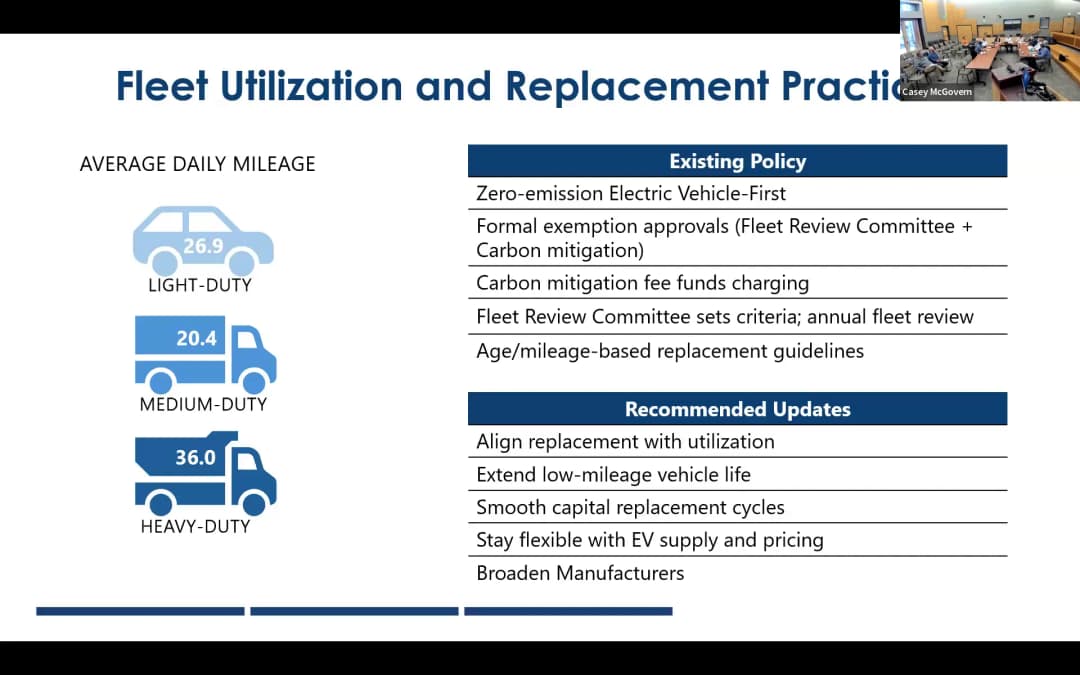
The Olympia City Council Finance Committee met on Monday, April 20, 2026, from 4:30 PM to 6:54 PM in Council Chambers and virtually. All three committee members attended: Chair Clark Gilman, Kelly Green, and Robert Vanderpool. The meeting featured three major committee business items—a budget spotlight on cost allocations, a briefing on the City Building Electrification Plan and Facility Condition Assessment, and a presentation on the Fleet Electrification Plan and EV Charging Recommendations. Staff also provided updates on the new Monthly Financial Report Power BI Dashboard and the Annual Comprehensive Financial Report process. There was no public comment. Consent Calendar - Approval of Minutes (26-0299): The committee unanimously approved the March 16, 2026 Finance Committee meeting minutes after a motion by Kelly Green and second by Robert Vanderpool. Discussion Items - Budget Spotlight: Cost Allocations (26-0296) - Senior Budget & Finance Manager Joan Lutz presented the monthly budget spotlight on cost allocation, explaining how the City maintains a cost allocation plan to fairly recover General Fund costs from supported funds. The presentation covered direct and indirect cost allocation methodologies, including a two-year lag for indirect cost data that leads to fluctuations in departmental budgets. Total administrative costs allocated are $17.8 million annually. The committee discussed the methodology, the smoothing effect of averages, and the inclusion of building capital replacement in indirect costs after a study by SCS. The goal is to avoid relying on one-time money and create a more sustainable budget. The presentation was received. - Briefing on City Building Electrification Plan, Facility Condition Assessment and Future Funding Strategies (26-0266) - Public Works Director Mark Russell and Facilities Manager Eli Cole presented the results of a facility condition assessment (FCA) and building electrification plan for 15 city facilities, updated in partnership with a consultant. The FCA observed deficiencies where assets have passed their useful life, prompting replacement and electrification opportunities. Key statistics: the Olympia Center requires $3.4 million in critical assets over five years, $6.1 million over 10 years, and $40 million over 30 years. Citywide, the 30-year facility funding need is approximately $28 million (for replacement of assets at end of life) plus $36.6 million for full building electrification and decarbonization over 13 years, totaling $97.6 million. Current annual revenue into the facility fund (Fund 335) averages $1.8 million, leaving an annual deficit of $5.4 million. The committee asked about energy cost impacts, lifecycle planning, the role of grants and state/federal incentives, and trade-offs in building design (e.g., windows vs. insulation). Staff noted that some buildings (like the Olympia Center and Washington Center for Performing Arts) are heavy natural gas users, and converting to electric will require system redesigns. The discussion highlighted the challenge of timing investments and the potential savings from avoided future carbon costs. - Fleet Electrification Plan and Electric Vehicle Charging Recommendations (26-0297) - Deputy Public Works Director Thahn Jeffers and Fleet Operations Supervisor Jaime Mastache presented the City's Fleet Electrification Plan. The city has 340 pieces of equipment across 17 facilities; 238 are suitable for electrification, and 35 electric vehicles (EVs) are already in the fleet. A major success: switching heavy-duty vehicles from diesel to renewable diesel reduced fleet greenhouse gas emissions (excluding fire) by 49% compared to the 2019 baseline (2,200 metric tons). The plan recommends a phased approach: Phase 1 (2026-2030) aims to transition 24 vehicles (realistic based on current conversion rate of 5-10 per year). Total cost for converting 220 vehicles to EVs is $26 million (today's dollars), plus $7.5 million for 63 charging stations (with 34 Level 2, 11 DC slow chargers, and 18 DC fast chargers). The committee discussed challenges such as space constraints at the maintenance center, copper wire theft at charging stations, and the higher total cost of ownership for heavy-duty EVs (e.g., a refuse truck costing $1 million vs. $500,000 conventional). Staff highlighted innovative funding mechanisms, including a carbon mitigation fee on non-EV purchases that builds a fund for charging infrastructure, and successful grants (e.g., Volkswagen settlement covering 75% of a $470,000 EV). The presentation was received. Reports and Updates - Monthly Financial Report Power BI Dashboard: City Manager Jay Burney and Finance Director Michael Githens previewed the new interactive Power BI dashboard that replaces the static 70+ page PDF monthly financial report. The dashboard features a summary page with watch list items (police/fire overtime, jail costs, sales tax) and allows drill-down into specific funds and revenue categories. It will be soft-launched to the public and presented to the full City Council at a future meeting. The committee praised the tool for enhancing transparency and analysis efficiency, noting it frees staff from manual data updates. - Annual Comprehensive Financial Report (ACFR): Director Githens reported that the ACFR is nearing completion. The state auditor's office has contacted the city to schedule a pre-conference and entrance conference for the financial audit, including a federal single audit for grant funds. The committee was invited to attend the audit conferences. Key Outcomes - No formal votes were taken on the three committee business items; all presentations were received and discussions concluded. - The committee approved the March 16, 2026 meeting minutes unanimously. - The new Monthly Financial Report Power BI Dashboard will be rolled out to the public and full City Council in the coming weeks. - Staff will continue to develop the dashboard and provide training materials for the community. - The Finance Committee will meet again on the same day next month (May 20, 2026) at 4:30 PM.

TECHNOLOGY AND INNOVATION 23% · BUDGET EQUITY ANALYSIS 18% · CAPITAL FACILITIES PLANNING 16% · ENVIRONMENTAL PROTECTION 10%
56
APR 15, 2026 · OLYMPIA, WASHINGTON · CITY COUNCIL & COMMISSIONS
Olympia City Council Regular Business Meeting – April 15, 2026

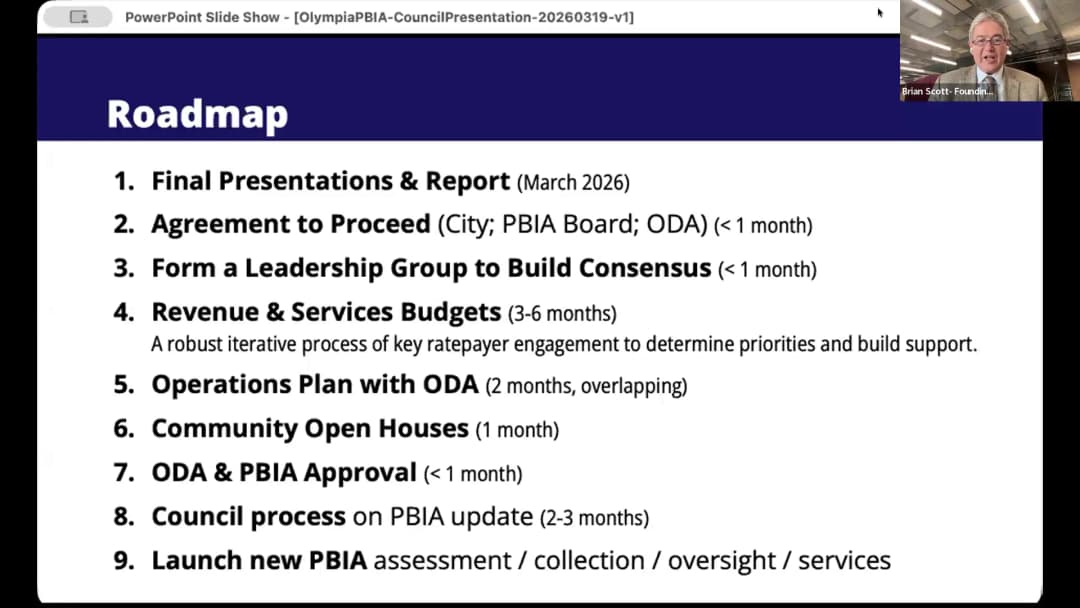
Note: The transcript states the meeting date as April 14, 2026, but the supplied metadata indicates April 15, 2026. This summary uses the date provided in the instructions. The Olympia City Council held a regular business meeting on April 15, 2026, proclamations, public comment on housing and safety, adoption of the consent calendar, discussion of the Parking and Business Improvement Area (PBIA) evaluation, approval of 2026 Neighborhood Matching Grant allocations, and council reports. Consent Calendar - Approved unanimously (voice vote) the consent calendar, which included routine items such as the adoption of ordinances related to the residential energy performance rating and disclosure ordinance and the reappointment of Mark Shatmeyer as hearing examiner and Phil Aldbrex as pro tem hearing examiner. Public Comments & Testimony - Cece Coates (Olympia resident, homeless, disabled) described being harassed through homelessness services and having to move her van daily; she called current practices a "eugenics program" and urged the city to meet the moment for seniors and disabled people. - Eric Cedar (South Capitol Neighborhood Association board) thanked the council for supporting the Neighborhood Matching Grants program, which brings neighborhoods together. - Sam Kellandy (trans community member) called for action to support trans and houseless communities, emphasizing that houseless people are human and deserve respect and support. - Ash Valentine expressed disgust that the city spends over $32 million on police while people sleep on the street, criticized harassment of unhoused people by police, and urged shifting resources to direct support. - Gary Myers (engineer with a building permit) advocated for proportionality in permit conditions, citing the Supreme Court's unanimous decision in Sheetz, and asked that permit staff be given flexibility to apply these tests at the point of service. - Stephanie Scott (Lisi resident, mother of a trans young person) spoke in support of Cece Coates, arguing that declaring sanctuary status without action is dangerous and that fair housing must protect people living in vehicles or tents; she urged the council to revisit trans community asks. - Tom Crawford (Thurston Climate Action Team board member) thanked the council for adopting the home energy ordinance, noting it supports climate goals, home buyers, and energy-efficiency jobs. - David Webb (City of Olympia resident) criticized the council for claiming progressiveness while unhoused people are not safe, called the fair housing proclamation tone-deaf, and urged sufficient resources for the unhoused. - Jacob DeMonti Finn (Southwest Olympia Neighborhood Association) echoed earlier comments, angered that city resources are used against Cece Coates based on a homophobe's calls, and urged the city to support her. - Council members responded: Mayor Payne apologized and offered to connect Cece Coates with the police chief; Mayor Pro Tem Huyn emphasized the city's efforts to house hundreds and asked for trust. Discussion Items - Parking and Business Improvement Area (PBIA) Evaluation (Item 6A): - Jenica Machado (Economic Development Director) introduced the evaluation, noting the PBIA has not been updated since 2005, collects $114,000/year, and faces sustainability and equity concerns. - Brian Scott (Uncommon Bridges) presented findings: the PBIA structure does not align with national best practices; assessments are low, administrative costs high, and ratepayer priorities are not well served. He recommended moving to a property-based district (long-term goal) but immediate steps to substantially increase assessments (to $500,000/year comparable to similar districts) and reconfigure administration by partnering with the Olympia Downtown Alliance. The PBIA advisory board and CLIPS committee both endorsed proceeding to phase two (detailed stakeholder engagement and proposal development). - Council members expressed support for phase two; questioning touched on affordability, potential for clean & safe services, and the unsuccessful earlier district attempt. Desiree Freeland (Olympia Downtown Alliance) noted the earlier property-based district failed by single-digit percentages but sees potential. - Vote: Motion to approve the evaluation recommendations and proceed with phase two passed unanimously (voice vote). - 2026 Neighborhood Matching Grant Allocations (Item 6B): - Brittany Gillia (Associate Planner) presented program updates: eligibility expanded to informal groups (with $600 max grants), simplified application, new scoring criteria emphasizing equity, and two timeline options (Track A standard, Track B full year). Eleven applications recommended for funding totaling $33,000, leveraging $180,000 in community value. - Council praised the changes and neighborhood participation. - Vote: Motion to approve the allocations passed unanimously. Key Outcomes - Fair Housing Month Proclamation read and adopted; community speakers highlighted ongoing discrimination and the need for action. - Child Abuse Prevention Month Proclamation read and adopted; speakers emphasized connection between childhood trauma and homelessness. - Consent Calendar adopted unanimously. - PBIA Phase 2 authorized: staff to conduct further stakeholder engagement and develop detailed proposal; estimated cost $50,000 from economic development reserve. - Neighborhood Matching Grants awarded: 11 projects funded, including two informal groups, with total $33,000 allocated. - Council Reports: Mayor Payne updated on opioid abatement council (1.2 million allocation, RFP upcoming); Councilmember Madron reported on LOTT board retreat (wet science center expansion discussion); Councilmember Vanderpool reported on regional housing council and land use meetings (manufactured home communities, Plum Street corridor, community opportunity to purchase); Councilmember Green had no report; Councilmember Barrett discussed library layoffs and called for monthly city financial reporting; Assistant City Manager Sullivan noted that finance director is developing such reports for the finance committee.

BUSINESS LICENSING 17% · COMMUNITY ENGAGEMENT 13% · GRANT FUNDING 10% · PUBLIC SAFETY 7%
57
APR 14, 2026 · OLYMPIA, WASHINGTON · CITY COUNCIL & COMMISSIONS
Public Hearing on Springwood Garden Flat Subdivision - April 14, 2026

The City of Olympia Hearing Examiner convened a public hearing on April 14, 2026, to consider the preliminary plat application for Springwood Garden Flat, a proposed subdivision of 7.2 acres into 37 residential lots at 1609 Springwood Avenue Northeast (File No. 25-0980). The hearing included presentations from city staff, the applicant team, and public testimony from eight registered speakers. Key issues included wetland buffer reduction, stormwater management, traffic connectivity, safe walking routes, and environmental impacts. The hearing was left open for supplemental written responses and public comment on those responses. Public Comments & Testimony - Alexander Prescott (adjacent homeowner, environmental planner): Expressed disappointment with the public engagement process, stating the city did not adequately respond to specific community concerns. Opposed vehicle connectivity on Marion and Central Streets, citing negative impacts on the existing North Point neighborhood's safety and community character. Requested more native plant species in landscaping and criticized the lack of a sidewalk connection to Bethel Street, noting pedestrians will continue to cross unsafely. - Richard Williams (neighbor on Quasar Way): Raised concerns about ongoing water issues on his property, including a sump pump needed to manage groundwater. Opposed vehicle connectivity, arguing it would bring unwanted traffic and endanger children. Requested a higher fence along the southern boundary and urged preservation of green space for wildlife. - Abigail McSenney (attorney, Telegan Law, representing neighbors Claire Fullman, Pete Hamar, and Zach LeClair): Argued that the applicant misrated the wetland's habitat score and that the standard buffer should be 220 feet, not 180 feet. Stated the applicant failed to comply with Core Requirement 8 of the city's stormwater manual regarding evaluation of hydrology impacts. Questioned the buffer reduction criteria, noting that Tract B (stormwater pond) is not a protective buffer and that the applicant's plan does not connect the wetland to other priority habitats. Also noted a stream on the parcel requiring a 150-foot buffer and potential impacts to Mission Creek, a salmon-bearing stream. Concluded the application should be denied. - Zach LeClair (neighbor north of Springwood): Echoed the attorney's concerns about the wetland buffer reduction and habitat scoring. Highlighted standing water on the site during heavy rains and referenced problems with a similar stormwater pond in a nearby development (Devoncourt). Urged the Hearing Examiner to carefully review the letter submitted by Telegan Law. - Brittany Snyder (Springwood homeowner, educator): Expressed concerns about outdated FEMA flood mapping, noting that recent floods exceeded 100-year projections. Criticized the lack of bold climate action from the city. Questioned the lack of assessment of impacts on Mission Creek salmon habitat, given the city's prior investment in restoration. Asked about protections to prevent future owners from removing permeable surfaces. Also raised a discrepancy in well notification distance (200 feet earlier vs. 100 feet currently) and asked for clarification. Stated she deeply opposes the development. - Dale Pierce (North Point resident): Emphasized water pooling and flooding in his yard, and urged specific commitments on porous materials for driveways and roads. Challenged the city's focus on vehicular connectivity as increasing livability, citing safety concerns for pedestrians and children. Noted that a creek behind his house was illegally dammed by a neighbor and questioned the impact on buffer zones. Called for retractable bollards for emergency vehicles rather than full vehicular connections. Criticized the lack of a safe crossing at Bethel Street and inadequate sidewalks. - Peter Hamar (represented by Telegan Law, but spoke personally): Opposed the project. Raised concerns about increased traffic (estimated 70+ additional vehicles daily) on streets that are currently dead-end. Emphasized that people will walk to the bus stop at Springwood and Bethel despite the lack of sidewalks or crosswalks. Highlighted the parcel's role as a wildlife corridor connecting Mission Creek to Satchfield Lake, stating encircling these areas will kill ecosystems. Called the proposed buffer mitigation inadequate and argued the development would not provide affordable housing. - Leah Willette (homeowner near Satchfield Lake, runs an outdoor preschool): Emphasized the importance of the wildlife corridor, noting daily sightings of coyotes, weasels, bald eagles, salamanders, and newts. Described severe standing water on her property (enough for a canoe) and a sump pump. Opposed the development for cutting off wildlife habitat and increasing pollution. - Sandra Herndon (Springwood resident): Focused on the lack of a sidewalk from the development to Bethel Street. Expressed disappointment that the sidewalk extension was abandoned despite a neighbor willing to cooperate. Stated that pedestrians will walk in the street or across yards. Called for a dedicated crosswalk and bus shelter at the Bethel Street bus stop. - Deborah Walder (Springwood resident): Concerned about narrow road width (20 feet) on Springwood, parking issues, and blind driveways leading to speeding. Noted her car was damaged by a speeding driver. Asked about measures to prevent street parking and speeding. Discussion Items - City Staff Presentation (Jackson Ewing, Senior Planner): Presented key project details, including zoning (R 4-8, density 6.5 units/acre), wetland buffer reduction from 180 feet to 135 feet based on a biologist's report, stormwater pond sizing, street connections (Central and Marion extended north), off-site speed cushions on Marion, tree retention (75% in soil/vegetation tract, replanting above 30 units/acre), and safe walking routes. Recommended approval with conditions, including a cultural resource survey per Nisqually Tribe request. Noted that the SEPA appeal period has lapsed, so SEPA findings are not under review. - City Engineer (Tiffany King): Clarified that Springwood frontage improvements include 17.5 feet of additional dedication for sidewalk, planting strip, and street lighting; road width remains 20 feet. Explained that the sidewalk extension to Bethel was explored but deemed too costly ($75,000-$100,000) for the city to participate, and the city cannot legally require the applicant to build it because safe walking routes are already met. Emphasized that street connections were required by the city's Engineering Design Standards and the Comprehensive Plan (Marion designated as a neighborhood collector). Addressed concerns about parking: no parking will be allowed on the applicant's side of Springwood (signs to be installed). Noted that ADA ramps and other pedestrian accommodations are part of the detailed permits. - Applicant Presentation (Matt Weber, President of Garrett Holmes): Thanked city staff and discussed design constraints, including saving an 80-inch redwood tree. Described stormwater system: a wet detention pond with dispersed discharge to the buffer (no direct pipe), plus pervious driveways and downspout infiltration where possible. Agreed to all staff-recommended conditions, including the cultural resource study. For safe walking routes, presented Exhibit 20 showing a route via sidewalks on Marion to Roosevelt Elementary and Reeves Middle School (one-tenth mile longer than the Springwood-Bethel route). Stated the applicant negotiated an easement from the neighbor at Springwood and Bethel for a pedestrian path but encountered bureaucratic complications; committed to pursuing an alternative pathway. - Wetland Biologist (Tom Deming): Confirmed that the proposed buffer restoration (native trees, shrubs, ground cover) and planting along the stormwater pond will improve habitat. Addressed concerns about hydrology: stated that under developed conditions, the stormwater pond will capture runoff and infiltrate/disperse through the buffer, maintaining flow to the off-site wetland. Noted that surface water on site during storms is temporary and does not create wetland conditions. - Traffic Engineer (Aaron Van Aken): Stated that the vehicle connectivity requirement came from city standards, not applicant choice, and serves emergency access and traffic distribution. Without connectivity, there would be no level-of-service deficiency, but the city requires it. Key Outcomes - Hearing remains open for additional evidence and public comment. - Schedule: Applicant and city must submit written responses to the technical letter from Telegan Law and any other matters by April 24, 2026. Public comment on those responses is due by May 1, 2026. - City staff recommended approval subject to conditions, including a cultural resource survey. The applicant stated it is amenable to all conditions. - The Hearing Examiner will render a decision after reviewing all supplemental materials and comment, with no set deadline announced but will begin work after May 1.

ENVIRONMENTAL PROTECTION 28% · ENGINEERING AND INFRASTRUCTURE 14% · PROCEDURAL 13% · LAND USE PLANNING 13%
58
APR 14, 2026 · OLYMPIA, WASHINGTON · CITY COUNCIL & COMMISSIONS
Olympia Hearing Examiner Approves Bank Shoreline Permits - April 14, 2026

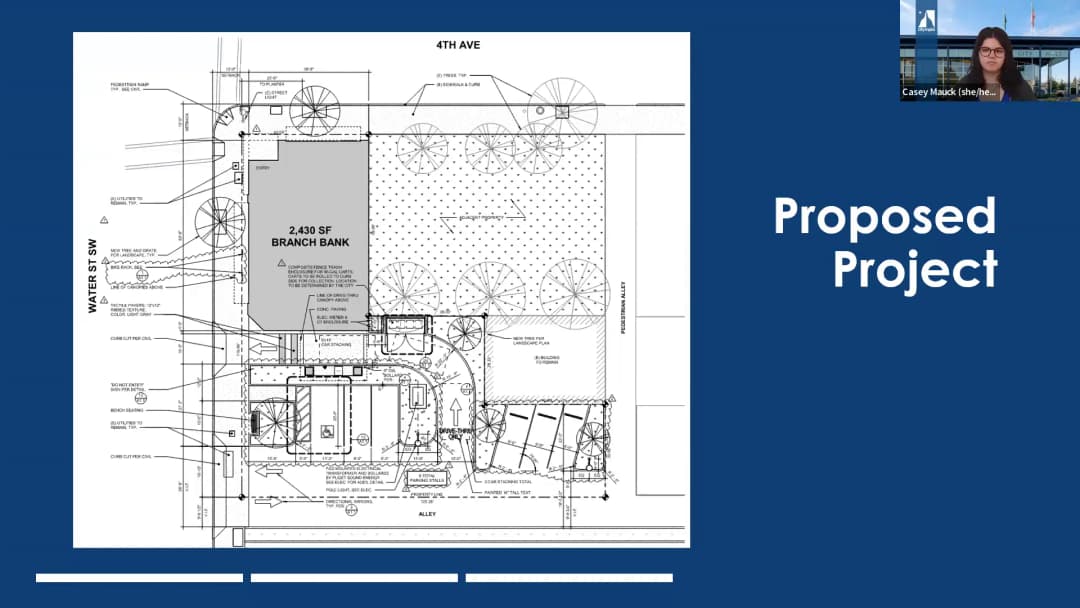
On the evening of April 14, 2026, City Hearing Examiner Mark Scheidemeyer convened a public hearing to consider a shoreline substantial development permit and a shoreline conditional use permit for Washington Federal Bank. The project proposes demolishing an existing 5,500 sq ft vacant office building at 406 Water Street SW (corner of Water and Fourth Avenue) and constructing a 2,400 sq ft bank with a drive‑through lane and parking. The site lies within shoreline jurisdiction due to its proximity to West Bay/Percival Landing, though separated by a street. The hearing included testimony from city staff, the applicant, and one member of the public. Public Comments & Testimony - Luke Viscusey (public attendee) – Asked about the proposed building height and whether it complies with shoreline height restrictions. City staff confirmed the one‑story building is 23 ft tall, well below the 35‑ft or 90‑ft limits applicable in the area. No other public comments or opposition were presented. Discussion Items - City Staff Presentation (Casey Mock, Planner) – Reviewed the project’s compliance with the Comprehensive Plan, Shoreline Master Program, historic preservation requirements, engineering standards, and other city codes. Key points: - The non‑water‑oriented bank use is appropriate because the site is functionally separated from the shoreline by a street and will not harm the shoreline environment. - A cultural resources assessment identified the site as a potential archaeological area; the applicant must obtain a permit from the Department of Archaeology and Historic Preservation (DAHP) prior to engineering permits, and coordinate with tribes for monitoring/trenching. - Traffic analysis showed only a net increase of one daily trip compared to the prior office use (39 vs. 40 trips), so no additional traffic mitigation was required. - Additional lighting was recommended by a Crime Prevention Through Environmental Design (CPTED) review in response to a neighboring property owner’s concerns about alley safety; the lighting is shielded from the shoreline by the building. - Parking is not required for a branch under 3,000 sq ft; the applicant chose to provide a few spaces, with on‑street parking available nearby. - Applicant Representatives (Michael Winnick and Joe Beretta) – Expressed appreciation for the city’s assistance and confirmed they will work with DAHP on the cultural permit. Emphasized eagerness to build a “beautiful building” on the corner. - Hearing Examiner Questions – Explored traffic impacts, lighting, archaeological findings, and parking balance. Staff responses confirmed no significant impacts and that conditions address potential issues. Key Outcomes - Decision – Hearing Examiner Mark Scheidemeyer approved both the shoreline substantial development permit and the shoreline conditional use permit, finding the project consistent with all applicable regulations and complementary to the downtown and shoreline environment. - Conditions of Approval – Recommended by staff and adopted: comply with DAHP permit (including tribal consultation), implement lighting per CPTED recommendations, replace damaged sidewalks/ramps, provide bike parking, install a tree in each parking lot island, meet tree density or pay in‑lieu fee, submit bonds for vegetation and maintenance, pay impact fees, and follow allowed construction hours. - Next Steps – The shoreline conditional use permit requires final approval from the Washington State Department of Ecology. The applicant must also obtain engineering permits before construction.

PROCEDURAL 30% · HISTORIC PRESERVATION 22% · LAND USE PLANNING 19% · ENGINEERING AND INFRASTRUCTURE 14%
59
MAR 27, 2026 · OLYMPIA, WASHINGTON · CITY COUNCIL & COMMISSIONS
Olympia Land Use & Environment Committee Meeting - March 26, 2026

The Olympia Land Use and Environment Committee met on Thursday, March 26, 2026, from 4:00 p.m. to 6:20 p.m. The committee discussed two major items: preservation of manufactured home communities and subarea planning for the Plum Street corridor. No formal votes were taken, but direction was provided to staff on next steps for both topics. Consent Calendar - The agenda was approved by unanimous consent. - Minutes from the February 17, 2026 and February 26, 2026 meetings were approved by unanimous consent. Public Comments & Testimony - Dan Scherck testified in support of preserving manufactured home communities. He shared that his mother lives in the Friendly Ridge community and faced a 63% rent increase attempt (from under $800 to over $1,400) after a corporate purchase, which was halted by state rent stabilization. He urged the city to continue working to preserve these communities, noting the broader economic and social connections to the city. Discussion Items Manufactured Home Communities Preservation Staff (Krista Lenssen, Senior Housing Program Specialist) presented an overview of Olympia's 12 manufactured home communities (about 800 total units), state policies, and potential city actions. Options included education/outreach, funding (e.g., revolving loan fund, relocation assistance, capital improvement grants), and policy options (e.g., protective zoning, covenants). Committee members discussed: - Interest in covenants over zoning for long-term preservation, as covenants are harder to change. - Exploring a revolving fund or bond-funded acquisition, though staff noted bonding is better for tangible assets. - The desire to understand costs for a new park and potential financing through federal legislation (e.g., 21st Century Housing Act). - The need for continued education and convening of residents to facilitate cooperative purchases. - A suggestion to hold a special roundtable meeting with organizations like Habitat for Humanity, Northwest Co-op, and others to discuss tenant opportunity to purchase and rent-to-own models. Plum Street Subarea Planning Scoping Staff (Casey Schaufler, Associate Planner) presented on the Plum Street corridor, which has 5-7 zoning districts, multiple designations, and upcoming major developments (Squaxin Island Tribe at former Justice Center, Thurston County Public Services and Regional Justice Center). The proposed scope of work included visioning, traffic study, zoning consolidation, and infrastructure evaluation. Committee discussed: - The need to simplify zoning to avoid spot-zoning requests, possibly moving toward a single downtown business zone. - A phased approach: first, in-house zoning consolidation (with a comp plan amendment in 2027), then visioning and transportation work (potentially requiring consultant funding). - The importance of public engagement, especially with many stakeholders (tribe, county, 130 property owners, 110 residential addresses within the planning area). - Staff recommended that the transportation master plan update (starting soon) should be coordinated with this effort. - Committee members emphasized that the goal is not to redevelop existing neighborhoods but to improve the corridor as a welcoming entry to downtown. Key Outcomes - Manufactured Home Communities: Staff will continue exploring educational avenues, creative funding (e.g., revolving funds, covenants), and will report back to the committee in June. A special meeting may be scheduled to gather input from housing organizations. - Plum Street Subarea Planning: The committee directed staff to proceed with a phased approach, beginning with zoning consolidation work (in-house) and preparing for a 2027 comp plan amendment. Visioning and transportation studies will follow when funding is available. - Reports and Updates: - Committee member Gilman reported issues with the new parking ticket system transition to Thurston County (delays, no online payment portal yet) and constituent concerns about pedestrian access to LBA Park. - Chair Vanderpool shared a conversation with the Housing Land Trust and suggested a roundtable with regional housing organizations. - Community Planning & Economic Development Director Smith noted that hearing examiner contracts will go to Council on April 14, and two leadership recruitments (Planning Manager and Housing Director) have been launched.

LAND USE PLANNING 32% · AFFORDABLE HOUSING 30% · HISTORIC PRESERVATION 11% · TRANSPORTATION SAFETY 11%
60
MAR 26, 2026 · OLYMPIA, WASHINGTON · CITY COUNCIL & COMMISSIONS
Community Livability and Public Safety Committee Meeting - March 25, 2026

Community Livability and Public Safety Committee Meeting - March 25, 2026\n\nThe Community Livability and Public Safety Committee of the Olympia City Council met on Wednesday, March 25, 2026, from 5:30 p.m. to 7:00 p.m. All three committee members (Chair Dani Madrone, Kelly Green, and Yến Huỳnh) were present. No public comments were submitted. The committee approved three agenda items, all forwarded to the full City Council for final action.\n\n Consent Calendar\n- Approval of Agenda: Approved unanimously.\n- Approval of Minutes: Approved minutes from February 25, March 4, and March 5, 2026, all unanimously.\n\n Public Comments & Testimony\n- None.\n\n Discussion Items\n- Parking and Business Improvement Area (PBIA) Phase I Findings and Phase II Direction: Economic Development Director Jennica Machado and Uncommon Bridges consultants Brian Scott and AshLee Day presented findings from a comprehensive evaluation initiated in late 2025. The PBIA, created in 2005, assesses approximately 520 downtown businesses based on number of employees, raising about $113,000 annually—unchanged since inception with no inflation adjustment. The assessment is divided into three zones and ten rate categories ($150–$750 per year). Consultants compared Olympia to similar districts (e.g., Downtown Everett at $636,000; West Seattle Junction at $570,000) and identified key weaknesses: outdated assessment model, insufficient revenue to justify collection costs, inefficient city administration, and misalignment of services (current spending on marketing/beautification while ratepayers prioritize clean/safe). Recommendations included substantially increasing the budget to roughly $500,000 per year, shifting to a property-based assessment (e.g., 15–20 cents per building square foot), and transferring day-to-day management to a nonprofit program manager such as the Olympia Downtown Alliance (ODA). Stakeholder engagement (interviews, focus groups with ratepayers, PBIA board, ODA board, city staff, and other business owners) revealed general support for more services but also distrust and a need for trust-building. The PBIA advisory board had unanimously recommended moving to Phase II, which would involve forming a steering committee, iterative ratepayer engagement to refine services and rates, and developing an operations plan—with a target to return to council with a refined proposal in early 2027. Committee members expressed support for Phase II, though Committee Member Huỳnh raised concerns about compliance and cultural/language barriers among some ratepayers. Chair Madrone asked about potential rebranding to improve public understanding. The motion to approve Phase I findings, move forward with Phase II, and forward to the full council passed 3–0.\n\n- Civilian Police Auditor 2026 Work Plan: Community Engagement Program Specialist Margo Morales and OIR Group Civilian Police Auditor Stephen Connolly presented the first annual work plan under an expanded contract. The work plan builds on recommendations from the Social Justice and Equity Commission (accepted by council in July 2024) and includes regular reporting (mid-year and end-of-year reports), quarterly meetings with the Community Policing Board (CPB), and community engagement initiatives. The key substantive focus for 2026 is an audit of the integration between the Olympia Police Department and the Crisis Response Unit during calls involving persons experiencing mental health crises. The CPB reviewed and provided input on the work plan. Committee members expressed strong support, noting the proactive approach. The motion to approve the work plan and forward to the full council passed 3–0.\n\n- City Council Appointed Advisory Body 2026 Work Plans: Assistant City Manager Stacey Ray presented an overview of work plans for 10 advisory bodies, organized by focus area (Public Safety, Community Livability, Environmental Stewardship, Economy, Organizational Excellence, and Well-Planned City). Of 31 work plan items, 16 will result in a recommendation to council, 14 to staff, and 2 to outside entities. Twelve items directly align with the 2026 council work plan. Examples include: the Social Justice and Equity Commission providing input on reimagining public safety and discrimination findings; the Bicycle and Pedestrian Advisory Committee reviewing speed limit enforcement cameras; the Parks and Recreation Advisory Committee working on the Rebecca Howard Park Concept Plan and Yeshiro Japanese Garden relocation; the Arts Commission developing the municipal art plan and recommending a cover artist; and the Planning Commission reviewing the Capital Facilities Plan, multifamily tax exemption, and parking strategies. Staff noted the planning commission typically has the heaviest workload, meeting twice monthly. Committee Member Huỳnh highlighted the need to coordinate with the planning commission on topics of council interest. The motion to approve the work plans and forward to the full council passed 3–0.\n\n Key Outcomes\n- PBIA Phase I approved and Phase II authorized (motion passed 3–0) – staff directed to bring to full council on April 14, 2026, with Phase II work to begin mid-year.\n- Civilian Police Auditor 2026 Work Plan approved (motion passed 3–0) – to be forwarded to full council for approval; implementation can begin before official approval.\n- Advisory Body 2026 Work Plans approved (motion passed 3–0) – to be added to the April 14 council consent agenda.\n- Meeting schedule update: No committee meeting in April 2026; a special meeting is scheduled for May 6, 2026.

PARKING MANAGEMENT 28% · PUBLIC ENGAGEMENT 16% · COMMUNITY ENGAGEMENT 16% · PROGRAM MANAGEMENT 12%
OPENPUBLICA · PUBLIC MEETING INDEXUPDATED DAILY · openpublica.com