Browse by city
Date range
Search help

Search titles, summaries, topics and stored transcripts together. Keywords may match separately; put the whole query in double quotes for a phrase. Matching follows word analysis, so punctuation is not exact. Both dates are included. Documents are not searched.

SHOWING 31–40 ENTRIES
31
APR 6, 2026 · RALEIGH, NORTH CAROLINA · CITY COUNCIL
Raleigh City Council Work Session: April 6, 2026

This work session covered presentations and discussions on solid waste services rates, external agency grant recommendations, parking rate adjustments, the capital improvement program, and a dire budget outlook. No formal votes were taken; staff will return with final proposals in May and June. Solid Waste Services Overview - Solid Waste Services Director Shika Gupta presented the FY27 budget, highlighting a $8.47 million budget gap driven by personnel costs, the yard waste enhancement transition, and reduced revenue from transportation tip fees. - Proposed a 9.8% rate increase ($2.55 per account) and a $10 increase in the yard waste center tip fee with a corresponding residential minimum fee adjustment. The increase is higher than the previously presented 7.7%, needed to fund weekly yard waste collection (from 26 to 52 collections per year). - The department is moving toward enterprise cost recovery; currently, services like bulky collection ($35 fee vs. $80 cost), central business district, and multifamily are not recovering full costs. A food waste processing pilot launched January 5, 2026, with results expected mid-July. - Council questions focused on staffing for growth (Councilmember Branch), a program for disabled/elderly residents (Councilmember Jones – confirmed existing assistance program and ongoing assessment), and long-term rate increase projections (Councilmember Patton asked when increases might slow to 2-3%; staff said future years are still projected at 9.8% but modeling will identify break-even). External Agency Grant Recommendations - Katie Conyers (Budget & Management) outlined the city’s competitive grant programs (arts, community enhancement, human services) with a total of $4.55 million in general fund recommendations for FY27, plus $200,000 from CDBG for community enhancement grants. - Raleigh Arts Commission (Tony Gadston, Carl Wilkins) recommended $1.95 million for 36 organizations, including three new applicants (Red Bud Writing Project, Raleigh Film and Art Festival, Black Box Dance Theater) and two returning organizations (Diamante Arts, VAE Raleigh). Raleigh Little Theatre has a multi-year agreement and also receives program support grants; Councilmember Branch raised concerns about leadership and community outreach, and staff confirmed reimbursement-based funding. - Community Enhancement Grants (Ashley Tucker) recommended four $50,000 awards to Early Years, Women’s Center of Wake County, Family Promise of the Triangle, and Interact, funded by CDBG. Councilmember Jones questioned the stagnant federal funding level despite population growth; staff will provide historical data. - Human services grant recommendations will be presented at the second council meeting in April. Parking Rates Review - Parking Manager Caitlin Parker presented a revised, more modest proposal compared to a previous aggressive plan. Key recommendations for off-street: non-event garages (City Hall, Wilmington, Moore Square) increase to $3/hour with $21 daily max, maintaining Monday-Friday 7AM-7PM and two-hour free parking. Event garages (Cabarrus, Convention Center, etc.) increase to $4/hour with $24 daily max, with Cabarrus moving to 24/7 operations. Monthly parking increases from $125 to $135. Programs (free two-hour, nights/weekends, small business) remain. Projected additional revenue: $1.8 million. - On-street: all meters increase to $1.50/hour (currently 68% at $1.25, 32% already at $1.50). Revenue can fund meter replacement, bike/scooter corrals, residential parking permit program, traffic striping, and enforcement. Council supported the scaled-back approach; Councilmember Silver requested clarification on pedestrian striping and stop bars; Councilmember Melton noted funds cannot currently support streeteries but suggested future legislative changes. A virtual meeting with DRA is scheduled for that week. - Next steps: parking study RFQ/RFP and RFI for Wilmington Street parking deck. Capital Improvement Program - Hannah Osborne (Budget & Management) presented the general fund pay-go CIP for FY27-FY31. $58.4 million dedicated to affordable housing, street resurfacing, and parks maintenance. Other projects include $26.6 million for transportation (bridge maintenance, sidewalk repair, traffic intersection improvements), $16 million for fire station improvements, and one-time interest revenue of $4.4 million for projects like historic markers (up to 40 markers) and facility maintenance. - Advanced planning continues for three limited obligation bond projects: Fire Training Center, Fire Station 23/Northwest Police Station, and Southeast Remote Operations Center. Rough cost estimates are preliminary. The city’s steady-state debt affordability is $203 million. If voters approve 2026 GO bonds (transportation and housing), spending would begin in FY28. If all advanced planning projects move forward, a tax rate increase may be needed in FY28. - Councilmember Silver asked about prioritization of sidewalk and crosswalk maintenance; Transportation’s Kenneth Richie explained that sidewalk repair is maintenance-driven and that the markings program faces an $800,000 gap to achieve optimal life cycles. Proposed Budget Outlook - Sadia Satari (Budget & Management) delivered a sobering update: property tax growth is near zero due to increased commercial appeals, brownfield exemptions, and a tax loophole used by multifamily complexes. The city faces a $13 million base budget gap for FY27 – the first such gap in her tenure – even before including salary increases, the fire master plan, or other supplemental requests (over $45 million annually). - A property tax increase will be necessary to balance the budget. An increase of 1.11 cents (like last year) would only cover the base gap; additional needs remain unfunded. Economic uncertainty from tariffs and inflation adds further pressure. The city manager noted uncertainty around state-level fixes (e.g., closing the Blue Ridge loophole) and a proposed levy limit, which are being watched. - Public hearing on the budget is June 2, with council work sessions throughout June and adoption expected by end of June. The city manager’s proposed budget will be presented on May 19. Key Outcomes - No votes were taken. Staff will return with final rate recommendations, grant approvals, parking adjustments, and the full proposed operating and capital budgets in May and June. - The budget outlook indicates a likely property tax increase for FY27 to address the $13 million gap and other pressures.
FISCAL SUSTAINABILITY 30% · ENGINEERING AND INFRASTRUCTURE 20% · WATER AND WASTEWATER MANAGEMENT 18% · ARTS AND CULTURE 13%
32
MAR 17, 2026 · RALEIGH, NORTH CAROLINA · CITY COUNCIL
City Council Meeting Summary: March 17, 2026

This meeting of the Raleigh City Council on March 17, 2026, covered a wide range of topics including public comments on greenway projects, zoning changes, affordable housing, property tax losses, leaf-out initiatives, stormwater programs, and several annexations. Consent Calendar - The consent agenda was approved unanimously with no items pulled. Public Comments & Testimony - Elizabeth Scott: Speaking for herself and Anderson Forest neighbors, she opposed the proposed greenway segment 1B through Anderson Forest. She stated that cost estimates exceed $8.65 million, nearly double the $4.48 million parks bond allocation, and that the route would violate a 40-year-old conservation easement. She urged consideration of less expensive alternatives. - Chris Crewe: Expressed opposition to three zoning requests (Z-31-25, Z-40-25, Z-526), arguing they threaten historic districts and neighborhood conservation overlays. He said that convenience and profit are not real public benefits and that unique neighborhoods and historic resources are what attract people to Raleigh. - Octavia Rainey: Expressed strong opposition to relocating the Moore Square Bus Station, saying the issue is about race, not crime. She asserted that black people do not bring crime and that the city must address mental health and homelessness. She called for the $20 million transportation bond to be put on hold until she is satisfied. - Athena Wallen: Spoke in support of stormwater creek conservation and announced a Creek Week celebration on March 18th from 3 to 6 p.m. at Brookside Drive. She highlighted a sidewalk mural grant and encouraged public engagement with natural systems. - Mamakai Sanders: Presented seven to ten ideas for addressing affordable housing on a communal level, including working with families using vouchers, purchasing properties along BRT routes for ADUs, and partnering with property owners interested in ADUs to preserve generational wealth. - Clodo Bastion: Urged support for the 24,000 Trees campaign to plant 24,000 trees by Raleigh's 240th birthday in 2032, citing a loss of more than 11,000 acres of tree canopy between 2010 and 2020. She noted that trees contribute $3.2 billion in ecosystem services according to a Wake County study. - Robert Hubbard: Listed numerous criticisms of city staff's handling of the greenway routing through Anderson Forest, alleging biased surveys, failure to disclose easement restrictions, and violation of city greenway guidelines. He concluded that staff did not present the "whole truth." Discussion Items - Legislative Agenda for Short Session: Symmetria Jones presented a proposed legislative agenda for the 2026 short session of the General Assembly. Council discussed priorities including increasing opportunities for local governments to purchase or lease state/county parcels, modifying the state building code for missing middle housing, and partnering for a comprehensive transportation plan. Council adopted the guiding principles, policy themes, and legislative goals as presented, with direction to staff to draft a formal agenda. - Loan Modification for Arbor and Millburnie Road Apartments: Essential Housing LLC requested approval to transfer loans on two 50-unit affordable housing properties to Harmony Housing (the previous owner) due to complicated financing from a shared $700 million line of credit. The request was approved with the understanding that all affordability restrictions would remain unchanged. - Property Tax Update: Marcus Kinraid, Wake County Tax Administrator, delivered a detailed presentation on unexpected real property tax base losses. Reasons included high commercial appeals from the 2024 revaluation (619 open appeals in Raleigh totaling $4.9 billion in value under appeal), an increase in brownfield exemptions, and a surge in affordable housing exemptions using a loophole. For FY26, the city lost an estimated $4 million in taxes. For FY27, the city anticipates an estimated $2.95 million loss from the affordable housing loophole alone. Kinraid noted that 94% of all multifamily units in Wake County could potentially qualify for this exemption. Council members expressed concern about the impact on services and tax rates, and the need for long-term protections on affordable housing properties. - Leaf Out Initiative: Charles Craig and Zach Manor presented the Leaf Out Initiative, a non-regulatory program focusing on protecting existing trees, planting more trees, and engaging residents. They outlined seven key focus areas including an internal invasive species policy (targeting spring 2026), a development native plant list, a community native plant list, a city property best practices policy (targeting fall 2026), a leaf-out landing page, continued community partnerships, and the goal of planting 24,000 trees by 2032. Kate Dixon presented resolutions from the Parks Board: one supporting the 24,000 tree campaign (adopted), and one requesting review of the Biltmore Hills tennis project (deferred for further discussion). - Stormwater Policies: Wayne Miles and Graham Smith presented updates to the Stream Stabilization Policy and the Drainage Assistance Policy. Changes include better alignment with the stormwater design manual, limiting projects in the Neuse River riparian buffer zone, and establishing a clearer project withdrawal process. Both policies were approved with an effective date of March 24, 2026. Key Outcomes - Public Hearings: Set for April 7, 2026, and April 21, 2026, as recommended by staff for several rezoning and annexation cases. - Ferry Road Assemblage: Public hearing set for April 21, 2026, in the afternoon, with conditions including relocation assistance. - Short Session Legislative Agenda: Adopted the guiding principles, policy themes, and legislative goals as presented, with direction to staff to draft a formal agenda. - Loan Modification: Approved transferring loans for Arbor and Millburnie Road Apartments from Essential Housing LLC to Harmony Housing LLC, with all affordability restrictions unchanged. - Leaf Out Resolutions: Adopted the Parks Board resolution supporting the 24,000 trees campaign. Deferred the resolution on Biltmore Hills tennis project for further discussion. - Stormwater Policies: Approved updates to the Stream Stabilization Policy and the Drainage Assistance Policy, effective March 24, 2026. - Nuisance Abatement: Approved for four properties: 1,000 Bunch Drive, 105 Cook Street, 700 Cooper Road (third abatement, total $2,441), and 614 Tower Street. - Annexations: Approved AX3425 (2936 Hodge Road), AX4125 (8415 Honeycutt Road), AX4625 (6305 Garrett Road), AX4725 (adjacent property), and AX126 (Old Millburnie Road). All annexations were approved with effective dates of March 17, 2026. - Rezoning: Approved the rezoning for 2936 Hodge Road from Wake County R-30 to R10 conditional use. - Appointments: Yu Gia Sway nominated for Bicycle and Pedestrian Advisory Commission (vote ongoing at end of transcript). CC Grant elevated to regular member of Raleigh Transit Authority (RTA). Cameron Zamott nominated for regular RTA vacancy and Eddie Sackinger for alternate RTA vacancy. - Closed Session: Council moved into closed session to discuss an honorary degree and to consult with the city attorney. No reportable actions taken.

PROCEDURAL 23% · AFFORDABLE HOUSING 16% · ENVIRONMENTAL PROTECTION 12% · PARKS AND RECREATION 11%
33
MAR 17, 2026 · RALEIGH, NORTH CAROLINA · CITY COUNCIL
Work Session on Safe Streets for All – March 17, 2026

City Council held a work session on the Safe Streets for All comprehensive safety action plan on March 17, 2026, to evaluate priorities for reducing traffic fatalities and serious injuries. Mayor Pro Tem Harrison was absent and excused. Sean Driscoll, Vision Zero Program Manager, presented the plan’s findings, recommendations, and next steps, followed by council discussion. Discussion Items - Background and Crash Data: The city experiences 20,000–25,000 reported crashes annually, of which about 250 are serious injury crashes and approximately 40 are fatalities. Over half of fatal and serious injury crashes (2013–2023 data) involve speeding, and nearly 75% involve no seat belt. About 50% occur on roadways with posted speeds greater than 40 mph. - High Injury Network and High Risk Network: The High Injury Network (reactive) identifies the top 20 corridors and intersections with the most serious injuries and fatalities; 80% of this network falls on NC DOT‑owned roadways. The High Risk Network (proactive) uses risk factors like roadway classification, number of lanes, traffic volumes, posted speed, transit routes, and land use to anticipate future crash patterns. - Public Engagement: In late 2024 and early 2025, the city held one in‑person public meeting in each council district (several hundred attendees) and received over 1,000 survey participants. Citizens requested better pavement markings, more signalized intersections, filling sidewalk gaps, more enforcement, and better connectivity to greenways, parks, and community centers. - Priority Network and Projects: From the networks and engagement, staff developed a priority network of 20 corridors, 10 vulnerable road user intersections, and 10 all‑mode intersections. Nine improvement projects were identified: five corridor projects (e.g., Capital Boulevard, Poole Road, South Saunders Street, Rock Quarry Road) and four intersection projects (three vulnerable road user, one all‑mode). - Safety Countermeasure Toolkit: A toolkit of 38 proven, data‑driven countermeasures (e.g., positive offset left turns) was created to help engineers and planners quickly identify appropriate treatments. - Safe Routes to School: Using safety, accessibility, population, and stakeholder criteria, 14 Tier 1 schools with the greatest need were identified. Cut sheets include relocating transit stops, signalizing crosswalks, filling sidewalk gaps, and pavement marking improvements. - Behavioral and Enforcement Measures: Staff worked with Raleigh Police Department (RPD), Raleigh Fire, and Wake EMS. Recommendations include targeted enforcement on the high injury network, educational campaigns, improved crash response to reduce secondary crashes (about 20% of fatalities nationally). RPD cited three recent saturation patrols (e.g., Glenwood Ave, 9 p.m.–4 a.m., with multiple DUI/seatbelt/speeding citations). - Policy Recommendations: The plan aligns with other city studies (Active Mobility Study, Downtown Mobility Study) and CAMPO’s Blueprint for Public Safety. Priorities include aligning design speeds with operational goals, updating the Unified Development Ordinance (UDO) and Street Design Manual to incorporate safety improvements, and embedding safety into daily transportation decisions. Council Questions and Comments - Council Branch requested that road names (e.g., SR 2205) be clarified for public‑facing materials. - Council Silver emphasized the importance of intersection design for pedestrian safety, noting issues like missing stop bars, crosswalks, and long distances between signalized intersections on corridors like Capital Boulevard. He supported the plan and urged a hard look at intersection design citywide. - Council Jones asked about broader educational outreach to address driver behavior. Driscoll suggested more enforcement, media engagement, social media posts, in‑school programs, and informational signage at high‑crash locations. She also raised concerns about staffing capacity to maintain existing and new infrastructure; Driscoll acknowledged the need for future operational resources. - Council Patton noted that Northeast and Southeast Raleigh appeared heavily impacted. She inquired about the effectiveness of speed feedback signs; Driscoll said they are effective-ish, especially when combined with other countermeasures. She also asked about the pace of spending $15 million in safety funding; Driscoll explained that most is delivered through NC DOT over 5–7 years and is subject to real estate, construction, and contractor constraints. She asked about the Street Design Manual update; Bradley Camillo (Transportation) said phase one (clarifications) may come in spring/summer 2026, and phase two (incorporating plan recommendations) later in the calendar year. Council Patton also raised the topic of neighborhood traffic management; Will Shoemaker (Transportation) confirmed an annual report will come in April/May 2026. - Council Lambert Milton asked about tactical urbanism and quick‑build projects. Driscoll mentioned a Tactical Urbanism webpage on the Vision Zero site and ongoing work with community groups like Oaks and Spokes. Lambert offered that creative community members could help deploy low‑cost, flexible projects. Key Outcomes - No formal votes were taken; the work session was informational. - The draft Comprehensive Safety Action Plan will be provided to council in a few weeks for review and feedback. - Staff aim to bring the plan back for adoption at a council meeting in April 2026. - Adoption of the plan is required to pursue Safe Streets and Roads for All implementation grant funding (design and construction), which opens in about a month and closes around May 2026. A consultant is already under contract to prepare the grant application. - After adoption, staff will advance quick‑build projects using the safety countermeasure toolkit, increase enforcement and educational outreach, and update policies through the UDO and Street Design Manual.

TRANSPORTATION SAFETY 84% · PUBLIC ENGAGEMENT 8% · ENGINEERING AND INFRASTRUCTURE 3% · COMMUNITY ENGAGEMENT 2%
34
MAR 4, 2026 · RALEIGH, NORTH CAROLINA · CITY COUNCIL
Raleigh City Council Regular Meeting - March 4, 2026

The Raleigh City Council met on Wednesday, March 4, 2026, with Mayor Pro Tem presiding due to the absence of Mayor Bertem Harrison and Councilor Jones. The meeting included presentations, consent agenda approval, reports from the Planning Commission and City Manager, committee updates, council member reports, appointments, and an overview of federal advocacy services. Consent Calendar - The consent agenda was approved unanimously with no items pulled. (Motion by Councilor, seconded, unanimous vote.) Presentations - Raleigh Summer Youth Employment Program Ambassadors: Rebecca Dixon introduced returning participants who serve as youth leaders. The program (43 years old) hires youth ages 15–18, providing work experience and professional skills. Discussion Items - Planning Commission Report (Bynam Walter, Nicole Bennett): - Several rezoning cases were presented with recommended public hearing dates: - South New Hope Road (60 acres): Split vote (6-? recommendation for approval). Public hearing suggested for April 7. - Trailwood Drive (two lots, 3 acres): Unanimous approval. April 7. - 516 North Blunt Street (<1 acre): Consistent with comprehensive plan; Raleigh Historic Development Commission recommended approval, but Planning Commission recommended denial by split vote. April 7. - Avent Ferry Road (9 acres): Unanimous approval; March 17 hearing recommended, but applicant may request deferral. - Wake Forest Road/Morticity Drive (<2 acres): HDC recommended denial, Planning Commission recommended approval. April 7. - Hodge Road (<1 acre): Unanimous approval; March 17 hearing to coincide with annexation. - Councilor Silver thanked Chair Bennett for her six years of service. - Councilor Patton questioned the split vote on Blunt Street. Chair Bennett explained concerns about impacts to adjacent properties (shared driveway, noise, light) and enforcement issues. Those voting denial felt the detriment was extraordinary despite consistency with the comprehensive plan. Councilor Patton clarified that current zoning (office mixed-use) would not allow a restaurant outside a mixed-use building. - Motion to pull Avent Ferry case and approve the remainder. Passed unanimously. - City Manager Report – Property Acquisition at 313 East Martin Street (Ken Bowers): - Staff recommended purchasing the Hadley family property for $3.4 million, using an option originally negotiated by the Loden team. The option expires March 11, 2026; failure to exercise would increase the price by $200,000. - The property is adjacent to city-owned land near Moore Square, enabling better redevelopment outcomes, including potential affordable housing. - Councilor Frank asked about re-subdividing; Bowers confirmed it would be done after test fits. - Councilor expressed support for affordable housing, noting this acquisition would help bring affordable housing downtown. - Motion to authorize the city manager to execute documents. Unanimously approved. - Transportation and Transit Committee Report: - The committee met on February 26, 2026, and heard updates on the Six Works Road project and a preview of the North BRT major investment study. Reported out with no action. - Federal Advocacy Overview (Jennifer Emo, Ferguson Group): - The Ferguson Group, hired as the city's federal advocate, presented their services. They represent over 200 entities and have helped clients secure $6.5 billion in federal funding since 2015, including $350 million in earmarks since FY2022. - Advocacy areas: legislative (e.g., Basics Act for transportation reauthorization, broadband preemption), regulatory (e.g., Treasury rulemaking on ARPA reporting), and funding (competitive grants, earmarks). - Congresswoman Ross's office is accepting earmark requests with a deadline of March 7, 2026. - Councilor asked about ideal engagement cadence; Emo suggested targeted visits for specific asks and regular communication on priorities. - No action taken; informational. Reports of Mayor and Council - Councilor Branch thanked residents for voting and looked forward to moving the city forward. - Councilor Silver thanked staff for supporting his marathon training. - Councilor (likely Patton) highlighted consent agenda items: maintenance services for interchanges (including Mitchell Mill Road) and an interlocal agreement with Wake Forest for 911 call reliability. - Councilor requested a work session on energy strategy covering city energy use, fleet electrification, LEED buildings, data center pressures, and water policies. Council agreed to schedule a work session. - Councilor announced proclamations: In Living Color closing reception (art exhibit at Dix Park) and honoring Dr. Brazil Robinson (former St. Augustine's University president, age 105). Appointments - Police Advisory Board: Derek Hicks reappointed by police chief (no council vote needed). - Bicycle and Pedestrian Advisory Commission: Uija UGA Sway appointed (8 votes). - Planning Commission: Trashana Sanchez appointed (6 votes). - Substance Use Advisory Commission: Brooklyn Price nominated by Councilor Jones. Key Outcomes - Consent Agenda approved unanimously. - Planning Commission recommendations adopted (except Avent Ferry deferred). All related public hearing dates set as recommended. - Property acquisition at 313 East Martin Street authorized unanimously for $3.4 million. - Minutes of February 16 and 17 meetings approved unanimously. - Upset bid process for 8919 Hunting Trail accepted, conveyance authorized unanimously. - Closed session held; no reportable actions.

LAND USE AND ZONING 41% · PROCEDURAL 37% · FEDERAL ADVOCACY 11% · TRANSPORTATION 3%
35
FEB 17, 2026 · RALEIGH, NORTH CAROLINA · CITY COUNCIL
Raleigh City Council Meeting – February 17, 2026

The Raleigh City Council met on February 17, 2026, at 1:00 p.m. The meeting included a consent agenda, public comments, a text change request regarding school minimum lot sizes, approval of rules of procedure for boards and commissions, updates on the Ask Raleigh customer experience platform and hospitality tax competitive awards, the Human Relations Commission annual report, public hearings on unfit properties and nuisance liens, and the approval of five annexation petitions. Several votes were taken, and council members reported on community events. Consent Calendar - Adopted unanimously. No items were pulled. Public Comments & Testimony - Carrie Bennington (Anderson Farr homeowner) opposed the Big Branch Greenway streamside Option 1B, citing safety, environmental violations, and misleading public engagement. She thanked Councilmember Jones for voting against the project. - Mama Kai Sanders expressed anger over local leadership, homelessness, traffic, and policies benefiting the wealthy. She urged council to be public servants rather than politicians. - Taylor Stewart (Anderson Farr resident) argued the city misled the public about the greenway route, claimed it would not be scenic or safe, and highlighted flooding risks and privacy fencing. - Kimberly Williams (healthcare advocate) alleged the city’s self-funded health plan discriminates by gender and age by excluding maternity benefits. She requested the city use claims reserves to cover a family’s $22,000 bill. - Octavia Rainey offered condolences and shared memories of Rev. Jesse Jackson, urging the city to acknowledge him. - Hanadi Ali called on the city to divest from Israel, citing human rights abuses, and questioned selective sanctions. - Athena Vallin advocated for collaborative creek management and neutralizing utility systems, arguing all neighborhoods are affected by erosion and flooding. - Nikki W. addressed mental health and homelessness, recounting an incident with a woman in distress. She urged the city to reopen Dorothea Dix Hospital or provide better crisis care. Discussion Items - External Text Change – School Minimum Lot Size (Justin Rametta) : The applicant proposed expanding an existing exemption in mixed-use districts within city growth centers or frequent transit areas to allow smaller school lots. Council debated options; Councilmember Branch and others favored Option 3 (work with staff to add mitigation measures). After discussion, a motion to advance with Option 3 passed 6-1. - Boards & Commissions Bylaws (Sue Ellen Cologne) : Staff presented the second batch of updated rules of procedures for the Planning Commission, Design Review Commission, and Board of Adjustment. Council approved them. Councilmember Jones requested staff also consider adding rules of decorum and code of conduct for all boards; staff agreed to explore that. - Customer Experience Program Update (Karen Ray) : Staff reported on the Ask Raleigh platform, showing data on service requests, improvements in categorization, and a public dashboard. Future plans include phone consolidation and AI pilot. Council asked about environmental impacts of AI; staff from sustainability and IT noted they are evaluating impacts. - Hospitality Tax Competitive Process (Evan Raleigh) : The review panel recommended nine projects for $15.5 million in joint city-county funding (total pot $23.5M). Council approved the recommendations unanimously. Council noted disappointment from unfunded Raleigh projects but acknowledged the county’s prior approval. - Human Relations Commission Annual Report (Jamie Robinson) : The commission presented its FY25 annual report and FY26 work plan, which were approved. The commission also requested amending the municipal code to remove the requirement for one member under 21. Council deferred action, asking for a plan on how youth input would be maintained. Key Outcomes - Text Change (School Lot Size) : Approved to advance with Option 3 (6-1 vote). - Bylaws for Planning Commission, Design Review Commission, Board of Adjustment : Approved unanimously. - Customer Experience Update : Received as information. - Hospitality Tax Awards : Approved unanimously. - HRC Annual Report and Work Plan : Approved; youth membership amendment deferred. - 700 Cooper Road (Unfit Dwelling) : Unfit ordinance adopted to secure the property; heirs given 30 days to secure or city will board it up. - 3028 Old Birch Drive : 90-day repair/demolish ordinance adopted. - Nuisance Liens : Approved for multiple properties; additional direction given to pursue measures for a defunct HOA property (1522 Even Made Drive). - Annexations : Five petitions (AX3325, AX3625, AX4025, AX4325, AX4525) all approved unanimously and effective immediately. - Appointments : Nine members removed from Human Relations Commission; reappointments made to Planning Commission (nomination pending) and Israeli Convention and Performing Arts Center Authority; two reappointments to Substance Use Advisory Commission approved.

PROCEDURAL 29% · LAND USE AND ZONING 12% · PUBLIC ENGAGEMENT 8% · COMMUNITY ENGAGEMENT 7%
36
FEB 16, 2026 · RALEIGH, NORTH CAROLINA · CITY COUNCIL
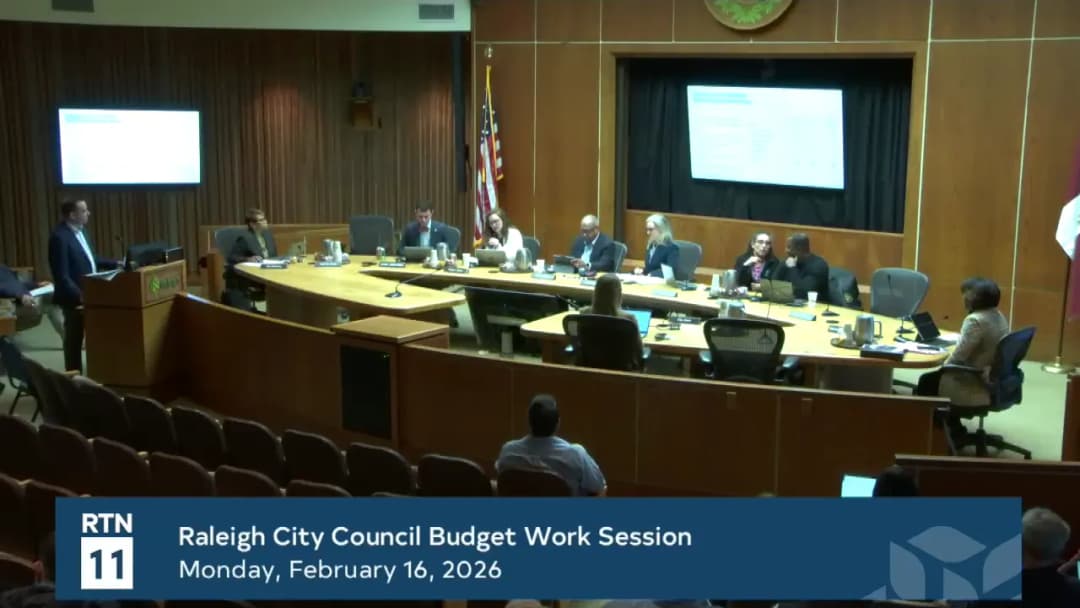
Raleigh City Council Budget Work Session – February 16, 2026

The Raleigh City Council held a budget work session on February 16, 2026, to review resident engagement results, compensation and benefits, and a targeted staffing study. The meeting included presentations from Budget and Management Services, Human Resources, and Matrix Consulting Group. Council members discussed competing priorities, vacancy rates, retiree health benefits, and staffing needs across multiple departments. Discussion Items Budget Engagement Presentation - Lauren Williams (Budget and Management Services) presented the results of the FY27 budget engagement process, which included listening sessions and a community survey that received 1,984 responses—seven times the previous year's count. - 82% of survey respondents rated Raleigh as good or excellent as a place to live, 72% as a place to work, and 71% as a place to play. 87% were satisfied or very satisfied with drinking water, 80% with greenways, and 86% with parks. Services residents desired greater levels of included affordable housing, Go Raleigh bus, and sustainability. - 82% of respondents supported dedicating additional resources to competitive employee compensation, enhanced public safety, and parks. When asked to rank priorities, 52% listed affordable housing as the top priority (284 mentions), followed by police (132 mentions), 911 call center, clean drinking water (106 mentions), fire/EMS (133 mentions), and Go Raleigh transit. - In listening sessions, 25% wanted more transportation funding, 17% asphalt maintenance, 17% public safety, 15% affordable housing. 37% wanted parks funding stable, 20% community engagement, 16% transportation. The top services residents felt were unnecessary included leaf collection and free parking. - Councilor Brown raised concerns about categorizing transportation versus transit and asked how contradictory feedback is reconciled. Councilor Jones noted declining attendance at in-person sessions and suggested partnering with council community meetings. Councilors Lambert Melton and Patton asked for further breakdown of “other” categories and for consideration of year-round engagement capacity. Compensation and Benefits Update - Sharnell Jones (Human Resources) reported that the city invested over $39.9 million in employee compensation since July 2025, including implementation of a comprehensive classification and compensation study with no tax increase. The city is aligned with market and proposes a flat annual pay increase for FY27. - A benefits survey with 1,151 responses (87% rated health benefits good or above) and a stay survey with 366 responses (28.1% cited benefits as top reason to stay) were reviewed. Health insurance costs $57 million annually; the city covers $48.3 million. No premium increases are proposed for medical, dental, or vision plans in FY27. - Vacancy rates have declined to 401 (8.9%) full-time vacancies as of February 13, 2026. Councilor Jones requested impact analysis of vacancies on service delivery. - Assistant City Manager Bradshaw presented OPEB (other post-employment benefits) options, noting a $210 million liability. Options include closing to new hires (saves $79 million over 15 years), moving eligibility to 20 years (saves $2.6 million), or moving to 25 years (saves $7.2 million). Councilor Jones expressed concern about cutting benefits for new hires. Mayor asked for benchmarking and real-life examples of how changes affect employees. Targeted Staffing Study - Ryan Bergman (City Manager's Office) and Aaron Baggerly (Matrix Consulting Group) presented a staffing study covering eight departments/divisions: Emergency Communications Center (ECC), Fleet Management, Fire Marshal, Code Enforcement, Building Safety, Solid Waste Services, Police, and Transportation (maintenance and traffic engineering). - Immediate staffing gaps identified: ECC needs 22 positions (currently 130 budgeted; should be fully staffed soon), Fleet 3.5, Fire Marshal 14, Code Enforcement no new positions (realignment only), Building Safety 29.5 (71 budgeted), Solid Waste 21 (due to leaf collection transition), Police draft analysis suggests maximum addition of 89 sworn positions (920 budgeted) plus 12 civilian positions, Transportation 6. - A three-year phased implementation proposes 52.5 new positions in FY27, 48 in FY28, 35.5 in FY29 (total 136 positions, excluding police pending data validation). A growth model projects 11% staffing increase over 10 years for these functions. - Councilor Silver questioned recruitment strategy for specialized positions (building safety, fire marshal). Councilor Patton asked for dynamic models, suggested improving plan quality from development community, and exploring service delivery changes. She also inquired about police district shapes and technology gains. Chief Boyce confirmed ongoing redistricting and use of technology (report dictation, two-officer cars). City Manager noted the study aligns with strategic resource use. Key Outcomes - No votes were taken; the work session was informational. - Next budget work sessions: March 9 (Raleigh Water, Stormwater, Parking), April 6 (Solid Waste Services, Grants, CIP), May 19 (proposed budget presentation to council). - Staff will complete data validation for police staffing study by end of March, along with fire shift analysis. A dynamic growth model will be provided to the city. - Compensation analysis for annual pay increase will be brought forward with FY27 budget. Council will consider OPEB changes as part of budget trade-off deliberations.

PUBLIC ENGAGEMENT 24% · PERSONNEL MATTERS 24% · PUBLIC SAFETY 18% · FISCAL SUSTAINABILITY 10%
37
FEB 3, 2026 · RALEIGH, NORTH CAROLINA · CITY COUNCIL
Raleigh City Council Meeting Summary – February 3, 2026

The Raleigh City Council met on February 3, 2026, at 6:00 PM. The meeting covered consent agenda items, a special budget adjustment, approvals for watershed protection and stormwater policies, a substance use advisory commission work plan, a transportation committee item, appointments, a discussion on snow removal, a motion regarding the Athens Drive library, and a report on minimum housing code and eviction trends. The council also entered closed session. Consent Calendar - The consent agenda was approved with the exception of Item C4B, which was pulled by Councilor Ford. - After Councilor Ford recused herself due to a conflict of interest, Item C4B was approved 7-0. - Other consent items included a resolution authorizing the donation of a police dog. Discussion Items - Council Contingency Budget: Sadia Satar presented a request to add $48,000 from FY25 capital reserves to the FY26 council contingency budget, increasing it from $150,000 to $198,000. Mayor Pro Tem Harrison noted the need to support nonprofits serving vulnerable residents. The council voted unanimously to approve. - Belvin Watershed Protection Project: Ed Bunkin from Raleigh Water presented the project to purchase 277 acres in Granville County for $479.60 per acre ($132,850 total) from the Belvin family, protecting Falls Lake water quality. The project leverages matching funds and has a high conservation value. Councilor Fort praised the partnership. The council authorized the purchase unanimously. - Rainwater Rewards Policy (R3): Wayne Miles and Graham Smith proposed increasing the cost-share from 75% to 90% citywide for green stormwater infrastructure projects, effective July 1, 2026. Other changes included updating language and raising staff approval thresholds. Councilor Fort asked about eligibility for the 100% subsidy (80% AMI or lower). Councilor Branch inquired about development applicability and program growth. The policy was approved unanimously. - Substance Use Advisory Commission: Chair Saul Parada presented the 2025 annual report and 2026 work plan, detailing medication take-back events (nearly 150 pounds in October 2024, 96 pounds in April 2025), listening sessions, and outreach. Councilor Harrison asked about surveys; Chair Parada noted a shift to direct outreach. Councilor Silver discussed funding ($7,000 annual allotment) and metrics. The work plan was approved unanimously. - Transportation and Transit Committee: Councilor Patton reported that the committee recommends ending the exception process for citizen-initiated street closures and reinstating previous procedures. The council approved unanimously. - Snow Removal and Weather Response: City Manager commended staff for their response to recent winter weather. Councilor Jones raised concerns about sidewalk snow removal and urged public communication encouraging property owners to clear sidewalks. Transportation Director Paul Calm noted that sidewalk clearing is low priority due to lane mile demands. - Athens Drive Community Library: Councilor Harrison motioned to authorize the city manager to engage in discussions with Wake County and the school board to keep the Athens Drive library in Raleigh, noting the city owns adjacent land at 4200 Avon Ferry Road. Councilor Scott opposed, stating libraries are not city purview and the land is better used for affordable housing. The motion passed 7-1. - City Attorney's Report on Minimum Housing Code: City Attorney Karen and Professor Rick Glazier of Campbell Law reviewed the existing housing code, enforcement process, and tenant resources. They highlighted that Wake County sees approximately 750 evictions per week, and tenants often lack representation. The clinic uses city funds for rental assistance and legal services. Council discussed the Durham ordinance, mediation efforts, and data collection. No vote was taken; the report was for information. - Appointments: The council confirmed the following appointments: Brandon Tucker (Bicycle and Pedestrian Advisory Commission), John Terzades (Design Review Commission), Chase Franklin (Police Advisory Board), and Jessica Hayden (Police Advisory Board). Other nominations were returned for future consideration. Key Outcomes - Approved consent agenda with exception; Council Contingency addition ($48,000); Belvin project purchase; Rainwater Rewards policy (effective July 1, 2026); Substance Use Advisory Commission 2026 work plan; reinstatement of previous street closure petition procedure. - Motion to engage in discussions regarding Athens Drive library passed 7-1. - Appointments made as listed. - Minutes from January 20 and January 24 retreats approved. - Closed session entered and adjourned with no report.

PROCEDURAL 65% · AFFORDABLE HOUSING 8% · PUBLIC ENGAGEMENT 7% · WATER AND WASTEWATER MANAGEMENT 5%
38
FEB 3, 2026 · RALEIGH, NORTH CAROLINA · CITY COUNCIL
Raleigh City Council Unanimously Approves Pickleball Rezoning on February 3, 2026

The Raleigh City Council held a meeting on February 3, 2026, where the primary action was the unanimous approval of a rezoning request (Z-33-25) to allow a new pickleball complex on Gresham Lake Road. Mayor Pratim Harrison was excused and absent from the meeting. Discussion Items - Z-33-25 Gresham Lake Road (Pickleball Facility): Matthew Clem of Planning and Development presented the request to rezone 7.8 acres from Heavy Industrial (with SHOD-2) to Industrial Mixed Use (with SHOD-2). The site is adjacent to a landfill to the east and I-540 to the west. Zoning conditions limit development to a maximum of 10,000 square feet of retail and a maximum of 50 play courts. The intended use is a pickleball complex with potential outdoor seating and a future small tournament stadium. A council member expressed strong support for the case, describing it as a "nice, simple case". The Planning Commission had previously recommended approval by an 8-0 vote. Public Comments & Testimony - Isabel Maddox (RITD LLC, prospective developer): Spoke in support of the rezoning. She stated the project addresses a need for more pickleball courts in Raleigh, that the existing remediation business on the property would remain, that there had been no neighborhood opposition, and that the project is an economic development target area that aligns with the city's comprehensive plan. Key Outcomes - Unanimous Approval: The Council voted unanimously to approve the Z-33-25 rezoning request, adopting the proposed consistency statement dated February 3, 2026.

PROCEDURAL 58% · LAND USE AND ZONING 21% · REZONING 21%
39
JAN 20, 2026 · RALEIGH, NORTH CAROLINA · CITY COUNCIL
Raleigh City Council Meeting - January 20, 2026

The Raleigh City Council met on January 20, 2026, at 6:00 PM. The meeting included presentations on police technology, a memorandum of agreement with the Dix Park Conservancy, multiple public hearings, and a major rezoning case for North Hills. The council approved a GPS tracking system for police, a technology upgrade contract with Axon, and several annexations, and voted 6-2 to approve the North Hills rezoning with additional community benefits. Consent Calendar - Approval of minutes from January 6 and January 13, 2026, was unanimous. - The consent agenda included item C1A (Star Chase GPS tracking system), which was pulled for discussion but later approved. Public Comments & Testimony - Lawrence Yelly criticized the city's budget process, staffing vacancy data, and FOIA responsiveness, urging council to question salary increases and property tax assumptions. - Mamakai Sanders expressed concern about environmental destruction, climate change, and the loss of natural ecosystems in Raleigh, urging better environmental stewardship. - Helen Kirvin opposed the Big Branch Greenway Connector's Streamside West Route, claiming the city breached a conservation easement and presented false claims. She noted the Parks Board voted 9-5 against the route. - Kevin Kwong advocated for improved transit in North Hills, including extending bus routes and restoring direct airport service. - Benji Caps (Executive Director, Miracle League of the Triangle) proposed a partnership to create a universally designed playground and play plaza at the existing Miracle League field on Queensland Road. - Octavia Rainey shared experiences from door-knocking in Oakwood, highlighting racial tensions and the threat of development to historically Black neighborhoods. - Jane Hubbard (homeowner bordering Big Branch) opposed the greenway, citing lower-cost alternatives and the Parks Board's opposition. - Dorothy Barrow spoke about failures in the mental health system, particularly the ACT team's neglect of her son during a crisis, and called for accountability. - Athena Wallen urged the city to maintain diverse tree canopy and root systems along stormwater creeks, emphasizing the need for updated policies. Discussion Items - Star Chase GPS Tracking System (C1A): Chief Rico Boyce presented the system as a tool to reduce high-speed pursuits. Funded by the Raleigh Police Department Foundation ($0 taxpayer cost). Discussion included data privacy, integration with existing systems, and transparency. Councilmember Jones raised concerns about process and lack of background. Motion to approve passed with a voice vote (unanimous in favor). - Police Technology Upgrade (Axon Contract): Chief Boyce requested approval for a 10-year, $1.6 million per year contract with Axon for a new records management system, Taser 10 devices, and the FUCSIS Connect Raleigh platform. He noted 22 Taser deployments in 2025 out of 320,000 contacts. Discussion covered data security, use-of-force continuum, and post-incident reporting. Motion to approve was unanimous. - Dix Park Conservancy Memorandum of Agreement: Stephen Bentley (Parks Director) and Ruffin Hall (Conservancy) presented updates to the partnership, including a new Dix Park Commission, streamlined roles, and focus on buildings and fundraising. Council approved the MOA unanimously. - Rezoning Z3425 (North Hills): The applicant sought to increase building heights (up to 37 stories) while keeping the same development entitlement. Conditions added: $500,000 for Raleigh Fire, affordable housing contribution ($40,000 per unit for 1% of units), and restricted access on Rowan Street. Debate centered on consistency with the Midtown Area Plan, traffic, and public benefits. Motion to approve passed 6-2. Key Outcomes - Star Chase GPS Tracking: Approved (voice vote, unanimous). - Axon Technology Contract: Approved (unanimous). - Dix Park MOA: Approved (unanimous). - Rezoning Z3425 (North Hills): Approved 6-2. - Public Hearings: - Bond anticipation notes (Series 2026 and refunding) approved. - Demolition lien for 617 South Blunt Street approved. - Public nuisance liens for 9 properties approved (one paid). - Annexations: Three annexations approved (Blue Run Lane, Old Wake Forest Road, Garner Road) effective January 20, 2026. - Smoking Ordinance Amendment: Approved with effective date April 20, 2026. - Appointments: Confirmed for Civil Service Commission, Bicycle/Pedestrian Advisory Commission, Park Recreation and Greenway Advisory Board, Board of Directors for Raleigh Sister Cities, Stormwater Management Advisory Commission, and others. - Transportation & Transit Committee: Meeting scheduled for January 29, 2026, on citizen-initiated street closures; Six Forks Road discussion postponed to February 2026. - Closed Session: Entered closed session to consider personnel matters.

PROCEDURAL 36% · PUBLIC SAFETY 13% · LAND USE AND ZONING 11% · PARKS AND RECREATION 8%
40
JAN 20, 2026 · RALEIGH, NORTH CAROLINA · CITY COUNCIL
City Council Work Session on Big Ideas for Raleigh's Future - January 20, 2026

This work session was held on January 20, 2026, to discuss three transformative big ideas identified at the September 2025 retreat: sponge cities, transportation innovations, and housing partnerships. City staff from the Office of Strategy and Innovation presented research and benchmarking on each topic, seeking initial council feedback ahead of a more detailed discussion at the upcoming budget retreat. No votes were taken. Discussion Items Sponge Cities (Designing with Water) - Heather McDougall (Strategy and Innovation Officer) presented the concept of becoming the nation's leading sponge city by expanding green stormwater infrastructure, creating landmark sponge parks, and unifying policies. She highlighted Raleigh's existing leadership (e.g., Wooten Meadow Park) and benchmarked against Cook Park in Atlanta ($40 million, 10 million gallon catchment) and Philadelphia's Green City Clean Water Plan ($1 billion over 20 years). Proposed an additional $10.2 million spread across multiple projects, with potential federal funding. - Councilor Jones expressed interest in using partnerships (e.g., RDU) to amplify efforts and requested examples from cities with separate sewer/stormwater systems (like Raleigh) rather than Philadelphia. The Mayor suggested creating incentives for private property owners to adopt green infrastructure. Councilor Lambert Melton supported exploring no-cost options like zoning changes to leverage private sector contributions. Transportation - Christina Leos (OSI) presented four concepts: a walkable downtown pedestrian network (inspired by NYC High Line, with potential elevated walkways costing $4-5 million each), Raleigh Rail (improving existing Amtrak corridor with station upgrades and schedule alignment), autonomous transit (downtown circulator, costs vary from $65M to $400M), and a streetcar (Charlotte example, $141 million per mile). - Councilor Ford asked for clarification on scope—whether the unsheltered homelessness initiative would be citywide or downtown-focused. Councilor Lambert Melton raised concerns about autonomous vehicles being low-capacity and not true mass transit, preferring investment in existing rail and bus infrastructure. Councilor Patton similarly expressed heartburn over safety and hacking risks of autonomous vehicles, and supported improving existing transit connectivity and frequencies. Councilor Silver noted potential for pedestrian connection from downtown to Dix Park. The Mayor requested examining Kansas City's streetcar funding model. Housing - Christina Leos presented three concepts: a philanthropic-led housing fund (modeled on Charlotte's $50M private match to a $50M bond), a street-to-home initiative (Dallas housed 250 people in <100 days, reducing visible homelessness, at $30M public-private cost), and healthcare partner investments (Durham's Commerce Street Apartments with $17M from CVS/Aetna). - Councilor Ford asked about citywide vs. downtown focus for homelessness. Councilor Patton supported moving faster on the Bringing Neighbors Home pilot, citing its 90% success rate at six months, rather than waiting for the Continuum of Care strategic plan (expected spring). She also raised concerns about cannibalizing existing nonprofit donations. Mayor Burtim agreed on urgency. Councilor Jones appreciated the philanthropic fund idea but wanted to ensure it added new money, not redirect existing donations. He also questioned why hospitals in Wake County haven't partnered similarly as in Durham. Key Outcomes - No formal decisions or resolutions were made. The presentations and council feedback will inform further research and a more focused discussion at the budget retreat (to be held next week). Staff will provide additional details on partnership models, cost breakdowns, and the timeline for the Continuum of Care strategic plan. Councilors will be able to prioritize ideas with “star stickers” at the retreat.

TRANSPORTATION 27% · ENVIRONMENTAL PROTECTION 16% · HOMELESSNESS 14% · ECONOMIC DEVELOPMENT 12%
OPENPUBLICA · PUBLIC MEETING INDEXUPDATED DAILY · openpublica.com