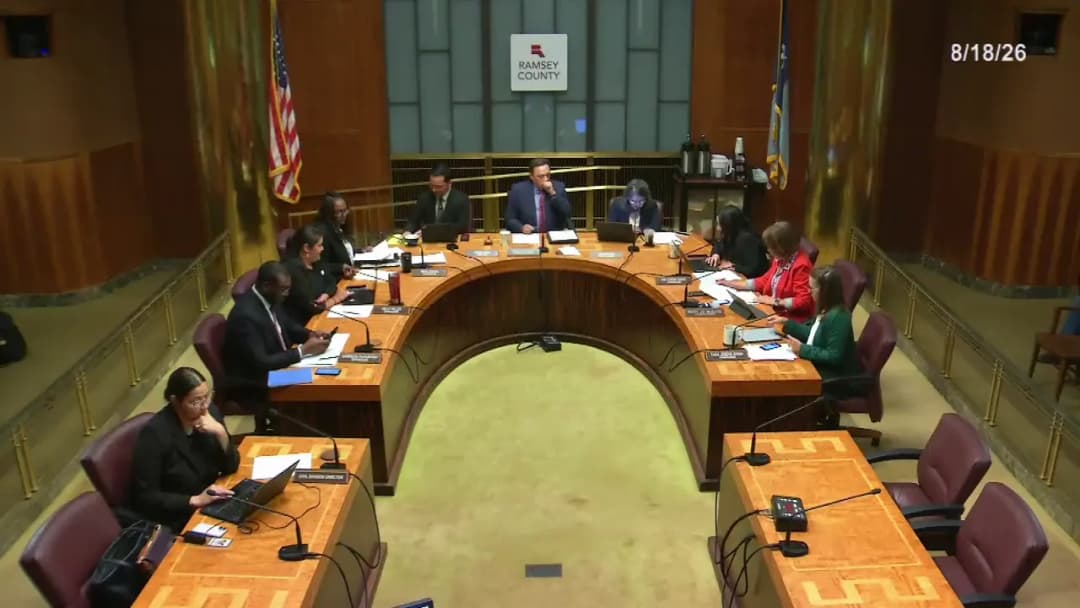
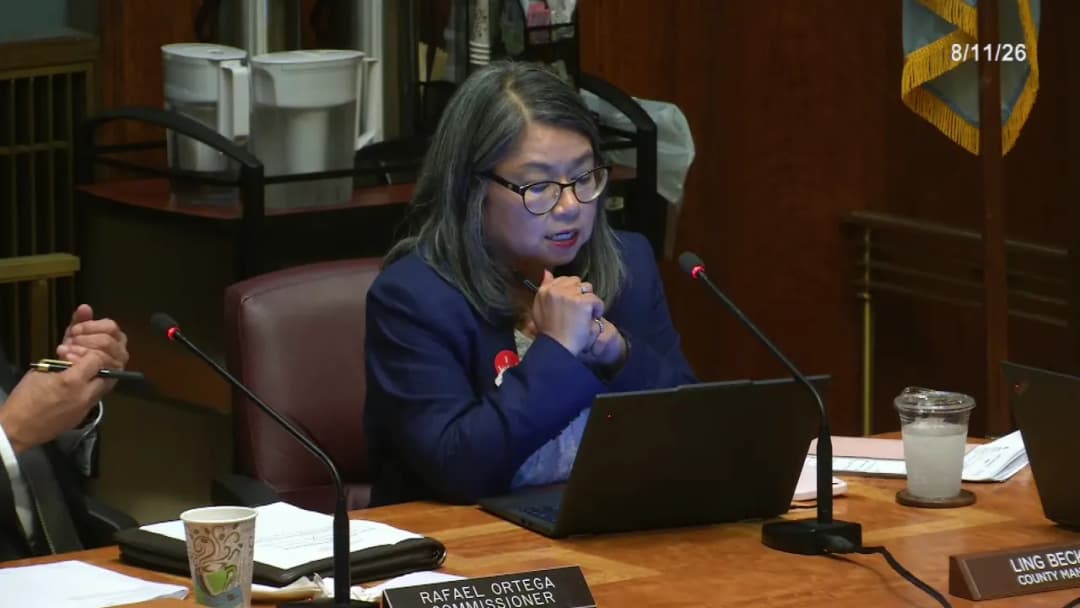
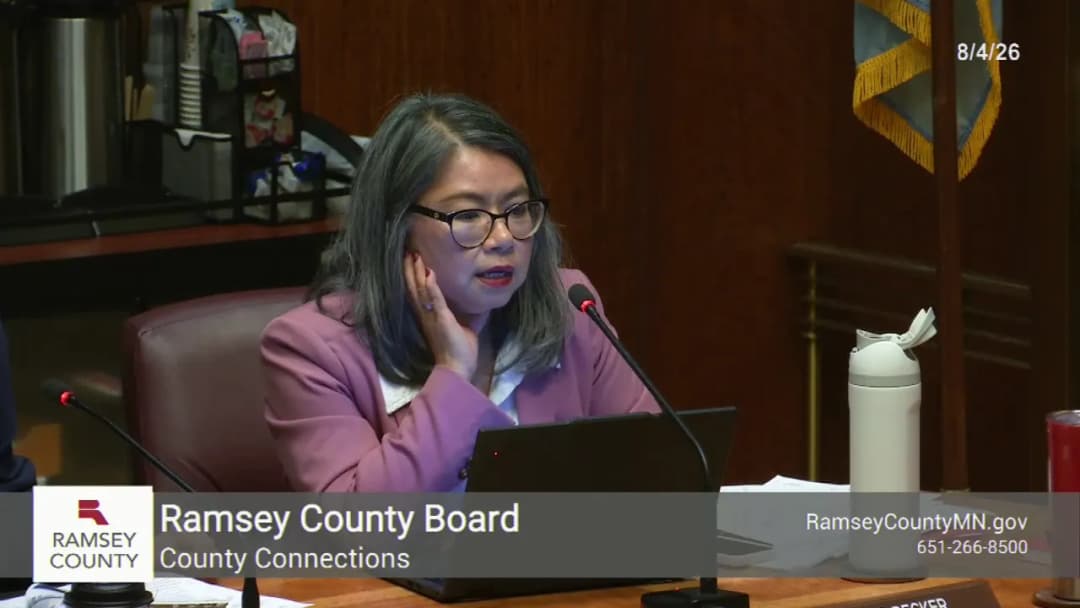
The Ramsey County Board of Commissioners met on August 25, 2026, at 9:03 a.m. in the Council Chambers of the Courthouse. The meeting focused on the presentation of the 2027 Supplemental Budget and Performance Measures by County Manager Ling Becker. The board also approved the agenda and minutes from August 18, 2026. No public comments were heard; the first public hearing is scheduled for September 10, 2026. The meeting adjourned at 10:48 a.m., followed by a board workshop on the projected impact of 2027 taxes. Consent Calendar - Agenda Approval (2026-321): Motion by McGuire, seconded by Miller. Passed unanimously (7-0). - Minutes Approval (August 18, 2026) (2026-322): Motion by Jebens-Singh, seconded by Miller. Passed unanimously (7-0). Discussion Items - Presentation of the 2027 Supplemental Budget (2026-324): County Manager Ling Becker presented a comprehensive overview of the proposed 2027 budget, totaling $965.7 million (4.5% increase over 2026). The proposed property tax levy is $464 million, an 8.25% increase ($35 million). Key drivers included: - Federal HR1 cost shifts (SNAP and Medicaid changes) adding $6.2 million in county costs, equivalent to 1.35 percentage points of the levy increase. - Adult Detention Center staffing needs (32 additional FTEs) adding 0.75 percentage points. - The projected levy increase needed to cover all pressures was 9.6%, but Becker recommended holding the line at 8.25% through cost savings, hiring limits, and operational efficiencies. - Strategies to achieve the lower levy included limiting hiring, reducing discretionary spending, implementing non-resident fees (starting with golf fees in 2027), and seeking additional personnel cost control tools (e.g., furloughs). - Long-term pressures include an estimated 4–5% additional levy impact in 2028 from HR1, state budget shifts, and long-term care funding changes. - Board members expressed support for the transparent presentation and acknowledged the difficulty of balancing service obligations with taxpayer burden. Commissioner Jebens-Singh requested details on how the 1.35% gap between 9.6% and 8.25% would be closed; Becker outlined ongoing budget management and department-level reviews. Commissioner Miller emphasized considering cumulative impacts of decisions. Commissioner Moran noted the need for regional partnerships and advocacy. Chair Ortega commended Becker's stewardship and noted that Ramsey County remains in relatively strong fiscal shape compared to metro peers. Key Outcomes - The board received the 2027 Supplemental Budget presentation for information only. No formal vote was taken. - The next steps in the budget process include: - Department performance measure presentations starting August 27, 2026. - First public hearing on September 10, 2026. - Joint Property Tax Advisory Committee meeting on September 21, 2026. - Board sets maximum levy on September 22, 2026. - Truth in Taxation hearing on December 3, 2026. - Final budget and levy adoption on December 15, 2026. - County Manager Becker committed to providing ongoing updates on cost-saving measures and to advocating at the state and federal levels for sustainable funding. County Connections & Outside Reports - County Manager Becker highlighted community events: a community baby shower (Mother's First program), Rice Creek Commons open house (spine road construction), and the Environmental Center Fix-It Clinic. - Board members reported on external meetings, including discussions on homelessness with Ecolab (CEO invested $2 million), a tour of deeply affordable housing units in St. Paul (seven units at 30–50% AMI), and participation in the AMC Tribal Leadership Meeting where four tribal leaders agreed to join SHAC. - No formal actions were taken on these reports.
Public Meetings - Ramsey County, Minnesota
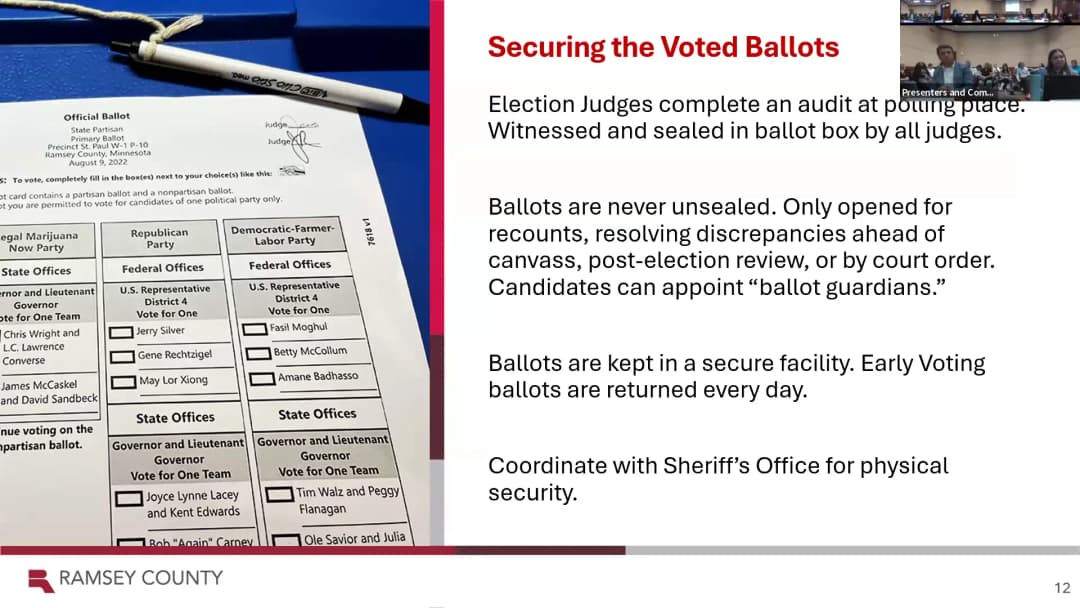
Public Meetings - Ramsey County, MinnesotaOn August 18, 2026, the Ramsey County Board held a workshop to receive updates on election preparations for the 2026 general election, following the August 11 state primary. The workshop covered voter turnout, communication strategies, election security, emergency preparedness, language services, student election judges, contract renewals, and a planned voting system upgrade. No votes were taken during the workshop. Discussion Items - Primary Results & Turnout: David Triplett, Deputy Director of Property Tax, Records & Election Services, reported a record number of voters in Ramsey County for a non-presidential primary, exceeding turnout from 2018, 2022, and 2024. The county opened 165 voting locations (163 Ramsey County precincts plus two Hennepin County precincts under contract for St. Anthony). Over 1,500 election judges were deployed on election day, with a waiting list of several hundred for future elections. - Communications & Voter Information: The elections office redesigned its website to make information more accessible, increased social media content with professional photos, and provided a communications toolkit for community organizations. New public office hours (Q&A sessions) are scheduled for three weeks starting August 20. Staff also coordinate with city partners and community groups to reach voters who are not online. - Election Security & Emergency Preparedness: An emergency response group including stakeholders from county departments, cities, and law enforcement meets regularly and was active on primary day. Staff have attended state tabletop exercises and conducted de-escalation training. The group coordinates with the Secretary of State's office and has protocols for handling unauthorized observers, law enforcement presence (peace officers restricted to 50 feet from polling places), and polling place disruptions. Commissioners asked about preparedness for federal intervention; staff and board members affirmed commitment to legal integrity and the constitution. - Voting System Security: Ramsey County uses non-networked voting systems with paper ballots. Ballots are physically transported and audited. The voter registration database is maintained through daily verification, use of social security and public health databases, and post-election audits. The county's voting system (HART) is federally certified by the Election Assistance Commission and state-certified by the Secretary of State. A post-election review will randomly hand-count five precincts to verify accuracy. - Language Services: The county deploys professional interpreters (e.g., 26 Hmong, 6 Karen, 6 Somali, and Spanish interpreters on primary day) and provides a phone line covering six additional languages. A new virtual translation app (FaceTime-style) was deployed at 36 locations but had limited use (2 calls) during the primary; it will be expanded for the general election. - Student Election Judges & Teacher Liaisons: The county works with five high schools to recruit up to 300 student election judges per general election. Students are paid $16/hour; a proposed $2/hour increase for all election judges (ranging from $18 to $22/hour) will be brought to the board later. Teacher liaisons coordinate paperwork and training. - Contracts for Election Services: The county is renewing 16 contracts with 16 municipalities and 4 school districts for election services. Costs are increasing due to inflation, expanded absentee/early voting, new voting booths, and proposed pay increases. The county is not losing money on contracts, according to staff. - Voting System Upgrade: The current voting system is 11 years old and showing issues. Staff plan to bring an action to the board before the end of 2026 to purchase a new system meeting 2021 federal standards. No federal dollars have been used for election administration in recent years. Key Outcomes - No votes taken: The workshop was informational only. - Follow-ups requested: Commissioners asked for clarification on the definition of "peace officer" for polling place restrictions, the list of five colleges requesting on-campus early voting, and more information on legal support for potential federal action. - Upcoming actions: The board will receive an action item to approve a $2/hour pay increase for election judges and a separate action to purchase a new voting system before the end of 2026. - Public office hours: Starting August 20, 2026, the elections office will host three weekly Q&A sessions for residents. - Contract timeline: Contracts for election services will be sent to cities and school districts by end of August, with board action expected before year-end.
The Ramsey County Housing and Redevelopment Authority (HRA) met on August 18, 2026, at approximately 9:57 a.m. in Council Chambers (Courthouse Room 300), despite the agenda listing a 10:15 a.m. start. All seven board members were present: Jebens-Singh, McGuire, McMurtrey, Miller, Moran, Ortega, and Chair Xiong. The meeting lasted approximately two minutes and concluded at 9:59 a.m. No public comments or board chair updates were provided. Consent Calendar - Agenda Approval: The agenda for August 18, 2026 (Item 1) was approved unanimously via roll call vote (motion by McGuire, second by Miller). - Minutes Approval: The minutes from July 7, 2026 (Item 2) were approved unanimously via roll call vote (motion by Ortega, second by Miller). Administrative Items - Substantial Amendments to HOME Funding (Item 3): The board approved substantial amendments to the 2022, 2023, 2024, and 2025 Community Development Block Grant-HOME Investment Partnerships Act Annual Action Plans. The action authorized the obligation of $879,000 in HOME funds for construction and preservation of affordable owner-occupied housing. It also authorized the County Manager to execute necessary loan agreements. The motion by McGuire, seconded by Miller, passed unanimously via roll call (7 ayes). Resolution H2026-013 was adopted. Key Outcomes - All three agenda items were approved unanimously (7-0 votes). - $879,000 in HOME funds were obligated for affordable homeownership projects. - The County Manager was authorized to enter into agreements consistent with federal and local regulations. - Note: The meeting started at 9:57 a.m., earlier than the scheduled 10:15 a.m. on the agenda. The minutes and transcript confirm an earlier start, but the reason for the discrepancy is not discussed.
The Ramsey County Regional Railroad Authority met on August 18, 2026, in Council Chambers (Courthouse Room 300) with all seven commissioners present: Jebens-Singh, McGuire, McMurtrey, Miller, Moran, Ortega, and Xiong. The agenda listed a 10:00 a.m. start, but the minutes record that the meeting was called to order at 9:47 a.m. and adjourned at 9:54 a.m. The raw transcript appears to render Commissioner Xiong's name as "Zhang" or "Zhong" and refers to one commissioner as "Commissioner Shaw," likely a transcription variant. All items on the agenda were approved unanimously by 7-0 roll-call votes. Consent Calendar - Agenda of August 18, 2026 (2026-300): Approved unanimously after a motion by Commissioner Miller, seconded by Commissioner Xiong. - Minutes of May 19, 2026 (2026-301): Approved unanimously after a motion by Commissioner Jebens-Singh, seconded by Commissioner Miller. Discussion Items - Capital Grant Agreement for METRO Bronze Line BRT Engineering Phase (2026-286): Jennifer Jordan of Public Works presented the Capital Grant Agreement with the Metropolitan Council and Ramsey County for the METRO Bronze Line Bus Rapid Transit Project. She said the design is at 3 percent, and both Ramsey County and Metro Transit will bring consultants back in fall 2026 to begin detailed design and stakeholder engagement. Remaining questions include whether the bridge along Johnson Parkway can be shifted and what the treatments around it will look like. A commissioner (identified as "Commissioner Shaw" in the transcript, likely a transcription variant of Commissioner Xiong) expressed full support for the project, said he would not pause progress, and acknowledged that constituents in his district have concerns because the line would be in their backyards. He stressed the importance of continuing to meet community members where they are and noted he also represents about 78,000 other constituents. Approved unanimously as Resolution R2026-010; the resolution also authorized the Chair to execute the agreement and the County Manager to enter into related agreements within funding limits. - Fund Balance Transfer for RiversEdge Land Work (2026-280): The board authorized the County Manager to transfer up to $2,500,000 from the Ramsey County Regional Railroad Authority fund balance to the RRRA capital fund for completion of land title surveys, title insurance commitment, title abstracts, and legal assistance related to property ownership for the RiversEdge Project in downtown Saint Paul. The transfer is to be accounted for in the Riverfront Redevelopment project budget established by the County Board, with County Manager authority to enter into agreements within funding limits. Approved unanimously as Resolution R2026-011. - Transit Impacts Research Program 2026 Funding (2026-282): The board approved a $30,000 expenditure for Ramsey County Regional Railroad Authority's share of the Transit Impacts Research Program for 2026. A commissioner expressed support for the program and urged that the research evaluate completed projects such as the Green Line, which has been operating for 10 years, including development along the corridor, median home values, changes in car usage on University Avenue, and crash data, rather than only documenting advantages of transit. There was also a suggestion that future funding requests include a mini workshop so the county can outline its vision for the research. Approved unanimously as Resolution R2026-012. Corridor Updates - None reported. Key Outcomes - All agenda items passed unanimously with identical 7-0 roll-call votes; no negative votes or abstentions were recorded. - Resolutions adopted: R2026-010 (Bronze Line engineering grant agreement), R2026-011 (RiversEdge $2,500,000 fund balance transfer), and R2026-012 ($30,000 Transit Impacts Research Program funding). - Motions for agenda items 3-5 were made by Commissioner Xiong and seconded by Commissioner Miller. - No corridor updates were provided, and Chair Ortega declared the meeting adjourned at 9:54 a.m.
The Ramsey County Board of Commissioners met in regular session at 9:01 a.m. on August 18, 2026, in Council Chambers at the Courthouse. All seven commissioners were present. The meeting included approval of the agenda and prior minutes, discussion and approval of two administrative items (a capital grant agreement for the METRO Bronze Line BRT and a personnel complement increase for HR1 implementation), and reports from the county manager and commissioners. The meeting was adjourned at 9:44 a.m. Consent Calendar - Agenda of August 18, 2026 approved unanimously. - Minutes from August 11, 2026 approved unanimously. - Both motions passed with all members voting aye. Discussion Items - Capital Grant Agreement for METRO Bronze Line Bus Rapid Transit (Item 3): The board approved a grant agreement with the Metropolitan Council for the engineering phase of the METRO Bronze Line BRT project. Resolution B2026-113 was adopted unanimously. - Personnel Complement Increase for HR1 Implementation (Item 4): The board approved adding 16.5 FTE Eligibility Specialists and 1 FTE Supervisor in Financial Assistance Services, and authorized transferring up to $363,263 from the General Contingency Account for 2026 operations. Resolution B2026-114 was adopted unanimously. Discussion included the impact of federal HR1 legislation, which creates unfunded mandates for SNAP and Medicaid administration. County Manager Ling Becker and FAS Director Ali Ali explained that the new hires are needed to manage increased workload from expanded renewals and eligibility checks. The annual cost is estimated at $1 million (0.25% property tax levy impact). Commissioners expressed concern about long-term cost shifts, including a potential $9.2 million benefit cost shift in 2028 if statewide error rates do not improve. Commissioners emphasized the need for state and federal advocacy to mitigate taxpayer burden. All commissioners supported the increase. Reports and Other Business - County Connections: County Manager Becker announced a new Employee Assistance Program partner (New Vantage/Lutheran Social Services) and highlighted a recent cybersecurity panel with state and National Guard partners. - Elections Update: Chair Ortega and others praised the elections team for the successful primary election (highest non-presidential primary turnout in Ramsey County) and encouraged residents to rely on official county information. - Homelessness Continuum: Commissioner Moran emphasized the need to address family homelessness and the broader continuum, not just encampments. A board workshop on Heading Home Ramsey is scheduled for September 22, 2026, and additional information on family homelessness will be provided. - Other Reports: Commissioners reported on community events (Roseville Volunteer Fair, Rice Larpenter Alliance block party, Central Honors Philando event), tours (Operating Engineers training center), and meetings (AMC strategic planning, state fair concerns). Also announced the reopening of the Ramsey County Public Health Center in Maplewood and the start of advisory board applications. Key Outcomes - Approved agenda and minutes. - Approved Resolution B2026-113 (METRO Bronze Line grant agreement). - Approved Resolution B2026-114 (Personnel complement increase and contingency fund transfer). - Noted upcoming workshops: Elections 2.0 at 10:30 a.m. and African American Family Preservation at 1:30 p.m. on same day. - Scheduled board workshop on Heading Home Ramsey for September 22, 2026. - Adjourned at 9:44 a.m.
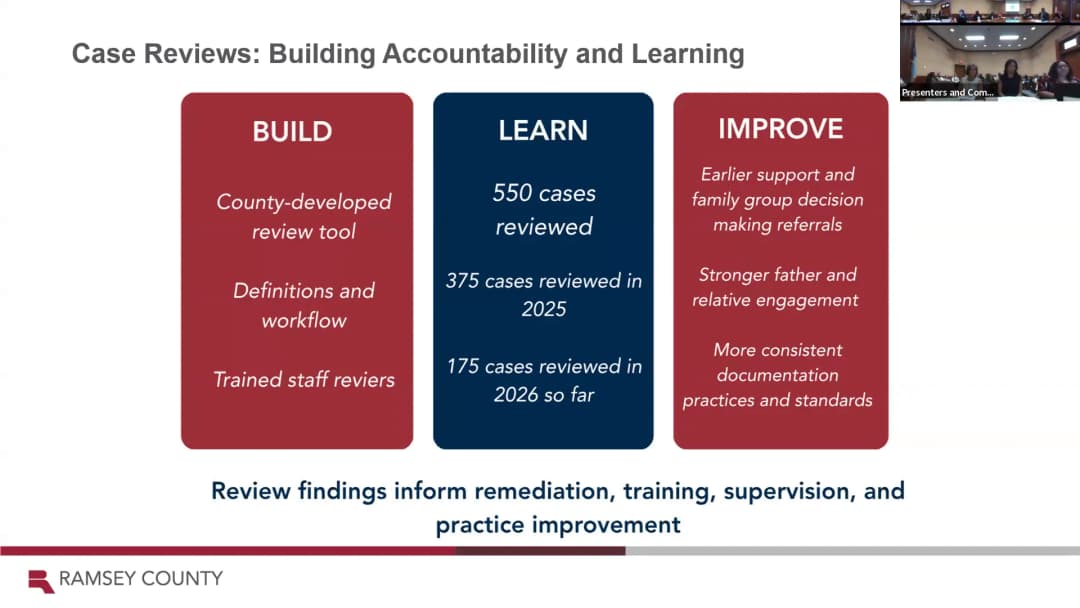
This workshop, held on August 18, 2026, provided an in-depth review of Ramsey County’s implementation of the Minnesota African American Family Preservation and Child Welfare Disproportionality Act (MAFPA-CWDA or the Act). County staff, commissioners, and community elders discussed progress, persistent disparities, workforce challenges, and the need to shift from a system-centered to a family- and community-driven approach. No votes were taken. Discussion Items - Legislative context and rationale: The Act responds to longstanding disproportionality in child welfare. Despite prior efforts, African American and American Indian children continue to experience higher rates of removal. Data specific to Ramsey County showed an increase in removals from 2024 to 2025, a trend attributed to families in deeper crisis and limited community-based services. At the same time, 96% of MAFPA-eligible children (718 families, 1,700 children) remained safely at home. - Workforce and capacity: Several funded positions remain unfilled due to multiple hiring rounds. New social workers often lack experience, and existing staff face rising case complexity, turnover, and the challenge of providing “active efforts” (a higher standard than “reasonable efforts”) which requires more in-person, relational engagement. A new six-week training curriculum and an onboarding unit have been implemented to improve retention. - Active efforts vs. reasonable efforts: The Act requires active efforts—e.g., helping families overcome transportation, childcare, or scheduling barriers rather than simply providing a referral. Ramsey County models this on Indian Child Welfare Act (ICWA) standards. Staff are being trained to document and operationalize active efforts consistently. - Law enforcement role and collaboration: Police are often the first to make removal decisions through emergency holds, with removals sometimes occurring before child protection is involved. County staff are working to strengthen partnerships with law enforcement through training and a multidisciplinary mapping process to return children home within 72 hours. There is recognition that police discretion can lead to inequitable experiences for families. - Community partnership and the Black Table pilot: Elders from the community (Elder Ford and Elder Atom) described their 18-month participation in an advisory committee that moved from advising to action. In June 2026, they convened 35 families and community members to discuss the Act and identify where community authority should be centered. The consensus was on the front end—screening decisions. A pilot project called the “Black Table” emerged, proposing that culturally rooted standards (e.g., “Standards for a Healthy African Community”) be used alongside legal maltreatment guidelines during initial screening. Elders emphasized shifting power and authority to the community, not simply involving them. - Funding and costs: Ramsey County received a $2.5 million phase-in award (available through December 2026) and anticipates a new statewide allocation of approximately $1 million for 2027. Implementation cost estimates range from $4 million to $17 million, depending on the scope of active efforts, community contracts, and service gaps (e.g., rent, daycare, supervised visitation). Commissioners stressed the need to build community capacity rather than only seeking county dollars. - Case review changes: The Act currently requires 100% case review of eligible MAFPA cases, which is administratively burdensome and may yield less meaningful data. The county and its legislative delegation are proposing to shift review responsibility to the Minnesota Department of Children, Youth, and Families (DCYF) and use statistically significant sampling instead. Elders and commissioners urged retaining a community-informed review component. - Early prevention challenges: Commissioners asked how families can access help before crisis escalates, given negative historical perceptions of child welfare. Staff acknowledged the need to rebuild trust and expand voluntary preventive services. Key Outcomes - No formal votes were taken. The board directed staff to: - Provide follow-up data on removal decisions by law enforcement vs. social services. - Report on family locations by zip code to understand geographic disparities and inform broader ecosystem advocacy. - Include community-driven work (e.g., the Black Table pilot) in the next legislative report. - Continue to strengthen workforce supports, preventive services, and culturally responsive community partnerships. - The workshop underscored a fundamental tension between complying with statutory requirements and transforming power dynamics to center family and community authority—a theme that will shape Ramsey County’s approach as full implementation (100% of eligible cases) is reached by January 2027.
The Ramsey County Board of Commissioners met in regular session on August 11, 2026, at 9:03 a.m. in Council Chambers, Courthouse Room 300. Present: Commissioners Jebens-Singh, McGuire, Miller, Moran, Ortega (Chair), and Xiong (arrived at 9:04 a.m.). McMurtrey was excused. The meeting included approval of the agenda and minutes, unanimous approval of several administrative items, a detailed policy presentation on House Resolution 1 implementation, and brief reports from the County Manager and Commissioners. The meeting adjourned at 10:40 a.m., followed by a closed meeting concerning the potential sale of 97 Moore Street. Consent Calendar - Agenda and Minutes: The agenda of August 11, 2026, and the minutes from August 4, 2026, were approved unanimously (Motion by Moran, seconded by Miller). - Administrative Items (Items 3–7): Commissioner Miller moved approval of Items 3 through 7 as a block. The motion passed unanimously. - Item 3: Appointment of Samantha Wicks to the Personnel Review Board for a four-year term (August 11, 2026 – August 1, 2030). (Resolution B2026-106) - Item 4: Appointment of Hawona Sullivan Janzen, Joseph P. Collins, and Rick Sanders (all incumbents) to the Capitol Region Watershed District Board of Managers for terms October 1, 2026 – September 30, 2029. (Resolution B2026-107) - Item 5: Appointment of Niko Le Mieux, Clarence Patterson, and Mazel McCoy-Anderson (all incumbents) to the Capital Improvement Program Advisory Committee for terms August 30, 2026 – August 30, 2028. (Resolution B2026-108) - Item 6: Rescinded Resolution 99-250 and amended Resolution 90-191 to increase the Parks and Recreation Commission from seven to nine at-large members with three-year staggered terms. (Resolution B2026-109) - Item 7: Approved the project budget and financing plan for the Arden Hills Subsurface Drain Restoration project up to $2,400,000; authorized transfers of $1,300,000 from Property Management fund balance and $1,100,000 from county bond interest. (Resolution B2026-110) - Item 8 (Pulled for Separate Vote): Appointment of Kendall Bobula as Ramsey County Director of Emergency Management, effective August 11, 2026. Presented by County Manager Ling Becker. Motion by Miller, seconded by Jebens-Singh, passed unanimously. (Resolution B2026-111) Bobula addressed the board, highlighting her background in state and local emergency management and her commitment to stewardship and regional partnerships. Public Comments & Testimony - No public comments were made during the meeting. Discussion Items - Policy Item 9 – House Resolution 1 Implementation: Director Ali Ali of Financial Assistance Services presented on operational readiness, service delivery, and staffing needs resulting from federal House Resolution 1 (HR1). Key points: - The county serves about 150,000–160,000 residents; Financial Assistance Services has approximately 465 employees. - HR1 imposes new eligibility reviews, verification, and work requirements on SNAP and Medical Assistance (MA). MA renewals will shift from every 12 months to every 6 months, doubling the workload. - The department has already made improvements: reduced turnover from 21% to 17%, trained 170 staff in customer service, and deployed a new digital quality assurance tool. - Despite improvements, current staffing cannot absorb the added workload. The county requests 17.5 additional FTEs (16.5 eligibility specialists and 1 supervisor) at an estimated $1.8 million net of anticipated federal reimbursement. The cost would add 0.25% to the property tax levy. - Hiring must begin immediately because eligibility specialists require 6–9 months of training. The county now has three certified internal trainers, allowing accelerated onboarding starting October 2026. - Commissioners expressed concern about the burden on residents, potential loss of coverage if staffing is insufficient, and the need for state and federal advocacy. County Manager Becker noted that HR1 impacts to the 2027 budget include this FTE request plus additional SNAP and long-term care cost shifts totaling roughly $19 million in potential exposure by 2028. - No vote was taken; this was an informational presentation. Formal board approval is requested at the August 18, 2026 meeting. - County Connections: County Manager Becker announced a redesigned employee recognition program, including Values in Action Awards, Shining Star Awards (quarterly), High Five peer recognition, and a One Ramsey County Award. A formal ceremony will be held in April 2027. - Board Member Reports: Commissioners shared activities including National Night Out, attendance at the Wall That Heals memorial, the East Metro Mental Health Roundtable, League of Women Voters events, and various community festivals. - Election Day Reminder: The County Manager reminded the public that the state primary was held on August 11, 2026 (polls open 7 a.m. – 8 p.m.), and encouraged voting. Key Outcomes - All consent and administrative items approved unanimously (6-0, McMurtrey excused). - Parks and Recreation Commission membership increased from 7 to 9 at-large members with staggered three-year terms. - Arden Hills Subsurface Drain Restoration project funded at $2.4 million. - Kendall Bobula officially appointed as Emergency Management Director. - No formal decision on the HR1 staffing request; additional discussion and a vote will occur on August 18, 2026. - Following adjournment at 10:40 a.m., a closed meeting under Minnesota Statutes 13D.05 was held from 10:50–11:28 a.m. to discuss the sale of 97 Moore Street, St. Paul. The board authorized staff to proceed as discussed (Motion by Moran, seconded by Jebens-Singh; Resolution B2026-112, 6-0).
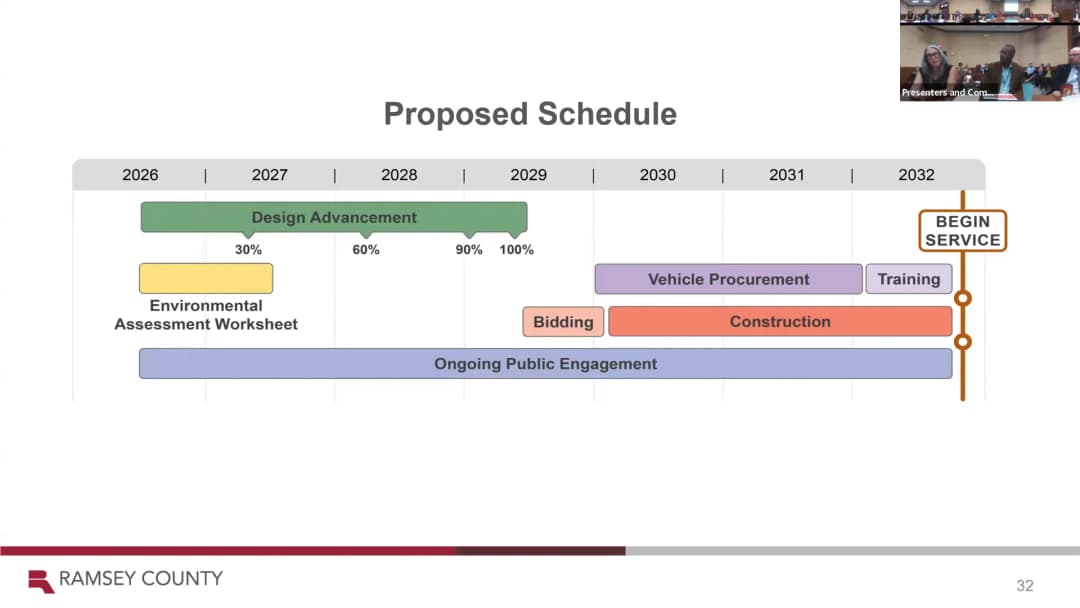
The Ramsey County Board held a workshop on August 5, 2026, to discuss the Bronze Line Bus Rapid Transit (BRT) project. The workshop provided an overview of the project, proposed capital grant agreement, cooperative project delivery agreement, and public works staffing plan. No votes were taken. The capital grant agreement is scheduled for board consideration on August 18, 2026. Discussion Items - Project Overview: The Bronze Line is a 10-mile BRT route from Union Depot to Maplewood Mall, with 22 stations (17 new). Fifty percent of the alignment is dedicated guideway. The project aims to improve mobility, safety, and multimodal access. Key statistics: 28% of trips are work commutes, 64% of trips are expected from households without cars, and 97% of trips involve walking, biking, or transferring between transit lines. - Funding and Delivery: The project is 100% locally funded. Approximately 90% comes from Ramsey County (regional railroad authority levy and county-controlled sales tax), and 10% from the Metropolitan Council. The project is delivered through an integrated approach: Ramsey County handles roadway, utilities, streetscape, and pedestrian improvements; Metro Transit handles stations, transit systems, fleet, and dedicated bridges. - Technical Issues: Presenters highlighted several technical challenges: - RK Station proximity to the Pay Phelan community, with requests to move the station closer to Arcade Street. - Coordination with Walk on TP (a Dakota-led nonprofit) on daylighting Phalen Creek along the Bruce Vento Trail, where the county will reconstruct the trail and guideway. - Johnson Parkway Bridge proximity to the Real Life Cooperative retirement community (50 feet from the building); the county is exploring shifting the bridge. - Reconstruction of Pennsylvania Avenue, Maryland Avenue, and White Bear Avenue, with efforts to minimize property impacts and maintain business access. - Staffing Needs: Public Works identified a need for additional staff in engineering, traffic, right-of-way, and communications to deliver the project. These positions will be funded through project funding sources, not the general levy. - Board Questions and Discussion: Commissioners raised questions about: - Funding breakdown between the levy and sales tax (currently expected to be 50/50, but may change). - Decision points and thresholds: a project decision board comprising three Ramsey County elected officials and two Met Council members will approve scope, cost, and schedule changes at 30%, 60%, 90%, and 100% design. Items over $150,000 require board approval. - Business support during construction: Commissioners emphasized proactive communication, technical assistance, and a business resiliency inventory, rather than direct grants or loans. - Inclusion of benches at BRT stations for aging residents. - Request for a future workshop on pedestrian and bicycle lane design across multiple projects. Key Outcomes - No formal votes were taken at the workshop. - The Capital Grant Agreement will be presented to the board for action on August 18, 2026. - The Cooperative Project Delivery Agreement is still under negotiation and will be brought to the board later in 2026. - Staffing increases were endorsed, funded by project sources. - The board agreed to hold future workshops on specific topics (e.g., pedestrian/bike lanes) to provide ongoing oversight.
The Ramsey County Board of Commissioners met in regular session at 9:05 a.m. on August 4, 2026, and adjourned at 10:55 a.m. All members were present except Commissioner McMurtrey (excused). The board approved several routine items, discussed major housing and homelessness initiatives, and passed a resolution addressing encampment closures in Saint Paul. Six commissioners voted in favor on all items. Consent Calendar - Agenda and Minutes: The agenda for August 4, 2026, and the minutes from July 28, 2026, were approved by voice vote. - Proclamation: Child Support Awareness Month: The board declared August 2026 as Child Support Awareness Month. Staff highlighted that Ramsey County Child Support serves nearly 20,000 children, collects over $38 million annually, and that 40% of custodial parents served are survivors of domestic violence. - Item 4: Teams Rooms Technology Project: The board accepted a project budget and financing plan up to $500,000 for Teams Rooms technology, authorized the County Manager to account for the project in Property Management, and transfer up to $500,000 from the Capital Projects Fund Holding Project. (Resolution B2026-099) - Item 9: Social Services Fee Changes: The board approved proposed changes to Mental Health services rates and added a fee schedule for Guardianship services. (Resolution B2026-100) Discussion Items Item 5: Amendment to Twin Cities Army Ammunition Plant Master Plan Commissioner McGuire moved approval, noting the amendment is a small clarification of an ambiguous height specification. Commissioner Jebens-Singh added that significant progress continues at the site. The motion passed unanimously. (Resolution B2026-101) Items 6 & 7: Obligation of 2026 State and Local Affordable Housing Aid Max Holdhusen, Deputy Director of Community and Economic Development, presented the combined items. The board obligated $436,475 in State Affordable Housing Aid (SAHA) and $8,194,000 in Local Affordable Housing Aid (LAHA). Of 45 applications received totaling over $72 million in requests, the board recommended $16 million across four funding actions. The projects will impact 897 multifamily units (546 renovation/preservation, 115 in vacant buildings) and 22 owner-occupied units, with multifamily units targeting 30% AMI. Commissioner Moran questioned funding percentages and timelines; Holdhusen explained that partial awards are common when multiple funders are involved, and projects vary from ready-to-close to still seeking state funding. Commissioner Xiong thanked staff for prioritizing deeply affordable housing. The motion passed unanimously. (Resolutions B2026-102 and B2026-103) Item 8: Amendment to Agreement with Minnesota Housing Finance Agency for Family Homelessness Prevention and Assistance Program (FHPAP) Commissioner Xiong moved approval. Renee Theese, FHPAP coordinator, explained that the $5,281,093 amendment to the existing grant (through Sept. 30, 2027) primarily funds prevention projects and also supports coordinated entry and street outreach. Commissioner Moran asked about point-of-entry; staff described a "no-wrong-door" approach but noted ongoing efforts to centralize access. Moran also shared a story of a pregnant woman with a child unable to find immediate help, questioning the county's ability to provide hotel stays. Director Wilkins responded that hotels are expensive and not best practice for wraparound services, but emergency funds exist. Moran urged creative partnerships with hotels and landlords. The motion passed unanimously. (Resolution B2026-104) Item 10: Ramsey County’s Response to Encampment Closures in the City of Saint Paul County Manager Ling Becker provided an extensive update. On July 8, 2026, the City of Saint Paul announced rolling encampment closures, starting with Pig's Eye Park on August 5. In response, Ramsey County launched a coordinated "One Ramsey County" effort on July 14, bringing together multiple departments. Staff have made over 5,000 individual contacts, involving more than 90 employees. The county invested $1.1 million in emergency shelter and case management, spent $33,000 on outreach supplies, and repurposed an estimated $150,000 in staff time. Becker noted the county is operating a temporary resource site at 555 Cedar Street through at least August 20. Becker also announced that since December 2021, the county has invested approximately $106 million in affordable housing, touching over 7,000 units. Commissioner McGuire asked about preventing displacement to suburban areas; Becker noted that enforcement is the city's role and that the county coordinates regionally. Commissioner Zhang urged a 60-day pause and expressed disappointment in the city's decision. Commissioner Moran called for data-driven outcomes and tracking of investments, stating the county has been "thrown into reaction." The motion to approve the resolution affirming county values, directing continued coordination, and advancing housing strategies passed unanimously. (Resolution B2026-105) Key Outcomes - All items (resolutions B2026-099 through B2026-105) passed unanimously with 6 ayes (Commissioner McMurtrey excused). - The board directed the County Manager to continue executing strategies in alignment with the Heading Home Ramsey Strategic Plan and the Economic Competitiveness and Inclusion Plan, including expanding housing access, increasing supportive housing capacity, and strengthening homelessness prevention. - The board requested future reports on the impact of encampment closure investments and outcomes for individuals served. - A board workshop on the Heading Home Ramsey Strategic Plan was scheduled for a future date. - The next regular board meeting is August 11, 2026.
The Ramsey County Board of Commissioners met in regular session on July 28, 2026, at 9:02 a.m. in Council Chambers, Courthouse Room 300. The meeting adjourned at 10:51 a.m. All seven commissioners were present: Jebens-Singh, McGuire, McMurtrey, Miller, Moran, Xiong, and Chair Ortega. The agenda was amended to add a Joint Powers Agreement with the City of Saint Paul (Item 7) and to move County Connections to immediately follow the approval of the agenda and minutes. Consent Calendar - Agenda Approval (2026‑270): Approved unanimously after amendments to add Item 7 and reorder County Connections. - Minutes Approval (2026‑271): Approved unanimously. - Appointments to Workforce Innovation Board (2026‑257): Approved the reappointment of five incumbents for terms August 1, 2026 – July 31, 2028: Tami Cybulski (Business), Ethel Garcia (Business), Jennifer Germain (One-Stop Partner), Fidelity Goodlaxson (Community-Based Organization), John Perlich (Business). - Cooperative Deer Management Plan (2026‑255): Approved the 2026 plan. - Operations and Maintenance Funding from Metropolitan Council (2026‑254): Authorized the County Manager to accept O&M funds annually and to use the Regional Rehabilitation project for future O&M budgeting. - Joint Powers Agreement with City of Saint Paul for Emergency Shelters (2026‑284): Approved unanimously (see Discussion Items). Recognition - Medical Examiner Investigator Vicky received a national award from a leading international forensic organization. County Manager Ling Becker and DCM Gloria Reyes acknowledged her 34 years of service and the recognition for the office. Discussion Items Staffing Study Recommendations for the Adult Detention Center (Item 6, 2026‑262) - Proposal: Based on an independent staffing study by Matrix Consulting Group (2025), the Sheriff’s Office requested an increase of 32.0 Full‑Time Equivalent (FTE) positions at the Adult Detention Center: 23.0 Correctional Officers, 1.0 Community Service Officer, and 8.0 Unfunded Correctional Officers (for attrition management). The board also authorized transfer of up to $1 million from the General Contingency Account to the Sheriff’s 2026 operating budget. - Overtime Context: Overtime at the ADC rose 251% from 2019 to 2025, reaching a structural level of approximately $2.6 million in 2025. The study confirmed that current staffing is insufficient to meet operational demands without heavy overtime. - Positions: - County Manager Ling Becker emphasized legal obligations for safe, compliant jail operations and that the positions are for the ADC only, not patrol deputies. - Sheriff Bob Fletcher supported the study’s findings and committed to: - Reducing overtime by $900,000–$1 million in the fourth quarter of 2026. - Closing one pod for at least six months beginning August 2026, which will further reduce overtime and staff burnout. - Monthly meetings with the audit chair (Commissioner Jebens-Singh) for accountability. - Regular written updates to the board on hiring progress and overtime. - Commissioners Moran, Xiong, McGuire, and McMurtrey voiced support, stressing accountability, retention challenges, and the need for long‑term solutions. Commissioner Xiong noted that the workhouse (Community Corrections) managed overtime differently and that additional positions may not eliminate overtime entirely. Chair Ortega noted the ongoing nature of such management issues and the importance of open communication. - Workforce Plans: Advertising for positions yielded 200 applicants, 77 advanced to background checks, and Sheriff Fletcher expects to expedite hiring, with a target of full complement by mid‑September 2026. - Future Study Components: County Manager Becker outlined five additional areas from the Matrix study that require deeper work: overtime code management, court responsibilities, community resource officers at schools, Regions Hospital partnerships, and data/budget roles. Work groups will be formed in fall 2026. Joint Powers Agreement with City of Saint Paul for Emergency Shelters (Item 7, 2026‑284) - Proposal: Approve a JPA with the City of Saint Paul to accept $1,080,000 in Local Affordable Housing Aid (LAHA) funds to support emergency shelter, stabilization, and housing connections for individuals experiencing homelessness, including those affected by the Pig’s Eye Park encampment closure (scheduled August 5, 2026). The agreement runs from July 28, 2026 through December 31, 2028. - Funding Breakdown (as clarified by staff): - The city is transferring the full $1,080,000 to the county. - The county had already committed $969,000 for 49 emergency shelter beds at Catholic Charities (Higher Ground) using 2025 LAHA funds and some opioid settlement money. - Of that $969,000, $200,000 will be reimbursed from the new JPA, reducing the county’s net cost to $769,000. - The remaining $880,000 from the city will fund a new solicitation (opening immediately after the meeting) for additional emergency shelter beds. - Total combined county/city investment for emergency shelter beds is approximately $1.85 million. - Positions: - County Manager Becker and Housing Stability Director Jaime Wilkins explained the urgency of the encampment response and that the county is acting as administrator for city funds. They emphasized that emergency shelter is only one part of the homeless response continuum and that long‑term strategy (prevention, permanent supportive housing, affordable housing) remains critical. - Commissioners Moran, Xiong, McGuire, and Miller raised questions about: - Capacity and types of beds (49 beds, with only 8 for women; need for gender‑neutral, couples, and pet‑friendly options). - Impact on the existing coordinated entry wait list (1,400 people). Staff confirmed that encampment residents would not jump the queue but that case management and housing problem‑solving are being expanded. - Coordination with suburban Ramsey County cities and the state. Chair Ortega noted that the burden of homelessness falls heavily on Ramsey County, and that state partners must be involved. - Commissioner Moran expressed full support for the emergency response but stressed the need for fiscal sustainability and partnership with other entities. - Next Steps: The new solicitation for emergency shelter providers will open within hours of the meeting. The county’s outreach team continues engagement at encampments. Heading Home Ramsey will discuss systemic issues at its upcoming meeting. Key Outcomes - Adult Detention Center Staffing (Item 6): Approved unanimously (7‑0) via Resolution B2026‑097. Authorized 32.0 FTEs (24 funded, 8 unfunded) and up to $1 million from General Contingency. Sheriff’s Office committed to monthly audit chair meetings, regular written reports, and a specific overtime reduction target of $900,000–$1 million in Q4 2026. - Emergency Shelter JPA (Item 7): Approved unanimously (7‑0) via Resolution B2026‑098. Authorized receipt of $1,080,000 from Saint Paul, established a project number, and executed the agreement. Immediately thereafter, a new solicitation for emergency shelter beds will be released. The county will also issue a separate case management solicitation. - Consent Items (Items 1‑5): All approved unanimously. - Workshops Scheduled: Following the meeting, the board held two workshops: (1) Workforce Forward – Talent Attraction, Retention, and Promotion; (2) Community Health Improvement Plan and Community Health Assessment.